
#Performance and Construction Advice (Priority Queue Lib)
84 messages · Page 1 of 1 (latest)
 thick mountain
 sacred trellis
thick mountain
Hi all, I've been working on a small crate for the past week learning rust. Was ...
sacred trellis
thick mountain
Hi all, I've been working on a small crate for the past week learning rust. Was ...
Hello 👋
Ok a few things I can suggest to improve performance would be:
-
If you don't have a particular need of hashing or a strong requirement then I would suggest replacing
hashmapswithVec<(datatype, datatype)>this will improve speed by eliminating the hashing overhead on each element insersation and invectordatatype there are also some really efficient functions likeswap_remove()which can really improve speed if used in the right way. -
I would look into the build profile flags like
lto,strip,codegen-units, etc which you can tweak it for release builds which can give some really good performance.
Also, for a complete guide on different other optimisation techniques you can use I would suggest going through the performance book here 🙂 :
https://nnethercote.github.io/perf-book/introduction.html
I hope this helps 🙂
 granite lynx
sacred trellis
Hello 👋
Ok a few things I can suggest to improve performance would be:
- If ...
granite lynx
sacred trellis
Hello 👋
Ok a few things I can suggest to improve performance would be:
- If ...
Is this AI-generated? If not, why do you think that Vecs would be better than HashMaps here?
sacred trellis
granite lynx
Is this AI-generated? If not, why do you think that Vecs would be better than Ha...
No I wrote it by myself 😅 I think because hashmaps internally use hashing function like they have to hash each key each time on insertion which can have an overhead of O(k + n) time complexity which you know is not great like why have extra time complexity if you don't need it like if you don't have a strong use case for it. I hope you got my point 🙂
granite lynx
sacred trellis
No I wrote it by myself 😅 I think because hashmaps internally use hashing funct...
I have no idea what you're talking about.
sacred trellis
granite lynx
I have no idea what you're talking about.
Ok I would suggest this post on time complexity of hashing:
I think it will help understand I am saying more clearly.
Also, now after reading this now if you look into how hashmaps work you will see that if you insert any new key value pair what it does is it takes the key and then it uses a hashing function on it and then sorts all the keys based on this newly hashed key now as you can see already the overhead is there like first it needs to hash then it needs to sort and sorting itself can at best be O(n log(n)) now adding both O(k+ n) + O(n log(n)) it just gets worst like why would you want to add such a time complexity on every new key value inserted to your hashmap like it is not very good in performance that's why if you come from c++ there they have talks about data structure where they say try to avoid hashmaps as much as possible use data structures which are memory contingent and also if you don't care about hashing or ddos protection just use vectors they perform way better.
Also, you might argue rust uses swisstable yes I agree it does and it is memory contingent that's why I didn't mention about memory contingency like we have already solved that but what is the hit in performance here is first hashing and then sorting so the overhead internally of a data structure like hashmaps and hashsets are high so that's I suggested going with vectors than with this data structures if you don't have the hard requirements as I mentioned. 😅
I know again this sounds confusing but to understand this I think you might need to study like how internally how each data structure work and you will really understand what I meant. 😅

Cryptography Stack Exchange
I'm wondering what's the computational complexity of computing a hash function/random oracle when doing complexity analysis. For example, what's the computational complexity of computing $H(b|r)$?...
granite lynx
sacred trellis
Ok I would suggest this post on time complexity of hashing:
https://crypto.stac...
What? A hash table doesn't have to do any O(n log n) sort. And where did this k come from?
I think you're misunderstanding something.
sacred trellis
granite lynx
What? A hash table doesn't have to do any O(n log n) sort. And where did this k ...
Nah hashmaps has to sort keys internally according to hashes of the key so that's where it comes from. 😅
granite lynx
Hashmaps just do an array indexing operation. That doesn't require sorting.
sacred trellis
granite lynx
Hashmaps just do an array indexing operation. That doesn't require sorting.
Ok let me check swisstable once...
Ok you are right with swisstable you don't have to. It is just array indexing operation. I am sorry for that misunderstanding but the hashing part is still the overhead why would you want to add that like think about it 😅
granite lynx
sacred trellis
Ok let me check swisstable once...
Ok you are right with swisstable you don't h...
Because hashmaps are fast for key-value lookups.
sacred trellis
granite lynx
Because hashmaps are fast for key-value lookups.
Yes true but insertions are slow. And for a queue I don't think hashmaps are great as a whole like inserting each element O(n+k) while inseting an element in vector is just O(1) and O(n) (if you insert from front) quite good in alot of cases while remove is also the same O(1) from back and O(n) from front. And get is O(1) in vector. So you see what I mean that's why even std library we have a vector based deque vecdeque though note it is not contingenious. I hope you got the idea. 😅
granite lynx
Inserting into a hashmap is O(1)
sacred trellis
granite lynx
Inserting into a hashmap is O(1)
Well what about the hashing part it will be an overhead right?
Though don't take this whole discussion as an argument or debate just maybe with our discussion we may get things cleared like I mean all the doubts everything cleared who knows. 😅
granite lynx
There is an overhead for hashing, yes. But if you need to search for something corresponding to a key, a HashMap will be better than a Vec, since searching in a Vec is O(n), while searching a HashMap is O(1).
sacred trellis
granite lynx
There is an overhead for hashing, yes. But if you need to search for something c...
True agreed hmmm... Basically I think it is more like the author has to take the decision according to the need like if we compare both there are both cons and pros so it depends I think. So I think we should leave it on the author to compare and make the best choice. What do you think? 🙂
 short cove
granite lynx
Inserting into a hashmap is O(1)
short cove
granite lynx
Inserting into a hashmap is O(1)
(amorized yes, but if you insert enough it will have to grow eventually, which is gonna be O(n) as it will have to basically construct a bigger hashmap again from scratch (which is also true for vec, it may need to resize as well)
 deep garnet
thick mountain
Hi all, I've been working on a small crate for the past week learning rust. Was ...
deep garnet
thick mountain
Hi all, I've been working on a small crate for the past week learning rust. Was ...
https://github.com/JustinTimperio/rpq/blob/master/src/pq.rs#L200
There are pub fns that are commented as for "internal use only". These should be pub(crate) or module-private if possible, or should at least be #[doc(hidden)]

GitHub
RPQ is a high performance embeddable double priority queue with complex priority ordering guarantees - JustinTimperio/rpq
 iron cairn
how do you write like an ai
sacred trellis
short cove
(amorized yes, but if you insert enough it will have to grow eventually, which i...
Yes that's what it really depends mostly I think we should best leave it on author to make the best decision like choosing the best data structure depends on what you are trying to solve I feel. 😅
What are your thoughts on this? 🙂
short cove
if you do random lookups by key, using a vec of tuples is only gonna be better than a hashmap if there are very few elements
sacred trellis
iron cairn
how do you write like an ai
Well, Idk about that tbh like why whatever I write sounds like AI generated though in reality I am typing myself with my thoughts. So no idea why it sounds like that. 😅
sacred trellis
short cove
if you do random lookups by key, using a vec of tuples is only gonna be better t...
Yes but there is a third argument someone can add how would iterators play with each then it should not be O(n) then? 🤔
Though again not trying to argue I am quite open minded of a person would love to hear your thoughts on this because it clarifies alot of things. And also thanks ❤️ for all the explainations so far. 🙂
thick mountain
deep garnet
https://github.com/JustinTimperio/rpq/blob/master/src/pq.rs#L200
There are `pub ...
would you mind pointing me in the direction of some docs on this? I have a couple fields that needs to be publicly avail but really shouldn't be used by the user. There are also some fields that are readonly (can be useful for the end client but you can't set them)
thick mountain
granite lynx
Is this AI-generated? If not, why do you think that Vecs would be better than Ha...
For my use case Vec is indeed faster than a HashMap given that typically priorities are between the range of 1-1000. I had a friend of my mine look at this and this was his recommendation as well @sacred trellis. I have modified this in recent versions
@here I have resolved a number of the issues in the library and have merged in the RC1 that fixes some bugs and resolves some of the performance and synchronization issues. If anyone would like to take a look feel free
sacred trellis
thick mountain
For my use case Vec is indeed faster than a HashMap given that typically priorit...
Well after reviewing your PR. I think I would suggest a few things:
- The choice of
Vecdequeis good but one thing to note it is not a continginous data structures meaning it will have cache misses alot which can really slow things down if you are reading data alot which is not great. So I would suggest if you can just implement your own dequeue from scratch using purelyvectorsas they tend to be contigenous and less prone to cache misses. Thus improving performance.
Also, when you implement your own deque structure and if you need to have the need to implement find/search function I think you can take the help of iterators for that like
iter+findoriter + filterthough I assume they should beO(1)in time complexity seeing the lazy nature of iterators and reading the std library docs though I will still leave the confirmation of whether it isO(1)onHelix(noop_noob)&noratriebbecause I could be wrong with this one 😅 .
- I would suggest using iterators more than loops because they have zero cost abstraction and are slightly more performant than loops which becomes more pronounced if you iterate over large number of elements.
Other than that I would suggest setting up clippy lints like:
#![forbid(unsafe_code, clippy::panic)]
#![deny(missing_docs, clippy::missing_docs_in_private_items, clippy::perf)]
#![warn(clippy::cognitive_complexity, rust_2018_idioms)]
Which can really help diagnose your code easily and suggest code suggestion to improve code readability and performance. Though note don't copy and paste the above example blindly I would strongly suggest reading each lint carefully before you do so. 🙂
granite lynx
sacred trellis
Well after reviewing your PR. I think I would suggest a few things:
- The choic...
Why on earth would you think that cobbling up a deque from Vecs manually would help?
Why do you think that iterators are more performant?
sacred trellis
granite lynx
Why on earth would you think that cobbling up a deque from Vecs manually would h...
Well if you read the last paragraph on the vecdequeue docs in the std library it says:
Since VecDeque is a ring buffer, its elements are not necessarily contiguous in memory. If you want to access the elements as a single slice, such as for efficient sorting, you can use make_contiguous. It rotates the VecDeque so that its elements do not wrap, and returns a mutable slice to the now-contiguous element sequence.
Where it says that it is not memory contigent meaning all the elements are not stored in one after the other memory which cause cache misses when you are iterating over this data structure. To understand this I would suggest this video to you:
https://www.youtube.com/watch?v=247cXLkYt2M
And for iterators I think I had seen a benchmark on this and even I have done and it is slightly I mean marginally but quite noticeable when iterating over a large number of elements. 🙂
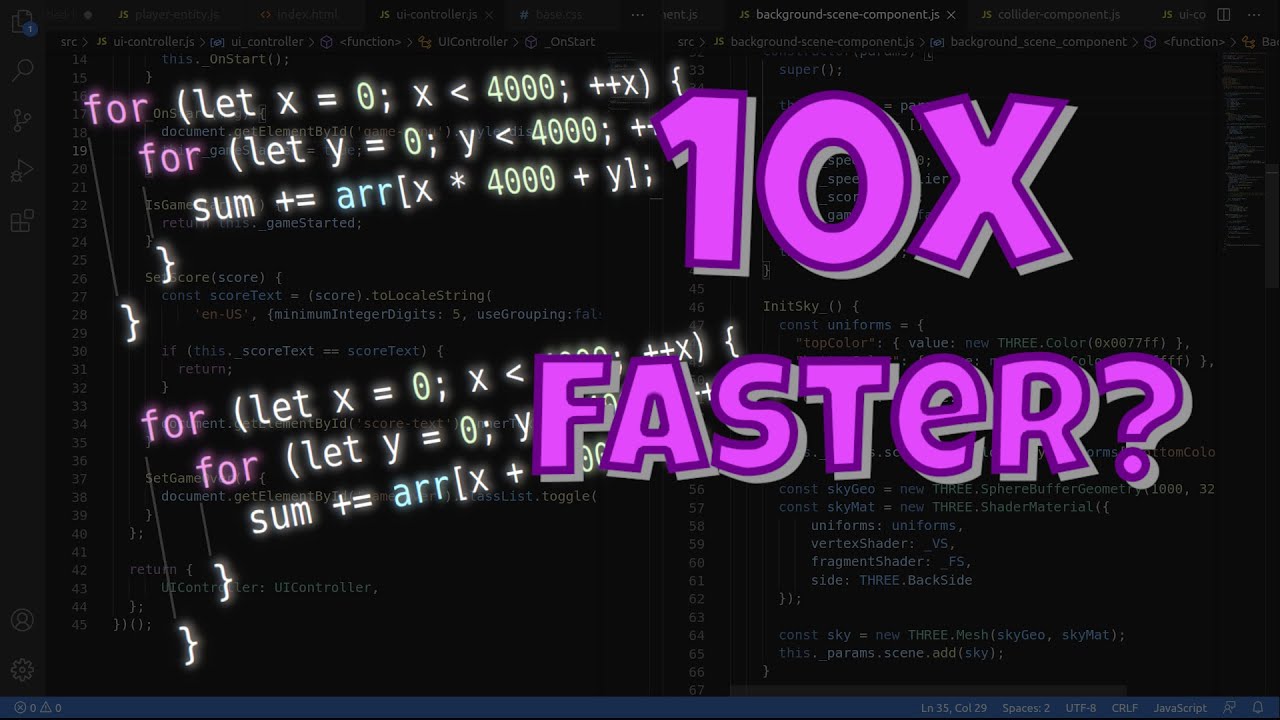
Why is the first loop 10x faster than the second, despite doing the exact same work?
Follow me on:
Twitter: https://twitter.com/iced_coffee_dev
Github: https://github.com/simondevyoutube/
In this video we talk a bit about memory, the cpu caches (specifically the L1/L2/L3 cache), hardware prefetching, and how all this comes together for arrays....
 rose veldt
sacred trellis
Well after reviewing your PR. I think I would suggest a few things:
- The choic...
rose veldt
sacred trellis
Well after reviewing your PR. I think I would suggest a few things:
- The choic...
i would like to point out that a VecDeque is continuous in so much as the allocation is as one, so all elements will be local, the only issue would be with a VecDeque that has been grown very large and then most of its elements removed and it happens to cross the max allocation and wraps
rose veldt
sacred trellis
Well if you read the last paragraph on the `vecdequeue` docs in the std library ...
iterators are very rarely faster than the equivalent loop, and sometimes they are worst, This is very usecase dependent
sacred trellis
rose veldt
i would like to point out that a VecDeque is continuous in so much as the alloca...
Well I read this in the std library docs that's why I made the suggestion 😅 :
Since VecDeque is a ring buffer, its elements are not necessarily contiguous in memory. If you want to access the elements as a single slice, such as for efficient sorting, you can use make_contiguous. It rotates the VecDeque so that its elements do not wrap, and returns a mutable slice to the now-contiguous element sequence.
rose veldt
sacred trellis
Well I read this in the std library docs that's why I made the suggestion 😅 :
...
yes, this is true but for cache misses it would hardly ever come into play, this is mostly a note about "If you want to access the elements as a single slice"
 halcyon portal
Ye, a vecdeque at worst means you cache two memory regions that add up to the same size as a single contiguous one
That's not a big deal
Caches dislike your data being scattered in memory. A VecDeque is a bit more scattered than a Vec, but by a tiny margin
rose veldt
its not like a linked list that has potentially one page per element
sacred trellis
rose veldt
its not like a linked list that has potentially one page per element
Ok I see cool, there is always something new to learn. I think we should have a talk on this actually like data structures like we have many cpp but none in rust. Like it is a big gap I feel. What do you think? 🙂
rose veldt
sacred trellis
Ok I see cool, there is always something new to learn. I think we should have a ...
thats side tracking this thread
sacred trellis
rose veldt
thats side tracking this thread
Oh yes sorry for that I should have messaged it somewhere else 😅
iron cairn
sacred trellis
Well after reviewing your PR. I think I would suggest a few things:
- The choic...
why are you randomly suggesting clippy lints? rather odd clippy lints too?
you have these clippy lints, yet you use Box<dyn Error>
thick mountain
iron cairn
you have these clippy lints, yet you use Box<dyn Error>
My Box<dyn Error> returns seem kind of odd to me. Is the standard that you define a set of errors that can be returned in the lib?
iron cairn
yes.
thick mountain
k im gonna have to sit down and do that
iron cairn
look into thiserror
short cove
if youre a library and dont have that many different errors you probably just want to implement your own error types by hand without any other library
iron cairn
possiblu
but you can inline the thiserror macro anyways
and sometimes you have a lot of error types
short cove
https://sabrinajewson.org/blog/errors i can recommend this blog post as well
Sabrina Jewson
thick mountain
i think there maybe 10 low level errors that just get passed up to other error returns so prob can hand roll it
thick mountain
halcyon portal
That's not a big deal
so is the consensus that VecDeqeue is the correct choice here? The impl i have is about ~15% away in speed from a standard binary heap, and almost all of the overhead is futex syscalls so that data structure is thread safe
sacred trellis
iron cairn
why are you randomly suggesting clippy lints? rather odd clippy lints too?
Well just as a tip to help them with maintaining code easily. Also, some lints are not bad at all like there is clippy::perf lint for lints specific to performance and idioms one which I think gives suggestions that makes code more readable I feel. Also congnitive complexity one which suggests code changes that reduce mental strain while reading code. 🙂
iron cairn
clippy::perf is enabled by default though
i have problems with #![deny] in general, and #![forbid(panic)] is simply silly
sacred trellis
thick mountain
k im gonna have to sit down and do that
I would suggest error_stack if you want to provide errors with more verbosity and information. 🙂
sacred trellis
iron cairn
i have problems with #![deny] in general, and #![forbid(panic)] is simply silly
Like it depends on the use case like if you maintain an oss project you don't want to let others introduce panics in places. I hope you got the idea 🙂 . Also, I don't think we should discuss this here like this sounds offtopic so I would suggest having a seperate thread for this one. 🙂
iron cairn
just stop them from adding panics that are wrong?
iron cairn
its not like panics are invisible and you cant see them
does clippy::panic look at # Panics too
no its literally just panic!?
thick mountain
pardon my ignorance but what exactly is clippy?
rose veldt
iron cairn
does clippy::panic look at # Panics too
i don't think so, but also the lint for # Panics would never trigger if you followed clippy::panic
iron cairn
A collection of lints to catch common mistakes and improve your Rust code.
rose veldt
rose veldt
i don't think so, but also the lint for # Panics would never trigger if you foll...
its quite a dumb lint (as in it's analysis not its existence)
sacred trellis
thick mountain
pardon my ignorance but what exactly is clippy?
It is a linter for rust in simple terms. 😅
thick mountain
iron cairn
https://rust-lang.github.io/rust-clippy/master/index.html clippy
wow this covers a lot
sacred trellis
thick mountain
wow this covers a lot
That's why I suggested it. 😅
sacred trellis
iron cairn
error stack is not for libs
Well how? they don't mention anything about libs in their docs 😅
rose veldt
sacred trellis
Well how? they don't mention anything about libs in their docs 😅
thiserror or snafu are the big ones
though snafu leaks its involvement sometimes
sacred trellis
rose veldt
thiserror or snafu are the big ones
Well there are so many crates for this. I would again just leave it on the author to choose from. Like they are the one to make the best decision. 🙂
rose veldt
error_stack like crates use grouped error types ment for reporting to humans, not for programmatic response to them
most of the time a library should not assume it's errors will just be displayed
sacred trellis
iron cairn
its not like panics are invisible and you cant see them
Like I mean you could automate stuff with linters and github actions to disallow PRs with such stuff like productivity for the maintainers I feel. What do you think? 🙂