
#Can anyone tell me where this term in this expression came from?
1 messages · Page 1 of 1 (latest)
 strange gull
 vagrant radishBOT
<@&987246717831381062> please have a look, thanks.
vagrant radishBOT
vagrant radish
<@&987246717831381062> please have a look, thanks.
While you are waiting for getting help, here are some tips to improve your experience:
Code is much easier to read if posted with syntax highlighting and proper formatting.

If nobody is calling back, that usually means that your question was not well asked and hence nobody feels confident enough answering. Try to use your time to elaborate, provide details, context, more code, examples and maybe some screenshots. With enough info, someone knows the answer for sure.
Don't forget to close your thread using the command </help-thread close:1027500463647621170> when your question has been answered, thanks.
 gleaming phoenix
didnt u ask that already a few weeks back and i explained it?
i remember showing u the math step by step
strange gull
Yes I didn't understand it
gleaming phoenix
well, instead of literally asking the same again, why dont u provide the previous info u got, link to it, and explain in detail what remains unclear
strange gull
I get the left and right subtree part
gleaming phoenix
otherwise ur wasting everyones and ur own time by just getting the same explajnation again
there we gop
re read the explanation
and then come back with a more specific question please
i mean, i literally explained precisely this part
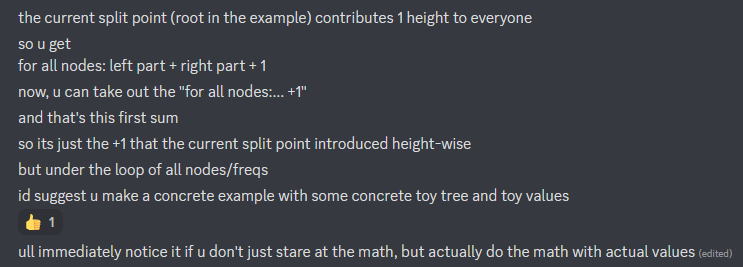
 vagrant radishBOT
Closed the thread due to inactivity.
If your question was not resolved yet, feel free to just post a message to reopen it, or create a new thread. But try to improve the quality of your question to make it easier to help you 👍
strange gull
gleaming phoenix
https://i.imgur.com/OABo1YL.png
How is the first sum equal to just 1?
gleaming phoenix
strange gull
How is the first sum equal to just 1?
it is not
if u do the math, as explained above, u will have 1 in each step and that sums up per frequency
u know, foo * (1 + x) is foo + foo*x
did u finally make the concrete example with real numbers and a real tree?
as i told u 4 times
strange gull
Okay will try to understand; I have not yet since I am trying to understand where the equation is coming from 🤔
gleaming phoenix
ull understand it once u do the example
strange gull
gleaming phoenix
ull understand it once u do the example
Will it be possible to show how to derive the expanded equation from initial equation algebraically? And commentary. I am not sure how to do the math 🤔
gleaming phoenix
i refuse to help u before u make a concrete example
thats the easiest way to learn this and for some odd reason u just dont want to do it
vagrant radishBOT
Closed the thread due to inactivity.
If your question was not resolved yet, feel free to just post a message to reopen it, or create a new thread. But try to improve the quality of your question to make it easier to help you 👍
strange gull
gleaming phoenix
i refuse to help u before u make a concrete example
I read the explanation again; I would like to ask why the cost of the root node is still the sum of the frequencies for all keys? In the first term it starts from i=1 up to n
Why is it not a constant multiplied by its frequency?
gleaming phoenix
i refuse to help u before u make a concrete example
thats the easiest way to learn this and for some odd reason u just dont want to do it
either do that or u have to wait for someone else to help
strange gull
I think I have found the answer here:
