
#How do we prove that an equation maps to Big o of something?
17 messages · Page 1 of 1 (latest)
 wet bronze
 light rootBOT
 grave sluice
wet bronze
Hello, can someone explain how do we prove that an equation is an element of big...
grave sluice
wet bronze
Hello, can someone explain how do we prove that an equation is an element of big...
weird, since the n term is linear its growth rate cant be quadratic unless im missing something
wet bronze
I'm confused because in the video the user rewrite the equation as:
2n + 3 <= 2n^2 + 3n^2
How did we obtain the 2n^2 + 3n^2 ?
grave sluice
wet bronze
I'm confused because in the video the user rewrite the equation as:
2n + 3 <= 2...
Oh
It just means 2n^2 + 3n^2 grows faster than 2n+3 for sufficiently large n
Which is like true
But 2n+3n also grows faster than 2n+3
wet bronze
https://www.youtube.com/watch?v=0asZleBjer0
This is the video I'm watching
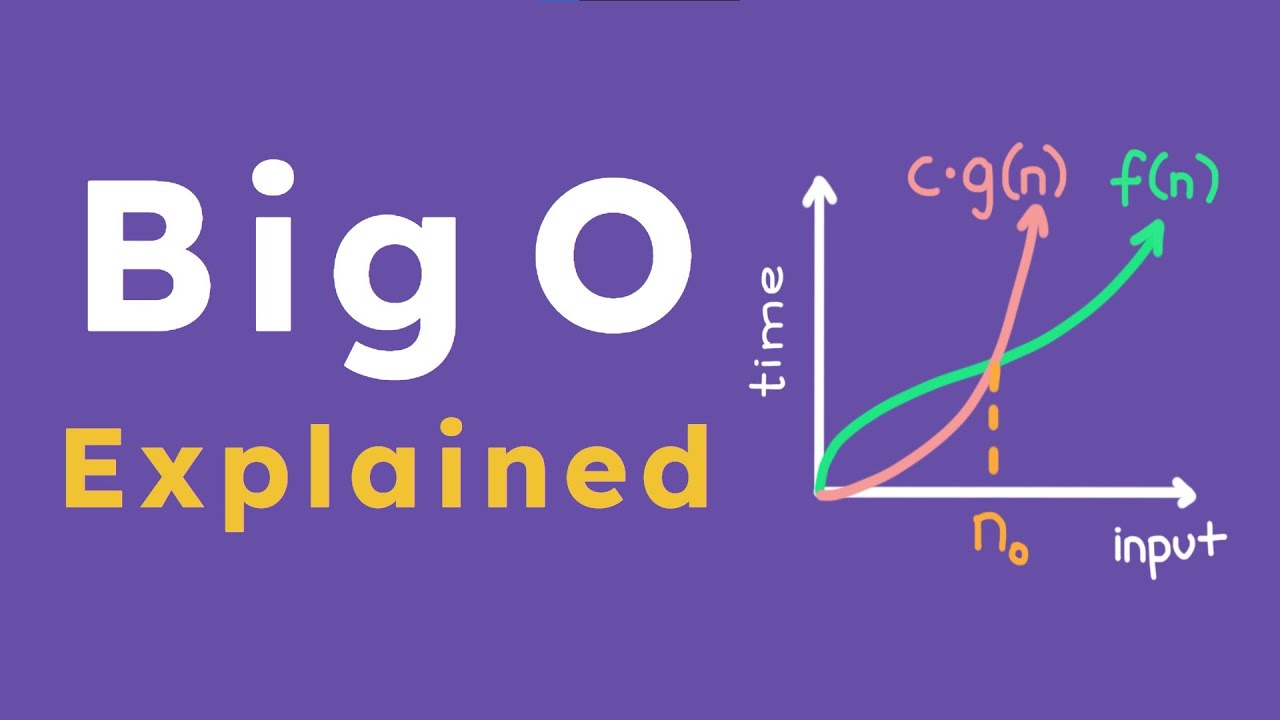
In this video, I will show you how to prove or disprove Big O. I will also go over the formal definition of the formula Big O. For example, you are asked to prove that a function 2n+3 is O(n). By the definition of big O, f(n) is O(g(n)) if you can find a positive constant c and a positive integer nₒ such that f(n) is less than or equal to c ti...
I'm confused when the user start explaining with the examples, like I don't understand how we obtain these equations, there are no cues
grave sluice
wet bronze
https://www.youtube.com/watch?v=0asZleBjer0
This is the video I'm watching
g(n) is just chosen so that for large enough n it outgrows f(n)
Frfr
It like is kinda arbitrary