#What is harmonic mean, when do we use it?
30 messages · Page 1 of 1 (latest)
 cyan isle
 clever fjordBOT
 elfin maple
harmonic means are usually used to calculate means of ratios
like speed
the harmonic mean is obtained by doing the following:
- take the reciprocal of all of your values (basically, take all of your values to the power of -1).
- divide it by the number of elements there are (much like you would normally)
- take the reciprocal of the answer in step 2.
for example, the harmonic mean of 1, 4 and 4 is: \
$\left(\frac{1^{-1} + 4^{-1} + 4^{-1}}{3}\right)^{-1} = \frac{3}{\frac{1}{1} + \frac{1}{4} + \frac{1}{4}} = \frac{3}{1.5} = 2$
 balmy forge
i usually just remember it by "the reciprocal of the mean of the reciprocals"
 tame sparrowBOT
fox(x, y); ∂(fox)/∂x (Flower)
 elfin maple
balmy forge
i usually just remember it by "the reciprocal of the mean of the reciprocals"
elfin maple
balmy forge
i usually just remember it by "the reciprocal of the mean of the reciprocals"
that works too yeah
cyan isle
elfin maple
the harmonic mean is obtained by doing the following:
1. take **the reciprocal o...
yeah I see
what are its application? Like when do we know when to use harmonic mean vs arithmetic mean?
elfin maple
elfin maple
harmonic means are usually used to calculate means of **ratios**
^
average speed is a good example
https://en.wikipedia.org/wiki/Harmonic_mean#Examples
consider reading this
In mathematics, the harmonic mean is a kind of average, one of the Pythagorean means.
It is the most appropriate average for ratios and rates such as speeds, and is normally only used for positive arguments.
The harmonic mean is the reciprocal of the arithmetic mean of the reciprocals of the numbers, that is, the generalized f-mean with
...
yeah I see hmm but what is special with ratios, like average speed? :c
Like, say we have some counting numbers, 1, 2 and 3, their arithmetic mean would be (1+2+3)/3, right?
Now let's say we have 3 speeds, 4km/h, 5km/h and 6km/h.
Here also, their arithmetic mean can be (4+5+6)/3, no? (I think)
balmy forge
cyan isle
yeah I see hmm but what is special with ratios, like average speed? :c
Like, sa...
sure but thats not what some problems are asking for
elfin maple
that is their arithmetic mean, yes. but it's not representative of the actual mean speed travelled (sometimes)
balmy forge
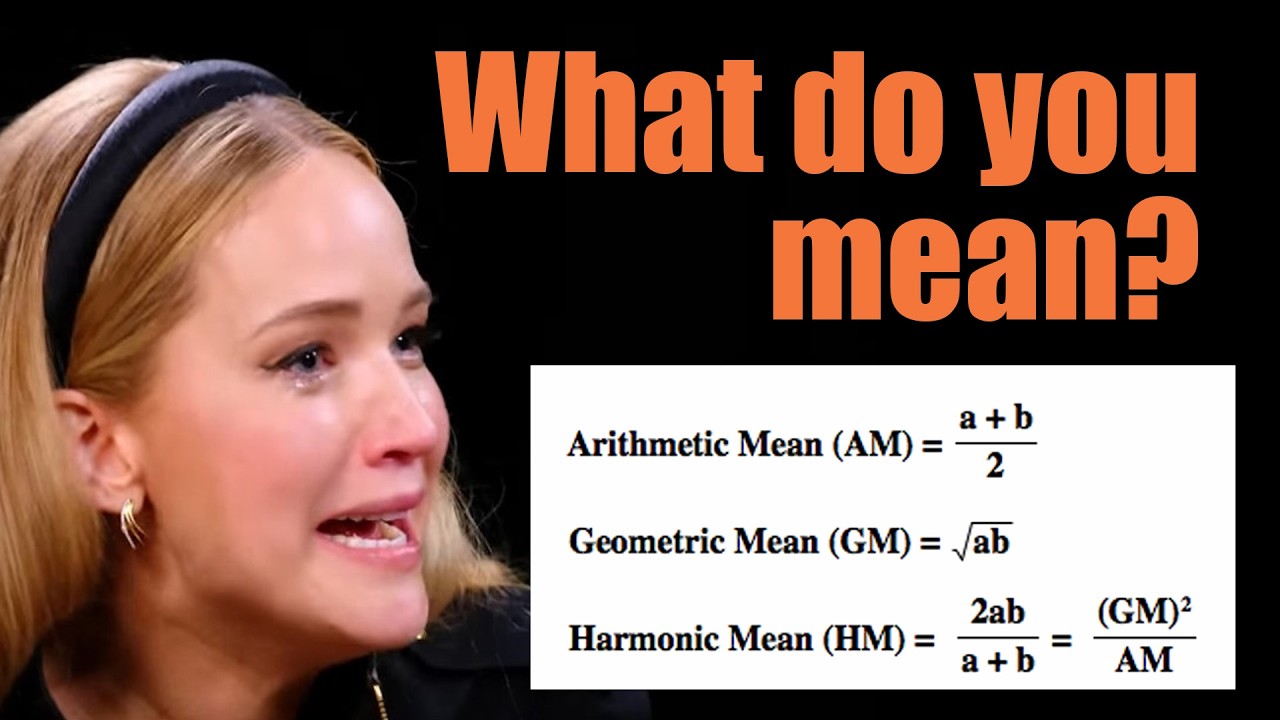
Did you know there is more than one way to calculate the mean? Mathematics has many means! Arithmetic mean, geometric mean, harmonic mean, least squares mean, and many many more. Why so many means? We tackle this question in this video to better understand why students too often misunderstand the meaning of a mean.
Math The World is dedicated t...
cyan isle
yep I see
Is there a way to know when reading a question whether we would need arithmetic mean, geometric mean or harmonic mean?
I know how they are calculated but like just having a glance at a question and say "oh ok maybe this is geometric mean..."
Maybe some keywords for geometric mean would be financial investments while for harmonic mean would be ratios?
 woven iron
In general, when the word mean is used, arithmetic mean is used, unless another mean is specified
In a problem for average speed--stealing an example from above--if a question is asked about average speed, they mean average speed over time, though, usually
Which is different from averaing the speeds, for which you'd take the arithmetic mean of the speeds
 tacit wren
Overkill on the word harmonic in geometry deleted. Suffice it to say the word has deep roots and a lot of connections. Ask me in DM if history of geometry is your thing
(I know I know)
 tired mural
tacit wren
Overkill on the word harmonic in geometry deleted. Suffice it to say the word ha...
tired mural
tacit wren
Overkill on the word harmonic in geometry deleted. Suffice it to say the word ha...
This is not going to be helpful at all for the OP
tired mural
Probably yes
tired mural
cyan isle
Is there a way to know when reading a question whether we would need arithmetic ...
When a problem says "mean", assume that it is referring to the arithmetic mean.
In the real world though, different measures of centrality are going to be useful for talking about different types of data. For example, let's say you're thinking about the average age of a friend group. Age usually varies additively (you might talk about your friends' ages as "two years above me" or "one year below me", but you would normally not think about your friends' ages in terms of "twice my age" or "half my age"), so an arithmetic mean makes sense here.
On the other hand, let's say you're trying to measure the "average" length of a river on the Earth. Some rivers are super short whereas others are orders and orders of magnitude bigger. In this setting, where you have data ranging over a lot of orders of magnitude (from tens of meters to thousands of kilometers), it might make more sense to calculate a geometric mean (or to consider other measures, like median or mode). If you calculated an arithmetic mean here, the contributions of the super long rivers would drown out any information.
So it all depends on what type of data you're collecting and what you want to measure about it.