#Guys help with integration pls😔
42 messages · Page 1 of 1 (latest)
 unborn kelp
 silk nicheBOT
 weary rampart
Hi! So, integration is basically the opposite of differentiation. If differentiation is:
“Given a curve, tell me its gradient/slope at any point,” then integration is:
“Given the gradient function, tell me what the original curve was.”
And integration helps us find:
-
Mainly areas under curves
-
Accumulated quantities (like distance from velocity)
For Alevels, there are two types of integrations.
The first is Indefinite integration, which is the process of finding the original function f(x) when you're only given its derivative f'(x)
It’s called “indefinite” because you’re not given any limits (like from
a to b). Instead, you get a general formula that includes a constant +c
why +c is because when we reverse the differentiate process (integrate), we don’t know what constant might have been there, so we just write +C.

The second is definite integration, which is basically finding the area under the curve between two x-values
normally, it looks like this, and means 'find the area between the curve f(x), the x-axis, and the vertical lines x=a and x=b' .

Still, we use the same rule as indefinite integrals here, but when calculating the final result we don't need to plus c. You can have a go by yourself, and will find that c cancels out
so, step1 is to integrate the function, step two plug in b and a separately and calculate the difference, ie f(b) - f(a)
A simple example would be

i.e, We want to find the area under the curve y=2x, from x=1 to x=3
weary rampart
weary rampart
why +c is because when we reverse the differentiate process (integrate), we don’...
we integrate using this formula, and we get x^2
and then we plug in 3 and 1 separately, calculating 3^2 - 1^2 = 8
and this is the final answer :)
These are basically the fundamentals, lemme know if you have any further questions :)
unborn kelp
Thank you so much Ari!!
So if I understand correctly, integration can be used to calculate probability? Or am I wrong
weary rampart
unborn kelp
So if I understand correctly, integration can be used to calculate probability? ...
mm yess you are correct!
we need to enter a PDF here which is probability density function
it's a curve, and the actual probability is the area under the curve
Because integration literally means “Add up all the tiny areas under a curve from point A to point B”
So if you want to know, let's say 'what’s the probability that a person is between 160cm and 170cm tall?'
you write sth like this

f(x) is the pdf
The integral gives the area under the curve
And that area = probability
unborn kelp
Thanks a lottt 🤍
weary rampart
you are welcome!! lemme know at any time if you need help with anything else🥺💗
silk nicheBOT
unborn kelp
Thanks a lottt 🤍
If you are done with this channel, please mark your problem as solved by typing .close
 steep shard
weary rampart
mm yess you are correct!
steep shard
weary rampart
mm yess you are correct!
Just a question,
let o = σ and u = μ
If the empirical rule is difficult to apply in some scenario… to find the probability of something, would you integrate this function between the designated bounds? Does this integral have an “easy” elementary solution? If you answered this already my apologies

 weary rampart
Hii, thank you for your question! I took a little time to think about it, and my idea is that youd still compute it in the same way, tho there is no way to integrate this function exactly using basic calculus. The antiderivative doesn't exist in terms of elementary functions, and I think we need other tools like erf or z tables, and this type of functions are most likely calculated by calculators :)
I haven't dived really deep into this field, so pls feel free to share if you find out any other solutions to the problem!!
 coarse cargo
weary rampart
we integrate using this formula, and we get x^2
coarse cargo
weary rampart
we integrate using this formula, and we get x^2
How does gradient relate to area tho?
steep shard
Differentiation finds out the instantaneous rate of change anywhere along a function
Integration reverses this process by finding the total accumulation along this function. In other words, it finds the net area. If you want a better, more in-depth explanation, try this video https://youtu.be/FnJqaIESC2s?si=Zvx8evie_eNnu3O3
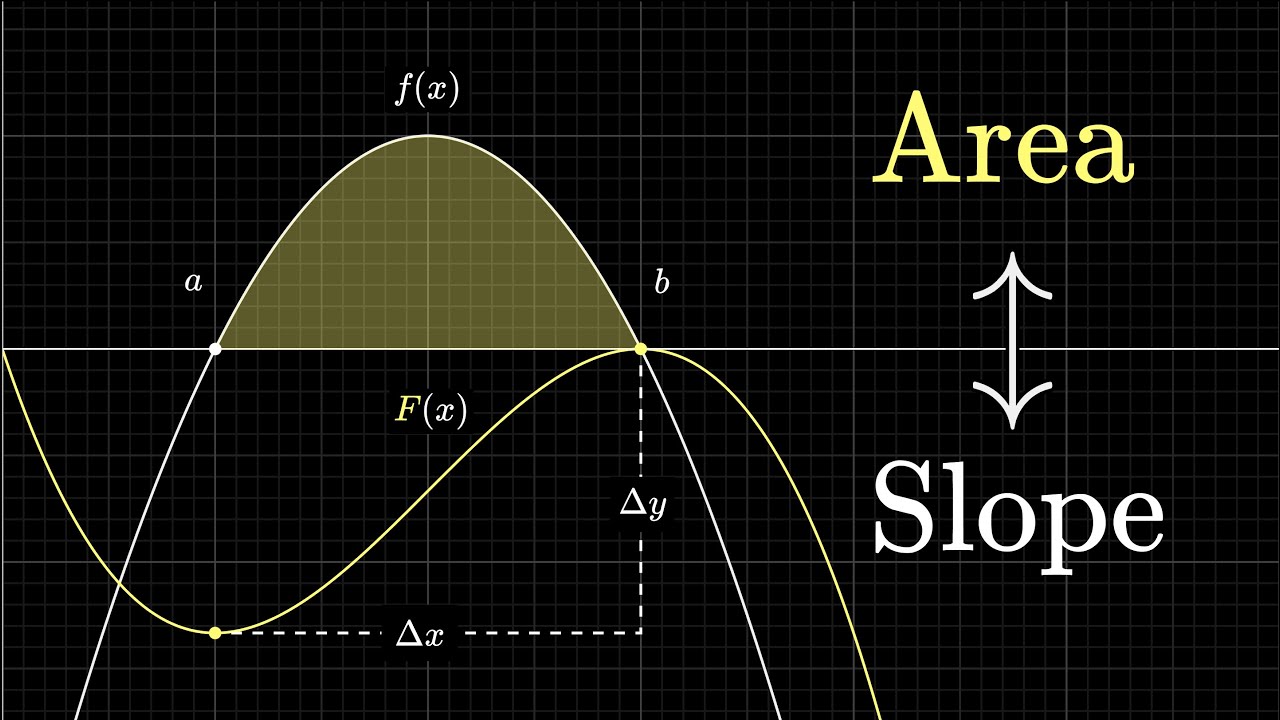
One view on why integrals and derivatives are inverses.
Help fund future projects: https://www.patreon.com/3blue1brown
An equally valuable form of support is to simply share some of the videos.
Special thanks to these supporters: http://3b1b.co/lessons/area-and-slope#thanks
Full series: http://3b1b.co/calculus
Thanks to these viewers for their...
@coarse cargo
coarse cargo
steep shard
Differentiation finds out the instantaneous rate of change anywhere along a func...
thanks ill check it out
 wraith basin
steep shard
Differentiation finds out the instantaneous rate of change anywhere along a func...
wraith basin
steep shard
Differentiation finds out the instantaneous rate of change anywhere along a func...
This one's a real great video and series ngl
 raven urchin
i found out this website recently, hope that can help
(https://tutorial.math.lamar.edu/Classes/CalcI/IntegralsIntro.aspx)
In this chapter we will give an introduction to definite and indefinite integrals. We will discuss the definition and properties of each type of integral as well as how to compute them including the Substitution Rule. We will give the Fundamental Theorem of Calculus showing the relationship between derivatives and integrals. We will also disc...