#Hey I'm tryna learn maths, please check the description it's not going to take a lot of your time

1 messages · Page 1 of 1 (latest)

vale stone
#

" Name a topic each or a few at a time here and just mind your business go somewhere else if u wish. then I do my research on that and type it in here with explaining how or why and logics with the concept.
you aren't responsible for focusing on what I replied. but whenever you come here to dump your concepts per day or so, you can choose to reply on my replies to someone else and say if I'm correct or wrong or question something.
Like that no one will lose their valuable time in tutoring me. and I would still be able to do things in the way I asked "

and by what topics or concepts u name here, it isn't limited to high school. the bigger picture just should contain all of high school maths, but we could go overboard too

and please don't type paras, just a few or one topic each for a day.
My goal is to complete all of high school maths before may 31st

#

hello

#

I am open to answering questions on why I need this

#

but anyways

#

to anyone who's here reading this and to everyone who's not

#

I wish you a merry life:)

hardy nest
#

Well what do you already know

vale stone
#

little

carmine beacon
#

do you at least know algebra 1

vale stone
#

well

#

yes

#

but what I know doesn't matter

hardy nest
#

I would say linear equations 😭😭😭😭

carmine beacon
#

I mean it kinda does but ok

vale stone
#

it does but

#

not based on the topics you give

#

it would be better if they're in high school year 1 to 4 but it's fine if it's any topic really

#

I'd love to go deep.

#

and u don't even have to put a lot of work

carmine beacon
vale stone
#

yep

carmine beacon
#

so start doing algebra 1, geometry, algebra 2, then precalc

vale stone
#

I will read all that requires in me learning yor concept

#

but

carmine beacon
#

and make sure you understand the concepts

vale stone
#

I can't just read books in order I can but it isn't what I feel like to do

hardy nest
#

On a scale of 1 to 10 how proficient are you with lines

carmine beacon
#

tbh for hs math there's no order (except for precalc which you want to do last)

#

so just start with geometry or algebra 2

vale stone
carmine beacon
#

I can find a decent textbook for you

vale stone
#

no I don't want textbooks

#

you just name topics

#

and I study all that requires to go in depth

#

even if it requires a textbook

carmine beacon
#

ok I'm confused

vale stone
#

what I wanna do is "I" Going into it myself

carmine beacon
#

why are you doing this

#

do you want to get really deep into mathematics

vale stone
#

yes

carmine beacon
#

do you wanna learn it for like school

carmine beacon
vale stone
#

no

#

well physics but

#

physics requires math

#

and both require deep thinking

#

so I like them both in a way

carmine beacon
#

ok so your final, overall goal is to excel in physics?

vale stone
#

uh

#

yeah

#

but while I'm on discord it's gonna be maths

#

alright please stop focusing on the clutter

carmine beacon
#

alright this is def gonna require textbooks

#

search online for an algebra 1 textbook

#

and work through it

#

repeat this for geometry and algebra 2

#

and precalc

vale stone
carmine beacon
#

for calculus

vale stone
#

alright thanks for the resources

carmine beacon
#

u

#

use khan academy as practice

#

and for precalc

hardy nest
# vale stone probably a 2 or a 3

Well then maybe the first topic I recommend is linear spaces. So essentially all of the following

• linear equations (y = mx + b)
• linear functions & properties
• system of simultaneous equations
• basic intro: vectors & matrices
• "linearity"; the general concept
• linear transformations
• vector spaces

You don’t have to dive deep into the last one, but this would give you an exceptional knowledge on "lines” and their properties. Vectors are important for physics

carmine beacon
#

if you're looking for the traditional method of learning math I'd recommend my way

#

but if you want a more abstract method

#

you should go with @hardy nest 's method

vale stone
vale stone
#

I will reply to you after I understand those and when I can defend those

carmine beacon
#

best of luck in your mathematical endeavors

vale stone
#

thanks

hardy nest
vale stone
#

ah I see alright

#

thanks

#

I was looking for something like this

#

where u give a concept for me to research.

cunning quail
#

I would suggest the topic of algebraic understanding of power of point like a function on the plane

fallow quarry
#

Give these a try:

  • Cartesian Products
  • Set Theory Math Symbols
  • Derivation of e
  • The Fundamental Theorem of Arithmetic
  • Decimal Binary Conversion
hardy nest
#

@vale stone btw hows it gong

heavy furnace
#

so

#

here's what I found out till now

#

after watching like 20 minutes of videos

#

so

#

a linear equation

#

ax + by

#

= c

#

where a b and c are constants

#

they'd make a line in a graph!

#

okay

#

now

#

if I have another equation

#

a2 x + b2 y

#

= c2

#

where a2 and b2 and c2 are constants as well

#

I have another line in a graph!

#

so

#

the thing where you want a solution

#

mainly comes based on intersecting points

#

for example

#

you got a line stretching from y axis 7 to x axis 8

#

that's the first equation

#

or thingy

#

and u have another line of the equation

#

which extends from 0 to somewhere

#

if they intersect

#

at ONE point

#

then

#

that's what is called

#

a UNIQUE solution!

#

BUT

#

if they are lines which are on TOP of each other in the graph

#

then they have infinite solutions, because u can just add or multiply each thingy thingy

#

that's called a

#

infinite solution?

#

anyways

#

so these 2 are where you actually get solutions of inter sections

#

BUT

#

what if

#

The lines are parralel

#

then you get something called

#

no solution-

#

that means there's no solution at all

#

it doesn't mean anything

#

so mathematically tho u dont have to draw graphs all the time to DETERMINE if theyd give solutions and which type or not.

#

there's a simple thing like a trick or something like a law.

#

what it means is

#

If a1 by a2 is not equal to b1 by b2

#

then it only has one solution

#

and it intersects

#

what they really mean here is

hardy nest
#

@heavy furnace are u usap on a different account

heavy furnace
#

the a part in the first line

heavy furnace
heavy furnace
#

if it's not equal to b part (b1 times y in the first line and b2 times y in second line) aka b1/b2

#

them you'd only get one solution

#

because logically you cannot change the variables to get many answers

#

so only one

#

alright moving on

#

to know if you'd get infinite solutions

#

you have to check if a1/a2 = b1/b2 BUT also = c1/c2 (the answer in the first line divided by the answer in second line)

#

if that's true and they all equal

#

then you have infinite solutions

#

why?

#

because you can change things and add or multiply and they'd differ in constant answers but remain the same pretty much

#

uh that's not grammatically correct but somewhat like it

#

but

#

how do u know if u dont have a solution?

#

you check if a1/a2 = b1/b2 BUT is not equal to c1/c2

#

because

#

logically

#

if the thingies that multiply x in the first line and the second line are divided aka a1/a2, and they EQUAL to the thingies that multiply y in the second line aka b1/ b2

#

are NOT equal to the thingies that answer the whole thing divided as c1/c2

#

then there's no sense

#

because x and y are same in both lines

#

so if a's and b's are samely proportional or equal in fractions

#

the c's should be too

#

but if they're NOT

#

you won't get a solution

#

this is what I learnt in the 20 minutes of YouTube videos

#

I also learnt that

#

you have to convert the right answer to a constant or something

#

for example

#

2x + 3y +2 = 0

#

and 4x + 6y -4 = 0

#

you can't do it before logicalizing it

#

so

#

take the +2 and -4 and take it to the right side

#

and you'd get

#

2x + 3y = -2

#

and 4x - 6y = 4

#

now 2/4 = 3/6 but is NOT equal to -2/4

#

so you have a parrelel line formation that doesn't inter sect to give a solution

#

and boom you're gone

#

there's also many more things of this chapter

#

that are covered by a 2 hour video

#

and I learnt this in the first 20 minutes of it

#

also

#

I think I can learn by these one shot completion videos of chapters on YouTube. upto an extent

#

they seem pretty human and easy to me.

hardy nest
# heavy furnace mainly comes based on intersecting points

Yes essentially, a linear equation is any equation that can be written in the form

y = mx + b
or a(x) + b(y) = c, where a, b and c are coefficients

If two lines have the same rate of change, or slope, they would never intersect, meaning they are parallel. The only time they would intersect if they are the exact same line

However if they have different slopes, they will always intersect somewhere

Unique solution → a solution is unique if it satisfies a given problem

Infinite solutions (dependent) → lines are dependent if they are the same line everywhere - if one if a scalar multiple of another. More specifically something is considered dependent if it can be written as a linear combination of something else but you'd learn this more when you learn vectors
y = 2x + 6
2y = 4x + 12
These are the same lines, and they intersect everywhere so when trying to find the intersection points you'll find out they are the same lines

Inconsistent → not just for lines, but if a system of equations is inconsistent it means there are no solutions

Parallel lines are two different lines with the same slope, they never intersect
Perpendicular lines are two lines that intersect at exactly a 90° angle. Two lines are perpendicular if their slope are negative reciprocals
y = 2x
⇒ y = -(1/2)x
These two lines are perpendicular

#

My explanation could definitely be more rigorous but that’s the general concept at least

heavy furnace
#

wdym by y = mx + b

#

I can just say 2 = 0.5 times 1 + 1.5

#

would that be a linear equation?

#

doesn't linear mean the power of it is 1 ?

hardy nest
# heavy furnace wdym by y = mx + b

y = mx + b
⇒ m is the slope
⇒ b is the y-intercept, it's where x = 0 on the graph, it is literally where the line touches the y-axis

y and x are variables, inputting an x gives you a 'y', assuming you know what 'm' and 'b' are

hardy nest
hardy nest
heavy furnace
#

ah I see

hardy nest
# heavy furnace What exactly is the slope?

The slope of a linear function is the steepness of the line, or the rate of change. Suppose you know two points on the line (x1, y1) and (x2, y2), you can find the slope, m, by finding the change in y over the change in x. The "change in" something is notated with the delta (Δ) symbol,
m = (Δy)/(Δx)
⇒ m = (y2 - y1) ÷ (x2 - x1)

#

A function with a slope of 'm' has a rate of change of m y-units per 1 x-unit. It moves vertically 'm' units and horizontally 1 unit

heavy furnace
#

what is the slope over here

#

I can't exactly understand how to get the change of y or x

#

I know what it means

#

but what exactly is it

hardy nest
#

Notice how when y = 2, x = 1. The slope is 2 because for 1 change in the x-value, there is a change of 2 in the y-value

y = mx + b
y = 2x + 0
⇒ intersects the y-axis when x = 0
y = 2x

The slope here is 2

heavy furnace
#

so lowkey like proportions

#

if it's a 5 on the x axis and 15 on the y axis

#

then it's a 3 slope

#

because for every chunk of x, there's 3 chunks of y

#

ah I see

#

I see

#

wait

#

doesn't that mean the highest integer in x,y is the slope

#

?!?

#

oh no

#

similar but no nvm

hardy nest
# heavy furnace I can't exactly understand how to get the change of y or x

Consider you know two points on a line, (1, 2) and (2, 4) and the function intersects the y-axis when x = 6. To find the slope, we subtract the change in y over the change in x

Δy = (4 - 2) = 2
Δx = (2 - 1) = 1
m = Δy/Δx = 2/1 = 2
The slope is 2, but what about the y-intercept? If the graph intercepts the y-axis when x = 6, the y-intercept (b) is simply 6.

y = mx + b

y = 2x + 6
↑ also because, when x = 0, you get y = 6 as a result, and this is exactly what the problem said

#

The change in something is simply the difference between its constituent values, it doesn’t matter what way you subtract/find the difference, because eventually you will end up with the right slope

#

It’s just recommended to do

higher - lower

So you can avoid negatives

heavy furnace
# hardy nest Consider you know two points on a line, (1, 2) and (2, 4) and the function inter...

so, I have to points one here. and one. . here
the first point is 1 of x axis and 2 of y axis, and the second is 2 of x axis and 4 of y axis.
when x = 6 , the line intersects y axis, so it takes a turn somewhere. to find the turn, we subtracy the change in y over the change in x. how
you mean the difference in the first points' y axis and the second points' y axis to the vice versa for x axis?

so bigger to smaller aka.
2-1 for x and 4-2 for y.
so I get 1 and 2
and the m aka the change of slope rate is the change in y over the change in x basically triangly y divided by triangly x

#

and the triangly y is 2 because 4-2 bigger to smaller of the 2 points

#

and triangly x is 1

heavy furnace
# hardy nest

okay but what if I don't have two points, like here?

#

I just do y/x or x/y and that's the slope?

#

but hows that the slope I don't know for sure if the lines bending or turning somewhere

hardy nest
heavy furnace
#

okay how do I know for sure it isn't a straight line

hardy nest
#

If the line “bends” or somehow curves it’s not a line

hardy nest
heavy furnace
#

I see

hardy nest
#

For example
y = 2 + x^2
y = x^3 - 2x^2 - 3x
These aren’t straight lines anymore, so the concept of “slope” is a bit more abstract

#

Slope is specified towards straight lines that change at a constant rate

heavy furnace
#

wait

#

uh

heavy furnace
#

so something that takes turns sharply or changes sharply without bending

#

precisely* not sharply

hardy nest
#

Algebraically though, to determine if something is a “line” you simply look at the exponent. If you see any exponent higher than 1 it’s not a line

heavy furnace
#

why is that

#

for example if I have an equation x square + y square is a point

#

it can be 3 square and 2 square giving 9 and 4

#

right?

#

why's it not gonna be a line

hardy nest
#

If you see an exponent that is 0 or 1, it is a line, but equations with an exponent of 0 are horizontal lines meaning they have don’t change
If the exponent is 1, it’s still a line except it’s a diagonal line and it does change according to its slope

hardy nest
#

We call this "highest exponent" as the degree

heavy furnace
#

what's the basic logic of it tho, aren't equations to take points and draw lines between them? how do you curve something between 2 points there?

hardy nest
#

The degree of a (non constant) linear function is 1

heavy furnace
#

hmm

#

so

#

a constant linear function can be any degree

#

like 3 square, etc..

#

but the x and y parts

#

should be just 1

#

but why?

#

you're anyways gonna multiply those constants to variables

#

hmmmmm

#

uhm

#

I think

#

I'm cooked somewhere

hardy nest
# heavy furnace why's it not gonna be a line

Oh this is a line, because

  1. There is no variable, which implies the degree is 0. Polynomial functions with a degree of 0 or 1 are lins

y = 3^2
⇒ y = 9
This simply creates a horizontal line at y = 9 that does not change

heavy furnace
#

wait

#

uh

#

ax + by = c

#

where do I put these in graphs

#

the ax part as x axis and by part as y axis? right?

hardy nest
# heavy furnace you're anyways gonna multiply those constants to variables

With a function, the general format of it is
x → f(x) → y
For every x you input into the function f(x), you get a y. If the highest degree is 0 or 1, the y's will change linearly, they are just scaled by any other coefficients or shifts

y = 2x + 2
This is a linear function, because consider the chart…
y(0) = 2(0) + 2 = 2
y(1) = 2(1) + 2 = 4
y(2) = 2(2) + 2 = 6
y(3) = 2(3) + 2 = 8
y(4) = 2(4) + 2 = 10
For every x you input, it returns a y that is 2 times the value of the x plus 2. We inputted x = 3 and got y = 8….
8 = 2(3) + 2
↑ two times three plus two

The fact that there are other factors that change the relationship between x and y does not change the fact that it is a linear relationship

heavy furnace
#

I see

#

I see

#

I see

hardy nest
# heavy furnace the ax part as x axis and by part as y axis? right?

ax + by = c
Typically, it would be best to isolate y before you try to graph it, this means get y alone and by doing this, you see exactly what y equals,

2x - 3y = 2
-3y = 2 - 2x
y = (2 - 2x) ÷ -3
y = -(2/3) + (2/3)x

This means for every x we input, we will get a value (y) such that y is (2/3) times x plus a negative -2/3

heavy furnace
# hardy nest With a function, the general format of it is x → f(x) → y For every x you input ...

f of x gets a y, and f of x is 2 x + 2 then y is 2 x +2 . it starts at y(0) = 2(0) +3 = 2 . For every x you input it returns a y that is 2 times x plus 2 .

OHHH so it doesn't really change and it stays same so u can input any x u want so if I say x axis has a 3 . then you get a y axis of 8 because f of x is 2x +2 which gives y.

and if u get 3 chunks right side and 8 chunks up side. that's a function. so is a function just a point? and when does the non linearity come. Can u give example of that?

#

wait

#

I think I got it

#

can I keep f (x) = y where y = 2x -3y = 2?

#

wait but

#

huh

#

never mind I didn't get it

#

ok wait

#

let me read what u said above

#

properly

#

it's 4 am I'm just a bit clumsy rn

hardy nest
hardy nest
hardy nest
#

It might seem confusing right now because you’re missing some key topics

#

The first one is a function because for every x, there is exactly one y.

The second one is not a function because both 'b' is mapped to '2' and '3' indicating that for every x, there is not exactly one y (where b is the x)

heavy furnace
#

I see

#

which type of equation would give 2 answers tho

#

OHH

#

if the degree is 2 or more

#

u can write -2 times -2 too

#

OMG I UNDERSTAND IT NOW

#

so it must be linear to be considered a function

#

ah I see

hardy nest
#

Wait wait wait

#

No 😭

heavy furnace
#

huh

#

no?

#

so it can be illeniar?

#

but how? If it's 2 or more degrees u get multiple answers

#

or how do u actually get the 2 and 3 too

hardy nest
#

It does not necessarily have to be linear, but every for x that you input, it must map to ONLY one output. Let’s say this analogy

Consider a toy machine where you input a toy and it gives you another random toy. Let’s say you input a red toy and get a green toy, this is fine. But let’s say you input a blue toy and also get a green toy. This is not a function because both the red toy and blue toy correspond to the same toy (green toy).

heavy furnace
#

I see

#

but a question

#

if y is x square

#

then there are multiple answers no?

#

wait

#

ok yea yes

#

but then how can

#

illeniar things be included?

hardy nest
#

x^2 + y^2 = 2

This is an example of an equation, but it is not a function, because try isolating one of the variables.

y^2 = 2 - x^2
y = ±sqrt(2 - x^2)

where sqrt() is the square root function, √

This is not a function because when you input an x, you get two outputs (a positive y and a negative y)

P.S, x^2 + y^2 = 2 is the equation of a circle.

heavy furnace
#

okay

#

I think

#

I'm getting the gist of it

#

a bit a bit

#

whenever I see an equation it must contain x and y and both after the plus sign and must have a constant = answer.

hardy nest
#

Notice that for any x you go to in this graph of a circle, you get two y's

#

y = 0.7 and y = -0.7

#

(Approximately)

#

For when x = 1.2

hardy nest
heavy furnace
#

yeah

#

-4 times -4 is same as 4 times 4

#

so why is it being a function?

#

oh

#

I think

#

I get it a bit more

#

the answer is the same

#

but like the circle picture it has a different y factor

#

the answer always leads to 16

#

which doesn't differ

hardy nest
#

This is a function. It’s a very popular type of function that you explore in high school math after linear functions, called a quadratic function — a polynomial of degree two.

This is a function because for any x you input, you get exactly one y. Consider x = 2

y = (2)^2
y = 4

When you input x = 2, you will always get y = 4. But what about x = -2? You also get 4,

y = (-2)^2
y = 4

But this does not break the rule of the function. x = 2 and x = -2 produce the same output, but they are not the same input.

I just realized a flaw with my toy analogy. Let’s say you input a green toy in the machine and get a red toy, let’s say later you try to input the green toy in the machine again and get a blue toy. The green toy corresponds to both red and blue? It corresponds to two different toys, which means one input (green toy) corresponds to more than one output (red toy and blue toy), this toy machine is not a function.

heavy furnace
#

ah I see

hardy nest
#

If something isn’t a function, it means that when you input a singular x-value, you get more than one corresponding y values. Although, different x-values can correspond to the same y-value.. an example is this constant linear function

y = 5

This is secretly the same as

y = 5x^0

Where the degree is 1, because anything raised to the zeroth power is 1. If you input x = 2, you get 5, if you input x = 7, you also get 5. It does not matter what value of x you input, you will always get 2. The key thing here, is that, a singular x-value does not correspond to more than one y-value. It always corresponds to y = 5

heavy furnace
#

Hmmm

#

I see

#

I see

#

so

#

you mainly focus on the x value

#

that's why you give it priority during the equations too

#

and the question giver gives what f(x) = y is, so they can give y = 2x +2 or anything

#

so once I get x

#

I check that

#

they don't give more than one y value

#

alright

#

but

#

hmm

#

but

#

a function is a point then?

#

it's just a point... right?

#

a special type of point that isn't on the lines

#

you get a line only when u have 2 functions?

#

or do u get one with just one?

hardy nest
# heavy furnace a function is a point then?

A function is a relationship between inputs and outputs

But on a graph, a function is a shape because of the behavior between x and y as you input different x values that corresponds to different y values. it draws a shape and connects it.

heavy furnace
#

yea but

#

but

#

if u take x as 3

#

you'd only get a point

#

on the paper

#

which is a x input's y output

hardy nest
#

It just tells you what is y when x = 3, so I guess you can think of a function as a connection of points

heavy furnace
#

so

#

u can change x

#

and get many points that are

#

sequancially similar

#

and then draw a line between them

#

And then calculate the slope

#

right?

#

but what do u do after that?

hardy nest
#

You can input an x into some linear function then get a y, you can do this with a few points and notice the general shape when you connect the points. According to intuition, you would fill the rest of the graph which a straight line (for linear functions)

heavy furnace
#

I see

#

if the function is linewr

#

it is a straight line

#

BECAUSE

#

it gives the same type Ofvalues

#

but if it's illeniar

#

it can change

#

only then the slope comes in

hardy nest
#

As you graph more and more, the shape of functions would be very intuitive to you; for example you would already know the general shape for functions like these

y = 3x - 2
y = 6x^2 - 12x
y = 4sin(x) - 3
y = 5(2^x)
y = 2log(x + 2)

etc….

As you progress more through the study of functions in high school, you can easily visualize the function on a graph as you graph and understand functions more

hardy nest
#

?

heavy furnace
#

I may wanna say you

#

I don't know what sin or log is

#

haven't touched trigonometry yet

#

but

hardy nest
# heavy furnace if the function is linewr

Well a function is linear because it has a constant rate of change. As x changes, y changes at a constant rate — that is the slope, even if there is a vertical shift or stretch of the function because of the coefficients and other values

hardy nest
#

Log isn’t trigonometry

#

Do you know what an exponent is? Exponential function?

heavy furnace
#

yes

#

exponent I know but

#

I'm not really well affirmed with it

#

For example

hardy nest
#

You don’t have to know everything about exponential functions but

#

“Log” is the inverse of the exponential functions. The full word is the logarithmic function

heavy furnace
#

yea

#

I tried it

#

in calculation

#

it gives a small integer and a really complicated decimal

#

I think it's making big numbers small

hardy nest
#

It’s the function that undoes the exponent

2^x = 8
To solve for x, you would log both sides
log(2^x) = log(8)
x • log(2) = log(8)
x = log(2^3) ÷ log(2)
x = 3log(2)/log(2)
the log's cancel
x = 3

heavy furnace
#

by taking it in between of integers

hardy nest
#

Using the properties of the logarithm

#

I don’t wanna make this confusing for you tho sorry

heavy furnace
#

No no

#

it's not confusing at all

#

it's very fun actually

hardy nest
#

sin(x) isn't as scary as you think but it is different than the functions you are typically used to

#

The sine function is a periodic function so it repeats after a certain interval

heavy furnace
#

I see

hardy nest
#

The shape of it is like this

heavy furnace
#

oh

#

log (2) / (log(2)

#

cancel

#

okay

heavy furnace
#

think I've seen it somewhere in a video

#

cool shape

#

that's sin but

#

I thought sin was for triangles

hardy nest
#

log(8) = log(2^3)

According to logarithmic rules, there is a rule that states

log(a^b) = b • log(a)

When raising something in the logarithm by a power, you can "factor" the power out of the logarithm

hardy nest
heavy furnace
#

I see

hardy nest
#

It is for triangles but it’s more connected to circles

#

You learn it when you’re in algebra 2

heavy furnace
#

uh people keep saying me about, algbera 2 , calculus 1 , calculus 4 etc..

#

are these uh

#

levels of it or something?

hardy nest
#

Well it depends on where you are in the world

heavy furnace
#

I see

hardy nest
#

In the US, there are courses such as "Algebra 1", "Geometry", "Algebra 2" and "Precalculus"

#

Algebra 2 is typically taken as a 10th grader

heavy furnace
#

ah I see

#

around 15

hardy nest
#

Yes

heavy furnace
#

same here too

hardy nest
#

But I see your point

heavy furnace
#

hmm

hardy nest
#

But for linear functions and stuff do you have questions, it could be related or unrelated

heavy furnace
#

do u know

#

when I could calculate the rpm of my fan or the weight in tons of my home's cement / concrete?

#

or the durability

hardy nest
#

Rpm ? Rate per minute

#

?

heavy furnace
#

no rotations per minute

#

if I turn on a fan

hardy nest
#

Oh

heavy furnace
#

is that included in this somewhere?

hardy nest
#

The rotations per minute, I’d have to look into that

#

But the weight in tons of your homes cement, yes that’s in the domain of calculus

heavy furnace
#

I see

hardy nest
#

Calculus deals with rates of changes and accumulations (area, volume, etc). It allows us to find the area or volume of irregular regions, and calculus is actually where those simple algebraic / geometric formulas for the area or volume of shapes come from

heavy furnace
# heavy furnace I see

SO I'D BE ABLE TO take a paper, and a pen, and write how much years a shop will last or the weight of it in tons and then impress the shopkeeper to get me a free bag of chips?

hardy nest
#

It generalizes the concept of "slope" to nonlinear functions

hardy nest
#

Such as y = x^2 or y = x^3 - 2x^2

heavy furnace
#

I have a question though

#

how do u

#

apply it to irl objects

#

I mean

#

how do u take the shape in graphs

#

from irl objects

hardy nest
hardy nest
heavy furnace
heavy furnace
#

I see

#

calculus seems fun

hardy nest
#

If you let the region R be a 3-dimensional irregular region in space, then to calculate the volume of it, you would need to attempt to model this shape as a function and consider the bounds you are finding the volume inbetween of

heavy furnace
#

I see

hardy nest
#

It doesn’t have to be a function, but an equation

heavy furnace
#

there's gonna be 3d graphs tooo omg this is gonna be soo fun, I feel like doctor Strange

heavy furnace
#

what are you doing right now?

#

in the sense which course or which calculus or what-

hardy nest
#

The lines and linear functions?

heavy furnace
#

uh nnno-?

#

I mean

#

what do u mean

#

lines and linear functions?

#

where

hardy nest
#

Like are you asking what class does this linear function stuff fall in?

#

What we did earlier

heavy furnace
#

oh yea sure

hardy nest
#

Alg 1, geometry, alg 2, calculus, etc?

heavy furnace
#

although I was asking what you are u doing-

#

like irl

hardy nest
#

Typing right now 😭

heavy furnace
#

I meant something like quantum mechanics phd Or uhmm- a COURSE

#

like

#

a studying course

hardy nest
# heavy furnace oh yea sure

Right now it’s in the scope of algebra 1, but that’s only because we’re just getting started. Matrices and vectors are typically first introduced in precalculus (after algebra 2, which is usually 11th or 12th grade). Everything above that like linear transformations and vector spaces are in a college level course called linear algebra, it's usually taken after calculus 1 and 2, and before calculus 3

Don’t be fooled by the name "linear algebra" because it’s way more complex than the usual y = mx + b stuff

hardy nest
heavy furnace
hardy nest
#

I’m still in high school 😭

#

I just happen to know almost all of calculus 1, calculus 2, some of multivariable calc and a good chunk of linear algebra

heavy furnace
heavy furnace
#

you're 14!?!

#

or 15

#

and you know all this

hardy nest
#

I won’t disclose my age but im still a minor

heavy furnace
#

ah I see

hardy nest
heavy furnace
#

no wonder you seemed smart

#

alright I think I'll go learn algebra 1 and algebra 2 and geometry now

#

I found yt vids that explain them in hours completely

#

tysm for helping me

hardy nest
# heavy furnace ah I see, that's what I was thinking. when I ordered my quantum mechanics book, ...

An example of an average linear algebra question can be something like

Consider the matrix A,
A = [2 5 1]
[3 1 2]
[1 0 7]
1a) Find the eigenvalues and eigenvectors of this matrix A, which are the vectors v(→) that satisfy Av(→) = λv(→).
1b) Write the eigenspace for this matrix which is the set of eigenvectors and interpret what it means in terms of a vector field.
1c) Find the set of eigenvectors that form a basis in A. In other words, find the eigenbasis and determine what it means in the context of matrix A.

#

It gets more difficult but I couldn’t think of anything else

#

Not to mean to overwhelm you but linear algebra isn’t just lines everywhere

hardy nest
#

This video is probably perfect for everything we just did. It might expand on some topics more than I did as well

heavy furnace
#

oh thanks

#

thank you

hardy nest
#

Desmos has a 2D graphing calculator, you can experiment with it and just input random functions, if you have any questions about it you can ask here

hardy nest
#

They have a 3D graphing calculator website as well. For example,

heavy furnace
#

I see

#

okay I'll check it out

hardy nest
# hardy nest They have a 3D graphing calculator website as well. For example,

To find the volume of this 3D shape, you'd use calculus, but more specifically you would use something called an integral. The process / mathematical operation of using an integral on something is called integration. You would integrate the function f(x, y) in respect to both the x, y and z axis.

The symbol for an integral is an elongated S symbol,

and it is always followed with a differential at the end, something like 'dx' , 'dy' , etc. This differential is the width of the infinitesimal rectangles enclosed between the function and something else

Volume = ∫∫∫ (x^2 + y^2) dV
R
where dV is the differential representing volume and R is enclosed region within the function. R is a set containing the "bounds" or inequalities for the shape, these inequalities are the bounds you input in the integrals.

I hoped this make sense conceptually, but you don’t need to worry about the math right now

heavy furnace
#

yea

#

there were something called integrals and deriviatives I heard

hardy nest
#

∫∫∫ f(x, y) dV
This is a triple integral, and it's first learned in calculus 3 as well as double integrals. In calculus 1 and 2 you focus on single integrals (∫)

heavy furnace
#

and limits I'm pretty aware of

hardy nest
#

The derivative

hardy nest
#

The derivative is the generalization to slope, as I said earlier

heavy furnace
#

oh

#

y/x is a derivative?

#

I mean the triangle y by triangle x

hardy nest
#

To find the derivative of a function, or the "slope" of a function at a specific point x = α (the rate of change at the function when x is α), the mathematical operation is called differentiation

The Fundamental Theorem of Calculus (part 1) essentially states that differentiation and integration are inverse operations.

hardy nest
hardy nest
heavy furnace
#

I have a doubt

hardy nest
#

The limit returns the y-value that the function approaches as x approaches α (x → α)

#

This states, the limit as x → c on the function f(x) is equal to L… the value of L is the value that y approaches as x approaches c.

heavy furnace
# heavy furnace I have a doubt

so an x and y being 1, 2 and another of the next of that function being 2, 4
The slope would be 4-2/2-1 aka the slope would be 2.
and supposedly this is the derivative. how or what is integration then? u add and multiply?

hardy nest
heavy furnace
#

Oh I see

#

yeah sure then

hardy nest
#

Conceptually

heavy furnace
#

Oh

#

Wait

#

I think

#

I understand it a bit

#

there's a shape

#

that has lines with

hardy nest
#

We don’t have to understand the math behind it right now, just the concepts

heavy furnace
#

yea

#

the concept

hardy nest
#

Are you familiar with this formula

#

?

#

It’s… literally what we did earlier actually 😭

heavy furnace
#

what's the

#

f(b) - f(a)

hardy nest
#

It’s the function f evaluated at x = b and x = a respectively.

Consider the function,
f(x) = x
when x = 1 or x = 2, we say
f(1) = 1
f(2) = 2

#

f(b) just means the function evaluated at x = b. It is the output retrieved when you input b.

b is a variable and can represent an actual value… but for right now it’s a variable

#

oh cool I got the active role 😭

heavy furnace
#

Lol

#

uh

#

one sec

#

Let me try to process it

hardy nest
#

It might be unfamiliar if you’re not familiar with function notation such as f(x), g(x) or h(x)

heavy furnace
#

"it might be unfamiliar if you're not familiar"

#

lol

#

alright so

heavy furnace
#

I mean

#

how is it y2-y1/ x2-x1

#

or

heavy furnace
#

so f of x is x

#

x is just itself

hardy nest
heavy furnace
#

okay but f(x) = x

#

so

#

y = x

hardy nest
heavy furnace
#

what-

hardy nest
#

But in higher level math we don’t use "y" much

heavy furnace
#

oh

#

they don't like it?

hardy nest
#

f(x) just means a function that inputs x

heavy furnace
#

I see

hardy nest
#

f(2) means the output of the function when x = 2. In other words, it’s the y-value when x = 2

heavy furnace
#

Okay but

#

to understand the slope

#

don't we need the y value OVER the x value?

#

why have they said f(b) - f(a) then?

hardy nest
heavy furnace
#

oh

hardy nest
#

f(b) - f(a) ⇒ y2 - y1

#

They’re kind of interchangeable

heavy furnace
#

I see

#

I see

#

OH I SEE

#

that's why u said b = y

#

or itself

#

y = itself then

#

b = b

#

so y = y

#

so y2-y1 is same

#

but

#

u can calculate it for x too

#

and by that by by that

#

so

#

It is y2-y1 / x2 - x1

#

but I don't see any

#

divided by sign

#

where am I going wrong here then

#

what does it really say at the end

hardy nest
#

It indicates a fraction

#

Which means you are doing the numerator ÷ denominator.

6/3 ⇒ 6 ÷ 3 = 2

#

That’s why the fraction 6/3 simplifies to 1

#

If you consider the graph of the function y = x^2 - 2, and wanted to find the average rate of change between the point (0, -2) and (sqrt(2), 0), you would use the slope, or average rate of change formula

#

The line between these two points is also called a secant line which will be important later on

heavy furnace
#

Oh

hardy nest
#

A secant line is simply a line that passes through two (or more) points

#

Key word: line

heavy furnace
#

Oh

#

wait

#

it's still tryna

#

unclear

#

why is there

#

f(b) - f(a)

#

and b - a on the down of it or near x

#

if f(b) - f(a) really is y2 - y1

#

then

#

b - a how can it be equal to x2 - x1

hardy nest
#

Does this make it clearer

#

f(x) = 2x

let’s say a = 1
f(a) = f(1) = 2(1) = 2

#

So when a = 1, f(a) = 2 because the y-value returned when x is 1 is equal to 2.

heavy furnace
#

Oh

#

Wait

#

I think you're onto something

#

so

#

f(a) is y2 but it's of 'a'

#

are u tryna tell me

#

that a is x2 Or x1?

hardy nest
#

You know how for functions like f(x) we say "f of x"

#

Suppose a was some numerical value like a = 2.

We would be saying "f of 2" instead, which simplify means the function's output value (y) when the input is 2.

heavy furnace
#

I see

#

I see

#

but

#

we are calculating slope

#

this includes the y factor

#

but

#

where's the x factor then

#

WAIT

#

the x factor IS

#

OMG

#

OMG

#

OMG

#

OMG

#

there's no SPECIFIC X

#

whatever u take

#

IS x axis

#

so

#

2,1

#

is basically

#

huh

#

one sec

#

One sec

#

one sec

#

shit

#

alr

#

2,1

#

f of a

#

what is f of a

#

it's 2x

#

okay

#

it's 2x

#

so f of a or y is 2

#

okay

#

f of b

#

4,2

#

shit

#

but

#

wait no

#

I'm not cooked

#

I'm not cooked

#

f of a or y is 4

#

f of b or y2 8

#

so f of b - f of a

#

is

#

y2 - y1

#

and b - a

#

IS X2 - X1

#

OH MY GOD

#

OH MY GOD

#

OH MY GOD

#

I'M ONTO SOMETHING

hardy nest
#

😭

#

f(b) - f(a)
= (y2 - y1)

b - a
= (x2 - x1)

#

y2 is simply the value returned when you plug in 'b' for x into the function f
(where b is a numerical value like b = 2, 3, 10, etc… depends on context)

heavy furnace
#

I just said that

#

but it took me sooo long

#

but

#

how

#

HOW IS THIS

#

how was this

#

created

#

From stones and trees

heavy furnace
#

Let's move on

#

okay

#

now I understand

#

the slope formula basic

hardy nest
#

Ok do you understand the average rate of change and secant lines

#

The average rate of change between two lines is given as the "slope".. so consider two points
(a, f(a)) and (b, f(b)), the average rate of change between them is

(f(b) - f(a))/(b - a)
⇒ (y2 - y1)/(x2 - x1)
where (x1, y1) = (a, f(a)) and (x2, y2) = (b, f(b))

heavy furnace
#

okay

#

I don't like the multiple brackets but yes

#

I think I feel it

hardy nest
#

Ok well

heavy furnace
#

alright

hardy nest
#

What if we say
b = a + h
where h is some value, the difference between a and b? For example,

a = 7
b = 10

b = a + h
⇒ b = 7 + h, where h = 3 right?

heavy furnace
#

uh

#

uh

#

one sec

#

okay

#

b is 10

#

then h is 3

#

yea

#

ok yea

hardy nest
#

We can change the average rate of formula to be

(f(b) - f(a)) ÷ (b - a)
(f(a + h) - f(a)) ÷ (a + h - a)

⇒ (f(a + h) - f(a)) ÷ (h)

heavy furnace
#

uh

#

f of b

#

Minus

#

f of a

#

total bracket

#

Divided by

#

b-a

#

yea that's the formula

#

f of a + h

#

minus

#

f of a

hardy nest
heavy furnace
#

total total bracket

hardy nest
#

We’re extremely close to getting to the definition of the derivative

heavy furnace
hardy nest
#

Ok hold on

heavy furnace
#

divided by

#

a+h-a

#

hmmmmmmmm

#

one sec

#

I'm cooked

#

lemme try to deep think it

#

okay

#

okay

#

OHHH

#

instead of b- a

#

it's a + h

#

no

#

lemme deep think it again

hardy nest
heavy furnace
#

Okay

#

I understand it

#

I understand it

#

yes

#

although

#

I feel we are going in a rabbit hole

#

a very deep rabbit hole

#

soon I won't be able to remember that it's y2 - y1 / x2 - x1

#

if it goes like this

hardy nest
#

Youre generalizing the concept of slope to all functions

#

All functions will have a “slope”, that’s called the derivative

#

Anyways

heavy furnace
#

alright

hardy nest
#

Do you know what a limit is? Right?

heavy furnace
#

next

#

yes

hardy nest
#

The basic concept of it

heavy furnace
#

yes

#

what does it have to do with derivatives tho?

hardy nest
#

The derivative is mathematically defined as a limit

#

Same with the integral

#

Limits are the first topic in calculus 1 actually

heavy furnace
#

wait what

hardy nest
#

But, do you know how when you zoom in on a function graph

heavy furnace
#

the slope is a limit?

hardy nest
#

It looks like a line?

hardy nest
heavy furnace
#

zoom in?

#

like

#

ultra zoom in

#

so it is just a point or a line

#

?

hardy nest
#

Look at this clip

#

As we zoom in on this function, it ends up looking like a line, a linear function

heavy furnace
#

yeah

#

where does it get the slope from

hardy nest
#

This implies that all functions are just made up of linear functions

heavy furnace
#

wait

#

it can't change

heavy furnace
#

But

#

it can't

#

physically

hardy nest
#

Consider this graph with a and a + h

heavy furnace
#

move

#

differently

hardy nest
#

Well, what if we make it so that

#

a and a + h are extremely close together, the difference in h becomes very small, as if it’s approaching zero

#

When we let a get closer and closer to a + h, we are essentially drawing a line segment that touches the function at that specific point

#

This type of line is called the tangent line

#

A tangent line touches the function at exactly one point

heavy furnace
#

Oh

#

so

#

when a hits a+h

#

it's a tangent line?

hardy nest
#

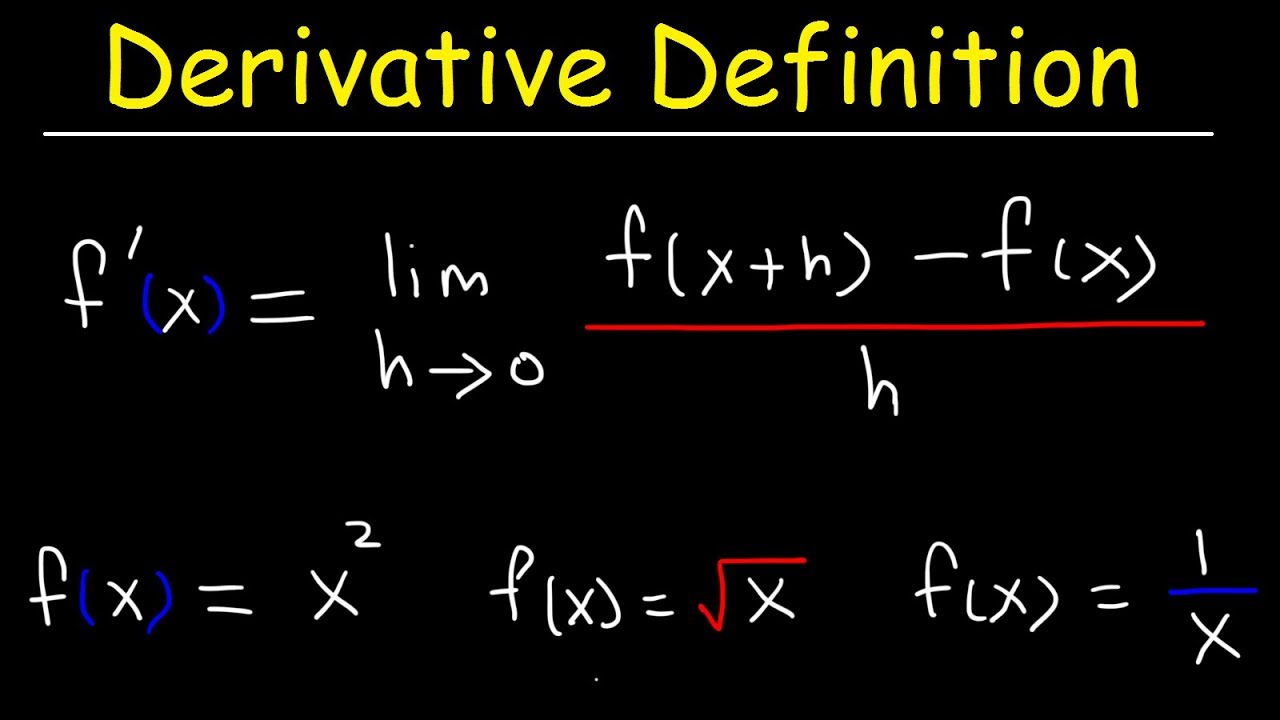
This is the definition of the derivative

#

f'(a) = lim(h → 0) : (f(a + h) - f(a)) ÷ (h)

heavy furnace
#

uhhhhhh

#

ug

hardy nest
#

The slope of the function evaluates at x = a is given as the limit as h approaches 0 for the equation (f(a + h) - f(a)) ÷ h

heavy furnace
#

uh

hardy nest
#

I’m sorry it gets rlly complicated here but let’s go back

#

f'(x) is the notation for the derivative function of f, it's notated with an apostrophe (')

heavy furnace
#

I see

#

just a question

#

aren't slopes

#

decide with 2 points?

hardy nest
#

Yes, the average rate of change (slope) between two points

heavy furnace
#

okay but

#

what does tangent lines and getting closer

#

affect

#

that concept

#

how does*

hardy nest
#

Consider this though,

x → f(x) → y
For normal functions, as we input 'x' into the function f(x), we output a 'y'

x → f'(x) → slope of f at x
However, for the derivative function, as we input 'x' into the derivative function, we get the slope of the normal function f(x) evaluated at a specific x. In other words, the derivative function returns how fast the function f(x) is changing at any point x

hardy nest
#

But as we make one of the variables approach the other… in this case, letting
b = a + h,
⇒ h = b - a
Then letting the difference between b and an approach zero (the limit as h → 0), we get the instantaneous rate of change of the function. We get how fast the function is changing at any x, doesn't matter if it's linear or curved.

#

This image is also good

#

The derivative is equal to the slope, Δy/Δx, as the change in x approach 0

#

Δy = f(x + h) - f(x)
⇒ Δy = y2 - y1
⇒ y2 = y1 + h, where h is the difference between the y-values

#

This is the same thing in the image, just worded differently
f(x0 + Δx) - f(x0)
So the change in y is equal to the function evaluated at some x (notated as x0), with Δx being the change in x, which is the difference between y2 and y1 — the y2 being f(x0 + Δx) and the y1 being the f(x0)

#

You might still be confused, please watch this video closely to see what he’s doing and saying

heavy furnace
#

I understand it but

hardy nest
#

Hearing an audio and a visual would be better

heavy furnace
#

I understand it but I still don't comprehend it

#

I might need a break

#

it's 7 am for me rn

#

I haven't slept for a lot of hours

#

for like

#

24+ hours

#

so

#

it's basically

#

it's not basically

#

uh

#

the change as x approaches 0

#

but

#

that means

#

you calculate the slope between two things, and you calculate it all the way till those two things join but don't join

#

uh

#

uh

#

right?

#

similar to that?

#

or lemme just watch the video

hardy nest
#

You should get rest

#

I hope the video makes it make a bit more sense conceptually

#

(You should know that division by zero is undefined… so we say the limit as the denominator (change in x) approaches 0)

heavy furnace
hardy nest
hardy nest
heavy furnace
#

I see, and u just repeat the process almost infinite times as n approaches 0

#

but

#

how is this practically possible

hardy nest
#

As for the numerator,
Δy = y2 - y1 = f(x + h) - f(x)
where h is the difference between y2 and y1. it's the value you need to add to y1 in order to get y2.

#

But the difference between y2 and y1 shrinks as the difference between x2 and x1 approach zero..

#

This means that the difference as a whole approaches 0, so the limit as h → 0

hardy nest
heavy furnace
#

I see

hardy nest
#

Because if we do say h = 0, the denominator (Δx = x2 - x1 = h) is equal to 0, and division by zero is undefined

#

Did you watch the video?

#

Its not quiet long but you can watch it later

heavy furnace
#

I think

#

I understood it a bit

#

I will watch the video

#

but I got the gist of it

#

u have to do it to a very close value to 0

#

'precise enough'

#

I mean

#

of the value

#

of the slope

#

what you'd get when you reach very close.

hardy nest
#

You’ll learn the mathematical definition of a limit and what it means to "approach" because it is a bit ambiguous

Because if we say x approaches α, then x also approaches α + 1… it also approaches α + 5, so what does "approaching" specifically α even mean

#

You don’t learn this in calculus 1 or 2 at least

#

You learn it in a class called real analysis which is essentially the rigorous study of functions

#

Proving definitions from scratch and such

heavy furnace
#

oh

#

oh

hardy nest
#

Calculus is apart of analysis

#

But it doesn’t rigorously define limits and such

hardy nest
#

The definition of the derivative is literally this… but as Δx → 0

#

You get the rate of change of the function at any point on the graph

#

But I think it’s time for you to go tbh

heavy furnace
#

alright

#

it was so fun

#

what I've managed to understand with you

hardy nest
#

https://youtu.be/-aTLjoDT1GQ?si=EB0CUb2ozKcj0Orl

This is a longer video but I believe it does explain more

This calculus video tutorial provides a basic introduction into the definition of the derivative formula in the form of a difference quotient with limits. It explains how to find the derivative of a function using the limit process. This video contains plenty of examples and practice problems.

Derivatives - Free Formula Sheet:
https://www.vid...

▶ Play video
hardy nest
heavy furnace
#

you really are one of the greatest person for me

#

nobody has made me understood something this complex before

#

they just told me to read books

#

thank you so much

hardy nest
#

f(x) = x^2
f'(x) = 2x
This means that anywhere on the graph of f(x), the graph is changing at a rate of 2x. To find the rate of change (slope) of the function at x = 6, we plug in x = 6 into the derivative function
f'(6) = 2(6) = 12
So when x = 6 on the normal function, the function is changing at a rate of 12 units of y per 1 unit of x

#

We’ll get to the point where we understand why the derivative of x^2 is 2x but that’s that for right now

heavy furnace
#

I see

#

okie thanks

hardy nest
#

If you try finding the "slope" of this quadratic function given the two points (6, 36) and (7, 49) you end up getting 13. However the actual rate of change of the function at x = 6 is 12. This is because the quadratic function is not actually a straight line, it is curving a bit, and as a result the slope between the two points is not fully accurate

#

So while using the average rate of change formula for non linear functions gives you the secant line between two points, it doesn’t give you the accurate rate of change of the function, because it doesn’t take into consideration the fact that the function may curve or bend

#

⇒ At x = 6, the function is changing at a rate of 12 units per y, for 1 unit of x. This is what f'(6) tells us

⇒ However, when trying to find the slope between the two points using
m = (y2 - y1) ÷ (x2 - x1)
We get 13, this means the average rate of change of the function between x = 6 and x = 7 is 13 units of y per 1 unit of x, although how fast the function is truly changing at x = 6 is 12 units of y per 1 unit of x, not 13.

#

The true speed at which the function is changing is always found with f'(x). You can't simply use the average rate of change (slope) formula because you are assuming that the points on that interval are separated with a straight, constant line; when in reality they could be separated with a curve that looks like line, but slightly curves (this scenario). The only reason why our values were so close (12 and 13) is because of the steepness of the quadratic, it was so steep that the curve looked like a straight line, however it actually isn't.

#

@heavy furnace I hope this helps

#

bye!!!!

carmine beacon
#

Oh if you're learning about lines rn you should also try systems of linear equations and matrices

#

If you'd like to balance it on top of whay you're currently learning, of course

heavy furnace
#

helpo

#

hello*

#

I woke up

vale stone
#

@hardy nest

hardy nest
#

@vale stone

vale stone
#

so

#

it's may 22nd

#

I have like

#

8 days

#

to study something truly rigorous

hardy nest
#

What topic are you on

vale stone
#

and prove to my father

vale stone
#

but uh

#

trigonometry

#

ish

#

started

hardy nest
#

Are you still going on the linear algebra route?

Linear algebra is typically after calculus 2 and before calculus 3, but I don’t know if your father considers it “rigorous”.

vale stone
#

rigorous in hs terms

#

not that far

#

precalc aka trigonometry geometry etc.. derivatives etc.. basic calculus and calculus 1

#

so I need to learn these things

#

aka all of high school's math topics mainly

#

and some probability and statistics

#

wait

#

actually

#

I can

#

you're right I don't need to be rigorous in small terms

#

alr

#

linear algebra is the goal

hardy nest
#

Vectors and matrices are a very deep topic because there so much to them

#

Then after, I can help with trigonometry, but there is a lot of algebra you should know too

#

Calculus 1 is literally just differentiation.

#

Calculus 2 is literally just integration

vale stone
#

I see

hardy nest
#

We’ve already learned the definition of the derivative, which is what calc 1 is all about, it doesn’t dive into integration too deeply unlike calc 2

vale stone
#

I see

hardy nest
#

They are obviously not JUST differentiation or integration, but these span majority of the courses

#

Calculus 2 also includes vectors, sequences and series, as well as parametric equations and polar functions