#Sum to Integral
9 messages · Page 1 of 1 (latest)
 deep haloBOT
 hollow moat
What exactly is the goal here? If you're trying to calculate partial sums, there's a formula for that.
In any case, for the geometric series
$\sum_{k=0}^{n}ar^{k}$
you may treat $ar^{k}$ as an exponential function. The geometric sum would then just be the lower Riemann sum of that of function.
 bleak nymphBOT
solarunes

 timber basin
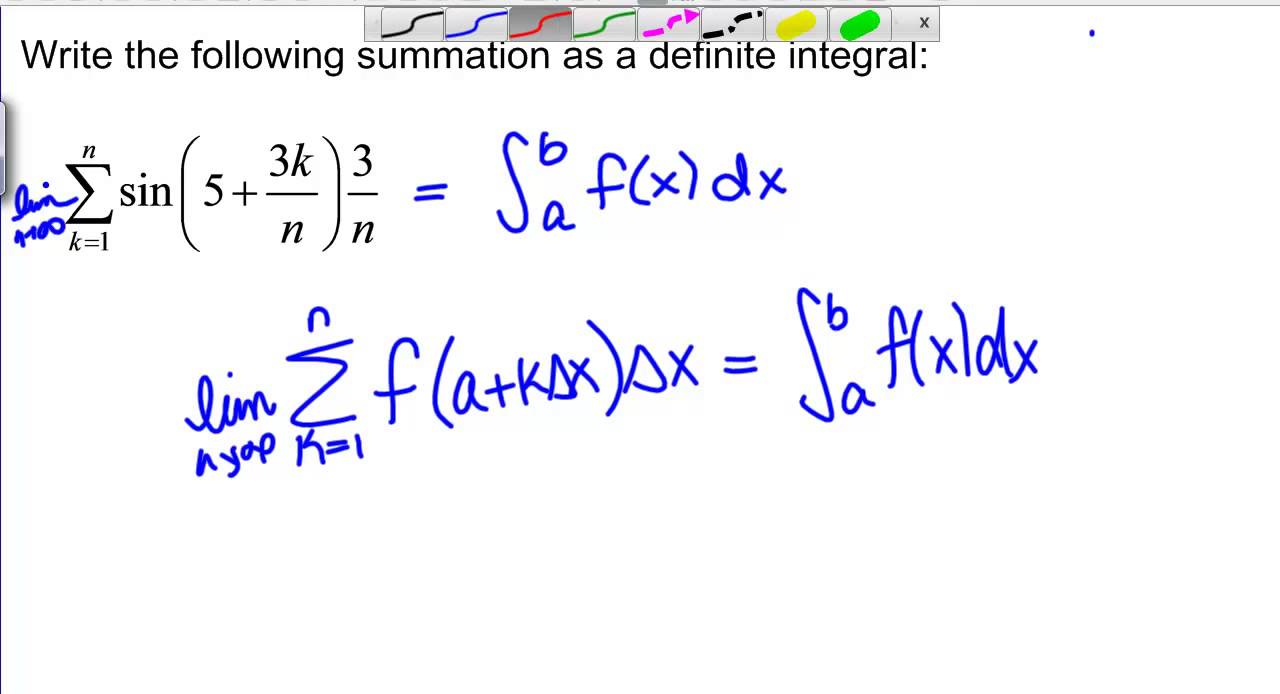
This video shows how to convert Riemann Sum written in Sigma notation to a definite integral.
 fallow token
My actual goal is to prove the basel problem with integrals but before i convert a p-series into an integral I thought i should learn geometric series first because its easier to do.
I will watch the Video later but thanks a lot
 fickle agate
fallow token
My actual goal is to prove the basel problem with integrals but before i convert...
fickle agate
fallow token
My actual goal is to prove the basel problem with integrals but before i convert...
Itd likely serve you better if you prove the basel problem using taylor series and weierstrass product series
fallow token
fickle agate
Itd likely serve you better if you prove the basel problem using taylor series a...
I already did that but my problem is that apparently i don't understand integrals as much as i thought i did so I thought it might help if i did a proof involving integrals and sums to understand it more about what their relationship is
fickle agate
fallow token
I already did that but my problem is that apparently i don't understand integral...
Fair enough