
#Bearings
46 messages · Page 1 of 1 (latest)
 chrome crane
 rustic orioleBOT
chrome crane
rustic orioleBOT
chrome crane
<@&286206848099549185>
 lost whale
use trigonometry
chrome crane
yea i know that much
i should post my working
currently got theta = tan ^ -1 (14/20)
like the tutorial said to
chrome crane
lost whale
use trigonometry
i just dont know how they got the degrees for it
lost whale
you put that into a calculator
lost whale
what do you mean by "it won't let me"? what calculator are you using, and what error do you get?
chrome crane
syntax error
chrome crane
lost whale
what do you mean by "it won't let me"? what calculator are you using, and what e...
the online ones give decimals
and the ones that ask for degrees give me
wont let me put tan^-1
lost whale
chrome crane
uhm should it be in degrees
or is that in degrees?
yup yup
thanks
so would my answer be 35 degrees
and is that correct?
lost whale
well 35 degrees is the right angle, although we should format it properly for a bearing
chrome crane
sorry dude im not quite sure. we havent even started this topic
so i got no clue
went through a couple videos
how do we format it?
lost whale
we just have to state which line we measure from and which direction. so "35 degrees west of north" (shorthand N35°W) would be correct
chrome crane
and just to make sure
the tutorial i have says we are going clockwise from north
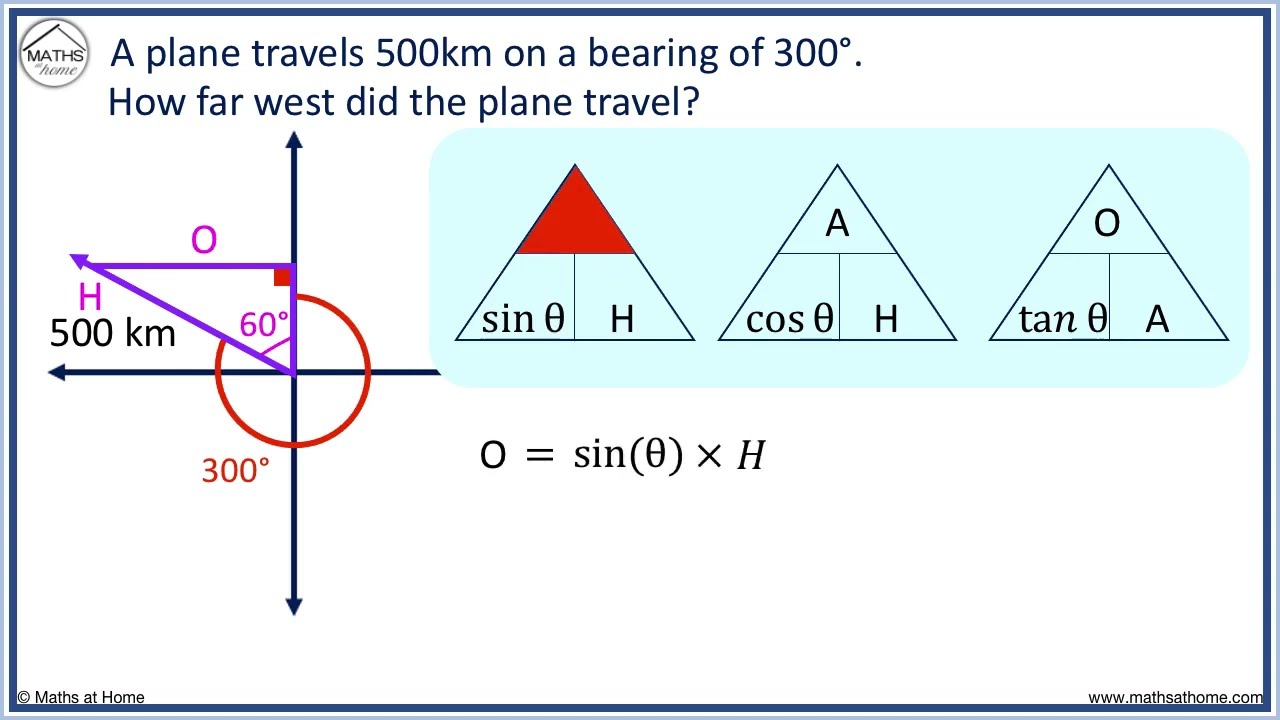
The full lesson and more can be found on our website at https://mathsathome.com/calculating-bearings
In this lesson we learn how to find a bearing using trigonometry. We look at a variety of examples using trigonometry to find the bearing from north.
does this have any implications on the answer
because im missing out an entire turn axis at the end
cause we've figured out the theta
but not the bearing
lost whale
there are two different formats for bearings: there is an azimuth bearing which is up to 360° clockwise from north, and there is a relative bearing which can be clockwise or counterclockwise up to 90° from north or south (whichever is closer)
so "N35°W" is the correct relative bearing, but to find the azimuth we need to find the clockwise angle since 35° is counterclockwise
chrome crane
So if we were to start from the bottom
would it be going north so 360 minus 35?
from my understanding of bearings anyways
lost whale
chrome crane
would it be going north so 360 minus 35?
that would give us the clockwise angle from north, which is what we're looking for