
#Write Trig Equations from Context
260 messages · Page 1 of 1 (latest)
 wicked badge
 strange spokeBOT
wicked badge
I need help with this question
strange spokeBOT
strange spokeBOT
wicked badge
I need help with this question
What step are you on?
1. I don't know where to begin.
2. I have begun but got stuck midway.
3. I got an answer but I was told that it's wrong.
4. I got an answer and would like my work checked.
5. I have a question about someone else's work/solution.
6. I have completed the problem and don't need help anymore. Thank you.
7. None of the above
step #1
 balmy field
wicked badge
step *#1*
balmy field
wicked badge
step *#1*
hi
First question:
What does your function resemble more, cosine or sine?
 balmy field
not this againlmao
we can choose actually both
let's work with cosine
y = Acos(B(t - C)) + D
wicked badge
i think its Sine ...
balmy field
To get A you need to calculate the vertical distance betwee 30 and 50
balmy field
No you subtract 30 from 50
wicked badge
oh
balmy field
then you divide by 2

We want to find the red length and divide by 2
You do that by doing 50-30=20 then divide by 2 you get A=10
Let me know if you understood
wicked badge
My D would be 40
balmy field
yes!
wicked badge
bcuz 30+50=80 then divide by 2 is 40
wicked badge
So...
now my
A = 10
D = 40
balmy field
Yea I know (soory)
wicked badge
😅
balmy field
But first we need the period P
 lusty nacelleBOT
𝔸dωn𝓲²s
 balmy field
So for the period take 2 points for example (0,30) and (10,30) and count their horizontal distance
wicked badge
is it 10 ?
wicked badge
B = π/5
balmy field
...
nice!!
Now we have
y = 10cos(π/5(t - C)) + 40
Do you think we need C
Do we have a horizontal shift?
 balmy field
actually nope
C = 0
cosine has the following property
at the start x = 0
it either starts with maximum or minimum
here it starts with its minimum
so we therefore know there is not horizontal shift to the left or right
we jsut went up with cosine and adjusted the period and amplitude
balmy field
yes..
wicked badge
then**...** don**'t we have left is y=10cos(π/5)+40?**
wicked badge
oh
balmy field
We know that cosine starts with its maximum
here we start at the minimum
do you know what happened or what we need to do as a final step
 lusty nacelleBOT


 Requested by adoniszgks
lusty nacelleBOT
Requested by adoniszgks
lusty nacelleBOT
 Requested by adoniszgks
 wicked badge
how do I do that**?**
balmy field
yes now do the complete thing
wicked badge
what could my T (variable) be**?**
balmy field
free
it stays like that
you have a function f(t)
t is time
you let it
you're done
the difference between A,B,C and D and T is
A,B,C,D are parameters that we certainly need to determine.
T is a variable that we dont touch 🙂
wicked badge
So.. what would the equation be**?**
balmy field
try it x)
wicked badge
would it be like -10cos(π/5(T-0)+40
wicked badge
 balmy field
you can simplify it like this:
wicked badge
do I do the same thing for here**?**
balmy field
yeaaaaaaaaaaaaaaaaaaaaaaaaaaaaaa
wicked badge
I need to figure out what my
A = 10
D = 10
P =
wicked badge
do I Subtract 6.5 and 12.5 to get my D ?
wicked badge
is it 10 ?
wicked badge
Max = 6.5
Min = 12.5
wicked badge
20+0=20 divide by 2 is 10
 wicked badge
now i need to figure out what my P is**..**
balmy field
yes
wicked badge
B = 2π**/**P
balmy field
yes
wicked badge
how do I figure out what my P is**?**
balmy field
you take one point for example (0.5,0)
Oh I just realized we also need a C xD
we start at t = 0.5 not t = 0
wicked badge
oh**.**
balmy field
So you take a point (0.5,0)
then you go along the graph with your finger
until one cycle is done at the same place
wicked badge
 balmy field
uhm
wicked badge
did I do it wrong?
balmy field
you could have stopped at (12.5,0)
wicked badge
oh
balmy field
do you know why?
wicked badge
bcuz it completes 1 cycle there...?
balmy field
yes"!!!!
wicked badge
A = 10
D = 10
P = ?
balmy field
now count the horizontal distance between those two points
(0.5,0) and (12.5,0)
that would be P
wicked badge
is it 7 ?
balmy field
not quiete
wicked badge
6**?**
 balmy field
yea so you see
12.5 does not come out
6 would be the distance between 0.5 and 6.5
we wnat between 0.5 and 12.5
wicked badge
oh**..**
balmy field
You -> o at 0.5m
Destinateion -> o 12.5m
wicked badge
 balmy field
You can always subtract the bigger length from the smaller one
to get the distance in between
for example
the distance between 4 and 10 is obviously 6 but mathemaically: 10 - 4 = 6
 wicked badge
 wicked badge
I need to figure out what my P is**...**
cuz I already found my A and D which is 10
balmy field
Yes so you do 12.5 - 0.5
balmy field
 balmy field
wicked badge
> A = 10
> D = 10
> P = π**/**6
balmy field
wicked badge
> A = 10
> D = 10
> P = π**/**6
yea you fast this time
BUT we also need a C

cosine starts usually at t = 0
now we start at t = 0.5
what is the horizontal shift
wicked badge
wait**..** how do I find my Horizontal Shift , again**?**
balmy field
weelll
think
cosine is usually at t = 0
not it's at t = 0.5
what happened
what could have happened
from 0 to 0.5...
what was shift factor
wicked badge
 balmy field
 G
G
it cant be that hard
your pen is at 0cm now it's at 0.5 cm
what did you do, you moved the pen obviously
by how much
wicked badge
1**?**
balmy field
are you sure?
wicked badge
no..
balmy field
your pen went from 0 to 0.5 cm
it cannot be 1cm
from 0 to 0.5
i cant make it more obvious lmao
the shift is 0.5
so is it here
cosine went starting from t = 0 at t = 0.5
imagine like usually cosine starts at t = 0 minutes, now it's started lated by 0.5 minutes
so C = 0.5
Also cosine needs to be flipped again so put a minus again before and done, can you tell me the function?
wicked badge
y=**-**10cos(π/6(t-0.5))+10
wicked badge
😦
balmy field
if you plan on torturing me you can do it another time
wicked badge


 proper vector
wicked badge
do you think you can help me with this one**?**
proper vector
wicked badge
do you think you can help me with this one**?**
My timezone sucks
It doesn't match the time you guys are here
proper vector
For questions like this, you don’t have to know how horizontal shifts work, in order to understand horizontal shift you gotta study lots of different things which I’m not gonna cover
I will solve an example for you, and this is the easiest way of solving this type of question
Consider the following function, you can either find the function by using asin(bx+c)+d or acos(bx+c)+d, both will give you the same answer

This time I’m going to use the cosine function, the very first step is to find the amplitude, I’m sure you are familiar with it so I won’t explain it much


So far we have found a=8, now the second step is to find d, the process is very simple, you take either a max point or min point and use it to find the value of “d”


as we just mentioned, we take a max point or min point, here I take the max point, it’s very important to mention that max point means cos(whatever) = 1, doesn’t matter what the value of b and c are, you just replace cos with 1 (please pay attention that if you are working with -cos, you should put -1 as cos so you would get -(-1), which is the max value for cos), now you just replace cos with 1 and simply solve for “d”

and if you are wondering how you would get “d” using min point, it’s exactly the opposite, you take the min value for cos(whatever) which is -1 and you replace cos with -1 and simply solve for the value of “d” which you would again get 4=d

Now it’s time to find “b” using period, as you know period means the distance of two max points (or the domain that is repeating), here as you can see the distance between two max points are pi (you can find it by 4pi/3 - pi/3 = pi)

Now that you know the value of period, you put it in P=2pi/b


now it’s time to find “c”, I know you can find it by using horizontal shift but it’s super complicated and you need to know different stuff which from my previous experiences with you, you don’t give a damn about the explanation I send so this is the simplest way.

You take one of the points on the graph, it can be anything but here we choose max/min points, as we mentioned earlier, in order to make it a max point, cosine should be 1

you can also choose min point, which cosine should be -1

let’s take max, which means cos(2x+c) = 1 and as you can see the max point is x=4pi/3, basically it means that if you put 4pi/3 you should get 1, and cos(A)=1 then A=0 or 2pi or 4pi or … (I accidentally wrote pi and 3pi so ignore that part)
You might be saying “why the fk this gives us infinite solutions?!” Well in fact every single question you have sent have infinite amount of solutions.
**NOTE: if you are using sine instead of cosine you should put 2.4pi/3 + c = pi/2 or 5pi/2 or … **

We choose 0 because that’s very easy and simple to use

And we are done, we wrote the function

It could be written this way

The graph was not accurate cuz I drew it by hand, but the points are correct anyways

I won’t explain further than this, you can continue solving the questions with adonhs, good luck!
proper vector
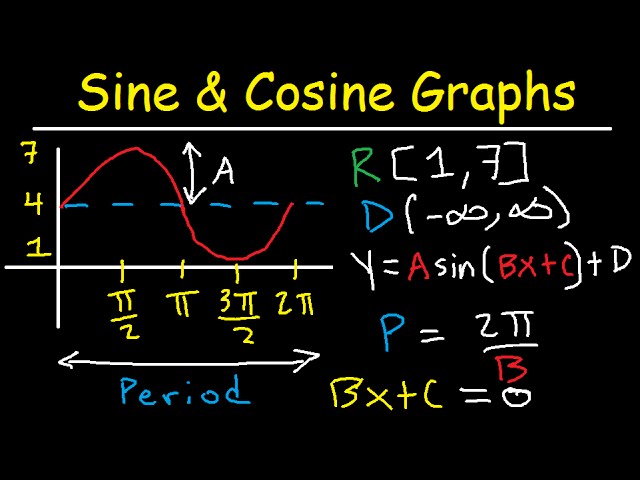
This trigonometry and precalculus video tutorial shows you how to graph trigonometric functions such as sine and cosine functions using transformations, phase shifts, period, and amplitude.
Trigonometry - Basic Introduction: https://www.youtube.com/watch?v=g8VCHoSk5_o
Angle of Elevation Problems:
h...
You can watch this video as well
proper vector
wicked badge
do you think you can help me with this one**?**
Seems like I'm being the annoying person here, what did you find for the period?