
#Need help solving this second order differential equation
118 messages · Page 1 of 1 (latest)
 verbal shard
 formal pathBOT
verbal shard
formal pathBOT
verbal shard
@viral zephyr
 viral zephyr
verbal shard
<@587715738484211754>
viral zephyr
verbal shard
<@587715738484211754>
ok i imagined something different uhmmm
is this a differential equation in terms of y with respect to x?
or even a differential equation system
 round schooner
Ru in uni ?
viral zephyr
because i never learnt how to solve systems 💀 yet
viral zephyr
round schooner
Ru in uni ?
yes
round schooner
Which?
viral zephyr
uhmmmmmm wdym which
round schooner
Name ?
viral zephyr
round schooner
Name ?
hustler's university
round schooner
viral zephyr
hustler's university
Isn't that Andrew tate uni?
Nvm I sleep 3 am already got school in 2.5 hrs
viral zephyr
round schooner
Nvm I sleep 3 am already got school in 2.5 hrs
go sleep
verbal shard
viral zephyr
ok i imagined something different uhmmm
Basically, you are suppose to change ax to d2x/dt^2
And change ay to d2y/dt^2 and that is how you form the equations. Then somehow get x in term of t and y in term of t. And maybe substitute t in x to y or the other way round to get y in term of x and theta.
viral zephyr
verbal shard
Basically, you are suppose to change ax to d2x/dt^2
And change ay to d2y/dt^2 an...
i understand it's physics and a is the acceleration with respect to x and also another with respect to y
s'' = a
verbal shard
Yes.
viral zephyr
$a(t) = -kv(t) \Rightarrow \frac{d^2x}{dt^2}= -k \cdot ucos\theta \
a(t) =-g-k(t) \Rightarrow \frac{d^2y}{dt^2}= -g - usin\theta$
what is k_y ?
or it supposed to be v_y?
verbal shard
How did you do that?
verbal shard
K is like a constant.
viral zephyr
k_y ?
verbal shard
viral zephyr
$a(t) = -kv(t) \Rightarrow \frac{d^2x}{dt^2}= -k \cdot ucos\theta \\
a(t) =-g-k(...
I completely do not understand what is happening here.
viral zephyr
verbal shard
I completely do not understand what is happening here.
it's code haha
but i was unsure
verbal shard
Wow. Maybe this is correct?
verbal shard
viral zephyr
but i was unsure
Which part?
viral zephyr
ehm i dont think so
 cobalt inletBOT
adonhs
 verbal shard
Oh I see. I put wrong.
Sorry. I did not see properly.
For Ky I meant K.
So basically just K.
Both k in both equations have the same value.
viral zephyr
$a_x(t) = -kv_x(t) \Rightarrow \frac{d^2x}{dt^2}= -k \cdot ucos\theta \
\a_y(t) =-g-k\Rightarrow \frac{d^2y}{dt^2}= -g - k$
cobalt inletBOT
adonhs
 verbal shard
viral zephyr
$a_x(t) = -kv_x(t) \Rightarrow \frac{d^2x}{dt^2}= -k \cdot ucos\theta \\
\\a_y(t...
verbal shard
viral zephyr
$a_x(t) = -kv_x(t) \Rightarrow \frac{d^2x}{dt^2}= -k \cdot ucos\theta \\
\\a_y(t...
How to continue? I completely have no idea.
viral zephyr
verbal shard
How to continue? I completely have no idea.
since we have theta we gotta somehow convert the differentials
verbal shard
viral zephyr
since we have theta we gotta somehow convert the differentials
How do you even solve d2y/dx^2? I have never done this before.
viral zephyr
$x''(t) = -k \cdot cos\theta$ and $y''(t) = -g-k$
cobalt inletBOT
adonhs
 viral zephyr
i think we could differentiate
$v_x = ucos\theta \Rightarrow \frac{dx}{d\theta} = -usin\theta$?
cobalt inletBOT
adonhs
 viral zephyr
if v_x is a function of theta
verbal shard
But I thought you need in function of t so that can substitute t later?
Because want y on the left side and x and theta on the right side.
viral zephyr
verbal shard
Because want y on the left side and x and theta on the right side.
ok so since i never done such thing, but i just watched a video it seems to involve linear algebra
so we are working with vectors and matrices
and x and y are components
verbal shard
I never learnt those. Maybe just tiny bits of vector.
viral zephyr
verbal shard
I never learnt those. Maybe just tiny bits of vector.
can you tell what you know
or you do
verbal shard
For vector I onky know like the level of the person yesterday. I do not know about equations or planes.
Is that person called unknown?
viral zephyr
are you a high schooler?
verbal shard
I saw in a worksheet and that is exactly the level I am at.
verbal shard
viral zephyr
are you a high schooler?
Yes I am.
viral zephyr
i thought u were some engineer ok lol
verbal shard
viral zephyr
i thought u were some engineer ok lol
Why did you think that?
As you can see I am pre university.
viral zephyr
some people who study have pre uni and some who are high schooler have undergraduate role so cant tell
besides that i thought because it involves some physics lol
I would start off with this
cobalt inletBOT
adonhs
 viral zephyr
because v_x is basically the first derivative of x(t)
verbal shard
I am trying to understand it.
viral zephyr
I would write it even simpler
verbal shard
From what I know to get x and y I have to integrate twice? But that does not seem correct?
Okay. This is rewriting equation?
viral zephyr
yes to my understanding
it should make sense that v_x = dx/dt = x' first derivative
a_x = d²x/dt² = x''
I would try to do this with this video
so basically we have
actually
cobalt inletBOT
adonhs
 viral zephyr
In physics instead of ' we use dots if it's with respect to time
Maybe integrating both sides helps


 viral zephyr
Now this is the approach
cobalt inletBOT
adonhs
 viral zephyr
So we can rewrite the equation as
verbal shard
I am completely lost.
cobalt inletBOT
adonhs
 viral zephyr
verbal shard
I am completely lost.
viral zephyr
verbal shard
I am completely lost.
You can watch the video I am just trying it on my own for the first time lol
It's just that I am familiar with linear algebra so I thought give it a try
So now we would for the Eigenvalues as this equation above reminds us of the Eigenvalues of a matrix
,w eigenvalues {{[//number:-0.5k//],[//number:C//]},{[//number:D//],[//number:-(g+k)//]}}
cobalt inletBOT


 Requested by adoniszgks
viral zephyr
Requested by adoniszgks
viral zephyr
I am gonna use the lambda notation for the eigenvalues
The Eigenvectors look so complicated haha
cobalt inletBOT
adonhs
 viral zephyr
So basically the solutions should be
cobalt inletBOT
adonhs
 viral zephyr
Hmm I honestly, I can't tell, since we have too many constant variables, we already had g and k, but due to the integration of both equations we also got C and D and the vectors c1 and c2 are also "vector of constants" and a and b are constants of the linear combination (linear algebra)
You'd need some basic foundation in Linear Algebra and Calculus/Analysis, at least to know what Eigenvalues and Eigenvectors are but anyway
This is all I could do LOL
Here is the link again:
https://www.youtube.com/watch?v=E0YUvCqhr-c
You could check some videos out of him or so
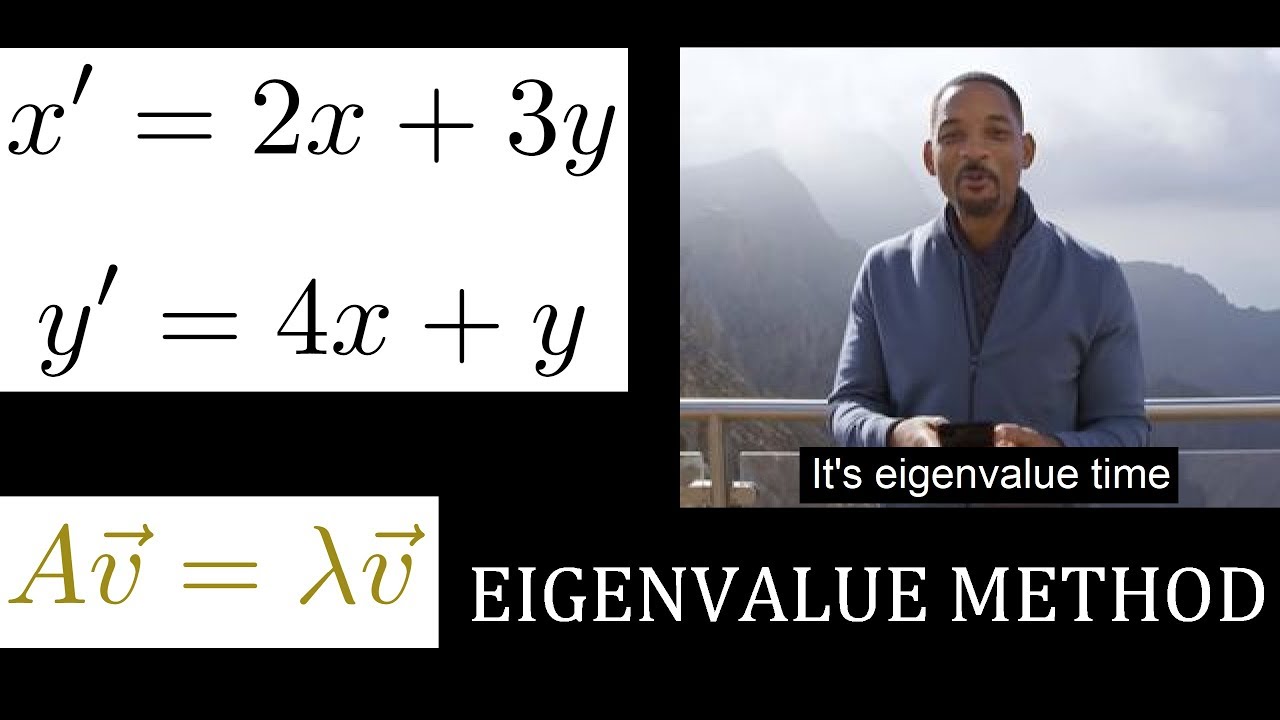
How to find eigenvalues: https://youtu.be/hpE9Iom55N0
When we start looking at how multiple quantities change, we get systems of differential equations. What do we use for systems of equations? Linear algebra, of course!
Full dissecting differential equations playlist: https://www.youtube.com/playlist?list=PLug5ZIRrShJF-vOxStdHg1jyntiTKrAYO
N...
viral zephyr
cobalt inlet
**adonhs**
Oh no I forgot the square here, meaning it is not a linear differential equation, damn it
x² instead of x...
well it was all for nothing i guess
Maybe you can check out the other channels people who are more experienced than me
#calculus
#real-complex-analysis
#advanced-analysis
you can try it in those channels, i believe they are connected to this topic
#diff-geo-diff-top should also work too
verbal shard
viral zephyr
This is all I could do LOL
Thank you so much. It is okay. I will try to understand.
verbal shard
viral zephyr
<#908108569688301649> should also work too
I cannot type in that Chanel I do not know why.
verbal shard
viral zephyr
Oh no I forgot the square here, meaning it is not a linear differential equation...
I am so sorry. I am stupid. I just checked and realized that the equation was wrong. I forgot to put v.