#probability question
62 messages · Page 1 of 1 (latest)
 raven goblet
 languid kilnBOT
 haughty belfry
what do you mean specifically by "how close"?
because obviously some cases will be 0% and some will be 100%
thus you need to refer to a certain range
raven goblet
like shouldn’t the standard deviation for how close it is to 50% over time consistently get smaller
haughty belfry
yea
raven goblet
haughty belfry
thus you need to refer to a certain range
yeah i want an infinite range equation if possible
haughty belfry
oh i think you misunderstand
let's suppose we run 100 trials where we flip a given coin 100 times
on average 50 of the coins will land heads
this is clear
however maybe in around 50% of the cases it will be less than 48 or greater than 52
in maybe 90% of the cases it will lie within 35 and 65 heads
and in 99% of the cases it might lie within 20 and 80
alternatively you can ask "what's the average deviation from 50 heads" which is also not so hard to calculate
raven goblet
yeah i’m looking more to like 1 million flips to 500 million flips would there be an equation for its deviation from 50% as the flips increase
haughty belfry
"deviation" is an imprecise word
do you want the standard deviation
or the average deviation
standard deviation is more useful if you wanna do more sophisticated analysis
average deviation tells you on average how far it is from 50
y'know what ill just send both
raven goblet
thanks lol i’m not sure what i’m looking for really
haughty belfry
do you know what a probability density function is
also do you want the more accurate version or the less complicated approximation (it's only less accurate for small numbers of coin flips)
raven goblet
more accurate would be better, im trying to use it for something practical
sorry for late response
haughty belfry
ok
I'm gonna write choose as $C(n, k)=\frac{n!}{k!(n-k)!}$ for simplicity of latex
 unkempt questBOT
marival
 haughty belfry
Assume that you flip a coin n times.
raven goblet
n is rolls k is possible outcomes?
haughty belfry
n choose k is used in the formulas
haughty belfry
haughty belfry
Assume that you flip a coin n times.
The standard deviation is given as follows (give me a sec to type up)
$\sigma = \sqrt{\int^n_0 \left(C(n, x)\frac{1}{2^n}\right)\left(x-\frac{n}{2}\right)^2 dx}$
The mean absolute deviation is given as follows
$MAD = \int^n_0 \left(C(n, x)\frac{1}{2^n}\right)\left| x-\frac{n}{2}\right| dx$
raven goblet
thank you, i’m still a little confused on what k is tho
haughty belfry
oh just a typo

 haughty belfry
if you wanna do further analysis use the standard deviation
if you just want the "average deviation" use the mean absolute deviation
and if you are so inclined to learn further, i found this thread upon a whim one time

1/
Get a cup of coffee.
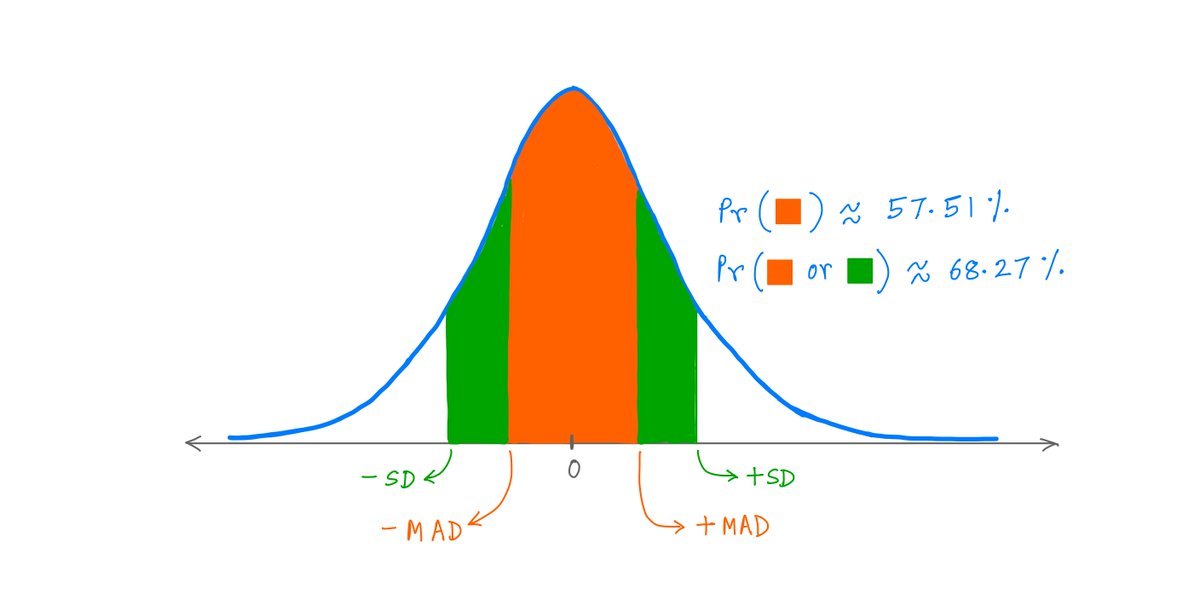
In this thread, I'll walk you through 2 probability concepts: Standard Deviation (SD) and Mean Absolute Deviation (MAD).
This will give you insight into Fat Tails -- which are super useful in investing and in many other fields.
Likes
2782
Retweets
589
 Twitter
·
raven goblet
Twitter
·
raven goblet
thanks mate
 mighty reef
raven goblet
is there an equation for how close to 50% the number of heads will be as you inc...
mighty reef
raven goblet
is there an equation for how close to 50% the number of heads will be as you inc...
it will vary
i mean it could just go HTHTHTHT forever and then it would be very close
or it could go HHHHHHHH forever and then it would be very far
so it'll be a probability distribution
so let S_n be the number of heads after n flips
then (S_n)/n will be the proportion of heads
and 0.5 will be the expected proportion of heads
so you're trying to find the distribution of D_n = (S_n)/n - 0.5, the difference in proportion after n tosses
it turns out that this converges to a normal distribution, by the central limit theorem
the difference will be normally distributed with mean 0 (equal chance of the proportion being more than c above 0.5 as more than c below 0.5)
and the variance turns out to be s^2/n, where s^2 is the variance of a single toss
the variance of a single coin flip turns out to 0.25 i believe
so the variance is 1/4n
so you can see that as n grows large, the variance gets smaller and smaller
it's like a thinner and thinner normal distribution
google like 'central limit theorem coin flipping' for more info, that'll probs help