#Anyone understand inversions?
312 messages · Page 1 of 1 (latest)
 quartz folioBOT
 ruby juniper
 worldly kayak
do you understand what a means
worldly kayak
do you understand what a means
Honestly all of it. I think "part a" says that If we invert a point on a line containing C, the inverted point will end up on that line
That's the only part I have somewhat of an idea
worldly kayak
ruby juniper
Honestly all of it. I think "part a" says that If we invert a point on a line co...
yep
so basically if you have a line containing C
and you invert all of the points on the line
you just get the line again
does that make sense?
ruby juniper
worldly kayak
does that make sense?
I thought it's if you invert a point on the line, it just ends up somewhere else on the line
Like this
 worldly kayak
yeah that's correct
what this theorem is saying is that the line itself remains unchanged
so if you take every point on the line and invert it
you get the line again
ruby juniper
Does it have to end up at a specific part of the line or can it end up anywhere?
worldly kayak
the theorem doesn't specify, so it can end up anywhere
ruby juniper
So is an inversion just taking a point in the circle outside and then vice versa (outside to inside?)
ruby juniper
worldly kayak
so that CP * CP' = r^2
Gotcha. Ok so what about part B? straight lines not containing C onto circles through C
Like is point P not on the line?
Or you could explain it in your own words
worldly kayak
well suppose you have a line
and the line doesn't go through C
and then you take every single point on that line and apply the inversion to it
then the resulting image you get is a circle that goes through C
ruby juniper
worldly kayak
then the resulting image you get is a circle that goes through C
This isn't a perfect image, but something like this? Like the inversion of a point P will be a point on the circle when we invert all the points on that line?
Also how could we invert the points on the line (in the circle) when I thought inverstions were taking a point inside the circle to out and vice versa. We can invert a point inside the circle to inside it again
 worldly kayak
ruby juniper
This isn't a perfect image, but something like this? Like the inversion of a poi...
worldly kayak
ruby juniper
This isn't a perfect image, but something like this? Like the inversion of a poi...
yeah you are right, points inside the circle invert to points outside the circle, so the circle you draw here is not quite right, but this is the right idea
ruby juniper
worldly kayak
yeah you are right, points inside the circle invert to points outside the circle...
Would the line have to be outside the circle?
worldly kayak
yeah, if it inverted to that circle
ruby juniper
worldly kayak
yeah, if it inverted to that circle
Ok just a quick question, I thought there need to be a ray between the center and the point we plan on inverting?
Like this
 worldly kayak
the idea is for each point on the original line, you draw the ray and figure out where that point goes
and you do this for each point on the line
(obviously there's an infinite number of points on the line, so you can't physically do this, but that's what the process of inverting the line is)
ruby juniper
worldly kayak
the idea is for each point on the original line, you draw the ray and figure out...
So something like this? I just drew P and Q and picked random parts of the circle for them to go through

So essentially an inversion is taking a point inside the circle, drawing a ray to it somewhere outside the circle (and vice versa)
worldly kayak
here this video might help you visualize it https://youtu.be/Z6GG8zsMWH8?t=119
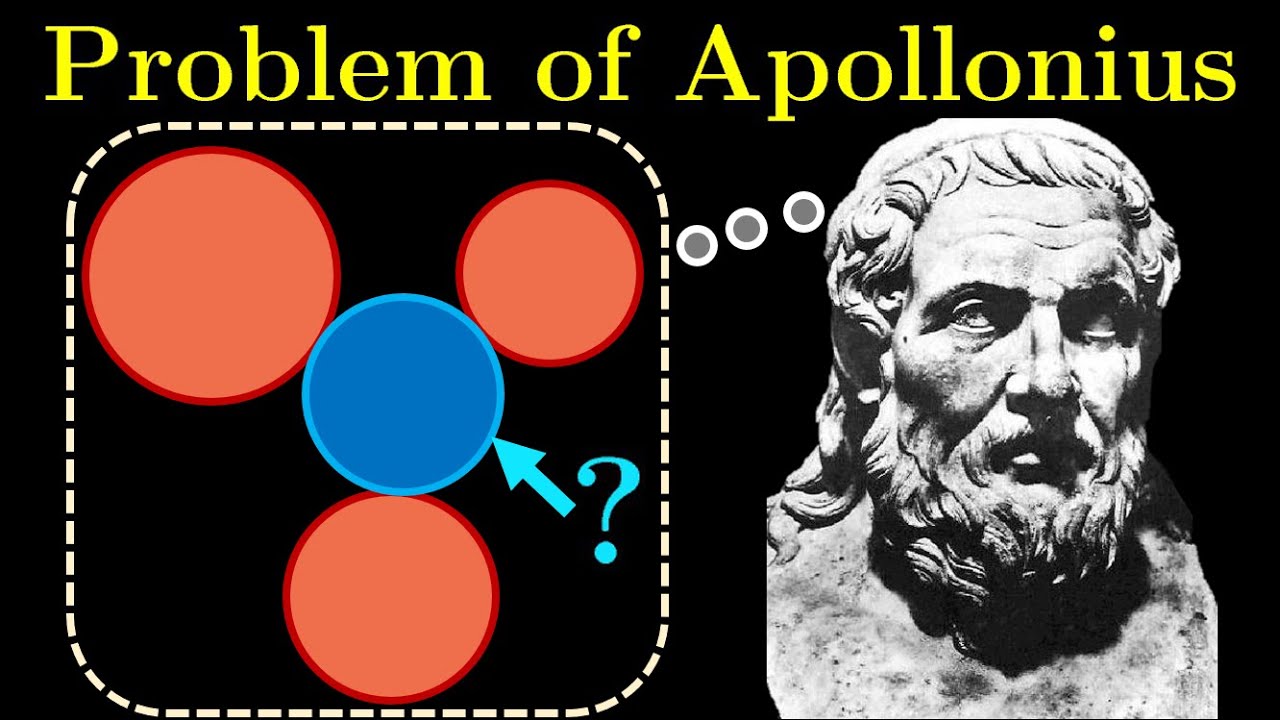
This video uses the problem of Apollonius as a way to introduce circle inversion and an important problem-solving technique - transforming a hard problem into a simpler one; then solve for the simpler, transformed version of the problem before doing the inverse transformation so that we obtain the solution to the hard problem. This problem-solvi...
worldly kayak
ruby juniper
So essentially an inversion is taking a point inside the circle, drawing a ray t...
yeah exactly
and the ray goes through the center of the circle
ruby juniper
worldly kayak
and the ray goes through the center of the circle
Gotcha. So now we're at part C. Circles through C onto straight lines not containing C
This is the vice versa of part b 🤔
So if we invert any point on the circle that goes through C, we get a straight line not containing C (so the straight line is outside of the circle)
I think that's what it is saying
worldly kayak
ruby juniper
Gotcha. So now we're at part C. Circles through C onto straight lines not contai...
the straight line not containing C doesn't necessarily mean it's outside the circle
but yeah if you have a circle through C, then it inverts to a straight line that does not contain C
and yup it's the opposite as b
ruby juniper
But if we invert a point on any circle through C, then we need to be outside of the circle. Isn't that was inversions do?
worldly kayak
if the circle is through C, then not all the points on the circle have to be inside the original circle
ruby juniper
Like this is what I'm thinking
 worldly kayak
if the circle that you drew is entirely contained within your original circle, then yea your line will be entirely outside of the original circle
worldly kayak
ruby juniper
Like this is what I'm thinking
when you draw inversions, make sure your ray starts at C
ruby juniper
Good catch
 worldly kayak
but yeah that's right, if your blue circle is like that then the resulting line will be outside of the purple circle
but if you make your blue circle bigger so that parts of it are outside the purple circle, then your red line will be partially inside the purple circle
ruby juniper
worldly kayak
but if you make your blue circle bigger so that parts of it are outside the purp...
But the points will be outside the purple circle (like always?)
worldly kayak
if hypothetically, the point P on your blue circle is outside the purple circle, then P' will be inside the purple circle
ruby juniper
Ok let me gather my thoughts, one sec, this is a lot to digest
ruby juniper
worldly kayak
if hypothetically, the point P on your blue circle is outside the purple circle,...
So if I invert a point P on the blue circle that goes through the center of the purple circle, it can end up in the purple circle
and eventually every point on the blue circle that's inverted will create a straight line not containing C
isn't it possible for P' to be outside the purple circle? it just has to be outside of the blue circle. Just making sure, since inversions are transforming points outside circles and inside circles
 worldly kayak
ruby juniper
So if I invert a point P on the blue circle that goes through the center of the ...
worldly kayak
ruby juniper
So if I invert a point P on the blue circle that goes through the center of the ...
if I invert a point P on the blue circle, it can end up in the purple circle
yup, this is correct! although P' is not in the correct place in the picture you drew (it should be between C and P)
every point on the blue circle will invert to become a straight line not containing C
yup!
isn't it possible for P' to be outside the purple circle?
yup, if P is inside the purple circle
ruby juniper
And then circles not through C onto circles not through C?
So like inverting points on a circle that don't go through C will just create another circle that doesn't go through C
worldly kayak
yup
ruby juniper
worldly kayak
yup
And then this moreover part... So if you invert points from a circle, which create a straight line (or vice-versa), then the line joining C to the center of p... and this is where I get confused... if C is our center, where does the center "p" come from?
 worldly kayak
there are two different circles here
there is a circle k (with center C) and a circle p (with its own center)
not sure what m is though?
ruby juniper
worldly kayak
not sure what m is though?
When the inversion transforms a circle p into a straight line m, or vice versa, then the straight line that joins C to the center ofthe circle p is perpendicular to the given straight line m. When the inversion transforms a circle into a circle, their centers are collinear with C.
The book my prof uses (which I found online, we have no book for the class) explains it a little differently.^^
I'm confused how there are "two circles here". Ick has a circle with a center C... Isn't that what circle P is? we're inverting points on circle P with the center C
worldly kayak
ruby juniper
So if I invert a point P on the blue circle that goes through the center of the ...
like for example here the purple circle would be your circle k (with center C) and your blue circle would be a circle p (with its own center)
and then the blue circle transforms into a line m
worldly kayak
oh k is the radius?
worldly kayak
then the purple circle would be your circle with center C and radius k, and your blue circle would be a circle p (with its own center)
and then the blue circle transforms into a line m
sorry, I wasn't sure what your prof's notation meant haha, should've asked
ruby juniper
 ruby juniper
Wait is what we came up here wrong?
worldly kayak
no everything we said before is right
that's all good
just, if I ever said "circle k" replace that mentally in your head with "circle with radius k" lol
ruby juniper
I'm still confused on what the moreover part says. So you invert points on a circle p (with center c) to a straight line
But there's no theorem from part (a-d) that says you can invert a circle to a straight line unless the straight line doesn't contain C??
worldly kayak
the center of p is a different point than C
the "moreover" part is referencing case c
ruby juniper
So when we invert points on a circle p with a center c, we create a straight line not containing c (or vice versa-.. what's this)?
This is what I understand so far
worldly kayak
the circle p does not have the center C
rather, C is on the circle
vice versa means the other way around, so case b
C is the center of the original circle, not circle p
ruby juniper
So when we have a circle p and invert points on it, we get a straight line not containing c (or vice versa, which is case b) (also C is the center of some other circle not p)
This is what's basically going on
worldly kayak
yea
worldly kayak
ruby juniper
So if I invert a point P on the blue circle that goes through the center of the ...
like in this example, C is the center of the purple circle
and the blue circle is a circle p containing C
ruby juniper
So what's this "the line joining C to the center of p is perpendicular to m"
Like is there a line that goes through the center of c and p and is perpendicular to some other line m?
worldly kayak
so I think m is the line you get after inverting the circle
and then the line going between C and the center of p is perpendicular to m

here is a diagram
hopefully this explains it better lol
ruby juniper
I thought we're doing case C where where inverting points on circles through C result in a straight line not containing C
worldly kayak
yeah so p is the circle we are inverting (notice that it goes through C)
and it turns into m (a straight line not containing C)
and now notice that the "moreover" comment holds, we have two perpendicular lines
ruby juniper
I'm confused where the second circle comes from... C is the center
C isn't a circle
 worldly kayak
yeah C is the center of the green circle
ruby juniper
C is another circle though?
worldly kayak
no, C is the center of the original circle
and then p is a circle that we are inverting
ruby juniper
But you drew a circle here? I'm probably not understanding something

You have a circle labeled C
worldly kayak
oh C is labeling the center of that circle
do you see the little green dot in the center of the circle
that's C
ruby juniper
I think you're trying to show the center C by circling it in?
worldly kayak
C is the little dot, and I drew a circle of radius k around C
and we are inverting the circle p
and the circle p, after inversion, becomes the line m
hopefully this didn't make it more confusing 😢
ruby juniper
worldly kayak
hopefully this didn't make it more confusing 😢
I honestly think it would be better to do look over some examples off the theorem because even though I understand a-d word for word (a bit confused on the moreover) part, I don't know how to approach a question based off the theorem
Like here we want to find an inversion that transforms the circle x^2+y^2=16 to x=4... I honestly don't know which part of the theorem to use here
 worldly kayak
kk
so notice that you have a circle getting mapped to a line, which case of the theorem is that?
ruby juniper
worldly kayak
so notice that you have a circle getting mapped to a line, which case of the the...
I honestly think I'm not understanding the theorem tbh... like for a I said inverting a point on a straight line that goes through C will end up resulting a point on that same line... You said it results in the "whole line"
worldly kayak
the idea for a is that you don't just invert one point on your line, you invert all of them
and then what you end up with after you invert all of them is your original line again
ruby juniper
Ok so I came up with formal definitions of parts a-d
ruby juniper
worldly kayak
the idea for a is that you don't just invert one point on your line, you invert ...
(a). Inverting points on a straight line containing C will result in the point ending up back on the line
(b.) Inverting points on a straight line NOT containing C will result into a circle that goes through C
(c.) Inverting points on a circle through C will result into a straight line not containing C
(d). Inverting points on a circle not through C will result into another circle that doesn't go through C
*Note that c and d are about a circle inside another circle
Is this correct?
worldly kayak
wait how is this different from the original theorem
worldly kayak
oh okay
 worldly kayak
that's correct, but your note isn't true, the theorem applies to any time where you want to invert a circle
so the circle doesn't necessarily have to be inside your original circle
it can be outside your circle
or half inside and half outside
worldly kayak
yes
any type of circle, basically
for part c, the circle goes through C, and for part d, the circle does not go through C
ruby juniper
*Note that c and d are about a circle being fully or half inside a circle (I changed it to this. Is that correct?)
worldly kayak
I don't think a note is necessary
because the circle can be any circle
it doesn't have to satisfy any conditions
it just has to be a circle
ruby juniper
I think it should just be a circle engaging with a circle
The note helps me
*Note that c and d are about a circle engaging with another circle
So like this
Also I would think about using part c of the theorem because we want to take points on a circle to a line (and that line doesn't contain C, as we can see)
worldly kayak

yeah like any of these situations are possible
in the third case, the circle would invert to a line
in the other cases, it would invert to another circle which does not contain C
worldly kayak
well basically we have one circle with center C and radius k
ruby juniper
Ok so just wondering... how does the third case invert a circle to a line... and not the other ones?
worldly kayak
ruby juniper
Ok so just wondering... how does the third case invert a circle to a line... and...
because of the theorem parts c and d
so if the circle contains C, it inverts to a line
and if the circle does not contain C, it inverts to a circle
one way to understand why is that you can think of a line as a circle that goes through the "point at infinity"
and then the center C will always map to the point at infinity
and the point at infinity maps to the center C
which is why a line (which always contains the "point at infinity") will always go through C after you do the inversion
ruby juniper
worldly kayak
so if the circle contains C, it inverts to a line
So we need to find a circle that inverts points on the circle to a straight line (so we use part c)... Confused where you get part D from
worldly kayak
and then a curve that goes through C will invert to a line
worldly kayak
ruby juniper
So we need to find a circle that inverts points on the circle to a straight line...
d is for the other situations I posted
so situations 1, 2, and 4
all of those circles map to other circles
ruby juniper
Ok so wait
Lemme collect my thoughts
So just wondering, what does it mean for a circle to be "through c" like does the circle have to have a point which is equal to the center of our original circle?
worldly kayak
oh so the circle being through C means that C is one of the points that the circle goes through, so it looks like this
 worldly kayak
C is the center of a circle
but not the center of the circle that we're transforming
it's the center of the circle that stays fixed after the transformation
 ruby juniper
So if we want to invert points on the circle x^2+y^2=16, we find a circle that goes through that circle (x^2+y^2=16 in this case) so we can apply part c which lets us invert points on that circle to help create a line that's not going through (-4,0)
Wait
I worded that poorly
So if we want to invert points on x^2+y^2=16, we find a circle that has (-4,0) as a center to apply part c which lets us invert points on a circle with a center, say C (in this case -4,0) to create a line that doesn't go through (-4,0)
worldly kayak
yeah exactly!
and this is also a good example as to why the "moreover" part is useful; let's imagine that you didn't know that the y-coordinate of C was zero
worldly kayak
you can actually figure out that the y-coordinate has to be 0 based on the "moreover" part of the theorem
okay well first let's think about (4,0)
based on the theorem, the circle gets mapped onto a straight line not containing C right?
worldly kayak
but if C = (4,0) then the line would contain C, so it's impossible
ruby juniper
so (0,4) and (0,-4)
worldly kayak
and the other two are impossible because they give you the hint that C = (c,0) so the y-coordinate of C is 0
but it's actually possible to figure out that the y-coordinate of C has to be 0 without that hint
note that the moreover part says that the line joining C and (0,0) (the center of the circle being inverted) has to be perpendicular to x=4
ruby juniper
Well C=(c,0) isn't included in the original problem
worldly kayak
therefore, the line joining C and (0,0) has to be horizontal
ruby juniper
That was his worked out solution
worldly kayak
oh alright lol
worldly kayak
worldly kayak
note that the *moreover* part says that the line joining C and (0,0) (the center...
then this is why
ruby juniper
I think it's a good time for me to now understand the moreover part:
So when a circle goes to a straight line (or vice-versa) then the line joining the center of the circle C to the center of the circle P is perpendicular to a line m
(so when they both meet at their center, there's a line perpendicular to it?)
And when it's a circle to circle, their centers are C and colinear (what?)
worldly kayak
okay so
worldly kayak
ruby juniper
Isn't the center (0,0) here?
let's take this example first
ruby juniper
Mhm
worldly kayak
so there's the point C which is (-4, 0)
and then there's the center of the circle P which is (0, 0)
and then there's the line m which is x=4
do you get that so far
ruby juniper
Yes
worldly kayak
okay cool
so all the "moreover" part is saying in this scenario is
the line that goes between (-4,0) and (0,0) is perpendicular to the line x=4
does that make sense?
ruby juniper
Like this?
 ruby juniper
You said "the line that goes between (-4,0) and (0,0)" so I drew a line that goes through them
worldly kayak
yea that line is correct
the horizontal line is correct
but the vertical line should be at x=4
ruby juniper
I'm confused? Are you saying we need to draw a line that goes through (-4,0) and (0,0)? because if so I would've thought about the x-axis just
worldly kayak
yeah the line that goes through (-4, 0) and (0,0) is the x-axis
and then notice how it's perpendicular to the line x=4
which is the vertical line on the far right
ruby juniper
So like this? and if so, yea, I notice
 worldly kayak
yea perfect!
that's exactly what the "moreover" part is saying
so we can use this information to conclude that C has to be on the x-axis
and so C has to be (-4,0)
ruby juniper
worldly kayak
yea perfect!
So when you take a circle, say p, onto a straight line (or vice versa) and there is a line going through the center of C (a different circle than p) and through the center of the circle p, that line is perpendicular to some other line, say m
Basically that's what we're saying
Basically B and C follow that condition^
worldly kayak
ruby juniper
So when you take a circle, say p, onto a straight line (or vice versa) and there...
D doesn't follow that condition, but the rest of your explanation is perfectly correct
B and C follow that condition
A and D follow the second part of the "moreover" statement
yea
and just to add some details,
if p is a circle, and I_C,k(p) is a line m, then the line going through C and the center of p is perpendicular to m
that's for C
the case for B is the exact same but flipped
so if m is a line, and I_C,k(m) is a circle p, then the line going through C and the center of p is perpendicular to m
ruby juniper
worldly kayak
so if m is a line, and I_C,k(m) is a circle p, then the line going through C and...
Ok so I need to rush this small discussion post real quick, but I'll be back in like an hour. Small question, but like how long will you be on tonight? I'm desperately trying to catch up on some lectures
worldly kayak
I probably won't be able to stay much longer
unfortunately
but hopefully what we've done so far was helpful
this thread will probably close, but if you have other questions you can open another thread and someone else will help you :)
ruby juniper
worldly kayak
this thread will probably close, but if you have other questions you can open an...
I got help here from someone before on a practice problem for a quiz and the same exact problem showed up on my actual quiz and I used the same approach and got it wrong 💀 I fear I'll get the wrong information if someone else helps
worldly kayak
rippp
okay you can ping me when you have other questions, but I might not be around to answer
all the helpers here are volunteers so unfortunately I can't invest a ton of time here haha but I enjoy helping when I can
ruby juniper
worldly kayak
okay you can ping me when you have other questions, but I might not be around to...
Long shot but if you could look at these (review problems) questions briefly and provide me hints of what part of the theorem they used, I would appreciate it. Don't need no step by step, just would appreciate an idea since u might be off soon.
worldly kayak
okay!
ruby juniper
worldly kayak
all the helpers here are volunteers so unfortunately I can't invest a ton of tim...
True. And I appreciate your help
worldly kayak
no problem :)
ruby juniper
The answers are below btw
worldly kayak
I haven't looked carefully, so apologies if there any errors here
1a) part c and the "moreover"
b) no (why? use parts a and b of the theorem)
c) part d and the "moreover"
2a) part b of the theorem
b) part d of the theorem
-
part d of the theorem and the "moreover"
-
part c of the theorem and the "moreover"
ruby juniper
worldly kayak
I haven't looked carefully, so apologies if there any errors here
1a) part c an...
Alright I'm back. So I wanna understand the second part of the moreover part... which is for A and B, right?
Especially since a lot of these questions use that part of the theorem
worldly kayak
it's for a and d
okay I can't stay for long but I can draw a picture and hopefully it should be self-explanatory
worldly kayak

okay let's say you have some point C once again
and you have another circle and it's centered at B
and you calculate the inversion of the circle and end up with the blue circle
which is centered at A
then, A, B, and C are colinear, i.e. they all lie on the same line
that's all it's saying
oh I just realized I made a typo earlier when I said it applied to a and d
it only applies to d lol
anyways hopefully this helps
ruby juniper
and you calculate the inversion of the circle and end up with the blue circle
Inversion of which circle?
worldly kayak
inversion of the purple circle
ruby juniper
Yea i was thinking D since it's circle to circle
worldly kayak
so I_C,k(the purple circle) = the blue circle
ruby juniper
And you mean like inverting all the points on the purple circle gets us the blue circle?
 worldly kayak
.close
quartz folioBOT
 Solved
Post marked as solved by @worldly kayak.
Use .unsolved if this was a mistake.
worldly kayak
it archives eventually, but you'll still be able to see it regardless
ruby juniper
worldly kayak
it archives eventually, but you'll still be able to see it regardless
If your still on, quick question, does the moreover for case C (and vice-versa B) stay the same?
worldly kayak
worldly kayak
if p is a circle, and I_C,k(p) is a line m, then the line going through C and th...
yes it's this ^
ruby juniper
worldly kayak
yes it's this ^
Hey, are you available to help?
worldly kayak
not right now sorry
ruby juniper
Darn 😔 When are you usually available? I want to be considerate
worldly kayak
probably not anytime soon, sorry