#help-43
1 messages · Page 43 of 1
 compact pewterBOT
 smoky heart
the X value of P is 100% = 2 (per the answer response its given to me)
cant seem to find the y and the z though
this is homework and not a test by the way
 weak cobalt
There are clearly 4 tick marks in the y and z directions
smoky heart
i tried 2,4,4 which was my first answer
possible the website is just displaying incorrectlyho r something?
weak cobalt
Idk, 2,4,4 looks correct to me
compact pewterBOT
Channel closed
Closed by @smoky heart
Use .reopen if this was a mistake.
compact pewterBOT
 Available help channel!
Send your question here to claim the channel.
Remember:
• Ask your math question in a clear, concise manner.
• Show your work, and if possible, explain where you are stuck.
• After 15 minutes, feel free to ping <@&286206848099549185>.
• Type the command .close to free the channel when you're done.
• Be polite and have a nice day!
Read #❓how-to-get-help for further information on how to ask a good question, and about conduct in the question channels.
compact pewterBOT
Channel closed
Channel closed due to the original message being deleted.
If you did not intend to do this, please open a new help channel,
as this action is irreversible, and this channel may abruptly lock.
 tawdry lantern
P should be (2,4,4) according to the indexation but that would violate it being a R^3 no? According to indexation it will be more like a rectangle.
 cursive harbor
Why would it violate it being in ℝ³?
compact pewterBOT
Available help channel!
Send your question here to claim the channel.
Remember:
• Ask your math question in a clear, concise manner.
• Show your work, and if possible, explain where you are stuck.
• After 15 minutes, feel free to ping <@&286206848099549185>.
• Type the command .close to free the channel when you're done.
• Be polite and have a nice day!
Read #❓how-to-get-help for further information on how to ask a good question, and about conduct in the question channels.
 eager plinth
need help with this question
 compact pewterBOT
eager plinth
need help with this question
compact pewterBOT
eager plinth
need help with this question
 plucky crater
Well so far you only can find the angle A
 sick furnace
get a perpendicular
plucky crater
How are you doing it
 unreal void
!larry
compact pewterBOT

 potent berry
cosine law
eager plinth
plucky crater
Well so far you only can find the angle A
how?
plucky crater
eager plinth
how?
You said in discussion you have the sine rule
potent berry
@eager plinth do you know the law of cosines
plucky crater
Ok you do it
 bleak dock
eager plinth
but all i have is the area and 2 lengths
bleak dock
eager plinth
but all i have is the area and 2 lengths
yes, and that's enough information
 kind viper
what triangle area formulas do you know
eager plinth
1/2absinC
bleak dock
can you use the area formula = 1/2 ab sin C and sub in values?
bleak dock
eager plinth
but i cant rearrange it
why do you feel the need to rearrange it?
eager plinth
because thats how i find it?
potent berry
bleak dock
can you use the area formula = 1/2 ab sin C and sub in values?
1/2 cb sin A no
bleak dock
no, that's not how you find it
bleak dock
bleak dock
can you use the area formula = 1/2 ab sin C and sub in values?
the point is that you can choose any two sides a, b
then angle C must be the angle in between
potent berry
yeah
cursive harbor
potent berry
1/2 cb sin A no
Same thing no
eager plinth
im so confused
potent berry
cursive harbor
Same thing no
well you wanna find sin A so you can then use law of cosines
the end goal is to find a
eager plinth
but i cant find SinA
cursive harbor
I didn't see the diagram when I said that lol
eager plinth
im so confused lol
eager plinth
i know i do
bleak dock
eager plinth
im so confused lol
nvm
 edgy field
potent berry
edgy field
potent berry
,wolf 40 sin(x) = 25
eager plinth
bleak dock
nvm
why am i using cos
 boreal girderBOT


 potent berry
hm
edgy field
edgy field
The 25 isn’t squared, the unit is cm^2
potent berry
boreal girder
not a fan
cursive harbor
There's too many people here, I'm gonna step away
cursive harbor
potent berry
not a fan
You can calculate cos A from that
eager plinth
i got 18.21
bleak dock
eager plinth
why am i using cos
do you know what substitution is though
eager plinth
i think thats angle C
eager plinth
yes
bleak dock
oh ok
bleak dock
so 25 = 1/2 * 8 * 10 * sin A right
bleak dock
cursive harbor
Actually dumb idea, what if we don't need to do trig stuff
you can use Pythagoras twice but shhh
potent berry
heron
cursive harbor
I was going for much more direct lol
potent berry
would that work
eager plinth
we havent been taught heron
cursive harbor
Although ig that gives you a degree 4 polynomial
bleak dock
,w arcsin(5/8) in degrees
eager plinth
so im not gonna use it
boreal girderBOT

 eager plinth
wait so its not 18.21?
bleak dock
no
eager plinth
jesus man
cursive harbor
Anyway like I said, too many people so I'm gonna step back
potent berry
me too
eager plinth
somebody please help lol
ive gotta have this in before i leave to college in an hour and 20 mins
bleak dock
bleak dock
so 25 = 1/2 * 8 * 10 * sin A right
so then 25/(1/2 * 8 * 10) = sin(A)
then you can take the sin^(-1) of both sides
so A = sin^(-1) (25/(1/2 * 8 * 10))
try typing that into your calculator
bleak dock
(for other helpers, it is assumed that A is acute from the diagram)
(I know it's an ambiguous case sine rule)
yeah then can you continue?
it's cosine rule
eager plinth
i think i got this from here
 random mica
bleak dock
so A = sin^(-1) (25/(1/2 * 8 * 10))
random mica
bleak dock
so A = sin^(-1) (25/(1/2 * 8 * 10))
or just find cos A from there??
bleak dock
random mica
or just find cos A from there??
yes but they don't need the exact answer
random mica
bleak dock
yes but they don't need the exact answer
oh ok
bleak dock
so like for them doing cos of that would be easier
sick furnace
eager plinth
need help with this question
take a perpendicular from B to AC call it B0 we have BO = 5cm then you can find AO, so you get the CO and it's done?be short if you agree
 solid umbra
Hiiiiiiiiiiiiiiiiiiiiiiiiiiiiiiiiiiiiiiiiiiiiiiiiiiiiiiiiiiiiiiiiiiiiiiiiiiii everyone 👋
I am back
 eager plinth
how do i begin this
 solid umbra
eager plinth
how do i begin this
solid umbra
eager plinth
how do i begin this
Class 10th easiest question
potent berry
!occupied
compact pewterBOT
Someone else is already using this help channel. If you need help with a question, please open your own help channel/thread (see #❓how-to-get-help for instructions).
solid umbra
eager plinth
how do i begin this
This is the one of the most important question for the bords
solid umbra
compact pewter
Someone else is already using this help channel. If you need help with a questio...
Hi
eager plinth
.close
compact pewterBOT
Channel closed
Closed by @eager plinth
Use .reopen if this was a mistake.
Available help channel!
Send your question here to claim the channel.
Remember:
• Ask your math question in a clear, concise manner.
• Show your work, and if possible, explain where you are stuck.
• After 15 minutes, feel free to ping <@&286206848099549185>.
• Type the command .close to free the channel when you're done.
• Be polite and have a nice day!
Read #❓how-to-get-help for further information on how to ask a good question, and about conduct in the question channels.
unreal void
eager plinth
how do i begin this
no more of this?
compact pewterBOT
unreal void
no more of this?
compact pewterBOT
Channel closed
Closed by @bleak dock
Use .reopen if this was a mistake.
compact pewterBOT
Available help channel!
Send your question here to claim the channel.
Remember:
• Ask your math question in a clear, concise manner.
• Show your work, and if possible, explain where you are stuck.
• After 15 minutes, feel free to ping <@&286206848099549185>.
• Type the command .close to free the channel when you're done.
• Be polite and have a nice day!
Read #❓how-to-get-help for further information on how to ask a good question, and about conduct in the question channels.
 sturdy star
 compact pewterBOT
sturdy star
compact pewterBOT
sturdy star
 sturdy star
 chilly basalt
What are you looking for?
chilly basalt
What are you looking for?
how do i graph the bottom one?
 winged lion
There are several things one can do, check for the domain and for roots. Consider the monotony and extreme values with the first derivative, and limit behavior.
compact pewterBOT
@sturdy star Has your question been resolved?
Channel closed
Closed by @sturdy star
Use .reopen if this was a mistake.
Available help channel!
Send your question here to claim the channel.
Remember:
• Ask your math question in a clear, concise manner.
• Show your work, and if possible, explain where you are stuck.
• After 15 minutes, feel free to ping <@&286206848099549185>.
• Type the command .close to free the channel when you're done.
• Be polite and have a nice day!
Read #❓how-to-get-help for further information on how to ask a good question, and about conduct in the question channels.
 gloomy narwhal
How should I approach these types of questions
 compact pewterBOT
gloomy narwhal
How should I approach these types of questions
compact pewterBOT
gloomy narwhal
How should I approach these types of questions
 quartz yoke
gloomy narwhal
How should I approach these types of questions
quartz yoke
gloomy narwhal
How should I approach these types of questions
its hard to work with sus expressions so you want to rewrite the LHS in a nicer way
gloomy narwhal
quartz yoke
its hard to work with sus expressions so you want to rewrite the LHS in a nicer ...
What exactly is a "nicer" way
 quasi moon
gloomy narwhal
What exactly is a "nicer" way
quasi moon
gloomy narwhal
What exactly is a "nicer" way
Simplify the brackets and stuff
gloomy narwhal
quasi moon
Simplify the brackets and stuff
That would just make it more confusing for me
quartz yoke
gloomy narwhal
What exactly is a "nicer" way
it could be factoring the expression, or grouping certain terms together
gloomy narwhal
quartz yoke
it could be factoring the expression, or grouping certain terms together
Ah
quartz yoke
if you try to factor this you wont really obtain anything nice, but still, you see some squares and products that ||could resemble the expansion of (x+y)^2||
gloomy narwhal
quartz yoke
if you try to factor this you wont really obtain anything nice, but still, you s...
Oh I see
So it's either factorable or a perfect square?
quasi moon
gloomy narwhal
So it's either factorable or a perfect square?
might also be sum of squares
quartz yoke
if this was a perfect square the expression would be factorable
gloomy narwhal
quasi moon
might also be sum of squares
Yeah mb
quartz yoke
the first idea would in fact be to try to see if the LHS is a perfect square
quartz yoke
quasi moon
might also be sum of squares
but its not so you can still try this because it reallly looks like they just expanded some squares
gloomy narwhal
quartz yoke
but its not so you can still try this because it reallly looks like they just ex...
Oh alright thanks
.close
compact pewterBOT
Channel closed
Closed by @gloomy narwhal
Use .reopen if this was a mistake.
compact pewterBOT
Available help channel!
Send your question here to claim the channel.
Remember:
• Ask your math question in a clear, concise manner.
• Show your work, and if possible, explain where you are stuck.
• After 15 minutes, feel free to ping <@&286206848099549185>.
• Type the command .close to free the channel when you're done.
• Be polite and have a nice day!
Read #❓how-to-get-help for further information on how to ask a good question, and about conduct in the question channels.
quartz yoke
 compact pewterBOT
quartz yoke
quartz yoke
compact pewterBOT
quartz yoke
quartz yoke
,rccw
boreal girderBOT
 kind viper
,rotate 180
boreal girderBOT

 tulip spear
boreal girder
tulip spear
boreal girder
use some properties of direction cosines and sines
ull prolly get the answer
tulip spear
uhh whats the result for it
quartz yoke
1
tulip spear
https://youtu.be/8-K5F92mudM?si=CaCZpKscVbywo3p1 try to take a bit of a clue from this video then
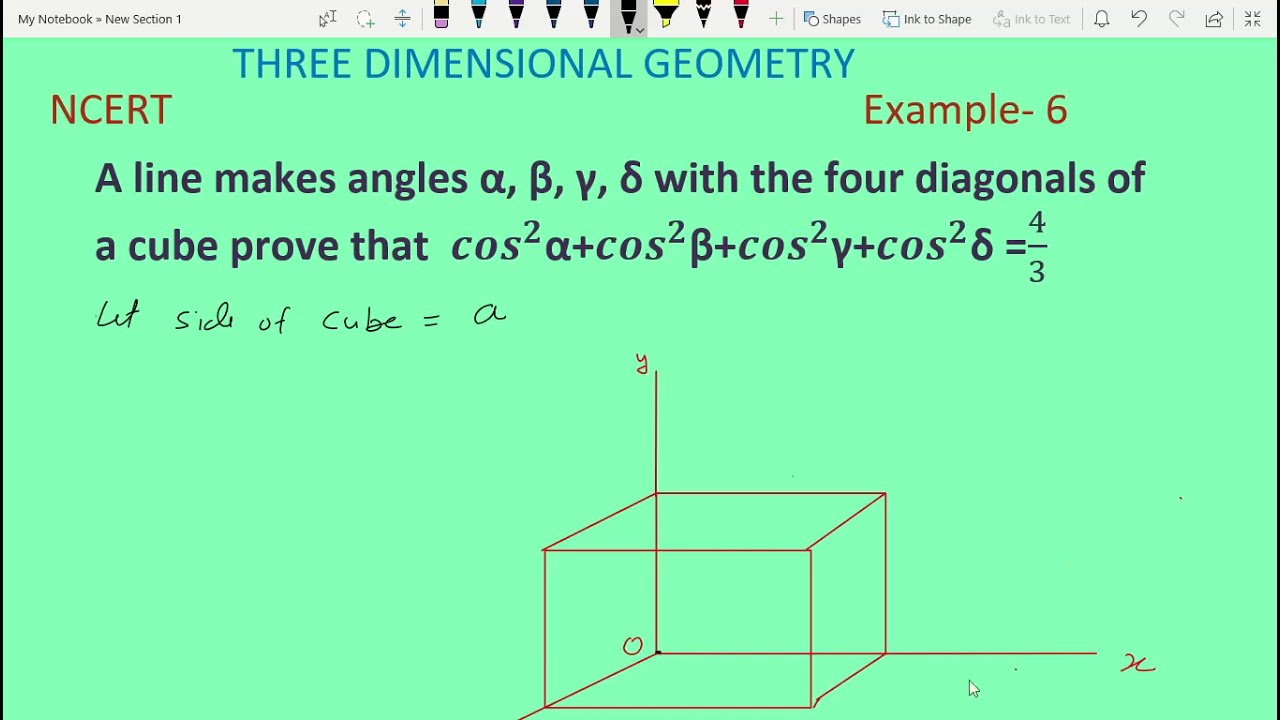
example 6 3d geometry class 12
a line makes angles alpha beta gamma with the diagonals of a cube
A line makes angles alpha,beta,gammaand deltawith the diagonals of a cube, prove that cos^2alpha+cos^2beta+cos^2gamma+cos^2delta=4/3
A line makes angles α, β, γ, δ with the four diagonals of a cube, find the value of 3(cos^2 α + cos^2 ...
idk much of 3d geo myself had learnt it long ago
compact pewterBOT
Channel closed
Closed by @woven loom
Use .reopen if this was a mistake.
tulip spear
quartz yoke
Ncert, example 6? Never seen in it
u know NCERT?
quartz yoke
Im class 12 cbse
tulip spear
ohh im also a 12th grader nice to meet u
quartz yoke
Oh s2u
compact pewterBOT
Available help channel!
Send your question here to claim the channel.
Remember:
• Ask your math question in a clear, concise manner.
• Show your work, and if possible, explain where you are stuck.
• After 15 minutes, feel free to ping <@&286206848099549185>.
• Type the command .close to free the channel when you're done.
• Be polite and have a nice day!
Read #❓how-to-get-help for further information on how to ask a good question, and about conduct in the question channels.
 sullen jewel
So I'm learning about vector spaces and specifically subspaces. The question is the following Is the unit circle S = { (x,y) ∈ R^2 | x^2 + y^2 = 1 } a ubspace of R^2?. As I understood there are 3 requirements to know if a subset V if part of R^n.
- The zero vector is with in V
- If the vectors
uandvare a part of V, thenu+vis also part of V - if the vectors
uandvare a part of V, thenc*vis also part of V for each scalar c ∈ R.
While I can understand that requirement 2 and 3 are both not counting here, I don't understand why the zero vector is also not a part of V? As sin(0) = 0?
 compact pewterBOT
sullen jewel
So I'm learning about vector spaces and specifically subspaces. The question is ...
kind viper
compact pewterBOT
sullen jewel
So I'm learning about vector spaces and specifically subspaces. The question is ...
kind viper
sin(0)=0 has absolutely nothing to do with the fact that the unit circle doesn't pass thru the origin
 brazen quiver
The unit circle is all points (cos(t), sin(t)) if you have sin(0) = 0, then what is cos(0)? Is this point (cos(0), sin(0)) on the unit circle? if so where?
(And why is it not on the origin?)
sullen jewel
Oh alright, so do they mean that the function itself will never pass (0,0)?
kind viper
you've conveniently marked the zero vector (0, 0) in red and the unit circle in blue
they don't pass through each other
or to say it more algebraically, (0, 0) does not satisfy x^2 + y^2 = 1
sullen jewel
kind viper
you've conveniently marked the zero vector (0, 0) in red and the unit circle in ...
Should've mentioned that I'm not the one who drew that
kind viper
you've been a bit loosey-goosey with terminology here esp. with "part"
and "function"
kinda... not what those words mean in that context
 rugged forge
why did you go to sin(x)?
compact pewterBOT
@sullen jewel Has your question been resolved?
Channel closed
Closed by @sullen jewel
Use .reopen if this was a mistake.
Available help channel!
Send your question here to claim the channel.
Remember:
• Ask your math question in a clear, concise manner.
• Show your work, and if possible, explain where you are stuck.
• After 15 minutes, feel free to ping <@&286206848099549185>.
• Type the command .close to free the channel when you're done.
• Be polite and have a nice day!
Read #❓how-to-get-help for further information on how to ask a good question, and about conduct in the question channels.
 icy topaz
Find the greatest value of x for which x satisfies the equation in the image.
compact pewterBOT
icy topaz
Find the greatest value of x for which x satisfies the equation in the image.
icy topaz


An observation:
If we take x = a and (13-x)/(x+1) = b, the equation becomes:
ab(a+b) = 42.
compact pewterBOT
@icy topaz Has your question been resolved?
icy topaz
<@&286206848099549185>
 quiet bison
its not really tough but long
icy topaz
I can certainly use the quartic formula.
quiet bison
ohh
icy topaz
There are no options.
potent berry
icy topaz
But how can we find the roots, easily?
idt you can
why od you want to
!xy
compact pewterBOT
Please show the original problem, exactly as it was stated to you, with the entire original context. A picture or screenshot is best. If the original problem is not in English, then post it anyway! The additional context might still be helpful. Do your best to provide a translation.
icy topaz
potent berry
idt you can
This question came in an olympiad.
 shy current
icy topaz
This question came in an olympiad.
shy current
icy topaz
This question came in an olympiad.
you can just subtract 42 from both sides and begin factoring
compact pewterBOT
icy topaz
This question came in an olympiad.
Please show the original problem, exactly as it was stated to you, with the entire original context. A picture or screenshot is best. If the original problem is not in English, then post it anyway! The additional context might still be helpful. Do your best to provide a translation.
 cold widget
 toxic cipher
icy topaz
toxic cipher
icy topaz
once you arrive at the quartic equation, you could try substituting small values of x and if youre lucky youll get x = 1 as a solution
then factorise out (x - 1) to get a simpler cubic
afterwards you can apply the method you usually use to solve cubics
 civic quartz
toxic cipher
afterwards you can apply the method you usually use to solve cubics
civic quartz
toxic cipher
afterwards you can apply the method you usually use to solve cubics
bro wants him to do cardano
toxic cipher
civic quartz
bro wants him to do cardano
hehe ;)
potent berry
did the olympiad really ask you to find the greatest solution to a random looking equation
civic quartz
potent berry
did the olympiad really ask you to find the greatest solution to a random lookin...
xy issue for sure
potent berry
thats not how normal olympiad questions look
quartz yoke
toxic cipher
afterwards you can apply the method you usually use to solve cubics
just find another rational root lol
toxic cipher
quartz yoke
just find another rational root lol
how?
civic quartz

 civic quartz
we did it like 4 times atp
quartz yoke
civic quartz
its not that deep
 pine thicket
@quartz yoke the op is @icy topaz
let him speak for himself
toxic cipher
toxic cipher
once you arrive at the quartic equation, you could try substituting small values...
another way is to use rational root theorem and test all the possible rational roots @icy topaz
i just remembered that existed
quartz yoke
quartz yoke
the options arent even that many
like 4
civic quartz
quartz yoke
the options arent even that many
?? there are no options ??
he gave solution set for the given equation
toxic cipher
quartz yoke
like 4
plus or minus though
compact pewterBOT
Please show the original problem, exactly as it was stated to you, with the entire original context. A picture or screenshot is best. If the original problem is not in English, then post it anyway! The additional context might still be helpful. Do your best to provide a translation.
quartz yoke
civic quartz
?? there are no options ??
do you know what the rational root theorem is
toxic cipher
honestly i dont doubt that this could be a math olympiad question
quartz yoke
toxic cipher
plus or minus though
||you can see the roots are positive||
pine thicket
quartz yoke
do you know what the rational root theorem is
only works if we know that the max root is rational
icy topaz
potent berry
whihc one
I don't know, but it must have an easy solution.
potent berry
icy topaz
I don't know, but it must have an easy solution.
you dont know where the problem is from?
quartz yoke
pine thicket
only works if we know that the max root is rational
Wdym
You literally just find all the roots
icy topaz
The problem is from a mock test for an olympiad.
potent berry
give a screenshot!!
civic quartz
thats the problem? find x?
icy topaz
Bruh.
potent berry
this is insane
icy topaz
civic quartz
thats the problem? find x?
Find x.
toxic cipher
civic quartz
thats the problem? find x?
find the solutions of x for the equation in the image
icy topaz
 potent berry
alright
pine thicket
quartz yoke
Wdym
if the function is (x-1)(x-2)(x-3), then you would find all the roots
if it is (x - root5)(x + root5)(x - 3 + root6)(x - 3 - root6)
the theorem wont work
quartz yoke
pine thicket
if the function is (x-1)(x-2)(x-3), then you would find all the roots
if it is (...
so youre just saying one should never try to find rational roots
What's the problem in using it then lol
toxic cipher
it's a math olympiad problem, so chances are there would be a rational root
quartz yoke
and ofc one would at least try some rational roots before doing sus stuff
pine thicket
its ok to use that, but we can never be sure whether our ans is correct unless we find all the roots
quartz yoke
if you find two rational roots you're left with a quadratic equation
weak cobalt
Since it's an olympiad it's probably worth setting the factors to 6 and 7 and solving that, checking that it works simultaneously
compact pewterBOT
@icy topaz Has your question been resolved?
Channel closed
Closed by @icy topaz
Use .reopen if this was a mistake.
compact pewterBOT
Available help channel!
Send your question here to claim the channel.
Remember:
• Ask your math question in a clear, concise manner.
• Show your work, and if possible, explain where you are stuck.
• After 15 minutes, feel free to ping <@&286206848099549185>.
• Type the command .close to free the channel when you're done.
• Be polite and have a nice day!
Read #❓how-to-get-help for further information on how to ask a good question, and about conduct in the question channels.
 shrewd helm
 compact pewterBOT
shrewd helm
shrewd helm
compact pewterBOT
shrewd helm
shrewd helm
can someone pls help me for d I am haveing a hard time understNDING D
compact pewterBOT
@shrewd helm Has your question been resolved?
 rotund sphinx
shrewd helm
rotund sphinx
shrewd helm
i. Remember that $\frac{x^a}{x^b}=x^{a-b}$. Applying this to the leading terms, the degree of $p$ is $\deg(f)-1$. \ \
ii. Note that $r$ is the remainder when $f$ is divided by $x-1$. You can now find this using the remainder theorem.
boreal girderBOT
Civil Service Pigeon
 compact pewterBOT
@shrewd helm Has your question been resolved?
shrewd helm
rotund sphinx
i. Remember that $\frac{x^a}{x^b}=x^{a-b}$. Applying this to the leading terms, ...
wait so what is r??/
or what is f(x) because I don't know how to solve this
rotund sphinx
shrewd helm
wait so what is r??/
ii. Note that r is the remainder when f is divided by x-1. You can now find this using the remainder theorem.
Do you remember the remainder theorem?
If not, go back to your notes or look it up
compact pewterBOT
Channel closed
Closed due to timeout
Use .reopen if this was a mistake.
compact pewterBOT
Available help channel!
Send your question here to claim the channel.
Remember:
• Ask your math question in a clear, concise manner.
• Show your work, and if possible, explain where you are stuck.
• After 15 minutes, feel free to ping <@&286206848099549185>.
• Type the command .close to free the channel when you're done.
• Be polite and have a nice day!
Read #❓how-to-get-help for further information on how to ask a good question, and about conduct in the question channels.
 lost shale
 compact pewterBOT
lost shale
compact pewterBOT
lost shale
 twin idol
lost shale
would c be 3 vars, 2 pivots? so 1 free?
twin idol
lost shale
would c be 3 vars, 2 pivots? so 1 free?
They're not 3 vars
lost shale
is it not the 1 1 -5?
twin idol
Wait actually since the 2 rows full of 0 are redundant and the whole if column 3 is 0, then that makes it 3 vars
Yeah you're right
3 vars: 2 pivots, and 1 free
compact pewterBOT
@lost shale Has your question been resolved?
compact pewterBOT
Channel closed
Closed due to timeout
Use .reopen if this was a mistake.
Available help channel!
Send your question here to claim the channel.
Remember:
• Ask your math question in a clear, concise manner.
• Show your work, and if possible, explain where you are stuck.
• After 15 minutes, feel free to ping <@&286206848099549185>.
• Type the command .close to free the channel when you're done.
• Be polite and have a nice day!
Read #❓how-to-get-help for further information on how to ask a good question, and about conduct in the question channels.
 tough canyon
can you help me simplify my equiation so the computer marks it correct?
compact pewterBOT
tough canyon
can you help me simplify my equiation so the computer marks it correct?

 vivid breach
tough canyon
vivid breach
tough canyon
see what happens when x = -5
tough canyon
it is still wrong
after looking at desmos i think i see the issue

oh it apears that i tried to meny times, and it wont let me submit anymore, but can we still try and figure it out?
vivid breach
tough canyon
oh it apears that i tried to meny times, and it wont let me submit anymore, but ...
given its mostly typos, you should be able to figure out the correct function on your own
you shouldve gotten ||y = -7/3 x + 7/3 (-5) - 2||
tough canyon
how did you get y=-7/3 instead of y=(-7)/3
vivid breach
youre telling me -7/3 and (-7)/3 are different numbers?
tough canyon
mb this is what i mean
vivid breach
if youre dividing -7 by 3, theres no use in distinguishing where the - sign is
-7 / 3 is -7/3
 vivid breach
thats not how division works
if you divide a negative by a positive, you know you get a negative
vivid breach
different
 vivid breach
look closer at what you typed
tough canyon
oh +2 vs -2
vivid breach
and also?
tough canyon
and -5
tough canyon
oh i missed the - in my calulations on paper
vivid breach
this wouldve worked for (5, 2) instead of (-5, -2)
did you also notice that the -7/3 is +7/3?
tough canyon
i see
tough canyon
vivid breach
did you also notice that the -7/3 is +7/3?
where?
 tough canyon
hmm, I dont know, I must have missed some negatives in the cancellation of each side.
i have to remember to check the sign
vivid breach
going off of that, you shouldve originally typed
,,y=\frac{-7}3x+\left(\frac{-7}3(5)-2\right)
boreal girderBOT
mtt
 vivid breach
$\frac{-7}3(5)=\frac73(-5)$, which is then how this lines up with my spoiler solution
boreal girderBOT
mtt
 tough canyon
oh wait but doest this get flipped? when you subtract -7/3(5) on both sides?
nvm it wouldent be right if i did that
 nocturne frigate
Wait, even if you simplified, isn't that not correct for your question? It's looking for a parallel line that goes through (-5,-2)
vivid breach
yes, theres two typos which he missed
tough canyon
and also the software told me to simplify or it was wrong
vivid breach
you dont know that since you just gave a wrong answer
vivid breach
if you want to be sure, you can try on another question like this then simplify only halfway
tough canyon
let me try, there is a awesome try another button here
nocturne frigate
I think there was even more problems going on than the sign errors honestly
vivid breach
it appears to only be the sign errors
it sounds like nuka doesnt know what the result would intuitively act like and is just trusting the algebra
that makes sense but it does make typos very hard to spot
tough canyon
yea i am new
nocturne frigate
oh yeah it is just the sign errors sorry, dont do drunk math
vivid breach
with how messy it looks unsimplified, its hard to see what the right way around wouldve been first
nocturne frigate
yeah it was really throwing me for a loop for a second 😅
tough canyon
what did i do wrong this time?

its really close
if its helpfull heres my paper math
tough canyon
thats great thank you very much
vivid breach
np
tough canyon
yes it was
vivid breach
nice
tough canyon
if u where grading a test and i submited that without simplifying would u mark it wrong?
vivid breach
I wouldnt consider it a problem because I know where you got the numbers from
Id wonder where the 2 came from
simplifying is for after the hard part, and Id only be testing on the hard part anyway
tough canyon
got it, thank you very much
vivid breach
yep
if the solution turns out to look really nice after simplifying, thatd be when simplifying would be more required
for example, x + 2 - 2
tough canyon
i see yea thats a lot more steps
compact pewterBOT
@tough canyon Has your question been resolved?
Channel closed
Closed by @tough canyon
Use .reopen if this was a mistake.
Available help channel!
Send your question here to claim the channel.
Remember:
• Ask your math question in a clear, concise manner.
• Show your work, and if possible, explain where you are stuck.
• After 15 minutes, feel free to ping <@&286206848099549185>.
• Type the command .close to free the channel when you're done.
• Be polite and have a nice day!
Read #❓how-to-get-help for further information on how to ask a good question, and about conduct in the question channels.
compact pewterBOT
Channel closed
Channel closed due to the original message being deleted.
If you did not intend to do this, please open a new help channel,
as this action is irreversible, and this channel may abruptly lock.
compact pewterBOT
Available help channel!
Send your question here to claim the channel.
Remember:
• Ask your math question in a clear, concise manner.
• Show your work, and if possible, explain where you are stuck.
• After 15 minutes, feel free to ping <@&286206848099549185>.
• Type the command .close to free the channel when you're done.
• Be polite and have a nice day!
Read #❓how-to-get-help for further information on how to ask a good question, and about conduct in the question channels.
 pliant canopy
I really dont understand how i take the limit as t approaches infinity
 compact pewterBOT
pliant canopy
I really dont understand how i take the limit as t approaches infinity
pliant canopy
compact pewterBOT
pliant canopy
I really dont understand how i take the limit as t approaches infinity
pliant canopy
I think i understand how to setup everything until i get to evaluating i just dont get it
 viscid canopy
pliant canopy
I really dont understand how i take the limit as t approaches infinity
viscid canopy
pliant canopy
I really dont understand how i take the limit as t approaches infinity
as t grows larger
1/sqrt(t) grows smaller
as t->inf, 1/sqrt(t) -> zero
you are just taking the limit as t->infinity for the whole definite integral
pliant canopy
So can i say the limit is 0
viscid canopy
yes
pliant canopy
for that integral
viscid canopy
for the bound of t
the constant is not affected
lim k = k
x->a
where k is a constant
therefore the integral evaluates to 2
pliant canopy
So its like if i imagine plugging in 0,1,2,3… so on and know that as the numbers grow the function gets smaller? And it gets closer to 0 so it ends up just being 0?🧍♀️
viscid canopy
yeah thats how limit to infinities work!
you imagine plugging in larger and larger values of t. if the limit settles to some finite value then we say the limit converges
pliant canopy
i hate this😔 it seems like it shouldnt be difficult but my brain is having a hard time
viscid canopy
thats okay. limits are often the trickiest part of calculus
pliant canopy
If there was a question where like t->5 would i imagine plugging in all possible numbers before 5 including 5?
viscid canopy
depends if the function is defined at that point, then you can indeed plug in 5 and get the limit
pliant canopy
if i plug in 5 it discontinues
viscid canopy
for example, here:
lim (x^2-10x+25)/(x-5)
x->5
you cannot directly plug in x=5
but the truth is that the limit does not care about what happens at x=5
you are only checking the behaviour when x is really close to 5 so like what happens when x is
5.000000001, 5.00000000000001, and so on
or
4.999999999, 4.99999999999999
viscid canopy
viscid canopy
for example, here:
lim (x^2-10x+25)/(x-5)
x->5
you cannot directly plug in x=5
turns out we can factor x^2-10x+25 = (x-5)^2
so we can cancel out (x-5)^2 / (x-5) = x-5
given x≠5
remember the limit does not care about x=5 so we can just let x->5 and see the behaviour. For x values close to 5, we see the limit approaches 0
but to be clear: the function is NOT defined at x=5
viscid canopy
not really, there isnt a full blown generalization to solving limits like there is with derivatives
i can link you a video that is quite long but u only need to watch a section. would u want that? 
pliant canopy
if it would help yes :)
viscid canopy

Learn Calculus 1 in this full college course.
This course was created by Dr. Linda Green, a lecturer at the University of North Carolina at Chapel Hill. Check out her YouTube channel: https://www.youtube.com/channel/UCkyLJh6hQS1TlhUZxOMjTFw
This course combines two courses taught by Dr. Green. She teaches both Calculus 1 and a Calculus 1 Coreq...
just watch the section on computing limits using algebraic techniques
pliant canopy
Okay thanks
compact pewterBOT
@pliant canopy Has your question been resolved?
compact pewterBOT
Channel closed
Closed due to timeout
Use .reopen if this was a mistake.
compact pewterBOT
Available help channel!
Send your question here to claim the channel.
Remember:
• Ask your math question in a clear, concise manner.
• Show your work, and if possible, explain where you are stuck.
• After 15 minutes, feel free to ping <@&286206848099549185>.
• Type the command .close to free the channel when you're done.
• Be polite and have a nice day!
Read #❓how-to-get-help for further information on how to ask a good question, and about conduct in the question channels.
 karmic stirrup
this question was in my quiz and its asking to prove that these three points are collinear. keep in mind that i just started this whole 3d thing and idk what cross multiplication is,
how was i supposed to solve this question?
 compact pewterBOT
karmic stirrup
this question was in my quiz and its asking to prove that these three points are...
karmic stirrup
compact pewterBOT
karmic stirrup
this question was in my quiz and its asking to prove that these three points are...
karmic stirrup
perhaps someone will ask for proof if im still in the quizz or not

in the "intended" answer, it says that AB + BC = AC
what the fuck?
oh my god that makes sense
but why wasnt i told this the first time i asked 😭
ig thats fine
.close
compact pewterBOT
Channel closed
Closed by @karmic stirrup
Use .reopen if this was a mistake.
 midnight stream
bro created the ticket, ranted, reached a conclusion and left
 random path
pro
potent berry
love this
potent berry
karmic stirrup
oh my god that makes sense
triangle inequality
compact pewterBOT
Available help channel!
Send your question here to claim the channel.
Remember:
• Ask your math question in a clear, concise manner.
• Show your work, and if possible, explain where you are stuck.
• After 15 minutes, feel free to ping <@&286206848099549185>.
• Type the command .close to free the channel when you're done.
• Be polite and have a nice day!
Read #❓how-to-get-help for further information on how to ask a good question, and about conduct in the question channels.
 wintry knot
three doors, the first one red, the second one blue, and the third one green.
Behind one of the doors is a path to freedom. Behind the other two doors,
however, is an evil fire-breathing dragon. Opening a door to the dragon means
almost certain death.
On each door there is an inscription: Red door (freedom is behind this door); Blue door (freedom is not behind this door); Green door (freedom is not behind the blue door). Given the fact that at least one of the three statements on the three doors is true and at least one of them is false, which door would lead the boys to safety?``` can someone please verify if my work is correct? compact pewterBOT
Channel closed
Closed by @wintry knot
Use .reopen if this was a mistake.
compact pewterBOT
Available help channel!
Send your question here to claim the channel.
Remember:
• Ask your math question in a clear, concise manner.
• Show your work, and if possible, explain where you are stuck.
• After 15 minutes, feel free to ping <@&286206848099549185>.
• Type the command .close to free the channel when you're done.
• Be polite and have a nice day!
Read #❓how-to-get-help for further information on how to ask a good question, and about conduct in the question channels.
 floral kelp
guys i need help. i dont understand how they multiply the denominator :(((
 compact pewterBOT
floral kelp
guys i need help. i dont understand how they multiply the denominator :(((
floral kelp
compact pewterBOT
floral kelp
guys i need help. i dont understand how they multiply the denominator :(((
floral kelp
why does the denominator not change omggg
 mild sky
The 1-tan^2 in the denominator ia canceled by some part of the numerator
Look the the 1-tan^2 in the numerator has an exponent of 2 before the simplificafion and 1 after it
floral kelp
OHHH
floral kelp
mild sky
Look the the 1-tan^2 in the numerator has an exponent of 2 before the simplifica...
THANKU SO MUCH!
holdon
floral kelp
mild sky
Look the the 1-tan^2 in the numerator has an exponent of 2 before the simplifica...
ohhh i get it
thankss again
.close
compact pewterBOT
Channel closed
Closed by @floral kelp
Use .reopen if this was a mistake.
Available help channel!
Send your question here to claim the channel.
Remember:
• Ask your math question in a clear, concise manner.
• Show your work, and if possible, explain where you are stuck.
• After 15 minutes, feel free to ping <@&286206848099549185>.
• Type the command .close to free the channel when you're done.
• Be polite and have a nice day!
Read #❓how-to-get-help for further information on how to ask a good question, and about conduct in the question channels.
 molten badger
Given tetrahedron OABC with edges OA, OB, OC, which are all mutually perpendicular. Let M be any point within the triangle ABC. Find the minimum value of $T=\frac{MA^2}{OA^2} + \frac{MB^2}{OB^2} + \frac{MC^2}{OC^2}$
compact pewterBOT
molten badger
Given tetrahedron OABC with edges OA, OB, OC, which are all mutually perpendicul...
boreal girderBOT
Alexis_Fx
 molten badger

 prime loom
ok since were doing minimization, cant u let OA=OB=OC=1?
then use some coords O=(0, 0, 0)
molten badger
prime loom
ok since were doing minimization, cant u let OA=OB=OC=1?
 idk, probably prove it first
yeah O(0,0,0)
prime loom
I mean... since the question asks for any tetrahedron
quartz yoke
molten badger
<:pandathink:524885344995508235> idk, probably prove it first
wait so OABC is not fixed?
prime loom
cant we just take the simplest one and then find minima?
molten badger
hold on
prime loom
then T = MA^2+MB^2+MC^2
molten badger
Does it fixed lol
prime loom
its obv. minima at MA=MB=MC
molten badger
prime loom
then T = MA^2+MB^2+MC^2
I mean it's too easy to go on from this
prime loom
yep
it becomes 2 I believe
but I dont think this is an acceptable method is an olympiad ngl
quartz yoke
its not acceptable in general lol
prime loom
lol
true
ok u have the answer with kinda cool method, but no solid proof
that work for you?
molten badger
prime loom
ok u have the answer with kinda cool method, but no solid proof
lol, nah
i don't think so
I mean I have no clue myself
molten badger
prime loom
like extremely 99.999... % sure
I mean if they ask for any tetrahedron then it's true for OA=OC=OB
but uh...
prime loom
yeah ig its unacceptable
molten badger
alright I got the solution from my teacher
prime loom
ooh spill

 prime loom
oh so take a,b,c
prime loom
lol who tf is doin allat
quartz yoke
imagine bashing
prime loom
I would pass out halfway thru those expressions
quartz yoke
L
quartz yoke
find a way to make it acceptable
compact pewterBOT
Channel closed
Closed by @molten badger
Use .reopen if this was a mistake.
molten badger
quartz yoke
fuck the lemoine point
what was that
quartz yoke
molten badger
what was that
nothing i thought the lemoine point messed up my sol
but it doesnt, so i have a sol
which is less bashy
 sharp drum
molten badger
Apparently we suppose to use coordinate and inequality lol
sharp drum
molten badger
Apparently we suppose to use coordinate and inequality lol
💀💀
average vietnamese highschool geo problem
compact pewterBOT
Available help channel!
Send your question here to claim the channel.
Remember:
• Ask your math question in a clear, concise manner.
• Show your work, and if possible, explain where you are stuck.
• After 15 minutes, feel free to ping <@&286206848099549185>.
• Type the command .close to free the channel when you're done.
• Be polite and have a nice day!
Read #❓how-to-get-help for further information on how to ask a good question, and about conduct in the question channels.
 slim garnet
I messed up my first try so Imma start over here
 compact pewterBOT
slim garnet
I messed up my first try so Imma start over here
compact pewterBOT
slim garnet
I messed up my first try so Imma start over here

 native shard
did you integrate 3x^3/(x^2 + 1)
slim garnet
yes
native shard
what did you get


 native shard
seems fine
slim garnet
I think I messed up the first time by dropping the 3/2
native shard
,w integrate 3x^3/(x^2 + 1)
boreal girderBOT

 native shard
yours looks different because of the constant but it’s the same
the 3/2 can be multiplied by the x^2 + 1 then you can split the constant off
slim garnet
 native shard
the left side is the derivative of what
slim garnet
the P(x)
native shard
well
slim garnet
ooh
native shard
the integrating factor times y
 native shard
yes
slim garnet
ugh this integral is gonna be annoying
slim garnet
yes thanks for stopping by have a great day!
compact pewterBOT
@slim garnet Has your question been resolved?
slim garnet
.close
compact pewterBOT
Channel closed
Closed by @slim garnet
Use .reopen if this was a mistake.
compact pewterBOT
Available help channel!
Send your question here to claim the channel.
Remember:
• Ask your math question in a clear, concise manner.
• Show your work, and if possible, explain where you are stuck.
• After 15 minutes, feel free to ping <@&286206848099549185>.
• Type the command .close to free the channel when you're done.
• Be polite and have a nice day!
Read #❓how-to-get-help for further information on how to ask a good question, and about conduct in the question channels.
 soft fern
Q: Find the inverse of $f(x) = 3x - 2$.
Steps:
1. replace $f(x)$ with $y$
$$
y = 3x-2
$$
2. swap $x$ & $y$
$$
x = 3y-2
$$
3. solve for $y$
$$
-3y+x=-2
$$
$$
-3y=-2-x
$$
$$
y=\frac{-2-x}{-3}
$$
I'm confused about how this negative sign gets distributed and simplified from this step to the final answer
A: $f⁻¹(x) = \frac{x+2}{3}$
compact pewterBOT
soft fern
**Q:** Find the inverse of $f(x) = 3x - 2$.
**Steps:**
*1.* replace $f(x)$ wi...
 tired rock
multiply both top and bottom by -1
boreal girderBOT
Tubberware
Compile Error! Click the  reaction for more information.
(You may edit your message to recompile.)
 compact pewterBOT
Channel closed
Closed by @soft fern
Use .reopen if this was a mistake.
compact pewterBOT
Available help channel!
Send your question here to claim the channel.
Remember:
• Ask your math question in a clear, concise manner.
• Show your work, and if possible, explain where you are stuck.
• After 15 minutes, feel free to ping <@&286206848099549185>.
• Type the command .close to free the channel when you're done.
• Be polite and have a nice day!
Read #❓how-to-get-help for further information on how to ask a good question, and about conduct in the question channels.
 dawn thorn
Can someone help me on 13?Sorry for being in portuguese
 compact pewterBOT
dawn thorn
Can someone help me on 13?Sorry for being in portuguese
dawn thorn
compact pewterBOT
dawn thorn
Can someone help me on 13?Sorry for being in portuguese
dawn thorn
Idk were to start
 craggy sluice
can you translate the question for us?
weak cobalt
,rccw
boreal girderBOT
 weak cobalt
The figure is a regular hexagon of side a units. Thus RQ dot PO is...
I'm assuming R is cropped off
 dawn thorn
I know the product role but idk how to apply here
weak cobalt
Can you state any formula you know for the dot product?
dawn thorn
 weak cobalt
$\vec{AB} = A \cdot B \cos \theta$
boreal girderBOT
Nel
 weak cobalt
This?
weak cobalt
dawn thorn
Being ab the norm
Which one? With the arrow on top?
The way you've written it, "AB" is a vector, but then you have A and B separately, so it doesn't really work
Do you know what's wrong?
 weak cobalt
Ok that's better but still wrong
There should only be an angle in the cos; what did you try to do with cos(v,v)?
dawn thorn
weak cobalt
There should only be an angle in the cos; what did you try to do with cos(v,v)?
Should it be a and b?
weak cobalt
You probably should look for the formula in your textbook because this is not going to work
dawn thorn
weak cobalt
You probably should look for the formula in your textbook because this is not go...
Ohhh the vector of(a,b)
Of both
I mean
weak cobalt
The angle between them?
dawn thorn
weak cobalt
The angle between them?
 weak cobalt
,rccw
boreal girderBOT
 weak cobalt
 that's the first time I see this notation, but fair enough

Ok so do you understand how to apply this formula? Like what would be u and v in your problem?
The problem is asking for $\vec{RQ} \cdot \vec{PO}$
boreal girderBOT
Nel
 dawn thorn
weak cobalt
<:pandahmm:858834883760750602> that's the first time I see this notation, but f...
dawn thorn
weak cobalt
<:pandahmm:858834883760750602> that's the first time I see this notation, but f...
No
@weak cobalt
weak cobalt
weak cobalt
Ok so do you understand how to apply this formula? Like what would be u and v in...
Yeah, can you answer this
dawn thorn
weak cobalt
Yeah, can you answer this
,idk tbh
weak cobalt
I mean... I'm only asking you to apply the formula
dawn thorn
weak cobalt
I mean... I'm only asking you to apply the formula
Ohhh
weak cobalt
I'm not expecting a concrete result, just what RQ dot PO looks like
dawn thorn
Rq•po○cos(rq,po) being rq a vector in () and po a vector in ()
weak cobalt
It would be easier if you wrote that down on paper I think

 cerulean bramble
,rccw
boreal girderBOT
 weak cobalt
Yes ok that looks better
Now all you need to do is find the values for each part
$||\vec{RQ}|| = ?$
boreal girderBOT
Nel
 dawn thorn
boreal girder
**Nel**
dawn thorn
boreal girder
**Nel**
Thats what idk vro
 dawn thorn
weak cobalt
dawn thorn
weak cobalt
Ahhh the part that says "lado a"?
weak cobalt
Yes
dawn thorn
dawn thorn
Wait a little bit,i think i got it
I am kinda stuck here
a²○cos(a,a)
@weak cobalt
weak cobalt
You can't just do cos(a,a)
Inside the cos, you need the angle between the two vectors
dawn thorn
weak cobalt
Inside the cos, you need the *angle* between the two vectors
Ohhh
And how do i find them?
weak cobalt
Well the vectors are shown in the picture along with a regular hexagon
Should be easy to figure out
dawn thorn
weak cobalt
Be careful though, it's 120º (degrees), not 120 (radians)
Oh yes 120⁰
weak cobalt
So what's cos(120º)?
dawn thorn
weak cobalt
So what's cos(120º)?
-(1/2)soooo the answer is c
 weak cobalt
Yes!
compact pewterBOT
Channel closed
Closed by @dawn thorn
Use .reopen if this was a mistake.
compact pewterBOT
Available help channel!
Send your question here to claim the channel.
Remember:
• Ask your math question in a clear, concise manner.
• Show your work, and if possible, explain where you are stuck.
• After 15 minutes, feel free to ping <@&286206848099549185>.
• Type the command .close to free the channel when you're done.
• Be polite and have a nice day!
Read #❓how-to-get-help for further information on how to ask a good question, and about conduct in the question channels.
 strange pendant
how do I prove product of limits in multivariable?
compact pewterBOT
strange pendant
how do I prove product of limits in multivariable?
winged lion
strange pendant
how do I prove product of limits in multivariable?
have you proved product of limits in single variable
strange pendant
yes
winged lion
so then i think the idea should be the same
though i cannot walk you through as i will go to sleep soon
strange pendant
can you elaborate?
 boreal dawn
I can help in ~20-30min
boreal dawn
strange pendant
how do I prove product of limits in multivariable?
to start, how are you defining a limit?
boreal dawn
Are you using pythagorean distance formula?
Is it just a multivariable domain, or multivariable range too?
strange pendant
boreal dawn
Is it just a multivariable domain, or multivariable range too?
R2 -> R2 for this purposes
strange pendant
boreal dawn
Are you using pythagorean distance formula?
yes

@boreal dawn @boreal dawn @boreal dawn
 dense dagger
!noping
compact pewterBOT
Please do not ping individual helpers unprompted.
strange pendant
dense dagger
!noping
it was just a reminder since he said he will be available in 20 min
hopefully he is able to be back soon
compact pewterBOT
@strange pendant Has your question been resolved?
boreal dawn
@strange pendant I am back
compact pewterBOT
@strange pendant Has your question been resolved?
 boreal dawn
Okay, so the idea is going to be pretty similar actually. How you choose your delta and how you break down the product should be pretty similar between single and multiple variables
Have you started any work on the multivariable limit yet?
strange pendant
boreal dawn
Okay, so the idea is going to be pretty similar actually. How you choose your de...
any feedback on the single variable proof?
boreal dawn
taking a look right now
strange pendant
feel free to ask if something is unclear with the proof, there is a lot going on
boreal dawn
no worries. I've seen this proof quite a few times 🙂
@strange pendant your single variable proof looks just fine
strange pendant
so, how to generalize it to R2?
boreal dawn
It's really the same idea. What does $\lim_{(x,y)\to(a, b)} f(x, y)=L_1$ mean? And same for $g$? How would you set up the limit of the product?
boreal girderBOT
SWR
 strange pendant
 boreal dawn
I see. So your difficutly is probably with the pythagorean distance?
strange pendant
i mean if 0 < ||(x-a, y-b) || < delta1 and 0 < ||(x-a, y-b) || < delta2
then surely 0 < ||(x-a, y-b) || < min{delta1, delta2} = delta
strange pendant
boreal dawn
I see. So your difficutly is probably with the pythagorean distance?
im new to multivariable
boreal dawn
well so far you are doing fine
strange pendant
can I confess you something?
I dont understand any of this epsi delta thingymagic?
boreal dawn
oh yeah? You're using it well
strange pendant
for me is like saying some magic words, and then bounding stuff
?
what is the difference between this and sandwich theorem? 🥪
strange pendant
boreal dawn
oh yeah? You're using it well
how does 0 < sqrt((x-a)^2) < delta imply |f(x) - L| < epsilon?
boreal dawn
That's hard to say. It's an apples-oranges comparison
sandwich theorem is an application of limit properties
strange pendant
when you prove a limit exists and reaches a certain value you bound stuff aswell with sandwich
boreal dawn
strange pendant
how does 0 < sqrt((x-a)^2) < delta imply |f(x) - L| < epsilon?
It doesn't implicitly. Finding such a $\delta$ to satisfy any $\varepsilon$ is how we define a limit
boreal girderBOT
SWR
 boreal dawn
It would help to think of $\varepsilon$ and $\delta$ in plain english terms. $\varepsilon$ is often called the $\textbf{allowed error}$, and $\delta$ is called the $\textbf{sufficient distance}$
boreal girderBOT
SWR
 boreal dawn
The idea of a limit is that, given any allowable error, you can always find a sufficient distance such that the function will always map within that allowed error so long as the domain is within the sufficient distance
strange pendant
it is never mentioned, but epsilon is a real positive number?
boreal girderBOT
SWR
 boreal dawn
The allowed error must be any positive number
zero error would mean that f(x) has to match the limit L exactly, which isn't helpful for the idea of a limit
And negative error makes zero sense
strange pendant
ok another question
why if a limit exists at a certain value we say there is a deltadistance that is nonzero with the point, also, do yyou jafe a draw ing a opicture so we can understand this better or no
sufficient distance?
boreal dawn
we say there is a deltadistance that is nonzero with the point
Not sure what you mean here
strange pendant
like, 0 < ||(x,y) - (a,b)|| < delta
this is pythagorean distance
sqrt((x-a)^2 + (y-b)^2)
why is it stricltly greater than 0
also, isnt this the equation of a circle? the distance between 2 points in R2?
do you see what I mean?
there is a nonzero distance that we are investigating between the point we are approaching to and the (x,y) variables
boreal dawn
strange pendant
why is it stricltly greater than 0
because delta represents a distance
strange pendant
there is a drawing?
boreal dawn
strange pendant
also, isnt this the equation of a circle? the distance between 2 points in R2?
If x and y are free variables, but they are fixed coordinates in the context of this limit
strange pendant
we are investigating the neighborhood of (x-a,y-b) no?
boreal dawn
correct
strange pendant
if the limit exists, then there is a deleted neighborhood such that there is a nonzero distance between (x,y) and (a,b)
something like dat
do you have a drawing or not?
boreal dawn
im drawing it

 boreal dawn
im drawing it
boreal dawn
boreal dawn
im drawing it

strange pendant
ok, I will start doing the proof in the meantime take ur time
please draw a lot of balls
boreal dawn
strange pendant
please draw a lot of balls
I won't
I'm just giving a basic geometric drawing of epsilon-delta limit
Let's say you have some function, and some point where you want to find the limit

You start by choosing any arbitrary $\varepsilon>0$
boreal girderBOT
SWR
 boreal dawn

This is your allowable error
That is, can you find an x-interval such that all f(x) are within the $\varepsilon$-distance from your limit?
boreal girderBOT
SWR
 boreal dawn
the dashed line
You want all of your f(x) to be within that dashed line
If they are, then all of your f(x) are within the allowable error
strange pendant
ok
strange pendant
boreal dawn
That is, can you find an x-interval such that all f(x) are within the $\varepsil...
wdym?
boreal dawn
Are you familiar with sets?
strange pendant
epsilon indicates distance and delta is amount of error?
strange pendant
boreal dawn
Are you familiar with sets?
only basic very introductory basic set theory
boreal dawn
strange pendant
epsilon indicates distance and delta is amount of error?
epsilon and delta both represent distance. epsilon represents distance along the y axis, and delta along the x axis (in the single-variable sense)
Are you familiar with functions with sets? And intervals?
Do you know that the interval $(0, 2)$ is a set? Would you know how to describe the set $f((0, 2))$ if $f(x)=x^2$?
boreal girderBOT
SWR
 strange pendant
(0,2) in R2?
boreal dawn
Not quite.
Okay nevermind, that won't help you here if you're not comfortable with the notation
strange pendant
I am not
boreal dawn
Basically, these solid black lines are you delta distance

If all of your x are within that interval, then all of your f(x) will be within the epsilon interval
strange pendant
whats your point?
boreal dawn
That's basically what a limit is requiring you to do.
strange pendant
how does this motivate lim f(x) = L <=> 0 < |x - a| < delta => |f(x) - L| < epsi
boreal dawn
$\varepsilon$ is an interval around $L$. You want you find an interval around $a$ so that every $f(x)$ in that interval will be within your $\varepsilon$ interval
boreal girderBOT
SWR
 boreal dawn
I am simply trying to explain in plain words/visually the definition of a limit
 boreal dawn
A is point. Let's say its coordinates are (a, L). My bad for not labelling it better
 boreal dawn
hm?
strange pendant
there is an interval in y axis, that is the epsilon distance
between (a,L) and (a,epsilon)
or what?
boreal dawn
strange pendant
between (a,L) and (a,epsilon)
The interval would be $(L-\varepsilon, L+\varepsilon)$
boreal girderBOT
SWR
 strange pendant
when we say
lim_{x to a} f(x) = L <=> 0 < sqrt((x-a)^2) < delta, there is an amount of error because otherwise we would be exactly at (a,L)
boreal dawn
basically, yeah.
strange pendant
delta is distance along x axis
boreal dawn
We don't care what f(a) is. We care about what f(x) is for any x near a
strange pendant
 boreal dawn
yea
as long as your x stays within those delta bounds, f(x) will stay within your epsilon bounds, which means that limit of f at x0 would be L
strange pendant
sure, the issue is I dont see why you say (L - epsi, L + epsi)
thats the deleted neighborhood?
that surrounds (a,L)?
boreal dawn
Because it is the interval here
 boreal dawn
strange pendant
thats the deleted neighborhood?
boreal dawn
strange pendant
thats the deleted neighborhood?
No, the deleted neighborhood is $(a-\delta, a+\delta)-{a}$
boreal girderBOT
SWR
 boreal dawn
Good. The idea is that, if $x$ is in that deleted $\delta$-neighborhood, and if $f(x)$ is in the $\varepsilon$-neighborhood, then the limit condition is satisfied
boreal girderBOT
SWR
 boreal dawn
In multivraible, the idea is very similar, but your $\delta$-neghborhood is no longer an interval centered at $a$, but a disc of radius $\delta$ centered at $(a, b)$
boreal girderBOT
SWR
 strange pendant
disc?
boreal dawn
But, same thing otherwise. If your $(x, y)$ is in the deleted $\delta$-neighborhood, and if $f(x, y)$ is in the $\varepsilon$-neighborhood, then the limit is satisfied
boreal girderBOT
SWR
 boreal dawn
strange pendant
disc?
boreal dawn
strange pendant
disc?
a filled circle
Your $\delta$ neighborhood is the set of all points less than $\delta$ from $(a, b)$, which forms a circle
boreal girderBOT
SWR
 boreal dawn
an open circle, if you are familiar with open and closed sets
strange pendant
we havent covered sets other than basic introductory set theory
coming back to the proof
can we do it or no?
boreal dawn
sure
strange pendant
i think multivariable intuition is something that is hard to grasp, but just assuming the def of precise def of the limit
it will be not too complex to proof, hopefully
can you help me or not?
boreal dawn
yes I can
try to just do the same things you did in your single-variable proof
It's the same for most of it
strange pendant
 boreal dawn
yeah you're fine so far
strange pendant
now what?
boreal dawn
what did you do next for your single-variable proof?
strange pendant
I sum 0
strange pendant


 boreal dawn
strange pendant
boreal dawn
strange pendant
It should be this long
boreal dawn
what do you have so far?
I've written proofs that have taken 11 pages before
2 is nothing
11 is nothing
 boreal dawn
okay but your proof is fine so far. Just keep following the single variable proof
 boreal dawn
recall what you did here

 boreal dawn
How do you what
boreal dawn
How did you do it for single variable proof?
strange pendant
no
the mistake is in the multivariable


ohh I see the mistake now
let me fix dis

@boreal dawn @boreal dawn @strange pendant
dude
can we conclude?
strange pendant
boreal dawn
I've written proofs that have taken 11 pages before
at this point writing it in latex would be wiser
because the picture quality is being compressed
@boreal dawn @boreal dawn @boreal dawn @boreal dawn @boreal dawn
im close to concluding but idk how to join the pieces together
boreal dawn
strange pendant
<@374795910032523266> <@374795910032523266> <@374795910032523266> <@374795910032...
please stop ping spamming me
It looks fine
but I'm also tired
strange pendant
Idk how to conclude
boreal dawn
I'm gonna leave you with the same thing I've been saying over and over
just follow the single variable proof
how did you conclude that one?
It's really just the exact same proof
strange pendant
i think I made a mistake in the single variable proof

look at this part
you see the mistake?
this is why I say its much better to do it on latexx
because then little stuffs like this happen if I do it on paper
strange pendant
boreal dawn
just follow the single variable proof
can I send you the proofs fixed via DMs? tomorrow morning?
I am also tired and this is ridiculous, I am planning on writting them on latex
writing them on paper is just nonsense
boreal dawn
i don't do dm. just ask someone else tomorrow, there are plenty of helpful people here\
boreal dawn
strange pendant
the other proofs regarding this were cleaner?
wdym
strange pendant
about the product of two limits?
like, less wording less computations or something, messy epsilon choices?
this feels like an odd proof from my part
like I am not proving anything extraordinary and its taking me pages of writing
just figuring out the epsilons, explaining the bounds
strange pendant
ask who?
oh the other helpers
well yeah its whatever I will look out other proofs on the internet
mine is too long, usually this should take max a couple lines
I dont believe taking a couple pages writing a proof of the product limit is anything that people would read
people most likely has figured out ways to short it out and make it less of a caveman proof like mines
maybe I will ask math stack exchange, there is always crazy people in there
this wasnt part of the exercises for my multivar course
but the sum of limits was part of the homework to be proved using precise definition of the limit
and that kept me thinking, product of limits then might aswell could be proved hmm?
but wasnt really mandatory and maybe I will just leave it at that
since I also need to progress on the other exercises from my homework
I appreciate the help
I think we made remarkable progress but yeah sorry I was afk for a bit, I had to answer a call from my granny
I appreciate you helping me with the precise definition of the limit to be understandable graphically
anyways, have a great day, I will continue with my other hw
.close
compact pewterBOT
Channel closed
Closed by @strange pendant
Use .reopen if this was a mistake.
boreal dawn
strange pendant
mine is too long, usually this should take max a couple lines
nah, again, this is a longer proof
boreal dawn
strange pendant
but the sum of limits was part of the homework to be proved using precise defini...
that one is much easier
compact pewterBOT
Available help channel!
Send your question here to claim the channel.
Remember:
• Ask your math question in a clear, concise manner.
• Show your work, and if possible, explain where you are stuck.
• After 15 minutes, feel free to ping <@&286206848099549185>.
• Type the command .close to free the channel when you're done.
• Be polite and have a nice day!
Read #❓how-to-get-help for further information on how to ask a good question, and about conduct in the question channels.
 ionic plover
hi what is modular arithemetic used for?
compact pewterBOT
ionic plover
hi what is modular arithemetic used for?
viscid canopy
ionic plover
hi what is modular arithemetic used for?
ive seen it pop up in programming usually and im guessing cryptography also uses modular arithmetic frequently
ionic plover
ohhh cool
viscid canopy
this is an example in the context of pseudorandom generators
specifically the section on linear congruential generator
compact pewterBOT
Channel closed
Closed by @ionic plover
Use .reopen if this was a mistake.
Available help channel!
Send your question here to claim the channel.
Remember:
• Ask your math question in a clear, concise manner.
• Show your work, and if possible, explain where you are stuck.
• After 15 minutes, feel free to ping <@&286206848099549185>.
• Type the command .close to free the channel when you're done.
• Be polite and have a nice day!
Read #❓how-to-get-help for further information on how to ask a good question, and about conduct in the question channels.
wintry knot
can someone please check where have i gone wrong?
 compact pewterBOT
wintry knot
can someone please check where have i gone wrong?
compact pewterBOT
wintry knot
can someone please check where have i gone wrong?