#help-43
1 messages · Page 30 of 1
 cerulean steeple
yeah cause of the lemma right
 hushed magnet
yes
and then by the same lemma there is a unique a with x=a^3/b
so if x is fixed, there is a unique solution (a,b) to that system of equations
and there are 2027 possible values of x
so there are 2027 possible systems and for each of those a unique solution
so there are also 2027 solutions to the original equation
add the trivial solution a=b=0 and we are done
cerulean steeple
hushed magnet
given any x, we know that there is a unique b solving x^2+1=-b^3
actually quick question, is x^2 mod 2027 unique? cause if its not wont you get two distinct x where the lhs is the same and b wont possibly be unique?
hushed magnet
the b will be the same. but the a will have different signs
cerulean steeple
oh i think i just misinterpreted what unique means whoops
ohh i get it nowww
the concept atleast
hushed magnet
fwiw, I dont think I would have come up with that solution. introducing an extra parameter x is quite something
cerulean steeple
arent we assuming a^3/b is an integer? why does it have to be one
hushed magnet
all calculations are modulo 2027
a^3/b means a^3b^-1 with the multiplicative inverse of b mod 2027
cerulean steeple
but waes said its not a modular inverse its literally a fraction ;-;
hushed magnet
that was wrong
cerulean steeple
ok
ok but seriously what would make one sane person possibly think of this solution? is it really the 3 hour exploration trying out 50 possible stuff until stumbling into the dividing by b^2 and the unique a and b stuff?
i mean there should be some telltale signs that point to a and b being unique wouldnt there?
hushed magnet
yeah dunno
 compact pewterBOT
Channel closed
Closed by @cerulean steeple
Use .reopen if this was a mistake.
cerulean steeple
❤️
compact pewterBOT
 Available help channel!
Send your question here to claim the channel.
Remember:
• Ask your math question in a clear, concise manner.
• Show your work, and if possible, explain where you are stuck.
• After 15 minutes, feel free to ping <@&286206848099549185>.
• Type the command .close to free the channel when you're done.
• Be polite and have a nice day!
Read #❓how-to-get-help for further information on how to ask a good question, and about conduct in the question channels.
 round plank
Hi. What does it mean for a function to be defined or undefined?🤔
 jagged plank
Can you share the context you're asking this about?
round plank
In calculus, some questions ask about if a function is defined at said "point". Like continuity of a function. Pleasr Correct me if I'm wrong.
jagged plank
oh right. What this is talking about are situations like f(x)=1/x evaluated at 0. f(0)=1/0 which is undefined. In this case, you could say that the function is undefined at 0
round plank
Oooh ok. Thank you so much, that cleared up some uncertainty 😆
 kind viper
round plank
In calculus, some questions ask about if a function is defined at said "point". ...
kind viper
round plank
In calculus, some questions ask about if a function is defined at said "point". ...
"function f is defined at point a" means f(a) exists
in calculus you deal with functions whose domains are subsets of R
round plank
Right. So f in defined at any given point IF it is a subset of its domain. But, may I ask if every subset satisfies the function's domain, will all points be defined for that function? ( for all x belonging to R)🙏
compact pewterBOT
@round plank Has your question been resolved?
Channel closed
Closed by @round plank
Use .reopen if this was a mistake.
Available help channel!
Send your question here to claim the channel.
Remember:
• Ask your math question in a clear, concise manner.
• Show your work, and if possible, explain where you are stuck.
• After 15 minutes, feel free to ping <@&286206848099549185>.
• Type the command .close to free the channel when you're done.
• Be polite and have a nice day!
Read #❓how-to-get-help for further information on how to ask a good question, and about conduct in the question channels.
 lofty mountain
i don't get it how they did it..
can anyone help me understand this

 compact pewterBOT
lofty mountain
i don't get it how they did it..
can anyone help me understand this
kind viper
compact pewterBOT
lofty mountain
i don't get it how they did it..
can anyone help me understand this
kind viper
- Let x be the number of oranges that the seller has in the morning.
- He sells 45% of current stock and one more orange.
- Therefore, he is left with (55% of x) - 1 oranges.
- Now he sells 20% of current stock and two more oranges.
- Therefore, he is left with 80% of [(55% of x) - 1] - 2 oranges.
- Finally he sells 90% of current stock, and is left with 5 oranges.
- But by previous calculations he would be left with 10% of {80% of [(55% of x) - 1] - 2}.
@lofty mountain do you understand these bullet points i just gave? if no, name the earliest one which confuses you. if yes, say "yes i understand all".
lofty mountain
oh now i got it. ..
lofty mountain
kind viper
<@1194198498451656745> do you understand these bullet points i just gave? if no,...
do i have to say those words
kind viper
no, if you can say the same shit clearly with other words then you can say that instead.
but usually when i break things down for helpees, i expect the same precision in answers from them
lofty mountain
I have been inconsistent for many days..
i hope this message act as accountability for staying active as a maths student
lofty mountain
kind viper
but usually when i break things down for helpees, i expect the same precision in...
ohok
kind viper
(and i do this to eliminate vagueness and misunderstanding, or at least to weaken it)
compact pewterBOT
@lofty mountain Has your question been resolved?
compact pewterBOT
Channel closed
Closed due to timeout
Use .reopen if this was a mistake.
Available help channel!
Send your question here to claim the channel.
Remember:
• Ask your math question in a clear, concise manner.
• Show your work, and if possible, explain where you are stuck.
• After 15 minutes, feel free to ping <@&286206848099549185>.
• Type the command .close to free the channel when you're done.
• Be polite and have a nice day!
Read #❓how-to-get-help for further information on how to ask a good question, and about conduct in the question channels.
 umbral barn
can someone solve q 2
 compact pewterBOT
umbral barn
can someone solve q 2
kind viper
umbral barn
can someone solve q 2
compact pewterBOT
umbral barn
can someone solve q 2
kind viper
umbral barn
can someone solve q 2
!noans
compact pewterBOT
umbral barn
can someone solve q 2
The purpose of this server is to help you learn, not to hand out answers. Do not ask someone to give you the answer directly.
compact pewterBOT
What step are you on?
1. I don't know where to begin.
2. I have begun but got stuck midway.
3. I got an answer but I was told that it's wrong.
4. I got an answer and would like my work checked.
5. I have a question about someone else's work/solution.
6. I have completed the problem and don't need help anymore. Thank you.
7. None of the above
 eager thunder
umbral barn
can someone solve q 2
eager thunder
umbral barn
can someone solve q 2
do you intutively understand what $\lim_{x\to -1^-}$ is
 boreal girderBOT
Arnavutköy

 arctic portal
gonna smash my keyboard istg
 eager thunder
oh okay
eager thunder
so this requires two parts
eager thunder
umbral barn
the separting thing
ok
so essentially the 'separating' thing shouldn't matter
when we are calculating $\lim_{x\to c}\textbf{some function}(x)$
boreal girderBOT
Arnavutköy
 eager thunder
we are calculating $\lim_{x\to c^-}$
boreal girderBOT
Arnavutköy
 eager thunder
and $\lim_{x\to c^+}$
boreal girderBOT
Arnavutköy
 eager thunder
the value of the function at $c$ is irrelevant
boreal girderBOT
Arnavutköy
 eager thunder
if $\lim_{x\to c^-}=\lim_{x\to c^+}$, we refer to this as the $\lim_{x\to c}$
boreal girderBOT
Arnavutköy
 umbral barn
okok
 plucky stag
eager thunder
if $\lim_{x\to c^-}=\lim_{x\to c^+}$, we refer to this as the $\lim_{x\to c}$
plucky stag
eager thunder
if $\lim_{x\to c^-}=\lim_{x\to c^+}$, we refer to this as the $\lim_{x\to c}$
Yeah but the problem is that the limit seems to be ambiguous in this example, no?
eager thunder
plucky stag
Yeah but the problem is that the limit seems to be ambiguous in this example, no...
explain?
yes, the limit is undefined
plucky stag
eager thunder
explain?
Ah never mind, I did not do the calculations before making that statement
I wanted to point out the lack of - and + but it's irrelevant for this question, my mistake
umbral barn
eager thunder
yes, the limit is undefined
wait so because (1 times 1) doesn't equal (1 times 2) its
undefined?
compact pewterBOT
Channel closed
Closed by @umbral barn
Use .reopen if this was a mistake.
compact pewterBOT
Available help channel!
Send your question here to claim the channel.
Remember:
• Ask your math question in a clear, concise manner.
• Show your work, and if possible, explain where you are stuck.
• After 15 minutes, feel free to ping <@&286206848099549185>.
• Type the command .close to free the channel when you're done.
• Be polite and have a nice day!
Read #❓how-to-get-help for further information on how to ask a good question, and about conduct in the question channels.
 quick tulip
A given sinusoidal function has a period of 3, an amplitude of 7, and a maximum at (0,
2). Represent the function with a sine equation and a cosine equation
compact pewterBOT
quick tulip
A given sinusoidal function has a period of 3, an amplitude of 7, and a maximum ...
quick tulip
okay so for the cosine equation i got y = 7cos (2pi/3 x) -5
is this correct or did i go wrong somewhere?
 placid bridge
Seems correct
compact pewterBOT
@quick tulip Has your question been resolved?
compact pewterBOT
Channel closed
Closed due to timeout
Use .reopen if this was a mistake.
Available help channel!
Send your question here to claim the channel.
Remember:
• Ask your math question in a clear, concise manner.
• Show your work, and if possible, explain where you are stuck.
• After 15 minutes, feel free to ping <@&286206848099549185>.
• Type the command .close to free the channel when you're done.
• Be polite and have a nice day!
Read #❓how-to-get-help for further information on how to ask a good question, and about conduct in the question channels.
quick tulip
placid bridge
Seems correct
okay thank you
compact pewterBOT
quick tulip
okay thank you
quick tulip
.close
compact pewterBOT
Channel closed
Closed by @quick tulip
Use .reopen if this was a mistake.
Available help channel!
Send your question here to claim the channel.
Remember:
• Ask your math question in a clear, concise manner.
• Show your work, and if possible, explain where you are stuck.
• After 15 minutes, feel free to ping <@&286206848099549185>.
• Type the command .close to free the channel when you're done.
• Be polite and have a nice day!
Read #❓how-to-get-help for further information on how to ask a good question, and about conduct in the question channels.
 fallen frost
In linear algebra, what is the property that implies that a matrix M having no nonzero eigenvalues h means that there is no vector v such that Mv = vec(0) ? See the underlined sentence:
 compact pewterBOT
fallen frost
In linear algebra, what is the property that implies that a matrix `M` having no...
fallen frost
compact pewterBOT
fallen frost
In linear algebra, what is the property that implies that a matrix `M` having no...
fallen frost
I guess what throws me off in the sentence is that it says that the formula "..." reveals why the last two statements are equivalent. It then shows why the |M| != 0 makes sense, but it doesn't show a connection between that and the implication of the empty nullspace.
In other words, I understand the Invertible Matrix Theorem state that they are equivalent, but I expected that section to show that, but it just seems to re-state it.
 brazen quiver
Do you recall what an eigenvalue is?
fallen frost
It's the diagonal compents of an eigendecomposed matrix.
brazen quiver
Well, I guess that's technically correct, but it misses the intuition entirely
 cerulean bramble
It's a scalar, lambda, for which there is some non-zero vector v satisfying Mv = lambda v (this v is the associated eigenvector)
brazen quiver
An eigenvalue is a value associated with an eigenvector. And an eigenvector is the interesting thing.
If we have a matrix A with an eigenvalue λ and associated eigenvector v, then Av = λv
In other words, the vector is special with regard to A, because its direction does not change(!)
Now imagine that λ=0
What would that imply of the above equation?
cerulean bramble
-# it's like me: degenerate
fallen frost
Av = 0v
brazen quiver
Can we simplify 0v?
brazen quiver
Now an interesting question:
What if we replace v with ξv with ξ being some scalar
Does the equation still hold?
The original one, Av = λv
brazen quiver
Yup, which means if an eigenvalue λ has an associated eigenvector v then any scalar multiple of v is also an eigenvector of λ
These eigenvectors form a space
Generally, 1 dimensional, but they can be larger if you have repeated eigenvalues.
And if we have an entire space of vectors v such that Av = 0, then that space is also called what?
fallen frost
nullspace
fallen frost
It's getting me closer, but I haven't felt the eureka yet. So, I'm gonna go over the discussion and think about the implications.
compact pewterBOT
@fallen frost Has your question been resolved?
fallen frost
still thinking
Ok, so this is what I've come up with:
If none of the eigenvalues of M are zero, then that implies that none of the columns of M are zero. Thus, when M multiplies any non-zero vector, it would always result in a non-zero vector as output. Only the zero vector as input could result in the zero vector as output. So, with the eigenvector equation Mv = hv, h=eigenvalue, the equation wouldn't hold if the eigenvalue is zero and the eigenvector is non-zero. It would only hold when both the eigenvalue and eigenvectors are zero.
@brazen quiver ^^
brazen quiver
Not quite. You can have an eigenvalue of 0 even if no columns are nonzero
brazen quiver
For instance, the matrix {{1,1},{1,1}} has a zero eigenvalue
fallen frost
I'm gonna put that matrix in my notes as an example of that.
fallen frost
I feel like I'm close, but it's not 100% clicking. I'm gonna put this away for now, cause I've spent too much time on it already. So, I'm gonna have to come back to it at another point in the future.
I appreciate the help, though. Thanks
.close
compact pewterBOT
Channel closed
Closed by @fallen frost
Use .reopen if this was a mistake.
compact pewterBOT
Available help channel!
Send your question here to claim the channel.
Remember:
• Ask your math question in a clear, concise manner.
• Show your work, and if possible, explain where you are stuck.
• After 15 minutes, feel free to ping <@&286206848099549185>.
• Type the command .close to free the channel when you're done.
• Be polite and have a nice day!
Read #❓how-to-get-help for further information on how to ask a good question, and about conduct in the question channels.
 rotund ledge
Hello, Rational Inequalities.
(2x/(x-4))≥1
compact pewterBOT
rotund ledge
Hello, Rational Inequalities.
(2x/(x-4))≥1
 rotund sphinx
Note that you're dividing two things and the result is non-negative. What does this tell you about the signs of the numerator and denominator?
rotund ledge
rotund sphinx
Note that you're dividing two things and the result is non-negative. What does t...
this i dont get
if result is non negative then signs of numerator and denominator should be equal of signs
but if result is negative, the numerator or the denominator could be negative
rotund ledge
I only am confused on how to do the graph
 unkempt sail
so you wanna graph (x + 4)/(x - 4) ?
rotund ledge
unkempt sail
how did you say it then
bcs when -/- it results to positive, same as +/+.
and when -/+ it results to -, same as +/-
yes
but not in the Cartesian plane
the line graph
rotund ledge
unkempt sail
now apply them
wat dos that mean 😭
unkempt sail
num and den can be either both positive or both negative
so x + 4 >0 and x - 4 > 0 OR x+4<0 and x-4<0
unkempt sail
idk maybe its defined in your country but not in mine
rotund ledge
ows
we just call them open and close circle
well for now atleast
anyways continuing further
unkempt sail
yes
rotund ledge
unkempt sail
thats where an open interval will be
so (4,-4]?
unkempt sail

rotund ledge
whats up with your reaction 😭
rotund ledge
unkempt sail
2. I'm pretty sure you're guessing these answers
That is correct 💯
unkempt sail
i suggest you write it down and solve instead of doing it mentally
rotund ledge
Wait how will we know what is
a and b?
ex. (a,b)?
unkempt sail
by solving the ocnditions
rotund ledge
wth they have conditions
unkempt sail
how do you solve an inequality
rotund ledge
no idea, we just started today and immediately got confused on the graphing part
unkempt sail
before we continue, do you not know what wavy curve method is
unkempt sail

The wavy curve method (also called the method of intervals) is a strategy used to solve inequalities of the form ...
look at this
compact pewterBOT
@rotund ledge Has your question been resolved?
compact pewterBOT
Channel closed
Closed due to timeout
Use .reopen if this was a mistake.
compact pewterBOT
Available help channel!
Send your question here to claim the channel.
Remember:
• Ask your math question in a clear, concise manner.
• Show your work, and if possible, explain where you are stuck.
• After 15 minutes, feel free to ping <@&286206848099549185>.
• Type the command .close to free the channel when you're done.
• Be polite and have a nice day!
Read #❓how-to-get-help for further information on how to ask a good question, and about conduct in the question channels.
 quartz yoke
in the xy plane, the point (2, 9) is a solution to which of the following systems of inequalities
x<3, y>7
x<3, y<7
x>3, y<7
x>3, y>7
compact pewterBOT
quartz yoke
in the xy plane, the point (2, 9) is a solution to which of the following system...
 vivid breach
the < has its smaller end towards the smaller number
so 2 < 3 is true instead of 2 > 3
quartz yoke
oh wait i get it
i misunderstood the problem
i was thinking of smth else
yea
thanks 🙂
.close
vivid breach
np
compact pewterBOT
Channel closed
Closed by @unreal lantern
Use .reopen if this was a mistake.
compact pewterBOT
Available help channel!
Send your question here to claim the channel.
Remember:
• Ask your math question in a clear, concise manner.
• Show your work, and if possible, explain where you are stuck.
• After 15 minutes, feel free to ping <@&286206848099549185>.
• Type the command .close to free the channel when you're done.
• Be polite and have a nice day!
Read #❓how-to-get-help for further information on how to ask a good question, and about conduct in the question channels.
 strong gazelle
Hii, im not quite sure on how to prove the left side of the equation
this is my progress
let A be x-y+z
let B be y-z+x


 compact pewterBOT
strong gazelle
Hii, im not quite sure on how to prove the left side of the equation
this is my ...
compact pewterBOT
strong gazelle
Hii, im not quite sure on how to prove the left side of the equation
this is my ...
 covert crater
strong gazelle
Hii, im not quite sure on how to prove the left side of the equation
this is my ...
covert crater
strong gazelle
Hii, im not quite sure on how to prove the left side of the equation
this is my ...
the only thing I can see is you just expand them all and you get some cancellations
it's tedious though and there's most likely a better way
 stark marsh
covert crater
the only thing I can see is you just expand them all and you get some cancellati...
stark marsh
covert crater
the only thing I can see is you just expand them all and you get some cancellati...
i feel it could be done with some trick though like all x^2 terms are positive for example
stark marsh
strong gazelle
Hii, im not quite sure on how to prove the left side of the equation
this is my ...
wait looking at it you are at the last step
covert crater
stark marsh
i feel it could be done with some trick though like all x^2 terms are positive f...
Hmm yeah, that's true
stark marsh
strong gazelle
Hii, im not quite sure on how to prove the left side of the equation
this is my ...
aren't you already done with it from what it seems like
covert crater
actually yeah it does look like it's done
strong gazelle
oh what
stark marsh
maybe just cancel the y-y and z-z and you'll be done
stark marsh
covert crater
the only thing I can see is you just expand them all and you get some cancellati...
would've been funny if someone really did that and wasted ~3 minutes
covert crater
stark marsh
would've been funny if someone really did that and wasted ~3 minutes
My dumbass would've probably done that 
stark marsh
covert crater
My dumbass would've probably done that <:kekw:752021756650455061>
same here
strong gazelle
stark marsh
would've been funny if someone really did that and wasted ~3 minutes
i was going to do that tbh 😭
stark marsh
strong gazelle
i was going to do that tbh 😭
😭
:3 but it looks done
just undo the sub and that's pretty much it lhs=rhs
 south sage
Well the left side is really an expression in 2 variables once you make the substitution a = y-z
strong gazelle
stark marsh
:3 but it looks done
just undo the sub and that's pretty much it lhs=rhs
ohhh okk
strong gazelle
south sage
Well the left side is really an expression in 2 variables once you make the subs...
OH YEAHH
stark marsh
$x-y+z+y-z+x=2x$
boreal girderBOT
qimmah
 compact pewterBOT
Channel closed
Closed by @strong gazelle
Use .reopen if this was a mistake.
 compact pewterBOT
Available help channel!
compact pewterBOT
Available help channel!
Send your question here to claim the channel.
Remember:
• Ask your math question in a clear, concise manner.
• Show your work, and if possible, explain where you are stuck.
• After 15 minutes, feel free to ping <@&286206848099549185>.
• Type the command .close to free the channel when you're done.
• Be polite and have a nice day!
Read #❓how-to-get-help for further information on how to ask a good question, and about conduct in the question channels.
 rose goblet
hello in limit definition can we also use c* ε instead of ε where c is a positive number?
compact pewterBOT
rose goblet
hello in limit definition can we also use c* ε instead of ε where c is a positiv...
rose goblet
 gaunt wedge
It has to be strictly positive tho
gaunt wedge
It has to be strictly positive tho
how can it be the same
gaunt wedge
rose goblet
how can it be the same
What do you mean?
rose goblet
why is that the case
gaunt wedge
Because the function that Maps epsilon to c*epsilon is bikective from R+ to R+
The définition of Limit is for every epsilon strictly positive, blabla
rose goblet
bikeactive?
gaunt wedge
Well c*epsilon goes through all of r+
gaunt wedge
rose goblet
bikeactive?
Bijective sorry
gaunt wedge
Oh what?
Saying for every epsilon positive, we have P(epsilon) is like saying for a certain c and for every positive epsilon P(c*epsilon)
rose goblet
gaunt wedge
Saying for every epsilon positive, we have P(epsilon) is like saying for a certa...
alr
thanks
.close
compact pewterBOT
Channel closed
Closed by @rose goblet
Use .reopen if this was a mistake.
compact pewterBOT
Available help channel!
Send your question here to claim the channel.
Remember:
• Ask your math question in a clear, concise manner.
• Show your work, and if possible, explain where you are stuck.
• After 15 minutes, feel free to ping <@&286206848099549185>.
• Type the command .close to free the channel when you're done.
• Be polite and have a nice day!
Read #❓how-to-get-help for further information on how to ask a good question, and about conduct in the question channels.
 turbid surge
Can I get a tip forthese type of questions? I would assume that the function isn't trigonometric since there's no factorial in the denominator so I would try to derive the function by starting with series of x^n by deriving or integrating it, is this a good approach
 compact pewterBOT
turbid surge
Can I get a tip forthese type of questions? I would assume that the function isn...
rotund sphinx
turbid surge
Can I get a tip forthese type of questions? I would assume that the function isn...
compact pewterBOT
turbid surge
Can I get a tip forthese type of questions? I would assume that the function isn...
rotund sphinx
turbid surge
Can I get a tip forthese type of questions? I would assume that the function isn...
Reindex and compare to arctan
compact pewterBOT
@turbid surge Has your question been resolved?
turbid surge
.solved
compact pewterBOT
Channel closed
Closed by @turbid surge
Use .reopen if this was a mistake.
compact pewterBOT
Available help channel!
Send your question here to claim the channel.
Remember:
• Ask your math question in a clear, concise manner.
• Show your work, and if possible, explain where you are stuck.
• After 15 minutes, feel free to ping <@&286206848099549185>.
• Type the command .close to free the channel when you're done.
• Be polite and have a nice day!
Read #❓how-to-get-help for further information on how to ask a good question, and about conduct in the question channels.
 exotic marlin
Is there a way fit a function onto another curve? x axis of function will become curve
compact pewterBOT
exotic marlin
Is there a way fit a function onto another curve? x axis of function will become...
 strange ermine
!original
compact pewterBOT
Please show the original problem, exactly as it was stated to you, with the entire original context. A picture or screenshot is best. If the original problem is not in English, then post it anyway! The additional context might still be helpful. Do your best to provide a translation.
 misty quail
um maybe non-Euclidean geometry?
 carmine garden
exotic marlin
Is there a way fit a function onto another curve? x axis of function will become...
carmine garden
exotic marlin
Is there a way fit a function onto another curve? x axis of function will become...
What do you mean by this
compact pewterBOT
@exotic marlin Has your question been resolved?
exotic marlin
carmine garden
What do you mean by this
I mean take an arbitrary function like sin(x+y) and fit it onto another curve like x^2 or a bezier curve
exotic marlin
 thorny kestrel
like, parametrizing?
thorny kestrel
like, parametrizing?

Desmos
Graph doesn't belong to me and I don't know math behind it
thorny kestrel
hmmmm
thorny kestrel
maybe if $(x(t), y(t))$ is a curve then $(x(t), y(t)) + f(t) (-y(t); x(t)))$ should do it
boreal girderBOT
bloubbloub
 thorny kestrel
you might need to normalize the second term
exotic marlin
Does it work on desmos?
thorny kestrel
let me try
compact pewterBOT
@exotic marlin Has your question been resolved?
thorny kestrel
it's definitly something like this, but I can't figure out how to normalize t
 exotic marlin
Can you explain so far
thorny kestrel

so you're taking the original curve, then adding a scaled version of its normal, according to your function f
the tricky part is to make f depend on the distance travelled along the curve, not t
here $(X(t), Y(t))$ is the original curve, $\int_0^t \sqrt{(X'(t)^2 + Y'(t)^2) }dt$ is the distance, and $(-Y'(t), X'(t))$ is the normal (which you need to normalize)
boreal girderBOT
bloubbloub
 thorny kestrel
in 3D it's a bit trickier to get the distance right I think
exotic marlin
Thanks
compact pewterBOT
@exotic marlin Has your question been resolved?
compact pewterBOT
Channel closed
Closed due to timeout
Use .reopen if this was a mistake.
Available help channel!
Send your question here to claim the channel.
Remember:
• Ask your math question in a clear, concise manner.
• Show your work, and if possible, explain where you are stuck.
• After 15 minutes, feel free to ping <@&286206848099549185>.
• Type the command .close to free the channel when you're done.
• Be polite and have a nice day!
Read #❓how-to-get-help for further information on how to ask a good question, and about conduct in the question channels.
 fair thunder
not getting any ideas how to start with this
 compact pewterBOT
fair thunder
not getting any ideas how to start with this
arctic portal
compact pewterBOT
fair thunder
not getting any ideas how to start with this
arctic portal
observe that one of p-1, p, or p+1 is a multiple of 3
fair thunder
right
arctic portal
and if p-1 or p+1 is prime, then dividing by a power of two still makes it a multiple of 3
fair thunder
i didnt get this
arctic portal
lets say p+1 is a multiple of 3
so p+1 can be written as 3a where a is a pos. int.
thus (p+1)/2 is 3a/2, right?
which is the same as 3 (a/2)
fair thunder
yeah
arctic portal
so then what must p be?
fair thunder
3
fair thunder
yes
arctic portal
so p can't be a multiple of 3
now let's try p+1 is a multiple of 3
aka (p+1)/2=3
so what is p, then?
fair thunder
5 then
arctic portal
which is not prime, right?
arctic portal
yes
fair thunder
oh then p is 13, and itll also satisfy
arctic portal
yep!
fair thunder
how do i make myself get these ideas 😭
arctic portal
if the problem mentions 3/5/7 some number of consecutive integers, you know that at least one of those integers is a multiple of said number
fair thunder
arctic portal
which is the same as 3 (a/2)
does it matter that a/2 may not be an integer
arctic portal
if a/2 is not integer, then p+1/2 is not integer
fair thunder
ahhh okay right
arctic portal
because the 3 and 2 are relatively prime
fair thunder
arctic portal
if the problem mentions 3/5/7 some number of consecutive integers, you know that...
right that makes sense, ive been literally getting stuck on basically every problem on number theory
thank you so much tho
arctic portal
np!
fair thunder
.close
compact pewterBOT
Channel closed
Closed by @fair thunder
Use .reopen if this was a mistake.
compact pewterBOT
Available help channel!
Send your question here to claim the channel.
Remember:
• Ask your math question in a clear, concise manner.
• Show your work, and if possible, explain where you are stuck.
• After 15 minutes, feel free to ping <@&286206848099549185>.
• Type the command .close to free the channel when you're done.
• Be polite and have a nice day!
Read #❓how-to-get-help for further information on how to ask a good question, and about conduct in the question channels.
 novel narwhal
can anyone give me a hint on this problem? this is what i currently have (it's problem #2):
- Notice that all the points are part of one big web
- There are three subsets of the vertices: The first one has vertice 1 (call this S1), the second has vertice 2 to 511 (call this S2), the third one has vertices 512 to 1023 (call this S3).
- We can break up the second subset into more subsets: The first has vertices 2-3 (call this SS1), the second has vertices 4-255 (call this SS2), the third has vertices 256-511 (call this SS3).
- In SS1, there is one endpoint in S1 and two in S2. In SS2, there are three endpoints in SS2. In SS3, there is one endpoint in S2 and two endpoints in S3.
There are six methods of deletion:
- Delete 1 edge that is S1-SS1 and 1 that is SS1-SS2. (+1 of degree 1)
- Delete 1 SS2-SS1 and 1 SS2-SS2 (+1 of degree 1)
- Delete 2 SS2-SS2 (+1 of degree 1)
- Delete 1 SS2-SS2 and 1 SS2-SS3 (+1 of degree 1)
- Delete 1 SS2-SS3 and 1 SS3-S3 (+1 of degree 1)
- Delete two SS3-S3 (-1 of degree 1)
The current place I am stuck on is calculating the probabilites of each amount of vertices of degree 1. Also, I think it would be helpful to establish an upper and lower bound, but I'm also not sure how to do that. All help is appreciated! Thank you
 compact pewterBOT
novel narwhal
can anyone give me a hint on this problem? this is what i currently have (it's p...
thorny kestrel
compact pewterBOT
novel narwhal
can anyone give me a hint on this problem? this is what i currently have (it's p...
thorny kestrel
you need to use linearity of expected value
novel narwhal
how so
novel narwhal
uhh. idk
thorny kestrel
it depends on the node
novel narwhal
yea
thorny kestrel
suppose we're in S3
novel narwhal
okay, then it's 1/2 right?
thorny kestrel
right
novel narwhal
because the edge can be removed or not be removed
okay
wait. gimme a sec lemme write this down
thorny kestrel
I'll let you find P(A_i) for S1 and S2
thorny kestrel
ok, now we're interested in the random variable $X_i = \mathds{1}_{A_i} ~ B(P(A_i))$
hmm that's not what I wanted
novel narwhal
wait
boreal girderBOT
bloubbloub
Compile Error! Click the  reaction for more information.
(You may edit your message to recompile.)
 novel narwhal
what does B(P(A_i)) mean
thorny kestrel
I meant the indicator function of A_i
thorny kestrel
which follows a bernoulli distribution of parameter p = P(A_i)
thorny kestrel
oh
novel narwhal
yea sorry about that
thorny kestrel
basically X_i = 1 with probability P(A_i) and 0 otherwise
novel narwhal
yea i know what indicator functions are
thorny kestrel
do you see what to do?
thorny kestrel
nah I couldn't get it right
it has multiple notations but the one I'm familiar with is a "fancy" "1"
anyways it doesn't matter
novel narwhal
wait, i'm still confused on how to use linearity of expectation tho
thorny kestrel
so recall how we have X_i = 1 when vertex i has degree 1
novel narwhal
wait, X_i is the indicator right?
thorny kestrel
yeah but you should think of it as 1 with proba P(A_i) and 0 otherwise,
novel narwhal
okay
thorny kestrel
we want to calculate the sum of all the X_i right? more precisely its expected value
novel narwhal
yes'
thorny kestrel
$E(X_1 + X_2 + ... + X_{1023})$ any ideas?
novel narwhal
Oh.
boreal girderBOT
bloubbloub
 thorny kestrel
it's actually not that intuitive
because you'd expect the X_i to depend on each other
thorny kestrel
in a way, it's feels magical that we can calculate the expected value of the whole thing by considering the vertices one by one
novel narwhal
yea
even though this problem made me go through psychological warfare, i think it's pretty interesting
south sage
thorny kestrel
$E(X_1 + X_2 + ... + X_{1023})$ any ideas?
Just use independence of expectation? Lol?
thorny kestrel
you should definitly keep in mind how using indicator functions and linearity of E can be powerful
thorny kestrel
south sage
Just use independence of expectation? Lol?
thing is the X_i are NOT independent
novel narwhal
thorny kestrel
you should definitly keep in mind how using indicator functions and linearity of...
okay thanks
so after the computation, the answer is ||446.75|| right?
thorny kestrel
hmm i didn't do it, but it sounds reasonable
novel narwhal
just 1/2 + 510(3/8) + 510(1/2)?
since there are 510 vertices in S2 and 510 vertices in S3 that have the same probabilty for X_i to be 1
thorny kestrel
it should be right yeah
thorny kestrel
np
compact pewterBOT
Channel closed
Closed by @novel narwhal
Use .reopen if this was a mistake.
compact pewterBOT
Available help channel!
Send your question here to claim the channel.
Remember:
• Ask your math question in a clear, concise manner.
• Show your work, and if possible, explain where you are stuck.
• After 15 minutes, feel free to ping <@&286206848099549185>.
• Type the command .close to free the channel when you're done.
• Be polite and have a nice day!
Read #❓how-to-get-help for further information on how to ask a good question, and about conduct in the question channels.
 honest merlin
 compact pewterBOT
honest merlin
honest merlin
compact pewterBOT
honest merlin
honest merlin
can someone give an example or like explain this please
I learned epsilon delta def for limits but forgot it
if that's relevant^
thorny kestrel
do you understand the epsilon delta definition of a limit, or is it all abstract for you?
 flat sand
honest merlin
can someone give an example or like explain this please
flat sand
honest merlin
can someone give an example or like explain this please
Take f(x) = 1/x, and the sequence a_n = 1/n
honest merlin
thorny kestrel
do you understand the epsilon delta definition of a limit, or is it all abstract...
yeah I just forgot the def. if u said it ill rmbr tho
 native shard
honest merlin
native shard
honest merlin
the definition of limits at infinity are the exact same definition for sequences
there is no |x - a| < delta
honest merlin
flat sand
Take f(x) = 1/x, and the sequence a_n = 1/n
okay so f(n) = 1/n. a_n = 1/n. lim x to infinity of 1/x = 0. so the limit of {a_n} = 0 also?
flat sand
Yes
honest merlin
native shard
there is no |x - a| < delta
hmm, I see
honest merlin
flat sand
Yes
so what's the +- infinity at the end of the sentence? "where L may be +- infinity"
native shard
lim x —> inf f(x) = L <—> for all epsilon > 0 there exists N such that for all x, if x > N then |f(x) - L| < epsilon
thorny kestrel
f goes to L at infinity if it's arbitrarily close to L and remains there after some point
flat sand
honest merlin
so what's the +- infinity at the end of the sentence? "where L may be +- infinit...
L doesn’t have to be a real number
native shard
same thing when we consider f being a sequence
 rigid perch
other than swapping N for M these are identical

 flat sand
L doesn’t have to be a real number
flat sand
flat sand
L doesn’t have to be a real number
It could be infty or -infty
rigid perch
there are separate definitions for the limit being +/- infinity but they are also identical for functions and sequences
native shard
when we say the limit is infinite we just replace the |f(x) - L| < epsilon with f(x) > M
flat sand
I mean one way of thinking about this is that the sequence in this case is just a subset of of the points for the limit of the fucntion
native shard
and a similar statement for -inf
 lime juniper
rigid perch
other than swapping N for M these are identical
lime juniper
rigid perch
other than swapping N for M these are identical
a more modern definition doesn't require N to be an integer. you can always make it an integer by taking the ceiling of N, but allowing it to be a non-integer is often less annoying
js
honest merlin
I see
yeah everything you all said makes sense
I'll make note of everything. thanks everyone!
.close
compact pewterBOT
Channel closed
Closed by @honest merlin
Use .reopen if this was a mistake.
Available help channel!
Send your question here to claim the channel.
Remember:
• Ask your math question in a clear, concise manner.
• Show your work, and if possible, explain where you are stuck.
• After 15 minutes, feel free to ping <@&286206848099549185>.
• Type the command .close to free the channel when you're done.
• Be polite and have a nice day!
Read #❓how-to-get-help for further information on how to ask a good question, and about conduct in the question channels.
honest merlin
 compact pewterBOT
honest merlin
honest merlin
compact pewterBOT
honest merlin
honest merlin
idek if it's worth looking this deep into terminology
but like what is nondecreasing and nonincreasing?
seems redundant
 real forum
honest merlin
but like what is nondecreasing and nonincreasing?
real forum
honest merlin
but like what is nondecreasing and nonincreasing?
It’s the difference between strict and non strict
honest merlin
real forum
It’s the difference between strict and non strict
what's that?
real forum
If I have a(1) = 1 a(2) = 1 and a(3) = 2 you can see that it’s not always increasing however it’s not decreasing
rigid perch
increasing: each term is greater than the previous term
nondecreasing: each term is greater than or equal to the previous term
real forum
So it’s non decreasing 🤷🏻
honest merlin
real forum
If I have a(1) = 1 a(2) = 1 and a(3) = 2 you can see that it’s not always increa...
ohh
honest merlin
rigid perch
increasing: each term is greater than the previous term
nondecreasing: each term...
yeah right
makes sense yeah
tysm!
 devout latch
Like a constant function is nondecreasing and nonincreasing
honest merlin
devout latch
Like a constant function is nondecreasing and nonincreasing
yeah
real forum
You can check its variations by doing a_n+1 - a_n
devout latch
honest merlin
but it's not increasing and it's not decreasing according to this
compact pewterBOT
Channel closed
Closed by @honest merlin
Use .reopen if this was a mistake.
compact pewterBOT
Available help channel!
Send your question here to claim the channel.
Remember:
• Ask your math question in a clear, concise manner.
• Show your work, and if possible, explain where you are stuck.
• After 15 minutes, feel free to ping <@&286206848099549185>.
• Type the command .close to free the channel when you're done.
• Be polite and have a nice day!
Read #❓how-to-get-help for further information on how to ask a good question, and about conduct in the question channels.
real forum
1a . If f(b)=f(a)=0 , then f <= 0 on [a,b]
 compact pewterBOT
real forum
1a . If f(b)=f(a)=0 , then f <= 0 on [a,b]
compact pewterBOT
real forum
1a . If f(b)=f(a)=0 , then f <= 0 on [a,b]
 kind crane
!status
compact pewterBOT
What step are you on?
1. I don't know where to begin.
2. I have begun but got stuck midway.
3. I got an answer but I was told that it's wrong.
4. I got an answer and would like my work checked.
5. I have a question about someone else's work/solution.
6. I have completed the problem and don't need help anymore. Thank you.
7. None of the above
1
If I just replace I get that f(a+b/2)<= 0
But that’s not all
Nvm got it
.close
compact pewterBOT
Channel closed
Closed by @real forum
Use .reopen if this was a mistake.
Available help channel!
Send your question here to claim the channel.
Remember:
• Ask your math question in a clear, concise manner.
• Show your work, and if possible, explain where you are stuck.
• After 15 minutes, feel free to ping <@&286206848099549185>.
• Type the command .close to free the channel when you're done.
• Be polite and have a nice day!
Read #❓how-to-get-help for further information on how to ask a good question, and about conduct in the question channels.
 scenic forge
when is $a^n\pmod{p}=a^{n\pmod p}\pmod p$
compact pewterBOT
scenic forge
when is $a^n\pmod{p}=a^{n\pmod p}\pmod p$
boreal girderBOT
DaveyLovesSocks
 scenic forge
i heard it was something to do with squarefree but im not sure
 lost jackal
Hmm actually if we used
Fermit little theorem
To state that
$$a^{p-1} = 1 \mod(p)$$
Then we can say
$$a^n = a^{n \mod(p-1)} \mod(p)$$
boreal girderBOT
Sherif Player
 lost jackal
That only applies if gcd(a,p) = 1 though
scenic forge
i suppose so
but i saw a problem a long time ago that went something like
compute $a^n\pmod{\text{some number i forgot}}$
boreal girderBOT
DaveyLovesSocks
 scenic forge
and the solution was to take n mod that number
a and n obviously had actual values here i just forgot them
lost jackal
Are you sure the answer is to take modulo p not p - 1
cerulean bramble
lost jackal
Are you sure the answer is to take modulo p not p - 1
(modulo*)
lost jackal
From Fermat Little theorem I would say that what you say would only work if
$$n \mod (p - 1) = n \mod (p)$$
Which would happen if n is in the form of
$$n = p^{1+k}-p^{k}$$
Where k is a positive integer
scenic forge
let me see if i can find a similar problem
cerulean bramble
lost jackal
From Fermat Little theorem I would say that what you say would only work if
$$n ...
(also - Ferm__a__t's* Little Theorem)
scenic forge
ah i was probably thinking of eulers theorem
cerulean bramble
It's a related theorem, yeah
lost jackal
cerulean bramble
(also - Ferm__a__t's* Little Theorem)
Ok thanks : )
boreal girderBOT
Sherif Player
 cerulean bramble
It's a related theorem, yeah
cerulean bramble
cerulean bramble
It's a related theorem, yeah
But that's specifically:

(where the phi, "Euler's totient function", means "however many integers from 1 to n inclusive are coprime to n")
scenic forge
but this implies $a^n\pmod{k}=a^{n\pmod{\varphi(k)}}\pmod{k}$
boreal girderBOT
DaveyLovesSocks
 compact pewterBOT
Channel closed
Closed by @scenic forge
Use .reopen if this was a mistake.
Available help channel!
Send your question here to claim the channel.
Remember:
• Ask your math question in a clear, concise manner.
• Show your work, and if possible, explain where you are stuck.
• After 15 minutes, feel free to ping <@&286206848099549185>.
• Type the command .close to free the channel when you're done.
• Be polite and have a nice day!
Read #❓how-to-get-help for further information on how to ask a good question, and about conduct in the question channels.
 torn flicker
@bright bobcat hey u still there
compact pewterBOT
torn flicker
<@769420534537912331> hey u still there
torn flicker

Since the sides of the triangle are only 6 each, A(S) would be 18 no?
you'd still have sqrt3 in the bottom
 bright bobcat
So,there a few things to note . First of all are you sure that each side of the triangle has length 6?
Next, assuming that they are 6, are you sure that area A(S) of the triangle would be 18 and not the perimeter ?
torn flicker
well I mean upon projection to the xy plane
I didn't know you could take the area of the parallelogram like that, that's more sensible
bright bobcat
Well even without taking the parallelogram thing
torn flicker
I was thinking of doing a double integral after having found the surface normal, over the xy projection with bounds 0 6-x for y and 0 6 for x
bright bobcat
Find the sides of the triangle
then you can find the height since the triangle is equilateral
After that use the usual hb/2
so for example find the length of the segment with (0,0,6) and (0,6,0) as it's endpoints
torn flicker
that's sqrt(2)6
bright bobcat
You can do this for the other 2 sides using the corresponding coordinates too, or you can notice that since eacl vertix has only one non-zero coordinate (which is 6) and so all sides are equal in length
bright bobcat
So you got the side
torn flicker
you'd do sqrt(2*36-((sqrt(2)/6)/2)^2)
bright bobcat
Why do something like this
torn flicker
you have the hyp and the base is one half of another side
bright bobcat
the triangle formed by one of the original triangle's sides , the height and half another side of the triangle S is semi-equilateral
so the height has length hyp sqrt(3)/2 , where hyp=6sqrt(2)
I mean this is a consequence of pythagoras' theorem but maybe it is already saved in your mind because you use it frequently in hs geometry
At least that's the case with me
torn flicker
yeah that's clean, you can still do what I did tho
just take sqrt(hyp^2-a^2)
where a is 3sqrt2
bright bobcat
Sure
torn flicker
double integral works too
bright bobcat
torn flicker
you'd do sqrt(2*36-((sqrt(2)/6)/2)^2)
But thats not the same thing as this
The numbers you plugged here are a bit different
torn flicker
aren't you taking the height of the eq. triangle at the base
bright bobcat
Yes
the side of the triangle has length 6sqrt(2) (that's the hyp)
The other side is 3sqrt(2) (as you mentioned later)
torn flicker
oh i had a /6
bright bobcat
So where does the 2*36 and the other term come from
bright bobcat
Ah you directly did the calculation I see
Mb
Yeah for the other term you had the 6 on the bottom instead of the top
bright bobcat
Other than that you are correct
torn flicker
I worked it out with double ints
bright bobcat
Ohh so you converted from surface integral to double integral and then computed it?
torn flicker
just taking the explicit parameters of the tangent plane makes it easier, you dont have to normalize since you can take the parallel normal vector to <36,36,36> as <1,1,1>
torn flicker
bright bobcat
Ohh so you converted from surface integral to double integral and then computed ...
you can do this by stokes theorem
surface integral is just projection times the "scaling factor" which is the curl
 torn flicker
rly? I think this is shorter
cuz you just take a point like (6,0,0) and write teh tanget as (x-6)+y+z=0
then you have that as z parameter
bright bobcat
I mean after you reach the place where you need to find A(S), you just need to compute the area of the parallelogram and divide it by 2
Which is just the magnitude of the normal vector divided by 2
And you already have the normal vector
So there is no need to compute the length of the height and the sides of the triangle
So if you try computing the area of the triangle using a double integral then you would probably take more time
torn flicker
yeah that makes sense, im visuzalizing if you take the vectors along x and y and find the cross, then half of of that would be the triangle you're solving for
or am i seeing it wrong
bright bobcat
By the vectors along x and y, you mean the vectors constituting the sides of the triangle which are in these directions?
torn flicker
yeah like the vectors supporting the bottom side of the triangle
cuz the cross product of that gives you the <36,36,36> normla
the magnitude of which is double the area youre solving for?
bright bobcat
Yeah that's exactly what you do, the magnitude of the cross product of 2 non-collinear vectors gives you the area of the parallelogram made by these vectors
And the area of the triangle made by these 2 vectors is just half the area of the above parallelogram
torn flicker
or you can think of it as the surface that you're solving for the double integral
and just keep the curl
right
bright bobcat
Yea you can transform the surface integral into a double integral and then find the bounds of that double integral to solve it
torn flicker
isn't half the mag of the normal <36,36,36> equal to the double int
bright bobcat
It should be, otherwise you would have something wrong with your computation of the integral
torn flicker
shouldn't need a double int then?
bright bobcat
No, in this case you only need to transform the line integral into a surface integral and then simplify till you reach the thing with the area of the triangle
torn flicker
yeah yr forced to take a dp then integrate
bright bobcat
Then the area of the triangle would be computed directly using the magnitude of the cross product/magnitude of the normal made by the cross product
torn flicker
bright bobcat
Then the area of the triangle would be computed directly using the magnitude of ...
just a minute im trying to understand this
bright bobcat
Alright take your time (that's just restating the thing about half the magnitude of the normal that we talked about earlier)
torn flicker
I see how they're equal, just not how they're expressed in the curl (dot) normal integral
bright bobcat
Wdym by this
torn flicker
you're saying all we do is do a dot product between the flux and the normalized unit vector, then multiply by half the magnitude of the normal?
that makes sense act
bright bobcat
Well the first part is a consequence of stokes' theorem, the second one comes from the fact that you are left with a scalar multiplied by the surface integral of 1 with the surface being the triangle
Now the surface area of the triangle is the same as it's area
So you either compute the surface integral normally and reach the answerq
bright bobcat
bright bobcat
Now the surface area of the triangle is the same as it's area
Or notice this and then use the fact that this area is just the area of the suitable parallelogram divided by 2 which in turn can be found by calculating the magnitude of the cross product (our normal vector in this case)
So you calculate this magnitude and divide it by 2
torn flicker
bright bobcat
So you calculate this magnitude and divide it by 2
yeah makes sense, kinda 3-step here, first finding the flux, then dotting it with the normal using a double int or halving the normal again
bright bobcat
Yeah that's the process done here
torn flicker
.close
compact pewterBOT
Channel closed
Closed by @torn flicker
Use .reopen if this was a mistake.
compact pewterBOT
Available help channel!
Send your question here to claim the channel.
Remember:
• Ask your math question in a clear, concise manner.
• Show your work, and if possible, explain where you are stuck.
• After 15 minutes, feel free to ping <@&286206848099549185>.
• Type the command .close to free the channel when you're done.
• Be polite and have a nice day!
Read #❓how-to-get-help for further information on how to ask a good question, and about conduct in the question channels.
 native bridge
please tell me the answer of the following question. My answer is coming 16u^2
 compact pewterBOT
native bridge
please tell me the answer of the following question. My answer is coming 16u^2
quartz yoke
native bridge
please tell me the answer of the following question. My answer is coming 16u^2
compact pewterBOT
native bridge
please tell me the answer of the following question. My answer is coming 16u^2
quartz yoke
native bridge
please tell me the answer of the following question. My answer is coming 16u^2
lemme verify
native bridge
if possible pls tell me the steps tooo
native bridge
unit
quartz yoke
oh
native bridge
its 16unit square
 glass turret
what were your steps
quartz yoke
ye
native bridge
i have written them in paper how will i show you??
glass turret
you can take a photo and send
native bridge
but can u first pls try??
quartz yoke
i have no clue abt where to go
glass turret
it'll probably be easier to fact check your answer if you show your line of thought
quartz yoke
ye
quartz yoke
j
glass turret
what were the steps?
native bridge
wait a sec
i took this

its r-1/2 BTW
and r-1
pls ignore my handwriting
then i took a^2 + b^2 = c^2
and wrote: (r-1)^2 + (r-1/2)^2 = r^2
then a quadractic equation came
glass turret
howd you get r-1/2
native bridge
see i have taken r-1 from the centre of the circle so. one side of the square = 2(r-1) +1
= 2r -2+1
glass turret
r and r-1 look good, if you use pythagorean you should have the last side turn out to be 2r-1
native bridge
=2r-1
glass turret
yeah
south sage
Not quite
south sage
x² + (r-1)² = r²
x² + r² - 2r + 1 = r²
x² - 2r + 1 = 0
x² = 2r - 1
x = sqrt(2r-1)
native bridge
yeh i know tha
i made a damn mistake
alright i made a mistake
but now can u all show me how to solve it
pls
south sage
tell me one thing first
does the diameter of the circle bisect the square?
looks like it
native bridge
nope
quartz yoke
oh
native bridge
i think so
quartz yoke
no proof either, we cant assume
native bridge
nonno i doesnt
compact pewterBOT
@native bridge Has your question been resolved?
south sage
,w 4r^2 -12r + 5 = 0
boreal girderBOT


 Requested by the.mr.gamer
 compact pewterBOT
@native bridge Has your question been resolved?
compact pewterBOT
Channel closed
Closed due to timeout
Use .reopen if this was a mistake.
compact pewterBOT
Available help channel!
Send your question here to claim the channel.
Remember:
• Ask your math question in a clear, concise manner.
• Show your work, and if possible, explain where you are stuck.
• After 15 minutes, feel free to ping <@&286206848099549185>.
• Type the command .close to free the channel when you're done.
• Be polite and have a nice day!
Read #❓how-to-get-help for further information on how to ask a good question, and about conduct in the question channels.
 kind wind
can any one explain the permutation formula
compact pewterBOT
kind wind
can any one explain the permutation formula
 solemn wasp
there are n competitors in a race, and you want to find the number of rankings for the top r of them (1st, 2nd, 3rd, ..., rth)
kind wind
k
solemn wasp
on one hand:
there are n choices for who comes in 1st, because there are n competitors
kind wind
yea
solemn wasp
as the 1st place podium is already chosen, there are n-1 choices for 2nd place
kind wind
yea
solemn wasp
n-2 choices for 3rd, and so on, up to n-(r-1) choices for rth place, following the pattern
hence there are n(n-1)(n-2)...(n-r+1) ways
solemn wasp
that's the first equality
another way to think about it:
there are already n! outcomes for the race altogether
kind wind
yea
solemn wasp
it's just the same idea as before: n for 1st, n-1 for 2nd, etc. down to the last being forced
hence n(n-1)(n-2)...(2)(1)
kind wind
um
solemn wasp
but you only care about the top r racers; you do not care how the remaining n-r racers finish
 karmic escarp
I recommend you to watch this video: https://youtu.be/s8sm8garNkQ?si=vayJb1Q2khArcK44
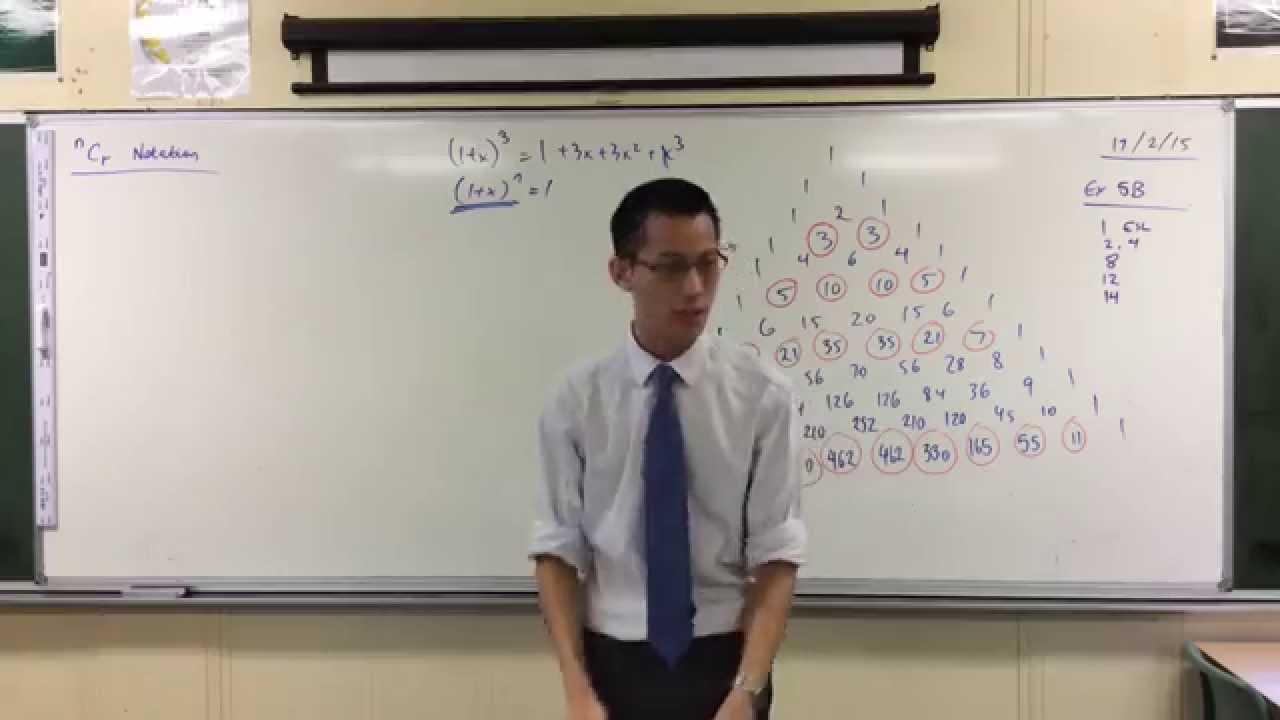 kind wind
karmic escarp
I recommend you to watch this video: https://youtu.be/s8sm8garNkQ?si=vayJb1Q2khA...
kind wind
karmic escarp
I recommend you to watch this video: https://youtu.be/s8sm8garNkQ?si=vayJb1Q2khA...
k
solemn wasp
karmic escarp
I recommend you to watch this video: https://youtu.be/s8sm8garNkQ?si=vayJb1Q2khA...
this is slightly different because this notation addresses choosing, not picking
 upper bane
karmic escarp
I recommend you to watch this video: https://youtu.be/s8sm8garNkQ?si=vayJb1Q2khA...
upper bane
karmic escarp
I recommend you to watch this video: https://youtu.be/s8sm8garNkQ?si=vayJb1Q2khA...
this is combination, not permutation btw
karmic escarp
oh sorry
kind wind
binomial theorem
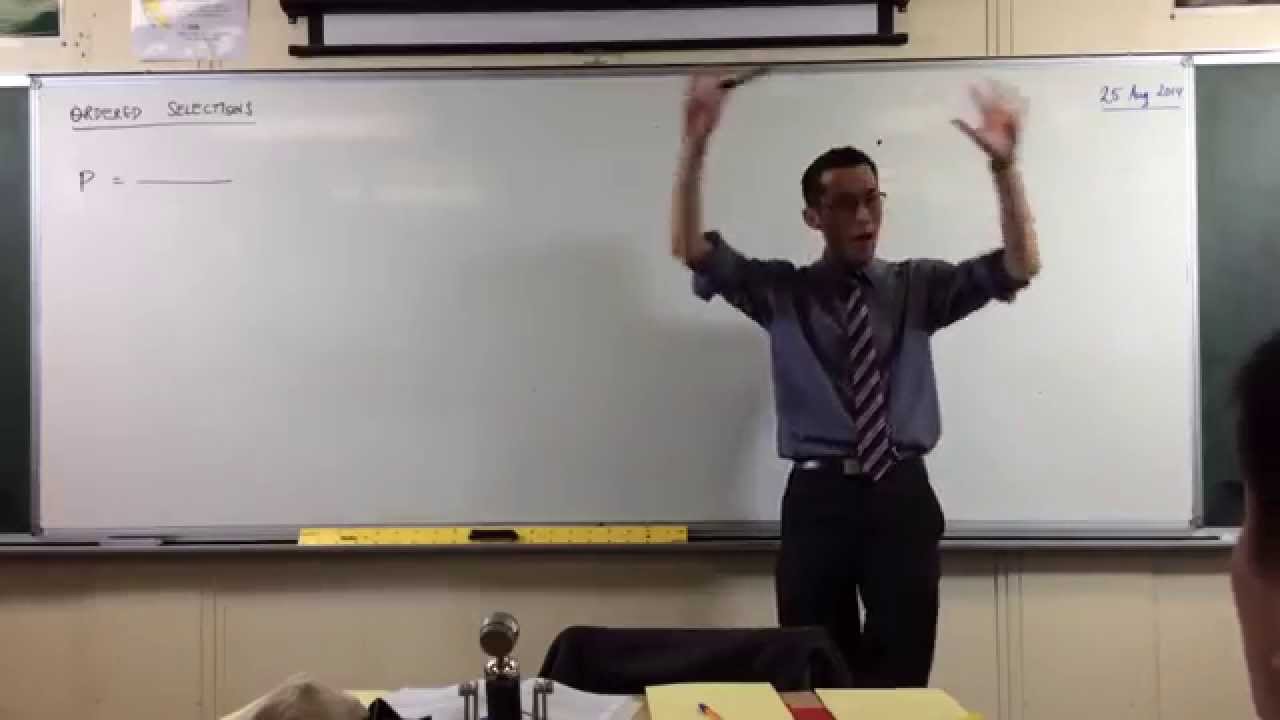 solemn wasp
anyway, n! total races, with (n-r)! ways to order the losers
kind wind
karmic escarp
https://youtu.be/JVbbRCVBVRI?si=kQ-NjOKN8E-CQYZe
lmfao
karmic escarp
mb guys i thought they were asking for combinations
solemn wasp
me wait
solemn wasp
ok cool
kind wind
(n-r)! possibilities of position after rth position
solemn wasp
correct
now, each of the n! race outcomes does prescribe an ordering of the top r, of course, but how many of these permutations prescribe the same ordering of the top r?
kind wind
solemn wasp
now, each of the n! race outcomes does prescribe an ordering of the top r, of co...
wait
what
i didnt get it
ohh
oh
solemn wasp
for example, with n=6 and r=3, we could have
(1, 2, 3), 4, 5, 6
(1, 2, 3), 4, 6, 5
(1, 2, 3), 5, 4, 6
and so on...
kind wind
solemn wasp
now, each of the n! race outcomes does prescribe an ordering of the top r, of co...
i get the question
but not the answer
kind wind
solemn wasp
for example, with n=6 and r=3, we could have
(1, 2, 3), 4, 5, 6
(1, 2, 3), 4, 6,...
this too
can u elaborate
solemn wasp
consider a fixed permutation of the top r competitors, something like (1, 2, ..., r)
how many of the n! permutations give this exact top r ordering?
well, since the top r is already fixed, there's 1 choice for 1st, 1 choice for 2nd, ...., 1 choice for rth
so really, we're just asking how many ways there are to permute everyone beyond the rth position
kind wind
solemn wasp
so really, we're just asking how many ways there are to permute everyone beyond ...
beyonf
beyond
would be
solemn wasp
(r+1)st, (r+2)nd, (r+3)rd, ..., nth
solemn wasp
but we already know how many ways there are to do this; it's (n-r)!
solemn wasp
so the upshot is, for every choice of top r, exactly (n-r)! of the n! total permutations present this top r as well
kind wind
top r u mean top after r
solemn wasp
I don't, I mean top r: 1st, 2nd, 3rd, ..., rth
kind wind
every choice of top r, exactly (n-r)! of the n! total permutations present this top r as well
present this top r aswell
i didnt get it
solemn wasp
e.g. for the top r (1, 2, ..., r), there are exactly (n-r)! permutations that start off with (1, 2, ..., r)
(1, 2, ..., r), r+1, ..., n
(1, 2, ..., r), r+2, r+1, ..., n
...
does that make more sense?
the two listed permutation examples are "presenting" the same top r
kind wind
well isnt (n-r)! permutations beyond rth position ?
solemn wasp
it is
kind wind
so
exactly (n-r)! permutations that start off with (1, 2, ..., r)
what do u mean by this
solemn wasp
the permutation (1, 2, 3, 4, 5, 6) begins with (1, 2, 3)
the permutation (1, 2, 3, 6, 5, 4) also begins with (1, 2, 3)
they aren't the same permutation, but they agree for the first 3 terms
since there are 3! ways to permute the set {4, 5, 6}, I'm saying there are 3! permutations that begin with (1, 2, 3)
they are, explicitly,
(1, 2, 3), 4, 5, 6
(1, 2, 3), 4, 6, 5
(1, 2, 3), 5, 4, 6
(1, 2, 3), 5, 6, 4
(1, 2, 3), 6, 4, 5
(1, 2, 3), 6, 5, 4
does that make sense?
upper bane
basically, fix the top r positions
kind wind
solemn wasp
they are, explicitly,
(1, 2, 3), 4, 5, 6
(1, 2, 3), 4, 6, 5
(1, 2, 3), 5, 4, 6
(...
yea
but i have one question u can call (1, 2, 3, 4, 5, 6) this set as a whole permutation ??
isnt the ordered set called
permuttation
solemn wasp
yeah. I'm using parentheses to group things together, but if the ordering doesn't matter, I call it a set and use set brackets
kind wind
shiii ben getting called by relatives sorry
solemn wasp
hope all is well
kind wind
soo
this the order of things outta that set is permutation
but we only count non repetitive ordered
things (objects) from the set
no
that notation
set's diffrent
solemn wasp
a permutation of a finite set is just an ordering of the objects in that set
instead of commas, we could use < signs
1 < 2 < 3 < ... but it gives off a different vibe
kind wind
order can be of single and in pairs both right
solemn wasp
we like to imagine permutations as like, a way to list the elements
kind wind
in ordered pairs of distinct objects
solemn wasp
this is kinda getting out of scope and asking for a level of precision that is perhaps not required. I need to say that my notation here is not necessarily sanctioned or agreed on in all contexts
but
in my world, I'm saying that (4, 6, 1, 3, 2, 5) and 4, 6, 1, 3, 2, 5 are equal, and they represent a permutation of the set {1, 2, 3, 4, 5, 6} that designated "4" as 1st, "6" as 2nd, and so on
solemn wasp
kind wind
but it is a part of the total permutation
a permutation has to address an entire collection; is that what you're asking?
solemn wasp
you cannot call (1, 2, 3) a permutation of {1, 2, ..., n} , because what happens to the other objects?
kind wind
no i mean of nth object set the permutation should include all n objects
i was just saying
there are n! ways of ordering
or permutation
isnt it right ??
solemn wasp
yeah, they're the same
n! ways to order a set, n! ways to permute the set, n! permutations of the set
kind wind
solemn wasp
the permutation (1, 2, 3, 6, 5, 4) also begins with (1, 2, 3)
!
lemme read again

ahhmm i didnt get it
ohhh
one number was missing lol
wait
ohhhhhhhhhhhhhhhhhhhhhhhhhhhhhhhhhhh
dang
solemn wasp
good?
kind wind
yeah
solemn wasp
good enough to go back to the original argument?
kind wind
yeah i hope so
solemn wasp
the statement is, for each possible "top r" in the race, there are exactly (n-r)! of the n! permutations that present (i.e. agree with) this top r
solemn wasp
in the example with n=6, r=3, and "top r" = (1, 2, 3), exactly 3! of the 6! permutations present (1, 2, 3) as their top 3
kind wind
kind wind
with same position
no maybe wait
n!/(n-r)! permutations for the top r of n item set
(n-r)! permutations for top after rth position
so u are saying there are (n-r)! permutations that agree or share the one possible order of (n-R+1) permutation
solemn wasp
the first line is wrong
kind wind
what is
solemn wasp
the first line
solemn wasp
but also in that adding a factorial doesn't correct it
solemn wasp
n!/(n-r)!
kind wind
yea
kind wind
kind wind
n!/(n-r)! permutations for the top r of n item set
(n-r)! permutations for top ...
!!
now >??
solemn wasp
the conclusion we're trying to arrive to is that the number of "top r" choices is n!/(n-r)!, and I believe it's two sentences away
kind wind
idk u hold those sentences
kind wind
k k
solemn wasp
here are the two sentences
solemn wasp
each top r is presented in exactly (n-r)! of the total n! permutations
thus the total number of top r choices is just n!/(n-r)!
...dividing like this is essentially choosing a representative for each top r
 strong plinth
it is like finding a single exemplar of each possible top r
kind wind
lemme digest something
kind wind
solemn wasp
each top r is presented in exactly (n-r)! of the total n! permutations
by "each top r" u mean one order of positions is contained in each (n-r)! of possible positions
solemn wasp
algebraically,
\begin{align*}
n(n-1)\cdots(n-r+1)&=n(n-1)\cdots(n-r+1)\cdot\mathcolor{red}{\frac{(n-r)(n-r-1)\cdots(2)(1)}{(n-r)(n-r-1)\cdots(2)(1)}}\
&=\frac{n(n-1)\cdots(n-r+1)(n-r)(n-r-1)\cdots(2)(1)}{(n-r)(n-r-1)\cdots(2)(1)}\
&=\frac{n!}{(n-r)!}
\end{align*}
kind wind
sorry if im not getting it right because its my first time into the topic
ye
algebrically
solemn wasp
let me fix it lmao
kind wind
my book has it
boreal girderBOT
Flip
 solemn wasp
we can obtain an algebraic explanation from one via a combinatorial explanation of the other
solemn wasp
the n!/(n-r)! representation is more concise, so however you obtain that is good
strong plinth
so to summarize: the number of all possible combinations is n! , and to find all combinations of the top r, we need to remove the duplicates. for each top r, there exists (n-r)! ways to order the remaining items, so we divide the number of all possible permutations by (n-r)! to get one item for each top r.
kind wind
well cant we just say that of n! of possibilities for position dividing it by (n-r)! which gives possible positions after rth position the numerator and denominator cancel out in such a away like
n(n-1)(n-2)...( n-R+1)(n-r)!/(n-r)!
solemn wasp
I don't know how to parse the english
kind wind
huh
solemn wasp
idk what you're saying lol
kind wind
strong plinth
so to summarize: the number of all possible combinations is n! , and to find all...
combination or permutation
??
isnt it permutatiomn
solemn wasp
it's clear by now that they're permutations from context
combination is being used loosely here
strong plinth
kind wind
well cant we just say that of n! of possibilities for position dividing it by (n...
(n-r)! means the possible positions of the under top r for the same ordering of the top r positions, so the number of the same r in n! ; dividing by it gives us the number of all the possible top r positions
strong plinth
kind wind
combination or permutation
i meant permutations, sorry :0
kind wind
kind wind
well cant we just say that of n! of possibilities for position dividing it by (n...
!
this gives total possible top r positions
solemn wasp
kind wind
well cant we just say that of n! of possibilities for position dividing it by (n...
I can't tell if the math in the message is correct because the sentence itself is hard to read
maybe it's my fault, I saw it a little better just now
solemn wasp
kind wind
well cant we just say that of n! of possibilities for position dividing it by (n...
after some reconsideration, I think you mean to express something that is equivalent to the image above it
 kind wind
solemn wasp
the junk in red is just "a good looking 1"
kind wind
solemn wasp
the junk in red is just "a good looking 1"
yeh
solemn wasp
I did it because, looking at n(n-1)...(n-r+1), I want to make use of factorials to express the same thing, and it's just missing terms (n-r)(n-r-1)...(2)(1) to make it happen. so, I multiply it by this number, while also dividing it, to not perturb the equality
kind wind
if there are n-(r-1) choices for rth position then n-(r-1) -1 for position beyond r continuing it we go down being small as 3 2 1
is it
??
solemn wasp
yes
kind wind
kaay
i think
i gotthe proof
but i will reread what two of u said of that another proof
thanks for now
thank u so much for taking ur time
bye
.close
compact pewterBOT
Channel closed
Closed by @kind wind
Use .reopen if this was a mistake.
compact pewterBOT
Available help channel!
Send your question here to claim the channel.
Remember:
• Ask your math question in a clear, concise manner.
• Show your work, and if possible, explain where you are stuck.
• After 15 minutes, feel free to ping <@&286206848099549185>.
• Type the command .close to free the channel when you're done.
• Be polite and have a nice day!
Read #❓how-to-get-help for further information on how to ask a good question, and about conduct in the question channels.
 digital trench
help
 compact pewterBOT
digital trench
help
compact pewterBOT
digital trench
help
 fathom basin
@digital trench I would start by looking at a graph of tan(x) and x+1
digital trench
fathom basin
<@875728071846666251> I would start by looking at a graph of tan(x) and x+1
why is that so
fathom basin
Because setting them equal is the same thing as asking for an intersection.
digital trench
fathom basin
Because setting them equal is the same thing as asking for an intersection.
makes sense
damn
@fathom basin
 fathom basin
Yes. So, you can see that there are an infinite number of solutions for tan(x)=x+1