#help-43
1 messages · Page 21 of 1
 trail crater
 kind viper
ok right
so it looks like you didnt make any algebraic mistakes here as such
but the IH you've written out is not going to be of much help
trail crater
is the IH my assumption or prove step
kind viper
i think you may need to assume it works for two adjacent values of n
cause the sequence $a_n = (3n+1) \cdot 7^n - 1$ obeys a 2nd-order recurrence relation
 boreal girderBOT
Ann
 kind viper
(rather than 1st as you would see with a*b^n + c or whatever)
trail crater
so ur saying to make multiple inductive hypothesis?
kind viper
im trying to avoid saying the words "strong induction" cause that would seem to go against the instruction to use "mathematical (weak) induction"
but yes basically
 compact pewterBOT
Channel closed
Closed by @trail crater
Use .reopen if this was a mistake.
kind viper
"onesidky"?
compact pewterBOT
 Available help channel!
Send your question here to claim the channel.
Remember:
• Ask your math question in a clear, concise manner.
• Show your work, and if possible, explain where you are stuck.
• After 15 minutes, feel free to ping <@&286206848099549185>.
• Type the command .close to free the channel when you're done.
• Be polite and have a nice day!
Read #❓how-to-get-help for further information on how to ask a good question, and about conduct in the question channels.
 raw portal
i don't quite understand the direct transition from step one to 2

 rigid perch
on the U matrix, he "pulls 2 out" by multiplying the top row by 1/2
to counteract this, you would multiply on the left by the diagonal matrix [ \mat{2 & 0 \ 0 & 1} ] which corresponds to the elementary row operation of multiplying the first row by 2
boreal girderBOT
cloud
 rigid perch
he similarly "pulls 3 out" of the second row and combines the two effects into a single diagonal matrix
raw portal
how does this pulling and all work actually i am new to the idea , ive dealth with matrix multiplication in school but never this way
just not intuitive to me
can you elaborate
rigid perch
so if you were to multiply any matrix by the matrix
[ \mat{2 & 0 \ 0 & 1} ]
that would have the effect of multiplying the first row by 2, and otherwise leaving it unchanged. so for example,
[ \mat{2 & 0 \ 0 & 1} \mat{1 & 1/2 \ 0 & 3} = \mat{2 & 1 \ 0 & 3} ]
boreal girderBOT
cloud
 rigid perch
boreal girder
**cloud**
rigid perch
boreal girder
**cloud**
and in general if you do any elementary row operation to the identity matrix, then that generates what we call an elementary matrix, which has the effect of performing that row operation when multiplied
raw portal
yeah he got into elementary matrices
rigid perch
so to factorize a matrix, we can "multiply the first row by 2 and also divide it by 2" in order to really leave it unchanged, the same way as we can both multiply and divide a number by 2 to leave it unchanged
we just applied the division by 2 directly to the matrix and the multiplication by 2 in the form of an elementary matrix
raw portal
how did gauss think of it intuitively though
like manipulating the identity then multiplying it by a matrix
to perform the row transformation
raw portal
rigid perch
so to factorize a matrix, we can "multiply the first row by 2 and also divide it...
is this a thing to be learned in a lecture or to be thought ourself 💀
rigid perch
well that may or may not be how it's presented in lecture, just the way i like to think of it
it's sort of similar to the way that the LU decomposition itself is found
raw portal
does matrix multiplication get more intuitive as we move forward in linear aljebra
rigid perch
yes, you get more perspectives on it
compact pewterBOT
Channel closed
Closed by @raw portal
Use .reopen if this was a mistake.
compact pewterBOT
Available help channel!
Send your question here to claim the channel.
Remember:
• Ask your math question in a clear, concise manner.
• Show your work, and if possible, explain where you are stuck.
• After 15 minutes, feel free to ping <@&286206848099549185>.
• Type the command .close to free the channel when you're done.
• Be polite and have a nice day!
Read #❓how-to-get-help for further information on how to ask a good question, and about conduct in the question channels.
 analog sleet
Hi Im confused the answer for b) says y=-5t^2 only

 compact pewterBOT
analog sleet
Hi Im confused the answer for b) says y=-5t^2 only
compact pewterBOT
compact pewterBOT
analog sleet
Hi Im confused the answer for b) says y=-5t^2 only
compact pewterBOT
Channel closed
Closed by @analog sleet
Use .reopen if this was a mistake.
compact pewterBOT
Available help channel!
Send your question here to claim the channel.
Remember:
• Ask your math question in a clear, concise manner.
• Show your work, and if possible, explain where you are stuck.
• After 15 minutes, feel free to ping <@&286206848099549185>.
• Type the command .close to free the channel when you're done.
• Be polite and have a nice day!
Read #❓how-to-get-help for further information on how to ask a good question, and about conduct in the question channels.
 carmine garden
I don't get why the underlined part matters here.
More specifically why is the minimal polynomial sq and not q
 compact pewterBOT
carmine garden
I don't get why the underlined part matters here.
More specifically why is the ...
compact pewterBOT
carmine garden
I don't get why the underlined part matters here.
More specifically why is the ...
 hushed magnet
cause q doesnt necessarily kill all of T?
range(qT) survives
s needs to kill that
compact pewterBOT
Channel closed
Closed by @carmine garden
Use .reopen if this was a mistake.
compact pewterBOT
Available help channel!
Send your question here to claim the channel.
Remember:
• Ask your math question in a clear, concise manner.
• Show your work, and if possible, explain where you are stuck.
• After 15 minutes, feel free to ping <@&286206848099549185>.
• Type the command .close to free the channel when you're done.
• Be polite and have a nice day!
Read #❓how-to-get-help for further information on how to ask a good question, and about conduct in the question channels.
 warped oar
Isn't this statement that "pi is the twice the smallest positive solution to cos(x) = 0" directly equivalently equal to saying that pi is the ratio of any circle's circumference and the diameter of it?
compact pewterBOT
warped oar
Isn't this statement that "pi is the twice the smallest positive solution to cos...
 acoustic yarrow
how do u show the implication
 lime juniper
warped oar
Isn't this statement that "pi is the twice the smallest positive solution to cos...
lime juniper
warped oar
Isn't this statement that "pi is the twice the smallest positive solution to cos...
depends how you define cosine. this form is preferred because cosine can be defined without circles
acoustic yarrow
they r tautologically the same statement because both define π but id like to see how u show if a then b and if b then a
lime juniper
for example, the unique solution to c''=-c, c(0)=1, c'(0)=0
kind viper
warped oar
Isn't this statement that "pi is the twice the smallest positive solution to cos...
directly equivalent?
warped oar
direclty equivalently equal
kind viper
wait what the fuck does "equivalently equal" mean
warped oar
Because the input of cos(x) is taken in radians which are defined using circles
acoustic yarrow
what do u think directly equivalent means by the way
warped oar
The original statement implies pi is a straight angle.
This implies that pi = (half circumference)/radius = (2 * half circumference)/(2 * radius) = circumference / diameter
trivially the same statement = directly equivalently equal like the fractions five upon six and 10 upon 12
cos(x) = base/hypotenuse
<@&286206848099549185>
 tribal nacelle
kind viper
wait what the fuck does "equivalently equal" mean
tribal nacelle
kind viper
wait what the fuck does "equivalently equal" mean
identical, equal with 3 lines instead of 2
(i think...?)
 soft bobcat
? That would just mean equivalent
warped oar
very equal
warped oar
Certainly, we can show that cosine(x) = a summation, but his is not directly equivalently equal
 strange ermine
warped oar
_very equal_
strange ermine
warped oar
_very equal_
??
soft bobcat
warped oar
_very equal_
What 
warped oar
very equivalent*
 inner spoke
warped oar
Certainly, we can show that cosine(x) = a summation, but his is not _directly eq...
inner spoke
warped oar
Certainly, we can show that cosine(x) = a summation, but his is not _directly eq...
cause it's infinite summation
soft bobcat
Still makes no sense
strange ermine
Still not making sense
inner spoke
warped oar
_very equivalent_*
@warped oar did u just make it up?
warped oar
no
strange ermine
!original
compact pewterBOT
Please show the original problem, exactly as it was stated to you, with the entire original context. A picture or screenshot is best. If the original problem is not in English, then post it anyway! The additional context might still be helpful. Do your best to provide a translation.
warped oar
make up what
inner spoke
@soft bobcat and @strange ermine saying the same things
warped oar
npcs
strange ermine
warped oar
make up what
Your question
inner spoke
warped oar
make up what
the definition for very equal
warped oar
what is it
inner spoke
about the inifinte polynomial sum of cosine
i don't rlly agree
the infinite sum is by definition strictly equal to cosine
inner spoke
warped oar
oh
so both way around the equal sign, they are very equivalent 😂
warped oar
warped oar
cos(x) = base/hypotenuse
This is my definition.
inner spoke
warped oar
This is my definition.
i was talking abt the Taylor Series but nvm
inner spoke
warped oar
This is my definition.
solid for geometry
inner spoke
warped oar
This is my definition.
oh wait u r 15 my bad
tribal nacelle
inner spoke
solid for geometry
solid...?
soft bobcat
Are you trolling again philosopher
inner spoke
tribal nacelle
solid...?
he's 15 bro
tribal nacelle
 strange ermine
soft bobcat
Are you trolling again philosopher
strange ermine
soft bobcat
Are you trolling again philosopher
I believe he is the orange propic guy called Mathematician
warped oar
strange ermine
I believe he is the orange propic guy called Mathematician
Yes.
please dont spam if youre not helping
inner spoke
anyways, was ur question answered @warped oar
warped oar
The definition of cosine(x) is base upon hypotenuse
Is the answer to my original question "yes"
inner spoke
warped oar
The definition of cosine(x) is base upon hypotenuse
A definition of cosine is based upon hypothenuse in a right triangle, yes.
strange ermine
warped oar
Is the answer to my original question "yes"
Your original question makes no sense
At least redefine the term "equivalently equal"
inner spoke
strange ermine
Your original question makes no sense
At least redefine the term "equivalently ...
consider it means identical
i think
warped oar
cosine(x) can be showed to be equal to a certain summation, but 'tis not that easy
inner spoke
warped oar
cosine(x) can be _showed_ to be equal to a certain summation, but 'tis not that ...
and what
warped oar
So I think my question has been answered
soft bobcat
You should send a screenshot or picture of your original question as it is written so we understand it better
inner spoke
warped oar
cosine(x) can be _showed_ to be equal to a certain summation, but 'tis not that ...
it is actually equal to that summation
warped oar
soft bobcat
You should send a screenshot or picture of your original question as it is writt...
This was a question of mine
inner spoke
for now, just in keep in mind that cos x is base or adjacent over hypothenuse
u'll discover other definitions later on
warped oar
okay, thank you very much 😄
and y'all
inner spoke
soft bobcat
How would you define the "base" of a triangle?
he means adjacent, but it seems clear in his head i think
soft bobcat
Yeah adjacent is a better word
warped oar
yes
soft bobcat
But anyway tomato tomahto
compact pewterBOT
Channel closed
Closed by @warped oar
Use .reopen if this was a mistake.
Available help channel!
Send your question here to claim the channel.
Remember:
• Ask your math question in a clear, concise manner.
• Show your work, and if possible, explain where you are stuck.
• After 15 minutes, feel free to ping <@&286206848099549185>.
• Type the command .close to free the channel when you're done.
• Be polite and have a nice day!
Read #❓how-to-get-help for further information on how to ask a good question, and about conduct in the question channels.
carmine garden
can I have a hint, I really doubt I need to find the Linear transfromation here
 compact pewterBOT
carmine garden
can I have a hint, I really doubt I need to find the Linear transfromation here
carmine garden
compact pewterBOT
carmine garden
can I have a hint, I really doubt I need to find the Linear transfromation here
carmine garden
I mean If I have to it would be $\begin{bmatrix} \cos(π/180) && -\sin (π/180)\ \sin (π/180) && \cos (π/180) \end{bmatrix}$
 short ferry
geometrically, what does minimal polynomial even mean?
boreal girderBOT
wai
 carmine garden
short ferry
geometrically, what does minimal polynomial even mean?
carmine garden
short ferry
geometrically, what does minimal polynomial even mean?
It maps to the 0 vector
you can a linear combination of the operator raised to various powers, with the highest power. being monic
short ferry
oh, now that I think of it, what i wanted to do might not be correct. Sorry
hushed magnet
v=e1
carmine garden
Okie, will try to work with that
so I get T(e_1)=e_1+e_2
T^2(e_1)=2e_2
T(e_2)=-e_1+e_2
T^2(e_2)=0
e_1,T(e_1) are LI
so T^2(e_2) is not
so the minmal poly is x^2+2=0
ok, looks like I made a mistake
what am I doing wrong
ooh\
T(e_1)= ( \cos(1),\sin(1))
T^2(e_1)= (cos(1)-sin(1), 2 cos(1) sin(1))
or to express it better
T(e_1)= cos(1)e_1+ sin(1) e_2
Yea, I thik I got it
thanks
.close
compact pewterBOT
Channel closed
Closed by @carmine garden
Use .reopen if this was a mistake.
compact pewterBOT
Available help channel!
Send your question here to claim the channel.
Remember:
• Ask your math question in a clear, concise manner.
• Show your work, and if possible, explain where you are stuck.
• After 15 minutes, feel free to ping <@&286206848099549185>.
• Type the command .close to free the channel when you're done.
• Be polite and have a nice day!
Read #❓how-to-get-help for further information on how to ask a good question, and about conduct in the question channels.
 unique hill
IS GETTING THE AREA OF THIS POSSIBLE??
 compact pewterBOT
unique hill
IS GETTING THE AREA OF THIS POSSIBLE??
compact pewterBOT
unique hill
IS GETTING THE AREA OF THIS POSSIBLE??
 inland nacelle
unique hill
IS GETTING THE AREA OF THIS POSSIBLE??
inland nacelle
unique hill
IS GETTING THE AREA OF THIS POSSIBLE??
Try breaking it down into simpler geometric shapes first
unique hill
i did but...
 inland nacelle
Like a rectangles and triangles if that helps
I do not know if the lines are 90 degrees
inland nacelle
i also dont know if they are parallel
inland nacelle
what
thats a bit stupid
Unless the diagram is drawn to scale
Then we can approximate it
compact pewterBOT
@unique hill Has your question been resolved?
Channel closed
Closed by @unique hill
Use .reopen if this was a mistake.
Available help channel!
Send your question here to claim the channel.
Remember:
• Ask your math question in a clear, concise manner.
• Show your work, and if possible, explain where you are stuck.
• After 15 minutes, feel free to ping <@&286206848099549185>.
• Type the command .close to free the channel when you're done.
• Be polite and have a nice day!
Read #❓how-to-get-help for further information on how to ask a good question, and about conduct in the question channels.
 charred sundial
Completely lost, don't know how to start
 compact pewterBOT
charred sundial
Completely lost, don't know how to start
short ferry
compact pewterBOT
charred sundial
Completely lost, don't know how to start
short ferry
try similar triangles
inland nacelle
do you know intercept theorem
charred sundial
short ferry
try similar triangles
how tho
charred sundial
inland nacelle
do you know intercept theorem
no
short ferry
try sliding the line with x+6 closer to the other one
inland nacelle
do you know ratios between parallel lines?
short ferry
that wont change any distances
 runic creek
just use intercept theoremm
inland nacelle
runic creek
just use intercept theoremm
He said he dosent know
runic creek
wait tthe pic i am sending is loading
charred sundial
inland nacelle
do you know ratios between parallel lines?
nope
 hearty saffron
charred sundial
nope
hearty saffron
charred sundial
nope
5/6 = 12/x is intercept theorm I tink
charred sundial
ok hold on lemme check this theorem out
 inland nacelle
charred sundial
ok hold on lemme check this theorem out
inland nacelle
charred sundial
ok hold on lemme check this theorem out
Indeed, it is useful
However an alternative is @short ferry 's way
short ferry
alternatively, you can slide the lengths like this without rotating. Since you didnt rotate them, the angles stay the same and you got 2 similar triangles

x / 12 = 6 / 5
hearty saffron
short ferry
alternatively, you can slide the lengths like this without rotating. Since you d...
nice one
charred sundial
ohhhhh i see
charred sundial
short ferry
alternatively, you can slide the lengths like this without rotating. Since you d...
very nice method, didn't even consider that
 short ferry
yeah, interesting
if a / b = c / d, then they are equal to (a + c) / (b + d) as well
funny little theorem which is a consequence of this
compact pewterBOT
Channel closed
Closed by @charred sundial
Use .reopen if this was a mistake.
Available help channel!
Send your question here to claim the channel.
Remember:
• Ask your math question in a clear, concise manner.
• Show your work, and if possible, explain where you are stuck.
• After 15 minutes, feel free to ping <@&286206848099549185>.
• Type the command .close to free the channel when you're done.
• Be polite and have a nice day!
Read #❓how-to-get-help for further information on how to ask a good question, and about conduct in the question channels.
 dawn palm
guys
compact pewterBOT
dawn palm
guys


 azure vault
dawn palm
and wolframalpha show this
azure vault
dawn palm
and wolframalpha show this
you can see that WA's graph has a y axis with very very small values
so seeing it from Desmos's perspective
you won't be able to see a thing
but if you zoom in on the y axis
 keen granite

Desmos
azure vault
surely enough, you'll see the very small but negative y values between 0 and 5
keen granite
fun fact you can scale the axes on desmos and get the same thing W|A is showing :)
compact pewterBOT
Channel closed
Closed by @dawn palm
Use .reopen if this was a mistake.
Available help channel!
Send your question here to claim the channel.
Remember:
• Ask your math question in a clear, concise manner.
• Show your work, and if possible, explain where you are stuck.
• After 15 minutes, feel free to ping <@&286206848099549185>.
• Type the command .close to free the channel when you're done.
• Be polite and have a nice day!
Read #❓how-to-get-help for further information on how to ask a good question, and about conduct in the question channels.
 velvet moon
 compact pewterBOT
velvet moon
velvet moon
compact pewterBOT
velvet moon
velvet moon
I don't understand a)ii)
 kind crane
velvet moon
I don't understand a)ii)
kind crane
velvet moon
I don't understand a)ii)
the theorem/series that allows you to make the expansion makes assumptions on x.
velvet moon
What is the answer??
compact pewterBOT
The purpose of this server is to help you learn, not to hand out answers. Do not ask someone to give you the answer directly.
velvet moon
I got x=2
compact pewterBOT
@velvet moon Has your question been resolved?
To ask for mathematics help on this server, please open your own help channel or help thread. See #❓how-to-get-help for instructions.
Channel closed
Closed due to timeout
Use .reopen if this was a mistake.
Available help channel!
Send your question here to claim the channel.
Remember:
• Ask your math question in a clear, concise manner.
• Show your work, and if possible, explain where you are stuck.
• After 15 minutes, feel free to ping <@&286206848099549185>.
• Type the command .close to free the channel when you're done.
• Be polite and have a nice day!
Read #❓how-to-get-help for further information on how to ask a good question, and about conduct in the question channels.
 foggy ruin
Hello! I’m new here 🙂
i’m a teen but I’m not very good at math and am falling behind drastically in this subject! I need help!
compact pewterBOT
foggy ruin
Hello! I’m new here 🙂
i’m a teen but I’m not very good at math and am falling b...
kind crane
you can just follow the bot message above and post your question now
kind viper
we can't really help you in any more general way
but we can recommend places for self-studying
such as khanacademy
if you have a specific question you'd like us to help with, you're welcome to post it here
 astral trellis
can yall help me with a question ?
kind viper
astral trellis
can yall help me with a question ?
!occupied
compact pewterBOT
astral trellis
can yall help me with a question ?
Someone else is already using this help channel. If you need help with a question, please open your own help channel/thread (see #❓how-to-get-help for instructions).
astral trellis
kind viper
!occupied
all of them are
kind viper
read #❓how-to-get-help for instructions. there are four channels which are free rn.
foggy ruin
Got it, thank you guys! I don’t have any specific questions but thank you 🙂
kind viper
foggy ruin
Got it, thank you guys! I don’t have any specific questions but thank you 🙂
ok in this case you can .close this channel
compact pewterBOT
@foggy ruin Has your question been resolved?
compact pewterBOT
Channel closed
Closed due to timeout
Use .reopen if this was a mistake.
Available help channel!
Send your question here to claim the channel.
Remember:
• Ask your math question in a clear, concise manner.
• Show your work, and if possible, explain where you are stuck.
• After 15 minutes, feel free to ping <@&286206848099549185>.
• Type the command .close to free the channel when you're done.
• Be polite and have a nice day!
Read #❓how-to-get-help for further information on how to ask a good question, and about conduct in the question channels.
 runic verge
hi all, again me
How did he take a square root of 2 in this method, from where did he get it at all? Thanks!!
 compact pewterBOT
runic verge
hi all, again me
How did he take a square root of 2 in this method, from where d...
compact pewterBOT
runic verge
hi all, again me
How did he take a square root of 2 in this method, from where d...
 dusky nymph
he wants to get it in the form 1/(t^2 + 1)
so looking at the denominator of the original, t would have to be the square root of this:

 dusky nymph
yea, that general form (he ends up with a scale factor but that's fine)
runic verge
could you maybe explain please why does square root of 2 help?
dusky nymph
it's not that it helps or hurts, it's just necessary if you're gonna get the denominator in the form t^2 + 1
you basically pattern match and say, ok i have (something) + 1
so t^2 = (something)
and therefore t = sqrt(something)
and since the something has a 2 coefficient out in front, sqrt(something) will have a sqrt(2)
compact pewterBOT
Channel closed
Closed by @runic verge
Use .reopen if this was a mistake.
compact pewterBOT
Available help channel!
Send your question here to claim the channel.
Remember:
• Ask your math question in a clear, concise manner.
• Show your work, and if possible, explain where you are stuck.
• After 15 minutes, feel free to ping <@&286206848099549185>.
• Type the command .close to free the channel when you're done.
• Be polite and have a nice day!
Read #❓how-to-get-help for further information on how to ask a good question, and about conduct in the question channels.
 untold pelican
Hello you great math fellows.
I need some help regarding a calculus/linear-algebra problem please.
So let say we have a cylinder with the equation x^2 + y^2 = 2 in R^3 (where z is free), and a plane like x+z=4.
So their intersection result an ellipse, and I like to find the equation of the ellipse, but I don't know how?
I just found the x in terms of z from the plane, and plugged in cylinder equation which gives us a perpendicular cylinder to the original cylinder. I'm not sure how to find the equation of the ellipse (the intersection of plane and the cylinder)
Any hint is appreciated.
Thank you for your time and consideration.
compact pewterBOT
untold pelican
Hello you great math fellows.
I need some help regarding a calculus/linear-algeb...
kind crane
What does "x in terms of z" mean? There's no z in either of your shapes
untold pelican
kind crane
What does "x in terms of z" mean? There's no z in either of your shapes
Oh, sorry, there was a type, I fixed. the plane is x+z=4

 winged lion
You mean that?

 civic quartz
maybe we can start by finding the angle between the plane z = 0 and x+z=4
then trig for the major axis lenght?
untold pelican
winged lion
You mean that?
Yes sir, the equation of the green ellipse.
winged lion
If you wanna find a parameterization, on the xy-plane it's a circle with radius 2, so you can set x = 2cost and y = 2sint. Now the z-component you would take the equation x+z=4 and solve for z.
So overall z = 4-x = 4-2cost
Oh wait, you asked for an equation, actually
untold pelican
Thanks, and how to find the equation of the ellipse in cartesian? in the std form of (x-h)/a^2 + (y-k)/b^2 = 1 ?
winged lion
Well the thing is the ellipse is on the plane and not cartesian plane
soo 
Unless you are asking for the projection, which I dont think you are asking for
untold pelican
winged lion
Unless you are asking for the projection, which I dont think you are asking for
The projection of ellipse should be the circle I guess?!
winged lion
Yes
untold pelican
So, no that doesn't help actually. I'm thinking to rotate the plane and the circle for 45 deg, as the angle between the plane and xy plane is 45, then finding the ellipse will be easier I think(no sure), and finally rotate back the ellipse once it's found. But I don't know if it's even logical.
winged lion
Might as well rotate the parameterization with a rotation matrix I guess
If we see (2cos(t), 2sin(t), 4-2cos(t)) as a vector function
civic quartz
civic quartz
sint =y/2
converting this to cos t , and equating all
like if you want that equation form
i found my new love btw , parametric equations , thanks anti algebraist
untold pelican
The correct equation should be (sqrt(2)cos(t),sqrt(2)sin(t),4-sqrt(2)cos(t)) as I calculated(I hope I did it right).
civic quartz
untold pelican
The correct equation should be `(sqrt(2)cos(t),sqrt(2)sin(t),4-sqrt(2)cos(t))` a...
oh yeah just read your question again
the radius is sqrt 2
winged lion

I rotated it with R_y matrix around y-axis
Then I think you can insert the components into the ellipse equation.
civic quartz
did you want this type of equation?
 untold pelican
Yes, first I like to solve it without rotating if it's not very devil in calculation. let's see. And yes, rotating along by y axis could help I suppose.
winged lion
Oh, how did you do it?
civic quartz
civic quartz
cos t = x/2
used your parametric equations and eliminated t
civic quartz
finding the locus of your parametric thing
untold pelican
civic quartz
did you want this type of equation?
Not, really, but it looks very cool.
civic quartz
untold pelican
Not, really, but it looks very cool.
what are you looking for exactly ?
maybe just an ellipse in the xy plane with the dimentions of the ellipse you cut?
winged lion
untold pelican
The correct equation should be `(sqrt(2)cos(t),sqrt(2)sin(t),4-sqrt(2)cos(t))` a...
Well that's like the green one, but scaled down a bit?
untold pelican
winged lion
Well that's like the green one, but scaled down a bit?
No, that's the exact ellipse.
untold pelican
civic quartz
what are you looking for exactly ?
The ellipse in standard form.
winged lion
Well it doesnt look like
 civic quartz
uhh like the xy ellipse?
untold pelican
winged lion
Well it doesnt look like
https://www.desmos.com/3d/n52amddhcd
Maybe we are using vary coefficients?
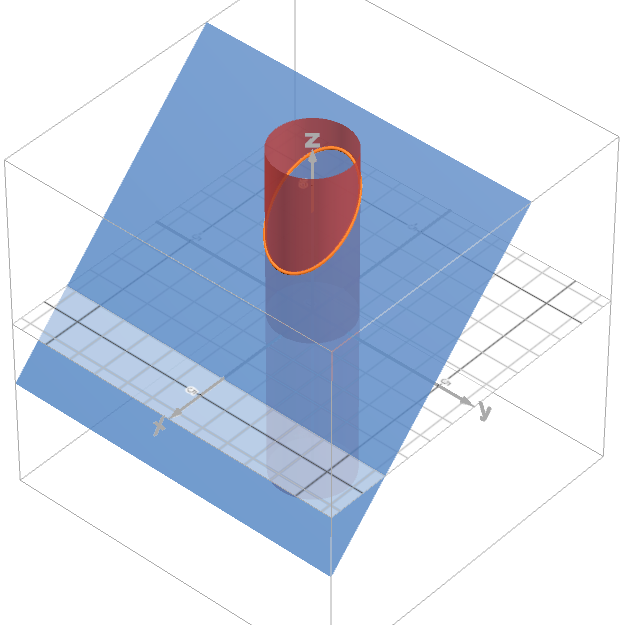
Desmos
civic quartz
winged lion
Well it doesnt look like
he wanted the equation for the circle having radius sqrt2 , we assumed he wanted for the radius two
civic quartz
untold pelican
Thanks, and how to find the equation of the ellipse in cartesian? in the std for...
oh . but this is 3d, uhhh
winged lion
winged lion
If you wanna find a parameterization, on the xy-plane it's a circle with radius ...
you do that but with radius sqrt(2)
untold pelican
civic quartz
he wanted the equation for the circle having radius sqrt2 , we assumed he wanted...
The radius is sqrt(2) by x^2+y^2=2
untold pelican
civic quartz
oh . but this is 3d, uhhh
Yes, so z is also involved I believe. pretty interesting.
untold pelican
winged lion
I apologize for any inconvenience.
No worries, some days ago I did 6+2=7, this is fine.
civic quartz
i mean yeah its on R3, its along the x+z plane
is this any specific problem you need it for
or a thought exercise
winged lion
Well 6+2=7 mod 1
civic quartz
amen
untold pelican
This is just very interesting. I have to do this. Than you great fiends and math fellows helping me regarding this, really appreciate it. It seems I have to study some more calculus regarding this, and I'll do(to forget it again).
Math bless us all.
🍻🤘🤓
untold pelican
.close
compact pewterBOT
Channel closed
Closed by @untold pelican
Use .reopen if this was a mistake.
Available help channel!
Send your question here to claim the channel.
Remember:
• Ask your math question in a clear, concise manner.
• Show your work, and if possible, explain where you are stuck.
• After 15 minutes, feel free to ping <@&286206848099549185>.
• Type the command .close to free the channel when you're done.
• Be polite and have a nice day!
Read #❓how-to-get-help for further information on how to ask a good question, and about conduct in the question channels.
 ruby lava
im tryna solve this by graphing it into demos, the assignment was talking about using the change of base formula. im confused on what y2 is going to be, i think the notes i took are confusing me, what would be y2 or am i wrong on both of them?

 compact pewterBOT
ruby lava
im tryna solve this by graphing it into demos, the assignment was talking about ...
compact pewterBOT
ruby lava
im tryna solve this by graphing it into demos, the assignment was talking about ...
 rigid perch
yes
rigid perch
the log only applies to the 3
ruby lava
rigid perch
the log only applies to the 3
so it would be (log3)+1?
rigid perch
yes
ruby lava
so y2=(log3)+1/log5 ?
rigid perch
no you should only divide the log part
 rigid perch
yes
ruby lava
ive been reading it as log5^(3+1) not (log5^3)+1
thats on me
thank u very much
what did i do wrong in this

nvm i think its cus no parentheses on x-1
.close
compact pewterBOT
Channel closed
Closed by @ruby lava
Use .reopen if this was a mistake.
compact pewterBOT
Available help channel!
Send your question here to claim the channel.
Remember:
• Ask your math question in a clear, concise manner.
• Show your work, and if possible, explain where you are stuck.
• After 15 minutes, feel free to ping <@&286206848099549185>.
• Type the command .close to free the channel when you're done.
• Be polite and have a nice day!
Read #❓how-to-get-help for further information on how to ask a good question, and about conduct in the question channels.
 glacial pike
I hate geo
 compact pewterBOT
glacial pike
I hate geo
glacial pike
compact pewterBOT
glacial pike
I hate geo
glacial pike
I don’t even know where to begin here
 rapid fjord
 compact pewterBOT
Channel closed
Closed by @glacial pike
Use .reopen if this was a mistake.
Available help channel!
Send your question here to claim the channel.
Remember:
• Ask your math question in a clear, concise manner.
• Show your work, and if possible, explain where you are stuck.
• After 15 minutes, feel free to ping <@&286206848099549185>.
• Type the command .close to free the channel when you're done.
• Be polite and have a nice day!
Read #❓how-to-get-help for further information on how to ask a good question, and about conduct in the question channels.
 rocky shadow
Hi guys, just wanted help for this particular question.
What I've tried:
Calculating the area of the hexagon by dividing it into two trapeziums and getting a total area.
Dividing the hexagon into equal triangular slices based on the edges (40 deg).
Where I'm stuck: I have no idea how to get to the area of the square or the circle. It feels like there is not enough information given to get it.
Would appreciate any help or hints towards the right direction!
 compact pewterBOT
rocky shadow
Hi guys, just wanted help for this particular question.
What I've tried:
Calcula...
inland nacelle
compact pewterBOT
rocky shadow
Hi guys, just wanted help for this particular question.
What I've tried:
Calcula...
inland nacelle
@rocky shadow the circle is tangent to the hexagon right
So draw the radius at the tangency point and what can we say about the triangles formed?
rocky shadow
but can we really say that if we dont know if its drawn to scale?
inland nacelle
rocky shadow
but can we really say that if we dont know if its drawn to scale?
Its inscribed
So internally tangent
rocky shadow
ah
okay so since since its the tangent, we can say that thats the radius of the circle?
 inland nacelle
rocky shadow
okay so since since its the tangent, we can say that thats the radius of the cir...
inland nacelle
rocky shadow
okay so since since its the tangent, we can say that thats the radius of the cir...
What can we say about the angles in the red triangle?
inland nacelle
rocky shadow
orange and green = 120
what can we say about the relationship between orange and green?
inland nacelle
There the same angle
rocky shadow
OH
inland nacelle
Do you know why?
rocky shadow
since the length opposite the hypotenuse is the tangent on the hexagon side
sorry that didnt make sense
the longer length is the tangent to the hexagon side
rocky shadow
yeaaa
inland nacelle
yay nice
rocky shadow
thats a better way to describe it
inland nacelle
Now can you solve?
You might want to use the ratio of sides in a 90-60-30 triangle
inland nacelle
nice
rocky shadow
thank you man
inland nacelle
Np
soft bobcat
Yes
rocky shadow
.close
compact pewterBOT
Channel closed
Closed by @rocky shadow
Use .reopen if this was a mistake.
Available help channel!
Send your question here to claim the channel.
Remember:
• Ask your math question in a clear, concise manner.
• Show your work, and if possible, explain where you are stuck.
• After 15 minutes, feel free to ping <@&286206848099549185>.
• Type the command .close to free the channel when you're done.
• Be polite and have a nice day!
Read #❓how-to-get-help for further information on how to ask a good question, and about conduct in the question channels.
 tribal tinsel
Hi
compact pewterBOT
tribal tinsel
Hi
tribal tinsel
I need help urgently
keen granite
 tribal tinsel
keen granite
tribal tinsel
keen granite
Hello
How do I solve this to get the answer
It's it's probably really easy and I tried it multiple times
But I get stuck
At the last part when I have to put everything together
soft bobcat
!status
compact pewterBOT
What step are you on?
1. I don't know where to begin.
2. I have begun but got stuck midway.
3. I got an answer but I was told that it's wrong.
4. I got an answer and would like my work checked.
5. I have a question about someone else's work/solution.
6. I have completed the problem and don't need help anymore. Thank you.
7. None of the above
show your work

 atomic panther
what are you finding difficult the multiplication?
 tribal tinsel
I know
soft bobcat
maybe recheck your work a bit, your method is correct
 ember crystal
tribal tinsel
Yeah
ember crystal
tribal tinsel
Yeah
just try rewriting the the whole calculations again neatly
tribal tinsel
Do I times the three binomials
Or do I cancel them out or are you even allowed to cancel them out if there is a subtraction sign
atomic panther
no you can not cancle
cancel*
only when there is multiplication
for example x+3/x the x can not cancel
but (x+3)(x)/x the x can cancel
tribal tinsel
Oh ok
compact pewterBOT
@tribal tinsel Has your question been resolved?
Channel closed
Closed by @tribal tinsel
Use .reopen if this was a mistake.
Available help channel!
Send your question here to claim the channel.
Remember:
• Ask your math question in a clear, concise manner.
• Show your work, and if possible, explain where you are stuck.
• After 15 minutes, feel free to ping <@&286206848099549185>.
• Type the command .close to free the channel when you're done.
• Be polite and have a nice day!
Read #❓how-to-get-help for further information on how to ask a good question, and about conduct in the question channels.
 solar folio
how can I find the length L in terms of R
 compact pewterBOT
solar folio
how can I find the length L in terms of R
solar folio
compact pewterBOT
solar folio
how can I find the length L in terms of R
solar folio
without using trigonometry
 bleak dock
solar folio
without using trigonometry
bleak dock
solar folio
without using trigonometry
you need trigonometry
solar folio
without sin, cos, etc.
bleak dock
yeah you need those
solar folio
not necessarily
winged lion
solar folio
without sin, cos, etc.
use their taylor series
solar folio
lol
winged lion
wait sin = 1/csc
bleak dock
solar folio
how can I find the length L in terms of R
you could try approximating the polygon as a circle
but that won't be an exact answer
 junior crater
what is "a"? the area of the small triangle?
bleak dock
oh wait are you given the length of a already?
solar folio
No I am only given the radius
bleak dock
oh okay
solar folio
and the fact that the inscribed polygon is a decagon
the answer is this

but I cant use trig
only geomtric constructions
and triangles' similarities perhaps
bleak dock
ah yes the decagon is constructible with a ruler and compass
bleak dock
solar folio
and triangles' similarities perhaps
okay you should have said that from the very beginning
but thanks for clarifying

In geometry, a decagon (from the Greek δέκα déka and γωνία gonía, "ten angles") is a ten-sided polygon or 10-gon. The total sum of the interior angles of a simple decagon is 1440°.
did you not read the Wikipedia page then?
solar folio
I think all polygons are constructible with ruler and compass
junior crater
solar folio
I think all polygons are constructible with ruler and compass
7-gon is not

In mathematics, a constructible polygon is a regular polygon that can be constructed with compass and straightedge. For example, a regular pentagon is constructible with compass and straightedge while a regular heptagon is not. There are infinitely many constructible polygons, but only 31 with an odd number of sides are known.
solar folio
?
 bleak dock
yeah and there's another version here
 bleak dock
https://en.wikipedia.org/wiki/Decagon
bleak dock
bleak dock
https://en.wikipedia.org/wiki/Decagon
read the page: it has the steps
solar folio
ok I will, but one thing
if the polygon was not a decagon how would I find L(r) for the polygon also
 slate sand
Holy moly gauss is goated he figured out how to draw the 17-gon
solar folio
is there a general "method"
slate sand
You should try to figure it out
solar folio
like a hexagon is very easy because the angles are 60 30, 90
slate sand
It’s a good exercise
solar folio
but a decagon is harder
slate sand
Consider triangles
From the centre of each polygon, draw lines to each vertex
How would you describe the angles and the side lengths?
bleak dock
the method for the decagon works for polygons with 2 * F(n) sides
where F(n) is the nth Fermat prime
3, 5, 17, 257, 65537....
bleak dock
solar folio
is there a general "method"
I doubt so
you can find general methods for specific cases
but not every constructible polygon at once
bleak dock
solar folio
btw is a heptagon constructible or no?
that's the one with 7 sides
so no
 junior crater
solar folio
?
junior crater
solar folio
?
"the regular heptagon is not constructible with compass and straightedge but is constructible with a marked ruler and compass"

In geometry, a heptagon or septagon is a seven-sided polygon or 7-gon.
The heptagon is sometimes referred to as the septagon, using septa- (an elision of septua-), a Latin-derived numerical prefix, rather than hepta-, a Greek-derived numerical prefix (both are cognate), together with the suffix -gon for Greek: γωνἰα, romanized: gonía, mea...
bleak dock
solar folio
so this is an approximation
yeah, there are lots of really clever constructions that approximate well
or they marked the ruler, which is not allowed
that would be called a neusis construction
solar folio
such an interesting topic tho
junior crater
and thats why there is galois theory in algebra
compact pewterBOT
Channel closed
Closed by @solar folio
Use .reopen if this was a mistake.
Available help channel!
Send your question here to claim the channel.
Remember:
• Ask your math question in a clear, concise manner.
• Show your work, and if possible, explain where you are stuck.
• After 15 minutes, feel free to ping <@&286206848099549185>.
• Type the command .close to free the channel when you're done.
• Be polite and have a nice day!
Read #❓how-to-get-help for further information on how to ask a good question, and about conduct in the question channels.
 next epoch
this does not give you a vector space since multiplying by zero gives you a matrix not in V
 compact pewterBOT
next epoch
this does not give you a vector space since multiplying by zero gives you a matr...
kind viper
compact pewterBOT
next epoch
this does not give you a vector space since multiplying by zero gives you a matr...
kind viper
really?
dusky nymph
it doesn't say a and b have to be nonzero
compact pewterBOT
Channel closed
Closed by @next epoch
Use .reopen if this was a mistake.
compact pewterBOT
Available help channel!
Send your question here to claim the channel.
Remember:
• Ask your math question in a clear, concise manner.
• Show your work, and if possible, explain where you are stuck.
• After 15 minutes, feel free to ping <@&286206848099549185>.
• Type the command .close to free the channel when you're done.
• Be polite and have a nice day!
Read #❓how-to-get-help for further information on how to ask a good question, and about conduct in the question channels.
 forest token
 compact pewterBOT
forest token
compact pewterBOT
forest token
 brazen quiver
which is the largest non-negative integer value from that list of options?
brazen quiver
then you've made a mistake
soft bobcat
Yes this one is cursed
brazen quiver
!show
soft bobcat
I remember
compact pewterBOT
Show your work, and if possible, explain where you are stuck.
forest token
yea
soft bobcat
Yeah its hella cursed
forest token
oh 😭
kind viper
forest token
ok important question: does {} mean fractional part or are those just brackets
forest token
kind viper
ok important question: does {} mean fractional part or are those just brackets
just brackets
if its fractional part they will mention
forest token
i lost track
of what u guys were talking about
like u were saying negative numbers cannot be raised to fractional powers??
brazen quiver
negative numbers can be raised to fractional powers, but you wind up getting complex numbers out of it.
and you have to deal with branches.
it's a mess.
forest token
brazen quiver
negative numbers can be raised to fractional powers, but you wind up getting com...
not always
forest token
yeah
brazen quiver
even then (-1)^1/3 does have a real solution, but it's not the principal solution
forest token
(-2)^1/3
brazen quiver
the principal solution is exp(pi i / 3)
forest token
broo why tf will u think of putting a value back in the limit
when it says largest value 😭
compact pewterBOT
Channel closed
Closed by @forest token
Use .reopen if this was a mistake.
brazen quiver
soft bobcat
I didn't know that
https://en.wiktionary.org/wiki/principal_root
(mathematics) A complex number which, when raised to the power of n, yields the radicand of its nth degree radical, and which has the greatest real part among all such numbers, and positive imaginary part in case of equality of the real parts.
Wiktionary
soft bobcat
.reopen
compact pewterBOT
✅
brazen quiver
just the first thing google pulled up
brazen quiver
👍
soft bobcat
.close
compact pewterBOT
Channel closed
Closed by @soft bobcat
Use .reopen if this was a mistake.
compact pewterBOT
Available help channel!
Send your question here to claim the channel.
Remember:
• Ask your math question in a clear, concise manner.
• Show your work, and if possible, explain where you are stuck.
• After 15 minutes, feel free to ping <@&286206848099549185>.
• Type the command .close to free the channel when you're done.
• Be polite and have a nice day!
Read #❓how-to-get-help for further information on how to ask a good question, and about conduct in the question channels.
 hexed hemlock
Can someone explain to me how this equals each other, this is putting it in geometric series form a/1-r
 compact pewterBOT
hexed hemlock
Can someone explain to me how this equals each other, this is putting it in geom...
compact pewterBOT
hexed hemlock
Can someone explain to me how this equals each other, this is putting it in geom...
 solemn remnant
They don't equate one another
kind viper
those... don't look equal. context?
kind viper
you sure this is from GPT? :P
 solemn remnant
kind viper
you sure this is from GPT? :P
solemn remnant
kind viper
you sure this is from GPT? :P
I'd recognize that output among thousands 
kind viper
hexed hemlock
this is original question
ok and show your work?
 kind viper
,rccw
hexed hemlock
my bad lol im being gaslighted by gpt
boreal girderBOT
 solemn remnant
Hint: $$\frac2{4x+3}=\frac23\times\frac1{1-(-4x/3)}$$
kind viper
solemn remnant
Hint: $$\frac2{4x+3}=\frac23\times\frac1{1-(-4x/3)}$$
you want it in powers of x+1 not x
solemn remnant
Oh you're right I misread
kind viper
boreal girder
it's much easier actually: $\frac{2}{4(x+1) - 1} = \frac{-2}{1 - 4(x+1)}$
boreal girderBOT
Ann
 kind viper
a/b = -a/-b
hexed hemlock
.close
compact pewterBOT
Channel closed
Closed by @hexed hemlock
Use .reopen if this was a mistake.
compact pewterBOT
Available help channel!
Send your question here to claim the channel.
Remember:
• Ask your math question in a clear, concise manner.
• Show your work, and if possible, explain where you are stuck.
• After 15 minutes, feel free to ping <@&286206848099549185>.
• Type the command .close to free the channel when you're done.
• Be polite and have a nice day!
Read #❓how-to-get-help for further information on how to ask a good question, and about conduct in the question channels.
compact pewterBOT
 atomic aspen
The inequality should flip to x <= - 4. But I can't understand what I'm doing wrong.
kind viper
in general going from (x-a)(x-b) ≥ 0 to some combination of x ≥ a and x ≥ b and then trying to figure out which one should "flip" based on arcane rules is a bad approach
atomic aspen
kind viper
in general going from (x-a)(x-b) ≥ 0 to some combination of x ≥ a and x ≥ b and ...
Okey, what is the best approach. Been struggling with these inequality where there is something like |x^2 + ax + b|
 dire fiber
atomic aspen
The inequality should flip to x <= - 4. But I can't understand what I'm doing wr...
dire fiber
atomic aspen
The inequality should flip to x <= - 4. But I can't understand what I'm doing wr...
You did the wavy curve wrong
x>=3 and x<=-4
But you wrote x>=-4
kind viper
you should draw explicit wavy curves/number lines for every single case and do the sign analysis thing
compact pewterBOT
Channel closed
Closed by @atomic aspen
Use .reopen if this was a mistake.
compact pewterBOT
Available help channel!
Send your question here to claim the channel.
Remember:
• Ask your math question in a clear, concise manner.
• Show your work, and if possible, explain where you are stuck.
• After 15 minutes, feel free to ping <@&286206848099549185>.
• Type the command .close to free the channel when you're done.
• Be polite and have a nice day!
Read #❓how-to-get-help for further information on how to ask a good question, and about conduct in the question channels.
 dark pasture
How to factor this
 compact pewterBOT
dark pasture
How to factor this
compact pewterBOT
dark pasture
How to factor this
 glass turret
well
have you tried anything
you can start off by factoring each term as far as you can
dark pasture
ok, but then i get to the exponents, and i can't understand why the exponents are simplified like this : 3/4 + 1/4 and not the other way around
i mean like 3/4 - 1/4
 jagged blade
What is your first step?
jagged blade
?
 unkempt sail
?
 short leaf
?-?
jagged blade
2 =/= 1
short leaf
It isn’t simplified to -1/4
dark pasture
omg i am so tired sorry, -1/2
jagged blade
Go to sleep then >.<
dark pasture
i just want to understand this and then i will do ahaha
jagged blade
$5x (3x + 2)^{-\frac{2}{4}} + (12x + 8)^{\frac{3}{2}}$
boreal girderBOT
💪 Greenie The Power Queenie 💪
 jagged blade
Okay so you've simplified -2/4 to -1/2
$5x (3x + 2)^{-\frac{1}{2}} + (12x + 8)^{\frac{3}{2}}$
boreal girderBOT
💪 Greenie The Power Queenie 💪
 jagged blade
What next?
dark pasture
ok then (12x + 8)^3/2 becomes (4(3x+2))^3/2
forest token
yes
boreal girderBOT
💪 Greenie The Power Queenie 💪
 dark pasture
then (4^3/2(3x+2)^3/2) becomes 8(3x+2)^3/2
then i can factor taking out the lesser exponent
jagged blade
$5x (3x + 2)^{-\frac{1}{2}} + 8(3x + 2)^{\frac{3}{2}}$
boreal girderBOT
💪 Greenie The Power Queenie 💪
 dark pasture
and i cant understand why when factoring, the exponents become 3/2+1/2 instead of 3/2 - 1/2
jagged blade
In order to combine these, we need the two exponents to be the same
jagged blade
dark pasture
and i cant understand why when factoring, the exponents become 3/2+1/2 instead o...
I'm not sure what you mean by this
Can you write down what you've got?
dark pasture
okok
(3x+2)^-1/2 * (5x+8(3x+2)^3/2+1/2) instead of (3x+2)^-1/2 * (5x+8(3x+2)^3/2-1/2)
jagged blade
Right
jagged blade
dark pasture
(3x+2)^-1/2 * (5x+8(3x+2)^3/2+1/2) instead of (3x+2)^-1/2 * (5x+8(3x+2)^3/2-1/2)
So let's take it in two steps
glass turret
but if you're subtracting a negative exponent then you'd end up adding it
for example (2^4)/(2^-2) = 2^(4-(-2)) = 2^6
jagged blade
We want to make it so that the second term has a factor of $(3x + 2)^{-\frac{1}{2}}$
boreal girderBOT
💪 Greenie The Power Queenie 💪
 jagged blade
Right?
dark pasture
yes
dark pasture
glass turret
but if you're subtracting a negative exponent then you'd end up adding it
ok yes
glass turret
dark pasture
ok yes
and when you factor out a term from an expression, you divide the rest of the expression by that term
right?
jagged blade
$(3x + 2)(3x + 2)^{\frac{1}{2}} = (3x + 2)^{\frac{3}{2}}$
boreal girderBOT
💪 Greenie The Power Queenie 💪
 jagged blade
Are you happy with that?
dark pasture
glass turret
and when you factor out a term from an expression, you divide the rest of the ex...
yes
dark pasture
jagged blade
Are you happy with that?
oooooh ok
jagged blade
dark pasture
oooooh ok
So what do we need to do next?
dark pasture
(3x+2)^-1/2 * (5x+8(3x+2)^2) the it becomes like this
ok so i-ve got the rest figured out, but i couldn't figure thatù
jagged blade
You're alright now then?
compact pewterBOT
Channel closed
Closed by @dark pasture
Use .reopen if this was a mistake.
jagged blade
dark pasture
thank you very much
Just to clarify, when you take out a factor from something, you have to divide the rest by that factor. If you're dividing by (3x + 2)^(-1/2), you have to subtract the powers, and when you subtract -1/2, you get +1/2
dark pasture
.reopen
compact pewterBOT
✅
dark pasture
ok because it would be like this right? -(-1/2)
jagged blade
$\frac{(3x + 2)^{\frac{3}{2}}}{(3x + 2)^{-\frac{1}{2}}} = (3x + 2)^{\frac{3}{2} - (-\frac{1}{2})}$
boreal girderBOT
💪 Greenie The Power Queenie 💪
 jagged blade
Yep
dark pasture
ok now i understand it better, thanks a lot
jagged blade
Np
dark pasture
so now i close this with . close right?
jagged blade
Yep
compact pewterBOT
Channel closed
Closed by @dark pasture
Use .reopen if this was a mistake.
glass turret
dark pasture
ok because it would be like this right? -(-1/2)
yes
compact pewterBOT
Available help channel!
Send your question here to claim the channel.
Remember:
• Ask your math question in a clear, concise manner.
• Show your work, and if possible, explain where you are stuck.
• After 15 minutes, feel free to ping <@&286206848099549185>.
• Type the command .close to free the channel when you're done.
• Be polite and have a nice day!
Read #❓how-to-get-help for further information on how to ask a good question, and about conduct in the question channels.
 elfin abyss
If, A + B + C = π
Prove, sin2A + sin2B + sin2c = 4sinA sinB sinC
 subtle helm
Let’s try simplifying
elfin abyss
Alr
jagged blade
We're starting with a sum, and ending up with a product
So we probably want to use the sum-to-product identities
 subtle helm
i went from rhs to lhs using this too
my initial approach wasnt helpful
notice c = pi - (a+b)
subtle helm
[ \sin(\pi - (A+B)) = \sin(A+B)]
and
[ \cos(\pi -(A+B)) = -\cos(A+B)]
boreal girderBOT
k
 elfin abyss
Wait isnt the first one supposed to be -sin (a+b)?
Oh noo wait
Sorry its in 2nd quadrant
compact pewterBOT
@elfin abyss Has your question been resolved?
elfin abyss
No
compact pewterBOT
Channel closed
Closed due to timeout
Use .reopen if this was a mistake.
jagged blade
.reopen
elfin abyss
Miss is that a command?
compact pewterBOT
Available help channel!
Send your question here to claim the channel.
Remember:
• Ask your math question in a clear, concise manner.
• Show your work, and if possible, explain where you are stuck.
• After 15 minutes, feel free to ping <@&286206848099549185>.
• Type the command .close to free the channel when you're done.
• Be polite and have a nice day!
Read #❓how-to-get-help for further information on how to ask a good question, and about conduct in the question channels.
jagged blade
elfin abyss
Miss is that a command?
Yeah you'll need to use it keep your channel open
elfin abyss
Greenie can u dm me pls?
compact pewterBOT
jagged blade
Yeah you'll need to use it keep your channel open
elfin abyss
Dm pls
soft bobcat

subtle helm
compact pewterBOT
@jagged blade Has your question been resolved?
compact pewterBOT
Channel closed
Closed due to timeout
Use .reopen if this was a mistake.
Available help channel!
Send your question here to claim the channel.
Remember:
• Ask your math question in a clear, concise manner.
• Show your work, and if possible, explain where you are stuck.
• After 15 minutes, feel free to ping <@&286206848099549185>.
• Type the command .close to free the channel when you're done.
• Be polite and have a nice day!
Read #❓how-to-get-help for further information on how to ask a good question, and about conduct in the question channels.
compact pewterBOT
Channel closed
Channel closed due to the original message being deleted.
If you did not intend to do this, please open a new help channel,
as this action is irreversible, and this channel may abruptly lock.
 crisp ingot
wth
compact pewterBOT
Available help channel!
Send your question here to claim the channel.
Remember:
• Ask your math question in a clear, concise manner.
• Show your work, and if possible, explain where you are stuck.
• After 15 minutes, feel free to ping <@&286206848099549185>.
• Type the command .close to free the channel when you're done.
• Be polite and have a nice day!
Read #❓how-to-get-help for further information on how to ask a good question, and about conduct in the question channels.
 ebon crane
1+1=
compact pewterBOT
ebon crane
1+1=
ebon crane
it
 quartz yoke
2
 short lantern
<@&268886789983436800> im not gonna bother trolling back with this one
quartz yoke
short lantern
<@&268886789983436800> im not gonna bother trolling back with this one
Pls help me
short lantern
no
 sturdy hill
quartz yoke
Pls help me
sturdy hill
quartz yoke
Pls help me
do not invade random help channels to ask for help
you have your own, wait patiently
.close
compact pewterBOT
Channel closed
Closed by @sturdy hill
Use .reopen if this was a mistake.
quartz yoke
sturdy hill
do not invade random help channels to ask for help
Ok 😭 mb sorry
compact pewterBOT
Available help channel!
Send your question here to claim the channel.
Remember:
• Ask your math question in a clear, concise manner.
• Show your work, and if possible, explain where you are stuck.
• After 15 minutes, feel free to ping <@&286206848099549185>.
• Type the command .close to free the channel when you're done.
• Be polite and have a nice day!
Read #❓how-to-get-help for further information on how to ask a good question, and about conduct in the question channels.
 sleek wind
 compact pewterBOT
sleek wind
sleek wind
compact pewterBOT
sleek wind
sleek wind
can anyone help me with this?
 ember marten
what have you tried?
sleek wind
using variables
ember marten
you might need to elaborate what you're trying to achieve with that?
cause like the equation already has variables lol
ember marten
right, so how are you trying to isolate it?
sleek wind
but doesnt work
ember marten
okay, what are a and b
sleek wind
how do i write swuare root
ember marten
you could do sqrt(...)
sleek wind
but 1-x^2 = (1-x)(x+1)
ember marten
right, so that makes sense
so you let a = 1 - x and b = 1 + x, or something like that?
 ember marten
okay, and the other root is b?
you could do (...)^(1/3) if you want to do cube root
or like uhh
sleek wind
yeah
jagged blade
I'd suggest multiplying it out as a first step
cbrt() would be a reasonable notation
ember marten
i actually think their substitution is much easier, so they don't have to worry about distributing inside the radicals
cause they'd end up with (ab) * (a + b) = 2
jagged blade
Or alternatively, $\sqrt[3]{1 - x^2}$ is actually what you're looking for
boreal girderBOT
💪 Greenie The Power Queenie 💪

 vale star
Maybe try substituting (1+x) as a and (1-x) as b?
ember marten
^^ this is what i thought was slightly easier
jagged blade
I think that's what he's done already
ember marten
sleek wind
this is a
he's tried this
jagged blade
ember marten
cause they'd end up with (ab) * (a + b) = 2
After this step though, you're probably gonna have to undo it
ember marten
right, so i guess a = 1 - x and b = 1 + x is probably better
jagged blade
Mmm?
ember marten
@sleek wind still here?
sleek wind
ye
ember marten
if you tried a = 1 + x and b = 1 - x, what would your equation become?
 ebon halo
I'm reading all of this, I'm in form 1 nd.. sorry, I'm not here to help but is this what I'll have to suffer through in the future?? Cuz I need a headsup so desperately right now.
sleek wind
ember marten
if you tried a = 1 + x and b = 1 - x, what would your equation become?
still wont work
or we can switch ab to the side
we will have a+b = 2/ab
vale star
Finding a relation between a and b might?
jagged blade
ebon halo
I'm reading all of this, I'm in form 1 nd.. sorry, I'm not here to help but is t...
In what sense is it suffering?
jagged blade
-a + 2
ember marten
sleek wind
bro i'm ngl, just cube both sides it'll make things easier
you know the expansion formula for (a + b)^3, right?
sleek wind
ye
sleek wind
1-x^2 (___)^3 = 8
vale star
sleek wind
we will have a+b = 2/ab
Is this is ryt then u will get a quadratic eqn ,so 2 roots?
ember marten
sleek wind
1-x^2 (___)^3 = 8
right
so expand the stuff in the cube, simplify
distribute the (1 - x^2) into that expansion
etc
jagged blade
I think something useful to note would be that 2 can be written as a^3 + b^3
So we have ab(a + b) = a^3 + b^3
jagged blade
So we have a^3 - a^2b - ab^2 + b^3 = 0
ember marten
oh i see an (a-b) in there
jagged blade
Not sure if this is going anywhere though
ember marten
a^2(a - b) - b^2 (a - b) = 0?
so (a+b)(a-b)(a-b) = 0
jagged blade
I can also eyeball 1 solution straight off
ember marten
right, the only solutions could be if a = b or if a = -b
which should be enough to justify that the eyeballed solution is the only one
jagged blade
Ayyy we did it
ember marten
idk if papaya is still here :(
jagged blade
So we have
1 + x = 1 - x -> x = 0
or
1 + x = -1 + x -> no solutions
 molten badger
Prove that x=1 is not a solution, divide both sides by 3th root(1-x^2). Rewrite (3throot(1+x)+.....) as a fraction so that we only have 1+x+1-x=2 on the numberator so now we have 2 same numberator on both side
jagged blade
?
The proof that x = 1 is not a solution is very short lol
If x = 1, then the LHS = 0
And the RHS = 2
molten badger
This is my way to solve it
jagged blade
0 =/= 2
molten badger
Yess I know
jagged blade
How are you going to rewrite it as a fraction?
molten badger
But we need to prove since we want divided both side with number that different from 0
ember marten
we never needed to divide both sides by that quantity
molten badger
jagged blade
How are you going to rewrite it as a fraction?
Try to make the numerator have form a^3+ b^3 by multiple both by a^2-ab+b^2
ember marten
cause you'll end up having to cube both sides and then multiply it back over anyway, and then expand
might as well just cube both sides
jagged blade
$\sqrt[3]{1 + x} + \sqrt[3]{1 - x} = \frac{2}{\sqrt[3]{1 - x^2}}$
boreal girderBOT
💪 Greenie The Power Queenie 💪
 molten badger
$\frac{1 + x + 1- x}{sqrt[3]{(+x)^2} - \sqrt[3]{1-x^2} + \sqrt[3]{(1 - x)^2} = \frac{2}{\sqrt[3]{1 - x^2}}$
boreal girderBOT
Alexis_Fx
Compile Error! Click the  reaction for more information.
(You may edit your message to recompile.)
 molten badger
Damn
sleek wind
sorry guys
boreal girderBOT
Rajvir
 jagged blade
We have succeeded
sleek wind
boreal girder
**Rajvir**
is this the answer?
 pseudo shale
Chat
sleek wind
tysm guys
pseudo shale
No
jagged blade
No. He just turned up now lol
sleek wind
oh ok
pseudo shale
I was helping a person solve smtg
jagged blade
jagged blade
I think something useful to note would be that 2 can be written as a^3 + b^3
It starts here
molten badger
$\frac{1 + x + 1- x}{\sqrt[3]{(1+x)^2} - \sqrt[3]{1-x^2} + \sqrt[3]{(1 - x)^2}}= \frac{2}{\sqrt[3]{1 - x^2}}$
boreal girderBOT
Alexis_Fx
 molten badger
This is what i mean
sleek wind
jagged blade
I think something useful to note would be that 2 can be written as a^3 + b^3
how
molten badger
Sorry im on phone rn so i typing slowly
sleek wind
ah yes
jagged blade
sleek wind
how
$a = \sqrt[3]{1 + x}$
boreal girderBOT
💪 Greenie The Power Queenie 💪
 jagged blade
$a^3 = 1 + x$
boreal girderBOT
💪 Greenie The Power Queenie 💪
 jagged blade
Oki
sleek wind
goated
jagged blade
And then we did some rearranging and factorising
jagged blade
If you're happy, yes
sleek wind
.close
compact pewterBOT
Channel closed
Closed by @sleek wind
Use .reopen if this was a mistake.
compact pewterBOT
Available help channel!
Send your question here to claim the channel.
Remember:
• Ask your math question in a clear, concise manner.
• Show your work, and if possible, explain where you are stuck.
• After 15 minutes, feel free to ping <@&286206848099549185>.
• Type the command .close to free the channel when you're done.
• Be polite and have a nice day!
Read #❓how-to-get-help for further information on how to ask a good question, and about conduct in the question channels.
 jovial widget
very quick functions question.. for the transformations if the parent function's values are -2 would the -5 only mean it transforms downward by 3 units or by 5?
 compact pewterBOT
jovial widget
very quick functions question.. for the transformations if the parent function's...
compact pewterBOT
jovial widget
very quick functions question.. for the transformations if the parent function's...
 timid pawn
think of the transformations relative to the original function sqrt(x)
jovial widget
so -5 would represent the function translating down by 3?
 old mica
yeah, it's relative to the original function you were given 
jovial widget
old mica
well... I guess the question you've been provided is a little ambiguous
the question is just stating the tranformations done
old mica
it's not clear if f(x) and g(x) are both transformed versions of the original function sqrt(x), or if g(x) is a transformed version of f(x)
jovial widget
i didnt include the original question 😅 maybe i shouldve wait
" Describe the transformations to the graph of the reciprocal parent function,
to produce the function g(x)=-\frac{1}{2}(x+1)-3"
oh wait
;emme just take a ss
 old mica
huh. but that's not the same as the question you initially provided 
jovial widget
old mica
huh. but that's not the same as the question you initially provided <:kongouderp...
noo the question i originally provided was me just trying to figure it out
 old mica
if sqrt(x) is your parent function, then you ought to say that g(x) is translated to the right by 4 units, and down by 5
 old mica
hm, they haven't said what the parent function is 
old mica
the wording makes me think they want you to describe the transformations that you need to apply to f(x) to turn it into g(x)
it sounds like you have the same idea
jovial widget
old mica
the wording makes me think they want you to describe the transformations that yo...
yes i think so
old mica
you should be careful with your transformations when doing this though :p