#help-42
1 messages · Page 164 of 1
 calm coralBOT
Channel closed
Closed by @karmic willow
Use .reopen if this was a mistake.
 Available help channel!
Send your question here to claim the channel.
Remember:
• Ask your math question in a clear, concise manner.
• Show your work, and if possible, explain where you are stuck.
• After 15 minutes, feel free to ping <@&286206848099549185>.
• Type the command .close to free the channel when you're done.
• Be polite and have a nice day!
Read #❓how-to-get-help for further information on how to ask a good question, and about conduct in the question channels.
 karmic willow
i need help understanding inverse trig functions
karmic willow
how do i know how to find the second angle from a calculator
 indigo grove
karmic willow
how do i know how to find the second angle from a calculator
indigo grove
karmic willow
how do i know how to find the second angle from a calculator
context
?
indigo grove
 sacred zephyr
~~Second angle?~~
sacred zephyr
~~Second angle?~~
i think sine rule maybe
 sacred zephyr
60'=1°,
60''=1'
 merry silo
sin(theta) = sin(180-theta)
cos(theta) = cos(360-theta)
tan(theta) = tan(180+theta)
 shadow tendon
karmic willow
how do i know how to find the second angle from a calculator
shadow tendon
karmic willow
how do i know how to find the second angle from a calculator
Calculator can only give one. In order to find the other angle you need to consider properties of trig functions (which quadrants are they positive/negative in) and which values in [0,360) are they equal
karmic willow
shadow tendon
Calculator can only give one. In order to find the other angle you need to consi...
yeah i understand this i just am confused what to do
karmic willow
merry silo
sin(theta) = sin(180-theta)
cos(theta) = cos(360-theta)
tan(theta) = tan(180+the...
is this how i find the second angle?
merry silo
@karmic willow before you memorize the tips I gave you, you should draw the angles on the unit circle to see why the rules work. Basically what purururu said.
merry silo
karmic willow
is this how i find the second angle?
Yes
karmic willow
i understand how to draw them on the unit circle i think
why for some of them the calculators output isnt the first one
merry silo
That's good. To understand the 3 rules I sent, keep in mind that a straight line is 180 degrees and a full revolution is 360 degrees.
merry silo
karmic willow
why for some of them the calculators output isnt the first one
Did you figure this out?
karmic willow
no
merry silo
Can you explain what you mean
karmic willow
in the video of my teacher going over the paper i sent he is just like and of course we add 180 for the first angle or smth
merry silo
When you use the arcsin, arccos, and arctan functions on a calculator, the output angle will always be in a range.
arcsin: [-pi/2, pi/2]
arccos: [0, pi]
arctan: (-pi/2, pi/2)
Does that help clarify your doubts? @karmic willow
karmic willow
im just so confused on this
merry silo
karmic willow
im just so confused on this
Is there anything I can do to help
merry silo
Yes
calm coralBOT
Channel closed
Closed by @karmic willow
Use .reopen if this was a mistake.
calm coralBOT
Available help channel!
Send your question here to claim the channel.
Remember:
• Ask your math question in a clear, concise manner.
• Show your work, and if possible, explain where you are stuck.
• After 15 minutes, feel free to ping <@&286206848099549185>.
• Type the command .close to free the channel when you're done.
• Be polite and have a nice day!
Read #❓how-to-get-help for further information on how to ask a good question, and about conduct in the question channels.
 keen dragon
Hello
calm coralBOT
keen dragon
Hello


 unkempt drift
keen dragon
unkempt drift
keen dragon
$\frac{2 \frac{\tan x}{x}}{1 - \tan x} \to \frac{2 \cdot 1}{1 - 0} = 2$
 potent lotusBOT
south
 calm coralBOT
@keen dragon Has your question been resolved?
 wraith geode
(1 + tan x) / (1 - tan x) after simplifying
Actually there are 1-2 trig identities you can try to apply here
wraith geode
This is another identity you can try

But the fact that you have 1/X in the exponent of e, the limit might always give infinity
keen dragon
keen dragon
This is the final result
I want to reach here
which identity is being used

@wraith geode
wraith geode
keen dragon
It’s the same, 1 and -1 cancels you get
(1 + tan x)/(1 - tan x)
Which can be reversed to what you had
2tanx/1-tanx
keen dragon
right, but which identity allows me to express the quantity within as a power of the exponential
along with the original exponent
unkempt drift
keen dragon
I'm working from this step
keen dragon
unkempt drift
I'm working from this step
are you trying it out?
unkempt drift
potent lotus
**south**
no it's literally been done here
unkempt drift
keen dragon
right, but which identity allows me to express the quantity within as a power of...
Taylor series
keen dragon
unkempt drift
no it's literally been done here
I don't understand
unkempt drift
that technique your book used is based on Taylor series
keen dragon
can you give me the property used?
unkempt drift
$\frac{2 \tan x}{1 - \tan x} \cdot \frac{1}{x} = \frac{\frac{2 \tan x}{x}}{1 - \tan x}$
potent lotusBOT
south
 unkempt drift
keen dragon
I don't understand
unkempt drift
keen dragon
I don't understand
okay that's the first step of what I did
wraith geode
keen dragon
right, but which identity allows me to express the quantity within as a power of...
e^ln(x) = x
Valid both ways
 unkempt drift
wraith geode
This is another identity you can try
unkempt drift
wraith geode
This is another identity you can try
that's actually not related
unkempt drift
keen dragon
I am not sure how
how what?
I don't know which part you're talking about
keen dragon
keen dragon
This step was arrived at in the first place
unkempt drift
oh okay so it was that
keen dragon
I got the next steps now
unkempt drift
keen dragon
well to go from $\frac{1}{x} \ln(1 + f(x))$ in the exponent
potent lotusBOT
south
 keen dragon
because you explained the next steps, how it comes to e^2
unkempt drift
you can use the fact that $\ln(1 + f(x)) \approx f(x)$
potent lotusBOT
south
 unkempt drift
this fact specifically comes from Taylor series
also you must have $f(x) \to 0$ which is satisfied by 2 (tan x) / (1 - tan x) as x goes to 0
potent lotusBOT
south
 unkempt drift
potent lotus
**south**
unkempt drift
potent lotus
**south**
no, that gives you e to the power of $\frac{1}{x} \cdot f(x)$ then
potent lotusBOT
south
 unkempt drift
keen dragon
to the power of 1/x
unkempt drift
keen dragon
to the power of 1/x
.
keen dragon
keen dragon
I want to get the rhs of this equation
unkempt drift
keen dragon
I want to get the rhs of this equation
I know
calm coralBOT
@keen dragon Has your question been resolved?
calm coralBOT
Channel closed
Closed due to timeout
Use .reopen if this was a mistake.
calm coralBOT
Available help channel!
Send your question here to claim the channel.
Remember:
• Ask your math question in a clear, concise manner.
• Show your work, and if possible, explain where you are stuck.
• After 15 minutes, feel free to ping <@&286206848099549185>.
• Type the command .close to free the channel when you're done.
• Be polite and have a nice day!
Read #❓how-to-get-help for further information on how to ask a good question, and about conduct in the question channels.
 rain rover
 calm coralBOT
rain rover
rain rover
calm coralBOT
rain rover
rain rover
is this correct
$\forall x ( \exists y ((Pxy \land (\forall z \neg(x=z) \rightarrow \neg Pzy) \land \neg(x=y))\oplus(Pyx \land (\forall z \neg(x=z) \rightarrow \neg Pyz) \land \neg(x=y)))$
potent lotusBOT
reg
 rain rover
potent lotus
**reg**
rain rover
potent lotus
**reg**
i want to pair each element in the domain with another element such that neither of the elements repeat in the predicate set in either position
Pxy or Pyx and x,y don't repeat
@whole hinge 
calm coralBOT
@rain rover Has your question been resolved?
rain rover
$x\neq y$ and if $<x,y>\in P^A$ then $\forall a \in |A|-{y}<x,a>,<a,x> \notin P^A$ and $\forall a \in |A|-{x} <a,y>,<y,a >\notin P^A$ and $<y,x> \notin P^A$
potent lotusBOT
reg
 calm coralBOT
@rain rover Has your question been resolved?
calm coralBOT
@rain rover Has your question been resolved?
 whole hinge
rain rover
i want to pair each element in the domain with another element such that neither...
whole hinge
rain rover
i want to pair each element in the domain with another element such that neither...
this idea seems correct to me
 whole hinge
rain rover
i want to pair each element in the domain with another element such that neither...
whole hinge
rain rover
i want to pair each element in the domain with another element such that neither...
you can simplify this a bit: for all x there exists y such that x ≠ y and Pxy and Pyx but for all z ≠ y, not Pxz and not Pzx
I only skimmed it but it looks good
rain rover
whole hinge
you can simplify this a bit: for all x there exists y such that x ≠ y and Pxy an...
ahaaa nice  Pxy and Pyx
no need for the xor and all then
whole hinge
yea that way it's symmetric and simple
calm coralBOT
@rain rover Has your question been resolved?
Channel closed
Closed by @rain rover
Use .reopen if this was a mistake.
Available help channel!
Send your question here to claim the channel.
Remember:
• Ask your math question in a clear, concise manner.
• Show your work, and if possible, explain where you are stuck.
• After 15 minutes, feel free to ping <@&286206848099549185>.
• Type the command .close to free the channel when you're done.
• Be polite and have a nice day!
Read #❓how-to-get-help for further information on how to ask a good question, and about conduct in the question channels.
 graceful thistle
 calm coralBOT
graceful thistle
graceful thistle
calm coralBOT
graceful thistle
graceful thistle
what do i do if the X is on the bottom again
 tropic moth
graceful thistle
what do i do if the X is on the bottom again
tropic moth
graceful thistle
what do i do if the X is on the bottom again
tan(67)=9/x is the same as 1/tan(67)=x/9
so u can flip it
 tropic moth
graceful thistle
tropic moth
graceful thistle
yep
 tropic moth
graceful thistle
tropic moth
graceful thistle
i cant tell if that is 1/tan(67)-9 or 1/tan67*9
if thats a minus its not correct
graceful thistle
tropic moth
i cant tell if that is 1/tan(67)-9 or 1/tan67*9
oh sorry let me make it more visible

that better?
tropic moth
 👍
👍
calm coralBOT
Channel closed
Closed by @graceful thistle
Use .reopen if this was a mistake.
calm coralBOT
Available help channel!
Send your question here to claim the channel.
Remember:
• Ask your math question in a clear, concise manner.
• Show your work, and if possible, explain where you are stuck.
• After 15 minutes, feel free to ping <@&286206848099549185>.
• Type the command .close to free the channel when you're done.
• Be polite and have a nice day!
Read #❓how-to-get-help for further information on how to ask a good question, and about conduct in the question channels.
 green path
I'd like to promote my website, it's a math website, any text channel preferred?
calm coralBOT
green path
I'd like to promote my website, it's a math website, any text channel preferred?
 dull wagon
Please don't self-promote in this server
calm coralBOT
@green path Has your question been resolved?
 leaden thunder
.close
calm coralBOT
Channel closed
Closed by @leaden thunder
Use .reopen if this was a mistake.
Available help channel!
Send your question here to claim the channel.
Remember:
• Ask your math question in a clear, concise manner.
• Show your work, and if possible, explain where you are stuck.
• After 15 minutes, feel free to ping <@&286206848099549185>.
• Type the command .close to free the channel when you're done.
• Be polite and have a nice day!
Read #❓how-to-get-help for further information on how to ask a good question, and about conduct in the question channels.
 iron ore
Could somebody check this
 iron ore
Also this page
 calm coralBOT
@iron ore Has your question been resolved?
calm coralBOT
Channel closed
Closed due to timeout
Use .reopen if this was a mistake.
Available help channel!
Send your question here to claim the channel.
Remember:
• Ask your math question in a clear, concise manner.
• Show your work, and if possible, explain where you are stuck.
• After 15 minutes, feel free to ping <@&286206848099549185>.
• Type the command .close to free the channel when you're done.
• Be polite and have a nice day!
Read #❓how-to-get-help for further information on how to ask a good question, and about conduct in the question channels.
 plucky walrus
If a^2 + b^2 = c^2 where a, b and c are positive integers, does this imply that b^2 >= 2a + 1 and a^2 >= 2b + 1?
calm coralBOT
plucky walrus
If a^2 + b^2 = c^2 where a, b and c are positive integers, does this imply that ...
plucky walrus
Are they correct?
riemann ||hypothesis||?
Well c - 1 >= a
c >= (a+1)
c^2 >= (a+1)^2
c^2 >= a^2 + 2a + 1
c^2 - a^2 >= 2a + 1
b^2 >= 2a + 1
Yes, they're correct.
Thanks.
.close
calm coralBOT
Channel closed
Closed by @plucky walrus
Use .reopen if this was a mistake.
Available help channel!
Send your question here to claim the channel.
Remember:
• Ask your math question in a clear, concise manner.
• Show your work, and if possible, explain where you are stuck.
• After 15 minutes, feel free to ping <@&286206848099549185>.
• Type the command .close to free the channel when you're done.
• Be polite and have a nice day!
Read #❓how-to-get-help for further information on how to ask a good question, and about conduct in the question channels.
calm coralBOT
Channel closed
Channel closed due to the original message being deleted.
If you did not intend to do this, please open a new help channel,
as this action is irreversible, and this channel may abruptly lock.
Available help channel!
Send your question here to claim the channel.
Remember:
• Ask your math question in a clear, concise manner.
• Show your work, and if possible, explain where you are stuck.
• After 15 minutes, feel free to ping <@&286206848099549185>.
• Type the command .close to free the channel when you're done.
• Be polite and have a nice day!
Read #❓how-to-get-help for further information on how to ask a good question, and about conduct in the question channels.
 hazy nova
<@&268886789983436800>
calm coralBOT
Channel closed
Channel closed due to the original message being deleted.
If you did not intend to do this, please open a new help channel,
as this action is irreversible, and this channel may abruptly lock.
calm coralBOT
Available help channel!
Send your question here to claim the channel.
Remember:
• Ask your math question in a clear, concise manner.
• Show your work, and if possible, explain where you are stuck.
• After 15 minutes, feel free to ping <@&286206848099549185>.
• Type the command .close to free the channel when you're done.
• Be polite and have a nice day!
Read #❓how-to-get-help for further information on how to ask a good question, and about conduct in the question channels.
 hardy root
I seem to be running into an issue with the remainders on this problem, the 7 corrects my factoring for the constant but the x coefficient was correct to begin with and is made incorrect by the remainder I got, but I can't figure out what I did incorrect there.
 calm coralBOT
hardy root
I seem to be running into an issue with the remainders on this problem, the 7 co...
leaden thunder
calm coralBOT
hardy root
I seem to be running into an issue with the remainders on this problem, the 7 co...
leaden thunder
,tex \polylongdiv{x^4+3x^3-x^2-2x+3}{x^2+x+1}
potent lotusBOT
riemann
 leaden thunder
you didn't multiply 2x to the +1 term
calm coralBOT
Channel closed
Closed by @hardy root
Use .reopen if this was a mistake.
calm coralBOT
Available help channel!
Send your question here to claim the channel.
Remember:
• Ask your math question in a clear, concise manner.
• Show your work, and if possible, explain where you are stuck.
• After 15 minutes, feel free to ping <@&286206848099549185>.
• Type the command .close to free the channel when you're done.
• Be polite and have a nice day!
Read #❓how-to-get-help for further information on how to ask a good question, and about conduct in the question channels.
 fickle flume
hello, anyone available to help me with a several variable calc problem? really im looking to ask questions about the problem to understand things more generally
calm coralBOT
fickle flume
hello, anyone available to help me with a several variable calc problem? really ...
fickle flume
here is the problem:

and it reads "The body K is bound by the paraloid area z=x^2 + y^2 and z = 2 - x^2 - y^2, calculate the integral"
calm coralBOT
@fickle flume Has your question been resolved?
calm coralBOT
@fickle flume Has your question been resolved?
fickle flume
.close
calm coralBOT
Channel closed
Closed by @fickle flume
Use .reopen if this was a mistake.
Available help channel!
Send your question here to claim the channel.
Remember:
• Ask your math question in a clear, concise manner.
• Show your work, and if possible, explain where you are stuck.
• After 15 minutes, feel free to ping <@&286206848099549185>.
• Type the command .close to free the channel when you're done.
• Be polite and have a nice day!
Read #❓how-to-get-help for further information on how to ask a good question, and about conduct in the question channels.
 brittle sail
sequence ( 1 + \frac{1}{3} + \frac{1}{5} + \dots + \frac{1}{2n-1} )
potent lotusBOT
Andy
 brittle sail
i wonder that should they mentioned it as a series?
 quiet swan
brittle sail
sequence \( 1 + \frac{1}{3} + \frac{1}{5} + \dots + \frac{1}{2n-1} \)
quiet swan
brittle sail
sequence \( 1 + \frac{1}{3} + \frac{1}{5} + \dots + \frac{1}{2n-1} \)
i don't get it, how is this a sequence?
or series?
its just a finite sum of terms
brittle sail
quiet swan
i don't get it, how is this a sequence?
Yeah
Is ot like function of sequence?
quiet swan
brittle sail
Is ot like function of sequence?
wdym? you have to define it, all i see rn is a finite sum
 velvet osprey
is there a meaningful question here or are we battling shit book with shit wording
like the "parallel and perpendicular forces" shit from <30 min ago
 glad rivet
potent lotus
**Andy**
glad rivet
potent lotus
**Andy**
$\sum_{n=1}^{k}\frac{1}{2n-1}$ i believe
potent lotusBOT
667

 fickle steeple
quiet swan
its just a finite sum of terms
fickle steeple
quiet swan
its just a finite sum of terms
(doubt) Why is it not a series? Isn't series defined as sum of all terms of a sequence? And this is sum of terms of a sequence where nth term is defined as 1/(2n-1).
calm coralBOT
Channel closed
Closed by @brittle sail
Use .reopen if this was a mistake.
quiet swan
fickle steeple
(doubt) Why is it not a series? Isn't series defined as sum of all terms of a se...
a series is a infinite sum. what is given is a finite sum
without further clarification of what the OP meant we can't really tell
calm coralBOT
Available help channel!
Send your question here to claim the channel.
Remember:
• Ask your math question in a clear, concise manner.
• Show your work, and if possible, explain where you are stuck.
• After 15 minutes, feel free to ping <@&286206848099549185>.
• Type the command .close to free the channel when you're done.
• Be polite and have a nice day!
Read #❓how-to-get-help for further information on how to ask a good question, and about conduct in the question channels.
 blazing coyote
$\sum_{j=i}^{n} \binom{n}{j} \binom{j}{i} = \binom{n}{i} 2^{n-i}$
potent lotusBOT
wai
 blazing coyote
Trying to prove this
 finite oasis
,, \binom nj\binom ji =\binom ni\binom{n-i}{j-i}
potent lotusBOT
 finite oasis
this would be pretty nifty i reckon
blazing coyote
I started by attempting to expand this
 blazing coyote
potent lotus
blazing coyote
potent lotus
hmm, how did you get this
finite oasis
its another identity
finite oasis
oh u r forced to start from scratch
ok
i see
but i mean, that one is pretty easy to prove algebraically
just expand it out
potent lotusBOT
wai
 blazing coyote
Which looks like a multinomial?
velvet osprey
the use of i as a free variable but j as a bound one is throwing me off a little with how to phrase the thing
but you can view this combinatorially:
both sides count the number of ways to hand out i red stickers and an unrestricted number of yellow stickers to a group of n people, under the constraint that everyone gets at most one sticker
blazing coyote
velvet osprey
but you can view this combinatorially:
both sides count the number of ways to h...
so we chose i people out of n and then chose if n-i people get red or yellow
blazing coyote
velvet osprey
are you trying to justify LHS or RHS
RHS
velvet osprey
ok then no, thats not the right wording
you choose i people to receive red stickers and then for each of the remaining n-i you either give them a yellow or you don't
 sweet stag
sure
sweet stag
potent lotus
this is easily provable 2 lines
blazing coyote
potent lotus
**wai**
This is what I'm trying to prove though
I'm wondering if induction on j is the way to go
sweet stag
$\binom nj\binom ji =\frac{n!}{j! (n-j)!} \cdot \frac{j!}{i! (j-i)!} = \frac{n!}{i! (n-j)! (j-i)!} = \frac{n!}{i! (n-i)!} \cdot \frac{(n-i)!}{(j-i)!(n-i - (j-i))!}$
potent lotusBOT
Goëtia
 blazing coyote
probably is easier
blazing coyote
potent lotus
**Goëtia**
ooh
velvet osprey
LHS can also be justified combinatorially: first you pick how many stickers get handed out at all (j ranging from i to n), then choose who gets the stickers (in one of nCj ways) and finally who among them gets the red ones (in jCi ways)
blazing coyote
Ah yes, okay
blazing coyote
velvet osprey
LHS can also be justified combinatorially: first you pick how many stickers get ...
Thanks!
blazing coyote
sweet stag
$\binom nj\binom ji =\frac{n!}{j! (n-j)!} \cdot \frac{j!}{i! (j-i)!} = \frac{n!}...
So this show's it's $\binom{n}{i} \binom{n-i}{j-i}$
potent lotusBOT
wai
 blazing coyote
I then have to sum this up
sweet stag
potent lotus
**wai**
substitute what u have here
then pull binom(n, i) out of the sum ur left wit binom(n-i, j-i), let k = j-i
so the sum start from k=0 to n-i
and remember what (1+1) is using binomial theorem
potent lotusBOT
wai
 sweet stag
flip j wit i
blazing coyote
okay
sweet stag
i gtg now, u alrdy have all the tools gl
blazing coyote
$\sum_{i=j}^{n} \binom{n}{j} \binom{n-j}{i-j}$
potent lotusBOT
wai
 blazing coyote
like so?
blazing coyote
sweet stag
i gtg now, u alrdy have all the tools gl
Thanks!
okay, got it
thanks
.close
calm coralBOT
Channel closed
Closed by @blazing coyote
Use .reopen if this was a mistake.
Available help channel!
Send your question here to claim the channel.
Remember:
• Ask your math question in a clear, concise manner.
• Show your work, and if possible, explain where you are stuck.
• After 15 minutes, feel free to ping <@&286206848099549185>.
• Type the command .close to free the channel when you're done.
• Be polite and have a nice day!
Read #❓how-to-get-help for further information on how to ask a good question, and about conduct in the question channels.
 pearl snow
I got the (1^2+2^2...)/n and I want to reach the answer C (2n^2+3n+1)/6, how can I?

 calm coralBOT
pearl snow
I got the (1^2+2^2...)/n and I want to reach the answer C (2n^2+3n+1)/6, how can...
calm coralBOT
pearl snow
I got the (1^2+2^2...)/n and I want to reach the answer C (2n^2+3n+1)/6, how can...
 formal tulip
Do you know the formula for the summation of squares
potent lotusBOT
jewels!
 pearl snow
formal tulip
Do you know the formula for the summation of squares
pearl snow
formal tulip
Do you know the formula for the summation of squares
Nope I didn't knew it, that solves everything ig
Thx
formal tulip
I find it odd that this was given to you without them telling you this formula lol
Were you meant to derive it yourself
pearl snow
formal tulip
Were you meant to derive it yourself
How can you get it by deriving
formal tulip
I don't remember the process
pearl snow
formal tulip
I find it odd that this was given to you without them telling you this formula l...
Well it's a guide for an exam I am gonna take that is like SAT, and these topics are what I am supposed to learn in my next classes lol
pearl snow
formal tulip
I don't remember the process
Well it's fine, thank you anyways
Bye and have a great day
.close
calm coralBOT
Channel closed
Closed by @pearl snow
Use .reopen if this was a mistake.
calm coralBOT
Available help channel!
Send your question here to claim the channel.
Remember:
• Ask your math question in a clear, concise manner.
• Show your work, and if possible, explain where you are stuck.
• After 15 minutes, feel free to ping <@&286206848099549185>.
• Type the command .close to free the channel when you're done.
• Be polite and have a nice day!
Read #❓how-to-get-help for further information on how to ask a good question, and about conduct in the question channels.
blazing coyote
Axiomatically show $P(E \cup F) = P(E)+ P(F)- P(EF)$.
\
potent lotusBOT
wai
 calm coralBOT
Please don't occupy multiple help channels.
blazing coyote
I;ll list the axioms
- 0≤P(E)≤1\
- Let the sample space be 1, the P(S)=1\
- For any sequence of mutually exclusive events $E_1,E_2, \dots, P( \bigcup_{i=1}^{\infty}E_i)= \sum_{i=1}^{\infty} P(E_i)$
 odd robin
potent lotus
**jewels!**
odd robin
potent lotus
**jewels!**
Shouldn't it be n(n+1)(2n+1)/6
blazing coyote
yea
potent lotusBOT
wai
 blazing coyote
potent lotus
**wai**
blazing coyote
potent lotus
**wai**
so here we first have to find a way to write the union as the intersection of two disjoint events
 real olive
Are these events assumed to be independent?
blazing coyote
real olive
Are these events assumed to be independent?
I assume not, because otherwise the intersection would be empty
 glass heart
why two disjoint events
blazing coyote
glass heart
why two disjoint events
so that we can use the third axiom
real olive
Oh true
glass heart
the third axiom allows infinitely many disjoint events
in fact it requires you to use infinitely many disjoint events
blazing coyote
I see, okay
odd robin
EUF=(EintersectionFc)U(EintersectionF)U(FintersectionEc)
glass heart
!nosols
calm coralBOT
As a helper, please do not give out answers that could be copied as a homework solution. Have the student work through the problem themselves and guide them along the way.
odd robin
Then use axiom 3
blazing coyote
glass heart
the third axiom allows infinitely many disjoint events
hmm
blazing coyote
glass heart
in fact it requires you to use infinitely many disjoint events
But there are only 4 possible events here, no?
blazing coyote
glass heart
there is a very simple event you are forgetting
both events not hapenning
odd robin
pearl snow
How can you get it by deriving
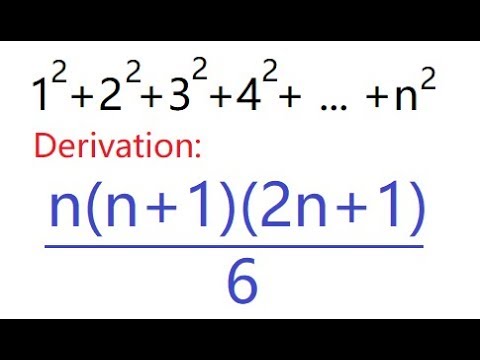
Sum of first n Natural Numbers: https://youtu.be/aaFrAFZATKU
Here we have a simple algebraic derivation of formula to find the sum of first n square numbers.
glass heart
even simpler
blazing coyote
either both events don't happen, one happens ,and the other doesn't ( two such possibilities), or none happen
glass heart
are you sure you typed what you wanted?
blazing coyote
now yes
glass heart
well in your list you definitely forgot both happening
glass heart
but anyway
the event I am talking about is none of those
I am talking about the empty event
blazing coyote
$P(E_1 \cap E_2)=0$
potent lotusBOT
wai
 glass heart
is that the def you were given?
blazing coyote
for two events
let me confirm
2 minutes
I can't really find a defn, but on further thought, it sounds like mutaully exclusive
glass heart
what are disjoint sets
blazing coyote
sets whose intersection is the null set
glass heart
and I would always have defined disjoint events the same way
but tbf, its been quite long since I've done probability theory
for finite things this is equivalent to having probability 0
for continuous distributions its not
anyway
not that relevant here
given the empty event, how can you have infinitely many disjoint events
blazing coyote
You can have the intersection of all events with the empty event?
glass heart
which are?
blazing coyote
$E_1 \cap E_2; E_1, E_2, E_1 \cap \varnothing, E_2 \cap \varnothing, E_1\cap E_2 \cap \vanothing,\varnothing$
potent lotusBOT
wai
Compile Error! Click the  reaction for more information.
(You may edit your message to recompile.)
 glass heart
what do the last of those equal
blazing coyote
\varnothing
glass heart
the key point being: we can use the empty event over and over again
and in this way fill up our events until we have infinitely many
and this enables us to effectively use axiom 3 even for a finite amount of events
I hope you have shown P(empty event)=0 btw
otherwise you also need to show that
blazing coyote
glass heart
I hope you have shown P(empty event)=0 btw
yes
I forgot an event too
So all I have to do now is write $ E_1 \cup E_2$ as the intersection of two disjoint events
glass heart
why two
blazing coyote
well, not necessarily two
just the union of disjoint events
Well, the best I can do is $P(E_1 \cup (E_1^{C} \cap E_2)) = P(E_1) + P(E_1 ^C\cap E_2)$
potent lotusBOT
wai
 potent lotusBOT
The current time for math_rocks is 11:47 PM (IST) on Fri, 23/05/2025.
calm coralBOT
Channel closed
Closed by @blazing coyote
Use .reopen if this was a mistake.
blazing coyote
And thanks
calm coralBOT
Available help channel!
Send your question here to claim the channel.
Remember:
• Ask your math question in a clear, concise manner.
• Show your work, and if possible, explain where you are stuck.
• After 15 minutes, feel free to ping <@&286206848099549185>.
• Type the command .close to free the channel when you're done.
• Be polite and have a nice day!
Read #❓how-to-get-help for further information on how to ask a good question, and about conduct in the question channels.
 wind bane
how does the solution space have a dimension of 3 when the vectors themselves are in the sixth dimension?
 calm coralBOT
wind bane
how does the solution space have a dimension of 3 when the vectors themselves ar...
velvet osprey
wind bane
how does the solution space have a dimension of 3 when the vectors themselves ar...
calm coralBOT
wind bane
how does the solution space have a dimension of 3 when the vectors themselves ar...
velvet osprey
wind bane
how does the solution space have a dimension of 3 when the vectors themselves ar...
they live in R^6 but they span only a subspace of R^6.
"dimension 3" does not mean the vectors themselves have to look like they live in R^3; only that it takes 3 vectors to span the space that you're talking about.
wind bane
so because we have three vectors they span R^3?
and because they are linearly independent
or im i misunderstanding something
and how can sixth dimensional vectors span R^3?
 dire gulch
do you know how you define dimensions of a vector space?
wind bane
based on the basis vectors right?
so if you have three linearly independent vectors
they make a basis for R^3
thus the dimension is 3
dire gulch
wind bane
they make a basis for R^3
not for R^3
wind bane
correct me if im worng
wind bane
dire gulch
not for R^3
how
dire gulch
wind bane
thus the dimension is 3
the dimension of a vector space is n, if there is a basis which has cardinality n
is the definition of dimension of a vector space
 woeful berry
you just need to show that the vectors are linearly independent
dire gulch
it doesnt matter what the vector space is
it could be a bit sequence under xor and and
woeful berry
R-linear combinations of 3 linearly independent vectors will span a subspace isomorphic to R^3
so we say the solution space has dimension 3
 stoic oyster
and isomorphic to R^3 doesn't mean it's literally R^3
wind bane
why is it important to find the solution space anyway? what does it say about the system you solved?
woeful berry
stoic oyster
and isomorphic to R^3 doesn't mean it's literally R^3
thats true 😄
velvet osprey
is the... space... of all of its solutions...
woeful berry
wind bane
why is it important to find the solution space anyway? what does it say about th...
its the goal of solving a system
wind bane
tahst not a good reason
woeful berry
it is, for me 😄 and for many others
wind bane
woeful berry
its the goal of solving a system
but why does it matter that we know the dimension of the solution space
dire gulch
well i admit the qn is not that interesting, but if you want to solve it you have to solve it
wind bane
is there any relations to differential equations?
dire gulch
wind bane
is there any relations to differential equations?
not this particular qn, but yes
velvet osprey
wind bane
but why does it matter that we know the dimension of the solution space
we know how many "degrees of freedom" the solutions have, in some sense.
calm coralBOT
Channel closed
Closed by @wind bane
Use .reopen if this was a mistake.
calm coralBOT
Available help channel!
Send your question here to claim the channel.
Remember:
• Ask your math question in a clear, concise manner.
• Show your work, and if possible, explain where you are stuck.
• After 15 minutes, feel free to ping <@&286206848099549185>.
• Type the command .close to free the channel when you're done.
• Be polite and have a nice day!
Read #❓how-to-get-help for further information on how to ask a good question, and about conduct in the question channels.
 cloud nexus
 calm coralBOT
cloud nexus
cloud nexus
calm coralBOT
cloud nexus
cloud nexus
 cloud nexus
 edgy leaf
ie why the inverse exists for instance
edgy leaf
ie why the inverse exists for instance
its a field
edgy leaf
indeed
woeful berry
not to mention, you have not provided a proper proof in the case that v =/= 0
edgy leaf
oh
cloud nexus
i need some hints to like figure that part out
i know ill need to do some distributive shenanigans
bnut like
can i have a subtle hint
edgy leaf
is it not sufficient to show that if v≠0 then av = 0 by taking inverse a on both sides, hence a must be 0??
 sharp narwhal
edgy leaf
is it not sufficient to show that if v≠0 then av = 0 by taking inverse a on both...
sharp narwhal
edgy leaf
is it not sufficient to show that if v≠0 then av = 0 by taking inverse a on both...
you mean a≠0?
edgy leaf
wait i got a bit confused
sharp narwhal
what op showed is sufficient yes
edgy leaf
yes thats what i meant to say
woeful berry
suppose that v != 0 AND av = 0. then we want to show a = 0. well, if a were not 0, then you can take a^{-1} both sides to get v = 0 (contradiction)
sharp narwhal
@cloud nexus you are done
cloud nexus
woeful berry
suppose that v != 0 AND av = 0. then we want to show a = 0. well, if a were not ...
oh that just
works
sharp narwhal
woeful berry
suppose that v != 0 AND av = 0. then we want to show a = 0. well, if a were not ...
yeah that's what op showed
u don't need to assume v≠0
calm coralBOT
Channel closed
Closed by @cloud nexus
Use .reopen if this was a mistake.
woeful berry
cloud nexus
oh that just
indeed, and now you can see why we didnt need to assume the v != 0 😄
calm coralBOT
Available help channel!
Send your question here to claim the channel.
Remember:
• Ask your math question in a clear, concise manner.
• Show your work, and if possible, explain where you are stuck.
• After 15 minutes, feel free to ping <@&286206848099549185>.
• Type the command .close to free the channel when you're done.
• Be polite and have a nice day!
Read #❓how-to-get-help for further information on how to ask a good question, and about conduct in the question channels.
 vernal drum
I have this um brick 🧱 puzzle problem, so basically I have different sized bricks and I want to make the tallest tower. But I can't place a brick on a brick which has lesser width or lesser length than it. How can I make tallest tower 🗼?
calm coralBOT
vernal drum
I have this um brick 🧱 puzzle problem, so basically I have different sized bric...
vernal drum
Please ping me if you have insight/hint
calm coralBOT
What step are you on?
1. I don't know where to begin.
2. I have begun but got stuck midway.
3. I got an answer but I was told that it's wrong.
4. I got an answer and would like my work checked.
5. I have a question about someone else's work/solution.
6. I have completed the problem and don't need help anymore. Thank you.
7. None of the above
@vernal drum can you share all the brick shapes that are available to you
and maybe the precise rules as detailed in your worksheet
vernal drum
You have to have an efficient method which works for any set of bricks 🧱
Although you can be loosey goosey with the efficiency at first and slowly work the way up
velvet osprey
not really helpful, that.
you can and should send images here btw
can we please just have a screenshot or photo of your worksheet
vernal drum
Its not from a worksheet
velvet osprey
then where is it from
velvet osprey
well what kind of shape do we consider as a "brick", for one
velvet osprey
"any"?
vernal drum
Positive real dimensions
velvet osprey
ok then you can make an infinitely tall tower??
velvet osprey
so what exactly is the rule we have to satisfy
vernal drum
The height should be maximum and if you are placing a brick on another, it's length and width should both be lesser than the brick we are placing it on
velvet osprey
under what conditions do we consider a brick to be "on" another?
what happens if the bottom face of brick A partially overlaps with the top of brick B? do we still consider A to be "on" B?
vernal drum
If we have a bricks of dimensions (l,w,h) as (5,6,10) and (6,7,12) we can place the first brcik on the next
But we can't place second on first
If it's (4, 5, 2) and (5, 4, 2) then neither can be placed on the other
velvet osprey
im asking what is considered as placing one "on" another
do we allow overhangs
or does each brick have to rest either on the table or entirely on the surface of a single other brick
vernal drum
There's no table
velvet osprey
if there's no table what do the bottom-most bricks rest on...
vernal drum
It has to rest entirely on the other brick yes
vernal drum
velvet osprey
if there's no table what do the bottom-most bricks rest on...
Oh, I see, yea you can assume it to be a table or ground or earth
velvet osprey
like... table, ground, base plane, what else do you wanna call it
vernal drum
Yes
Bottom most is only a brivk
You cant have multiple bricks on the same plane
And you cannot spatially rotate the bricks
It it's (l,w,h) you can only keep them as such
velvet osprey
so not even rotations in the horizontal plane are allowed?
vernal drum
Nope
velvet osprey
so e.g. you cannot fit a (3,10,1) over a (12,5,2)?
vernal drum
Nope
vernal drum
That should make the problem simpler right
velvet osprey
i guess
now it feels kinda reminiscent of some kind of knapsack problem
but i dont really know if there are any straightforward reductions in either direction
vernal drum
Hmm
😶
a rather inefficient approach: take all possible stacks which you can make under the length width constraints, find the tallest
Oh I got it
Thanks Ann.
.close
calm coralBOT
Channel closed
Closed by @vernal drum
Use .reopen if this was a mistake.
calm coralBOT
Available help channel!
Send your question here to claim the channel.
Remember:
• Ask your math question in a clear, concise manner.
• Show your work, and if possible, explain where you are stuck.
• After 15 minutes, feel free to ping <@&286206848099549185>.
• Type the command .close to free the channel when you're done.
• Be polite and have a nice day!
Read #❓how-to-get-help for further information on how to ask a good question, and about conduct in the question channels.
 peak wadi
first of all i'd say im not sure if this is even the server for that
if its not ill happily go on my merry way!
some background: i am making a cpu in minecraft (gotta have a hobby somehow amiright) and i needed a pseudo random number generator for it
i ended up on lfsrs as the main generator
i dont know if people on here know what lfsrs are so ill try to give a brief explanation
its a shift register where using some sort of logic gate (mostly xors and xnors) in series lead to the next bit, basically its a loop
now there is some math behind it but certain layouts of xors lead to a maximum cycle lfsr which means that it cycles through each binary number within its bit range atleast once, so for example for an 8 bit lfsr an optimal arrangement is placing xors at bits 8 6 5 4 which leads to a 255 cycle lfsr (not 256 as a 0 would cause the entire lfsr to output only 0s)
now this 0 problem is an issue as i need an rng from 0-255 not 1-255 so what my plan was
having eight 8 bit lfsrs in parallel each initialized to a random start within their cycle (a random preset number chosen beforehand)
and another 11 bit lfsr which would xor its last 8 bits with each of the eight 8 bit lfsrs giving them variation, because the cycle length of the
11 bit lfsr is 2047 and the 8 bit is 255 and becasue they are relatively prime the entire cycle for the system is 255 * 2047 numbers long
sorry for the long background now for the main issue
when checking the system beforehand with code (ill attach the file) when running it for its full cycle it showed me that the numbers 127 and 255 occur 50% less than all other numbers (attached is a picture showing the counts of each number in total over the entire cycle)
so to clarify some things:
11 bit lfsr: 0 0 0 [0 0 0 0 0 0 0 0]
8x8 bit lfsr [0...0, 0...0, 0...0, 0...0, 0...0, 0...0, 0...0, 0...0]
i take the last 8 bits of the 11 bit lfsr and the last bits of each 8 bit lfsr and xor them together
now when i try to use any other 8 bits in a row from the 11 bit lsfr for example: 0 [0, 0, 0, 0, 0, 0, 0, 0] 0, 0 it gives me incredibly different results
as in, half the numbers never. occur. and it gives a very obvious pattern
what im asking is basically:
why does this arrangement give less 127s and 255s
because in my mind the 11 bit lfsr and 8 bit lfsrs are not connected at all their cycles do not coincide
i'd love to know why this happens like this and how to fix it so that the chances for all numbers to occur are roughly the same
calm coralBOT
peak wadi
first of all i'd say im not sure if this is even the server for that
if its not ...
peak wadi

code:
def lfsr_multiple(start_b, start_a=None, length=521985):
    if start_a is None:
        start_a = [0, 0, 0, 0, 0, 0, 0, 0]
    state_a, state_b = start_a, start_b
    sequence = [0]
    for _ in range(length):
        for index, state in enumerate(state_a):
            feedback_a = (state >> 7) & 1
            feedback_a = ((~feedback_a) & 1) ^ ((state >> 5) & 1)
            feedback_a = ((~feedback_a) & 1) ^ ((state >> 4) & 1)
            feedback_a = ((~feedback_a) & 1) ^ ((state >> 3) & 1)
            state_a[index] = ((state << 1) | feedback_a) & 0xFF

        feedback_b = (state_b >> 10) & 1
        feedback_b = ((~feedback_b) & 1) ^ ((state_b >> 8) & 1)
        state_b = ((state_b << 1) | feedback_b) & 0x7FF  # Ensure 11-bit register
        sequence.append(int(''.join(str((state & 1) ^ (((state_b & 1024) >> (10 - index)) & 1)) for index, state in enumerate(state_a[::-1])), 2))

    print(state_b)

    return sequence


# Generate random data for comparison
N = 2047 * 255  # Length of the random data

# data = lfsr_combined_8_11(254, 255, N)
data = lfsr_multiple(1000, [17, 46, 248, 49, 150, 106, 104, 239], N)

random_data = [random.randint(0, 255) for _ in range(N)]


# Prepare counters and values
def prepare_plot_data(input_data):
    c = Counter(input_data)
    keys = sorted(c.keys())
    values = [c[k] for k in keys]
    return keys, values


keys1, values1 = prepare_plot_data(data)
keys2, values2 = prepare_plot_data(random_data)

# Create subplots
fig, axs = plt.subplots(1, 2, figsize=(16, 6))

# Plot original data
axs[0].bar(keys1, values1, color='steelblue')
axs[0].set_title("Frequency of Each Number (Original Data)")
axs[0].set_xlabel("Value")
axs[0].set_ylabel("Count")
axs[0].grid(axis='y', linestyle='--', alpha=0.6)

# Plot random data
axs[1].bar(keys2, values2, color='orange')
axs[1].set_title(f"Frequency of Each Number (Random Data, N={N})")
axs[1].set_xlabel("Value")
axs[1].set_ylabel("Count")
axs[1].grid(axis='y', linestyle='--', alpha=0.6)

plt.tight_layout()
plt.show()
now i realize this isnt really a school/homework question
but im genuinly interested why this arrangement which in my head should produce relatively balanced pseudorandom numbers is weighing 127 and 255 down
leaden thunder
wut
 fringe reef
peak wadi
now i realize this isnt really a school/homework question
but im genuinly intere...
fringe reef
peak wadi
now i realize this isnt really a school/homework question
but im genuinly intere...
i have a hunch but give me a moment to read everything
peak wadi
ill wait as long as needed i'd love all the help i can get
fringe reef
peak wadi
first of all i'd say im not sure if this is even the server for that
if its not ...
and another 11 bit lfsr which would xor its last 8 bits with each of the eight 8 bit lfsrs giving them variation, because the cycle length of the
huh? what are you doing with the remaining 3 bits?
peak wadi
not using them, they exist because they are needed for the lfsr to exist but im only using the last 8 for the xoring
fringe reef
peak wadi
code:
```
def lfsr_multiple(start_b, start_a=None, length=521985):
if start_...
honestly, i have no idea, but i am wouldn't be surprised if
state_b = ((state_b << 1) | feedback_b) & 0x7FF # Ensure 11-bit register
affects the range of values you can get with the "11"-bit lfsr - you might not be able to reach every state considering that you & 0x7FF
but that's just a guess honestly
peak wadi
0x7FF is used to limit it to 11 bits
fringe reef
yes
peak wadi
the range is supposed to be 11 bits
fringe reef
but then you feed the cropped version back into the lfsr
i think you should just be running it separately and do & 0x7FF on a copy of these 11bits that you will xor
fringe reef
but you crop it to 8 bits and feed that state back in
peak wadi
sequence.append(int(''.join(str((state & 1) ^ (((state_b & 1024) >> (10 - index)) & 1)) for index, state in enumerate(state_a[::-1])), 2))
this line sequences only 8 bits out of that 11
specifically
10 - index
as index is the enumerated output of state_a which has 8 elements
the code works i checked
im like 99% sure the code works but its always good to be checked on it ig
ummm am i supposed to wait, can i @ someone or how does this work
peak wadi
ig ill do that? <@&286206848099549185> sorry for the ping but if i may have some help 🙏
 safe pecan
peak wadi
as index is the enumerated output of state_a which has 8 elements
safe pecan
peak wadi
as index is the enumerated output of state_a which has 8 elements
maybe try?
sequence.append(int(
    ''.join(
        str(
            ((state_a[::-1] + [0]*(11-len(state_a)))[i] ^ ((state_b >> (10-i)) & 1))
        )
        for i in range(11)
    ), 2
))
unless you mean "xor each of the N bits in state_a with the corresponding high bits of state_b"
then it'd be:
n = len(state_a)
sequence.append(int(''.join(
    str((bit & 1) ^ ((state_b >> (n-1 - idx)) & 1))
    for idx, bit in enumerate(state_a[::-1])
), 2))
@peak wadi Has your question been resolved?
peak wadi
safe pecan
```py
n = len(state_a)
sequence.append(int(''.join(
str((bit & 1) ^ ((state_...
this is 1 for 1 what i am doing (just noticed im doing a useless & 1024 but it doesnt effect the outcome)
and is what i mean
peak wadi
safe pecan
maybe try?
```py
sequence.append(int(
''.join(
str(
((s...
not sure what this is supposed to do
safe pecan
first, it reverses state_a and pads it with zeros so it has 11 elements, then for each index i from 0 to 10, it xors that padded bit with the (10-i)th bit of state_b
and finally it joins all those xor results into an 11-character string of '0's and '1's in order to convert that binary string back to an integer and pushing it onto the sequence
peak wadi
mhm well the final output needs to be 8 bit not 11
safe pecan
ohh, my bad
peak wadi
nah i didnt mention that ig
safe pecan
you can easily fix it tho
peak wadi
fix what? the code is fine
my problem is with the mathematical aspect of what im doing
my issue is that certain numbers have redcued chances of generating
and i dont know why or how to fix it
calm coralBOT
Channel closed
Closed due to timeout
Use .reopen if this was a mistake.
calm coralBOT
Available help channel!
Send your question here to claim the channel.
Remember:
• Ask your math question in a clear, concise manner.
• Show your work, and if possible, explain where you are stuck.
• After 15 minutes, feel free to ping <@&286206848099549185>.
• Type the command .close to free the channel when you're done.
• Be polite and have a nice day!
Read #❓how-to-get-help for further information on how to ask a good question, and about conduct in the question channels.
 hardy spindle
!help
calm coralBOT
To ask for mathematics help on this server, please open your own help channel or help thread. See #❓how-to-get-help for instructions.
calm coralBOT
hardy spindle
!help

 alpine stone
Could you translate?
hardy spindle
Yeah so which polynomial corresponds to the volume of the box
 rough blade
it gives a bunch of surfaces for each side , and the question is which one correspond to the volume of the box
what is a facade ?
alpine stone
Alright, a good start would be to try factoring the given polynomials
hardy spindle
If the value of x is 4 what is the numerique value of the volume
rough blade
so its a rectangle ?
hardy spindle
alpine stone
Alright, a good start would be to try factoring the given polynomials
What would that do just asking
hardy spindle
rough blade
so its a rectangle ?
Yeah basically
 dapper sable
hardy spindle
What would that do just asking
dapper sable
hardy spindle
What would that do just asking
You'll perhaps be able to figure out the side lengths.
hardy spindle
Okay ill try that
dapper sable
The volume is the product of the side lengths.
alpine stone
hardy spindle
What would that do just asking
If two faces have a common factor, it is safe to assume the side shared by the faces has length equal to that factor
alpine stone
If all the polynomials turn out to have common factors in pairs, you know the side lengths
alpine stone
hardy spindle
So which one are we factorising?
Each one
hardy spindle
Ik
Ok
Im trying to factorise 3x^2 + 14x + 8
With somme product
S = 14 P = 24
rough blade
||the quadratic formula ||
 glad parrot
You tryin to do the a)?
hardy spindle
Yeah
glad parrot
hardy spindle
(3x+2)(x+4)
Seems good
You can factor all of the three polynomial and make the product of all of it
The thing is that, it depends what they are waiting as "polynome"
hardy spindle
Alright when im done ill try to do that
glad parrot
Is it the developped form or the factor one
hardy spindle
glad parrot
Is it the developped form or the factor one
Im not sure
glad parrot
To me its the developped form
hardy spindle
Well do that then
Also
3x^2 + 8x + 4
P = 8 S 12
Only numbers i found are 6 and 2
But they dont work
glad parrot
-2 is a root
hardy spindle
So +-?
 remote mural
guys I will go crazy
alpine stone
hardy spindle
6 and the 2
Divide them by 3 and you get relevant constants
glad parrot
So S = 8/3 and P = 4/3
alpine stone
2, 3/2, hence 3(x + 2)(x + 2/3)
glad parrot
Yeah
hardy spindle
Alr
And just to lyk
I didnt do -c/a on the other polynomial
But i still got a good answer
Or -b/a
glad parrot
c/a but yeah, good thing ig
glad parrot
Idk how you did the other one, but what you wrote for S and P on the other one are wrong cuz -4 + -2/3 != 14 and same for the product which is 8/3 and not 24
hardy spindle
Okay okay
But then what on earth is this supposed to be

Cause i basically
Used this to solve
glad parrot
Ah
Not what i thought you was doing
I thought you was doing the product and sum of the roots
And solving for it
glad parrot
Ok
glad parrot
No idea, -2 is a root of it so you can force factor it
glad parrot
-2 root aswell
hardy spindle
Wait
hardy spindle
glad parrot
(X+2)(x + ?)
Wdym
glad parrot
-2 is a root so you can factor the polynomial as (x+2)(x + ?) since there is nothing infront of x²
what is the ?
hardy spindle
How did yk it was a root
hardy spindle
glad parrot
what is the ?
Hm
glad parrot
i plug the value in
glad parrot
no
you want something such as 2*this something = 8
since the polynomial has 8 in constant terms
hardy spindle
Ohh
glad parrot
so its (x+2)(x+?)
hardy spindle
3
glad parrot
2*3 = 8 ?
glad parrot
develop
hardy spindle
Cause the other one was
glad parrot
you don't have 3 infront of x²
hardy spindle
hardy spindle
Ok whats the difference between (3x+2)(x+4)
So this is also wrong?
glad parrot
hardy spindle
Now for x^2 + 6x +8
see
hardy spindle
hardy spindle
Look at this ones answer
glad parrot
what about it
hardy spindle
Theres a different way to solve for 3x^2 and x^2
hardy spindle
glad parrot
what about it
It also has 3x
glad parrot
can you sum up your answers
hardy spindle
hardy spindle
Ok whats the difference between (3x+2)(x+4)
First
hardy spindle
hardy spindle
(3x+2)(x+2)
2nd
glad parrot
yeah they both correct
now for x² +6x +8
you know -2 is a root
so x²+6x+8 = (x+2)(x+?)
and you want to know the '?'
glad parrot
well the others were done so ofc
hardy spindle
Yeah
 hardy spindle
 glad parrot
for the volume
hardy spindle
Yea
glad parrot
lets get the longueur first
hardy spindle
Kk
glad parrot
we know 3x²+8x+4 = ?
and 3x² +14x +8 = ?
hardy spindle
So replace x with 4
glad parrot
hardy spindle
So replace x with 4
no
hardy spindle
Ah
hardy spindle
Whats the factored form
glad parrot
you found it earlier
hardy spindle
(3x+2)(x+2)
glad parrot
ok and for 3x²+14x+8 ?
hardy spindle
(3x+2)(x+4)
glad parrot
ok so we see that we have a common factor between these two
which means that since they share the SAME longueur
the longueur is represented by this common factor
which is ?
glad parrot
(3x+2)(x+2) (3x+2)(x+4)
what do they have in common
hardy spindle
Yea
glad parrot
what about the hauteur (height)
hardy spindle
Its (x+2)
glad parrot
yes cuz its the one they share with the other one "(X+2)(x+4)"
hardy spindle
Ye
glad parrot
and what about the largeur (width)
hardy spindle
(X+4)
glad parrot
great
so now if you product all these three "longueur, largeur and hauteur"
you will have your polynomial that express the volume
and now
hardy spindle
Now replace x
glad parrot
you can answer question 2 by plugging in x = 4 into that said polynomial
glad parrot
where this polynomial is the answer to question 1
hardy spindle
Volume = 672
glad parrot
well assuming calculations are correct, this is wrong
hardy spindle
Huh
hardy spindle
Cm^3
glad parrot
ok
hardy spindle
Mb
hardy spindle
Alr lol
calm coralBOT
If you are done with this channel, please mark your problem as solved by typing .close
glad parrot
yea
hardy spindle
Thanks bro
glad parrot
yw
hardy spindle
.close
calm coralBOT
Channel closed
Closed by @hardy spindle
Use .reopen if this was a mistake.
calm coralBOT
Available help channel!
Send your question here to claim the channel.
Remember:
• Ask your math question in a clear, concise manner.
• Show your work, and if possible, explain where you are stuck.
• After 15 minutes, feel free to ping <@&286206848099549185>.
• Type the command .close to free the channel when you're done.
• Be polite and have a nice day!
Read #❓how-to-get-help for further information on how to ask a good question, and about conduct in the question channels.
 lyric ore
can I get any help? I did the first part, but I dont see any conection with second part
 calm coralBOT
lyric ore
can I get any help? I did the first part, but I dont see any conection with seco...
calm coralBOT
lyric ore
can I get any help? I did the first part, but I dont see any conection with seco...
@lyric ore Has your question been resolved?
lyric ore
.close
calm coralBOT
Channel closed
Closed by @lyric ore
Use .reopen if this was a mistake.
calm coralBOT
Available help channel!
Send your question here to claim the channel.
Remember:
• Ask your math question in a clear, concise manner.
• Show your work, and if possible, explain where you are stuck.
• After 15 minutes, feel free to ping <@&286206848099549185>.
• Type the command .close to free the channel when you're done.
• Be polite and have a nice day!
Read #❓how-to-get-help for further information on how to ask a good question, and about conduct in the question channels.
 viscid path
Is my velocity time graph correct?

 calm coralBOT
viscid path
Is my velocity time graph correct?
viscid path
calm coralBOT
viscid path
Is my velocity time graph correct?
viscid path
for qn3a
 flat orchid
No
Why is your graph a straight line in any interval?
Velocity is constant for 0-2, 2-3 and 3-6 yes?
viscid path
flat orchid
Why is your graph a straight line in any interval?
its supposed to be a straight line tho
flat orchid
Huh
flat orchid
flat orchid
Velocity is constant for 0-2, 2-3 and 3-6 yes?
^^
viscid path
flat orchid
^^
isnt it going at 2.5ms^-1 for 2.0min
flat orchid
viscid path
isnt it going at 2.5ms^-1 for 2.0min
So it's constant for 0 to 2 minute right
viscid path
yeah
viscid path
so what, only when there's acceleration, it'll be slanted line?
flat orchid
viscid path
so what, only when there's acceleration, it'll be slanted line?
No
Acceleration is 0 everywhere except for the instantaneous moments when velocity changes abruptly
viscid path
flat orchid
Acceleration is 0 everywhere except for the instantaneous moments when velocity ...
errr so how do I change my graph
flat orchid
I've already provided multiple hints
You figure it out yourself now
Think of what the slant line and horizontal line means
viscid path
flat orchid
Think of what the slant line and horizontal line means
dont tell me the graph is gonna be horizontal lines that are not connected to each other
flat orchid
viscid path
dont tell me the graph is gonna be horizontal lines that are not connected to ea...
Yeah
viscid path
flat orchid
Yeah
wouldn't that look so weird
flat orchid
viscid path
wouldn't that look so weird
Why does it matter that it looks weird
Lmao
It's gonna be discontinuous yes
That's the weird thing you're getting
viscid path
flat orchid
Why does it matter that it looks weird
I mean I've never seen graphs that are disconnected
viscid path
Like this?
 calm coralBOT
@viscid path Has your question been resolved?
viscid path
<@&286206848099549185>
 stoic walrus
viscid path
<@&286206848099549185>
stoic walrus
viscid path
<@&286206848099549185>
yeeee
calm coralBOT
@viscid path Has your question been resolved?
calm coralBOT
Channel closed
Closed due to timeout
Use .reopen if this was a mistake.
Available help channel!
Send your question here to claim the channel.
Remember:
• Ask your math question in a clear, concise manner.
• Show your work, and if possible, explain where you are stuck.
• After 15 minutes, feel free to ping <@&286206848099549185>.
• Type the command .close to free the channel when you're done.
• Be polite and have a nice day!
Read #❓how-to-get-help for further information on how to ask a good question, and about conduct in the question channels.
 surreal patio
can someone help me out of question 4? :d
 calm coralBOT
surreal patio
can someone help me out of question 4? :d
surreal patio
calm coralBOT
surreal patio
can someone help me out of question 4? :d
surreal patio
the matrixx is already in RREF form so x3 would be 0
x2 would be free variable
x1 = 3x2
x2 = x2
x3 =0
what about x4
velvet osprey
RREF form
what do you think the F in RREF stands for
surreal patio
RRE form then
surreal patio
velvet osprey
x2 _and_ x4 are your parameters.
oh , both would be free variables?
velvet osprey
yes
surreal patio
also how would u write nul space
Nul A = span { u ,v } or just the set?
cuzz i think it should be span {u , v} because we have free variables , so many vectors would satisfy ax=0
glass heart
you have x=(x1,x2,x3,x4) = (3x2,x2,0,x4)
rewrite that as a linear combination of two vectors
surreal patio
yeah done that
(3 1 0 0 )x2 + (0 0 0 1) x4
but do i write it as
Nul A = span {(3 1 0 0 ), (0 0 0 1)} or just Nul A = {(3 1 0 0 ), (0 0 0 1)}
surreal patio
glass heart
Nul A is not jsut those two vectors
yeah thats what i thought as well but at the end of the book , we have this
 glass heart
you were asked to list the vectors that span the space
so thats fine
but the equality nul A = {u,v} is wrong
surreal patio
ok ok , and same goes for colA i assume?
im gonna go with yes there as well , cuz its the linear combination of columns of A
ty for the help
.close
calm coralBOT
Channel closed
Closed by @surreal patio
Use .reopen if this was a mistake.
calm coralBOT
Available help channel!
Send your question here to claim the channel.
Remember:
• Ask your math question in a clear, concise manner.
• Show your work, and if possible, explain where you are stuck.
• After 15 minutes, feel free to ping <@&286206848099549185>.
• Type the command .close to free the channel when you're done.
• Be polite and have a nice day!
Read #❓how-to-get-help for further information on how to ask a good question, and about conduct in the question channels.
 lament sorrel
the "->" means indexes 1,...,n. and "<-" means indexes n,...,1? that's it?
 calm coralBOT
lament sorrel
the "->" means indexes 1,...,n. and "<-" means indexes n,...,1? that's it?
lament sorrel
calm coralBOT
lament sorrel
the "->" means indexes 1,...,n. and "<-" means indexes n,...,1? that's it?
lament sorrel
no other meaning ever behind it?
 tawdry flame
What
lament sorrel
and also, do people use upper/down arrow as notation as well for column vector
glass heart
the arrow just means its a vector
tawdry flame
I think arrow just indicates a vector
glass heart
I have never seen <-
tawdry flame
lament sorrel
and also, do people use upper/down arrow as notation as well for column vector
No
lament sorrel
glass heart
I have never seen <-
i see
tawdry flame
Every vector is just ->
calm coralBOT
Channel closed
Closed by @lament sorrel
Use .reopen if this was a mistake.
Available help channel!
Send your question here to claim the channel.
Remember:
• Ask your math question in a clear, concise manner.
• Show your work, and if possible, explain where you are stuck.
• After 15 minutes, feel free to ping <@&286206848099549185>.
• Type the command .close to free the channel when you're done.
• Be polite and have a nice day!
Read #❓how-to-get-help for further information on how to ask a good question, and about conduct in the question channels.
 brittle basin
 calm coralBOT
brittle basin
brittle basin
calm coralBOT
brittle basin
brittle basin
can someone help me work out the curve equation
ive worked out the gradient of the line
 heavy mantle
So you got the eq of line
brittle basin
yes
brittle basin
yes
 tidal condor
brittle basin
tidal condor
brittle basin
Since C cuts the x-axis at 0 and 6, the quadratic function can be written as: y = ax(x - 6)
We know that C passes through the point (10, 80). Substitute these values to find a
brittle basin
i get it now thank u two
but just a question
anytime
i work out the equation of the curve
and i am given a coordinate
i use y = ax(x-z)
right
tidal condor
nice
tidal condor
yes
brittle basin
ty guys!
heavy mantle
Is it the point where slope is 0?
brittle basin
heavy mantle
Is it the point where slope is 0?
yes
heavy mantle
tidal condor
0 ≤ x ≤ 10
How?
tidal condor
heavy mantle
How?
Therefore, the equation of C is: y = 2x(x - 6) = 2x² - 12x
heavy mantle
tidal condor
Therefore, the equation of C is: y = 2x(x - 6) = 2x² - 12x
Yes
tidal condor
Find the equation of the line l
heavy mantle
tidal condor
0 ≤ x ≤ 10
Isnt this a rectangle?
tidal condor
The line l passes through (0, 60) and (10, 80)
heavy mantle
The region
tidal condor
heavy mantle
The region
nah
tidal condor
tidal condor
The line l passes through (0, 60) and (10, 80)
The slope of the line is (80 - 60) / (10 - 0) = 20 / 10 = 2
Since the line intersects the y-axis at 60, the y-intercept is 60
heavy mantle
Mm
tidal condor
Therefore, the equation of l is: y = 2x + 60
heavy mantle
Mm
tidal condor
Yeah
Then
Define the region R using inequalities
For the region R, the y-values are always greater than or equal to those of the curve C. So, we have: y ≥ 2x² - 12x
For the region R, the y-values are always less than or equal to those of the line l we have: y ≤ 2x + 60
The region R is bounded by the x-values of 0 and 10 (the x-coordinates of the intersection points)
So: 0 ≤ x ≤ 10
Understand?
heavy mantle
Ok
tidal condor
How are u?
heavy mantle
Fine
tidal condor
heavy mantle
Fine
I just logged into this server today
heavy mantle
I see
tidal condor
So i want to get acquainted with somebody
heavy mantle
tidal condor
So: 0 ≤ x ≤ 10
But isn't this like an infinite rectangle 🤔
tidal condor
I think, that we cannot set a graph of an infinite rectangle
heavy mantle
Yea nvm...
heavy mantle
India
tidal condor
oh, its not too far from me
heavy mantle
Ok
tidal condor
i want to learn English very well
heavy mantle
Mm.. I am not very good at english
heavy mantle
Only in typing
tidal condor
because some your frases i needed too translate from the internet))
heavy mantle
I see