#help-42
1 messages · Page 159 of 1
 remote mural
 calm coralBOT
Channel closed
Closed by @misty swift
Use .reopen if this was a mistake.
 tranquil bone
 calm coralBOT
 Available help channel!
Send your question here to claim the channel.
Remember:
• Ask your math question in a clear, concise manner.
• Show your work, and if possible, explain where you are stuck.
• After 15 minutes, feel free to ping <@&286206848099549185>.
• Type the command .close to free the channel when you're done.
• Be polite and have a nice day!
Read #❓how-to-get-help for further information on how to ask a good question, and about conduct in the question channels.
 spice venture
 calm coralBOT
spice venture
spice venture
calm coralBOT
spice venture
spice venture
not able to find a method which involves less calculation
 restive sigil
Or lagrange interpolation if you don't mind the time it takes
spice venture
restive sigil
Or lagrange interpolation if you don't mind the time it takes
never heard that in my life
 glass heart
no
spice venture
mb sorry let me try again
restive sigil
spice venture
never heard that in my life
Given n coordinate pairs (x_i,y_i) you can find a unique polynomial such that P(x_i)=y_i
That's called lagrange interpolating polynomial
spice venture
glass heart
if you have g=f-(2x-1) then g(1)=...=g(5)=0
not getting it dude sorry 😔could you help?
spice venture
restive sigil
Given n coordinate pairs (x_i,y_i) you can find a unique polynomial such that P(...
oh
but ive not learnt that so i dont think im supposed to use it
restive sigil
restive sigil
Given n coordinate pairs (x_i,y_i) you can find a unique polynomial such that P(...
After you find the expression of P you can evaluate it at 6
restive sigil
spice venture
but ive not learnt that so i dont think im supposed to use it
Oh okay you can do what Denascite said Ig it works as well
glass heart
spice venture
not getting it dude sorry 😔could you help?
what about it do you not get
spice venture
like what to do with that
restive sigil
spice venture
like what to do with that
You have all the roots of your polynomial
glass heart
just intuitively speaking
spice venture
restive sigil
You have all the roots of your polynomial
the roots are 1,3,5,7,9?
glass heart
given the values you can indeed just find out the formula of g easily
glass heart
spice venture
the roots are 1,3,5,7,9?
no
restive sigil
spice venture
the roots are 1,3,5,7,9?
Yes but for g(x)=f(x)-2x+1 so you can factor out g
 swift ravine
Is this group helpful for engineering students?
spice venture
glass heart
no
of g i mean
spice venture
restive sigil
Yes but for g(x)=f(x)-2x+1 so you can factor out g
factor out meaning?
restive sigil
Meaning write g as a product of monomials
spice venture
oh ok so
swift ravine
Guys?
restive sigil
spice venture
oh ok so
Gotta go I've a physics exam
spice venture
(x-1)(x-2)(x-3)(x-4)(x-5)(x-alpha) + 2x + 1 = f(x)
spice venture
restive sigil
Gotta go I've a physics exam
oh man
spice venture
glass heart
no
sorry i meant 1,2,3,4,5
glass heart
spice venture
(x-1)(x-2)(x-3)(x-4)(x-5)(x-alpha) + 2x + 1 = f(x)
thats false
g is also a polynomial of degree 6
and has leading coefficient 2009
spice venture
right so some unknown root alpha
glass heart
yes
spice venture
oh but what does this mean
glass heart
it means that 2 is a double root of g
glass heart
glass heart
and has leading coefficient 2009
.
spice venture
is it correct now?
glass heart
yes
spice venture
so now x=6? 😭
glass heart
yes
calm coralBOT
Channel closed
Closed by @spice venture
Use .reopen if this was a mistake.
calm coralBOT
Available help channel!
Send your question here to claim the channel.
Remember:
• Ask your math question in a clear, concise manner.
• Show your work, and if possible, explain where you are stuck.
• After 15 minutes, feel free to ping <@&286206848099549185>.
• Type the command .close to free the channel when you're done.
• Be polite and have a nice day!
Read #❓how-to-get-help for further information on how to ask a good question, and about conduct in the question channels.
 unreal rose
why cant i do 9C3 = 84 ?
 calm coralBOT
unreal rose
why cant i do 9C3 = 84 ?
calm coralBOT
unreal rose
why cant i do 9C3 = 84 ?
 potent smelt
unreal rose
why cant i do 9C3 = 84 ?
potent smelt
unreal rose
why cant i do 9C3 = 84 ?
If you select all three points from a single line you do not get a triangle
calm coralBOT
Channel closed
Closed by @unreal rose
Use .reopen if this was a mistake.
calm coralBOT
Available help channel!
Send your question here to claim the channel.
Remember:
• Ask your math question in a clear, concise manner.
• Show your work, and if possible, explain where you are stuck.
• After 15 minutes, feel free to ping <@&286206848099549185>.
• Type the command .close to free the channel when you're done.
• Be polite and have a nice day!
Read #❓how-to-get-help for further information on how to ask a good question, and about conduct in the question channels.
 ripe hornet
Hiya I am having quite a simple issue. Its to do with integration but im strugging to see how google gets between two points. Pictures are below
calm coralBOT
ripe hornet
Hiya I am having quite a simple issue. Its to do with integration but im struggi...

 rapid cliff

This calculus video tutorial provides a basic introduction into u-substitution. It explains how to integrate using u-substitution. You need to determine which part of the function to set equal to the u variable and you to find the derivative of u to get du and solve for dx. After replacing all x variables with u variables, find the antideriva...
calm coralBOT
Channel closed
Closed by @ripe hornet
Use .reopen if this was a mistake.
Available help channel!
Send your question here to claim the channel.
Remember:
• Ask your math question in a clear, concise manner.
• Show your work, and if possible, explain where you are stuck.
• After 15 minutes, feel free to ping <@&286206848099549185>.
• Type the command .close to free the channel when you're done.
• Be polite and have a nice day!
Read #❓how-to-get-help for further information on how to ask a good question, and about conduct in the question channels.
 maiden gale
Does anyone have any idea of how the hell im supposed to calculate this without a calculator??
 calm coralBOT
maiden gale
Does anyone have any idea of how the hell im supposed to calculate this without ...
calm coralBOT
maiden gale
Does anyone have any idea of how the hell im supposed to calculate this without ...
 velvet osprey
$\sqrt{\frac{2\cdot 6.67 \cdot 10^{-11} \cdot 7.5 \cdot 10^{22}}{1.5\cdot 10^6}}$
 potent lotusBOT
Ann
 velvet osprey
this?
maiden gale
yes
velvet osprey
well you can handle the powers of ten separately and the mantissas (ie everything else) separately
pretending 6.67 ≈ 6.666... = 20/3 seems to also be a good idea
so then that all becomes $\sqrt{\frac{2\cdot \frac{20}{3}\cdot \frac{15}{2}}{\frac32}\cdot 10^{-11+22-6}}$
potent lotusBOT
Ann
 velvet osprey
which is more amenable to manual solution
why would they ban calculators for this q tho
that or you recognize 2*7.5/1.5 = 10
maiden gale
velvet osprey
why would they ban calculators for this q tho
I genuinely don’t know, they banned it for all of the exam as a whole
appreciate the help btw, ill give your method a go.
.close
calm coralBOT
Channel closed
Closed by @maiden gale
Use .reopen if this was a mistake.
calm coralBOT
Available help channel!
Send your question here to claim the channel.
Remember:
• Ask your math question in a clear, concise manner.
• Show your work, and if possible, explain where you are stuck.
• After 15 minutes, feel free to ping <@&286206848099549185>.
• Type the command .close to free the channel when you're done.
• Be polite and have a nice day!
Read #❓how-to-get-help for further information on how to ask a good question, and about conduct in the question channels.
 manic jungle
This is the graph of y=-sin(x/2)
But if the domain is from 0 to 180 then,
we'll only take this part, right?
 calm coralBOT
manic jungle
This is the graph of y=-sin(x/2)
But if the domain is from 0 to 180 then,
we'll ...
manic jungle
calm coralBOT
manic jungle
This is the graph of y=-sin(x/2)
But if the domain is from 0 to 180 then,
we'll ...
manic jungle
This part

 leaden thunder
π radians = 180 degrees
 bold hatch
manic jungle
This part
bold hatch
manic jungle
This part
✅ assuming 0 and 180 are degrees
calm coralBOT
Channel closed
Closed by @manic jungle
Use .reopen if this was a mistake.
Available help channel!
Send your question here to claim the channel.
Remember:
• Ask your math question in a clear, concise manner.
• Show your work, and if possible, explain where you are stuck.
• After 15 minutes, feel free to ping <@&286206848099549185>.
• Type the command .close to free the channel when you're done.
• Be polite and have a nice day!
Read #❓how-to-get-help for further information on how to ask a good question, and about conduct in the question channels.
Channel closed
Channel closed due to the original message being deleted.
If you did not intend to do this, please open a new help channel,
as this action is irreversible, and this channel may abruptly lock.
 ancient grotto
?!
calm coralBOT
Available help channel!
Send your question here to claim the channel.
Remember:
• Ask your math question in a clear, concise manner.
• Show your work, and if possible, explain where you are stuck.
• After 15 minutes, feel free to ping <@&286206848099549185>.
• Type the command .close to free the channel when you're done.
• Be polite and have a nice day!
Read #❓how-to-get-help for further information on how to ask a good question, and about conduct in the question channels.
 marble edge
For the function F, it holds that
F′(x) = f(x)
and
F(−1) = 4.
Determine F(x) if the graph of y = f(x) is the line shown in the figure below.
 calm coralBOT
marble edge
For the function F, it holds that
F′(x) = f(x)
and
F(−1) = 4.
Determine F(x) if...
marble edge
calm coralBOT
marble edge
For the function F, it holds that
F′(x) = f(x)
and
F(−1) = 4.
Determine F(x) if...
marble edge
its in swedish so i translated it
bold hatch
Can you try figuring out an equation for f(x) @marble edge
marble edge
no i cant im too dumb for it
 tropic moth
marble edge
no i cant im too dumb for it
tropic moth
marble edge
no i cant im too dumb for it
do you not remember anything at all
bold hatch
marble edge
no i cant im too dumb for it
ok start with the points (-2, 3) and (0, -1)
tropic moth
mx+b
marble edge
nah we solve it with kx+m
marble edge
bold hatch
ok start with the points `(-2, 3)` and `(0, -1)`
i did check
bold hatch
marble edge
i did check
and what did you get?
marble edge
what
they deleted my message for nothing
i cant say low
i
q
wow
bro what is this censorship
im leaving giving up in life
cya guys
bold hatch
marble edge
they deleted my message for nothing
it might have been a mistake. can you try sending it again?
tropic moth
😭
calm coralBOT
Channel closed
Closed by @marble edge
Use .reopen if this was a mistake.
calm coralBOT
Available help channel!
Send your question here to claim the channel.
Remember:
• Ask your math question in a clear, concise manner.
• Show your work, and if possible, explain where you are stuck.
• After 15 minutes, feel free to ping <@&286206848099549185>.
• Type the command .close to free the channel when you're done.
• Be polite and have a nice day!
Read #❓how-to-get-help for further information on how to ask a good question, and about conduct in the question channels.
 worn hedge
,rotate
 calm coralBOT
worn hedge
,rotate
potent lotusBOT
calm coralBOT
worn hedge
,rotate
potent lotusBOT

 unreal isle
calm coralBOT
unreal isle
calm coralBOT
Channel closed
Closed by @worn hedge
Use .reopen if this was a mistake.
calm coralBOT
Available help channel!
Send your question here to claim the channel.
Remember:
• Ask your math question in a clear, concise manner.
• Show your work, and if possible, explain where you are stuck.
• After 15 minutes, feel free to ping <@&286206848099549185>.
• Type the command .close to free the channel when you're done.
• Be polite and have a nice day!
Read #❓how-to-get-help for further information on how to ask a good question, and about conduct in the question channels.
 visual gust
when solving geometric problems with the roots of a complex number to form a polygon, how do you find all of the individual roots of unity?
calm coralBOT
visual gust
when solving geometric problems with the roots of a complex number to form a pol...
visual gust
I understand w = e^(2pi/n i), but on all of my sheets and stuff it just says "if you know one root of a complex number with n roots, then you can find the other roots by multiplying by an nth root of unity"
I don't understand what it means by multiplying the root by an nth root of unity
velvet osprey
multiplying by what you called w
so if a number z has some nth root r then the others are rw, rw^2, rw^3, ..., rw^(n-1)
visual gust
oh, right, okay. I think that makes sense.
because if I just multiply the initial one n+1 times it seems to loop back around to the first root of unity
velvet osprey
just n
calm coralBOT
Channel closed
Closed by @visual gust
Use .reopen if this was a mistake.
Available help channel!
Send your question here to claim the channel.
Remember:
• Ask your math question in a clear, concise manner.
• Show your work, and if possible, explain where you are stuck.
• After 15 minutes, feel free to ping <@&286206848099549185>.
• Type the command .close to free the channel when you're done.
• Be polite and have a nice day!
Read #❓how-to-get-help for further information on how to ask a good question, and about conduct in the question channels.
 wanton ember
Hey so I have this question and basically I just confirmed that F = curl G. But my question is when I then calculate the flux do I use curl G instead of curl F?
 calm coralBOT
wanton ember
Hey so I have this question and basically I just confirmed that F = curl G. But ...
wanton ember
calm coralBOT
wanton ember
Hey so I have this question and basically I just confirmed that F = curl G. But ...
wanton ember
like should it be double integral curl G * ds?
nvm I found some article for it
.close
calm coralBOT
Channel closed
Closed by @wanton ember
Use .reopen if this was a mistake.
calm coralBOT
Available help channel!
Send your question here to claim the channel.
Remember:
• Ask your math question in a clear, concise manner.
• Show your work, and if possible, explain where you are stuck.
• After 15 minutes, feel free to ping <@&286206848099549185>.
• Type the command .close to free the channel when you're done.
• Be polite and have a nice day!
Read #❓how-to-get-help for further information on how to ask a good question, and about conduct in the question channels.
 thorny steeple
<@&286206848099549185>
calm coralBOT
thorny steeple
<@&286206848099549185>

 marsh valley
What have you tried?
thorny steeple
um
well I know the int is 14
but i dont know what x value is x
anyone
hello
 limpid geyser
thorny steeple
hello
limpid geyser
thorny steeple
hello
do you know integration by parts
potent lotusBOT
Zentisuincarnate
 limpid geyser
its $\int_{lower}^{upper}$ btw
potent lotusBOT
nilo
 limpid geyser
if you know integration by parts just apply it to this problem set u=x and dv=f'(x)dx
that should give u a good start
you have all the info u need
thorny steeple
$\int_{2}^{5}(x*f'(x))dx$
potent lotusBOT
Zentisuincarnate
 thorny steeple
$$u=x, dv = f'(x), therfore , \int_{2}^{5}(udv) = uv - \int(v) du$$
potent lotusBOT
Zentisuincarnate
 limpid geyser
yeah try to evaluate it now u set it up correctly
thorny steeple
$$u=x, dv = f'(x), therfore , \int_{2}^{5}(xf'(x)) = xf(x) - \int(f) *1$$
potent lotusBOT
Zentisuincarnate
 limpid geyser
actually since its a definite integral you need to include the bounds for the first term $\int_{2}^{5}xf'(x)dx = \bigl[x,f(x)\bigr]{2}^{5} - \int{2}^{5}f(x)dx$
potent lotusBOT
nilo
 limpid geyser
literally just evaluate that i set it up for you
limpid geyser
yeah right
potent lotusBOT
Zentisuincarnate
 limpid geyser
that’s given to you in the problem
potent lotusBOT
Zentisuincarnate
 thorny steeple
oh 14
limpid geyser
yeah
calm coralBOT
@thorny steeple Has your question been resolved?
calm coralBOT
Channel closed
Closed due to timeout
Use .reopen if this was a mistake.
calm coralBOT
Available help channel!
Send your question here to claim the channel.
Remember:
• Ask your math question in a clear, concise manner.
• Show your work, and if possible, explain where you are stuck.
• After 15 minutes, feel free to ping <@&286206848099549185>.
• Type the command .close to free the channel when you're done.
• Be polite and have a nice day!
Read #❓how-to-get-help for further information on how to ask a good question, and about conduct in the question channels.
 rocky mantle
Im having trouble with AP stats. I dont know when to use a binomial probability. im guessing you DONT calculate a binomial probability when you're trying to guess what the next outcome would be? But you WOULD use it if you know the number of trials?
calm coralBOT
rocky mantle
Im having trouble with AP stats. I dont know when to use a binomial probability....
rocky mantle
The main question I’m stuck on

 swift laurel
well you would use whatever probability distribution is underlying the event for figuring out the probability of a single trial
then you can use the binomial distribution (along with the knowledge of the probability of a single trial) to find out the probability of something happening across multiple trials
calm coralBOT
Channel closed
Closed by @rocky mantle
Use .reopen if this was a mistake.
calm coralBOT
Available help channel!
Send your question here to claim the channel.
Remember:
• Ask your math question in a clear, concise manner.
• Show your work, and if possible, explain where you are stuck.
• After 15 minutes, feel free to ping <@&286206848099549185>.
• Type the command .close to free the channel when you're done.
• Be polite and have a nice day!
Read #❓how-to-get-help for further information on how to ask a good question, and about conduct in the question channels.
 unborn stone
 calm coralBOT
unborn stone
unborn stone
calm coralBOT
unborn stone
unborn stone
why use the limit test if it already converges due to p series
i dont need to use it right
velvet osprey
(n+1)/(n^3+1) looks an awful lot like a p-series but formally is not one
LCT is how you formalize the resemblance
unborn stone
velvet osprey
(n+1)/(n^3+1) looks an awful lot *like* a p-series but formally is not one
why i compare it to n/n^3 which is bn and is 1/n^2 which converge. and since bn converge an must also?
velvet osprey
sorry, i don't understand your question.
are you asking "Why do we need to make a comparison at all?" or are you asking "So does sum a_n converge?"
unborn stone
velvet osprey
are you asking "Why do we need to make a comparison at all?" or are you asking "...
ok i made comparison of the (n+1)/(n^3+1) to n/n^3
and n/n^3 is bn
and it converges so shoudlnt (n+1)/(n^3+1) which is a_n also converge
velvet osprey
... yes, sum a_n does converge.
unborn stone
velvet osprey
... yes, sum a_n **does** converge.
ok so i coulda used direct comparison instead of limit?
velvet osprey
uhh
unborn stone
thats what i did
velvet osprey
wait does the inequality (n+1)/(n^3+1) <= n/n^3 actually hold?
as in do you have proof that it does?
cause i actually think it doesn't, as-written
(though you could tweak it to make it work still...)
unborn stone
velvet osprey
(though you could tweak it to make it work still...)
ok how
velvet osprey
"Sorry, I don't have proof that that inequality is true. Also, I decided not to give you a straight answer to your question."
unborn stone
bruh ima just use limit then
 pallid halo
it fails rather badly for n=2
unborn stone
pallid halo
it fails rather badly for n=2
ok so limits only way
velvet osprey
pallid halo
it fails rather badly for n=2
yeah but my point is OP is bad at communicating with me in this moment
unborn stone
whenever the numerator is also adding or subtracting something?
 calm coralBOT
@unborn stone Has your question been resolved?
calm coralBOT
Channel closed
Closed due to timeout
Use .reopen if this was a mistake.
Available help channel!
Send your question here to claim the channel.
Remember:
• Ask your math question in a clear, concise manner.
• Show your work, and if possible, explain where you are stuck.
• After 15 minutes, feel free to ping <@&286206848099549185>.
• Type the command .close to free the channel when you're done.
• Be polite and have a nice day!
Read #❓how-to-get-help for further information on how to ask a good question, and about conduct in the question channels.
 median cloak
Hello hello
calm coralBOT
median cloak
Hello hello
median cloak
I want a
Application
That can calculate anything I wrote
Any sketches
Immediately
Is there anything like this
Calculate what I wrote
Microsoft
Apple
Applications
velvet osprey
you are asking for something that is like Wolfram Alpha but also does handwriting recognition?
calm coralBOT
@median cloak Has your question been resolved?
median cloak
velvet osprey
you are asking for something that is like **Wolfram Alpha** but also does **hand...
Yes
I cannot really type any mathematical operations.
I can only draw
velvet osprey
mmm
yeah i dont think anything like that exists, unfortunately
as far as typing math stuff goes, there is this markup language called LaTeX which all mathematicians use
which is also what @potent lotus runs on
calm coralBOT
@median cloak Has your question been resolved?
 short salmon
it might be easier to learn latex, a coding language, or how to use wolfram alpha, than find a tool like this right now
though with AI improving, who knows honestly
calm coralBOT
Channel closed
Closed due to timeout
Use .reopen if this was a mistake.
Available help channel!
Send your question here to claim the channel.
Remember:
• Ask your math question in a clear, concise manner.
• Show your work, and if possible, explain where you are stuck.
• After 15 minutes, feel free to ping <@&286206848099549185>.
• Type the command .close to free the channel when you're done.
• Be polite and have a nice day!
Read #❓how-to-get-help for further information on how to ask a good question, and about conduct in the question channels.
 runic whale
how would i solve these
 calm coralBOT
runic whale
how would i solve these
runic whale
calm coralBOT
runic whale
how would i solve these
runic whale
or what can i search up to understand this
 mellow harbor
runic whale
how would i solve these
mellow harbor
runic whale
how would i solve these
Do you know the sin and cos of standard values?
mellow harbor
Do you know the identities $\sin(x \pm \frac{\pi}{2}), \cos(x \pm \frac{\pi}{2}), \sin(x + \pi), \cos(x + \pi)$
potent lotusBOT
@mellow harbor
 manic jungle
runic whale
how would i solve these
manic jungle
runic whale
how would i solve these
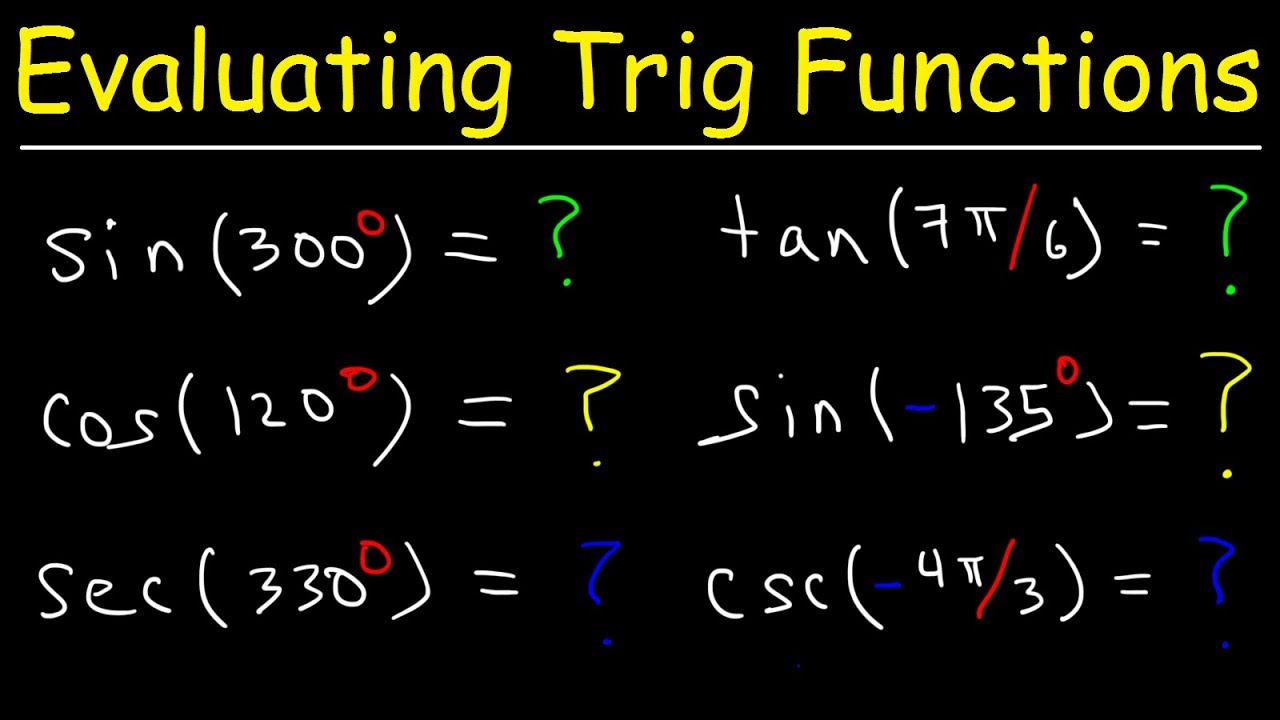
This trigonometry video tutorial explains how to use reference angles to evaluate trigonometric functions such as sine, cosine, tangent, secant, cosecant, and cotangent with positive and negative angles in radians and degrees.. You need to have a good understanding of right triangle trigonometry, SOHCAHTOA, 30-60-90 triangle and the 45-45-90 tr...
This should help
runic whale
manic jungle
https://youtu.be/V8LEHEzdU2U?si=CQYeGlyuym0H4GoZ
YAYYAYYA
thank youuuuuuuuuuuu
manic jungle
Ur welcome
mellow harbor
?
manic jungle
runic whale
okay maybe i dont understand...
Yeah, try going through the vid
u'll get it
mellow harbor
Since you know the unit circle you can also just try using it
You'll see a relation soon enough
if you look at the sin and cos values of standard angles on the unit circle
runic whale
mellow harbor
Do you know the identities $\sin(x \pm \frac{\pi}{2}), \cos(x \pm \frac{\pi}{2})...
can u come back and explain please 😞
im sorry
runic whale
in the video, i got really confused after he started drawing the triangles and labeling the sides
😭
but im looking at chatgpt

and i dont understand the thought process of -5 pi/2 +2 pi = cos(-pi/2)
mellow harbor
Well, do you know what $2\pi$ is?
potent lotusBOT
@mellow harbor
 runic whale
nope
mellow harbor
$2\pi = 360^{\circ}$
potent lotusBOT
@mellow harbor
 mellow harbor
runic whale
ITS A FULL REVOLUTION
mellow harbor
runic whale
ITS A FULL REVOLUTION
YES
mellow harbor
So it just gets back to the same point
runic whale
SO SO THEN IT CANCELS OUT ITS LIKE BOOM -PI/2
mellow harbor
Yep
runic whale
runic whale
but im looking at chatgpt
is cos the only even function
that changes the negative sign?
mellow harbor
runic whale
is cos the only even function
cos is an even function
mellow harbor
runic whale
that changes the negative sign?
?
runic whale
is tan or sin a even function
potent lotusBOT
@mellow harbor
 runic whale
but im looking at chatgpt
runic whale
runic whale
but im looking at chatgpt
sorry i keep referencing back to this pic, but yk how it says step 2 even function
mellow harbor
Yes
runic whale
and turns the -pi/2 into just pi/2
mellow harbor
mhm
mellow harbor
IDK what you mean by cancel out here
runic whale
OH OKAYYY
mellow harbor
$\cos(-\theta) = \cos(\theta)$, similar to $\sin(-\theta) = -\sin(\theta)$ and $\tan(-\theta) = -\tan(\theta)$ this is pretty easily visible on the unit circle
runic whale
i think i can just google that
potent lotusBOT
@mellow harbor
 runic whale
how would i solve these
runic whale
runic whale
how would i solve these
is it okay if you walk me thru the rest of these problems 😞
esp sin -23 pi/4
mellow harbor
Sure
mellow harbor
runic whale
esp sin -23 pi/4
Use the identity $\sin(-\theta) = -\sin(\theta)$ as stated before on $\sin(\frac{-23\pi}{4})$
potent lotusBOT
@mellow harbor
 mellow harbor
and then use the full revolutions
mellow harbor
$2\pi$ is a full revolution
potent lotusBOT
@mellow harbor
 mellow harbor
So, $5\pi$ is?
potent lotusBOT
@mellow harbor
 mellow harbor
Yep
2 full rotations
and a half rotation
Now what happens to sin on unit circle when you go half way accross the circle
runic whale
mellow harbor
Now what happens to sin on unit circle when you go half way accross the circle
thats a good quesiton
i have no idea
mellow harbor
Draw it on the unit circle
runic whale
mellow harbor
Draw it on the unit circle
does it flip it to negttive
runic whale
OH SORRY
I UNDERSTAND IT NOW
AFTER YOU POINTED OUT THE REVOLUTIONS STUFF
THANK YOUUUUU
.close
calm coralBOT
Channel closed
Closed by @runic whale
Use .reopen if this was a mistake.
Available help channel!
Send your question here to claim the channel.
Remember:
• Ask your math question in a clear, concise manner.
• Show your work, and if possible, explain where you are stuck.
• After 15 minutes, feel free to ping <@&286206848099549185>.
• Type the command .close to free the channel when you're done.
• Be polite and have a nice day!
Read #❓how-to-get-help for further information on how to ask a good question, and about conduct in the question channels.
 polar bison
Let T be a right-angled triangle in the plane whose side lengths
are in a geometric progression. Let n(T) denote the number of
sides of T that have integer lengths. Then the maximum value
of n(T) over all such T is ?
calm coralBOT
polar bison
Let T be a right-angled triangle in the plane whose side lengths
are in a geomet...
polar bison
Is the answer 3
 tropic breach
Hmm..got this eqn (r^4 - r^2 - 1 = 0) when I took the sides as (a, ar, ar^2) and applied the pythagoras theorem
tropic breach
if u solve the eqn, the values are irrational
polar bison
exactly
tropic breach
polar bison
you will get irrational no
yep
then the ans should be 1 as a can be considered as integer
polar bison
why can't ar be rational
calm coralBOT
As a helper, please do not give out answers that could be copied as a homework solution. Have the student work through the problem themselves and guide them along the way.
tropic breach
polar bison
why can't ar be rational
I mean if r is irrational, anything multipled with irrational is irrational again soo
polar bison
unless it's 1/that irrational right
tropic breach
not fully, contradiction arises in some cases
glass heart
rewording the question, does there exist a pythagorean triple in arithmetic progression
polar bison
gp
glass heart
fuck I cant read
tropic breach
polar bison
and I haven't seen anything
same
polar bison
so I wrote answer as 3 cause
a can be integer then
ar and ar^2 are not
then ar can be integer if a=1/r so a and ar^2 cannot be
same for ar^2
tropic breach
yep..if u mention that case, then it's correct
polar bison
so you sure the answer is 3?
glass heart
you just excluded 3
tropic breach
In general, I would say the ans is 1 as there are no cases mentioned
polar bison
hmm
polar bison
glass heart
you just excluded 3
?
glass heart
you showed that it can never be all 3 sides
tropic breach
tropic breach
In general, I would say the ans is 1 as there are no cases mentioned
But if it's a proof kinda question, u can mention this case (if a = 1/r)
polar bison
choosing 1 is safer
tropic breach
yep
calm coralBOT
Channel closed
Closed by @polar bison
Use .reopen if this was a mistake.
Available help channel!
Send your question here to claim the channel.
Remember:
• Ask your math question in a clear, concise manner.
• Show your work, and if possible, explain where you are stuck.
• After 15 minutes, feel free to ping <@&286206848099549185>.
• Type the command .close to free the channel when you're done.
• Be polite and have a nice day!
Read #❓how-to-get-help for further information on how to ask a good question, and about conduct in the question channels.
 crystal zephyr
Guys how do I solve

 calm coralBOT
crystal zephyr
Guys how do I solve
crystal zephyr
calm coralBOT
crystal zephyr
Guys how do I solve
crystal zephyr
Ended up getting these 2 linear equations but didn’t work out

Can someone help me
calm coralBOT
@crystal zephyr Has your question been resolved?
polar bison
Don't open 2 help channels
calm coralBOT
@crystal zephyr Has your question been resolved?
crystal zephyr
Mb
calm coralBOT
@crystal zephyr Has your question been resolved?
 unkempt blade
crystal zephyr
Mb
unkempt blade
crystal zephyr
Mb
Oklid maybe????
calm coralBOT
Channel closed
Closed due to timeout
Use .reopen if this was a mistake.
Available help channel!
Send your question here to claim the channel.
Remember:
• Ask your math question in a clear, concise manner.
• Show your work, and if possible, explain where you are stuck.
• After 15 minutes, feel free to ping <@&286206848099549185>.
• Type the command .close to free the channel when you're done.
• Be polite and have a nice day!
Read #❓how-to-get-help for further information on how to ask a good question, and about conduct in the question channels.
polar bison
Let n > 1 be the smallest composite integer that is coprime to
10000!/9900! . Then n leq 100 , 100<n leq 9900 , n <9900 leq 10000 , n>10000?
calm coralBOT
polar bison
Let n > 1 be the smallest composite integer that is coprime to
10000!/9900! . Th...
 vagrant oak
polar bison
Let n > 1 be the smallest composite integer that is coprime to
10000!/9900! . Th...
vagrant oak
polar bison
Let n > 1 be the smallest composite integer that is coprime to
10000!/9900! . Th...
n must be composite, that means that it's a product of at least 2 primes
polar bison
ok
vagrant oak
so you will probably be looking for primes which dont divide 10000!/9900!
polar bison
n cannot be between 9900 and 10000
vagrant oak
polar bison
n cannot be between 9900 and 10000
Yep, thats correct
polar bison
I need to eliminate other options also
vagrant oak
vagrant oak
so you will probably be looking for primes which dont divide 10000!/9900!
just with this, you should be able to eliminate one more
Do you know how to rewrite 10000!/9900! as a product
polar bison
9901*9902..10000
polar bison
I think no
vagrant oak
why not?
polar bison
If we take the even composites 2 will be common
polar bison
It has to be composite
vagrant oak
91 then
vagrant oak
oh im stupid twice
polar bison
There surely exists some number in that product
 rocky flower
vagrant oak
91 then
rocky flower
vagrant oak
91 then
You mean 97
vagrant oak
polar bison
There surely exists some number in that product
Yeah, why
vagrant oak
rocky flower
You mean 97
yep, that'd work
what about 97? Can you prove that 97 is not coprime with the product?
It's gonna be cruicial anyway in the next part
polar bison
97 is prime
vagrant oak
yes, ik, we'll need it later
polar bison
we need to find composite number right
vagrant oak
okay, let's just return to that later
vagrant oak
vagrant oak
n must be composite, that means that it's a product of at least 2 primes
back to this
you are trying to minimize n
that means that your n should be product of exactly 2 primes
and the primes should be least
(and also equal therefore)
so you are looking for the least prime p which is coprime with the product
and then n is just gonna be p^2
do you get that?
polar bison
yes
vagrant oak
alright, now try eliminating more intervals
use the fact that n = p^2
for the least prime p which doesnt divide the product
if you cant do that currently, can you at least reduce the question about in which interval n is to question about in which interval p is?
polar bison
I just square the intervals?
polar bison
<10000
polar bison
oh
polar bison
p<10
vagrant oak
so to prove that n < 100, we only need to prove that each p < 10 divides the product
polar bison
ah
vagrant oak
what about n < 10000?
polar bison
p<100
vagrant oak
yeah
and n > 10000 would just be p > 100
so now you see why determining whether all primes < 100 divide the product is crucial
vagrant oak
why?
polar bison
cause 9901 to 10000 is like 100
vagrant oak
Exactly
polar bison
ok so p>100
vagrant oak
and so there must be at least 1 multiple of each p < 100 in that interval
polar bison
yes
vagrant oak
and hence n > 10000
calm coralBOT
Channel closed
Closed by @polar bison
Use .reopen if this was a mistake.
calm coralBOT
Available help channel!
Send your question here to claim the channel.
Remember:
• Ask your math question in a clear, concise manner.
• Show your work, and if possible, explain where you are stuck.
• After 15 minutes, feel free to ping <@&286206848099549185>.
• Type the command .close to free the channel when you're done.
• Be polite and have a nice day!
Read #❓how-to-get-help for further information on how to ask a good question, and about conduct in the question channels.
 keen tinsel
 calm coralBOT
keen tinsel
keen tinsel
calm coralBOT
keen tinsel
keen tinsel
Does anyone know how you get d theta by dx
The cos squared one that I have in a box
Wait I figured it out
.close
calm coralBOT
Channel closed
Closed by @keen tinsel
Use .reopen if this was a mistake.
calm coralBOT
Available help channel!
Send your question here to claim the channel.
Remember:
• Ask your math question in a clear, concise manner.
• Show your work, and if possible, explain where you are stuck.
• After 15 minutes, feel free to ping <@&286206848099549185>.
• Type the command .close to free the channel when you're done.
• Be polite and have a nice day!
Read #❓how-to-get-help for further information on how to ask a good question, and about conduct in the question channels.
 cedar rune
hey. idk if that question fits in here but i guess so. its not really a math problem question. i am currently looking for good material to practice and exercise in general. this autumn i will start studying physics and therfore i try to improve my math skills at least a bit. so what i am looking for is i a book or any other common material to improve my integral calculus skills. so does anyone know like a source like a book or pdf which contains lots of integral questions? that would be nice. if possible with structured solutions as well. :3
calm coralBOT
cedar rune
hey. idk if that question fits in here but i guess so. its not really a math pro...
cedar rune
my bad. i have not seen it. that probably solves it yet. thanks 😅 should have looked better
.close
calm coralBOT
Channel closed
Closed by @cedar rune
Use .reopen if this was a mistake.
 glad parrot
Its ok, there are also a lot of great online content for integrals
calm coralBOT
Available help channel!
Send your question here to claim the channel.
Remember:
• Ask your math question in a clear, concise manner.
• Show your work, and if possible, explain where you are stuck.
• After 15 minutes, feel free to ping <@&286206848099549185>.
• Type the command .close to free the channel when you're done.
• Be polite and have a nice day!
Read #❓how-to-get-help for further information on how to ask a good question, and about conduct in the question channels.
 plucky karma

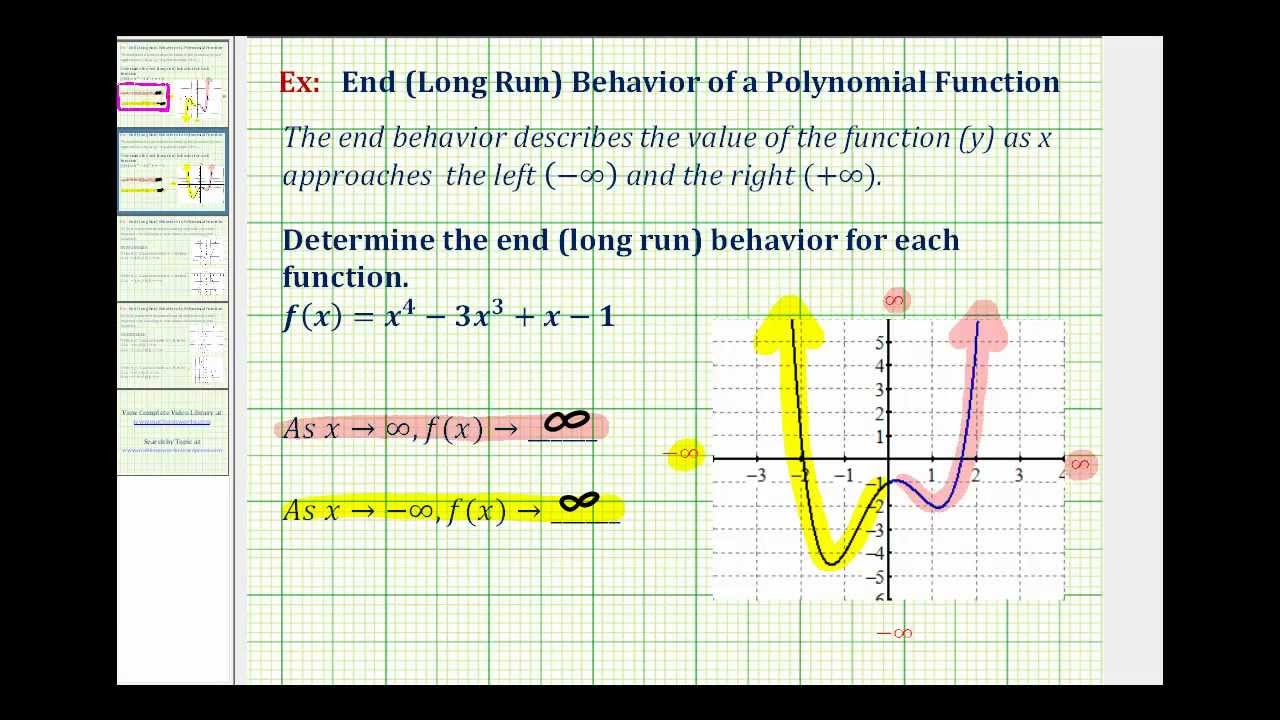
This example provides two examples of how to describe the end behavior and long run behavior of a function.
Site: http://mathispower4u.com
Blog: http://mathispower4u.wordpress.com
calm coralBOT
plucky karma
https://www.youtube.com/watch?v=Krjd_vU4Uvg
plucky karma
so I can understand this while looking a graph but I don't know what the variable behaves or how to graph it
Therefore I don't understand how it behaves, thus I am unable to answer the question
 valid linden
do u hv an idea of how does the graph of x^(2n) changes as we increase the value on n
plucky karma
no
valid linden
when we increase the value of n the graph kinda remains like the graph of y=x²
But...
It gets steeper
maybe u should plot a graph of y=x^(2n)
And u should try seeing what's going on when u increase n
{n is a natural number}
plucky karma
Okay I think I understand
valid linden
:)
plucky karma
its kinda like a parabola but its the w thing
postive goes up and negative goes down
plucky karma
I mean lie -2x^2 would open down
valid linden
yea then it will be a downward parabola
because its leading coefficient is negative
calm coralBOT
@plucky karma Has your question been resolved?
Channel closed
Closed by @plucky karma
Use .reopen if this was a mistake.
Available help channel!
Send your question here to claim the channel.
Remember:
• Ask your math question in a clear, concise manner.
• Show your work, and if possible, explain where you are stuck.
• After 15 minutes, feel free to ping <@&286206848099549185>.
• Type the command .close to free the channel when you're done.
• Be polite and have a nice day!
Read #❓how-to-get-help for further information on how to ask a good question, and about conduct in the question channels.
 fluid swallow
Help
calm coralBOT
fluid swallow
Help
fluid swallow
Did I do this correctly and is the parentheses handle correctly should I do left closed right open?

I actually don’t have to say the convergence implies measurability it is already proven I guess
calm coralBOT
@fluid swallow Has your question been resolved?
calm coralBOT
@fluid swallow Has your question been resolved?
calm coralBOT
Channel closed
Closed due to timeout
Use .reopen if this was a mistake.
Available help channel!
Send your question here to claim the channel.
Remember:
• Ask your math question in a clear, concise manner.
• Show your work, and if possible, explain where you are stuck.
• After 15 minutes, feel free to ping <@&286206848099549185>.
• Type the command .close to free the channel when you're done.
• Be polite and have a nice day!
Read #❓how-to-get-help for further information on how to ask a good question, and about conduct in the question channels.
 olive lion
 calm coralBOT
olive lion
olive lion
calm coralBOT
olive lion
olive lion
My professor did an example with apples (0,2 euro) and pears (0,3) euro and they spend 5,50 and bought 20 in total so help me with this please cuz this is way harder ;/
glass heart
take it sentence by sentence and think about how you can model each of them
olive lion
but the per soon confused me
for like the sweetener for example
do I want to convert that to the ratio of the calories?
glass heart
not sure what you mean
you specify how many spoons of each ingredient are in the milkshake
olive lion
so I want to use spoons instead of calories?
for the modeling ?
I now have the following:
x1 = total calories, 380=<x1=<420
x2 = vitamins >= 50
x3 = fat calories =< 0.2 * x1
x4 = sweetener => x5/1.2
x5 = artificial sweetener
olive lion
x1 = 50 . N + 100 . R + 120 . K + 80 . V?
with N R K V being the amount of spoons for that certain ingredient?
glass heart
yes
glass heart
not quite
olive lion
oh true
glass heart
that would allow for example N=1 and K=2
olive lion
ye shit
fat calories = N + 75R + 30V <= 0.2 Total calories
Vitamins = 20N + 50VS + 2V >= 50
N >= 2K
min (cost) = 10N + 8R + 25VS + 15K + 6V
Such that:
N + 75R + 30V =< 10N + 20R + 24K + 16V
20N + 50VS+2V >= 50
3N + 8R + VS + 2K + 25V = 15
N >= 2R
N,R,VS,K,V >= 0
glass heart
check for typos
olive lion
glass heart
check for typos
Hmm
glass heart
olive lion
x1 = 50 . N + 100 . R + 120 . K + 80 . V?
also this is missing
olive lion
glass heart
also this is missing
i added that to the first inequality
olive lion
olive lion
fat calories = N + 75R + 30V <= 0.2 Total calories
I substituted it here
glass heart
you need the 380<=x1<=420
glass heart
olive lion
min (cost) = 10N + 8R + 25VS + 15K + 6V
Such that:
N + 75R + 30V =< 10N + 20R + ...
N>=2K
olive lion
and that is a typo yes
glass heart
I think the rest checks out
calm coralBOT
Channel closed
Closed by @olive lion
Use .reopen if this was a mistake.
calm coralBOT
Available help channel!
Send your question here to claim the channel.
Remember:
• Ask your math question in a clear, concise manner.
• Show your work, and if possible, explain where you are stuck.
• After 15 minutes, feel free to ping <@&286206848099549185>.
• Type the command .close to free the channel when you're done.
• Be polite and have a nice day!
Read #❓how-to-get-help for further information on how to ask a good question, and about conduct in the question channels.
 wide scaffold
is this correct
 calm coralBOT
wide scaffold
is this correct
bold hatch
wide scaffold
is this correct
calm coralBOT
wide scaffold
is this correct
bold hatch
wide scaffold
is this correct
✅
wide scaffold
.close
calm coralBOT
Channel closed
Closed by @wide scaffold
Use .reopen if this was a mistake.
Available help channel!
Send your question here to claim the channel.
Remember:
• Ask your math question in a clear, concise manner.
• Show your work, and if possible, explain where you are stuck.
• After 15 minutes, feel free to ping <@&286206848099549185>.
• Type the command .close to free the channel when you're done.
• Be polite and have a nice day!
Read #❓how-to-get-help for further information on how to ask a good question, and about conduct in the question channels.
 pearl crag
in the sd formula, is it n or or n-1
calm coralBOT
pearl crag
in the sd formula, is it n or or n-1
pearl crag
its apparently n but ive been taught its n-1
 limpid lagoon
depends on context of the problem
i believe if you have data for the entire area then it's n and if it's a sample then n-1
 near crag
ohhhh this is one of my favorite things lol
it's been a while since I had it fresh in memory though
pearl crag
yh got an exam tmrw
and i swr ive never been taught to use n
but it says to use n or n-1
and im confused on what requires what
near crag
If you have one discrete random variable of a certain kind, then there's a formula for the standard deviation of that variable, and it includes n where n is how many different values the variable can take
but in practice, you don't care about a single random variable, instead you consider a collection of independently and identically distributed random variables
So if I have ten variables that are i.i.d., then that models me going out in the wild and getting 10 samples of something
and it turns out that if you want to estimate the standard deviation of that underlying distribution, then the formula will have n-1
So basically the way the mathematical analysis goes is that you assume the underlying distribution has some expected value mu, then you form a new random variable according to the sample variance formula where
R = 1/(N-1) * ( (X_1 - mu)^2 + ... + (X_N - mu)^2 )
and if you compute the expected value of this random variable (i.e. R) then you'll notice that it perfectly lines up with the standard deviation of X_1
So presumably, hopefully, if you plug in your samples in place of X_1, ..., X_N, you'll get a good estimate for the standard deviation
If you know mu, you're golden
If you don't know mu, then you need to guess
And a good estimator for that is the sample mean
Because if you define the random variable
Q = (1/N) * (X_1 + X_2 + ... + X_N)
then its expected value will be the expected value of X_1
which is quite wonderful
So, a magical random variable R has the property that its expected value is the standard deviation of X_1, therefore we call it an unbiased estimator
A magical random variable Q has the property that its expected value is the expected value of X_1, therefore we call it an unbiased estimator again
And when you use an estimator, you essentially get a sample of the magical random variable
Now, because the process is random, it's entirely possible that the sample mean gives a completely wrong estimate for the mean, or the sample variance gives a completely wrong estimate for the variance
But, nonetheless, the expected value of the magical random variable matches what its trying to estimate
near crag
There are many layers of abstraction here and I think the reason that this stuff is often confusing is because statisticians try to make it seem less abstract than it really is
calm coralBOT
@pearl crag Has your question been resolved?
near crag
So first, you have a random variable X that models the height of a single person
Then, you have 100 random variables X_1, X_2, ..., X_100 that model an experiment where I go and measure the heights of a 100 people (these are identically and independently distributed)
Now, let's say I don't know the mean or the variance of X_1
I can define a new variable
Q = 1/N * (X_1 + X_2 + ... + X_100)
That has the property that its expected value is the same as the expected value of X_1.
I can define another random variable
R = 1/(N - 1) * ( (X_1 - E[X_1])^2 + ... + (X_100 - E[X_1])^2 )
whose expected value is the same as the variance of X_1.
Therefore, to have a reasonable guess for the mean and variance of the human height (assuming it follows a probability distribution where those quantities are well-defined), I should evaluate Q to get the mean and R to get the variance. I can't evaluate R without knowing E[X_1], but I can fix that issue by just using the estimate I got from evaluating Q
Of course this is just the big picture idea. Showing that E[Q] = E[X_1] is perhaps quite easy, but showing that E[R] = Var[X_1] might require some work
near crag
If you look up the Wikipedia page for an estimator, nowhere does it state that an estimator is essentially just another random variable that you evaluate based on your data. I think that's the crucial understanding that statisticians want to sweep under the rug for some reason

Like that description is technically not wrong but it reads to me the same as saying "An integral is a rule for computing the area under a curve"
Like yeah okay that's true but you're really obfuscating the mathematical details
near crag
The very first sentence on the Wikipedia page for an integral says "an integral is the continuous analog of a sum"
which is already giving mathematical intuition
You can describe literally any mathematical construct as "a rule for computing X" but that's just stupid lol
 lean hull
That is just over complicating it
 boreal rose
that might literally be the problem
lean hull
I don't even understand what a continuous analog means
boreal rose
somethings are oversimplified at the expense of important details
boreal rose
lean hull
I don't even understand what a continuous analog means
continuous analog means its like the continuous version of sum
instead of discrete
boreal rose
no not always
lean hull
Rieman sum is continuous sum, ive questioned it once but a summation doesn't need to be discrete no?
Im only alevel fm student so im not well rehearsed on thsi stuff
Just more about computing it in my syllablus so correct me if im wrong
boreal rose
riemann sums can be quite inaccurate for some integrals
calm coralBOT
Channel closed
Closed due to timeout
Use .reopen if this was a mistake.
Available help channel!
Send your question here to claim the channel.
Remember:
• Ask your math question in a clear, concise manner.
• Show your work, and if possible, explain where you are stuck.
• After 15 minutes, feel free to ping <@&286206848099549185>.
• Type the command .close to free the channel when you're done.
• Be polite and have a nice day!
Read #❓how-to-get-help for further information on how to ask a good question, and about conduct in the question channels.
 stable hollow
 calm coralBOT
stable hollow
stable hollow
calm coralBOT
stable hollow
stable hollow
why would my teacher have done this when yo ucan just mannipulate it into sec=sec
and if you did it that way you would not need to cehck for npvs? or no
also whats the point of calclating the npv for this quesiton in the first place
stable hollow
stable hollow
, i also dont even know what is hapining on the left side as a whole
what is that for?
near crag
stable hollow
why would my teacher have done this when yo ucan just mannipulate it into sec=se...
Why your teacher considered the 30 degree case, I don't know
but you should investigate when tan(theta) / sin(theta) is a valid expression
and when 1/cos(theta) is a valid expression
and presumably you'll get different results
does it count as an identity, well equality holds wherever both sides are defined
but that doesn't necessarily mean they're the same function
so you should probably ask your teacher how they feel about that
in any case I think this is a completely trash horrible exercise that makes students not really focus on the right things
but you should not tell your teacher that
The problem is that the way functions are handled in high school is so sloppy that it's very easy to generate questions regarding singularities that are difficult to answer
Like does the function "x/x" have a limit at 0. I think most teachers would say yes even though the function isn't defined there
And that's not necessarily an issue since we also speak of the limit of the difference quotient as h->0
but if we choose this path then you can have a function that is not defined on a large strip. And do limits exist somewhere on that strip? For logical consistency you would have to say yes, but what is the limit? Well logically speaking the limit could be any real number. And now we're making some very unorthodox claims about limits. Kinda my point is that in high school we just don't have the nuance to talk about these things properly, so any teacher attempting to get philosophical with these is probably just shooting themselves in the foot
Because at the end of the day these things depend exclusively on the way mathematicians like to define things, and definitions can vary...
calm coralBOT
@stable hollow Has your question been resolved?
calm coralBOT
Channel closed
Closed due to timeout
Use .reopen if this was a mistake.
Available help channel!
Send your question here to claim the channel.
Remember:
• Ask your math question in a clear, concise manner.
• Show your work, and if possible, explain where you are stuck.
• After 15 minutes, feel free to ping <@&286206848099549185>.
• Type the command .close to free the channel when you're done.
• Be polite and have a nice day!
Read #❓how-to-get-help for further information on how to ask a good question, and about conduct in the question channels.
 halcyon ore
 calm coralBOT
halcyon ore
halcyon ore
calm coralBOT
halcyon ore
halcyon ore
How come when i put it in my casio calc
I get 6.49x10^21
I used to just do a fraction bar on my ti84 and it fixed the problem but ti84s are banned from my class now
bold hatch
halcyon ore
You forgot to use parentheses for the denominator.
halcyon ore
Oh
calm coralBOT
@halcyon ore Has your question been resolved?
calm coralBOT
Channel closed
Closed due to timeout
Use .reopen if this was a mistake.
Available help channel!
Send your question here to claim the channel.
Remember:
• Ask your math question in a clear, concise manner.
• Show your work, and if possible, explain where you are stuck.
• After 15 minutes, feel free to ping <@&286206848099549185>.
• Type the command .close to free the channel when you're done.
• Be polite and have a nice day!
Read #❓how-to-get-help for further information on how to ask a good question, and about conduct in the question channels.
 pastel igloo
 calm coralBOT
pastel igloo
pastel igloo
calm coralBOT
pastel igloo
pastel igloo
 serene talon
combinatorics
serene talon
combinatorics
Could you show me a solution using combinatorics
serene talon
actually this is more sophisticated
this is a diphantine equation, you need to write it using whole numbers , like this
write it in cents
price of bananas is 60, number of bananas b
price of strawberries is 75, number of strawberries s
price of water is 80, number of water units (bottles or whatever) w
you want to solve
60b+75s+80w=1480
an equation when youre dealing with whole numbers is called a Diophantine equation
this is much easier to do when:
a) you have only two variables
b) you limit yourself to all integers, positive and negative, and then at the end discard solutions with negative numbers
follow so far?
pastel igloo
Im following
pastel igloo
serene talon
this is much easier to do when:
a) you have only two variables
b) you limit you...
Sorry i replied late
Diophantine equation 😭
serene talon
okay let's firs tmake sure there is a solution so we dont waste time looking for somrthing that doesnt exist
,w solve 60b + 75s + 80w = 1480 in integers subject to b>=0, s>=0,w>=0
potent lotusBOT

Wolfram Alpha doesn't understand your query!
Perhaps try rephrasing your question?
Click here to refine your query online
 Requested by gfauxpas
serene talon
Requested by gfauxpas
serene talon
boo okayu we'll do it by hjand
as I said it's much easier with two variables so I will introduce a fake variable
X=60b+75s
the equation becomes
X+80W = 1480
pastel igloo
Yeah
serene talon
theorem: this has a solution (allowing for negative integers) precisely when gcf(1,80) | 1480
similkarly the original has a solution precisely with gcf(60,75,80)|1480
the lines mean "divides" , like "is divisible by" but the other direction
,w gcf(60,75,80)}
potent lotusBOT

 serene talon
good , original has a solution
actually you know what
now that we know that it' divisible by 5 throughout
let's divide it by 5 throughout!
we get:
12b+15s+16w=296
let X = 12b+15s
X+16W=296
now this is annoying
but we can do this
have you seen modular arithmetic before? things like: a≡4 (mod 6)
if not, it's less intimidating then it looks
pastel igloo
serene talon
have you seen modular arithmetic before? things like: a≡4 (mod 6)
Whats that
Is modular arithmetic when you get remainders?
is it the same as modulous
pastel igloo
yeah
serene talon
so we write 8 ≡ 2 (mod 2)
serene talon
okay so, using a computer to make things faster
12b+15s+16w=296
let X = 12b+15s
X+16W=296
,w prime factorization of 296
potent lotusBOT
 serene talon
great, so, watch this
pastel igloo
My eyes are open
serene talon
X+16W=296 , let's divide bhoth sides by 8 and take remainders
X ≡ X (mod 8), doesn't really help
16W ≡ 0 mod 8 though!
because 16W is a multiple of 8
serene talon
so we have:
X+8 ≡ 0 (mod 8)
pastel igloo
X = -8 mod 8
pastel igloo
37
serene talon
by the way in theory
you dont have to use all factors, you could use just 37, or just 2
but im assuming solving all of them will be helpful
serene talon
looking up what to do, I forgot
okay it doesnt simplify without knowing what w is
however we had before
12b+15s+16w=296
$\begin{cases} 16w \equiv -12b - 15s \pmod {37} \ X \equiv -8 \pmod 8\end{cases}$
potent lotusBOT
gfauxpas
 pastel igloo
Yeah
serene talon
and might as well go back to how we defined x actually
X= 296-16W
$\begin{cases} 16w \equiv -12b - 15s \pmod {37} \-16w \equiv -8 \pmod 8 \end{cases}$
potent lotusBOT
gfauxpas
 serene talon
ah, great
pastel igloo
😭😭
serene talon
no, it's good, we split the equation itno 2 simpler ones
pastel igloo
Okk
serene talon
except
the second one isnt useful lol because it's just saying 0=0
so we have:
$15w \equiv -12b - 15s \pmod {37}$
potent lotusBOT
gfauxpas
 serene talon
alright, let's see
I have a better approach
12b+15s+16w=296
I thougth of this now, didnt see it earlier
we have 2,2^2,2^3, 37 | 296
so let's just take all 4 of those and mod the equation
mod 2 gives
s=0 (mod 2) because the other coefficients are even
mod 4 gives
3s = 0 (mod 4)
mod 8 gives
12b+15s+0=0 (mod 8)
and mod 37 gives
12b+15s+16w=0 (mod 37)
working on it
sorry im not particularly good at this, i need to look things up
gcf(3,4) = 1, so
3s = 0 (mod 4)
simplifies to
s = 0 (mod 4)
because a number cant magically become divisible by 4 by multiplying it by 3!
pastel igloo
serene talon
sorry im not particularly good at this, i need to look things up
Its okay
serene talon
and s=0(mod 4) is a stronger statement than s=0(mod 2), so we can get rid of the latter. if it's divisible by 4, it's divisible by 2, but not vice versa necessarily
serene talon
for 12b+15s = 0 (mod 8)
pastel igloo

For private use only. Rights belong to HSE (Higher School of Economics), Moscow, Russia.
serene talon
we can replace "s" with "4t", because, s is divisible by 4! t is any whole number
so remember s = 4t
12b+15s=12b+60t=0 (mod 8)
60 mod 8 is 4
so 60t mod 8 is 4t also
replace 60t with 4t
12 / 8 = 1 r 4
so 12b = 4b (mod 8)
so 12b+60t=4b+4t=4(b+t) mod 8
okay 4(b+t) considered mod 8 is tricky
because dividing by 4 can ruin the divisibility by 8
but it cant ruin divisibility by 2 , because (b+t) has to be even for 4(b+t) to be a multiple of 8
so we have
b=-t (mod 2)
s=0 (mod 4)
but t = s/4
b=(-s/4) (mod 2)
now you normally cant multiply both sides of a congruence by -1 because that's not the same thing as multiplying by 1 most of the time
but -1 = 1 (mod 2) so with mod 2 you can!
replace -s/4 with s/4
b=s/4 (mod 2)
we have:
s=0 (mod 4)
b=(s/4) (mod 2)
and I'm getting tired so im gonna leave it at that
you still need to work on:
16w=-12b-15s (mod 37)
but im getting sleepy sorry
pastel igloo
serene talon
and I'm getting tired so im gonna leave it at that
you still need to work on:
16...
Its okay
Good night
I might sleep too
This is pretty cool icl
serene talon
$\begin{cases} s = 0 \pmod 4 \ b \equiv \frac s 4 \pmod 2 \ 16w=-12b-15s \pmod {37}\end{cases}$
potent lotusBOT
gfauxpas
 serene talon
the third one is not simplified
asking a computer, it turns into
w=27b + 6s (mod 37)
with the same kind of sorcery we've been using so far but im too tired to do it by hand
pastel igloo
serene talon
with the same kind of sorcery we've been using so far but im too tired to do it ...
Thank you
serene talon
$\begin{cases} s = 0 \pmod 4 \ b \equiv \frac s 4 \pmod 2 \ w=27b+6s \pmod {37}\end{cases}$
potent lotusBOT
gfauxpas
 serene talon
so this is enough to find a solution
pick any s divible by 4. once you choose s, choose b = s/4 (mod 2)
meaning (b-s/4) must be even
and then once youve chosen b and s, you find w, and if w is larger than 37, take remainders!
or, well
pick the multiple of 37 that makes sense
@pastel igloo I asked a computer to find all non-negative solutions using our congruences, here it is
(b,s,w) triples with non-negative values:
(2, 0, 17)
(6, 0, 14)
(10, 0, 11)
(14, 0, 8)
(18, 0, 5)
(22, 0, 2)
(1, 4, 14)
(5, 4, 11)
(9, 4, 8)
(13, 4, 5)
(17, 4, 2)
(0, 8, 11)
(4, 8, 8)
(8, 8, 5)
(12, 8, 2)
(3, 12, 5)
(7, 12, 2)
(2, 16, 2)
gn
pastel igloo
serene talon
<@768871009645625344> I asked a computer to find all non-negative solutions usin...
Omg thank you! 😭
I was gonna ask my calc teacher
Tomorrow
If he knows how to solve diophantine equations
serene talon
maybe you ddint realize how difficult this problem is lol
pastel igloo
I was helping my brother and this was on his assignment
serene talon
diophantine equations can get really tricky really quickly
pastel igloo
serene talon
diophantine equations can get really tricky really quickly
Looks tricky
Okk gn
Im bouta pass out
Thank you
.close
calm coralBOT
Channel closed
Closed by @pastel igloo
Use .reopen if this was a mistake.
Available help channel!
Send your question here to claim the channel.
Remember:
• Ask your math question in a clear, concise manner.
• Show your work, and if possible, explain where you are stuck.
• After 15 minutes, feel free to ping <@&286206848099549185>.
• Type the command .close to free the channel when you're done.
• Be polite and have a nice day!
Read #❓how-to-get-help for further information on how to ask a good question, and about conduct in the question channels.
 steady dome
 calm coralBOT
steady dome
steady dome
calm coralBOT
steady dome
steady dome
Where am I wrong
 untold summit
steady dome
untold summit
steady dome
hint: int 1/(a - x) dx = - int 1/(x - a) dx
steady dome
untold summit
hint: int 1/(a - x) dx = - int 1/(x - a) dx
Taking - as common
But why I have to
serene talon
steady dome
Where am I wrong
+C
steady dome
serene talon
+C
Nahh
untold summit
steady dome
Taking - as common
not sure what you mean here
you should use the sub u = a - x
but yes also you are missing + C
steady dome
What
serene talon
steady dome
What
if you differentiate log|a-x| wrt x what do you get
steady dome
serene talon
if you differentiate log|a-x| wrt x what do you get
-1/log|a-x|
serene talon
is what what you were integrating?
steady dome
Huh?
untold summit
steady dome
-1/log|a-x|
this is not correct
steady dome
untold summit
this is not correct
How
untold summit
what is the derivative of log(x)
steady dome
1/x
untold summit
ok so what is the derivative of log(a-x)
steady dome
-1/log(a-x)
steady dome
Yes
untold summit
what is it
steady dome
I did it with the chain rule
untold summit
write out the chain rule
untold summit
well which do you think
untold summit
well it can only be one
steady dome
1st one
steady dome
steady dome
...
steady dome
f(x)g′(x) + f′(x)g(x)
steady dome
What u asking
 steady dome
Log (a-x) is f ad (a-x) is g
steady dome
That's what I wrote
untold summit
what could f(x) be
untold summit
no
steady dome
So what
untold summit
ok seperate scenario
if i say f(x) = x^2 and g(x) = x - 3 then what is g(f(x)), what is f(g(x))
steady dome
(x-3)^2
untold summit
for which
steady dome
What