
#help-42
1 messages · Page 154 of 1
 fringe reef
 calm coralBOT
fringe reef
fringe reef
calm coralBOT
fringe reef
fringe reef
is this easier to do if i say $\xi = \sqrt{\ln(1+\xi)}$ or $\xi = e^{\xi^2}-1$
 potent lotusBOT
artemetra
 fringe reef
yeah no the second one wouldn't be a contraction
so let me set $f(x)=\sqrt{\ln(1+\xi)}$
potent lotusBOT
artemetra
 potent lotusBOT
artemetra

 tacit moat
fringe reef
how would i show that this is a contraction?
tacit moat
fringe reef
how would i show that this is a contraction?
I don't think it is a contraction near 0
fringe reef
that's true but other than that
we are only asked to show that there exists a xi
in that interval
tacit moat
yeah you can probably use that to prove there's a xi in a smaller interval
dividing by xi on the original equation looks more like the intended contraction though
calm coralBOT
@fringe reef Has your question been resolved?
fringe reef
tacit moat
dividing by xi on the original equation looks more like the intended contraction...
ohh shit
i didn't notice that
it's not defined at 0 tho
the limit goes to 1
eh idk both should work
fringe reef
tacit moat
dividing by xi on the original equation looks more like the intended contraction...
but thank you i would not have seen that
calm coralBOT
Channel closed
Closed by @fringe reef
Use .reopen if this was a mistake.
 Available help channel!
Send your question here to claim the channel.
Remember:
• Ask your math question in a clear, concise manner.
• Show your work, and if possible, explain where you are stuck.
• After 15 minutes, feel free to ping <@&286206848099549185>.
• Type the command .close to free the channel when you're done.
• Be polite and have a nice day!
Read #❓how-to-get-help for further information on how to ask a good question, and about conduct in the question channels.
 tall moon
Define a positive integer as "powerful" if when prime factorized, all powers are greater than 1. Prove there exists infinitely many consecutive powerful numbers
calm coralBOT
tall moon
Define a positive integer as "powerful" if when prime factorized, all powers are...
tall moon
call the first and second number a and b respectively, write a=xn^2 and b=ym^2 where x and y are square-free numbers, ym^2-xn^2=1
maybe you can do something with this?
for a pell equation in that form, is there some sort of requirement for infinite solutions/
or maybe even a solution of a pell eqn in that form could work
 rocky flower
tall moon
for a pell equation in that form, is there some sort of requirement for infinite...
rocky flower
tall moon
for a pell equation in that form, is there some sort of requirement for infinite...
I’m pretty sure that for y=1 (the typical Pell equation), as long as x is not a square which is already true then there should exist infinite solutions. Not sure about y>1, but you can already solve the problem for y=1 (take the equation: || m^2-8n^2 = 1 || which already has a solution of || (m,n) = (3,1) ||. Then you’re done.
So you can take || a = 8n^2 ||and || b = m^2 || I’m pretty sure
calm coralBOT
Channel closed
Closed by @tall moon
Use .reopen if this was a mistake.
rocky flower
tall moon
8 isnt square free
Oh mb. I see what you mean, but it should still work
rocky flower
tall moon
but i see what you mean
I’m sorry but is it fine I also provide a different solution (it’s bit easier)
tall moon
by all means
rocky flower
tall moon
by all means
Thank you
tall moon
.reopen
calm coralBOT
✅
tall moon
(making sure it doesent close accidentally)
rocky flower
tall moon
by all means
So clearly (8,9) are consecutive powerful numbers. Let k be the beginning of let’s say a “powerful” pair. Prove that if k is powerful, then so is 4k(k+1). So basically you generate an infinite family of “powerful” pairs
tall moon
wouldnt proving it basically be doing a pell equation?
rocky flower
tall moon
wouldnt proving it basically be doing a pell equation?
Not really, you just have to show that 4k(k+1) and 4k(k+1)+1 are powerful given that k and k+1 are powerful. Honestly I’m not great at using Pells equation, so this is probably the route that I would take
tall moon
proving 4k(k+1) seems p easy, but proving 4k(k+1)+1 seems tricky
rocky flower
rocky flower
Not really, you just have to show that 4k(k+1) and 4k(k+1)+1 are powerful given ...
And you need a base case so you start with the pair (8,9) to generate the infinite family of solutions
rocky flower
tall moon
proving 4k(k+1) seems p easy, but proving 4k(k+1)+1 seems tricky
It’s not tricky. Hint: || factorise||
Also btw idk if it’s still unsolved but there’s a conjecture that there doesn’t exist three consecutive powerful numbers
calm coralBOT
Channel closed
Closed by @tall moon
Use .reopen if this was a mistake.
Available help channel!
Send your question here to claim the channel.
Remember:
• Ask your math question in a clear, concise manner.
• Show your work, and if possible, explain where you are stuck.
• After 15 minutes, feel free to ping <@&286206848099549185>.
• Type the command .close to free the channel when you're done.
• Be polite and have a nice day!
Read #❓how-to-get-help for further information on how to ask a good question, and about conduct in the question channels.
 light nimbus
Markov Chains Question, in particular I'm stuck on the highlighted part at the bottom.
I've tried many things including reducing to first principles definitions and by trying to incorporate the new Tau variable and also by taking double expectations ie. E(E(X|Y)) to see if it leads anywhere
 calm coralBOT
light nimbus
Markov Chains Question, in particular I'm stuck on the highlighted part at the b...
light nimbus
calm coralBOT
light nimbus
Markov Chains Question, in particular I'm stuck on the highlighted part at the b...
light nimbus
Because of how small the state space is it's easy to directly find all the k(x,y)'s but I don't think that's the spirit of the question
I've got that E(k(X_0,a)-k(X_0,b)|X_0~Pi) gives the RHS
<@&286206848099549185>
calm coralBOT
@light nimbus Has your question been resolved?
light nimbus
<@&286206848099549185>
calm coralBOT
@light nimbus Has your question been resolved?
light nimbus
<@&286206848099549185>
calm coralBOT
@light nimbus Has your question been resolved?
light nimbus
<@&286206848099549185>
calm coralBOT
@light nimbus Has your question been resolved?
light nimbus
<@&286206848099549185>
 fickle arch
Yea dude this one's intimidating.
Give it some time, most won't be able to solve it.
light nimbus
Im getting pegged by this one fr
fickle arch
Yeah most do.
 leaden thunder
light nimbus
Markov Chains Question, in particular I'm stuck on the highlighted part at the b...
leaden thunder
light nimbus
Markov Chains Question, in particular I'm stuck on the highlighted part at the b...
Try #probability-statistics ?
light nimbus
Could be tactical
calm coralBOT
@light nimbus Has your question been resolved?
calm coralBOT
Channel closed
Closed due to timeout
Use .reopen if this was a mistake.
calm coralBOT
Available help channel!
Send your question here to claim the channel.
Remember:
• Ask your math question in a clear, concise manner.
• Show your work, and if possible, explain where you are stuck.
• After 15 minutes, feel free to ping <@&286206848099549185>.
• Type the command .close to free the channel when you're done.
• Be polite and have a nice day!
Read #❓how-to-get-help for further information on how to ask a good question, and about conduct in the question channels.
Channel closed
Channel closed due to the original message being deleted.
If you did not intend to do this, please open a new help channel,
as this action is irreversible, and this channel may abruptly lock.

 dull wagon
Please note the bot's automated message.
You should claim a new channel if you still require help.
 night lion
I opened in 21
calm coralBOT
Available help channel!
Send your question here to claim the channel.
Remember:
• Ask your math question in a clear, concise manner.
• Show your work, and if possible, explain where you are stuck.
• After 15 minutes, feel free to ping <@&286206848099549185>.
• Type the command .close to free the channel when you're done.
• Be polite and have a nice day!
Read #❓how-to-get-help for further information on how to ask a good question, and about conduct in the question channels.
Channel closed
Channel closed due to the original message being deleted.
If you did not intend to do this, please open a new help channel,
as this action is irreversible, and this channel may abruptly lock.
 limber nebula
.close
calm coralBOT
Available help channel!
Send your question here to claim the channel.
Remember:
• Ask your math question in a clear, concise manner.
• Show your work, and if possible, explain where you are stuck.
• After 15 minutes, feel free to ping <@&286206848099549185>.
• Type the command .close to free the channel when you're done.
• Be polite and have a nice day!
Read #❓how-to-get-help for further information on how to ask a good question, and about conduct in the question channels.
 brazen estuary
 calm coralBOT
brazen estuary
https://tenor.com/view/cry-about-it-formula1-silverstone-lewis-hamilton-max-vers...
calm coralBOT
brazen estuary
https://tenor.com/view/cry-about-it-formula1-silverstone-lewis-hamilton-max-vers...
 velvet osprey
ok so just for future reference
you are supposed to send the question as your first message
rather than some irrelevant gif
(but do not delete it now)
 stoic pagoda
brazen estuary
https://tenor.com/view/cry-about-it-formula1-silverstone-lewis-hamilton-max-vers...
stoic pagoda
brazen estuary
https://tenor.com/view/cry-about-it-formula1-silverstone-lewis-hamilton-max-vers...
you are not hamilton
brazen estuary
How do i do this second one

I mean the first one is fine
but I cant use a calc
for the 2nd one
which makes it confusing
stoic pagoda
factorise
velvet osprey

oh god that is small
anyway you CAN work out the discriminant and thus the roots of 12-5x-3x^2 here.
the numbers aren't that big
calm coralBOT
Channel closed
Closed by @brazen estuary
Use .reopen if this was a mistake.
calm coralBOT
Available help channel!
Send your question here to claim the channel.
Remember:
• Ask your math question in a clear, concise manner.
• Show your work, and if possible, explain where you are stuck.
• After 15 minutes, feel free to ping <@&286206848099549185>.
• Type the command .close to free the channel when you're done.
• Be polite and have a nice day!
Read #❓how-to-get-help for further information on how to ask a good question, and about conduct in the question channels.
 remote mural
 calm coralBOT
remote mural
calm coralBOT
remote mural
 vagrant oak
remote mural
vagrant oak
remote mural
Do you know how does the constant term relate to the roots?
vagrant oak
remote mural
25 = product of roots
Yeah, so multiply it all and equate it to 25
 tranquil bone
multiply that with (9-a^2)
equals 25
8a^2 - a^4 + 9 = 25 is a discovered quadratic when you substitute a^2 = t
remote mural
(-a^2 - 1)(a^2 - 9)?
vagrant oak
remote mural
(-a^2 - 1)(a^2 - 9)?
the first factor is incorrect
tranquil bone
Yeah
remote mural
vagrant oak
the first factor is incorrect
but when i expand it i get the same answer
vagrant oak
tranquil bone
8a^2 - a^4 + 9 = 25 is a discovered quadratic when you substitute a^2 = t
yeah, this is incorrect as well
tranquil bone
vagrant oak
yeah, this is incorrect as well
yeah my calc’s bad imma just
remote mural
ayo what
tranquil bone
do it
remote mural
ok
tranquil bone
vagrant oak
yeah, this is incorrect as well
nah it is correct
t^2 - 8t + 16 = 0
(t-4)^2 = 0
t=4
a=2,-2
tranquil bone
remote mural
(-a^2 - 1)(a^2 - 9)?
yeah thats right
vagrant oak
remote mural
(-a^2 - 1)(a^2 - 9)?
oh i read it as (- a^2 + 1) for some reason, but the way you wrote it is same as -(a^2 + 1)(a^2 - 9) which results in the same answer
calm coralBOT
Channel closed
Closed by @quasi crest
Use .reopen if this was a mistake.
calm coralBOT
Available help channel!
Send your question here to claim the channel.
Remember:
• Ask your math question in a clear, concise manner.
• Show your work, and if possible, explain where you are stuck.
• After 15 minutes, feel free to ping <@&286206848099549185>.
• Type the command .close to free the channel when you're done.
• Be polite and have a nice day!
Read #❓how-to-get-help for further information on how to ask a good question, and about conduct in the question channels.
 wide vine
I'm getting 0 and root pi both but both cannot be correct simultaneously
 dull wagon
show your work
calm coralBOT
@wide vine Has your question been resolved?
calm coralBOT
Channel closed
Closed due to timeout
Use .reopen if this was a mistake.
Available help channel!
Send your question here to claim the channel.
Remember:
• Ask your math question in a clear, concise manner.
• Show your work, and if possible, explain where you are stuck.
• After 15 minutes, feel free to ping <@&286206848099549185>.
• Type the command .close to free the channel when you're done.
• Be polite and have a nice day!
Read #❓how-to-get-help for further information on how to ask a good question, and about conduct in the question channels.
Channel closed
Channel closed due to the original message being deleted.
If you did not intend to do this, please open a new help channel,
as this action is irreversible, and this channel may abruptly lock.
 glad parrot
<@&268886789983436800>
calm coralBOT
Available help channel!
Send your question here to claim the channel.
Remember:
• Ask your math question in a clear, concise manner.
• Show your work, and if possible, explain where you are stuck.
• After 15 minutes, feel free to ping <@&286206848099549185>.
• Type the command .close to free the channel when you're done.
• Be polite and have a nice day!
Read #❓how-to-get-help for further information on how to ask a good question, and about conduct in the question channels.
calm coralBOT
 ocean relic
<@&268886789983436800>
calm coralBOT
Channel closed
Channel closed due to the original message being deleted.
If you did not intend to do this, please open a new help channel,
as this action is irreversible, and this channel may abruptly lock.
Available help channel!
Send your question here to claim the channel.
Remember:
• Ask your math question in a clear, concise manner.
• Show your work, and if possible, explain where you are stuck.
• After 15 minutes, feel free to ping <@&286206848099549185>.
• Type the command .close to free the channel when you're done.
• Be polite and have a nice day!
Read #❓how-to-get-help for further information on how to ask a good question, and about conduct in the question channels.
 untold shale
when trying to find the area of a polar function, for ex of one petal or such of cos2theta, how do i find the bounds
calm coralBOT
untold shale
when trying to find the area of a polar function, for ex of one petal or such of...
 ancient grotto
untold shale
do i just set cos 2theta equal to 0?
ancient grotto
untold shale
do i just set cos 2theta equal to 0?
Yeah
Remember cos(n*theta) will have 2n petals if n is even
As well as sin(n*theta)
calm coralBOT
@untold shale Has your question been resolved?
calm coralBOT
Channel closed
Closed due to timeout
Use .reopen if this was a mistake.
Available help channel!
Send your question here to claim the channel.
Remember:
• Ask your math question in a clear, concise manner.
• Show your work, and if possible, explain where you are stuck.
• After 15 minutes, feel free to ping <@&286206848099549185>.
• Type the command .close to free the channel when you're done.
• Be polite and have a nice day!
Read #❓how-to-get-help for further information on how to ask a good question, and about conduct in the question channels.
 outer sedge
If I have the surface z = sqrt(5-x^2-y^2), above z = 1, what would be the limits for phi and theta? (if i wanna parametrize it using spherical coordinates)
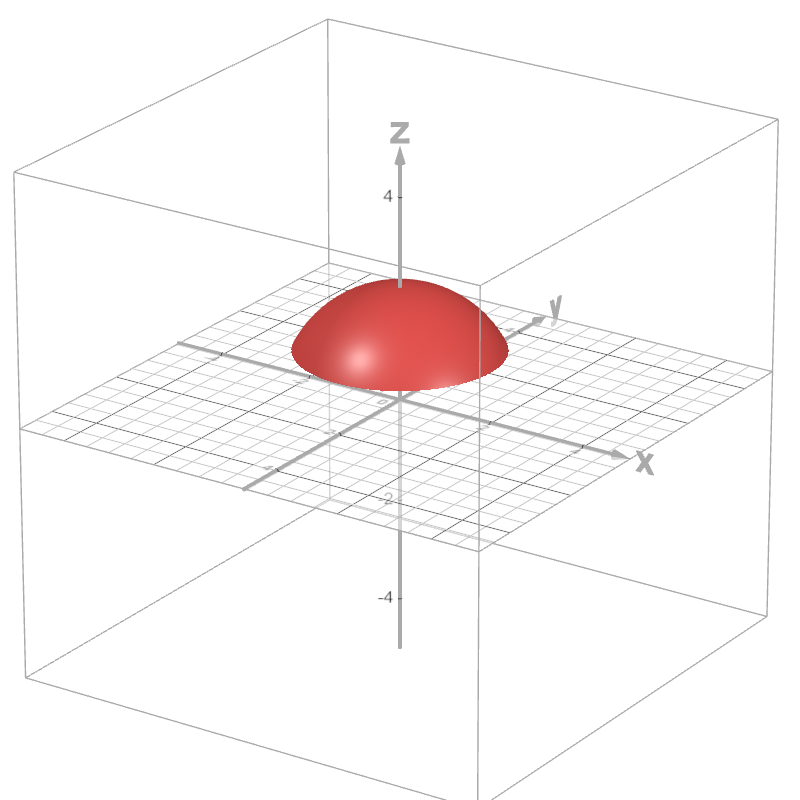
Desmos
calm coralBOT
outer sedge
If I have the surface z = sqrt(5-x^2-y^2), above z = 1, what would be the limits...
outer sedge
would phi be just 0 to pi/2? and theta 0 to 2pi?
ancient grotto
Is phi the azimuthal angle?
outer sedge
the one measured from z to y
ancient grotto
I would say 0 to pi. Why did you change it?
outer sedge
why 0 to pi?

0 to pi would be the whole half-circle
if u had x^2+y^2+z^2=5
it would be 0 to pi
 empty dune
I think you should be able to calculate the necessary starting angle with trig
ancient grotto
outer sedge
0 to pi would be the whole half-circle
Isn’t that what you’re trying to integrate?
calm coralBOT
@outer sedge Has your question been resolved?
empty dune
@outer sedge Do you want the surface area or volume of the hemisphere?
outer sedge
surface area
i wanna parametrize it using spherical coordinates
rho = sqrt(5), right?
empty dune
Ok, do you remember how x, y, and z relate to theta, phi, and rho in spherical coordinates?
empty dune
ok, perfect. Now given our constraint on z, can we translate it to a constraint on phi?
empty dune
outer sedge
rho = sqrt(5), right?
yup!
outer sedge
how is it sqrt(5) tho
empty dune
I would find it by plugging in x, y = 0, what do you get?
also its sqrt(5-radius^2), and given the constraint on the sqrt function, that it must be positive, do you see where this is going?
outer sedge
some math youtuber said to plug in x = 0
to get the trace on the yz plane
with these problems
empty dune
you might need to plug in z=0
outer sedge
that's for theta
outer sedge
for phi u plug in x = 0
so I have this

it doesn't look correct lol
rho doesn't seem to be constant
wait a second, does rho go from 0 to sqrt(5)?
then this is rho
 empty dune
yes rho is the arrow
outer sedge
i thought we're dealing with the top portion only
empty dune
since we are caring about the surface area, we don't care about rho less than the radius of this hemisphere
yes, we are
so you need to find the angle (phi) to start and end your selection
empty dune
yeah your function is defined from the origin, so we need to use that
you should be able to transform the graph(shift it down by the height), then you can let phi go from 0 to pi
outer sedge
I got it!
u just do z = sqrt(5)cos(phi)
and plug in z = 1
that's the ending phi value
empty dune
Lovely, that is correct! Great work
outer sedge
so in these problems, u wanna get the projection onto the yz plane?
empty dune
uhh, that might help you visualize, but I don't think it is necessary. Could be useful when plotting it though.
calm coralBOT
Channel closed
Closed by @outer sedge
Use .reopen if this was a mistake.
Available help channel!
Send your question here to claim the channel.
Remember:
• Ask your math question in a clear, concise manner.
• Show your work, and if possible, explain where you are stuck.
• After 15 minutes, feel free to ping <@&286206848099549185>.
• Type the command .close to free the channel when you're done.
• Be polite and have a nice day!
Read #❓how-to-get-help for further information on how to ask a good question, and about conduct in the question channels.
Channel closed
Channel closed due to the original message being deleted.
If you did not intend to do this, please open a new help channel,
as this action is irreversible, and this channel may abruptly lock.
Available help channel!
Send your question here to claim the channel.
Remember:
• Ask your math question in a clear, concise manner.
• Show your work, and if possible, explain where you are stuck.
• After 15 minutes, feel free to ping <@&286206848099549185>.
• Type the command .close to free the channel when you're done.
• Be polite and have a nice day!
Read #❓how-to-get-help for further information on how to ask a good question, and about conduct in the question channels.
 edgy bluff
How do I separate square roots
calm coralBOT
edgy bluff
How do I separate square roots
edgy bluff
Like sqrt(2x+3)
 main marlin
in that case you cannot that would be meaningful because, in general: (\sqrt{a+b}\neq\sqrt{a}+\sqrt{b})
edgy bluff
Ik that
potent lotusBOT
PajamaMamaLlama
 edgy bluff
But I've seen people separate them in other ways
main marlin
then what do you mean by separate? 🤔
edgy bluff
I saw a video about finding the square root of i
And he separated a square root
See

 drifting seal
lmao
edgy bluff
drifting seal
lmao
?
 nimble harbor
${\sqrt{a}+\sqrt{b} = \sqrt{a+b + 2\sqrt{ab}}}$
potent lotusBOT
k
 edgy bluff
Where's b
 warm warren
i mean realistically
edgy bluff
Here
warm warren
this question is done more intuitively by doing
$\sqrt{e^{i\frac{\pi}{2}}} = e^{i^{\frac{\pi}{4}}} = \frac{1}{\sqrt 2} + i\frac{1}{\sqrt 2}$
potent lotusBOT
frosst
 nimble harbor
${a = 1/2, b = -1/2}$
potent lotusBOT
k
 nimble harbor
warm warren
this question is done more intuitively by doing
nimble harbor
warm warren
this question is done more intuitively by doing
True
warm warren
but also this is taking the principle branch of √ because of course
you can also do
$\sqrt{e^{i\frac{\pi}{2}}} = e^{i^{\frac{5\pi}{4}}} = -\frac{1}{\sqrt 2} - i\frac{1}{\sqrt 2}$
potent lotusBOT
frosst
 edgy bluff
Thanks
warm warren
depends on how you define √
edgy bluff
.close
calm coralBOT
Channel closed
Closed by @edgy bluff
Use .reopen if this was a mistake.
Available help channel!
Send your question here to claim the channel.
Remember:
• Ask your math question in a clear, concise manner.
• Show your work, and if possible, explain where you are stuck.
• After 15 minutes, feel free to ping <@&286206848099549185>.
• Type the command .close to free the channel when you're done.
• Be polite and have a nice day!
Read #❓how-to-get-help for further information on how to ask a good question, and about conduct in the question channels.
Channel closed
Channel closed due to the original message being deleted.
If you did not intend to do this, please open a new help channel,
as this action is irreversible, and this channel may abruptly lock.
calm coralBOT
Available help channel!
Send your question here to claim the channel.
Remember:
• Ask your math question in a clear, concise manner.
• Show your work, and if possible, explain where you are stuck.
• After 15 minutes, feel free to ping <@&286206848099549185>.
• Type the command .close to free the channel when you're done.
• Be polite and have a nice day!
Read #❓how-to-get-help for further information on how to ask a good question, and about conduct in the question channels.
 sweet meadow
What is the voltage of a resistor if I know that 120C flow each 60s?
sweet meadow
Can this be solved? I believe that R=V/I, but I only have the "I" (which is 2Amp)
I was told to play with the unit of measurement
1 Ohm = Joule * Second / Coulomb**2
but im lost
 jolly pilot
voltage of a resistor
?
sweet meadow
something like that
jolly pilot
resistors have a resistance
and you need to know voltage across it and the current to find that from the ohm's law
sweet meadow
I haven't seen the ohm's law
 delicate tulip
whats that
sweet meadow
I was only given the definition of R. R=V/I
jolly pilot
sweet meadow
I was only given the definition of R. R=V/I
R = V/I is the ohm's law
sweet meadow
jolly pilot
R = V/I is the ohm's law
I only have the "I"
jolly pilot
yea, thats a problem, insufficient information. You also need V to find the R
sweet meadow
It might be an error in the translation of the book
I have my book in spanish, but it was originally written in english
.close
calm coralBOT
Channel closed
Closed by @sweet meadow
Use .reopen if this was a mistake.
Available help channel!
Send your question here to claim the channel.
Remember:
• Ask your math question in a clear, concise manner.
• Show your work, and if possible, explain where you are stuck.
• After 15 minutes, feel free to ping <@&286206848099549185>.
• Type the command .close to free the channel when you're done.
• Be polite and have a nice day!
Read #❓how-to-get-help for further information on how to ask a good question, and about conduct in the question channels.
Channel closed
Channel closed due to the original message being deleted.
If you did not intend to do this, please open a new help channel,
as this action is irreversible, and this channel may abruptly lock.
Available help channel!
Send your question here to claim the channel.
Remember:
• Ask your math question in a clear, concise manner.
• Show your work, and if possible, explain where you are stuck.
• After 15 minutes, feel free to ping <@&286206848099549185>.
• Type the command .close to free the channel when you're done.
• Be polite and have a nice day!
Read #❓how-to-get-help for further information on how to ask a good question, and about conduct in the question channels.
 whole warren
 calm coralBOT
whole warren
whole warren
calm coralBOT
whole warren
whole warren
Hey i know it is in Portuguese
I will translate it
- (EEAR 2/2024)
Consider the formula ,
which calculates the "ideal weight," in kg, of an adult human body, based on the height (given in cm), and a constant , where for men and for women.
If João and Maria have the same height and possess their "ideal weights," and Maria weighs 3 kg less than João, then, under these conditions, the sum of their weights is ____ kg.
Options:
a) 110
b) 115
c) 124
d) 126
So, i was trying to solve this way:

I don't even know what I was trying to do :/
Can anyone help me?
leaden thunder
,rotate
potent lotusBOT
 leaden thunder
you didn't translate where k=2 and k=4 come in
leaden thunder
can you simplify the bottom equation and solve for a
or do they refer to two different a values
whole warren
Both are the same equation
I just replace the "k"
maybe i can remove the parentheses?
leaden thunder
yea but remember distributive property

 leaden thunder
whole warren
leaden thunder
whole warren
keep going
 calm coralBOT
Channel closed
Closed by @whole warren
Use .reopen if this was a mistake.
calm coralBOT
Available help channel!
Send your question here to claim the channel.
Remember:
• Ask your math question in a clear, concise manner.
• Show your work, and if possible, explain where you are stuck.
• After 15 minutes, feel free to ping <@&286206848099549185>.
• Type the command .close to free the channel when you're done.
• Be polite and have a nice day!
Read #❓how-to-get-help for further information on how to ask a good question, and about conduct in the question channels.
whole warren
 calm coralBOT
whole warren
whole warren
calm coralBOT
whole warren
whole warren
Wait a minute
- (EEAR 1/2024)
Let be f(x)= ax + b a first-degree polynomial function that is decreasing, and suppose that . Which of the following statements could be true?
***Suppose that f(3) = 5
I tried this:


I don't think that's how you solve it, I tried to find "a" using b=5/3 and it didn't give any valid solution
 formal chasm
what does decreasing mean for a function ax+b
what is the constraint the function being 'decreasing' imposes on a and/or b?
calm coralBOT
@whole warren Has your question been resolved?
 inner zealot
whole warren
inner zealot
whole warren
Only one of those values can be a decreasing function. Eliminate the ones that cannot be decreasing.
calm coralBOT
Channel closed
Closed due to timeout
Use .reopen if this was a mistake.
Available help channel!
Send your question here to claim the channel.
Remember:
• Ask your math question in a clear, concise manner.
• Show your work, and if possible, explain where you are stuck.
• After 15 minutes, feel free to ping <@&286206848099549185>.
• Type the command .close to free the channel when you're done.
• Be polite and have a nice day!
Read #❓how-to-get-help for further information on how to ask a good question, and about conduct in the question channels.
 topaz nova
Can somebody explain why 3k+2 is included in this proof ?

 topaz nova
3k+2 is not "one more than a multiple of 3" it is two more than a multiple of 3 no ?
drifting seal
topaz nova
Can somebody explain why 3k+2 is included in this proof ?
because this exhausts all the cases of natural numbers
a natural number is either of the form 3k, 3k + 1, or 3k + 2 if we take k >= 0 to be an integer
then just square each of those cases and deduce that their squares are either of the form 3n or 3n + 1
for some integer n
topaz nova
drifting seal
because this exhausts all the cases of natural numbers
Could you explain this in more detail please ?
drifting seal
well we are trying to prove something for all natural numbers
and the claim is that any natural number is of one of the three forms given
so if the desired result holds in each of those cases then we’ve certainly showed it holds for every natural number haven’t we
we couldn’t have missed any natural numbers because every natural number has to be of one of the three forms
are you having trouble seeing why every natural number is of one of the three forms
topaz nova
I get the first two. 3k is valid because it's a multiple of 3. 3k+1 is valid because it's one more than a multiple of 3. 3k+2 is two more than a multiple of three which isn't what the questioned asked for. Are you saying that we use 3k+2 and other examples like it (e.g 3k-1) to do a sort of upper bound check kind of scenario ? Like we're going 1 more above 3k+1 just to make sure that it's for every natural number. Does that make sense ???
drifting seal
maybe a similar example would help you
suppose we wanted to prove that for all natural numbers n, n^2 is a multiple of 4 or n^2 is one more than a multiple of 4. to do this we can break this into cases. we know that n is either even or odd which just means it’s either a multiple of 2 or one more than a multiple of 2. so n = 2k or n = 2k + 1. if we can show that both of these two possibilities lead us to the desired conclusion that squares of natural numbers are multiples of 4 or one more than a multiple of 4 then we’ve showed it’s true for all natural numbers because n has to be even or odd, both cases give us the desired conclusion
what’s confusing you is that both the conclusion and method of proof uses multiples or 3/ one more than a multiple of 3
we use the fact that n is either a multiple of 3, one more than a multiple of 3, or two more than a multiple of 3 to then show that n^2 is a multiple of 3 or one more than a multiple of 3
topaz nova
So to prove a statement is true for all natural numbers you have to prove its true of all even and odd numbers right ?
drifting seal
yea sure that would work but here in your problem you really want to use multiples of 3
instead of multiples of 2
even just means n = 2k and odd means n = 2k + 1
we could just as easily make words up for 3
n = 3k, n = 3k + 1, or n = 3k + 2
you can do this for any natural number
topaz nova
3k+1: 4,7,10,13 3k+2: 5,8,11,14 Do you notice how each term is the opposite in terms of evenness. For example, the first term in 3k+1 is 4 whereas the first tirm in 3k+2 is 5 and so on. So do we use 3k+2 because it's letting us prove all the even/odd numers missed out by 3k+1 ?? If that makes sense ?
drifting seal
well it having opposite parity is simply because if 3k + 1 is even then adding one to it makes it odd and vice versa but no it’s just because we want to show it’s true for all even/odd specifically, this follows from showing it’s true for 3k, 3k + 1, 3k + 2 etc
like
pick any number
it will either be of one of these forms
we could just as easily do
4k, 4k + 1, 4k + 2, 4k + 3
it doesn’t have to just be even/odd it’s just that any natural number can be expressed like this
while it’s true that by showing it’s true in the cases with 3 that we show it’s true for even/odd that’s not really the main takeaway
you have to understand that any natural number is of one of the three forms
we just don’t care enough to give those ones special names
 quiet island
Have you heard about "The division algorithm"?
calm coralBOT
Channel closed
Closed by @topaz nova
Use .reopen if this was a mistake.
calm coralBOT
Available help channel!
Send your question here to claim the channel.
Remember:
• Ask your math question in a clear, concise manner.
• Show your work, and if possible, explain where you are stuck.
• After 15 minutes, feel free to ping <@&286206848099549185>.
• Type the command .close to free the channel when you're done.
• Be polite and have a nice day!
Read #❓how-to-get-help for further information on how to ask a good question, and about conduct in the question channels.
 blazing socket
How do I find the Equation of a plane, that goes through one line (g: x=(6,1,3)+ Lambda (2,1,-2)) and is parallel to another (h: x= (4,5,-3)+ Lambda (0,1,2) )? My idea was using g's support vector (6,1,3) and finding a normalvector to the plane and h by n dot (0,1,2) and then inserting everything into n dot x = p dot n where n is a normal vector to h and the plane, p is the support vector and well x is just x1,x2,x3 but I got the solution x_2-2x_3=5 but my book has the answer 2x_1-2x_2+x_3=13 and I dont know how they got there...
calm coralBOT
blazing socket
How do I find the Equation of a plane, that goes through one line (g: x=(6,1,3)+...
blazing socket
I tried finding a normal vector by doing n dot (0,1,2) and got n_2=-2n_3 so I assumed a vector like (0,1,-2) would work but that isn't right...
Basically my problem is finding a normalvector to (0,1,2)
Could use (1,0,0) but thats not how I get to the book solution so maybe my idea is just fully wrong
<@&286206848099549185>
.close
calm coralBOT
Channel closed
Closed by @blazing socket
Use .reopen if this was a mistake.
calm coralBOT
Available help channel!
Send your question here to claim the channel.
Remember:
• Ask your math question in a clear, concise manner.
• Show your work, and if possible, explain where you are stuck.
• After 15 minutes, feel free to ping <@&286206848099549185>.
• Type the command .close to free the channel when you're done.
• Be polite and have a nice day!
Read #❓how-to-get-help for further information on how to ask a good question, and about conduct in the question channels.
calm coralBOT
Channel closed
Channel closed due to the original message being deleted.
If you did not intend to do this, please open a new help channel,
as this action is irreversible, and this channel may abruptly lock.
Available help channel!
Send your question here to claim the channel.
Remember:
• Ask your math question in a clear, concise manner.
• Show your work, and if possible, explain where you are stuck.
• After 15 minutes, feel free to ping <@&286206848099549185>.
• Type the command .close to free the channel when you're done.
• Be polite and have a nice day!
Read #❓how-to-get-help for further information on how to ask a good question, and about conduct in the question channels.
delicate tulip
 calm coralBOT
delicate tulip
delicate tulip
calm coralBOT
delicate tulip
delicate tulip
How do I find the value of K?
 edgy leaf
do you know the sin cos tan definitions
delicate tulip
do u mean like what they are?
delicate tulip
edgy leaf
do you know the sin cos tan definitions
yea
delicate tulip
im not sure
edgy leaf
what is the opposite of the triangle relative to angle 30 degrees
delicate tulip
K is oppositre to 30 degrees
delicate tulip
opposite to the 30 degree angle?
delicate tulip
edgy leaf
yes?
yes
edgy leaf
now find k
delicate tulip
useing a caculater?
delicate tulip
oh I use 30 for sin?
delicate tulip
edgy leaf
if u are allowed to
no i dont think
edgy leaf
from the unit circle
delicate tulip
oh below that it shows how to get the answer but it doesnt make sence
delicate tulip
what is the ratio of 30 60 90
edgy leaf
it is a consequence of trig ratios
delicate tulip
oh
edgy leaf
do u know ur unit circle
delicate tulip
ok
edgy leaf
like if i asked u cos(60 degrees)
you would know the answer

This is the thing that has kept you up at night all week! That darn unit circle! So many roots and fractions and pies, how will you get it all in your head? Actually it's super easy to memorize the unit circle if you know a few tricks, so check this out and rest easy tonight!
Watch the whole Mathematics playlist: http://bit.ly/ProfDaveMath
Cla...
delicate tulip
edgy leaf
like if i asked u cos(60 degrees)
ok thx
edgy leaf
they are teaching you the special angled triangles
and the ratios of side lengths that come with that
delicate tulip
ok
edgy leaf
the problem with this is that it is an inefficient form of rote learning
delicate tulip
ok
edgy leaf
would you like a video that explains why these ratios hold?
delicate tulip
ok
edgy leaf
okay im gonna take it that u know pythagoras theorem at least?
delicate tulip
yea
edgy leaf
Thanks to all of you who support me on Patreon. You da real mvps! $1 per month helps!! :) https://www.patreon.com/patrickjmt !! Deriving Values on the Unit Circle. In this video, I show how to actually DERIVE the values in the first quadrant of the unit circle (so that you are not just memorizing them!). All you are really doing is using a ...
these explain why the triangle ratios hold
calm coralBOT
Channel closed
Closed by @delicate tulip
Use .reopen if this was a mistake.
calm coralBOT
Available help channel!
Send your question here to claim the channel.
Remember:
• Ask your math question in a clear, concise manner.
• Show your work, and if possible, explain where you are stuck.
• After 15 minutes, feel free to ping <@&286206848099549185>.
• Type the command .close to free the channel when you're done.
• Be polite and have a nice day!
Read #❓how-to-get-help for further information on how to ask a good question, and about conduct in the question channels.
whole warren
formal chasm
what is the constraint the function being 'decreasing' imposes on a and/or b?
I think "a" must be <0, doesn't it?
calm coralBOT
whole warren
I think "a" must be <0, doesn't it?
whole warren
I know this, but how can it help?
calm coralBOT
@whole warren Has your question been resolved?
calm coralBOT
@whole warren Has your question been resolved?
whole warren
.close
calm coralBOT
Channel closed
Closed by @whole warren
Use .reopen if this was a mistake.
calm coralBOT
Available help channel!
Send your question here to claim the channel.
Remember:
• Ask your math question in a clear, concise manner.
• Show your work, and if possible, explain where you are stuck.
• After 15 minutes, feel free to ping <@&286206848099549185>.
• Type the command .close to free the channel when you're done.
• Be polite and have a nice day!
Read #❓how-to-get-help for further information on how to ask a good question, and about conduct in the question channels.
 raven sentinel
Can someone help walk me through this, I need to find x, y, and z.

 lost hatch
Let's start with the easiest one, any idea how you'd get y?
When you get y, then z becomes trivial
lost hatch
correct. you'd need the 3rd angle for solving y, right? use the same method than for z for the 3rd angle
raven sentinel
huh
 raven sentinel
Would it be 68?
lost hatch
mhm
raven sentinel
and then what?
lost hatch
it's a right triangle, so now you know 2 angles from it
raven sentinel
22?
lost hatch
Yup. then you get z
raven sentinel
158?
lost hatch
Yup. Any idea for x?
raven sentinel
Since the angle at top is 134, than the small one is 46, then the vertical angle of that is 46, which is another side of triangle. Then 68 + 46 = 114. 180 - 114 = 66
Is it 66?
lost hatch
nice!
raven sentinel
So x=66, y = 22, and z = 158?
lost hatch
that's what I got with my 5am brain :D
calm coralBOT
@raven sentinel Has your question been resolved?
calm coralBOT
Channel closed
Closed due to timeout
Use .reopen if this was a mistake.
Available help channel!
Send your question here to claim the channel.
Remember:
• Ask your math question in a clear, concise manner.
• Show your work, and if possible, explain where you are stuck.
• After 15 minutes, feel free to ping <@&286206848099549185>.
• Type the command .close to free the channel when you're done.
• Be polite and have a nice day!
Read #❓how-to-get-help for further information on how to ask a good question, and about conduct in the question channels.
calm coralBOT
Channel closed
Channel closed due to the original message being deleted.
If you did not intend to do this, please open a new help channel,
as this action is irreversible, and this channel may abruptly lock.
Available help channel!
Send your question here to claim the channel.
Remember:
• Ask your math question in a clear, concise manner.
• Show your work, and if possible, explain where you are stuck.
• After 15 minutes, feel free to ping <@&286206848099549185>.
• Type the command .close to free the channel when you're done.
• Be polite and have a nice day!
Read #❓how-to-get-help for further information on how to ask a good question, and about conduct in the question channels.
 median cloak
You think you are good at math?
calm coralBOT
median cloak
You think you are good at math?
median cloak
My textbook will humble you!
 uncut prawn
I'm sure it will
tall moon
brother your opening statements arent necessary 🙏
median cloak
If y=ax^2 + 4x +3a has a maximum of 4 then a=?
Show me you’re capable of math!
I just differentiated it
 unkempt drift
okay edgelord
no but seriously you could also try the discriminant
ax^2 + 4x + (3a - 4) = 0 has only one solution for a, hence discriminant = 0
median cloak
unkempt drift
ax^2 + 4x + (3a - 4) = 0 has only one solution for a, hence discriminant = 0
Is that a typo? The constant term is 3a not 3a - 4
unkempt drift
median cloak
Is that a typo? The constant term is 3a not 3a - 4
no, because you get ax^2 + 4x + 3a = 4
median cloak
unkempt drift
no, because you get ax^2 + 4x + 3a = 4
I got it
unkempt drift
and you need to reject the positive solution of a
median cloak
What if I want to differentiate it
unkempt drift
cause if a quadratic has a max, it must be concave down not concave up
median cloak
Is it also doable by differentiation
tall moon
yes
unkempt drift
median cloak
What if I want to differentiate it
sure, just giving you one more method
I think the discriminant method is quicker though actually
median cloak
 unkempt drift
2ax + 4 = 0 means x = -2/a and oh boy that's another quadratic
median cloak
I got a=-5/2 as the answer using differentiation but it’s incorrect
calm coralBOT
@median cloak Has your question been resolved?
calm coralBOT
Channel closed
Closed due to timeout
Use .reopen if this was a mistake.
Available help channel!
Send your question here to claim the channel.
Remember:
• Ask your math question in a clear, concise manner.
• Show your work, and if possible, explain where you are stuck.
• After 15 minutes, feel free to ping <@&286206848099549185>.
• Type the command .close to free the channel when you're done.
• Be polite and have a nice day!
Read #❓how-to-get-help for further information on how to ask a good question, and about conduct in the question channels.
Channel closed
Channel closed due to the original message being deleted.
If you did not intend to do this, please open a new help channel,
as this action is irreversible, and this channel may abruptly lock.
calm coralBOT
Available help channel!
Send your question here to claim the channel.
Remember:
• Ask your math question in a clear, concise manner.
• Show your work, and if possible, explain where you are stuck.
• After 15 minutes, feel free to ping <@&286206848099549185>.
• Type the command .close to free the channel when you're done.
• Be polite and have a nice day!
Read #❓how-to-get-help for further information on how to ask a good question, and about conduct in the question channels.
 limpid mulch
 calm coralBOT
limpid mulch
limpid mulch
calm coralBOT
limpid mulch
limpid mulch
should i use double angle formula or smthn
potent lotusBOT
mia
 calm coralBOT
Channel closed
Closed by @limpid mulch
Use .reopen if this was a mistake.
calm coralBOT
Available help channel!
Send your question here to claim the channel.
Remember:
• Ask your math question in a clear, concise manner.
• Show your work, and if possible, explain where you are stuck.
• After 15 minutes, feel free to ping <@&286206848099549185>.
• Type the command .close to free the channel when you're done.
• Be polite and have a nice day!
Read #❓how-to-get-help for further information on how to ask a good question, and about conduct in the question channels.
limpid mulch
For this question, we need to prove A = 2/rt3
 calm coralBOT
limpid mulch
For this question, we need to prove A = 2/rt3
limpid mulch
calm coralBOT
limpid mulch
For this question, we need to prove A = 2/rt3
limpid mulch
but the given sols has an error right
would this part in fact be wrong, since -9 x -3 = 27 not -27
 limpid mulch
also, shouldnt 8 x -4 =-32

product of roots would just be 4A right?
this part of the sols maybe the correct answer
 velvet osprey
limpid mulch
For this question, we need to prove A = 2/rt3
velvet osprey
limpid mulch
For this question, we need to prove A = 2/rt3
first line should be 4A
not -4A
limpid mulch
yeh
still is it possible that A =2/root3
For part ii) I did 5C2 x 4! = 240, the given sols use 5! x 2! = 240
Is my a correct method to use?

 vernal parrot
limpid mulch
For part ii) I did 5C2 x 4! = 240, the given sols use 5! x 2! = 240
Is my a cor...
vernal parrot
limpid mulch
For part ii) I did 5C2 x 4! = 240, the given sols use 5! x 2! = 240
Is my a cor...
Hi! Depends on your reasoning. How did you reason 5C2 * 4!?
limpid mulch
u need two choose 2 adults who need to sit together from 5 adults
5C2
and then u do (5-1)!
coz 5 people remaining
and -1. of them coz its the circle table question
I do kinda understand the 5! x 2!, but if the 2! is there shouldnt that mean the adults chosen to sit together aren't random
vernal parrot
limpid mulch
u need two choose 2 adults who need to sit together from 5 adults
5C2
and then u...
Yeah, that reasoning checks out. You treat each person as distinct, so 5C2 * 4! works.
limpid mulch
limpid mulch
I do kinda understand the 5! x 2!, but if the 2! is there shouldnt that mean the...
what about this
limpid mulch
vernal parrot
Yeah, that reasoning checks out. You treat each person as distinct, so 5C2 * 4! ...
hopefully, if i would right something like this in an exam, i dont lose mks
since its 1 mk, i hope having the answer without thorough reasoning be okay
vernal parrot
limpid mulch
I do kinda understand the 5! x 2!, but if the 2! is there shouldnt that mean the...
This reasoning is what I would probably do:
- Pick a child to sit. Then you are arranging
AAAAAC - If we group two of the adults, we can write that as
XAAAC
Therefore, you can arrange this 5! times. The arrangement X itself can be arranged 2! times. So, 5! * 2!.
limpid mulch
coz ill prolly forget to do it an exam
vernal parrot
vernal parrot
This reasoning is what I would probably do:
1. Pick a child to sit. Then you are...
Note that each A is distinct, which is why we can just arrange it 5! times.
limpid mulch
vernal parrot
This reasoning is what I would probably do:
1. Pick a child to sit. Then you are...
what is X?
vernal parrot
X is two adults bunched together.
limpid mulch
is the 2! children, or is it the two adults ought to sit together
this is given sols
 vernal parrot
X has 2! arrangements. Either Bob sits left of Ann, or Bob sits right of Ann.
limpid mulch
but that would mean
that bob and ann are confirmed to sit next together
we aren't choosing two random adults right
vernal parrot
limpid mulch
we aren't choosing two random adults right
Right, that's actually a pretty good point. X isn't 2!, it would be 5 * 4.
Wait.
Let me get my argument together
limpid mulch
vernal parrot
Right, that's actually a pretty good point. X isn't 2!, it would be 5 * 4.
5 x 4?
limpid mulch
vernal parrot
XAAAC is (5 * 4) * 3 * 2 * 1 * 1
thats just 5!
vernal parrot
Yeah, I know
limpid mulch
true
maybe, the question had suggested these two adults were specific
coz it says if two not if any two
vernal parrot
Wait
vernal parrot
limpid mulch
maybe, the question had suggested these two adults were specific
Yeah
I just realised
Because if there's only two children, two adults will always sit together
So it must be a specific pair of adults.
vernal parrot
limpid mulch
u need two choose 2 adults who need to sit together from 5 adults
5C2
and then u...
Hmm, I guess this reasoning isn't good then.
vernal parrot
limpid mulch
For part ii) I did 5C2 x 4! = 240, the given sols use 5! x 2! = 240
Is my a cor...
Just curious but,
Are you a HSC student?
limpid mulch
yeh
vernal parrot
Just checked mutual servers 🤦
limpid mulch
oh ok
vernal parrot
Best of luck with your studies!
limpid mulch
when did u graduate
vernal parrot
2023
limpid mulch
i am assuming u were hsc as well
vernal parrot
Yeah.
limpid mulch
did u do 3u or 4u
vernal parrot
4U.
limpid mulch
damn
limpid mulch
vernal parrot
Best of luck with your studies!
thanks
vernal parrot
No problem 👍
limpid mulch
.close
calm coralBOT
Channel closed
Closed by @limpid mulch
Use .reopen if this was a mistake.
calm coralBOT
Available help channel!
Send your question here to claim the channel.
Remember:
• Ask your math question in a clear, concise manner.
• Show your work, and if possible, explain where you are stuck.
• After 15 minutes, feel free to ping <@&286206848099549185>.
• Type the command .close to free the channel when you're done.
• Be polite and have a nice day!
Read #❓how-to-get-help for further information on how to ask a good question, and about conduct in the question channels.
 wheat knoll
probability using tree diagrams
question - Given that she won at least one of the games, find the probability she won Hoopla.
 calm coralBOT
wheat knoll
probability using tree diagrams
question - Given that she won at least one of th...
warm warren
calm coralBOT
wheat knoll
probability using tree diagrams
question - Given that she won at least one of th...
warm warren
What have you tried
 warm warren
Well you haven’t solved for the right thing
The question is asking P(A|B)
Not P(A ∩ B)
Also P(A ∩ B) = P(A)P(B) only when A and B are independent events
That’s clearly not true because if A happens then B always happens as well
wheat knoll
so it would be 0.232/0.58 = 0.4
or could you also do (0.4 x 0.3) + (0.4 x 0.7), it gives the same answer
calm coralBOT
@wheat knoll Has your question been resolved?
Channel closed
Closed by @wheat knoll
Use .reopen if this was a mistake.
Available help channel!
Send your question here to claim the channel.
Remember:
• Ask your math question in a clear, concise manner.
• Show your work, and if possible, explain where you are stuck.
• After 15 minutes, feel free to ping <@&286206848099549185>.
• Type the command .close to free the channel when you're done.
• Be polite and have a nice day!
Read #❓how-to-get-help for further information on how to ask a good question, and about conduct in the question channels.
outer sedge
Is: z = 4-x^2-y^2, z>0, the same as z=4-x^2-y^2>0
 finite oasis
Second one doesn't really make sense
outer sedge
Why
finite oasis
Written like this, it looks like a compound statement. It actually suggests something like "Take 4 - x² - y² and require it to be greater than 0" but this doesn't make full sense as an assignment (= and > together like that is messy)
outer sedge
z is 4-x^2-y^2 right? And z > 0
finite oasis
outer sedge
z is 4-x^2-y^2 right? And z > 0
The first case with z = 4 - x² - y² and the condition z > 0 means you first define z by the formula z = 4 - x² - y² then you impose that only the points where z is positive are valid (i.e., z > 0). That's kind of how I see it.
fringe reef
explicit is better than implicit
calm coralBOT
outer sedge
Is: z = 4-x^2-y^2, z>0, the same as z=4-x^2-y^2>0
Please show the original problem, exactly as it was stated to you, with the entire original context. A picture or screenshot is best. If the original problem is not in English, then post it anyway! The additional context might still be helpful. Do your best to provide a translation.
fringe reef
i feel like there's missing context
outer sedge
It’s a surface integral problem. You have some vector field F and S is the surface above.
.close
calm coralBOT
Channel closed
Closed by @outer sedge
Use .reopen if this was a mistake.
calm coralBOT
Available help channel!
Send your question here to claim the channel.
Remember:
• Ask your math question in a clear, concise manner.
• Show your work, and if possible, explain where you are stuck.
• After 15 minutes, feel free to ping <@&286206848099549185>.
• Type the command .close to free the channel when you're done.
• Be polite and have a nice day!
Read #❓how-to-get-help for further information on how to ask a good question, and about conduct in the question channels.
 wise marten
can yall help me understand this
 calm coralBOT
wise marten
can yall help me understand this
wise marten
calm coralBOT
wise marten
can yall help me understand this
wise marten
the options are like
both are needed
only 1 is needed, only 2 is needed both if alone are fine
orboth statements dont help
calm coralBOT
What step are you on?
1. I don't know where to begin.
2. I have begun but got stuck midway.
3. I got an answer but I was told that it's wrong.
4. I got an answer and would like my work checked.
5. I have a question about someone else's work/solution.
6. I have completed the problem and don't need help anymore. Thank you.
7. None of the above
@wise marten Has your question been resolved?
wise marten
calm coral
```
What step are you on?
1. I don't know where to begin.
2. I have begun but go...
2
i dont know how to figure it out
after
x^2+bx+d
x^2+5dx+d is something
what do i do with taht
 rustic osprey
Do you recall the condition for a quadratic to have real roots?
rustic osprey
wise marten
sorry i dont know what that is
Consider the quadratic formula
And what part could lead to having non real solutions
And what you can do to “fix” that
potent lotusBOT
Civil Service Pigeon
 wise marten
i have an idea
wise marten
yeah
rustic osprey
wise marten
i can remove the d
You can factor it out, yes
wise marten
quadratic thing i think
wise marten
d>=0 or d>=4/25?
wise marten
what do i do if its an inqueality?
rustic osprey
Draw a quick sketch of the graph
It should be obvious after that
Alternatively you can do casework on the signs of the factors
Pick your poison
wise marten
wait wait hold on
x^2+bx+d
this was the original
b^2-4d>=
i
wait i can jsut skip a step
wait no
uhhh
b and d are natural numbers
that means are not 0 right
or lower
b-5d=0
fuck i do not know waht to do
hm graphing it does this
 calm coralBOT
@wise marten Has your question been resolved?
Channel closed
Closed by @wise marten
Use .reopen if this was a mistake.
Available help channel!
Send your question here to claim the channel.
Remember:
• Ask your math question in a clear, concise manner.
• Show your work, and if possible, explain where you are stuck.
• After 15 minutes, feel free to ping <@&286206848099549185>.
• Type the command .close to free the channel when you're done.
• Be polite and have a nice day!
Read #❓how-to-get-help for further information on how to ask a good question, and about conduct in the question channels.
 blissful carbon
whats a parametric equation?
 calm coralBOT
blissful carbon
whats a parametric equation?
calm coralBOT
blissful carbon
whats a parametric equation?
 icy galleon
the position expressed in terms of t
such as:(t,cost), t real is a parametrizationof the curve y=cosx
calm coralBOT
@blissful carbon Has your question been resolved?
 topaz raft
BUM CHICKEN
calm coralBOT
Channel closed
Closed due to timeout
Use .reopen if this was a mistake.
calm coralBOT
Available help channel!
Send your question here to claim the channel.
Remember:
• Ask your math question in a clear, concise manner.
• Show your work, and if possible, explain where you are stuck.
• After 15 minutes, feel free to ping <@&286206848099549185>.
• Type the command .close to free the channel when you're done.
• Be polite and have a nice day!
Read #❓how-to-get-help for further information on how to ask a good question, and about conduct in the question channels.
 snow spire
Please help with this proof
 calm coralBOT
snow spire
Please help with this proof
calm coralBOT
snow spire
Please help with this proof
 icy galleon
is formalizing in predicate logic really a necessary step
snow spire
icy galleon
is formalizing in predicate logic really a necessary step
Yes, because I am just learning predicate logic at the moment. No, because there might be many ways, perspectives to reason about it.
snow spire
icy galleon
is formalizing in predicate logic really a necessary step
We can rephrase the question: Does every finite subset of points of the plane with triangles have a smallest triangle?
Let's assume that every finite subset of tringles have a smallest triangle.
Then a finite subset that doesn't have a smallest triangle has a infinitely many triangles. A contrdiciton.
icy galleon
well yeah, but that assumption is pretty bold, you need to prove that too?
snow spire
icy galleon
well yeah, but that assumption is pretty bold, you need to prove that too?
I don't know, becuase the way I think about it is, that the smallest triangle in a set is empty, and if it is not empty, than it is not the smallest.
icy galleon
uummmm define smalledt triangle?
snow spire
icy galleon
uummmm define smalledt triangle?
A triangle with the least area, or least distance of vertices.
snow spire
The minimum element of a set of triangles where triangles are ordered by magnitude of area.
snow spire
icy galleon
is that a consistent definition?
I don't know, what does consistent mean?
Consistent over the domain?
icy galleon
thats alright, the latter definition is ok, it just means well defined, spits out same answer every time
snow spire
icy galleon
thats alright, the latter definition is ok, it just means well defined, spits ou...
Does it mean the same as well formed formula, or formula?
icy galleon
it just means a usable definition. but onto our next point. the two claims are not equivalent. having a smallest triangle is obvious, but the question asks if there exists a triangle that "doesnt contain any vertices"
im gonna sleep hope you solve your problem'
snow spire
icy galleon
im gonna sleep hope you solve your problem'
Thanks so much @icy galleon , I am writing it now!
Good night
We can rephrase the question:
Does every finite subset of points of the plane have an empty triangle?
An empty triangle is a triangle with no points on it's interior, while the smallest triangle of a set of triangles ordered by area, is the triangle with the least area.
If a triangle has a point in its interior, in other words not empty, then it is not the smallest triangle. For any two of its vertices can be connected with the point on its inside to make a smaller triangle, with less area.
Then the smallest triangle, the minimum triangle of a set of triangles ordered by area, is empty.
Let's assume that every finite subset of tringles of the plane have a smallest triangle.
Then a finite subset that doesn't have a smallest triangle has a infinitely many triangles, because each triangle has a point on its inside, so to each smallest triangle there is a smaller triangle. Which is a contradiciton.
Maybe Let's assume that every finite subset of tringles of the plane have a smallest triangle.
Can be written as Every finite subset of triangles of the plane has a triangle with the least area, becuase area maps each triangle bijectively to a real value, and any finite subset of real values has a least element.
calm coralBOT
@snow spire Has your question been resolved?
snow spire
There maybe isn't a bijective function of triangles and areas, because more triangles in a set can have the same area. Areas of a finite set of triangles are mapped to a finite set of areas, and a finite set of areas has a least value.
calm coralBOT
@snow spire Has your question been resolved?
snow spire
- map each triangle to its area
- a triangle with the least area does not have points in its interior, because if it had, then there were another triangle with less area, namely the triangle with any of the two vertices of the first triangle and the point.
- a set of triangles where every triangle has a point on its interior is infinite, because a triangle in it with least area has a point in it's interior, which accounts for a triangle with even less area, which has a point in it's interior as well, and so on.
<@&286206848099549185>
snow spire
fickle arch
Wait a bit, most won't/can't solve it.
Thank you! Is the problem complicated or my approach? I am learning aton from this, it's nice.
fickle arch
snow spire
Thank you! Is the problem complicated or my approach? I am learning aton from th...
I'm in hs dude 😭 spare me...
snow spire
Alright
 mortal orbit
snow spire
- map each triangle to its area
- a triangle with the least area does not have p...
mortal orbit
snow spire
- map each triangle to its area
- a triangle with the least area does not have p...
it seems like your proof is correct. Just know that multiple triangles of minimal area may exist, but ordering the triangles by magnitude is a cool approach.
Formalized:
let S be your finite collection of points in the plane, not all colinear. we denote T = {triangles made with points of S} and A = {Area(t), t in T}.
A is a finite, non-empty subset of R, upper bounded by 0. Thus it has a minimum, call it a. then there is a triangle PQR in T such that Area(PQR) = a.
If there some point M in S in the interior of triangle PQR, then PQM is a triangle in T of area smaller than a. This is a contradiction to the fact that a is the minimum of A.
Thus triangle PQR is a triangle with no points from S in its interior.
 proven thistle
Why 0 power 0 = 1
calm coralBOT
@snow spire Has your question been resolved?
snow spire
mortal orbit
it seems like your proof is correct. Just know that multiple triangles of minima...
Awesome, thank you for your help, and formalising it, it gives me a new perspective.
What does it mean that A is upper bounded by 0?
snow spire
proven thistle
Why 0 power 0 = 1
Sorry, I don't understand this, are you asking this related to this proof?
mortal orbit
proven thistle
Why 0 power 0 = 1
!occupied
calm coralBOT
proven thistle
Why 0 power 0 = 1
Someone else is already using this help channel. If you need help with a question, please open your own help channel/thread (see #❓how-to-get-help for instructions).
mortal orbit
snow spire
What does it mean that **A** is `upper bounded by 0`?
Lower bounded sorry
0 is a lower bound of A
a>=0 for every element a of A
(Areas are nonnegative)
Otherwise, another approach: make any triangle with vertices in S
There is a finite number of points in S in the interior of the triangle
So
Pick a random point in that interior if there is any
If PQR was the original triangle and M is the point you picked
Consider now triangle PQM
and repeat
At every iteration the number of interior points must decrease
So this algorithm must end
snow spire
mortal orbit
0 is a lower bound of A
Are you saying A is finite because it has lower bound 0? It can still be infinite with lower bound 0, when the areas of triangles get smaller and smaller, when every triangle has a point in its interior.
mortal orbit
snow spire
Are you saying A is finite because it has lower bound 0? It can still be infini...
A being finite and having lower bound 0 are two different things
A is finite because you can only create a finite number of triangles with vertices in S
snow spire
mortal orbit
A is finite because you can only create a finite number of triangles with vertic...
Because S is finite
mortal orbit
Yes
snow spire
By assumption
mortal orbit
Yes
snow spire
Okay
snow spire
mortal orbit
So this algorithm must end
That's nice also
Thanks
Proof by algorithm

calm coralBOT
@snow spire Has your question been resolved?
calm coralBOT
Channel closed
Closed by @snow spire
Use .reopen if this was a mistake.
calm coralBOT
Available help channel!
Send your question here to claim the channel.
Remember:
• Ask your math question in a clear, concise manner.
• Show your work, and if possible, explain where you are stuck.
• After 15 minutes, feel free to ping <@&286206848099549185>.
• Type the command .close to free the channel when you're done.
• Be polite and have a nice day!
Read #❓how-to-get-help for further information on how to ask a good question, and about conduct in the question channels.
 late isle
Can anyone help me with showing that a hyperrectangle in Rd is path connected? So far I've tried constructing a function r(t) that's just
x + t(y-x) where x and y are points in the hyperrectangle, but I'm having trouble showing that r(t) maps entirely to the hyperrectangle
calm coralBOT
late isle
Can anyone help me with showing that a hyperrectangle in Rd is path connected? S...
calm coralBOT
Channel closed
Closed by @late isle
Use .reopen if this was a mistake.
calm coralBOT
Available help channel!
Send your question here to claim the channel.
Remember:
• Ask your math question in a clear, concise manner.
• Show your work, and if possible, explain where you are stuck.
• After 15 minutes, feel free to ping <@&286206848099549185>.
• Type the command .close to free the channel when you're done.
• Be polite and have a nice day!
Read #❓how-to-get-help for further information on how to ask a good question, and about conduct in the question channels.
limpid mulch
For this mathematical induction question, i got 7p +3^k = q


 calm coralBOT
@limpid mulch Has your question been resolved?
 quick talon
It looks right
calm coralBOT
Channel closed
Closed by @limpid mulch
Use .reopen if this was a mistake.
calm coralBOT
Available help channel!
Send your question here to claim the channel.
Remember:
• Ask your math question in a clear, concise manner.
• Show your work, and if possible, explain where you are stuck.
• After 15 minutes, feel free to ping <@&286206848099549185>.
• Type the command .close to free the channel when you're done.
• Be polite and have a nice day!
Read #❓how-to-get-help for further information on how to ask a good question, and about conduct in the question channels.
 simple musk
 calm coralBOT
simple musk
calm coralBOT
simple musk
 teal drift
What's your doubt?
simple musk
help me draw the situation for 1.
teal drift
Alright, can you write the direction vector of line L1?
simple musk
teal drift
Alright, can you write the direction vector of line L1?
QP or PQ
velvet osprey
pick one and find its value
simple musk
for the fun of it
i always struggle with the geometric interpretation in 3D of lines planes and vectors
velvet osprey
simple musk
i always struggle with the geometric interpretation in 3D of lines planes and ve...
throw it in geogebra tbh
simple musk
ggb or desmos 3d beta?
which one is better?
i gotta go to chemistry class
see ya
.close
calm coralBOT
Channel closed
Closed by @simple musk
Use .reopen if this was a mistake.
Available help channel!
Send your question here to claim the channel.
Remember:
• Ask your math question in a clear, concise manner.
• Show your work, and if possible, explain where you are stuck.
• After 15 minutes, feel free to ping <@&286206848099549185>.
• Type the command .close to free the channel when you're done.
• Be polite and have a nice day!
Read #❓how-to-get-help for further information on how to ask a good question, and about conduct in the question channels.
remote mural
Can someone check if what ive done is correct and how do I get VCB

 remote mural
Question 4
calm coralBOT
@remote mural Has your question been resolved?
calm coralBOT
Channel closed
Closed due to timeout
Use .reopen if this was a mistake.
Available help channel!
Send your question here to claim the channel.
Remember:
• Ask your math question in a clear, concise manner.
• Show your work, and if possible, explain where you are stuck.
• After 15 minutes, feel free to ping <@&286206848099549185>.
• Type the command .close to free the channel when you're done.
• Be polite and have a nice day!
Read #❓how-to-get-help for further information on how to ask a good question, and about conduct in the question channels.
calm coralBOT
Channel closed
Channel closed due to the original message being deleted.
If you did not intend to do this, please open a new help channel,
as this action is irreversible, and this channel may abruptly lock.
Available help channel!
Send your question here to claim the channel.
Remember:
• Ask your math question in a clear, concise manner.
• Show your work, and if possible, explain where you are stuck.
• After 15 minutes, feel free to ping <@&286206848099549185>.
• Type the command .close to free the channel when you're done.
• Be polite and have a nice day!
Read #❓how-to-get-help for further information on how to ask a good question, and about conduct in the question channels.
remote mural
.open
calm coralBOT
Channel closed
Channel closed due to the original message being deleted.
If you did not intend to do this, please open a new help channel,
as this action is irreversible, and this channel may abruptly lock.
Available help channel!
Send your question here to claim the channel.
Remember:
• Ask your math question in a clear, concise manner.
• Show your work, and if possible, explain where you are stuck.
• After 15 minutes, feel free to ping <@&286206848099549185>.
• Type the command .close to free the channel when you're done.
• Be polite and have a nice day!
Read #❓how-to-get-help for further information on how to ask a good question, and about conduct in the question channels.
 valid linden
remote mural
.open
valid linden
remote mural
.open
Why did u calculate VX
calm coralBOT
valid linden
Why did u calculate VX
calm coralBOT
Channel closed
Closed by @valid linden
Use .reopen if this was a mistake.
calm coralBOT
Available help channel!
Send your question here to claim the channel.
Remember:
• Ask your math question in a clear, concise manner.
• Show your work, and if possible, explain where you are stuck.
• After 15 minutes, feel free to ping <@&286206848099549185>.
• Type the command .close to free the channel when you're done.
• Be polite and have a nice day!
Read #❓how-to-get-help for further information on how to ask a good question, and about conduct in the question channels.
 blazing coyote
If I have a function, whose value I know at say x, and I want to find the derivative in the direction v, I'm trying to understand how it's give by $\grad{f(x)} \cdot v$
calm coralBOT
blazing coyote
If I have a function, whose value I know at say x, and I want to find the deriva...
potent lotusBOT
What a wonderful world !
 blazing coyote
ah right
It's just a concise way to express the usual expansion
Thanks
.close
calm coralBOT
Channel closed
Closed by @blazing coyote
Use .reopen if this was a mistake.
calm coralBOT
Available help channel!
Send your question here to claim the channel.
Remember:
• Ask your math question in a clear, concise manner.
• Show your work, and if possible, explain where you are stuck.
• After 15 minutes, feel free to ping <@&286206848099549185>.
• Type the command .close to free the channel when you're done.
• Be polite and have a nice day!
Read #❓how-to-get-help for further information on how to ask a good question, and about conduct in the question channels.
 blazing wadi
If I change the delta epsilon defination
Lim f(x) = L if For all delta there exists epsilon such that if |x-c| < delta then | f(x) - L | < epsilon
What's the problem with this def ?
calm coralBOT
blazing wadi
If I change the delta epsilon defination
Lim f(x) = L if For all delta there ex...
velvet osprey
it requires f(c) to exist and be equal to L
 cobalt swallow
Try to find a continuous function with a discontinuous inverse
blazing wadi
velvet osprey
it requires f(c) to exist and be equal to L
Could you elaborate pls
velvet osprey
take the function f(x) = 15 if x=0, 0 if x != 0
intuitively what would you expect lim[x->0] f(x) to be?
velvet osprey
right
but your definition is not satisfied
because the set of all x such that |x-0| < delta necessarily includes x=0 itself
blazing wadi
ahh ic
 glass heart
there are bigger issues
I actually claim that in this example the limit for x->0 is 17
because by choosing epsilon=100 I have |f(x)-17| < epsilon
blazing wadi
Hmm
blazing wadi
glass heart
because by choosing epsilon=100 I have |f(x)-17| < epsilon
I could choose any limit greater than 15 for this purpose right
glass heart
you could choose literally any number
calm coralBOT
Channel closed
Closed by @blazing wadi
Use .reopen if this was a mistake.
Available help channel!
Send your question here to claim the channel.
Remember:
• Ask your math question in a clear, concise manner.
• Show your work, and if possible, explain where you are stuck.
• After 15 minutes, feel free to ping <@&286206848099549185>.
• Type the command .close to free the channel when you're done.
• Be polite and have a nice day!
Read #❓how-to-get-help for further information on how to ask a good question, and about conduct in the question channels.
 static wolf
Can someone explain how to solve this problem, step by step

 shut geyser
30% decrease each day because 1 - 0,7 = 0,3
didn't notice the 2 there, it will actually be 1 - 0,7^2 = 1 - 0,49 = 0,51. so 51% decrease
velvet osprey
shut geyser
~~30% decrease each day because 1 - 0,7 = 0,3~~
didn't notice the 2 there, it wi...
!nosols
calm coralBOT
shut geyser
~~30% decrease each day because 1 - 0,7 = 0,3~~
didn't notice the 2 there, it wi...
As a helper, please do not give out answers that could be copied as a homework solution. Have the student work through the problem themselves and guide them along the way.
velvet osprey
but also that is wrong anyway
velvet osprey
static wolf
Can someone explain how to solve this problem, step by step
ok, do you know how to calculate percentage increase/decrease between two numbers in general?
static wolf
Yes
velvet osprey
ok right
daily percentage change means the percentage change between values at two consecutive days
for an exponential growth or decay function this will be the same no matter which days you pick,
velvet osprey
not quite no
you need to find the percentage change from N(0) to N(1), is what i was gonna say.
that, or rewrite 0.7^(2t) as (0.7^2)^t
static wolf
Oh ok what is the best way to do it
So I have to undo the exponents?
Is there no other way to solve it
velvet osprey
idk what you mean by "undo"
static wolf
I mean rewrite
velvet osprey
static wolf
Is there no other way to solve it
there is no meaningfully different way of doing it other than "find the percentage change from N(0) to N(1)", no.
static wolf
Ok so what should I do after I rewrite it
velvet osprey
what did you get after rewriting it
static wolf
0.7^2 =0.49
velvet osprey
right
N(t) = 8950 * 0.49^t
every day the number of locusts is multiplied by 0.49 from the previous day.
static wolf
So it’s 49%?
velvet osprey
49% increase or 49% decrease?
static wolf
Decrease
velvet osprey
if you decrease a number by 49% of its value, this is the same as multiplying it by what?
static wolf
0.7?
velvet osprey
$x - 0.49x = 0.7x$?
potent lotusBOT
Ann
 velvet osprey
are you sure about this?
velvet osprey
we are trying to relate multiplicative change to percentage change
ok let me try to phrase it this way
static wolf
The first step was to rewrite the equation which I got 0.49
velvet osprey
no, you didn't get just 0.49.
velvet osprey
mmm
sure i guess
i was trying to guide you through some conceptual understanding here.
but if you just want a procedure to crunch numbers with, yes, it's 0.49 - 1 and then convert into percentage and don't forget to recast the minus sign as "removal".
static wolf

What to I do here, I want to understand it
So the chemical started with 900 grams and it loses 8/27 every blank days, is what the equation is saying
static wolf
8/27
 balmy bane
8/27 of its initial mass?
static wolf
balmy bane
How much does it have after 1 day?
Is this in the equation?
balmy bane
Is what in the equation?
balmy bane
They've given you a formula connecting the mass in grams and time elapsed in days
static wolf
It starts off with 900
balmy bane
e.g. at the start, i.e. t = 0, we have that there is M(0) = 900 times (8/27)^0 = 900 grams of chemical
You see how after 1 day we have M(1) = 900 X (8/27)^1 grams left?
balmy bane
yee
Now, if the sample were to lose "1/3" of its mass after some amount of time from the start, how much of the chemical would we have?
static wolf
How do I do that without knowing how many days
balmy bane
If we start with 900 grams of chemical, and I tell you we've lost a third of it, how much have we lost?
static wolf
300
balmy bane
So how much have we got left?
static wolf
600
balmy bane
Right
So after some amount of days, let's say "t" days, we've only got 600 grams left
i.e. M(t) = 600
Can we find t?
static wolf
Is this how I’m supposed to solve the problem? I thought there was a certain way to solve it
balmy bane
Strictly, the formal reasoning would go as follows:
The mass of the chemical becomes 8/27 of what it was the previous day
i.e. it goes to (8/27)^t of what it was after t days
We're asked for how many days it takes to lose 1/3 of the mass
i.e. how many days for it to become 2/3 of what it was
Thus we solve (8/27)^t = 2/3
balmy bane
balmy bane
So after _some_ amount of days, let's say "t" days, we've only got 600 grams lef...
The reasoning I've provided here is more intuitive of what's contextually going on in this question
static wolf
Oh ok
balmy bane
balmy bane
Thus we solve (8/27)^t = 2/3
You will end up at the same equation, i.e. the one I'm replying to
calm coralBOT
Channel closed
Closed by @static wolf
Use .reopen if this was a mistake.
calm coralBOT
Available help channel!
Send your question here to claim the channel.
Remember:
• Ask your math question in a clear, concise manner.
• Show your work, and if possible, explain where you are stuck.
• After 15 minutes, feel free to ping <@&286206848099549185>.
• Type the command .close to free the channel when you're done.
• Be polite and have a nice day!
Read #❓how-to-get-help for further information on how to ask a good question, and about conduct in the question channels.
 odd belfry
An ABCD parallelogram is given. N is the midpoint of CD and M is the midpoint of BC. AN = 6, AM = 12, angle NAM = 60 degrees, NM = 6 * root(3) and BD is 12 * root(3).
I am on the third part of this problem and need to find AD. How?
calm coralBOT
odd belfry
An ABCD parallelogram is given. N is the midpoint of CD and M is the midpoint of...
odd belfry
odd belfry
An ABCD parallelogram is given. N is the midpoint of CD and M is the midpoint of...

 plucky walrus
Let DC = x and AD = y.
Let angle ADN = x
In triangle ADN, x^2 / 4 + y^2 - xy cos(x)= 36
In triangle ABM, x^2 + y^2 / 4 - xy cos(x) = 144
Also, by triangle MCN, (x^2 + y^2)/4 + xy cos(x) / 2 = 108.
Solve these three.
,w x^2 / 4 + y^2 - xy cos(x)= 36, x^2 + y^2 / 4 - xy cos(x) = 144, (x^2 + y^2)/4 + xy cos(x) / 2 = 108.
potent lotusBOT


 Requested by forlorn1002