
#help-42
1 messages · Page 138 of 1
 exotic cosmos
isn't the vector sum there
for kv + lw if k = 1 = l
which is like what i meant with the parallelogram
 ancient thistle
but we aren't taking their sum
we're taking a vector on the line segment joining them
ancient thistle
d*kv + e*lw for some d + e = 1, 0 <= d,e,k,l <= 1
exotic cosmos
yeah makes sense i think
what are we doing here anyway

like the main goal here is to
show what exactly?
like we left off at c + d + e = 1
showing c,d,e >= 0?
ancient thistle
well
we didn't construct every point in the triangle
we only found the black edge
and i should be using primes for all these
d*kv' + e*lw' for some d + e = 1, 0 <= d,e,k,l <= 1
exotic cosmos
ancient thistle
d\*kv' + e*lw' for some d + e = 1, 0 <= d,e,k,l <= 1
yep i understsand these steps
but like i'm lost what the role of it is
ancient thistle
no that was just to tell you that we weren't done
ancient thistle
yes but it turns out c + d + e = 1 is not really a constraint
that's like the least important one
ancient thistle
you can get that for free from my argument here without any mention of our line segment stuff
so yeah we need to worry about the signs
exotic cosmos
ancient thistle
you can get that for free from my argument here without any mention of our line ...
yeah i get that part
ancient thistle
but back to d*kv' + e*lw'
exotic cosmos
ancient thistle
so yeah we need to worry about the signs
why?
i mean aside from c + d + e = 1
not being a constraint
why does something like
ancient thistle
well i can set c = 10000
ancient thistle
it's outside the triangle
c + d + e = 1 gives you every single point in the plane
exotic cosmos
oh yeah that's the equation of a plane
😭 all these concepts i just haven't learnt yet kinda
ancient thistle
for any point in the plane containing u, v, w, you can find c, d, e such that it's cu + dv + ew
which isn't something you need to know
but it's true
exotic cosmos
yes that's correct
x + y + z = 1 is a plane where 1 is roughly the distance from th eorigin or smth okay yeah
fine
ancient thistle
yeah
exotic cosmos
the entire plane can't possibly be the triangle
ancient thistle
we've concluded that every point in the triangle can be expressed as d*kv' + e*lw' for some d + e = 1, 0 <= d,e,k,l <= 1 however
more importantly, you can write that expression as
(dk)v' + (el)w'
where 0 <= dk, el <= 1, dk + el <= 1
exotic cosmos
yes correct
but like something feels off cuz we're working back in the diagram where u' = 0 😭
ancient thistle
so we may as well chuck out the fact that it's dk and el, and just write it with a single symbol each
exotic cosmos
when we came back to u = whatever
ancient thistle
exotic cosmos
but like something feels off cuz we're working back in the diagram where u' = 0 ...
this is okay, pretend we never went back to u
we do that at the very end
exotic cosmos
0<= k,l <= 1 and d + e = 1 for black line so yeah sure 0 <= k,d,e,l <= 1
ancient thistle
dk -> d, el -> e
ancient thistle
ye
ancient thistle
and d + e <= 1 now
cuz before d + e = 1
if you multiply by k and l
dk + el <= 1
exotic cosmos
yeah
ancient thistle
cuz k and l are both <= 1
okay nice
so we are basically done
in our version where u' = 0
the triangle can be described as
dv' + ew', d + e <= 1, d,e >= 0
exotic cosmos
indeed
ancient thistle
translating back to u, we get
u + dv' + ew' = (1 - d - e)u + dv + ew
the calculation i did earlier
d,e >= 0 we have
but the additional constraint d + e <= 1 means that the coefficient of u is
1 - (d + e) >= 0
exotic cosmos
wait i'm dumb
exotic cosmos
ancient thistle
but the additional constraint d + e <= 1 means that the coefficient of u is
1 - ...
oh yeah
this is what u meant
so c >= 0 and d >= 0 and e >= 0
and that's it
wait
yeah nvm
the sum is indeed 1
which wasn't dependent on c
oh my god that was definitely one of the hardest questions i've done this week
😭
tysmmm, i feel really bad i think for wasting so much time of yours
u could've probably written half a book LOL
ancient thistle
if you want to read more context about this problem
you can look up barycentric coordinates
ancient thistle
uh
i wouldn't say it's competition maths per se
like it's a thing that exists which people use
exotic cosmos
and briefly how does that relate? like okay i search up barycentric coordinates but what exactly did we do such that it was motivated by barycentric stufffs
exotic cosmos
ancient thistle
like it's a thing that exists which people use
oh it's something about mass thing right
ancient thistle
kind of?
you can reframe it in terms of mass
but in the most basic form
barycentric coordinates is a way to give 3 numbers to describe a point inside of a triangle
and the 3 numbers satisfy exactly the constraints we derived
c + d + e = 1, all non-negative
exotic cosmos
ohhh
so with barycentric coordinates (i'll research more about this)
would've just solved our question easily cuz it's a tool
that lets us
find the region inside triangles or something?
ancient thistle
not exactly
i'd rather say that what we did was prove that barycentric coordinates exist
c, d, e in your problem are the barycentric coordinates of a point in the triangle uvw
exotic cosmos
oh
so the coefficients
kinda
that sounds like something weird
where do you learn about this
if you follow a general learning trend/path
or is this just extra learning and doesn't fall into any specific "subject"?
ancient thistle
idk it probably comes up in linalg at some point
ancient thistle
i haven't used either book to learn linalg
 ancient thistle
i've only read axler because other people use it here and i end up helping them
exotic cosmos
it kinda looks like what we did
exotic cosmos
ancient thistle
i've only read axler because other people use it here and i end up helping them
do u just use lecture notes or smth?
*did
ancient thistle
uh
i guess?
if you're doing computer graphics programming, you'll have to use what we found today to test if points lie within triangles
i've had to program this at least a couple of times
ancient thistle
yeah
exotic cosmos
ancient thistle
if you're doing computer graphics programming, you'll have to use what we found ...
like doing this
and that also happened
to be what we did in this problem
ancient thistle
yes
ancient thistle
linalg is kinda the backbone for coordinate geometry
exotic cosmos
oh so this does
show up here
after all
here = linear algebra
okay i was curious cuz
ancient thistle
yeah
exotic cosmos
i can watch a video sure but idk where to find questions pertinent to it
cuz this topic
is definitely not in my book
the gilbert one i chose
so that's that
ancient thistle
it gets used in plane geometry sometimes so there will be material on that
exotic cosmos
but also i heard barycentric is advanced comp math topic so i don't want to do hard questions which idk how to do either
exotic cosmos
ancient thistle
it gets used in plane geometry sometimes so there will be material on that
oh
ancient thistle
yeah that's what i mean by plane geometry
exotic cosmos
i see
i'll look into it

but yeah looks very related
exercise 2:
okay tysmm once again
sorry for taking alot of your time

ancient thistle
lol
the notation is scarier than what it's really trying to say
very typical of maths
exotic cosmos
😭 yeah looks complicated but also approacable cuz like
it's what we did
and this just looks like
ancient thistle
ye
exotic cosmos
a copied version of that
hilarious but
everything after page 1
is out of my level already
 exotic cosmos
so only that half page i think
ancient thistle
dw about it then
exotic cosmos
yeah i'll just watch a video and hopefully if i ever see something similar
i can watch it again
okay bye
ancient thistle

exotic cosmos
.close
 calm coralBOT
Channel closed
Closed by @exotic cosmos
Use .reopen if this was a mistake.
calm coralBOT
 Available help channel!
Send your question here to claim the channel.
Remember:
• Ask your math question in a clear, concise manner.
• Show your work, and if possible, explain where you are stuck.
• After 15 minutes, feel free to ping <@&286206848099549185>.
• Type the command .close to free the channel when you're done.
• Be polite and have a nice day!
Read #❓how-to-get-help for further information on how to ask a good question, and about conduct in the question channels.
 livid mauve
Hi, I need help in linearisation
calm coralBOT
livid mauve
Hi, I need help in linearisation
livid mauve
I have a downwards facing parabola and idk how to linearise it, I want help in its linearisation

<@&286206848099549185>
calm coralBOT
@livid mauve Has your question been resolved?
livid mauve
<@&286206848099549185>
calm coralBOT
@livid mauve Has your question been resolved?
livid mauve
.close
calm coralBOT
Channel closed
Closed by @livid mauve
Use .reopen if this was a mistake.
calm coralBOT
Available help channel!
Send your question here to claim the channel.
Remember:
• Ask your math question in a clear, concise manner.
• Show your work, and if possible, explain where you are stuck.
• After 15 minutes, feel free to ping <@&286206848099549185>.
• Type the command .close to free the channel when you're done.
• Be polite and have a nice day!
Read #❓how-to-get-help for further information on how to ask a good question, and about conduct in the question channels.
 toxic elm
guys, can anyone teach me what this probability generation function is doing? why can you plug in i and -1 to it??? And how did the last step work in the first picture? (the one arriving at (i-1)/6+(-i-1)/6+1)) why can we just use the same formula for the experiment. What's the difference between specific formula of the quesiton and the definition of pgf (since the information allowed us to construct a function solving for P(xmod4=0), I believe there are information differences in the two expressions)
calm coralBOT
toxic elm
guys, can anyone teach me what this probability generation function is doing? wh...


 leaden thunder
Your notes are quite confusing
do you have the original problem and definition of probability generating function
toxic elm
definition

the problem is to find the probability that the sum of 10 dice rolls (each independent) is divisible by 4
sorry our TA's lecture style is all over the place...
calm coralBOT
@toxic elm Has your question been resolved?
calm coralBOT
Channel closed
Closed due to timeout
Use .reopen if this was a mistake.
calm coralBOT
Available help channel!
Send your question here to claim the channel.
Remember:
• Ask your math question in a clear, concise manner.
• Show your work, and if possible, explain where you are stuck.
• After 15 minutes, feel free to ping <@&286206848099549185>.
• Type the command .close to free the channel when you're done.
• Be polite and have a nice day!
Read #❓how-to-get-help for further information on how to ask a good question, and about conduct in the question channels.
 foggy salmon
I need help with the 15th question
 calm coralBOT
foggy salmon
I need help with the 15th question
calm coralBOT
foggy salmon
I need help with the 15th question


 trim jungle
foggy salmon
trim jungle
foggy salmon
u have written it wrong
foggy salmon
P'(0) = c, and they said x is the only real factor so c must be zero.. atleast that's what I thought
foggy salmon
Sorry I seem to have skipped a few steps
foggy salmon
trim jungle
p(x) is greater than 0
Why so?
I wasn't sure abt the sign of d so I couldn't say anything abt P(x)
Even for x>0, it would still depend on d right?
foggy salmon
trim jungle
and p'(x) is less than 0
I don't understand 
trim jungle
foggy salmon
Why so?
because it is given that p(-1) is less than p(1) which means a<0 and b<0 which mean p'(x) is greater than 0
foggy salmon
Oh you're right P'(x) won't depend on d so.. for x>0, P'(x)>0 right?
trim jungle
exactly
foggy salmon
Okay
trim jungle
after diffrentiation it won't matter
foggy salmon
Yea
foggy salmon
Yea, abt P'(x) being greater than 0.. for x>0
foggy salmon
No I still don't know what to do with that information
I'll cook a bit with whatever you said for now
trim jungle
see we can find that p(1) is max....you got that right?
foggy salmon
Wait how?
trim jungle
increasing function....
foggy salmon
Hm in the interval [0,1], I think so
trim jungle
yess
foggy salmon
But what abt [-1,0)?
trim jungle
now what is the condition for decreasing function?
foggy salmon
f'(x)<0
trim jungle
what is your answer for decreasing coming?
trim jungle
it will come greater than 0
foggy salmon
what will 
trim jungle
foggy salmon
So it's increasing right
yes
now tell me is it option 1 or 2
you got it right?
foggy salmon
How did you decide P(1) is now the max
foggy salmon
Say there's a value, in the interval [-1,0], that's larger than P(1)
foggy salmon
foggy salmon
How did you decide P(1) is now the max <:blobcry:971797574916907028>
Yes, it's the max in the interval [0,1]
foggy salmon
Idk, cause I haven't figured out the nature of P(x) in [-1,0)
Gimme a sec to process
trim jungle
bro i think you should ask a teacher....
trim jungle
foggy salmon
Gimme a sec to process
okk
foggy salmon
Ok I'm sorry my bad, P'(x) is increasing in the whole interval [-1,1], meaning P(1) is the maximum in that interval
trim jungle
yesss
foggy salmon
Wouldn't that mean P(-1) is min?
foggy salmon
trim jungle
f'(x) > 0
I thought that's why it's the min-
foggy salmon
What about d?.. and wouldn't the x³ term change the sign?
trim jungle
d is not at all relevant here
foggy salmon
I think I'm missing something, is there some condition to be applied for when a polynomial power 4 is always positive?
foggy salmon
trim jungle
d is not at all relevant here
I don't get why
trim jungle
i really think you should ask your teacher tom
oe watch a video on increasing and decreasing functions
cause you are getting more confsed by me
sorry
foggy salmon
Yea I feel stupid ill do that, thanks
trim jungle
or ping helpers again
trim jungle
foggy salmon
Yea I feel stupid <:blobcry:971797574916907028> ill do that, thanks
nah i am also stupid as i cannot help u bro
it is ok
foggy salmon
Nah thanks for sticking with me
trim jungle
no one is stupid just because they can't solve a few questions
don't underestimate yourself
you can do it with a little help from teachers and practice
foggy salmon

foggy salmon
foggy salmon
Ok I'm sorry my bad, P'(x) is increasing in the whole interval [-1,1], meaning P...
Okkk I finally get it it's only inc in [0,1] ;-; it's decreasing in [-1,0] and I could have found that the same way I said it's increasing as long as x>0.. so when x<0 P'(x) is negative, i.e., decreasing.. sooo P(0)<P(-1)
THANK YOU I FINALLY GOT IT
.close
calm coralBOT
Channel closed
Closed by @foggy salmon
Use .reopen if this was a mistake.
Available help channel!
Send your question here to claim the channel.
Remember:
• Ask your math question in a clear, concise manner.
• Show your work, and if possible, explain where you are stuck.
• After 15 minutes, feel free to ping <@&286206848099549185>.
• Type the command .close to free the channel when you're done.
• Be polite and have a nice day!
Read #❓how-to-get-help for further information on how to ask a good question, and about conduct in the question channels.
 lean aspen
how should I factor x^3 - 6x^2 + 11x?
I pull out the x to get x(x^2-6x+11) but I'm stuck trying to factor it from here.
calm coralBOT
lean aspen
how should I factor x^3 - 6x^2 + 11x?
I pull out the x to get x(x^2-6x+11) but ...
lean aspen
this is in reference to a partial fractions problem
lean aspen
i said i already did that
 glad parrot
Indeed
 upper sparrow
You could split the partial fractions you get into the form
[
\frac{A}x + \frac{Bx + C}{x^2 - 6x + 11}
]
 potent lotusBOT
@upper sparrow
 calm coralBOT
Channel closed
Closed by @lean aspen
Use .reopen if this was a mistake.
Available help channel!
Send your question here to claim the channel.
Remember:
• Ask your math question in a clear, concise manner.
• Show your work, and if possible, explain where you are stuck.
• After 15 minutes, feel free to ping <@&286206848099549185>.
• Type the command .close to free the channel when you're done.
• Be polite and have a nice day!
Read #❓how-to-get-help for further information on how to ask a good question, and about conduct in the question channels.
 karmic willow
Super confused rn my homework is asking to simplify log_7(49)
karmic willow
I made it exponential and solved for x and got 7
 velvet osprey
well that's quite far off
can you show what happened after you made it exponential?
calm coralBOT
Channel closed
Closed by @karmic willow
Use .reopen if this was a mistake.
Available help channel!
Send your question here to claim the channel.
Remember:
• Ask your math question in a clear, concise manner.
• Show your work, and if possible, explain where you are stuck.
• After 15 minutes, feel free to ping <@&286206848099549185>.
• Type the command .close to free the channel when you're done.
• Be polite and have a nice day!
Read #❓how-to-get-help for further information on how to ask a good question, and about conduct in the question channels.
 frank isle
 calm coralBOT
frank isle
frank isle
calm coralBOT
frank isle
frank isle
please how dow i find Alpha????
 ancient grotto
frank isle
ancient grotto
frank isle
Set up a system of equations using trigonometric functions.
Note that the foot of P and Q are at the same point.
Thus, what trig function should you use?
 pale blade
Force equilibrium on the horizontal/x direction.
 ancient grotto
frank isle
ancient grotto
frank isle
Yep.
ancient grotto
frank isle
but how do i get alpha
Use cosine on P.
frank isle
ancient grotto
Use cosine on P.
wht u mean
calm coralBOT
@frank isle Has your question been resolved?
calm coralBOT
@frank isle Has your question been resolved?
calm coralBOT
Channel closed
Closed due to timeout
Use .reopen if this was a mistake.
Available help channel!
Send your question here to claim the channel.
Remember:
• Ask your math question in a clear, concise manner.
• Show your work, and if possible, explain where you are stuck.
• After 15 minutes, feel free to ping <@&286206848099549185>.
• Type the command .close to free the channel when you're done.
• Be polite and have a nice day!
Read #❓how-to-get-help for further information on how to ask a good question, and about conduct in the question channels.
 stiff dragon
 calm coralBOT
stiff dragon
stiff dragon
calm coralBOT
stiff dragon
stiff dragon
Ok so I know it happens at the x value 2
bc y' = 6x - 7
5 = 6x - 7
12 = 6x
2 = x
but now, i thought you plug in 2 back in the original equation of y which gives you 3 so its (2,3)
and then you use the x and y to solve for y = mx + b
but thats wrong
LOL
because i got y = 5x - 12 but the answer is y = 5x - 7
velvet osprey
how did you get y=5x-12
 manic vault
,calc 3(2)^2-7(2)+5
potent lotusBOT
Result:
3
sounds like an execution error to me
manic vault
stiff dragon
because i got y = 5x - 12 but the answer is y = 5x - 7
Show your work.
velvet osprey
cause your planning sounds correct the way you described it
manic vault
You might have mixed up the x and y-coordinates, or something along those lines.
stiff dragon
i forgot that x is 2
manic vault
Ah.
stiff dragon
thank you so much lol
i was worried that my steps are wrong
but that means i just need to be more careful on the small details
thank youu
.close
calm coralBOT
Channel closed
Closed by @stiff dragon
Use .reopen if this was a mistake.
Available help channel!
Send your question here to claim the channel.
Remember:
• Ask your math question in a clear, concise manner.
• Show your work, and if possible, explain where you are stuck.
• After 15 minutes, feel free to ping <@&286206848099549185>.
• Type the command .close to free the channel when you're done.
• Be polite and have a nice day!
Read #❓how-to-get-help for further information on how to ask a good question, and about conduct in the question channels.
 still terrace
how do you check if a vector is coplanar?
calm coralBOT
still terrace
how do you check if a vector is coplanar?
 restive elk
still terrace
how do you check if a vector is coplanar?
restive elk
still terrace
how do you check if a vector is coplanar?
U cant
 mortal orbit
coplanar to what
mortal orbit
so vector is coplanar TO another vector
still terrace
mortal orbit
so vector is coplanar TO another vector
yeah i guess
but how do i do this
help?
<@&286206848099549185>
calm coralBOT
@still terrace Has your question been resolved?
calm coralBOT
Channel closed
Closed due to timeout
Use .reopen if this was a mistake.
Available help channel!
Send your question here to claim the channel.
Remember:
• Ask your math question in a clear, concise manner.
• Show your work, and if possible, explain where you are stuck.
• After 15 minutes, feel free to ping <@&286206848099549185>.
• Type the command .close to free the channel when you're done.
• Be polite and have a nice day!
Read #❓how-to-get-help for further information on how to ask a good question, and about conduct in the question channels.
calm coralBOT
Channel closed
Channel closed due to the original message being deleted.
If you did not intend to do this, please open a new help channel,
as this action is irreversible, and this channel may abruptly lock.
Available help channel!
Send your question here to claim the channel.
Remember:
• Ask your math question in a clear, concise manner.
• Show your work, and if possible, explain where you are stuck.
• After 15 minutes, feel free to ping <@&286206848099549185>.
• Type the command .close to free the channel when you're done.
• Be polite and have a nice day!
Read #❓how-to-get-help for further information on how to ask a good question, and about conduct in the question channels.
 viral abyss
 calm coralBOT
viral abyss
upper sparrow
calm coralBOT
viral abyss
upper sparrow
Did you have any idea how to begin this one? 
viral abyss
i did and i got 82.1 but idk if its rifht
manic vault
viral abyss
i did and i got 82.1 but idk if its rifht
Show your work.
viral abyss
i cant ss on pc but the hypotenuse of teh triangle i drew has hypoteuse 210, long leg is 5 and 23 degeree is in between them
manic vault
Nevrmind
upper sparrow
I don't think that's how I interpret what they mean in the question
manic vault
manic vault
Nevrmind
^
upper sparrow
Of course, "distance to the drone" is a bit ambiguous, but I assume that's meant to mean the horizontal distance
manic vault
The drone is not necessarily parallel to you
viral abyss
upper sparrow
Of course, "distance to the drone" is a bit ambiguous, but I assume that's meant...
then where is the5
manic vault
upper sparrow
Of course, "distance to the drone" is a bit ambiguous, but I assume that's meant...
Well that is how I originally interpreted it
manic vault
viral abyss
then where is the5
Below your eyes
You basically construct a rectangle below the triangle
viral abyss
what
 keen grail
Pretty sure by distance to the drone they are referring to the hypotenuse
 viral abyss
ok now what
manic vault
viral abyss
ok now what
Let me mark it
keen grail
manic vault
I think you’re making it more complicated/wrong lol
You find the opposite side of the angle using sin rules and just add 5 at the end
manic vault
keen grail
I think you’re making it more complicated/wrong lol
It still does same thing
keen grail
From the way I interpret the question, the triangle starts at eye level
manic vault
You want black+green
 viral abyss
yes
manic vault
So use sin(23) to get black
keen grail
But you have the hypotenuse labelled as the entire thing from the ground
manic vault
keen grail
But you have the hypotenuse labelled as the entire thing from the ground
No
You misinterpreted it
keen grail
K
viral abyss
i think i got this.. if not ill ask teacher tmrw
calm coralBOT
@viral abyss Has your question been resolved?
calm coralBOT
Channel closed
Closed due to timeout
Use .reopen if this was a mistake.
Available help channel!
Send your question here to claim the channel.
Remember:
• Ask your math question in a clear, concise manner.
• Show your work, and if possible, explain where you are stuck.
• After 15 minutes, feel free to ping <@&286206848099549185>.
• Type the command .close to free the channel when you're done.
• Be polite and have a nice day!
Read #❓how-to-get-help for further information on how to ask a good question, and about conduct in the question channels.
 opaque yoke
 calm coralBOT
opaque yoke
calm coralBOT
opaque yoke
 high sentinel
Look back at what your notes tell you or watch a video from the organic chem
Im not a helper but i put this through gemin and this is what it says (might be wrong) but look back at notes
- Recognize Similar Triangles
Since angles A and B are congruent, and we can assume the triangles share the same angle at the unlabeled vertex, the two triangles are similar by Angle-Angle Similarity. This means their corresponding sides are proportional.
- Set Up a Proportion
Match the corresponding sides of the triangles. The side of length 4 in triangle A corresponds to the side of length 2 in triangle B. The side of length 6 in triangle A corresponds to the side of length x in triangle B. We can set up the following proportion:
4/2 = 6/x
3. Solve for x
Simplify the proportion:
2 = 6/x
Multiply both sides by x:
2x = 6
Divide both sides by 2:
x = 3
4. Check the Answer Choices
Since 3 is not one of the answer choices, the correct answer is E. NOTA (None of the Above).
its probably wrong but idk
upper sparrow
high sentinel
Im not a helper but i put this through gemin and this is what it says (might be ...
!nogpt, please don't do that
calm coralBOT
high sentinel
Im not a helper but i put this through gemin and this is what it says (might be ...
Please do not trust ChatGPT or similar AI tools for mathematical tasks, as they often generate output which "sounds correct" but has numerous factual or logical errors. Use of these AI tools to answer other people's help questions is strictly against server rules (see #rules).
opaque yoke
.close
calm coralBOT
Channel closed
Closed by @opaque yoke
Use .reopen if this was a mistake.
Available help channel!
Send your question here to claim the channel.
Remember:
• Ask your math question in a clear, concise manner.
• Show your work, and if possible, explain where you are stuck.
• After 15 minutes, feel free to ping <@&286206848099549185>.
• Type the command .close to free the channel when you're done.
• Be polite and have a nice day!
Read #❓how-to-get-help for further information on how to ask a good question, and about conduct in the question channels.
 pearl iron
 calm coralBOT
pearl iron
calm coralBOT
calm coralBOT
pearl iron
calm coralBOT
@pearl iron Has your question been resolved?
calm coralBOT
@pearl iron Has your question been resolved?
 ionic venture
pearl iron
ionic venture
pearl iron
is this calc
 potent smelt
Because g = f^(-1) we have that f(x) = y implies g(y) = x. Therefore, if we have a point on the curve (x, f(x)) = (g(y), y) then consider a second point: (x + Δx, f(x + Δx)) = (g(f(x + Δx)), f(x + Δx)) we can construct the following two triangles: the first with base Δx and height f(x) and the second with base Δy = f(x + Δx) - f(x), and height g(y). Notice that Δy can be approximated as df/dx Δx, and this approximation becomes exact as we take the limit as Δx -> 0.
Then from here it's a matter of limit manipulation, and using the definitions. Assuming I haven't made a mistake in the setup, which is possible. Give it a go.
@pearl iron
calm coralBOT
@pearl iron Has your question been resolved?
calm coralBOT
Channel closed
Closed due to timeout
Use .reopen if this was a mistake.
calm coralBOT
Available help channel!
Send your question here to claim the channel.
Remember:
• Ask your math question in a clear, concise manner.
• Show your work, and if possible, explain where you are stuck.
• After 15 minutes, feel free to ping <@&286206848099549185>.
• Type the command .close to free the channel when you're done.
• Be polite and have a nice day!
Read #❓how-to-get-help for further information on how to ask a good question, and about conduct in the question channels.
 scarlet lichen
can someone help me out with the concept of projecting vectors
 winter elbow
!show
calm coralBOT
Show your work, and if possible, explain where you are stuck.
winter elbow
like you don't know why the formula looks like that?
scarlet lichen
idc abt the formula right now question is asking me to just draw the scalar projections of one vector on the other
like what’s the goal
are we trying to make a right angle or what
idk
 eternal shard
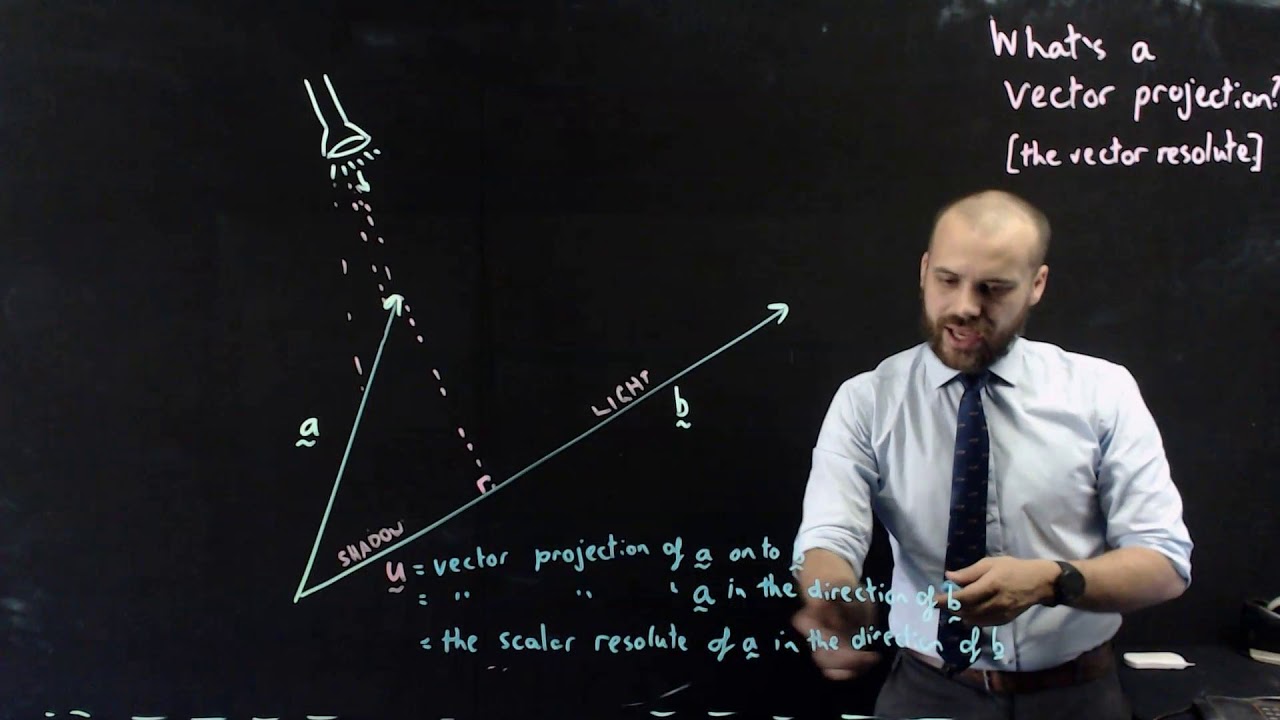
Simple, easy to understand math videos aimed at High School students. Want more videos? I've mapped hundreds of my videos to the Australian senior curriculum at my website http://mathsvideosaustralia.com/
scarlet lichen
doesn’t rlly make sense to me
how to find projection of b onto A

becuase it’s a straight line down so there’s no shadow
 swift laurel
,tikz
{[rotate around={30:(0,0)}]
\draw[dashed] (-3,0) -- (5,0);
{[thick, -Latex]
\draw[\red] (0,0) coordinate(O) -- node[midway, left]{$\vb a$} (2,2) coordinate(A);
\draw[\red] (O) --node[midway, below right]{$\mathcolor{black}{\proj}{\mblue{\vb b}} \mred{\vb a}$} (O -| A) coordinate(PA);
\draw[\blue] (PA) -- node[midway, below]{$\vb b$} ++ (1,0);
\draw[\green] (O) -- node[midway, above right]{$\vb c$} (-2, 1) coordinate(C);
\draw[\green] (O) --node[midway, below right]{$\mathcolor{black}{\proj}{\mblue{\vb b}} \mgreen{\vb c}$} (O -| C) coordinate(PC);
}
\draw[dashed] (A) -- (PA) (C) -- (PC);
\path pic[draw, angle radius = 7]{right angle =A--PA--O} pic[draw, angle radius = 7]{right angle =C--PC--O};
}
potent lotusBOT
cloud
 swift laurel
as you can see the projection can point in either the same direction or the opposite direction as the vector being projected onto
calm coralBOT
@scarlet lichen Has your question been resolved?
calm coralBOT
Channel closed
Closed due to timeout
Use .reopen if this was a mistake.
Available help channel!
Send your question here to claim the channel.
Remember:
• Ask your math question in a clear, concise manner.
• Show your work, and if possible, explain where you are stuck.
• After 15 minutes, feel free to ping <@&286206848099549185>.
• Type the command .close to free the channel when you're done.
• Be polite and have a nice day!
Read #❓how-to-get-help for further information on how to ask a good question, and about conduct in the question channels.
 scenic atlas
 calm coralBOT
scenic atlas
scenic atlas
calm coralBOT
scenic atlas
scenic atlas

I got till here, not sure what to do nest
Oh nvm got it you have to use hopital
.close
calm coralBOT
Channel closed
Closed by @scenic atlas
Use .reopen if this was a mistake.
calm coralBOT
Available help channel!
Send your question here to claim the channel.
Remember:
• Ask your math question in a clear, concise manner.
• Show your work, and if possible, explain where you are stuck.
• After 15 minutes, feel free to ping <@&286206848099549185>.
• Type the command .close to free the channel when you're done.
• Be polite and have a nice day!
Read #❓how-to-get-help for further information on how to ask a good question, and about conduct in the question channels.
 hidden ice
 calm coralBOT
hidden ice
hidden ice
calm coralBOT
hidden ice
hidden ice
Im confused about part b, the only think important from part a is that when you remove the discontinuity at (2, 3/10) you have f(x) = 3x/(2x+1)(x+2)
This question should be really easy, its literally just algebra, but I got the wrong answer 🤔
velvet osprey
did you get lost in the algebraic sauce
hidden ice
velvet osprey
did you get lost in the algebraic sauce
I guess I did 😭
3x/(2x+1)(x+2) = ((2)(2x+1) - (x+2))/(x+2)(2x+1)
3x/(2x+1)(x+2) = ((4x+2) - x - 2))/(x+2)(2x+1)
velvet osprey
did you try to rawdog it starting from f
hidden ice
velvet osprey
did you try to rawdog it starting from f
But then they wouldnt be equal right?
Cause of the discontinuity?
velvet osprey
this doesn't answer my question and i do not understand yours either
hidden ice
I thought that we needed to remove the discontinuity in order for f(x) and g(x) to be equal
Since it says 'Except for the perforation'
hidden ice
velvet osprey
yeah so your working will pre-assume x != 2
But if thats the case what difference would it make?
I will still get the same answer right?
Or no?
velvet osprey
idk what you mean by "the same answer"
i actually have little idea what you are talking about anymore?
hidden ice
Ok I will just leave it
hidden ice
velvet osprey
did you try to rawdog it starting from f
I will try this
(3x^2 - 6x)/(2x + 1)(x^2 - 4) = ((2)(2x+1) - (x+2))/(x+2)(2x+1)
(3x^2 - 6x)/(2x + 1)(x^2 - 4) = (4x + 2 - x - 2)/(x+2)(2x+1)
(3x^2 - 6x)/(2x + 1)(x^2 - 4) = (3x)/(x+2)(2x+1)
Wait
That was literally our original equation with the discontinuity removed 👀
(3x)(x-2)/(x+2)(2x+1)(x-2) = (3x)/(x+2)(2x+1)
(3x)/(x+2)(2x+1) = (3x)/(x+2)(2x+1)
Ok ya that was easy 💀
Thanks though
.close
calm coralBOT
Channel closed
Closed by @hidden ice
Use .reopen if this was a mistake.
calm coralBOT
Available help channel!
Send your question here to claim the channel.
Remember:
• Ask your math question in a clear, concise manner.
• Show your work, and if possible, explain where you are stuck.
• After 15 minutes, feel free to ping <@&286206848099549185>.
• Type the command .close to free the channel when you're done.
• Be polite and have a nice day!
Read #❓how-to-get-help for further information on how to ask a good question, and about conduct in the question channels.
hidden ice
 calm coralBOT
hidden ice
hidden ice
calm coralBOT
hidden ice
hidden ice
This is the g(x) theyre referring to

The algebra is loooooooong but for h'(x) = 0 I got x = +-1 and g'(x) = 0 I got x = 1
 verbal finch
What did you try?
hidden ice
verbal finch
What did you try?
Yes wait im telling you
verbal finch
Alr alr
hidden ice
hidden ice
The algebra is loooooooong but for h'(x) = 0 I got x = +-1 and g'(x) = 0 I got x...
The answer sheet confirmed these solutions, thats now what I was confused about
Im confused why I got 2 solutions for h'(x) = 0 but only 1 solution for g'(x) = 0
Does that mean its NOT true?
Or does that mean its only true for x = 1?
Or what does it mean im confused
verbal finch
Ok so u said u got 2 values ie ±1
But he mentioned that interval is from 0 to 3
So just ignore -1
verbal finch
Lol
hidden ice
So what do I actually say as my answer
Something like 'As you can see from the algebra above, they are both on the same interval (1, y- coordinate)'?
verbal finch
Yes basically now that u have x=1 for both equations
I proved that they attain their maxima at the same point
If u want to go super clear then just prove that f"(x)<0 for x =1
calm coralBOT
Channel closed
Closed by @hidden ice
Use .reopen if this was a mistake.
calm coralBOT
Available help channel!
Send your question here to claim the channel.
Remember:
• Ask your math question in a clear, concise manner.
• Show your work, and if possible, explain where you are stuck.
• After 15 minutes, feel free to ping <@&286206848099549185>.
• Type the command .close to free the channel when you're done.
• Be polite and have a nice day!
Read #❓how-to-get-help for further information on how to ask a good question, and about conduct in the question channels.
 wispy aurora
Im stuck at how to open these
 calm coralBOT
wispy aurora
Im stuck at how to open these
wispy aurora
calm coralBOT
wispy aurora
Im stuck at how to open these
wispy aurora
does anyone have an idea to solve this
 random adder
An idea would be to factor and just factor out that common -1
random adder
$$a^3 - b^3 = (a - b)(a^2 + ab + b^2)$$
potent lotusBOT
casework
 wispy aurora
wait ill try
random adder
You should know
$$\sum_{a = 1}^n a^2 = \frac{n(n + 1)(2n + 1)}{6}$$
potent lotusBOT
casework
 wispy aurora
What is this
random adder
A formula for the sum of first n squares
calm coralBOT
Channel closed
Closed by @wispy aurora
Use .reopen if this was a mistake.
calm coralBOT
Available help channel!
Send your question here to claim the channel.
Remember:
• Ask your math question in a clear, concise manner.
• Show your work, and if possible, explain where you are stuck.
• After 15 minutes, feel free to ping <@&286206848099549185>.
• Type the command .close to free the channel when you're done.
• Be polite and have a nice day!
Read #❓how-to-get-help for further information on how to ask a good question, and about conduct in the question channels.
 glossy haven
whats this answer
 calm coralBOT
glossy haven
whats this answer
calm coralBOT
calm coralBOT
glossy haven
whats this answer
calm coralBOT
@glossy haven Has your question been resolved?
glossy haven
<@&286206848099549185>
 ionic sail
glossy haven
whats this answer
ionic sail
glossy haven
whats this answer
is that all the information given to you
glossy haven
ionic sail
is that all the information given to you
here
 ionic sail
glossy haven
here
ionic sail
glossy haven
here
from the graph you can tell that there are 40 penguins
median is the mass of the 50%th percentile that is the mass of the 20th penguin
to find the interquartile range you need the mass of the 75th% percentile and 25th% percentil
and then subtract those masses
glossy haven
so the interquartile range would be 30?
tried to shorten interquartile range to the beginning letters and it didnt send
ionic sail
glossy haven
so the interquartile range would be 30?
nope
what is the 75%th and 25%th percentile of 40
glossy haven
75th is 30 and 25th is 10
glossy haven
ionic sail
from the graph
19 and 23
ionic sail
glossy haven
19 and 23
just subtract these to get the interquartile range
glossy haven
4
ionic sail
yep
calm coralBOT
Channel closed
Closed by @glossy haven
Use .reopen if this was a mistake.
glossy haven
.close
calm coralBOT
Available help channel!
Send your question here to claim the channel.
Remember:
• Ask your math question in a clear, concise manner.
• Show your work, and if possible, explain where you are stuck.
• After 15 minutes, feel free to ping <@&286206848099549185>.
• Type the command .close to free the channel when you're done.
• Be polite and have a nice day!
Read #❓how-to-get-help for further information on how to ask a good question, and about conduct in the question channels.
 regal charm
I have no idea where to start on this, and my teacher never covered this in class 😭
 calm coralBOT
regal charm
I have no idea where to start on this, and my teacher never covered this in clas...
regal charm
calm coralBOT
regal charm
I have no idea where to start on this, and my teacher never covered this in clas...
regal charm
i have NO idea why it's on our test review
ancient grotto
regal charm
I have no idea where to start on this, and my teacher never covered this in clas...
Do you know the dimensions for work?
leaden thunder
regal charm
I have no idea where to start on this, and my teacher never covered this in clas...

Mathematics LibreTexts
Work is the scientific term used to describe the action of a force which moves an object. The SI unit of force is the Newton (N), and the SI unit of distance is a meter (m). The fundamental unit of …
regal charm
ancient grotto
Do you know the dimensions for work?
doesn't really ring a bell?
 balmy grove
Triangles are half a quadratic shape?
regal charm
wait imma check if one of the other professors at my uni went over it in his videos
work's the integral kxdx between two limits
ancient grotto
regal charm
doesn't really ring a bell?
Well, it’s a Newton-meter (N*m).
regal charm
oh that
ancient grotto
Try to conclude from there.
regal charm
wait isn't work either N*m or joules?
depending on if youre using imperial or metric or something like that
understood
ancient grotto
regal charm
wait isn't work either N*m or joules?
Yeah
I personally think in this context that N*m is better used.
regal charm
wait a second
how have i never heard of libretexts up until now
this site is awesome
gotcha
ancient grotto
Yeah, has it for all science and mathematics.
calm coralBOT
Channel closed
Closed by @regal charm
Use .reopen if this was a mistake.
Available help channel!
Send your question here to claim the channel.
Remember:
• Ask your math question in a clear, concise manner.
• Show your work, and if possible, explain where you are stuck.
• After 15 minutes, feel free to ping <@&286206848099549185>.
• Type the command .close to free the channel when you're done.
• Be polite and have a nice day!
Read #❓how-to-get-help for further information on how to ask a good question, and about conduct in the question channels.
scenic atlas
 calm coralBOT
scenic atlas
scenic atlas
calm coralBOT
scenic atlas
scenic atlas
Where did the series expansion fail?

Is missed a minus at the x^2 part but cant find any other error
 near seal
scenic atlas
Where did the series expansion fail?
near seal
scenic atlas
Where did the series expansion fail?
take the limit to numerator and denominator
then multiply and divide by 4x
its done
scenic atlas
near seal
take the limit to numerator and denominator
No i solved it
Just wanna know why series expansion failed
leaden thunder
doesn't look like series expansion enough terms in denominator
calm coralBOT
Channel closed
Closed by @scenic atlas
Use .reopen if this was a mistake.
Available help channel!
Send your question here to claim the channel.
Remember:
• Ask your math question in a clear, concise manner.
• Show your work, and if possible, explain where you are stuck.
• After 15 minutes, feel free to ping <@&286206848099549185>.
• Type the command .close to free the channel when you're done.
• Be polite and have a nice day!
Read #❓how-to-get-help for further information on how to ask a good question, and about conduct in the question channels.
Channel closed
Channel closed due to the original message being deleted.
If you did not intend to do this, please open a new help channel,
as this action is irreversible, and this channel may abruptly lock.
Available help channel!
Send your question here to claim the channel.
Remember:
• Ask your math question in a clear, concise manner.
• Show your work, and if possible, explain where you are stuck.
• After 15 minutes, feel free to ping <@&286206848099549185>.
• Type the command .close to free the channel when you're done.
• Be polite and have a nice day!
Read #❓how-to-get-help for further information on how to ask a good question, and about conduct in the question channels.
 deep violet
x takes values from between 0 and pi.
Maximize the following:
2cos(x/2) + sin(x)
calm coralBOT
deep violet
x takes values from between 0 and pi.
Maximize the following:
2cos(x/2) + sin(x)
glad parrot
What have you tried ?
velvet osprey
one non-calculus insight you can make is this:
 tardy chasm
deep violet
Calculus is not allowed.
tardy chasm
deep violet
Calculus is not allowed.

velvet osprey
letting f(x) be the expression you aim to maximize, you can immediately say f(x) > f(pi-x) for any x ∈ [0, π/2)
glad parrot
Rewrite sinx = 2cos(x/2)sin(x/2)
 remote mural
hello, i'm 16 and i haven't been on school since my 10, i lost alot of practice in almost everything and my parents won't do anything, don't bully me pls 🙏
velvet osprey
since sin(x) = sin(pi-x) but cos((pi-x)/2) < cos(x/2)
velvet osprey
remote mural
hello, i'm 16 and i haven't been on school since my 10, i lost alot of practice ...
hi, this channel is occupied.
remote mural
ty
velvet osprey
i mean this in the gentlest way possible but you should move to #discussion
these help channels are for when somebody needs help with a specific question
remote mural
i need help
velvet osprey
#❓how-to-get-help has instructions for how to claim your own help channel
so that it has your name on it
mq do not encourage channel hogging please.
velvet osprey
deep violet
We need to MAXIMIZE ++++++ the value of that expression.
did you think we would not see, read, or understand the word "maximize" the first time around?
calm coralBOT
@deep violet Has your question been resolved?
calm coralBOT
Channel closed
Closed due to timeout
Use .reopen if this was a mistake.
Available help channel!
Send your question here to claim the channel.
Remember:
• Ask your math question in a clear, concise manner.
• Show your work, and if possible, explain where you are stuck.
• After 15 minutes, feel free to ping <@&286206848099549185>.
• Type the command .close to free the channel when you're done.
• Be polite and have a nice day!
Read #❓how-to-get-help for further information on how to ask a good question, and about conduct in the question channels.
 noble narwhal
 calm coralBOT
noble narwhal
eternal shard
noble narwhal
calm coralBOT
noble narwhal
eternal shard
noble narwhal
What did you try?
noble narwhal
wait, i found the answer but now i need help for the second question: show that if z = exp(itheta) or z = exp(-itheta); the series is divergent

if z = exp(itheta)
@eternal shard and then?
glad parrot
noble narwhal
if z = exp(itheta)
Z=|z|exp(itheta)
You have to let the |z|
Since its going to be a condition for the convergence
eternal shard
can you post the original
 eternal shard
noble narwhal
eternal shard
noble narwhal
I guess this one fails the divergence test if you were to take the limit
or no
noble narwhal
wha-
eternal shard
i have no idea leave me alone
velvet osprey
 vast flare
I’ll do it for u
vast flare
I’ll do it for u
!nosols
calm coralBOT
vast flare
I’ll do it for u
As a helper, please do not give out answers that could be copied as a homework solution. Have the student work through the problem themselves and guide them along the way.
noble narwhal
glad parrot
Z=|z|exp(itheta)
wdym
velvet osprey
!nosols
calm coralBOT
As a helper, please do not give out answers that could be copied as a homework solution. Have the student work through the problem themselves and guide them along the way.
glad parrot
noble narwhal
wdym
I thought you was asking for the first question
manic vault
noble narwhal
wdym
A complex number z is composed of the modulous (|z|) and the argument (theta). In polar form, this is $z=re^{i\theta}$, where $r=|z|$.
potent lotusBOT
mathisfun
 eternal shard
modulos is just 1 here bruh
manic vault
noble narwhal
Do you know what power series are?
manic vault
eternal shard
modulos is just 1 here bruh
Not for question 1.
eternal shard
y'all went all the way back just to skip the part where q1 is done
noble narwhal
i dont understand this
manic vault
noble narwhal
Do you see the condition?
vast flare
noble narwhal
i dont understand this
What didn’t you understand
noble narwhal
manic vault
Do you know what power series are?
yes
noble narwhal
manic vault
Do you see the condition?
for convergence?
manic vault
This is overcomplicated. All you have to do is just apply the result from part 1.
manic vault
noble narwhal
for convergence?
Yes.
 elder pawn
@vast flare dont give full sols. i deleted it
leaden thunder
it was also wrong
vast flare
elder pawn
<@1308116512523157514> dont give full sols. i deleted it
Okay sorry
manic vault
What is the modulous of e^(i*theta) and e^(-i*theta)? (adwin gave it away)?
noble narwhal
1
eternal shard
roketto should delete my solution too
manic vault
noble narwhal
1
Good. And does that fall within the convergence?
noble narwhal
vast flare
Okay sorry
why u giving wrong answers
eternal shard
how ungentleman to give wrong solutions
noble narwhal
manic vault
Good. And does that fall within the convergence?
no
manic vault
noble narwhal
no
So what can you conclude?
noble narwhal
that if z is that, the series does not converge
leaden thunder
i don't think the solution to a) that hhh showed proved the radius of convergence was equal to 1, just that it was less than 1
manic vault
Do you know how to calculate radius of convergence?
noble narwhal
leaden thunder
i don't think the solution to a) that hhh showed proved the radius of convergenc...
youre right
leaden thunder
yea i don't think you can use part a) to prove b)
manic vault
leaden thunder
yea i don't think you can use part a) to prove b)
For which question in part b)? Both? Or just the radius of convergence?
leaden thunder
the first part of 2
manic vault
Hmm
leaden thunder
 manic vault
Can we use $\lim_{n\to\infty}\bigg\vert\frac{a_{n+1}}{a_n}\bigg\vert$?
potent lotusBOT
mathisfun
 noble narwhal
to find the radius?
manic vault
noble narwhal
to find the radius?
That is what I think we should use.
And also, for convergence/divergence.
noble narwhal
manic vault
And also, for convergence/divergence.
but the limit is hard to find
i dont think we can directly use this
manic vault
noble narwhal
but the limit is hard to find
How so?
noble narwhal
manic vault
How so?
because of theta, also i dont know why they would ask us to deduce the radius if we can just immediately apply the formula
noble narwhal
eternal shard
I think comparison test is a lot easier
where
eternal shard
nvm i just forgot the partial terms have to be non-negative for that one
manic vault
noble narwhal
because of theta, also i dont know why they would ask us to deduce the radius if...
Hmm
leaden thunder
<@&268886789983436800> scam
hehe con-mmunity. these bots find identify themselves
eternal shard
Dirichlet's test
noble narwhal
1/n then?
eternal shard
yea
so we have to find a contradiction that shows the complex sequence cos(nθ)e^(±iθ) is unbounded
noble narwhal
eternal shard
so we have to find a contradiction that shows the complex sequence cos(nθ)e^\(±i...
so we take a partial sum?
eternal shard
wait
noble narwhal
no srry
so we just take exp(itheta)?
because cos(ntheta) is bounded
?
uh
noo
what am i saying
the series cos(ntheta)exp(itheta)
potent lotusBOT
 eternal shard
this was what you had
noble narwhal
yes
eternal shard
this is like
noble narwhal
yes
potent lotusBOT
 eternal shard
mid fraction
noble narwhal
the two sequences
leaden thunder
she's asking how splitting the sum is justified
noble narwhal
yes like
eternal shard
it isnt 😦
noble narwhal
where is the taylor series of ln(1-x) in this
noble narwhal
but then it converges ???  or...
or...
potent lotusBOT
 eternal shard
noble narwhal
but then it converges ??? <:sully:651816820122189834> or...
eternal shard
noble narwhal
but then it converges ??? <:sully:651816820122189834> or...
no
what about the other series
1/n
but i still dont know if that's a good justification
eternal shard
potent lotus
in my notes i only had that \sum x^n/n converges iff -1 < x \le 1
so i am unsure
noble narwhal
so we didnt even use dirichlet
eternal shard
ye
on wikipedia it says that what i used only converges iff |x| < 1 so i think that's not the right way to do it
leaden thunder
potent lotus
can you just use the taylor series for log on the first term
log(1-exp-1) or something
noble narwhal
leaden thunder
can you just use the taylor series for log on the first term
is it the second part now?
to find the radius?
eternal shard
,, \frac{1}{2}\sum_{n\ge 1} \frac{e^{2in\theta}+1}{n} = \frac{1}{2}\sum_{n\ge 1} \frac{1}{n} \cdot (e^{2in\theta}+1)
potent lotusBOT
 eternal shard
forgot the name
potent lotusBOT
riemann
 eternal shard
y
leaden thunder
bottom one with x = -numerator or something
eternal shard
leaden thunder
profound observation adonis
i am just trying how one could use dirichlet but i am getting confused cause e^2intheta seems to be bounded 😕
leaden thunder
@noble narwhal did you even learn dirichlet
noble narwhal
leaden thunder
<@775298448056123403> did you even learn dirichlet
uhm... yes but it was last year but now i remeber
so what can we say
to conclude
in conclusion, the radius is 1?
leaden thunder
up to you to decide which path. follow the log to justify it converges for the range of x in taylor
eternal shard
oh wait
potent lotusBOT
 eternal shard
this surely isn't bounded
|e^(2iθ)| = |e^(iθ)|^2 = 1
so the geometric series wouldnt converge and the sum of 1s anyway
noble narwhal
ok
eternal shard
i give up i am going to sleep
noble narwhal
waiitt
for the conclusion
if z = ewp(-,+iheta) it diverges
uhm no actually
yeah ok thanks good night
.close
calm coralBOT
Channel closed
Closed by @noble narwhal
Use .reopen if this was a mistake.
calm coralBOT
Available help channel!
Send your question here to claim the channel.
Remember:
• Ask your math question in a clear, concise manner.
• Show your work, and if possible, explain where you are stuck.
• After 15 minutes, feel free to ping <@&286206848099549185>.
• Type the command .close to free the channel when you're done.
• Be polite and have a nice day!
Read #❓how-to-get-help for further information on how to ask a good question, and about conduct in the question channels.
 azure kite
The activity is about Anti differentiation by substitution.
I don't know how to properly apply the rules and I'm really really bad at fractions.
Please let me know if I got #1 right, and how to continue numbers 2,3,4,5, and 6

 calm coralBOT
azure kite
The activity is about Anti differentiation by substitution.
I don't know how to...
calm coralBOT
azure kite
The activity is about Anti differentiation by substitution.
I don't know how to...
 dull wagon
is incorrect because your
du is wrong
azure kite
What I understand so far:
You use U on the one that is harder to solve, du is the easier one. Then you substitute the values and add +1 on the end
dull wagon
derivative of 5x isn't 1
azure kite
dull wagon
is incorrect because your
du is wrong
Please elaborate
Ohhhhh

Lik this?
Mb it's hard to use notes app with fingers lmao
azure kite
azure kite
The activity is about Anti differentiation by substitution.
I don't know how to...
On #2, What if it's just dx on the numerator? What is its value?
dull wagon
du = 5 dx
why are you adding 5 to the denominator and the power
and having 5du at the end is also incorrect
du = 5 dx
dx = ?
dull wagon
dx =
du/5?
azure kite
?

 dull wagon
du shouldn't be there anymore after integrating
dull wagon
* 1/5
azure kite
Ohhhhh ok ok
Where do I apply the dx?

Do I distribute it with the U?
(5x-3) (1/5)
And (101)(1/5)
?

I'll go look for yt vids in the meantime. I'll be back
.close
calm coralBOT
Channel closed
Closed by @azure kite
Use .reopen if this was a mistake.
calm coralBOT
Available help channel!
Send your question here to claim the channel.
Remember:
• Ask your math question in a clear, concise manner.
• Show your work, and if possible, explain where you are stuck.
• After 15 minutes, feel free to ping <@&286206848099549185>.
• Type the command .close to free the channel when you're done.
• Be polite and have a nice day!
Read #❓how-to-get-help for further information on how to ask a good question, and about conduct in the question channels.
 foggy tiger
yo question whats a function that would go over this perfectly

 vagrant dune
foggy tiger
yo question whats a function that would go over this perfectly
vagrant dune
foggy tiger
yo question whats a function that would go over this perfectly
what
 tacit moat
foggy tiger
yo question whats a function that would go over this perfectly
tacit moat
foggy tiger
yo question whats a function that would go over this perfectly
can you draw out what the function you want looks like?
 tacit moat
foggy tiger
tacit moat
foggy tiger
it's not really possible to have a single function be all of those lines
you can make a function for each line
also, what is this for?
foggy tiger
sorry this is for a desmos projecty
if you want i can share a link so you can check it out
actually can you go over it and see if you can help change some lines around to make them look better
im having some trouble on the shoes
tacit moat
sure, share the link
foggy tiger

Desmos
if you change anything can you send me the equation and tell me what one you changed
tacit moat
ah I don't think I can help much
it already looks pretty good imo, maybe the line weights needs tweaking
if you give me a specific line you don't like, then maybe I can find a better function
foggy tiger
Is there anything you can do for the feet? they look so out of place and bad
foggy tiger
tacit moat
ah I don't think I can help much
it already looks pretty good imo, maybe the lin...
thank you btw

heres my rubric let me know if i hit the points at like a teacher stand point
thank you sm 😭
calm coralBOT
@foggy tiger Has your question been resolved?
 ionic moon
foggy tiger
https://www.desmos.com/calculator/q9ddh1smd4
ionic moon
foggy tiger
https://www.desmos.com/calculator/q9ddh1smd4
this is good! id give you a perfect score
calm coralBOT
Channel closed
Closed due to timeout
Use .reopen if this was a mistake.
Available help channel!
Send your question here to claim the channel.
Remember:
• Ask your math question in a clear, concise manner.
• Show your work, and if possible, explain where you are stuck.
• After 15 minutes, feel free to ping <@&286206848099549185>.
• Type the command .close to free the channel when you're done.
• Be polite and have a nice day!
Read #❓how-to-get-help for further information on how to ask a good question, and about conduct in the question channels.
 pallid apex
 calm coralBOT
pallid apex
pallid apex
calm coralBOT
pallid apex
pallid apex
<@&286206848099549185>
potent smelt
!15min
calm coralBOT
Please only use the <@&286206848099549185> ping once if your question has not been answered for 15 minutes. Please do not ping or DM individual users about your question.
pallid apex
potent smelt
!15min
sorry
 low river
pallid apex
low river
pallid apex
Use the second equation given
P = 80
r = rate, or 0.055
n = how many times per year it is compounded, so 12
t is the amount of time you have from now (age 34) to age 65
plug things in
calm coralBOT
@pallid apex Has your question been resolved?
calm coralBOT
Channel closed
Closed due to timeout
Use .reopen if this was a mistake.
Available help channel!
Send your question here to claim the channel.
Remember:
• Ask your math question in a clear, concise manner.
• Show your work, and if possible, explain where you are stuck.
• After 15 minutes, feel free to ping <@&286206848099549185>.
• Type the command .close to free the channel when you're done.
• Be polite and have a nice day!
Read #❓how-to-get-help for further information on how to ask a good question, and about conduct in the question channels.
 stark hatch
Someone please teach me how to do PNC questions
 calm coralBOT
stark hatch
Someone please teach me how to do PNC questions
stark hatch
calm coralBOT
stark hatch
Someone please teach me how to do PNC questions
stark hatch
I promise I know PNC and that I did it really well before my midterms (september) but I've forgotten EVERYTHING
 marsh valley
You can divide it into cases and use symmetry to avoid repeating calculations
Really this is asking how many ways you can add two numbers to 7 where each is less than 5
stark hatch
Yeah ik that but how do I show these calculations
 hushed knot
Let me give you just one part of the answer and you would understand everything
marsh valley
stark hatch
Yeah ik that but how do I show these calculations
Choose 2 questions from the first group
Choose 5 questions from the second
That’s one way
hushed knot
6C2×6C5
This is just one case
There are two groups of 6 questions and total questions are 7
hushed knot
I think you understand
marsh valley
So you can just see which pairs add up to 7 and you’ll be golden
calm coralBOT
Channel closed
Closed by @stark hatch
Use .reopen if this was a mistake.
calm coralBOT
Available help channel!
Send your question here to claim the channel.
Remember:
• Ask your math question in a clear, concise manner.
• Show your work, and if possible, explain where you are stuck.
• After 15 minutes, feel free to ping <@&286206848099549185>.
• Type the command .close to free the channel when you're done.
• Be polite and have a nice day!
Read #❓how-to-get-help for further information on how to ask a good question, and about conduct in the question channels.
 heavy nimbus
I'm so lost here😭
 calm coralBOT
heavy nimbus
I'm so lost here😭
calm coralBOT
heavy nimbus
I'm so lost here😭
 blazing coyote
You're trying to prove equality?
heavy nimbus
Yep
velvet osprey
blazing coyote
find $\frac{2}{2} \log(2) - \frac{1}{2} \log(2)$
\log
potent lotusBOT
What a wonderful world !
 heavy nimbus
I'm definitely doing this wrong💀
 potent lotusBOT
What a wonderful world !

 ocean hornet
heavy nimbus
I'm definitely doing this wrong💀
ocean hornet
heavy nimbus
I'm definitely doing this wrong💀
Do you know about addition property of logarithms when base is same?
|| log(a) with base c + log(b) with base c = log(ab) with base c ||
heavy nimbus
Yep, you multiply the arguments?