#help-42
1 messages · Page 73 of 1
 candid pilot
 polar frost
What do u mean?
polar frost
candid pilot
<@424820587551129600>
yes?
candid pilot

In the part I circled
Like is there supposed to be another line there or is it right
also how can i find the point of intercepts for f(x) = 6- x^2 and its inverse root 6-x
polar frost
 polar frost
candid pilot
point of intersection i mean
polar frost
candid pilot
point of intersection i mean
U dont neef to prove it
Its a fact
Those x value has a corresponding f(x) and they're there
candid pilot
Oh that ones for a different question
candid pilot
Sorry well start a new question
how can i find the point of intersection for f(x) = 6- x^2 and its inverse root 6-x
polar frost
Like the intersection of the 2 lines?
candid pilot
yeah
 candid pilot
oh sorry no like
f^1(x) = root 6-x
so originally i found the reciprocal of 6 - x^2
candid pilot
candid pilot
f^1(x) = root 6-x
and got that
the next step was the point of intersection
polar frost
 candid pilot
yeah
polar frost
Just set them =
candid pilot
i also substituted for y and got x^4 + 12x^2 + x +30 = 0
polar frost
6 - x^2 = sqrt(6-x)
candid pilot
yeah i wasn't able to factorise it
polar frost
square them
candid pilot
yeah and then i got x^4 - 12x^2 + x +30 = 0 is what i mean
and wasn't able to factorise it
polar frost
Use calculator then
candid pilot
is there any like way to do it without calculator?
polar frost
its a 4 degree poly
candid pilot
yeah so 4 intersections
polar frost
Only 2
polar frost
U need to restrict that sqrt
candid pilot
would you have a plus minus in front of it
candid pilot
okok
wait so
im a bit lost
i squared the square root meaning i squared both sides
and then i brought everything to the LHS
and got x^4 - 12x^2 + x +30 = 0
but im not sure how to solve for x so i can then substitute it and find y
unless this process is wrong
@polar frost
polar frost
candid pilot
unless this process is wrong
Just use the calculator for this part
then u should get 4 values of x
but u should only accept x > 0
 calm coralBOT
@candid pilot Has your question been resolved?
calm coralBOT
Channel closed
Closed due to timeout
Use .reopen if this was a mistake.
 Available help channel!
Send your question here to claim the channel.
Remember:
• Ask your math question in a clear, concise manner.
• Show your work, and if possible, explain where you are stuck.
• After 15 minutes, feel free to ping <@&286206848099549185>.
• Type the command .close to free the channel when you're done.
• Be polite and have a nice day!
Read #❓how-to-get-help for further information on how to ask a good question, and about conduct in the question channels.
 timber timber
Option 1: 2(lw + lh + wh), l + w + h, lwh Option 2: 3 layers of 10, 7 layers of 21, 3 layers of 21, 7 layers of 3. Option 3: volume, edge lengths, base area Option 4: equal to, less than, greater than
Image
 timber timber
pls help 🙂
calm coralBOT
@timber timber Has your question been resolved?
calm coralBOT
Channel closed
Closed by @timber timber
Use .reopen if this was a mistake.
calm coralBOT
Available help channel!
Send your question here to claim the channel.
Remember:
• Ask your math question in a clear, concise manner.
• Show your work, and if possible, explain where you are stuck.
• After 15 minutes, feel free to ping <@&286206848099549185>.
• Type the command .close to free the channel when you're done.
• Be polite and have a nice day!
Read #❓how-to-get-help for further information on how to ask a good question, and about conduct in the question channels.
 mortal heath
could i possibly get some help on this question? i'm just honestly quite confused on where to even start with this
 calm coralBOT
mortal heath
could i possibly get some help on this question? i'm just honestly quite confuse...
calm coralBOT
mortal heath
could i possibly get some help on this question? i'm just honestly quite confuse...
 brazen elbow
mortal heath
could i possibly get some help on this question? i'm just honestly quite confuse...
brazen elbow
mortal heath
could i possibly get some help on this question? i'm just honestly quite confuse...
also be aware of the fact that rainfall cannot be negative
mortal heath
yeah i'm just confused on the > thing but should i just treat it as = when solving for x?
polar frost
brazen elbow
also be aware of the fact that rainfall cannot be negative
Doesnt matter
brazen elbow
mortal heath
yeah i'm just confused on the > thing but should i just treat it as = when solvi...
kind of yeah, but you also swap the direction when multiply both hand side with negative
polar frost
For that function y>60 only return x in positive
brazen elbow
polar frost
For that function y>60 only return x in positive
the problem is just convenient to give that result
without considering it, the answer is inconplete
mortal heath
wait so i should write it out as 60 > 7500x/x^2 + 2500?
polar frost
 mortal heath
i'm just confused because the final answer is a range
 remote mural
there is some algebra you have to do
so like, do you understand that [
\4{7500x}{x^2+2500} \ge 60
]
is the inequality you are meant to solve
 potent lotusBOT
 mortal heath
yes
remote mural
ok
so a good way to start is to subtract 60 from both sides, and combine everything on the left to a single fraction
What does that get you
mortal heath
oh i thought it would be better to multiply each side by x^2 + 2500 to cancel out that fraction
 glass heart
I would say its easier to multiply both sides by x^2+2500
remote mural
i mean sure the denominator goes away either way
mortal heath
yeah
glass heart
note that x^2+2500 is certainly >0, so you dont have to switch the inequality
mortal heath
so then i got that 60x^2 + 150000 < 7500x
yeah
or wait i can just send what i did

i know i should've put < instead of = but yea
i still don't think i got the right answer idk
 mortal heath
maybe i'm stupid but i don't know what's wrong with that
polar frost
You should use the => arrow instead of -> this one
I thought u were substitute that part in
mortal heath
oh i didn't know that made a difference it's just kinda how i write stuff down for myself when working out
polar frost
😭
remote mural
it's not really important its fine, you can always just include the endpoints
polar frost
Hmm
remote mural
anyways
 remote mural
im pretty sure you erased a 0 from the 150000 @mortal heath
polar frost
Did u remove one 0 from 150000 to 15000
mortal heath
oh i did my bad 😭
polar frost
Wait no
mortal heath
i got it thank you!!
polar frost
Did she devide everything by 10
mortal heath
i did yeha
mortal heath
yeah i did
my mistake was that i calculated with 1500 instead of 15000
i got the right answers fixing that haha
remote mural
yeah she erased a 0 like we said lmao
mortal heath
thank you! sorry if this work is really simple but i appreciate the help a lot 😭 need to pass this class
polar frost
2 values of x mean u need to limit it
polar frost
Good
calm coralBOT
Channel closed
Closed by @mortal heath
Use .reopen if this was a mistake.
calm coralBOT
Available help channel!
Send your question here to claim the channel.
Remember:
• Ask your math question in a clear, concise manner.
• Show your work, and if possible, explain where you are stuck.
• After 15 minutes, feel free to ping <@&286206848099549185>.
• Type the command .close to free the channel when you're done.
• Be polite and have a nice day!
Read #❓how-to-get-help for further information on how to ask a good question, and about conduct in the question channels.
 lunar ridge
Please help
 calm coralBOT
lunar ridge
Please help
calm coralBOT
lunar ridge
Please help
 timid oracle
you can solve for x since the all the probabilities sum to 1
split that thing into P(B intersect A')/P(C)
calm coralBOT
@lunar ridge Has your question been resolved?
calm coralBOT
Channel closed
Closed due to timeout
Use .reopen if this was a mistake.
Available help channel!
Send your question here to claim the channel.
Remember:
• Ask your math question in a clear, concise manner.
• Show your work, and if possible, explain where you are stuck.
• After 15 minutes, feel free to ping <@&286206848099549185>.
• Type the command .close to free the channel when you're done.
• Be polite and have a nice day!
Read #❓how-to-get-help for further information on how to ask a good question, and about conduct in the question channels.
 fringe hamlet
 calm coralBOT
fringe hamlet
calm coralBOT
fringe hamlet
 ancient helm
fringe hamlet
Can the fraction be reversed when there is a + in the middle?
ancient helm
fringe hamlet
Can the fraction be reversed when there is a + in the middle?
where?
fringe hamlet
On the penultimate line of the photo
ancient helm
this?
 fringe hamlet
Yes
ancient helm
like to go from the line above it to that?
fringe hamlet
Yes
ancient helm
well in general no
you should combine LHS into a single fraction
then cross multiply
LHS has common denom already
don't simplify the 3^(n+1)/3^(n+1) part
calm coralBOT
Channel closed
Closed by @fringe hamlet
Use .reopen if this was a mistake.
calm coralBOT
Available help channel!
Send your question here to claim the channel.
Remember:
• Ask your math question in a clear, concise manner.
• Show your work, and if possible, explain where you are stuck.
• After 15 minutes, feel free to ping <@&286206848099549185>.
• Type the command .close to free the channel when you're done.
• Be polite and have a nice day!
Read #❓how-to-get-help for further information on how to ask a good question, and about conduct in the question channels.
 midnight field
working on triple integrals! what am i doing wrong here?

 warm warren
midnight field
working on triple integrals! what am i doing wrong here?
warm warren
midnight field
working on triple integrals! what am i doing wrong here?
Something’s wrong why are you integrating over T but then you say a ball B
midnight field
warm warren
Something’s wrong why are you integrating over T but then you say a ball B
oops
forgot that i wrote t
should be b
nothing else is changed i just had T in my notes and instinctually put it there
im confdent theres something wrong with the setup
warm warren
I don’t see it soz I’m very sleepy tho
midnight field
all good
im guessing its a dumb mistake somewhere i havent seen
Yup
forgot rho ^2
lmao
.close
calm coralBOT
Channel closed
Closed by @midnight field
Use .reopen if this was a mistake.
calm coralBOT
Available help channel!
Send your question here to claim the channel.
Remember:
• Ask your math question in a clear, concise manner.
• Show your work, and if possible, explain where you are stuck.
• After 15 minutes, feel free to ping <@&286206848099549185>.
• Type the command .close to free the channel when you're done.
• Be polite and have a nice day!
Read #❓how-to-get-help for further information on how to ask a good question, and about conduct in the question channels.
 uncut narwhal
Hi

 unkempt drift
uncut narwhal
934.38
unkempt drift
uncut narwhal
934.38
Please show your work in future
uncut narwhal
unkempt drift
Please show your work in future
I calculated it.
unkempt drift
I know but the steps are also important
It saves us from having to do your work again
 thin gulch
uncut narwhal
I calculated it.
thin gulch
uncut narwhal
I calculated it.
It is much easier for us to fix your error from your work. It doesn't really help you if I just give you the right answer right?
calm coralBOT
@uncut narwhal Has your question been resolved?
calm coralBOT
Channel closed
Closed due to timeout
Use .reopen if this was a mistake.
Available help channel!
Send your question here to claim the channel.
Remember:
• Ask your math question in a clear, concise manner.
• Show your work, and if possible, explain where you are stuck.
• After 15 minutes, feel free to ping <@&286206848099549185>.
• Type the command .close to free the channel when you're done.
• Be polite and have a nice day!
Read #❓how-to-get-help for further information on how to ask a good question, and about conduct in the question channels.
 blazing coyote
 calm coralBOT
blazing coyote
blazing coyote
calm coralBOT
blazing coyote
blazing coyote
I split this into
$\int_{\frac{1}{3}}^{\frac{1}{2}}e^2dx+\int_{\frac{1}{2}}^1edx+\int_1^3dx$
potent lotusBOT
ƒ(Why am. I here)=I don't know
 blazing coyote
would that be right
if right that would be
$\int_{\frac{1}{3}}^{\frac{1}{2}}e^2dx+\int_{\frac{1}{2}}^1edx+\int_1^3dx=e^2\left(\frac{1}{6}\right)+\frac{e}{2}+2$
potent lotusBOT
ƒ(Why am. I here)=I don't know

 rustic osprey
Did you remember the ln part
rustic osprey
,w 2(1/2-1/3)+(1/2)
potent lotusBOT


 Requested by civil_service_pigeon
blazing coyote
Requested by civil_service_pigeon
blazing coyote
so $\int_{\frac{1}{3}}^{\frac{1}{2}}\ln\left(e^2\right)dx+\int_{\frac{1}{2}}^1\left(e\right)dx+\int_1^30dx=e^2\left(\frac{1}{6}\right)+\frac{e}{2}+2$
rustic osprey
blazing coyote
so it would be the ln of these exponetial functions ?
Yeah e^2 should be replaced with 2 and so on
potent lotusBOT
ƒ(Why am. I here)=I don't know
 blazing coyote
thanks!
rustic osprey
blazing coyote
thanks!

blazing coyote
.close
calm coralBOT
Channel closed
Closed by @blazing coyote
Use .reopen if this was a mistake.
blazing coyote
.reopen
calm coralBOT
✅
blazing coyote

so I was thinkng of solving this by. breaking it down into seperate intervals
$\int_0^1xdx+\int_1^22x^2-1dx+\int_2^33x^3-2dx$
potent lotusBOT
ƒ(Why am. I here)=I don't know
 blazing coyote
would that be right
rustic osprey
blazing coyote
would that be right
Yeah
blazing coyote
thanks!
potent lotusBOT
Max
 blazing coyote
hmm
let me think
thanks for the nice problem
hmm
so that would be
$e^0+e^{-1}+e^{-2}....$
potent lotusBOT
ƒ(Why am. I here)=I don't know

 clever ruin
yea
blazing coyote
$\frac{e}{e-1}..$
potent lotusBOT
ƒ(Why am. I here)=I don't know
 clever ruin
yea
blazing coyote
thanks! That was fun
clever ruin
if u like integrals
there are Bees such as the MIT int bee and UK Integration Bee (Cambridge)
blazing coyote
I do solve them, that's where I get these problems from, Thanks though!
could you link to the cambridge bee
can't find it
 bronze adder
blazing coyote
bronze adder
blazing coyote
saw this in the caltech one lol
blazing coyote
it is from the caltech one
clever ruin
 bronze adder
utilize symmetry about pi/2 
blazing coyote
$\left(\int_0^{\pi}\frac{\left(\sin\left(\frac{x}{2}\right)-\cos\left(\frac{x}{2}\right)\right)^2}{\left(\sin\left(\frac{x}{2}\right)+\cos\left(\frac{x}{2}\right)^2\right)}dx\right)$
potent lotusBOT
ƒ(Why am. I here)=I don't know
 bronze adder
after some simplifcation it turns into tan^2(x/2) which is easy to integrate
oh lord

rustic osprey
If we’re doing integration then have another fun one
Hint: ||binomial theorem||
 blazing coyote
thanks!
blazing coyote
bronze adder
after some simplifcation it turns into tan^2(x/2) which is easy to integrate
thanks!
bronze adder
do you know how to get there
blazing coyote
thinking about it
bronze adder
alright
blazing coyote
potent lotus
**ƒ(Why am. I here)=I don't know**
this could be converted to $\int_0^{\pi}\left(\tan\left(\frac{\pi}{4}-x\right)\right)^2$
potent lotusBOT
ƒ(Why am. I here)=I don't know
 blazing coyote
which is integrable
bronze adder
fair
rustic osprey
blazing coyote
thanks!
3 more random ones I had lying around, I’ll leave you alone now


👋
blazing coyote
thanks a lot
bronze adder
for the 19th one ||you can split it as arctan(1 + x) - arctan(x)||
and the 20th is just ||an embellished euler log trig so thats -pi(ln 2)/2||
blazing coyote
spoilers !
rustic osprey
blazing coyote
thanks a lot
👍 feel free to ping me if you want more
blazing coyote
potent lotus
**ƒ(Why am. I here)=I don't know**
this is $\int_0^{\frac{3\pi}{4}}1-\sec^2\left(x-\frac{\pi}{4}\right)+\int_{\frac{3\pi}{4}}^{\pi\ }1-\sec^2\left(x-\frac{\pi}{4}\right)$
potent lotusBOT
ƒ(Why am. I here)=I don't know
 blazing coyote
rustic osprey
👍 feel free to ping me if you want more
blazing coyote
rustic osprey
👍 feel free to ping me if you want more
thanks!
blazing coyote
potent lotus
**ƒ(Why am. I here)=I don't know**
which evaluvates to
$\int_0^{\frac{3\pi}{4}}1-\sec^2\left(x-\frac{\pi}{4}\right)+\int_{\frac{3\pi}{4}}^{\pi\ }1-\sec^2\left(x-\frac{\pi}{4}\right)=\frac{3\pi}{4}-\tan\left(\frac{\pi}{2}\right)+\frac{\pi}{4}-\tan\left(\frac{3\pi}{4}\right)-\tan\left(\frac{\pi}{\left(2\right)}\right)$
potent lotusBOT
ƒ(Why am. I here)=I don't know
 blazing coyote
what am I doing wrong here
oo
it should be x/2
$\int_0^{\pi}1-\sec^2\left(\frac{\pi}{4}-\frac{x}{2}\right)$
potent lotusBOT
ƒ(Why am. I here)=I don't know
 blazing coyote
whcih is $\pi-1$
potent lotusBOT
ƒ(Why am. I here)=I don't know
 potent lotusBOT

 Requested by physicsrocks
blazing coyote
rustic osprey
3 more random ones I had lying around, I’ll leave you alone now
Requested by physicsrocks
blazing coyote
rustic osprey
3 more random ones I had lying around, I’ll leave you alone now
now onto these
$\left(\int_0^{\infty}\tan^{-1}\left(\frac{\left(x+1-x\right)}{1+x\left(x+1\right)}\right)\right)$
potent lotusBOT
ƒ(Why am. I here)=I don't know
 bronze adder
why do you surround the whole thing in parenthesis lol
bronze adder
dunno what that means but alright
blazing coyote
$\int_0^{\infty}\tan^{-1}\left(\left(x+1\right)-\tan^{-1}\left(x\right)\right)$
potent lotusBOT
ƒ(Why am. I here)=I don't know
 bronze adder
whatever your approach 0 is
blazing coyote
which can be integrated by parts
bronze adder
its misplacing parenthesis willy nilly
blazing coyote
bronze adder
whatever your approach 0 is
Approach Zero: A math-aware search engine.
blazing coyote
bronze adder
its misplacing parenthesis willy nilly
that's my doing
bronze adder
potent lotus
**ƒ(Why am. I here)=I don't know**
lol the whole thing is in an arctan
blazing coyote
$\int_0^{\infty}\tan^{-1}\left(x+1\right)-\tan^{-1}\left(x\right)$
potent lotusBOT
ƒ(Why am. I here)=I don't know
 blazing coyote
,w $\int_0^{\infty}^{-1$\ln\left(x\right)\arcsin\left(x\right)-\int \frac{\arcsin\left(x\right)}{x}$$\int \frac{\ln\left(1-x\right)}{\sqrt{2x\left(1-x\right)}}$}\left(x+1\right)-\tan^{-1}\left(x\right)$
lol
thanks
bronze adder
use arctan
blazing coyote
yeah, will in the future, I think in this problem, getting it to this form was the hard part, so I'll skip evaluvating it for now
onto problem 20
$\int_0^1\frac{\ln\left(x\right)}{\sqrt{1-x^2}}$
potent lotusBOT
ƒ(Why am. I here)=I don't know
 blazing coyote
let $x=e^t$
potent lotusBOT
ƒ(Why am. I here)=I don't know
 blazing coyote
$\int_1^e\frac{te^t}{\sqrt{1-e^{2t}}}$
potent lotusBOT
ƒ(Why am. I here)=I don't know
 bronze adder
-infinity to 0
potent lotusBOT
ƒ(Why am. I here)=I don't know
 blazing coyote
$\int_1^e\frac{te^t}{\sqrt{1-e^{2t}}}=t\sqrt{1-e^{2t}}-\int \sqrt{1-e^{2t}}$
potent lotusBOT
ƒ(Why am. I here)=I don't know
 blazing coyote
$\int_{\ -\infty}^0\frac{te^t}{\sqrt{1-e^{2t}}}=t\sqrt{1-e^{2t}}-\int \sqrt{1-e^{2t}}$
potent lotusBOT
ƒ(Why am. I here)=I don't know
 blazing coyote
let $e^t=u$ for the second part
potent lotusBOT
ƒ(Why am. I here)=I don't know
 blazing coyote
I think I;ll just be going in circles if I do that
bronze adder
the IBP is
blazing coyote
let me IBP instead
bronze adder
not right
bronze adder
potent lotus
**ƒ(Why am. I here)=I don't know**
i mean as it stands for t --> - infinity you don't even get a real answer
blazing coyote
$t\arcsin\left(e^t\right)-\int \arcsin\left(e^t\right)$
potent lotusBOT
ƒ(Why am. I here)=I don't know
 bronze adder
shouldn't it be arcsin(e^t)
bronze adder
bronze adder
shouldn't it be arcsin(e^t)
you'll have to do some limit fuckery
blazing coyote
I think I better IBP the first function instead
bronze adder
easy enough though just multiply and divide by e^t i'd think
blazing coyote
potent lotus
**ƒ(Why am. I here)=I don't know**
this
bronze adder
sure try it out
blazing coyote
$\ln\left(x\right)\arcsin\left(x\right)-\int \frac{\arcsin\left(x\right)}{x}$
potent lotusBOT
ƒ(Why am. I here)=I don't know
 bronze adder
,w integrate arcsin(x)/x
blazing coyote
oo
potent lotusBOT

 Requested by neonperseus
bronze adder
Requested by neonperseus
bronze adder
F
potent lotusBOT
ƒ(Why am. I here)=I don't know
 blazing coyote
nah
that won't work either
hmm, maybe I use a polynomial approximation for bith functions
and integrate that
bronze adder
you cant approximate this stuff
blazing coyote
hmm
bronze adder
the choices are all closed form
potent lotusBOT
 Requested by physicsrocks
potent lotusBOT
Requested by physicsrocks
potent lotusBOT
ƒ(Why am. I here)=I don't know
 blazing coyote
let $ln(x)=u$
potent lotusBOT
ƒ(Why am. I here)=I don't know
 blazing coyote
yes please
bronze adder
trig sub
blazing coyote
hmm, x=sin(t)
so dx=cos(t)dt
$\int \frac{\ln\left(\sin\left(t\right)\right)}{\cos\left(t\right)}\cos\left(t\right)dt$
potent lotusBOT
ƒ(Why am. I here)=I don't know
 potent lotusBOT
 Requested by neonperseus
blazing coyote
Requested by neonperseus
blazing coyote
oh
blazing coyote
hmm
ok
hmm
$\int_0^{\frac{\pi}{2}}\ln\left(\sin\left(t\right)\right)+\ln\left(\cos\left(t\right)dt\right)$
potent lotusBOT
ƒ(Why am. I here)=I don't know
 blazing coyote
this is 2I
is it -pi/2 ln(2)
$\int_0^{\frac{\pi}{2}}\ln\left(\sin\left(t\right)\cos\left(t\right)\right)dt\ $
$\int_0^{\frac{\pi}{2}}\ln\left(\frac{\sin\left(2t\right)}{2}\right)dt\ $
$\int_0^{\frac{\pi}{2}}\ln\left(\frac{\sin\left(2t\right)}{2}\right)dt$
bronze adder
no space after the last character
bronze adder
blazing coyote
is it -pi/2 ln(2)
yeah
potent lotusBOT
ƒ(Why am. I here)=I don't know
Compile Error! Click the  reaction for more information.
(You may edit your message to recompile.)

 blazing coyote
potent lotus
**ƒ(Why am. I here)=I don't know**
blazing coyote
potent lotus
**ƒ(Why am. I here)=I don't know**
the denominator's form looks similar to this
 cursive linden
blazing coyote
now to try this
cursive linden
blazing coyote
now to try this
oh i see 
bronze adder
1 + x + x^2 in the denominator always screams a sub
potent lotusBOT
ƒ(Why am. I here)=I don't know
 bronze adder
not what I meant but keep going 🫠
cursive linden
first keep going with what you were thinking
blazing coyote
$\int_0^{\frac{\pi}{2}}\frac{\sec^2\left(u\right)}{\sec^2\left(u\right)+\tan\left(u\right)}$
potent lotusBOT
ƒ(Why am. I here)=I don't know
Compile Error! Click the reaction for more information.
(You may edit your message to recompile.)
 blazing coyote
$\int_0^{\frac{\pi}{2}}\frac{u\sec^2\left(u\right)}{\sec^2\left(u\right)+\tan\left(u\right)}$
potent lotusBOT
ƒ(Why am. I here)=I don't know
Compile Error! Click the reaction for more information.
(You may edit your message to recompile.)
 blazing coyote
nah
I'll try some other sub
$\int_0^{\infty}\frac{\arctan\left(x\right)}{\tan\left(\operatorname{arccot}\left(x+1\right)-\operatorname{arccot}\left(x\right)\right)}$
potent lotusBOT
ƒ(Why am. I here)=I don't know
Compile Error! Click the reaction for more information.
(You may edit your message to recompile.)
 blazing coyote
nah, that won't work either
maybe I IBP

that definietly won't work
I guessing I have to do something to the denom
write it in terms of trig functions , is that right?
cursive linden
keep trying ig 🤷♂️
blazing coyote
hmm
bronze adder
what have I returned to
blazing coyote
$\int_0^{\infty}\arctan\left(x\right)\tan\left(\arctan\left(x+1\right)-\arctan\left(x\right)\right)dx$
potent lotusBOT
ƒ(Why am. I here)=I don't know
 bronze adder
do you wanna know what id do
blazing coyote
blazing coyote
now to try this
I guess IBP is wrong here
blazing coyote
did that long ago
 pure breach
blazing coyote
now to try this
pure breach
blazing coyote
now to try this
ah this is what ur trying
blazing coyote
$\int \frac{\arctan\left(x\right)}{\left(1+x\right)^2-x}$
potent lotusBOT
ƒ(Why am. I here)=I don't know
 pure breach
not really imo but u can try
blazing coyote
hmm
ok
in that case I think I have to express the denom as an inverse trig function?
pure breach
that seems to be it

 pure breach
wdym?
blazing coyote
blazing coyote
so this is what I thought of
this is almost in teh same form except for the tan
$\int \arctan\left(x\right)\left(\arctan\left(x+1\right)-\arctan\left(x\right)\right)$
potent lotusBOT
ƒ(Why am. I here)=I don't know
 pure breach
oh 💀
blazing coyote
am i right until here
pure breach
i have no idea what u subbed
blazing coyote
no sub yet
pure breach
wth r u doing then 💀
blazing coyote
just tried re-writing 1/(1+x+x^2)
that's why I wrote it as $tan\left(\arctan\left(x+1\right)-\arctan\left(x\right)\right)dx$
potent lotusBOT
ƒ(Why am. I here)=I don't know
 pure breach
potent lotus
**ƒ(Why am. I here)=I don't know**
pure breach
potent lotus
**ƒ(Why am. I here)=I don't know**
so it will indeed be this
 pure breach
i am trying feynman 🙂
blazing coyote
That's way beyond me
pure breach
tbh it isnt
as long as uk partial diff
which everyone knows as long as they r good at differentiation
hmm feynman gives something that i might be able to partial frac
pure breach
bronze adder
49 ||x --> 1/x and add||
hmm oh wait i forgot the infinity
blazing coyote
why am I so slow, lol
pure breach
blazing coyote
that works
ye why didnt u just that if he gave u that 💀
calm coralBOT
Channel closed
Closed by @blazing coyote
Use .reopen if this was a mistake.
pure breach
well if u want i can show u the feynman way @blazing coyote
its pretty easy that way
calm coralBOT
Available help channel!
Send your question here to claim the channel.
Remember:
• Ask your math question in a clear, concise manner.
• Show your work, and if possible, explain where you are stuck.
• After 15 minutes, feel free to ping <@&286206848099549185>.
• Type the command .close to free the channel when you're done.
• Be polite and have a nice day!
Read #❓how-to-get-help for further information on how to ask a good question, and about conduct in the question channels.
remote mural
 calm coralBOT
remote mural
remote mural
calm coralBOT
remote mural
remote mural
How do I prove this obvious statement
 atomic idol
construct a bijection between the sets
remote mural
atomic idol
construct a bijection between the sets
Can the subsets have the same elements?
atomic idol
the subsets don't have all the same elements
remote mural
One has n the other does not
atomic idol
A and B are different sets, they just have the same cardinality
remote mural
Ok
remote mural
atomic idol
A and B are different sets, they just have the same cardinality
How do I create a bijecriom
atomic idol
for any $A \in \mathcal{A}$ it corresponds to the set $A \cup {n} \in \mathcal{B}$
potent lotusBOT
Awesam
 atomic idol
remote mural
I don’t understand
atomic idol
remote mural
I don’t understand
I assume you learned how to show that sets have the same cardinality?
what did you learn as the method
remote mural
atomic idol
I assume you learned how to show that sets have the same cardinality?
Logic
atomic idol
so you're not looking for a formal proof just intuition?
remote mural
atomic idol
so you're not looking for a formal proof just intuition?
Ye the statement is obvious
But how do I do a formal proof
Using BP
atomic idol
what's BP
remote mural
What even is it
atomic idol
do you know what a bijection is
atomic idol
yes
 brisk pelican
And onto
remote mural
Ex: {1,2,3,4,5} and {5,6,7,8,9}
atomic idol
yes so if you map a set $A$ to a set $A \cup {n}$ then this is a 1 to 1 correspondance between $\mathcal{A}$ and $\mathcal{B}$
potent lotusBOT
Awesam
 atomic idol
for example if I have the set ${1, 2, 3}$ then it maps to the set ${1, 2, 3, n}$
potent lotusBOT
Awesam
 atomic idol
then every set maps to a different set and every set containing n is accounted for
remote mural
1,1 2,2 3,3 it’s one to one and onto
Because n has no element mapped
Surjective
I’ll show u my proof
remote mural
atomic idol
then every set maps to a different set and every set containing n is accounted f...
And you see if it’s good ok?
atomic idol
okay
remote mural
atomic idol
okay
 ancient helm
that's not onto
also that's not even what A and B look like
A is the set of all subsets not containing n
B is the set of all subsets containing n
calm coralBOT
@remote mural Has your question been resolved?
remote mural
ancient helm
B is the set of all subsets containing n
So what do I do
ancient helm
atomic idol
yes so if you map a set $A$ to a set $A \cup \{n\}$ then this is a 1 to 1 corres...
.
remote mural
But I don’t understand that
ancient helm
He gave you the correspondence
ancient helm
potent lotus
**Awesam**
.
remote mural
ancient helm
.
But I don’t understand what it says tho
ancient helm
No
ancient helm
Yes you're trying to show this mapping is a bijection
So you need to show it's injective and surjective
remote mural
ancient helm
Yes you're trying to show this mapping is a bijection
But isn’t a bijectiom also mean it’s onto?
remote mural
What does onto mean
One to one means the mapping goes 1 element for each corresponding
But onto?
Sorry I never learnt this lol
ancient helm
Let f:A -> B then f is onto if for every b in B, there exists an a in A with f(a)=b
ancient helm
if a1 and a2 are distinct
ancient helm
How is it obvious
remote mural
Because each subset will be different
ancient helm
Yes but why wont f map different subsets to the same thing
remote mural
The sets which hold the subsets are equal caridinality I mean
remote mural
ancient helm
Yes but why wont f map different subsets to the same thing
So now, how do I construct the proof
Cuz I’m still lost I can’t visualize anything
@ancient helm can u show me an example?
Let’s say i take the set X={1,2,3}
ancient helm
That's not what B is
remote mural
Is it that?
remote mural
Oh
ancient helm
Ok now show me the mapping
remote mural
ancient helm
Ok now show me the mapping
 remote mural
Ok
ancient helm
You need to show your map is injective and surjective in your proof
remote mural
ancient helm
You need to **show** your map is injective and surjective in your proof
That’s hard there’s so many elements
remote mural
ancient helm
That's why you need to generalize
How do I generalize?
remote mural
ancient helm
That's why you need to generalize
Aren’t all possible subsets 2^n
?
Half contain n, half don’t
So I’ve proved it but not by BP 😂
remote mural
ancient helm
Not explicitly write out the mapping
Look I’ve never proved something using BP. I know what it is now, but I don’t know how to use it
Ok first how do I prove that it’s is invective (ie at least 1 x connects to exactly 1 y)

<@&286206848099549185> can someone tell me how to prove injectivity?
 amber roost
remote mural
amber roost
remote mural
Injective is when B can only have 1 A or 0
potent lotusBOT
3ndlyb Alabyd
 remote mural
amber roost
Injective is when B can only have 1 A or 0
remote mural
amber roost
Injective is when B can only have 1 A or 0
I see but how do I connect that to the problem I need to solve?
amber roost
remote mural
I see but how do I connect that to the problem I need to solve?
What's the problem? I am too lazy to scroll up
 calm coralBOT
@remote mural Has your question been resolved?
 untold compass
idk what BP is but you can pair up items in A and B to prove it
like {stuff without n} pairs with {same stuff with n added}
and that hits everything
calm coralBOT
Channel closed
Closed due to timeout
Use .reopen if this was a mistake.
calm coralBOT
Available help channel!
Send your question here to claim the channel.
Remember:
• Ask your math question in a clear, concise manner.
• Show your work, and if possible, explain where you are stuck.
• After 15 minutes, feel free to ping <@&286206848099549185>.
• Type the command .close to free the channel when you're done.
• Be polite and have a nice day!
Read #❓how-to-get-help for further information on how to ask a good question, and about conduct in the question channels.
 proper panther
im having a tough time understnading logical statements and negations. could someone verify that my process is correct for these problems?
 calm coralBOT
proper panther
im having a tough time understnading logical statements and negations. could som...
calm coralBOT
proper panther
im having a tough time understnading logical statements and negations. could som...
@proper panther Has your question been resolved?
proper panther
.close
calm coralBOT
Channel closed
Closed by @proper panther
Use .reopen if this was a mistake.
calm coralBOT
Available help channel!
Send your question here to claim the channel.
Remember:
• Ask your math question in a clear, concise manner.
• Show your work, and if possible, explain where you are stuck.
• After 15 minutes, feel free to ping <@&286206848099549185>.
• Type the command .close to free the channel when you're done.
• Be polite and have a nice day!
Read #❓how-to-get-help for further information on how to ask a good question, and about conduct in the question channels.
 keen grove
how do I solve this?
 calm coralBOT
keen grove
how do I solve this?
calm coralBOT
keen grove
how do I solve this?

 lethal oak
you know how log laws work right
keen grove
yeah
lethal oak
do you think u can apply it here
keen grove
so do i do ln((1+4R^2)/1+R^2))? i dont see how that helps tho
lethal oak
oh brother it helps
what can you do with limits here
in this situation
given that you have a inside function nested inside an outside function
lethal oak
Can you not push the limit inside if the limit inside exists?
keen grove
inside the log?
lethal oak
yes
keen grove
ahhh ok
lethal oak
you see now
lethal oak
mhmmm
keen grove
thanks for that
lethal oak
np
keen grove
.close
calm coralBOT
Channel closed
Closed by @keen grove
Use .reopen if this was a mistake.
calm coralBOT
Available help channel!
Send your question here to claim the channel.
Remember:
• Ask your math question in a clear, concise manner.
• Show your work, and if possible, explain where you are stuck.
• After 15 minutes, feel free to ping <@&286206848099549185>.
• Type the command .close to free the channel when you're done.
• Be polite and have a nice day!
Read #❓how-to-get-help for further information on how to ask a good question, and about conduct in the question channels.
 mossy wigeon
 calm coralBOT
mossy wigeon
calm coralBOT
mossy wigeon
 neon sage
,w plot 1-x^2
potent lotusBOT

 neon sage
notice how the function is symmetric about x = 0
so instead of integrating from -1 to 1, we integrate from 0 to 1 and double the value
mossy wigeon
neon sage
so instead of integrating from -1 to 1, we integrate from 0 to 1 and double the ...
so
its the same thing
like
i dont need to change it
but
its for
easiness
calm coralBOT
@mossy wigeon Has your question been resolved?
neon sage
mossy wigeon
i dont need to change it
yes
calm coralBOT
Channel closed
Closed by @mossy wigeon
Use .reopen if this was a mistake.
calm coralBOT
Available help channel!
Send your question here to claim the channel.
Remember:
• Ask your math question in a clear, concise manner.
• Show your work, and if possible, explain where you are stuck.
• After 15 minutes, feel free to ping <@&286206848099549185>.
• Type the command .close to free the channel when you're done.
• Be polite and have a nice day!
Read #❓how-to-get-help for further information on how to ask a good question, and about conduct in the question channels.
 novel jackal
yo
calm coralBOT
novel jackal
yo
novel jackal

I don't understand why f(x) is a bijection from the natural numbers to the positive rational numbers
in there example, there is never any rational number greater than 1 in there list
Because of that, isn't this a bijection from the natural numbers to all rational numbers between 0 and 1?
So why did they claim its a bijection from the naturals to all positive rationals?
 clear delta
you're right
 swift laurel
an actual example for your reference, from wikipedia (note that the red numbers are duplicates and are discarded)
 calm coralBOT
@novel jackal Has your question been resolved?
Channel closed
Closed by @novel jackal
Use .reopen if this was a mistake.
Available help channel!
Send your question here to claim the channel.
Remember:
• Ask your math question in a clear, concise manner.
• Show your work, and if possible, explain where you are stuck.
• After 15 minutes, feel free to ping <@&286206848099549185>.
• Type the command .close to free the channel when you're done.
• Be polite and have a nice day!
Read #❓how-to-get-help for further information on how to ask a good question, and about conduct in the question channels.
remote mural
I have to prove
$Z_1 \bar{Z_2} + Z_2 \bar{Z_1} = 2 |Z_1| |Z_2| \cos (\theta_1 - \theta_2)$
calm coralBOT
remote mural
I have to prove
$Z_1 \bar{Z_2} + Z_2 \bar{Z_1} = 2 |Z_1| |Z_2| \cos (\theta_1 ...
 clear moat
great!
remote mural

clear moat
now, is Z and Z^C complex numbers
remote mural
Z1 and Z2 are complex numbers, the $\bar{}$ represents their conjugates and $\theta_1 \ and \ \theta_2$ represent their arguments respectively
potent lotusBOT
fredthebread69
 clear moat
fair enough what did you try
remote mural
I have tried putting $Z1 = |Z1|e^{i\theta}$

 clear moat
try using the respective form for complex numbers
$$z_1 = r_1 (\cos \theta_1+ i \sin \theta_1)$$
potent lotusBOT
ℕaive
 clear moat
$$z_2 = r_2 (\cos \theta_2+ i \sin \theta_2)$$
potent lotusBOT
ℕaive
 remote mural
Can I not use exponents and try?
clear moat
sure if you feel so
remote mural
Could you help me out?
calm coralBOT
@remote mural Has your question been resolved?
 calm coralBOT
@remote mural Has your question been resolved?
 green haven
potent lotus
**fredthebread69**
green haven
potent lotus
**fredthebread69**
does the RHS look like some familiar identity/law/rule?
(idk if it's helpful actually i just noticed it immediatly)
remote mural
It would help if someone knew what the name of the identity haha
And yes it's an identity
green haven
yea is it possible to visualise the LHS as what was usual in that identity?
ir transpose/convert etc
somehow idk
remote mural
green haven
ir transpose/convert etc
What?
green haven
like if u think about it the cos rule works out the square of the side opposite the angle
now u have angle and the 2 sides
can u make z1__z__2+__z__1z2 into that somehow
remote mural
The cosine rule?
green haven
yea
calm coralBOT
@remote mural Has your question been resolved?
remote mural
.close
calm coralBOT
Channel closed
Closed by @slate atlas
Use .reopen if this was a mistake.
calm coralBOT
Available help channel!
Send your question here to claim the channel.
Remember:
• Ask your math question in a clear, concise manner.
• Show your work, and if possible, explain where you are stuck.
• After 15 minutes, feel free to ping <@&286206848099549185>.
• Type the command .close to free the channel when you're done.
• Be polite and have a nice day!
Read #❓how-to-get-help for further information on how to ask a good question, and about conduct in the question channels.
 austere moth
Let $f(x, y, z) = 14 + x^3y^4e^{x(z+4)}$ and $A = (1, 1, −4)$ \
(a) Specify the tangent plane to the level surface f(x, y, z) = 15 at point A.\
(b) At what rate of change $f′_v (A)$ does f increase or decrease in the direction (−6, 2, −3) away from the point A? \
(c) In what limits does the directional derivative $f_v (A)$ depending on the departure direction v away from A?
calm coralBOT
austere moth
Let $f(x, y, z) = 14 + x^3y^4e^{x(z+4)}$ and $A = (1, 1, −4)$ \\
(a) Specify the...
austere moth
 potent lotusBOT
Merineth
Compile Error! Click the reaction for more information.
(You may edit your message to recompile.)
 austere moth
Anyhow.... i have a formula for calculating the tangent plane

Does this formula work with f(x,y,z)
or is specifically f(x,y,)


 clever loom
Where v is the direction
austere moth
Hold on, do I just input the point A into the formula essentiallly to get the tangentplanes equation?
clever loom
Yes
 clever loom
I don't understand what you want in (c)
clever loom
austere moth
No. The other one
austere moth
Oh
clever loom
Because the surface is f(x,y,z)-15 = 0
clever loom
Vanishes when you take derivative
austere moth
"In what limits varies the directional derivative $f'_v (A)$ depending on the direction of departure v from A"
potent lotusBOT
Merineth
 austere moth
It's written in very poor swedish so a little hard to translate it 
clever loom
Are you asking for minimum and maximum values of f_v'(A)?
austere moth
I honestly have no idea, it's written in very poor swedish to begin with so it's quite unclear
I could ask my teacher for more clarification
clever loom
Please do so. There is no point attempting a question which is unclear
austere moth
either way, do i need to handle the triangle differently?

Cant remember what it's called
delta?
gradient?
potent lotusBOT
themadchessplayer
 clever loom
Otherwise part (c) does not make sense
clever loom
austere moth
gradient?
Yes, it is gradient. The symbol is called nabla
austere moth
Oh ok! And gradient is a derivative vector?
clever loom
Transpose of derivative (Jacobian) matrix
austere moth
"The gradient of a line is the measure of the steepness of a straight line." seems right?
But i can't just inpout a,b,c into the fornula right?
I have to do something with the gradient?
clever loom
clever loom
Transpose of derivative (Jacobian) matrix
Since we are not screwing around with weird bases of R^3.
austere moth
$\nabla F(1,1,-4) \cdot (x-1, y-1, z+4) = 0$
potent lotusBOT
Merineth
 clever loom
austere moth
But i can't just inpout a,b,c into the fornula right?
clever loom
austere moth
But i can't just inpout a,b,c into the fornula right?
We can. Just calculate $\nabla f$ and plug (a,b,c) in it. The specific values ensure that the point is actually on the surface $f = 15$
potent lotusBOT
themadchessplayer
 austere moth
the gradient of that point will give a value, right?
clever loom
austere moth
the gradient of that point will give a value, right?
No!
Gradient is a vector
austere moth
Oh, i thought gradient was to calculate the slopes incline / decline


Is this the one i should use ?
potent lotusBOT
Merineth
 austere moth
x is in bold, does that mean it's a vector?
I don't have a vector, i have a point
Are you sure i can use that formula to calculate the gradient?
 rare anchor
hi can any body help with a question for solving a differential equation?
austere moth
rare anchor
hi can any body help with a question for solving a differential equation?
!occupied
calm coralBOT
rare anchor
hi can any body help with a question for solving a differential equation?
Someone else is already using this help channel. If you need help with a question, please open your own help channel/thread (see #❓how-to-get-help for instructions).
 austere moth
@upper sparrow 
clever loom
austere moth
I don't have a vector, i have a point
Don't worry. Boldface is often used for points in R^n.
 clever loom
Yes
austere moth
Why is f lowercase here but uppercase on the formula for calculating the tangentplane?
clever loom
That's the third or fourth time you asked this
clever loom
austere moth
Why is f lowercase here but uppercase on the formula for calculating the tangent...
Different places have different notations
For functions
austere moth
$\nablda f(1,1,-4) = (\frac{\partial f}{\partial x} (1,1,-4), ... )^T$
potent lotusBOT
Merineth
Compile Error! Click the reaction for more information.
(You may edit your message to recompile.)
 calm coralBOT
@austere moth Has your question been resolved?
clever loom
potent lotus
**Merineth**
Compile Error! Click the <:errors:504266556054962196> reaction for ...
Yes do this calculation
austere moth
Got a little trouble with the derivatives
$\frac{\partial f}{\partial x} = 14+x^3y^4e^{x(z+4)}$
potent lotusBOT
Merineth
 austere moth
14 is a constant so it disappears
I think i have to use product rule here to derive x^3 and e^(x(z+4))
However i'm not sure what happens with y^4 when i try to apply product rule
$x^3y^4e^{x(z+4)}$
potent lotusBOT
Merineth
 potent lotusBOT
Merineth
 austere moth
I guess i can apply the product role within the 
$\frac{\partial f}{\partial x} = 14+x^3y^4e^{x(z+4)}$
potent lotusBOT
Merineth
 austere moth
<@&286206848099549185> Can someone please help me with deriving this expression with respect to x
I understand that the constant 14 dissapears
and that i can apply the product rule to
$y^4(x^3e^{x(z+4)})$
But i just can't seem to get the right answer...
potent lotusBOT
Merineth
 timid oracle
partial derivative of this wrt to x?
austere moth
Yea
austere moth
$y^4(3x^2e^{x(z+4)} + x^3(z+4)e^{x(z+4)})$
potent lotusBOT
Merineth
 timid oracle
Yeah i think
austere moth
I'm not getting the same on wolf or derivator-calculator.net
,wolf derive with respect to x (14+x^3y^4e^(x(z+4)))
potent lotusBOT

 timid oracle
thats same
austere moth
I tried simplifying but i'm not getting the same afaik?
timid oracle
pretty sure it is
austere moth
glad to hear
and when i do with respect to y then it's literally the same?
except 4y^3
,w derive with respect to y (14+x^3y^4e^{x(z+4))
potent lotusBOT
 austere moth
,w derive with respect to z (14+x^3y^4e^{x(z+4))
potent lotusBOT

 austere moth
clever loom
Yes do this calculation
austere moth
clever loom
Yes do this calculation
I did the calculation and i think i got the right answer
Does it seem right?
I never utilized 15 tho?
So i might have done it wrong?
austere moth
<@&286206848099549185> :(
calm coralBOT
@austere moth Has your question been resolved?
calm coralBOT
Channel closed
Closed by @austere moth
Use .reopen if this was a mistake.
calm coralBOT
Available help channel!
Send your question here to claim the channel.
Remember:
• Ask your math question in a clear, concise manner.
• Show your work, and if possible, explain where you are stuck.
• After 15 minutes, feel free to ping <@&286206848099549185>.
• Type the command .close to free the channel when you're done.
• Be polite and have a nice day!
Read #❓how-to-get-help for further information on how to ask a good question, and about conduct in the question channels.
 silent sinew
hello, i am trying to prove {0,1} is an albien group under ⨁.
ancient helm
do you mean $\mathbb{Z}_2$?
potent lotusBOT
chebyshev's infinite pee norm
 silent sinew
yesh
ancient helm
because that's defintely not closed
silent sinew
potent lotus
**chebyshev's infinite pee norm**
maybe?
 modern peak
fyi {0, 1} isn't really a group
silent sinew
uh oh
modern peak
you need to define the operation ;-;
it could be addition, multiplication, anything...
silent sinew
modern peak
fyi {0, 1} isn't really a group
i just got into discrete srry
modern peak
we can't really figure out what u mean

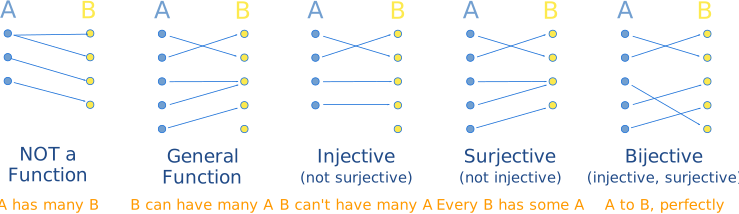 modern peak
silent sinew
i just got into discrete srry
modern peak
silent sinew
i just got into discrete srry
same i started grp theory like a week and a half ago
modern peak
silent sinew
...
ancient helm
it's not the same
silent sinew
its logic
silent sinew
yes its logic
ancient helm
ok
silent sinew
groups in logic
ancient helm
it's just xor
silent sinew
so for set A ={1,0} is {A, ⨁} a abelian group
silent sinew
ancient helm
it's just xor
yes i think so
ancient helm
it is
ancient helm
what have you done so far
silent sinew
give me a sec breh
we need it to be closed
which it is because its always either gonna be 1 or 0
associative
which idk how to prove but maybe if i do truth tables for theta ⨁ phi and then phi ⨁ theta and they equal thats enough proofg
identity i really dont know how to do
inverse i really really dont how to do
ancient helm
i think i would just write out the multiplication table if i were you
ancient helm
yeah truth table
silent sinew
yeh done that
ancient helm
show
calm coralBOT
@silent sinew Has your question been resolved?
silent sinew
srry am back

one sec for phi ⨁ theta trusth table
phi ⨁ theta is same truth table
so it is commutative
composition table is wrong
is diagonal
but anyway
what is the identity element
@ancient helm come back 😢
ancient helm
,rotate
potent lotusBOT
 silent sinew
 ancient helm
please fix the tables on the right but yes
ancient helm
silent sinew
what is the identity element
you tell me
there's only two options, true or false
silent sinew
yeh
identity means that for any element in the group
if it undergoes the operation then it stays the same
oh it’s 0
just by looking at the truth tables
ancient helm
if it undergoes the operation then it stays the same
if it undergoes the operation with the identity then it stays the same
ancient helm
yes identity is 0