#help-42
1 messages · Page 63 of 1
 sterile wharf

 calm coralBOT
Channel closed
Closed by @sterile wharf
Use .reopen if this was a mistake.
calm coralBOT
 Available help channel!
Send your question here to claim the channel.
Remember:
• Ask your math question in a clear, concise manner.
• Show your work, and if possible, explain where you are stuck.
• After 15 minutes, feel free to ping <@&286206848099549185>.
• Type the command .close to free the channel when you're done.
• Be polite and have a nice day!
Read #❓how-to-get-help for further information on how to ask a good question, and about conduct in the question channels.
 jaunty helm
Hey, I've been on this problem for hours and I'm just not coming onto the right answer
The angle of elevation from a point on the ground to the top of a pyramid is 38°20'. The angle of elevation from a point 160 feet farther back to the top of the pyramid is 25°40'. Find the height of the pyramid.
It's in the context of a trig class. There's a visual as well. I was wondering if someone could walk me through it?
calm coralBOT
jaunty helm
Hey, I've been on this problem for hours and I'm just not coming onto the right ...
@jaunty helm Has your question been resolved?
calm coralBOT
@jaunty helm Has your question been resolved?
calm coralBOT
@jaunty helm Has your question been resolved?
calm coralBOT
Channel closed
Closed due to timeout
Use .reopen if this was a mistake.
Available help channel!
Send your question here to claim the channel.
Remember:
• Ask your math question in a clear, concise manner.
• Show your work, and if possible, explain where you are stuck.
• After 15 minutes, feel free to ping <@&286206848099549185>.
• Type the command .close to free the channel when you're done.
• Be polite and have a nice day!
Read #❓how-to-get-help for further information on how to ask a good question, and about conduct in the question channels.
 glad sinew
 calm coralBOT
glad sinew
glad sinew
calm coralBOT
glad sinew
glad sinew
how to do?
 hearty citrus
 honest quiver
Alternatively you could possibly define it using polynomials of the form $[P(x) = (x-r_1)(x-r_2)…(x-r_n)]$
 potent lotusBOT
Hat MSC2020 82B10
 calm coralBOT
@glad sinew Has your question been resolved?
calm coralBOT
@glad sinew Has your question been resolved?
honest quiver
glad sinew
Like is this a more set theoretic question or algebra question? What level of algebraic rigor does it want, or is it more towards set theoretic rigor?
If it’s set theory you could probably just take all polynomials in Pn with coefficients that satisfy the quadratic equation for x=1 and exclude them from Pn
If it’s algebra you could say for instance all polynomials (x-r1)(x-r2)•••(x-rn) such that rn ≠ 0 and all complex roots are present in conjugate pairs
But without context it’s hard to tell what the question is asking
Especially since it appears to be part of a larger problem
calm coralBOT
Channel closed
Closed due to timeout
Use .reopen if this was a mistake.
Available help channel!
Send your question here to claim the channel.
Remember:
• Ask your math question in a clear, concise manner.
• Show your work, and if possible, explain where you are stuck.
• After 15 minutes, feel free to ping <@&286206848099549185>.
• Type the command .close to free the channel when you're done.
• Be polite and have a nice day!
Read #❓how-to-get-help for further information on how to ask a good question, and about conduct in the question channels.
 teal moss
How do I find the domain and co domain in 2(d)?
 calm coralBOT
teal moss
How do I find the domain and co domain in 2(d)?
teal moss
calm coralBOT
teal moss
How do I find the domain and co domain in 2(d)?
teal moss
is it just not the opposite of (c)?
 proper ridge
what ???????
calm coralBOT
@teal moss Has your question been resolved?
teal moss
the domain of (d) is the codomain of (c) and codomain of (c) is domain of (d)?
 brisk pelican
teal moss
the domain of (d) is the codomain of (c) and codomain of (c) is domain of (d)?
brisk pelican
teal moss
the domain of (d) is the codomain of (c) and codomain of (c) is domain of (d)?
Yes
teal moss
but when I tried graphing the inverse function, the domain seems to be different, it is not between 0 and sqrt(3/2)
 calm coralBOT
@teal moss Has your question been resolved?
calm coralBOT
Channel closed
Closed due to timeout
Use .reopen if this was a mistake.
Available help channel!
Send your question here to claim the channel.
Remember:
• Ask your math question in a clear, concise manner.
• Show your work, and if possible, explain where you are stuck.
• After 15 minutes, feel free to ping <@&286206848099549185>.
• Type the command .close to free the channel when you're done.
• Be polite and have a nice day!
Read #❓how-to-get-help for further information on how to ask a good question, and about conduct in the question channels.
 paper prawn
John got these scores in his 4 seatworks. On the first one he got 76% the second he got 80% the third he got 82% and for fourth he got 90%, the seatworks are 20% of his final mark. If he gets 80% on his final exam which weighs 50% what will be his final average?
calm coralBOT
paper prawn
John got these scores in his 4 seatworks. On the first one he got 76% the second...
paper prawn
paper prawn
John got these scores in his 4 seatworks. On the first one he got 76% the second...
Need help with this problem
Solution and answrr
 sick umbra
answer is 5
paper prawn
Oh ok how did u get?
calm coralBOT
sick umbra
answer is 5
As a helper, please do not give out answers that could be copied as a homework solution. Have the student work through the problem themselves and guide them along the way.
sick umbra
huh
paper prawn
uh what
 rough heath
Not sure might be wrong but I think you first find average of the seat works then find it's 1/5th 20% then make the 80% of the final score 1/2(50%) and add them
rough heath
paper prawn
Then add them with the final score
I think yeah but before you add them you need to put them on the correct analogy of the final score given
paper prawn
Alright
rough heath
Also the final exam and the seatworks add up to 70% not 100% of the final average
paper prawn
Ohh
calm coralBOT
@paper prawn Has your question been resolved?
calm coralBOT
Channel closed
Closed due to timeout
Use .reopen if this was a mistake.
calm coralBOT
Available help channel!
Send your question here to claim the channel.
Remember:
• Ask your math question in a clear, concise manner.
• Show your work, and if possible, explain where you are stuck.
• After 15 minutes, feel free to ping <@&286206848099549185>.
• Type the command .close to free the channel when you're done.
• Be polite and have a nice day!
Read #❓how-to-get-help for further information on how to ask a good question, and about conduct in the question channels.
 full abyss
x-2y+k=0 intersects circle x^2+y^2+2x-6y-30=0 at A and B, where AB = sqrt(80), what is k?
calm coralBOT
full abyss
x-2y+k=0 intersects circle x^2+y^2+2x-6y-30=0 at A and B, where AB = sqrt(80), w...
 hardy maple
its more of a geometery question if you ask me
potent lotusBOT
You must be a bot manager to use this command!
hardy maple
full abyss
plus teacher advised us to use algebra
oof
full abyss
i tried
subbing
the straightline equation into circle equation
then we have a quadratic equation in terms of y
hardy maple
it would get hellish 🙂
hardy maple
full abyss
the straightline equation into circle equation
no i mean what have you tried ?
full abyss
but anyways im interested in the geometry method
full abyss
hardy maple
no i mean what have you tried ?
wait ill just send a picture
nvm dont have phone with me
basically since the distance between roots is sqrt(discriminant)/a
i subbed the straight line equation into circle equation
then find sqrt(D)/a
but discriminant is negative
hardy maple
yeh because that distance is in a 2D plane
you are trying to find abs(x2 -x1)
but in 2D plane its sqrt((x2-x1)^2 + (y2-y1)^2)
you could only use that if and only if your line was y= k
or x= k
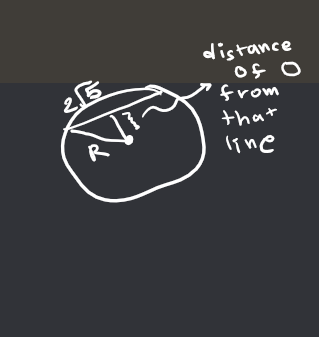
you have R
calm coralBOT
@full abyss Has your question been resolved?
calm coralBOT
Channel closed
Closed by @full abyss
Use .reopen if this was a mistake.
Available help channel!
Send your question here to claim the channel.
Remember:
• Ask your math question in a clear, concise manner.
• Show your work, and if possible, explain where you are stuck.
• After 15 minutes, feel free to ping <@&286206848099549185>.
• Type the command .close to free the channel when you're done.
• Be polite and have a nice day!
Read #❓how-to-get-help for further information on how to ask a good question, and about conduct in the question channels.
 old pagoda
I keep getting negative values when I apply the SA of revolution integral to a function
calm coralBOT
old pagoda
I keep getting negative values when I apply the SA of revolution integral to a f...
old pagoda
This is the function if yall need reference
pi * Integral from 5.94 to 3.336 of ((0.0821515 x^3 + 0.859522x^2 - 2.93095x + 7.55275)* (1+ (-0.2464545 x^2 +1.719044x-2.93095)^2)^1/2 dx
Yeah its a pain in the ass, I solved it using a GDC
But I'm getting a negative value
Am I supposed to just use a modulus sign or is there smthn more to it
calm coralBOT
@old pagoda Has your question been resolved?
calm coralBOT
@old pagoda Has your question been resolved?
calm coralBOT
@old pagoda Has your question been resolved?
calm coralBOT
Channel closed
Closed due to timeout
Use .reopen if this was a mistake.
Available help channel!
Send your question here to claim the channel.
Remember:
• Ask your math question in a clear, concise manner.
• Show your work, and if possible, explain where you are stuck.
• After 15 minutes, feel free to ping <@&286206848099549185>.
• Type the command .close to free the channel when you're done.
• Be polite and have a nice day!
Read #❓how-to-get-help for further information on how to ask a good question, and about conduct in the question channels.
 kind forge
 calm coralBOT
kind forge
kind forge
calm coralBOT
kind forge
kind forge
Need help understanding P{X = n}. The experiment ends after n flips, but I still don't get why we don't include the *p.
I guess that would account for the (t,t,...,t,h)
but the (t,t,...,t,t) would be (1-p)^n
 flat laurel
This is really the geometric distribution
kind forge
Well sheldon ross doesn't do geom distribution until 4.8.1
 upbeat venture
what they did is this:
$(1-p)^n + (1-p)^{n-1}p = (1-p)^{n-1}(1-p+p)$
potent lotusBOT
doaby
 upbeat venture
they really should've shown more steps but they're adding the probability of each of those 2 possible events
kind forge
oh wow, Thanks! So then I must ask, what resources did you use to learn probability?
upbeat venture
I really don't remember lol, I think I started off by watching khan academy since they give an intuition instead of focusing on memorization. Harvard lectures are good too but much more high level
I'm not much on books usually, but also practicing a lot helps
kind forge
Ah, okay. I'll try khan academy too. Yeah I guess practicing on many problems is always gonna be the determining factor.
have a good one.
.close
calm coralBOT
Channel closed
Closed by @kind forge
Use .reopen if this was a mistake.
calm coralBOT
Available help channel!
Send your question here to claim the channel.
Remember:
• Ask your math question in a clear, concise manner.
• Show your work, and if possible, explain where you are stuck.
• After 15 minutes, feel free to ping <@&286206848099549185>.
• Type the command .close to free the channel when you're done.
• Be polite and have a nice day!
Read #❓how-to-get-help for further information on how to ask a good question, and about conduct in the question channels.
glad sinew
I asked about this a while back, but for real matrices A, A is orthogonally diagonalizable iff A is symmetric
calm coralBOT
glad sinew
I asked about this a while back, but for real matrices A, A is orthogonally diag...
 calm coralBOT
@glad sinew Has your question been resolved?
 upper sparrow
glad sinew
but whats the theorem for complex matrices?
upper sparrow
glad sinew
but whats the theorem for complex matrices?
Unitarily diagonalisable iff normal
glad sinew
ok
lololol ok what I’m gonna do is, literally nap for an hour and then come back
I know my sleep schedule is actually a little (not a little) bit cray cray
sooo yea
I’ll stay in the channel tho I intend to get some work done
calm coralBOT
@glad sinew Has your question been resolved?
calm coralBOT
Channel closed
Closed due to timeout
Use .reopen if this was a mistake.
Available help channel!
Send your question here to claim the channel.
Remember:
• Ask your math question in a clear, concise manner.
• Show your work, and if possible, explain where you are stuck.
• After 15 minutes, feel free to ping <@&286206848099549185>.
• Type the command .close to free the channel when you're done.
• Be polite and have a nice day!
Read #❓how-to-get-help for further information on how to ask a good question, and about conduct in the question channels.
 cloud flume
Hi, it may seem like a stupid question but is this correct overall

 remote mural
the objective being?
and no your derivatives are wrong if thats what u are asking
v' is fine, u' is not
remote mural
cloud flume
ok ik that sinx=cosx
sinx is not equal to cosx? 
cloud flume
remote mural
sinx is not equal to cosx? <:thonk:406575732563902485>
Wait
potent lotusBOT
 cloud flume
AH
okay
so
that is actually like multiple ah
Ok i know rn
Makes sense
Thanks and sorry lol
remote mural
no worries lmao
calm coralBOT
Channel closed
Closed by @cloud flume
Use .reopen if this was a mistake.
calm coralBOT
Available help channel!
Send your question here to claim the channel.
Remember:
• Ask your math question in a clear, concise manner.
• Show your work, and if possible, explain where you are stuck.
• After 15 minutes, feel free to ping <@&286206848099549185>.
• Type the command .close to free the channel when you're done.
• Be polite and have a nice day!
Read #❓how-to-get-help for further information on how to ask a good question, and about conduct in the question channels.
 unkempt kite
 calm coralBOT
unkempt kite
calm coralBOT
unkempt kite
 pure zephyr
calm coralBOT
pure zephyr
calm coralBOT
@unkempt kite Has your question been resolved?
calm coralBOT
Channel closed
Closed due to timeout
Use .reopen if this was a mistake.
Available help channel!
Send your question here to claim the channel.
Remember:
• Ask your math question in a clear, concise manner.
• Show your work, and if possible, explain where you are stuck.
• After 15 minutes, feel free to ping <@&286206848099549185>.
• Type the command .close to free the channel when you're done.
• Be polite and have a nice day!
Read #❓how-to-get-help for further information on how to ask a good question, and about conduct in the question channels.
remote mural
 calm coralBOT
remote mural
remote mural
calm coralBOT
remote mural
remote mural
So I know that dy/dt = dx/dt * dy/dx
dy/dx = -4xsin4x + cos4x
The multiply by 3 and sub in x
But I did not get the same answer
 pure kayak
what did you get
remote mural
pure kayak
what did you get
Well I got 3.45 to 2dp
The answer was given in exact value
 pure kayak
remote mural
dy/dx = -4xsin4x + cos4x
pure kayak
remote mural
dy/dx = -4xsin4x + cos4x
sin(5pi/4)=-1/sqrt(2)=cos(5pi/4)
try working with that
remote mural
pure kayak
sin(5pi/4)=-1/sqrt(2)=cos(5pi/4)
I'm not sure what this is for
Is it dy/dx
?
pure kayak
no
im saying its useful for you to evaluate dy/dt
you have -12xsin(4x)+3cos(4x)
and x=5pi/16
pure kayak
i am saying that
remote mural
Yeah I got the same thing
I couldn't get it alll they way down to the answer form but it didn't ask for it in exact form in the question
So I got the equivalent to the answer
Thanks
.close
calm coralBOT
Channel closed
Closed by @frozen pollen
Use .reopen if this was a mistake.
calm coralBOT
Available help channel!
Send your question here to claim the channel.
Remember:
• Ask your math question in a clear, concise manner.
• Show your work, and if possible, explain where you are stuck.
• After 15 minutes, feel free to ping <@&286206848099549185>.
• Type the command .close to free the channel when you're done.
• Be polite and have a nice day!
Read #❓how-to-get-help for further information on how to ask a good question, and about conduct in the question channels.
glad sinew
helloo
calm coralBOT
glad sinew
helloo
glad sinew
Im having some trouble changing from f_x(x,y) to f(x,y)
idk man its confusiing
just this one question my brain is kinda fried cause im integrating, and then differentiating, and then differentiating with respect to some variable
idk man
 sinful pasture
wdym changing
glad sinew

q5

not sure how they got f(x,y)=ye^xy + g(y)
😭idkkk the other examples made sense my brain is just not working for this one??
sinful pasture
the book integrated with respect to x
so just the same way the derivative of derivative of a constant is 0
the derivative of g(y) with respect to x is 0 since g(y) is a constant in terms of x
suppose g(y) = y^2 + siny
what is the partial derivative of g(y) with respect to x ?
glad sinew
e^x
sinful pasture
ok
suppose now you started from fx = e^x
then you know f = e^x + something that didnt depend on x
aka
f = e^x + g(y)
 glad sinew
ok
sinful pasture

check by differentiating both sides by x
h(y) is a constant with respect to x
just like in single variable as c was the constant
sinful pasture
a constant with respect to x could be anything that doesn't depend on x
sinful pasture
 calm coralBOT
Channel closed
Closed by @glad sinew
Use .reopen if this was a mistake.
calm coralBOT
Available help channel!
Send your question here to claim the channel.
Remember:
• Ask your math question in a clear, concise manner.
• Show your work, and if possible, explain where you are stuck.
• After 15 minutes, feel free to ping <@&286206848099549185>.
• Type the command .close to free the channel when you're done.
• Be polite and have a nice day!
Read #❓how-to-get-help for further information on how to ask a good question, and about conduct in the question channels.
 native zealot
Hi, can anyone help me with this question. I have to use multivariable calculus. I tried to use partial derivaties on S, but it didn't work. Any other ideas?
 calm coralBOT
native zealot
Hi, can anyone help me with this question. I have to use multivariable calculus....
calm coralBOT
native zealot
Hi, can anyone help me with this question. I have to use multivariable calculus....
 still marlin
Lagrange multipliers https://math.libretexts.org/Bookshelves/Calculus/Vector_Calculus_(Corral)/02%3A_Functions_of_Several_Variables/2.07%3A_Constrained_Optimization_-_Lagrange_Multipliers

Mathematics LibreTexts
In this section we will use a general method, called the Lagrange multiplier method, for solving constrained optimization problems. Points (x,y) which are maxima or minima of f(x,y) with the …
So basically the function ur tryna maximize is V(l, w, h) = lwh
And the constraint is (lw + wh +hl) = S/2
S is a constant
still marlin
yeah
native zealot
we havent been told about lagrange multipliers though
still marlin
hmm
only other way I can think of is intuition 
mainly that a cube would maximize the volume for a given surface area
Cus symmetry shenanigans
If it were a rectangle u could use single var calc hmmm
Wait
Maybe AM-GM?
native zealot
I don't know what that is
 native zealot
.close
calm coralBOT
Channel closed
Closed by @native zealot
Use .reopen if this was a mistake.
calm coralBOT
Available help channel!
Send your question here to claim the channel.
Remember:
• Ask your math question in a clear, concise manner.
• Show your work, and if possible, explain where you are stuck.
• After 15 minutes, feel free to ping <@&286206848099549185>.
• Type the command .close to free the channel when you're done.
• Be polite and have a nice day!
Read #❓how-to-get-help for further information on how to ask a good question, and about conduct in the question channels.
 hasty creek
Given the information $\sec(\theta)=\frac{-3}{2}$ find the exact value of the five remaining trigonometric functions
calm coralBOT
hasty creek
Given the information $\sec(\theta)=\frac{-3}{2}$ find the exact value of the fi...
potent lotusBOT
guy
 hasty creek
im pretty sure one of them is $cos(\theta)=\frac{-2}{3}$ but im not sure ohw to find the rest
potent lotusBOT
guy
 hasty creek
also its probably importantt to mention pi < theta < 3pi/2
 sly apex
potent lotus
**guy**
sly apex
potent lotus
**guy**
this is true because sec is the reciprocal of cos
use pythagoras to find the value of sintheta
hasty creek
yes thats what i was thinking
but im not quite sure
which quadrant this is in
so idk which number is negative
sly apex
do you know that sin^2(x)+cos^2(x)=1?
hasty creek
yes
sly apex
now find tantheta by pluggin sin/cos
calm coralBOT
Channel closed
Closed by @hasty creek
Use .reopen if this was a mistake.
calm coralBOT
Available help channel!
Send your question here to claim the channel.
Remember:
• Ask your math question in a clear, concise manner.
• Show your work, and if possible, explain where you are stuck.
• After 15 minutes, feel free to ping <@&286206848099549185>.
• Type the command .close to free the channel when you're done.
• Be polite and have a nice day!
Read #❓how-to-get-help for further information on how to ask a good question, and about conduct in the question channels.
 brave snow
 calm coralBOT
brave snow
calm coralBOT
calm coralBOT
brave snow
calm coralBOT
@brave snow Has your question been resolved?
calm coralBOT
Channel closed
Closed due to timeout
Use .reopen if this was a mistake.
calm coralBOT
Available help channel!
Send your question here to claim the channel.
Remember:
• Ask your math question in a clear, concise manner.
• Show your work, and if possible, explain where you are stuck.
• After 15 minutes, feel free to ping <@&286206848099549185>.
• Type the command .close to free the channel when you're done.
• Be polite and have a nice day!
Read #❓how-to-get-help for further information on how to ask a good question, and about conduct in the question channels.
 subtle kayak
hi
calm coralBOT
subtle kayak
hi
potent lotusBOT
sin
 subtle kayak
Finally
What can I substitute for u here?
I tried u = 9-x² but im still ending up with
Dx = du/-2x
 pearl dune
It's a trigonometric substitution
pearl dune
Your integral is of the form $\sqrt{a^2-x^2}$
potent lotusBOT
TayBee
 pearl dune
So you can make the substution $x=a \sin(\theta)$
potent lotusBOT
TayBee
 pearl dune
Same steps as standard integration by substitution, what do you get if you differentiate x=asin(theta)?
You should end up with $dx = 3\cos(\theta)d\theta$
potent lotusBOT
TayBee
 pearl dune
Substitute in and the rest is trig identities, so see how far you can get
pearl dune
Bit harsh of them to give you that integral if you haven't done trig substitutions yet lol

More simplistically, if the coefficeint of x^2 is 1:
 pearl dune
Well first time for everything XD Once you've made that subtitution in your question, your first target after some simplifying is to end up with:
subtle kayak
mhm
subtle kayak
pearl dune
Same steps as standard integration by substitution, what do you get if you diffe...
a sin theota would js be
a cos theta?
wait
would u use product rule
pearl dune
$\int 9\cos^2(\theta)d\theta$
subtle kayak
no u wouldn't
potent lotusBOT
TayBee
 pearl dune
That's what you should aim for
pearl dune
(I've removed the limits as one problem at a time lol
So after you've substituted x=asin(theta) and substituted for dx, you have $\int \sqrt{9-[3\sin(\theta)]^2}\cdot 3\cos(\theta)d\theta$
potent lotusBOT
TayBee
 pearl dune
Do a little expanding and that's $\int \sqrt{9-9\sin^2(\theta)} \cdot 3\cos(\theta)d\theta$
potent lotusBOT
TayBee
 pearl dune
Now you can use your understanding of trig to simplify that square root
subtle kayak
Ohhh
pearl dune
potent lotus
**TayBee**
and a couple of lines later you should end up at this
pearl dune
Let me know once you've got that far (or if you've got completely stuck) then we'll see what to do next haha
How goes it?
calm coralBOT
@subtle kayak Has your question been resolved?
calm coralBOT
Channel closed
Closed by @subtle kayak
Use .reopen if this was a mistake.
Available help channel!
Send your question here to claim the channel.
Remember:
• Ask your math question in a clear, concise manner.
• Show your work, and if possible, explain where you are stuck.
• After 15 minutes, feel free to ping <@&286206848099549185>.
• Type the command .close to free the channel when you're done.
• Be polite and have a nice day!
Read #❓how-to-get-help for further information on how to ask a good question, and about conduct in the question channels.
 leaden sandal
 calm coralBOT
leaden sandal
leaden sandal
calm coralBOT
leaden sandal
leaden sandal
Hi, can anyone help me with this one? The answer should be 0.085
 glacial nacelle
how did you get 0.064
calm coralBOT
@leaden sandal Has your question been resolved?
 amber bolt
what they mean is
70% of the phones are never submitted for repair, maybe they work forever or something
12% of the phones are replaced
18% are repaired
nothing happens with probability 0.4
leaden sandal
Wait, where did 12% and 18% come from?
amber bolt
that's what happens when you separate 30 into 4:6
 earnest sparrow
leaden sandal
earnest sparrow
leaden sandal
Answer is 0.085
amber bolt
you did it right otherwise, on your second attempt
 amber bolt
yes
leaden sandal
How^*
amber bolt
you just use the probability of the phone beng replaced
instead of 0.4 which corresponds to nothing
calm coralBOT
Channel closed
Closed due to timeout
Use .reopen if this was a mistake.
amber bolt
.reopen
calm coralBOT
✅
amber bolt
i don't know how to explain it
"that's what happens when you separate 30 into 4:6"
this isn't magic, you don't have to derive anything, it's common sense and multiplying numbers
leaden sandal
The only reason I can think of on that is p(returned&replaced) = 0.3*0.4 = 0.12
amber bolt
if 7/90 of the cars in a town are white and 1/4 of white cars are trucks, then 7/360 of the cars are white trucks
we don't have a name for this
they teach it around 5th grade and they tell us to multiply the fractions and it's not called anything
calm coralBOT
@leaden sandal Has your question been resolved?
calm coralBOT
Channel closed
Closed due to timeout
Use .reopen if this was a mistake.
calm coralBOT
Available help channel!
Send your question here to claim the channel.
Remember:
• Ask your math question in a clear, concise manner.
• Show your work, and if possible, explain where you are stuck.
• After 15 minutes, feel free to ping <@&286206848099549185>.
• Type the command .close to free the channel when you're done.
• Be polite and have a nice day!
Read #❓how-to-get-help for further information on how to ask a good question, and about conduct in the question channels.
 solar bolt
 calm coralBOT
solar bolt
calm coralBOT
solar bolt
 calm coralBOT
Channel closed
Closed by @solar bolt
Use .reopen if this was a mistake.
calm coralBOT
Available help channel!
Send your question here to claim the channel.
Remember:
• Ask your math question in a clear, concise manner.
• Show your work, and if possible, explain where you are stuck.
• After 15 minutes, feel free to ping <@&286206848099549185>.
• Type the command .close to free the channel when you're done.
• Be polite and have a nice day!
Read #❓how-to-get-help for further information on how to ask a good question, and about conduct in the question channels.
 stark turret
Hi guys can someone tell me where it went wrong

 timid oracle
the ratio of the sides is not exactly the ratio of the volumes
stark turret
How can I find the ratio to the volumes tho
timid oracle
try a simpler case: imagine a cube with side length s and a cube with side length s/2, what's the ratio of these volumes?
and the ratio would be the same for those pyramids, or any 3D shape
stark turret
1/8 ?
timid oracle
Yep
calm coralBOT
Channel closed
Closed by @stark turret
Use .reopen if this was a mistake.
calm coralBOT
Available help channel!
Send your question here to claim the channel.
Remember:
• Ask your math question in a clear, concise manner.
• Show your work, and if possible, explain where you are stuck.
• After 15 minutes, feel free to ping <@&286206848099549185>.
• Type the command .close to free the channel when you're done.
• Be polite and have a nice day!
Read #❓how-to-get-help for further information on how to ask a good question, and about conduct in the question channels.
 rigid crystal
hello
calm coralBOT
rigid crystal
hello
rigid crystal

consider this example
what is the convention for ordering this polynomial
for example both -4ab and +6ac have the same degree, so how do I order them? and how do I order this entire polynomial
calm coralBOT
@rigid crystal Has your question been resolved?
calm coralBOT
Channel closed
Closed due to timeout
Use .reopen if this was a mistake.
calm coralBOT
Available help channel!
Send your question here to claim the channel.
Remember:
• Ask your math question in a clear, concise manner.
• Show your work, and if possible, explain where you are stuck.
• After 15 minutes, feel free to ping <@&286206848099549185>.
• Type the command .close to free the channel when you're done.
• Be polite and have a nice day!
Read #❓how-to-get-help for further information on how to ask a good question, and about conduct in the question channels.
 desert falcon
find the remainder when 1⁰+ 2¹+3²+4³+...+1001¹⁰⁰⁰ is divided by 3
timid oracle
I would suggest splitting it into (1+4^3+7^6+…)+(2^1+5^4+8^7+…)+(3^2+6^5+9^8+…) before taking mod 3
desert falcon
Can you like guess the answer?
 modern peak
wait so basically this is what you have
 pallid halo
if the terms repeat as 1,2,0,1,2,0,1,2,0,...
then the partial sums will be 1,0,0,1,0,0,1,0,0,...
so work out where you are in that partial sum sequence
modern peak
$$(\sum_{n = 1}^{1001} n^{n-1}) \text{mod 3}$$
potent lotusBOT
ren
 modern peak
yes?
calm coralBOT
@desert falcon Has your question been resolved?
 winged basin
desert falcon
I see that they repeat after 1,2,0
winged basin
desert falcon
I see that they repeat after 1,2,0
The 0's and 1's can be added easily
However, the numbers which leave remainders of the form 2^k
The remainders of this form will be in a gp
calm coralBOT
Channel closed
Closed due to timeout
Use .reopen if this was a mistake.
Available help channel!
Send your question here to claim the channel.
Remember:
• Ask your math question in a clear, concise manner.
• Show your work, and if possible, explain where you are stuck.
• After 15 minutes, feel free to ping <@&286206848099549185>.
• Type the command .close to free the channel when you're done.
• Be polite and have a nice day!
Read #❓how-to-get-help for further information on how to ask a good question, and about conduct in the question channels.
calm coralBOT
calm coralBOT
@stone steeple Has your question been resolved?
calm coralBOT
Channel closed
Channel closed due to the original message being deleted.
If you did not intend to do this, please open a new help channel,
as this action is irreversible, and this channel may abruptly lock.
Available help channel!
Send your question here to claim the channel.
Remember:
• Ask your math question in a clear, concise manner.
• Show your work, and if possible, explain where you are stuck.
• After 15 minutes, feel free to ping <@&286206848099549185>.
• Type the command .close to free the channel when you're done.
• Be polite and have a nice day!
Read #❓how-to-get-help for further information on how to ask a good question, and about conduct in the question channels.
 rocky flower
Say you have that a_1b_1+a_2b_2=n where a_i and b_i are integers between 0 and 9. (How many/What are the) subsets of (a_1,a_2) exist such that we can choose certain b_i that produce all possible n within the bound of 0 and 9(a_1+a_2)? I was wondering about this, and sorry if this lacks mathematical clarity. I am never great at expressing myself
calm coralBOT
rocky flower
Say you have that a_1b_1+a_2b_2=n where a_i and b_i are integers between 0 and 9...
rocky flower
0<=n<=9(a_1+a_2)
so we pick certain b_i that can produce all the values of n within this range given the a_i we select
 graceful dust
the b_i’s are confusing me still
let me write a possible interpretation of the problem and you tell me if it’s right
rocky flower
sure
graceful dust
fix a positive integer n. how many pairs (a_1,a_2) of integers are there with the following properties:
- 0 <= a_1, a_2 <= 9
- 0<=n<=9(a_1+a_2)
- there exist integers b_1, b_2 with 0 <= b_1, b_2 <= 9 and a_1b_1 + a_2b_2 = n
rocky flower
for example (2,1) works
graceful dust
produce all values of n?
i thought we were fixing n and counting the pairs (a_1,a_2)
rocky flower
graceful dust
i thought we were fixing n and counting the pairs (a_1,a_2)
sorry, what do u mean by this
i want to find all (a_1,a_2) pairs such that there exist b_i's which are integers between 0-9 that produce all values of n between 0 and 9(a_1+a_2)
so i want to fix (a_1, a_2) and see if it produces all values of n within the range by selecting b_i each time
graceful dust
oh ok i might get it now
graceful dust
graceful dust
fix a positive integer n. how many pairs (a_1,a_2) of integers are there with th...
that’s different than this
rocky flower
oh ok
graceful dust
let me try again
rocky flower
sorry .-.
graceful dust
lol dw
rocky flower
graceful dust
let me try again
yep, sure
graceful dust
which pairs of integers (a_1,a_2) with 0 <= a_1, a_2 <= 9 have the following property?
for all integers n with 0<=n<=9(a_1+a_2), there exist integers b_1, b_2 with 0 <= b_1, b_2 <= 9 and a_1b_1 + a_2b_2 = n
rocky flower
graceful dust
which pairs of integers (a_1,a_2) with 0 <= a_1, a_2 <= 9 have the following pro...
yes, thats it
graceful dust

rocky flower
thank you
graceful dust
ok so for the problem…
if a_1 and a_2 are both even and greater than 0, they don’t have the property
see why?
graceful dust
yep
(0,1) and (1,0) have the property but if one of them is 0 and the other is greater than 1 then they don’t right?
(0,0) has it
rocky flower
graceful dust
(0,1) and (1,0) have the property but if one of them is 0 and the other is great...
yes
graceful dust
ok anything with 0 taken care of
graceful dust
graceful dust
if a_1 and a_2 are both even and greater than 0, they don’t have the property
this also taken care of
still lots left
rocky flower
yeah
graceful dust
well actually if a_1 and a_2 aren’t small it shouldn’t be possible to get small n’s right?
rocky flower
i was thinking that if a_1 divides a_2 or the other way round, it wouldnt work as well, right?
rocky flower
graceful dust
well actually if a_1 and a_2 aren’t small it shouldn’t be possible to get small ...
yes, i think so
graceful dust
yea if they are both 2 or greater you can’t get n = 1
graceful dust
graceful dust
if a_1 and a_2 are both even and greater than 0, they don’t have the property
ok that’s much stronger than this lol
rocky flower
graceful dust
yea if they are both 2 or greater you can’t get n = 1
yes, thats true
graceful dust
that covers a lot then
what’s left?
one of a_1,a_2 are 1 and the other is at least 1?
i think we got everything else
rocky flower
yes, i think so
rocky flower
hmmm, could we check
graceful dust
kinda like that other problem
rocky flower
yeah
graceful dust
say a_1 = 1 and a_2 is whatever. we can get 0, a_2, 2*a_2, 3*a_2, …, 9*a_2 by setting b_1 = 0 and ranging b_2 over 0 through 9
and we can fill in the gaps with 1*b_1
rocky flower
yes this should make sense
graceful dust
so i think my answer is:
(a_1,a_2) has the property if and only if [[a_1 = 1 or a_2 = 1] or [a_1 = a_2 = 0]]
rocky flower
yes, that should be the answer i think too
i also have a similar question
which pairs of integers (a_1,a_2,a_3) with 0 <= a_1, a_2,a_3 <= 9 have the following property?
for all integers n with 0<=n<=9(a_1+a_2+a_3), there exist integers b_1, b_2 with 0 <= b_1, b_2, b_3 <= 9 and a_1b_1 + a_2b_2 +a_3b_3 = n
graceful dust

rocky flower
omg, so sorry .-.
graceful dust
lol
so if i’m understanding you’ve been wanting to generalize your problem from earlier this whole time 
rocky flower
graceful dust
so if i’m understanding you’ve been wanting to generalize your problem from earl...
yeah, that was what i was trying to get at lol
graceful dust
having a 1 might be the key thing no matter how many terms
rocky flower
i thought that by doing smaller cases, it would be easy to generalise through intuition
graceful dust
yea that’s good
rocky flower
graceful dust
having a 1 might be the key thing no matter how many terms
yes, that was what i was thinking
graceful dust
you need a 1 to get the = n condition when n = 1
and if you have a 1, you can “fill in the gaps”
graceful dust
graceful dust
so i think my answer is:
(a_1,a_2) has the property if and only if [[a_1 = 1 or ...
that was the key to why this is an if and only if here
and i thiiiiiink it generalizes
rocky flower
graceful dust
you need a 1 to get the = n condition when n = 1
i see how
rocky flower
graceful dust
and if you have a 1, you can “fill in the gaps”
i was wondering if we could always fill in the gaps
rocky flower
graceful dust
and i thiiiiiink it generalizes
i could see how it would generalise
graceful dust
should be able to, you can build up to 9(a_2 + a_3 + … + a_k) by increasing the b_i’s one by one and and the gaps will be no bigger than 9
with a_1 = 1 ig i should say
rocky flower
hmmm, thats interesting
now finally could we count the number of pairs that do exist
graceful dust
so if there are k terms, we want the number of k-tuples (a_1, a_2, …, a_k) that have at least one 1
rocky flower
graceful dust
so if there are k terms, we want the number of k-tuples (a_1, a_2, …, a_k) that ...
yes, and do we include the (0,0) case
graceful dust
plus an extra one for all 0s case
rocky flower
ok
graceful dust
graceful dust
so if there are k terms, we want the number of k-tuples (a_1, a_2, …, a_k) that ...
we could also just count with no 0s though
0s basically just make it so that there are fewer terms
might be best to assume all coordinates are nonzero
so that we actually have k terms
yea i think it’s better this way and doesn’t change any results found earlier
rocky flower
ok
graceful dust
b_i’s can be 0 but make the a_i’s nonzero
graceful dust
graceful dust
so if there are k terms, we want the number of k-tuples (a_1, a_2, …, a_k) that ...
so there are 9^k possible tuples
first coordinate has 9 options (1 through 9), second has 9 etc
rocky flower
yes
rocky flower
wait, is it fine if you could list all the tuples that work for k=2
im still a bit confused
rocky flower
how about (0,0)?
rocky flower
yeah
graceful dust
and (0,1) is like having only 1 term
rocky flower
hmmm true
rocky flower
so for k=2 it would be 20 possible tuples i think
graceful dust
graceful dust
so 9^k - 8^k that have at least one 1
so this should be 10^k - 9^k + 1 now i think
the + 1 being the all 0 tuple
agrees with our answer for k = 2
rocky flower
wait, could u list the number of tuples for k=3
graceful dust
,calc 10^3 - 9^3 + 1
potent lotusBOT
Result:
272

graceful dust
what condition?
rocky flower
was it that all a_i=0 or one of a_i=1 and the others could be anything
graceful dust
a tuple has the property iff at least one coordinate is 1, or they are all 0
so yes
rocky flower
oh my bad, sorry .-.
graceful dust
they get hard to list nicely because you can have various amounts of 1s
rocky flower
yeah, i should have known
graceful dust
for k = 3 they take the forms
0 0 0
1 _ _
_ 1 _
_ _ 1
1 1 _
_ 1 1
1 _ 1
1 1 1
with the empty slots being not 1
darn
rocky flower
for k=3, i was thinking of (0,0,0), then the number of (1,blank,blank) tuples which in total is 3*100+1 minus the number of repeats
graceful dust
graceful dust
for k = 3 they take the forms
0 0 0
1 \_ \_
\_ 1 \_
\_ \_ 1
1 1 \_
\_ 1 1
1 \_ ...
this is about as nicely as i can list them
rocky flower
graceful dust
this is about as nicely as i can list them
yes, thank you so much. i very much appreciate your help and the time u have taken to help me
rocky flower
yes, im amazed by it too
rocky flower
graceful dust
for k = 3 they take the forms
0 0 0
1 \_ \_
\_ 1 \_
\_ \_ 1
1 1 \_
\_ 1 1
1 \_ ...
so here the number would be 1+81+81+81+9+9+9+1=243+27+2=272
graceful dust
yep!
graceful dust
potent lotus
Result:
```
272
```
same as what my formula proposed
rocky flower
oh ok i think i get it now
rocky flower
graceful dust
same as what my formula proposed
yes, very much so
your formula should be correct
graceful dust
graceful dust
for k = 3 they take the forms
0 0 0
1 \_ \_
\_ 1 \_
\_ \_ 1
1 1 \_
\_ 1 1
1 \_ ...
and if you want to describe them explicitly rather than just give the number this is a good way to do so
just gets a little messy with all the ways to have 1s with larger k
rocky flower
graceful dust
just gets a little messy with all the ways to have 1s with larger k
yes, i see
thank you so much for your help!
graceful dust

rocky flower
.close
calm coralBOT
Channel closed
Closed by @rocky flower
Use .reopen if this was a mistake.
calm coralBOT
Available help channel!
Send your question here to claim the channel.
Remember:
• Ask your math question in a clear, concise manner.
• Show your work, and if possible, explain where you are stuck.
• After 15 minutes, feel free to ping <@&286206848099549185>.
• Type the command .close to free the channel when you're done.
• Be polite and have a nice day!
Read #❓how-to-get-help for further information on how to ask a good question, and about conduct in the question channels.
 wary sun
how do i do this
 calm coralBOT
wary sun
how do i do this
calm coralBOT
wary sun
how do i do this
 tiny monolith
1,2,3,3
1,1,2,3
 jagged latch
what have you tried
calm coralBOT
As a helper, please do not give out answers that could be copied as a homework solution. Have the student work through the problem themselves and guide them along the way.
tiny monolith
that should be the main columns
tiny monolith
calm coral
As a helper, please do not give out answers that could be copied as a homework s...
that is not a solution
wary sun
jagged latch
what have you tried
i tried putting the numbers on 1 side n amount if times on the other
then put them in
and idk how that is helping
jagged latch
ig we could do it using basic combinatorics
tiny monolith
tiny monolith
1,2,3,3
1,1,2,3
try using this, put it in the form of a multiplication table. but add the entries
wary sun
tiny monolith
1,2,3,3
1,1,2,3
Like this?
 tiny monolith
one would be horizontal and the other vertical
 tiny monolith
move the column to the left
wary sun
ohk
tiny monolith
you should have a 4 by 4 table to put in stuff
tiny monolith
no, add them
wary sun
ohk
jagged latch
basically try adding each of the numbers from the corressponding columns
 wary sun
alrr
tiny monolith
you want to see what proportion of those are 4 or more
wary sun
oooo
jagged latch
since 16 is the total number of sums
wary sun
thanks bros
jagged latch
and 11 is the total number of sums more than 3
wary sun
yeah
tiny monolith
wary sun
thanks bros
and me too!!
jagged latch
!done
calm coralBOT
If you are done with this channel, please mark your problem as solved by typing .close
tiny monolith

calm coralBOT
@wary sun Has your question been resolved?
Channel closed
Closed by @wary sun
Use .reopen if this was a mistake.
Available help channel!
Send your question here to claim the channel.
Remember:
• Ask your math question in a clear, concise manner.
• Show your work, and if possible, explain where you are stuck.
• After 15 minutes, feel free to ping <@&286206848099549185>.
• Type the command .close to free the channel when you're done.
• Be polite and have a nice day!
Read #❓how-to-get-help for further information on how to ask a good question, and about conduct in the question channels.
 brittle crow
how do i find the domain and range of a circle
calm coralBOT
brittle crow
how do i find the domain and range of a circle
brittle crow

 empty quail
do you see that 9 is a perfect square root
hint: the domain and range for any circle is always becomes the same
in x^2+y^2=9, as x^2 and y^2 both are positive and hence cannot take values beyond 9
so what do you think the domain and range will be for this function
empty quail
correct
calm coralBOT
@brittle crow Has your question been resolved?
Channel closed
Closed by @brittle crow
Use .reopen if this was a mistake.
Available help channel!
Send your question here to claim the channel.
Remember:
• Ask your math question in a clear, concise manner.
• Show your work, and if possible, explain where you are stuck.
• After 15 minutes, feel free to ping <@&286206848099549185>.
• Type the command .close to free the channel when you're done.
• Be polite and have a nice day!
Read #❓how-to-get-help for further information on how to ask a good question, and about conduct in the question channels.
brittle crow
 calm coralBOT
brittle crow
brittle crow
calm coralBOT
brittle crow
brittle crow
how do i solve this
wait no sorry
how do i find the domain and range
ive tried already and got it wrong (i got solution)
my answer was
domain: $(-\infty, 0]$
potent lotusBOT
pixel
 brittle crow
range: $[2, \infty)$
potent lotusBOT
pixel


 raw dirge
try using derivatives to find range
raw dirge
 fleet raptor
Domain should be x less than or equal to 2
fleet raptor
Domain should be x less than or equal to 2
!noans
calm coralBOT
fleet raptor
Domain should be x less than or equal to 2
The purpose of this server is to help you learn, not to hand out answers. Do not ask someone to give you the answer directly.
fleet raptor
Domain is all the values x can take on: ask yourself what x values result in a math error? what x values work
Range is all the values y can take on
The square root sign is important here, what restrictions does that cause?
raw dirge
yes
calm coralBOT
@brittle crow Has your question been resolved?
Channel closed
Closed by @brittle crow
Use .reopen if this was a mistake.
Available help channel!
Send your question here to claim the channel.
Remember:
• Ask your math question in a clear, concise manner.
• Show your work, and if possible, explain where you are stuck.
• After 15 minutes, feel free to ping <@&286206848099549185>.
• Type the command .close to free the channel when you're done.
• Be polite and have a nice day!
Read #❓how-to-get-help for further information on how to ask a good question, and about conduct in the question channels.
 autumn pollen
Hello
calm coralBOT
autumn pollen
Hello
autumn pollen
I am confused as too why you can use the upper bound when proving that a function is an little of another function

this is what i am in particular talking about
here they are showing that the limit of the upper bound approaches 0
and that somehow shows that the original must also be 0
?
i tried showing that this works with the epsilon definition of the little o definition
but so far, it doesn't make much sense
any help would be great
calm coralBOT
@autumn pollen Has your question been resolved?
calm coralBOT
Channel closed
Closed due to timeout
Use .reopen if this was a mistake.
Available help channel!
Send your question here to claim the channel.
Remember:
• Ask your math question in a clear, concise manner.
• Show your work, and if possible, explain where you are stuck.
• After 15 minutes, feel free to ping <@&286206848099549185>.
• Type the command .close to free the channel when you're done.
• Be polite and have a nice day!
Read #❓how-to-get-help for further information on how to ask a good question, and about conduct in the question channels.
 void frost
calm coralBOT
void frost
https://discord.com/channels/268882317391429632/1195800467880558672/121890185964...
void frost
void frost
calm coralBOT
void frost
https://discord.com/channels/268882317391429632/1195800467880558672/121890185964...
void frost
.close
calm coralBOT
Channel closed
Closed by @void frost
Use .reopen if this was a mistake.
Available help channel!
Send your question here to claim the channel.
Remember:
• Ask your math question in a clear, concise manner.
• Show your work, and if possible, explain where you are stuck.
• After 15 minutes, feel free to ping <@&286206848099549185>.
• Type the command .close to free the channel when you're done.
• Be polite and have a nice day!
Read #❓how-to-get-help for further information on how to ask a good question, and about conduct in the question channels.
 zealous slate
idk
 calm coralBOT
zealous slate
idk
calm coralBOT
calm coralBOT
zealous slate
idk
calm coralBOT
Channel closed
Closed by @zealous slate
Use .reopen if this was a mistake.
calm coralBOT
Available help channel!
Send your question here to claim the channel.
Remember:
• Ask your math question in a clear, concise manner.
• Show your work, and if possible, explain where you are stuck.
• After 15 minutes, feel free to ping <@&286206848099549185>.
• Type the command .close to free the channel when you're done.
• Be polite and have a nice day!
Read #❓how-to-get-help for further information on how to ask a good question, and about conduct in the question channels.
native zealot
$$ Why is w_1= (2 1), I get why mu = 1/5, but when i input it in the equation, it doesn't give me these scalars $
 calm coralBOT
native zealot
$$ Why is w_1= (2 1), I get why mu = 1/5, but when i input it in the equation, i...
calm coralBOT
native zealot
$$ Why is w_1= (2 1), I get why mu = 1/5, but when i input it in the equation, i...
@native zealot Has your question been resolved?
calm coralBOT
Channel closed
Closed due to timeout
Use .reopen if this was a mistake.
Available help channel!
Send your question here to claim the channel.
Remember:
• Ask your math question in a clear, concise manner.
• Show your work, and if possible, explain where you are stuck.
• After 15 minutes, feel free to ping <@&286206848099549185>.
• Type the command .close to free the channel when you're done.
• Be polite and have a nice day!
Read #❓how-to-get-help for further information on how to ask a good question, and about conduct in the question channels.
potent lotusBOT
snow
Compile Error! Click the  reaction for more information.
(You may edit your message to recompile.)
 calm coralBOT
@remote mural Has your question been resolved?
calm coralBOT
Channel closed
Closed due to timeout
Use .reopen if this was a mistake.
Available help channel!
Send your question here to claim the channel.
Remember:
• Ask your math question in a clear, concise manner.
• Show your work, and if possible, explain where you are stuck.
• After 15 minutes, feel free to ping <@&286206848099549185>.
• Type the command .close to free the channel when you're done.
• Be polite and have a nice day!
Read #❓how-to-get-help for further information on how to ask a good question, and about conduct in the question channels.
 regal rain
"A series $\sum_{}^{} a_n$ converges if its sequence ${a_n}$ converges. "
Why is this the case? Taking $a_n = 2 - (1/n^2)$ as example, doesn't this sequence converge because its terms approach 2 as n approaches infinity? But the series are definitely divergent right?
calm coralBOT
regal rain
"A series $\sum_{}^{} a_n$ converges if its sequence ${a_n}$ converges. "
Why i...
potent lotusBOT
seinng

 marsh agate
it's moreso
series converges only if sequence converges to 0
regal rain
marsh agate
it's moreso
series converges only if sequence converges to 0
ohh, so it's if and only if the sequence converges to 0, not any other number?
marsh agate
not iff
 dull wagon
if the sequence doesn't converge to 0, the series doesn't converge
regal rain
oh oops, not the other way around
marsh agate
for convergence of the series, the sequence must go to 0
But it is not a sufficient condition
calm coralBOT
Channel closed
Closed by @regal rain
Use .reopen if this was a mistake.
Available help channel!
Send your question here to claim the channel.
Remember:
• Ask your math question in a clear, concise manner.
• Show your work, and if possible, explain where you are stuck.
• After 15 minutes, feel free to ping <@&286206848099549185>.
• Type the command .close to free the channel when you're done.
• Be polite and have a nice day!
Read #❓how-to-get-help for further information on how to ask a good question, and about conduct in the question channels.
 celest flower
 calm coralBOT
celest flower
calm coralBOT
celest flower
 calm coralBOT
@celest flower Has your question been resolved?
calm coralBOT
@celest flower Has your question been resolved?
calm coralBOT
@celest flower Has your question been resolved?
calm coralBOT
@celest flower Has your question been resolved?
 potent smelt
@celest flower your image is different from the question. I'm going to answer the question rather than the image.
Also there does not seem to actually be a sought value.
Please clarify
potent smelt
Yes
And we have two angles, so we can make two right triangles
But if we want to know, for instance, how high up the balcony is, we would need to also know how far away Romeo is from the wall
celest flower
yes alpha is 33,7degree and beta is 46,8 degree
potent smelt
Well, hmmm
So actually thinking about it you might be able to figure it out
So your first triangle is the 33.7 degree one.
celest flower
potent smelt
But if we want to know, for instance, how high up the balcony is, we would need ...
and we dont know how far away he is we just know this two angles, his height, and that the like balcony thing is 1.2m high
potent smelt
Let the base of the triangle be b
This base is shared between both triangles
Let the height of the shorter triangle be h.
This means the height of the higher triangle is h + 1.2
celest flower
yes
potent smelt
So we have
tan 33.7 = h/b
tan 46.8 = (h+1.2)/b
celest flower
yes
potent smelt
You can solve these two equations simultaneously for h and b
And your answer is h + 1.75, the height of the bottom of the balcony, plus the offset from Romeo's eyes
celest flower
you mean equaation system
potent smelt
Yes
celest flower
ok i'll try it brb
$tan(33,7) = h/b \ b = \frac{h}{tan(33,7)} \ tan(46,8) = \frac{h + 1,2}{\frac{h}{tan(33,79)}}$
like this?
potent lotusBOT
Kraut
 celest flower
@potent smelt
potent smelt
Ok, you should be able to solve that for h.
celest flower
potent smelt
Ok, you should be able to solve that for h.
$tan(46,8) = \frac{(h + 1,2) \cdot tan(33,79}{h} \ 1,06h = 0,669h + 0.803 \ 0,395h = 0,803 \2,02 = h$
potent lotusBOT
Kraut
 celest flower
but sadly this is false
oh wait
the man
i come to 3,78m the solution book says 3,760m
celest flower
potent lotus
**Kraut**
@potent smelt is this correct
potent smelt
This is close enough, the errors are in the second decimal place and likely due to rounding
celest flower
alr thanks buddy
calm coralBOT
@celest flower Has your question been resolved?
calm coralBOT
Channel closed
Closed due to timeout
Use .reopen if this was a mistake.
Available help channel!
Send your question here to claim the channel.
Remember:
• Ask your math question in a clear, concise manner.
• Show your work, and if possible, explain where you are stuck.
• After 15 minutes, feel free to ping <@&286206848099549185>.
• Type the command .close to free the channel when you're done.
• Be polite and have a nice day!
Read #❓how-to-get-help for further information on how to ask a good question, and about conduct in the question channels.
 languid vine
 calm coralBOT
languid vine
calm coralBOT
calm coralBOT
languid vine
calm coralBOT
@languid vine Has your question been resolved?
calm coralBOT
@languid vine Has your question been resolved?
calm coralBOT
@languid vine Has your question been resolved?
calm coralBOT
Channel closed
Closed due to timeout
Use .reopen if this was a mistake.
Available help channel!
Send your question here to claim the channel.
Remember:
• Ask your math question in a clear, concise manner.
• Show your work, and if possible, explain where you are stuck.
• After 15 minutes, feel free to ping <@&286206848099549185>.
• Type the command .close to free the channel when you're done.
• Be polite and have a nice day!
Read #❓how-to-get-help for further information on how to ask a good question, and about conduct in the question channels.
 safe moss
Can someone please explain me descartes' Rules of Signs and Upper and Lower bounds theorem
calm coralBOT
safe moss
Can someone please explain me descartes' Rules of Signs and Upper and Lower boun...
safe moss
I dont understand anything from these theorems theyre so complicated
like a simple explanation and an error works fine
Explanations of the book


ik this is like the 3rd time im aaking someone to describe some theorems but i just cant do them and i need to do them im sorry
 wide jewel
safe moss
wide jewel
safe moss
Variations in signs, which means if the sign is different than the previous one
The number of variations is equals to the number of positive zeroes
And for negative zeroes its same but with p(-x)
calm coralBOT
@safe moss Has your question been resolved?
calm coralBOT
Channel closed
Closed due to timeout
Use .reopen if this was a mistake.
Available help channel!
Send your question here to claim the channel.
Remember:
• Ask your math question in a clear, concise manner.
• Show your work, and if possible, explain where you are stuck.
• After 15 minutes, feel free to ping <@&286206848099549185>.
• Type the command .close to free the channel when you're done.
• Be polite and have a nice day!
Read #❓how-to-get-help for further information on how to ask a good question, and about conduct in the question channels.
 tall kindle
is this answer wrong
 calm coralBOT
tall kindle
is this answer wrong
tall kindle
calm coralBOT
tall kindle
is this answer wrong
tall kindle
I got the same exact answer except that the exponent is 2 in denomentrator
 patent tundra
!show
calm coralBOT
Show your work, and if possible, explain where you are stuck.
@tall kindle Has your question been resolved?
 quaint sphinx
tall kindle
is this answer wrong
quaint sphinx
tall kindle
is this answer wrong
it's wrong yes
quaint sphinx
patent tundra
!show
they were asking to check ans key and they were right
patent tundra
yes but it can be useful to see their work to do that
calm coralBOT
Channel closed
Closed due to timeout
Use .reopen if this was a mistake.
calm coralBOT
Available help channel!
Send your question here to claim the channel.
Remember:
• Ask your math question in a clear, concise manner.
• Show your work, and if possible, explain where you are stuck.
• After 15 minutes, feel free to ping <@&286206848099549185>.
• Type the command .close to free the channel when you're done.
• Be polite and have a nice day!
Read #❓how-to-get-help for further information on how to ask a good question, and about conduct in the question channels.
 sonic raft
Guys, i need help to understand this math topic, it called progressions (this is the teory)

 calm coralBOT
sonic raft
Guys, i need help to understand this math topic, it called progressions (this is...
calm coralBOT
sonic raft
Guys, i need help to understand this math topic, it called progressions (this is...
@sonic raft Has your question been resolved?
sonic raft
nope
calm coralBOT
Channel closed
Closed due to timeout
Use .reopen if this was a mistake.
Available help channel!
Send your question here to claim the channel.
Remember:
• Ask your math question in a clear, concise manner.
• Show your work, and if possible, explain where you are stuck.
• After 15 minutes, feel free to ping <@&286206848099549185>.
• Type the command .close to free the channel when you're done.
• Be polite and have a nice day!
Read #❓how-to-get-help for further information on how to ask a good question, and about conduct in the question channels.
 blissful garnet
How can i find sin and cos of alpha
 calm coralBOT
blissful garnet
How can i find sin and cos of alpha
blissful garnet
calm coralBOT
blissful garnet
How can i find sin and cos of alpha
blissful garnet
Alpha is the opposite angle of 6 meters btw
jagged latch
!original
calm coralBOT
Please show the original problem, exactly as it was stated to you, with the entire original context. A picture or screenshot is best. If the original problem is not in English, then post it anyway! The additional context might still be helpful. Do your best to provide a translation.
blissful garnet
Its in portuguese
Ill translate
In an ABC triangle, which AC is 8m, BC is 6m, opposite angle of 8m is alpha, opposite angle of 6m is beta, and beta equals 60°, find senalpha and cosalpha

 surreal patio
blissful garnet
In an ABC triangle, which AC is 8m, BC is 6m, opposite angle of 8m is alpha, opp...
surreal patio
blissful garnet
In an ABC triangle, which AC is 8m, BC is 6m, opposite angle of 8m is alpha, opp...
opposite angle of 6m is beta
in ur diagram, opposite angle of 8m is beta
surreal patio
blissful garnet
In an ABC triangle, which AC is 8m, BC is 6m, opposite angle of 8m is alpha, opp...
$sen\alpha = \sin\alpha$?
never heard the term sen before
potent lotusBOT
JustToPro
 blissful garnet
Sen is sin
surreal patio
ah ok
blissful garnet
In portuguese its seno so it turns into sen
surreal patio
so ig we first need to find alpha , what do u think we can do to find alpha?
 surreal patio
seems good
blissful garnet
Then sen is 4.sqrt3/6
surreal patio
yes
blissful garnet
Yes but usually i do it by seeing like sin is 60 degress cos is 30 degrees
But with this i dont know the angle
surreal patio
u only need to find sin alpha
blissful garnet
Sin30=cos60
surreal patio
not the angle
if they wanted to find angle then they would have said to find alpha
surreal patio
u can find cos 2 ways
- taking sin inverse to get alpha then then finding cos alpha
- sin^2alpha + cos^2 alpha = 1
OR cosalpha = sqrt{1 - sin^2 alpha)
blissful garnet
We actually learned the second way
Sinx squared + cosx squared= 1
But i actually didnt think about it
surreal patio
both ways give same answer
blissful garnet
4/3
So 4/3. cosalpha squared=1
But it is already over 1
4/3
So how do i do i do it
blissful garnet
Oh
surreal patio
this means that the angle lies in quadrant number 2 (if u learnt about those)
blissful garnet
But wait
How does cos alpha squared turn into negative 1/3
We dont even know imaginary numbers rn
surreal patio
wait
surreal patio
,w arcsin ((2 sqrt3) / 3)
blissful garnet
If we used the other triangle
Cos alpha would be 0.592014313
I think its the right answer
surreal patio
the other triangle isnt correct tho
blissful garnet
It is i think
surreal patio
not according to the question
blissful garnet
A opposite b c
What is wrong about it (not trying to be mean i just didnt see something wrong)
surreal patio
blissful garnet
What is wrong about it (not trying to be mean i just didnt see something wrong)
what u translated said
beta is opposite to 6m
blissful garnet
The -- Abovee the letters is a line
The ^ on the letter means opposite of the side
So alpha is in opposite angle of side a
surreal patio
blissful garnet
How can i find sin and cos of alpha
ok this triangle is correct
u translated it wrong
surreal patio
 surreal patio
what u said was opposite angle of 6m is beta
 blissful garnet
Yes
surreal patio
blissful garnet
Im sorry
my bad also for not reading the question
btw i gtg
!done
calm coralBOT
If you are done with this channel, please mark your problem as solved by typing .close
calm coralBOT
Channel closed
Closed by @blissful garnet
Use .reopen if this was a mistake.
surreal patio
blissful garnet
With the correct triangle the answer is cosalpha= 0.592014313
thats seems good
calm coralBOT
Available help channel!
Send your question here to claim the channel.
Remember:
• Ask your math question in a clear, concise manner.
• Show your work, and if possible, explain where you are stuck.
• After 15 minutes, feel free to ping <@&286206848099549185>.
• Type the command .close to free the channel when you're done.
• Be polite and have a nice day!
Read #❓how-to-get-help for further information on how to ask a good question, and about conduct in the question channels.
 timid leaf
 calm coralBOT
timid leaf
calm coralBOT
timid leaf
 timid leaf
Oh so they factored out the 2? And e^sin2x?
surreal patio
timid leaf
here u can factor out 2 , e^(sin2x) and ln(cos2x) from the numerator which cancels with 1 of the ln(cos2x) in denominator
surreal patio
timid leaf
Huhu i see idk how id see the solution without the final answer hehe
usually just factor out the common stuff and leave it be
calm coralBOT
@timid leaf Has your question been resolved?
calm coralBOT
Channel closed
Closed due to timeout
Use .reopen if this was a mistake.
Available help channel!
Send your question here to claim the channel.
Remember:
• Ask your math question in a clear, concise manner.
• Show your work, and if possible, explain where you are stuck.
• After 15 minutes, feel free to ping <@&286206848099549185>.
• Type the command .close to free the channel when you're done.
• Be polite and have a nice day!
Read #❓how-to-get-help for further information on how to ask a good question, and about conduct in the question channels.
remote mural
 calm coralBOT
remote mural
remote mural
calm coralBOT
remote mural
remote mural
Can someone explain why both 2^n become only one there
remote mural
So It is 2^n(14•2)
remote mural
Can I rewrite that as 14 •2(n+n)?
 spice phoenix
no
remote mural
Do you know a good factoring video I can check?
spice phoenix
idk about a good video man maybe ask someone else here or consult your teacher
remote mural
spice phoenix
idk about a good video man maybe ask someone else here or consult your teacher
Can you write on you note book and show me yourself doing the factoring?