#help-42
1 messages · Page 62 of 1
 calm coralBOT
 lucid knot
hows this for a comparison of joint and combined variation?
calm coralBOT
@lucid knot Has your question been resolved?
calm coralBOT
Channel closed
Closed by @lucid knot
Use .reopen if this was a mistake.
 Available help channel!
Send your question here to claim the channel.
Remember:
• Ask your math question in a clear, concise manner.
• Show your work, and if possible, explain where you are stuck.
• After 15 minutes, feel free to ping <@&286206848099549185>.
• Type the command .close to free the channel when you're done.
• Be polite and have a nice day!
Read #❓how-to-get-help for further information on how to ask a good question, and about conduct in the question channels.
 remote mural
can someone tell me how to do this step by step?
 calm coralBOT
remote mural
can someone tell me how to do this step by step?
calm coralBOT
remote mural
can someone tell me how to do this step by step?
@remote mural Has your question been resolved?
calm coralBOT
Channel closed
Closed due to timeout
Use .reopen if this was a mistake.
Available help channel!
Send your question here to claim the channel.
Remember:
• Ask your math question in a clear, concise manner.
• Show your work, and if possible, explain where you are stuck.
• After 15 minutes, feel free to ping <@&286206848099549185>.
• Type the command .close to free the channel when you're done.
• Be polite and have a nice day!
Read #❓how-to-get-help for further information on how to ask a good question, and about conduct in the question channels.
 white mountain
Can someone please explain why they can assume f(a)=g(a)=0
 white mountain
<@&286206848099549185>
 manic oriole
white mountain
Can someone please explain why they can assume f(a)=g(a)=0
manic oriole
white mountain
Can someone please explain why they can assume f(a)=g(a)=0
its a weaker version of the proof
that doesnt actually work
white mountain
manic oriole
its a weaker version of the proof
Wdym
manic oriole
white mountain
Wdym
basically it assumes that the functions are continuous
just cuz the lim x->a f(x) = 0 doesnt mean f(a) = 0
manic oriole
yeah
they are saying that lim x->a f(x) = 0 implies f(a) = 0
which is only true for continuous functions
the way you have to actually do the proof is define F and G such that F(x) = f(x) and G(x) = g(x) except at x = a when F(x) = 0 and G(x) = 0
and then use the cauchy mean value theorem on that
white mountain
Well it’s the only proof my book gives😭
Can you recommend somewhere I can learn a more robust one
manic oriole
white mountain
Well it’s the only proof my book gives😭
its the same basic idea
you just have to be careful cuz you dont actually know that f(a) = g(a) = 0
white mountain
This one doesn’t cite a limit for the f(a)=g(a) either
I know it’s referring to the weaker one
But I just don’t get how they are stating it
Even if you assume continuity how can you necessarily assume they are 0?
manic oriole
white mountain
Even if you assume continuity how can you necessarily assume they are 0?
well the standard definition of continuity is that lim x->a f(x) = f(a)
we are working with the indeterminate form where the limits are zero
because 0 = lim x->a f(x) = f(a) we know f(a) = 0 if f is continuous
same thing for g
white mountain
manic oriole
because 0 = lim x->a f(x) = f(a) we know f(a) = 0 if f is continuous
Where was that stated
Nvm I think I see
Because otherwise it’s not indeterminate
calm coralBOT
@white mountain Has your question been resolved?
calm coralBOT
Channel closed
Closed due to timeout
Use .reopen if this was a mistake.
Available help channel!
Send your question here to claim the channel.
Remember:
• Ask your math question in a clear, concise manner.
• Show your work, and if possible, explain where you are stuck.
• After 15 minutes, feel free to ping <@&286206848099549185>.
• Type the command .close to free the channel when you're done.
• Be polite and have a nice day!
Read #❓how-to-get-help for further information on how to ask a good question, and about conduct in the question channels.
lucid knot
 calm coralBOT
lucid knot
calm coralBOT
lucid knot
 old falcon
 onyx wadi
lucid knot
i keep getting 1/ (5x)^3/2
onyx wadi
lucid knot
i keep getting 1/ (5x)^3/2
u need to bring the (5x)^3/2 up
so that it isnt a decimal
 maiden plover


 calm coralBOT
Channel closed
Closed by @lucid knot
Use .reopen if this was a mistake.
calm coralBOT
Available help channel!
Send your question here to claim the channel.
Remember:
• Ask your math question in a clear, concise manner.
• Show your work, and if possible, explain where you are stuck.
• After 15 minutes, feel free to ping <@&286206848099549185>.
• Type the command .close to free the channel when you're done.
• Be polite and have a nice day!
Read #❓how-to-get-help for further information on how to ask a good question, and about conduct in the question channels.
 gray briar
(8x-1)/(3)=7-(4x+2)/(5) solve for x
calm coralBOT
gray briar
(8x-1)/(3)=7-(4x+2)/(5) solve for x
gray briar
I didnt get the correct answer which is x=2 i was left with x=116/28 which simplified is x=58

where did I mess up to not get x=2
 gray briar
ohh that makes more sense know I got lost in my own math. Thank you for that .
 kind kraken
Or actually.. having a hard time following your work, but.. looks like you corrected for it
gray briar
.close
calm coralBOT
Channel closed
Closed by @gray briar
Use .reopen if this was a mistake.
calm coralBOT
Available help channel!
Send your question here to claim the channel.
Remember:
• Ask your math question in a clear, concise manner.
• Show your work, and if possible, explain where you are stuck.
• After 15 minutes, feel free to ping <@&286206848099549185>.
• Type the command .close to free the channel when you're done.
• Be polite and have a nice day!
Read #❓how-to-get-help for further information on how to ask a good question, and about conduct in the question channels.
 exotic falcon
do not post images that contain your personal information
I can see your school, city, email address, etc.
all from this one image
you should delete it and take a better screenshot
remote mural
ok
calm coralBOT
Channel closed
Channel closed due to the original message being deleted.
If you did not intend to do this, please open a new help channel,
as this action is irreversible, and this channel may abruptly lock.

 exotic falcon
open a new channel
remote mural
oh ok
exotic falcon
@remote mural how old are you btw?
calm coralBOT
Available help channel!
Send your question here to claim the channel.
Remember:
• Ask your math question in a clear, concise manner.
• Show your work, and if possible, explain where you are stuck.
• After 15 minutes, feel free to ping <@&286206848099549185>.
• Type the command .close to free the channel when you're done.
• Be polite and have a nice day!
Read #❓how-to-get-help for further information on how to ask a good question, and about conduct in the question channels.
 thorny sage
Disclaimer: Self-teaching calculus two years before I took the actual class so forgive me if this is the most bare-bones calculus question you can come across.
=====
Does anyone know exactly what purpose Sigma represents in an equation regarding area approximations on curved functions?
For example, I know how to work this problem. You would use the symbol Sigma to prepare one's equation for adding together the approximate areas of all the other, smaller rectangles in correspondence to the function. Still, it's never actually told me what Sigma itself represents. I've never had to do anything regarding it because the two values associated with Sigma I can easily define off to the side.
 calm coralBOT
thorny sage
Disclaimer: Self-teaching calculus two years before I took the actual class so f...
thorny sage
calm coralBOT
thorny sage
Disclaimer: Self-teaching calculus two years before I took the actual class so f...
thorny sage
Funnily enough I got this one wrong only because I forgot to multiply my answer by delta x 💀
calm coralBOT
@thorny sage Has your question been resolved?
thorny sage
<@&286206848099549185>
 drifting seal
sigma is just the notation for summation
the same way the integral symbol is notation
sigma is just notation to represent summing up/adding up the rectangles
to give an area
and you obviously want infinitely many rectangles
thorny sage
drifting seal
sigma is just notation to represent summing up/adding up the rectangles
Oh ok, so it's what I originally thought
drifting seal
to have an exact answer for area
it’s not a "value"
the sum has a clue
value*
but
it’s literally just telling you to add the inputs
thorny sage
Yeah
thorny sage
Well thank you kind sir
drifting seal
you’re welcome good sir
thorny sage
Just wanted to know, since I'd rather understand the math than just input a bunch of values
drifting seal
mhm understandable
thorny sage
.close
calm coralBOT
Channel closed
Closed by @thorny sage
Use .reopen if this was a mistake.
calm coralBOT
Available help channel!
Send your question here to claim the channel.
Remember:
• Ask your math question in a clear, concise manner.
• Show your work, and if possible, explain where you are stuck.
• After 15 minutes, feel free to ping <@&286206848099549185>.
• Type the command .close to free the channel when you're done.
• Be polite and have a nice day!
Read #❓how-to-get-help for further information on how to ask a good question, and about conduct in the question channels.
 quartz nexus
I enter a pizza store where they have 10 slices of pepperoni, 8 slices of margarita, and 5 slices of hawaii on display. In how many ways can I give it out to 10 people where each person can get anywhere from 0 to 23 slices of pizza?
I enter a pizza store where they have 10 slices of pepperoni, 8 slices of margarita, and 5 slices of hawaii on display. In how many ways can I give exactly one slice each out to 5 people?
calm coralBOT
quartz nexus
I enter a pizza store where they have 10 slices of pepperoni, 8 slices of margar...
Please don't occupy multiple help channels.
quartz nexus
@sly geyser
calm coralBOT
@quartz nexus Has your question been resolved?
calm coralBOT
@quartz nexus Has your question been resolved?
calm coralBOT
Channel closed
Closed due to timeout
Use .reopen if this was a mistake.
Available help channel!
Send your question here to claim the channel.
Remember:
• Ask your math question in a clear, concise manner.
• Show your work, and if possible, explain where you are stuck.
• After 15 minutes, feel free to ping <@&286206848099549185>.
• Type the command .close to free the channel when you're done.
• Be polite and have a nice day!
Read #❓how-to-get-help for further information on how to ask a good question, and about conduct in the question channels.
 rocky flower
Is there an efficient way of calculating the sum the rounded down function of n/i given i ranges from 1 to n?
calm coralBOT
rocky flower
Is there an efficient way of calculating the sum the rounded down function of n/...
rocky flower
rocky flower
Is there an efficient way of calculating the sum the rounded down function of n/...
if someone could help me latex this, it would be great
 potent lotusBOT
ren
 rocky flower
yes
rocky flower
i dont think there is a general formula to that
rocky flower
no, im looking for an algorithm to find the quickest way of calculating that
exotic falcon
I think my ma'am @graceful dust might know about this
 graceful dust
lmfao
 blazing coyote
so you want $\left[\frac{1}{n}\right]+\left[\frac{2}{n}\right]....\left[1\right]$?
 modern peak
harvey, mike, jessica, and louis
potent lotusBOT
Why am. I here
 modern peak
no it's n/i
blazing coyote
oh
modern peak
not i/n
blazing coyote
right
rocky flower
modern peak
no it's n/i
yes, this
modern peak
and btw u put square bracs, it's floor
blazing coyote
$\left[n\right]+\left[\frac{n}{2}\right]+\left[\frac{n}{3}\right]....\left[1\right]$
potent lotusBOT
Why am. I here
 blazing coyote
that;s what I meant
modern peak
so basically he wants
f(n) + f(0.5n) ...
graceful dust
square braces are used for floor by some people
blazing coyote
hmm,w $\sum_{i=1}^{n}\lfloor{\frac{n}{i}}\rfloor$ (edited)
potent lotusBOT
Why am. I here
 modern peak
n is an integer, right?
prime factorization+mods maybe
blazing coyote
,w $\sum_{i=1}^{n}\lfloor{\frac{n}{i}}\rfloor$ (edited)
potent lotusBOT

Wolfram Alpha doesn't understand your query!
Perhaps try rephrasing your question?
Click here to refine your query online
 Requested by physicsrocks
potent lotusBOT
Requested by physicsrocks
potent lotusBOT


 Requested by justarenegade
modern peak
Requested by justarenegade
modern peak
welp
blazing coyote
lol
blazing coyote
try using induction maybe
modern peak
,w algorithms for sum from i = 1 to n of floor (n/i)
no he wants an algorithm to solve this ASAP
THAT'S NOT EVEN WHAT I TYPED
blazing coyote
try for say i from 1 to 5
rocky flower
huh
 winged smelt
$\sum_{i=1}^{n}\lfloor{\frac{n}{i}}\rfloor$ (edited)
potent lotusBOT
ColdTee
 modern peak
he wants the fastest algorithm for this
rocky flower
potent lotus
**ColdTee**
yes this
modern peak
try using mods and prime factorization maybe?
winged smelt
Lemme think
modern peak
if n is an int
winged smelt
n is an integer?
rocky flower
winged smelt
n is an integer?
yes
modern peak
hm
blazing coyote
ok, say n=a, until i=a ,it's 1
blazing coyote
say summation to n=10
modern peak
blazing coyote
ok, say n=a, until i=a ,it's 1
explain again, idt i got this
graceful dust
this might have a lot of dependence on the prime factors of n which is bad
rocky flower
modern peak
<@703251436485738526> what u want exactly
i was wondering if there was a way of simplifying the expression for any given n
modern peak
blazing coyote
hmm, say n=5, it becomes 5+2+1+1+1
yessir
rocky flower
graceful dust
this might have a lot of dependence on the prime factors of n which is bad
yeah
winged smelt
The sum will depend on whether n is bigger or smaller than i
modern peak
graceful dust
this might have a lot of dependence on the prime factors of n which is bad
what i was saying b4 ;-;
bruh
winged smelt
Lmao
rocky flower
oh .-.
blazing coyote
n=6 , 6+3+2+1+1+1
modern peak
if n > i then it's 1
but if n < i it's 0
but the thing is
sum's upper bound is n
so its never 0
omfg im an idiot
blazing coyote
,w summation from i=1 to 10 of floor(11/i)
potent lotusBOT
 Requested by physicsrocks
blazing coyote
Requested by physicsrocks
blazing coyote
23,27,28
rocky flower
i was wondering for example, if i is a factor of n, we can calculate the exact values without need of the rounded down function, but i was wondering if there is a formula for when i is not a factor of n
modern peak
$\sum_{i=1}^{n}\left[\frac{n}{i}\right]=\left[n\right]+\left[n\cdot\frac{1}{2}\right]+\left[n\cdot\frac{1}{3}\right]\ ...\ 1$
potent lotusBOT
ren
 modern peak
no use related fracs i think
potent lotusBOT
Why am. I here
 modern peak
like how it varies
graceful dust
rocky flower
i was wondering for example, if i is a factor of n, we can calculate the exact v...
you can express that with mod or something
rocky flower
graceful dust
you can express that with mod or something
how would we do that, could u give an example?
modern peak
$\sum_{i=1}^{n}\left[\frac{n}{i}\right]=\left[n\right]+\left[n-\frac{n}{2}\right]+\left[n-\frac{2n}{3}\right]\ +\left[n-\frac{3n}{4}\right]...$
potent lotusBOT
ren
 blazing coyote
$\sum_{i=1}^n\frac{n}{i}-\left{\frac{n}{i}\right}$
modern peak
{} refers to?
modern peak
potent lotus
**ren**
also check this out
blazing coyote
fractional part function
modern peak
it's - not plus
potent lotusBOT
Why am. I here
 blazing coyote
my bad
modern peak
and put brackets around the function
graceful dust
example: floor(10/3) = 10/3 - (10 mod 3)/3 i think?
blazing coyote
the summ of fractional parts shouldn't be too hard IMO
modern peak
potent lotus
**ren**
this is my thinking. idk why.
blazing coyote
1/2+2/3...
graceful dust
blazing coyote
the summ of fractional parts shouldn't be too hard IMO
me thinks it will be as they depend on prime factorizations
rocky flower
graceful dust
example: floor(10/3) = 10/3 - (10 mod 3)/3 i think?
so 3+1/3-1/3 = 3, hmmm that seems to work, could u explain why though?
graceful dust
10 mod 3 is the remainder that 10 leaves when divided by 3. so 10/3 has (10 mod 3)/3 "extra" past its integer part


 rocky flower
graceful dust
10 mod 3 is the remainder that 10 leaves when divided by 3. so 10/3 has (10 mod ...
rocky flower
graceful dust
10 mod 3 is the remainder that 10 leaves when divided by 3. so 10/3 has (10 mod ...
ohhh yeah, i get it
winged smelt
,w summation of (1-i)/i from i=1 to n
potent lotusBOT

 modern peak
ykw imma go
graceful dust
where did this problem come from/what do you need it for?
potent lotusBOT
ColdTee
 rocky flower
graceful dust
where did this problem come from/what do you need it for?
rocky flower
graceful dust
where did this problem come from/what do you need it for?
i made the problem myself, and i need it for an experiment
blazing coyote
the harmonic number don't have a closed form for theri summation if I remember right
winged smelt
I made a mistake nvm
graceful dust
it seems hard
winged smelt
$\left[\frac{n}{i}\right] = \left[\f1i\right] + \left[\f1i + \f1n\right] + \left[\f1i + \f 2n\right] + \ldots + \left[\f1i + \frac{n-1}{n}\right]$
blazing coyote

Mathematics Stack Exchange
Can someone help me the summation of the given series.
$$\sum_{i=1}^n\left\lfloor\frac{n}i\right\rfloor$$
Negative of the above summation looks similar to the expansion of the $\log(1-x)$ without...
winged smelt
This works for $n \in N$
potent lotusBOT
ColdTee
 graceful dust
blazing coyote
https://math.stackexchange.com/questions/486002/finding-the-summation-of-the-flo...
graceful dust
blazing coyote
https://math.stackexchange.com/questions/486002/finding-the-summation-of-the-flo...
yep that confirms every single suspicion i had about this problem
rocky flower
blazing coyote
https://math.stackexchange.com/questions/486002/finding-the-summation-of-the-flo...
thank you
potent lotusBOT
ColdTee
 rocky flower
graceful dust
yep that confirms every single suspicion i had about this problem
rocky flower
graceful dust
yep that confirms every single suspicion i had about this problem
yes, i knew there wouldnt be a formula for this, i was just wondering if there was a faster way of calculating the summation
blazing coyote
approximate it using an integral for sufficently large values?
say, n=100
this could be appoximated as 100ln(100) ti think
,w 100ln(100)
potent lotusBOT
 Requested by physicsrocks
blazing coyote
Requested by physicsrocks
blazing coyote
$\sum_{i=1}^{100}\lfloor{\frac{100}{i}}\rfloor$ (edited)
winged smelt
,w summation from i=1 to 100 of floor(100/i)

 winged smelt
Pretty much
potent lotusBOT
 Requested by physicsrocks
blazing coyote
Requested by physicsrocks
blazing coyote
,w summation from i=1 to 1000 of floor(1000/i)
potent lotusBOT
 Requested by physicsrocks
winged smelt
Requested by physicsrocks
winged smelt
,w summation from i=1 to 10000 of floor(10000/i)
potent lotusBOT
 graceful dust
i'm curious...
blazing coyote
,w 10000ln(10000)
graceful dust
,w summation from i=1 to 10000 of (10000/i)-(1/2)


 graceful dust
why am i here your estimate seems to be missing something
,w 10000ln(10000) + (2*0.577215665-1)*10000
potent lotusBOT
 graceful dust
pretty close
rocky flower
graceful dust
,w 10000ln(10000) + (2*0.577215665-1)*10000
is this
a(n) = n * ( log(n) + 2*gamma - 1 ) + O(sqrt(n)) ?
graceful dust
yea
rocky flower
could u explain how it gives a good approximation
graceful dust
i have no idea and it probably involves analytic number theory way above my paygrade
i do happen to know an expert in this
blazing coyote
austin?
graceful dust
no definitely not
blazing coyote
rocky flower
could u explain how it gives a good approximation
look up rienman summation
graceful dust
@queen wave hi daddy explain why asymptotic formula here works pls
https://math.stackexchange.com/questions/486002/finding-the-summation-of-the-floor-of-the-series?noredirect=1
Mathematics Stack Exchange
Can someone help me the summation of the given series.
$$\sum_{i=1}^n\left\lfloor\frac{n}i\right\rfloor$$
Negative of the above summation looks similar to the expansion of the $\log(1-x)$ without...
blazing coyote
that may provide some insights on why this works
winged smelt
I givw up
graceful dust
coldtee really out here trying to resolve open problems
winged smelt

calm coralBOT
Channel closed
Closed by @rocky flower
Use .reopen if this was a mistake.
calm coralBOT
Available help channel!
Send your question here to claim the channel.
Remember:
• Ask your math question in a clear, concise manner.
• Show your work, and if possible, explain where you are stuck.
• After 15 minutes, feel free to ping <@&286206848099549185>.
• Type the command .close to free the channel when you're done.
• Be polite and have a nice day!
Read #❓how-to-get-help for further information on how to ask a good question, and about conduct in the question channels.
 steel tide
 calm coralBOT
steel tide
exotic falcon
calm coralBOT
steel tide
exotic falcon
 calm coralBOT
Channel closed
Closed by @steel tide
Use .reopen if this was a mistake.
calm coralBOT
Available help channel!
Send your question here to claim the channel.
Remember:
• Ask your math question in a clear, concise manner.
• Show your work, and if possible, explain where you are stuck.
• After 15 minutes, feel free to ping <@&286206848099549185>.
• Type the command .close to free the channel when you're done.
• Be polite and have a nice day!
Read #❓how-to-get-help for further information on how to ask a good question, and about conduct in the question channels.
 glacial raptor
how can I find the probability in this
 calm coralBOT
glacial raptor
how can I find the probability in this
glacial raptor
calm coralBOT
glacial raptor
how can I find the probability in this
glacial raptor
so I can get the mew and sigma
 queen wave
graceful dust
<@290010858258563072> hi daddy explain why asymptotic formula here works pls
htt...
queen wave
graceful dust
<@290010858258563072> hi daddy explain why asymptotic formula here works pls
htt...

 topaz raft
 queen wave
rocky flower
is this
a(n) = n * ( log(n) + 2*gamma - 1 ) + O(sqrt(n)) ?
queen wave
rocky flower
is this
a(n) = n * ( log(n) + 2*gamma - 1 ) + O(sqrt(n)) ?
The problem you are referring to can be rewriting using the divisor function. Namely, $$\sum_{n \le x} d(n)=\sum_{n \le x} \sum_{d|n}1= \sum_{d \le x} \left\lfloor x/d \right\rfloor$$
Now you can go ahead and express the floor function as x-{x} and get a rough estimate of $x \log x + O(x)$ but we can do better than this by taking a different method of estimating our sum via Dirichlet hyperbola method. With that method you get all these additional constants that come for free in the big O term in $x \log x + O(x)$
potent lotusBOT
Deltoid
 calm coralBOT
Channel closed
Closed by @glacial raptor
Use .reopen if this was a mistake.
graceful dust
queen wave
The problem you are referring to can be rewriting using the divisor function. Na...
thank you
queen wave
graceful dust
thank you
I love just waking up at 4 am and see this
calm coralBOT
Available help channel!
Send your question here to claim the channel.
Remember:
• Ask your math question in a clear, concise manner.
• Show your work, and if possible, explain where you are stuck.
• After 15 minutes, feel free to ping <@&286206848099549185>.
• Type the command .close to free the channel when you're done.
• Be polite and have a nice day!
Read #❓how-to-get-help for further information on how to ask a good question, and about conduct in the question channels.
 maiden crater
hey guys need help on this one
calm coralBOT
maiden crater
hey guys need help on this one
maiden crater

I don't understand why number 42's answer is a negative
how did it get the negative
blazing coyote
arctan's principal branch is (-pi/2, pi/2)
maiden crater
blazing coyote
arctan's principal branch is (-pi/2, pi/2)
yes im aware that's the restriction for tan
why couldn't it just be pi/2
blazing coyote
wdym
maiden crater
maiden crater
why couldn't it just be pi/2
i meant positive pi/4
blazing coyote
what;s tan(3pi/4) equal to
maiden crater
blazing coyote
what;s tan(3pi/4) equal to
it's -1
maiden crater
blazing coyote
what;s tan(3pi/4) equal to
i meant for this, why is it negative one
 fleet verge
It is not
blazing coyote
it is
fleet verge
,w tan^(-1)(3×π/4)
maiden crater
whattt lmaooo
potent lotusBOT

 Requested by _arkimond_
maiden crater
Requested by _arkimond_
maiden crater
im doubting everything now
maiden crater
blazing coyote
it is
where did the negative come from tho
blazing coyote
,w tan(3pi/4)
potent lotusBOT
 Requested by physicsrocks
blazing coyote
Requested by physicsrocks
blazing coyote
try deriving it using a unit circle
maiden crater
fleet verge
It is in the second quadrant
ohh okay
maiden crater
maiden crater
how bout for number 36 then
4π/3 is in the third quadrant, why is it not negative
fleet verge
From where u get 3
I read 2
Maybe it is a 3 i cant read
Ok it is a 3 yes
But cos^-(1)(cos(3pi4)) is in the second quadrant
So it has to be positive
maiden crater
fleet verge
So it has to be positive
i dont get it WASHSHAHSHSAHAS
isnt sin the only trig function thats supposed to be positive on the second quadrant
fleet verge
Ok let see
Cos(3pi/4) how much is it
Now we want to find the angle whose cos is -1/2, but arcsin gives the value from 0 to pi for negative values of cos. In the unit circle the -1/2 is pi/4 and 3pi/4
But because we are interested in 0, pi range
We get the second cuadrant
Pi/4
calm coralBOT
@maiden crater Has your question been resolved?
calm coralBOT
Channel closed
Closed due to timeout
Use .reopen if this was a mistake.
Available help channel!
Send your question here to claim the channel.
Remember:
• Ask your math question in a clear, concise manner.
• Show your work, and if possible, explain where you are stuck.
• After 15 minutes, feel free to ping <@&286206848099549185>.
• Type the command .close to free the channel when you're done.
• Be polite and have a nice day!
Read #❓how-to-get-help for further information on how to ask a good question, and about conduct in the question channels.
remote mural
 calm coralBOT
remote mural
remote mural
calm coralBOT
remote mural
remote mural
how do I determine where the turning points of f(x) is coordinate wise?
I know that since the f'(x)=0 at 1 and -1 that will be the x coordinate of the turning point in the graph of f(x)
but how am I able to determine the y-coordinate of the respective x coordinate?
 manic grove
can we assume that f'(0) = -1?
remote mural
 remote mural
remote mural
remote mural
I read this earlier thinking it was insignificant to the question but is this what you're looking for?
manic grove
did you get the f'(x)=0 at 1 and -1 also from the exercise or did you just look at the graph
remote mural
I just looked at the graph of f'(x)
manic grove
if f'(0)=-1 we know that f'(x) = x^2-1 so we can get f(x) by antiderivative
manic grove
well if you know f(x) you can sketch it
manic grove
or well it says rough sketch so my idea is maybe a bit over the top
remote mural
yeah I personally haven't dealt with antiderivatives before lol but I'm open to learning
aka integrals
manic grove
i could explain both ways your choice
remote mural
I mean if you'd like to explain it the antiderivative way go ahead, but that hasn't been covered yet
manic grove
ok sure
so the goal of the integral is to find the function that, if you take the derivative, results again in the function you want to find the integral of
remote mural
basically just reversing the derivative right
manic grove
so e.g. f(x) = x^2 and g'(x) = x^2 whats g(x)
remote mural
okok gotcha
manic grove
remote mural
basically just reversing the derivative right
yeah you could look at it that way
so what would g(x) be in that case f(x) = x^2 and g'(x) = x^2?
remote mural
what are we trying to do here?
manic grove
yeah
manic grove
yup nice
but note that you could add something e.g. 1/3 x^3 + 5 and it would result in the same derivative
remote mural
yeah cause thats a constant
remote mural
definetly
manic grove
so to generalize that you just add a +C at the end always
so like g(x) = 1/3 x^3 + C
remote mural
mhm yea makes sense
manic grove
but thats just for looking nice
so now you know the basics how to get the integral of a function
so now back to your question if you look at the graph we get f'(-1) = 0 = f'(1) and f'(0) = -1
what does that tell us about the function f'(x)?
manic grove
remote mural
so visibly the slope is horizontal at -1 and 1
you talk about f(x) not f'(x)
remote mural
oh right
manic grove
the goal currently is to get a function for f'(x)
remote mural
right
manic grove
so what function does the picture remind you of
remote mural
a parabola
remote mural
x^2-1 then
remote mural
$\tfrac13 x^3 -x + c$
potent lotusBOT
Safiya
 manic grove
yeah nice
so to be easier just set the c=0 and ignore it
and then the goal would be to sketch that function
manic grove
ah yeah didnt remember that info but yeah
remote mural
$f(x)=\tfrac13 x^3 -x + 2$
potent lotusBOT
Safiya
 manic grove
yup
so because of the info you could find the one definite integral
thats often the case in exercise if i remember correctly
so how would you sketch f(x) ?
remote mural
I would use a table of values
manic grove
yup
remote mural
hmm okay
this doesn't seem too bad
are you sure there's a different way of doing it?
manic grove
yeah if you didnt have integrals until now how would you get the function of f(x) then
remote mural
I probably would've done something similar because it seems intuitive
manic grove
you could try to find a few fixpoints like -1,0,1 because you know the value or know how the function behaves at that point
and then you also know its a x^3 function because the derivative is a parabola
so try fitting that function somehow on those fixpoints
because it says you just need a rough sketch i guess that was the goal
remote mural
so you'd have it as y=ax^3+bx^2+cx+d
but d=2
and then find the original fxn based off that?
manic grove
yeah kinda
manic grove
yup no problem 🙂
e.g. like this

just focus on 0 where we know the value and -1,1 because there is the slope 0 and then between -1,1 the slope needs to be negative because f' is negative there and outside the slope is all positive
and rising
@remote mural
remote mural
yeah that makes sense
calm coralBOT
@remote mural Has your question been resolved?
Channel closed
Closed by @old nexus
Use .reopen if this was a mistake.
Available help channel!
Send your question here to claim the channel.
Remember:
• Ask your math question in a clear, concise manner.
• Show your work, and if possible, explain where you are stuck.
• After 15 minutes, feel free to ping <@&286206848099549185>.
• Type the command .close to free the channel when you're done.
• Be polite and have a nice day!
Read #❓how-to-get-help for further information on how to ask a good question, and about conduct in the question channels.
 bronze adder
$\dv{y}{x} = \frac{y(x - y\ln y)}{x(x\ln x - y)}$
potent lotusBOT
NEON
 bronze adder

Don't know where to begin
tried writing it in terms of differentials and nothing seems to work
calm coralBOT
Channel closed
Closed by @bronze adder
Use .reopen if this was a mistake.
Available help channel!
Send your question here to claim the channel.
Remember:
• Ask your math question in a clear, concise manner.
• Show your work, and if possible, explain where you are stuck.
• After 15 minutes, feel free to ping <@&286206848099549185>.
• Type the command .close to free the channel when you're done.
• Be polite and have a nice day!
Read #❓how-to-get-help for further information on how to ask a good question, and about conduct in the question channels.
blazing coyote
really sillly question, but why isn't the energy stored in a region with no electric field not necessarily zero?
calm coralBOT
blazing coyote
really sillly question, but why isn't the energy stored in a region with no elec...
 vivid vine
ask this question in a phyaics server
calm coralBOT
Channel closed
Closed by @blazing coyote
Use .reopen if this was a mistake.
remote mural
.reopen
calm coralBOT
✅
remote mural
@blazing coyote to give you a good analogy
your question can be asked as
"If some land is flat or horizontal, does it imply that its height above sea level has to be zero?"
potent lotusBOT
Why am. I here
 blazing coyote
if E=0, wouldn't that mean energy density is zero
remote mural
actually, no
because what you have is infact an integral
,, \412 \eps_0 \int E^2 \dd \tau
potent lotusBOT
 remote mural
E = 0 just implies that the integral is equal to a constant
blazing coyote
ah
 restive perch
you can associate the energy with a potential.
your question is essentially does the potential need to be zero if electric field is zero, which is clearly false.
bronze adder
whats tau
restive perch
potent lotus
This is half of the energy.
restive perch
bronze adder
whats tau
Time
blazing coyote
I thought the energy was stored in the field
restive perch
yeah yes,
bronze adder
yeah it should be volume
remote mural
blazing coyote
I thought the energy was stored in the field
this is an eternal debate between physicists for some reason
is energy stored in the field or in the charge?
bronze adder
field obvs 🙄
remote mural
if its in the charge you hvae $\ds \412\rho V$ as your energy instead
potent lotusBOT
 remote mural
i mean both are correct but like you really shouldnt care
blazing coyote
hmm, so to find the energy stored inside a sphere for instance, I first find the energy required to construct it, and then remove the energy outside the sphere, right?
bronze adder
self energy stuff
potent lotusBOT
 Requested by physicsrocks
 bronze adder
what?
blazing coyote
nvm
made a mistake, let me retry
hmm, so considering the energy required to construct the system first
let the surface charge density be $\sigma$
potent lotusBOT
Why am. I here
 blazing coyote
so the radius of a ring element varies with the polar angle, say $\theta$ as $Rsin(\theta)$
potent lotusBOT
Why am. I here
 blazing coyote
so the area varies as $2\pi R^2 (\sin(\theta)) d\theta$
potent lotusBOT
Why am. I here
 blazing coyote
nah. this won't work
I'm trying to find the energy stored inside a sphere of charge Q
bronze adder
$U = \frac 12 \epsilon_0 \int_0^R \left ( \frac{1}{4\pi \epsilon_0}Q \frac rR \right )^2 4\pi r \dd{r}$
just that?
potent lotusBOT
NEON
 blazing coyote
wait, how did you get that
E_in=0
ah
potential
you integrated that?
thanks
potent lotusBOT
NEON
 blazing coyote
potent lotus
**NEON**
blazing coyote
potent lotus
**NEON**
This is a hollow sphere
I know the derivation no need of that
It's a hollow conducting sphere
bronze adder
uh
pretty sure it's solid
I mean the field inside a hollow sphere is obviously 0 because of gauss's law
blazing coyote
Yeah, that was my question, so the energy stored inside a solid sphere is zero, right?
Thanks !
bronze adder
no it's not
blazing coyote
I meant hollow sphere sorry
bronze adder
0 yes
calm coralBOT
Channel closed
Closed by @blazing coyote
Use .reopen if this was a mistake.
Available help channel!
Send your question here to claim the channel.
Remember:
• Ask your math question in a clear, concise manner.
• Show your work, and if possible, explain where you are stuck.
• After 15 minutes, feel free to ping <@&286206848099549185>.
• Type the command .close to free the channel when you're done.
• Be polite and have a nice day!
Read #❓how-to-get-help for further information on how to ask a good question, and about conduct in the question channels.
 unborn stone
 calm coralBOT
unborn stone
unborn stone
calm coralBOT
unborn stone
unborn stone
How come in the final equation it’s not sec(x)tan(x) times tan(x)sec(x)tan^2(x)?
 surreal patio
unborn stone
How come in the final equation it’s not sec(x)tan(x) times tan(x)sec(x)tan^2(x)?
surreal patio
unborn stone
How come in the final equation it’s not sec(x)tan(x) times tan(x)sec(x)tan^2(x)?
u mean this?

the plus being a multiplication sign? if so then
(1+tanx)(secxtanx) = secxtanx + secxtan^2x
unborn stone
surreal patio
the plus being a multiplication sign? if so then
(1+tanx)(secxtanx) = secxtanx ...
Oh I thought u we’re supposed to distribute tan to both sec and tan
So after the plus sign secxtanx times tan^2x
surreal patio
unborn stone
Oh I thought u we’re supposed to distribute tan to both sec and tan
secxtanx is basically 1 term so u first multiply with 1 and then with tanx and get
calm coralBOT
Channel closed
Closed by @unborn stone
Use .reopen if this was a mistake.
calm coralBOT
Available help channel!
Send your question here to claim the channel.
Remember:
• Ask your math question in a clear, concise manner.
• Show your work, and if possible, explain where you are stuck.
• After 15 minutes, feel free to ping <@&286206848099549185>.
• Type the command .close to free the channel when you're done.
• Be polite and have a nice day!
Read #❓how-to-get-help for further information on how to ask a good question, and about conduct in the question channels.
 manic cape
The problem:
Given a convex pentagon ABCDE with AB + CD = BC + DE. It is known that there is a circle centered on AE which forms points of tangency with the sides AB, BC, CD and DE P, Q, R, and S, respectively. Prove that PS and AE are parallel.
So, there is already a given solution (shown below), but I don't understand one part.
Let AP = x, P B = y, QC = z, RD = t. From tangency we get BQ = y, CR = z, DS = t, so AB = x + y, BC = y + z, CD = z + t, DE = t + SE. Thus AB + CD = BC + DE gives x + y + z + t = y + z + t + SE, SE = x = AP. Together with OP = OS (radii) and ∠AP O = ∠ESO = 90◦ from the tangent
Why are the angles APO and ESO = 90? What kind of rule is this?
calm coralBOT
manic cape
The problem:
Given a convex pentagon ABCDE with AB + CD = BC + DE. It is known t...
@manic cape Has your question been resolved?
calm coralBOT
@manic cape Has your question been resolved?
manic cape
nope
calm coralBOT
@manic cape Has your question been resolved?
 limber swift
Put the diagram
calm coralBOT
Channel closed
Closed due to timeout
Use .reopen if this was a mistake.
Available help channel!
Send your question here to claim the channel.
Remember:
• Ask your math question in a clear, concise manner.
• Show your work, and if possible, explain where you are stuck.
• After 15 minutes, feel free to ping <@&286206848099549185>.
• Type the command .close to free the channel when you're done.
• Be polite and have a nice day!
Read #❓how-to-get-help for further information on how to ask a good question, and about conduct in the question channels.
 tall hemlock
 calm coralBOT
tall hemlock
blazing coyote
calm coralBOT
tall hemlock
blazing coyote
!status
calm coralBOT
What step are you on?
1. I don't know where to begin.
2. I have begun but got stuck midway.
3. I got an answer but I was told that it's wrong.
4. I got an answer and would like my work checked.
5. I have a question about someone else's work/solution.
6. I have completed the problem and don't need help anymore. Thank you.
7. None of the above
 blazing coyote
also, is this a test?
 lime valve
make this into cosa - cosb form
tall hemlock
,rotate
blazing coyote
no need
potent lotusBOT
 lime valve
and then it'll be easier
tall hemlock
its just a small problem i think
tall hemlock
yes i tried that but its wrong
tall hemlock
i did IBP twice
 wraith robin
Use the product sum formulae
tall hemlock
but the problem is that the initial integral cancels out
lime valve
first convert it..
wraith robin
No point doing IBP, use sin(x)sin(y) = 1/2(cos(y-x)-cos(y+x))
wraith robin
Yep
tall hemlock
oh its because we only learnt IBP
we only did the beginning of integration so i only know IBP and u-sub
lime valve
yes but this is like product to sum formula and its taught before calculus.. well as far as I know
lime valve
yeah.. it isn't like one method would work and the other would give a wrong answer lol
tall hemlock
yeah but my double IBP cancels the initial integral out which makes me think the answer is 0 but its not
 faint ether
First reduce the integral
2times
Then do kings rule
@tall hemlock
you will get πcos1 ig
calm coralBOT
@tall hemlock Has your question been resolved?
calm coralBOT
Channel closed
Closed due to timeout
Use .reopen if this was a mistake.
Available help channel!
Send your question here to claim the channel.
Remember:
• Ask your math question in a clear, concise manner.
• Show your work, and if possible, explain where you are stuck.
• After 15 minutes, feel free to ping <@&286206848099549185>.
• Type the command .close to free the channel when you're done.
• Be polite and have a nice day!
Read #❓how-to-get-help for further information on how to ask a good question, and about conduct in the question channels.
 fierce cradle
could someone help me with problem 2?
 calm coralBOT
fierce cradle
could someone help me with problem 2?
calm coralBOT
fierce cradle
could someone help me with problem 2?
 kind wagon
images are not working discord issue
 glad plover
fierce cradle
could someone help me with problem 2?
glad plover
fierce cradle
could someone help me with problem 2?
what have you tried
calm coralBOT
@fierce cradle Has your question been resolved?
calm coralBOT
Channel closed
Closed due to timeout
Use .reopen if this was a mistake.
fierce cradle
.reopen
calm coralBOT
✅
fierce cradle
glad plover
what have you tried
Working on it right now, do you underatand part 1?
calm coralBOT
@fierce cradle Has your question been resolved?
calm coralBOT
Channel closed
Closed due to timeout
Use .reopen if this was a mistake.
Available help channel!
Send your question here to claim the channel.
Remember:
• Ask your math question in a clear, concise manner.
• Show your work, and if possible, explain where you are stuck.
• After 15 minutes, feel free to ping <@&286206848099549185>.
• Type the command .close to free the channel when you're done.
• Be polite and have a nice day!
Read #❓how-to-get-help for further information on how to ask a good question, and about conduct in the question channels.
 opal zodiac
 calm coralBOT
opal zodiac
opal zodiac
calm coralBOT
opal zodiac
opal zodiac
chat whats this
exotic falcon
What have you tried
opal zodiac
i thought it was the y intercept
how do i do it
@exotic falcon
plz
i need the answer
rn
its almost due
remote mural
do you know integration
calm coralBOT
@opal zodiac Has your question been resolved?
calm coralBOT
@opal zodiac Has your question been resolved?
calm coralBOT
@opal zodiac Has your question been resolved?
calm coralBOT
@opal zodiac Has your question been resolved?
calm coralBOT
@opal zodiac Has your question been resolved?
 fossil spruce
Hi
Did you figure it out?
In case you want to know, if you look at the graph carefully you will look that at x= -2 , y= -2 so f(-2) = -2 then just plug the -2 and solve for b
fossil spruce
remote mural
i have 5000+ messages
κέχοδα
remote mural
fossil spruce
κέχοδα
the hell does that mean
remote mural
fossil spruce
κέχοδα
ok sure
fossil spruce
remote mural
ok sure
Ἓν οἶδα ὅτι οὐδὲν οἶδα
calm coralBOT
Channel closed
Closed due to timeout
Use .reopen if this was a mistake.
calm coralBOT
Available help channel!
Send your question here to claim the channel.
Remember:
• Ask your math question in a clear, concise manner.
• Show your work, and if possible, explain where you are stuck.
• After 15 minutes, feel free to ping <@&286206848099549185>.
• Type the command .close to free the channel when you're done.
• Be polite and have a nice day!
Read #❓how-to-get-help for further information on how to ask a good question, and about conduct in the question channels.
 buoyant grove
Can someone explain why there's also $h > 4$? Shouldn't it only be $0 < h < 1$ since we can split these two by the purple line?

 calm coralBOT
buoyant grove
Can someone explain why there's also $h > 4$? Shouldn't it only be $0 < h < 1$ s...
potent lotusBOT
calm coralBOT
buoyant grove
Can someone explain why there's also $h > 4$? Shouldn't it only be $0 < h < 1$ s...
potent lotusBOT
skyglow
 calm coralBOT
@buoyant grove Has your question been resolved?
calm coralBOT
@buoyant grove Has your question been resolved?
buoyant grove
<@&286206848099549185> This is for SVM.
calm coralBOT
@buoyant grove Has your question been resolved?
 untold compass
buoyant grove
Can someone explain why there's also $h > 4$? Shouldn't it only be $0 < h < 1$ s...
untold compass
buoyant grove
Can someone explain why there's also $h > 4$? Shouldn't it only be $0 < h < 1$ s...
it's annoying since it's off the grid but if you keep going there's another line
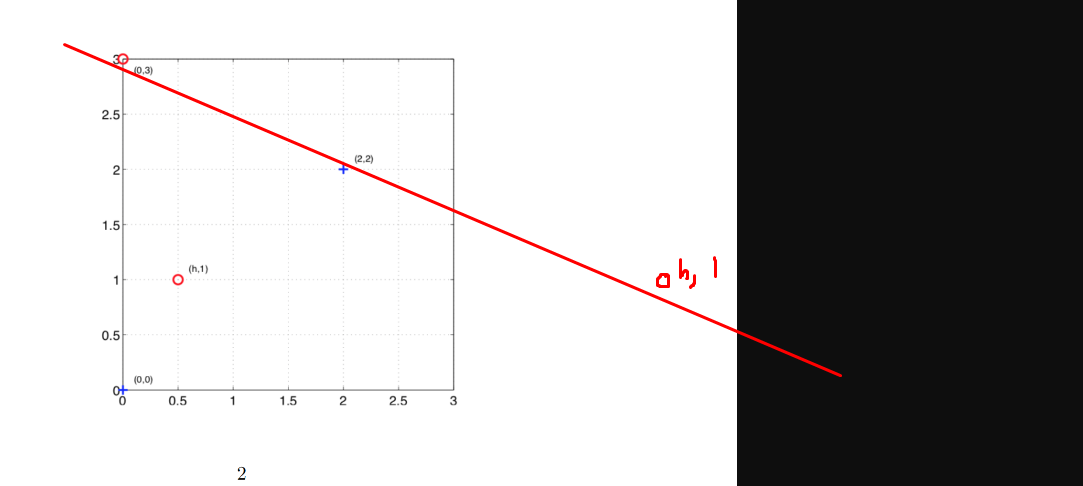 buoyant grove
untold compass
it's annoying since it's off the grid but if you keep going there's another line
buoyant grove
untold compass
it's annoying since it's off the grid but if you keep going there's another line
So we would have two lines. For the second line, the blue at (0,0), circled in pink, would be an outlier for the linear SVM?
https://imgur.com/a/9cYZ774
Is that essentially what I'm missing?
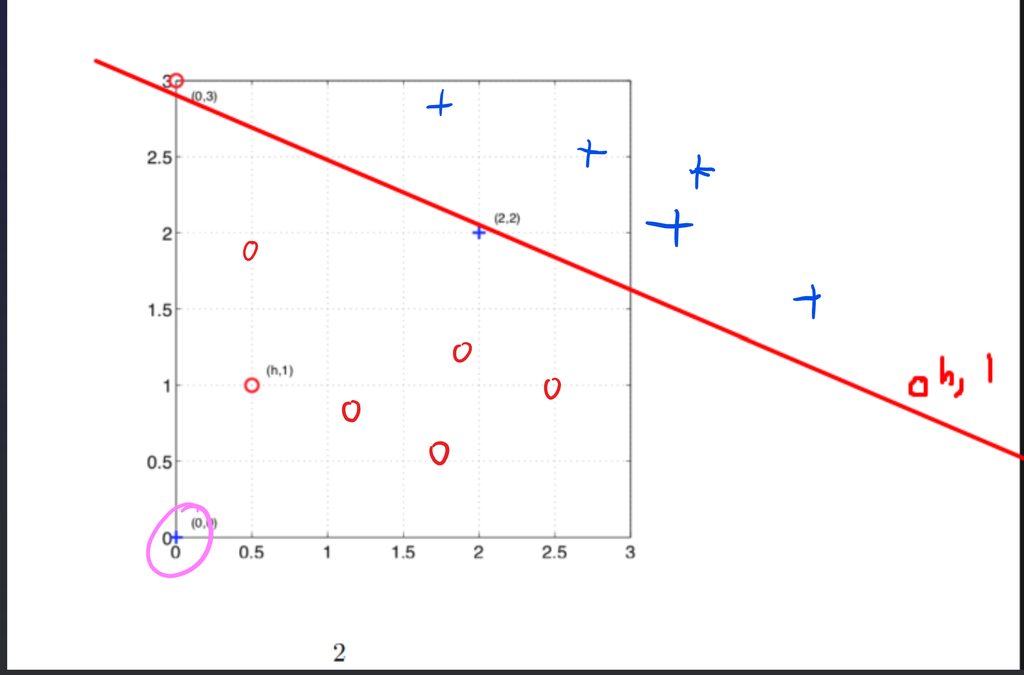 untold compass
oh there'd be no outlier, swap where you're writing the o's and +'s
buoyant grove
OH, because the red dot we're looking at is (h,1) and can be shifted.
untold compass
the intuition for visualizing this is that if you connect the blue ones with a line (or like convex hull in general), you want to draw lines that don't cut through that line
buoyant grove
Yea, I think I was just stuck on trying to draw a second line with (h,1) at where it's currently drawn. Not where it could potentially be.
buoyant grove
untold compass
the intuition for visualizing this is that if you connect the blue ones with a l...
Thanks!
untold compass
makes sense
buoyant grove
.close
calm coralBOT
Channel closed
Closed by @buoyant grove
Use .reopen if this was a mistake.
calm coralBOT
Available help channel!
Send your question here to claim the channel.
Remember:
• Ask your math question in a clear, concise manner.
• Show your work, and if possible, explain where you are stuck.
• After 15 minutes, feel free to ping <@&286206848099549185>.
• Type the command .close to free the channel when you're done.
• Be polite and have a nice day!
Read #❓how-to-get-help for further information on how to ask a good question, and about conduct in the question channels.
remote mural
 calm coralBOT
remote mural
remote mural
calm coralBOT
remote mural
remote mural
on d rn
apparently iii) is x=2?
need someone to explain that to me
that isn't a local minimum or maximum
 swift laurel
it's a graph of the derivative of f
a local maximum or minimum corresponds to a point where the derivative is 0
calm coralBOT
Channel closed
Closed by @old nexus
Use .reopen if this was a mistake.
calm coralBOT
Available help channel!
Send your question here to claim the channel.
Remember:
• Ask your math question in a clear, concise manner.
• Show your work, and if possible, explain where you are stuck.
• After 15 minutes, feel free to ping <@&286206848099549185>.
• Type the command .close to free the channel when you're done.
• Be polite and have a nice day!
Read #❓how-to-get-help for further information on how to ask a good question, and about conduct in the question channels.
 dry glacier
Need help for discretization. (I will apply explicit FTCS scheme) In the explicit FTCS (Forward Time Centered Space) method, the time derivative and the spatial derivative terms of the Navier-Stokes equation are discretized separately. For the temporal derivative, a forward difference approximation is employed Meanwhile, the spatial derivative term is discretized using central differences.
calm coralBOT
dry glacier
Need help for discretization. (I will apply explicit FTCS scheme) In the explici...
dry glacier
,tex \rho\frac{\partial u}{\partial t}=-\frac{\partial p}{\partial x}+\mu\frac1r\frac\partial{\partial r}\Big(r\frac{\partial u}{\partial r}\Big)
potent lotusBOT
pantograf
Compile Error! Click the  reaction for more information.
(You may edit your message to recompile.)
 dry glacier
How do I discretisize this?
calm coralBOT
@dry glacier Has your question been resolved?
calm coralBOT
@dry glacier Has your question been resolved?
calm coralBOT
Channel closed
Closed due to timeout
Use .reopen if this was a mistake.
calm coralBOT
Available help channel!
Send your question here to claim the channel.
Remember:
• Ask your math question in a clear, concise manner.
• Show your work, and if possible, explain where you are stuck.
• After 15 minutes, feel free to ping <@&286206848099549185>.
• Type the command .close to free the channel when you're done.
• Be polite and have a nice day!
Read #❓how-to-get-help for further information on how to ask a good question, and about conduct in the question channels.
 shell spruce
Question 48
 calm coralBOT
shell spruce
Question 48
calm coralBOT
shell spruce
Question 48
 honest quiver
shell spruce
Question 48
honest quiver
shell spruce
Question 48
This is going to be the line that perpendicularly bisects line FF’
So you need to find line FF’, find an equation for lines perpendicular to that, and then find an equation for the specific line that passes through the midpoint of FF’
honest quiver
Well what’s the slope of that line
shell spruce
0?
honest quiver
Oh wait that’s a vertical line
So what would be the slope of a line perpendicular to it
shell spruce
Um
honest quiver
What kind of line is perpendicular to a vertical line
shell spruce
Also o
honest quiver
That one would be 0
honest quiver
Line FF’ has undefined slope
The perpendicular line has 0 slope
You follow that?
shell spruce
Yes.
shell spruce
So the midpoint formula with the foci points?
honest quiver
Yes
shell spruce
(0,0)
honest quiver
So what’s a line with slope 0 that passes through (0,0)
shell spruce
The FF line?
honest quiver
No, the FF’ line is a vertical line with undefined slope
shell spruce
Sorry I’m like new to hyperbolas 😭
honest quiver
We want its perpendicular bisector
honest quiver
Ok draw this on graph paper
It will make sense
FF’ has undefined slope as it is vertical
It’s perpendicular bisector has 0 slope as it is horizontal
FF’ goes from (0,-17) to (0,17) and has a midpoint at 0
Now what line with slope 0 passes through (0,0)?
Think y=mx+b
shell spruce
Vertical line
honest quiver
A vertical line does not have slope 0
A vertical line has undefined slope
You cannot make a vertical line with slope intercept form
A horizontal line has 0 slope because it is of the form y=b
shell spruce
So a horizontal line?
honest quiver
Yes but what is the equation of a horizontal line passing through (0,0)
Don’t overthink it
shell spruce
Isn’t that the only type of line that can have slope 0
honest quiver
Yes
Slope 0 means horizontal by definition essentially
Because it means y does not change with x
It stays the same for all x
If we have a line of the form y=b, and it passes through (0,0), what is b?
shell spruce
0
honest quiver
So what is the equation of the line?
shell spruce
But what is the equation
honest quiver
That is the equation
shell spruce
O
shell spruce
But what about k
shell spruce
LMAO
 shell spruce
yeah…
honest quiver
Onto the actual problem
Let's consider both points in isolation
What represents all points 30 units away from F?
And similarly, what represents all points 30 units away from F'?
honest quiver
no....
shell spruce
Or line
honest quiver
if i ask you to draw a curve with all the points some distance away from a certain point, what would you draw
shell spruce
A circle ⭕️
honest quiver
Indeed
shell spruce
o I thought it was a hyperbola
shell spruce
Parabola
shell spruce
Yup
honest quiver
you want an equation for the distance of a point to each one
 honest quiver
you should get there eventually
but first find what is the expression for the distance from F to a point (x,y)
And a similar expression for F'
honest quiver
yes
honest quiver
no no no
as an expression of x,y
So you could plug in x,y for any point and get the distance to F
shell spruce
🧠 an eclipse formula
honest quiver
?
shell spruce
Since the distance is always the same ?
honest quiver
no forget that for now
think just simply in terms of the distance from (x,y) to F
use pythagorean theorem
shell spruce
Yup
honest quiver
use that
shell spruce
So the distance between the F and F’
 shell spruce
 honest quiver
yes
now we know that |d1 - d2| = 30 right?
as that is what the question is asking
shell spruce
So we subtract the two distances?
honest quiver
yes
and set them equal to 30
square both sides to eliminate the absolute value and it's all algebra from there
honest quiver
honest quiver
now we know that |d1 - d2| = 30 right?
you need to plug them in to this
d1 and d2 are the two distance expressions you derived
shell spruce
Is this set correctly
 honest quiver
there should be a minus sign instead of a plus sign between the two distances
but otherwise yes
this equation literally states the premises of the question, now you just have to simplify it
shell spruce
Idk how to simplify this 💀 it seems wrong
honest quiver
i'm not sure, there might be an easier way of doing this, but this is just taking the question and putting it in mathematical form
i am trying to simplify it myself, you have to start by squaring both sides
shell spruce
Should I check on Photomath this seems like it’s going to be a really long answer
honest quiver
i have it simplifying down into a regular conic section
shell spruce
?
 honest quiver
you just have to do a lot of annoying algebra to get rid of the square roots
why is it taking a derivative...
that is not at all what you need
shell spruce
O I see
shell spruce
Doesn’t everything cross out
honest quiver
you just have to do the algebra
square both sides and do all the multiplication and whatnot
shell spruce
Is it y=900\68
honest quiver
it should be a hyperbola not a line
shell spruce
 I can’t
shell spruce
@honest quiver tysm for you help
honest quiver
sorry i couldn't help much :/
honest quiver
alright
shell spruce
👍ty
honest quiver
you're welcome
shell spruce
Now
honest quiver

shell spruce
How do I close this
honest quiver
.close
shell spruce
.close
calm coralBOT
Channel closed
Closed by @shell spruce
Use .reopen if this was a mistake.
calm coralBOT
Available help channel!
Send your question here to claim the channel.
Remember:
• Ask your math question in a clear, concise manner.
• Show your work, and if possible, explain where you are stuck.
• After 15 minutes, feel free to ping <@&286206848099549185>.
• Type the command .close to free the channel when you're done.
• Be polite and have a nice day!
Read #❓how-to-get-help for further information on how to ask a good question, and about conduct in the question channels.
 willow cove
Hey! I have an exact different equation here that I'm trying to solve but I'm getting stuck when it comes to integration constants (...yes, really.)
I need to find a solution for this:
$2 \frac{x}{y} dx + \left(1 - \frac{y^2}{x^2}\right) dy = 0$
calm coralBOT
willow cove
Hey! I have an exact different equation here that I'm trying to solve but I'm ge...
potent lotusBOT
Lucas
 willow cove
Where x and y are non-zero. My step by step got me this far:
$2 \frac{x}{y} dx = - \left(1 - \frac{x^2}{y^2}\right) dy$
$\text{Find } \phi(x, y) \text{ s.t. } \frac{\partial \phi}{\partial x} = \phi_x = 2\frac{x}{y}, \ \frac{\partial \phi}{\partial y} = \phi_y = 1 - \frac{x^2}{y^2}$
$\phi = \int \phi_x dx = \int 2 \frac{x}{y} dx = \int \phi_y dy = \int 1 - \frac{x^2}{y^2} dy$
potent lotusBOT
Lucas
 willow cove
$\phi = \frac{x^2}{y} + g(y) = y + \frac{x^2}{y} + h(x)$
potent lotusBOT
Lucas
 willow cove
$g(y) = y + h(x)$
And then I got stuck. The expected answer is $\phi(x, y) = y + \frac{x^2}{y} + K$ where K is a constant. What I don't understand, however, is how on earth g(y) and h(x) became K. Can anyone enlighten me please?
From my understanding, both g(y) and h(x) are functions, not necessarily constants
let me reopen this with proper formatting. god damn.
.close
calm coralBOT
Channel closed
Closed by @willow cove
Use .reopen if this was a mistake.
calm coralBOT
Available help channel!
Send your question here to claim the channel.
Remember:
• Ask your math question in a clear, concise manner.
• Show your work, and if possible, explain where you are stuck.
• After 15 minutes, feel free to ping <@&286206848099549185>.
• Type the command .close to free the channel when you're done.
• Be polite and have a nice day!
Read #❓how-to-get-help for further information on how to ask a good question, and about conduct in the question channels.
 sterile wharf
I have no clue where to start from 😐
 calm coralBOT
sterile wharf
I have no clue where to start from 😐
calm coralBOT
sterile wharf
I have no clue where to start from 😐
 quaint sphinx
would rewrite 8 in terms of (sqrt2) to the power of something
sterile wharf
quaint sphinx
would rewrite 8 in terms of (sqrt2) to the power of something
8^2?
quaint sphinx
do u know what "sqrt" means
sterile wharf
quaint sphinx
do u know what "sqrt" means
square?
quaint sphinx
is shorthand for "square root"
sterile wharf
quaint sphinx
is shorthand for "square root"
Oh ☠️
quaint sphinx
valid tbh
sterile wharf
umm no clue
quaint sphinx
well do u know what (sqrt2)^2 is
sterile wharf
quaint sphinx
well do u know what (sqrt2)^2 is
2?
sterile wharf
quaint sphinx
by definition the square of sqrt2 is 2
so m = 2?