#help-42
1 messages · Page 61 of 1
 winter loom
 blazing coyote
ok
*oh
right
so it would be
$\frac{\left(\lambda_0\right)}{16\ \epsilon_0R}\ $
$\frac{\left(\lambda_0\right)}{16\ \epsilon_0R}$
 potent lotusBOT
Why am. I here
Compile Error! Click the  reaction for more information.
(You may edit your message to recompile.)
 blazing coyote
and this would be the y component too
winter loom
There is no y component.
blazing coyote
oh
winter loom
The y component cancels.
blazing coyote
so the other two quads have the same result I pressume
winter loom
That was the point of this image.
blazing coyote
yeah, forgot, sorry
winter loom
blazing coyote
so the other two quads have the same result I pressume
Yes it would, you don't even have to worry about it. You can just use the bounds 0 to pi. And the result will be what it will be.
 calm coralBOT
Channel closed
Closed by @blazing coyote
Use .reopen if this was a mistake.
calm coralBOT
 Available help channel!
Send your question here to claim the channel.
Remember:
• Ask your math question in a clear, concise manner.
• Show your work, and if possible, explain where you are stuck.
• After 15 minutes, feel free to ping <@&286206848099549185>.
• Type the command .close to free the channel when you're done.
• Be polite and have a nice day!
Read #❓how-to-get-help for further information on how to ask a good question, and about conduct in the question channels.
 wind phoenix
hi, are my answers correct?
 calm coralBOT
wind phoenix
hi, are my answers correct?
calm coralBOT
wind phoenix
hi, are my answers correct?
 amber bolt
there's no second correct answer
wind phoenix
okay
wind phoenix
amber bolt
there's no second correct answer
then the first one?
only the first one
<@&286206848099549185>
<@&286206848099549185>
.close
calm coralBOT
Channel closed
Closed by @wind phoenix
Use .reopen if this was a mistake.
calm coralBOT
Available help channel!
Send your question here to claim the channel.
Remember:
• Ask your math question in a clear, concise manner.
• Show your work, and if possible, explain where you are stuck.
• After 15 minutes, feel free to ping <@&286206848099549185>.
• Type the command .close to free the channel when you're done.
• Be polite and have a nice day!
Read #❓how-to-get-help for further information on how to ask a good question, and about conduct in the question channels.
 glad sinew
 calm coralBOT
glad sinew
calm coralBOT
calm coralBOT
glad sinew
calm coralBOT
@glad sinew Has your question been resolved?
glad sinew
I'll send pictures of my work
but I think I got it


yea I gotta prove the other way for intersection
 dull storm
For (b) and maybe (c), have you tried finding counterexample? Maybe try a function with many inputs go to the same output, like {(1,2), (2,2), ...}
glad sinew
ok
dull storm
glad sinew
Okie, lgtm for (a).
glad sinew
can you explain a proof for c)?
oh wait
atually i think its ok
ill send a picture after

for (<-)
if I already said y cannot be in f(B) even if x1!= x2, I can’t say there exist such x1 st y=f(x) in f(B)
so the last part is wrong..
I could say x1 in A intersect B..

@dull storm
can you check my answer for c?
dull storm
Something's wrong in (->): even if $x\notin B$, it's still possible that $y \in f(B)$.
potent lotusBOT
poypoyan
 glad sinew
how should I write out (->) then?
so I just state that its still possible
abd hence it is a contradiction to f(A)\f(B)?
how come this is not true

but,
this is true

I did the proof, but isnt inverse basically in the domain and its function in codomain...
potent lotusBOT
poypoyan
 dull storm
I'm sorry I have to write this again. May LaTeX is not that good rn.
You can do this for (c):
Here's a counter-example: Suppose $x_1 \neq x_2 \in A$ such that $f(x_1) = f(x_2) = c \in B$.
Let $H = {x_1, x_2}$ and $G = {x_1}$. Then $f(H \setminus G) = f({x_2}) = {c}$, but $f(H) \setminus f(G) = \ldots$.
potent lotusBOT
poypoyan
 glad sinew
but f(H)\f(G) = c still hold s true...
dull storm
Nope, because f(H) = f(G) = {c}.
 calm coralBOT
@glad sinew Has your question been resolved?
 stray tundra
calm coralBOT
stray tundra
calm coralBOT
Channel closed
Closed due to timeout
Use .reopen if this was a mistake.
calm coralBOT
Available help channel!
Send your question here to claim the channel.
Remember:
• Ask your math question in a clear, concise manner.
• Show your work, and if possible, explain where you are stuck.
• After 15 minutes, feel free to ping <@&286206848099549185>.
• Type the command .close to free the channel when you're done.
• Be polite and have a nice day!
Read #❓how-to-get-help for further information on how to ask a good question, and about conduct in the question channels.
wind phoenix
could you help me please? i dont have much time.
 wind phoenix
i have multiply -8, 8, and 9 with the same number
so that it gets infintely many solutions
 timid oracle
make the second equation identical to the first to make it redundant
timid oracle
yeah so a(-4)=-8 and b(-4)=9
timid oracle
no, a is 2 and b is -9/4
think about how you can multiply both sides of the second equation by -4 to get the first equation
wind phoenix
oh yeah
wind phoenix
timid oracle
think about how you can multiply both sides of the second equation by -4 to get ...
i get it now
so 9/(-4)
is -9/4
?
timid oracle
that’s b
wind phoenix
timid oracle
that’s b
yeah
calm coralBOT
@wind phoenix Has your question been resolved?
Channel closed
Closed by @wind phoenix
Use .reopen if this was a mistake.
Available help channel!
Send your question here to claim the channel.
Remember:
• Ask your math question in a clear, concise manner.
• Show your work, and if possible, explain where you are stuck.
• After 15 minutes, feel free to ping <@&286206848099549185>.
• Type the command .close to free the channel when you're done.
• Be polite and have a nice day!
Read #❓how-to-get-help for further information on how to ask a good question, and about conduct in the question channels.
wind phoenix
Is this correct?
 calm coralBOT
wind phoenix
Is this correct?
calm coralBOT
wind phoenix
Is this correct?
 rough arrow
I don't understand german, but I assume it wants you to have the vector a + (1/2)b from point P?
wind phoenix
Yes
rough arrow
Notice the direction of the (1/2)b vector you wrote, it has the opposite direction of b.
So you wrote a -(1/2)b
rough arrow
wind phoenix
What
Direction matters. If you go north, then going south isn't going north, that's going the opposite direction of north.
wind phoenix
!occupied
calm coralBOT
Someone else is already using this help channel. If you need help with a question, please open your own help channel/thread (see #❓how-to-get-help for instructions).
wind phoenix
 wind phoenix
rough arrow
Notice the direction of the (1/2)b vector you wrote, it has the opposite directi...
wind phoenix
rough arrow
Notice the direction of the (1/2)b vector you wrote, it has the opposite directi...
Like this?
rough arrow
 final marsh
Can you do some math
final marsh
Can you do some math
Open a new channel. You'll find them in a section called "MATH HELP (AVAIABLE)" above this channel.
final marsh
 rough arrow
wind phoenix
Like this?
rough arrow
wind phoenix
Like this?
You're going in another direction.
final marsh
wind phoenix
What language
German?
I cant read
But it looks like i did it back in 7th
wind phoenix
rough arrow
You're going in another direction.
yeah but the b vector is minus, and i have to make it plus because it says +1/2b
wind phoenix
final marsh
Just basic 10th grade math
can you go to a different help channel please?
wind phoenix
final marsh
Just basic 10th grade math
here
 rough arrow
wind phoenix
rough arrow
wind phoenix
Your b vector has its direction towards west-north. Then that's it. That is the positive direction of b, and you want that, (1/2)b is asked.
final marsh
wind phoenix
can you go to a different help channel please?
Like which one is which
wind phoenix
rough arrow
Your b vector has its direction towards west-north. Then that's it. That is the ...
huh?
rough arrow
Shorten your b, and apply it.
wind phoenix
aah
west north is positive because it goes up
and not down?
but i think it is negative
because it is turned to the left side
rough arrow
wind phoenix
west north is positive because it goes up
Look at the arrow, that is the direction it's pointing.
wind phoenix
b goes to the left
it cannot be a postive vector
i thought i need to make b positive
rough arrow
wind phoenix
because it is turned to the left side

Beginning the linear algebra series with the basics.
Help fund future projects: https://www.patreon.com/3blue1brown
An equally valuable form of support is to simply share some of the videos.
Home page: https://www.3blue1brown.com/
Correction: 6:52, the screen should show [x1, y1] + [x2, y2] = [x1+x2, y1+y2]
Full series: http://3b1b.co/eola
Fu...
wind phoenix
i know that i have to shorten it
rough arrow
wind phoenix
i thought i need to make b positive
Direction of its own matters, not the plane.
rough arrow
rough arrow
https://www.youtube.com/watch?v=fNk_zzaMoSs&pp=ygULdmVjdG9yIG1hdGg%3D
Watch this video, you'll probably get a more wider vision of vectors.
rough arrow
wind phoenix
i dont have that much time
It wouldn't be easier to explain with words how a vector works.
 white atlas
wind phoenix
i dont have that much time
white atlas
wind phoenix
i dont have that much time
in essence, you can't rotate your vector around without actual cause
you can only translate it (move it up, down, left, or right)


 white atlas
wind phoenix
This
white atlas
wind phoenix
This
your 1/2 * b is okay
but your resultant (a + 1/2 * b) isn't
wrong direction
wind phoenix
white atlas
but your resultant (a + 1/2 * b) isn't
 white atlas
wind phoenix
white atlas
wind phoenix
yes, that's better lol
wind phoenix
white atlas
yes, that's better lol
thank youu
white atlas
wind phoenix
thank youu
no worries-
calm coralBOT
@wind phoenix Has your question been resolved?
Channel closed
Closed by @wind phoenix
Use .reopen if this was a mistake.
Available help channel!
Send your question here to claim the channel.
Remember:
• Ask your math question in a clear, concise manner.
• Show your work, and if possible, explain where you are stuck.
• After 15 minutes, feel free to ping <@&286206848099549185>.
• Type the command .close to free the channel when you're done.
• Be polite and have a nice day!
Read #❓how-to-get-help for further information on how to ask a good question, and about conduct in the question channels.
 torpid vine
 calm coralBOT
torpid vine
https://cdn.discordapp.com/attachments/908078008609431674/1217196858187714622/im...
torpid vine
calm coralBOT
torpid vine
https://cdn.discordapp.com/attachments/908078008609431674/1217196858187714622/im...
torpid vine
Can someone help me figure out how squared logarithms work
 glacial lily
torpid vine
Can someone help me figure out how squared logarithms work
glacial lily
torpid vine
Can someone help me figure out how squared logarithms work
Squared logarithms don't have a property so try to do normal algebraic manipulations
torpid vine
Okay
glacial lily
But the last term has an identity: $log_8x^2 = 2log_8x$
potent lotusBOT
Oğuzhan
 glacial lily
Only the $log_8^2x$ doesn't have a property
potent lotusBOT
Oğuzhan
 glacial lily
Alright
 potent lotusBOT
 potent lotusBOT
 torpid vine
,rotate
potent lotusBOT
 torpid vine
Okay
 potent lotusBOT
 torpid vine
I got this so far
Is this right?
Well I don't know what to do after this
Also, am I allowed to cross multiply with inequalities
@glacial lily
<@&286206848099549185>
Sorry if you did not want to be pinged Oguzhan
I got it into one fraction

I am having trouble factoring the quadratic
I am stuck with this
calm coralBOT
@torpid vine Has your question been resolved?
calm coralBOT
Channel closed
Closed due to timeout
Use .reopen if this was a mistake.
Available help channel!
Send your question here to claim the channel.
Remember:
• Ask your math question in a clear, concise manner.
• Show your work, and if possible, explain where you are stuck.
• After 15 minutes, feel free to ping <@&286206848099549185>.
• Type the command .close to free the channel when you're done.
• Be polite and have a nice day!
Read #❓how-to-get-help for further information on how to ask a good question, and about conduct in the question channels.
 heavy spoke
If f is surjective and g is not surjective then g o f is not surjective
heavy spoke
Is this statement true or false?
 glass heart
calm coralBOT
glass heart
calm coralBOT
@heavy spoke Has your question been resolved?
calm coralBOT
Channel closed
Closed due to timeout
Use .reopen if this was a mistake.
Available help channel!
Send your question here to claim the channel.
Remember:
• Ask your math question in a clear, concise manner.
• Show your work, and if possible, explain where you are stuck.
• After 15 minutes, feel free to ping <@&286206848099549185>.
• Type the command .close to free the channel when you're done.
• Be polite and have a nice day!
Read #❓how-to-get-help for further information on how to ask a good question, and about conduct in the question channels.
 tepid oriole
$f(x) = \begin{cases} \frac{kcosx}{\pi -2x}, &\text{ if x } \neq \frac{\pi}{2} \ 3, & \text{ if x = } \frac{\pi}{2} \end{cases}$
calm coralBOT
tepid oriole
$f(x) = \begin{cases} \frac{kcosx}{\pi -2x}, &\text{ if x } \neq \frac{\pi}{2} \...
tepid oriole
MAN WHY DO I NEVER GET THESE RIGHT
potent lotusBOT
Barbie
 calm coralBOT
@tepid oriole Has your question been resolved?
tepid oriole
<@&286206848099549185>
 remote mural
note x not equal pi/2 to means greater than or less than pi/2
tepid oriole
remote mural
note x not equal pi/2 to means greater than or less than pi/2
yes i am aware of that
for some reason i have a feeling that this question is incorrect
remote mural
think the question is wrong
calm coralBOT
Channel closed
Closed by @tepid oriole
Use .reopen if this was a mistake.
Available help channel!
Send your question here to claim the channel.
Remember:
• Ask your math question in a clear, concise manner.
• Show your work, and if possible, explain where you are stuck.
• After 15 minutes, feel free to ping <@&286206848099549185>.
• Type the command .close to free the channel when you're done.
• Be polite and have a nice day!
Read #❓how-to-get-help for further information on how to ask a good question, and about conduct in the question channels.
 scarlet saddle
given f(x)=3^x-1 +2 as x approaches negative infinity
what happens to f(x)?
calm coralBOT
scarlet saddle
given f(x)=3^x-1 +2 as x approaches negative infinity
what happens to f(x)?
tepid oriole
$f(x) = 3^{x-1} +2$
potent lotusBOT
Barbie
 tepid oriole
is this what you mean?
tepid oriole
i think it just equates to 2
scarlet saddle
tepid oriole
i think it just equates to 2
how?
im an idiot
yea it most likely does
lmao
how did u get it tho?
i plugged in
tepid oriole
i also plugged it in.
scarlet saddle
tepid oriole
i also plugged it in.
any other way?
tepid oriole
well there is one other
f(x) = 3^(x-1) + 2
= 3^x * (1/3) + 2
= (3^x / 3) + 2
lim[x → -∞] f(x) = lim[x → -∞] ((3^x / 3) + 2)
= lim[x → -∞] (3^x / 3) + lim[x → -∞] 2
= (lim[x → -∞] 3^x) / 3 + 2
= 0 / 3 + 2
= 0 + 2
= 2
 real sentinel
if you remember 3^-1 = 1/3 so the more negative the x-1 term gets the smaller it becomes so at negative infinity 3^x-1 is basically 0
scarlet saddle
tepid oriole
lim[x → -∞] f(x) = lim[x → -∞] ((3^x / 3) + 2)
= lim[x → -∞] (3^x / 3) + lim[x →...
we didnt learn limits
tepid oriole
scarlet saddle
we didnt learn limits
x approaches anything basically just means lim x-> whatever that is
but if you didn't just plug in.
it doesn't really matter.
scarlet saddle
real sentinel
if you remember 3^-1 = 1/3 so the more negative the x-1 term gets the smaller it...
this one makes sense
thx tho barbie
.close
calm coralBOT
Channel closed
Closed by @scarlet saddle
Use .reopen if this was a mistake.
calm coralBOT
Available help channel!
Send your question here to claim the channel.
Remember:
• Ask your math question in a clear, concise manner.
• Show your work, and if possible, explain where you are stuck.
• After 15 minutes, feel free to ping <@&286206848099549185>.
• Type the command .close to free the channel when you're done.
• Be polite and have a nice day!
Read #❓how-to-get-help for further information on how to ask a good question, and about conduct in the question channels.
calm coralBOT
Channel closed
Channel closed due to the original message being deleted.
If you did not intend to do this, please open a new help channel,
as this action is irreversible, and this channel may abruptly lock.
Available help channel!
Send your question here to claim the channel.
Remember:
• Ask your math question in a clear, concise manner.
• Show your work, and if possible, explain where you are stuck.
• After 15 minutes, feel free to ping <@&286206848099549185>.
• Type the command .close to free the channel when you're done.
• Be polite and have a nice day!
Read #❓how-to-get-help for further information on how to ask a good question, and about conduct in the question channels.
Channel closed
Channel closed due to the original message being deleted.
If you did not intend to do this, please open a new help channel,
as this action is irreversible, and this channel may abruptly lock.
Available help channel!
Send your question here to claim the channel.
Remember:
• Ask your math question in a clear, concise manner.
• Show your work, and if possible, explain where you are stuck.
• After 15 minutes, feel free to ping <@&286206848099549185>.
• Type the command .close to free the channel when you're done.
• Be polite and have a nice day!
Read #❓how-to-get-help for further information on how to ask a good question, and about conduct in the question channels.
 dusky tendon
Are there any shortcuts to knowing if something is a permutation or combination?
calm coralBOT
dusky tendon
Are there any shortcuts to knowing if something is a permutation or combination?
amber bolt
no
dusky tendon
so the only way is to read it and analyze :/ there aren't any keywords or anything?
 civic dirge
These questions can be extremely free and varied, sadly.
calm coralBOT
Channel closed
Closed by @dusky tendon
Use .reopen if this was a mistake.
Available help channel!
Send your question here to claim the channel.
Remember:
• Ask your math question in a clear, concise manner.
• Show your work, and if possible, explain where you are stuck.
• After 15 minutes, feel free to ping <@&286206848099549185>.
• Type the command .close to free the channel when you're done.
• Be polite and have a nice day!
Read #❓how-to-get-help for further information on how to ask a good question, and about conduct in the question channels.
 solid steppe
yo
calm coralBOT
solid steppe
yo
solid steppe
can someone help me with a question
 quick karma

solid steppe

so
i need to invert C
and C= A-2I
so my question is how do i get C ( i dont understand what 2I does)
 normal wadi
I is the identity matrix
normal wadi
wdym
solid steppe
yea in this case C=A-2I
normal wadi
that right part just says that the C matrix is equal to the difference of A and 2*I
normal wadi
were you taught how to add and subtract matrices?
solid steppe
yes
normal wadi
then what exactly don't you get about the operation here
solid steppe
the thing is i learned it but i have forgot it ( i am currently preparing for a retest)
normal wadi
solid steppe
the thing is i learned it but i have forgot it ( i am currently preparing for a ...
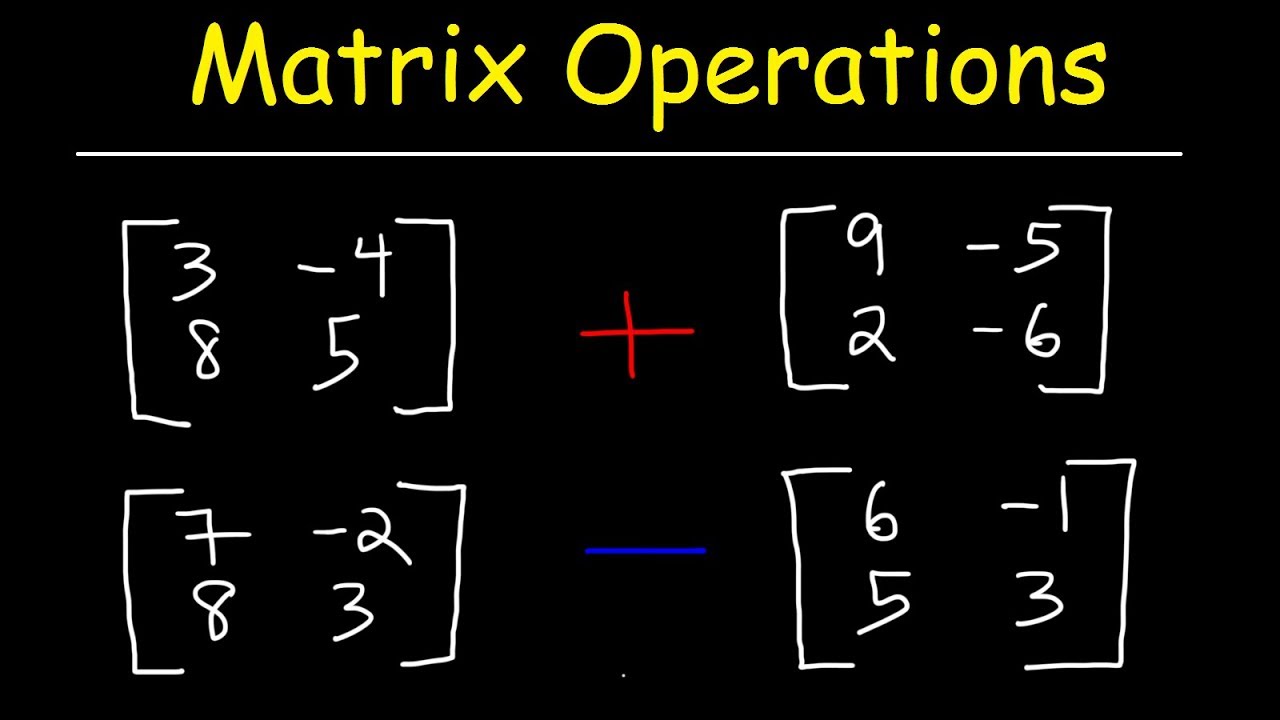
This precalculus video provides a basic introduction into addition and subtraction of matrices. It contains plenty of examples and practice problems on how to add and subtract matrices.
Introduction to Matrices: https://www.youtube.com/watch?v=yRwQ7A6jVLk
Adding and Subtracting Matrices:
ht...
incredibly trivial stuff
and should be the least of your concerns if you're diving into matrix inversion
solid steppe
i know this stuff
normal wadi
you just said you forgot it?
are you talking about inverting matrices or matrix addition
solid steppe
not what the video speaks about
i am talking about
when
it says A-2I
the 2I
what does that indicate?
normal wadi
do you know what the identity matrix is?
solid steppe
[100 010 001]
normal wadi
yes that's why I was so confused
solid steppe
[-2 0 0 ,0 -2 0 ,0 0 -2]
solid steppe
yea
i think when it comes to math
i always make harder then it should be
but thx for the help
i have 1 more question
if u can help me it would be the world
for me
normal wadi
yes
 solid steppe
so it says The plane Π contains the points (−1, −3, 2) and (1, 0, 1) and is parallel to
lelt with the vector
a)give an equation for Π.
b) Calculate the distance from the point (10, 1, 1) to Π.
normal wadi
I believe the first thing is to construct an additional vector so that you can utilize the cross product
normal wadi
not sure how they got that vector from the 2 points because neither addition nor subtraction of one point to another turns p_0 into that
 normal wadi
oh my bad I was looking at part a
normal wadi
let me test something out, I believe you dont need that specific point that your professor gave
I believe you can use either given point from the problem; let me try it first
solid steppe
oki
normal wadi
I get what your prof is doing but idk how they got the point, can you translate that second image
solid steppe
it does not say anything
solid steppe
just on the right side it say the point p0 is in the plane
normal wadi
what about the stuff before the final step
normal wadi
??
solid steppe
or u mean a)?
normal wadi
 solid steppe
the shortest distance is given by
normal wadi
solid steppe
the shortest distance is given by
got it
you can use any point that lies on the plane using the formula they provided
I would use one of the two points that was given in the problem
solid steppe
so like (1 0 1)?
normal wadi
yes
solid steppe
uhhh okay
does that always apply like that?
or can there be a question where u need to find out?
normal wadi
normal wadi
ok so I got a plane equation 2x - y + z = 3
as long as you're picking a point that satisfies this plane equation it will work I'm pretty sure
normal wadi
solid steppe
but yes if you have some layout like this, the equation for [distance from point to plane] that your prof provided should always work
normal wadi
np
calm coralBOT
Channel closed
Closed by @solid steppe
Use .reopen if this was a mistake.
calm coralBOT
Available help channel!
Send your question here to claim the channel.
Remember:
• Ask your math question in a clear, concise manner.
• Show your work, and if possible, explain where you are stuck.
• After 15 minutes, feel free to ping <@&286206848099549185>.
• Type the command .close to free the channel when you're done.
• Be polite and have a nice day!
Read #❓how-to-get-help for further information on how to ask a good question, and about conduct in the question channels.
wind phoenix
can someone help me with this? I am supposed to be asleep and i dont have much time
calm coralBOT
wind phoenix
can someone help me with this? I am supposed to be asleep and i dont have much t...
 calm coralBOT
Channel closed
Closed by @wind phoenix
Use .reopen if this was a mistake.
calm coralBOT
Available help channel!
Send your question here to claim the channel.
Remember:
• Ask your math question in a clear, concise manner.
• Show your work, and if possible, explain where you are stuck.
• After 15 minutes, feel free to ping <@&286206848099549185>.
• Type the command .close to free the channel when you're done.
• Be polite and have a nice day!
Read #❓how-to-get-help for further information on how to ask a good question, and about conduct in the question channels.
 torpid hinge
Can someone just give me a hint for this problem (other than the one already given)? Or maybe a way to actually apply the hint that was given. Preferably just the first step or smth
 calm coralBOT
torpid hinge
Can someone just give me a hint for this problem (other than the one already giv...
calm coralBOT
torpid hinge
Can someone just give me a hint for this problem (other than the one already giv...
 pure kayak
torpid hinge
pure kayak
torpid hinge
Lol dw it happens
I think I'm actually supposed to use that tho, I just don't know how to get to that point
 fathom solstice
try putting it in the form (y+1)^2 for some y
its gonna be a couple of terms of (y+1)^2 for different y
torpid hinge
fathom solstice
its gonna be a couple of terms of (y+1)^2 for different y
Wait wdym by this
Oh nvm I think I got it
fathom solstice
add and subtract some terms to have a polynomial that is of the form (y+1)^2 on the left side that uses the x^2 term
x^4 term*
calm coralBOT
Channel closed
Closed by @torpid hinge
Use .reopen if this was a mistake.
fathom solstice
youre welcome
 exotic falcon
fathom solstice
youre welcome
exotic falcon
fathom solstice
youre welcome
...
calm coralBOT
Available help channel!
Send your question here to claim the channel.
Remember:
• Ask your math question in a clear, concise manner.
• Show your work, and if possible, explain where you are stuck.
• After 15 minutes, feel free to ping <@&286206848099549185>.
• Type the command .close to free the channel when you're done.
• Be polite and have a nice day!
Read #❓how-to-get-help for further information on how to ask a good question, and about conduct in the question channels.
 heady jungle
 calm coralBOT
heady jungle
calm coralBOT
calm coralBOT
heady jungle
calm coralBOT
Channel closed
Closed by @heady jungle
Use .reopen if this was a mistake.
calm coralBOT
Available help channel!
Send your question here to claim the channel.
Remember:
• Ask your math question in a clear, concise manner.
• Show your work, and if possible, explain where you are stuck.
• After 15 minutes, feel free to ping <@&286206848099549185>.
• Type the command .close to free the channel when you're done.
• Be polite and have a nice day!
Read #❓how-to-get-help for further information on how to ask a good question, and about conduct in the question channels.
 desert talon
can someone just lmk if I'm doing this right?
 calm coralBOT
desert talon
can someone just lmk if I'm doing this right?
desert talon
calm coralBOT
desert talon
can someone just lmk if I'm doing this right?
desert talon
I've been absent with a cold and I can't take the test later because this is the last week of the quarter
 empty quail
you can't round the number when you start multiplying
because you get a different answer
desert talon
oh shoot
 empty quail
okie
desert talon
I couldn't find sin(40 so I just didnt round and it doesnt feel right
 desert talon
sorry for my hand writing xd
empty quail
desert talon
I couldn't find sin(40 so I just didnt round and it doesnt feel right

you should do it this way
because you see the circle part is confusing
desert talon
Ill try to be more clear in the furture 👍
empty quail

desert talon
so im on the right track?
empty quail
did you multiple sin 71 by 39.6 to get number like 40.165?
I gave you a clear step to restart again by multiplication
empty quail
no problem
 desert talon
is this correct?

YAAAY
alr lemme continue to solve for the triangle then ill send you another screenshot
desert talon
ooh alr alr
gn
hopefully someone else comes to my rescue
Now I would use the new angle I just in the law of cosine to find the last side?
 calm coralBOT
@desert talon Has your question been resolved?
desert talon
<@&286206848099549185> ?
calm coralBOT
@desert talon Has your question been resolved?
calm coralBOT
@desert talon Has your question been resolved?
desert talon
.close
calm coralBOT
Channel closed
Closed by @desert talon
Use .reopen if this was a mistake.
calm coralBOT
Available help channel!
Send your question here to claim the channel.
Remember:
• Ask your math question in a clear, concise manner.
• Show your work, and if possible, explain where you are stuck.
• After 15 minutes, feel free to ping <@&286206848099549185>.
• Type the command .close to free the channel when you're done.
• Be polite and have a nice day!
Read #❓how-to-get-help for further information on how to ask a good question, and about conduct in the question channels.
 warm warren
So I’m trying to understand this but I can’t see where this magical covector is coming from
 calm coralBOT
warm warren
So I’m trying to understand this but I can’t see where this magical covector is ...
warm warren
calm coralBOT
warm warren
So I’m trying to understand this but I can’t see where this magical covector is ...
warm warren
The claim is that a linear map is a (1, 1)-tensor
And he’s showing here that the notion of 𝚽 being a linear map that takes vectors to vectors is equivalent (in the finite dimensional case) to taking a vector to the dual of the dual space
He also claims that this output, that lives in the dual of the dual space, T( • , v), is something that can eat a covector, which maps vectors to reals
So suppose I have a linear map 𝚽
I can feed this map some vector v
What covector do I feed it to make it go to ℝ?
Because on the bottom left he writes that the T constructed from the data of 𝚽 maps a covector and vector to ℝ
By feeding the covector: 𝚽(vector) which gives a vector, which the covector clearly maps to ℝ by the definition of a covector
But I don’t get where this particular covector (denoted varphi) comes from
 ancient thistle

ancient thistle
warm warren
But I don’t get where this particular covector (denoted varphi) comes from
like the bottom left corner?
warm warren
Ye
ancient thistle
its coming from V*
warm warren
Well yes it’s a covector it comes from V*
But where do I get this covector from
Say I have a linear map 𝚽 and a vector v
warm warren
How do I make this covector
ancient thistle
you dont make it
its any element of V*
T(φ, v) = φ(phi(v))
phi is the other phi 
warm warren
So my 𝚽 can eat a covector and a vector and give me something in ℝ in a bilinear fashion
ancient thistle
isnt phi a map from V to V
warm warren
Ok my T_𝚽 can eat a covector and a vector and give me something in ℝ in a bilinear fashion
potent lotusBOT
 warm warren
So from a linear map, I can create a (1,1)-tensor
Ah, and the top part is saying from a (1,1)-tensor I can create a linear map
Then the (1,1)-tensor and the linear map must be the same thing
ancient thistle
theres a correspondence between the two
ancient thistle
iso
warm warren
Ah
So if I have a (1,1)-tensor and I give it a vector
Now it’s something that can eat a covector and spit out a real number
And this thing, has an isomorphic mapping to some vector v in V
So this thing is the T( • , v) object, which lives in (V*)*, and has a corresponding v in V by some isomorphism
And this corresponding v is what I’d have gotten if I just fed my original vector into 𝚽
warm warren
warm warren
So this thing is the T( • , v) object, which lives in (V\*)*, and has a correspo...
But then it depends on the isomorphism I chose at this step no?
 oblique current
Yeah but you wanna think of the map the other way, you send v to T(-,v) and this will turn out to be an iso
oblique current
Which is presumably why they're equals sign pilled
ancient thistle
you usually don't
you're gonna need some kind of finiteness of basis argument here cuz its just straight up not true when V is infinite dimensional
oblique current
You have to figure out that everything in the left vector space can be written as T(-,v)
In finite dim^
warm warren
Well he did restrict to finite dimensional cases here
oblique current
oblique current
You have to figure out that everything in the left vector space can be written a...
But this we can just get from considering the map the other way like above and show its an iso
ancient thistle
you can probably pick bases and do linear algebra stuff to say that the map is uniquely determined by its values on the bases
and that'll give you the map back from V** to V
warm warren
I’m trying to think perhaps say 𝚽 is a matrix right nice and concrete
oblique current
Well then you definitely do have to pick bases
warm warren
What sort of information am I getting out of the matrix such that I can feed it a vector and a covector to get a real number
warm warren
Because T_𝚽 is saying we extract the information out of 𝚽
What specifically what information
ancient thistle
if you have the matrix [phi] and the vector [v]
then [phi][v] is the image of v under phi
warm warren
Sure
warm warren
Indeed
ancient thistle
but then like
warm warren
That is indeed true
warm warren
Ah
So in matrix land the covector is just the row vector of length equal to the dimension of V
Right because it is the thing that sends vectors to real numbers linearly
Hey that’s just the dot product
Kinda
So from the identity linear map, I can make the dot product
That’s the (1,1)-tensor that corresponds to the dot product
oblique current
Once you choose (orthonormal?) bases yeah
ancient thistle
just pick a new dot product
warm warren
Oh right the dot product uses the basis as a definition
Hey but I don’t need it I can just slap some (w, v) into I(identity linear map)
And I get something that works like the dot product
oblique current
Your T is essentially an abstraction of the dot product yeah
But its just the obvious thing you would do to get a number if you have a vector and a function from vectors to R: apply that function to your vector
warm warren
oblique current
But its just the obvious thing you would do to get a number if you have a vector...
Ok so if I have a function that takes a covector and a vector
Naturally I just feed the vector into the covector
But suppose I wanted to change it up a bit and include a linear map somewhere in there
Then I just feed the image of the vector into the covector
oblique current
Yeah you can "twist" the map by some iso endo of V
warm warren
But how do I know the image of the vector, is something that the covector can eat?
ancient thistle
in some sense the isomorphism between V and V** is trivial when you talk about actual matrices
warm warren
What if my linear map lost dimensions
ancient thistle
[v] is also something in V** because you can do [w]^t [v]
oblique current
warm warren
But how do I know the image of the vector, is something that the covector can ea...
It's need to be a map from V to V
warm warren
Oh
Ah
That’s quite a strong restriction
So then not all linear maps are (1,1)-tensors
Only the ones from V to V
oblique current
Otherwise like you say your covector can no longer in general eat something in some other non isomorphic space W
ancient thistle
when you write (1,1)-tensors you kinda already mean like
V* x V -> R or something
but really like
Hom(V, W) and V* x W can be identified in some sense for finite dimensional spaces
warm warren
For the V* and W?
warm warren
I tried thinking about that but I didn’t get anywhere either
ancient thistle
if you have an element [ \sum_i \varphi^i \tensor w_i \in V^* \tensor W ]
potent lotusBOT
 warm warren
That’s a basis isn’t it
ancient thistle
no it's just a general element
something in the tensor product is a finite sum of pure tensors
which are those phi x w thingos
you can associate to it a map in $\Hom(V, W)$ by doing something quite similar [ T(v) = \sum_i \varphi^i(v) , w _i ]
potent lotusBOT
 warm warren
Are tensor product like a product topology
ancient thistle
just feed the phis the v and multiply by the corresponding w
no not quite
but also kinda
warm warren
You don’t just append the W part onto V?
warm warren
Ok I’m reading Wikipedia and it says
Tensor product of V and W is a vector space with a bilinear map
warm warren
It maps (v, w) to v tensor product w
In a bilinear fashion
I changed up the words a bit
ancient thistle
the bilinear map is ${-} \tensor {-}$
potent lotusBOT
 ancient thistle
it's kinda tautological
warm warren
Right ok nice
So Hom(V, W) is just a vector space of all linear maps from V to W
And V* tensor product W is
Something
So it’s like you take a row vector length dimV, and a column vector length dimW
Ah you can make a matrix out of that
That’s the linear map!
Ok but I lose all sense of control when I’m forced to give up the notion of a matrix, a row vector and a column vector
potent lotusBOT
 ancient thistle
it looks so gross
anyway
now when you get a vector
its gonna be like
,, \sum_i \mat[b]{|\ w_i \ |} \underbrace {\mat[b]{- & \varphi_i & -} \mat[b]{| \ v \ |}}_{\text{some number}}
potent lotusBOT
 ancient thistle
so if you think of the w_is as the basis of W
that will somehow be able to give you any vector in W
warm warren
potent lotus
What is this
ancient thistle
my shitty representation of what [ \sum_i \varphi^i \tensor w_i ] is supposed to be
potent lotusBOT
 warm warren
potent lotus
warm warren
potent lotus
Ok so this is what anything on the right side looks like
warm warren
ancient thistle
Hom(V, W) and V* x W can be identified in some sense for finite dimensional spac...
Right side of this statement
warm warren
And supposedly it represents a linear map because that’s what Hom(V, W) contains
ancient thistle
potent lotus
well heres how the linear map works
warm warren
potent lotus
So varphi_i is kinda telling me how much of my v gets turned a particular basis vector of w_i
ancient thistle
yea
perhaps what you want is something more like
[ \phi : V \to W, \qquad T : W^* \by V \to \R ]
potent lotusBOT
 ancient thistle
well the way im thinking of it is like
warm warren
WAIT NO HE DID SAY SOMETHING LIKE THAT
warm warren
something about “throw something on the right to the left, and give it a star”
ancient thistle
and W** is meant to be W
warm warren
“And works the other way too”
ancient thistle

warm warren

warm warren
ancient thistle
T is really a map V -> (W* -> R)
Where is this from
ancient thistle
like
T : W* x V -> R
but instead
you can just give it a v in V
and you're left with a w in W* to give
warm warren
ancient thistle
T : W* x V -> R
Ok suppose T is such a map
If I give it a v, then it now looks like T(v) : W* -> R
ancient thistle
T(-, v) : W* -> R
warm warren
Ah but this T(v) is in (W*)*
warm warren
The?
ancient thistle
canonical one
warm warren
I don’t know what’s the canonical isomorphism
ancient thistle
its the substitution map
v -> (phi -> phi(v))
aka the do nothing map on column vectors
[v] -> [v]
since [v] is a column vector, and its also a cocovector since if you take a row vector [w]^t, you can do [w]^t [v]
warm warren
So you’re saying a cocovector takes covectors to R
And in particular, [v] is a cocovector because it takes the covector [w]^t to R by [w]^t [v]
ancient thistle
yeah
warm warren
Ok sure
So then if I have T( • , v), this cocovector is canonically the vector v
And if I fed the cocovector T( • , v) some covector w
ancient thistle
well here you actually want to apply phi first
ancient thistle
yeah okay
warm warren
But suppose I wanted to construct a particular T from a linear map
Then the cocovector T_𝚽( • , v) is canonically the vector 𝚽(v) which lives in V
Hmm, but I don’t know that 𝚽 is full rank, what if the image of 𝚽 is not all of V
Then if 𝚽(v) = 𝚽(w), for some v,w ∈ V, I have that T_𝚽( • , v) = T_𝚽( • , w)
Ok sure I just have less cocovectors
And clearly the different cocovectors I have depend on the 𝚽 so it seems like at least some of the information of 𝚽 is indeed getting passed on to T
If I feed my cocovector a covector, I just apply the covector to my 𝚽(v)
And that’s why he write 𝚽(varphi(v))
Ok
And the idea is that a linear map 𝚽 bring v in V to 𝚽(v) in V
But this 𝚽(v) has the capability to be fed into a covector
So it is in a sense a cocovector
So I get out something that can take a covector and get into R
So $V\overset{\phi}{\to}V\overset{v^\in V^}{\to}\mathbb R$
potent lotusBOT
Frosst
 warm warren
So a linear map is like
Unfinished
I can still feed the result into a covector
Ok this is quite clear now, assuming I’ve not got the wrong idea in my head
Alright I will now roam freely with this new delusional idea
Thanks snow and zac 
.close
calm coralBOT
Channel closed
Closed by @warm warren
Use .reopen if this was a mistake.
calm coralBOT
Available help channel!
Send your question here to claim the channel.
Remember:
• Ask your math question in a clear, concise manner.
• Show your work, and if possible, explain where you are stuck.
• After 15 minutes, feel free to ping <@&286206848099549185>.
• Type the command .close to free the channel when you're done.
• Be polite and have a nice day!
Read #❓how-to-get-help for further information on how to ask a good question, and about conduct in the question channels.
 tranquil basin
can someone explain me this
calm coralBOT
tranquil basin
can someone explain me this
tranquil basin

the content in the brackets is (x^2 + 1)^2 right? but why did x^2 change its sign
 zealous hawk
add and subtract x^2
 alpine stone
tranquil basin
the content in the brackets is (x^2 + 1)^2 right? but why did x^2 change its sig...
alpine stone
tranquil basin
the content in the brackets is (x^2 + 1)^2 right? but why did x^2 change its sig...
What do you mean by changing its sign?
x^2 was rewritten as 2x^2 - x^2
tranquil basin
why
alpine stone
So that you would have x^4, 2x^2 and 1 in the sum; Those add up to (x^2 + 1)^2
zealous hawk
it's a trick to factorize x^4+x^2+1
we add x^2 so it becomes x^4 + 2x^2 + 1, then to balance it we subtract the x^2 we added
tranquil basin
zealous hawk
we add x^2 so it becomes x^4 + 2x^2 + 1, then to balance it we subtract the x^2 ...
to keep it equal?
zealous hawk
which becomes (x^4 + 2x^2 + 1) - x^2
yes
and now you can see it's a a^2 - b^2 form
cuz that left side quantity is square of x^2+1
tranquil basin
so the step between those 2 was (x^4 + x^2 + x^2 +1) + x^2 and then to keep it equal it comes down to (x^4 +2x^2 +1) - x^2
zealous hawk
yeah
tranquil basin
which is (x^4 + x^2 + 1) which is (x^2 + 1)^2
calm coralBOT
Channel closed
Closed by @tranquil basin
Use .reopen if this was a mistake.
tranquil basin
zealous hawk
it's done to factorize the thing
wait
isnt x^4 + x^2 +1 after subracting it what i started at :/
zealous hawk
yeah we dont subtract it again obviously

this is what you have
now use (a+b)(a-b) formula
calm coralBOT
Available help channel!
Send your question here to claim the channel.
Remember:
• Ask your math question in a clear, concise manner.
• Show your work, and if possible, explain where you are stuck.
• After 15 minutes, feel free to ping <@&286206848099549185>.
• Type the command .close to free the channel when you're done.
• Be polite and have a nice day!
Read #❓how-to-get-help for further information on how to ask a good question, and about conduct in the question channels.
 woven wigeon
How can i simplify this easily
 calm coralBOT
woven wigeon
How can i simplify this easily
calm coralBOT
woven wigeon
How can i simplify this easily
@woven wigeon Has your question been resolved?
white atlas
woven wigeon
How can i simplify this easily
Break it into their respective prime factors
15 = 5 * 3
6 = 2 * 3
10 = 5 * 2
21 = 7 * 3```Then exponentiate each appropriately and then simplify
calm coralBOT
Channel closed
Closed due to timeout
Use .reopen if this was a mistake.
Available help channel!
Send your question here to claim the channel.
Remember:
• Ask your math question in a clear, concise manner.
• Show your work, and if possible, explain where you are stuck.
• After 15 minutes, feel free to ping <@&286206848099549185>.
• Type the command .close to free the channel when you're done.
• Be polite and have a nice day!
Read #❓how-to-get-help for further information on how to ask a good question, and about conduct in the question channels.
calm coralBOT
Channel closed
Channel closed due to the original message being deleted.
If you did not intend to do this, please open a new help channel,
as this action is irreversible, and this channel may abruptly lock.
Available help channel!
Send your question here to claim the channel.
Remember:
• Ask your math question in a clear, concise manner.
• Show your work, and if possible, explain where you are stuck.
• After 15 minutes, feel free to ping <@&286206848099549185>.
• Type the command .close to free the channel when you're done.
• Be polite and have a nice day!
Read #❓how-to-get-help for further information on how to ask a good question, and about conduct in the question channels.
 lucid knot
 calm coralBOT
lucid knot
lucid knot
calm coralBOT
lucid knot
lucid knot
i used a calculator, and i think its right
i have 2 questions
- is it even correct?
- how would you solve this without a calculator?
glacial lily
lucid knot
2. how would you solve this without a calculator?
You need a calculator.
lucid knot
ok that makes me feel better
glacial lily
x > ln(sqrt(63/7))
glacial lily
lucid knot
thats ln (3)
Yeah and whatever your calculator gives is the answer
glacial lily
lucid knot
1.09861
If that's it then your answer is correct
calm coralBOT
Channel closed
Closed by @lucid knot
Use .reopen if this was a mistake.
calm coralBOT
Available help channel!
Send your question here to claim the channel.
Remember:
• Ask your math question in a clear, concise manner.
• Show your work, and if possible, explain where you are stuck.
• After 15 minutes, feel free to ping <@&286206848099549185>.
• Type the command .close to free the channel when you're done.
• Be polite and have a nice day!
Read #❓how-to-get-help for further information on how to ask a good question, and about conduct in the question channels.
 grim vale
convert 0.281 to a fraction (81 is recurring)
calm coralBOT
grim vale
convert 0.281 to a fraction (81 is recurring)
 full niche
grim vale
convert 0.281 to a fraction (81 is recurring)
full niche
grim vale
convert 0.281 to a fraction (81 is recurring)
just let x = the number
and try cancelling out the recurring part
calm coralBOT
@grim vale Has your question been resolved?
calm coralBOT
Channel closed
Closed due to timeout
Use .reopen if this was a mistake.
Available help channel!
Send your question here to claim the channel.
Remember:
• Ask your math question in a clear, concise manner.
• Show your work, and if possible, explain where you are stuck.
• After 15 minutes, feel free to ping <@&286206848099549185>.
• Type the command .close to free the channel when you're done.
• Be polite and have a nice day!
Read #❓how-to-get-help for further information on how to ask a good question, and about conduct in the question channels.
 gray briar
I am having a hard time understanding how to evaluate these functions I have tried to teach myself and haven't made any sense of these.
 calm coralBOT
gray briar
I am having a hard time understanding how to evaluate these functions I have tri...
gray briar
calm coralBOT
gray briar
I am having a hard time understanding how to evaluate these functions I have tri...
gray briar
what does the graph serve in understanding how to evaluate the functions?
 blissful phoenix
The graph shows you which values the functions take at different values of x
gray briar
so at -1 f(x) is at 0 and g(x) -2 in terms of the y axis or is this not relevant?
blissful phoenix
Correct. f(-1) = 0, and g(-2) = 0
So for the first question, (f+g)(-1) = f(-1) + g(-1), can you tell me what that is by looking at the graph?
gray briar
Im sorry I am confused.. Am i looking at the difference of the to graphs? If so the difference is -2
blissful phoenix
Correct. (f+g)(-1) = f(-1) + g(-1) = 0 + (-2) = -2
gray briar
so then i am using the (-1) as a reference to see on the graph of where they are talking about and then seeing what the difference is. are we setting the function equal to zero to find the answer?
In part two the answer would then be 0 as there is no difference?
Also how does the function (f+g) , (g-f), ((g)(f)), (g/f) affect evaluating?
blissful phoenix
Let's make sure we know what a function is first. A function f(x) takes a value x and maps it to the y-axis in this case (see y = f(x)). So, for example, if x=-1, then f(x) = f(-1) = 0, as you can see on the picture
The first question states: (f+g)(-1) = ?, and you're supposed to answer what ? is. (f+g)(-1) is a syntactic way of writing f(-1) + g(-1), i.e., it's the same thing.
The second question states: (g-f)(-2) = ?, which is the same thing as g(-2) - f(-2) = ?
You have correctly answered that the second question is g(-2) - f(-2) = -1 - (-1) = 0
Does it make sense?
gray briar
sorta.. so in i could view however they put g and f in the syntactic way as basically saying = and not be hyper focused on it as its going to not effect what i am seeing on the graph? cause (g/f) (1) would be 1/1 right?
(g/f)(1) is -4 in that case correct?
blissful phoenix
Make it easier on yourself by writing out the whole thing. (g/f)(1) = g(1)/f(1) = ?
 gray briar
 blissful phoenix
Bravo. Correct
gray briar
ahhh I understand this now the function is saying the rule that you are going to use to evaluate but also where on the graph you will be looking on the graph and the once you find the (f) and (g) you can then use the values from the graph to get the solution
correct?
blissful phoenix
Correct.
 blissful phoenix
First evaluate f(-4), then take the answer you get and plug it into the g function
So
- let f(-4) = z
- look at the graph to figure out the value of z
- when you have the value of z, look at the graph to find the value of g(z)
gray briar
so (f(-4)) = -3
blissful phoenix
Correct. You have figured out steps 1 and 2. Next, do the third step, i.e., evaluate g(-3)
gray briar
Wouldn't that mean then that (-1(-3)) as g(-4)=-1 so then the solution would be 3
blissful phoenix
Where are you getting (-1(-3)) from?
blissful phoenix
Yes, it seems you are thinking about it wrong.
g(f(x)) is a two-step process. First, you evaluate f(x). Then, you take the answer you got from f(x) and plug it into g
So you've correctly figured out that f(-4) = -3
The next step is to evaluate g(-3)
then you have the answer
gray briar
That makes more sense now
blissful phoenix
👍
gray briar
Thank you so much I was so lost and didn't understand any of this you definetly helped me understand how to solve these correctly
blissful phoenix
Glad to help!
gray briar
last question on this
As far as ((g)(f)) would be the same as ((f)(g)) as its just multiplication but just switching around g and f right?
blissful phoenix
Yes

 blissful phoenix
f ∘ g is usually denoted as function composition, so (f ∘ g)(0) = f(g(0))
and (g ∘ f)(-3) = g(f(-3))
This should be defined wherever you are learning this from
gray briar
... Now I am more confused
Oh is it saying it similar to how g(f(-4)) just written different?
blissful phoenix
It is the same but written differently, yes
calm coralBOT
Channel closed
Closed by @gray briar
Use .reopen if this was a mistake.
calm coralBOT
Available help channel!
Send your question here to claim the channel.
Remember:
• Ask your math question in a clear, concise manner.
• Show your work, and if possible, explain where you are stuck.
• After 15 minutes, feel free to ping <@&286206848099549185>.
• Type the command .close to free the channel when you're done.
• Be polite and have a nice day!
Read #❓how-to-get-help for further information on how to ask a good question, and about conduct in the question channels.
 jagged surge
Hey I need help soling this fraction. I would appreciate if you showed how you solved it.
 calm coralBOT
jagged surge
Hey I need help soling this fraction. I would appreciate if you showed how you s...
jagged surge
calm coralBOT
jagged surge
Hey I need help soling this fraction. I would appreciate if you showed how you s...
jagged surge
Im not sure where to start
jagged surge
the numerator? Im sorry im not fluent in english
jagged surge
hm
im not sure how
we can probably do soemthing with the "b" to start
no we cant, the other Bs multiplied
 jagged surge
how did the 2 from the first line turn into a 4 in the second?
jagged surge
yeah, but why did that mulitply and not the others
remote mural
So 4 x a square x b
remote mural
jagged surge
yeah, but why did that mulitply and not the others
They did
jagged surge
oh lright
just to make it match with the other side?
im sorry, I dont understadn where the second B went in the second line
jagged surge
remote mural
They did
hello? If you went away you could tell me, so I could ask someone else
.close
calm coralBOT
Channel closed
Closed by @jagged surge
Use .reopen if this was a mistake.
Available help channel!
Send your question here to claim the channel.
Remember:
• Ask your math question in a clear, concise manner.
• Show your work, and if possible, explain where you are stuck.
• After 15 minutes, feel free to ping <@&286206848099549185>.
• Type the command .close to free the channel when you're done.
• Be polite and have a nice day!
Read #❓how-to-get-help for further information on how to ask a good question, and about conduct in the question channels.
 proud osprey
how do you find the tanget line
 calm coralBOT
proud osprey
how do you find the tanget line
calm coralBOT
proud osprey
how do you find the tanget line
 swift laurel
what kind of operation do you use to find tangent lines in other contexts?
proud osprey
y - y0 = m (x - x0)
swift laurel
so in other contexts, you find a tangent line based on a point and a direction. what kind of operation gives you the direction of a tangent line?
 inner zealot
proud osprey
first derivative?
inner zealot
proud osprey
first derivative?
Yes.
proud osprey
uh you dont need the second derivative anywhere right
inner zealot
Not to calculate the tangent vector, no.
proud osprey
whats the point?
because r(pi/4) is ust one value
and this needs x0 and y0
oh wait
sorry im stupid
bruh
its a vector
sorry im really tired
.close
calm coralBOT
Channel closed
Closed by @proud osprey
Use .reopen if this was a mistake.
calm coralBOT
Available help channel!
Send your question here to claim the channel.
Remember:
• Ask your math question in a clear, concise manner.
• Show your work, and if possible, explain where you are stuck.
• After 15 minutes, feel free to ping <@&286206848099549185>.
• Type the command .close to free the channel when you're done.
• Be polite and have a nice day!
Read #❓how-to-get-help for further information on how to ask a good question, and about conduct in the question channels.
remote mural
hi
calm coralBOT
remote mural
hi
remote mural
i was wondering
if there is an alternative more elegant proof than i already did
i will state the problem

translation is show that the number c = .... is a perfect square
now my proof consists of taking an natural number(any number works) and seeing the general rule
complementary combinatorics
so you get
lets say n = 2
you get
C(5,1) * C(5,2) * C(5,3) * C(5,4) * C(5,5)
now
heres where things get nice
wait actually
maybe no
t
yeah it is
so
C(5,1) is 5, C(5,2) is 10 , C(5,3) is 10, C(5,4) is 5 and the other one is 1 which doesnt matter
now
10 * 10 * 5 * 5 = 2500 sqrt(2500) = 50
so perfect square
now from that
i just generalize for C(2n+1,k)
i showed that the rule still holds because using complementary formulas ( C(n,k) = C(n,n-k))
that's how i proved it
now i was wondering if there is a more elegant way of doing it
you COULD also
do
something like this
let me upload it wait

yeah something like this works good
and still a proof
since the first is equal to the one at the end
and there are 2n combinatorics in total
then there will be n pairs
so that will result in perfect square
that's another good proof i think
what are your thoughts?
calm coralBOT
@remote mural Has your question been resolved?
Channel closed
Closed by @lucid raven
Use .reopen if this was a mistake.
Available help channel!
Send your question here to claim the channel.
Remember:
• Ask your math question in a clear, concise manner.
• Show your work, and if possible, explain where you are stuck.
• After 15 minutes, feel free to ping <@&286206848099549185>.
• Type the command .close to free the channel when you're done.
• Be polite and have a nice day!
Read #❓how-to-get-help for further information on how to ask a good question, and about conduct in the question channels.
 twilit bramble
 calm coralBOT
twilit bramble
twilit bramble
calm coralBOT
twilit bramble
twilit bramble
Is the answer to this c?
calm coralBOT
@twilit bramble Has your question been resolved?
Channel closed
Closed by @twilit bramble
Use .reopen if this was a mistake.
Available help channel!
Send your question here to claim the channel.
Remember:
• Ask your math question in a clear, concise manner.
• Show your work, and if possible, explain where you are stuck.
• After 15 minutes, feel free to ping <@&286206848099549185>.
• Type the command .close to free the channel when you're done.
• Be polite and have a nice day!
Read #❓how-to-get-help for further information on how to ask a good question, and about conduct in the question channels.
 fluid edge
Am i correct?
 calm coralBOT
fluid edge
Am i correct?
fluid edge
calm coralBOT
fluid edge
Am i correct?
fluid edge
dude its the same question


 kind wagon
yes
fluid edge
nice thx
calm coralBOT
@fluid edge Has your question been resolved?
calm coralBOT
Channel closed
Closed due to timeout
Use .reopen if this was a mistake.
calm coralBOT
Available help channel!
Send your question here to claim the channel.
Remember:
• Ask your math question in a clear, concise manner.
• Show your work, and if possible, explain where you are stuck.
• After 15 minutes, feel free to ping <@&286206848099549185>.
• Type the command .close to free the channel when you're done.
• Be polite and have a nice day!
Read #❓how-to-get-help for further information on how to ask a good question, and about conduct in the question channels.
lucid knot
Joint Variation: One variable increases (or decreases) along with two or more others, all in the same way. More of one thing means more of another (and vice versa).
Combined Variation: One variable is affected by a mix of increases and decreases from other variables. An increase in one thing might be countered by a decrease in another.