
#help-42
1 messages · Page 55 of 1
 midnight tiger
 upbeat venture
midnight tiger
i don't know what the 4 empty blanks are supposed to be
upbeat venture
midnight tiger
i don't know what the 4 empty blanks are supposed to be
$\frac{\partial z}{\partial u}= \frac{\partial z}{\partial x} \cdot \frac{\partial x}{\partial u} + \frac{\partial z}{\partial y} \cdot \frac{\partial y}{\partial u}$
 potent lotusBOT
doaby
 midnight tiger
 upbeat venture
right, sooo what should go in the blanks then? you've already filled in the last 2 blanks
 calm coralBOT
@midnight tiger Has your question been resolved?
calm coralBOT
Channel closed
Closed due to timeout
Use .reopen if this was a mistake.
 Available help channel!
Send your question here to claim the channel.
Remember:
• Ask your math question in a clear, concise manner.
• Show your work, and if possible, explain where you are stuck.
• After 15 minutes, feel free to ping <@&286206848099549185>.
• Type the command .close to free the channel when you're done.
• Be polite and have a nice day!
Read #❓how-to-get-help for further information on how to ask a good question, and about conduct in the question channels.
 modest venture
due tn and prof never discussed what s meant in these

 modest venture
ive tried so many things this is my last resort
cant find anything on what the s means in front of the matrix
 spark stratus
modest venture
cant find anything on what the s means in front of the matrix
spark stratus
modest venture
cant find anything on what the s means in front of the matrix
do you know what a free variable is
modest venture
maybe but i havent heard that term
spark stratus
consider this idea
you have a way to exactly name a solution if theres only 1 of them, right
modest venture
Yeah
spark stratus
now if theres infinite solutions, surely theres a way to name them too
maybe its like [1 2 3 4] + [3 4 5 6] x
where x can be any real number
spark stratus
spark stratus
maybe its like [1 2 3 4] + [3 4 5 6] x
this would produce a 1D "line" of solutions
does that make sense
modest venture
yeah
spark stratus
modest venture
due tn and prof never discussed what s meant in these
so now you need to find a way to show the infinite solutions in terms of those 8 blanks there
you have some leeway here, not all 8 blanks have a strict 1-number answer
spark stratus
spark stratus
maybe its like [1 2 3 4] + [3 4 5 6] x
consider if you add [3 4 5 6] to [1 2 3 4]
youd get [4 6 8 10] + [3 4 5 6] x
this is still the same solution as before, since "adding [3 4 5 6]" is already covered by the x
does that check out
modest venture
uh not really honestly...
spark stratus
modest venture
uh not really honestly...
consider [1 2 3 4] + [3 4 5 6] x again
@modest venture you here? I have a different idea
modest venture
yes
modest venture
Uh i havent really taken trig honestly
idk i dont really see this helping me but thank you anyway for trying
ill try elsewhere
.close
calm coralBOT
Channel closed
Closed by @modest venture
Use .reopen if this was a mistake.
spark stratus
modest venture
idk i dont really see this helping me but thank you anyway for trying
I wasnt done showing it to you yet
this video walks through how to do it https://www.youtube.com/watch?v=OnCLWE-ohSE

Free variables and basic variables: 1:05
Part b solution: 7:50
calm coralBOT
Available help channel!
Send your question here to claim the channel.
Remember:
• Ask your math question in a clear, concise manner.
• Show your work, and if possible, explain where you are stuck.
• After 15 minutes, feel free to ping <@&286206848099549185>.
• Type the command .close to free the channel when you're done.
• Be polite and have a nice day!
Read #❓how-to-get-help for further information on how to ask a good question, and about conduct in the question channels.
 lunar zephyr
 calm coralBOT
lunar zephyr
calm coralBOT
lunar zephyr
 zealous hawk
That should be enough
lunar zephyr
I only got 0/0
calm coralBOT
lunar zephyr
I've tried multiplying the conjugation
Show your work, and if possible, explain where you are stuck.
zealous hawk
Conjugation will give you (2-x)/x(x-2) and the conjugate
lunar zephyr
(Ok it is incomplete) but after this step i tried working it out in my head it didnt amount to -1/8

 icy mulch
lunar zephyr
(Ok it is incomplete) but after this step i tried working it out in my head it ...
icy mulch
lunar zephyr
(Ok it is incomplete) but after this step i tried working it out in my head it ...
Simplify (x+2) - 2x
what do you get
icy mulch
no problem
lunar zephyr
.close
calm coralBOT
Channel closed
Closed by @lunar zephyr
Use .reopen if this was a mistake.
calm coralBOT
Available help channel!
Send your question here to claim the channel.
Remember:
• Ask your math question in a clear, concise manner.
• Show your work, and if possible, explain where you are stuck.
• After 15 minutes, feel free to ping <@&286206848099549185>.
• Type the command .close to free the channel when you're done.
• Be polite and have a nice day!
Read #❓how-to-get-help for further information on how to ask a good question, and about conduct in the question channels.
 remote mural
hello just want clarification on something. To convert a cylinderical coordinates vector to a Cartesian coordinates vector we multiply by the rotation matrix
calm coralBOT
remote mural
hello just want clarification on something. To convert a cylinderical coordinate...
remote mural
but why is that?
im talking about the transformation [
\vj A = A_r\vcr + A_{\theta}\vc\theta + A_z\vck \Implies A_x\vc\imath + A_y\vc*\jmath + A_z\vc*k
]
oh fuck sorry
potent lotusBOT
 remote mural
i did this manually by taking the dot product with the i and j vectors (k just gives u A_z ehich is shared between the two) then i recovered the equations
although putting it all together gets u the rotation matrix which i find interesting but dont quite understand why it is there
calm coralBOT
@remote mural Has your question been resolved?
 leaden thunder
remote mural
hello just want clarification on something. To convert a cylinderical coordinate...
leaden thunder
remote mural
hello just want clarification on something. To convert a cylinderical coordinate...
what roation matrix
remote mural
,,\mat[b]{A_x \ A_y \ A_z} = \mat[b]{\6\cos\theta&\6\sin\theta&0\ -\6\sin\theta&\6\cos\theta&0\ 0&0&1}\mat[b]{A_r \ A_\theta \ A_z}
potent lotusBOT
 remote mural
this @leaden thunder
leaden thunder
did you do the matrix-vector multiplication to get equations for Ax and Ay?
remote mural
yes that's pretty much how you do it. I recovered the equations the first time by comparing the dot products of the unit vectors though, but im still confused on what the above is actually "rotating"
leaden thunder
not the best explanation
https://www.euclideanspace.com/maths/geometry/space/coordinates/polar/cylindrical/index.htm

and the lookat function:
https://www.euclideanspace.com/maths/algebra/vectors/lookat/index.htm
i'm guessing it's just rotating about the z-axis to an arbitrary (x, y) point
remote mural
hmmm i guess the conversion between coordinates needs u to modify the placement of ur vector or something
i guess that makes sense
thanks riemann
.close
calm coralBOT
Channel closed
Closed by @silent flower
Use .reopen if this was a mistake.
calm coralBOT
Available help channel!
Send your question here to claim the channel.
Remember:
• Ask your math question in a clear, concise manner.
• Show your work, and if possible, explain where you are stuck.
• After 15 minutes, feel free to ping <@&286206848099549185>.
• Type the command .close to free the channel when you're done.
• Be polite and have a nice day!
Read #❓how-to-get-help for further information on how to ask a good question, and about conduct in the question channels.
potent lotusBOT
kewvid

 quaint sphinx
do u know how to start
 pulsar arch
rn i have
potent lotusBOT
kewvid
 pulsar arch
not sure where to go from here
potent lotusBOT
kewvid
 pulsar arch
@quaint sphinx
quaint sphinx
that's the answer i get
pulsar arch
great tysm!
quaint sphinx
yw
pulsar arch
.close
calm coralBOT
Channel closed
Closed by @pulsar arch
Use .reopen if this was a mistake.
calm coralBOT
Available help channel!
Send your question here to claim the channel.
Remember:
• Ask your math question in a clear, concise manner.
• Show your work, and if possible, explain where you are stuck.
• After 15 minutes, feel free to ping <@&286206848099549185>.
• Type the command .close to free the channel when you're done.
• Be polite and have a nice day!
Read #❓how-to-get-help for further information on how to ask a good question, and about conduct in the question channels.
calm coralBOT
 steel herald
calm coralBOT
steel herald
calm coralBOT
Channel closed
Channel closed due to the original message being deleted.
If you did not intend to do this, please open a new help channel,
as this action is irreversible, and this channel may abruptly lock.
calm coralBOT
Available help channel!
Send your question here to claim the channel.
Remember:
• Ask your math question in a clear, concise manner.
• Show your work, and if possible, explain where you are stuck.
• After 15 minutes, feel free to ping <@&286206848099549185>.
• Type the command .close to free the channel when you're done.
• Be polite and have a nice day!
Read #❓how-to-get-help for further information on how to ask a good question, and about conduct in the question channels.
Channel closed
Channel closed due to the original message being deleted.
If you did not intend to do this, please open a new help channel,
as this action is irreversible, and this channel may abruptly lock.
Available help channel!
Send your question here to claim the channel.
Remember:
• Ask your math question in a clear, concise manner.
• Show your work, and if possible, explain where you are stuck.
• After 15 minutes, feel free to ping <@&286206848099549185>.
• Type the command .close to free the channel when you're done.
• Be polite and have a nice day!
Read #❓how-to-get-help for further information on how to ask a good question, and about conduct in the question channels.
 echo harness
Hi can I get some help on how to plot a logarithmic graph pls
echo harness
Y=e^3x -6
The -6 is not part of the 3x By the way
I found the y intercept and x intercept but not sure where to go from there
 patent tundra
You mean y = e^(3x) -6
echo harness
Yea
patent tundra
So this is an exponential graph
echo harness
Okay
patent tundra
So it have a shape similar to e^x
patent tundra
Yes there various graph transformations going on
echo harness
👍
patent tundra
The -6 is a vertical shift down 6 units
echo harness
Ahh ok
patent tundra
The e^(3x) is a horizontal stretch by 1/3
echo harness
So I’d need to know what an e^x graph looks like, and then just apply those graph transformations
patent tundra
Correct. Just rough shape will do. If intercepts are correct then should be good
echo harness
Ok brb
So does y intercept and that stuff still apply
Or do we just focus on the transformations like moving down and compressing
patent tundra
To find the y intercept, you will substitute x=0.
echo harness
Yea I found that, which was 0,5
patent tundra
I wouldn't worry to much about transformations for this questions. I would focus on getting the shape correct and the intercepts correct. It is not possible to except you draw curve exactly given the graph contains an infinite number of points.
transformations are important topic though
echo harness
Ok, I just drew the e^x curve
Looks pretty accurate
Do I shift it down? Or what do u mean by not needing to worry
patent tundra
You can sketch using desmos if need be
What I am try say is the main details like concavity and intercepts should be correct
patent tundra
y = ln(x) is the inverse of y = e^x
patent tundra
So if (x, y) is a point of function f, then (y, x) is a point of f^-1
This is the definition of inverse function
As a result you get this symmetry when you plot both graphs together across y = x
echo harness
Does this look right btw?
 echo harness
patent tundra
As a result you get this symmetry when you plot both graphs together across y = ...
echo harness
patent tundra
As a result you get this symmetry when you plot both graphs together across y = ...
Ok I see
patent tundra
echo harness
Does this look right btw?
What I would do is indicate the horizontal asymptote. The graph looks very steep almost as though it has a vertical asymptote. But I will say it is good
echo harness
Yea the question did say label any asympototes
patent tundra
Maybe you could change the scaling of the graph to make it easy graph. Then just label the asymptote
echo harness
Alright, how would I label asmyptotes sorry, ik they’re just lines which almost touch
Just like a straight line
patent tundra
So what happen to e^x as x approaches -infinity
echo harness
There would be two asymptotes in this graph right
patent tundra
For the graph e^3x -6 there should be one asymptote but one you drawn it seem like there is 2, one horizontal and one vertical asymptote
echo harness
We started learning the topics yea
patent tundra
Let take 3^(-x) = 1/(3^x) using exponential rules. So as x->infinity 3^(-x) approaches 0
It is the same idea with e^3x but your having x->-infinity
echo harness
Ok
patent tundra
So as x->-infinity we get 0 -6
So y =-6 is the horizontal asymptote.
Note that x aproaches infinity, y approaches infinity. Consider 3^x as x-> infinity, y will approach infinity as we are multiplying 3 by itself an infinite number of times
This means there is no vertical asymptote
calm coralBOT
@echo harness Has your question been resolved?
calm coralBOT
Channel closed
Closed due to timeout
Use .reopen if this was a mistake.
Available help channel!
Send your question here to claim the channel.
Remember:
• Ask your math question in a clear, concise manner.
• Show your work, and if possible, explain where you are stuck.
• After 15 minutes, feel free to ping <@&286206848099549185>.
• Type the command .close to free the channel when you're done.
• Be polite and have a nice day!
Read #❓how-to-get-help for further information on how to ask a good question, and about conduct in the question channels.
 cunning hawk
How do i add powers without the same base
calm coralBOT
cunning hawk
How do i add powers without the same base
cunning hawk
i forgot and google isn’t helping
 full niche
cunning hawk
How do i add powers without the same base
full niche
cunning hawk
How do i add powers without the same base
What exactly do u mean
u cant add powers which dont have same base
cunning hawk
what
calm coralBOT
Channel closed
Closed by @cunning hawk
Use .reopen if this was a mistake.
 naive kindle
cunning hawk
yeah
naive kindle
cunning hawk
yeah
u basically cant. now lets let the channel to reopen
calm coralBOT
Available help channel!
Send your question here to claim the channel.
Remember:
• Ask your math question in a clear, concise manner.
• Show your work, and if possible, explain where you are stuck.
• After 15 minutes, feel free to ping <@&286206848099549185>.
• Type the command .close to free the channel when you're done.
• Be polite and have a nice day!
Read #❓how-to-get-help for further information on how to ask a good question, and about conduct in the question channels.
 brittle crow
 calm coralBOT
brittle crow
brittle crow
calm coralBOT
brittle crow
brittle crow
okay so I know the answer is (-2, 7]
because I calculated that it can reach 7
by substituting x = -2 into equation
but how did they get that it cant reach -2?
 prime skiff
cuz x < 7
 sweet briar
when x = 7, f(x) = -2
prime skiff
so if its -2 then f(x) = 5 - - 2 = 7
sweet briar
but x < 2 so f(x) > -2
brittle crow
yeah i got it

now for this question
we root everything
and we have
$x-2+y= \pm4$
potent lotusBOT
pixel

 brazen elbow
brittle crow
brazen elbow
brittle crow
hint: its a circle
brittle crow
okay so i think its either C or D
ill go with C seems more reasonable
$x-2+y= \pm4$
when x = 0:
$-2+y=\pm4$
then:
$y=\pm2$
potent lotusBOT
pixel
 calm coralBOT
@brittle crow Has your question been resolved?
Channel closed
Closed by @brittle crow
Use .reopen if this was a mistake.
Available help channel!
Send your question here to claim the channel.
Remember:
• Ask your math question in a clear, concise manner.
• Show your work, and if possible, explain where you are stuck.
• After 15 minutes, feel free to ping <@&286206848099549185>.
• Type the command .close to free the channel when you're done.
• Be polite and have a nice day!
Read #❓how-to-get-help for further information on how to ask a good question, and about conduct in the question channels.
 ornate notch
 ornate notch
<@&286206848099549185>
calm coralBOT
@ornate notch Has your question been resolved?
calm coralBOT
Channel closed
Closed due to timeout
Use .reopen if this was a mistake.
Available help channel!
Send your question here to claim the channel.
Remember:
• Ask your math question in a clear, concise manner.
• Show your work, and if possible, explain where you are stuck.
• After 15 minutes, feel free to ping <@&286206848099549185>.
• Type the command .close to free the channel when you're done.
• Be polite and have a nice day!
Read #❓how-to-get-help for further information on how to ask a good question, and about conduct in the question channels.
 grim bobcat
 calm coralBOT
grim bobcat
grim bobcat
calm coralBOT
grim bobcat
grim bobcat
Help w 6
brazen elbow
,rccw
potent lotusBOT
 calm coralBOT
@grim bobcat Has your question been resolved?
calm coralBOT
@grim bobcat Has your question been resolved?
calm coralBOT
Channel closed
Closed due to timeout
Use .reopen if this was a mistake.
Available help channel!
Send your question here to claim the channel.
Remember:
• Ask your math question in a clear, concise manner.
• Show your work, and if possible, explain where you are stuck.
• After 15 minutes, feel free to ping <@&286206848099549185>.
• Type the command .close to free the channel when you're done.
• Be polite and have a nice day!
Read #❓how-to-get-help for further information on how to ask a good question, and about conduct in the question channels.
 fast nest
hi
calm coralBOT
fast nest
hi
 modern peak
!da2a
calm coralBOT
No need to ask “Can I ask…?” or “Does anyone know about…?”—it’s faster for everyone if you just ask your question! See https://dontasktoask.com/
 modern peak
convergence?
fast nest
yes
fast nest
it says to also calculate if it converges
fast nest
modern peak
look at the graph of ln as it goes to inf
goes to infinite
modern peak
yes-
look at it
do the terms go to 0 or to inf
in short, calculate lim n -> inf ln (n/(n+1))
fast nest
its 0
modern peak
yep
fast nest
i tried that
sweet briar
well do you see that 1/(n+1) decreases as n goes to inf
sweet briar
$\frac{n}{n+1} = \frac{n+1-1}{n+1} = 1 - \frac{1}{n+1}$
potent lotusBOT
nalin
 sweet briar
fast nest
n/(n+1) = 1 + 1/n
sweet briar
fast nest
n/(n+1) = 1 + 1/n
no
fast nest
nvm, i thought of it reversed
sweet briar
potent lotus
**nalin**
using this
fast nest
ok
still, i dont know how to continue
like, the ln(...) is negative for every n >=2, so most of the criteria dont work, since they require an >= 0
 mortal orbit
you have a couple of ways of showing convergence or not
mortal orbit
potent lotus
**nalin**
either yes write n/(n+1) like this and find an equivalent for ln(n/(n+1)) as n goes to infinity
or
use properties of ln
and then you get some pretty good cancelling
fast nest
i thought of your ideas, i tried them both but i got stuck
fast nest
the limit?
mortal orbit
no
an equivalent
meaning a simpler function f such that ln(1+x)/f(x) goes to 1 when x-> 0
fast nest
let me think
fast nest
the tangent line is y = x i think
fast nest
so, f(x) = x?
mortal orbit
$\ln(\frac{n}{n+1}) = \ln(1-\frac{1}{n+1}) \sim -\frac{1}{n+1}$ when $n\to \infty$
potent lotusBOT
rafilou2003
 mortal orbit
but what can be said about $\sum_n-\frac{1}{n+1}$
potent lotusBOT
rafilou2003
 fast nest
potent lotus
**rafilou2003**
fast nest
potent lotus
**rafilou2003**
wait, how did you come to this conclusion
mortal orbit
fast nest
wait, how did you come to this conclusion
ln(1+x) ~ x
that's the definition of equivalence
ln(1+x)/x has limit 1 when x -> 0
let x = -1/(n+1)
when n -> infinity, -1/(n+1) -> 0
fast nest
i dont think i have been tought equivalence
i got it but i dont know if i could use it in an exam
fast nest
potent lotus
**rafilou2003**
this is a harmonic series, so this diverges?
mortal orbit
fast nest
this is a harmonic series, so this diverges?
diverges
so the original series diverges
anyways
the second method was probably the way to go
hint : ln(n/(n+1)) = ln(n) - ln(n+1)
fast nest
mortal orbit
hint : ln(n/(n+1)) = ln(n) - ln(n+1)
oh, okk, so both ln(n) and ln(n+1) diverge, but how can i conclude that their difference also converges?
we have been taught a theorem: Lets say a and b are series,
S -> sum
if S(a) = A and S(b) = B
then S(a + b) = A + B
same for minus
but this doesnt help since the series cant be calculated since they diverge
mortal orbit
that's not this theorem that will help
i could always write 1/n^2 = (1+ 1/n^2) - 1
though 1/n^2 series converges but both differences don't
start with a finite sum
as in $\sum_{n=2}^N(ln(n)-ln(n+1))$
potent lotusBOT
rafilou2003
 fast nest
a1 = ln2 - ln3
a2 = ln3 - ln4
...
an = lnn - ln(n+1)
sn = ln2 - ln(n+1)
and lim sn = -oo
so it diverges
right?
btw sn is the finite sum
calm coralBOT
Channel closed
Closed by @fast nest
Use .reopen if this was a mistake.
calm coralBOT
Available help channel!
Send your question here to claim the channel.
Remember:
• Ask your math question in a clear, concise manner.
• Show your work, and if possible, explain where you are stuck.
• After 15 minutes, feel free to ping <@&286206848099549185>.
• Type the command .close to free the channel when you're done.
• Be polite and have a nice day!
Read #❓how-to-get-help for further information on how to ask a good question, and about conduct in the question channels.
ornate notch
.reopen
 graceful pendant
Hi t
 calm coralBOT
graceful pendant
Hi t
full niche
graceful pendant
Can someone explain how i got 6 as denominator
calm coralBOT
graceful pendant
Hi t
full niche
graceful pendant
Can someone explain how i got 6 as denominator
wait a minute
its not 6 denominator
graceful pendant
full niche
its not 6 denominator
Wdymm
 neon sage
6 is the LCM of 3 and 2
calm coralBOT
Channel closed
Closed by @graceful pendant
Use .reopen if this was a mistake.
calm coralBOT
Available help channel!
Send your question here to claim the channel.
Remember:
• Ask your math question in a clear, concise manner.
• Show your work, and if possible, explain where you are stuck.
• After 15 minutes, feel free to ping <@&286206848099549185>.
• Type the command .close to free the channel when you're done.
• Be polite and have a nice day!
Read #❓how-to-get-help for further information on how to ask a good question, and about conduct in the question channels.
 spiral zephyr
 calm coralBOT
spiral zephyr
calm coralBOT
spiral zephyr
 modern condor
(14xe^y-4y^3)(-sin t)+(7x^2e^y-12xy^2)(cos t)
simplify this again
and then put in the values x=cos t, y= sin t
 calm coralBOT
@spiral zephyr Has your question been resolved?
calm coralBOT
@spiral zephyr Has your question been resolved?
calm coralBOT
@spiral zephyr Has your question been resolved?
calm coralBOT
@spiral zephyr Has your question been resolved?
calm coralBOT
@spiral zephyr Has your question been resolved?
spiral zephyr
.close
calm coralBOT
Channel closed
Closed by @spiral zephyr
Use .reopen if this was a mistake.
calm coralBOT
Available help channel!
Send your question here to claim the channel.
Remember:
• Ask your math question in a clear, concise manner.
• Show your work, and if possible, explain where you are stuck.
• After 15 minutes, feel free to ping <@&286206848099549185>.
• Type the command .close to free the channel when you're done.
• Be polite and have a nice day!
Read #❓how-to-get-help for further information on how to ask a good question, and about conduct in the question channels.
brittle crow
 calm coralBOT
brittle crow
brittle crow
calm coralBOT
brittle crow
brittle crow
this is a function because there is one x intercept and one y intercept
well they dont really intercept
but
they touch
so
brazen elbow
brittle crow
this is a function because there is one x intercept and one y intercept
it is a function, but your explanation is wrong
brazen elbow
do you know vertical line test?
brittle crow
uh is it where you put a vertical line anywhere and
the line
should only be intersected
once
or something like that
if not, then I do not know the vertical line test
brazen elbow
in short, can you draw a vertical line where it intersects with the graph more than once
brazen elbow
if you cant, its a function
brittle crow
so that makes it a function
got it

so we will have 2 functions here
well one piece wise function
but 2 equations
how would we go about figuring out the equations of this?
brazen elbow
do you see what the left graph look like?
brittle crow
yes
brazen elbow
and the right graph?
brazen elbow
yes
brittle crow
i think
brittle crow
brazen elbow
and the right graph?
linear
brazen elbow
yes
potent lotusBOT
pixel
 brazen elbow
the linear graph should be easy to identify
brazen elbow
for the quadratic, determine its root and y intercept
brittle crow
brittle crow
in other words
nvm idk how to show it in latex
brittle crow
brazen elbow
for the quadratic, determine its root and y intercept
y intercept = 4
root is 2?
brazen elbow
correct
brazen elbow
brittle crow
y intercept = 4
and you got c
potent lotusBOT
pixel
 brazen elbow
brittle crow
root is 2?
brazen elbow
brittle crow
root is 2?
recall the quadratic solution formula
its only root is 2
therefore...?
brittle crow
brazen elbow
recall the quadratic solution formula
you mean like ax^2+bx+c = 0?
potent lotusBOT
pixel
 brittle crow
prob wrong
brittle crow
oh okay then uh
I don't understand what you were asking me
I don't recall a root formula either 😭
$x^2=y$
potent lotusBOT
pixel
 brittle crow
(googled)
brazen elbow
brittle crow
I don't recall a root formula either 😭
-b+sqrt(...)/2a
potent lotusBOT
pixel
 brittle crow
So what do we do with this now?
potent lotusBOT
pixel
 brittle crow
$1=a(3)^2+b(3)+4$
potent lotusBOT
pixel
 brittle crow
$1=9a+3b+4$
potent lotusBOT
pixel
 brittle crow
$-3=9a+3b$
potent lotusBOT
pixel
 brittle crow
.close
calm coralBOT
Channel closed
Closed by @brittle crow
Use .reopen if this was a mistake.
calm coralBOT
Available help channel!
Send your question here to claim the channel.
Remember:
• Ask your math question in a clear, concise manner.
• Show your work, and if possible, explain where you are stuck.
• After 15 minutes, feel free to ping <@&286206848099549185>.
• Type the command .close to free the channel when you're done.
• Be polite and have a nice day!
Read #❓how-to-get-help for further information on how to ask a good question, and about conduct in the question channels.
 blissful carbon
excsue me
calm coralBOT
blissful carbon
excsue me
blissful carbon
how do i memorise tan values
 lunar meteor
blissful carbon
how do i memorise tan values
lunar meteor
blissful carbon
how do i memorise tan values
you can memorize only sin and cos values
and whenever you need tan value you divide sin by cos
blissful carbon
lunar meteor
you can memorize only sin and cos values
and whenever you need tan value you di...
oh
but in my test
usual;ly i only get 25 minutes
so i need to do fast
is there a life hack
 prime topaz
wait is r u talking abt exact values
blissful carbon
yes
prime topaz

Exact Trig Values - Hand Trick | Trigonometry | Maths | FuseSchool
There are some key angles that have exact values in trigonometry. The ones we need to know are 0, 30, 45, 60 and 90.
In this video, we will discover one method to remember what these values are: by counting fingers on our hand!
In the first part we explored a different metho...
prime topaz
prime topaz
https://www.youtube.com/watch?v=PF2nmCVSUEs
use that
lunar meteor
blissful carbon
is there a life hack
i don't know any hacks for that, but thats my way in doing it
blissful carbon
prime topaz
https://www.youtube.com/watch?v=PF2nmCVSUEs
i hate this womans voice3 im just gonna fail the test
thanks guys
.close
calm coralBOT
Channel closed
Closed by @blissful carbon
Use .reopen if this was a mistake.
calm coralBOT
Available help channel!
Send your question here to claim the channel.
Remember:
• Ask your math question in a clear, concise manner.
• Show your work, and if possible, explain where you are stuck.
• After 15 minutes, feel free to ping <@&286206848099549185>.
• Type the command .close to free the channel when you're done.
• Be polite and have a nice day!
Read #❓how-to-get-help for further information on how to ask a good question, and about conduct in the question channels.
brittle crow
 calm coralBOT
brittle crow
lunar meteor
brittle crow
calm coralBOT
brittle crow
lunar meteor
brittle crow
looks like x^2 or something
brittle crow
lunar meteor
looks like x^2 or something
i mean through transformations
id assume its
y=(x-2)^2
but
 celest stream
ax^2 + bx + c = 0
substitute (-2,0) (-4,4) ( -3,1)
celest stream
3 eqns 3 variables
brittle crow
celest stream
ax^2 + bx + c = 0
substitute (-2,0) (-4,4) ( -3,1)
then solve
simultaneously?
celest stream
if u subsitute each of the poiints , u get 3 eqns in a b and c
solve for a b and c
lunar meteor
brittle crow
y=(x-2)^2
isn't it (x+2)^2 ?
celest stream
lunar meteor
isn't it (x+2)^2 ?
yea'
brittle crow
+2
lunar meteor
celest stream
yea'
 brittle crow
$1=9a-3b+c$
potent lotusBOT
pixel
 brittle crow
$0=4a-2b+c$
potent lotusBOT
pixel
 brittle crow
$4=16a-4b+c$
potent lotusBOT
pixel
 brittle crow
these are my 3 equations
i know i need to solve simultaneously
but idk which first two equations to do
lunar meteor
brittle crow
but idk which first two equations to do
you can do 2 with 1
and then 2 with 3,
you'll get two equations and two variables
calm coralBOT
@brittle crow Has your question been resolved?
Channel closed
Closed by @brittle crow
Use .reopen if this was a mistake.
Available help channel!
Send your question here to claim the channel.
Remember:
• Ask your math question in a clear, concise manner.
• Show your work, and if possible, explain where you are stuck.
• After 15 minutes, feel free to ping <@&286206848099549185>.
• Type the command .close to free the channel when you're done.
• Be polite and have a nice day!
Read #❓how-to-get-help for further information on how to ask a good question, and about conduct in the question channels.
 narrow hamlet
how would u integreate this
 calm coralBOT
narrow hamlet
how would u integreate this
narrow hamlet
calm coralBOT
narrow hamlet
how would u integreate this
narrow hamlet
other than the way where you try get f'(x)/f(x) - unless its fine but doesnt that only work for some?
cuz then u want 3x + 3 on top hence times top by 3
can u use substitution?
brazen elbow
f'(x)/f(x) IS substitution
calm coralBOT
@narrow hamlet Has your question been resolved?
narrow hamlet
.close
calm coralBOT
Channel closed
Closed by @narrow hamlet
Use .reopen if this was a mistake.
Available help channel!
Send your question here to claim the channel.
Remember:
• Ask your math question in a clear, concise manner.
• Show your work, and if possible, explain where you are stuck.
• After 15 minutes, feel free to ping <@&286206848099549185>.
• Type the command .close to free the channel when you're done.
• Be polite and have a nice day!
Read #❓how-to-get-help for further information on how to ask a good question, and about conduct in the question channels.
narrow hamlet
how do u integrate this
 calm coralBOT
narrow hamlet
how do u integrate this
narrow hamlet
calm coralBOT
narrow hamlet
how do u integrate this
narrow hamlet
i kinda tried substituion but then i get 1/2u integ(ln(u)), u = 2x
i get derivative is 2xln(2x) + x
remote mural
for things like x log x and x^2 log x etc
you have to do integration by parts
try to first do x log x
to convince yourself how to do it
and then try x^2 log x
 azure willow
narrow hamlet
how do u integrate this
azure willow
narrow hamlet
how do u integrate this
if f'(x) = 2xln(2x)+x, f(x) = ∫2xln(2x) dx + ∫x dx (by integrating both sides)
(f(x)-∫x dx)/2 = ∫xln(2x) dx
we know f(x) = x^2ln(2x) and ∫x dx = x^2/2
remote mural
we're not supposed to give out the answer here
narrow hamlet
xd
azure willow
remote mural
we're not supposed to give out the answer here
there is it better
narrow hamlet
its fine i just gotta process how to integ by parts so ill be a smidge sec
azure willow
narrow hamlet
its fine i just gotta process how to integ by parts so ill be a smidge sec
you dont need to
the question is asking you to consider f'(x) for a reason
azure willow
azure willow
if f'(x) = 2xln(2x)+x, f(x) = ∫2xln(2x) dx + ∫x dx (by integrating both sides)
read what i typed here
narrow hamlet
azure willow
we know f(x) = x^2ln(2x) and ∫x dx = x^2/2
ohhh yooo
nice
is that integ by parts essentially
azure willow
azure willow
if f'(x) = 2xln(2x)+x, f(x) = ∫2xln(2x) dx + ∫x dx (by integrating both sides)
just start from here
integrating f'(x) gives f(x)
narrow hamlet
azure willow
if f'(x) = 2xln(2x)+x, f(x) = ∫2xln(2x) dx + ∫x dx (by integrating both sides)
so essentially when u got the derivative of f(x) and its a sum of 2 values, you integarate the 2 parts, and rearange to get the integration u need
cuz ik when u got simpler ones like: you can just see that the deriv goes into place

hence theres normal integration tactics,
substituion,
then the f'(x)/f(x)
and then the original question thingy ^ where u seperate the 2 derivs,
and also integ by parts which idk yet if i am correct
azure willow
narrow hamlet
so essentially when u got the derivative of f(x) and its a sum of 2 values, you ...
yes
azure willow
narrow hamlet
cuz ik when u got simpler ones like: you can just see that the deriv goes into ...
f'(x) = -3cos^2xsinx, f(x) = -3∫cos^2xsinx dx, ∫cos^2xsinx dx = f(x)/-3 + C
narrow hamlet
azure willow
f'(x) = -3cos^2xsinx, f(x) = -3∫cos^2xsinx dx, ∫cos^2xsinx dx = f(x)/-3 + C
-3 cos
narrow hamlet
not trynna be petty if it comes across like that xd
azure willow
narrow hamlet
not trynna be petty if it comes across like that xd
you understand how to do it now right
narrow hamlet
azure willow
f'(x) = -3cos^2xsinx, f(x) = -3∫cos^2xsinx dx, ∫cos^2xsinx dx = f(x)/-3 + C
then + c cuz u can
azure willow
narrow hamlet
then + c cuz u can
sorry i just woke up
calm coralBOT
Channel closed
Closed by @narrow hamlet
Use .reopen if this was a mistake.
calm coralBOT
Available help channel!
Send your question here to claim the channel.
Remember:
• Ask your math question in a clear, concise manner.
• Show your work, and if possible, explain where you are stuck.
• After 15 minutes, feel free to ping <@&286206848099549185>.
• Type the command .close to free the channel when you're done.
• Be polite and have a nice day!
Read #❓how-to-get-help for further information on how to ask a good question, and about conduct in the question channels.
 median cloak
 calm coralBOT
median cloak
median cloak
calm coralBOT
median cloak
median cloak
I have some physics-related questions
 winter elbow
Sure
median cloak
So the question asks for the sum of the gravitational forces that impose on the point B.
Given the length of the square is d
I was thought that whether I can assume points A and C as a system, which has a center of mass situated on the intersection of the two diagonals.
then I can simplify the situation and make the calculation work much easier.
is it legal
However, my answer is not consistent with the one provided on the book.
is anything wrong in my assumption?
 median cloak
wdym, multiple "it" by two.
winter elbow
Multiply the force provided by (A+C)/2
winter elbow
winter elbow
I’ve drawn the graph
The length of the ultimate force are different
Is it clear for you?
median cloak
no.
winter elbow
Just transform the ultimate vector into different sub-vector
The gradient vector can be divided into two vectors
Do you agree?
median cloak
for sure
winter elbow
yeah
The vector DB is two times longer than vector EB
E is the center of the square
You can merge vector AB and vector CB into vector DB
I just move vector AB vertically downward
Nothing has fundamentally changed
calm coralBOT
@median cloak Has your question been resolved?
calm coralBOT
Channel closed
Closed due to timeout
Use .reopen if this was a mistake.
Available help channel!
Send your question here to claim the channel.
Remember:
• Ask your math question in a clear, concise manner.
• Show your work, and if possible, explain where you are stuck.
• After 15 minutes, feel free to ping <@&286206848099549185>.
• Type the command .close to free the channel when you're done.
• Be polite and have a nice day!
Read #❓how-to-get-help for further information on how to ask a good question, and about conduct in the question channels.
 young sable
 calm coralBOT
young sable
young sable
calm coralBOT
young sable
young sable
I'm not sure where to start
modern peak
expand LHS
then transfer the constants and multiply by the irrationals (bc we know they're pos int)
calm coralBOT
Channel closed
Closed by @young sable
Use .reopen if this was a mistake.
calm coralBOT
Available help channel!
Send your question here to claim the channel.
Remember:
• Ask your math question in a clear, concise manner.
• Show your work, and if possible, explain where you are stuck.
• After 15 minutes, feel free to ping <@&286206848099549185>.
• Type the command .close to free the channel when you're done.
• Be polite and have a nice day!
Read #❓how-to-get-help for further information on how to ask a good question, and about conduct in the question channels.
Channel closed
Channel closed due to the original message being deleted.
If you did not intend to do this, please open a new help channel,
as this action is irreversible, and this channel may abruptly lock.
calm coralBOT
Available help channel!
Send your question here to claim the channel.
Remember:
• Ask your math question in a clear, concise manner.
• Show your work, and if possible, explain where you are stuck.
• After 15 minutes, feel free to ping <@&286206848099549185>.
• Type the command .close to free the channel when you're done.
• Be polite and have a nice day!
Read #❓how-to-get-help for further information on how to ask a good question, and about conduct in the question channels.
 supple vector
 calm coralBOT
supple vector
supple vector
calm coralBOT
supple vector
supple vector
I’m not sure if I’ve done this correctly, but if I have then how can I simplify it further?
 lime trench
supple vector
I’m not sure if I’ve done this correctly, but if I have then how can I simplify ...
lime trench
supple vector
I’m not sure if I’ve done this correctly, but if I have then how can I simplify ...
i would try writing it in the form nCr
so first term is (n-1)C(k-1)
and second
(n-1)C(k)
and is there any property you remember?
of adding in nCr
@supple vector
?
if you dont

so the ans here would be nCk
that is n!/(k!*n-k!)
@supple vector you even here??/
hello?/ @supple vector ???
supple vector
Sorry, my notifications was turned off
lime trench
supple vector
Sorry, my notifications was turned off
bro
supple vector
Well, I feel like it’s 50-50. Sometimes I don’t even get help so I actually didn’t expect anyone to answer.
I’ll watch the video you sent
But is it not possible to do it the way that I did it?
lime trench
supple vector
Well, I feel like it’s 50-50. Sometimes I don’t even get help so I actually didn...
yeah i am not even the helper
supple vector
Where I actually insert the formula
lime trench
supple vector
But is it not possible to do it the way that I did it?
it is but it will be way longer
lime trench
supple vector
I’ll watch the video you sent
there is no vid ,
supple vector
Yes, but I think that’s what expected
Yeah, I realized it was just a picture😭
My dumbass tried to open it
But I think I have to go the long way to show it
lime trench
supple vector
But I think I have to go the long way to show it
whats the real question?
supple vector
It is to show that that right there is the same as the binomial coefficient
lime trench
send me a pic of it
 lime trench
supple vector
lime trench
supple vector
just solve one step of LHS and its done
supple vector
No, so like the left-hand side is what I expanded on the right
lime trench
supple vector
No, so like the left-hand side is what I expanded on the right
okay!!
so
 lime trench
lime trench
lime trench
I was taught to learn this that's why I could give the answer right away
lime trench
supple vector
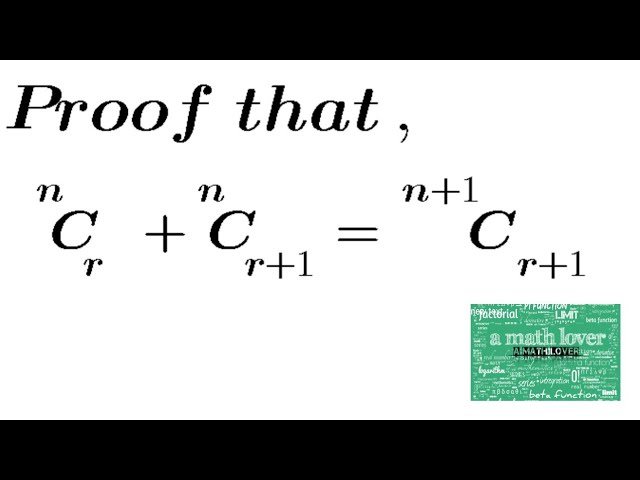
general formula of (nCr + nCr+1 = n+1Cr+1)
Here we also post math question & answer .
Which are trending on social media.
this general formula is very useful and also interesting.
So like comment share & subscribe my YouTube channel and never miss press the bell icon
Also follow me on Instagram
Link-
https://www.instagram.com/a_math_lover/
...
supple vector
Yeah
lime trench
check this rq
supple vector

But I think I have to insert the formulas and then show that it actually the same by arriving at the same formula
lime trench
supple vector
But I think I have to insert the formulas and then show that it actually the sam...
yeah see the video to check calc
you also might get confused so take n-1=N AND k-1=R
@supple vector
supple vector

So he’s doing the same thing that I’m doing by getting a common denominator
But how is it that he could just multiply by this without having it in the nominators as well
lime trench
supple vector
But how is it that he could just multiply by this without having it in the nomin...

he actually did it right
lime trench
supple vector
So he’s doing the same thing that I’m doing by getting a common denominator
do you know that if there are common parts in denominator that need not to be multiplied
in the numerator
supple vector
The arrows that I’ve drawn on the picture indicates why is it not in the nominator as well

Like I do here, right
lime trench
supple vector
but still see the first term;s denominator does not match the 2nd ones
the k! matches
the n-k ! also
but other two?
what abt k-1 ! and n-k-1 !
x(multiply) and /(divide) that too
you will get your ans
as it is pretty simple
you get it @supple vector ?
supple vector
Uhm
supple vector
lime trench
but still see the first term;s denominator does not match the 2nd ones
What do you mean?
lime trench
supple vector
What do you mean?
bro check you addition its wrong?
supple vector
Can you say which line?
lime trench
3rd line
 supple vector
What’s wrong about the two last lines?
lime trench
bro can you come in a vc
supple vector
Yeah
lime trench
ok come in physics server under grad lounge
 lime trench
supple vector
Verified
lime trench
supple vector
Verified
yeah join
supple vector
I can’t because my discord isn’t verified
And I can’t verify it because it takes a number and I have another Discord with the number currently on it
lime trench
supple vector
I can’t because my discord isn’t verified
oh so join lofi girl or any popular server
supple vector
We only have these two common servers
lime trench
supple vector
We only have these two common servers
okay check dm
calm coralBOT
@supple vector Has your question been resolved?
calm coralBOT
Channel closed
Closed due to timeout
Use .reopen if this was a mistake.
Available help channel!
Send your question here to claim the channel.
Remember:
• Ask your math question in a clear, concise manner.
• Show your work, and if possible, explain where you are stuck.
• After 15 minutes, feel free to ping <@&286206848099549185>.
• Type the command .close to free the channel when you're done.
• Be polite and have a nice day!
Read #❓how-to-get-help for further information on how to ask a good question, and about conduct in the question channels.
 tawny grotto
 calm coralBOT
tawny grotto
tawny grotto
calm coralBOT
tawny grotto
tawny grotto
Here we are also taking the derivative of dx when we differentiate sinx dx
?
I mean we take the derivative will be 0
I’m kinda not getting it
remote mural
no your integrating it
tawny grotto
But how dx is popping up
 pure kayak
dv/dx=sin(x) v=-cos(x)
tawny grotto
I’m confused about that
tawny grotto
pure kayak
dv/dx=sin(x) v=-cos(x)
Yeah
remote mural
what do you mean, you integrate sinxdx, the assigned dv, into -cosx or v
your integrating that sinx in respect to x
thats what the dx represents
tawny grotto
Ohhh so v = integral of sinx?
remote mural
correct
tawny grotto
Ahhhh
The same case is for u and du right? u is the integral and du is the derivative
remote mural
its fine, u du, v dv, are just variables your using to follow the steps, you assign some part to U, in this case X, and somepart to DV, in this case sinxdx
you find the derivative and integral respectively
calm coralBOT
Channel closed
Closed by @tawny grotto
Use .reopen if this was a mistake.
Available help channel!
Send your question here to claim the channel.
Remember:
• Ask your math question in a clear, concise manner.
• Show your work, and if possible, explain where you are stuck.
• After 15 minutes, feel free to ping <@&286206848099549185>.
• Type the command .close to free the channel when you're done.
• Be polite and have a nice day!
Read #❓how-to-get-help for further information on how to ask a good question, and about conduct in the question channels.
What step are you on?
1. I don't know where to begin.
2. I have begun but got stuck midway.
3. I got an answer but I was told that it's wrong.
4. I got an answer and would like my work checked.
5. I have a question about someone else's work/solution.
6. I have completed the problem and don't need help anymore. Thank you.
7. None of the above
 waxen ivy
Find how long it took to travel the 120km
Find how much time it would have taken at initial speed
Find initial speed
There's no need for y
The distance is 120km
No, there's a 4 minute difference in those two situations
Yes
calm coralBOT
Channel closed
Closed by @heady flax
Use .reopen if this was a mistake.
waxen ivy
-_-
calm coralBOT
Available help channel!
Send your question here to claim the channel.
Remember:
• Ask your math question in a clear, concise manner.
• Show your work, and if possible, explain where you are stuck.
• After 15 minutes, feel free to ping <@&286206848099549185>.
• Type the command .close to free the channel when you're done.
• Be polite and have a nice day!
Read #❓how-to-get-help for further information on how to ask a good question, and about conduct in the question channels.
 viral pollen
Can someone give me advice on where I can make a maths paper?
viral pollen
Like a website or something
calm coralBOT
@viral pollen Has your question been resolved?
 calm coralBOT
Channel closed
Closed due to timeout
Use .reopen if this was a mistake.
calm coralBOT
Available help channel!
Send your question here to claim the channel.
Remember:
• Ask your math question in a clear, concise manner.
• Show your work, and if possible, explain where you are stuck.
• After 15 minutes, feel free to ping <@&286206848099549185>.
• Type the command .close to free the channel when you're done.
• Be polite and have a nice day!
Read #❓how-to-get-help for further information on how to ask a good question, and about conduct in the question channels.
 lavish haven
howzit lookin
 calm coralBOT
lavish haven
howzit lookin
calm coralBOT
lavish haven
howzit lookin
 kind wagon
you said half of the coefficient of x is 1.5, but didnt specify which x, maybe highlight it somehow
but yeah its looking ok
calm coralBOT
Channel closed
Closed by @lavish haven
Use .reopen if this was a mistake.
calm coralBOT
Available help channel!
Send your question here to claim the channel.
Remember:
• Ask your math question in a clear, concise manner.
• Show your work, and if possible, explain where you are stuck.
• After 15 minutes, feel free to ping <@&286206848099549185>.
• Type the command .close to free the channel when you're done.
• Be polite and have a nice day!
Read #❓how-to-get-help for further information on how to ask a good question, and about conduct in the question channels.
 azure folio
 calm coralBOT
azure folio
remote mural
calm coralBOT
azure folio
remote mural
!showwork
calm coralBOT
Show your work, and if possible, explain where you are stuck.
 exotic falcon
 remote mural
this reduces to 2ln(x)
remote mural
so the integral should be $2(x\ln(x) - x) |_{-e^c}^{e^c + 1}$
potent lotusBOT
45
 remote mural
yea
azure folio
let me work this out and get to an answer
so the upper limit is coming out to 2(ce^(c+1)
and the lower limit is coming out to 2e^c (1-c)
so i'm getting 2ce^(c+1) - 2e^c (1-c)
which would be infinity - infinity (-infinity)
so infinity + infinity^2 lol
where am i going wrong here
 graceful dust
exotic falcon
graceful dust
exotic falcon
not your best work
exotic falcon
graceful dust
not your best work
 calm coralBOT
Channel closed
Closed by @azure folio
Use .reopen if this was a mistake.
calm coralBOT
Available help channel!
Send your question here to claim the channel.
Remember:
• Ask your math question in a clear, concise manner.
• Show your work, and if possible, explain where you are stuck.
• After 15 minutes, feel free to ping <@&286206848099549185>.
• Type the command .close to free the channel when you're done.
• Be polite and have a nice day!
Read #❓how-to-get-help for further information on how to ask a good question, and about conduct in the question channels.
 tawdry sphinx
 calm coralBOT
tawdry sphinx
tawdry sphinx
calm coralBOT
tawdry sphinx
tawdry sphinx
When I have a z score to the left and right do I subtract both then I do 1- to account for the z score on the right?
calm coralBOT
@tawdry sphinx Has your question been resolved?
 elfin merlin
tawdry sphinx
When I have a z score to the left and right do I subtract both then I do 1- to a...
elfin merlin
tawdry sphinx
When I have a z score to the left and right do I subtract both then I do 1- to a...
I find it helpful to draw a graph of what’s being asked for
Shade the part of the curve you want the probabilities for
Most tables give you a diagram showing you what probability is provided at each z score
Use the fact that the whole area adds up to one to get the probabilities you need
calm coralBOT
Channel closed
Closed due to timeout
Use .reopen if this was a mistake.
Available help channel!
Send your question here to claim the channel.
Remember:
• Ask your math question in a clear, concise manner.
• Show your work, and if possible, explain where you are stuck.
• After 15 minutes, feel free to ping <@&286206848099549185>.
• Type the command .close to free the channel when you're done.
• Be polite and have a nice day!
Read #❓how-to-get-help for further information on how to ask a good question, and about conduct in the question channels.
 torpid spear
.reopen
 drowsy tide
i dont know what to do
 calm coralBOT
drowsy tide
i dont know what to do
calm coralBOT
drowsy tide
i dont know what to do
 fleet verge
Do you know what is the exercise asking to you?
calm coralBOT
@drowsy tide Has your question been resolved?
calm coralBOT
Channel closed
Closed due to timeout
Use .reopen if this was a mistake.
Available help channel!
Send your question here to claim the channel.
Remember:
• Ask your math question in a clear, concise manner.
• Show your work, and if possible, explain where you are stuck.
• After 15 minutes, feel free to ping <@&286206848099549185>.
• Type the command .close to free the channel when you're done.
• Be polite and have a nice day!
Read #❓how-to-get-help for further information on how to ask a good question, and about conduct in the question channels.
 waxen topaz
 calm coralBOT
waxen topaz
waxen topaz
calm coralBOT
waxen topaz
waxen topaz
This is the answer but I cant do it

I tried rewriting it as
~(q or ~p ) or (r or p)
then turning the left into an and
(~q and p) or (r or p)
what can change to
(~q and p) or r
I believe
then im stuck
remote mural
You could try to prove it by truth tables
waxen topaz
remote mural
You could try to prove it by truth tables
okay ill try
waxen topaz
remote mural
You could try to prove it by truth tables
I got this
 remote mural
What do you want to prove?
waxen topaz
remote mural
What do you want to prove?
Idk not really prove, the question was to simplify the pined picture to the second picture
my head
calm coralBOT
@waxen topaz Has your question been resolved?
waxen topaz
.close
calm coralBOT
Channel closed
Closed by @waxen topaz
Use .reopen if this was a mistake.
calm coralBOT
Available help channel!
Send your question here to claim the channel.
Remember:
• Ask your math question in a clear, concise manner.
• Show your work, and if possible, explain where you are stuck.
• After 15 minutes, feel free to ping <@&286206848099549185>.
• Type the command .close to free the channel when you're done.
• Be polite and have a nice day!
Read #❓how-to-get-help for further information on how to ask a good question, and about conduct in the question channels.
 inland pawn
 calm coralBOT
inland pawn
inland pawn
calm coralBOT
inland pawn
inland pawn
I'm unsure how to set up the double integral for the mass.
 past zinc
you have to apply the polar coordinates and additionally, you need to divide the region D on three subregions
inland pawn
wouldn't D be the top region inside the red circle and outside the blue one
or is it the middle region
past zinc
this way:
inland pawn
also i am unsure of what to put as my integrand. would it be 1/k ?
 past zinc
inland pawn
also i am unsure of what to put as my integrand. would it be 1/k ?
past zinc
inland pawn
also i am unsure of what to put as my integrand. would it be 1/k ?
this photo shows your correct region D
do you know how to set polar up ?
inland pawn

this is what i have so far, but i am unsure if my integrand is correct
and the bounds
past zinc
bounds are very well
)
let me see function then
these are formulas:

and small sigma
si so called surface density
and
yoru density
is inverse proportinal emans:

k is so called, coeff of propportionality
it wi eb reduced in calculations
inland pawn
so in polar, would it be k/r ?
inland pawn
Jacobian? I am unfamiliar with that.
past zinc
🙂
let me write :

can you see this small greek letter on end ?
ro
mayeb you write r dr
this r is module of jacobian
when you play with double integrals with polar coords
you need to use this jacobian always
inland pawn
ok. It is just a bit confusing because the notation i am learning looks very different 😭
past zinc
inland pawn
ok. It is just a bit confusing because the notation i am learning looks very dif...
yes i am not from usa
inland pawn
let me try.
past zinc
we use ro
 past zinc
lok at formulae i wrote above, M_y is with x inside
inland pawn
oh ok, I switched M_y and M_x
past zinc
 past zinc
yes i thikn al is ok, these integrals as you can see, they are quitely easy
inland pawn
okay. thank you.
past zinc
yw
calm coralBOT
Channel closed
Closed by @inland pawn
Use .reopen if this was a mistake.
calm coralBOT
Available help channel!
Send your question here to claim the channel.
Remember:
• Ask your math question in a clear, concise manner.
• Show your work, and if possible, explain where you are stuck.
• After 15 minutes, feel free to ping <@&286206848099549185>.
• Type the command .close to free the channel when you're done.
• Be polite and have a nice day!
Read #❓how-to-get-help for further information on how to ask a good question, and about conduct in the question channels.
 charred plume
AYUDA
calm coralBOT
charred plume
AYUDA
charred plume
WITH EQUILATERAL AREA TRIANGLES

I wasn’t given any formulas and I also didn’t pay attention in class…😓
leaden thunder
is that dot the center of the triangle? if so, then find the height, then use trig to find the side length
charred plume
Yes it is a dot
So would I just double it to get the height since it’s half
How would I imply trig?
leaden thunder
should be able to recognize a special triangle
calm coralBOT
@charred plume Has your question been resolved?
calm coralBOT
Channel closed
Closed due to timeout
Use .reopen if this was a mistake.
Available help channel!
Send your question here to claim the channel.
Remember:
• Ask your math question in a clear, concise manner.
• Show your work, and if possible, explain where you are stuck.
• After 15 minutes, feel free to ping <@&286206848099549185>.
• Type the command .close to free the channel when you're done.
• Be polite and have a nice day!
Read #❓how-to-get-help for further information on how to ask a good question, and about conduct in the question channels.
lavish haven
3x^2+x+1=0
calm coralBOT
lavish haven
3x^2+x+1=0
lavish haven
how do i solve this?
 swift laurel
quadratic formula
lavish haven
well yes
but i started plugging it in
and look what google says it is
like i looked it up to skip some simplification

what even is that 
like i know imaginary numbers
but guys this cant be
pure kayak
why cant it
lavish haven
this is above my pay grade this is our first assignment on it
im jus being hopeful..
i cant do the ones wiht i
swift laurel
they're complex numbers. if a parabola never crosses the x-axis then it has no real number solutions and instead 2 complex solutions
pure kayak
1-12=-11 im afraid, so imaginary coming to get you
i wouldnt overthink it, theyre not so bad
lavish haven
oh no
pure kayak
quite friendly
swift laurel
,w graph 3x^2 + x + 1
potent lotusBOT


 Requested by cloudedhorizons
lavish haven
Requested by cloudedhorizons
lavish haven
complex numbers killed my entire family and kicked my trashcan over
pure kayak
lavish haven
complex numbers killed my entire family and kicked my trashcan over
that doesnt sound like them
swift laurel
square root of a negative number (b²-4ac in the quadratic formula)
lavish haven
guys
thank you for the help but
i dont think anyone is equipped to explain this to me.
i appreciate u trying
.close
calm coralBOT
Channel closed
Closed by @lavish haven
Use .reopen if this was a mistake.
calm coralBOT
Available help channel!
Send your question here to claim the channel.
Remember:
• Ask your math question in a clear, concise manner.
• Show your work, and if possible, explain where you are stuck.
• After 15 minutes, feel free to ping <@&286206848099549185>.
• Type the command .close to free the channel when you're done.
• Be polite and have a nice day!
Read #❓how-to-get-help for further information on how to ask a good question, and about conduct in the question channels.
 vale pond
Find the sum of the series for n terms $1^2+3^2+5^2+...... $
vale pond
!status
calm coralBOT
What step are you on?
1. I don't know where to begin.
2. I have begun but got stuck midway.
3. I got an answer but I was told that it's wrong.
4. I got an answer and would like my work checked.
5. I have a question about someone else's work/solution.
6. I have completed the problem and don't need help anymore. Thank you.
7. None of the above