#help-42
1 messages · Page 38 of 1
 calm coralBOT
 brittle cape

 drifting seal
distributive property
multiply each term in the left by each term in the right then add
 trim dust
or j do (5x-2)x + (5x-2)4
drifting seal
which is what i said

 azure rose
These are two different questions?
azure rose
but, (x + 2)(3x^2 + 6x -4)
3x^3 + 6x^2 -4x + 6x^2 + 12x - 8
3x^3 + 12x ^2 + 8x - 8
calm coralBOT
brittle cape
Ok guys chatgpt isn’t getting the same answer as me what am I doing wrong here
Please do not trust ChatGPT or similar AI tools for mathematical tasks, as they often generate output which "sounds correct" but has numerous factual or logical errors. Use of these AI tools to answer other people's help questions is strictly against server rules (see #rules).
brittle cape
azure rose
but, (x + 2)(3x^2 + 6x -4)
3x^3 + 6x^2 -4x + 6x^2 + 12x - 8
3x^3 + 12x ^2 + 8x...
Did I just distribute wrong
azure rose
brittle cape
Did I just distribute wrong
I think so
brittle cape
Oh alr
azure rose
x * 6x = 6x^2
You can think of lone variables like the x in (x + 2) as 1x
so 1x * 6x^2 is just (6 * 1)(x * x^2)
brittle cape
So instead of adding x to 6x to make 7x, I add it onto the exponent?
In order to make the 6x^2
azure rose
kind of, yes
calm coralBOT
Channel closed
Closed by @brittle cape
Use .reopen if this was a mistake.
 Available help channel!
Send your question here to claim the channel.
Remember:
• Ask your math question in a clear, concise manner.
• Show your work, and if possible, explain where you are stuck.
• After 15 minutes, feel free to ping <@&286206848099549185>.
• Type the command .close to free the channel when you're done.
• Be polite and have a nice day!
Read #❓how-to-get-help for further information on how to ask a good question, and about conduct in the question channels.
 turbid shell
 calm coralBOT
turbid shell
calm coralBOT
turbid shell
 glad grove
turbid shell
glad grove
turbid shell
try factorizing by grouping
 shadow tendon
turbid shell
shadow tendon
turbid shell
Did u find any rational roots by graphing
shadow tendon
Exactly
shadow tendon
Yeah
calm coralBOT
Channel closed
Closed by @turbid shell
Use .reopen if this was a mistake.
Available help channel!
Send your question here to claim the channel.
Remember:
• Ask your math question in a clear, concise manner.
• Show your work, and if possible, explain where you are stuck.
• After 15 minutes, feel free to ping <@&286206848099549185>.
• Type the command .close to free the channel when you're done.
• Be polite and have a nice day!
Read #❓how-to-get-help for further information on how to ask a good question, and about conduct in the question channels.
 thorny sorrel
for this step could we also just have made the RHS (k+1)(k+2)/2?

 whole urchin
^^
calm coralBOT
@thorny sorrel Has your question been resolved?
 marsh valley
thorny sorrel
for this step could we also just have made the RHS (k+1)(k+2)/2?
marsh valley
thorny sorrel
for this step could we also just have made the RHS (k+1)(k+2)/2?
That's what you want to show, so this step is somewhat necessary to get to the conclusion that 1+2+... + k + (k+1) = (k+1)(k+2)/2.
calm coralBOT
Channel closed
Closed due to timeout
Use .reopen if this was a mistake.
Available help channel!
Send your question here to claim the channel.
Remember:
• Ask your math question in a clear, concise manner.
• Show your work, and if possible, explain where you are stuck.
• After 15 minutes, feel free to ping <@&286206848099549185>.
• Type the command .close to free the channel when you're done.
• Be polite and have a nice day!
Read #❓how-to-get-help for further information on how to ask a good question, and about conduct in the question channels.
 rain grove
How would I solve (9x^2 +7x-5)+(4x^3-x+2)
calm coralBOT
rain grove
How would I solve (9x^2 +7x-5)+(4x^3-x+2)
 calm coralBOT
@rain grove Has your question been resolved?
 leaden thunder
rain grove
How would I solve (9x^2 +7x-5)+(4x^3-x+2)
leaden thunder
rain grove
How would I solve (9x^2 +7x-5)+(4x^3-x+2)
There isn't anything to solve for
What's the question asking
rain grove
I believe I need to simplify it
rain grove
I can’t combine different exponents right?
Oh
Other side

So then would this be the anwser
leaden thunder
The parentheses are unnecessary, but yes that's correct
 rain grove
Idk what that is
 nocturne zephyr

use those
and follow pemdas basically
so youll want to do the powers first
then do the multiplication
calm coralBOT
@rain grove Has your question been resolved?
calm coralBOT
Channel closed
Closed due to timeout
Use .reopen if this was a mistake.
Available help channel!
Send your question here to claim the channel.
Remember:
• Ask your math question in a clear, concise manner.
• Show your work, and if possible, explain where you are stuck.
• After 15 minutes, feel free to ping <@&286206848099549185>.
• Type the command .close to free the channel when you're done.
• Be polite and have a nice day!
Read #❓how-to-get-help for further information on how to ask a good question, and about conduct in the question channels.
 remote mural
 calm coralBOT
remote mural
remote mural
calm coralBOT
remote mural
remote mural
How to solve that one with cubic equation
I would need the steps what I should do to solve that problems
 modern dagger
maximum occurs when f'=0 and f''<0 for smooth curves, right?
remote mural
I dont know much
modern dagger
and min occurs when f'=0 and f''>0
remote mural
modern dagger
do you know those two facts?
remote mural
Hey do I need to use derivatives
modern dagger
did you learn derivatves yet?
remote mural
modern dagger
did you learn derivatves yet?
I little bit
remote mural
modern dagger
you obviously learned integrals so your teacher shouldve togut you min and max
Thanks
I figured out by you what I have to learn
remote mural
Can I learn all of it in Khan academy
modern dagger
the local max occurs when f'(x)=0 and f''(x)<0
probably
you can use those two facts to help you
compute p
or whatever you need to find
the local min occurs when f'(x)=0 and f''(x)>0
you have two equations
and two unknowns
you can now solve it
remote mural
Oh thank you so much
For your help I dont know alot od topucs there so I will learn them and Will try solve later
modern dagger
ok
calm coralBOT
@remote mural Has your question been resolved?
calm coralBOT
Channel closed
Closed due to timeout
Use .reopen if this was a mistake.
calm coralBOT
Available help channel!
Send your question here to claim the channel.
Remember:
• Ask your math question in a clear, concise manner.
• Show your work, and if possible, explain where you are stuck.
• After 15 minutes, feel free to ping <@&286206848099549185>.
• Type the command .close to free the channel when you're done.
• Be polite and have a nice day!
Read #❓how-to-get-help for further information on how to ask a good question, and about conduct in the question channels.
 stark cloak
How would one do an induction proof for an equality of the determinant of a matrix and a term T?
I figured this could be done via the laplace expansion but somehow I cant figure out the induction steps proof and I couldnt find any examples.
Can someone help?
calm coralBOT
stark cloak
How would one do an induction proof for an equality of the determinant of a matr...
stark cloak
This is the situation Im in right now where L(G) is the laplacian of a graph G and L' is the first principal minor

And e1, i is the i-th entry in the first row
Oh sorry it was supposed to be L' everywhere I wrote L
And its n =1 in the basecase actually
calm coralBOT
@stark cloak Has your question been resolved?
calm coralBOT
Channel closed
Closed due to timeout
Use .reopen if this was a mistake.
Available help channel!
Send your question here to claim the channel.
Remember:
• Ask your math question in a clear, concise manner.
• Show your work, and if possible, explain where you are stuck.
• After 15 minutes, feel free to ping <@&286206848099549185>.
• Type the command .close to free the channel when you're done.
• Be polite and have a nice day!
Read #❓how-to-get-help for further information on how to ask a good question, and about conduct in the question channels.
 sweet totem
Let $f:[0,1]\times[0,1] \to \bR$ be an integrwble function and let $g: [0,1]\to[0,1]\times[0,1]$ be a continuous function. Prove or disprove that $f\circ g$ is integrable.
calm coralBOT
sweet totem
Let $f:[0,1]\times[0,1] \to \bR$ be an integrwble function and let $g: [0,1]\to[...
 potent lotusBOT
Faq
 sweet totem
How should I go about this?
 calm coralBOT
@sweet totem Has your question been resolved?
sweet totem
 fluid flame
that's an undergrad question??
fluid flame
that's an undergrad question??
Yeah it’s a second year question
 trail yarrow
sweet totem
How should I go about this?
trail yarrow
sweet totem
How should I go about this?
Hint: the image of g can have measure 0 ( / be just a line idk what integral this is) in [0,1] x [0,1]
calm coralBOT
@sweet totem Has your question been resolved?
calm coralBOT
Channel closed
Closed due to timeout
Use .reopen if this was a mistake.
calm coralBOT
Available help channel!
Send your question here to claim the channel.
Remember:
• Ask your math question in a clear, concise manner.
• Show your work, and if possible, explain where you are stuck.
• After 15 minutes, feel free to ping <@&286206848099549185>.
• Type the command .close to free the channel when you're done.
• Be polite and have a nice day!
Read #❓how-to-get-help for further information on how to ask a good question, and about conduct in the question channels.
 near pawn
could anyone lead me to where i could get help with string theory?
 reef nimbus
 graceful dust
near pawn
graceful dust
near pawn
thanks
calm coralBOT
@near pawn Has your question been resolved?
Channel closed
Closed by @near pawn
Use .reopen if this was a mistake.
Available help channel!
Send your question here to claim the channel.
Remember:
• Ask your math question in a clear, concise manner.
• Show your work, and if possible, explain where you are stuck.
• After 15 minutes, feel free to ping <@&286206848099549185>.
• Type the command .close to free the channel when you're done.
• Be polite and have a nice day!
Read #❓how-to-get-help for further information on how to ask a good question, and about conduct in the question channels.
 unreal nest
in a quadrilateral ABCD, the diagonals meet at E, such that EA:EB = EC:ED. Prove that ABCD is a parrallelogram
calm coralBOT
unreal nest
in a quadrilateral ABCD, the diagonals meet at E, such that EA:EB = EC:ED. Prove...
unreal nest
i figured that ABE is similar to CDE, so angle EAB = angle ECD, hence AB || CD
i cant figure out how to prove AD || BC or AB = CD

nvm
i read the question wrong
.close
calm coralBOT
Channel closed
Closed by @unreal nest
Use .reopen if this was a mistake.
Available help channel!
Send your question here to claim the channel.
Remember:
• Ask your math question in a clear, concise manner.
• Show your work, and if possible, explain where you are stuck.
• After 15 minutes, feel free to ping <@&286206848099549185>.
• Type the command .close to free the channel when you're done.
• Be polite and have a nice day!
Read #❓how-to-get-help for further information on how to ask a good question, and about conduct in the question channels.
 warm grove
hello
calm coralBOT
warm grove
hello
warm grove
We ask for the values of x so that the following expressions denote a real:
log(1-2x)
its 1/2 > x ?
 lime valve
!original
calm coralBOT
Please show the original problem, exactly as it was stated to you, with the entire original context. A picture or screenshot is best. If the original problem is not in English, then post it anyway! The additional context might still be helpful. Do your best to provide a translation.
warm grove
this is the original
lime valve
warm grove
its 1/2 > x ?
yes
warm grove
thank you brather
warm grove
lime valve
yes
hey
lime valve
hi
warm grove
for logx(-x²-x+2)
lime valve
yes
warm grove
i need to do -x²-x+2>0 ?
warm grove
thank you brother
lime valve
is your base x here?
warm grove
yes
lime valve
warm grove
i need to do -x²-x+2>0 ?
then find solutions for this and take the intersection of it with x > 0
lime valve
yes
warm grove
.close
calm coralBOT
Channel closed
Closed by @warm grove
Use .reopen if this was a mistake.
Available help channel!
Send your question here to claim the channel.
Remember:
• Ask your math question in a clear, concise manner.
• Show your work, and if possible, explain where you are stuck.
• After 15 minutes, feel free to ping <@&286206848099549185>.
• Type the command .close to free the channel when you're done.
• Be polite and have a nice day!
Read #❓how-to-get-help for further information on how to ask a good question, and about conduct in the question channels.
 pearl jay
how do i calculate this limit without using lhopital?

 glass heart
for example induction
 wide creek

 past zinc
you can use the theorem about two sequences, or show that the inverse of this sequence converges to zero, and since it is positive, the sequence itself diverges to infinity
 cloud topaz
Another way is proving 2^n/n >= (n-1)/2
calm coralBOT
Channel closed
Closed by @pearl jay
Use .reopen if this was a mistake.
Available help channel!
Send your question here to claim the channel.
Remember:
• Ask your math question in a clear, concise manner.
• Show your work, and if possible, explain where you are stuck.
• After 15 minutes, feel free to ping <@&286206848099549185>.
• Type the command .close to free the channel when you're done.
• Be polite and have a nice day!
Read #❓how-to-get-help for further information on how to ask a good question, and about conduct in the question channels.
 junior fern
 calm coralBOT
junior fern
reef nimbus
calm coralBOT
junior fern
reef nimbus
it's part of the definition of the relation
 hollow totem
You don't have to prove an iff statement
junior fern
 glass heart
which is part of the definition of what R is
"the relation R = (some stuff) is only transitive"
junior fern
but isnt proving an if and only statement requires proving if p then q and if q then p
glass heart
where the some stuff is "for x,y in R, x~y <=> x < y"
calm coralBOT
Channel closed
Closed by @junior fern
Use .reopen if this was a mistake.
Available help channel!
Send your question here to claim the channel.
Remember:
• Ask your math question in a clear, concise manner.
• Show your work, and if possible, explain where you are stuck.
• After 15 minutes, feel free to ping <@&286206848099549185>.
• Type the command .close to free the channel when you're done.
• Be polite and have a nice day!
Read #❓how-to-get-help for further information on how to ask a good question, and about conduct in the question channels.
 tall hemlock
 calm coralBOT
tall hemlock
calm coralBOT
tall hemlock
 tall hemlock
if so, what is that method called, i forgot it
calm coralBOT
Channel closed
Closed by @tall hemlock
Use .reopen if this was a mistake.
Available help channel!
Send your question here to claim the channel.
Remember:
• Ask your math question in a clear, concise manner.
• Show your work, and if possible, explain where you are stuck.
• After 15 minutes, feel free to ping <@&286206848099549185>.
• Type the command .close to free the channel when you're done.
• Be polite and have a nice day!
Read #❓how-to-get-help for further information on how to ask a good question, and about conduct in the question channels.
 tawny lava
@wet hollow
atan(-x,-y) is supposed to be atan2(-x,-y)
 tawny lava
atan2 is a piecewise function
its the same as arctan, but without quadrant constraints
it gives the correct angle over all quadrants
primarily important in light ray reflections such as the one I am doing
 calm coralBOT
@tawny lava Has your question been resolved?
 wet hollow
What do you mean by "correct angle"? Arc tangent has the codomain restrictions it does in order to make it a function.
The angle is not unique.
tawny lava
when x and y are negative, it thinks they are in the first quadrant and therefore gives quadrant 1 angles
when they are in quadrant 3
it doesn't know if the angle is also in quadrant 2 or 4, it cannot tell
because it could be y or x that are negative
wet hollow
So atan2(-x, -y) is just $\tan^{-1}(x/y) + \pi$?
potent lotusBOT
chencking

 wet hollow
You cannot remove the peacewise, but $\cos(\tan^{-1}(x/y)) = \frac{|y|}{\sqrt{x^2 + y^2}}$
potent lotusBOT
chencking
 wet hollow
Something similar is true for sin except with x
tawny lava
but is there anyway i can solve for x and y without having to solve x,y and c for so many equations?
from here

because in the end, I get one ridiculously long polynomial
wet hollow
Not that I can see. You're going to have to do the casework on when each part is positive or negative. It's a slog but it is what it is.
tawny lava
it does simplify to get rid of the trig functions and give only x and y but its so much work that has to be done for so many equations
wet hollow
If the atan2 form is something you reached and the original problem is something different, then you can try posting the original question and seeing if anyone knows a simpler approach.
Otherwise, you may not have any choice other than doing the casework.
tawny lava
there is no original question
its just work I am doing on my own to calculate light ray reflections to find the focal points of all surfaces
I am doing this for a set number of light ray bounces
calm coralBOT
@tawny lava Has your question been resolved?
calm coralBOT
@tawny lava Has your question been resolved?
calm coralBOT
Channel closed
Closed due to timeout
Use .reopen if this was a mistake.
Available help channel!
Send your question here to claim the channel.
Remember:
• Ask your math question in a clear, concise manner.
• Show your work, and if possible, explain where you are stuck.
• After 15 minutes, feel free to ping <@&286206848099549185>.
• Type the command .close to free the channel when you're done.
• Be polite and have a nice day!
Read #❓how-to-get-help for further information on how to ask a good question, and about conduct in the question channels.
 glad sinew
 calm coralBOT
glad sinew
glad sinew
calm coralBOT
glad sinew
glad sinew
I know i gotta prove this but if U is {1,2,3}, A={1,2,3}, and let C be {1,2}, C\A would be {3} but there is no such B, where C intersect B would be {3}
reef nimbus
C would be the empty set for your example, wouldn't it?
 dapper sable
glad sinew
I know i gotta prove this but if U is {1,2,3}, A={1,2,3}, and let C be {1,2}, C\...
dapper sable
glad sinew
I know i gotta prove this but if U is {1,2,3}, A={1,2,3}, and let C be {1,2}, C\...
It doesn't say for all C, there exists a unique B. It says there is a unique B such that for all C.
You need to find a B that works.
You don't start that off by trying a C.
glass heart
well you definitely can start off by just trying some stuff
its not a proof but thats how you find out whats going on
glad sinew
dapper sable
It doesn't say for all C, there exists a unique B. It says there is a unique B s...
isnt it reversible?
no?
says that theres a unique B such that for evry C
dapper sable
No, only if it's exists followed by exists or for all followed by for all.
glass heart
try a few examples. see how the set B relates to A in those examples
glad sinew
heres the solution btw
 glass heart
well then what do you want to hear
dapper sable
B = {}.
C = A implies C \ A = C \ C = {}
B = {} implies C n B = C n {} = {}
{} = {}
C \ A = C n B.
calm coralBOT
@glad sinew Has your question been resolved?
glad sinew
yes but isnt it saying for every A?
say the powerset of {1,2,3}
if C=A={2,3}, then B could be any set that is disjoint from C
For example, B could be {/0}, {1}
dapper sable
No, B is picked before C is.
B has to work for all C.
So, it has to work for A = C, but it also has to work for other values of C.
B doesn't depend on C.
@glad sinew
glad sinew
oops sorry
hm ok
So the solutions chose B=U\A. Which makes sense
but deriving that during an exam is gonna be 😵💫
dapper sable
Yeah, you have to practice proofs to get better so that you can do them on exams.
Notice that A = C has to work because all C values have to work.
And you can see that {} works for B in that case.
But then you can notice that B just can't have any A elements in it.
Because you'll possibly have C as a strict superset of A, so C \ A will have some elements in it, they just can't be elements of A.
So, since C \ A can't have A elements in it, neither can C n B. The "n B" part needs to take all the elements of A away to make that happen.
By that I mean, the B can't have any elements of A in it.
But it also has to have all the elements of C in it that aren't in A.
Otherwise the "n B" will take away too many elements from C to match C \ A.
So, since C is arbitrary, you have to have all elements of U in B, except those in A.
That way, C n B will always have all the elements of C in it that aren't in A.
Also, C n B won't have any elements of A in it that were subtracted in C \ A.
Then you prove uniqueness from there.
glad sinew
thank you!
dapper sable
You're welcome.
calm coralBOT
@glad sinew Has your question been resolved?
Channel closed
Closed by @glad sinew
Use .reopen if this was a mistake.
Available help channel!
Send your question here to claim the channel.
Remember:
• Ask your math question in a clear, concise manner.
• Show your work, and if possible, explain where you are stuck.
• After 15 minutes, feel free to ping <@&286206848099549185>.
• Type the command .close to free the channel when you're done.
• Be polite and have a nice day!
Read #❓how-to-get-help for further information on how to ask a good question, and about conduct in the question channels.
 iron yoke
A rocket is shot straight from the roof of a school. The height, h in metres, after t seconds can be approximated by h = -5t^2 + 22t + 15
how long would it take the rocket to pass a window that is 10m above the ground?
calm coralBOT
iron yoke
A rocket is shot straight from the roof of a school. The height, h in metres, af...
iron yoke
so we look for t
 red yarrow
yep!
iron yoke
but im not sure how to sub in H and get the value of t
red yarrow
it's a quadratic equation because of the t^2
iron yoke
yep
red yarrow
iron yoke
but im not sure how to sub in H and get the value of t
h = 10 = -5t^2+22t+15
iron yoke
and then i get stuck when solving
red yarrow
well first you gotta set it equal to 0, because otherwise you get into the hell that is trying to solve from both sides
iron yoke
so -5t^2+22t+15 - 10 = 0?
iron yoke
after that do you just factor?
red yarrow
yep
iron yoke
so get the answer in factored form
red yarrow
mhm! and then you pick the answer that makes the most sense / is the smallest
there will be two answers because it's a quadratic equation
red yarrow
yep
red yarrow
🫡
iron yoke
red yarrow
🫡
uhhh
red yarrow
?
red yarrow
D:
iron yoke
shoot
red yarrow
it should be 4.62 yeah
check and make sure you didn't mess up any negatives, since you have a = -5
iron yoke
okay one sec
iron yoke
red yarrow
also if it helps it should be -b - sqrt(...) not -b +
okayy everything's good now i got 4.62
thanks
im learning quadratic word problems rn and I hate word problems so much
iron yoke
red yarrow
:D
wait when im finding the max height of the rocket
im going to be looking for the y value of the vertex right
iron yoke
i literally got 7.84 when the answer is 39.2
💀
so i was completing the square
oh shoot
wait i think i know what i did wrong
ok nvm
here are the things i did
i did the following
-5(t^2 - 22/5 - 3)
-5(t^2 - 22/5 + 4.84 - 4.84) - 3
-5(t - 2.2)^2 + 24.2 - 3
-5(t-2.2)^2 + 21.2
@red yarrow where'd I go wrong?
red yarrow
gimme a sec i'm trying to figure it out 😅 it's been a long time since i've had to do completing the square
iron yoke
np ty
red yarrow
i think you may have forgotten to square it after dividing by 2 though
here's my results (sorry i couldn't figure out a better way to show this)

you have to account for the -5 when you're taking (-121/10) out
iron yoke
red yarrow
i think you may have forgotten to square it after dividing by 2 though
AHHHhhhh 😭 ur right
omg
red yarrow
it's alright, i mean it took me a few tries too 😆 in my defense i haven't done completing the square in years so
remember that whenever you summon some random constant out of thin air you have to justify it by subtracting it from the same equation too
i tried to show how the -5 affects the negative constant (-121/10) with arrows but i'm not sure how clearly it comes across
red yarrow
of course!
calm coralBOT
@iron yoke Has your question been resolved?
Channel closed
Closed by @iron yoke
Use .reopen if this was a mistake.
Available help channel!
Send your question here to claim the channel.
Remember:
• Ask your math question in a clear, concise manner.
• Show your work, and if possible, explain where you are stuck.
• After 15 minutes, feel free to ping <@&286206848099549185>.
• Type the command .close to free the channel when you're done.
• Be polite and have a nice day!
Read #❓how-to-get-help for further information on how to ask a good question, and about conduct in the question channels.
 high drift
What is 1/2(x-1)^2-1
calm coralBOT
high drift
What is 1/2(x-1)^2-1
Please don't occupy multiple help channels.
@high drift Has your question been resolved?
calm coralBOT
Channel closed
Closed due to timeout
Use .reopen if this was a mistake.
Available help channel!
Send your question here to claim the channel.
Remember:
• Ask your math question in a clear, concise manner.
• Show your work, and if possible, explain where you are stuck.
• After 15 minutes, feel free to ping <@&286206848099549185>.
• Type the command .close to free the channel when you're done.
• Be polite and have a nice day!
Read #❓how-to-get-help for further information on how to ask a good question, and about conduct in the question channels.
 wraith fern
How do I know when to use degree or radian mode when solving sinusoidal or tangent problems?
For example, I was solving this problem (on paper, this is the key), and at first I solved it using degree mode and got roughly 30.5m, then realized it was wrong and solved it in radians. How would I figure out which mode to use in the first place?
 calm coralBOT
wraith fern
How do I know when to use degree or radian mode when solving sinusoidal or tange...
wraith fern
calm coralBOT
wraith fern
How do I know when to use degree or radian mode when solving sinusoidal or tange...
wraith fern
Also, I realized after a while that degree mode was also wrong because it changed the period of the function since I didn't know my window was at x max: 365. I still need clarification though, if possible.
calm coralBOT
@wraith fern Has your question been resolved?
calm coralBOT
@wraith fern Has your question been resolved?
Channel closed
Closed by @wraith fern
Use .reopen if this was a mistake.
Available help channel!
Send your question here to claim the channel.
Remember:
• Ask your math question in a clear, concise manner.
• Show your work, and if possible, explain where you are stuck.
• After 15 minutes, feel free to ping <@&286206848099549185>.
• Type the command .close to free the channel when you're done.
• Be polite and have a nice day!
Read #❓how-to-get-help for further information on how to ask a good question, and about conduct in the question channels.
 stark steeple
 calm coralBOT
stark steeple
stark steeple
calm coralBOT
stark steeple
stark steeple
Its asking to evaluate the closed integral F*dr using stoke's theorem and surface integrals
I think first step would be finding curlF which i got <2z,-1,-2y>
but not sure where to go from here
leaden thunder
stark steeple
Its asking to evaluate the closed integral F*dr using stoke's theorem and surfac...
Do a couple examples
https://tutorial.math.lamar.edu/classes/calcIII/stokestheorem.aspx

Mathematics LibreTexts
In this section, we study Stokes’ theorem, a higher-dimensional generalization of Green’s theorem. This theorem, like the Fundamental Theorem for Line Integrals and Green’s theorem, …
stark steeple
leaden thunder
Do a couple examples
https://tutorial.math.lamar.edu/classes/calcIII/stokestheor...
i already did a lesson on it
im just having trouble with this one cuz usually you would have g(x,y)
but now its only in terms of t in which I don't know what x and y are equal to
in order to use ∫∫-Pdg/dx - Qdg/dy + R dA
leaden thunder
stark steeple
but now its only in terms of t in which I don't know what x and y are equal to
Did you learn parametrization
Do this lesson if you haven't
https://math.libretexts.org/Bookshelves/Calculus/Calculus_(OpenStax)/16%3A_Vector_Calculus/16.02%3A_Line_Integrals
Mathematics LibreTexts
Line integrals have many applications to engineering and physics. They also allow us to make several useful generalizations of the Fundamental Theorem of Calculus. And, they are closely connected to …
And a couple examples
stark steeple
leaden thunder
Did you learn parametrization
ive learned line integrals but I need to do this in a surface integral
cuz thats per instruction
leaden thunder
stark steeple
ive learned line integrals but I need to do this in a surface integral
Then parametrize the surface?
Mathematics LibreTexts
If we wish to integrate over a surface (a two-dimensional object) rather than a path (a one-dimensional object) in space, then we need a new kind of integral. We can extend the concept of a line …
calm coralBOT
@stark steeple Has your question been resolved?
calm coralBOT
Channel closed
Closed due to timeout
Use .reopen if this was a mistake.
Available help channel!
Send your question here to claim the channel.
Remember:
• Ask your math question in a clear, concise manner.
• Show your work, and if possible, explain where you are stuck.
• After 15 minutes, feel free to ping <@&286206848099549185>.
• Type the command .close to free the channel when you're done.
• Be polite and have a nice day!
Read #❓how-to-get-help for further information on how to ask a good question, and about conduct in the question channels.
 hollow sphinx
 calm coralBOT
hollow sphinx
reef nimbus
calm coralBOT
hollow sphinx
reef nimbus
division rule? yes it should be
hollow sphinx
reef nimbus
division rule? yes it should be
should be + you mean?
or the - is correct
reef nimbus
plus
hollow sphinx
then wouldn't the function not have a horizontal asymptote at 1?
unless they messed up the numerator too
potent lotusBOT


 hollow sphinx
reef nimbus
numerator looks right
hollow sphinx
reef nimbus
numerator looks right
but then when you plug 1 into that you don't get 0, so there is no horizontal asymptote at x = 1
is C still the correct answer, if so why?
reef nimbus
I thought you were just asking about the derivative (i.e., the blue circle)
for C, f(1) = f(-1) = 0
calm coralBOT
@hollow sphinx Has your question been resolved?
hollow sphinx
reef nimbus
I thought you were just asking about the derivative (i.e., the blue circle)
yeah that was my question intiailly, but due to that I don't see how C can be the answer
if we plug in 1 into the derivative we get 4/4
for a horizontal asymptote shouldn't f'(x) not exist or be 0?
reef nimbus
why are you plugging in 1 at the derivative?
hollow sphinx
to see if that gives infinity
reef nimbus
at x=1 the function is increasing, so it makes sense it's slope is 1
hollow sphinx
from the graph we can see that there's a horizontal asymptote at x =1
reef nimbus
no...
calm coralBOT
Channel closed
Closed by @hollow sphinx
Use .reopen if this was a mistake.
Available help channel!
Send your question here to claim the channel.
Remember:
• Ask your math question in a clear, concise manner.
• Show your work, and if possible, explain where you are stuck.
• After 15 minutes, feel free to ping <@&286206848099549185>.
• Type the command .close to free the channel when you're done.
• Be polite and have a nice day!
Read #❓how-to-get-help for further information on how to ask a good question, and about conduct in the question channels.
 restive dove
I dont know where to start at all
 calm coralBOT
restive dove
I dont know where to start at all
restive dove
calm coralBOT
restive dove
I dont know where to start at all
restive dove
im supposed to do this without the halflife formula btw
 paper obsidian
restive dove
I dont know where to start at all
paper obsidian
restive dove
I dont know where to start at all
Is the answer ~4?
restive dove
well maybe but idk how to do it
like im confused what the hint is saying in relation to the equation I should be using
paper obsidian
restive dove
like im confused what the hint is saying in relation to the equation I should be...
Its just showing the formula
X is the days
Then M(x) = 0.336P (P is the mass of radon-222)
So we divide 0.336 by 6 to see what the original formula was
We get 0.56x * P
Then we wanna get 0.5P that means 0.5P=0.56xP
That means x = ~1?🫠
Stupid problem
restive dove
final on wednesday 
paper obsidian
Fr same
Actually I did the math wrong
0.336 divided by 6 is 0.056
So our formula is M(x) = x0.056P
That should be equal to 0.5P
restive dove
whats P
paper obsidian
Then x0.056=0.5
restive dove
ah okai
paper obsidian
paper obsidian
Then x0.056=0.5
Then x = ~9
Are we even expected to round these numbers?
restive dove
answer key says 3.8132 days 
 calm coralBOT
Channel closed
Closed by @restive dove
Use .reopen if this was a mistake.
paper obsidian
Oh wait
calm coralBOT
Available help channel!
Send your question here to claim the channel.
Remember:
• Ask your math question in a clear, concise manner.
• Show your work, and if possible, explain where you are stuck.
• After 15 minutes, feel free to ping <@&286206848099549185>.
• Type the command .close to free the channel when you're done.
• Be polite and have a nice day!
Read #❓how-to-get-help for further information on how to ask a good question, and about conduct in the question channels.
paper obsidian
Nah nvm, best I managed to get was 4.032. Leave the channel open, someone smarter could help
calm coralBOT
paper obsidian
Nah nvm, best I managed to get was 4.032. Leave the channel open, someone smarte...
paper obsidian
.close
calm coralBOT
Channel closed
Closed by @paper obsidian
Use .reopen if this was a mistake.
calm coralBOT
Available help channel!
Send your question here to claim the channel.
Remember:
• Ask your math question in a clear, concise manner.
• Show your work, and if possible, explain where you are stuck.
• After 15 minutes, feel free to ping <@&286206848099549185>.
• Type the command .close to free the channel when you're done.
• Be polite and have a nice day!
Read #❓how-to-get-help for further information on how to ask a good question, and about conduct in the question channels.
 languid pagoda
How to do first one
 calm coralBOT
languid pagoda
How to do first one
calm coralBOT
languid pagoda
How to do first one
 exotic zealot
- can you use a calcylator?
- is the commas decimal poijts?
and show me the entire question please
languid pagoda
You can’t use a calculator and it’s decimals it’s just French
languid pagoda
exotic zealot
and show me the entire question please
It is the entire question
Oh
exotic zealot
did they mention anything about the number line?
languid pagoda
 exotic zealot
or any instructions?
languid pagoda
So what do I do
languid pagoda
exotic zealot
or any instructions?
It’s there
exotic zealot
right
still a bit confused on whatvthey want with tthe nunberline
i think its best if i leave it here
languid pagoda
?
languid pagoda
Noooo
When you get the answer you put it on the number line
?
Nvm
Ok I’ll wait
calm coralBOT
@languid pagoda Has your question been resolved?
calm coralBOT
@languid pagoda Has your question been resolved?
languid pagoda
No
calm coralBOT
@languid pagoda Has your question been resolved?
 dire zephyr
languid pagoda
dire zephyr
languid pagoda
the whole thing?
dire zephyr
well that's the only thing i can see
languid pagoda
Yea
dire zephyr
I'll show you a couple of them, so you see how it works
let's start with sqrt(119)
we know that 10^2=100 < 119 < 11^2 = 121, so the estimate will be 10 < sqrt(119) < 11
next, sqrt(2/9)
(1/3)^2 = 1/9 < 2/9 < 4/9 = (2/3)^2 , so the estimate will be (1/3) < sqrt (2/9) < (2/3)
your goal is to use whole or rational numbers to estimate these irrational numbers
languid pagoda
0.77
dire zephyr
so that's where the perfect squares come in.
dire zephyr
languid pagoda
0.77
?
languid pagoda
dire zephyr
we know that 10^2=100 < 119 < 11^2 = 121, so the estimate will be 10 < sqrt(119)...
It’s 11.9
dire zephyr
i might be blind, but I don't see any decimal point there
but let's say that we need to estimate sqrt(11.9)
languid pagoda
dire zephyr
i might be blind, but I don't see any decimal point there
There is not a decimal on
One
dire zephyr
i am really confused as to what you want from me
languid pagoda
dire zephyr
we know that 10^2=100 < 119 < 11^2 = 121, so the estimate will be 10 < sqrt(119)...
So it’s 11
Only
dire zephyr
what will be 11 only?
languid pagoda
119
dire zephyr
we've discussed that it lies in between 100 and 121, so the square root lies between 10 and 11. What should I explain more clearly?
dire zephyr
yes, you mark the lower and upper bound on the number line
languid pagoda
dire zephyr
yes, you mark the lower and upper bound on the number line
?
dire zephyr
and the square root goes strictly inbetween
languid pagoda
Ohhhhhhhhhhhh
dire zephyr
(1/3)^2 = 1/9 < 2/9 < 4/9 = (2/3)^2 , so the estimate will be (1/3) < sqrt (2/9) < (2/3)
languid pagoda
dire zephyr
(what's "left" and "right" of the number)
So 11 on the line at right far and left one is 10 far
dire zephyr
languid pagoda
So 11 on the line at right far and left one is 10 far
i don't 100% understand what you mean by the word "far", but probably yeah
languid pagoda
dire zephyr
(1/3)^2 = 1/9 < 2/9 < 4/9 = (2/3)^2 , so the estimate will be (1/3) < sqrt (2/9...
I don’t understand
dire zephyr
dire zephyr
(1/3)^2 = 1/9 < 2/9 < 4/9 = (2/3)^2 , so the estimate will be (1/3) < sqrt (2/9...
this here means the sqrt(2/9) lies between 1/3 (left) and 2/3 (right)
I am asking just for clarification, how old are you/what level of education do you have (what level of school do you go to), just so i know how to approach explaining this
languid pagoda
On what
dire zephyr
In general, what a (rational) fraction is
languid pagoda
No I forgot
dire zephyr
Ok, I'll draw a few things for you.
languid pagoda
Kk
dire zephyr
 languid pagoda
Ok
dire zephyr
a square is when you multiply the same thing twice :>
so that means 2^2 or two squared is equal to 2 times 2,
5^2 or five squared is equal to 5 times 5 and so on.
languid pagoda
Yea
dire zephyr
You can also square fractions!
just multiply the top part to itself, and the bottom part to itself!
dire zephyr
$\frac{1}{3}\cdot\frac{1}{3} = \frac{1}{9}$
potent lotusBOT
🇵🇸Mína🔆
 languid pagoda
Now what
dire zephyr
conversly, a square root sort of "takes away" the square, or the second power
languid pagoda
Why is it not 4/81
dire zephyr
that means, if a number is not a perfect square (meaning a square of some natural number) or a ratio of two perfect squares, that number will be irrational
well, we know, that $\left(\frac{2}{9}\right)^2=\frac{4}{81}$
languid pagoda
Ok
potent lotusBOT
🇵🇸Mína🔆
 dire zephyr
that is not what we are trying to calculate though
by the nature of this excercise, we are trying to estimate these irrational numbers (meaning numbers, which are not expressible as a finite ratio of two whole numbers) by rational numbers (or fractions)
languid pagoda
???
dire zephyr
Let us come back to the 2/9 example
languid pagoda
Ok
dire zephyr
we know the perfect squares.
1,2,3,4,5,6,7,8,9,... squares to 1,4,9,16,25,36,49,64,81...
languid pagoda
Yes
dire zephyr
2 is not a perfect square. Thus, the ratio sqrt(2/9) must lie somewhere between two ratios of perfect squares
languid pagoda
1.5
languid pagoda
dire zephyr
2 is not a perfect square. Thus, the ratio sqrt(2/9) must lie somewhere *between...
So how
dire zephyr
how about you think about it with all the information I have made available to you? I will not be doing this whole excercise for you
I want to teach you how to think about this and express it on your own.
languid pagoda
I did
dire zephyr
once again, 1 squares to 1, 2 squares to 4. 3 squares to 9, so we don't have to worry about that.
languid pagoda
So we’re doing 2/9
dire zephyr
thus, sqrt(2/9) is between 1/3 and 2/3.
I'll show you one more with a decimal point, and then I'm done. I am not getting paid to do this.
languid pagoda
Ohh you did division
dire zephyr
let's look at sqrt(1.6).
languid pagoda
dire zephyr
I'll show you one more with a decimal point, and then I'm done. I am not getting...
Ok you don’t need to make me sad 😑
languid pagoda
dire zephyr
let's look at sqrt(1.6).
Ok now what
 magic olive
Do you know what is "perfect square"?
languid pagoda
Yes ik it
magic olive
so what is it
languid pagoda
Not gonna say
magic olive
💀
languid pagoda
Or it’s 0.81 and 1.21 or it’s 0.64
dire zephyr
$\sqrt{1.6}=\sqrt{\frac{16}{10}}=\frac{4}{\sqrt{10}}=\frac{4}{\sqrt{10}}\cdot\frac{\sqrt{10}}{\sqrt{10}}=\frac{4\cdot\sqrt{10}}{10}=\frac{2\cdot\sqrt{10}}{5}. $ So now we just find an estimate for $\sqrt{10}$. We know $\sqrt{9}=3$ and $\sqrt{16}=4$, so in the end $\sqrt{1.6}$ is gonna lie between $\frac{2\cdot 3}{5}=\frac{6}{5}$ and $\frac{2\cdot 4}{5}=\frac{8}{5}$.
Try to look at these examples, and do others on your own. Write here, after trying, how you did, and other folks will help you, if needed. I wish you strength and patience.
potent lotusBOT
🇵🇸Mína🔆
 languid pagoda
The 9 and 3 is random tho.
And how did 5 is there…
Ok I’m just gonna not do it anymore I’m not doing it with my dad I hate him haha bye
dire zephyr
dire zephyr
Try to look at these examples, and do others on your own. Write here, **after tr...
.
calm coralBOT
@languid pagoda Has your question been resolved?
calm coralBOT
Channel closed
Closed due to timeout
Use .reopen if this was a mistake.
Available help channel!
Send your question here to claim the channel.
Remember:
• Ask your math question in a clear, concise manner.
• Show your work, and if possible, explain where you are stuck.
• After 15 minutes, feel free to ping <@&286206848099549185>.
• Type the command .close to free the channel when you're done.
• Be polite and have a nice day!
Read #❓how-to-get-help for further information on how to ask a good question, and about conduct in the question channels.
 zinc phoenix
 calm coralBOT
zinc phoenix
zinc phoenix
calm coralBOT
zinc phoenix
zinc phoenix
so this is the question
heres my idea so far
I use conservation of momentum to find the system of equations
the known values are $v_f\text{ and }m_w\text{ and }m_f$
potent lotusBOT
SoMadSoBad
 potent lotusBOT
SoMadSoBad
 zinc phoenix
I really dont know where to go from here though
trail yarrow
is this conservation of momentum? where is the term for the momentum of the wings
zinc phoenix
trail yarrow
is this conservation of momentum? where is the term for the momentum of the wing...
hm
do I need to do that?
if so, why?
This is indeed conservation of momentum
trail yarrow
the wings are part of the system are they not?
zinc phoenix
but how would they help us find v_1?
theyre no longer attached
after the plane breaks apart
trail yarrow
no, but some of the momentum before the plane broke apart is now in the wings
zinc phoenix
trail yarrow
no, but some of the momentum before the plane broke apart is now in the wings
I see
zinc phoenix
trail yarrow
no, but some of the momentum before the plane broke apart is now in the wings
Is the equation that I presented incorrect or is it one of the ones I need?
trail yarrow
it's incorrect
because the two sides will have different values
(I'm also unsure why you subtracted the masses of the wings on the RHS, given mf is already just the fuselage)
zinc phoenix
trail yarrow
(I'm also unsure why you subtracted the masses of the wings on the RHS, given mf...
right
the left hand side of that equation i think is still right though
unsure what I could do differently about the right
trail yarrow
the idea is that the momentum before and after the breakup is the same, in all directions
both forwards/backwards (which intially is the LHS of your equation)
but also side to side, which is intially 0
if you split vL and vR into components, using sin and cos and a new unknown theta, the angle the right wing is travelling at, you can write separate equations for the two directions
(the third equation you need, due to the three unknowns vL, vR, theta, comes from the 'assume very little energy was lost')
zinc phoenix
trail yarrow
if you split vL and vR into components, using sin and cos and a new unknown thet...
Wouldn’t you use cos for both vL and vR?
Since vF js known?
zinc phoenix
trail yarrow
yes, but you'd need sin for the other component
But why do we need that
Doesn’t seem like it’s related to the problem
trail yarrow
we need it because momentum is conserved
zinc phoenix
man im so lost
i have trig equations for vL and vR
vR doesnt use 60, it uses theta
trail yarrow
yes
zinc phoenix
trail yarrow
yes
vL and vR arent equal, right?
zinc phoenix
trail yarrow
or at least we can't assume they are
I also have equations for the y components of vL and vR now
how exactly do I put these into an equation?
trail yarrow
ok, now conservation of momentum says that the x components of momentum before and after break up are equal
and the same holds for the y components
zinc phoenix
trail yarrow
ok, now conservation of momentum says that the x components of momentum before a...
so for the x component it'd just be
$(m_f+2m_w)v_1=m_fv_f$
potent lotusBOT
SoMadSoBad
 trail yarrow
ok but what about the wings?
potent lotusBOT
SoMadSoBad
 potent lotusBOT
SoMadSoBad
 zinc phoenix
trail yarrow
ok but what about the wings?
zinc phoenix
trail yarrow
ok but what about the wings?
how does that look?
trail yarrow
is that the x components?
trail yarrow
(this does work if you treat them as vectors, idk if you've learned those, but not as scalars)
zinc phoenix
if we treat them as scalars
zinc phoenix
trail yarrow
(this does work if you treat them as vectors, idk if you've learned those, but n...
i guess since its in x direction
it needs to be v_f
not v_L or v_R
so
$(m_f+2m_w)v_1=m_fv_f+2m_wv_f$
potent lotusBOT
SoMadSoBad
 trail yarrow
no I'm just saying replace vL and vR with their x components
zinc phoenix
o
one sec
$(m_f+2m_w)v_1=m_fv_f+m_w((\frac{v_f}{cos(60)}+\frac{v_f}{cos(theta)})$
wtf
potent lotusBOT
SoMadSoBad
 zinc phoenix
trail yarrow
but also why the divide?
zinc phoenix
trail yarrow
but also why the divide?
$cos(60)=\frac{v_f}{v_L}$
potent lotusBOT
SoMadSoBad
 trail yarrow
only if there was a right angled triangle
zinc phoenix
isnt that how we find the y component?
we draw the height of the right triangle
v_L is the hypotenuse
v_F is the base
the y component is the height
trail yarrow
v_f is not the base
if you did that on the drawing, vf would be too long for example
zinc phoenix
i see
trail yarrow
what you can do, is say the x component is some unknown we want to find, and that is the numerator / adjacent we want
so the x component is $v_L\cos(60)$
potent lotusBOT
Edward II
 zinc phoenix
then the y component is $vRcos(theta)$
potent lotusBOT
SoMadSoBad
 zinc phoenix
trail yarrow
because the y component is the opposite on the same right angle triangle
zinc phoenix
trail yarrow
because the y component is the opposite on the same right angle triangle
right
so now we have one equation
zinc phoenix
potent lotus
**SoMadSoBad**
here i meant "then the x component for V_r is $v_rcos(theta)$
potent lotusBOT
SoMadSoBad
Compile Error! Click the  reaction for more information.
(You may edit your message to recompile.)
 trail yarrow
yes
zinc phoenix
ok
so now we have one equation being
$(m_f+2m_w)v_1=m_fv_f+m_w(v_LCos(60)+v_RCos(theta))$
potent lotusBOT
SoMadSoBad
 zinc phoenix
trail yarrow
yes
zinc phoenix
trail yarrow
yes
this is the first equation?
trail yarrow
yep
trail yarrow
not necessarily
(although the second equation I had in mind does actually rearrange to do that, but that's not the point)
zinc phoenix
trail yarrow
(although the second equation I had in mind does actually rearrange to do that, ...
well if you have a different idea, lets follow that
i guess we]]
are fidning v_L and v_R now
cause theyre unknowns?
trail yarrow
there's still conservation of momentum in the y direction
zinc phoenix
ah, so one is the same thing but with y components
trail yarrow
yes
zinc phoenix
trail yarrow
be careful with the signs in that one
wdym?
trail yarrow
it's not going to be $v_L\cos(60)+v_R\sin\theta$ because the wings are going in opposite y directions
potent lotusBOT
Edward II
 zinc phoenix
trail yarrow
it's not going to be $v_L\cos(60)+v_R\sin\theta$ because the wings are going in ...
zinc phoenix
trail yarrow
it's not going to be $v_L\cos(60)+v_R\sin\theta$ because the wings are going in ...
ah, so the components would both be negative
trail yarrow
no, one would be negative
zinc phoenix
just vR
trail yarrow
whichever you pick as going in the negative direction
vR is the more obvious choice yeah
trail yarrow
the third is hinted at with the 'assume very little energy is lost'
3 unknowns, vR, vL, theta
zinc phoenix
what about v_1?
zinc phoenix
trail yarrow
the third is hinted at with the 'assume very little energy is lost'
we still need the energy equation, the two we have, and now one more, right?
zinc phoenix
trail yarrow
actually not sure
rip
im gonna continue to work on this and see what I can find i guess
trail yarrow
there's a link to a physics server in #old-network they might be able to see either where I messed up in helping, or what I'm not seeing now
zinc phoenix
trail yarrow
there's a link to a physics server in <#406129911992942593> they might be able t...
what is the energy equation you were thinking?
trail yarrow
that kinetic energy would be conserved
so $\frac12(m_f+2m_w)v_1^2 = \frac12m_fv_f^2+\frac12m_Lv_L^2 + \frac12m_Rv_R^2$
potent lotusBOT
Edward II
 zinc phoenix
trail yarrow
there's a link to a physics server in <#406129911992942593> they might be able t...
zinc phoenix
trail yarrow
there's a link to a physics server in <#406129911992942593> they might be able t...
I wonder if I just call theta 60 and call it a day
zinc phoenix
trail yarrow
this is going to bug me for days
yeahh idk. this happened to me a few times with moment of inertia stuff.
also random, but is the a in the y direction (the one I need to solve for Fn) 0 in this problem?

@trail yarrow once I know that acceleration i can finish the problem
im pretty sure its 0 cause nessie isnt moving in the y direction but im not fully sure
trail yarrow
I have not done friction in a while
conservation laws I did mechanics more recently, but not friction
zinc phoenix
trail yarrow
I have not done friction in a while
this isnt really friction
its just
forces in general
if nessie isnt moving in the y direction, then isnt her acceleration 0?
its just solving for normal force
trail yarrow
I think the question is saying nessie isn't moving before the mayor pulls?
zinc phoenix
trail yarrow
I think the question is saying nessie isn't moving before the mayor pulls?
so she does have an acceleration in the y direction then?
aofwrgijoer
this is so
tough
trail yarrow
maybe, I guess it depends on whether that's enough force to overcome static friction
I have no idea how to find the force of friction though
so
¯_(ツ)_/¯
zinc phoenix
trail yarrow
I have no idea how to find the force of friction though
its just the coefficient*normal force
 zinc phoenix
trail yarrow
conservation laws I did mechanics more recently, but not friction
zinc phoenix
trail yarrow
conservation laws I did mechanics more recently, but not friction
Do you have an idea how to do a problem like this without that equation?
Energy?
zinc phoenix
Spring force & gpe come to mind
trail yarrow
I would honestly recommend going to the physics server, or seeking help from not me
zinc phoenix
trail yarrow
I would honestly recommend going to the physics server, or seeking help from not...
Hm ok
Tyty
.close
calm coralBOT
Channel closed
Closed by @zinc phoenix
Use .reopen if this was a mistake.
Available help channel!
Send your question here to claim the channel.
Remember:
• Ask your math question in a clear, concise manner.
• Show your work, and if possible, explain where you are stuck.
• After 15 minutes, feel free to ping <@&286206848099549185>.
• Type the command .close to free the channel when you're done.
• Be polite and have a nice day!
Read #❓how-to-get-help for further information on how to ask a good question, and about conduct in the question channels.
 little coyote
 calm coralBOT
little coyote
little coyote
calm coralBOT
little coyote
little coyote
hello
b = (4, 3, 3, 1)
how do i find the solution to Ax = b on python using PLU, QR, or cholesky?
indication: P²=P^-1
i alredy have the decompositions, and two functions that solve upper and lower triangular systems
dapper sable
If you don't get help here, you can try #computing-software.
calm coralBOT
@little coyote Has your question been resolved?
calm coralBOT
Channel closed
Closed due to timeout
Use .reopen if this was a mistake.
Available help channel!
Send your question here to claim the channel.
Remember:
• Ask your math question in a clear, concise manner.
• Show your work, and if possible, explain where you are stuck.
• After 15 minutes, feel free to ping <@&286206848099549185>.
• Type the command .close to free the channel when you're done.
• Be polite and have a nice day!
Read #❓how-to-get-help for further information on how to ask a good question, and about conduct in the question channels.
 coarse hazel
 calm coralBOT
coarse hazel
https://i.imgur.com/k7HNnYp.png
coarse hazel
calm coralBOT
coarse hazel
https://i.imgur.com/k7HNnYp.png
coarse hazel
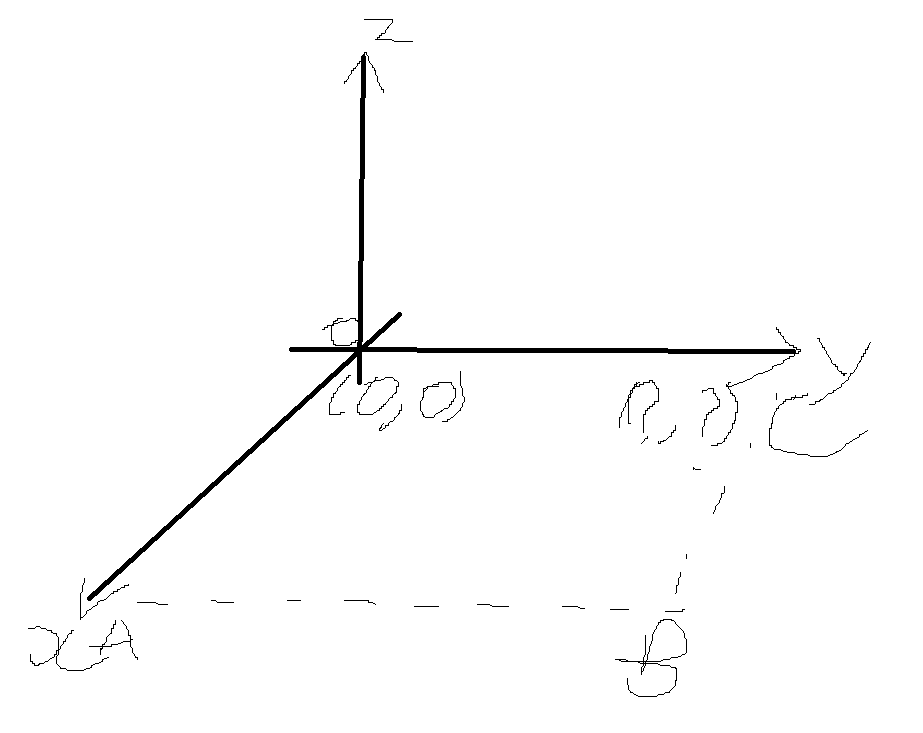
ok so this is a cube right here
and idk how these points are being plotted on the vertices
like (a,0,0)
can someone explain how this works?
remote mural
do you know how a 3 dimensional coordinate system looks like?
remote mural

A point on this say point P is (x,y,z)
if we have some cube with length a on all sides
we can start creating the cube from the origin
coarse hazel
so origin is (0,0,0)
remote mural
are you following? or is this not what you are confused on?
remote mural
ok so if a point on this coordinate system is of the form (x,y,z). We can draw a square on each plane.
For example look only on the xy-plane
a square there would have the points: (0,0) , (a,0), (a,a), and (0,a)
thosse points were of the form (x,y) however you can put in 3d coords by having z =0. So : (0,0,0), (a,0,0), (a,a,0), (0,a,0)
Just from that you have 4 of the vertices for your cube
coarse hazel
remote mural
a square there would have the points: (0,0) , (a,0), (a,a), and (0,a)
how do ik what point i should plot on each vertex like i could do anything from (0,a) (a,a) (a,0)
remote mural
the o ther 4 you get by letting z = a now sicne this a cube all the sides have a fixed length of a (in this case).
Can you explain your question a little more I am not sure what you are asking
coarse hazel
remote mural
Can you explain your question a little more I am not sure what you are asking
what point should i plot for C
remote mural
what is y = ? at C?
coarse hazel
(a,0), (0,a),
coarse hazel
remote mural
what is y = ? at C?
y axis
remote mural
yes what is y =
remote mural
it is not on either axis.
So if a point is on an axis one of the values of the point have to hold a 0. But at point B if you look x is a or in other words distance a from the origin on the positive x axis.
point B would be (a,a,0)
coarse hazel
then vertex A would be (a,0,0) right?
remote mural
correct
coarse hazel
coarse hazel
https://i.imgur.com/k7HNnYp.png
so back to this figure
it would be difficult to plot points cause there is no xyz axis diagram here
remote mural
well it has points already labeled. If you are trying to imagine a 3d coordinate plane on that you would have to look at each point and see which axis would make sense
for example, your origin is at point O
coarse hazel
remote mural
well it has points already labeled. If you are trying to imagine a 3d coordinate...
yeah but i gotta create the figure by myself and label the points by myself in the exam
oh wait
i could draw a cube like this and label
 remote mural
can you draw something like this in the exam and then plot points to make the cube? Or does the perspective matter becuase the image you sent is looking a the cube at a different octant
 coarse hazel
remote mural
can you draw something like this in the exam and then plot points to make the cu...
coarse hazel
remote mural
can you draw something like this in the exam and then plot points to make the cu...
yeahhh
i just figured
remote mural
so like i said there are 8 vertices. 4 have a z value of 0 and the other with a z value of a
calm coralBOT
Channel closed
Closed by @coarse hazel
Use .reopen if this was a mistake.
Available help channel!
Send your question here to claim the channel.
Remember:
• Ask your math question in a clear, concise manner.
• Show your work, and if possible, explain where you are stuck.
• After 15 minutes, feel free to ping <@&286206848099549185>.
• Type the command .close to free the channel when you're done.
• Be polite and have a nice day!
Read #❓how-to-get-help for further information on how to ask a good question, and about conduct in the question channels.
 sweet zodiac
 calm coralBOT
sweet zodiac
sweet zodiac
calm coralBOT
sweet zodiac
sweet zodiac
no idea how to approach this
actually i might have an idea
g prime is slope of function
perhaps i can use g(4)=0.325 and g(1)
also i think I worded this weird
nvm
the answer I gotw as wrong
because u can't do that it ain't linear
or at least we don't know if it's linear
ok i have no idea then
any idea?
 blazing hinge
do you know about integrals
sweet zodiac
but like why
<@&286206848099549185>
oh shoot actually if i do tak ethe antiderivative of this
it gives g(x)
wtf am i thinking
OK it still don't give me agood answer
i'l ask my teacher tmrw ig
.close
calm coralBOT
Channel closed
Closed by @sweet zodiac
Use .reopen if this was a mistake.
Available help channel!
Send your question here to claim the channel.
Remember:
• Ask your math question in a clear, concise manner.
• Show your work, and if possible, explain where you are stuck.
• After 15 minutes, feel free to ping <@&286206848099549185>.
• Type the command .close to free the channel when you're done.
• Be polite and have a nice day!
Read #❓how-to-get-help for further information on how to ask a good question, and about conduct in the question channels.
 dire lantern
I have no idea how to solve this problem
 calm coralBOT
dire lantern
I have no idea how to solve this problem
leaden thunder
dire lantern
didn't get anywhere significant
calm coralBOT
dire lantern
I have no idea how to solve this problem
leaden thunder
dire lantern
didn't get anywhere significant
Show all your work
 tidal grotto
dire lantern
I have no idea how to solve this problem
tidal grotto
dire lantern
I have no idea how to solve this problem
you can multiply them under the sqrt(), and complete the square
dire lantern
tidal grotto
you can multiply them under the sqrt(), and complete the square
I tried that multiple times
let me send a pic
tidal grotto
$(1-x)(x+3)=-x^{2}-2x+3=-(x^{2}+2x)+3$
potent lotusBOT
Moosey


 tidal grotto
that's not completeing the square...(x^2+2x+4) doesn't turn into a perfect square
(x^2+2x+1)=(x+1)^2
dire lantern
oh wait you are right
I think I have been doing too much math today
my brain is not working
regardless what would you do next
$-(x+1)^2+4$
potent lotusBOT
Fenagon
