#help-42
1 messages · Page 14 of 1
 hidden elbow
 potent lotusBOT
Springsskateboard
 hidden elbow
nice
 upper sparrow
Now expand that out 
hidden elbow
now wolfy simplify
upper sparrow
Or at least just get the constant term
upper sparrow
hidden elbow
now wolfy simplify
No, no wolfie
hidden elbow
constant term would be 11?
upper sparrow
Wolfie won’t save you this time
upper sparrow
How did you get that, explain!
upper sparrow
hidden elbow
(2)(3) + (1)(3)+ (1)(2)
Uh-huh, what do you notice about that sum?
hidden elbow
increasing?
upper sparrow
Well, that’s not what I wanted you to spot 
upper sparrow
Like you see how it’s kinda like we have (1)(2)(3) in each of them
But each time, one of the numbers is missing yea?
hidden elbow
yeah
upper sparrow
So can you figure out what the general case would look like?
(So much pain without sum and product notation  )
)
hidden elbow
n(n+1) + n(n-1) + (n-1)(n+1)?
upper sparrow
Hmmm, not quite
hidden elbow
fk
upper sparrow
Say we have to k
hidden elbow
upper sparrow
(So much pain without sum and product notation <:monkey:651816857153699840>)
let’s do it
cool looking symbols
upper sparrow
We kind of have like k!/1 + k!/2 + k!/3 + … + k!/k
upper sparrow
upper sparrow
We kind of have like k!/1 + k!/2 + k!/3 + … + k!/k
You agree with that one?
hidden elbow
I thought we had (1)(2) + (2)(3) + (1)(3)
upper sparrow
upper sparrow
But each time, one of the numbers is missing yea?
See what I said here
hidden elbow
yeah
upper sparrow
hidden elbow
I thought we had (1)(2) + (2)(3) + (1)(3)
Put k=3 in that
What do you get?
hidden elbow
k=3?
hidden elbow
upper sparrow
We kind of have like k!/1 + k!/2 + k!/3 + … + k!/k
into this?
6+3 +2+…2
💩
 hidden elbow
yeah
hidden elbow
$\frac{3!}{1} + \frac{3!}{2} + \frac{3!}{3} +…\frac{3!}{3}$
potent lotusBOT
Springsskateboard
 upper sparrow
It’s just [shit] notation to explain you could have an arbitrary amount of terms
upper sparrow
Just these
 upper sparrow
hidden elbow
what’s the proper notation?
upper sparrow
hidden elbow
what’s the proper notation?
Something like $\sum_{n=1}^{k} \frac{k!}{n}$ in this case
potent lotusBOT
chartbit
 hidden elbow
ah ok
upper sparrow
Put in n=1 and work that out, then put in n=2 and work that out, all the way up until n=k
Then add those all up together
Does that make sense? It’s kinda like a crash intro to the notation hahah
hidden elbow
wait what would the general notation be for this case
since we’re not just plugging in n=1
is it just n
then they would have laid out conditions like n is in the set of all reals or smth
$\sum_{n}^{k} \frac{k!}{n}$
potent lotusBOT
Springsskateboard
 hidden elbow
where $n\in{\mathbb{Z^+}$
potent lotusBOT
Springsskateboard
Compile Error! Click the  reaction for more information.
(You may edit your message to recompile.)
 upper sparrow
hidden elbow
the top value is the last value n can take
upper sparrow
hidden elbow
the top value is the last value n can take
Yeah that’s it
It basically is like from the bottom value to the top value (in integer steps)
hidden elbow
upper sparrow
It basically is like from the bottom value to the top value (in integer steps)

sending for convenience sake
upper sparrow
Ah, sheiittt, notation makes this so much better 
upper sparrow
We have that $A_{k} = \sum_{n=1}^{k} \frac{k!}{n}$, so $g_{k}(x) = \frac{A_k}{k!} = \sum_{n=1}^{k} \frac{1}{n}$
potent lotusBOT
chartbit

 upper sparrow
potent lotus
**chartbit**
upper sparrow
potent lotus
**chartbit**
But are you happy with that?
hidden elbow
wait what’s Ak
upper sparrow
Oh I relabelled the A’s to A_k because they depend on k
Me being naughty, but I prefer showing they depend on k tbh
hidden elbow
ah so the A_k is f_k?
upper sparrow
It’s like not constant for everything so less confusion
hidden elbow
upper sparrow
Me being naughty, but I prefer showing they depend on k tbh
not as naughty as the person who made this
upper sparrow
hidden elbow
ah so the A_k is f_k?
It’s the constant term for the same f_k
hidden elbow
wait but where did it say $A = \sum_{n=1}^{k} \frac{k!}{n}$
potent lotusBOT
Springsskateboard
 upper sparrow
A is basically the constant term of the numerator of f_k
hidden elbow
I thought that was f’_k
upper sparrow
And that sum is how we expressed what it was
hidden elbow
OH
ok cool stuff
We have that $A_{k} = \sum_{n=1}^{k} \frac{k!}{n}$, so $g_{k}(x) = \frac{A_k}{k!} = \sum_{n=1}^{k} \frac{1}{n}$
potent lotusBOT
Springsskateboard
 hidden elbow
so you related $f’_k(x)$ and $g_k(x)$?
potent lotusBOT
Springsskateboard
 hidden elbow
OH WAIT
nvm
I didn’t read the question LOL
ok cool so how do we show that as k increase g_k(x) —> infinity
upper sparrow
It happens, more than I’d like to admit 
hidden elbow
LOL
upper sparrow
With what they said, I’m so tempted to just screenshot the proof I have in my notes and send it
hidden elbow
oooo you did this question before?
upper sparrow
But anyways, we turn our attention to $\sum_{n=1}^{k} \frac{1}{n} = \frac{1}{1} + \frac{1}{2} + \frac{1}{3} + \ldots + \frac{1}{k}$
upper sparrow
hidden elbow
oooo you did this question before?
Well, not this exact question, but the last bit of it here I have, it’s part of series convergence/divergence
potent lotusBOT
chartbit
 upper sparrow
Sorry my bad!
hidden elbow
upper sparrow
Well, not this exact question, but the last bit of it here I have, it’s part of ...
ah I see I see
aye let’s go im learning
np
wait but that sum can’t tend to infinity

 hidden elbow
upper sparrow
Ayo this shit surely is not in your syllabus <:catscream:941918398533758986>
hidden elbow
upper sparrow
Ayo this shit surely is not in your syllabus <:catscream:941918398533758986>
fk my sch math department
upper sparrow
hidden elbow
wait but that sum can’t tend to infinity
It’s more that as you let k go to infinity, so you add even more terms of 1/k
upper sparrow
So like if you add that infinitely many times, does the value of the sum go off to ♾️
hidden elbow
shouldn’t be
I thought
since it’s all reciprocals
oh wait
nvm
it’s the same thing added repeatedly
upper sparrow
hidden elbow
I thought
 upper sparrow
You know what, I’m on mobile, too lazy for all the typesetting
hidden elbow
how do we prove it 🧐
hidden elbow
upper sparrow
You know what, I’m on mobile, too lazy for all the typesetting
yea same LOL
hmmm
upper sparrow

After the Geometric Series, the Harmonic Series is one of the most important examples in Calculus. This is a series that we will show - by investigating the partial sums - diverges. But it turns out to diverge incredibly slowly, taking over 10^43 terms just to add up to 100.
YOUR TURN! Learn...
That guy can explain it for me
Basically search up “harmonic series” and a proof should come up haha
hidden elbow
upper sparrow
Basically search up “harmonic series” and a proof should come up haha
so this is an example of harmonic series?
upper sparrow
hidden elbow
so this is an example of harmonic series?
It is the harmonic series 
hidden elbow
upper sparrow
It *is* the harmonic series <:catThimc:732011802459635713>
WATCHED
so we needa bring limits into the proof?
OH
wait nah
we can just show
Sn and S2n
so confirm it’ll diverge
upper sparrow
hidden elbow
Pretty much the question they're asking is a limit question in disguise
upper sparrow
Basically yep, you'd do it in the way that they've done it in the video really!
hidden elbow
but how do I show the part where it tends to infinity regardless of x
upper sparrow
That's why they gave you the hint
upper sparrow
hidden elbow
but how do I show the part where it tends to infinity regardless of x
Note that g_{k}(x) doesn't depend on the value of x, it only depends on k
hidden elbow
upper sparrow
We have that $A_{k} = \sum_{n=1}^{k} \frac{k!}{n}$, so $g_{k}(x) = \frac{A_k}{k!...
oh and that was shown here?
cool
upper sparrow
Matter of fact, they're kind of dicks for labelling it as a function of x, when it clearly doesn't depend on x
hidden elbow
let me write down everything and try to present it correctly lol
upper sparrow
Massive dickheads 
hidden elbow
upper sparrow
Matter of fact, they're kind of dicks for labelling it as a function of x, when ...
LOL
why is it even a function of x then 😭
shouldn’t it be a function of k
upper sparrow
hidden elbow
why is it even a function of x then 😭
Exactly lmao, it really didn't need to be because they didn't add any dependencies on x
hidden elbow
ah ok
upper sparrow
hidden elbow
shouldn’t it be a function of k
It's basically a function of both, only that it's constant with respect to x
Like for a given fixed k, it doesn't change as x changes
upper sparrow
Ayo, whoever set these questions... even satan is looking at them like "you're going way too far though, stop, that's enough"
hidden elbow
should pull them down with him
hidden elbow
upper sparrow
Ayo, whoever set these questions... even satan is looking at them like "you're g...

so after I find S8
do I use S_(2^n) > 1+n/2
and hence proved?
since it’ll eventually tend to infinity
upper sparrow
Basically, yep, this is the key statement we want, from that point we can deduce that the sum goes off to ♾️ as k get's bigger, though be careful with the labels
 upper sparrow
Let me dig through my notes a moment
hidden elbow
noiceee
upper sparrow
Ah found it finally, looked in the wrong .pdf for this haha
 hidden elbow
ayeee
upper sparrow
hidden elbow
where’s my label error
Actually I think you're good, I might be fried 
I'm still in shock they've basically tortured you like this 
hidden elbow

hidden elbow
upper sparrow
Ah found it finally, looked in the wrong .pdf for this haha
wth is that 2^infinity
I see
upper sparrow
I mean, I guess it's doable, but it surely isn't trivial
upper sparrow
hidden elbow
wth is that 2^infinity
Ah, that's 2^n, poor resolution
hidden elbow
ah LOL
 upper sparrow
Hopefully this is clearer maybe
 hidden elbow
aye nice
upper sparrow
Ah yes, better
hidden elbow
yea
wait
the first math line
when it’s 2
how is it 1/2 + 1/3?
isn’t it 1 + 1/2?
upper sparrow
It is, but for the purposes of showing it diverges [or converges] you can ignore the first term[s]
upper sparrow
As in if it converged without that 1, then it would converge with it, and similar if it diverges with it, it would diverge with it
hidden elbow
ah I see I see
upper sparrow
hidden elbow
but we can still do it with 1+1/2 instead right
Yea you can include it if you wanted, just modify the argument as appropriate
upper sparrow
No worries, was an interesting question! Somewhat surprised it went down the path of harmonic series in the end, but I really should have seen that coming
But hopefully all of that makes sense!
[I mean, I couldn't see myself doing this at 16 tbh  ]
]
I think, a better way of stating this would be that you have $g_{2^{m}}(x) = \sum_{n= 1}^{2^{m}} \frac{1}{n} > \frac{m - 1}{2}$ via similar arguments as before
potent lotusBOT
chartbit
 upper sparrow
As that explicitly involves the function they stated, but it's like a tiny point hehe
And as a final point, the $\Pi$ product notation is basically the equivalent for $\sum$ but for products, so $\Pi_{m =1}^{n} a_{m} = a_{1} \times a_{2} \times \ldots \times a_{n}$
potent lotusBOT
chartbit
 hidden elbow
upper sparrow
I think, a better way of stating this would be that you have $g_{2^{m}}(x) = \su...
hidden elbow
upper sparrow
I think, a better way of stating this would be that you have $g_{2^{m}}(x) = \su...
ahhh okok
NICE I’m learning notations
upper sparrow
E.g. you can represent the factorial $n! = \Pi_{m = 1}^{n} m$
potent lotusBOT
chartbit
 upper sparrow
hidden elbow
NICE I’m learning notations
upper sparrow
hidden elbow
NICE I’m learning notations
Yep it actually makes life so much easier, that's how I instantly spotted it would be a harmonic series question
- there's less ambiguity as well
hidden elbow
yea HAHA the thing is we didn’t learn these notations
so idk what my teacher is smoking cuz he expects us to try these
upper sparrow
So e.g.
$$
\ln\left( \Pi_{n=1}^{k} (x + n)\right) = \sum_{n=1}^{k} \ln(x+n)
$$
potent lotusBOT
chartbit
 upper sparrow
Is how I'd have written the first part of the question if it were me doing it
upper sparrow
hidden elbow
so idk what my teacher is smoking cuz he expects us to try these
Whatever it is, me no wan it
hidden elbow
upper sparrow
Whatever it is, me no wan it
LOL
upper sparrow
 hidden elbow
 upper sparrow
But yeah, there you go, done quite a bit of math here hope that's been all good!
hidden elbow
YEA it’s been amazing
gna rub this in my teachers face
he’s gonna think I cheated
technically it’s not officially an assignment
he just asked us to try
I still learnt new stuff though 🤙
upper sparrow
I mean, I think quite a lot of it you would have made progress on, you could have done the differentiation and common denominatoring, it's just knowing how to write that constant term [which might have taken time to spot]
The general case is a bit to visualise [hence do small examples and try to generalise from there]
But we done made it now 🥳


 hidden elbow
YEA
hidden elbow
upper sparrow
I think, a better way of stating this would be that you have $g_{2^{m}}(x) = \su...
wait for this
what is m?
upper sparrow
hidden elbow
what is m?
It's supposed to be some random integer, but to be fair you can replace that m with any other letter of your choice [except n, as we used that as our summation variable, and that would be really bad form  ]
]
upper sparrow
hidden elbow
so I can just use m
You can just say "for some integer m", it should be clear from the context what you're doing - like you can say "if we take the sum up to 2^m, then our sum becomes..." then clarify that m is a positive integer if you wanted
hidden elbow
oh so
hidden elbow
upper sparrow
You can just say "for some integer m", it should be clear from the context what ...
$g_{2^{m}}(x) = \sum_{n= 1}^{2^{m}} \frac{1}{n} > \frac{m - 1}{2}$ for some $m \in \mathbb{Z^{+}}$?
potent lotusBOT
Springsskateboard
 upper sparrow
potent lotus
**Springsskateboard**
upper sparrow
potent lotus
**Springsskateboard**
More the other way round: let $m \in \mathbb{Z^{+}}$ be given, then $g{2^{m}}(x) = \sum_{n= 1}^{2^{m}} \frac{1}{n} > \frac{m - 1}{2}$
potent lotusBOT
chartbit
 upper sparrow
That's something you'll hear about in e.g. classes in logic, the order of statements and the wording really matters
upper sparrow
hidden elbow
hence proved
Yep that'll do 
hidden elbow
upper sparrow
That's something you'll hear about in e.g. classes in logic, the order of statem...
oh sheesh
what’s QED?
upper sparrow
 leaden thunder
useless wolfie
leaden thunder
useless wolfie
 hidden elbow
BRUH
leaden thunder
"Q.E.D." (sometimes written "QED") is an abbreviation for the Latin phrase "quod erat demonstrandum" ("that which was to be demonstrated"), a notation which is often placed at the end of a mathematical proof to indicate its completion. Several symbols are occasionally used as synonyms for Q.E.D. These include a filled square filled square (Unico...
hidden elbow
we broke wolfie
with our first question
so QED = hence proved
is that Latin
wait wtf did I ask
it literally says Latin
upper sparrow
leaden thunder
,w define qed
They basically asked this guy to prove divergence of the harmonic series
leaden thunder
hidden elbow
what a roundabout way  to prove divergence of harmonic series
upper sparrow
Honestly the setup of the question didn't help one bit, why on earth did they need to define that function as one in x when it clearly doesn't depend on it
Swear they just want @hidden elbow to suffer 
hidden elbow
SEND HELP
leaden thunder
indeed
hidden elbow
leaden thunder
indeed
wait I asked my friend and she said it’s not conclusive cuz I only did it for 3 cases?
eh oops wrong ping
@upper sparrow
upper sparrow
hidden elbow
<@788085606483361802>
Hmmm, as in you'd show it in general what it would look like, as per here, that should be enough really I would think
 upper sparrow
As in you should do something like this one here too
 hidden elbow
AH
hidden elbow
upper sparrow
As in you should do something like this one here too
I see I see
upper sparrow
hidden elbow
I see I see
Yep, once you've shown that pattern like that, you should be good imo!
upper sparrow
hidden elbow
so I just show the pattern of 2^m
Yep 
 calm coralBOT
@hidden elbow Has your question been resolved?
upper sparrow
W H A T
 hidden elbow
upper sparrow
W H A T <:sad:532803514892812288>
hidden elbow
upper sparrow
W H A T <:sad:532803514892812288>
LMAO
that’s why I was prepared for a comedy show
upper sparrow
That's just outright disrespectful there whoever did that, honestly, is an opp
calm coralBOT
Channel closed
Closed due to timeout
Use .reopen if this was a mistake.
hidden elbow
.reopen
calm coralBOT
✅
hidden elbow
upper sparrow
That's just outright disrespectful there <:thonkHang:661788564119355406> whoever...

wait
@upper sparrow

this look alright?
upper sparrow
hidden elbow
this look alright?
that's what I would like to see 
hidden elbow
NOICE
hidden elbow
upper sparrow
<:catYes:830588319472812044> that's what I would like to see <:happyCat:53637165...
so then after this I do 3 cases
and show the pattern
upper sparrow
hidden elbow
Actually wait a moment
hidden elbow
uh oh
upper sparrow
Group them like this
 hidden elbow
oh wait why
upper sparrow
As you want to replace 1/3 by 1/4, all of the 1/5, 1/6, 1/7 by 1/8 and so on so forth
hidden elbow
but the picture grouped them like 1/2 + 1/3 etc
upper sparrow
Ah yeah, they did, but got an even better way to do it now
hidden elbow
aye cool alr
upper sparrow
upper sparrow
Anyways, we want to use this
This will make use of the hint they gave
 hidden elbow
wait how about the 2^3 pattern
upper sparrow
Same idea
upper sparrow
Actually give me a second, I'll write it on paper for you
calm coralBOT
@hidden elbow Has your question been resolved?
upper sparrow
 hidden elbow
it’s been 3 hours on this problem ☺️
upper sparrow
Been quite some time! It's the wording of the last proof that's the nuts bit
upper sparrow
upper sparrow
Try this one out, hopefully I've counted right
hidden elbow
ayeee
hidden elbow
upper sparrow
Try this one out, hopefully I've counted right <:KEK:586240877358350341>
wait what does the orange part say
upper sparrow
hidden elbow
wait what does the orange part say
"there are n of these terms in total"
hidden elbow
ahh
upper sparrow
Ah shit it should be n+1 of them, fuck
Actually shit I've confused my poor brain 
No it's n of them
...I think 
hidden elbow
nw I’ve been cooked since the first question
wait btw
1/2^n repeated n-1 times right
then let’s say n=2
1/4
it should only appear once no?
why does it appear twice
upper sparrow
hidden elbow
why does it appear twice
Oh yeah was gonna say, they done fuqd up there
Actually no hang on, I don't think so
No yes they did
That should be $2^{n-1}$ times
potent lotusBOT
chartbit
 upper sparrow
They have the nerve to set that shit and fuck up the quoting, kmt
hidden elbow
lmaoo is snow here also
@ancient thistle
wait so assuming they typed 2^(n-1) there,
I find the pattern for 2^k
wait I don’t have to show 3 cases?
hidden elbow
upper sparrow
Hmmm, as in you'd show it in general what it would look like, as per here, that ...
here they said using the estimate
what does that mean
upper sparrow
hidden elbow
here they said using the estimate
What they're saying is that they're going to bound the sum below by replacing all the terms with something smaller
So like in that one, all the terms will be less than 1/2n, so replace them all with 1/2n and you get a smaller sum
hidden elbow
upper sparrow
So like in that one, all the terms will be less than 1/2n, so replace them all w...
wait so for our terms
since we’re grouping different from theirs
what would our estimate be
upper sparrow
We're basically here replacing all the terms with something smaller, the next 1/2^n up, so like the blue is replaced with 1/4, the purples are replaced with 1/8, the greens with 1/16 and so on

It's a similar idea to what they have, but we're trying to change our sum into one based on 1/2^n looking thingys
upper sparrow
upper sparrow
Kinda like in this picture here!
hidden elbow
AH ok
hidden elbow
upper sparrow
wait what does “the sum is bounded below by 1 + n/2” mean?
upper sparrow
Basically at the end because we replaced the OG sum with something smaller, we know the sum must be at least [bigger than] 1 + n/2
hidden elbow
oh we can prove that way?
upper sparrow
hidden elbow
oh we can prove that way?
Yep, prove the sum is at least something which ends up going to infinity and you’re done!
hidden elbow
upper sparrow
Yep, prove the sum is at least something which ends up going to infinity and you...
wait but how does it show the sun ends up going to infinity
upper sparrow
It's, like, trivial
upper sparrow
hidden elbow
wait but how does it show the sun ends up going to infinity
Think about it: you are at least something, and that something gets bigger, so you must get bigger too
upper sparrow
hidden elbow
at last?
Yep
upper sparrow
Damn, for a whole 5 mark question 
upper sparrow
hidden elbow
LETS GOOOO
But yep, all that all good now?
calm coralBOT
@hidden elbow Has your question been resolved?
calm coralBOT
Channel closed
Closed due to timeout
Use .reopen if this was a mistake.
calm coralBOT
 Available help channel!
Send your question here to claim the channel.
Remember:
• Ask your math question in a clear, concise manner.
• Show your work, and if possible, explain where you are stuck.
• After 15 minutes, feel free to ping <@&286206848099549185>.
• Type the command .close to free the channel when you're done.
• Be polite and have a nice day!
Read #❓how-to-get-help for further information on how to ask a good question, and about conduct in the question channels.
 remote mural
 calm coralBOT
remote mural
calm coralBOT
remote mural

 somber finch
Someone said before that it was already solved
 velvet osprey
 how are we supposed to find tangents if not with calculus
remote mural
This was a question for 9th grade surprisingly haha
velvet osprey
how are 9th graders supposed to know what a tangent is
remote mural
Ask miss @ancient thistle herself haha
She administered it to her students lmfao
I have no clue though
velvet osprey
@ancient thistle 
 ancient thistle

velvet osprey
finger got pointed at you
remote mural
Name dropping snow
ancient thistle
the tangent and the conic are supposed to intersect at a quadratic root
so you solve for discriminant = 0
remote mural
ancient thistle
the tangent and the conic are supposed to intersect at a quadratic root
Wait conic?
ancient thistle
f is a hyperbola

 dreamy tangle
so you can calculate the k for every x_0 by \delta=0
somber finch
You mentioned loss?
 dreamy tangle
so you can calculate the k for every x_0 by \delta=0
dreamy tangle
dreamy tangle
so you can calculate the k for every x_0 by \delta=0
and you can find two spots which satisfies x_1 = 1/x_2 and k_1*k_2 = 0
 graceful dust
who let ms snow near those poor 9th graders
somber finch
ancient thistle
so you solve for discriminant = 0
I tried that, but the roots are not that easy
remote mural
She got like 5 people in vc trying to solve this 
somber finch
$y = m\cdot\left[x-a\right]+f(a)$
potent lotusBOT
sopinha
 somber finch
$m\cdot\left[x-a\right]+f(a) = \dfrac{1}{x}+x \iff mx^2-max +f(a) \cdot x = x^2+1$
 night torrent
remote mural
She got like 5 people in vc trying to solve this <:xd:1063691231265296384>
night torrent
remote mural
She got like 5 people in vc trying to solve this <:xd:1063691231265296384>
she 
potent lotusBOT
sopinha
 remote mural
night torrent
she <:thonkZoom:532962123110940682>
remote mural
night torrent
she <:thonkZoom:532962123110940682>
It's meant to be a secret 
dreamy tangle
ancient thistle
so you solve for discriminant = 0
i put that to practice and got a super long equation
your mind just keep you from doing this after you learned a advanced method
calm coralBOT
Channel closed
Closed by @dawn spruce
Use .reopen if this was a mistake.
calm coralBOT
Available help channel!
Send your question here to claim the channel.
Remember:
• Ask your math question in a clear, concise manner.
• Show your work, and if possible, explain where you are stuck.
• After 15 minutes, feel free to ping <@&286206848099549185>.
• Type the command .close to free the channel when you're done.
• Be polite and have a nice day!
Read #❓how-to-get-help for further information on how to ask a good question, and about conduct in the question channels.
 dull salmon
I got an answer of f(g(x))= 9x^2 + 6x - 11, but the marking scheme says its f(g(x))= 9x^2 + 3x - 12, can someone help where i've went wrong?
calm coralBOT
dull salmon
I got an answer of f(g(x))= 9x^2 + 6x - 11, but the marking scheme says its f(g...
calm coralBOT
Channel closed
Closed by @dull salmon
Use .reopen if this was a mistake.
Available help channel!
Send your question here to claim the channel.
Remember:
• Ask your math question in a clear, concise manner.
• Show your work, and if possible, explain where you are stuck.
• After 15 minutes, feel free to ping <@&286206848099549185>.
• Type the command .close to free the channel when you're done.
• Be polite and have a nice day!
Read #❓how-to-get-help for further information on how to ask a good question, and about conduct in the question channels.
 mint cloud
 calm coralBOT
mint cloud
mint cloud
calm coralBOT
mint cloud
mint cloud
how do i convert radians to angles/degrees
how do i find in what quadrant and what angle these are refferring to
my course completely jumped over that
 carmine sorrel
multiply the radian by 180/pi
carmine sorrel
in the examples you have the pi will cancel out immediately
and generally, you'll be looking at examples like that
carmine sorrel
yes
 narrow spear
you know that $2pir = 360$
potent lotusBOT
phoestaclies
 narrow spear
$2*\pi*r = 360$ so you can have r = something
potent lotusBOT
phoestaclies
 carmine sorrel
potent lotus
**phoestaclies**
carmine sorrel
potent lotus
**phoestaclies**
no? 2pi(r) is the circumference of a circle. not a degree measure. unless you're using r as rad, which is very confusing.
mint cloud
i do not know that 2x pi x r =360. i thought 2pi equalled 360
narrow spear
oh no sorry i said nothing forgot
carmine sorrel
yes
carmine sorrel
yes
mint cloud
with a theta of 45?
maybe i used that word wrong
i guess the theta is 135
whats the inner angle called
inside the triangle
carmine sorrel
yeah, it would be equivalent to +/-sin(45) and +/-cos(45) depending on the quadrant
mint cloud
whats with the +/-
i keep seeing that in trig
isnt it clear if its + or - based on the quadrant
carmine sorrel
because sin(x) and cos(x) change signs depending on the quadrant. For short hand +/-sin(x) just means "positive or negative sin(x)"
mint cloud
also last question, do i always multiply radians by 180. or does that change to 90. 270. 360 ever?
i suppose its 180 because that equals pi right
carmine sorrel
for example, in the first quadrant cosine is positive, in the second quadrant cosine is negative
carmine sorrel
mint cloud
do i still need the +/-
you need to decide which one to use based on the quadrant
carmine sorrel
np
mint cloud
.close
calm coralBOT
Channel closed
Closed by @mint cloud
Use .reopen if this was a mistake.
calm coralBOT
Available help channel!
Send your question here to claim the channel.
Remember:
• Ask your math question in a clear, concise manner.
• Show your work, and if possible, explain where you are stuck.
• After 15 minutes, feel free to ping <@&286206848099549185>.
• Type the command .close to free the channel when you're done.
• Be polite and have a nice day!
Read #❓how-to-get-help for further information on how to ask a good question, and about conduct in the question channels.
 ashen solstice
 calm coralBOT
ashen solstice
remote mural
calm coralBOT
ashen solstice
remote mural
so do you see what type of triangle triangle ABC is?
ashen solstice
.close
calm coralBOT
Channel closed
Closed by @ashen solstice
Use .reopen if this was a mistake.
Available help channel!
Send your question here to claim the channel.
Remember:
• Ask your math question in a clear, concise manner.
• Show your work, and if possible, explain where you are stuck.
• After 15 minutes, feel free to ping <@&286206848099549185>.
• Type the command .close to free the channel when you're done.
• Be polite and have a nice day!
Read #❓how-to-get-help for further information on how to ask a good question, and about conduct in the question channels.
 main remnant
How would i simplify this?
 calm coralBOT
main remnant
How would i simplify this?
leaden thunder
main remnant
How would i simplify this?
calm coralBOT
main remnant
How would i simplify this?
leaden thunder
main remnant
How would i simplify this?
What's f
leaden thunder
main remnant
I would just plug in i/2 in the function?
Yes. Whatever f is
calm coralBOT
@main remnant Has your question been resolved?
calm coralBOT
Channel closed
Closed due to timeout
Use .reopen if this was a mistake.
calm coralBOT
Available help channel!
Send your question here to claim the channel.
Remember:
• Ask your math question in a clear, concise manner.
• Show your work, and if possible, explain where you are stuck.
• After 15 minutes, feel free to ping <@&286206848099549185>.
• Type the command .close to free the channel when you're done.
• Be polite and have a nice day!
Read #❓how-to-get-help for further information on how to ask a good question, and about conduct in the question channels.
 craggy oar
 calm coralBOT
craggy oar
calm coralBOT
craggy oar
 viscid silo
do you know how exponents work
craggy oar
i think it should 3^8
i mean im learning exponents now
its showing up as wrong though
6561 is it solved, but thats also wrong
potent lotusBOT


 Requested by DerpZ#9141

 prisma mango
Post screenshot of the entire page? Maybe there are specific instructions

 subtle osprey
,w (3^-2)^-4=6561
potent lotusBOT

 Requested by Jash#2503
craggy oar
Requested by Jash#2503
craggy oar
I figured it out, thanks for the help
my friend put a comma originally, and I didnt realize
it is 6561
.close
calm coralBOT
Channel closed
Closed by @craggy oar
Use .reopen if this was a mistake.
Available help channel!
Send your question here to claim the channel.
Remember:
• Ask your math question in a clear, concise manner.
• Show your work, and if possible, explain where you are stuck.
• After 15 minutes, feel free to ping <@&286206848099549185>.
• Type the command .close to free the channel when you're done.
• Be polite and have a nice day!
Read #❓how-to-get-help for further information on how to ask a good question, and about conduct in the question channels.
 burnt cobalt
quick question about propositions
calm coralBOT
burnt cobalt
quick question about propositions
 steel grail
It is a false proposition
Because you can prove that 5 + 7 = 12
and that 12 is not equal to 13
calm coralBOT
Channel closed
Closed by @burnt cobalt
Use .reopen if this was a mistake.
calm coralBOT
Available help channel!
Send your question here to claim the channel.
Remember:
• Ask your math question in a clear, concise manner.
• Show your work, and if possible, explain where you are stuck.
• After 15 minutes, feel free to ping <@&286206848099549185>.
• Type the command .close to free the channel when you're done.
• Be polite and have a nice day!
Read #❓how-to-get-help for further information on how to ask a good question, and about conduct in the question channels.
 fiery torrent
 calm coralBOT
fiery torrent
calm coralBOT
fiery torrent
 sterile seal
Drop a perp from D to BC and a perp from A to BC
 sterile seal
Let BD be x
 fiery torrent
What do you mean ous?

Everything is written in terms of x @sterile seal

@sterile seal look what I did
I found
I did
IT
It's Square root of 2
.close
calm coralBOT
Channel closed
Closed by @fiery torrent
Use .reopen if this was a mistake.
Available help channel!
Send your question here to claim the channel.
Remember:
• Ask your math question in a clear, concise manner.
• Show your work, and if possible, explain where you are stuck.
• After 15 minutes, feel free to ping <@&286206848099549185>.
• Type the command .close to free the channel when you're done.
• Be polite and have a nice day!
Read #❓how-to-get-help for further information on how to ask a good question, and about conduct in the question channels.
 terse pine
$cos\theta=\frac{1}{\sqrt{2}}$
calm coralBOT
terse pine
$cos\theta=\frac{1}{\sqrt{2}}$
Please don't occupy multiple help channels.
potent lotusBOT
Zyme><SOL

 mellow crater
terse pine
Need to solve for $0^{\circ}\leq\theta\leq360^{\circ}$
mellow crater
terse pine
Need to solve for $0^{\circ}\leq\theta\leq360^{\circ}$
$1^{\circ}$
potent lotusBOT
Modus
 sterile seal
What do you need help with?
potent lotusBOT
Zyme><SOL

 rigid kettle
What have you tried
terse pine
I tried to find a degree
using a handy dandy table
but none of the degrees for sin cos and tan had $\frac{1}{\sqrt{2}}$
potent lotusBOT
Zyme><SOL
 terse pine
unless I modified $\frac{1}{\sqrt{2}}$
potent lotusBOT
Zyme><SOL
 sterile seal
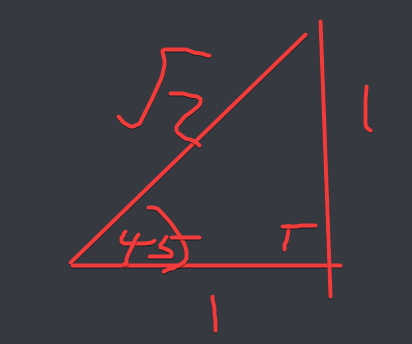
If I draw a right triangle with leg 1 and hypotenuse sqrt2, what do you notice about it
rigid kettle
That aside, a table isn't a good method anyways
rigid kettle
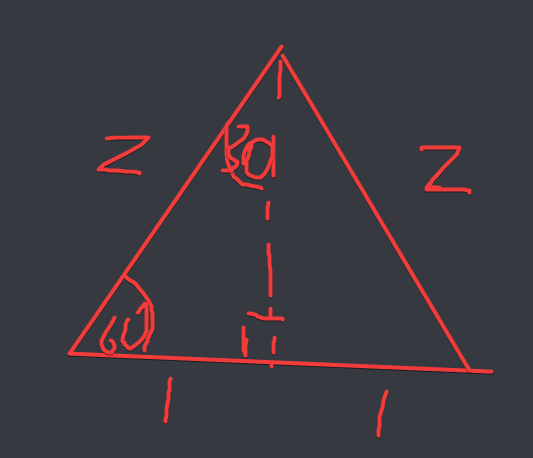
The best way to remember trig angles related to 30, 45, 60 is to remember 2 triangles
 sterile seal
look at the table
terse pine
is $\frac{\sqrt{2}}{2}=\frac{1}{\sqrt{2}}$?
potent lotusBOT
Zyme><SOL
 rigid kettle
yes prove it
sterile seal
rigid kettle
That aside, a table isn't a good method anyways
Isn’t the only method to calculate using the complex form of them
rigid kettle
potent lotus
**Zyme><SOL**
what can you multiply by top and bottom
terse pine
potent lotus
**Zyme><SOL**
because in mines it had sqrt2/2 as the values for that
sterile seal
Rationalize the denominator
rigid kettle
to rationalize the denominator yes
 sterile seal
Really?
terse pine
sqrt2*2 is 1?
rigid kettle
draw them neater on a piece of paper and you will find it does the job
yh for 30 60 45
rigid kettle
terse pine
sqrt2*2 is 1?
??? what
sterile seal
Oh I thought you were talking about for all triangles
rigid kettle
$\frac{1}{\sqrt{2}} = \frac{\sqrt{2}}{\sqrt{2}\sqrt{2}} = \frac{\sqrt{2}}{2}$
potent lotusBOT
 rigid kettle
yes?
terse pine
$\frac{\sqrt{2} * \sqrt{2}}{2 *\sqrt{2}}$
potent lotusBOT
Zyme><SOL
 rigid kettle
first step multiply by sqrt2 / sqrt2 = 1
rigid kettle
potent lotus
**Zyme><SOL**
???
terse pine
bro what I'm lost
how do you change sqrt2/2 into 1/sqrt 2
divide both sides by sqrt 2?
why would that occur to you though
what's the trigger that would say yes, divide both sides by sqrt 2
terse pine
rigid kettle
https://i.imgur.com/fJcnnUg.png
https://i.imgur.com/YY1loIz.png
I'll try remembering this but I need to understand it at base value
sterile seal
$\frac{1}{\sqrt{2}}=\frac{1}{\sqrt{2}} \cdot \frac{\sqrt{2}}{\sqrt{2}} = \frac{\sqrt{2}}{\sqrt{2}^2}=\boxed{\frac{\sqrt{2}}{2}}$
terse pine
backwards would be dividing by sqrt 2 right
potent lotusBOT
kappa
 sterile seal
This might be easier to see
terse pine
yeah I get that
sterile seal
What are you having trouble with?
sterile seal
It’s a common technique to make computation easier
For example, if sqrt2 is approximately 1.41, then what is 1/sqrt2?
terse pine
1/1.41
sterile seal
And that’s hard to find right
terse pine
yeah
sterile seal
But if we rationalize the denominator and find that 1/sqrt2=sqrt2/2
We can simply divide by 2 and find that 1.41/2=0.705
terse pine
oh alright, do you happen to know anything about transformations of the parent function sqrt x
sterile seal
Maybe??
terse pine
I posted a question in #help-32
if you could take a look at it
would be appreciated
.close
calm coralBOT
Channel closed
Closed by @terse pine
Use .reopen if this was a mistake.
Available help channel!
Send your question here to claim the channel.
Remember:
• Ask your math question in a clear, concise manner.
• Show your work, and if possible, explain where you are stuck.
• After 15 minutes, feel free to ping <@&286206848099549185>.
• Type the command .close to free the channel when you're done.
• Be polite and have a nice day!
Read #❓how-to-get-help for further information on how to ask a good question, and about conduct in the question channels.
 uneven saffron
Hey
calm coralBOT
uneven saffron
Hey
uneven saffron
Need help with a q
 swift marsh
uneven saffron
Need help with a q
swift marsh
uneven saffron
Need help with a q
 uneven saffron
"Lethna buys some boxes of pens and some packets of pencils
There are 40 pens in each box
There are 12 Pencils each box
Lethna givesone pen and one pencil to each student in Year 7 of her school
When she has done this she has no pens and no pencils left
Work our how many boxes of pens and pencils Lethna could have bought"
 vagrant oak
Do you know least common multiple?
uneven saffron
idk howto find it
okay
i relearned how to find it
its 120
cause 2 x 2 x 2 x 3 x 5 = 120
What now
used prime factor decomposition to get this btw
alr
i got it
3 boxes of pens and 10 boxes of pencils
.close
calm coralBOT
Channel closed
Closed by @uneven saffron
Use .reopen if this was a mistake.
Available help channel!
Send your question here to claim the channel.
Remember:
• Ask your math question in a clear, concise manner.
• Show your work, and if possible, explain where you are stuck.
• After 15 minutes, feel free to ping <@&286206848099549185>.
• Type the command .close to free the channel when you're done.
• Be polite and have a nice day!
Read #❓how-to-get-help for further information on how to ask a good question, and about conduct in the question channels.
terse pine
Just needed some help remembering what sides are on both the 30-60-90 triangle and the 45-45-90 triangle
calm coralBOT
terse pine
Just needed some help remembering what sides are on both the 30-60-90 triangle a...
upper sparrow
For the 45-45-90, you have a [right angle] triangle whose non-hypotenuse sides are equal
For the 30-60-90, take an equilateral triangle and fold it in half
prisma mango
terse pine
Just needed some help remembering what sides are on both the 30-60-90 triangle a...
terse pine
I'm looking through my lesson pages if your wondering
rigid kettle
the information in them is apparent
you just need to draw an equilateral and split it in half
and a right isos
terse pine
there was an example where I wrote down the exact side length associated with the angle
rigid kettle
Wait sorry misread your question
you wanted the sides???
It doesnt really matter what the sides are
rigid kettle
Its the same scaled up or down
You get the same fraction but the numerator/denominator is multiplied by a constant
terse pine
is the 30 60 90 triangle the sine triangle or the cosine
or am I just making things up now
prisma mango
You use sine and cosine to solve for the sides
terse pine
that's the purpose of my question
prisma mango
It's not restricted to just one of those
terse pine
so sin 30 for the 30 angle?
which case would you use either
it gives different results
prisma mango
Do you know the mnemonic SOH CAH TOA?
terse pine
yup
prisma mango
So if you did $\sin(\theta)$ that's opp/hyp
potent lotusBOT
dldh06
 prisma mango
If theta = 30, then you are using the sides opp and hyp, if you are applying sine
If you are using cosine, that's adj/hyp
So you are using both trig functions to find opp and adj
calm coralBOT
@terse pine Has your question been resolved?
calm coralBOT
Channel closed
Closed due to timeout
Use .reopen if this was a mistake.
Available help channel!
Send your question here to claim the channel.
Remember:
• Ask your math question in a clear, concise manner.
• Show your work, and if possible, explain where you are stuck.
• After 15 minutes, feel free to ping <@&286206848099549185>.
• Type the command .close to free the channel when you're done.
• Be polite and have a nice day!
Read #❓how-to-get-help for further information on how to ask a good question, and about conduct in the question channels.
 marsh canyon
 calm coralBOT
marsh canyon
calm coralBOT
calm coralBOT
marsh canyon
calm coralBOT
Channel closed
Closed by @marsh canyon
Use .reopen if this was a mistake.
Available help channel!
Send your question here to claim the channel.
Remember:
• Ask your math question in a clear, concise manner.
• Show your work, and if possible, explain where you are stuck.
• After 15 minutes, feel free to ping <@&286206848099549185>.
• Type the command .close to free the channel when you're done.
• Be polite and have a nice day!
Read #❓how-to-get-help for further information on how to ask a good question, and about conduct in the question channels.
 toxic igloo
 calm coralBOT
toxic igloo
toxic igloo
calm coralBOT
toxic igloo
toxic igloo
i need help drawing this out
calm coralBOT
@toxic igloo Has your question been resolved?
Channel closed
Closed by @toxic igloo
Use .reopen if this was a mistake.
toxic igloo
.reopen
calm coralBOT
✅
toxic igloo
<@&286206848099549185>
to find the bearing, i found the angle of about 41 degrees but on the answer key it says the bearing is S27W

thats my work
never mind
i figured it out
i just had to subtract 41-14
.close
calm coralBOT
Channel closed
Closed by @toxic igloo
Use .reopen if this was a mistake.
Available help channel!
Send your question here to claim the channel.
Remember:
• Ask your math question in a clear, concise manner.
• Show your work, and if possible, explain where you are stuck.
• After 15 minutes, feel free to ping <@&286206848099549185>.
• Type the command .close to free the channel when you're done.
• Be polite and have a nice day!
Read #❓how-to-get-help for further information on how to ask a good question, and about conduct in the question channels.
 tribal kernel
Hello i need help on a math problem
calm coralBOT
tribal kernel
Hello i need help on a math problem
 calm coralBOT
@tribal kernel Has your question been resolved?
tribal kernel
<@&286206848099549185>
calm coralBOT
@tribal kernel Has your question been resolved?
calm coralBOT
Channel closed
Closed due to timeout
Use .reopen if this was a mistake.
Available help channel!
Send your question here to claim the channel.
Remember:
• Ask your math question in a clear, concise manner.
• Show your work, and if possible, explain where you are stuck.
• After 15 minutes, feel free to ping <@&286206848099549185>.
• Type the command .close to free the channel when you're done.
• Be polite and have a nice day!
Read #❓how-to-get-help for further information on how to ask a good question, and about conduct in the question channels.
 wintry glacier
whenever i write that something is true because [fancy A] is a sigma algebra
calm coralBOT
wintry glacier
whenever i write that something is true because [fancy A] is a sigma algebra
calm coralBOT
@wintry glacier Has your question been resolved?
wintry glacier
.close
calm coralBOT
Channel closed
Closed by @wintry glacier
Use .reopen if this was a mistake.
Available help channel!
Send your question here to claim the channel.
Remember:
• Ask your math question in a clear, concise manner.
• Show your work, and if possible, explain where you are stuck.
• After 15 minutes, feel free to ping <@&286206848099549185>.
• Type the command .close to free the channel when you're done.
• Be polite and have a nice day!
Read #❓how-to-get-help for further information on how to ask a good question, and about conduct in the question channels.
 west fossil
 calm coralBOT
west fossil
west fossil
calm coralBOT
west fossil
west fossil
wasnt paying enough attention in class lmao
 strange lichen
factor out an x
west fossil
1 x or 0.1x
strange lichen
x
calm coralBOT
@west fossil Has your question been resolved?
Channel closed
Closed by @west fossil
Use .reopen if this was a mistake.
calm coralBOT
Available help channel!
Send your question here to claim the channel.
Remember:
• Ask your math question in a clear, concise manner.
• Show your work, and if possible, explain where you are stuck.
• After 15 minutes, feel free to ping <@&286206848099549185>.
• Type the command .close to free the channel when you're done.
• Be polite and have a nice day!
Read #❓how-to-get-help for further information on how to ask a good question, and about conduct in the question channels.
 vivid idol
Help
calm coralBOT
vivid idol
Help
 prisma mango
vivid idol
prisma mango
vivid idol
You don't need to close and open new channels if no one answers you, just wait patiently for help
strange lichen
So that’s x^(-3/2)
To find antiderivative, +1 to exponent and then multiply the whole thing by 1/(the number u got in the exponent)
strange lichen
Yes, if we change it to a negative exponent, it has to go to the numerator
strange lichen
- Use parentheses, 2. Show ur work. 3. No
 strange lichen
Ye in the exponent
vivid idol
 vivid idol
strange lichen
Ye in the exponent
vivid idol
strange lichen
Ye in the exponent
Back to the original problem
 strange lichen
Just the way you’ve been doing it
 potent lotusBOT
 vivid idol
or still something wrong
strange lichen
Ur good
Actually, the last line u did
The limits are from 1 to 3
Not 3 to 1
Remember we changed that alrdy
strange lichen
It’s read bottom to top
vivid idol
what?
strange lichen
The limits
vivid idol
the first second or third one
strange lichen
The original problem had 3 to 1 right?
vivid idol
Wdym
strange lichen
Bottom limit to top limit
 potent lotusBOT

 strange lichen
Bottom limit to top limit
strange lichen
strange lichen
Bottom limit to top limit
Just read this lol
I’ve said it a few times
strange lichen
The integral was from 3 to 1 originally, we read from the bottom number to the top number
strange lichen
…
vivid idol
but flipped it
strange lichen
Yes
strange lichen
Why’d u flip it back here…
 strange lichen
Ok I understand
vivid idol

not sure how to subtract this mess.
oh nvm
i got it
multiply both by
sqrt
num/dem
den*
done

,rotate
potent lotusBOT
 vivid idol
look good?
vivid idol
ty
can i show u some other simple problems
that i just finished?
that i asked u a while back
strange lichen
Can u wait like 5 mins
 potent lotusBOT
 strange lichen
all 3?
strange lichen
u got em all right
 potent lotusBOT
 strange lichen
ye thats right
 strange lichen
btw if u just wanna check ur answers, search up integral calculator
potent lotusBOT
 strange lichen
ok
strange lichen
nah its fine
vivid idol
 strange lichen
ok
first flip the limits of the second integral
anyways
think abt it like this
the area under the curve from 1 to 7 is -5
from 4 to 7 its -7
strange lichen
not sure what u mean
strange lichen
actually lets do this
vivid idol
we should
strange lichen
break that last integral up into 2 integrals
vivid idol
flip the integral
strange lichen
well yea do that to the limits of the 2nd integral


