#help-41
1 messages · Page 71 of 1
 stable kelp
 tawdry moon
I need help yes
tawdry moon
stable kelp
find the derivative of x sin x using product rule
How
I am stuck on this x+y = 0
Part
0 is full
So I put pi/4
But I can find out cos pi and sin pi but dont know how to remove 4's
stable kelp
Df(x)g(x) = ...
that is product rule
stable kelp
tawdry moon
But I can find out cos pi and sin pi but dont know how to remove 4's
what is cos(pi/4)?
tawdry moon
So basically I apply that to derivated function?
stable kelp
yes you use it to find the derivative they show you
tawdry moon
stable kelp
what is cos(pi/4)?
1/squareroot2
tawdry moon
stable kelp
yes you use it to find the derivative they show you
But I already got one derivatice
stable kelp
what did you get
stable kelp
ok
tawdry moon
I put the x = pi/4 in its place now
stable kelp
ok
tawdry moon
Which made it f'(pi/4)
stable kelp
ok
tawdry moon
Sin pi/4 + pi/4 + cos pi/4
stable kelp
woah woah
tawdry moon
Now I put 0 to find zero point but 0 is filled with - pi/4
tawdry moon
stable kelp
woah woah
What
stable kelp
there is no second plus
tawdry moon
stable kelp
there is no second plus
Yea
stable kelp
it's pi/4 multiplying cos(pi/4)
 stable kelp
use parentheses
i figure your input system automatically makes the whole thing a fraction instead of just the argument to sin/cos
tawdry moon
stable kelp
i figure your input system automatically makes the whole thing a fraction instea...
Yea
tawdry moon
stable kelp
use parentheses
Whats that
stable kelp
()
 grizzled pagodaBOT
firestepper

 ripe cipher
switch into radian mode
ripe cipher
tawdry moon
the line that starts with f'(pi/4) is wrong btw
tawdry moon
ripe cipher
the line that starts with f'(pi/4) is wrong btw
In what way?
 split sail
ripe cipher
the line that starts with f'(pi/4) is wrong btw
split sail
ripe cipher
the line that starts with f'(pi/4) is wrong btw
yh they figured he input it wrong
ripe cipher
tawdry moon
In what way?
you have sin(pi)/4 when you should have sin(pi/4), and the same shit with the cos further on
tawdry moon
ripe cipher
you have sin(pi)/4 when you should have sin(pi/4), and the same shit with the co...
Hmmm
stable kelp
yeah yeah we been over
tawdry moon
Okau
stable kelp
you fixed them all right
ripe cipher
stable kelp
yeah yeah we been over
oh i will leave you to it then
tawdry moon
So likw
What am I gonna do now?
Found it out
@stable kelp @split sail @ripe cipher thanks
Answer was one step away
I did the whole question almost right anyways
.close
 amber waspBOT
Channel closed
Closed by @tawdry moon
Use .reopen if this was a mistake.
amber waspBOT
 Available help channel!
Send your question here to claim the channel.
Remember:
• Ask your math question in a clear, concise manner.
• Show your work, and if possible, explain where you are stuck.
• Do not immediately ping people or roles. After 15 minutes, feel free to ping <@&286206848099549185> once.
• Type the command .close to free the channel when you're done.
• Be polite and have a nice day!
Read #❓how-to-get-help for further information on how to ask a good question, and about conduct in the question channels.
amber waspBOT
 mighty schooner
amber waspBOT
mighty schooner
amber waspBOT
Channel closed
Channel closed due to the original message being deleted.
If you did not intend to do this, please open a new help channel,
as this action is irreversible, and this channel may abruptly lock.
Available help channel!
Send your question here to claim the channel.
Remember:
• Ask your math question in a clear, concise manner.
• Show your work, and if possible, explain where you are stuck.
• Do not immediately ping people or roles. After 15 minutes, feel free to ping <@&286206848099549185> once.
• Type the command .close to free the channel when you're done.
• Be polite and have a nice day!
Read #❓how-to-get-help for further information on how to ask a good question, and about conduct in the question channels.
 dim zealot
what does those walls next to x mean?
 amber waspBOT
dim zealot
what does those walls next to x mean?
amber waspBOT
dim zealot
what does those walls next to x mean?
 tepid widget
It means absolute value
 sly schooner
absolute value, whatever number is inside is positive after it comes out
tepid widget
Basically that
dim zealot
can i put it like that in geogebra?
tepid widget
$|x| = x, \text{ if } x\geq 0; -x \text{ if } x<0$
grizzled pagodaBOT
Erk Gah
 tepid widget
dim zealot
can i put it like that in geogebra?
tepid widget
dim zealot
can i put it like that in geogebra?
Yea
Just type |x| there and it should plot the function
It has a V shape
dim zealot
ah i see it now
tepid widget
grizzled pagoda
**Erk Gah**
For example |3| =3 because 3≥0
dim zealot
What if x is -3?
tepid widget
|-3|=-(-3)=3
We apply -x if x<0
Basically the absolute value makes all input nonnegative
dim zealot
so whatever number i put into x is positive?
tepid widget
Yes, either that or 0
It's more accurate to say "nonnegative" because there's 0
|0|=0
tepid widget
Yes
dim zealot
so that symbol means that x is the same value no matter if its - or positive?
or is it like that just in this case
tepid widget
It's not "the same value", if the input is negative then it becomes positive
tepid widget
Exactly
dim zealot
thats what i meant by value
i think i understand it now

yea since its symetrical
so the y value is the same on both sides, right side is postive and left side is negative. but y value stays the same
thank you
.close
amber waspBOT
Channel closed
Closed by @dim zealot
Use .reopen if this was a mistake.
amber waspBOT
Available help channel!
Send your question here to claim the channel.
Remember:
• Ask your math question in a clear, concise manner.
• Show your work, and if possible, explain where you are stuck.
• Do not immediately ping people or roles. After 15 minutes, feel free to ping <@&286206848099549185> once.
• Type the command .close to free the channel when you're done.
• Be polite and have a nice day!
Read #❓how-to-get-help for further information on how to ask a good question, and about conduct in the question channels.
 north radish
for $a > -1, a \neq 0$ and n $(\in \mathbb{N}) > 1$ show that $(1+a)^n > 1 + na$
amber waspBOT
north radish
for $a > -1, a \neq 0$ and n $(\in \mathbb{N}) > 1$ show that $(1+a)^n > 1 + na$
 gloomy tide
 indigo cloud
presumably you mean > 1+na ?
gloomy tide
north radish
what is that sticker lmao
it's part of a larger one that sometimes comes up
 north radish
oh yes mb
grizzled pagodaBOT
ginny
 north radish
this is it
gloomy tide
indigo cloud
presumably you mean > 1+na ?
no i don't think so, consider a = -1/2 and n = 2
(1 - 1/2)^2 = 1/4
1 + na = 0
north radish
no it is 1 + na
gloomy tide
yea so apparently i'm losing my mind ok anyway
indigo cloud
(its bernoulli)
gloomy tide
ummm can you prove it for n = 2?
north radish
 split sail
gloomy tide
it's part of a larger one that sometimes comes up
split sail
gloomy tide
it's part of a larger one that sometimes comes up
Lmao why is it trimmed
gloomy tide
what about for n = 3? there may be some pattern you can exploit
grizzled pagodaBOT
Ajay

 drowsy furnace
Another way is to do it by induction
 valid shadow
induction lowk the way to go
north radish
drowsy furnace
Another way is to do it by induction
this seems good
yeah lol i got it
thanks
.close
amber waspBOT
Channel closed
Closed by @north radish
Use .reopen if this was a mistake.
amber waspBOT
Available help channel!
Send your question here to claim the channel.
Remember:
• Ask your math question in a clear, concise manner.
• Show your work, and if possible, explain where you are stuck.
• Do not immediately ping people or roles. After 15 minutes, feel free to ping <@&286206848099549185> once.
• Type the command .close to free the channel when you're done.
• Be polite and have a nice day!
Read #❓how-to-get-help for further information on how to ask a good question, and about conduct in the question channels.
 orchid patrol
For 20b I am confused why if I let $u=x^2$ and solve doesn't lead to the same answer as rewtring the integral as $x\int_0^x (1+(xt)^2)^-3dt$
 amber waspBOT
orchid patrol
For 20b I am confused why if I let $u=x^2$ and solve doesn't lead to the same an...
amber waspBOT
orchid patrol
For 20b I am confused why if I let $u=x^2$ and solve doesn't lead to the same an...
 full elk
Wdym by if you let u=x^2 and solve?
With chain rule and all you mean?
Like $\int_0^{x^2} (1+t^2)^{-3} \dd{t} = \int_0^u (1+t^2)^{-3} \dd{t}$
And then chain rule
grizzled pagodaBOT
Azyrashacorki
 orchid patrol
Can't we just say $A(u) =\int_0^u (1+t^2)^-3dt$

 orchid patrol
grizzled pagoda
**Azyrashacorki**
orchid patrol
grizzled pagoda
**Azyrashacorki**
Ye and just apply the first fundamental theorem and get $A'(u) = (1+u^2)^-3$
full elk
grizzled pagoda
**BigBen**
That's fine but you're looking for $\frac{d}{\dd{x}} A(u)$ so there's chain rule involved.

 orchid patrol
I'm confused because we have f(u)
Can we not just then sub in for u. We do we need to do the chain rule if we aren't focusing on A'(u)
full elk
Because you're not differentiating with respect to u, you're differentiating with respect to x
and u = x^2
grizzled pagodaBOT
Azyrashacorki
 full elk
It is true that $\frac{\dd{A}}{\dd{u}} = f(u)$.
orchid patrol
So I understand your write up I just don't see we we can't then sub in for u is it because we get f(x^2) and not f(x)
full elk
If you write $A(u) = \int_0^u f(t) \dd{t}$, then the FTC \textbf{does} say that $\frac{\dd{A}}{\dd{u}} = f(u).$
grizzled pagodaBOT
Azyrashacorki
 full elk
But the question isn't asking you to compute $\frac{\dd{A}}{\dd{u}}$, it's asking you to compute $\frac{\dd{A}}{\dd{x}}$
grizzled pagodaBOT
Azyrashacorki
 full elk
So you need to use the chain rule
orchid patrol
But that is only since the first one leads to f(x^2) right
 magic lily
thats basically the use of leibniz integral rule right?
orchid patrol
Not familiar with that
magic lily
what class are you taking?
orchid patrol
No class
full elk
Maybe a bit less intricate than the integral rule. You don't really need to differentiate under the integral sign for #20
full elk
orchid patrol
But that is only since the first one leads to f(x^2) right
Essentially, yes
orchid patrol
Ok I'm going to do it with the chain rule. Not sure if it will match though since what I found solving the second way seems odd
full elk
Yeah that's another thing what did you mean in your second method?
orchid patrol
I mean I rewrote the integral as $A(x)= x\int_0^x (1+(xt)^2)^-3dt$ I expanded, broke up the integral and took out all the x's and then applied the first fundamental theorem.
grizzled pagodaBOT
BigBen
 full elk
It just seems like a weird workaround
And I'm not sure there's even a clean way to pull all the x's out like in 19
Anyways the intended route is definitely FTC and chain rule.
orchid patrol
full elk
It just seems like a weird workaround
I am just applying this
 orchid patrol
full elk
And I'm not sure there's even a clean way to pull all the x's out like in 19
orchid patrol
full elk
And I'm not sure there's even a clean way to pull all the x's out like in 19
Because for say 20c I don't see how I could just sub the bounds for u
Also using chain rule I have that we have $A'(u)u'(x)$ so we have $2x(1+x^4)^-3$
grizzled pagodaBOT
BigBen
 full elk
Another way to see it is like this, and this works for c):
If $F(t)$ is the antiderivative of the $(1+t^2)^{-3}$, then the FTC says that $$\int_0^{x^2} (1+t^2)^{-3}\dd{t} = F(x^2) - F(0)$$
Now if you differentiate that you get $(F(x^2))' - (F(0))' = F'(x^2) \cdot (x^2)' - 0 = (1+x^4)^{-3} \cdot 2x.$
grizzled pagodaBOT
Azyrashacorki
 full elk
Then if both bounds are function of x, you can solve it the same way
orchid patrol
How do we know F(x)
full elk
You don't, but it's an antiderivative of the integrand, so F'(x) is just the integrand
orchid patrol
But don't the bounds still mess us up because the problem is just $F(x)=\int_0^{x^2}(1+t^2)^-3$
grizzled pagodaBOT
BigBen
 orchid patrol
full elk
And I'm not sure there's even a clean way to pull all the x's out like in 19
orchid patrol
full elk
And I'm not sure there's even a clean way to pull all the x's out like in 19
Let me show you what I did. Because I pull it out but it doesn't seem like what we found with the chain rule
full elk
The point is if you have $A(x) = \int_0^{x^2} f(t) \dd{t}$, then you can assume you have some antiderivative $F(t)$ of $f(t)$ (so that means that $F'(t) = f(t)$.) \
Now $A(x) = \int_0^{x^2} f(t) \dd{t} = F(x^2) - F(0)$ by the FTC. That's how you compute integrals generally : take some antiderivative and compute that antiderivative at the endpoints. This doesn't give a precise definition of $A(x)$, since we just know $F(t)$ is an antiderivative of $f(t)$.\
However, we want to compute $A'(x)$, so $$A'(x) = (F(x^2) - F(0))' = (F(x^2))' - \cancelto{0}{(F(0))'} = F'(x^2) \cdot 2x = f(x^2) \cdot 2x.$$
grizzled pagodaBOT
Azyrashacorki
 orchid patrol
Ok I understand this.
The last thing I don't understand is the more convoluted method
@full elk this is what I have
 full elk
It seems you've assumed that $\frac{1}{k^3 + 3k^2 + 3k + 1} = \frac{1}{k^3} + \frac{1}{3k^2} + \frac{1}{3k} + 1$
grizzled pagodaBOT
Azyrashacorki
 full elk
You can't do that unfortunately
magic lily
this is the one with leibniz integral rule i think
because the function inside integral is in terms of limit variable
orchid patrol
full elk
You can't do that unfortunately
Lol. Silly mistake
full elk
orchid patrol
Lol. Silly mistake
That's what I mean by how you won't be able to pull stuff out nicely like in the previous exercise
amber waspBOT
Channel closed
Closed by @orchid patrol
Use .reopen if this was a mistake.
amber waspBOT
Available help channel!
Send your question here to claim the channel.
Remember:
• Ask your math question in a clear, concise manner.
• Show your work, and if possible, explain where you are stuck.
• Do not immediately ping people or roles. After 15 minutes, feel free to ping <@&286206848099549185> once.
• Type the command .close to free the channel when you're done.
• Be polite and have a nice day!
Read #❓how-to-get-help for further information on how to ask a good question, and about conduct in the question channels.
 grim isle
 grim isle
What am I doing wrong
indigo cloud
why do you think you are doing something wrong?
magic lily
whats the question
grim isle
Cuz 7(4) -9(3) ain't 5
grim isle
Oh so my X and y is multiplied by 5 too?
indigo cloud
yes
amber waspBOT
Channel closed
Closed by @grim isle
Use .reopen if this was a mistake.
amber waspBOT
Available help channel!
Send your question here to claim the channel.
Remember:
• Ask your math question in a clear, concise manner.
• Show your work, and if possible, explain where you are stuck.
• Do not immediately ping people or roles. After 15 minutes, feel free to ping <@&286206848099549185> once.
• Type the command .close to free the channel when you're done.
• Be polite and have a nice day!
Read #❓how-to-get-help for further information on how to ask a good question, and about conduct in the question channels.
 topaz flame
i drew a table
 amber waspBOT
topaz flame
i drew a table
amber waspBOT
topaz flame
i drew a table
 topaz flame
idk what that means
magic lily
when you represent a number in form of another, you are left with a remainder
like 5 = 3×1 +2
2 is the remainder here
 unreal plume
interrobang
unreal plume
magic lily
when you represent a number in form of another, you are left with a remainder
technically thats true but it makes more sense for the context to think of it as the amount remaining after one number is divided by another
unreal plume
topaz flame
for exmaple 5/2 - remainder being .5
for example the remainder here is one because two twos (a four) goes into five and one is left from the five
magic lily
topaz flame
for exmaple 5/2 - remainder being .5
partly correct , the decimal part of the number can be multiplied by the denominator to get the remainder
topaz flame
ok
magic lily
unreal plume
technically thats true but it makes more sense for the context to think of it as...
yea true
magic lily
topaz flame
i still dont get it
after you find out all the remainders
magic lily
topaz flame
how does this table that i have help
just replace each term in this table by their remainder when divided by 3 , and then calculate the probability of 0,1,2
unreal plume
since you have every possible value, you could go down one of two paths: convert each value into the remainder and find the probability of each remainder OR find the probability of each value and then find remainders afterwards
magic lily
no thats not how probability works
topaz flame
yea i aint understanding ts at all
magic lily
take the number of 2s and divide them by the number of total numbers
topaz flame
so 4 divided by 16
unreal plume
yeah i think 1/4 is right?
topaz flame
u guys confusing me
magic lily
no
first you also have to see thay after taking the remainder , 5 also becomes 2
so there will be two more 2s
topaz flame
.close
amber waspBOT
Channel closed
Closed by @topaz flame
Use .reopen if this was a mistake.
unreal plume
@topaz flame if youre still willing i can explain it to you
unreal plume
kk
amber waspBOT
Available help channel!
Send your question here to claim the channel.
Remember:
• Ask your math question in a clear, concise manner.
• Show your work, and if possible, explain where you are stuck.
• Do not immediately ping people or roles. After 15 minutes, feel free to ping <@&286206848099549185> once.
• Type the command .close to free the channel when you're done.
• Be polite and have a nice day!
Read #❓how-to-get-help for further information on how to ask a good question, and about conduct in the question channels.
 reef skiff
find the values of b for which the point (2b+3,b^2) lies above the line 3x-4y-a(a-2)=0 for all a belongs to R
amber waspBOT
reef skiff
find the values of b for which the point (2b+3,b^2) lies above the line 3x-4y-a(...
magic lily
you need b in terms of a right?
reef skiff
the answer is in proper numbers, no variables
magic lily
ok
so
with different values of a
the line shifts up and down
when a >2 , the line is below origin
when a belongs to (0,2) it goes above origin
when a<0 it again goes below origin
in the three cases
just put (2b+3, b²)
in the given equation and put the sign according to sign of origin
is that a hint enough
stable kelp
i would put the equation in y = ... form
reef skiff
magic lily
in the given equation and put the sign according to sign of origin
i thought of that but there must be a simpler way than this right
reef skiff
stable kelp
i would put the equation in y = ... form
and after that?
stable kelp
put in the point lel
reef skiff
magic lily
how does that lead to a finite answer
answer is a range
reef skiff
the book has a solution but it was very confusing
split sail
magic lily
in the three cases
just need to evaluate the case where line goes fartherst above origin those points will satisfy all lines
reef skiff
 reef skiff
magic lily
why is discriminant negative tho
reef skiff
magic lily
why is discriminant negative tho
i think cuz tthe quadratic in a is always positive
amber waspBOT
Channel closed
Closed by @reef skiff
Use .reopen if this was a mistake.
amber waspBOT
Available help channel!
Send your question here to claim the channel.
Remember:
• Ask your math question in a clear, concise manner.
• Show your work, and if possible, explain where you are stuck.
• Do not immediately ping people or roles. After 15 minutes, feel free to ping <@&286206848099549185> once.
• Type the command .close to free the channel when you're done.
• Be polite and have a nice day!
Read #❓how-to-get-help for further information on how to ask a good question, and about conduct in the question channels.
 hollow plank
a question came in an exam about coding in c++. the question was: (No calculators allowed. No Devices alowed.)
 amber waspBOT
hollow plank
a question came in an exam about coding in c++. the question was: (No calculator...
amber waspBOT
hollow plank
a question came in an exam about coding in c++. the question was: (No calculator...
 solar gust
k++ return the value before incrementing (and increments it)
++k return the one after being incremented
Lasting to know how does the program starts evaluating it
(If it even compiles)
I think it will clearly goes undefined behaviour and depends on the compiler
 lilac vector
You really shouldn't program like that anyway.
 winter badge
on gcc the output for this kind of thing is 10
but its entirely compiler dependant like υἀκυβρος said
so its a silly silly question
solar gust
Its the kind of a[i] = i++ that they changed in cpp17 but they won't make any change for this as no one do this
amber waspBOT
@hollow plank Has your question been resolved?
winter badge
hmmm I think gcc is doing this its working pairwise and goes (++k + k++) + (++k + ++k) the first bracket does this
++k makes k=1
- k++ means that add k then increment k by 1
so this should be 2 then after this addition k becomes 3 from the k++
so so far we have (1+1) + (...) where k=3
then the second bracket ++k makes k=4 + k=5?
this the gives (2+9=11)?
so rather its doing something like this
in the first 2 brackets its going (++k + k++) now ++k makes k=1 and k++ returns 1 and plans to increment k=2
so it does k=1+1 then it does k=2
and for (++k + ++k)
it takes (k =3 and k=4)
then it performs the addition
but k is now 4
so it does 4+4=8
so now I have (1+1)+(4+4)=10
damn
this is an awful question even with running the code if we just have to f around with how we think the specific compiler works
get your class rep to void this question from the marking

gcc vs clang
#include <iostream>
int main(){
    int k =0;
    k = ++k + k++ + ++k + ++k;
    std:: cout << k << '\n';
    return 0;
}
shilly shilly
hollow plank
winter badge
gcc vs clang
im on mac so i use clang and it gives me 8
the actual answer was 9
winter badge
there is no answer since they didn't say:
which compiler
which version
which OS
I am on archlinux
which uses a different version of clang to mac
hollow plank
Ok Can i give another problem in the same channel or do i have to close it and go to another channel
winter badge
better to just close and open a new one if you want a higher likelyhood off people answering
but either is fine
hollow plank
find v[100000]

The way i sloved it was that every index where the value is zero is a triangular number
I try to find the largest triangular number that is less than 100000.
which took me a long time to do
an i got it wrong bc of a miscalculation i did while multiplying
winter badge
you would not believe that we literally just helped with a question like this
hollow plank
winter badge
you would not believe that we literally just helped with a question like this
Really?
winter badge
@coral wigeon
hollow plank
winter badge
<@984319941417250907>
who is she?
 coral wigeon
lol
winter badge
a very nice person, sometimes. Layla would u be willing to help this silly
hollow plank
coral wigeon
lol
whats funny
winter badge
i gtg
hollow plank
hollow plank
find v[100000]
with this not the other one
 agile sun
amen nyxzore
coral wigeon
the nth triangular number is n(n+1)/2. you can find the largest one less than 100000 with some algebra
hollow plank
coral wigeon
the nth triangular number is n(n+1)/2. you can find the largest one less than 10...
how?
coral wigeon
how what?
coral wigeon
but c++ programs are allowed?
hollow plank
coral wigeon
but c++ programs are allowed?
No its a pen and paper exam
coral wigeon
well we want to find the largest n such that n(n+1)/2 < 100000.
coral wigeon
one way would be with quadratic formula or something but probably good to avoid that if possible if working by hand
n(n+1) is approximately n^2
so we could just consider the inequality n^2 < 200000
the largest n satisfying this will be very close to the answer to the original problem. and we can just check it manually once we know
hollow plank
$200\sqrt{5}$
grizzled pagodaBOT
P2O5
 coral wigeon
,calc (200*sqrt(5))^2
grizzled pagodaBOT
Result:
2e+5
great
coral wigeon
i was just checking your math
coral wigeon
no
coral wigeon
,calc 200*sqrt(5)
grizzled pagodaBOT
Result:
447.21359549996
 leaden stone
oh coding problems, thats rare
leaden stone
coral wigeon
yea well i’m not approximating 200*sqrt(5) by hand
use differentials
winter badge
I is back
winter badge
leaden stone
oh coding problems, thats rare
Indeed and they are definitely better, don't kill me pls
 hidden narwhal
Just approximate
leaden stone
winter badge
Indeed and they are definitely better, don't kill me pls
i fw coding, dont worry
hollow plank
leaden stone
use differentials
derrivative?
coral wigeon
i don’t think you’re really going to get around approximating a square root for this problem
no matter what you do
winter badge
💀 
leaden stone
eh
coral wigeon

hollow plank
.closer
leaden stone
who scared him off?
hollow plank
.Close
coral wigeon
leaden stone
who scared him off?
you just showed up
leaden stone
this is why we dont help chemistry peeps
hollow plank
.closepls
hidden narwhal
Just do .close
hollow plank
leaden stone
this is why we dont help chemistry peeps
hey
hidden narwhal
 hollow plank
.close
amber waspBOT
Channel closed
Closed by @hollow plank
Use .reopen if this was a mistake.
leaden stone
coral wigeon
you just showed up
hahahahah
winter badge
hidden narwhal
Just do .close
Supposed to let him be silly fr
leaden stone
that was sarcastic btw
hidden narwhal
winter badge
Supposed to let him be silly fr
Chemistry learner always silly
leaden stone
fr
hidden narwhal
I do chemistry too no worries
leaden stone
let them do their orbital molecular theory
hollow plank
@ everyone
amber waspBOT
Available help channel!
Send your question here to claim the channel.
Remember:
• Ask your math question in a clear, concise manner.
• Show your work, and if possible, explain where you are stuck.
• Do not immediately ping people or roles. After 15 minutes, feel free to ping <@&286206848099549185> once.
• Type the command .close to free the channel when you're done.
• Be polite and have a nice day!
Read #❓how-to-get-help for further information on how to ask a good question, and about conduct in the question channels.
 solemn escarp
 amber waspBOT
solemn escarp
solemn escarp
amber waspBOT
solemn escarp
solemn escarp
one second i will translate it
grizzled pagodaBOT
Copter

 deep edge
You’d want to study how are M and N mod 1000, or at least mod the prime factors of 1000
I can see a way to do it for 2, but for 5 it seems harder
 quartz cargo
solemn escarp
oh yeah a_i are natural numbers
quartz cargo
solemn escarp
oh yeah a_i are natural numbers
i think it can be solved if we multiply both sides by a_1×a_2×a_3...×a_2012
And then you check the parity of both the sided
sides*
deep edge
deep edge
I can see a way to do it for 2, but for 5 it seems harder
I confirm that you can fully resolve MN mod 8 (8 being the highest power of 2 in 1000), but I’m not sure for 125
solemn escarp
sigh
solemn escarp
quartz cargo
i think it can be solved if we multiply both sides by a_1×a_2×a_3...×a_2012
And ...
how would you do this?
for odd ai
quartz cargo
solemn escarp
how would you do this?
ill send you a pic give me 5 mins
solemn escarp
oki
quartz cargo
 quartz cargo
lol wdym
solemn escarp
this contest just gives troll problems for middleschool students😭
quartz cargo
hahah
amber waspBOT
Channel closed
Closed by @solemn escarp
Use .reopen if this was a mistake.
quartz cargo
:)
amber waspBOT
Available help channel!
Send your question here to claim the channel.
Remember:
• Ask your math question in a clear, concise manner.
• Show your work, and if possible, explain where you are stuck.
• Do not immediately ping people or roles. After 15 minutes, feel free to ping <@&286206848099549185> once.
• Type the command .close to free the channel when you're done.
• Be polite and have a nice day!
Read #❓how-to-get-help for further information on how to ask a good question, and about conduct in the question channels.
magic lily
 amber waspBOT
magic lily
amber waspBOT
magic lily
 royal spoke
What are your ideas so far?
magic lily
i tried total - the unfavourable cases
but i made a major mistake of using a single number more than once
and whenever im fixing a certain pair to be unfavourable, like (2,4) , i dont know whether the other pairs are favourable or not
royal spoke
if a certain pair is unfavourable, then that configuration cannot be favourable. it doesn't matter if the other pairs are favourable or not.
Maybe use IEP to calculate the number of unfavourable cases
magic lily
royal spoke
if a certain pair is unfavourable, then that configuration cannot be favourable....
but i have to keep others favourable , to not do overcounting
royal spoke
IEP 😭
royal spoke
do you think it does?
magic lily
no
for the total cases
i cant really do 8! then can I?
cuz then it would treat 24 and 42 as different
so i do 8! / 8 then
coral wigeon
isn’t any collection of pairs where 2 and 6 aren’t together good?
coral wigeon
hm yes not sure what i was thinking
 ivory forge
Inclusion exclusion, cases . I hate cases
magic lily
magic lily
im getting 4980
can someone check pls
ivory forge
Wouldn't it work, if you made pairs of odd even
Then consider (4,8) and othere odd-even, one odd odd
magic lily
idk dawg
coral wigeon
going through cases with
2 with an odd number
2 with 4
2 with 6
2 with 8
is probably tedious but doable
magic lily
coral wigeon
going through cases with
2 with an odd number
2 with 4
2 with 6
2 with 8
is pr...
why 2 with odd
coral wigeon
well there are 0 in that case so you can just ignore it
i was just enumerating all the possibilities 2 can go with
magic lily
yuh
2 can only be with odd number in favourable cases
since every even with 2 gives gcd 2
coral wigeon
coral wigeon
well there are 0 in that case so you can just ignore it
for unfavorable arrangements that is. but maybe it is better to just count favorable arrangements. then we need to put 2 with an odd number
magic lily
but we also need to ensure every other pair to be favourable
coral wigeon
yea but the problem is a little smaller now. only 6 numbers instead of 8
could do some casework
coral wigeon
no idea, i don’t have the energy to try it
coral wigeon
coral wigeon
for unfavorable arrangements that is. but maybe it is better to just count favor...
we also need to put 6 with an odd number?
magic lily
ill just send my solution for anyone else
ivory forge
magic lily
im getting 4980
Most probably wrong because total possible ways to divide into 4 pairs is 1260
Maybe
magic lily


 magic lily
ivory forge
Most probably wrong because total possible ways to divide into 4 pairs is 1260
magic lily
ivory forge
Most probably wrong because total possible ways to divide into 4 pairs is 1260
mb
its not even that tho
2520
is the one
magic lily
magic lily
,rcw
coral wigeon
assign odds to 2 and 6. then we are left with {odd, odd, 4, 8}. any way we pair these is ok
4 * 3 * 3 if the pairs are not ordered?
magic lily
 magic lily
magic lily
magic lily
,rcw
grizzled pagodaBOT
 coral wigeon
*2^4 if they are ordered
ivory forge
magic lily
2520
That is to high as well
ivory forge
coral wigeon
*2^4 if they are ordered
They are not i feel the question doesnt mention
coral wigeon
yea that was my guess too
magic lily
grizzled pagoda
is this alr or no
ivory forge
Unrelated but while calculating total pairs, the order of pairs does not matter hence there is over counting here
 magic lily
where exactly
ivory forge
magic lily
is this alr or no
In the end you missed a case where 4 and 8 are in pair, remaining 2 odds are in pair
So 3 total of {odd, odd, 4, 8}
ivory forge
magic lily
where exactly
The line 8thing into pairs
amber waspBOT
@magic lily Has your question been resolved?
amber waspBOT
Channel closed
Closed due to timeout
Use .reopen if this was a mistake.
amber waspBOT
Available help channel!
Send your question here to claim the channel.
Remember:
• Ask your math question in a clear, concise manner.
• Show your work, and if possible, explain where you are stuck.
• Do not immediately ping people or roles. After 15 minutes, feel free to ping <@&286206848099549185> once.
• Type the command .close to free the channel when you're done.
• Be polite and have a nice day!
Read #❓how-to-get-help for further information on how to ask a good question, and about conduct in the question channels.
 robust charm
 amber waspBOT
robust charm
split sail
amber waspBOT
robust charm
split sail
they factorized it
split sail
(x+y) + (x+y)(x-y) = (x+y)(1+x-y) {taking x+y as a common factor}
robust charm
split sail
(x+y) + (x+y)(x-y) = (x+y)(1+x-y) {taking x+y as a common factor}
ah yes
thanks
.close
amber waspBOT
Channel closed
Closed by @robust charm
Use .reopen if this was a mistake.
split sail
np
amber waspBOT
Available help channel!
Send your question here to claim the channel.
Remember:
• Ask your math question in a clear, concise manner.
• Show your work, and if possible, explain where you are stuck.
• Do not immediately ping people or roles. After 15 minutes, feel free to ping <@&286206848099549185> once.
• Type the command .close to free the channel when you're done.
• Be polite and have a nice day!
Read #❓how-to-get-help for further information on how to ask a good question, and about conduct in the question channels.
 delicate spear
pretty sure its only 3. but the answer says 1 and 3.
 delicate spear
let me correct the third option wait
 formal dome
!original
amber waspBOT
Please show the original problem, exactly as it was stated to you, with the entire original context. A picture or screenshot is best. If the original problem is not in English, then post it anyway! The additional context might still be helpful. Do your best to provide a translation.
delicate spear
- abc
delicate spear
amber wasp
Please show the original problem, **exactly as it was stated to you**, with the ...
oki hodl on

.
split sail
delicate spear
what have you tried
delicate spear
split sail
what have you tried
hold on a min
split sail
hint : if x + y = odd , one of x,y needs to be odd and one even
delicate spear

as u can see if the a is even, b can be odd while c being even
all together makes odd
so 1st option is wrong
split sail
only odd . odd = odd
even.even = even
even. odd = odd.even = even
so if you cosinder bc odd then b , c are both odd
delicate spear
oh right sorry i made a mistake there
got comfused
thpught i was adding them
.close
amber waspBOT
Channel closed
Closed by @delicate spear
Use .reopen if this was a mistake.
amber waspBOT
Available help channel!
Send your question here to claim the channel.
Remember:
• Ask your math question in a clear, concise manner.
• Show your work, and if possible, explain where you are stuck.
• Do not immediately ping people or roles. After 15 minutes, feel free to ping <@&286206848099549185> once.
• Type the command .close to free the channel when you're done.
• Be polite and have a nice day!
Read #❓how-to-get-help for further information on how to ask a good question, and about conduct in the question channels.
 chrome trail
Anyone familiar with chess notation?
 amber waspBOT
chrome trail
Anyone familiar with chess notation?
amber waspBOT
chrome trail
Anyone familiar with chess notation?
 stuck vault
💀
chrome trail
Apparently you're supposed to put the x to capture in front of the location so Qxg7 but that doesn't work either
chrome trail
yeah
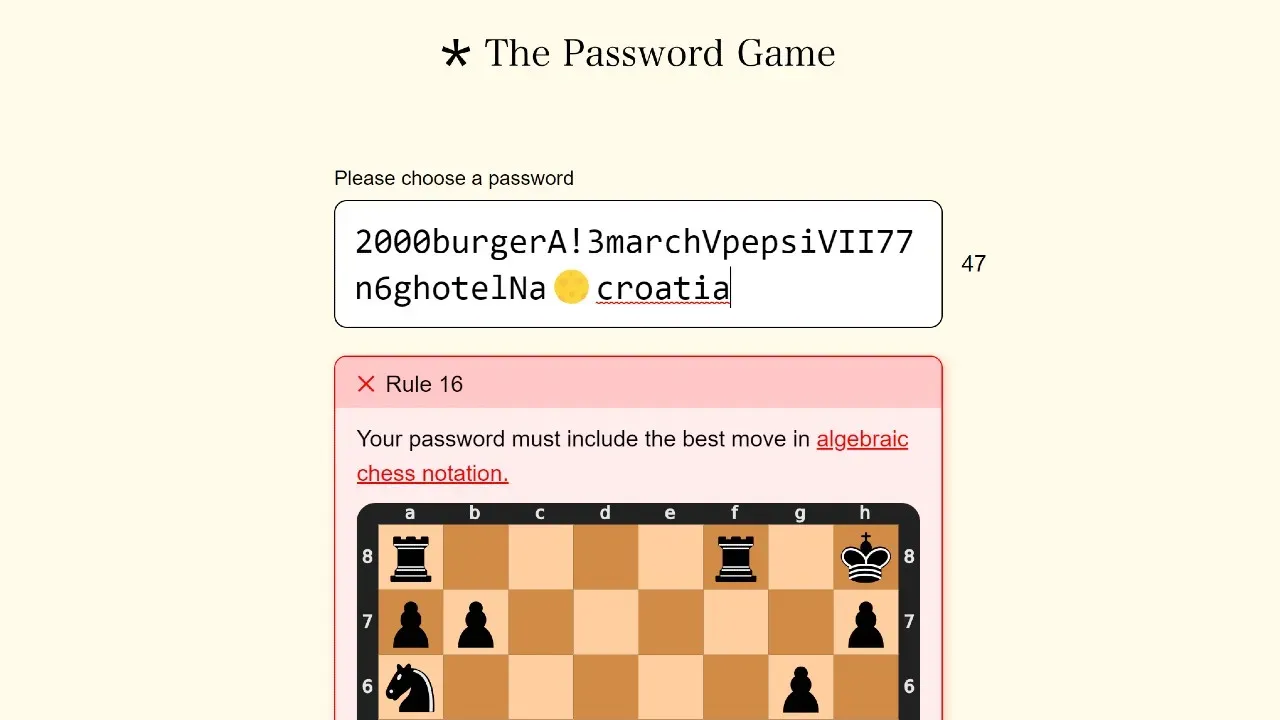
Attack of the Fanboy
Image: Attack of the Fanboy Whether it's baffling questions or madcap rules, The Password Game is the ultimate brain teaser taking social media by storm.
stuck vault
blud
stuck vault
chrome trail
Apparently you're supposed to put the x to capture in front of the location so Q...
what does it say?
 stuck vault
basically if you capture on Qxg7 then black's king will get your queen out
stuck vault
chrome trail
so it's not the best move, but still strange that it says invalid notation
knight sac could be the move
Nf5
because if pawn captures then you use your pawn to capture back, in which mating is better for ya
if don't then mate in 1
chrome trail
that's it, just had to add a plus to check
 frail oasis
Nf5
chrome trail
stuck vault
because if pawn captures then you use your pawn to capture back, in which mating...
I see!
thanks


 stuck vault
ooh
chrome trail
I spent too much time thinking about the notation when it should've been obvious that it wasn't the right move to begin with
amber waspBOT
@chrome trail Has your question been resolved?
Channel closed
Closed by @chrome trail
Use .reopen if this was a mistake.
amber waspBOT
Available help channel!
Send your question here to claim the channel.
Remember:
• Ask your math question in a clear, concise manner.
• Show your work, and if possible, explain where you are stuck.
• Do not immediately ping people or roles. After 15 minutes, feel free to ping <@&286206848099549185> once.
• Type the command .close to free the channel when you're done.
• Be polite and have a nice day!
Read #❓how-to-get-help for further information on how to ask a good question, and about conduct in the question channels.
magic lily
can anyone help me solve limit of log ( 2nCn)
amber waspBOT
magic lily
can anyone help me solve limit of log ( 2nCn)
magic lily
n tends to infinity
 orchid rover
!original please.
amber waspBOT
Please show the original problem, exactly as it was stated to you, with the entire original context. A picture or screenshot is best. If the original problem is not in English, then post it anyway! The additional context might still be helpful. Do your best to provide a translation.
magic lily
orchid rover
!original please.
1 sec
 gritty sluice
buddy isnt 2nCn diverging?
 orchid rover
magic lily
gritty sluice
orchid rover
magic lily
gritty sluice
ahh
 red terrace
stirling approximation maybe
gritty sluice
see
red terrace
for n!
gritty sluice
look at simple logic
magic lily
red terrace
stirling approximation maybe
whats that
gritty sluice
compare e^2n to 2nCn
magic lily
sandwhich?
gritty sluice
yea
red terrace
n! ~ sqrt(2pin)*(n/e)^n
magic lily
red terrace
n! ~ sqrt(2pin)*(n/e)^n
huh
gritty sluice
we see that e^2n >>> 2nCn for large values of n
split sail

In mathematics, Stirling's approximation (or Stirling's formula) is an asymptotic approximation for factorials. It is a good approximation, leading to accurate results even for small values of
    n


{\displaystyle n}
. It is named after James Stirling, though a related but less precise result was first stat...
gritty sluice
because of nature of exponents vs polynomials
magic lily
ok
gritty sluice
but 2^2n < e^2n
magic lily
okay
gritty sluice
yeah since e^2n > 2nCn, 2n> log 2nCn
gritty sluice
gritty sluice
yeah since e^2n > 2nCn, 2n> log 2nCn
not random 🥀
magic lily
ok now what
red terrace
it should be infinity
magic lily
red terrace
it should be infinity
how
gritty sluice
bro....
red terrace
its like 4^n/root(n) using stirling
gritty sluice
you know what
magic lily
red terrace
its like 4^n/root(n) using stirling
did you miss log and 1/2n too
gritty sluice
use graph calculator and check 🔥
red terrace
no i did 2nCn/2n
gritty sluice
you will see it goes to 0
gritty sluice
but you understood the logic?
red terrace
it'll be ln(2) if i didnt misread again
magic lily
gritty sluice
but you understood the logic?
nuh 🛐🛐
magic lily
red terrace
it'll be ln(2) if i didnt misread again
yea but i cant use stirling approx in a subjective exam
gritty sluice
what was stirling btw
magic lily
gritty sluice
brotatoskitocacho
?
gritty sluice
i forgot
red terrace
,w limit ln((2n choose n))/2n as n goes to inf
gritty sluice
u atleast understood that 2n> log 2nCn right?
grizzled pagodaBOT


 Requested by caelian_valet
grizzled pagodaBOT
Requested by caelian_valet
grizzled pagodaBOT
 Requested by caelian_valet
magic lily
Requested by caelian_valet
magic lily
idc about that
red terrace
 gritty sluice
bro....
red terrace
ln(2) ye
gritty sluice
red terrace
dam
magic lily
red terrace
i dont need sols guys 😭
gritty sluice
ig i was wrong 🙏
magic lily
i need help with my solution
stuck vault
red terrace
!nosols
amber waspBOT
red terrace
As a helper, please do not give out answers that could be copied as a homework solution. Have the student work through the problem themselves and guide them along the way.
stuck vault
magic lily
i dont need sols guys 😭
.
stuck vault
red terrace
a solution is a "solution"
and you should not post solutions
as what the bot says
magic lily
how do i convert this to integral
red terrace
its not a solution thats just a numerical answer 🥀
stuck vault
red terrace
its not a solution thats just a numerical answer 🥀
stop trying to argue
or i may want to call someone to handle
agile sun
stuck vault
and you should not post solutions
I think it's okay since the OP is not looking for a solution in either case, and wolfram was just consulted for sanity checking on the helper's part
red terrace
ts a online discord channel gang wym "should i call the cops"
agile sun
and indeed the helper's approach is misled
red terrace
we were confirming whether its 0 or ln2
stuck vault
magic lily
since its done now
all left to you
magic lily
how do i convert this to an integral
 coarse garnet
magic lily
coarse garnet
magic lily
Well by lim laws 1/n is 0, then it should be 0 no?
red terrace
magic lily
how do i convert this to an integral
ill see
magic lily
😭😭😃
red terrace
give me afew minutes
yes i think
integrals woek
what did you do @magic lily
as your work
red terrace
express rhe factorial as a sum of logs
magic lily
ill try to o forward
red terrace
you're going for integration so a sigma notation is definitely needed
try to convert the ugly factorials into that
magic lily
and 1/2n is just dx right?
magic lily
the ones in fraction become negative but
dont they
should i make two seperate integrals
 grizzled pagodaBOT
 magic lily
is this okay
red terrace
that kind of makes it
harder to see ahead
sum ln(2k) - sum ln(k) with different bounds
try writing like that and it'll be cleaner to see the k/n being the x for integration
 split sail
magic lily
im not getting log 2
split sail
magic lily
im not getting log 2
you should
magic lily
😭
red terrace
magic lily
what do i do with log 0
it goes to 0*ln0
red terrace
its an arithmetic error then 🥀
 red terrace
a negative sign to thr whole maybe
and thats only the first integral
it gives (2ln2-1)/2 as youve written
magic lily
red terrace
and thats only the first integral
no thats all of it
first bracket is first
and 2nd is 2nd
i did upper - lower limit in my mind
red terrace
ln(2-x):
-[(2-x)ln(2-x)-(2-x)]
(2ln2-2)-(1ln(1)-1)
=2ln2-1
split sail
a negative sign there and +1 missing
 red terrace
a +1 would appear from the 2nd integral
red terrace
magic lily
i did upper - lower limit in my mind
you made the arithmetic mistake in your mind 🥀
red terrace
yes
red terrace
i just wrote n! as sqrt(2pin)(n/e)^n
its an approximation for large n
sometimes works for limits
for ln(n!) you can just write nln(n)-n
large n
red terrace
np
amber waspBOT
Channel closed
Closed by @magic lily
Use .reopen if this was a mistake.
amber waspBOT
Available help channel!
Send your question here to claim the channel.
Remember:
• Ask your math question in a clear, concise manner.
• Show your work, and if possible, explain where you are stuck.
• Do not immediately ping people or roles. After 15 minutes, feel free to ping <@&286206848099549185> once.
• Type the command .close to free the channel when you're done.
• Be polite and have a nice day!
Read #❓how-to-get-help for further information on how to ask a good question, and about conduct in the question channels.
 tepid girder
help 🙏
 amber waspBOT
tepid girder
help 🙏
tepid girder
amber waspBOT
tepid girder
help 🙏
tepid girder
help
 steel cloak
integral of (ln(n)/(n+1)^2 dn?
tepid girder
yh
steel cloak
well I hate n as a variable so Imma change it to x
steel cloak
ahhhh okay
steel cloak
i see you did IBP
tepid girder
yes
steel cloak
Instead of again using IBP you should use partial fraction decomposition
tepid girder
oh hell no what 🙏
bro I am not that level
ik PF but
we dont need to do allat because of my syllabus
split sail
Hello
 split sail
Who needs help
split sail
With what
steel cloak
well then itps pretty much solved right
tepid girder
(enrique)
tepid girder
no the thing is
split sail
Yea
split sail
Gng show me the question
split sail
Whats the formula for (ii)?
split sail
Show me
tepid girder

 teal oxide
you forgot to multiply the -1 before you split 1/[(x)(1+x)] to 1/x -1/(1+x)
tepid girder
yeah no like I am asking that
if I multiply after solving the inner integral
I am getting - log |x/ x-1| + C
split sail
Hm
tepid girder
I am asking that
if I multiply after solving the inner integral, why am I getting -?
and when I am first multiplying -1, why am I getting +?
am I going insane or am I just wrong?
teal oxide
tepid girder
if I multiply after solving the inner integral, why am I getting -?
wdym multiply after solving the integral? multiply by -1?
 tepid girder
but then if I take the -1 which is outside and I multiply it with this idk equation it is called I am going insane, we're getting -log |x/ x - 1| + C
and if we first multiply
we are getting + log | x/ x-1 | + C
teal oxide
tepid girder
but then if I take the -1 which is outside and I multiply it with this idk equat...
are you referring to the negative before the integral sign?
tepid girder
YES
tepid girder
yeah ik
BUT THEN
THE DENOMINATOR
AND THE NUMERATOR
GET INTERCHANGED
I AM SORRY FOR CAPS I AM GOING INSANE 😭
IS THE ANSWER GIVEN BY THESE PEOPLE WRONG OR SOMETHING
teal oxide
tepid girder
we are getting + log | x/ x-1 | + C
the answer given by them has the term log(x/x+1) or log(x/x-1)?
 frozen horizon
$log | \frac{x}{x+1} | - log( \frac{x}{x+1} ) + C$?
grizzled pagodaBOT
WeAreIngram
 teal oxide
you are not multiplying this -1
 teal oxide
tepid girder
1/x - 1/x+1
teal oxide
tepid girder
1/x - 1/x+1
try solving that
tepid girder
I DID THAT
IT IS
LOG |X/ X+1|
BUT THE THING IS
THE OUTSIDE NEGATIVE SIGN
MAKES IT - LOG|X / X+1|
THE ANSWER IS
- LOGX/X+1 + LOG|X / X+1| + c
THIS IS THE ANSWER
I DID THAT BRO IK THAT 😭
frozen horizon
tepid girder
-logx / x+1 (I got this part right) + log | x/x+1 | +C
What happened to this minus?
frozen horizon
If you calm down and stop the caps it might help you think
teal oxide
,tex you are doing $\frac{-1}{(x)(x+1)}$=$\frac{1}{x}-\frac{1}{x+1}$ right?
grizzled pagodaBOT
Yash_AR
 tepid girder
huhh
teal oxide
did you do this or not?
teal oxide
sorry cant call
teal oxide
grizzled pagoda
**Yash\_AR**
can you just try solving the rhs for me
tepid girder
bro
teal oxide
you will see where you went wrong
tepid girder
that is where I want to tell u something
u text
and I willt alk
is it cool?
I cannot type anymmore I am going insae
teal oxide
nah bro sorry, cant do that, maybe someone else will be up for it
frozen horizon
Can you not solve $\int \frac{-1}{(x+1)^{2}} dx$
grizzled pagodaBOT
WeAreIngram
 frozen horizon
It's unclear where exactly you're getting caught up
teal oxide
tepid girder
THE ANSWER GIVEN BY THEM IS THIS 😭
can check the answer for you though
teal oxide
,w integrate (ln(x))/(1+x^2) with respect to x
grizzled pagodaBOT


 tepid girder
its fine dw
teal oxide
,w integrate (ln(x))/(1+x)^2 with respect to x
grizzled pagodaBOT
 teal oxide
yeah its the same as the answer they gave
tepid girder
so I am worng only