#help-41
1 messages · Page 50 of 1
 severe scroll

 fierce edge
 amber waspBOT
Channel closed
Closed by @fierce edge
Use .reopen if this was a mistake.
 Available help channel!
Send your question here to claim the channel.
Remember:
• Ask your math question in a clear, concise manner.
• Show your work, and if possible, explain where you are stuck.
• After 15 minutes, feel free to ping <@&286206848099549185>.
• Type the command .close to free the channel when you're done.
• Be polite and have a nice day!
Read #❓how-to-get-help for further information on how to ask a good question, and about conduct in the question channels.
 fringe otter
 amber waspBOT
fringe otter
fringe otter
amber waspBOT
fringe otter
fringe otter
It´s asking which of these 2 I need to determine the ration in between both triangles or if I cannot with these 2

I think it´s (2) alone, is this right?
Both rectangles are homotethic with a center of homotethy in O
 frank zealot
fringe otter
I think it´s (2) alone, is this right?
frank zealot
fringe otter
I think it´s (2) alone, is this right?
it works yes
u can even use thales theorem if you know it
amber waspBOT
@fringe otter Has your question been resolved?
Channel closed
Closed by @fringe otter
Use .reopen if this was a mistake.
Available help channel!
Send your question here to claim the channel.
Remember:
• Ask your math question in a clear, concise manner.
• Show your work, and if possible, explain where you are stuck.
• After 15 minutes, feel free to ping <@&286206848099549185>.
• Type the command .close to free the channel when you're done.
• Be polite and have a nice day!
Read #❓how-to-get-help for further information on how to ask a good question, and about conduct in the question channels.
 rose oxide
hello, how would you solve this limit without using lhopital?

 honest galleon
uhh $e^{\frac{\ln(3x+1)-3x}{2x^2}}=(3x+1)e^{-3x/2x^2}$
 grizzled pagodaBOT
fish
 honest galleon
and...
rose oxide
eh
honest galleon
wait i don't think that works
wait maybe it does
$\frac{\ln(3x+1)-3x}{2x^2}=\ln{e^{\frac{\ln(3x+1)-3x}{2x^2}}}$
grizzled pagodaBOT
fish

 warm burrow
maybe try splitting up into $\lim_{x\to\infty} \frac{ln(3x+1)}{2x^2}-\frac{3}{2x^2}$ tbh i have no clue how you would do this without hospital chan
grizzled pagodaBOT
Banana Steeler
 warm burrow
grizzled pagoda
**fish**
warm burrow
grizzled pagoda
**fish**
does this work?
honest galleon
wait i made a mistake, my idea still might work (let me check)
warm burrow
yeah mine doesn't work lol
rose oxide
taylor maybe?
honest galleon
perhaps
warm burrow
oh wait yeah that would work lol
amber waspBOT
Channel closed
Closed by @rose oxide
Use .reopen if this was a mistake.
amber waspBOT
Available help channel!
Send your question here to claim the channel.
Remember:
• Ask your math question in a clear, concise manner.
• Show your work, and if possible, explain where you are stuck.
• After 15 minutes, feel free to ping <@&286206848099549185>.
• Type the command .close to free the channel when you're done.
• Be polite and have a nice day!
Read #❓how-to-get-help for further information on how to ask a good question, and about conduct in the question channels.
 misty compass
I don't know if this is asking for a proof exactly. I understand the reason why both statements are true, I'm just not sure how I would generalise the argument to $D_n$
 amber waspBOT
misty compass
I don't know if this is asking for a proof exactly. I understand the reason why ...
grizzled pagodaBOT
amber waspBOT
misty compass
I don't know if this is asking for a proof exactly. I understand the reason why ...
grizzled pagodaBOT
Luca M
 amber waspBOT
@misty compass Has your question been resolved?
misty compass
.close
amber waspBOT
Channel closed
Closed by @misty compass
Use .reopen if this was a mistake.
amber waspBOT
Available help channel!
Send your question here to claim the channel.
Remember:
• Ask your math question in a clear, concise manner.
• Show your work, and if possible, explain where you are stuck.
• After 15 minutes, feel free to ping <@&286206848099549185>.
• Type the command .close to free the channel when you're done.
• Be polite and have a nice day!
Read #❓how-to-get-help for further information on how to ask a good question, and about conduct in the question channels.
 true plover
hey , can someone help me with this?
 amber waspBOT
true plover
hey , can someone help me with this?
true plover
amber waspBOT
true plover
hey , can someone help me with this?
true plover
this one

 scarlet trail
doing math in arabic is fucking inane
true plover
scarlet trail
doing math in arabic is fucking inane
wasnt algebra discovered and written in arabic?
let me translate real quick
scarlet trail
true plover
wasnt algebra discovered and written in arabic?
prob greek?
 strange nymph
scarlet trail
prob greek?
strange nymph
scarlet trail
prob greek?

Muhammad ibn Musa al-Khwarizmi (Persian: محمد بن موسى خوارزمی; c. 780 – c. 850), or simply al-Khwarizmi, was a polymath who produced vastly influential Arabic-language works in mathematics, astronomy, and geography. Around 820 CE, he was appointed as the astronomer and head of the House of Wisdom in Baghdad, the contemporary capital city of the...
true plover
b)conclude that .....
then put an end for...
true plover
scarlet trail
it was invented in arabic
those numbers 123456789 are arabic numbers btw
strange nymph
hindu-arabic
true plover
strange nymph
hindu-arabic
hindu are diffrent
 true plover
strange nymph
true plover
strange nymph
arabic numbers are indian numbers
modern numbers are arabic numbers
true plover
strange nymph
this doesn't seem relevant to your question
yea
there is no arab speaker to help me
ill just find someone
دوال
.close
amber waspBOT
Channel closed
Closed by @true plover
Use .reopen if this was a mistake.
amber waspBOT
Available help channel!
Send your question here to claim the channel.
Remember:
• Ask your math question in a clear, concise manner.
• Show your work, and if possible, explain where you are stuck.
• After 15 minutes, feel free to ping <@&286206848099549185>.
• Type the command .close to free the channel when you're done.
• Be polite and have a nice day!
Read #❓how-to-get-help for further information on how to ask a good question, and about conduct in the question channels.
 modest ruin
i am having a hard time understanding why this is wrong
 modest ruin
i put this into desmos
and it looks right
or maybe it isnt because my idea is that the period is 2
and i work backwards
maybe i assume that 3 places is one instead
and so the period is 1.3?
 full elk
It depends on how it's parsed by the website, but have you tried writing it as sin(pi * x)?
modest ruin
it is the same i promise
full elk
Might be a first thing to check
modest ruin
did but thanks
full elk
Now that I look closer at what you wrote, it doesn't seem to represent what's shown on the right
+12 is good, but the amplitude is off, and so is the period.
modest ruin
but sine goes up/down by one right?
and sine starts at 0 and goes up naturally
so a would be -1 right?
full elk
It would be negative, but not necessarily -1
Sin oscillates with amplitude 1
The graph you have on the right has a much bigger amplitude
See how it goes up to 12 above and below the "equilibrium line" at y = 12
modest ruin
but it say 11 and the bottom
full elk
11 is on the x axis, it doesn't have much to do with the amplitude
full elk
Not really. If you look at it you should be able to tell what the amplitude is
How much does it deviate from the line y=12?
full elk
The equilibrium is at 12
It goes down to 0
At the lowest
So the amplitude is 12 (-12 actually because as you pointed out earlier it should be negative)
full elk
Then you still have to fix the period
full elk
Why = 2?
modest ruin
well i guess the 11 is backwards so that dosent work
i assumed that if it was 12 then 11 at middle
then it would be 2
full elk
modest ruin
well i guess the 11 is backwards so that dosent work
No it's fine, but from what you see on the right, it takes 22 units before it gets back to its initial state
full elk
modest ruin
i assumed that if it was 12 then 11 at middle
If it was 12 in the middle, one could argue the period is 24, not 2
So in other words, in this case the period is 22
modest ruin
i have no idea how you got the 24
i get the period from 2pi/b
but then i guess how did you see pi being 24
full elk
You get b from the period. The period is the length of one full oscillation
Then you solve for b using 2pi / b = period
modest ruin
yes but when u said it takes 22 units
before it gets back
i guess i do not get this
i can graph normal sine and cosine functions i swear its just how the graph looks
full elk
At x = 0, the wave is at equilibrium and going downwards.
At x = 11, the wave is at equilibrium and going upwards
At x = 22, the wave is at equilibrium and going downwards again
So the period is 22
amber waspBOT
Channel closed
Closed by @modest ruin
Use .reopen if this was a mistake.
Available help channel!
Send your question here to claim the channel.
Remember:
• Ask your math question in a clear, concise manner.
• Show your work, and if possible, explain where you are stuck.
• After 15 minutes, feel free to ping <@&286206848099549185>.
• Type the command .close to free the channel when you're done.
• Be polite and have a nice day!
Read #❓how-to-get-help for further information on how to ask a good question, and about conduct in the question channels.
 lucid plume
Can anyone tell me all requirements for each specific triangles that must be met in order to be one?
- equilateral triangle
- isosceles triangle
- right triangle
amber waspBOT
lucid plume
Can anyone tell me all requirements for each specific triangles that must be met...
scarlet trail
right triangle
needs a 90 degree angle
equilateral is equal angles and sides
not too sure on isosceles
but
thats very googable
lucid plume
Rude!
scarlet trail
lol
 fiery moss
Isosceles triangle has at least 2 equal sides
warm burrow
two ongles respect each other cause they're both based
lucid plume
warm burrow
two ongles respect each other cause they're both based
Ok sigma
lucid plume
fiery moss
Isosceles triangle has at least 2 equal sides
Bruh why is right triangle so complicated like triogmetry, Pythagoras
@fiery moss What’s the req for a square?
scarlet trail
u gotta be trolling
warm burrow
unc is trolling 2025
warm burrow
respect🗿🗿
lucid plume
Sick person can’t help sick person
lucid plume
warm burrow
square all 90 degree aggles
How can a square be a rectangle?
warm burrow
its like how a Mazda RX-7 FD is a car but a car isnt the Mazda RX-7 FD
(ai generated ahh car name)
respect🗿
lucid plume
scarlet trail
for the definition of a rectangle
Skibidi
@warm burrow then a triangle is a diamond
scarlet trail
least obvious rage bait
warm burrow
lucid plume
<@1210477727828934668> then a triangle is a diamond
depends on your definition of a tringleee
respect
lucid plume
when anime fans start to talk about mathematics 💀
scarlet trail
lucid plume
when anime fans start to talk about mathematics 💀
how old r u
lucid plume
scarlet trail
how old r u
Half your age
scarlet trail
probably
 sand cargo
💀🙏
scarlet trail
she prob aint even old enough to have a discord account
asking questions about shapes
😭
warm burrow
lets make the new naruto sigma respect🗿🗿
sand cargo
Okay but like not tryna be rude but 100% of what you're saying can be found in your book
warm burrow
is this simga guys
lucid plume
Yes
amber waspBOT
@lucid plume Has your question been resolved?
amber waspBOT
@lucid plume Has your question been resolved?
lucid plume
.close
amber waspBOT
Channel closed
Closed by @lucid plume
Use .reopen if this was a mistake.
amber waspBOT
Available help channel!
Send your question here to claim the channel.
Remember:
• Ask your math question in a clear, concise manner.
• Show your work, and if possible, explain where you are stuck.
• After 15 minutes, feel free to ping <@&286206848099549185>.
• Type the command .close to free the channel when you're done.
• Be polite and have a nice day!
Read #❓how-to-get-help for further information on how to ask a good question, and about conduct in the question channels.
 odd zephyr
How do you simplify this
 amber waspBOT
odd zephyr
How do you simplify this
scarlet trail
odd zephyr
How do you simplify this
amber waspBOT
odd zephyr
How do you simplify this
scarlet trail
odd zephyr
How do you simplify this
if i were u id factor anything thats factorable prob first
to like
make it look less like that

 stable kelp
 amber waspBOT
@odd zephyr Has your question been resolved?
 mint nacelle
odd zephyr
Trying to solve this
mint nacelle
odd zephyr
Trying to solve this
ah do you see how the real part of $(r e^{i \theta})^2 = r^2 e^{2 i \theta}$ is $r^2 \cos 2 \theta$?
grizzled pagodaBOT
southlander!
 mint nacelle
similarly $r^3 \cos 3 \theta$ is the real part of $(r e^{i \theta})^3$
grizzled pagodaBOT
southlander!
 amber waspBOT
Channel closed
Closed due to timeout
Use .reopen if this was a mistake.
mint nacelle
.reopen
amber waspBOT
Channel closed
Closed due to timeout
Use .reopen if this was a mistake.
amber waspBOT
Available help channel!
Send your question here to claim the channel.
Remember:
• Ask your math question in a clear, concise manner.
• Show your work, and if possible, explain where you are stuck.
• After 15 minutes, feel free to ping <@&286206848099549185>.
• Type the command .close to free the channel when you're done.
• Be polite and have a nice day!
Read #❓how-to-get-help for further information on how to ask a good question, and about conduct in the question channels.
 icy oak
f:R->R prove inf{abs(f(x)-f(y)), x≠y} = 0
amber waspBOT
icy oak
f:R->R prove inf{abs(f(x)-f(y)), x≠y} = 0
@icy oak Has your question been resolved?
amber waspBOT
@icy oak Has your question been resolved?
 honest dagger
icy oak
f:R->R prove inf{abs(f(x)-f(y)), x≠y} = 0
honest dagger
icy oak
f:R->R prove inf{abs(f(x)-f(y)), x≠y} = 0
!status
amber waspBOT
icy oak
f:R->R prove inf{abs(f(x)-f(y)), x≠y} = 0
What step are you on?
1. I don't know where to begin.
2. I have begun but got stuck midway.
3. I got an answer but I was told that it's wrong.
4. I got an answer and would like my work checked.
5. I have a question about someone else's work/solution.
6. I have completed the problem and don't need help anymore. Thank you.
7. None of the above
@icy oak Has your question been resolved?
amber waspBOT
Channel closed
Closed due to timeout
Use .reopen if this was a mistake.
Available help channel!
Send your question here to claim the channel.
Remember:
• Ask your math question in a clear, concise manner.
• Show your work, and if possible, explain where you are stuck.
• After 15 minutes, feel free to ping <@&286206848099549185>.
• Type the command .close to free the channel when you're done.
• Be polite and have a nice day!
Read #❓how-to-get-help for further information on how to ask a good question, and about conduct in the question channels.
 finite seal
A doable way to approxycalculate x^1/3 to 2-3 decimal digits
sand cargo
Not sure what you mean by "doable way" but Taylor series
amber waspBOT
@finite seal Has your question been resolved?
finite seal
sand cargo
Not sure what you mean by "doable way" but Taylor series
I mean which can be done by hand and does not take too much time
 sinful sapphire
newton's is easy but i'm not sure it's that fast
like 7 minutes at least?
nevermind
that's probably close to best

this is exactly newton's as fasr as i can tell
you start with an integer and do one iteration
so it's just one division of two intgeres
7 minutes sound right
amber waspBOT
@finite seal Has your question been resolved?
amber waspBOT
@finite seal Has your question been resolved?
Channel closed
Closed by @finite seal
Use .reopen if this was a mistake.
Available help channel!
Send your question here to claim the channel.
Remember:
• Ask your math question in a clear, concise manner.
• Show your work, and if possible, explain where you are stuck.
• After 15 minutes, feel free to ping <@&286206848099549185>.
• Type the command .close to free the channel when you're done.
• Be polite and have a nice day!
Read #❓how-to-get-help for further information on how to ask a good question, and about conduct in the question channels.
 craggy sundial
is there an infinitely differentiable and continuous function where it is 0 for x<0 and 1 for x>1
and in the middle it transitions\\
kinda like for just 0 when x <= 0 there's the $$
\begin{cases}
e^{\frac{-1}{x^2}},& \text{if } x\ge 0\
0, & \text{otherwise}
\end{cases}$$ function
but is there one that is 2 way?
amber waspBOT
craggy sundial
is there an infinitely differentiable and continuous function where it is 0 for ...
grizzled pagodaBOT
Sepdron

 vernal bobcat
Perhaps if you integrate this?
craggy sundial
lemme try that
grizzled pagodaBOT
frosst
 craggy sundial
grizzled pagoda
**frosst**
craggy sundial
grizzled pagoda
**frosst**
seems like it goes off to infinity
 craggy sundial
 robust isle
what does 2 way mean?
robust isle
what does 2 way mean?
one that's
0 for x<=0
whatever for 0<x<1
1 for x>=1
robust isle
right okay
craggy sundial
what does that mean?
partition of unity?
robust isle
like when you partition up 1
1 = unity
so i guess f(x)/(f(x) + f(1 - x)) works
its complement being f(1 - x)/(f(x) + f(1 - x))
craggy sundial
woah that's a pretty cool technique, thanks
I'll look up what you mean by that partition thingi
oh, it's just a function from a set to [0,1]
I'll try to prove that it does work in my own time
.close
amber waspBOT
Channel closed
Closed by @craggy sundial
Use .reopen if this was a mistake.
amber waspBOT
Available help channel!
Send your question here to claim the channel.
Remember:
• Ask your math question in a clear, concise manner.
• Show your work, and if possible, explain where you are stuck.
• After 15 minutes, feel free to ping <@&286206848099549185>.
• Type the command .close to free the channel when you're done.
• Be polite and have a nice day!
Read #❓how-to-get-help for further information on how to ask a good question, and about conduct in the question channels.
 glad pulsar
how to do this
 amber waspBOT
glad pulsar
how to do this
amber waspBOT
glad pulsar
how to do this
 inland pulsar
show your working
amber waspBOT
@glad pulsar Has your question been resolved?
glad pulsar
inland pulsar
show your working
just applied the formula ncr/ncr-1= n-r+1/r
<@&286206848099549185>
ye
how to find x^49 coefficient tho?
no
what does siummand mean
how many terms are here?
in the series
50 or 51
yes
yes
yes
yes
last factor
50
yes
yes
ye
take for what?
oh
ok
what next
how can u possibly do that
sequence and series?
ok
but how to sum
which formula
how to calculate its value
it
the value of its coefficient
bcz answer is not in this format
50
by formula
50c1= 50
its select formula
,calc 50 select 1
grizzled pagodaBOT
The following error occured while calculating:
Error: Undefined symbol select
glad pulsar
its not incomplete
read the question again
it gave Cr= 50cr
This will be x^50?
Bcz u took 50 x
i think it's too confuse students
inland pulsar
is this still your doubt?
glad pulsar
inland pulsar
is this still your doubt?
yes
inland pulsar
okk
before getting to that question
tell me this
(x-1)(x-2)(x-3)(x-4)
coeff of x^3
inland pulsar
what about
(x-1)(x-2)
coeff of x^1
glad pulsar
inland pulsar
what about
(x-1)(x-2)
coeff of x^1
-3
glad pulsar
3
inland pulsar
nope
inland pulsar
nope
glad pulsar
-3
glad pulsar
inland pulsar
can you tell me what how you are doing it?
orally
inland pulsar
💀
glad pulsar
should i get a paper
inland pulsar
yup
think about it this way
you need x^2 so you take x from 2 barckets and the constant term from the third bracket
if i had asked coeff of x^1
glad pulsar
inland pulsar
you need x^2 so you take x from 2 barckets and the constant term from the third ...
yes
inland pulsar
it would have been -1*-2 + -2*-3 + -3*-1
we take one x and two constants
this is also called sum taken two at a time
glad pulsar
oh
inland pulsar
now back to your question
glad pulsar
yea
inland pulsar
glad pulsar
how to do this
do you know what to do now?
glad pulsar
inland pulsar
do you know what to do now?
add all roots
inland pulsar
yup
glad pulsar
oh
inland pulsar
because (x-1)(x-2)(x-3)
has roots 1, 2, 3 not -1, -2, -3
inland pulsar
nice
glad pulsar
inland pulsar
expanded or sigma both are ok
ok
glad pulsar
inland pulsar
expanded or sigma both are ok
here
 grizzled pagodaBOT
Wumpus Man
 inland pulsar
grizzled pagoda
**Wumpus Man**
inland pulsar
grizzled pagoda
**Wumpus Man**
use this ^
glad pulsar
r^2cn/cn-1
grizzled pagodaBOT
riddle
Compile Error! Click the  reaction for more information.
(You may edit your message to recompile.)
 glad pulsar
from 1 to 50?
inland pulsar
$\sum{r^2 Cn/cn-1}$
grizzled pagodaBOT
Wumpus Man
 inland pulsar
$\comb$
grizzled pagodaBOT
Wumpus Man
Compile Error! Click the reaction for more information.
(You may edit your message to recompile.)
 glad pulsar
ok i got it
what did they do here tho

this is after applying the formula for n-r+1/r
inland pulsar
hmm
can you tell me what it will be in terms of ncr first?
you should not skip steps especially if you are not able to do the said question
glad pulsar
inland pulsar
you should not skip steps especially if you are not able to do the said question
ok sry
glad pulsar
grizzled pagoda
**Wumpus Man**
this is correct
now apply the formula for Cn/Cn-1 = n-r+1/r
inland pulsar
grizzled pagoda
**Wumpus Man**
this makes no sense to me
i get the r^2
but not the C part
glad pulsar
inland pulsar
but not the C part
i think it should be r instead of n
inland pulsar
$\binom{n}{n-1}$
grizzled pagodaBOT
Wumpus Man
 inland pulsar
do you mean this?
inland pulsar
$\frac{\binom{n}{r}}{\binom{n}{r-1}}$
grizzled pagodaBOT
Wumpus Man
 inland pulsar
this?
inland pulsar
this is an alternate form
glad pulsar
so now we apply formula
inland pulsar
so you use C(r) / C(r-1) = ?
glad pulsar
inland pulsar
so you use C(r) / C(r-1) = ?
yep
n-r+1/r *r^2
numerator gets cancelled
inland pulsar
yes correct
inland pulsar
glad pulsar
what did they do here tho
so we land here
glad pulsar
yes
grizzled pagodaBOT
Wumpus Man
 glad pulsar
ye
inland pulsar
LESGO FRIST TRY
glad pulsar
W
inland pulsar
tell me the formula?
inland pulsar
grizzled pagoda
**Wumpus Man**
for this ^
grizzled pagodaBOT
Wumpus Man
 glad pulsar
oh
inland pulsar
try using these in
$\sum_{r=1}^{50} {r(51-r)}$
grizzled pagodaBOT
Wumpus Man
 glad pulsar
51(n)(n+1)/2 - n(n+1)(2n+1)/6
inland pulsar
correct
glad pulsar
thanks for ur help
inland pulsar
bro you are doing this on your own?
or using some ai?
inland pulsar
nicee
inland pulsar
why werent you able to do it before?
glad pulsar
inland pulsar
why werent you able to do it before?
i messed up the formula ig
anyways thanks
inland pulsar
npp
amber waspBOT
Channel closed
Closed by @glad pulsar
Use .reopen if this was a mistake.
amber waspBOT
Available help channel!
Send your question here to claim the channel.
Remember:
• Ask your math question in a clear, concise manner.
• Show your work, and if possible, explain where you are stuck.
• After 15 minutes, feel free to ping <@&286206848099549185>.
• Type the command .close to free the channel when you're done.
• Be polite and have a nice day!
Read #❓how-to-get-help for further information on how to ask a good question, and about conduct in the question channels.
 amber waspBOT
 split sail
Bc it’s less than 6 it’s not prime and it’s not
Odd
split sail
Bc it’s less than 6 it’s not prime and it’s not
Odd
Please don't occupy multiple help channels.
amber waspBOT
@split sail Has your question been resolved?
amber waspBOT
Channel closed
Closed due to timeout
Use .reopen if this was a mistake.
Available help channel!
Send your question here to claim the channel.
Remember:
• Ask your math question in a clear, concise manner.
• Show your work, and if possible, explain where you are stuck.
• After 15 minutes, feel free to ping <@&286206848099549185>.
• Type the command .close to free the channel when you're done.
• Be polite and have a nice day!
Read #❓how-to-get-help for further information on how to ask a good question, and about conduct in the question channels.
split sail
 amber waspBOT
split sail
split sail
amber waspBOT
split sail
split sail
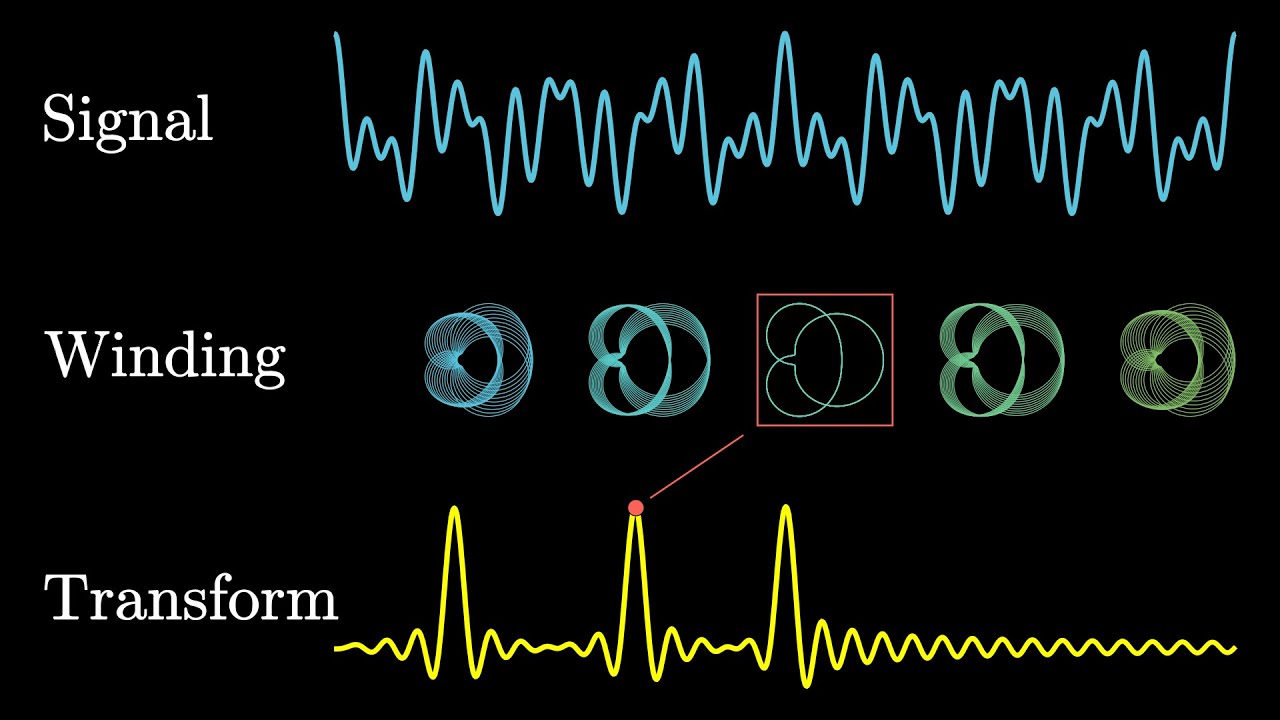
An animated introduction to the Fourier Transform.
Help fund future projects: https://www.patreon.com/3blue1brown
An equally valuable form of support is to simply share some of the videos.
Special thanks to these supporters: http://3b1b.co/fourier-thanks
Learn more about Janestreet: https://janestreet.com/3b1b
Follow-on video about the uncertai...
what exactly is happening as the 2nd frequency keeps on increasing?
In this graph
 split sail
split sail
split sail
0.5 is the "second frequency"
amber waspBOT
@split sail Has your question been resolved?
 pine timber
it's how quickly you spin the graph around on the polar graph
I have a demo here
https://www.desmos.com/calculator/ipoawhartx
change the k slider to visually see what it means to change the winding frequency
here's a copy with a shifted cosine set up like in the video
https://www.desmos.com/calculator/da2vki4xa4
split sail
3B1B didn't mention that we are converting the function into a polar equation ,rather he just said wraping around the origin
so i got confused
thank you
he explained it later in the video
its cool
amber waspBOT
Channel closed
Closed by @ancient quartz
Use .reopen if this was a mistake.
split sail
thanks
amber waspBOT
Available help channel!
Send your question here to claim the channel.
Remember:
• Ask your math question in a clear, concise manner.
• Show your work, and if possible, explain where you are stuck.
• After 15 minutes, feel free to ping <@&286206848099549185>.
• Type the command .close to free the channel when you're done.
• Be polite and have a nice day!
Read #❓how-to-get-help for further information on how to ask a good question, and about conduct in the question channels.
lucid plume
Why isn’t Tan working?
 amber waspBOT
lucid plume
Why isn’t Tan working?
amber waspBOT
lucid plume
<@&286206848099549185>
amber waspBOT
lucid plume
Why isn’t Tan working?
amber waspBOT
lucid plume
<@&286206848099549185>
Please only use the <@&286206848099549185> ping once if your question has not been answered for 15 minutes. Please do not ping or DM individual users about your question.
lucid plume
amber wasp
Please only use the <@&286206848099549185> ping **once** if your question has no...
Doesn’t really matter
@shadow stump
amber waspBOT
lucid plume
<@654893611934023680>
Please do not ping individual helpers unprompted.
 crude kite
lucid plume
Why isn’t Tan working?
crude kite
lucid plume
Why isn’t Tan working?
Can you show the original problem?
lucid plume
crude kite
Can you show the original problem?
Find all sides and angles in right triangle ABC with angle C = 90°
b) c = 1 m and angle A = 22°
crude kite
lucid plume
*Find all sides and angles in right triangle ABC with angle C = 90°*
b) c = 1 m...
What are you using tan to solve for?
lucid plume
I have a = 0,37 m
So I’m using tan
Tan 22° = 0,37 m / b
I’m moving 0,37 to the other side
crude kite
Oh that was a b, I thought it was a 6
lucid plume
And I’m multiplying 0,37 * Tan 22°
lucid plume
crude kite
Oh that was a b, I thought it was a 6
Woop
crude kite
lucid plume
And I’m multiplying 0,37 * Tan 22°
Moving 0.37 to the other side, you don't multiply
lucid plume
crude kite
Moving 0.37 to the other side, you don't multiply
Why?
It’s division
And you need to change signs
So multiplication
crude kite
You have $\tan(22) = \frac{0.37}{b}$
grizzled pagodaBOT
CaptainNova22
 crude kite
You would multiply if it was $\tan(22) = \frac{b}{0.37}$
grizzled pagodaBOT
CaptainNova22
 crude kite
grizzled pagoda
**CaptainNova22**
crude kite
grizzled pagoda
**CaptainNova22**
Here, 0.37 is in the numerator, and multiplying by 0.37 doesn't cancel it out
lucid plume
So what can I do to eliminate 0.37?
crude kite
How would you move the b?
lucid plume
b = 0,37 / tan(22)
crude kite
lucid plume
b = 0,37 / tan(22)
Yes like that
crude kite
lucid plume
-b
Why subtract?
$\tan(22) = \frac{0.37}{b}$ is the same as $\tan(22) = 0.37 \cdot \frac{1}{b}$
grizzled pagodaBOT
CaptainNova22
 crude kite
I said yes to that
crude kite
Sounds right
lucid plume
crude kite
Sounds right
0,9157 ≠ 0,927
crude kite
Because of rounding
crude kite
lucid plume
I’m getting result 0,927 m in the answers
What are you typing in when you calculated this?
lucid plume
0,37 m
crude kite
Not rounded to 2 decimal places
lucid plume
0,3746065934 m
crude kite
Use that value, instead of 0.37 in your calculator
Because 0,3746065934 m is more exact
lucid plume
Nvm I get it
Also
Shouldn’t it be -b?
When you move +b
You change the signs to
crude kite
crude kite
Why subtract?
.
lucid plume
-b = 0,37 / -Tan(A)
lucid plume
When you move in algebra, you change the signs as well
crude kite
grizzled pagoda
**CaptainNova22**
.
crude kite
lucid plume
When you move in algebra, you change the signs as well
That's if you're adding/subtracting, which you aren't doing
You're multiplying by b
lucid plume
Oh now it makes sense
crude kite
Depends on how it was taught
lucid plume
crude kite
Depends on how it was taught
Which is more popular?
crude kite
America normally is taught with tan, while most other countries use tg
lucid plume
Also let’s say we didn’t know <B
Wouldn’t we do
Sin^-1 = 0,3746 / 1?
crude kite
lucid plume
Also let’s say we didn’t know <B
Wouldn’t we do
Sin^-1 = 0,3746 / 1?
Not quite
lucid plume
How then?
 crude kite
Not either
lucid plume
Why?
crude kite
If you were looking for angle b and you wanted to use sin, and as mentioned sin is opp/hyp, what is opp from angle b?
crude kite
And hyp is?
lucid plume
0,9271 / 1
crude kite
So then the equation you would use is?
lucid plume
Sin^-1(0.9271/1)
crude kite
Yes
lucid plume
Makes sense
crude kite
There is a different way too, that does not use trig
Do you know the sum of interior angles of a triangle?
lucid plume
@crude kite In exams, how many decimal places we round to do we add when calculating sin, cos etc?
I think four?
E.g. 0,7849
lucid plume
crude kite
Do you know the sum of interior angles of a triangle?
I know that method
crude kite
lucid plume
<@970137450959732756> In exams, how many decimal places we round to do we add w...
Depends on what your teacher asks for
crude kite
But ideally you don't round until the end
crude kite
lucid plume
180-22-90=<B
Yes
lucid plume
Do we use ctg?
crude kite
For what?
amber waspBOT
@lucid plume Has your question been resolved?
Channel closed
Closed by @lucid plume
Use .reopen if this was a mistake.
Available help channel!
Send your question here to claim the channel.
Remember:
• Ask your math question in a clear, concise manner.
• Show your work, and if possible, explain where you are stuck.
• After 15 minutes, feel free to ping <@&286206848099549185>.
• Type the command .close to free the channel when you're done.
• Be polite and have a nice day!
Read #❓how-to-get-help for further information on how to ask a good question, and about conduct in the question channels.
 verbal lark
One message removed from a suspended account.
amber waspBOT
verbal lark
One message removed from a suspended account.
verbal lark
One message removed from a suspended account.
One message removed from a suspended account.
One message removed from a suspended account.
grizzled pagodaBOT
Kenzo
 verbal lark
One message removed from a suspended account.
One message removed from a suspended account.
grizzled pagodaBOT
Kenzo
 verbal lark
One message removed from a suspended account.
grizzled pagodaBOT
Kenzo
 verbal lark
One message removed from a suspended account.
One message removed from a suspended account.
 quick ridge
verbal lark
One message removed from a suspended account.
quick ridge
verbal lark
One message removed from a suspended account.
and x = 0
verbal lark
One message removed from a suspended account.
One message removed from a suspended account.
quick ridge
then we have
verbal lark
One message removed from a suspended account.
quick ridge
$-6x(x-2) = 0$
grizzled pagodaBOT
knief
 verbal lark
One message removed from a suspended account.
quick ridge
now
verbal lark
One message removed from a suspended account.
quick ridge
well can i tell you a secret
verbal lark
One message removed from a suspended account.
quick ridge
this is a concave down quadratic with two distinct roots so the function will be positive in between the two roots and negative on the side of the two roots (negative for x less than the smaller root and negative for x greater than the larger root)
verbal lark
One message removed from a suspended account.
One message removed from a suspended account.
quick ridge
hence its positive for -2<x<0 and negative everywhere else
quick ridge
verbal lark
One message removed from a suspended account.
already did
verbal lark
One message removed from a suspended account.
One message removed from a suspended account.
quick ridge
grizzled pagoda
**Kenzo**
^
verbal lark
One message removed from a suspended account.
One message removed from a suspended account.
verbal lark
One message removed from a suspended account.
quick ridge
in between
verbal lark
One message removed from a suspended account.
verbal lark
One message removed from a suspended account.
One message removed from a suspended account.
One message removed from a suspended account.
One message removed from a suspended account.
quick ridge
verbal lark
One message removed from a suspended account.
One message removed from a suspended account.
One message removed from a suspended account.
One message removed from a suspended account.
One message removed from a suspended account.
quick ridge
🤔
verbal lark
One message removed from a suspended account.
One message removed from a suspended account.
One message removed from a suspended account.
One message removed from a suspended account.
quick ridge
so for x>0 we have f’ < 0
for x < -2 we have f’ < 0
and for -2<x<0 we have f’>0
as i said
quick ridge
verbal lark
One message removed from a suspended account.
and wtf is this
verbal lark
One message removed from a suspended account.
verbal lark
One message removed from a suspended account.
quick ridge
quick ridge
this is a concave down quadratic with two distinct roots so the function will be...
^
verbal lark
One message removed from a suspended account.
verbal lark
One message removed from a suspended account.
One message removed from a suspended account.
One message removed from a suspended account.
quick ridge
😵💫😵💫😵💫
verbal lark
quick ridge
this is a concave down quadratic with two distinct roots so the function will be...
One message removed from a suspended account.
quick ridge
verbal lark
One message removed from a suspended account.
yes.
we’re doing first derivative test
we already identified the roots
verbal lark
One message removed from a suspended account.
verbal lark
One message removed from a suspended account.
One message removed from a suspended account.
grizzled pagodaBOT
knief
 quick ridge
you factored it wrong
verbal lark
One message removed from a suspended account.
verbal lark
One message removed from a suspended account.
One message removed from a suspended account.
One message removed from a suspended account.
amber waspBOT
Channel closed
Closed by @verbal lark
Use .reopen if this was a mistake.
Available help channel!
Send your question here to claim the channel.
Remember:
• Ask your math question in a clear, concise manner.
• Show your work, and if possible, explain where you are stuck.
• After 15 minutes, feel free to ping <@&286206848099549185>.
• Type the command .close to free the channel when you're done.
• Be polite and have a nice day!
Read #❓how-to-get-help for further information on how to ask a good question, and about conduct in the question channels.
verbal lark
One message removed from a suspended account.
amber waspBOT
verbal lark
One message removed from a suspended account.
verbal lark
One message removed from a suspended account.
One message removed from a suspended account.
honest dagger
verbal lark
One message removed from a suspended account.
You correctly calculated the derivative. Now set f'(x)=0 and solve for x
verbal lark
One message removed from a suspended account.
One message removed from a suspended account.
honest dagger
No
verbal lark
One message removed from a suspended account.
honest dagger
Simply solve f'(x)=0
verbal lark
One message removed from a suspended account.
honest dagger
verbal lark
One message removed from a suspended account.
That's okay. I think if you take it one step at a time you will find its not so bad here. I see why you might feel hesitant, but i implore that you just try for now
verbal lark
One message removed from a suspended account.
One message removed from a suspended account.
One message removed from a suspended account.
grizzled pagodaBOT
Kenzo
 verbal lark
One message removed from a suspended account.
One message removed from a suspended account.
One message removed from a suspended account.
One message removed from a suspended account.
One message removed from a suspended account.
 worthy depot
Test on the intervals before, between, and after the values u found
plug those into the derivative
and then graph based on if its positive or negative
verbal lark
One message removed from a suspended account.
One message removed from a suspended account.
One message removed from a suspended account.
amber waspBOT
Channel closed
Closed by @verbal lark
Use .reopen if this was a mistake.
amber waspBOT
Available help channel!
Send your question here to claim the channel.
Remember:
• Ask your math question in a clear, concise manner.
• Show your work, and if possible, explain where you are stuck.
• After 15 minutes, feel free to ping <@&286206848099549185>.
• Type the command .close to free the channel when you're done.
• Be polite and have a nice day!
Read #❓how-to-get-help for further information on how to ask a good question, and about conduct in the question channels.
 modern pendant
 amber waspBOT
modern pendant
amber waspBOT
modern pendant

 feral light
shouldn't the coefficient infront of the integral be 7/pi? Im not sure how you got c_n correct there
modern pendant
feral light
shouldn't the coefficient infront of the integral be 7/pi? Im not sure how you g...

 night jacinth
sounds like you forgot to divide the constant term by 2
modern pendant
Where?
feral light
c_0 = a_0/2
modern pendant
It worked!!!!!!!!!! THANK YOU SO MUCHHHH
night jacinth
and more visually, the constant term of the fourier series is supposed to be the average value of the function over a period
this is a whole period of the function (f is even remember)

area of the triangle is pi/7
divide by the period 2pi, you get 1/14
modern pendant
I also needed help with this


Is it the -1/2 x 3? he issue ?
the second coefficient which I took out of the bracket?
night jacinth
why is it **-**1/2 in the first place, I don't see why the minus appears
and yeah 3 is also an issue
you forgot a bracket there

you're factoring 3 out of the first bracket but not from the second one
this is what you'd have if the factoring was correct

@modern pendant
amber waspBOT
@modern pendant Has your question been resolved?
modern pendant
night jacinth
this is what you'd have if the factoring was correct
Thank you so much!!!
I really appreciate.
I'd also like to ask your advice for how to succeed in math. I always tend to make silly mistakes somewhere. Failed this course, and retaking it
amber waspBOT
Channel closed
Closed by @modern pendant
Use .reopen if this was a mistake.
Available help channel!
Send your question here to claim the channel.
Remember:
• Ask your math question in a clear, concise manner.
• Show your work, and if possible, explain where you are stuck.
• After 15 minutes, feel free to ping <@&286206848099549185>.
• Type the command .close to free the channel when you're done.
• Be polite and have a nice day!
Read #❓how-to-get-help for further information on how to ask a good question, and about conduct in the question channels.
 loud field
Someone please tell me how it's shifting to da left but LOOKS like it's shifting to the right? Which point should I focus on to give me the right idea?
 amber waspBOT
loud field
Someone please tell me how it's shifting to da left but LOOKS like it's shifting...
sand cargo
loud field
Someone please tell me how it's shifting to da left but LOOKS like it's shifting...
amber waspBOT
loud field
Someone please tell me how it's shifting to da left but LOOKS like it's shifting...
sand cargo
loud field
Someone please tell me how it's shifting to da left but LOOKS like it's shifting...
I'm not sure what you mean
If you're asking how to visualize whether it has shifted to the left or right, in this case you just look at the closest curve of tan
loud field
It says shifting left pi/4 , but to me it looks like it's shifting right by pi/4
sand cargo
The curve is shifting left, not the coordinates
π/4 is 1/4 of 1 curve
If you look at the closest curve to the origin then it's left of it
By exactly 1/4 of a curve
 lucid tendon
loud field
Someone please tell me how it's shifting to da left but LOOKS like it's shifting...
lucid tendon
loud field
Someone please tell me how it's shifting to da left but LOOKS like it's shifting...
does this help

red is the original
amber waspBOT
Channel closed
Closed by @loud field
Use .reopen if this was a mistake.
amber waspBOT
Available help channel!
Send your question here to claim the channel.
Remember:
• Ask your math question in a clear, concise manner.
• Show your work, and if possible, explain where you are stuck.
• After 15 minutes, feel free to ping <@&286206848099549185>.
• Type the command .close to free the channel when you're done.
• Be polite and have a nice day!
Read #❓how-to-get-help for further information on how to ask a good question, and about conduct in the question channels.
 trim tundra
uppose that F is a forest with n vertices, and f -many connected components. Determine
the sum of the degrees of all vertices in F . Give an explicit formula for any forest, and
state any/all theorems used.
kind of a specific question but i'd like to be able to talk out my thinking with someone
amber waspBOT
trim tundra
uppose that F is a forest with n vertices, and f -many connected components. Det...
 sterile nymph
Do you know the relation between the sum of degrees and the number of edges?
trim tundra
sterile nymph
Do you know the relation between the sum of degrees and the number of edges?
handshaking theorem, so $\sum deg(v) = 2|E|$
grizzled pagodaBOT
mads
 trim tundra
and for the second part, i found $|E| = |V| - 1$ is true for trees, which means $1 = |V| - |E|$
grizzled pagodaBOT
mads
 sterile nymph
Since there are f connected components, you could assume each component to be with $n_i$ vertices, for $1 \le i \le f$
grizzled pagodaBOT
andywho
 sterile nymph
And you can apply $|E| = |V|-1$ for each components respectively
grizzled pagodaBOT
andywho
 grizzled pagodaBOT
mads
 sterile nymph
The number of vertices in the ith component
trim tundra
ohh so the number of vertices in each 'tree' so to speak?
sterile nymph
Yeah
grizzled pagodaBOT
mads
 sterile nymph
You can start from considering $\sum_\text{$v$ in $i$-th component} deg(v)$
grizzled pagodaBOT
andywho
 trim tundra
huh
sterile nymph
Then sum up the total f results
trim tundra
i don't follow sorry
sterile nymph
trim tundra
so i could say $\sum deg(v) = 2(n-1) = 2n-2$?
Your result here is true for any tree, but not for arbitrary forest
But you still have something like this for each component
grizzled pagodaBOT
mads
 sterile nymph
Yes, that's correct
sterile nymph
For the notation, maybe you mean $\sum_{0}^{f}$
grizzled pagodaBOT
andywho
 sterile nymph
It's a little confusing actually
trim tundra
how so
sterile nymph
$\sum_{i=0}^f \sum_\text{$v$ in $i$-th component} deg(v)$
grizzled pagodaBOT
andywho
 trim tundra
oh i see what you mean by it being confusng
sterile nymph
Yeah, you should specify which is the changing variable in the sum
sterile nymph
trim tundra
so i could say $\sum deg(v) = 2(n-1) = 2n-2$?
Yes, and the second sum can be replaced by something like this
sterile nymph
$\sum_{i=1}^f$

 trim tundra
thank you
sterile nymph
I just figured that the range should be from 1 to f by what we defined
trim tundra
oh wait you are right
would it be better to define it from zero then, in case there is no components in the forest?
sterile nymph
Even though you want to include f=0, it's still okay to define it from 1
trim tundra
how come
sterile nymph
Since when $f=0$, the sum becomes like $\sum_{i=1}^0 (2n_i-2)$, which is zero
grizzled pagodaBOT
andywho
 sterile nymph
Summing from 1 to 0 can be seen as not summing anything
sterile nymph
trim tundra
$\sum{0}{f} deg(v) = (2n-2)f$?
Something like this is
It's like, given the number of vertices n and the number of components f, you can obtain the result by direct computation
trim tundra
but what is the result supposed to be?
sterile nymph
Just expand this formula $\sum_{i=1}^f (2n_i -2)$ and you can see the formula
grizzled pagodaBOT
andywho
 trim tundra
i lowkey forget how to expand summations hold on
sterile nymph
trim tundra
$\sum{0}{f} deg(v) = (2n-2)f$?
Actually, you've obtained the formula previously
trim tundra
why is that so
sterile nymph
$\sum_{i=1}^f (2n_i -2) = 2\sum_{i=1}^f n_i - \sum_{i=1}^f 2$
grizzled pagodaBOT
andywho
 sterile nymph
Actually, you've obtained the formula previously
sterile nymph
sterile nymph
Actually, you've obtained the formula previously
I was wrong. Your result is incorrect
trim tundra
uh oh 😭
sterile nymph
sterile nymph
$\sum_{i=1}^f (2n_i -2) = 2\sum_{i=1}^f n_i - \sum_{i=1}^f 2$
But you can obtain the correct one from this
trim tundra
i'm still lost on the concept of a formula for a forest
sterile nymph
From which point?
trim tundra
n - 1
sterile nymph
Yeah, and what can you say by using handshake lemma?
trim tundra
the sum of deg(v) is 2|E|
trim tundra
wait so the formula is the sum of the vertices?
sterile nymph
The formula is 2n-2
trim tundra
but the formula for a tree is just the sum of its vertices 😭?
sterile nymph
What did you mean by the sum of its vertices?
trim tundra
i mean the sum of its vertices' degrees
my bad
like i just don't know what the question is asking
sterile nymph
It want you to derive a explicit formula for $\sum deg(v)$ of a forest F
grizzled pagodaBOT
andywho
 trim tundra
grizzled pagoda
**mads**
trim tundra
grizzled pagoda
**mads**
so this is simply it?
sterile nymph
grizzled pagoda
**mads**
The equality notation should be erased
And you should further simplify it
trim tundra
grizzled pagoda
**andywho**
to this>
sterile nymph
grizzled pagoda
**andywho**
Like this
amber waspBOT
Channel closed
Closed by @trim tundra
Use .reopen if this was a mistake.
amber waspBOT
Available help channel!
Send your question here to claim the channel.
Remember:
• Ask your math question in a clear, concise manner.
• Show your work, and if possible, explain where you are stuck.
• After 15 minutes, feel free to ping <@&286206848099549185>.
• Type the command .close to free the channel when you're done.
• Be polite and have a nice day!
Read #❓how-to-get-help for further information on how to ask a good question, and about conduct in the question channels.
 nova lion
This is how I approached solving this cubic, but I couldn't manage to break down the cubic not sure if I'm approaching this wrong.
The next picture is the solutions using "Newton-Raphson" from symbolab but that's beyond the scope of my class

 amber waspBOT
nova lion
This is how I approached solving this cubic, but I couldn't manage to break down...
amber waspBOT
nova lion
This is how I approached solving this cubic, but I couldn't manage to break down...
 spiral zealot
did the original question ask you to find the solutions?
nova lion
yeah it said Solve, round answers to one decimal place
spiral zealot
what are you allowed to use
nova lion
it's a grade 12 advance functions/pre calc course but as far as I know for cubics we've just been using integral zero theorem and rational root theorem to factor/solve cubics
basically break it down to a quadratic by finding a factor using remainder theorem and then breaking down the quadratic after using whatever
spiral zealot
assuming you're not allowed cas/graphing calc?
nova lion
yeah for this question no graphing calc
spiral zealot
if you don't know calculus yet,
you can approximate solutions using the midpoint approximation method
nova lion
oo that sounds interesting, I'd need to search that up
 lusty pine
nova lion
This is how I approached solving this cubic, but I couldn't manage to break down...
lusty pine
nova lion
This is how I approached solving this cubic, but I couldn't manage to break down...
note when you sent 6 to the other side you didnt change its sign
nova lion
seems like something for a quadratic but I'm guessing for cubics too
nova lion
lusty pine
note when you sent 6 to the other side you didnt change its sign
Oh yeah you're right but in my actual hand written work I did
I pretty muched plugged in all the "possible factors" into the function
none of them gave me me a remainder of 0
lusty pine
none of the roots are rational
amber waspBOT
Channel closed
Closed by @nova lion
Use .reopen if this was a mistake.
amber waspBOT
Available help channel!
Send your question here to claim the channel.
Remember:
• Ask your math question in a clear, concise manner.
• Show your work, and if possible, explain where you are stuck.
• After 15 minutes, feel free to ping <@&286206848099549185>.
• Type the command .close to free the channel when you're done.
• Be polite and have a nice day!
Read #❓how-to-get-help for further information on how to ask a good question, and about conduct in the question channels.
 high moon

 alpine flower
fiery moss
alpine flower
fiery moss
replace the 1 in the numerator with this and it should be factorable
mint nacelle
nah you mean replace $1 = \sin^2 x+ \cos^2 x$ or something
grizzled pagodaBOT
southlander!
 mint nacelle
anyways I think that doesn't work
best bet is to multiply top and bottom by $\sin x - 1 - \cos x$
grizzled pagodaBOT
southlander!
 quick ridge
mint nacelle
nah you mean replace $1 = \sin^2 x+ \cos^2 x$ or something
quick ridge
mint nacelle
nah you mean replace $1 = \sin^2 x+ \cos^2 x$ or something
i think they meant in the first step
before converting into sin and cos
amber waspBOT
@high moon Has your question been resolved?
amber waspBOT
Channel closed
Closed due to timeout
Use .reopen if this was a mistake.
Available help channel!
Send your question here to claim the channel.
Remember:
• Ask your math question in a clear, concise manner.
• Show your work, and if possible, explain where you are stuck.
• After 15 minutes, feel free to ping <@&286206848099549185>.
• Type the command .close to free the channel when you're done.
• Be polite and have a nice day!
Read #❓how-to-get-help for further information on how to ask a good question, and about conduct in the question channels.
 tawny oxide
How can I find a polynomial function that intersects with the points:(1,1),(2,2),(3,3),(4,4),(5,5),(6,6)? <@&286206848099549185> .
amber waspBOT
tawny oxide
How can I find a polynomial function that intersects with the points:(1,1),(2,2)...
amber waspBOT
tawny oxide
How can I find a polynomial function that intersects with the points:(1,1),(2,2)...
Please only use the <@&286206848099549185> ping once if your question has not been answered for 15 minutes. Please do not ping or DM individual users about your question.
 fluid wren
Well, take the identity polynomial 
honest dagger
Bean with the  plays
plays
tawny oxide
*and (7,34)
 pseudo crescent
so there are 7 points
that means you will probably need 7 "degrees of freedom"
6th degree polynomial should be fine for that
f(x) = ax^6 + bx^5 + cx^4 + dx^3 + ex^2 + fx + g
pseudo crescent
pseudo crescent
f(x) = ax^6 + bx^5 + cx^4 + dx^3 + ex^2 + fx + g
there are 7 variables and so 7 degrees of freedom
now you want:
f(1) = 1
f(2) = 2
f(3) = 3
f(4) = 4
f(5) = 5
f(6) = 6
f(7) = 34
this should give you a system of 7 linear equations
which is probably a work for a computer
@tawny oxide
honest dagger
tawny oxide
*and (7,34)

honest dagger
pseudo crescent
this should give you a system of 7 linear equations
Nah this too much work
fluid wren
Or look up polynomial interpolation
honest dagger
What bean said