#help-41
1 messages · Page 45 of 1
 amber waspBOT
 rocky fjord
.close
amber waspBOT
Channel closed
Closed by @rocky fjord
Use .reopen if this was a mistake.
amber waspBOT
 Available help channel!
Send your question here to claim the channel.
Remember:
• Ask your math question in a clear, concise manner.
• Show your work, and if possible, explain where you are stuck.
• After 15 minutes, feel free to ping <@&286206848099549185>.
• Type the command .close to free the channel when you're done.
• Be polite and have a nice day!
Read #❓how-to-get-help for further information on how to ask a good question, and about conduct in the question channels.
 keen quartz
someone please give me the answer to this question
 keen quartz
anyone 😭
amber waspBOT
@keen quartz Has your question been resolved?
 sinful sapphire
oof that's hard to do without paper
keen quartz
thjank yto
sinful sapphire
8sin(12t/pi − 9) maybe
 sinful sapphire
no wait that's not right
+55
that looks right
maybe
could it be upside down?
no that's worse
sinful sapphire
keen quartz
this but 55
keen quartz
OH MY BAD
I DIDNT SEE YOUR MESSAGES
IM SORRY
is it +55 instead of 47
@sinful sapphire
IT WAS RIGHT
TYSM
amber waspBOT
@keen quartz Has your question been resolved?
Channel closed
Closed by @keen quartz
Use .reopen if this was a mistake.
Available help channel!
Send your question here to claim the channel.
Remember:
• Ask your math question in a clear, concise manner.
• Show your work, and if possible, explain where you are stuck.
• After 15 minutes, feel free to ping <@&286206848099549185>.
• Type the command .close to free the channel when you're done.
• Be polite and have a nice day!
Read #❓how-to-get-help for further information on how to ask a good question, and about conduct in the question channels.
 manic spindle
 amber waspBOT
manic spindle
manic spindle
amber waspBOT
manic spindle
manic spindle
Bonus question help please
I literally tried but I couldn’t even make a system of equations
amber waspBOT
@manic spindle Has your question been resolved?
 mint nacelle
manic spindle
mint nacelle
manic spindle
if the sum of 2 numbers is 5.5, what is their mean?
manic spindle
mint nacelle
if the sum of 2 numbers is 5.5, what is their mean?
(T1 + T1 + d)/2
mint nacelle
manic spindle
(T1 + T1 + d)/2
don't think of it as an arithmetic sequence
if I have two numbers a and b, what is their mean in terms of a and b?
manic spindle
mint nacelle
if I have two numbers a and b, what is their mean in terms of a and b?
(A+b)/2
manic spindle
5.5
mint nacelle
great, so the mean of the two numbers must be 5.5/2
manic spindle
Yes
mint nacelle
yeah and that is enough information to set up the linear equation actually
the "inserted" part is confusing I know
manic spindle
Wait
But the thing is there’s not only 1 arithmetic mean
There’s “k” amount of means
mint nacelle
manic spindle
There’s “k” amount of means
yes, but all of those means are equal to 5.5/2
manic spindle
Liek the sum of them?
mint nacelle
manic spindle
There’s “k” amount of means
wait, do you have the answer for the bonus question?
manic spindle
Yeah 12
manic spindle
Wait so does (a+b)/2 give u the value of the sum of the means
mint nacelle
manic spindle
Wait so does (a+b)/2 give u the value of the sum of the means
no, that just gives you one of the means
mint nacelle
mint nacelle
yes, but all of those means are equal to 5.5/2
this
mint nacelle
manic spindle
Cuz there could be more than 1 mean
no, all of the means are equal to 5.5/2
mint nacelle
manic spindle
Like the sum of them
no
mean 1 = 5.5/2
mean 2 = 5.5/2
mean 3 = 5.5/2
....
mean k = 5.5/2
manic spindle
So all the means are just the same?
But isn’t it an arithmetic series so all the means have a common difference?
mint nacelle
manic spindle
But isn’t it an arithmetic series so all the means have a common difference?
no, you're overthinking it
it's just k * 5.5/2 - 21 = k
amber waspBOT
Channel closed
Closed by @manic spindle
Use .reopen if this was a mistake.
amber waspBOT
Available help channel!
Send your question here to claim the channel.
Remember:
• Ask your math question in a clear, concise manner.
• Show your work, and if possible, explain where you are stuck.
• After 15 minutes, feel free to ping <@&286206848099549185>.
• Type the command .close to free the channel when you're done.
• Be polite and have a nice day!
Read #❓how-to-get-help for further information on how to ask a good question, and about conduct in the question channels.
 mortal vault
amber waspBOT
mortal vault
mortal vault
mortal vault
amber waspBOT
mortal vault
mortal vault
need help with this question, this is my attempt for the first direction and need help on how to approach the other
amber waspBOT
@mortal vault Has your question been resolved?
amber waspBOT
@mortal vault Has your question been resolved?
amber waspBOT
@mortal vault Has your question been resolved?
amber waspBOT
Channel closed
Closed due to timeout
Use .reopen if this was a mistake.
amber waspBOT
Available help channel!
Send your question here to claim the channel.
Remember:
• Ask your math question in a clear, concise manner.
• Show your work, and if possible, explain where you are stuck.
• After 15 minutes, feel free to ping <@&286206848099549185>.
• Type the command .close to free the channel when you're done.
• Be polite and have a nice day!
Read #❓how-to-get-help for further information on how to ask a good question, and about conduct in the question channels.
 unreal mirage
Tw: business math 💀
How to get the total number of payments (n)
 unreal mirage
Ive done the 4 × 10 since the time is 10 years and its quarterly
Since theres the word semi-annually will it be 4 × 10 × 2 😭
Or is it just 40
Am I overthinking it
 wide perch
wait what do you mean by n?
isnt that just 40? There are 40 payments involved, the interest rate/compounding/etc is irreleavant
 wicked girder
unreal mirage
Ive done the 4 × 10 since the time is 10 years and its quarterly
wicked girder
unreal mirage
Ive done the 4 × 10 since the time is 10 years and its quarterly
number of patments is just 40
the semi annually affects the interest not the numver of payments
unreal mirage
Thanks
wicked girder
👍
unreal mirage
.close
amber waspBOT
Channel closed
Closed by @unreal mirage
Use .reopen if this was a mistake.
unreal mirage
.reopen
amber waspBOT
✅
unreal mirage
Same problem

How do I get the interest per period
Its r/m
So it should be 2%/2 right
Or is there something im not seeing 😭
This wasnt explained properly by my teacher so I have a lot of questions 💀
wicked girder
unreal mirage
So it should be 2%/2 right
i think so (its been a while since i did financial math)
unreal mirage
Thank you 
Alright
Im finding the future value now

Is this correct 
<@&286206848099549185>
 celest sun
unreal mirage
<@&286206848099549185>
celest sun
unreal mirage
<@&286206848099549185>
ano ba yan anteh?
celest sun
unreal mirage
Business math
wait madali lng yan may notes em
unreal mirage
celest sun
wait madali lng yan may notes em
English only fo
unreal mirage
celest sun
wait madali lng yan may notes em
Fatingin
celest sun
huhu sorry i misplaced my notes
celest sun
awh
unreal mirage
I was just confused on finding the total number of payments

@celest sun

What about the total number of payments here
celest sun
what's quarterly
unreal mirage
celest sun
what's quarterly
Its where m=4
wicked girder
unreal mirage
Im finding the future value now
sorry i dont remember how to do that
wicked girder
unreal mirage
Is it 12 x 5
yes
wicked girder
unreal mirage
Or is it just 5 x 4
remember the compound annualy or quarterly or whatever only applies to interest, not number of payments
unreal mirage
If its compounded ____ it -
unreal mirage
wicked girder
remember the compound annualy or quarterly or whatever only applies to interest,...
YES
Thank you
wicked girder
sorry cant help with finding fv tho 😞
unreal mirage
So if its compounded whatever it will only apply to i and n where it is i/m and t(m) respectively
Confusioj #1 solved ig
Thank you kristy
wicked girder
unreal mirage
So if its compounded whatever it will only apply to i and n where it is i/m and ...
ig so
wicked girder
unreal mirage
Confusioj #1 solved ig
hurray
wicked girder
unreal mirage
Thank you kristy
🔥🔥
celest sun
unreal mirage
Its where m=4
like quarterly means 4 months


 floral raven
This is investment,annuities and loans right
unreal mirage
floral raven
This is investment,annuities and loans right
Yes
unreal mirage
unreal mirage
7 x 12
HOL UP
If its 7 x 12
Then i ( interest rate per period ) should be?
idk anymore
wicked girder
unreal mirage
7 x 12
mhmm
floral raven
Interest rate should just be divided by 12
wicked girder
unreal mirage
Then i ( interest rate per period ) should be?
what do u think semi annually means?
wicked girder
floral raven
Interest rate should just be divided by 12
isnt it by 6
bc semi annually
unreal mirage
Whats the purpose of compounded semi anually then
floral raven
Oh ye
unreal mirage
😭😭😭😭
floral raven
I was only doing 12 cause he did 7 x 12
unreal mirage
Wait so
wicked girder
unreal mirage
Whats the purpose of compounded semi anually then
semi anually means its compudned every 6 months (aka half a year)
our qn says u make payments per MONTH
unreal mirage
In payments its per month and in interest its different
wicked girder
wicked girder
semi anually means its compudned every 6 months (aka half a year)
so u wanna change this from per 6 months to per one month, thus u divde the 8.5 by 6
unreal mirage
Oh
wicked girder
unreal mirage
In payments its per month and in interest its different
the qn states were paying for 7 years right, and we make payments each month thus u get 7x12 payment installments
unreal mirage
Uhuh
wicked girder
the compounded semi anually basically indicates the kinda like extra accumative value u own per 6 months
wicked girder
essentially ur interest from the qn tells us it accumates by an additional 8.5% per 6 months
but sicne were paying per one month
we want to change the compound interset from per 6 months to per one month
thus we divide 8.5 by 6
and rhats ur interst for ur qn
wicked girder
wicked girder
and rhats ur interst for ur qn
to solve and stuff
unreal mirage
Cus
wicked girder
u want everything to be in terms of only per one month
unreal mirage
Its monthly and then the semi annually
So its 8.5% / 6

Wait i got this let me process the information
OHHHH
unreal mirage
wicked girder
we want to change the compound interset from per 6 months to per one month
I get this now
Okay thank you again kristy
wicked girder
unreal mirage
So its 8.5% / 6
yussss
wicked girder
unreal mirage
I get this now
yayyyy
wicked girder
unreal mirage
Okay thank you again kristy
nwwws
unreal mirage
If it said quarterly instead then it will be every 3 months and we gonna do 8.5% / 3

Ig
Gonna close this now
.close
amber waspBOT
Channel closed
Closed by @unreal mirage
Use .reopen if this was a mistake.
amber waspBOT
Available help channel!
Send your question here to claim the channel.
Remember:
• Ask your math question in a clear, concise manner.
• Show your work, and if possible, explain where you are stuck.
• After 15 minutes, feel free to ping <@&286206848099549185>.
• Type the command .close to free the channel when you're done.
• Be polite and have a nice day!
Read #❓how-to-get-help for further information on how to ask a good question, and about conduct in the question channels.
 clever sage
Hey, i need help with probabilities calculations
 tulip tapir
!da2a
amber waspBOT
No need to ask “Can I ask…?” or “Does anyone know about…?”—it’s faster for everyone if you just ask your question! See https://dontasktoask.com/
clever sage
I have an urn with 13 black balls, and 7 white balls,
i draw them one by one and sort them in a line until i run out of balls in the urn.
A. what is the probabillity that the last 4 balls in the line are black, if its known the first 3 ones are white.
B. GIVEN that 4 black balls are last in line, and 3 white balls are first in line, what is the probabilty that the first 6 balls in line at White?
i have solved for Question A, but i am having trouble understanding B,
i have calculated in A where:
A = the time where 3 white balls are drawn first,
B = the time where 4 black balls are drawn last.
and then did P(B|A), which gave me the answer
but for question B, i am unsure on how to approach it, is it like this:
C = the occurence where first 6 balls are white ?
and then P(C|AB)
or just take the "Starting position" where i have only to sort 13 balls, where 4 of them are white and 13 of them are black, and i need the first 3 ones to be white
its my first time doing homework in Probability and i am unsure on how to approach this
 covert onyx
Do you know how many way it could satisfy the arrangement for Question B?
covert onyx
clever sage
there are 14 ways for that arrangement
How
clever sage
you are left with only 1 white ball, and 13 black balls
covert onyx
First six are fixed, you only have one more white ball going around other 9 balls
clever sage
there are only 14 ways to rearrange them in different ways
covert onyx
clever sage
you are left with only 1 white ball, and 13 black balls
Last 4 is fixed to be black
clever sage
ohh thats for exclusvily 6 white balls
9 including the 4 fixed black balls
basically 10!/9!
covert onyx
clever sage
9 including the 4 fixed black balls
Think 10 more second
clever sage
10 ways
clever sage
yeah, 12!/3!*9!
clever sage
hmmm
is it, not P(A|B) in this situation?
since its a GIVEN state?
and not "if a then b?"
this is why i am confused, i am unsure of what to actually look for
 formal dome
P(A|B) means probability of A happening, when we already know that B has happened
clever sage
i am still a bit confused
in question A they said if its known that, that implies A|B
but in B they explicitly said given
covert onyx
covert onyx
First six are fixed, you only have one more white ball going around other 9 ball...
Here already give |AB
clever sage
so given the state the first 3 are white and last 4 are black
formal dome
i think you're confusing your A and B sets with the A and B questions
formal dome
Okay, what are you calling A, what are you calling B, and what are you calling C?
clever sage
A - 3 white balls at the beginning
B- 4 black balls at the end
C- 6 white balls at the start
formal dome
Okay. So you calculated the amount of arrangements that have A and B happening, correct?
clever sage
yeah
formal dome
can you please mark it for me?
clever sage
i have already calculated P(AandB)

the text is in hebrew, but essentially, this is what i did for the first question

writing is a bit funky, but i hope its enough to understand
formal dome
yeah that looks fine
so you're only missing the amount of arrangements C
you can work easier if you fix the balls at the start and end
formal dome
that does not sound right
clever sage
well, if given the first 6 ones are white
we have 1 white and 13 black remaining
so there are 14 ways to sort them
formal dome
yes, but you also have 4 black at the end
remember, you have the first 3 whites and the last 4 blacks fixed
clever sage
so should my C be 6 white and 4 black at the end?
formal dome
so you can only move the 4 white and 9 blacks remaining
covert onyx
clever sage
so should my C be 6 white and 4 black at the end?
That is C|AB as you defined
clever sage
yeah, C|AB
formal dome
and out of those arrangements, only the ones that have 3 whites at the start (fixed) are "successes".
So the valid cases would be the arrangements of 1 white and 9 blacks, while your total arrangements would be the arrangements of 4 white and 9 blacks
and that would be your P(C|AandB) as defined
clever sage
so starting point is AandB
3 white, 4 black
and what are teh chances to get from AB to C
essentially
formal dome
yeah, you can work with the probabilities of both, or you can work with the number of cases of both
usually, the number of cases is easier unless you already have the probs computed
so, how many arrangements of 1 white and 9 blacks do you have?
formal dome
so your prob would be those 10, divided by the 13!/4!9!
clever sage
yeah,
and is that equal to P(C|AB)?
or are we calculating something different
i am just confused defentionally
covert onyx
It is
clever sage
i see
i think that i need to seperate my intuition from this
but thank you very much everyone!
much appriciated
formal dome
as you defined them, it is
amber waspBOT
@clever sage Has your question been resolved?
Channel closed
Closed by @clever sage
Use .reopen if this was a mistake.
Available help channel!
Send your question here to claim the channel.
Remember:
• Ask your math question in a clear, concise manner.
• Show your work, and if possible, explain where you are stuck.
• After 15 minutes, feel free to ping <@&286206848099549185>.
• Type the command .close to free the channel when you're done.
• Be polite and have a nice day!
Read #❓how-to-get-help for further information on how to ask a good question, and about conduct in the question channels.
 cedar inlet
 amber waspBOT
cedar inlet
amber waspBOT
cedar inlet
 split sail
!status
amber waspBOT
What step are you on?
1. I don't know where to begin.
2. I have begun but got stuck midway.
3. I got an answer but I was told that it's wrong.
4. I got an answer and would like my work checked.
5. I have a question about someone else's work/solution.
6. I have completed the problem and don't need help anymore. Thank you.
7. None of the above
3/4
split sail
I am only well acquainted with the disk method
So I can check that
However you could wait for someone to come along and help you with the shell method
cedar inlet
split sail
I am only well acquainted with the disk method
Well I was required to use online calculator for this for my project
But then the disk and shell method do not compute the same answers
split sail
Huh
That’s interesting
I’ll just let someone smarter come along and help you with this. I am really quite unaware of the shell method
cedar inlet
I even double checked with my friends the equation for the disk and shell and still isnt the same
cedar inlet
split sail
I’ll just let someone smarter come along and help you with this. I am really qui...
Do you know someone who can help?
split sail
cedar inlet
Do you know someone who can help?
@mint nacelle (Sorry for the ping senõr) is quite a smart fella. He may be able to help
He’s helped me multiple times before
cedar inlet
split sail
<@1151031274413228043> (Sorry for the ping senõr) is quite a smart fella. He may...
Thank you man :)
mint nacelle
split sail
<@1151031274413228043> (Sorry for the ping senõr) is quite a smart fella. He may...
can you not ping me for random questions
split sail
mint nacelle
can you not ping me for random questions
Noted. Sorry
I will not do that ever again
cedar inlet
mint nacelle
can you not ping me for random questions
Could you help me out with a disk and shell method question
mint nacelle
be active enough in help channels
mint nacelle
cedar inlet
Could you help me out with a disk and shell method question
I'm working on it

okay so you have $x = \left(\frac{37}{10} y \right)^{1/3}$
 grizzled pagodaBOT
south, just south
 cedar inlet
yeah
mint nacelle
the bottom horizontal line is y = 7.297 approximately
cedar inlet
Just as a background info( With this equation when revolving around Y axis creates a cup and I'm supposed to calculate the disk and shell method for it)
mint nacelle
,w integrate 2 pi (y - 7.297)(4 - (10/37 y)^(1/3) from y = 7.297 to y = 17.297
grizzled pagodaBOT

Wolfram Alpha doesn't understand your query!
Perhaps try rephrasing your question?
Click here to refine your query online
 Requested by sooouth.
mint nacelle
Requested by sooouth.
mint nacelle
jesus
cedar inlet
mint nacelle
,w integrate 2 pi (y - 7.297)(4 - (10/37 y)^(1/3) from y = 7.297 to y = 17.297
Shouldn't this be calculated using disk method?
mint nacelle
huh it's not working
mint nacelle
cedar inlet
Shouldn't this be calculated using disk method?
you did it using the disk method though right
cedar inlet
mint nacelle
you did it using the disk method though right
Yeah disk in terms of y
and shell in terms of x
Disk method gave me 397 with some decimal value
mint nacelle
cedar inlet
Disk method gave me 397 with some decimal value
wrong
cedar inlet
While shell method gave me 265 with some decimal value
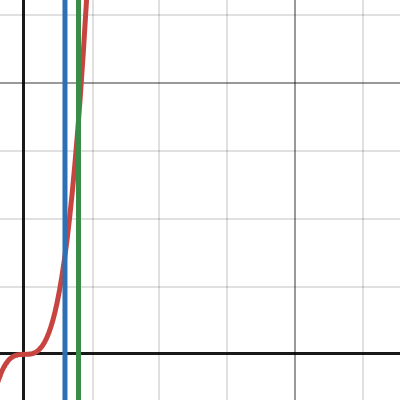 cedar inlet
mint nacelle
https://www.desmos.com/calculator/pc0gsvgdmm
cedar inlet
mint nacelle
https://www.desmos.com/calculator/pc0gsvgdmm
can you explain this?
 mint nacelle
cedar inlet
can you explain this?
mint nacelle
cedar inlet
can you explain this?

so each of these horizontal lines represents a shell

it has a radius, so that's the distance from y to the bottom horizontal line, y = 7.2973
cedar inlet
Also since its revolving around y axis, shouldn't disk method be in terms of y?
mint nacelle
it also has a length, so that's the distance between x on the function and x = 4
mint nacelle
cedar inlet
Also since its revolving around y axis, shouldn't disk method be in terms of y?
no, the disk method revolves around the x axis
cedar inlet
mint nacelle
no, the disk method revolves around the x axis
But in the question I provided it revolves around y axis?
cedar inlet
cedar inlet
.
mint nacelle
cedar inlet
oh shit
cedar inlet
mint nacelle
oh shit
Yeah I did it again and I'm still getting different answers for both disk and shell
mint nacelle
ok give me more time
mint nacelle
cedar inlet
Yeah I did it again and I'm still getting different answers for both disk and sh...
what calculations did you do?
cedar inlet
mint nacelle
what calculations did you do?
For the disk method I put in terms of y with limits from 7.297 to 17.297
For shell I put the same equation *2pi x with limits from 3 to 4
mint nacelle
cedar inlet
For the disk method I put in terms of y with limits from 7.297 to 17.297
no, what integrals did you get exactly
cedar inlet
mint nacelle
no, what integrals did you get exactly
You mean the answer?
cedar inlet
How i set it up?
mint nacelle
yes
cedar inlet
give me a minute
cedar inlet
mint nacelle
yes
Yeah so
Disk method

shell method

@mint nacelle are they correct?
cedar inlet
mint nacelle
hold on
Yeah I'm here
mint nacelle
wouldn't that just be $\pi\int_{7.2973}^{17.2973}\left(4-\left(\frac{37}{10}y\right)^{\frac{1}{3}}\right)^{2}\ dy$
grizzled pagodaBOT
south, just south
 mint nacelle
but that gives the volume as 9
cedar inlet
mint nacelle
but that gives the volume as 9
Why is it 4-the y equation?
mint nacelle
cedar inlet
Why is it 4-the y equation?
you want to find the horizontal distance between the curve and the vertical line x = 4
that's your "height"
but horizontal
cedar inlet
mint nacelle
you want to find the horizontal distance between the curve and the vertical line...
Isnt x=3 and 4 limits to use for x?
mint nacelle
cedar inlet
Isnt x=3 and 4 limits to use for x?
no
you were correct originally
when you revolve around the y-axis using the disk method
the integral is in fact dy
cedar inlet
mint nacelle
when you revolve around the y-axis using the disk method
What does it mean if disk and shell method answers are different?
Like which one do I need to consider then
mint nacelle
cedar inlet
Like which one do I need to consider then
they should be the same answer ofc
cedar inlet
mint nacelle
they should be the same answer ofc
But idk my equation isn't giving the same answers
mint nacelle
cedar inlet
But idk my equation isn't giving the same answers
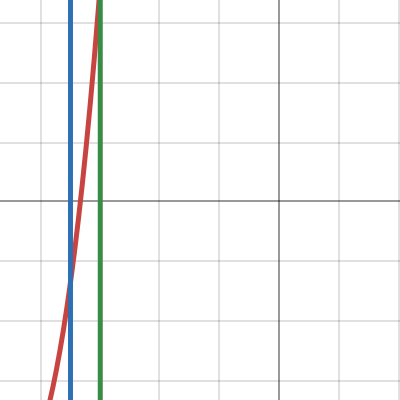
Desmos
okay now check this graph
this should be for the y-axis being the axis of revolution
cedar inlet
mint nacelle
this should be for the y-axis being the axis of revolution
I thought you didnt need to put subtract 4 or 7.297 since they're just boundaries you need to calulate area for
mint nacelle
 mint nacelle
cedar inlet
I thought you didnt need to put subtract 4 or 7.297 since they're just boundarie...
mint nacelle
cedar inlet
I thought you didnt need to put subtract 4 or 7.297 since they're just boundarie...
they are super important
please take a look at my annotations
cedar inlet
mint nacelle
please take a look at my annotations
Oh damn
You literally solved what I was thought was unsolvable
Ty so much man
You have no idea how much you helped me
mint nacelle
cedar inlet
You have no idea how much you helped me
no worries!
mint nacelle
cedar inlet
Oh damn
also like 4 - x is also the height when you do it with the disk method
cedar inlet
mint nacelle
also like 4 - x is also the height when you do it with the disk method
I see
mint nacelle
the only difference is that we use $x = \left(\frac{37}{10}y\right)^{1/3}$
grizzled pagodaBOT
south, just south
 cedar inlet
You literally helped me so much
mint nacelle
mint nacelle
and for the washer method, we use $y = \frac{10}{37} x^3$
yeah that's how it works
mint nacelle
cedar inlet
You literally helped me so much
alr no problemo!
cedar inlet
mint nacelle
alr no problemo!
Ty so much once again
mint nacelle
.close
amber waspBOT
Channel closed
Closed by @mint nacelle
Use .reopen if this was a mistake.
grizzled pagodaBOT
south, just south
 amber waspBOT
Available help channel!
amber waspBOT
Available help channel!
Send your question here to claim the channel.
Remember:
• Ask your math question in a clear, concise manner.
• Show your work, and if possible, explain where you are stuck.
• After 15 minutes, feel free to ping <@&286206848099549185>.
• Type the command .close to free the channel when you're done.
• Be polite and have a nice day!
Read #❓how-to-get-help for further information on how to ask a good question, and about conduct in the question channels.
 trail panther
Solve the following sets of equations by graphing them on a rectangular corridinate system. Check your answers by substituting them back into the original equations.y=x+4 and y= -x+2
amber waspBOT
trail panther
Solve the following sets of equations by graphing them on a rectangular corridin...
 edgy sky
trail panther
Solve the following sets of equations by graphing them on a rectangular corridin...
edgy sky
trail panther
Solve the following sets of equations by graphing them on a rectangular corridin...
go on desmos.com and graph those two equations
amber waspBOT
@trail panther Has your question been resolved?
amber waspBOT
Channel closed
Closed due to timeout
Use .reopen if this was a mistake.
Available help channel!
Send your question here to claim the channel.
Remember:
• Ask your math question in a clear, concise manner.
• Show your work, and if possible, explain where you are stuck.
• After 15 minutes, feel free to ping <@&286206848099549185>.
• Type the command .close to free the channel when you're done.
• Be polite and have a nice day!
Read #❓how-to-get-help for further information on how to ask a good question, and about conduct in the question channels.
split sail
Can someone help with the 3rd question
 amber waspBOT
split sail
Can someone help with the 3rd question
split sail
amber waspBOT
split sail
Can someone help with the 3rd question
split sail
This is what I did (the one I have cut)
 amber waspBOT
@split sail Has your question been resolved?
split sail
<@&286206848099549185>
amber waspBOT
split sail
<@&286206848099549185>
What step are you on?
1. I don't know where to begin.
2. I have begun but got stuck midway.
3. I got an answer but I was told that it's wrong.
4. I got an answer and would like my work checked.
5. I have a question about someone else's work/solution.
6. I have completed the problem and don't need help anymore. Thank you.
7. None of the above
@split sail Has your question been resolved?
 green swan
do you still need help?
green swan
split sail
<@&286206848099549185>
so you can actually find the smallest angle on the triangle arctan(32/75) and that angle will be an alternate angle
amber waspBOT
Channel closed
Closed by @dusky cove
Use .reopen if this was a mistake.
Available help channel!
Send your question here to claim the channel.
Remember:
• Ask your math question in a clear, concise manner.
• Show your work, and if possible, explain where you are stuck.
• After 15 minutes, feel free to ping <@&286206848099549185>.
• Type the command .close to free the channel when you're done.
• Be polite and have a nice day!
Read #❓how-to-get-help for further information on how to ask a good question, and about conduct in the question channels.
 arctic oriole
Can someone explain the annihilator method to me please?
arctic oriole
I don't feel like I understand it, factoring operators feels wrong and theres nothing intuitive about it
 pallid canopy
do you have a problem you're working on?
arctic oriole
I can make a random one but its really just the concept I'm confused about
$9y'' - 4y' - 12y = x - 6$
grizzled pagodaBOT
Nathan
 pallid canopy
In mathematics, the annihilator method is a procedure used to find a particular solution to certain types of non-homogeneous ordinary differential equations (ODEs). It is similar to the method of undetermined coefficients, but instead of guessing the particular solution in the method of undetermined coefficients, the particular solution is dete...
arctic oriole
pallid canopy
https://en.wikipedia.org/wiki/Annihilator_method#Example
I'm looking for an explanation than examples
I just dont get the concept
pallid canopy
what line exactly
pallid canopy
$\frac{d}{dx}\frac{d}{dx} = \frac{d^2}{dx^2}$
grizzled pagodaBOT
riemann
 pallid canopy
it's not more complicated than that
arctic oriole
How would you do $$(D^2 + 5D + 6)y = (D+2)(D+3)y$$ in normal notation though
grizzled pagodaBOT
Nathan
 pallid canopy
grizzled pagoda
**riemann**
pallid canopy
grizzled pagoda
**riemann**
$D = \frac{d}{dx}$
grizzled pagodaBOT
riemann
 arctic oriole
Sure but I mean exanding it in that format and factoring
pallid canopy
use this 2-3 times
grizzled pagodaBOT
Nathan
Compile Error! Click the  reaction for more information.
(You may edit your message to recompile.)
 pallid canopy
arctic oriole
but its saying that y'' + 5y' + 6y = (y'+2y)(y'+3y)
pallid canopy
arctic oriole
but its saying that y'' + 5y' + 6y = (y'+2y)(y'+3y)
nope it's not saying this
arctic oriole
Whats it saying?
 arctic oriole
$\left(\frac{d}{dx} + 2\right)\left(\frac{d}{dx}+3\right)y$
grizzled pagodaBOT
Nathan
 arctic oriole
$\left(\frac{d^{2}y}{dx^{2}}+5\frac{dy}{dx}+6y\right)$
grizzled pagodaBOT
Nathan
 arctic oriole
Again this is no clearer to me
It didnt pass up the fact that its factoring operators
pallid canopy
grizzled pagoda
**riemann**
this?
arctic oriole
I'm quite literally factoring operators
pallid canopy
correct the derivative is not multiplication
arctic oriole
dy/dx * dy/dx is not d^2y/dx^2
pallid canopy
grizzled pagoda
**riemann**
this isn't multiplication either
it's an operator acting on an operator
arctic oriole
yes I know
but its still having me write it as a binomial that is expanded through multiplication
or factored through division
its abuse
I cant say that $$5^2+5 = (^2 + 1)5$$
it makes no sense
grizzled pagodaBOT
Nathan
 pallid canopy
nobody writes it like that, but you can if $f(x) = x^2$ and $g(x) = 1 * x$ so that $(f + g)(5) = f(5) + g(5)$
grizzled pagodaBOT
riemann
 arctic oriole
so this is what a composite?
pallid canopy
If you understand that $\frac{d}{dx}$ is an operator, then you can understand that $\frac{d}{dx} + 3$ is also an operator with 3 being the function $g(x) = 3 \cdot x$
grizzled pagodaBOT
riemann
 arctic oriole
So can I say that $$ D^2 + D + 1 $$ is like $$ D^2(f) + D(f) + f $$ such that we can define it as $$L(f) = D^2(f) + D(f) + f$$ and so $$ L(y(x)) = \frac{d^2y}{dx^2} + \frac{dy}{dx} + y$$
grizzled pagodaBOT
Nathan
 arctic oriole
Is this right
pallid canopy
Yea
arctic oriole
Okay...
and so
$$ D^2 + 2D + 1 = (D+1)(D+1)$$ and if we put $$ L(y) = D^2(f) + 2D(f) + (f) $$ then we can say that it is the same as $$(D(f)+f)(D(f)+f)$$?
grizzled pagodaBOT
Nathan
 arctic oriole
But then that wouldnt make sense
because expanding that gives us a f^2
Also is D synonomous with y in that D(f) is synonymous with y(x) where the (x) is ommitted for simplicity?
pallid canopy
this is where you're making a mistake
 arctic oriole
yeah thats where im confused too
pallid canopy
You did (operator 1)(operator2) f = [operator1(f)] * [operator2(f)]
operators do not distribute
operators act in sequence right to left
pallid canopy
grizzled pagoda
**riemann**
$\frac{d}{dx}\frac{d}{dx}f \neq \frac{df}{dx}\cdot \frac{df}{dx}$
grizzled pagodaBOT
riemann
 pallid canopy
idk what you want
arctic oriole
I was expressing it as D(f)
pallid canopy
that's already fine
 grizzled pagodaBOT
Nathan
 pallid canopy
yea this is fine
 arctic oriole
so how would I factor that
pallid canopy
pallid canopy
that's already fine
you did here?
pallid canopy
it's just this with f instead of y
 arctic oriole
but thats like me saying y(x) + x = (y+1)x
arctic oriole
yes
but it doesnt like up with what I said
D(f) is not D*f just like y(x) is not yx
pallid canopy
instead of 3, your example is just 1
$(f+g)(x)$ is very common notation for $f(x) + g(x)$
grizzled pagodaBOT
riemann
 pallid canopy
sure you can think of it that way
arctic oriole
okay so then if I say
f = x^2
g = x
h = 17
(f+g+h)(x) = x^2+x+17
and
i = d^2/dx^2
j = d/dx
k = 1
(i+j+k)(y) = (D^2 + D + 1)(y) = d^2y/dx^2 + dy/dx + y
But then wouldnt that mean that (f+g+h)(x) is x^2+x+17x if (i+j+k)(y) = d^2y/dx^2 + dy/dx + y
amber waspBOT
@arctic oriole Has your question been resolved?
amber waspBOT
Channel closed
Closed due to timeout
Use .reopen if this was a mistake.
Available help channel!
Send your question here to claim the channel.
Remember:
• Ask your math question in a clear, concise manner.
• Show your work, and if possible, explain where you are stuck.
• After 15 minutes, feel free to ping <@&286206848099549185>.
• Type the command .close to free the channel when you're done.
• Be polite and have a nice day!
Read #❓how-to-get-help for further information on how to ask a good question, and about conduct in the question channels.
 tepid widget
when is $\log(z^n)=n\log(z)$ false in the complex numbers?
grizzled pagodaBOT
UbuRoi
 tepid widget
and can i always use that if i add 2kpi*i?
to solve equations like e^z=-1 for instance
 abstract canopy
by the definition of the principle branch of the complex logarithm, $\log(re^{i\theta})=\ln(r)+i\theta$, so $\log(r^ne^{ni\theta})=n\ln(r) + in\theta$
grizzled pagodaBOT
Bair
 abstract canopy
err wait
well i guess it's because z^n might not be in the domain of the complex log
tepid widget
hmm
abstract canopy
if z=i and n=2 for example
but also, n theta might overcount the number of rotations
tepid widget
but like i CAN say in a equation like e^z=a then z=lna+2kpi*i, i can 'use' the property with the adjustment of adding the rotations
right?
tepid widget
abstract canopy
yes
ok good cause i solved a lot of questions doing that i'd be really sad if i couldn't do that would have to redo all of it
it didn't occur to me the thought until i saw this fake proof
 abstract canopy
ye, it's because e^ix is not injective
tepid widget
so the mistake here is on step two already yeah?
abstract canopy
right, you would need to account for the rotation
amber waspBOT
Channel closed
Closed by @tepid widget
Use .reopen if this was a mistake.
amber waspBOT
Available help channel!
Send your question here to claim the channel.
Remember:
• Ask your math question in a clear, concise manner.
• Show your work, and if possible, explain where you are stuck.
• After 15 minutes, feel free to ping <@&286206848099549185>.
• Type the command .close to free the channel when you're done.
• Be polite and have a nice day!
Read #❓how-to-get-help for further information on how to ask a good question, and about conduct in the question channels.
 sinful breach
Need help
sinful breach
Is my proof for this limit correct?
 amber waspBOT
sinful breach
Is my proof for this limit correct?
amber waspBOT
sinful breach
Is my proof for this limit correct?
It is suggested that you limit yourself to one question per help channel, opening a new one once your original question is answered and your original channel has been closed. This is to make your channel easier to follow for potential helpers and can bring attention to the fact that your question has changed.
pallid canopy
sinful breach
Is my proof for this limit correct?
this is too small to read
sinful breach
sinful breach
pallid canopy
this is too small to read
Here you go the pdf
 runic kraken

 pallid canopy
why can you just l'hopital here but not in the very beginning ?
 sinful breach
No I am proving the limit
pallid canopy
but also you don't need l'hopital to prove that limit
 vast scaffold
Think she has to use delta epsilon proof
pallid canopy
delta epsilon rarely ever invokes l'hopital
sinful breach
So I just verify the limit holds as I did substitution
Because it’s undefined when I finished substitution
So I had to verify and I didn’t have scratch paper with me so I used LH there
pallid canopy
doesn't mean you can use l'hopital
sinful breach
I used LH to verify if my substitution holds not to prove the limit
pallid canopy
wat
sinful breach
u Goes to 1 is not defined for the fraction
I have to mention or its indeterminate
I have to show that it tends something then I prove the limit by incorporating delta - epsilon notation
vast scaffold
I don’t see where lh is used
Didn’t u jsut do u sub
And then divide numerator and denom by u-1
pallid canopy
sinful breach
u Goes to 1 is not defined for the fraction
yea but that doesn't mean you can use l'hopital
if you can use it at all, you can just use it in the very beginning
sinful breach
pallid canopy
yea but that doesn't mean you can use l'hopital
Proof is different than showing value
runic kraken
when you do delta epsilon you can't use l'hopital from what i know
vast scaffold
Ye
runic kraken
you replace the x in the limit by a sequence
and the limit of that sequence should be the value for which the initial limit goes to
pallid canopy
sinful breach
Proof is different than showing value
using l'hopital at all is supporting your proof
runic kraken
in this case 0
pallid canopy
either you can use it in the beginning before the subsitution or you can't use it at all
sinful breach
Yes that’s true kinda…
Yes
You’re right 😭😭
I forgot that part
Then still this limit is actually only solvable by Taylor expansion
pallid canopy
pallid canopy
why can you just l'hopital here but not in the very beginning ?
you don't need l'hopital to prove this limit is correct
sinful breach
pallid canopy
you don't need l'hopital to prove this limit is correct
Can I claim the limit to be 1/3 then prove it using delta epsilon?
I actually never used substitution for this kind of proof
runic kraken
i don't think you usually use substitution for proving limits
sinful breach
I couldn’t find articles so
runic kraken
you just say that any sequence for which the limit when k -> infinity = 0 in this case

 sinful breach
Yes but k is defined
runic kraken
this is a proof that i did
much simpler than your example but it should be the same method
hopefully my handwriting isn't horrible
sinful breach
Why can’t I use substitution if I may ask? 😭
sinful breach
I think it can, I just need to isolate x at one point
Other wise that limit is probably only provable by Taylor in term of basic method
runic kraken
maybe
you probably are learning more advance proofs than i am
becasue i never had to prove anything like what you have
sinful breach
This limit I think is quite textbook styled
sinful breach

Can you guys verify another solution
Bar{number) is equivalent classes in the modulo
Please help me with this divisibility proof <@&286206848099549185>
This should hold right?
Another question
runic kraken
sinful breach
This should hold right?
iono
sinful breach
Is the method rigorous?
runic kraken
try looking up this book: Mathematical Proofs- A Transition to Advanced Mathematics
it might have some answers to your questions
amber waspBOT
@sinful breach Has your question been resolved?
sinful breach
<@&286206848099549185>
amber waspBOT
@sinful breach Has your question been resolved?
amber waspBOT
Channel closed
Closed due to timeout
Use .reopen if this was a mistake.
Available help channel!
Send your question here to claim the channel.
Remember:
• Ask your math question in a clear, concise manner.
• Show your work, and if possible, explain where you are stuck.
• After 15 minutes, feel free to ping <@&286206848099549185>.
• Type the command .close to free the channel when you're done.
• Be polite and have a nice day!
Read #❓how-to-get-help for further information on how to ask a good question, and about conduct in the question channels.
sinful breach
 amber waspBOT
sinful breach
sinful breach
amber waspBOT
sinful breach
sinful breach
Guys is this method rigorous help me please ☺️☺️☺️
No please help me 😭😭
It’s actually quite some multiplicative groups and subgroups and some quotient rings
 patent raptor
sinful breach
patent raptor
sinful breach
is this Algebra?
sinful breach
patent raptor
is this Algebra?
I basically rewrote my high school number theory using ring theory
Literally
It looks very fancy (knowledge points are fancy) but it was actually my youth ☺️☺️🤭🤭
patent raptor
damn taking Algebra rn but havent gone through ring theory yet
sinful breach
Ring theory, and majority is group theory though
This is effectively making a high schooler’s homework equivalent to fancy stuff however it is still just basic modular arithmetics
patent raptor
sinful breach
What are you trying to prove?
sinful breach
patent raptor
damn taking Algebra rn but havent gone through ring theory yet
And it’s fun to see people’s reactions on those notions
sinful breach
patent raptor
What are you trying to prove?
10 | n
patent raptor
😂
sinful breach
n is that huge number
I used cyclicity of multiplicative subgroup to prove it
Involving Lagrange theorem
Subgroup
Basic property of rings
Blablabla
patent raptor
,w 3^(14102019)+3 mod 10
sinful breach
Basically for modular arithmetics
sinful breach
Some basic group is actually quite advantageous for these problems especially if you draw Cayley s table
But high schooler group theory 🫠🫠
patent raptor
how would you figure -3
 sinful breach
All calculations are based on equivalent classes instead of basic arithmetics
Because of the quotient ring and some basic property of equivalent classes
Basically it is isomorphic to bar(10-3)
grizzled pagodaBOT


 Requested by adoniszgks
sinful breach
Requested by adoniszgks
sinful breach
Is it very strict to call it isomorphic since it’s really structured at this point
But this is still basic modular arithmetics
patent raptor
sinful breach
Basically it is isomorphic to bar(10-3)
Ok I would have explained it more in the proof, at least for me it's not obvious
sinful breach
patent raptor
Ok I would have explained it more in the proof, at least for me it's not obvious
Yes, this is a very fancy revisit of that definition which is in modular arithmetics
Being decorated within algebraic structure 🤭🤭
One of my mischievous game 🤭
In essence these elements are subgroups so they are cyclic
In a order (cardinality of the group) raised to phi(10)
By Lagrange theorem the order of subgroup must divide the order of the multiplicative group
sinful breach
patent raptor
i was lost for a moment
Though I must say using cyclicity makes things a lot easier
patent raptor
yup
sinful breach
Though notation can be a bit too rigorous
But in high school especially EEA, misuse dan be common especially elementary number theory is quite abstract for high schooler
patent raptor
sinful breach
Though notation can be a bit too rigorous
after that you defined the prime remainder class of Z_10 if I understand correctly?
sinful breach
Yes I think I just took subgroup <3> and analyse its cyclicity
See if it matches 7 for the cycle wise
It doesn’t have to be prime remainder though
Relative prime to 10 otherwise it’s an ideal (principle ideal) instead of a subgroup
You can’t have a principle ideal in multiplicative group
&\mathbb{Z}/10\mathbb{Z} \cong \mathbb{Z}/5\mathbb{Z} \oplus \mathbb{Z}/2\mathbb{Z}$
sinful breach
patent raptor
after that you defined the prime remainder class of Z_10 if I understand correct...
why won’t my latex work
patent raptor
I actually can make it even more trivialized but it would be even more abstract I can perform ring decomposition: \[ \mathbb{Z}_{10}\mathbb{Z} \conj \mathbb{Z}_{5}\mathbb{Z} \oplus \mathbb{Z}_{2}\mathbb{Z} \] by taking it into direct sum I can just do a lcm to verify it.
lmao
sinful breach
&\mathbb{Z}/10\mathbb{Z} \cong \mathbb{Z}/5\mathbb{Z} \oplus \mathbb{Z}/2\mathbb{Z}$
I got it wrong the directly of dividing/
&\mathbb{Z}/10\mathbb{Z} \cong \mathbb{Z}/5\mathbb{Z} \oplus \mathbb{Z}/2\mathbb{Z}$
Or not
patent raptor
imma behonest after the Let part I dont get the idea nor what you tried to do lol prob due to my lack of algebra knowledge
patent raptor
sinful breach
&\mathbb{Z}/10\mathbb{Z} \cong \mathbb{Z}/5\mathbb{Z} \oplus \mathbb{Z}/2\mathbb...
$ $ not & $
sinful breach
It’s CRT
Omg I am probably day dreaming 😭😭
$\mathbb{Z}/10\mathbb{Z} \cong \mathbb{Z}/5\mathbb{Z} \oplus \mathbb{Z}/2\mathbb{Z}$
grizzled pagodaBOT
meow
 sinful breach
Exactly this one
patent raptor
what does that even mean 
sinful breach
Cong means isomorphic
patent raptor
ye
sinful breach
It means that LHS is isomorphic to the right hand side
With smaller n
In which case simpler
patent raptor
What does Z/10Z denote
patent raptor
ok
sinful breach
Fancier way of saying modulo though
patent raptor
hm
sinful breach
Though using decomposition is a thing probably not allowed for basic number theory
patent raptor
are you talking to yourself
sinful breach
No?
patent raptor
a crazy scientist
sinful breach
Well I study those stuff 😭😭
patent raptor
 patent raptor
sinful breach
Well I study those stuff 😭😭
patent raptor
sinful breach
Well I study those stuff 😭😭
me too, teach me :)
sinful breach
Like undergraduate mathematics
I am only good with real analysis set theory and number theory
patent raptor
you probably have a doctor degree
sinful breach
I am yet to be a master student
patent raptor
i see you like 🥧
patent raptor
grizzled pagoda
**meow**
shit that's like 10 = 5 + 2 but multiplied
 fair fjord
so is e^pi i think a classic question is to compare which larger
fair fjord
sinful breach
I might not be transcendent
then you're rational?
sinful breach
Is not only a classic question it’s a open question
Ignore me I am just daydreaming
Can’t type properly
patent raptor
sinful breach
Ignore me I am just daydreaming
see talking to yourself hahahaha
sinful breach
Direct sum is only called a sum though
That’s why 2+5 = 10
It means to sum the structure together
sinful breach
If you study math then you know at the second year of math journey
patent raptor
sinful breach
If you study math then you know at the second year of math journey
well i do and i do know nothign
sinful breach
If you take algebraic structure then you know probably first off
patent raptor
tbh i dont like that algebra stuff as opposed to analysis or calculus
patent raptor
is that good or bad
patent raptor
how bad
sinful breach
But I am very good with analysis on the other hand 😢
patent raptor
try harder next time
sinful breach
Which is why I felt weird
patent raptor
i see you are prob a theorist
sinful breach
Like failed cal for once while excelled in real analysis
Functional analysis I got a 3.7
Hahaha
Contradiction
patent raptor
what is the stuff you do in real analysis
patent raptor
ok i think i had that
sinful breach
And some axiomatic proofs
I am particularly good with axiomatic proofs they are fun
And delta epsilon too
patent raptor
i sometimes struggle delta epsilon
sinful breach
Ap is like high school right?😭
sinful breach
patent raptor
havent done that very often
If you are good with axiomatic proof delta and epsilon would be much easier I think
sinful breach
patent raptor
sometimes i just dont get the logic
Tbh real Analysis once you mastered delta epsilon notation everything will be fine I think
patent raptor
what are axiomatic proofs
sinful breach
Like using only most elementary axioms to proof higher stuff
patent raptor
achso
sinful breach
Assume no other theorem than axiom
patent raptor
this reminds me more of linear algebra then
sinful breach
I think real analysis actually relies on axioms a lot
But it makes it less abstract so introduced lemma’s
patent raptor
you are a math student right?
sinful breach
Like lower upper bound which you can construct using axiom of completeness instead of using definition derived lemma
How so?
sinful breach
A bit
patent raptor
a cs student
sinful breach
Let me show you something the. You guess
patent raptor
a little crazy too
sinful breach
[
\begin{tikzcd}[column sep=5em, row sep=5em]
% Diagram F: J -> C
J_1 \arrow[r, "f"] \arrow[d, "g"'] & J_2 \arrow[d, "h"] \
J_3 \arrow[r, "k"'] & J_4
% Limit Cone
& L \arrow[ul, "\pi_1"'] \arrow[dl, "\pi_2"] \arrow[dd, "u"', dashed] & \\
K \arrow[ur, "\phi_1"] \arrow[dr, "\phi_2"'] & & \\
& M \arrow[r, "m"'] & N
\end{tikzcd}
]
]
grizzled pagodaBOT
meow
Compile Error! Click the reaction for more information.
(You may edit your message to recompile.)
 patent raptor
real
sinful breach
\begin{tikzcd}[column sep=5em, row sep=5em]
J_1 \arrow[r, "f"] \arrow[d, "g"'] & J_2 \arrow[d, "h"] \\
J_3 \arrow[r, "k"'] & J_4


& L \arrow[ul, "\pi_1"'] \arrow[dl, "\pi_2"] \arrow[dd, "u"', dashed] & \\
K \arrow[ur, "\phi_1"] \arrow[dr, "\phi_2"'] & & \\
& M \arrow[r, "m"'] & N
\end{tikzcd}
\end{document}
grizzled pagodaBOT
meow
Compile Error! Click the reaction for more information.
(You may edit your message to recompile.)
 sinful breach
\begin{tikzcd}[column sep=5em, row sep=5em]
J_1 \arrow[r, "f"] \arrow[d, "g"'] & J_2 \arrow[d, "h"] \\
J_3 \arrow[r, "k"'] & J_4


& L \arrow[ul, "\pi_1"'] \arrow[dl, "\pi_2"] \arrow[dd, "u"', dashed] & \\
K \arrow[ur, "\phi_1"] \arrow[dr, "\phi_2"'] & & \\
& M \arrow[r, "m"'] & N
\end{tikzcd}
grizzled pagodaBOT
meow
Compile Error! Click the reaction for more information.
(You may edit your message to recompile.)
 patent raptor
if that's LaTeX it doesnt work always with TeXit
sinful breach
\begin{tikzcd}[column sep=4em, row sep=4em]
% Original Diagram F: J -> C
J_1 \arrow[r, "f"] \arrow[d, "g"'] & J_2 \arrow[d, "h"] \
J_3 \arrow[r, "k"'] & J_4
% Limit Object L
\arrow[dashed, bend left=30, from=J_1, to=J_2]

% Additional Cone (K, φ_j)
K \arrow[ur, "\phi_1"] \arrow[dr, "\phi_2"'] \arrow[dd, "u"', dashed] & & \\
& L \arrow[ul, "\pi_1"'] \arrow[dl, "\pi_2"] & \\
M \arrow[r, "m"'] & N &
\end{tikzcd}
grizzled pagodaBOT
meow
Compile Error! Click the reaction for more information.
(You may edit your message to recompile.)
 sinful breach
Just a simple commutative diagram
begin{tikzcd}[column sep=4em, row sep=4em]
J_1 \arrow[r, "f"] \arrow[d, "g"'] & J_2 \arrow[d, "h"] \
J_3 \arrow[r, "k"'] & J_4
\arrow[dashed, bend left=30, from=J_1, to=J_2]
K \arrow[ur, "\phi_1"] \arrow[dr, "\phi_2"'] \arrow[dd, "u"', dashed] & & \
& L \arrow[ul, "\pi_1"'] \arrow[dl, "\pi_2"] & \
M \arrow[r, "m"'] & N &
\end{tikzcd
begin{tikzcd}[column sep=4em, row sep=4em]
J_1 \arrow[r, "f"] \arrow[d, "g"'] & J_2 \arrow[d, "h"] \
J_3 \arrow[r, "k"'] & J_4
\arrow[dashed, bend left=30, from=J_1, to=J_2]
K \arrow[ur, "\phi_1"] \arrow[dr, "\phi_2"'] \arrow[dd, "u"', dashed] & & \
& L \arrow[ul, "\pi_1"'] \arrow[dl, "\pi_2"] & \
M \arrow[r, "m"'] & N &
\end{tikzcd}
\begin{tikzcd}[column sep=4em, row sep=4em]
J_1 \arrow[r, "f"] \arrow[d, "g"'] & J_2 \arrow[d, "h"] \
J_3 \arrow[r, "k"'] & J_4
\arrow[dashed, bend left=30, from=J_1, to=J_2]
K \arrow[ur, "\phi_1"] \arrow[dr, "\phi_2"'] \arrow[dd, "u"', dashed] & & \
& L \arrow[ul, "\pi_1"'] \arrow[dl, "\pi_2"] & \
M \arrow[r, "m"'] & N &
\end{tikzcd}
grizzled pagodaBOT
meow
Compile Error! Click the reaction for more information.
(You may edit your message to recompile.)
 patent raptor
i never understood these diagrams
patent raptor
sinful breach
The very doorstep of modern mathematics
well i guess i will never enter the room
patent raptor
I hate theories
sinful breach
It’s actually fun
sinful breach
You may guess now
sinful breach
I actually don’t play chess
patent raptor
see i am very awful at taking a guess
sinful breach
I’m studying theoretical mathematics
patent raptor
bruh
sinful breach
The kind of math that has nothing to do with any application
sinful breach
Applied mathematics?
patent raptor
yes
sinful breach
Then after real analysis it’ll much easier
patent raptor
we are supposed to hate each other 🔥
sinful breach
Like for me after real analysis gig goes directly to hell
Yes
Like impurity of mathematics
patent raptor
haha
sinful breach
Impurifies the noble art of mathematics
patent raptor
you started it 
sinful breach
Tbh I’m thinking taking stochastic process though
sinful breach
Make a bit more money before going to spend rest of my life in academia
Calculus? That thing is too dense in computation
Like integration is almost like too complex
patent raptor
why would you spend your life in academia, you wanna become a professor?
sinful breach
Like I remember one I failed is like the surface area of ellipsoid derivation
Which was like bizarre and I failed
patent raptor
exactly what i love
patent raptor
we are the very opposite
sinful breach
Calculus I was expecting one for final which my professor didn’t give us one
Otherwise I would be passing it without resitting
Delta-epsilon proof
patent raptor
sinful breach
Delta-epsilon proof
that's all you know and need
sinful breach
I can manipulate delta epsilon too a point to direct bound delta by using different inequalities though sometimes
For first year indeed
Delta epsilon is like my strongest weapon
 split kraken
patent raptor
if you are good at the theory how you fail at the application
split kraken
patent raptor
if you are good at the theory how you fail at the application
this isn't uncommon fwiw
patent raptor
sinful breach
Lhopital is horrific
it saves lifes from what i hear
split kraken
sinful breach
The kind of math that has nothing to do with any application
what math might that be? 
these days, it seems hard to find any math that has zero application whatsoever 
sinful breach
Like how the fuck can one do 3 iterations on such shit thing x^lnx/(lnx)^x
patent raptor
I am saying theoretical math is nothing without application. The same vice versa, applied math is nothing without some theory behind it.
sinful breach
No direct application
split kraken
patent raptor
I am saying theoretical math is nothing without application. The same vice versa...
I think calling either "nothing" without the other is too harsh
patent raptor
the world is harsh
sinful breach
x^lnx/(lnx)^x I still can’t do 3 iterations of derivative on this thing
patent raptor
unless you wanna become a professor, try to make some money just knowing pure maths
sinful breach
For pure math it’s actually easier I would say
patent raptor
but vice versa, if you only know to calculate stuff, and apply formulas, you are not much more than an AI
so both go hand in hand
sinful breach
Easy contracted job for faculty especially some rare abstract field these days
People went god digging
Even I wanted to do a bit of stochastic process study
patent raptor
in what year are you currently meow
sinful breach
For that sake
patent raptor
cake
patent raptor
😂
split kraken
patent raptor
so both go hand in hand
I think there is a distinction to be made between the fields and the practioners 
the fields of study would likely be okay if a single individual didn't go down one or the other
sinful breach
The thing I hate the most during calculus is that one
patent raptor
this is indeed a modular cycle study the stuff only to teach it to others, that will also teach it to others and that cycle never stops
split kraken
any given person would be in a tougher spot
sinful breach
Lhopital Taylor’s and fancy integral
split kraken
patent raptor
this is indeed a modular cycle study the stuff only to teach it to others, that ...
wdym
split kraken
sinful breach
Lhopital Taylor’s and fancy integral
hm? why? 
split kraken
you must hate diff geo then
sinful breach
Yes
patent raptor
split kraken
wdym
as Matplotlib said, becoming a professor as someone who studies math is your typical golden route
split kraken
patent raptor
HAHA
split kraken
patent raptor
as Matplotlib said, becoming a professor as someone who studies math is your typ...
mhm
patent raptor
i loved diff geo
sinful breach
I hate hearing PDEs
patent raptor
sinful breach
I hate hearing PDEs
ODEs
patent raptor
yea
sinful breach
ODEs actually saved my life for calculus
patent raptor
i dont think that will work
sinful breach
Otherwise I failed it twice
patent raptor
i got lost when it came to tensors and einstein summation 
split kraken
patent raptor
but i passed reasonably well
split kraken
I see
patent raptor
i understood like 70 % maybe but the very deep theory was too much for me to bear
patent raptor
split kraken
can I ask you questions?
i can try 😄
split kraken
70% is probably better than what I'm doing rn 
sinful breach
$otimes$
grizzled pagodaBOT
meow
 split kraken
,, \otimes
grizzled pagodaBOT
higher!
 sinful breach
$\otimes$
grizzled pagodaBOT
meow
 sinful breach
Tensor product
patent raptor
split kraken
70% is probably better than what I'm doing rn <:kekehands:1152776103212109866>
but you are like studying math and me applied math so that might make a difference e.g. be more difficult for you
sinful breach
Remember the property of tensor product? For its determinant
split kraken
patent raptor
but you are like studying math and me applied math so that might make a differen...
meh, someone who knows DG is someone who knows DG
I don't care if they do applied math or not
I don't discriminate
I'm not a fan of the holier than thou attitude that a few people exhibit sometimes
sinful breach
I remember I had a la exam which had a very weird matrix like no one solved it but I did, find diagonalizer for \begin{bmatrix}
0 & A \
A & 0
\end{bmatrix}
Can you actually guess how did I find the diagonalizer in just one or two steps 🤭🤭🤭🤭
Though I dare not write the process on exam paper bcs I used something in LA 2
So I basically said set the unknowns to be blablabla haha
patent raptor
split kraken
meh, someone who knows DG is someone who knows DG
The things I covered tho were like mathematical basics with introduction to vector analysis and tensor calculation, space curves, areas/surfaces iirc and "special surfaces"
split kraken
icic, so focused on curves and surfaces
patent raptor
yes
sinful breach
split kraken
cool!
Master?
Btw any of you figured out how to find diagonalizer for that one in a simple way