
#help-41
1 messages · Page 7 of 1
 echo wharf
Do you know the basic form of a parabola with shifted origin
 dull salmon
is this equation wrong?
 echo wharf
dull salmon
is this equation wrong?
echo wharf
dull salmon
is this equation wrong?
Mod only for the denominator ig
echo wharf
 sonic gazelle
i have the standard equation formulas
sonic gazelle
i have the standard equation formulas
Once say the standard eqn of a parabola with shifted origin
 echo wharf
Did you get first question atleast
dull salmon
echo wharf
Mod only for the denominator ig
thank you, that what i thought, because the tutorial showed this and i was very confused why so
sonic gazelle
sonic gazelle
ive only studied some and im having a really hard time with this one
dull salmon
dull salmon
thank you, that what i thought, because the tutorial showed this and i was very ...
https://lodev.org/cgtutor/raycasting.html#:~:text=sqrt(1 %2B (rayDirY * rayDirY) / (rayDirX * rayDirX))%20equals%20abs(sqrt(rayDirX%20*%20rayDirX%20%2B%20rayDirY%20*%20rayDirY)%20/%20rayDirX)
 sonic gazelle
not yet
dont know
been watching tutorials on yt and still dont get it
dont judge me i suck at matu
math
echo wharf
Here the parabola is in the standard form x^2=-4ay
So these type of parabolas have their origin at 0,0
sonic gazelle
the first one has a vertex of 0,0
echo wharf
The parabolas which don’t have any extra numbers other than x,y (in addition) have vertex at (0,0)
sonic gazelle
thankyou so much
echo wharf
And now for the second question
Try to compare it to one of the eqn from the pic u sent
And find its vertex
sonic gazelle
ouhh okay i get it now
cuz of the formula

how did it become and -8?
i just need someone to explain it
can sum1 help
 elfin vale
sonic gazelle
how did it become and -8?
elfin vale
sonic gazelle
how did it become and -8?
Because -4 times 2 is -8
sonic gazelle
thankyou but aside from that i need someone to explain me how this solvin works
step by step
elfin vale
sonic gazelle
It comes from the last equation here
The parabola goes to the left so it is the last one
Then you substitute each number
k = 2, h = 4 and p = |4-2| = 2
So you get (y-k)^2 = -4p(x-h) ---> (y-2)^2 = -4(2)(x-4)
sonic gazelle
what is negative plus negative?
positive plus positive?
negative minus positive
negative minus negative
what are the outcomes?
elfin vale
sonic gazelle
what are the outcomes?
Negative plus negative is negative, positive plus positive is positive, negative minus positive is negative and negative minus negative depends
But how is that related to the question?
sonic gazelle
it is used when adding or subtracting the numbers
i get distracted by it and sometimes forget about the signs so yea
thankyou for helping
hi do you know anyone who can help me with chemistry?
 amber waspBOT
@sonic gazelle Has your question been resolved?
amber waspBOT
Channel closed
Closed due to timeout
Use .reopen if this was a mistake.
amber waspBOT
 Available help channel!
Send your question here to claim the channel.
Remember:
• Ask your math question in a clear, concise manner.
• Show your work, and if possible, explain where you are stuck.
• After 15 minutes, feel free to ping <@&286206848099549185>.
• Type the command .close to free the channel when you're done.
• Be polite and have a nice day!
Read #❓how-to-get-help for further information on how to ask a good question, and about conduct in the question channels.
 stark sky
Calculate the angle theta between the force and the line AO
 stark sky
The solution is 57.7° But I don't know how to get that
I have calculated the unit vector to A, which is (1/3)i - (2/3)j + (2/3)k but I don't know how to continue with it
 shadow stump
you can use the property of dot products [ \vb u \cdot \vb v = \norm{\vb u}\norm{\vb v} \cos \theta ] to calculate the angle between two vectors
 grizzled pagodaBOT
cloud
 stark sky
shadow stump
you can use the property of dot products \[ \vb u \cdot \vb v = \norm{\vb u}\nor...
stark sky
shadow stump
you can use the property of dot products \[ \vb u \cdot \vb v = \norm{\vb u}\nor...
so the unit vector here is u and the cartesian forces is v?
so do i have to do (-6i + 9j + 3k)(1/3i - 2/3j + 2/3k) = 11.22*cos(theta)?
but if i do that, how can i find theta since the left side will be cluttered with i, j and k?
<@&286206848099549185>
amber waspBOT
@stark sky Has your question been resolved?
stark sky
<@&286206848099549185>
amber waspBOT
@stark sky Has your question been resolved?
 noble peak
stark sky
<@&286206848099549185>
noble peak
stark sky
<@&286206848099549185>
To find the angle θ between two vectors, you first calculate their dot product, then use the formula involving the magnitudes of the vectors and the dot product to solve for θ.
@stark sky
amber waspBOT
Channel closed
Closed due to timeout
Use .reopen if this was a mistake.
Available help channel!
Send your question here to claim the channel.
Remember:
• Ask your math question in a clear, concise manner.
• Show your work, and if possible, explain where you are stuck.
• After 15 minutes, feel free to ping <@&286206848099549185>.
• Type the command .close to free the channel when you're done.
• Be polite and have a nice day!
Read #❓how-to-get-help for further information on how to ask a good question, and about conduct in the question channels.
 unkempt imp
does any1 know how to prove this formulas?
 amber waspBOT
unkempt imp
does any1 know how to prove this formulas?
shadow stump
amber waspBOT
unkempt imp
does any1 know how to prove this formulas?
shadow stump
you can do a u-substitution u = x/a, or a trig substitution x = a sin θ (or the appropriate trig function)
amber waspBOT
@unkempt imp Has your question been resolved?
amber waspBOT
@unkempt imp Has your question been resolved?
Channel closed
Closed by @unkempt imp
Use .reopen if this was a mistake.
Available help channel!
Send your question here to claim the channel.
Remember:
• Ask your math question in a clear, concise manner.
• Show your work, and if possible, explain where you are stuck.
• After 15 minutes, feel free to ping <@&286206848099549185>.
• Type the command .close to free the channel when you're done.
• Be polite and have a nice day!
Read #❓how-to-get-help for further information on how to ask a good question, and about conduct in the question channels.
 vale smelt
 amber waspBOT
vale smelt
amber waspBOT
vale smelt
 wet plinth
So what’s the answer you have already?
wet plinth
Right so since the difference between the x value of those two points (3) stays the same the difference between the two y values would have to be the same
So the difference between -1 and 3 is 4 so what’s the other y value that would have a difference of 4 from -1
vale smelt
would it be 5?
wet plinth
-5 specifically but yea!
wet plinth
What’s the difference between -1 and -5
wet plinth
Yea, which is why it’s -5
Because the difference between 5 and -1 is 6 which means the total distance between the two points if y=-5 wouldn’t be 5
If you draw it on a mini graph it makes a bit more sense
vale smelt
Ohh so you have to use the 1st answer ?
wet plinth
You can work it out in other ways but generally with a question like that the two answers are similar to each other in their differences from numbers
I would of worked it out graphically but it really depends on what feels best for you
amber waspBOT
Channel closed
Closed by @vale smelt
Use .reopen if this was a mistake.
Available help channel!
Send your question here to claim the channel.
Remember:
• Ask your math question in a clear, concise manner.
• Show your work, and if possible, explain where you are stuck.
• After 15 minutes, feel free to ping <@&286206848099549185>.
• Type the command .close to free the channel when you're done.
• Be polite and have a nice day!
Read #❓how-to-get-help for further information on how to ask a good question, and about conduct in the question channels.
 bright cloak
 amber waspBOT
bright cloak
bright cloak
amber waspBOT
bright cloak
bright cloak
How would I solve this ?
 compact yarrow
,rccw
grizzled pagodaBOT
 bright cloak
I don’t know how to calculate the surface area or volume of a funnel
My teacher never went over anything like that
<@&286206848099549185>
.close
amber waspBOT
Channel closed
Closed by @bright cloak
Use .reopen if this was a mistake.
Available help channel!
Send your question here to claim the channel.
Remember:
• Ask your math question in a clear, concise manner.
• Show your work, and if possible, explain where you are stuck.
• After 15 minutes, feel free to ping <@&286206848099549185>.
• Type the command .close to free the channel when you're done.
• Be polite and have a nice day!
Read #❓how-to-get-help for further information on how to ask a good question, and about conduct in the question channels.
 gentle galleon
@sudden flare
amber waspBOT
@gentle galleon Has your question been resolved?
amber waspBOT
Channel closed
Channel closed due to the original message being deleted.
If you did not intend to do this, please open a new help channel,
as this action is irreversible, and this channel may abruptly lock.
Available help channel!
Send your question here to claim the channel.
Remember:
• Ask your math question in a clear, concise manner.
• Show your work, and if possible, explain where you are stuck.
• After 15 minutes, feel free to ping <@&286206848099549185>.
• Type the command .close to free the channel when you're done.
• Be polite and have a nice day!
Read #❓how-to-get-help for further information on how to ask a good question, and about conduct in the question channels.
@gentle galleon Has your question been resolved?
Channel closed
Channel closed due to the original message being deleted.
If you did not intend to do this, please open a new help channel,
as this action is irreversible, and this channel may abruptly lock.
Available help channel!
Send your question here to claim the channel.
Remember:
• Ask your math question in a clear, concise manner.
• Show your work, and if possible, explain where you are stuck.
• After 15 minutes, feel free to ping <@&286206848099549185>.
• Type the command .close to free the channel when you're done.
• Be polite and have a nice day!
Read #❓how-to-get-help for further information on how to ask a good question, and about conduct in the question channels.
 hybrid mango
Hello! Im having a bit of trouble with the folowing: find "b" s.t. y=x is tangent to y=log(base b)(x)
amber waspBOT
hybrid mango
Hello! Im having a bit of trouble with the folowing: find "b" s.t. y=x is tangen...
 weak zinc
Well, you want both that $y = x$ meets $y = \log_b(x)$, and that at the point they meet, $y = \log_b(x)$ has the same gradient as $y = x$, right...?
grizzled pagodaBOT
@weak zinc
 weak zinc
Yep, and you can find where log_b(x) does, right?
hybrid mango
yes but that changes with b no?
weak zinc
Well, it will depend on b, sure, but that's fine 
weak zinc
Find the x coordinate in terms of b for the point where log_b(x) has gradient 1, then use the fact that at that point, you meet with y = x to find b's actual value
On that, what is the slope of $\log_b(x)$?
grizzled pagodaBOT
@weak zinc
 hybrid mango
1/xln(b)
weak zinc
Yep and as above, if we find where that is 1...
weak zinc
b is fixed, though...
hybrid mango

in the question it doesnt give a value for b, im supposed to find it so i dont have a number to evaluate it at
weak zinc
Which means you can find stuff in terms of b, it doesn't change like x can change: for a given value of b, the graph of log_b(x) is fixed
The whole aim is to try and find it given the information: only x changes here (similar to how e.g. log_2(x) doesn't have its graph change)
hybrid mango
so should i evaluate it using b as some arbitrary constant?
weak zinc
Yes 
weak zinc
Got (e, e) as?
hybrid mango
(x,y)
hybrid mango
i averaged them after plugging in b
cuz it crossed at 2 points
tho now that i changed b it changed
weak zinc
Well, bear in mind that you're looking for b such that what you end up having, is this picture
 weak zinc
There's an exact value for b
hybrid mango
what method would u suggest to find it?
weak zinc
weak zinc
Well, you want both that $y = x$ meets $y = \log_b(x)$, and that at the point th...
As per before: treat b like any other number, like 2, 5, e, 10, whatever
weak zinc
hybrid mango
1/xln(b)
Given that b is a fixed number, for which value of x do you have that 1/(x * ln(b)) = 1?
hybrid mango
for b=10 x=.43
weak zinc
Don't choose a specific value of b, remember we are, at the end of this, solving for b
And keep things exact
(but if b were 10, you would be right )
hybrid mango
hmm
weak zinc
hybrid mango
for b=10 x=.43
Can you explain what you did to find that x?
hybrid mango
i did ivt
weak zinc
...intermediate value theorem, to find x?
hybrid mango
yes
weak zinc

weak zinc
...are you happy with the fact that $\frac1{x\ln(b)} = 1$ when $x = \frac1{\ln(b)}$, or...
grizzled pagodaBOT
@weak zinc

 unborn vapor
weak zinc
...are you happy with the fact that $\frac1{x\ln(b)} = 1$ when $x = \frac1{\ln(b...
unborn vapor
weak zinc
...are you happy with the fact that $\frac1{x\ln(b)} = 1$ when $x = \frac1{\ln(b...
he did not figure that out
(ur bio says ping u when u dont respond)
💀
weak zinc
unborn vapor
(ur bio says ping u when u dont respond)
I've got some questions involving drawing for you 
unborn vapor
weak zinc
I've got some questions involving drawing for you <a:kanna_Fire:9567632660869939...
whats the questions, do i know how to draw? not at all 😭
weak zinc
There've been a few where there's been a need to draw out a diagram to illustrate what was meant  me no like drawing either, to be fair
Anyways, back to the actual question-
weak zinc
hybrid mango
i did not figure that out
Are you at least happy that it's true?
unborn vapor
weak zinc
There've been a few where there's been a need to draw out a diagram to illustrat...
my proff said he probably gonna put drawing on the exam 😭
hybrid mango
weak zinc
Are you at least happy that it's true?
yes
weak zinc
Cool cool, anyways, the idea from now, is that you also have that $x = \log_b(x)$ for the $x$ that we just found, that $x = \frac1{\ln(b)}$, because this is the point where $y = x$ meets $y = \log_b(x)$, being a tangent and all...
grizzled pagodaBOT
@weak zinc
 weak zinc
Does that help a bit more with how to find b? 
weak zinc
unborn vapor
GOSH DANG IT
hybrid mango
what
unborn vapor
hybrid mango
what
gosh dang it why didnt we think of that 😂
amber waspBOT
@hybrid mango Has your question been resolved?
amber waspBOT
Channel closed
Closed due to timeout
Use .reopen if this was a mistake.
amber waspBOT
Available help channel!
Send your question here to claim the channel.
Remember:
• Ask your math question in a clear, concise manner.
• Show your work, and if possible, explain where you are stuck.
• After 15 minutes, feel free to ping <@&286206848099549185>.
• Type the command .close to free the channel when you're done.
• Be polite and have a nice day!
Read #❓how-to-get-help for further information on how to ask a good question, and about conduct in the question channels.
 split sail
.reopen
amber waspBOT
split sail
`.reopen`
split sail
I have assignment regarding the solve the equation in full formula and full explanation and the title is translations

@tepid verge
 tepid verge
don't ping random people
split sail
I am sorry but I saw u were solving questions I am new and I need really help with this
tepid verge
what is the question asking?'
split sail
The upper pic
Our teacher needs to full explanation of that formula
It's translations
tepid verge
you tell me what it's asking
I ask you because it shows how well you understand the task at hand
split sail
The graph of y = √2x is translated by the vector (-5/3) Find the equation of the resulting graph.
Answer
y = √2x
y = √2(x+5) +3
y = √2x+10+3
Replace x by x +5, and add 3 to the resulting function.
tepid verge
in your own words
tepid verge
what does it mean to translate a graph / function by a vector (a,b) ?
split sail
It's an worked example it's already solved but our assignment is to solve it on a full formula with all explanation
It's translated by the vector
tepid verge
that doesn't answer the question because you've recycled the words 'translate' and 'vector'
I want to know what translated means in this context
and furthermore how to translate something by a 'vector'
split sail
Wait I will send u the lesson pics
tepid verge
no
I don't need you to show me your notes
you need to explain to another human being what your notes say
split sail
I am confused what do u want to say?
tepid verge
I'm telling you to explain what it means to translate a graph by a vector in your own words, as if you were teaching me
thanks for typing mommymorphism, that is a great name and a pleasure to read lol
split sail
When the x-coordinates on the two graphs are the same (x = x) the y-coordinates differ by 3 (y = y + 3)
This means that the two curves have exactly the same shape but that they are separated by 3 units in the positive y direction.
Hence, the graph of y = x ^ 2 - 2x + 4 is a translation of the graph of y = x ^ 2 - 2x + 1 by the vector(0/3)
tepid verge
intuitively, what does it mean to translate a graph?
split sail
Translating a graph means shifting the entire graph of a function or shape horizontally, vertically, or both, without changing its size, shape, or orientation. It’s like moving a picture up, down, left, or right on a page.
tepid verge
you're not being serious
 vestal hatch
!nogpt
amber waspBOT
Please do not trust ChatGPT or similar AI tools for mathematical tasks, as they often generate output which "sounds correct" but has numerous factual or logical errors. Use of these AI tools to answer other people's help questions is strictly against server rules (see #rules).
split sail
That's my note that's what my teacher gave me as note
tepid verge
nevertheless, still not your words
vestal hatch
ah rip ok I believe that
but yes it's your understanding he's trying to test, not your teachers
split sail
Yh cuz it's our new lesson and our teacher wants us ti explain it before she does
Ik but we haven't study the lesson yet
tepid verge
a verbatim excerpt of thoughts that aren't your own shared out of context helps no one
split sail
It's our assignment as presentation
tepid verge
so you're being asked to present the solution to this assignment?
split sail
Yes
My teacher chose 2 students a day to explain the new lesson and if we did she will give us points
 rapid stag
split sail
I am confused what do u want to say?
rapid stag
split sail
I am confused what do u want to say?
They asked you to rephrase the question in your own words
split sail
Yh the book is cambridge
I need to solve the question in full formula with explanation
tepid verge
good assignment, and even more reason for you to show us your understanding
split sail
I need to present it in class so that other students can get it to its like being a teacher for a few min
Yh but I have problem solving it
tepid verge
first step to solve something is to understand what must be done in the first place
split sail
Ok
tepid verge
suppose I have a function f and a translation vector (a,b)
consider a point (x,y) on this function f; how do you translate it by this vector (a,b)?
split sail
Will it's our new lesson and we haven't study it
So I don't know
But if we have equations we can I do know that if the x is minus we got to the positive side of the the graph and if we x is plus we go to minus side of graph
And our teacher said we can help using the website desmos to draw the graph
split sail
The equation is solved already like I send the pic but I need the graph and the explanation
It's an worked example
tepid verge
what I want to do now is talk about translating points, rather than translating functions, because I think it'll help
you have a point (2,4) in space, no curve or function attached to it
I want to translate, or shift, this point by a translation vector (3,-1)
split sail
This was my friend presentation of today the same equation but different question
 split sail
Yh?
split sail
Ok
tepid verge
let's talk about translating points
split sail
Ok
tepid verge
a point (2,4) is translated by a vector (3,-1). what do I mean by this?
rather, what should this mean?
split sail
means adding 3 to its x-coordinate and subtracting 1 from its y-coordinate maybe ?
tepid verge
exactly what I want it to mean
split sail
Ok
tepid verge
so after translating (2,4) by (3,-1), the corresponding point is now at (2+3, 4-1)
better expressed as (2+3, 4+(-1))
split sail
Is the my equation?
tepid verge
stop
split sail
Sorry
tepid verge
we're not there yet, we're on this ride
split sail
Oh ok
tepid verge
you can think of a translation vector as a general rule for where every point should be shifted
horizontally by how much, vertically by how much
generalizing now, a point (x,y) is translated by a vector (a,b)
where is this new point now?
split sail
Y (x + a, y + b) ??
tepid verge
exactly
you move the point x by a, and y by b
whether you shift the x-coordinate left or right (resp. the y-coordinate down or up) is encoded by whether a (resp. b) is positive or negative
tepid verge
tepid verge
better expressed as (2+3, 4+(-1))
that's why I decided to rephrase (2+3,4-1) as (2+3,4+(-1)) by the way
to recontextualize the shifting as just coordinate-wise addition, if that makes sense
split sail
Yh I do know that if x is minus it goes to the positive side in graph and it's it x positive it goes to the negative side
tepid verge
that's not what we're talking about
I hear you and know what you're talking about, but that's in the context of functions
split sail
Ok
tepid verge
that's saying the graph given by g(x) = f(x-a) is effectively the graph of f(x) in which each x-coordinate is shifted to the right by a
we'll being it back to functions here
to translate a function by a vector (a,b), we imagine that we're shifting every point (x,y) on the function by the same vector (a,b)
so for a given function f, each point (x,y) is transformed into the point (x+a, y+b)
but since (x,y) is on the function f, we of course know that y = f(x)
so this is the point (x, f(x)) translated to the point (x+a, f(x)+b)
does that make sense so far?
split sail
Yh ig
tepid verge
we want to collect this family of points (x+a, f(x)+b) to define a new function g, being the result of translating f by the vector (a,b)
so we can do this naive thing by defining g in such a way so that g(x+a) = f(x)+b; that's just correlating the x-coordinates with the y-coordinate
now if we want to determine g(x) for arbitrary x, we can write:
g(x) = g((x-a) + a) = f(x-a) + b
notice the substitution here; we add and subtract a to the parameter x inside of g in the first step, then identify that g((x-a)+a) is just a specification of g(z+a) with z=x-a to obtain the next step
this is why we see that, for example, g(x) = f(x-3) is the graph of f shifted to the right by 3, rather than to the left
does that all make sense?
split sail
tepid verge
does that all make sense?
I am worried for my future now
split sail
It's was all addition and subtraction
now it's x y f g z
Plus I am in high school too
tepid verge
hmm I thought you were an undergrad by the role you chose
split sail
I am in 11 class
tepid verge
undergraduates are college students by the way
who hadn't gotten their bachelors yet
tepid verge
I'm just saying your discord role suggests you're at the college level
split sail
How do u fit so much things in ur brain
split sail
tepid verge
I'm just saying your discord role suggests you're at the college level
Yh cuz I didn't saw the option of high-schooler one
tepid verge
that would be pre-university
split sail
I actually have stm
tepid verge
idk what stm is
split sail
Short term memory
tepid verge
ah
if it makes you feel better, I didn't just have a whole presentation memorized or anything
you just make it up as you go
thought that point translations, being more intuitive, would make function translations make more sense
split sail
Do u want me tell u something
I know zero things about math
That's y I hate it
Expect the basic
Plus we r studying online classes our school is online so it's makes it more harder to understand the lesson especially maths
tepid verge
split sail
It's was all addition and subtraction
now it's x y f g z
a huge huge majority of math is about making overarching claims about systems, what can be said about every object of some kind in some world
split sail
tepid verge
a huge huge majority of math is about making overarching claims about systems, w...
⚰️
tepid verge
when we want to make a general claim about any object (like numbers or functions or whatever) and prove that our claim is true, we declare such objects arbitrarily and work with those
but we have to give them names. yet they're arbitrary, so we can't just say "pick a number -- like 3, I like 3"
you give them names so that you can refer to them easily, like x
because it's a single glyph and it looks good
f for function
whatever
split sail
Yh got it
tepid verge
especially in science, the exact representation of some data you're working with can be ugly numbers, either too large or require too much precision
which do you like looking at more, the number 173.1932809*pi*ln(3), or a single letter
I like the letter
tepid verge
yeah
so the point is that a function f translated by a vector (a,b) is a function g satisfying g(x) = f(x-a) + b
now refer to your original question
split sail
Finally
tepid verge
for whatever reason your translation vector is written like a column vector
but it changes nothing, it's just a representation
$\begin{pmatrix}a\b\end{pmatrix}\cong(a,b)$
grizzled pagodaBOT
Flip
 tepid verge
I already saw it so there was no reason to delete it
sqrt just means square root, and it typesetted its response in latex
split sail
tepid verge
I already saw it so there was no reason to delete it
Yh idk the server was reporting something that's y
split sail
tepid verge
sqrt just means square root, and it typesetted its response in latex
Then we just write it as sqrt ?
tepid verge
that was the bot complaining that it didn't compile correctly, but made a decent guess as to what it should look like
split sail
Ok
tepid verge
$\sqrt{2x}$
grizzled pagodaBOT
Flip
 tepid verge
it's only written as sqrt in-line to make the compiler draw a radical
split sail
Ok
tepid verge
nobody writes sqrt as sqrt on paper
split sail
Yh that's y I asked it
split sail
How do I write it on paper?
tepid verge
$\sqrt{ }$
grizzled pagodaBOT
Flip
 split sail
Ok
tepid verge
$\sqrt{\ \ \ \ \ }$
grizzled pagodaBOT
Flip
 split sail
Got it
grizzled pagodaBOT
Flip
 split sail
Ok
@tepid verge I will write the formula and then u check it if it's correct or not ok?
Is this correct ?
 tepid verge
the vector $\begin{pmatrix}-5\3\end{pmatrix}$ is not awarded a horizontal bar. that makes it look like a fraction, which it isn't
grizzled pagodaBOT
Flip
 tepid verge
the words are "shift" and "right" in the second line, i.e. they do not shed their t's
split sail
But in book it's written as fraction
tepid verge
it isn't
split sail
?
tepid verge
your wording stinks is what I'm saying
an answer to a question only "can be" something if the original question is poorly worded
and that your proposed answer is an answer to one possible interpretation of the supposedly-vague question
generally it's a bad habit to write "the final answer is _"
you want to address exactly what we've done here to avoid ambiguity
if we think of everything mathematical as a possible answer, you could really produce some absolute nonsense
like, '3' is an answer to some questions, but definitely not even a plausible answer to 'name a point on this graph'
split sail
Will I will solve u the whole formula along the explanation then send u in private then check it
tepid verge
no private messages, thanks
split sail
Ok sorry
tepid verge
your explanation should be a justification for why you know for sure that it's right
your reasoning is correct
I'm giving you feedback on your writing
because you'll be reading these notes and saying them out loud and it could sound awkward or unconvincing
split sail
Yh ik dw I will solve it later I do have time till Saturday
Thanks for ur help
tepid verge
.close
amber waspBOT
Channel closed
Closed by @tepid verge
Use .reopen if this was a mistake.
Available help channel!
Send your question here to claim the channel.
Remember:
• Ask your math question in a clear, concise manner.
• Show your work, and if possible, explain where you are stuck.
• After 15 minutes, feel free to ping <@&286206848099549185>.
• Type the command .close to free the channel when you're done.
• Be polite and have a nice day!
Read #❓how-to-get-help for further information on how to ask a good question, and about conduct in the question channels.
 sharp stream
Sam places 2 straws forming angles p and q which are supplementary. Sam moves straw n such that value of q triples. How does value of p change?
amber waspBOT
sharp stream
Sam places 2 straws forming angles p and q which are supplementary. Sam moves st...
tepid verge
you're given that the angles producing measurements p and q are supplementary
what does this mean?
amber waspBOT
@sharp stream Has your question been resolved?
amber waspBOT
Channel closed
Closed due to timeout
Use .reopen if this was a mistake.
Available help channel!
Send your question here to claim the channel.
Remember:
• Ask your math question in a clear, concise manner.
• Show your work, and if possible, explain where you are stuck.
• After 15 minutes, feel free to ping <@&286206848099549185>.
• Type the command .close to free the channel when you're done.
• Be polite and have a nice day!
Read #❓how-to-get-help for further information on how to ask a good question, and about conduct in the question channels.
 keen pawn
Trying to do Q26
 amber waspBOT
keen pawn
Trying to do Q26
keen pawn
amber waspBOT
keen pawn
Trying to do Q26
keen pawn
so $x^3-0 < \varepsilon$
grizzled pagodaBOT
Veni, vidi, perii
 keen pawn
so $-(\varepsilon)^{1/3}<x-0<(\varepsilon)^{1/3}$
so $|\delta|< \varepsilon^{1/3}$
what now
Do I select a value of delta?
keen pawn
ah yes

 keen pawn
so okay, so take $\delta=1$
grizzled pagodaBOT
Veni, vidi, perii
 keen pawn
$1<\varepsilon^{1/3}$
grizzled pagodaBOT
Veni, vidi, perii
 keen pawn
so it seems to work?
sharp stream
tepid verge
you're given that the angles producing measurements p and q are supplementary
p+q=180
Also why did the bot close the channel on its own
To not cause chaos ill switch to another channel kindly help me there
amber waspBOT
@keen pawn Has your question been resolved?
Channel closed
Closed by @keen pawn
Use .reopen if this was a mistake.
amber waspBOT
Available help channel!
Send your question here to claim the channel.
Remember:
• Ask your math question in a clear, concise manner.
• Show your work, and if possible, explain where you are stuck.
• After 15 minutes, feel free to ping <@&286206848099549185>.
• Type the command .close to free the channel when you're done.
• Be polite and have a nice day!
Read #❓how-to-get-help for further information on how to ask a good question, and about conduct in the question channels.
keen pawn
 keen pawn
Closed that
amber waspBOT
What step are you on?
1. I don't know where to begin.
2. I have begun but got stuck midway.
3. I got an answer but I was told that it's wrong.
4. I got an answer and would like my work checked.
5. I have a question about someone else's work/solution.
6. I have completed the problem and don't need help anymore. Thank you.
7. None of the above
I'm thinking
I'm on the floor rn, so kind of hard to write
waiting outside the classroom for my class to start
 near stone
so what do you need help with
keen pawn
I think proving the contrapositive may be easier here
keen pawn
near stone
so what do you need help with
I'm just using this as my notebook
near stone
lol
keen pawn
Ofcourse that begs the question what's $\neg(A>B)$
grizzled pagodaBOT
Veni, vidi, perii
 keen pawn
is it $B<A$
grizzled pagodaBOT
Veni, vidi, perii
 near stone
i think yes
near stone
i see
grizzled pagodaBOT
Veni, vidi, perii
 keen pawn
If AB is invertible obviously m=n is possible
now m<n is a more interesting question
I think a single counter example will suffice?
Am I on the right track?
split sail
a single counter example is enough, as long as you don't fix A,B,m,n
split sail
The statement should read as, for all A,B such that A is m-by-n and B is n-by-m, if m > n, then AB is not invertible. So you have to prove for all A,B pair.
This question is actually easy, just shove m independent vectors in and see what comes out
keen pawn
n independent vectors
split sail
at most
amber waspBOT
Channel closed
Closed by @keen pawn
Use .reopen if this was a mistake.
 amber waspBOT
Available help channel!
amber waspBOT
Available help channel!
Send your question here to claim the channel.
Remember:
• Ask your math question in a clear, concise manner.
• Show your work, and if possible, explain where you are stuck.
• After 15 minutes, feel free to ping <@&286206848099549185>.
• Type the command .close to free the channel when you're done.
• Be polite and have a nice day!
Read #❓how-to-get-help for further information on how to ask a good question, and about conduct in the question channels.
 fringe spire
does pacals triangle only work with positive binomials like (a+b)^n and not (a-b)^n
amber waspBOT
fringe spire
does pacals triangle only work with positive binomials like (a+b)^n and not (a-b...
elfin vale
fringe spire
does pacals triangle only work with positive binomials like (a+b)^n and not (a-b...
It also works if you rewrite $(a-b)^n$ as $(a+(-b))^n$
grizzled pagodaBOT
d
 amber waspBOT
Channel closed
Closed by @fringe spire
Use .reopen if this was a mistake.
amber waspBOT
Available help channel!
Send your question here to claim the channel.
Remember:
• Ask your math question in a clear, concise manner.
• Show your work, and if possible, explain where you are stuck.
• After 15 minutes, feel free to ping <@&286206848099549185>.
• Type the command .close to free the channel when you're done.
• Be polite and have a nice day!
Read #❓how-to-get-help for further information on how to ask a good question, and about conduct in the question channels.
 wicked iron
hi i need help with this
amber waspBOT
wicked iron
hi i need help with this

 foggy kayak
translate please
wicked iron
uhh yea sry forgot that part
it say decide every x for which is acceptable for ..... and then chose the correct answer
foggy kayak
so you need to find the interval of x
foggy kayak
seems fine to me
 rugged edge
-(1-pi/3) or (-1-pi)/3
wicked iron
foggy kayak
seems fine to me
so its correct?
foggy kayak
rugged edge
-(1-pi/3) or (-1-pi)/3
you messed up in signs
foggy kayak
wicked iron
so its correct?
yes
wicked iron
foggy kayak
yes
but is it the second one or the third one?
foggy kayak
3rd
rugged edge
No it isnt?
foggy kayak
wym
rugged edge
Its the second one
foggy kayak
how?
rugged edge
how is it the third one
wicked iron
i double checked now its the 3rd
foggy kayak
so it is solved
wicked iron
yes!

it say imagine if b>0. the number .... can be written such as ... , give the solution to a
i got the third on this also
wicked iron
foggy kayak
so it is solved
do i think right?
foggy kayak
means?
wicked iron
foggy kayak
means?
i write it below it
foggy kayak
i mean the 1st one is solved, we're doing the 2nd one right?
wicked iron
yes
foggy kayak
so what does the 4th option says?
wicked iron
none of the solution given is correct
foggy kayak
ok so from the question, can you make an equation?
wicked iron
yes i did and in my final answer i got pi ln (4b)
foggy kayak
explain your steps
wicked iron
so first step was i took 4^bpi=e^a
and the next step is taking ln to both sides
and becuase we gonna solve a i got a= bpi*ln(4)
foggy kayak
wasn't it 4^(bpi)
wicked iron
foggy kayak
not 4b^pi
i typed it wrong here lol
did not notice
on paper i had the correct way
foggy kayak
take natural log on both sides
wicked iron
yes i did that was the second step
foggy kayak
next what do you get
wicked iron
wicked iron
and becuase we gonna solve a i got a= bpi*ln(4)
and then i got this
foggy kayak
and is there any option for this?
wicked iron
nope
foggy kayak
so the option will be?
wicked iron
none of them?
foggy kayak
simplifying won't do anything
wicked iron
but the third one seems also correct
foggy kayak
atleast you won't get the other options
wicked iron
becuase everything is * each other
foggy kayak
yup
amber waspBOT
Channel closed
Closed by @wicked iron
Use .reopen if this was a mistake.
amber waspBOT
Available help channel!
Send your question here to claim the channel.
Remember:
• Ask your math question in a clear, concise manner.
• Show your work, and if possible, explain where you are stuck.
• After 15 minutes, feel free to ping <@&286206848099549185>.
• Type the command .close to free the channel when you're done.
• Be polite and have a nice day!
Read #❓how-to-get-help for further information on how to ask a good question, and about conduct in the question channels.
 river whale
Does the function f(x) = 3x^3 + 4x^2 + 5x + 2 have no maxima nor minima?
amber waspBOT
river whale
Does the function f(x) = 3x^3 + 4x^2 + 5x + 2 have no maxima nor minima?
river whale
At least that's what I got
 static shoal
river whale
Does the function f(x) = 3x^3 + 4x^2 + 5x + 2 have no maxima nor minima?
static shoal
river whale
Does the function f(x) = 3x^3 + 4x^2 + 5x + 2 have no maxima nor minima?
I'm getting imaginary roots bruh
 olive surge
Are you talking about absolute or local max/min? all functions have a max/min
I guess my precalc(?) teacher might have tought me differently, does your teacher/professor consider infinity as a max/min, other wise the function doesn't seem to have a "hill" or "trough" so, yes there is no maxima nor minima, to those standards
amber waspBOT
@river whale Has your question been resolved?
river whale
static shoal
I'm getting imaginary roots bruh
Yeah
So
The function should be
Only increasing
And never decreasing
Meaning no local maximas or minimas exist
Im asking for confirmation of that
river whale
olive surge
Are you talking about absolute or local max/min? all functions have *a* max/min
Local
river whale
olive surge
I guess my precalc(?) teacher might have tought me differently, does your teache...
Ah so no local maxima or minima essentially
Thanks
.close
amber waspBOT
Channel closed
Closed by @river whale
Use .reopen if this was a mistake.
static shoal
river whale
Ah so no local maxima or minima essentially
Bro
amber waspBOT
Available help channel!
Send your question here to claim the channel.
Remember:
• Ask your math question in a clear, concise manner.
• Show your work, and if possible, explain where you are stuck.
• After 15 minutes, feel free to ping <@&286206848099549185>.
• Type the command .close to free the channel when you're done.
• Be polite and have a nice day!
Read #❓how-to-get-help for further information on how to ask a good question, and about conduct in the question channels.
static shoal
static shoal
Bro
It's increasing so no maxima Or minima?
amber waspBOT
static shoal
It's increasing so no maxima Or minima?
@static shoal Has your question been resolved?
Channel closed
Closed by @static shoal
Use .reopen if this was a mistake.
Available help channel!
Send your question here to claim the channel.
Remember:
• Ask your math question in a clear, concise manner.
• Show your work, and if possible, explain where you are stuck.
• After 15 minutes, feel free to ping <@&286206848099549185>.
• Type the command .close to free the channel when you're done.
• Be polite and have a nice day!
Read #❓how-to-get-help for further information on how to ask a good question, and about conduct in the question channels.
 unique rose
Prove that for any Polynomial P with integer coefficients and any n atural number k, there exists such a natural n, that P(1) + P(2) + ... + P(n) is divisible by k
amber waspBOT
unique rose
Prove that for any Polynomial P with integer coefficients and any n atural numbe...
unique rose
I assume this'll use the Integer Root Theorem of Bezout
where p(a) - p(b) is divisible by a-b
however i don't see hwo to manipulate those statements to get + Polynomials instead
amber waspBOT
@unique rose Has your question been resolved?
unique rose
<@&286206848099549185>
unique rose
.close
amber waspBOT
Channel closed
Closed by @unique rose
Use .reopen if this was a mistake.
amber waspBOT
Available help channel!
Send your question here to claim the channel.
Remember:
• Ask your math question in a clear, concise manner.
• Show your work, and if possible, explain where you are stuck.
• After 15 minutes, feel free to ping <@&286206848099549185>.
• Type the command .close to free the channel when you're done.
• Be polite and have a nice day!
Read #❓how-to-get-help for further information on how to ask a good question, and about conduct in the question channels.
 exotic olive
 amber waspBOT
exotic olive
amber waspBOT
exotic olive

 trim cliff
exotic olive
am i right with A
trim cliff
exotic olive
am i right with A
nope
to spot your mistake, think about the value f(x) would have at the very values just before it switches to another equation
like -1 or 2
 clever dock
An easier way to solve that would be to plug in the values for x and get y coordinate using that
And then compare
trim cliff
yeah comparing the different y values for the x's in the graphs is easier
exotic olive
trim cliff
yeah comparing the different y values for the x's in the graphs is easier
im leaning towards D
exotic olive
clever dock
An easier way to solve that would be to plug in the values for x and get y coord...
i think its D
exotic olive
oh wait really??
exotic olive
clever dock
In the second equation when you put x=1
You get y = -1/2
oh my god dude i messed up with the numbers
clever dock
Ohh
amber waspBOT
@exotic olive Has your question been resolved?
amber waspBOT
Channel closed
Closed due to timeout
Use .reopen if this was a mistake.
Available help channel!
Send your question here to claim the channel.
Remember:
• Ask your math question in a clear, concise manner.
• Show your work, and if possible, explain where you are stuck.
• After 15 minutes, feel free to ping <@&286206848099549185>.
• Type the command .close to free the channel when you're done.
• Be polite and have a nice day!
Read #❓how-to-get-help for further information on how to ask a good question, and about conduct in the question channels.
 hot nacelle
how do I do this
 amber waspBOT
hot nacelle
how do I do this
amber waspBOT
hot nacelle
how do I do this
 mortal dust
hot nacelle
how do I do this
mortal dust
hot nacelle
how do I do this
isolate v
to isolate a variable you need to know what operations are currently being done on the side the variable is on and in what order they are in
this will be in the opposite order of:
Parenthesis, Exponents, Multiplication and Division, Addition and Subtraction
looking at the side of v we have: sqrt(5+vt)
only operation currently is what?
amber waspBOT
@hot nacelle Has your question been resolved?
amber waspBOT
Channel closed
Closed due to timeout
Use .reopen if this was a mistake.
Available help channel!
Send your question here to claim the channel.
Remember:
• Ask your math question in a clear, concise manner.
• Show your work, and if possible, explain where you are stuck.
• After 15 minutes, feel free to ping <@&286206848099549185>.
• Type the command .close to free the channel when you're done.
• Be polite and have a nice day!
Read #❓how-to-get-help for further information on how to ask a good question, and about conduct in the question channels.
 hasty rock
 amber waspBOT
hasty rock
amber waspBOT
hasty rock
 young needle
How'd you get 13? can you show the steps
young needle
Why square root?
young needle
The question is asking for which interval does |x-4|<3. The answer is not a particular number but rather a collection of points, and in this case an interval
When you take a square root, what you have is $\sqrt{|x-4|}<\sqrt{3}$, this doesn't solve anything
grizzled pagodaBOT
Van21sT
 young needle
Do you know what (a,b) represents?
young needle
Not really. (a,b) is an interval in this case. It means the collection of points x such that a<x<b.
young needle
Well you could do process of elimination. For each option pick a point in the interval and see if it satisfies the inequality. In the case where 0 is in the interval what can you conclude?
hasty rock
i plug in the x cord?
young needle
Ye
 hasty rock
y=mx +b
young needle
That's not the general formula tho. It works if one of the point lies along the x-axis y-axis
But in this case it's not
hasty rock
ok
amber waspBOT
@hasty rock Has your question been resolved?
amber waspBOT
Channel closed
Closed due to timeout
Use .reopen if this was a mistake.
amber waspBOT
Available help channel!
Send your question here to claim the channel.
Remember:
• Ask your math question in a clear, concise manner.
• Show your work, and if possible, explain where you are stuck.
• After 15 minutes, feel free to ping <@&286206848099549185>.
• Type the command .close to free the channel when you're done.
• Be polite and have a nice day!
Read #❓how-to-get-help for further information on how to ask a good question, and about conduct in the question channels.
 silk crescent
So basically I have this question, and the answer is shown here:
 silk crescent
but I need to know why its not that part in red?

 patent raptor
silk crescent
but I need to know why its not that part in red?
patent raptor
silk crescent
but I need to know why its not that part in red?
because your theta is bounded
between 3pi/4 and 7pi/4
silk crescent
Oh so it goes from the positive x axis counterclockwise?
patent raptor
yes
silk crescent
ok thanks
patent raptor
counterclockwise always
amber waspBOT
Channel closed
Closed by @silk crescent
Use .reopen if this was a mistake.
amber waspBOT
Available help channel!
Send your question here to claim the channel.
Remember:
• Ask your math question in a clear, concise manner.
• Show your work, and if possible, explain where you are stuck.
• After 15 minutes, feel free to ping <@&286206848099549185>.
• Type the command .close to free the channel when you're done.
• Be polite and have a nice day!
Read #❓how-to-get-help for further information on how to ask a good question, and about conduct in the question channels.
split sail
can someone help me with this proof
 amber waspBOT
split sail
can someone help me with this proof
split sail
amber waspBOT
split sail
can someone help me with this proof
split sail
I’m just not exactly sure how to get to proving that ad bisects bac bc ik i can do BA is congruent to CA because of definition of isosceles and then after there i’m just not fully sure how i should go about it
 olive pelican
ok so first
you write bd equals dc
cuz ad bisects bc
then ab = ac
so then you do sss
to get
abd is congruent to acd
and then cpctc
bad is congruent to cad
then since Since BAD = CAD AD bisects BAC
split sail
oh okay that makes sense
thank you
i was just a little confused on how to get to that
amber waspBOT
Channel closed
Closed by @high kite
Use .reopen if this was a mistake.
amber waspBOT
Available help channel!
Send your question here to claim the channel.
Remember:
• Ask your math question in a clear, concise manner.
• Show your work, and if possible, explain where you are stuck.
• After 15 minutes, feel free to ping <@&286206848099549185>.
• Type the command .close to free the channel when you're done.
• Be polite and have a nice day!
Read #❓how-to-get-help for further information on how to ask a good question, and about conduct in the question channels.
 bronze ore
can someone help me with this? i’m struggling with how im supposed to plug in the limit and get the answer.
 amber waspBOT
bronze ore
can someone help me with this? i’m struggling with how im supposed to plug in th...
bronze ore
amber waspBOT
bronze ore
can someone help me with this? i’m struggling with how im supposed to plug in th...
bronze ore
how do i do that? i’m so confused in this class my professor never showed us
 mellow hornet
do you know what the lim notation means
mellow hornet
bronze ore
but never actually reaching that point
whether it reaches the point or not doesn't really matter
at x=1 what is the function approaching
you might have to estimate a little
bronze ore
mellow hornet
at x=1 what is the function approaching
could you explain? because there isn’t a point at x=1
so what does the x=1 signify
mellow hornet
bronze ore
could you explain? because there isn’t a point at x=1
yes there is
 mellow hornet
you sure that isn't for b or c
bronze ore
a=2, b=1, c=4
mellow hornet
nah that's wrong 😭
amber waspBOT
Channel closed
Closed by @bronze ore
Use .reopen if this was a mistake.
Available help channel!
Send your question here to claim the channel.
Remember:
• Ask your math question in a clear, concise manner.
• Show your work, and if possible, explain where you are stuck.
• After 15 minutes, feel free to ping <@&286206848099549185>.
• Type the command .close to free the channel when you're done.
• Be polite and have a nice day!
Read #❓how-to-get-help for further information on how to ask a good question, and about conduct in the question channels.
 merry adder
Im stuck on the first image with the arrow and question mark
I dont understand how the integral is equal to that

 amber waspBOT
merry adder
Im stuck on the first image with the arrow and question mark
I dont understand h...
merry adder
amber waspBOT
merry adder
Im stuck on the first image with the arrow and question mark
I dont understand h...
merry adder
Thismy work
 amber waspBOT
@merry adder Has your question been resolved?
merry adder
How is it equal to that
amber waspBOT
@merry adder Has your question been resolved?
merry adder
Noone has answered anything
merry adder
How do i close this
 pallid canopy
merry adder
How do i close this
pallid canopy
merry adder
How do i close this
Do .close
merry adder
.close
amber waspBOT
Channel closed
Closed by @merry adder
Use .reopen if this was a mistake.
amber waspBOT
Available help channel!
Send your question here to claim the channel.
Remember:
• Ask your math question in a clear, concise manner.
• Show your work, and if possible, explain where you are stuck.
• After 15 minutes, feel free to ping <@&286206848099549185>.
• Type the command .close to free the channel when you're done.
• Be polite and have a nice day!
Read #❓how-to-get-help for further information on how to ask a good question, and about conduct in the question channels.
 hearty finch
i dont know what i need to do
i dont understand what n, r and t means
can you please show me how to start this question
amber waspBOT
hearty finch
i dont know what i need to do
i dont understand what n, r and t means
can you pl...
hearty finch
 compact yarrow
n, r, t are values you need to find
if you perform algebra to simplify the given expression, it'll ultimately end up in that form
amber waspBOT
@hearty finch Has your question been resolved?
compact yarrow
!show
amber waspBOT
Show your work, and if possible, explain where you are stuck.
hearty finch
 compact yarrow
what's going on with your denominator here?
 hearty finch
ummmm idk
compact yarrow
that's concerning
hearty finch
how do i solve 5b^-1/6 
 flat hollow
hearty finch
how do i solve 5b^-1/6 <:cat_happycry:636407813144576010>
flat hollow
hearty finch
how do i solve 5b^-1/6 <:cat_happycry:636407813144576010>
youre trying to find b? or just simplify??
hearty finch
hearty finch
im trying to find this but i dont know what to do with the ^-1/6
amber waspBOT
@hearty finch Has your question been resolved?
amber waspBOT
Channel closed
Closed due to timeout
Use .reopen if this was a mistake.
amber waspBOT
Available help channel!
Send your question here to claim the channel.
Remember:
• Ask your math question in a clear, concise manner.
• Show your work, and if possible, explain where you are stuck.
• After 15 minutes, feel free to ping <@&286206848099549185>.
• Type the command .close to free the channel when you're done.
• Be polite and have a nice day!
Read #❓how-to-get-help for further information on how to ask a good question, and about conduct in the question channels.
 tender schooner
Is the red panda population increasing or decreasing how would I know
 amber waspBOT
tender schooner
Is the red panda population increasing or decreasing how would I know
amber waspBOT
tender schooner
Is the red panda population increasing or decreasing how would I know
 limpid sun

 ionic zodiac
amber waspBOT
ionic zodiac
amber waspBOT
@tender schooner Has your question been resolved?
amber waspBOT
Channel closed
Closed due to timeout
Use .reopen if this was a mistake.
Available help channel!
Send your question here to claim the channel.
Remember:
• Ask your math question in a clear, concise manner.
• Show your work, and if possible, explain where you are stuck.
• After 15 minutes, feel free to ping <@&286206848099549185>.
• Type the command .close to free the channel when you're done.
• Be polite and have a nice day!
Read #❓how-to-get-help for further information on how to ask a good question, and about conduct in the question channels.
 slate gale
hi guys this is about compound angle formula. i don’t understand why that angle (yellow mark) is A. the person on yt mentioned something related to that 90 degree-A (circled in green). but i don’t understand why it became A
 amber waspBOT
slate gale
hi guys this is about compound angle formula. i don’t understand why that angle ...
amber waspBOT
slate gale
hi guys this is about compound angle formula. i don’t understand why that angle ...
 soft comet
take triangle PRB
there R is 90
and the sum of all angles of a traingle is 180 ( i think this is the compound angle formula)
slate gale
if it’s like that, why is the angle highlighted yellow not (90-B)/2?
(i’m not sure if it’s divided by 2 or not)
 keen topaz
Wha-
soft comet
slate gale
(i’m not sure if it’s divided by 2 or not)
its not divided by 2 lol
keen topaz
soft comet
and the sum of all angles of a traingle is 180 ( i think this is the compound an...
I don't think so
soft comet
slate gale
if it’s like that, why is the angle highlighted yellow not (90-B)/2?
and it is btw just that we have taken the opposite ( B = 90-A)
keen topaz
Sum of angles in a triangle is a different formula
soft comet
keen topaz
I don't think so
idk what its called but over here its called the angle sum property
keen topaz
slate gale
hi guys this is about compound angle formula. i don’t understand why that angle ...
Do you know how he got the two circled angles
@slate gale
amber waspBOT
@slate gale Has your question been resolved?
amber waspBOT
Channel closed
Closed due to timeout
Use .reopen if this was a mistake.
amber waspBOT
Available help channel!
Send your question here to claim the channel.
Remember:
• Ask your math question in a clear, concise manner.
• Show your work, and if possible, explain where you are stuck.
• After 15 minutes, feel free to ping <@&286206848099549185>.
• Type the command .close to free the channel when you're done.
• Be polite and have a nice day!
Read #❓how-to-get-help for further information on how to ask a good question, and about conduct in the question channels.
 iron heath
I am trying to do part c.
 amber waspBOT
iron heath
I am trying to do part c.
iron heath
amber waspBOT
iron heath
I am trying to do part c.
iron heath
I'm thinking that you can pair each number with its counter part up until 4 and 46.
Like (5, 0)/(0, 5) would work but (-1, 4)/(4,-1) would not since -1 isn't in the range.
So if I ignore the mirrored pair and start the sequence, it would be something like (0, 5), (1, 6), (2, 7) ... (45, 50). Does this mean there is 46x2 possible pairs?
 full marsh
its unordered so u dont multiply by 2
unordered means (0,5) and (5,0) are considered same
full marsh
yes
 cedar plaza
iron heath
So if I ignore the mirrored pair and start the sequence, it would be something l...
cedar plaza
iron heath
So if I ignore the mirrored pair and start the sequence, it would be something l...
yes
iron heath
Cheers.
cedar plaza
oh wait unordered
iron heath
If it was ordered, would I multiply by two?
cedar plaza
yes
full marsh
iron heath
If it was ordered, would I multiply by two?
yes
amber waspBOT
Channel closed
Closed by @iron heath
Use .reopen if this was a mistake.
slate gale
soft comet
and it is btw just that we have taken the opposite ( B = 90-A)
hi omg sorry for the late reply
slate gale
keen topaz
Do you know how he got the two circled angles
hii sorry for the late reply, yes i know
i think i get it noww
slate gale
soft comet
idk what its called but over here its called the angle sum property
thank you so much for ur help
slate gale
keen topaz
Do you know how he got the two circled angles
thank you so much for your help!
keen topaz
slate gale
thank you so much for your help!
You are welcome
amber waspBOT
Available help channel!
Send your question here to claim the channel.
Remember:
• Ask your math question in a clear, concise manner.
• Show your work, and if possible, explain where you are stuck.
• After 15 minutes, feel free to ping <@&286206848099549185>.
• Type the command .close to free the channel when you're done.
• Be polite and have a nice day!
Read #❓how-to-get-help for further information on how to ask a good question, and about conduct in the question channels.
 limpid totem
In how many ways can the numbers 1 through 5 be entered once each into the five boxes below so that all the given inequalities are true?
 amber waspBOT
limpid totem
In how many ways can the numbers 1 through 5 be entered once each into the five ...
amber waspBOT
limpid totem
In how many ways can the numbers 1 through 5 be entered once each into the five ...
 tulip tapir
a < b
c < b
c < d
e < d
 spare belfry
limpid totem
In how many ways can the numbers 1 through 5 be entered once each into the five ...
spare belfry
limpid totem
In how many ways can the numbers 1 through 5 be entered once each into the five ...
!status
amber waspBOT
limpid totem
In how many ways can the numbers 1 through 5 be entered once each into the five ...
What step are you on?
1. I don't know where to begin.
2. I have begun but got stuck midway.
3. I got an answer but I was told that it's wrong.
4. I got an answer and would like my work checked.
5. I have a question about someone else's work/solution.
6. I have completed the problem and don't need help anymore. Thank you.
7. None of the above
2, I thought it would be 6, since
1 3 2 5 4
1 5 2 3 4
2 3 1 5 4
2 5 1 3 4
3 5 1 4 2
3 5 2 4 1
are the permuations I found
but that is incorrect
 fresh ocean
tulip tapir
a < b
c < b
c < d
e < d
fresh ocean
tulip tapir
a < b
c < b
c < d
e < d
according to this, you can write the numbers as a,c,e < b,d OR a,c < b < e,d OR a highly specific case c,e < a,d < b. Now you can figure from here on, which numbers may be placed at which locations and permute them accordingly
amber waspBOT
@limpid totem Has your question been resolved?
amber waspBOT
@limpid totem Has your question been resolved?
split sail
1 4 2 5 3 is definitely missing
split sail
maybe a sudoku-like approach may work. 5 needs to be in second or fourth place. Then 4 needs to be next to the 5 but at the edge (first or last place), or in the fourth or second place where the 5 isn't.
And then take it from there
When 4 is at the edge place next to the 5, then the position of 3 is fixed.
Got it? Does this help?
limpid totem
sort of.. let me try again (still can't get it)
amber waspBOT
@limpid totem Has your question been resolved?
 unreal dome
Why is A(x) = √(x^4 ) = I x² I and why not -x² because (-x²)(-x²)=x^4
amber waspBOT
@limpid totem Has your question been resolved?
 plush marten
the principle square root always returns a positive number
 sinful sapphire
 amber waspBOT
@limpid totem Has your question been resolved?
amber waspBOT
Channel closed
Closed due to timeout
Use .reopen if this was a mistake.
Available help channel!
Send your question here to claim the channel.
Remember:
• Ask your math question in a clear, concise manner.
• Show your work, and if possible, explain where you are stuck.
• After 15 minutes, feel free to ping <@&286206848099549185>.
• Type the command .close to free the channel when you're done.
• Be polite and have a nice day!
Read #❓how-to-get-help for further information on how to ask a good question, and about conduct in the question channels.
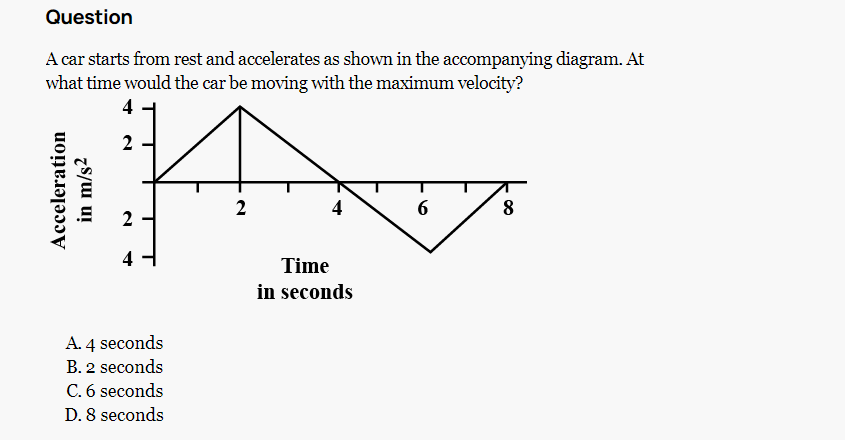
 hasty lotus
couldnt it be 4 or 8 seconds since both of them have the same area under the curve
just at 4 seconds it was moving right then at 8 seconds it was moving left
but the velocity is the same even if you are moving different direrctions?
 shy hazel
You are thinking of speed. Velocity has direction.
hasty lotus
so since its a negetive, the direciton and speed will be opposite so its slower?
idk
 prisma onyx
hasty lotus
so since its a negetive, the direciton and speed will be opposite so its slower?
prisma onyx
hasty lotus
so since its a negetive, the direciton and speed will be opposite so its slower?
even if you are moving different directions
That is important
hasty lotus
oh wait
at 8 seconds the velocity would be negetive because its going left
4 seconds its positive going right
so 4 is when it has the highest velo?
shy hazel
Yes but to be pedantic negative doesn’t mean going left and positive doesnt mean going right. It means going towards vs against a reference direction.
amber waspBOT
Channel closed
Closed by @hasty lotus
Use .reopen if this was a mistake.
hasty lotus
and at 4 seconds it would be furthest away from the starting position, right?
shy hazel
Yeah
Actually maybe not
It could still be traveling away from the starting point, just at a lower speed
hasty lotus
even if its below the 0 it could still be traveling away from the starting point?
shy hazel
If acceleration is below 0 yes.
If you are driving a car and let go of the gas pedal you are accelerating negatively but still going forward
amber waspBOT
Available help channel!
Send your question here to claim the channel.
Remember:
• Ask your math question in a clear, concise manner.
• Show your work, and if possible, explain where you are stuck.
• After 15 minutes, feel free to ping <@&286206848099549185>.
• Type the command .close to free the channel when you're done.
• Be polite and have a nice day!
Read #❓how-to-get-help for further information on how to ask a good question, and about conduct in the question channels.
 fathom pawn
Hi! How do I go about solving this?
 amber waspBOT
fathom pawn
Hi! How do I go about solving this?
amber waspBOT
fathom pawn
Hi! How do I go about solving this?
@fathom pawn Has your question been resolved?
fathom pawn
<@&286206848099549185>
fathom pawn
.close
amber waspBOT
Channel closed
Closed by @fathom pawn
Use .reopen if this was a mistake.
amber waspBOT
Available help channel!
Send your question here to claim the channel.
Remember:
• Ask your math question in a clear, concise manner.
• Show your work, and if possible, explain where you are stuck.
• After 15 minutes, feel free to ping <@&286206848099549185>.
• Type the command .close to free the channel when you're done.
• Be polite and have a nice day!
Read #❓how-to-get-help for further information on how to ask a good question, and about conduct in the question channels.
 mild kindle
Let A and B be two open, non-empty subsets of R with A =/= B. Is there always an open subset of A \ B?
amber waspBOT
mild kindle
Let A and B be two open, non-empty subsets of R with A =/= B. Is there always an...
mild kindle
 cunning birch
if A is a subset of B...
cunning birch
if A is a subset of B...
Okay yeah true, uhhh add that A is not a subset of B
In this I reckon it would be true, but I don't understand how to prove the assertion
amber waspBOT
@mild kindle Has your question been resolved?
cunning birch
Imagine A = (0,2) and B = (0,1)U(1,2).
mild kindle
True
Okay
I'm asking about Y when I should be asking about X
How would I show that an open subset of R uniquely determines the set of rational balls contained in it (i.e. open balls with rational center)? If this is even true that is
cunning birch
where does this question come from?
you know that if a rational number q is in a open subset A, then any ball (so interval) B(q,r) with r < d(q,R\A) is contained in it
in fact this works for any real number x instead of just any rational number q
mild kindle
Yeah
amber waspBOT
@mild kindle Has your question been resolved?
amber waspBOT
Channel closed
Closed due to timeout
Use .reopen if this was a mistake.
amber waspBOT
Available help channel!
Send your question here to claim the channel.
Remember:
• Ask your math question in a clear, concise manner.
• Show your work, and if possible, explain where you are stuck.
• After 15 minutes, feel free to ping <@&286206848099549185>.
• Type the command .close to free the channel when you're done.
• Be polite and have a nice day!
Read #❓how-to-get-help for further information on how to ask a good question, and about conduct in the question channels.
keen pawn
what does this even mean
 amber waspBOT
keen pawn
what does this even mean
cunning birch
amber waspBOT
keen pawn
what does this even mean
cunning birch
V is infinite dimensional if and only if you can find an infinite sequence v1,... such that (v1,...,vm) is linearly independent
no matter which m is picked last
 indigo cloud
from the other perspective, you know that if V is finite dimensional, then at some point you run out of linearly independent vectors to take. at some point v1,...,vm have to be linearly dependent
 shrewd elm
"no matter how many linearly independent vectors you have, you can always find one more"
indigo cloud
for infinite dim spaces that doesnt happen
keen pawn
I see
okay
Let me think
Now that I think of it, we haven't done dimension yet, i'll come back to this in a bit
thanks
.close
amber waspBOT
Channel closed
Closed by @keen pawn
Use .reopen if this was a mistake.
amber waspBOT
Available help channel!
Send your question here to claim the channel.
Remember:
• Ask your math question in a clear, concise manner.
• Show your work, and if possible, explain where you are stuck.
• After 15 minutes, feel free to ping <@&286206848099549185>.
• Type the command .close to free the channel when you're done.
• Be polite and have a nice day!
Read #❓how-to-get-help for further information on how to ask a good question, and about conduct in the question channels.
 marble shoal
Guys can someone just check this for 5 seconds and say if NOGPT‼️is doing it correctly?
 amber waspBOT
marble shoal
Guys can someone just check this for 5 seconds and say if NOGPT‼️is doing it cor...
amber waspBOT
amber waspBOT
marble shoal
Guys can someone just check this for 5 seconds and say if NOGPT‼️is doing it cor...
amber waspBOT
Channel closed
Closed by @marble shoal
Use .reopen if this was a mistake.
amber waspBOT
Available help channel!
Send your question here to claim the channel.
Remember:
• Ask your math question in a clear, concise manner.
• Show your work, and if possible, explain where you are stuck.
• After 15 minutes, feel free to ping <@&286206848099549185>.
• Type the command .close to free the channel when you're done.
• Be polite and have a nice day!
Read #❓how-to-get-help for further information on how to ask a good question, and about conduct in the question channels.
 fair nest
A fish has 17 cards labelled 1 to 17
It shuffles it
It notices that in the shuffled deck if it can charge the position of one card the cards are in ascending order
Find the number of possible arrangement of cards that the fish could have had
amber waspBOT
fair nest
A fish has 17 cards labelled 1 to 17
It shuffles it
It notices that in the shuff...
fair nest
my approach is that pick any one card and there are 16 ways that it can be in the wrong position
so a total of 17*16 ways
but apparently thats wrong.
 coral wigeon
what if you think about the problem in reverse
put all the cards in order
now just move one card
do you see how, if you started with that, you could move that one card to make them in order?
fair nest
coral wigeon
with say 3 cards
hmm
coral wigeon
fair nest
there would be repeated permutations
yes
starting with 1 2 3:
we will count 2 1 3 twice
once when we move the 2 around, again when we move the 1
fair nest
is this similar to circular permutations?
coral wigeon
i don’t think so
coral wigeon
coral wigeon
do you see how, if you started with that, you could move that one card to make t...
one thing you can try to do is figure out which arrangements you overcount with this process, and how many times you count them
and subtract off the overcounting
coral wigeon
coral wigeon
starting with 1 2 3:
we will count 2 1 3 twice
you might notice that e.g. 3 1 2 only gets counted once