#help-41
1 messages · Page 1 of 1 (latest)
 golden karma
 split kraken
oh hmm
if everything already converges, then this should play nicely
or rather, if the both of the RHS series converge, then there's no need to worry already
the LHS will just converge
golden karma
“If sum from 1 to infty (a_n^2) is convergent so
Sum from 1 to infty of |a_n|/n is also convergent”
I wanted to use this here
split kraken
maybe just preface this inner product by only allowing it to work when the infinite sum of a_nb_n converges or something 
golden karma
split kraken
or rather, if the both of the RHS series converge, then there's no need to worry...
Ye
split kraken
golden karma
“If sum from 1 to infty (a_n^2) is convergent so
Sum from 1 to infty of |a_n|/n...
I don't think we need C-S for this 
well...
we can use it yes
okay, sure. let's use it
do you have any ideas?
(please ping me when you come back, I will forget about this channel if you don't)
@golden karma
golden karma
split kraken
do you have any ideas?
Yes i did
Sum (|an|/n)^2 <= sum(a^2_n) * sum(1/n^2)
So it converges
golden karma
split kraken
(please ping me when you come back, I will forget about this channel if you don'...
@split kraken
split kraken
golden karma
Yes i did
Sum (|an|/n)^2 <= sum(a^2_n) * sum(1/n^2)
yes, that works

I'm pretty sure C-S is totally fine in this case because both of the RHS series converge
on the space of convergent sequences, what I wrote earlier is totally fine as an inner product
@golden karma if you're done here, be sure to close the channel
golden karma
split kraken
I'm pretty sure C-S is totally fine in this case because both of the RHS series ...
Ye
Ok thank you so much
.close
 amber waspBOT
Channel closed
Closed by @golden karma
Use .reopen if this was a mistake.
amber waspBOT
 Available help channel!
Send your question here to claim the channel.
Remember:
• Ask your math question in a clear, concise manner.
• Show your work, and if possible, explain where you are stuck.
• After 15 minutes, feel free to ping <@&286206848099549185>.
• Type the command .close to free the channel when you're done.
• Be polite and have a nice day!
Read #❓how-to-get-help for further information on how to ask a good question, and about conduct in the question channels.
 unreal nacelle
Can someone please help me with question no 8
 unreal nacelle
<@&286206848099549185>
 tropic wadi
!15m
amber waspBOT
Please only use the <@&286206848099549185> ping once if your question has not been answered for 15 minutes. Please do not ping or DM individual users about your question.
 plush ice
unreal nacelle
Can someone please help me with question no 8
plush ice
unreal nacelle
Can someone please help me with question no 8
can you provide book 📖 you are using ?
unreal nacelle
plush ice
can you provide book 📖 you are using ?
This is a collection of questions provided by the coaching I am studying in so I don't know which book is this from
unreal nacelle
plush ice
can you provide book 📖 you are using ?
Why do you want the book
plush ice
i just liked the problems in that book so got interested
unreal nacelle
plush ice
i just liked the problems in that book so got interested
Ohh
@plush ice Could you help me solve this problem
plush ice
can you provide drawing ?
unreal nacelle
This is how the diagram is supposed to look like
 spare belfry
Interesting question
unreal nacelle
@spare belfry hello
unreal nacelle

@plush ice Here is the drawing
@spare belfry could you help us solve this question
 plush ice
so i have coutple of questions: why points D,E,F are mentioned and what is delta ?
spare belfry
Forgot to mention, The area of the triangle is k/2
amber waspBOT
@unreal nacelle Has your question been resolved?
amber waspBOT
Channel closed
Closed due to timeout
Use .reopen if this was a mistake.
amber waspBOT
Available help channel!
Send your question here to claim the channel.
Remember:
• Ask your math question in a clear, concise manner.
• Show your work, and if possible, explain where you are stuck.
• After 15 minutes, feel free to ping <@&286206848099549185>.
• Type the command .close to free the channel when you're done.
• Be polite and have a nice day!
Read #❓how-to-get-help for further information on how to ask a good question, and about conduct in the question channels.
 willow jolt
How would I know whether to use the product or quotient property?
 willow jolt
this is my work so far:
2log5(x)-log5(2)+log5(x)
log(x^2)-log5(2)+log5(x)
split kraken
willow jolt
How would I know whether to use the product or quotient property?
you have to use both 
split kraken
willow jolt
this is my work so far:
2log5(x)-log5(2)+log5(x)
log(x^2)-log5(2)+log5(x)
good so far
have you tried using the product/quotient properties yet?
willow jolt
yes
so i would evaluate from left to right?
meaning I use quotient property first?
split kraken
it shouldn't matter
willow jolt
true
split kraken
try it, and see what you get
 willow jolt
log5((x^3)/2)
split kraken
done
willow jolt
no wait
split kraken
willow jolt
don't i need to simplify to log10
willow jolt
ok
i just thought bc log 10 was the default one
that people would want it to be in that form
willow jolt
so ln
split kraken
yeah
split kraken
I don't see why it shouldn't be fine lol
willow jolt
ok
split kraken
amber waspBOT
Channel closed
Closed by @willow jolt
Use .reopen if this was a mistake.
 solar gust
split kraken
solar gust
split kraken
That is definitely your outro mate
 amber waspBOT
Available help channel!
amber waspBOT
Available help channel!
Send your question here to claim the channel.
Remember:
• Ask your math question in a clear, concise manner.
• Show your work, and if possible, explain where you are stuck.
• After 15 minutes, feel free to ping <@&286206848099549185>.
• Type the command .close to free the channel when you're done.
• Be polite and have a nice day!
Read #❓how-to-get-help for further information on how to ask a good question, and about conduct in the question channels.
 unreal vortex
hello, i am trying to implement some algorithm or whatever you call it in programming, but i cant figure out the maths behind it
i have a variable size cube, made of smaller unit squares, the size of the cube represents the number of squares on the faces of the cube, i want to find the center of each smaller square on each face of the cube, but i cant figure out how to get those points
amber waspBOT
unreal vortex
hello, i am trying to implement some algorithm or whatever you call it in progr...
unreal vortex
like this would be one side of the cube(3x3x3 for this example)

i want to get these points

2x2x2

 vestal hatch
How large is the cube and where are the corners?
Also what's a "constant volume cube"
unreal vortex
vestal hatch
Also what's a "constant volume cube"
Fixed
unreal vortex
vestal hatch
How large is the cube and where are the corners?
you have all the data about the cube and its all variable
 proper egret
are you working with squares or cubes?
unreal vortex
proper egret
are you working with squares or cubes?
i am saying the cube faces are made up of smaller regular squares
like this is 3x3x3 (the cube is stylized but its still the structure similar to above with smaller squares) each square on each face of the cube has a red dark dot representing its center

sorry about the sun
vestal hatch
Well if the volume is fixed clearly the side length is not variable
So what is the side length
unreal vortex
vestal hatch
Well if the volume is fixed clearly the side length is not variable
i mentioned above i edited the original question
vestal hatch
Oh that's what you meant by fixed
unreal vortex
i translated something in my code to something else when i asked the quesiton so that ones on me
unreal vortex
vestal hatch
Oh that's what you meant by fixed
the little squares are of fixed size
vestal hatch
is the cube aligned with the x/y/z axis or can it be at a weird angle
unreal vortex
aligned
vestal hatch
ok
then take for example the bottom face
let (x,y) be the corner with the smallest x,y coordinates
To get a center, add s/6, 3s/6, or 5s/6 to x and also add one of those to y
unreal vortex
you have access to the center directly if that helps
unreal vortex
yes making your own problem and giving yourself everything you need > problems from text books
vestal hatch
so I'd cycle through every face one by one
For example, to get to the top face, add s/2 to the z-coordinate of the center
s is side length yeah
unreal vortex
ok
vestal hatch
Let's say it's an n x n cube
unreal vortex
sure
vestal hatch
For n=5 for example
unreal vortex
nxn would be number of squares that make it up?
vestal hatch
Yes
unreal vortex
aight
vestal hatch
add -2n/5, -n/5, 0, n/5, 2n/5 to the x-coordinate
and do the same to the y-coordinate
like a nested loop to generate all the centers
oh and multiply by s
so add -2ns/5, ..., 2ns/5
in general we're starting from [-(2n-1)/2 * s]/n and incrementing by s/n n times
vestal hatch
vestal hatch
in general we're starting from [-(2n-1)/2 * s]/n and incrementing by s/n n times
This description still works, if you look carefully it never hits 0 for even n
it'll give -3s/8 -s/8 s/8 3s/8 for n=4
for example
Just skipping the 0 wouldn't work otherwise
unreal vortex
vestal hatch
This description still works, if you look carefully it never hits 0 for even n
huh i thought these were just fixed numbers now i dont understand
vestal hatch
Actually I guess we're technically only incrementing n-1 times but that's unimportant
vestal hatch
unreal vortex
huh i thought these were just fixed numbers now i dont understand
Try with n=4 yourself then
These are all the possible numbers we add to the x/y coordinates
unreal vortex
vestal hatch
add -2n/5, -n/5, 0, n/5, 2n/5 to the x-coordinate
i dont understand how these numbers work
is this supposed to be a pattern
or do you literally just hard code these numbers/formulas
vestal hatch
vestal hatch
in general we're starting from [-(2n-1)/2 * s]/n and incrementing by s/n n times
It's this pattern
The specific example I gave you was for n=5
unreal vortex
vestal hatch
in general we're starting from [-(2n-1)/2 * s]/n and incrementing by s/n n times
woops missed that
unreal vortex
vestal hatch
in general we're starting from [-(2n-1)/2 * s]/n and incrementing by s/n n times
[-(2n-1)/(2*s)]/n ?
vestal hatch
No the s is outside the parens
unreal vortex
ah ok
vestal hatch
multiplied
unreal vortex
brb gonna test this
vestal hatch
then you need to replace s with the side length along the axis you're adding to
unreal vortex
ah and i assume n as well?
vestal hatch
if n is different depending on the axis then yes
you'd kinda treat each axis independently with its own s and it's own n
unreal vortex
vestal hatch
you'd kinda treat each axis independently with its own s and it's own n
alright thank you so much for the help, i was doing a similar approach but my formula was waaaaay off than yours, thanks
vestal hatch
You're welcome
unreal vortex
.close
amber waspBOT
Channel closed
Closed by @unreal vortex
Use .reopen if this was a mistake.
amber waspBOT
Available help channel!
Send your question here to claim the channel.
Remember:
• Ask your math question in a clear, concise manner.
• Show your work, and if possible, explain where you are stuck.
• After 15 minutes, feel free to ping <@&286206848099549185>.
• Type the command .close to free the channel when you're done.
• Be polite and have a nice day!
Read #❓how-to-get-help for further information on how to ask a good question, and about conduct in the question channels.
 spare galleon
I
amber waspBOT
spare galleon
I
 split sail
?
 split kraken
2.5, I presume
spare galleon
split kraken
2.5, I presume
“Presume”
I can smell the wrong use of word
Shouldn’t it be “assume”
split kraken
well, I am a bit tired tonight
spare galleon
split kraken
well, I *am* a bit tired tonight <:KEK:586240877358350341>
What had you done?
split kraken
either way, it's probably 2.5cm/hr
spare galleon
split kraken
either way, it's probably 2.5cm/hr
It is so slow
amber waspBOT
Channel closed
Closed by @spare galleon
Use .reopen if this was a mistake.
amber waspBOT
Available help channel!
Send your question here to claim the channel.
Remember:
• Ask your math question in a clear, concise manner.
• Show your work, and if possible, explain where you are stuck.
• After 15 minutes, feel free to ping <@&286206848099549185>.
• Type the command .close to free the channel when you're done.
• Be polite and have a nice day!
Read #❓how-to-get-help for further information on how to ask a good question, and about conduct in the question channels.
 mighty hare
 amber waspBOT
mighty hare
mighty hare
amber waspBOT
mighty hare
mighty hare
i got cos(theta) can someone double check
 wild vale
why would that be the case?
 little dagger
mighty hare
i got cos(theta) can someone double check
little dagger
mighty hare
i got cos(theta) can someone double check
that's correct
wild vale
little dagger
that's correct
that is wrong
little dagger
how?
little dagger
little dagger
that's correct
1/cos theta*
mighty hare
its 1/cos(theta)
wild vale
there you go
wild vale
sec(θ) and cos(θ) cancelled out, left with sin(θ)/cos(θ) multiply by 1/sin(θ) which is 1/cos(θ)
little dagger
yea
little dagger
little dagger
I just woke up
^^
mighty hare
.close
amber waspBOT
Channel closed
Closed by @mighty hare
Use .reopen if this was a mistake.
amber waspBOT
Available help channel!
Send your question here to claim the channel.
Remember:
• Ask your math question in a clear, concise manner.
• Show your work, and if possible, explain where you are stuck.
• After 15 minutes, feel free to ping <@&286206848099549185>.
• Type the command .close to free the channel when you're done.
• Be polite and have a nice day!
Read #❓how-to-get-help for further information on how to ask a good question, and about conduct in the question channels.
 minor night
 amber waspBOT
minor night
minor night
amber waspBOT
minor night
minor night
i have no idea how to do this
we are allowed to use our classpads which have a solve function and a normalpdf and cdf function too but idk what to input to make it work
wild vale
maybe you want to transform this to standard normal first
 distant herald
if you're allowed to use invnorm, you can also kind of abuse the symmetry of the distribution to find k
minor night
distant herald
if you're allowed to use invnorm, you can also kind of abuse the symmetry of the...
how?
minor night
wild vale
maybe you want to transform this to standard normal first
how?
i missed a few lessons lol
i can use invnorm btw
wild vale
then that is easy. you still need to transform it to standard normal first tho
think about it this way. the mean is where the distribution is centered. So if you want to move this graph to have center at the 0, you probably want to translate it by...
minor night
20
distant herald
iirc invnorm lets you put the mean and std, and you say the area to the left of what you're looking for, so you know that 0.4342 is on each side of the mean because of symmetry. that means that the area to the left of 20+k is 0.5 + 0.4342 = 0.9342
minor night
distant herald
iirc invnorm lets you put the mean and std, and you say the area to the left of ...
its mean, tail setting (left, right, centre), SD and probability value
distant herald
oh the tail settings make it even easier
older calculators always just did the left
minor night
i put in what you said and it was right
do you mind explaining it a little more for me?
distant herald
what part didn't make sense?
you could've technically done it a little faster using the centre setting for the tail but i didn't know you had that option
minor night
my brains just hurting atm i got a headache
how would the centre setting make it easier?
distant herald
all good, left means the area under the distribution to the left of the value you're considering
so the area under the distribution from (-infinity, a) where a is some number
you know that since the distribution is symmetric and the area represents probability, the total area underneath is 1, so the area to the left of the mean (the center) is 0.5
minor night
yep
distant herald
and similarly since your values 20-k and 20+k are symmetric about the mean, you know that the area to the right of the mean is half of that area
so 0.8684 / 2 is the area from 20 to 20+k
and you know that the area from (-inf, 20) is 0.5
which means the area to the left of 20+k is 0.5 + 0.8684/2 which is where the 0.9342 came from
minor night
yep
distant herald
so you'll get a number for 20+k from that calculation and it's just solving for k
distant herald
this extra math i did using the symmetry is only necessary here cause you're using a left tailed test
minor night
i need to go take a panadol
distant herald
distant herald
this extra math i did using the symmetry is only necessary here cause you're usi...
so you need to account for all the area to the left
but since centre tailed is an option
minor night
how would you do it with center bc i messed around on the calc trying to figure it out before i came here
distant herald
that accounts for the area for some interval symmetrically distributed around the center
i think
idk my calculator never had that option
what does your calculator ask you to input when you select centre?
minor night
same stuff
distant herald
mean, std, prob?
minor night
if i do invNormCDF (centre, p=0.8684), sd=5, mean=20) it gives me 12.46
distant herald
what did you get for k using the left tailed method?
minor night
if i do the method that u said, i get 27.54 and then i just take 20 to get k
distant herald
hm in that case i'm not too sure about how the center method works
you might want to look that up specifically about how your calculator does that
minor night
alright its ok
distant herald
afaik that setting should make this calculation quicker since the interval is symmetric about the mean
k above and k below
minor night
distant herald
k above and k below
you have my dads name btw but my dad sucks at maths
.close
amber waspBOT
Channel closed
Closed by @minor night
Use .reopen if this was a mistake.
amber waspBOT
Available help channel!
Send your question here to claim the channel.
Remember:
• Ask your math question in a clear, concise manner.
• Show your work, and if possible, explain where you are stuck.
• After 15 minutes, feel free to ping <@&286206848099549185>.
• Type the command .close to free the channel when you're done.
• Be polite and have a nice day!
Read #❓how-to-get-help for further information on how to ask a good question, and about conduct in the question channels.
spare galleon
 spare galleon
I cannot understand the highlighted line
tropic wadi
spare galleon
I cannot understand the highlighted line
bro please close your previous channel
spare galleon
sorry
 mint nacelle
spare galleon
I cannot understand the highlighted line
mint nacelle
spare galleon
I cannot understand the highlighted line
it's a cone basically
 amber waspBOT
@spare galleon Has your question been resolved?
amber waspBOT
Channel closed
Closed due to timeout
Use .reopen if this was a mistake.
amber waspBOT
Available help channel!
Send your question here to claim the channel.
Remember:
• Ask your math question in a clear, concise manner.
• Show your work, and if possible, explain where you are stuck.
• After 15 minutes, feel free to ping <@&286206848099549185>.
• Type the command .close to free the channel when you're done.
• Be polite and have a nice day!
Read #❓how-to-get-help for further information on how to ask a good question, and about conduct in the question channels.
 simple drum
 amber waspBOT
simple drum
simple drum
amber waspBOT
simple drum
simple drum
Can someone explain to me why this linear transformation is from R^3 to R^4?
 sudden jewel
multiplying a 4x3 matrix with a 3x1 vector results in a 4x1 vector
amber waspBOT
Channel closed
Closed by @simple drum
Use .reopen if this was a mistake.
amber waspBOT
Available help channel!
Send your question here to claim the channel.
Remember:
• Ask your math question in a clear, concise manner.
• Show your work, and if possible, explain where you are stuck.
• After 15 minutes, feel free to ping <@&286206848099549185>.
• Type the command .close to free the channel when you're done.
• Be polite and have a nice day!
Read #❓how-to-get-help for further information on how to ask a good question, and about conduct in the question channels.
simple drum
How to solve this?
 amber waspBOT
simple drum
How to solve this?
amber waspBOT
simple drum
How to solve this?
 indigo cloud
wdym by <=
also this clearly isnt enough unless you failed to mention that T is supposed to be linear
simple drum
T is a linear transformation
simple drum
indigo cloud
wdym by <=
In the first line ?
indigo cloud
yes
simple drum
T goes from R^3 to R^2x2
indigo cloud
ok second line
indigo cloud
ok so the <= is a typo
simple drum
Yes
indigo cloud
find out the linear combination a(1,9,9)+b(0,1,9)+c(0,0,1)=(3,23,-8)
then use that T is linear
simple drum
indigo cloud
then use that T is linear
What do u mean ?
indigo cloud
do the other thing first
simple drum
 indigo cloud
ok
simple drum
simple drum
Calculation mistake c=1
indigo cloud
I am gonna call the vectors (1,9,9) etc as u,v,w
so now you know (3,23,-8)=3u-4v+w, yes?
simple drum
Yes
indigo cloud
what is the definition of a linear map
simple drum
Its mapping between two vector spaces that perserves the operations of vector addition and scalar multiplication
indigo cloud
in symbols?
simple drum
T(u+v)=t(u)+t(v)
T(a*u)=at(u)
indigo cloud
indigo cloud
so T(3,23,-8)=T(3u-4v+w)
good now look at the right side of this
could you apply these two properties?
 indigo cloud
yes
amber waspBOT
Channel closed
Closed by @simple drum
Use .reopen if this was a mistake.
Available help channel!
Send your question here to claim the channel.
Remember:
• Ask your math question in a clear, concise manner.
• Show your work, and if possible, explain where you are stuck.
• After 15 minutes, feel free to ping <@&286206848099549185>.
• Type the command .close to free the channel when you're done.
• Be polite and have a nice day!
Read #❓how-to-get-help for further information on how to ask a good question, and about conduct in the question channels.
 sick echo
I have a quick question
amber waspBOT
sick echo
I have a quick question
sick echo
Basically I want to learn how to integrate integrals like the Gaussian integral but I don’t want to know how to do but but I want to learn the techniques that are required to integrate it then try and derive it on my own
So what techniques or things would I need to learn?
I think i need to know how to use Jacobean matrix?
Anything else I need to know how to use?
sick echo
sick echo
Basically I want to learn how to integrate integrals like the Gaussian integral ...
For example I learn how to integrate a similar integral then using the knowledge and techniques I have just learnt I then attempt to integrate the Gaussian integral
amber waspBOT
@sick echo Has your question been resolved?
 honest dagger
Polar integrals
amber waspBOT
@sick echo Has your question been resolved?
sick echo
honest dagger
Polar integrals
Is this all?
amber waspBOT
Channel closed
Closed due to timeout
Use .reopen if this was a mistake.
Available help channel!
Send your question here to claim the channel.
Remember:
• Ask your math question in a clear, concise manner.
• Show your work, and if possible, explain where you are stuck.
• After 15 minutes, feel free to ping <@&286206848099549185>.
• Type the command .close to free the channel when you're done.
• Be polite and have a nice day!
Read #❓how-to-get-help for further information on how to ask a good question, and about conduct in the question channels.
 woven junco
Find the function from this graph. It is a natural logarithm graph that has been shifted horizontally and vertically. Rather I only have 1 point to work with
 amber waspBOT
woven junco
Find the function from this graph. It is a natural logarithm graph that has been...
woven junco
amber waspBOT
woven junco
Find the function from this graph. It is a natural logarithm graph that has been...
woven junco
I'm kind of stumped at this one, maybe I forgot something?
So where I've been trying to get at is using (-2, -1) as a point, and using the general form f(x) = a ln(x + c) + d I've found d and c, but can't figure out where to get to for a
So: f(x) = a * ln(x + 3) -1
Rather, a = 2, as one can get from the answer
I'm just confused at how they get to it
 drifting rover
woven junco
So: f(x) = a * ln(x + 3) -1
drifting rover
woven junco
So: f(x) = a * ln(x + 3) -1
look at where it crosses x and y, shift ur graph up one and compare values
woven junco
drifting rover
look at where it crosses x and y, shift ur graph up one and compare values
Could you please give me another pointer?
 drifting rover
woven junco
Could you please give me another pointer?
drifting rover
woven junco
Could you please give me another pointer?
you just compare each value with what you have and try solve from there
so like you see where a ln(x+3) - 1 = y
for diff values of y and x
thats what id do, but also in general knowing what a vertical stretch of ln looks like
as it gets spread out more if that makes sense
woven junco
OK, I'll try that
woven junco
drifting rover
you just compare each value with what you have and try solve from there
Would I not need to know for certain a second point?
I mean, in the textbook I'm using
We can kind the key point and the x-intercept
But for the key point I need a
drifting rover
woven junco
Would I not need to know for certain a second point?
i would approximate
amber waspBOT
Channel closed
Closed by @woven junco
Use .reopen if this was a mistake.
amber waspBOT
Available help channel!
Send your question here to claim the channel.
Remember:
• Ask your math question in a clear, concise manner.
• Show your work, and if possible, explain where you are stuck.
• After 15 minutes, feel free to ping <@&286206848099549185>.
• Type the command .close to free the channel when you're done.
• Be polite and have a nice day!
Read #❓how-to-get-help for further information on how to ask a good question, and about conduct in the question channels.
 obtuse jolt
 amber waspBOT
obtuse jolt
obtuse jolt
amber waspBOT
obtuse jolt
obtuse jolt
Can I have help with 3
 keen pawn
Hint: $cos(2x)=1-2sin^2(x)$
 grizzled pagodaBOT
ƒ(Why am. I here)=I don't Know
 obtuse jolt
grizzled pagoda
**ƒ(Why am. I here)=I don't Know**
obtuse jolt
grizzled pagoda
**ƒ(Why am. I here)=I don't Know**
Thank you
Can you help me with 16

And can you answer it I wanna double check
My answers
Please
tropic wadi
show your work

 jovial field
amber waspBOT
jovial field
amber waspBOT
@obtuse jolt Has your question been resolved?
amber waspBOT
Channel closed
Closed due to timeout
Use .reopen if this was a mistake.
Available help channel!
Send your question here to claim the channel.
Remember:
• Ask your math question in a clear, concise manner.
• Show your work, and if possible, explain where you are stuck.
• After 15 minutes, feel free to ping <@&286206848099549185>.
• Type the command .close to free the channel when you're done.
• Be polite and have a nice day!
Read #❓how-to-get-help for further information on how to ask a good question, and about conduct in the question channels.
 amber juniper
im having some trouble with this question, the fxy derivative is correct but my fyz is wrong apparently

 amber waspBOT
amber juniper
im having some trouble with this question, the fxy derivative is correct but my ...
amber juniper
plush ice
what's your mistake
amber waspBOT
amber juniper
im having some trouble with this question, the fxy derivative is correct but my ...
amber juniper
plush ice
what's your mistake
im not sure but my lecturer just says the partial derivative for Fyz is wrong
the first part is partial der. with respect to y
which is correct
but the partial derivative with respect to z is wrong
plush ice
amber juniper
the first part is partial der. with respect to y
it's not correct
amber juniper
plush ice
it's not correct
partial derivative to y step is wrong?
 amber juniper
plush ice
amber juniper
plush ice
could you explain further, because for my working im getting this unless it has to be done another way?
 plush ice
oh sry i thought you were differentiating with respect to y first
ok then first part is correct
amber juniper
what about for the second part tho
plush ice
that is wrong
amber juniper
could you explain how to do it correctly or my error?
amber juniper
ah i see because we have y in the function and we have to differentiate to y
plush ice
icorrected the formula
amber juniper
alright thank you
plush ice
you are welcome
amber juniper
.close
amber waspBOT
Channel closed
Closed by @amber juniper
Use .reopen if this was a mistake.
amber waspBOT
Available help channel!
Send your question here to claim the channel.
Remember:
• Ask your math question in a clear, concise manner.
• Show your work, and if possible, explain where you are stuck.
• After 15 minutes, feel free to ping <@&286206848099549185>.
• Type the command .close to free the channel when you're done.
• Be polite and have a nice day!
Read #❓how-to-get-help for further information on how to ask a good question, and about conduct in the question channels.
 rapid stag
 amber waspBOT
rapid stag
rapid stag
amber waspBOT
rapid stag
rapid stag
Please help me
Someone pinged me and told me the answer is two
But i dont know how to do it
keen pawn
this is an indeterminate form, notice that first
rapid stag
keen pawn
this is an indeterminate form, notice that first
Yea.. its 0 right?
grizzled pagodaBOT
f(why am i here )= idk
 keen pawn
,w lim _{x \to \infty} x^2(sec(2/x)-1)
grizzled pagodaBOT


 Requested by physicsrocks
rapid stag
grizzled pagoda
Requested by physicsrocks
rapid stag
grizzled pagoda
Wow..
keen pawn
I'll preface this by saying I'm not sure, but I still want to try to help you, is that fine?
rapid stag
 i should have checked using wolfram instead of photomath
rapid stag
keen pawn
I'll preface this by saying I'm not sure, but I still want to try to help you, i...
Yeah, sure
little dagger
does he still need help?
grizzled pagodaBOT
f(why am i here )= idk
 keen pawn
now take the log of both sides
rapid stag
keen pawn
now take the log of both sides
How..
little dagger
keen pawn
now take the log of both sides
wait i got better way and easier
we can write sec(2/x) in terms of cos
and then take lcm
and apply expansions of taylor series
keen pawn
wait
little dagger
till x^2/2!
grizzled pagodaBOT
f(why am i here )= idk
 rapid stag
grizzled pagoda
**f(why am i here )= idk**
rapid stag
grizzled pagoda
**f(why am i here )= idk**
Ohh
keen pawn
little dagger
wait i got better way and easier
How are you so smart lol, I would have never noticed that
little dagger
keen pawn
How are you so smart lol, I would have never noticed that
as i got exam of that tmrw
XD
rapid stag
little dagger
as i got exam of that tmrw
😲
keen pawn
ah, good luck.
little dagger
thanks
rapid stag
little dagger
as i got exam of that tmrw
I got that on Tuesday
keen pawn
A competitive exam?
keen pawn
ah, cool, jee ke liya?
keen pawn
awesome, good luck.
little dagger
phy ne maar di hai
keen pawn
Sorry
rapid stag
keen pawn
wait
 rapid stag
rapid stag
rapid stag
Wait i dont quite understand
keen pawn
OK, @little dagger can help you from here, i'mma dip
rapid stag
little dagger
that should change limits to 0
 rapid stag
rapid stag
rapid stag
Like that?
little dagger
yk substitution method?
rapid stag
little dagger
yk substitution method?
Uh yeah? I did change x to 1/t
little dagger
you forgot to change limits
rapid stag
little dagger
you forgot to change limits
 rapid stag
little dagger
take lcm
rapid stag
little dagger
take lcm
How
little dagger
it would be
rapid stag

 rapid stag
little dagger
rapid stag
little dagger
Wow
little dagger
grizzled pagoda
**f(why am i here )= idk**
then apply this
rapid stag
Ohhhh
rapid stag
little dagger
then apply this
Why do i get -2
little dagger
send ur work
rapid stag
little dagger
send ur work
 little dagger
you cannot reduce like that
rapid stag
little dagger
you cannot reduce like that
Oh the 1-2sin²t?
 rapid stag
I lost the (1/t)²
little dagger
from num and deno
rapid stag
little dagger
Hm, i mean if limit goes to zero i can cancel out the sine
rapid stag
rapid stag
Hm, i mean if limit goes to zero i can cancel out the sine
(thats what my teacher said)
rapid stag
little dagger
do you know sinx/x = 1?
Yeah..
rapid stag
little dagger
for lim ending to 0
Yeah... So thats why i cancel it out
rapid stag
im sorry i know im dumb
 rapid stag
little dagger
rapid stag
little dagger
Oh
little dagger
i think
little dagger
becuase 1/t^2 you cannot cancel out
little dagger
rapid stag
Because cos 0 is 1
yup
 little dagger
np
rapid stag
little dagger
Can you break this down for me tho?
rapid stag
little dagger
what is
2/3
 rapid stag
little dagger
angle (2t)
rapid stag
little dagger
angle (2t)
Oh so its supposed to follow wherever cos goes
rapid stag
Ohh omg
 rapid stag
Thankyou!
rapid stag
.close
amber waspBOT
Channel closed
Closed by @rapid stag
Use .reopen if this was a mistake.
amber waspBOT
Available help channel!
Send your question here to claim the channel.
Remember:
• Ask your math question in a clear, concise manner.
• Show your work, and if possible, explain where you are stuck.
• After 15 minutes, feel free to ping <@&286206848099549185>.
• Type the command .close to free the channel when you're done.
• Be polite and have a nice day!
Read #❓how-to-get-help for further information on how to ask a good question, and about conduct in the question channels.
 grand rivet
did i do it right?


 amber waspBOT
grand rivet
did i do it right?
grand rivet
amber waspBOT
grand rivet
did i do it right?
grand rivet
mode 14
mean approx 13.62
median = 14
The mode is the most appropriate form of average for this distribution because it represents the most common size sold
B
Mode: £160,000 and £165,000 (bimodal)
mean = £158,000
median = £165,000
The median is the most appropriate form of average for this distribution because it is not affected by the extreme value
C
Mode = 30
mean = 19.47
median = 18.5
The median is the most appropriate form of average for this distribution because it is not affected by the extreme values
U can react with ticks and crosses with which is right and wrong if thats easier
sorry for the big question i just wanna make sure i understand it properly
amber waspBOT
Channel closed
Closed by @grand rivet
Use .reopen if this was a mistake.
amber waspBOT
Available help channel!
Send your question here to claim the channel.
Remember:
• Ask your math question in a clear, concise manner.
• Show your work, and if possible, explain where you are stuck.
• After 15 minutes, feel free to ping <@&286206848099549185>.
• Type the command .close to free the channel when you're done.
• Be polite and have a nice day!
Read #❓how-to-get-help for further information on how to ask a good question, and about conduct in the question channels.
amber waspBOT
 mystic lotus
Okay no one talk here unless you're actually helping with the question
distant herald
if <b> is convergent, then you know that the difference between the values of b_n and b_(n+1) must be getting arbitrarily small for large n
distant herald
distant herald
if <b> is convergent, then you know that the difference between the values of b_...
what does that tell you about how the value of b_n - b_(n+1) behaves for large n?
yeah it gets arbitrarily close to 0
hmm i'm actually not sure if there's some obscure counterexample for a diverging, intuitively the sequence converges to 0, i'm not too sure what that says about the series
distant herald
💀 his approach might actually be helpful, the telescoping part is probably what i missed
tropic wadi
I literally spent my 15 mins for nothing
distant herald
a_1 + a_2 + a_3 + ... = b_1 - b_2 + b_2 - b_3 + b_3 - b_4 + ...
and you know that b_n converges to 0
since the series converges
so as terms telescope and cancel, the contribution from larger and large b_n vanish
which means a_1 + ... = b_1
so yeah telescoping is def the right approach
mystic lotus
Sorry to interrupt
The OP was an alt of a banned user, we've just found out
.close
amber waspBOT
Channel closed
Closed by @mystic lotus
Use .reopen if this was a mistake.
distant herald
how did you even find that out 😭
tropic wadi
💀 and bro wanted me to ban
tropic wadi
distant herald
how did you even find that out 😭
mods being mods
distant herald
he just messaged me and said he was arjunn
amber waspBOT
Available help channel!
Send your question here to claim the channel.
Remember:
• Ask your math question in a clear, concise manner.
• Show your work, and if possible, explain where you are stuck.
• After 15 minutes, feel free to ping <@&286206848099549185>.
• Type the command .close to free the channel when you're done.
• Be polite and have a nice day!
Read #❓how-to-get-help for further information on how to ask a good question, and about conduct in the question channels.
 lilac birch
 bronze shuttle
why is this true? it should be -1
 amber waspBOT
bronze shuttle
why is this true? it should be -1
bronze shuttle
little dagger
take lcm
amber waspBOT
bronze shuttle
why is this true? it should be -1
bronze shuttle
little dagger
take lcm
what
amber waspBOT
Channel closed
Closed by @bronze shuttle
Use .reopen if this was a mistake.
keen pawn
Notice that $n^{-2x}$ tends to 0
grizzled pagodaBOT
🏳🌈f(why am i here )= idk
 bronze shuttle
keen pawn
Notice that $n^{-2x}$ tends to 0
bronze shuttle
keen pawn
Notice that $n^{-2x}$ tends to 0
yeah they should've wrote it like he said
vestal hatch
What if x=0?
bronze shuttle
vestal hatch
What if x=0?
=0
little dagger
little dagger
(n^2x-1)/n^2x
can solve like this too
vestal hatch
which doesn't approach 1
vestal hatch
How does 0 not approach 1?
vestal hatch
The limit is sign(x)
little dagger
little dagger
so yea miscomunication
.
vestal hatch
Yes I'm just confused because the problem is wrong
amber waspBOT
Available help channel!
Send your question here to claim the channel.
Remember:
• Ask your math question in a clear, concise manner.
• Show your work, and if possible, explain where you are stuck.
• After 15 minutes, feel free to ping <@&286206848099549185>.
• Type the command .close to free the channel when you're done.
• Be polite and have a nice day!
Read #❓how-to-get-help for further information on how to ask a good question, and about conduct in the question channels.
 vale garnet
is this right?

 amber waspBOT
vale garnet
is this right?
amber waspBOT
vale garnet
is this right?
 signal furnace
vale garnet
is this right?
signal furnace
vale garnet
is this right?
 signal furnace
vale garnet
is this right?
signal furnace
vale garnet
is this right?
 amber waspBOT
@vale garnet Has your question been resolved?
Channel closed
Closed by @vale garnet
Use .reopen if this was a mistake.
amber waspBOT
Available help channel!
Send your question here to claim the channel.
Remember:
• Ask your math question in a clear, concise manner.
• Show your work, and if possible, explain where you are stuck.
• After 15 minutes, feel free to ping <@&286206848099549185>.
• Type the command .close to free the channel when you're done.
• Be polite and have a nice day!
Read #❓how-to-get-help for further information on how to ask a good question, and about conduct in the question channels.
 burnt haven
 amber waspBOT
burnt haven
burnt haven
amber waspBOT
burnt haven
burnt haven
can somebody teach me how to handle a constant
 solemn escarp
?
burnt haven
like i dont undersatnd how they went from the first step to the second
ik the arctan integration
but the sqrt 3
basically
1 / 1 + s^2 would be arctan s
but what if its 1 / 3 + s^2
how do u handle that
keen pawn
see, what is the derivative of 1/(1+x^2)?
burnt haven
2x / (1+x^2)^2
burnt haven
keen pawn
see, what is the derivative of 1/(1+x^2)?
this ^?
keen pawn
I meant arctan(x)
grizzled pagodaBOT
77²
 tropic wadi
then u-sub for s/sqrt3
amber waspBOT
Channel closed
Closed by @burnt haven
Use .reopen if this was a mistake.
amber waspBOT
Available help channel!
Send your question here to claim the channel.
Remember:
• Ask your math question in a clear, concise manner.
• Show your work, and if possible, explain where you are stuck.
• After 15 minutes, feel free to ping <@&286206848099549185>.
• Type the command .close to free the channel when you're done.
• Be polite and have a nice day!
Read #❓how-to-get-help for further information on how to ask a good question, and about conduct in the question channels.
 visual mountain
How to solve this without knowing the height

 cerulean fossil
you can use trigonometry to find the height
one sec
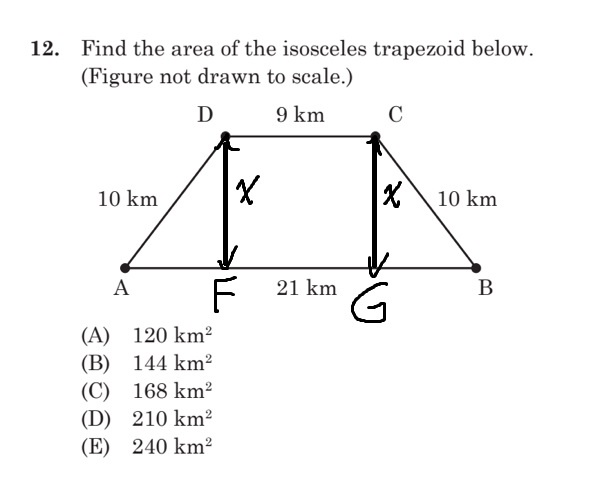
x is the height you're looking for, since FG = 9 and AF = GB, you can find the base of one of the right triangles (AF or GB)
visual mountain
Is it 6
cerulean fossil
AF = GB = 6
visual mountain
Yea,
cerulean fossil
now you can use the pythagorean theorem or trig in of the right triangles (ADF or CGB) to find x
visual mountain
Ok ty
cerulean fossil
cheers
visual mountain
.close
amber waspBOT
Channel closed
Closed by @visual mountain
Use .reopen if this was a mistake.
amber waspBOT
Available help channel!
Send your question here to claim the channel.
Remember:
• Ask your math question in a clear, concise manner.
• Show your work, and if possible, explain where you are stuck.
• After 15 minutes, feel free to ping <@&286206848099549185>.
• Type the command .close to free the channel when you're done.
• Be polite and have a nice day!
Read #❓how-to-get-help for further information on how to ask a good question, and about conduct in the question channels.
grand rivet
 amber waspBOT
grand rivet
grand rivet
amber waspBOT
grand rivet
grand rivet
is the answer to the mean x = 6.5 and the value of a is 2
 tired girder
What have you done ?
S(4x-1) = 4(S(x)) - 25 = 625 or , 4s(x) = 650 or s(x)/25 = 26/4
S(x)/25 = bar(x)

 tired girder
grand rivet
is the answer to the mean x = 6.5 and the value of a is 2
tired girder
grand rivet
is the answer to the mean x = 6.5 and the value of a is 2
X= 6.5 is correct
 grand rivet
tired girder
X= 6.5 is correct
grand rivet
tired girder
X= 6.5 is correct
thx
grand rivet
cheers thx
tired girder
grand rivet
thx
Glad to help !
grand rivet
can i ask u for one more question i wanna make sure i understand that too
tired girder
Yeah why not I will try my best
tired girder
Okk
grand rivet
so this one is the height of the rectangle 0.75 cm and x = 15 and for b is the mean approx 26.55 grams

so i used the frequence density formula to get x
and then used that x value back int othe frequency density formula to get the height
tired girder
Hm
tired girder
grand rivet
and then used that x value back int othe frequency density formula to get the he...
That's the methodology
grand rivet
i didnt know it was called that i just thought it worked lol
tired girder
One moment
tired girder
grand rivet
i didnt know it was called that i just thought it worked lol
Do you want me to check calculations ?
grand rivet
yea cuz then i know if i understand it properly or not
tired girder
2x = 3 cm you see
 tired girder
1-10 frequency height is 3 cm
grand rivet
cuz i thought the frequency was 2x and frequency density is 3cm and class width = 10
tired girder
See when the frequency is 2x the height is 3 cm
No we don't need class width to determine the height
tired girder
We can simply visualise it
In a histogram all rectangles have the same base width
When the frequency is 2x , the height is 3 , * frequency is plotted vertically
So when frequency will be x , it will be 3/2 = 1.5
Your method is completely correct and must be done when we have variable class widths
For this case it's pretty simple
tired girder
Yeàh
grand rivet
ok and now wat bout b
tired girder
Lemme see
 tired girder
For mean we need to consider the class median
For 0-10 length class it will be 5 , for 10-20 it will be 15 like that
Now what we will do is (2x×5+4x×15+...)/(2x+4x+...)
The formula is
Summation(x_i × f_i)/summation(f_i)
tired girder
grand rivet
so x= 1.5 and the height = 1.5
And we can't find x with the given information , we can only determine height
Are you getting me ?
grand rivet
i get everything but i am slight confused when it comes to the formula
tired girder
Have they given any data like total stones ?
grand rivet
all the data they give us is in the screenshot
tired girder
grand rivet
all the data they give us is in the screenshot
Then it doesn't seems possible to find x
Hey
Wait
Wait
 tired girder
I am solving it wrongly
I haven't
Noticed
51-70
The class length is 20
Why didn't you say me brooo 😭😭😭


 tired girder
Yeah this is correct !
grand rivet
so that does work then good
this question was very confusing for me when i was doing it lol

 grand rivet
tired girder
Yeah this is correct !
grand rivet
tired girder
Yeah this is correct !
how bout this one sorry if i am asking alot
tired girder
3 = 2x/10
So 2x is basically 30 , which holds good
But we can't consider frequency to be that value
Because if we calculate in another metric
Consider in meter , we will get a different value for x
So , as the question asks , you write 15 , but I hope you understand why it's actually invalid
grand rivet
sry i went toilet
tired girder
grand rivet
S(x) = -7
S(y) = 35
So this is correct
tired girder
grand rivet
This one ^


 grand rivet
tired girder
This one ^
grand rivet
tired girder
This one ^
can u react to the one ur talking bout
tired girder
Yeah divide next
So s(x) +s(y)/30
I'm extremely sorry for the second question, i didn't notice huh !!
 tired girder
Yeah !
grand rivet
tired girder
I'm extremely sorry for the second question, i didn't notice huh !!
np ur the biggest help lol i been trying to get help with these questions since yesterday and no one helped lol
tired girder
grand rivet
np ur the biggest help lol i been trying to get help with these questions since ...
Nah I'm really sry man , it wasted much time !
grand rivet
nah ur the goat lol im thankful for helpimg me with ur time
if there is any other questions can i just @ or reply to ur message if u have time?
tired girder
Thanks bro !
tired girder
grand rivet
if there is any other questions can i just @ or reply to ur message if u have ti...
Yeah ofcourse
grand rivet
aight appreciate it
tired girder
Ok cya
amber waspBOT
@grand rivet Has your question been resolved?
grand rivet
tired girder
Ok cya
u there btw i have 2 questions i wanna check with u
tired girder
Yeah bro
grand rivet
ok w gimme a min
icl this is a simple one b ut i forgot how to a stem leaf diagram

and for this one i just wanna make sure the mean is approx 3.07

the main question i need help with is

 grand rivet
tired girder
Yeah bro
grand rivet
tired girder
Yeah bro
sor for taking a little while sneding it
tired girder
Ok np
tired girder
grand rivet
icl this is a simple one b ut i forgot how to a stem leaf diagram
You need to make the stem leaf diagram first
As all are two digit numbers
A vertical plot of 1-6 would work
And make next two columns to incorporate the datas of the units place
For the seperate ones
grand rivet
ok that makes sense
tired girder
,calc 6+18+15+16+12+7+8+10
grizzled pagodaBOT
Result:
92
,calc 92/30
grizzled pagodaBOT
Result:
3.0666666666667
Correct
grand rivet
ok now for the last and the one im most confused about
tired girder
You know what's cumulative frequency?
grand rivet
not exactly
tired girder
See what cumulative frequency means is we add the previous frequency to it
grand rivet
but i do need to check those with u later if possible
tired girder
For example ≤100 =200
≤150 = 800
So 100 ≤ x ≤150 = 800-200 = 600
X is number of schools
So in this way we could easily make a frequency distribution from the cumulative frequency distribution by forming classes. But that's not necessary always
Now we will do the graph
It's quite simple as they say pupils frequency to schools graph
This is not the typical histogram
We will consider points here and rough draw it
Pupils on x axis , schools on y axis
On x axis make that distribution as said 2cm = 100 pupils
Now we will consider the centre of class nd plot it at 800 matching the horizontal axis
Are you getting me ?
tired girder
grand rivet
but i do need to check those with u later if possible
Hey there ?
tired girder
Wait lemme send one example 1 min

See this
On x axis we will similarly plot number of students
And on Y axis plot the school number maintaining the scale
Then you can form something sort of this
tired girder
A graph is recommended , as your class lengths are variable
 tired girder
Yeahh
grand rivet
tired girder
Are the plots correct?
i think so
i think i get the general idea
aswell
ok ill be back wih b c and d
cya in abit
tired girder
Yeah bye , I gtg bro , I will be on at night you can DM me if you face àny problem
grand rivet
tired girder
Yeah bye , I gtg bro , I will be on at night you can DM me if you face àny probl...
aight cya gn
sry for the late response
amber waspBOT
@grand rivet Has your question been resolved?
tired girder
grand rivet
aight cya gn
Gn bro !
amber waspBOT
Channel closed
Closed by @grand rivet
Use .reopen if this was a mistake.
amber waspBOT
Available help channel!
Send your question here to claim the channel.
Remember:
• Ask your math question in a clear, concise manner.
• Show your work, and if possible, explain where you are stuck.
• After 15 minutes, feel free to ping <@&286206848099549185>.
• Type the command .close to free the channel when you're done.
• Be polite and have a nice day!
Read #❓how-to-get-help for further information on how to ask a good question, and about conduct in the question channels.
 stoic locust
 urban jetty
 amber waspBOT
urban jetty
amber waspBOT
urban jetty

 cedar plaza
can you show the whole expression
urban jetty

 urban jetty
can you elaborate on how we can apply it to 1/4 cos^2 (2x)
cedar plaza
add 1, divide by 2, multiply by 1/4
urban jetty
ahhh
amber waspBOT
@urban jetty Has your question been resolved?
amber waspBOT
Channel closed
Closed due to timeout
Use .reopen if this was a mistake.
Available help channel!
Send your question here to claim the channel.
Remember:
• Ask your math question in a clear, concise manner.
• Show your work, and if possible, explain where you are stuck.
• After 15 minutes, feel free to ping <@&286206848099549185>.
• Type the command .close to free the channel when you're done.
• Be polite and have a nice day!
Read #❓how-to-get-help for further information on how to ask a good question, and about conduct in the question channels.
 rotund timber
 amber waspBOT
rotund timber
rotund timber
amber waspBOT
rotund timber
rotund timber

How can I find solutions where there is no finite 𝑛 or where 𝑥3 and 𝑥4 are unbounded?
<@&286206848099549185>
 fierce burrow
amber waspBOT
fierce burrow
amber waspBOT
@rotund timber Has your question been resolved?
amber waspBOT
Channel closed
Closed due to timeout
Use .reopen if this was a mistake.
rotund timber
.reopen
amber waspBOT
✅
rotund timber
<@&286206848099549185>
amber waspBOT
@rotund timber Has your question been resolved?
amber waspBOT
@rotund timber Has your question been resolved?
amber waspBOT
@rotund timber Has your question been resolved?
 twilit blaze
rotund timber
How can I find solutions where there is no finite 𝑛 or where 𝑥3 and 𝑥4 are un...
twilit blaze
rotund timber
How can I find solutions where there is no finite 𝑛 or where 𝑥3 and 𝑥4 are un...
מה הכוונה? זה נראה לי נכון
rotund timber
twilit blaze
מה הכוונה? זה נראה לי נכון
הצלחתי
זה היה למצוא פתרון כללי
לא הבנתי כל כך כי הם ביקשו ממני למצוא פתרון, וחשבתי שהם רוצים מספר סופי
amber waspBOT
Channel closed
Closed by @twilit blaze
Use .reopen if this was a mistake.
Available help channel!
Send your question here to claim the channel.
Remember:
• Ask your math question in a clear, concise manner.
• Show your work, and if possible, explain where you are stuck.
• After 15 minutes, feel free to ping <@&286206848099549185>.
• Type the command .close to free the channel when you're done.
• Be polite and have a nice day!
Read #❓how-to-get-help for further information on how to ask a good question, and about conduct in the question channels.
 zinc harbor
is this proof correct? i'm trying to prove a straight line from point a to point b is one of the shortest paths (as in has minimal length, but possibly not unique)
amber waspBOT
zinc harbor
is this proof correct? i'm trying to prove a straight line from point a to point...
 severe scroll
first
 blazing stream
second
zinc harbor
sorry for bad latex
 celest cove
 zinc harbor
probably should have sent photo
thanks!!!!
severe scroll
wait what are you trying to say
oh oops
oh yeah for uniqueness do what i said and deleted
zinc harbor
was reading then looked away what happened
severe scroll
i thought it was wrong
but it’s not
the hint is to use special orthogonal coords and then if your path has any normal component then you can make an inequality
zinc harbor
wait so like
 simple hare
I think you are integrating the derivative which maybe doesn't make sense because you are treating it like a scalar when you should be thinking of the gradient
And you're using FTC on it
For your last step
That's my interpretation of what you wrote, is that correct?
zinc harbor
simple hare
I think you are integrating the derivative which maybe doesn't make sense becaus...
what do you mean with this
wait imma reply to what smay said
zinc harbor
severe scroll
the hint is to use special orthogonal coords and then if your path has any norma...
like make orthogonal basis with (possibly scaled) b-a and then use that to check if the curve deviates from being straight line?
severe scroll
zinc harbor
like make orthogonal basis with (possibly scaled) b-a and then use that to check...
wait i mean coordinates, not just a basis, take a to (0,0) and b to (1,0) with an affine transformation of R^2, is what i mean. the context for this trick is the motto (something like) “homogeneity of R^n lets the geometry be the same everywhere”
you can find the transformation
and then calculate the speed of a curve in those coordinates
zinc harbor
oh okay
it seems easier to calculate after transformation
how do you know it's order preserving though
like
severe scroll
what do you mean by order preserving
zinc harbor
if curve X length =< curve Y, then after transformation that still applies
simple hare
I meant that you are trying to do the integral inside the norm but inside the norm you are dealing with the gradient of the function and so I don't think you can do the stuff you are trying to do
severe scroll
the length of each curve in this case will be a positive scalar multiple of the original length, prove that yourself
simple hare
Like you're defining an integral which integrates a vector function
zinc harbor
simple hare
I meant that you are trying to do the integral inside the norm but inside the no...
i'm pretty sure norm inequalities work for vectors too
simple hare
Yes