#help-39
1 messages · Page 278 of 1
 ebon skiff
 cinder flower
actually idr it at all but something about choosing being related to not choosing
cinder flower
ebon skiff
ok so my final answer is 3 * that
i’m not sure what that is, but we can go with what you had on paper earlier
ebon skiff
right
this is why i dislike probability
you never know if you're correct
it's very unintuitive
in general
cinder flower
that’s an issue with the people writing the question, not the subject
 dry lagoon
i recommend the book "Análise Combinatória e Probabilidade" of Morgado, et al.
dry lagoon
yeah
ebon skiff
cool
dry lagoon
i write the book
 ebon skiff
so you re a phd in math
ebon skiff
ebon skiff
so you re a phd in math
i mean to say that you have a degree in math
like uni
mb
or are yo ustill in high school
cinder flower

ebon skiff
cause it's not that common for undergrads to recommend books
cinder flower
ebon skiff
i was just curious
 bronze heath
Eh basicaly how i do these type is 65!*3!÷(22!*22!*21!*2!) Idk if it matches
ebon skiff
maybe they are just math genuises over there in france
ebon skiff
bronze heath
Eh basicaly how i do these type is 65!\*3!÷(22!\*22!\*21!\*2!) Idk if it matches
hm
 prime bramble
welcome to the mathcord 
#discussion the largest one 
cinder flower
i don’t understand anything happening here anymore
bronze heath
Close ts
cinder flower
ebon skiff
bronze heath
Close ts
im not done
bronze heath
Oh
bronze heath
Lemme use the calc tho
ebon skiff
bronze heath
Eh basicaly how i do these type is 65!\*3!÷(22!\*22!\*21!\*2!) Idk if it matches
so
i see a 3!
?
bronze heath
,w 65!*3!÷(22!*22!*21!*2!)
 jolly parrotBOT


 Requested by ihavebecumdeath
 drifting vale
cinder flower
that number seems… way too large
drifting vale
cinder flower
that number seems… way too large
65! is a big number
jolly parrotBOT

 Requested by masteroogway0599
cinder flower
Requested by masteroogway0599
cinder flower
,w (65 choose 22)*(43 choose 22)
ebon skiff
dude
jolly parrotBOT

 cinder flower
hm maybe it’s not way too large after all
bronze heath
ebon skiff
i see a 3!
How it goes is : n objects to divide into k distinguishable grps,
So we just multiply n!*k!
and devide by factorial of number of objects in each group
ebon skiff
ok so basically
cinder flower
i didn’t think 65 choose 22 was that big
bronze heath
,w (65 choose 22)*(43 choose 22)*3
ebon skiff
i love probability
jolly parrotBOT
 Requested by ihavebecumdeath
cinder flower
ebon skiff
got 3 different answers
Requested by ihavebecumdeath
cinder flower
ebon skiff
got 3 different answers
no
ebon skiff
ebon skiff
,w (65C22 * 43C22 * 21C21) + (65C22 * 43C21 * 22C22) + (65C21 * 44C22 * 22C22)
is this correct?
bronze heath
cinder flower
i didn’t think 65 choose 22 was that big
Real
cinder flower
jolly parrot
this is what you were trying to write i think oogy
cinder flower
look at them again
drifting vale
ebon skiff
i dont entiry understand the *3
Because there are 3 ways to choose which group has 21 people
ebon skiff
65C22 * 43C22 = 65C21 * 44C22
cinder flower
ebon skiff
65C22 * 43C22 = 65C21 * 44C22
you don’t need to look at it like that
 cinder flower
you can calculate them the same way in every case
ebon skiff
which i cant understand intuitively
drifting vale
ebon skiff
which i cant understand intuitively
You're just picking which one of the groups has 21 people
drifting vale
Yes
drifting vale
You're just changing which group has 21 people. That's why it doesn't matter
They're all equal
ebon skiff
btu every time
those 21 that go into the group get chose out of a different number of people
ok you know what
i'll think about it
cinder flower
ebon skiff
those 21 that go into the group get chose out of a different number of people
you don’t have to look at it like that
ebon skiff
i understood your poijts
drifting vale
ebon skiff
those 21 that go into the group get chose out of a different number of people
The order of selection doesn't matter
cinder flower
like… we’re just looking at it differently. the way you’re saying right now agrees with how you wrote it down
drifting vale
drifting vale
The order of selection doesn't matter
That's why you end up with the same partition in each case
ebon skiff
ok so basiclaly
"first 21 students for A and then 22 students for B" änd "first 22 students for A and then 21 students for B" leads to the exact same number of ways
drifting vale
Choosing 21, then 22 and 22
Or 22 then 21 and 22
Or 22 then 22 then 21 are all the same thing
The order does not matter
 cinder flower
i’m never useful
ebon skiff
why
cinder flower
no comment
ebon skiff
right
but today you helped me
so you were useful
to me
stop having these negative thoughts
you'll end up believing them
though i'm sure you know your actual worth very well
.close
 pearl pondBOT
Channel closed
Closed by @ebon skiff
Use .reopen if this was a mistake.
pearl pondBOT
 Available help channel!
Send your question here to claim the channel.
Remember:
• Ask your math question in a clear, concise manner.
• Show your work, and if possible, explain where you are stuck.
• Do not immediately ping people or roles. After 15 minutes, feel free to ping <@&286206848099549185> once.
• Type the command .close to free the channel when you're done.
• Be polite and have a nice day!
Read #❓how-to-get-help for further information on how to ask a good question, and about conduct in the question channels.
 ocean bear
i don't understand that
 pearl pondBOT
ocean bear
i don't understand that
ocean bear
pearl pondBOT
ocean bear
i don't understand that
ocean bear
variable change
 green aurora
Yes
green aurora
Maybe he's calculating the curvilinear integral?
Sorry, what topic are you talking about?
green aurora
But along a curve?
 tropic saddle
this is something you only learn from examples
 blissful cloak
ocean bear
i don't understand that
blissful cloak
ocean bear
i don't understand that
parameterization
tropic saddle
dont know why you want to throw the word curve into this
its just a u-sub with different letters
ocean bear
green aurora
But along a curve?
no in general
 green aurora
Ah ok
blissful cloak
nvm I interpreted it as something else, ignore parameterization, my apologies
green aurora
Me too
ocean bear
😭
green aurora
What is not clear?
 stray canyon
ocean bear
for example I don't get it
stray canyon
ocean bear
for example I don't get it
c'est juste une manière d'enlever un truc qui te gêne
ocean bear
stray canyon
c'est juste une manière d'enlever un truc qui te gêne
oui mais je vois pas comment trouver la bonne variable
stray canyon
t'as pas compris pourquoi ça marche ? ou à quoi ça sert ?
ahh
t'as plusieurs choix possibles
mais souvent c'est assez clair quand t'as une racine bizarre par exemple
ocean bear
green aurora
What is not clear?
how to find the right variable
stray canyon
ou quand t'as une racine tout court
ocean bear
oui?
green aurora
ocean bear
how to find the right variable
It depends on the exercise
stray canyon
ou alors par exemple, si tu as un truc avec des ln(x)
c'est juste pour enlever les choses qui gênent normalement
ocean bear
mais elle sert a quoi la formule?
 ocean bear
green aurora
It depends on the exercise
ocean bear
green aurora
It depends on the exercise
yeah i know but is usually kinda hard to find the anwser
ocean bear
stray canyon
je trouve
c'est a dire
stray canyon
att je te sors la version de mon prof
ah oui nn il ecrit pareil
c'est juste que c'est une formalisation du "changement de variable" où tu poses u = .... puis du = ... dx
stray canyon
si t'arrives sans, tant mieux
mais souvent ça simplifie ta vie

tu te ramènes à des formules de primitives connues
c'est juste ça
stray canyon
c'est mon cours de prepa de l'année dernière
green aurora
Most of the time, look at what you have and think about the derivatives you get from them. You want these derivatives to cancel out other parts of the function, preferably.
But I repeat: there is no definitive method of substitition.
stray canyon
green aurora
Most of the time, look at what you have and think about the derivatives you get ...
thats not always the thing we want the most
stray canyon
green aurora
But I repeat: there is no definitive method of substitition.
theres one ...
ocean bear
stray canyon
c'est mon cours de prepa de l'année dernière
ah okkk
ocean bear
stray canyon
theres one ...
a bon?
stray canyon
Bioche's rules, formulated by the French mathematician Charles Bioche (1859–1949), are rules to aid in the computation of certain indefinite integrals in which the integrand contains sines and cosines.
In the following,
    f
    (
    t
    )


{\displaystyle f(t)}
is a rational expression in ...
non mais c'est juste pour certains cas
ocean bear
green aurora
Most of the time, look at what you have and think about the derivatives you get ...
yeah you're right but i hard to find it
ocean bear
stray canyon
non mais c'est juste pour certains cas
? c'est a dire
stray canyon
ocean bear
? c'est a dire
 green aurora
Try to see what they say about the substitution method on reddit
stray canyon
ocean bear
yeah you're right but i hard to find it
il faut en faire plein
franchement moi ce que j'ai fait c'est que je me suis enfermé avec un pote pendant une aprem et on a fait plein d'intégrales\
ocean bear
stray canyon
franchement moi ce que j'ai fait c'est que je me suis enfermé avec un pote penda...
😭
mais on peut trouver ou les exos
 jade vessel
ocean bear
mais on peut trouver ou les exos
jade vessel
ocean bear
mais on peut trouver ou les exos
si t'as pas fait regarde les videos d axel arno il presente des integrales sympa si je me souviens bien
stray canyon
ouais
ocean bear
stray canyon
j ai lu rapidement c est pas ce qu'on fait...
ocean bear
jade vessel
si t'as pas fait regarde les videos d axel arno il presente des integrales sympa...
merci je vais essayer de voir
c etait de quelle année ?
stray canyon
ocean bear
j ai lu rapidement c est pas ce qu'on fait...
y a beaucoup d'integrales qui sont juste des changements de variable et des IPP

par ex pour la 9
tu vois bien qu'il faut faire un changement de variables
?
jade vessel
j ai ce pdf aussi il presente des tecniques plus avancés (par contre y a aucune rigueur dès qu'il manipule les integrales impropres et les derivations )
ocean bear
stray canyon
tu vois bien qu'il faut faire un changement de variables
non...
stray canyon
ocean bear
non...
c'est trop compliqué d'intégrer $sin(ln(x))$
jolly parrotBOT
robins
 stray canyon
c'est soit sin(x) soit ln(x)
donc tu voudrais un ln(x)
du coups tu vas faire un changement de variables pour avoir du sin(u)
c'est à ça que ça sert
ocean bear
mais ça donne -xcos(lnx)?
jade vessel
ocean bear
mais ça donne -xcos(lnx)?
non t es cense avoir du sin(u)
ocean bear
jade vessel
non t es cense avoir du sin(u)
mais en primitivant
stray canyon
essaye de dériver pour voir
jade vessel
t'arrives à $\int e^u sin(u)$ normalement
jolly parrotBOT
etnz the etnah
 ocean bear
jolly parrot
**etnz the etnah**
ocean bear
jolly parrot
**etnz the etnah**
?
stray canyon
att on va faire par etapes
si tu as $\int sin(ln(x))dx$ et que tu poses $u = ln(x)$
jolly parrotBOT
robins
 stray canyon
tu obtiens quoi selon ton cours ?
stray canyon
non mais avec la methode de ton cours pour faire des changements de variables
tu fais quoi après avoir posé $u = ln(x)$ ?
jolly parrotBOT
robins
 jade vessel
ocean bear
en plus on en a pas fais des masses donc bon
jade vessel
ocean bear
en plus on en a pas fais des masses donc bon
tu faisais comment dans ceux la ?
stray canyon
ocean bear
for example I don't get it
bah là ton prof exprime bien dx selon dt etc
ocean bear
jade vessel
tu faisais comment dans ceux la ?
je m en rappelle plus
ocean bear
stray canyon
bah là ton prof exprime bien dx selon dt etc
oui mais j ai pas vmrt compris
stray canyon
ok je vais faire l'exemple sur cette intégrale
On a $I = \int sin(ln(x))dx$. Posons $u = ln(x)$. Dans ce cas, $du = \frac 1 x dx$
jolly parrotBOT
robins
 stray canyon
Ainsi $dx = x du$. Donc notre intégrale devient $\int sin(u) x du$
jolly parrotBOT
robins
 stray canyon
Puisque $u = ln(x), x = e^u$. Ainsi on obtient $I = \int e^u sin(u) du$
jolly parrotBOT
robins
 stray canyon
et ça c'est résolvable par IPP
puis à la fin tu auras une intégrale selon u, et t'auras plus qu'à remplacer $u$ par $ln(x)$
jolly parrotBOT
robins
 ocean bear
jolly parrot
**robins**
ocean bear
jolly parrot
**robins**
pas compris cette etape la
mais pk dans ça on fait pas un changement de variable
 stray canyon
ocean bear
mais pk dans ça on fait pas un changement de variable
stray canyon
ocean bear
mais pk dans ça on fait pas un changement de variable
tu peux si tu veux
mais là t'as clairement une forme $u' \sqrt{u}$
jolly parrotBOT
robins
 stray canyon
faut aller au plus simple, mais t'as pas forcément une seule manière de faire
ocean bear
c est uen formule?
stray canyon
je sais pas j'ai pas reflechi
ouais c'est une formule parce que $(u^{3/2}) ' = 3/2 u' u^{1/2}$
jolly parrotBOT
robins
 stray canyon
mais ici tu peux surement faire un changement de variables
ocean bear
jolly parrot
**robins**
comment tu connais ça??
stray canyon
c'est la formule $(u^n)'$
jolly parrotBOT
robins
 stray canyon
t'as $(u^n)' = n u' u^{n-1}$
jolly parrotBOT
robins
 ocean bear
a oe pas bete tu suis
stray canyon
eh ouais
mais le changement de variables ça marche aussi
très bien meme
parce que si tu poses $u = x^2 + 3x + 4$
jolly parrotBOT
robins
 stray canyon
t'auras $du = 2x + 3 dx$ et donc $dx = \frac 1 {2x + 3} du$
jolly parrotBOT
robins
 stray canyon
et quand tu remplaces t'as $\int (2x+3) \sqrt u \frac 1 {2x + 3} du = $\int \sqrt u du$
jolly parrotBOT
robins
Compile Error! Click the  reaction for more information.
(You may edit your message to recompile.)
 stray canyon
flm de calculer les bornes
ocean bear
mais c est super simple enft avec changement de variable
mais comment on sait si c est la meilleur methode
stray canyon
tu peux pas vraiment savoir
mais dans un exo de cours si tu vois une forme et sa dérivée t'as surement un changement de variables à faire
ou alors si t'as une composée de fonctions (comme sin(ln(x)) )
ocean bear
mais la comment on ferai car j avais pas trop bien compris
stray canyon
comment on ferait quoi ?
ocean bear
sin(ln(x))
stray canyon
tu fais u = "l'intérieur"
ici t'as ln(x)
et c'est parfait parce qu'en +, tu peux ecrire x par rapport à u (x = exp(u))
donc quand tu poses u = ln(x)
tu vas transformer ton sin(ln(x)) en sin(u)
et puis le truc qui va arriver en faisant ton du = u'(x) dx (ici du = 1/x dx)
bah tu vas pouvoir l'exprimer selon u. Donc au final t'as un produit de fonctions usuelles (fonctions faciles à integrer/deriver)
et tu peux faire une IPP pour finir ton calcul
stray canyon
bah en faite x il a pas vraiment de sens
en gros
ton integrale (ton aire sous la courbe) de base elle est calculée selon les tous petits morceaux par rapport à x
et là c'est par rapport à u
du coups faut remplacer x par quelque chose qui depend de u
ocean bear
comme?
ocean bear
ahhh okk
stray canyon
si t'as un changement de variable c'est que tu peux trouver un inverse normalement
ocean bear
pas bete
stray canyon
t'es en quelle classe enft ? pcq j'ai pas envie de dire des trucs que tu comprends pas
ocean bear
stray canyon
si t'as un changement de variable c'est que tu peux trouver un inverse normaleme...
c'est a dire
ocean bear
stray canyon
t'es en quelle classe enft ? pcq j'ai pas envie de dire des trucs que tu compren...
1ere année de prepa
stray canyon
ocean bear
c'est a dire
bah si tu fais le changement de variables u = ln(x) c'est que tu peux retrouver la valeur de x par rapport à u
stray canyon
ocean bear
1ere année de prepa
ok ca va bah en gros tu dois faire ton changement de variables avec une fonction qui est bijective sur l'intervalle où t'intègres
si tu dis que u(x) c'est ton changement de variables
ocean bear
je pense avoir compris
stray canyon
bah tu dois avoir $u^{-1}$ qui existe sinon c'est galère de trouver la valeur de x avec u
jolly parrotBOT
robins
 stray canyon
t'es en prepa quoi ?
ocean bear
stray canyon
t'es en prepa quoi ?
ingenieur
stray canyon
bah tu trouves bien x par rapport à u quoi
mais toute façon je pense pas qu'il te mette dans ce genre de situation
ocean bear
non je pense pas aussi
stray canyon
juste qu'il faut que tu puisses tout écrire uniquement selon u (et plus x) facilement
stray canyon
explique en gros ce que t'as compris pour voir
ocean bear
quand Y a une composition de fonctions
faut substituer avec la fonction intene
interne
stray canyon
ouais
là c'est quasi obligatoire de passer par le changement de variables
et pour le reste vaut mieux essayer
mon prof disait qu'il fallait toujours commencer par des changements de variables et voir où ça pourrait nous mener, même sans ecrire, juste comme ça
ocean bear
dacc
j ai vue aussi qu'il faut quand Le cas "numérateur ≈ dérivée du dénominateur
mais jai pas trop compris cette circonstance
j ai tout compris mtnnn
merci de l aide
bonne soirée
aurevoi
.close
pearl pondBOT
Channel closed
Closed by @ocean bear
Use .reopen if this was a mistake.
pearl pondBOT
Available help channel!
Send your question here to claim the channel.
Remember:
• Ask your math question in a clear, concise manner.
• Show your work, and if possible, explain where you are stuck.
• Do not immediately ping people or roles. After 15 minutes, feel free to ping <@&286206848099549185> once.
• Type the command .close to free the channel when you're done.
• Be polite and have a nice day!
Read #❓how-to-get-help for further information on how to ask a good question, and about conduct in the question channels.
 glossy root
Where do I even start with this :v
Rn im at this


 tardy pollen
$\angle CBD = 30^{\circ}$ so $\angle CAD = 30^{\circ}$
jolly parrotBOT
c9
 glossy root
tardy pollen
$\angle CBD = 30^{\circ}$ so $\angle CAD = 30^{\circ}$
glossy root
tardy pollen
$\angle CBD = 30^{\circ}$ so $\angle CAD = 30^{\circ}$
But arent you just assuming its 30 degrees?
jolly parrotBOT
c9
 glossy root
Oh okok
tardy pollen
this is true in general
in circles if you have some arc
and two angles are made on the circle using that arc
then theyre the same
 proper nova
yea ik
tardy pollen
similarly $\angle BCA = \angle BDA$ but this isn't helpful here
jolly parrotBOT
c9
 tardy pollen
but in general it's true if you have two angles that "subtend" (big fancy word) the same arc (in this case AB)
proper nova
glossy root
Where do I even start with this :v
Rn im at this
let the intersection of AC and BD as H
proper nova
then use the properties you had to prove AHD and BHC is similar
and then probably you need some more variables
tardy pollen
i dont agree with this solution
@glossy root either way i think $\angle CAD = 30^{\circ}$ gives you a starting point, you can do some stuff now
jolly parrotBOT
c9
 tardy pollen
i think you eventually run into another problem later but for now you should just run with this
and then see what else stops you from finding AC
glossy root
Okok gimme a sec
proper nova
i think we didn't use the fact that the radius is 9
tardy pollen
we're not there yet
glossy root
Got this rn
 tardy pollen
@proper nova
||```
ED = 10, AE = 20, note center of circle lies on BD so <BCD = <BAD = 90, AB = 2sqrt6, CD = 9, BC = 9sqrt3, find AC with ptolemy's
dont click on this
glossy root
Okok
 glossy root
So EC = 20
CD = 10?
Wait i mean
AE = 20
ED = 10

All the info I got rn
How would I find CE?
tardy pollen
proper nova
i think we didn't use the fact that the radius is 9
notice that you haven't used this property
nor BD = 18
can you do something with this
glossy root
Ummm wouldnt I need like a center point as like a guidance for using the radii? Like unless something intersects the centre point how do i use radii
tardy pollen
$\angle BCD = \angle BAD = 90^{\circ}$
jolly parrotBOT
c9
 tardy pollen
since BD is a diameter this is another circle property
tardy pollen
tardy pollen
but in general it's true if you have two angles that "subtend" (big fancy word) ...
this is actually sort of a side effect of this property
subtended angles like $\angle CBD$ are half of the arc measure
jolly parrotBOT
c9
 tardy pollen
since diameters split the circle into two 180 degree arcs
both $\angle BCD$ and $\angle BAD$ are $90^\circ$
jolly parrotBOT
c9
 tardy pollen
👍
glossy root
tardy pollen
👍
Yea nvm I dont understand anything 🥲🥲
tardy pollen
hmm
unsure if this helps or not
www.onlinemathlearning.com
A review and summary of the properties of angles that can be formed in a circle and their theorems, Angles in a Circle - diameter, radius, arc, tangent, circumference, area of circle, circle theorems, inscribed angles, central angles, angles in a semicircle, alternate segment theorem, angles in a cyclic quadrilateral, Two-tangent Theorem, in vid...
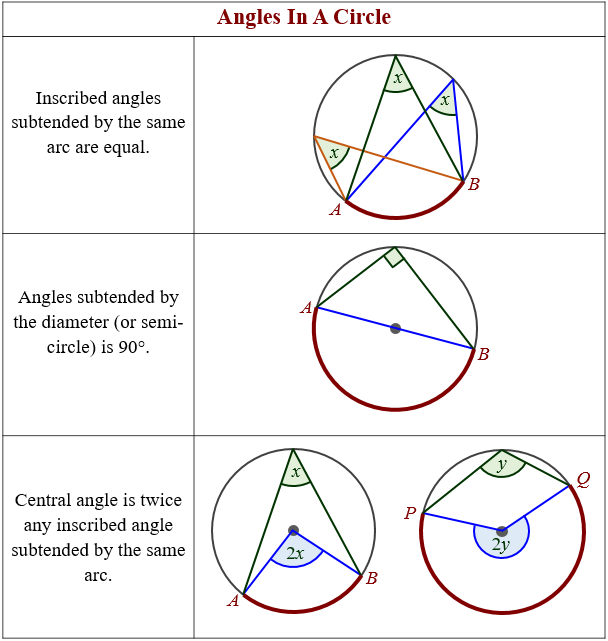
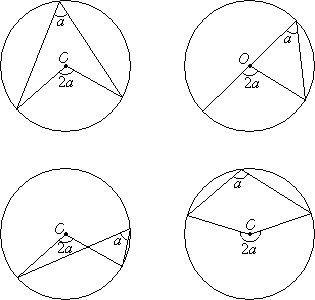
but circle angle properties are pretty useful for this problem
glossy root
tardy pollen
https://www.onlinemathlearning.com/angles-circle.html
Ohhh I get why BCD is 90 rn
For bad i still dont get it 😭
pearl pondBOT
@glossy root Has your question been resolved?
pearl pondBOT
Channel closed
Closed due to timeout
Use .reopen if this was a mistake.
Available help channel!
Send your question here to claim the channel.
Remember:
• Ask your math question in a clear, concise manner.
• Show your work, and if possible, explain where you are stuck.
• Do not immediately ping people or roles. After 15 minutes, feel free to ping <@&286206848099549185> once.
• Type the command .close to free the channel when you're done.
• Be polite and have a nice day!
Read #❓how-to-get-help for further information on how to ask a good question, and about conduct in the question channels.
 shut elm
\begin{proof}[Proof of \textbf{36}]
Let $\iota : \RR \to \CC$ be the identity mapping. This is a one-to-one function.

Let $f : \CC \to \RR$ be defined by representing the complex number $z$ as $x + yi$ and interleaving the digits of $x$ and $y$ (padding with 0's where necessary). $f$ is one-to-one as if $f(z_1) = f(z_2)$, then the digits of $x_1$ and $y_1$ match those of $x_2$ and $y_2$, respectively, so $z_1 = z_2$.

Therefore, by the Schr"oder-Bernstein Theorem, $|\CC| = |\RR|$.
\end{proof}

 pearl pondBOT
shut elm
```latex
\begin{proof}[Proof of \textbf{36}]
Let $\iota : \RR \to \CC$ be the id...
jolly parrotBOT
pearl pondBOT
shut elm
```latex
\begin{proof}[Proof of \textbf{36}]
Let $\iota : \RR \to \CC$ be the id...
jolly parrotBOT
Coolempire2026
 shut elm
Any comments on this proof
 waxen agate
blud
 rustic gate
you should probably define the map more precisely
waxen agate

rustic gate
this is reads like a trust me bro type of proof
waxen agate
decimal expansions are not unique
rustic gate
the age old 0.999... = 1
shut elm
Maybe I tried the wrong examples
Oh you can have infinite length decimals
Well I guess that's problematic
Discrete math is too hard 😩
So now I still have to come up with a one-to-one mapping from C to R
Okay
complex numbers ruin exponents for me
Why can't R have any irreducible numbers
waxen agate
bluds just yapping now
waxen agate
what's the idea
shut elm
I was gonna use the trick with primes that they gave for the integers
But there are no primes in the real numbers
i.e.
\begin{proof}[Proof of \textbf{36}]
Let $\iota : \RR \to \CC$ be the identity mapping. This is a one-to-one function.

Let $f : \CC \to \RR$ be defined by representing the complex number $z$ as $x + yi$ so that $f(z) = 2^x3^y$. $f$ is one-to-one as if $f(z_1) = f(z_2)$, then $2^{x_1}3^{y_1} = 2^{x_2}3^{y_2}$.

Therefore, by the Schr"oder-Bernstein Theorem, $|\CC| = |\RR|$.
\end{proof}

shut elm
This doesn't work
jolly parrotBOT
Coolempire2026
 rustic gate
erm
waxen agate
erm
shut elm
So I'm coming up with something new
shut elm
I'm sure it was fine given who suggested it but I can't figure out how to formalize it given your counterexample
Simple a1b1a2b2.a3b3a4b4 isn't enough
waxen agate
you simply need to enforce a canonical expansion
rustic gate
pick representatives
rustic gate
between 0.999... and 1, always choose 1
shut elm
Yeah but then 1 + 0i and 0.99... + i0.999... both map to the same number
1.0 and 1
Well 10 and 1? 🤔
rustic gate
erm what
waxen agate

rustic gate
you will always write 0.999... + i0.999... as 1 + 1i
this becomes 11 when interleaved
shut elm
Right
But that's different from 0.99999999999 when I interleave the first
Isn't it the case that for a well defined function
if a = b
then f(a) = f(b)?
shut elm
But those two are equal and 1 =/= 11
rustic gate
wdym
waxen agate
what is blud asking
shut elm
When you interleave those two numbers you get 11 and not 00.999...
Maybe I'm imagining the mapping wrong
rustic gate
we're not interleaving the 0.999... digits
we're interleaving the digits of 1
theyre the same number
you choose to use 1 over 0.999...
shut elm
You're allowed to do that?
rustic gate
theyre the same number
the function "interleave" or whatever you wish to call it is defined on the quantity 1 + 1i
not its abstract decimal representation
waxen agate
you’re just picking a canonical representative from an equivalence class that has size 1 or 2
shut elm
\begin{proof}[Proof of \textbf{36}]
Let $\iota : \RR \to \CC$ be the identity mapping. This is a one-to-one function.

Let $f : \CC \to \RR$ be defined by representing the complex number $z$ as $x + yi$ and interleaving the digits of $x$ and $y$ (padding with 0's where necessary and interpreting $a.9999$ as $a+1$ where appropriate). $f$ is one-to-one as if $f(z_1) = f(z_2)$, then the digits of $x_1$ and $y_1$ match those of $x_2$ and $y_2$, respectively, so $z_1 = z_2$.

Therefore, by the Schr"oder-Bernstein Theorem, $|\CC| = |\RR|$.
\end{proof}
Coolempire2026

 toxic lichen
waxen agate
you’re just picking a canonical representative from an equivalence class that ha...
toxic lichen
waxen agate
you’re just picking a canonical representative from an equivalence class that ha...
but that means we have to invoke ch*ice
rustic gate
0.099... = 0.1
waxen agate
toxic lichen
but that means we have to invoke ch*ice
it doesn't
shut elm
Oh I wondered where all the channels disappeared to
I clicked the close button
Okay where was I
I need to construct a choice function
rustic gate
blud is constructing the choice function
waxen agate

shut elm
\begin{proof}[Proof of \textbf{36}]
Let $\iota : \RR \to \CC$ be the identity mapping. This is a one-to-one function.

Let $f : \CC \to \RR$ be defined by representing the complex number $z$ as $x + yi$ and interleaving the digits of $x$ and $y$ (padding with 0's where necessary and excluding any members ending in an infinite string of 9's [as these can be represented by other members of the set]). $f$ is one-to-one as if $f(z_1) = f(z_2)$, then the digits of $x_1$ and $y_1$ match those of $x_2$ and $y_2$, respectively, because we have excluded duplicate members of $\CC$, so $z_1 = z_2$.

Therefore, by the Schr"oder-Bernstein Theorem, $|\CC| = |\RR|$.
\end{proof}
Coolempire2026
 shut elm
rustic gate
1 and 0.999... are the same element
shut elm
rustic gate
1 and 0.999... are the same element
Yes exactly!
0.99999 can be represented by the 1 element in the set
waxen agate
rustic gate
this phrase would suggest othewise
 shut elm
It's smart isn't it
Mmm maybe I can write it like
\begin{proof}[Proof of \textbf{36}]
Let $\iota : \RR \to \CC$ be the identity mapping. This is a one-to-one function.

Let $f : \CC \to \RR$ be defined by representing the complex number $z$ as $x + yi$ and interleaving the digits of $x$ and $y$ (padding with 0's where necessary and excluding any members ending in an infinite string of 9's [as these can be represented with another decimal expansion]). $f$ is one-to-one as if $f(z_1) = f(z_2)$, then the digits of $x_1$ and $y_1$ match those of $x_2$ and $y_2$, respectively, because we have chosen a single decimal expansion for every member of $\RR$, so $z_1 = z_2$.

Therefore, by the Schr"oder-Bernstein Theorem, $|\CC| = |\RR|$.
\end{proof}
Coolempire2026
 rustic gate
no, this wording still implies that you throw away 1
rustic gate
1 and 0.999.. are not distinct
shut elm
Right, just different decimal expansions of the same number
So we elect to use only one
Therefore the output is unique because now all the expansions are unique
(?)
rustic gate
that is also poor phrasing
waxen agate
rustic gate
you simply select a canonical decimal expansion out of all the choices
the canonical choice is unique
jolly parrotBOT

 Requested by coolempire93
shut elm
Requested by coolempire93
shut elm
Reduced to the simples and most significant form possible without loss of generality
But how does that specify that 1 is simpler than 0.999....
rustic gate
it doesn't mean anything
it just means you've made a choice and declared it the canonical one
rustic gate
the others are not canonical because you didn't choose them
shut elm
\begin{proof}[Proof of \textbf{36}]
Let $\iota : \RR \to \CC$ be the identity mapping. This is a one-to-one function.

Let $f : \CC \to \RR$ be defined by representing the complex number $z$ as $x + yi$, $x,y \in \RR$ and interleaving the digits of $x$ and $y$ (padding with 0's where necessary and choosing a canonical decimal expansion for those $x$ and $y$ with multiple). $f$ is one-to-one as if $f(z_1) = f(z_2)$, then the digits of $x_1$ and $y_1$ match those of $x_2$ and $y_2$, respectively, because we have chosen a single decimal expansion for every member of $\RR$, so $z_1 = z_2$.

Therefore, by the Schr"oder-Bernstein Theorem, $|\CC| = |\RR|$.
\end{proof}
Coolempire2026
 shut elm
So more like this?
rustic gate
well you don't just say canonical and call it a day
you have to describe what it is
"We choose each real number to have a canonical decimal expansion, being the one that does not end with recurring 9s."
waxen agate
shut elm
This feels like rigamarole but since it's an actual thing I'll need to write it down
This feels like when I learned about WLOG
waxen agate
rustic gate
"Now writing z = x + yi, where x = ...x_0.x_-1x_-2..., y = ...y_0.y_-1y_-2... are their canonical decimal expansions, we define f(z) = ...y_0x_0.y_-1x_-1..."
shut elm
Oh, so explicit
Okay my turn to bork it up
\begin{proof}[Proof of \textbf{36}]
Let $\iota : \RR \to \CC$ be the identity mapping. This is a one-to-one function.

Let $f : \CC \to \RR$ be defined by representing the complex number $z$ as $x + yi$, $x,y \in \RR$ and interleaving the digits of $x$ and $y$ (padding with 0's where necessary). More specifically, we choose each real number to have a canonical decimal expansion, that being the one not ending in an infinite string of 9's, so that for the canonical decimal expansions $x = \dots x_1x_0.x_{-1}x_{-2}\dots$ and $y = \dots y_1y_0.y_{-1}y_{-2}\dots$, $f(z) = \dots x_1y_1x_0y_0.x_{-1}y_{-1}x_{-2}y_{-2}\dots$.
Then $f$ is one-to-one because for $f(z) = f(z')$, we have $$\dots x_1y_1x_0y_0.x_{-1}y_{-1}x_{-2}y_{-2}\dots = \dots x_1'y_1'x_0'y_0'.x_{-1}'y_{-1}'x_{-2}'y_{-2}'\dots,$$ that is that $x$ and $x'$, $y$ and $y'$ have matching canonical decimal expansions, so $x = x'$, $y = y'$ and thus $z = z'$.

Therefore, by the Schr"oder-Bernstein Theorem, $|\CC| = |\RR|$.
\end{proof}
Coolempire2026
 rustic gate
alright but you also should justify why this implies each digit is the same

since we just spent the better half of an hour faffing over the fact that decimal expansions are not unique
shut elm
omg I didn't mean to keep you all that long 😭
I didn't expect it to turn out I was this unfit
Maybe I need a few more years of undergrad and not just a semester
In any case
Hm
Is it as simple as saying it can't end in a series of 9's on eithe rside there fore this expansion is canoncial
And thus we have our answer
rustic gate
essentially
you should also mumble something something finitely many digits on the left of the decimal point
shut elm
Are there no real numbers with infinitely many whole digits? (I should probably know this)
I thought maybe you could get away with countably many whole digits
waxen agate
your writing kinda suggests an infinite sequence of digits to the left
rustic gate
you're writing
shut elm
shut elm
I thought maybe you could get away with countably many whole digits
(So as a general matter of course this isn't possible?)
shut elm
\begin{proof}[Proof of \textbf{36}]
Let $\iota : \RR \to \CC$ be the mapping $\iota(x) = x$. This is a one-to-one function.

Let $f : \CC \to \RR$ be defined by representing the complex number $z$ as $x + yi$, $x,y \in \RR$ and interleaving the digits of $x$ and $y$ (padding with 0's where necessary). More specifically, we choose each real number to have a canonical decimal expansion, that being the one not ending in an infinite string of 9's, so that for the canonical decimal expansions $x = x_nx_{n-1} \dots x_1x_0.x_{-1}x_{-2}\dots$ and $y = y_ny_{n-1} \dots y_1y_0.y_{-1}y_{-2}\dots$, $f(z) = \dots x_1y_1x_0y_0.x_{-1}y_{-1}x_{-2}y_{-2}\dots$.
Then $f$ is one-to-one because for $f(z) = f(z')$, we have $$x_ny_nx_{n-1}y_{n-1} \dots x_1y_1x_0y_0.x_{-1}y_{-1}x_{-2}y_{-2}\dots = x_n'y_n'x_{n-1}'y_{n-1}' \dots x_1'y_1'x_0'y_0'.x_{-1}'y_{-1}'x_{-2}'y_{-2}'\dots.$$ Because we use the canonical decimal expansions of $x$, $x'$, $y$, and $y'$, neither side of this equation can end in an infinite string of 9's, so each side is a canonical decimal expansion, and thus $x = x'$, $y = y'$ and, finally, $z = z'$.

Therefore, by the Schr"oder-Bernstein Theorem, $|\CC| = |\RR|$.
\end{proof}
Coolempire2026
 shut elm
Did I make it too messy
rustic gate
not particularly
waxen agate
rustic gate
but why are the ns the same
waxen agate
yeah
shut elm
Because I padded with 0's
rustic gate
blud returned exactly when i returned
rustic gate
rustic gate
blald
shut elm
waxen agate
so just say that
So just leave what I said about it and remove the n
\begin{proof}[Proof of \textbf{36}]
Let $\iota : \RR \to \CC$ be the mapping $\iota(x) = x$. This is a one-to-one function.

Let $f : \CC \to \RR$ be defined by representing the complex number $z$ as $x + yi$, $x,y \in \RR$ and interleaving the digits of $x$ and $y$ (padding with 0's where necessary). More specifically, we choose each real number to have a canonical decimal expansion, that being the one not ending in an infinite string of 9's, so that for the canonical decimal expansions $x = \dots x_1x_0.x_{-1}x_{-2}\dots$ and $y = \dots y_1y_0.y_{-1}y_{-2}\dots$, $f(z) = \dots x_1y_1x_0y_0.x_{-1}y_{-1}x_{-2}y_{-2}\dots$, noting that the left side of the preceding as expansions are all finite.
Then $f$ is one-to-one because for $f(z) = f(z')$, we have $$ \dots x_1y_1x_0y_0.x_{-1}y_{-1}x_{-2}y_{-2}\dots = \dots x_1'y_1'x_0'y_0'.x_{-1}'y_{-1}'x_{-2}'y_{-2}'\dots.$$ Because we use the canonical decimal expansions of $x$, $x'$, $y$, and $y'$, neither side of this equation can end in an infinite string of 9's, so each side is a canonical decimal expansion, and thus $x = x'$, $y = y'$ and, finally, $z = z'$.

Therefore, by the Schr"oder-Bernstein Theorem, $|\CC| = |\RR|$.
\end{proof}
More like this
jolly parrotBOT
Coolempire2026
 waxen agate
it's probably a bit confusing to the grader as currently stated
i would just say
for k >= 0, we set x_k = 0 and y_k = 0 for sufficiently large k (padding the integer part with leading zeros)
jolly parrotBOT
Oléagineux Distilliànus VIVII
 shut elm
I need a save to dm button, so cleanly stated (save for the dots hanging off the page)
equality of the reals implies equality of their digit strings
Feels like something I'd read in a textbook and not understand it at all 😯
I'll save this to study
Thank you both 🙂
Sorry for taking like a full hour on a problem
shut elm
.close
pearl pondBOT
Channel closed
Closed by @shut elm
Use .reopen if this was a mistake.
 spiral pivot
shut elm
equality of the reals implies equality of their digit strings
spiral pivot
shut elm
equality of the reals implies equality of their digit strings
This is not true in the general case, there are real numbers with more than one representation, and these are precisely the terminating decimals.
i.e. 0.245 = 0.24500000... = 0.24499999...
Oh
My bad you mentioned this

shut elm
That's still interesting to me though
We only had to say canonical representation choosing the option not ending in 999999
But never said anything about the decimal representation 000000
Is this a mistake on their part or just an obviety?
spiral pivot
Well. If there are two ways of representing a particular number, and you disallow one way, then you allow the other way
shut elm
Yes but you've shown three ways
And we only eliminated one of those
We never specified that there should be no trailing 0's
spiral pivot
Oh, well for any real number we can pad to the left and right infinitely with zeroes
And these are just assumed to always be there
shut elm
Okay so it's treated like an obviety 👍
Thank you as well!
The mods here are very good
pearl pondBOT
Available help channel!
Send your question here to claim the channel.
Remember:
• Ask your math question in a clear, concise manner.
• Show your work, and if possible, explain where you are stuck.
• Do not immediately ping people or roles. After 15 minutes, feel free to ping <@&286206848099549185> once.
• Type the command .close to free the channel when you're done.
• Be polite and have a nice day!
Read #❓how-to-get-help for further information on how to ask a good question, and about conduct in the question channels.
 quasi estuary
Can someone explain the moseley's experiments ??
toxic lichen
sounds like physics and/or chemistry
tardy pollen
maybe more suitable for one of the other servers in the #old-network
waxen agate
quasi estuary
Can someone explain the moseley's experiments ??
the X-ray spectroscopy experiments?
quasi estuary
waxen agate
the X-ray spectroscopy experiments?
yep
waxen agate
hm what about it
quasi estuary
waxen agate
hm what about it
I just want to know what the experiment was
waxen agate
quasi estuary
I just want to know what the experiment was
What he did was essentially firing electrons at a metal target, and the collisions knocked out inner-shell electrons (mainly K-shell). When outer electrons dropped down to fill the hole, the atom emitted X-rays. Those X-rays had very specific wavelengths/frequencies. He then measured these X-ray frequencies for many elements. After plotting the datA, he discovered that the square root of the X-ray frequency increases linearly with an integer that matches the element’s position in the periodic table. This became known as Moseley's Law.
you can also just look it up on Google...
diamond$sq f propto (Z-1)$
jolly parrotBOT
Oléagineux Distilliànus VIVII
 waxen agate

quasi estuary
.close
pearl pondBOT
Channel closed
Closed by @quasi estuary
Use .reopen if this was a mistake.
waxen agate
likewise
pearl pondBOT
Available help channel!
Send your question here to claim the channel.
Remember:
• Ask your math question in a clear, concise manner.
• Show your work, and if possible, explain where you are stuck.
• Do not immediately ping people or roles. After 15 minutes, feel free to ping <@&286206848099549185> once.
• Type the command .close to free the channel when you're done.
• Be polite and have a nice day!
Read #❓how-to-get-help for further information on how to ask a good question, and about conduct in the question channels.
 zenith mural
 pearl pondBOT
zenith mural
zenith mural
pearl pondBOT
zenith mural
zenith mural
does anyone have suggestions on how I can get better at questions like this?
I'm taking an exam which has several of these sorts of puzzles
my answer was 19, cus 10+1+5+2+1, the answer was 17
toxic lichen
i think i've seen this exact question with these exact numbers somewhere.
zenith mural
oh what
toxic lichen
but i know of no general technique for this sort of crossing question.
zenith mural
might have been another student prepping for the same exam
zenith mural
toxic lichen
but i know of no general technique for this sort of crossing question.
just brain teasers n sorts
toxic lichen
zenith mural
oh what
it was dressed up in a different story, but the individual crossing times were still 1, 2, 5, 10
zenith mural
oh wait i'd love to know the source
toxic lichen
the idea here is to minimize the time "wasted" by the slow people by having them both cross together
idk the source tbh but i saw it on ted-ed
 patent yew
zenith mural
does anyone have suggestions on how I can get better at questions like this?
patent yew
zenith mural
does anyone have suggestions on how I can get better at questions like this?
if it's brain teasers in general that you want more practice with
the green book for quant is full of a lot of well-known and not-so-well-known brain teasers
ted ed also has a lot of riddle videos that are grounded usually in some level of logic or math
zenith mural
patent yew
the green book for quant is full of a lot of well-known and not-so-well-known br...
where can I find this?
patent yew
zenith mural
where can I find this?
if you search up "green book quant" it should be the first link
 covert fable
toxic lichen
i think i've seen _this exact question_ with _these exact numbers_ somewhere.
covert fable
toxic lichen
i think i've seen _this exact question_ with _these exact numbers_ somewhere.
Same with me, I even remember the answer was 17 too
patent yew
it's an open access to a pdf book and the first portion of chapter is brain teasers that are math-based
patent yew
my roommate is doing/trying to do quant this is the only reason i know abt it
zenith mural
lol no this looks really viable i can see them adding questions like these in the exam
thanks
patent yew
np and best of luck!
covert fable
zenith mural
my answer was 19, cus 10+1+5+2+1, the answer was 17
2+1+10+2+2=17
toxic lichen
so the basic idea is that bc the umbrella has to be carried, you need to have 2 ppl go home and then 1 person return with the umbrella back to the stop
at a time
so like, 2 there -> 1 back -> 2 there -> 1 back -> 2 there
zenith mural
just in case

anything for this etc?
because the time we have for the exam, i feel like it's highly unlikely to solve this without already having done something somewhat similar
zenith mural
toxic lichen
so like, 2 there -> 1 back -> 2 there -> 1 back -> 2 there
yeah got it
covert fable
zenith mural
Son+daughter->. 2mins
Daughter<- 1min
Father+grandfather-> 10mins
Son<- 2mins
Son+daughter-> 2mins
pearl pondBOT
@zenith mural Has your question been resolved?
pearl pondBOT
Channel closed
Closed due to timeout
Use .reopen if this was a mistake.
Available help channel!
Send your question here to claim the channel.
Remember:
• Ask your math question in a clear, concise manner.
• Show your work, and if possible, explain where you are stuck.
• Do not immediately ping people or roles. After 15 minutes, feel free to ping <@&286206848099549185> once.
• Type the command .close to free the channel when you're done.
• Be polite and have a nice day!
Read #❓how-to-get-help for further information on how to ask a good question, and about conduct in the question channels.
bronze heath
zenith mural
just in case
dis is bruteforce
 pearl pondBOT
bronze heath
dis is bruteforce
toxic lichen
pearl pondBOT
bronze heath
dis is bruteforce
toxic lichen
can you prove that it's impossible to do better?
bronze heath
toxic lichen
can you prove that it's impossible to do better?
no
i feel
by area max would be 9, 36/4
so if some squares remain after fitting 8 then it's 4 i don't feel this can be put better
 naive zinc
You can prove it I think. Coloring the grid with two colors 0 and 1, this shape can cover two 0 and two 1
0 and 1 can’t be adjacent in the coloring I meant
The only better situation comes when the whole grid is titled, which you need to prove it’s impossible
bronze heath
naive zinc
You can prove it I think. Coloring the grid with two colors 0 and 1, this shape ...
hm..
can you show
naive zinc
Or coloring with 4 colors might help

This shape can cover exactly 0,1,2,3
I am only providing a thought. I haven’t formulated a proof
If it’s titled with that shape, then 9 that shapes, each 0/1/2/3 is contained in exactly one of those 9
I think it’s done:

Each corner you can only have the blue or the red. Then all four corners must be all red or all blue. Then edge will cause having not enough room
(Four edges having four T shapes, that can’t be titled
pearl pondBOT
@bronze heath Has your question been resolved?
Channel closed
Closed by @bronze heath
Use .reopen if this was a mistake.
Available help channel!
Send your question here to claim the channel.
Remember:
• Ask your math question in a clear, concise manner.
• Show your work, and if possible, explain where you are stuck.
• Do not immediately ping people or roles. After 15 minutes, feel free to ping <@&286206848099549185> once.
• Type the command .close to free the channel when you're done.
• Be polite and have a nice day!
Read #❓how-to-get-help for further information on how to ask a good question, and about conduct in the question channels.
 abstract pagoda
Yo
I need help to show that
Every subgroup of (\mathbb{Z}, +) is of the form n\mathbb{Z} for some integer n \ge 0.
pearl pondBOT
abstract pagoda
Yo
I need help to show that
Every subgroup of (\mathbb{Z}, +) is of the form n\m...
tropic saddle
consider the smallest positive number in the subgroup
abstract pagoda
Then?
tropic saddle
think about it and take your time
abstract pagoda
n=min{x in H | h > 0}
abstract pagoda
tropic saddle
think about it and take your time
Need more hints
 rustic atlas
what happens when a non-multiple of n is in H?
abstract pagoda
H is not sub group
rustic atlas
why
abstract pagoda
rustic atlas
if there is a non multiple of n
Oh
naive zinc
Do Euclidean division, by definition of “minimal”, you can’t have a smaller positive integer in H.
abstract pagoda
tropic saddle
what would happen if 17 was in H
Uhhh
abstract pagoda
naive zinc
Do Euclidean division, by definition of “minimal”, you can’t have a smaller posi...
Why we can’t
naive zinc
You said “minimal”
tropic saddle
ok lets go back a step
abstract pagoda
Yes H can contains minimal pos element?
abstract pagoda
Add them together
tropic saddle
shut up
abstract pagoda
We cant get it
tropic saddle
that doesnt mean its not there
we have it from the start
we started with the building block 4
so its there
tropic saddle
why
abstract pagoda
Intuition
tropic saddle
forget your intuition
you are at a stage of learning where it will tell you lots of bullshit
tropic saddle
so we started with the numbers 4 and 17
which were in H
and we got some new numbers
which are also in H
tropic saddle
among them is 3
tropic saddle
yes
abstract pagoda
It cant be
tropic saddle
why
abstract pagoda
2
abstract pagoda
Same
tropic saddle
can 401 be in H?
abstract pagoda
3 be the min
tropic saddle
ok so we can now prove that if the minimal positive number in H is 4, then only numbers of the form 4k are in H
yes?
abstract pagoda
Okay
abstract pagoda
Right
tropic saddle
so now suppose the smallest positive number in H is n
can you show that all elements of H are multiples of n?
naive zinc
Euclidean division
abstract pagoda
x in H => x=nk + r
0<=r<n
abstract pagoda
x=r
tropic saddle
its correct but stylistically a bit weird. x=kn+r is not because x is in H
its just a true statement either way
you cant choose k
abstract pagoda
tropic saddle
its correct but stylistically a bit weird. x=kn+r is not *because* x is in H
Please dont let me overthink im fucking tired
tropic saddle
x=17
naive zinc
0<=r<n
tropic saddle
x=4*4+1
tropic saddle
yes
naive zinc
0<=r<n, if r>0, … … contradiction
abstract pagoda
tropic saddle
its correct but stylistically a bit weird. x=kn+r is not *because* x is in H
Wdym?
We can said
x in H => x=nk+r
For some k in Z
And 0<=r<n
naive zinc
P->Q, while Q is true any way, so you don’t need P->Q
abstract pagoda
What you mean by saying Q is true?
naive zinc
We usually don’t add steps that are irrelevant
Euclidean division is true for all integers, not true only for elements in some H
abstract pagoda
naive zinc
We usually don’t add steps that are irrelevant
But its correct or not?
naive zinc
If you insist, keep it.
abstract pagoda
Look
naive zinc
It’s just people usually don’t do things like this, but technically you are right
abstract pagoda
To show H=nZ
We need to take an arbitrary x in H
Then show that x=nk
nk in nZ
H contained in nZ
tropic saddle
the statement that x=nk+r itself doesnt have anything to do with x being in H
abstract pagoda
And show nZ contained in H too
tropic saddle
that also applies to numbers that arent in H
abstract pagoda
abstract pagoda
And show nZ contained in H too
Take arbitrary x from nZ
naive zinc
For any x in H, let x=kn+r with 0<=r<n
For any x in H, ->x=kn+r with 0<=r<n
Both are correct. It’s just people usually don’t add an unnecessary-> as the latter version
abstract pagoda
abstract pagoda
Take arbitrary x from nZ
We get the same result
naive zinc
That’s why I said you can keep it if you insist
abstract pagoda
naive zinc
That’s why I said you can keep it if you insist
Tbh
I noticed that the community of this server hates the use of logic symbols
Not only in this server
Even my prof
naive zinc
I have no objection with formality. It’s just that we tend to not add irrelevant things
tropic saddle
this is not about the logic symbol
abstract pagoda
naive zinc
I have no objection with formality. It’s just that we tend to not add irrelevant...
I think that each person and his way of thinking and his use of symbols
naive zinc
x in H doesn’t imply x=kn+r for some k, r in Z and 0<=r<n
abstract pagoda
naive zinc
x in H doesn’t imply x=kn+r for some k, r in Z and 0<=r<n
Why not lol
tropic saddle
x=kn+r anyway
whether x is in H or not
H doesnt have anything to do with writing x like that
I can write 41=4*10+1 without knowing whether 41 is in H or not
naive zinc
We don’t say useless facts. Like we also have one fact: a false statement implies any statement. It’s useless, so we don’t normally mention it when proving anything
abstract pagoda
tropic saddle
I can write 41=4*10+1 without knowing whether 41 is in H or not
Oh
What about equivalent then
It work i think
tropic saddle
equivalence is even stronger than implication
thats not better
look, forget about it
it doesnt matter much
tropic saddle
its not wrong. its just bad style
but thats ok
you are just learning proofs
you dont need to have a good style immediately
naive zinc
You don’t need to worry about these in algebra. That’s why I like algebra more than analysis. In algebra there are lots of equivalent conditions. Replacing one with another one won’t cause any damage. While in analysis we often need techniques, to know when to make the restraints stronger (it suffices to show that…) and when to make the restraints weaker (then it must satisfy…)
tropic saddle
ehhhh
naive zinc
Replying to him I was
tropic saddle
sure. still not sure I'm agreeing with that statement
abstract pagoda
naive zinc
You don’t need to worry about these in algebra. That’s why I like algebra more t...
Analysis
Is nightmare specially to logicians
naive zinc
you said one thing right, be rigorous in your proof.
0<=r not 0<r, what exactly caused the contradiction, what implies what
pearl pondBOT
@abstract pagoda Has your question been resolved?
Channel closed
Closed by @abstract pagoda
Use .reopen if this was a mistake.
Available help channel!
Send your question here to claim the channel.
Remember:
• Ask your math question in a clear, concise manner.
• Show your work, and if possible, explain where you are stuck.
• Do not immediately ping people or roles. After 15 minutes, feel free to ping <@&286206848099549185> once.
• Type the command .close to free the channel when you're done.
• Be polite and have a nice day!
Read #❓how-to-get-help for further information on how to ask a good question, and about conduct in the question channels.
 meager scroll
elastic collision find the distance between the first point and the second point of collision in relation to φ,h
 pearl pondBOT
meager scroll
elastic collision find the distance between the first point and the second point...
meager scroll
pearl pondBOT
meager scroll
elastic collision find the distance between the first point and the second point...
meager scroll
anyone know what mistake i made?
supposed to be 2hsin(4φ) i think so i should have cos(2φ)
 uneven cypress
Summarise what you did please. Sorry i cant make out whatever is written
@meager scroll
meager scroll
uneven cypress
Summarise what you did please. Sorry i cant make out whatever is written
well the |u| stays the same its direction after collision has angle 2φ with h
then i use ay= -g to find x,y in relation to time
uneven cypress
In such problems, it helps to transform your axes but ok
meager scroll
at the point where Δy/Δx = tanφ we have the second collision
meager scroll
uneven cypress
In such problems, it helps to transform your axes but ok
well i did that to show that the angle is 2φ
because momentum on the pararell axis is conserved
but for the equations of position its not much better
uneven cypress
Parallel to what?
meager scroll
uneven cypress
Parallel to what?
floor
anyways the angle is 2φ
thats for sure
doesnt matter how its found
uneven cypress
meager scroll
floor
Okay. We call that the common tangent
meager scroll
but integrating ay= -g and ax=0
uneven cypress
Why integrate for constant accn?
meager scroll
with initial conditions ux = - uosin(2φ) ,uy = -uocos(2φ)
meager scroll
uneven cypress
Why integrate for constant accn?
constant functions are integrable
wdym whats the issue
uneven cypress
I know that but it is not necessary. Continue
meager scroll
well maybe in your class it isnt like they take this as theory
and you get
Δx= uo sin(2φ) t, Δy=uo cos(2φ)t-gt^2 /2
Δx = 2uo /g (-cos(2φ)sin(2φ) - sin^2 ( 2φ) tanφ)
if you eliminate time
uneven cypress
It would be helpful if you reasoned these things because. Anyways, you switched the velocities along the common normal righ? And then you have to find the coordinates at which the trajectory intersects the slope
It is best to transform your axes here for it simplifies your problem solving process
meager scroll
x,y axis
cartesian
Δx = 2uo /g (-cos(2φ)sin(2φ) - sin^2 ( 2φ) tanφ)
you get this because Δy/Δx = tanφ
at the point of second collision
uneven cypress
I meant consider a x' and y' axis after rotating by phi clockwise
meager scroll
so we found the Δx for the second collision
meager scroll
uneven cypress
I meant consider a x' and y' axis after rotating by phi clockwise
well i did not do that im trying to examine this solution first
i ccan check the other way afterwards
anyways if you put t = Δx/uo sin(2φ)
in Δy