#help-39
1 messages · Page 265 of 1
 midnight haven
 compact ridge
midnight haven
so. Apent = 135.471
compact ridge
midnight haven
so. Apent = 135.471
still incorrect
midnight haven
oh
shi
uh im not too sure where ive gone wrong tbf
ok i went back and got radius, i got 110.11..
so i didnt do r^2 right
thats wat it was
compact ridge
midnight haven
ok i went back and got radius, i got 110.11..
great, now that's correct
compact ridge
okay, now rearrange for pi (small radius)^2
midnight haven
so i have 110.11 - 1/2 * pi *r^2 = pi(smallr)^2
what do i use for r on LHS?
4/sin32?
nope that gave me 20.6...
compact ridge
midnight haven
4/sin32?
4/sin(36)
compact ridge
if you do everything right, you should get the bottom value as the radius of the smaller circle
midnight haven
kk ill try retype into calc
asdaluhdasd somethings going wrong
i have r^2 to be 46.31...
so 1/2 * pi * ans should equal area of OED
compact ridge
,w (4/sin(36 deg))^2
 jolly parrotBOT


 midnight haven
so now
compact ridge
midnight haven
so i have 110.11 - 1/2 * pi *r^2 = pi(smallr)^2
so now you need to find the LHS
compact ridge
midnight haven
i cant remember..
from 5 * 1/2 r^2 sin(72)
jolly parrotBOT

 midnight haven
..
compact ridge
midnight haven
,w 5 * 1/2 * pi * (4/sin(36 deg))^2 * sin(72 deg)
there's no pi for the triangles
jolly parrotBOT
 midnight haven
ok cool so
now
,w sqrt((5 * 1/2 * (4/sin(36 deg))^2 * sin(72 deg)) - (1/2 * pi * (4/sin(36 deg)^2)/pi)
jolly parrotBOT
 midnight haven
ok so thats not it
compact ridge
no
midnight haven
the pi in wrong place
compact ridge
110.11 - 1/2 * pi *r^2 first
midnight haven
,w sqrt(((5 * 1/2 * (4/sin(36 deg))^2 * sin(72 deg)) - (1/2 * pi * (4/sin(36 deg)^2))/pi)
jolly parrotBOT
 compact ridge
yeah so you need to divide that entire thing by pi
midnight haven
compact ridge
110.11 - 1/2 * pi *r^2 first
wont i need to redo it to get the ans tho
ilke to use for next stage
compact ridge
midnight haven
wont i need to redo it to get the ans tho
it's easier if you calculate that first
jolly parrotBOT
 midnight haven
,w (5 * 1/2 * (4/sin(36 deg))^2 * sin(72 deg) )- (1/2 * pi * (4/sin(36 deg))^2)
jolly parrotBOT
 compact ridge
midnight haven
,w 5 * 1/2 * (4/sin(36 deg))^2 * sin(72 deg) - (1/2 * pi * 4/sin(36 deg)^2)
compact ridge
midnight haven
,w 5 * 1/2 * (4/sin(36 deg))^2 * sin(72 deg) - (1/2 * pi * 4/sin(36 deg)^2)
nope, you didn't subtract 1/2 pi r^2
okay now that's better
midnight haven
trial and error lol
compact ridge
jolly parrot
,w sqrt(37.36566/pi)
jolly parrotBOT

 pearl pondBOT
Channel closed
Closed by @compact ridge
Use .reopen if this was a mistake.
pearl pondBOT
 Available help channel!
Send your question here to claim the channel.
Remember:
• Ask your math question in a clear, concise manner.
• Show your work, and if possible, explain where you are stuck.
• Do not immediately ping people or roles. After 15 minutes, feel free to ping <@&286206848099549185> once.
• Type the command .close to free the channel when you're done.
• Be polite and have a nice day!
Read #❓how-to-get-help for further information on how to ask a good question, and about conduct in the question channels.
 fathom plank
how would you go about calculating the chances of two populations being from the same distribution?
pearl pondBOT
fathom plank
how would you go about calculating the chances of two populations being from the...
fathom plank
this isnt for homework, just something im curious about
pearl pondBOT
@fathom plank Has your question been resolved?
 floral canyon
Maybe ask that in the discussion channel since it isn't a specific problem?
 autumn fossil
fathom plank
how would you go about calculating the chances of two populations being from the...
autumn fossil
fathom plank
how would you go about calculating the chances of two populations being from the...
can u explain what exactly do u mean?
 tender egret
pearl pondBOT
tender egret
pearl pondBOT
Channel closed
Closed due to timeout
Use .reopen if this was a mistake.
Available help channel!
Send your question here to claim the channel.
Remember:
• Ask your math question in a clear, concise manner.
• Show your work, and if possible, explain where you are stuck.
• Do not immediately ping people or roles. After 15 minutes, feel free to ping <@&286206848099549185> once.
• Type the command .close to free the channel when you're done.
• Be polite and have a nice day!
Read #❓how-to-get-help for further information on how to ask a good question, and about conduct in the question channels.
 kindred vine
My solution for 2) is different from the official one. I tried it by writing:
((A->B) AND (B->C) AND not(A->C) | (A->B) AND (B->C) |= (A->C)
<=> (A->C) AND not(A->C)
And this is unsatisfiable and hence not a tautology.
is this a valid proof or is it informal to just rewrite (A->B) AND (B->C) to A->C ?

 pearl pondBOT
kindred vine
My solution for 2) is different from the official one. I tried it by writing:
((...
pearl pondBOT
kindred vine
My solution for 2) is different from the official one. I tried it by writing:
((...
@kindred vine Has your question been resolved?
kindred vine
<@&286206848099549185>
 sly garden
lemme give this a lookover
i think it works but you need to spell out the logic behind $(A \rightarrow B) \land (B \rightarrow C) \therefore (A \rightarrow B)$
jolly parrotBOT
Mirror
 sly garden
in effect you're doing the same logical steps, but you need to spell out why the propositions are logically equivalent
pearl pondBOT
Channel closed
Closed by @kindred vine
Use .reopen if this was a mistake.
pearl pondBOT
Available help channel!
Send your question here to claim the channel.
Remember:
• Ask your math question in a clear, concise manner.
• Show your work, and if possible, explain where you are stuck.
• Do not immediately ping people or roles. After 15 minutes, feel free to ping <@&286206848099549185> once.
• Type the command .close to free the channel when you're done.
• Be polite and have a nice day!
Read #❓how-to-get-help for further information on how to ask a good question, and about conduct in the question channels.
 spring nebula
Need help with finding asymptotes
pearl pondBOT
spring nebula
Need help with finding asymptotes
spring nebula
I need to find and sketch all asymptotes of this function

And i don't know how to start 🙁
 spare lark
Which one you want to do first, horizontal, vertical or slant
spring nebula
The horizontal
spare lark
Ok how do you know the horizontal asymptote?
spring nebula
No :/
spare lark
horizontal is y = a when lim x -> +inf f(x) = a
Symetricaly for -inf
Is there any horizontal asymptote here ?
if yes what are the equations of horizontal asymptote
spring nebula
I kinda don't know because we haven't even started learning about limits and asymptotes and my professor just put this on my seminar work
 chrome plank
it doesn't have a horizontal asymtote.
it has a vertical, and a slanted
spring nebula
chrome plank
it doesn't have a horizontal asymtote.
it has a vertical, and a slanted
How did you find out that it doesn't have a horizontal?
chrome plank
Do polynomial long division, and you get the following where $Q$ and $R$ are respectively the quotient and remainder.
$$f(x) = \frac{A(x)}{B(x)} = Q(x) + \frac{R(x)}{B(x)}$$
As $x \rightarrow \infty$ we see $f(x)$ looks like $Q(x)$ because $R(x) / B(x)$ goes to zero.
jolly parrotBOT
Shuba
 chrome plank
So Q describes the slanted asymtote, and B describes the vertical asymtote.
Hopefully I've not given too much away
spring nebula
I kinda don't understand sorry 😄
chrome plank
Or you can plot it and visually see the asymptote is slanted.
 spring nebula
So a function can only have one type of asymptote?
It can only be horizontal, vertical or slanted?
chrome plank
The asymtotes can be veertical, horizontal, or slanted. And functions can have multiple asymtotes of different types
chrome plank
spring nebula
It can only be horizontal, vertical or slanted?
they can be either.
For example, your function has two asymtotes - one vertical, and one slanted
spring nebula
Ohh so this one doesn't have a horizontal but only vertical and slanted?
chrome plank
For example, have a look at this one. This function has a vertical and a horizontal asymtote.

 chrome plank
This function has two vertical asymtotes, and one horizontal

Do you know what an asymtote means?
spring nebula
Not really
chrome plank
It means "which straight line does the function look like as x or y becomes very large"
spring nebula
It's like a form of visualization?
chrome plank
So take y = (x+1)/(x-2) for example. As x -> 2 we see the denominator goes to zero so the entire function becomes very large. That means there's an asymtote at x = 2.
Which means, "as we let y become very large, the function looks like x = 2"
But with your example, the numerator is a polynomial of a larger degree, so we can reveal another asymtote using long division.
spring nebula
So how would you depict that it has no horizontal asymptote?
I need to write it for my assignment and I don't really know how to
chrome plank
Take this function as another example. I would say "the function has a vertical asymtote at x=2 and a slanted asymtote at y=x-2"

We do long division to get $$\frac{x^2-3}{x+2} = (x-2) + \frac{1}{x+2}$$ Now when $x \rightarrow \infty$, we see the fraction go to zero which gives us the slanted asymtote $y = x - 2$ (the quotient), and when $x \rightarrow -2$ we see the entire function go to $\infty$ giving the vertical asymtote $x = -2$.
jolly parrotBOT
Shuba
 spring nebula
Oh right
spring nebula
spring nebula
Oh right
Is that for this one?
chrome plank
That's for my example. I can't do your particular problem for you (rules of the server XD)
It's all about looking for when either x or y go very large
spring nebula
Oh right sorry
chrome plank
Let me know if you want more help on your example 🙂
spring nebula
I think it's fine like this thank you 🙂
I don't really understand how to do it but I'll try it somehow
chrome plank
This is a good polynomial long-division video.
https://www.youtube.com/watch?v=_FSXJmESFmQ
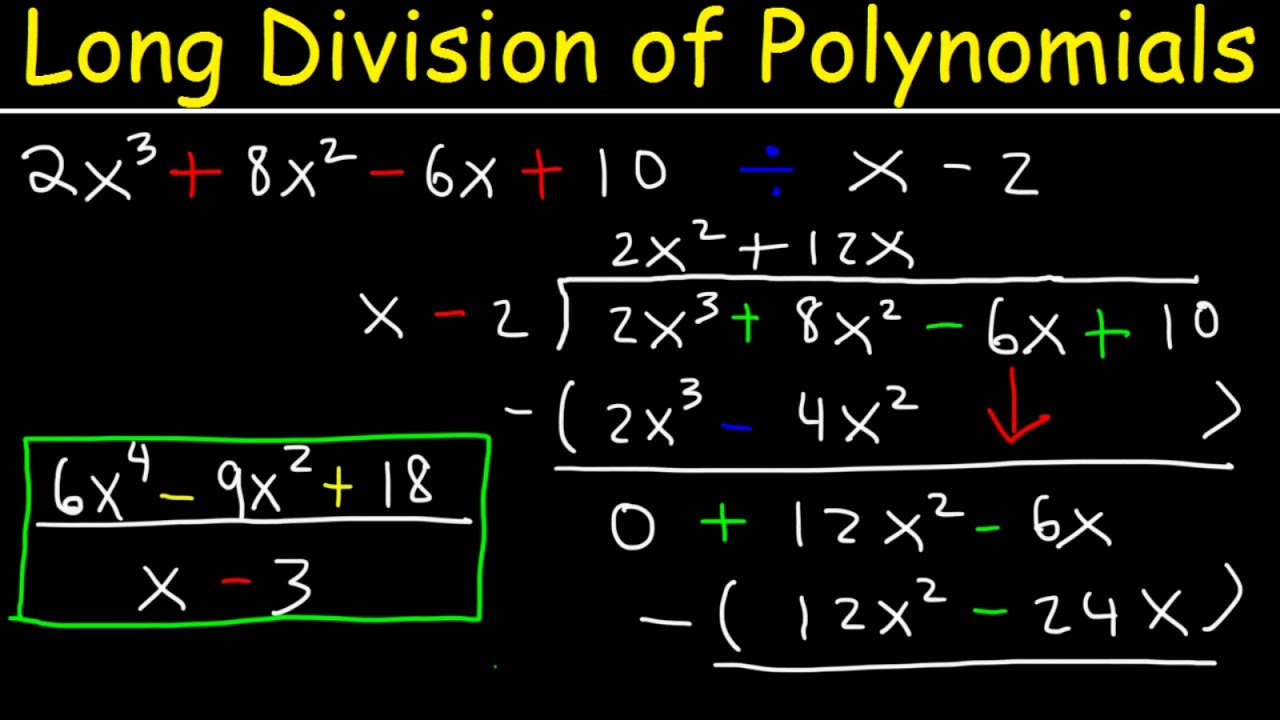
This video tutorial explains how to perform long division of polynomials with remainder and with missing terms.
Algebra Review: https://www.youtube.com/watch?v=i6sbjtJjJ-A
Join My Newsletter:
https://bit.ly/4jUXp6M
Algebra - Free Formula Sheets:
https://www.video-tutor.net/formula-sheets.html...
pearl pondBOT
@spring nebula Has your question been resolved?
Channel closed
Closed by @spring nebula
Use .reopen if this was a mistake.
pearl pondBOT
Available help channel!
Send your question here to claim the channel.
Remember:
• Ask your math question in a clear, concise manner.
• Show your work, and if possible, explain where you are stuck.
• Do not immediately ping people or roles. After 15 minutes, feel free to ping <@&286206848099549185> once.
• Type the command .close to free the channel when you're done.
• Be polite and have a nice day!
Read #❓how-to-get-help for further information on how to ask a good question, and about conduct in the question channels.
 blazing quartz
hi
pearl pondBOT
blazing quartz
hi

 strange fox
this is a similar triangles thing
wow i am procrastinating a lot
anyways the big triangle is just height 24 and base w + l
strange fox
small is the height of 6 with base just l
 strange fox
and you just gotta keep in mind they are similar
so what do you know about similar triangles now that you have the height and base of each the big and small triangle
blazing quartz
4
 strange fox
i feel like you might be overcomplicating this
strange fox
lets step back for a second
blazing quartz
sure
strange fox
w = the distance from the lamp to the woman (aka how far she has walked)
strange fox
and l = the length of the shadow
blazing quartz
l = length of shadow
strange fox
our goal is to look for dl/dt
strange fox
there will be 2 triangles
blazing quartz
yes
strange fox
1 larger one and a smaller one within that larger triangle
blazing quartz
yes
strange fox
meaning they are similar
strange fox
the larger one will have a height of 24 and the base will be the total distance which is w + l
blazing quartz
yes
strange fox
the smaller triangle has a height of 6 and only has the length of the shadow which is l
blazing quartz
yes
strange fox
we know that the ratio between the height and the base of a right triangle for similar triangles is the same
blazing quartz
yes
strange fox
therefore we can setup the equation:
big height / big base = small height / small base
we know big height is 24
we know small height is 6
we know big base is w + l
blazing quartz
24/w + l = 6/l
strange fox
we know small is l
strange fox
well it just becomes:
24 / (w + l) = 24 / 4l
so it simplifies a lot faster\
cause you got 24 on the top and bottom
so denominators must be equal
so w + l = 4l
then just isolate w
blazing quartz
(4 * 6 ) / 18 = dl/dt
blazing quartz
4/3
blazing quartz
bruh what
strange fox
what?
blazing quartz
that was simple
strange fox
yes
blazing quartz
im confused what i did wrong originally
strange fox
honestly im not sure what you were doing
the best process to these types of problems is to methodically go step by step
list out what is known
what is constant
and what is the goal
then use what you know to setup some sort of relationship/equation
and simplify and solve
strange fox
usually when they give you something weird they want you to use a property of that thing
like with similar triangles in this case it is known that the ratio between the height and base for both are the same
strange fox
well thats kind of missing the point
blazing quartz
wdym
strange fox
you just gotta use properties that are well known from different areas to apply to whatever the problem is seemingly asking
plus i dont think there is anything else with similar triangles
for ap calc
the most common ones are similar triangles exactly like how this one was, filling up or letting out liquid from a specific shape of a container, and pythag is used a lot
all of them use basic stuff usually like what is the equation for the volume of a sphere or something
and you just gotta use that to relate things, derive, and solve
pearl pondBOT
@blazing quartz Has your question been resolved?
pearl pondBOT
Channel closed
Closed due to timeout
Use .reopen if this was a mistake.
Available help channel!
Send your question here to claim the channel.
Remember:
• Ask your math question in a clear, concise manner.
• Show your work, and if possible, explain where you are stuck.
• Do not immediately ping people or roles. After 15 minutes, feel free to ping <@&286206848099549185> once.
• Type the command .close to free the channel when you're done.
• Be polite and have a nice day!
Read #❓how-to-get-help for further information on how to ask a good question, and about conduct in the question channels.
 random lintel
Brooo I’m sorry yall this has me drawing a blank
 random lintel
Idk how I’m supposed to know the dedicate graph without it showing
I meant derivative
 leaden wadi
Is that a test?
strange fox
leaden wadi
Is that a test?
its not she explained this previously its a take home thing
allegedly
strange fox
random lintel
Idk how I’m supposed to know the dedicate graph without it showing
what is another way to say derivative
a synonym
blazing quartz
random lintel
Brooo I’m sorry yall this has me drawing a blank
when f’(x) = 0 what does that mean abt the graph of the function at point x
random lintel
Idk does it mean it’s flat
I don’t know
I think another way to say derivative is rate of change
But don’t quote me
strange fox
well you just asnwered yourself
rate of change is the same as slope and is the same as derivative
a slope of 0 just means flat ground as you said
so where does it look flat / unchanging
random lintel
In the middle
strange fox
correct
random lintel
So at x=0?
strange fox
correct
strange fox
positive is above the line y = 0, increasing is going up aka derivative is positive
strange fox
youre doing b right?
it is asking where f prime of x is positive
aka derivative of f(x)
what do you know about a positive derivative?
random lintel
Uhh
strange fox
(aka positive slope, aka positive rate of change)
random lintel
It goes upwards
strange fox
correct
so the question is asking you exactly that
at which intervals is the function f(x) going upwards (aka derivative of f(x) is positive)
strange fox
what about the distance between -3 and -2 makes you think that isnt a positive slope>?
random lintel
Nuh uh im looking at it right now it’s literally open space

 random lintel
Here is proof
 strange fox
why only stop at x = -3 from -6 instead of going all the way to -2?
 vapid imp
hello
random lintel
Is it -6,-2 -2,2
vapid imp
sorry to bother but i kinda have a quick question
strange fox
first half is correct
strange fox
vapid imp
sorry to bother but i kinda have a quick question
if its quick then ask it
strange fox
random lintel
Is it -6,-2 -2,2
what makes you think -2,0 has a positive slope?
vapid imp
okk.. can you guys graph sinusoidal functions
strange fox

Desmos
vapid imp
with degree not radians
vapid imp
strange fox
https://www.desmos.com/calculator
bro
random lintel
Cause it’s the whole line I think
vapid imp
i need steps
random lintel
It goes up at the end
strange fox
 strange fox
random lintel
Cause it’s the whole line I think
strange fox
random lintel
Cause it’s the whole line I think
it doesnt have to be
pearl pondBOT
vapid imp
sorry to bother but i kinda have a quick question
Someone else is already using this help channel. If you need help with a question, please open your own help channel/thread (see #❓how-to-get-help for instructions).
strange fox
a function is just a bunch of points, an interval is just defining a starting and ending bounds
random lintel
K so -6,-2 0,3
strange fox
correct
strange fox
there is a difference between positive and increasing
as i said positive is only saying that the function itself has to be above y=0
and increasing is saying that the DERIVATIVE of that function has to be above y=0
random lintel
Idek
strange fox
meaning this C is asking you where the derivative of f'(x) is positive
we already know that a positive f'(x) is saying that the slope is positive
a positive f''(x) (which is the 2nd derivative of f(x) aka the derivative of f'(x)) would just mean the slope's slope is positive
essentially that means the slope is increasing
so where in the graph do you see a slope that is increasing in value
strange fox
B was looking for f'(x) to just be positive
C is looking for f'(x) to be INCREASING
B was looking for a slope greater than 0 across f(x)
C is looking for a slope's slope to be greater than 0 across f(x), essentially asking for a slope that gets greater and greater in magnitude in the positive direction
strange fox
indeed
strange fox
what makes you think that portion has the slope increasing in value along it
random lintel
Is it -2,0
strange fox
that is part of it
alright look at this

tell me which slope is higher in magnitude
random lintel
B
strange fox
correct
what the second derivative (f''(x)) is saying is we want that to be happening
where the slope increases
so lets look at this visually
random lintel
-5,-3
strange fox

take each one of these red lines as the derivative (slope) at a point
what intervals do you see consecutive patterns of A and B where A's slope is less than the slope of B
random lintel
The left side has a steep slope
strange fox
intervals, im asking for intervals in which the pattern occurs across
where the slope gets more and more steep
strange fox
it is not asking if it is super steep or not, it is simply asking if the steepness is increasing
 barren swift
random lintel
-6 is not super stew
barren swift
random lintel
-6 is not super stew
If it isn't straight its steeped
 strange fox
ah i just realized i shouldnt have used the word steep
random lintel
Why not
strange fox
youll get it
random lintel
-6,-4 0,3?????????
strange fox
incorrect
random lintel
Bro how
strange fox
what makes you think from A to B the slope isnt increasing?
barren swift
Sorry to interrupt but one question, is this an issued textbook?
random lintel
Cause it starts out steep and gets less steep
strange fox
barren swift
Sorry to interrupt but one question, is this an issued textbook?
its a take home exam
random lintel
No it’s from my math test
strange fox
random lintel
Cause it starts out steep and gets less steep
yes my bad, i shouldnt have used steep
the rule is whichever one is more positive*
aka increasing in value
barren swift
strange fox
its a take home exam
That is not even a function..
strange fox
these are both negative slopes
lets say at A its -9
and at B it is -8
B is more positive than A
random lintel
Since it’s negative it’s different
strange fox
yes which is why i shouldnt have said steep
strange fox
well look at it this way:
at x = A, y = -9
at x = B, y = -8
the rate of change over A,B is -8 - (-9)
which is -8 + 9
which is 1
which is a positive number (over 0)
this is finding the rate of change of f'(x) (the slopes at points)
which is f''(x)
and since it is 1 (which is over 0) the slope increased
therefore f'(x) is increasing over that interval
this also applies to positive slopes
barren swift
Why are you doing it like that and not immediately with the curve
strange fox
because it is easier to explain that a line is more positive than another line then generalize it
than just saying oh yeah this is increasing
random lintel
Is the answer -6,-4 -2,0 0,3
strange fox
just -2,3
strange fox
well technically since this is drawn and we dont know the function we cant actually be sure
barren swift
strange fox
than just saying oh yeah this is increasing
It is the definition if the function curves (horns up) that f'(x) is (strictly )increasing
strange fox
but i am assuming at x = 0 is the only instance of f'(x) being 0 near x=0
strange fox
barren swift
It is the definition if the function curves (horns up) that f'(x) is (strictly )...
that doesnt explain the underlying concept
random lintel
0 is very flat that’s why I think it’s weird
But I think I understand the increasing slope now
strange fox
yeah no teachers do this a lot but usually unless it is super flat it doesnt mean just a flat line
cause they just draw a function since they dont want to come up with a piecewise (multiple functions smushed together into one)
random lintel
Oh okay
barren swift
Which question are you guys doing rn?
strange fox
i can almost assure you that they meant x=0 to be a minimum though
barren swift
strange fox
i can almost assure you that they meant x=0 to be a minimum though
I mean the dude that made this is a complete joker. It ain't even a function since rhe way he made it indicates 2 vertical points at -2
 random lintel
K bruh it’s not that deep my teacher just trying to help boost my grade I think he is a very good teacher
strange fox
barren swift
I mean the dude that made this is a complete joker. It ain't even a function sin...
its a drawing? have you never seen this? lol
teachers do it all the time cause laziness and also to give better understanding to students without having them look at a weird piecewise
barren swift
strange fox
its a drawing? have you never seen this? lol
I ve seen this but its wrong drawing. Anyway tho
strange fox
random lintel
I think d is -4, -2, 0, and 3 idk though just my first impression
what makes you think f(x) at x=0 is not differentiable?
random lintel
It’s a flat line I think
 random lintel
So u can have a differential of a flat line
strange fox
a point having a slope in the first place means it is differentiable
since being differentiable just means there is a slope there
random lintel
-4 -2 3
strange fox
correct
strange fox
oh also can i see ur intervals real quick
barren swift
strange fox
correct
But it says the function is not defined in -2
random lintel
How am I supposed to know
strange fox
it says the bounds are strictly greater than -6 and less than 6
random lintel
 strange fox
so it needs to be a parenthesis instead of brackets
you need to do it in interval notation
strange fox
barren swift
But it says the function is not defined in -2
yeah, its saying where is it not differentiable, at x=-2 its a jump discontinuity
barren swift
strange fox
yeah, its saying where is it not differentiable, at x=-2 its a jump discontinuit...
Yes if -2 is at the domain. In the
Exercise it says it is not
strange fox
yeah didnt read that part
-2 isnt in there then
since it isnt part of the function in the first place
barren swift
strange fox
yeah didnt read that part
See why the shape is bad
If it had the holes it would be clearer
strange fox
random lintel
Oh like the u
[ and ] = including
( and ) = not including
u = union = or
strange fox
barren swift
See why the shape is bad
yeah filled in circles and hollow circles would make it a lot better
strange fox
well first of all x=-2 isnt part of the solution set for anything since it isnt part of the function f(x) in the first place
so you can put a parenthesis on where -2 pops up
barren swift
random lintel
Idk what to put parenthesis
In c
(-6, -4]U(-2,3)
strange fox
however if you want to include the number in the solution then you use a bracket
random lintel
How bout b
barren swift
random lintel
How bout b
Do you understand why we put it like that in the first place?
strange fox
well the function f(x) is only defined strictly greater than -6 and less than 6
which means -6 and 6 are not in the function in the first place
random lintel
Yeah I understand it
strange fox
so they cant be brackets
at x=3
we already determined just now that at that point it isnt differentiable
therefore we also put a parenthesis on that
and at -2 we know that x=-2 isnt in the function f(x) in the first place
so it is also a parenthesis
so currently what you have is correct it just needs a union
random lintel
Oh okay
barren swift
strange fox
so currently what you have is correct it just needs a union
How can we be sure that -4 is a v.tangent?
random lintel
Do yall. Understand E or no
Yall don’t need to overcomplicate it im sure it’s a simple thing like he’s not being tricky
strange fox
barren swift
How can we be sure that -4 is a v.tangent?
i mean usually thats what that pattern means :p
barren swift
strange fox
i mean usually thats what that pattern means :p
It isn't
Since
E
Asks of f'(4)
Ah the v.tagnent is at -4
Mb
strange fox
i mean yeah it could just be leading us towards DNE
oh well
yeah misreading negatives happens a lot to me too
strange fox
random lintel
Do yall. Understand E or no
its just basic rate of change
take a starting point and an ending point, its a straight line so you just use rise over run
aka y2-y1/x2-x1
random lintel
Idek what the points r
strange fox
well the obvious choice in this case would be (3,2) and (6,0) since those are the start and the end to the straight line from left to right
random lintel
Oh shoot ur not wrong
barren swift
strange fox
well the obvious choice in this case would be (3,2) and (6,0) since those are th...
The function isn't defined at 6
strange fox
it can be inferred that it approaches 0
random lintel
Imma just leave it at that I gotta get rolling on ts
strange fox
just like how .9999999 repeating equals 1
barren swift
strange fox
just like how .9999999 repeating equals 1
-_-
strange fox
im kidding
it doesnt really change anything though if we use it in the equation
plus its almost definitely the intended method
plus we're eyeballing both anyways
barren swift
strange fox
it doesnt really change anything though if we use it in the equation
Yea but you need to mention that you're using it as a theoretical line
Anyway tho
random lintel
F and G I have true and false do yall agree
strange fox
acting like this is a masters thesis dawg
barren swift
strange fox
acting like this is a masters thesis dawg
Yeay bad tbh but i mean..
Either you do it correctly or you dont
strange fox
random lintel
F and G I have true and false do yall agree
you got true for F?
random lintel
Bro can u just stop not trying to be mean but it’s getting annoying bruh
Yeah
It’s true
strange fox
what makes you think that
random lintel
Bro nevermind
Cause f(4) is the biggest one
Right
Or am I wrong
I atleast know f(4) is bigger than f’(4)
strange fox
well F is saying that f(4) is the smallest
random lintel
Noooo f(4) is not the smallest
strange fox
it is saying that f(4) < f''(4) < f'(4)
Which is saying f(4) is less than f''(4) is less than f'(4)
you are correct saying that f(4) is the largest
but the problem itself is saying otherwise
therefore it must be?
random lintel
So it is false
strange fox
correct
random lintel
And g is true then
random lintel
Cause putting 2 false in a row is ridiculous
random lintel
It’s bigger than 0
strange fox
correct
random lintel
Does concave mean negative
strange fox
concave is a state
you are either concave up, concave down, or straight
concave up makes a U shape
concave down makes an upsidedown U shape
however that isnt always the case
the formal definition is a function f(x) is concave up if its slope is increasing (meaning f''(x) is positive/f'(x) is increasing)
and a function f(x) is concave down if its slope is decreasing (meaning f''(x) is negative/f'(x) is decreasing)
and flat just means, well, straight line
sorry not flat\
random lintel
Brooo I did not think it meant that
strange fox
straight line*
random lintel
Ok
strange fox
anyways for g
it is saying that the f''(2) is less than 0
that statement is false
because as you just said, at x=2 f''(x) is greater than 0
so therefore it can not be less than 0
random lintel
Yeah i get that
strange fox
👍
barren swift
False/false right?
random lintel
Yeah that’s what I put
strange fox
which is correct
random lintel
Bro try at took way to long I need to lock the f in
barren swift
random lintel
Bro try at took way to long I need to lock the f in
I believe in you man
barren swift
strange fox
anyways for g
It is false because we do not know if f'(x) is differentiable 👀
strange fox
i mean
.-.
oh well
i guess we gotta burn the entire paper down and start over yall
barren swift
strange fox
i guess we gotta burn the entire paper down and start over yall
:p
It is a good exercise for basics but very terribly written
strange fox
i mean if you look at things that way
everything would need to have a citation all the way back to like god or wtv
kind of like wikipedia ngl
random lintel
Yooo sorry to bother do yall know what concave down is
strange fox
strange fox
and a function f(x) is concave down if its slope is decreasing (meaning f''(x) i...
^
random lintel
Is that like slope or something negative
strange fox
concave down is where f''(x) is negative
random lintel
Ohh I forgot i asked that
barren swift
random lintel
Yooo sorry to bother do yall know what concave down is
It's a frown

 random lintel
Bruhh I know what a upside down u look like im not that slow
Hating for what reason
barren swift
random lintel
Is it a b
Hoping it means strictly decreasing
barren swift
random lintel
Hating for what reason
I just wanted to show you accurately:(
barren swift
random lintel
Is it a b
So , this rule is like one of the most important.
When a derivable
Function is strictly increasing
The f'(x) is positive
And when strictly decreasing it is negative
That's like the first thing that must come to your mind when you hear increase/ decrease
barren swift
random lintel
Is it a b
So now to the exercise
It asks us when is f(x) is decreasing
So basically it asks when is f'(x)
Negative
So basically when the line is below x'x right?
So at which points is it below that?
( @strange fox check for mistakes)
random lintel
Idk I think it’s just a and b cause they concave looking
barren swift
random lintel
Idk I think it’s just a and b cause they concave looking
Nononob
random lintel
They round like a bowling ball
barren swift
Concave has nothing to do with this
Wait first let me ask you
What are we looking at
Which function are we looking at rn
Like what's the name of it
barren swift
random lintel
The question is which points concave down
Didn't you say A and B?
random lintel
Yeah as the answer
random lintel
Wait so did I get a and b wrong
barren swift
random lintel
Wait so did I get a and b wrong
Well yea
random lintel
Oh
barren swift
random lintel
Oh
How much time do you have?
random lintel
Idk it’s not due til tomorrow im just gonna stay up til i finish
This the last page w a graph tho so imma just cheat on the other shit
barren swift
random lintel
Idk it’s not due til tomorrow im just gonna stay up til i finish
I can get in a call to explain better if you want in about 1:30 hours
random lintel
Ok if u want
barren swift
random lintel
This the last page w a graph tho so imma just cheat on the other shit
I mean man if you want me to just give you the answers i can but if you want to actually do it on your own i can explain it
random lintel
I don’t care just don’t wanna waste ur time
I’m not very good with this shit
Stuff I meant my bad
barren swift
random lintel
I don’t care just don’t wanna waste ur time
I mean if you want to learn a thing or two i can explain it
 barren swift
random lintel
barren swift
random lintel
D technically correct
barren swift
random lintel
E correct
barren swift
F is incorrect
G is also incorrect
But man hey it's really good
So C
C is basically asking you when the rate of change ( f'(x) ) is at its highest right?
So when is it? ( Of the labeled points ofc)
barren swift
random lintel
Is it b or a or d
Out of these points which one is the highest up
random lintel
B
random lintel
Isn’t a tangent line like always flat
barren swift
random lintel
B
Do you understand why tho B is correct?
random lintel
Cause it’s highest up
strange fox
random lintel
Isn’t a tangent line like always flat
Always straight* tangent just means against a curve
Like you know the red lines I drew before
Those are called tangent lines
Because the lines are tangential to the curve, aka the slope at the points on the function
Also I’m back wassup
random lintel
Hello
strange fox
strange fox
which slope is more positive?
^
 blazing quartz
yo bro
strange fox
Well yeah that’s a tangent line against point C
blazing quartz
i just lifted for an hour, cooked and ate food and we still on
no way
dedication
respect
barren swift
random lintel
Yea. Remember tho that this is a graph of f'(x) not f(x)
strange fox
It is just the line representing the slope at a point thats what a tangent line is
It has to be tangent in accordance with something else
barren swift
blazing quartz
i just lifted for an hour, cooked and ate food and we still on
Brother its 5 40 am here
strange fox
barren swift
Yea. Remember tho that this is a graph of f'(x) not f(x)
^
Yeah so technically this is representing the f’’ at that point, but it’s still technically a tangent line
barren swift
Yea i joined in to help hope i don't mind
random lintel
K bro be respectful he is just trying to help out u don’t have to point it out
strange fox
blazing quartz
thecrumbeler has been helping for hella long
I’m coding, doing a project, and helping with math all at once
My tri-tasking is on another level
I got alt tab on LOCK rn
strange fox
random lintel
K bro be respectful he is just trying to help out u don’t have to point it out
I don’t think he was trying to be hurtful but I appreciate the backup
random lintel
He being nosy bruh like mid ur beeswax it’s a free country on bro
barren swift
random lintel
I amma let you in on a secret
The f'(x) shows basically the tangent of the angle of f(x)
barren swift
random lintel
Yeah ok
And what tangent do 0 degree angles have? ( Straight lines)
random lintel
Is it 0 or dne I forget
strange fox
Both technically since he said straight lines
DNE is vertical and 0 is flat so horizontal
barren swift
random lintel
Is it 0 or dne I forget
0 since the angle of functions is [0,90)
By definition ^
strange fox
I mean
(-90,90) technically
Also angles don’t exist in this context it’s just the slope steepness he’s just using angles as an example
barren swift
strange fox
Also angles don’t exist in this context it’s just the slope steepness he’s just ...
Well yea the slope
barren swift
I just realised that slope and angle in my language is the same word
strange fox
For wat
barren swift
random lintel
Is the answer -3, 1, 3
Yep
barren swift
strange fox
For wat
F
random lintel
Ok
strange fox
Bro what the hell is that question
Asking for x values when they labeled points using the alphabet and the x values aren’t even lined up
Am I reading it wrong this doesn’t seem possible on paper and eyeball
random lintel
What do u mean?
barren swift
strange fox
Asking for x values when they labeled points using the alphabet and the x values...
Yea its very badly written
There are lines
barren swift
Well now for g
random lintel
How is g not right like huh
strange fox
Rip
barren swift
Well then its all correct:D
random lintel
I’m a genie
barren swift
Yes, please tell the genius that wrote these exams to go back to high school, some of it inexcusable for a teacher
random lintel
Tbf my teacher is fresh out of college
barren swift
random lintel
Tbf my teacher is fresh out of college
It shows
random lintel
He is only a few years older then us
barren swift
Oh well if you have anything more send it if not close this ticket :d
strange fox
Impressive
barren swift
This was fun cruembeler
strange fox
Yur
random lintel
This the last question besides inverses and I fuckng hate those so I’m calling it quits
 barren swift
random lintel
This the last question besides inverses and I fuckng hate those so I’m calling i...
barren swift
random lintel
This the last question besides inverses and I fuckng hate those so I’m calling i...
Ooh
strange fox
Inverses aren’t that bad
barren swift
strange fox
Type in latex
As if i know latex 
jolly parrotBOT
thecrumbeler2
 random lintel
 strange fox
I just use a generator
strange fox
random lintel
Correct
random lintel
Last 2

 strange fox
Oh boy
barren swift
jolly parrot
**thecrumbeler2**
Oh you use this
strange fox
Have you learned power rule yet?
random lintel
Yeah that’s why I knew the answer to the other one before I did the limit definition
strange fox
Noice
These should be easy then
Just remember that sqrt is the same as exponent to the 1/2
I’m assuming you also know quotient and product rule
random lintel
Yes
strange fox
Alright ur set then
random lintel
I think yeah
strange fox
Well also chain rule
But I’m assuming you probably understand that if you know product and quotient
strange fox
Crazy
random lintel
I did this a long time ago do u think I did it right I don’t even remember
 random lintel
Is it 2/3
strange fox
ye
random lintel
Ok I see
strange fox
👍
random lintel
.close
pearl pondBOT
Channel closed
Closed by @random lintel
Use .reopen if this was a mistake.
pearl pondBOT
Available help channel!
Send your question here to claim the channel.
Remember:
• Ask your math question in a clear, concise manner.
• Show your work, and if possible, explain where you are stuck.
• Do not immediately ping people or roles. After 15 minutes, feel free to ping <@&286206848099549185> once.
• Type the command .close to free the channel when you're done.
• Be polite and have a nice day!
Read #❓how-to-get-help for further information on how to ask a good question, and about conduct in the question channels.
 misty trout
Hello I need help explain how to do math equation in chapter 3.5 and 3.6 in intergrated math 1 textbook. Here is a pdf of it. I do not understand how they work and need understanding of how to solve them. You can choose the questions.
 pearl pondBOT
misty trout
Hello I need help explain how to do math equation in chapter 3.5 and 3.6 in inte...
pearl pondBOT
misty trout
Hello I need help explain how to do math equation in chapter 3.5 and 3.6 in inte...
@misty trout Has your question been resolved?
 spiral coyote
misty trout
Hello I need help explain how to do math equation in chapter 3.5 and 3.6 in inte...
spiral coyote
misty trout
Hello I need help explain how to do math equation in chapter 3.5 and 3.6 in inte...
what exactly do u not understand
misty trout
How to write the equation out
 rain mulch
misty trout
Hello I need help explain how to do math equation in chapter 3.5 and 3.6 in inte...
rain mulch
misty trout
Hello I need help explain how to do math equation in chapter 3.5 and 3.6 in inte...
3.5 a y-intercept is a point on a function that touches the y-axis. to identify the y-intercept for a linear function, set x = 0
an x-intercept is a point on a function that touches the x-axis, to identify the x-intercept for a linear function, set y = 0
3.6 a transformation is a change in computation in comparison to its parent function. this could be multiplying by a constant, adding a number, etc etc
for whatever is inside f(x) is the variable. for instance, in f(x) = 3x-2, this is what we get when we plug in x. if we plug in x+3 instead, we get f(x+3) = 3(x+3)-2 = 3x + 9 - 2 = 3x+7
spiral coyote
misty trout
How to write the equation out
step 1?
misty trout
in 3.5
misty trout
mhm from my math teacher say we start with original line
which is something
and than find the new line
spiral coyote
do yk the slope intercept form?
misty trout
spiral coyote
do yk the slope intercept form?
foggy but yes
spiral coyote
y=mx+b
misty trout
spiral coyote
y=mx+b
yes I remember tha
spiral coyote
what r m and b here?
misty trout
spiral coyote
only m
and x is the amount
so if y=2x+b
for every time it goes right by 1
goes up by 2
spiral coyote
true
spiral coyote
its a graph of a straight line
so it doesn't really have a start or end
a line can be stretched infinitely
spiral coyote
If you've understood this form , can we discuss the ques?
spiral coyote
Okay so we need the x intercept (a,0)
misty trout
spiral coyote
Okay so we need the x intercept (a,0)
okay....
spiral coyote
Wait you're also supposed to graph it
misty trout
spiral coyote
Wait you're also supposed to graph it
yes
misty trout
spiral coyote
Wait you're also supposed to graph it
But might take long
And I do not wish to waste your time
misty trout
spiral coyote
It's a diff method than i use, in the picture
really? u use a diffrent method to solve the equation?
spiral coyote
spiral coyote
y=mx+b
So first we rewrite the equation in this form
misty trout
spiral coyote
So first we rewrite the equation in this form
mhm ic
which question do u want to use
spiral coyote
misty trout
really? u use a diffrent method to solve the equation?
No, to plot the graph. Just find two soln ,plot them,join them
spiral coyote
misty trout
which question do u want to use
First one
misty trout
spiral coyote
First one
ques. 18?
spiral coyote
Which one do u want to start with
misty trout
spiral coyote
Which one do u want to start with
whatever you think works best to help me learn how to this
spiral coyote
Oh to learn
misty trout
spiral coyote
Which one do u want to start with
Oh I forgot to say
misty trout
misty trout
Oh I forgot to say
Thxs so much for teaching me, I'm gonna have a test tmr and I'm stressing out. You teaching me means a lot to me. So thank you so much. Now back to math
question 18 says
y = 2x+4
spiral coyote
Good so, can u compare the general form and this eqn to find m and b?
misty trout
So first we need find slope and y-intercept right....
spiral coyote
Acc to the method in the pic ,yes
misty trout
misty trout
Hello I need help explain how to do math equation in chapter 3.5 and 3.6 in inte...
In y=mx+b m is slope and the y is y-intercept
so 2 is slope
but doesn't say y intercept?
y = 2x+4
spiral coyote
misty trout
In y=mx+b m is slope and the y is y-intercept
No b is y intercept
spiral coyote
Thats an eqn in x and y , hence they are can take different values
spiral coyote
misty trout
so y intercept is 4
Yessss
spiral coyote
So our b is (0,4)
spiral coyote
misty trout
ok plot, 0,4
Yes
spiral coyote
2/1 =m
misty trout
Every time it goes up 2 goes right 1 I believe or other way around😅
spiral coyote
2rise, 1run yes
spiral coyote
Eh not really
spiral coyote
misty trout
hmmm 1,6
You just need this but yeah all others are valid
Now you've got 2 points ,join em you've got a line
spiral coyote
Now we've got our graph
misty trout
spiral coyote
Now we've got our graph
ok...
spiral coyote
About x intercept(a,0)
We can see y=0
We can solve for a ,by substituting in eqn
spiral coyote
misty trout
ok...
why the dots...
misty trout
spiral coyote
*why the dots...*
oh nothing just idk u already got our graph
I was making it
Here I have it
 spiral coyote
Oh i thought u already graphed it😅
misty trout
spiral coyote
Oh i thought u already graphed it😅
no no
I was planing to gragh on paper
but than saw desmos
spiral coyote
spiral coyote
Now you've got 2 points ,join em you've got a line
..
spiral coyote
misty trout
I was planing to gragh on paper
Yh do tht
misty trout
spiral coyote
Yh do tht
YH?
spiral coyote
misty trout
YH?
Yeah
misty trout
well
our math teacher doesn't like us use computers
and say it's not the games, its technology
cause when we don't have it
we must relay on paper
spiral coyote
I js wanted u to confirm it using desmos yk
misty trout
spiral coyote
I js wanted u to confirm it using desmos yk
👍
spiral coyote
So..did u get the graph?
 spiral coyote
Ehh again it starts nowhere, 4 is js the y intercept
spiral coyote
misty trout
goes up 2 for every time it go right by 1
Yesh
misty trout
spiral coyote
Ehh again it starts nowhere, 4 is js the y intercept
yes
it starts no where
just y-intercept
spiral coyote

GCSE Maths revision tutorial video.
For the full list of videos and more revision resources visit www.mathsgenie.co.uk.
misty trout
spiral coyote
Yesh
Is that all, did we did it🥺 👍
misty trout
spiral coyote
https://youtu.be/edrwgW-lcMY?si=cs5lYGcylFVoNlhw
whats this for?
spiral coyote
misty trout
Is that all, did we did it🥺 👍
Yep
misty trout
spiral coyote
https://youtu.be/edrwgW-lcMY?si=cs5lYGcylFVoNlhw
Ima save the vid
spiral coyote
misty trout
whats this for?
This is js another method
spiral coyote
I kinda need to go 🫠
spiral coyote
Heh not when you have exams going on:')
misty trout
misty trout
Hello everyone I have been taught chapter 3.5 from this wondeful person
however I did not be able
to learn chap 3.6