#help-39
1 messages · Page 247 of 1
 plush bramble
 sharp vigil
a couple of the proofs in the wikipedia page use only elementary calculus (if you agree to brush all the convergence issues under the rug), but they tend to have some slightly nasty algebra along the way
 pearl pondBOT
@final citrus Has your question been resolved?
pearl pondBOT
Channel closed
Closed due to timeout
Use .reopen if this was a mistake.
 Available help channel!
Send your question here to claim the channel.
Remember:
• Ask your math question in a clear, concise manner.
• Show your work, and if possible, explain where you are stuck.
• After 15 minutes, feel free to ping <@&286206848099549185>.
• Type the command .close to free the channel when you're done.
• Be polite and have a nice day!
Read #❓how-to-get-help for further information on how to ask a good question, and about conduct in the question channels.
 magic ruin
Can anyone prove this to me..
(I am beginner in coordinate geometry)

 cobalt hinge
magic ruin
Can anyone prove this to me..
(I am beginner in coordinate geometry)
cobalt hinge
magic ruin
Can anyone prove this to me..
(I am beginner in coordinate geometry)
We can use some trigonometry
Let me whip out a diagram
The red is the line we are analyzing, the green is the perpendicular. I included the legs in order to use the trigonometry. Now, what I want you to do is two things:
- Tell me what alpha is in terms of theta
- Tell me the slope of the red and green lines, respectively, in terms of trig functions of theta.
I gotta go so I hope someone else picks up on this.
 magic ruin
I have no idea what it is...sorry
 autumn fossil
there are other ways to prove it
magic ruin
please
 magic ruin
the hypotenuse?
autumn fossil
what's the numerical value of the slope though?
express it using x and y
do you know what does slope mean?
magic ruin
autumn fossil
do you know what does slope mean?
a little bit..
it is the line that is crossing x and y(x or y) axis
autumn fossil
slope as a number
slope is in some way a property of line
it can be any number
what does that number represent?

would you be able to guess the slope of this line?
yes / no
magic ruin
I am completely new to this..
magic ruin
ok
autumn fossil
there are several other vids under that one, which you can watch as well
and there is an exercise as well
pearl pondBOT
Channel closed
Closed by @magic ruin
Use .reopen if this was a mistake.
pearl pondBOT
Available help channel!
Send your question here to claim the channel.
Remember:
• Ask your math question in a clear, concise manner.
• Show your work, and if possible, explain where you are stuck.
• After 15 minutes, feel free to ping <@&286206848099549185>.
• Type the command .close to free the channel when you're done.
• Be polite and have a nice day!
Read #❓how-to-get-help for further information on how to ask a good question, and about conduct in the question channels.
Please don't occupy multiple help channels.
Channel closed
Channel closed due to the original message being deleted.
If you did not intend to do this, please open a new help channel,
as this action is irreversible, and this channel may abruptly lock.
pearl pondBOT
Available help channel!
Send your question here to claim the channel.
Remember:
• Ask your math question in a clear, concise manner.
• Show your work, and if possible, explain where you are stuck.
• After 15 minutes, feel free to ping <@&286206848099549185>.
• Type the command .close to free the channel when you're done.
• Be polite and have a nice day!
Read #❓how-to-get-help for further information on how to ask a good question, and about conduct in the question channels.
 woven dove
أريد أن أسأل عن (التكامل) و (الإقترانات الأسية و اللوغاريتمية)،
سؤالي عنها بشكل عام ، ما هي ، القوانين المتعلقة بها، و أمثلة عنها...
pearl pondBOT
woven dove
أريد أن أسأل عن (التكامل) و (الإقترانات الأسية و اللوغاريتمية)،
سؤالي عنها بشكل ...
pearl pondBOT
@woven dove Has your question been resolved?
woven dove
<@&286206848099549185>
plush bramble
you might want to translate to english if you want help sooner than later
 robust iris
woven dove
أريد أن أسأل عن (التكامل) و (الإقترانات الأسية و اللوغاريتمية)،
سؤالي عنها بشكل ...
robust iris
woven dove
أريد أن أسأل عن (التكامل) و (الإقترانات الأسية و اللوغاريتمية)،
سؤالي عنها بشكل ...
积分是微分的逆过程,通过导数求原函数。它计算曲线下的面积,并解决累积问题,例如距离与速度的关系。关键规则包括幂律 (∫xⁿ dx = xⁿ⁺¹/(n+1) + C) 和复函数的代换。
指数函数用于模拟增长/衰减 (f(x)=aˣ),这在人口增长和放射性衰变中很常见。特殊情况 eˣ 是其自身的导数,这在微积分中至关重要。
对数函数(指数的逆函数)用于解指数方程。自然对数 (ln x) 和常用对数 (log₁₀ x) 将乘法转换为加法,用于分贝和 pH 值标度。
shit wrong lang
1s
woven dove
plush bramble
you might want to translate to english if you want help sooner than later
لا أعرف ، إستخدم مترجما
robust iris
woven dove
أريد أن أسأل عن (التكامل) و (الإقترانات الأسية و اللوغاريتمية)،
سؤالي عنها بشكل ...
التكامل يعكس التفاضل، بإيجاد الدوال الأصلية من مشتقاتها. يحسب التكامل المساحات تحت المنحنيات ويحل مسائل التراكم، مثل المسافة من السرعة. تشمل القواعد الأساسية قاعدة القوة (∫xⁿ dx = xⁿ⁺¹/(n+1) + C) والتعويض للدوال المركبة.
تُمثل الدوال الأسية النمو/الاضمحلال (f(x)=aˣ)، والتي تظهر في النمو السكاني والاضمحلال الإشعاعي. الحالة الخاصة eˣ هي مشتقتها الخاصة، وهي أساسية في حساب التفاضل والتكامل.
تحل الدوال اللوغاريتمية (معكوسات الدوال الأسية) المعادلات الأسية. يُحوّل اللوغاريتم الطبيعي (ln x) واللوغاريتم المشترك (log₁₀ x) عملية الضرب إلى جمع، ويُستخدمان في مقاييس الديسيبل والرقم الهيدروجيني.
woven dove
robust iris
积分是微分的逆过程,通过导数求原函数。它计算曲线下的面积,并解决累积问题,例如距离与速度的关系。关键规则包括幂律 (∫xⁿ dx = xⁿ⁺¹/(n+1) + ...
أنا لا أفهم
plush bramble
neither of those look english. also don't answer for OP
robust iris
plush bramble
neither of those look english. also don't answer for OP
Wym by "OP"?
woven dove
robust iris
التكامل يعكس التفاضل، بإيجاد الدوال الأصلية من مشتقاتها. يحسب التكامل المساحات ت...
شكرا ، هل لديك صور للقواعد في الرياضيات البحتة؟
robust iris
woven dove
شكرا ، هل لديك صور للقواعد في الرياضيات البحتة؟
القوانين الأساسية:
- الأسس: aˣ⁺ʸ = aˣaʸ، (aˣ)ʸ = aˣʸ
- اللوغاريتمات: log(xy)=logx+logy، log(xʸ)=ylogx
- التكامل: قاعدة القوى، قاعدة eˣ (∫eˣdx=eˣ+C)، التعويض
أمثلة:
- التمويل: الفائدة المركبة A=Peʳᵗ
- الكيمياء: pH=-log[H⁺]
- الفيزياء: ∫v(t)dt تعطي المسافة
All done?
 desert birch
woven dove
أريد أن أسأل عن (التكامل) و (الإقترانات الأسية و اللوغاريتمية)،
سؤالي عنها بشكل ...
desert birch
woven dove
أريد أن أسأل عن (التكامل) و (الإقترانات الأسية و اللوغاريتمية)،
سؤالي عنها بشكل ...
this is litteraly something you can study or search up
woven dove
robust iris
All done?
I hope
woven dove
desert birch
this is litteraly something you can study or search up
If that was all thing , why this server?
desert birch
robust iris
shit wrong lang
wdym lol , who speaks that
robust iris
English: Integration reverses differentiation, finding original functions from their derivatives. It calculates areas under curves and solves accumulation problems, like distance from velocity. Key rules include the power rule (∫xⁿ dx = xⁿ⁺¹/(n+1) + C) and substitution for complex functions.
Exponential functions model growth/decay (f(x)=aˣ), appearing in population growth and radioactive decay. The special case eˣ is its own derivative, crucial in calculus.
Logarithmic functions (inverses of exponentials) solve exponential equations. Natural log (ln x) and common log (log₁₀ x) convert multiplication to addition, used in decibel and pH scales.
Key Laws:
- Exponents: aˣ⁺ʸ=aˣaʸ, (aˣ)ʸ=aˣʸ
- Logs: log(xy)=logx+logy, log(xʸ)=ylogx
- Integration: Power rule, eˣ rule (∫eˣdx=eˣ+C), substitution

Examples:
- Finance: Compound interest A=Peʳᵗ
- Chemistry: pH=-log[H⁺]
- Physics: ∫v(t)dt gives distanceالترجمة مقرفة
 blissful cloak
robust iris
Ppl speak Chinese more than english
blissful cloak
robust iris
Ppl speak Chinese more than english
native yes, otherwise it actually is English
woven dove
ألا يوجد عربي إلا انا؟
desert birch
you'd get more luck asking in english here
but you can also ask in your native lang and someone who speaks it may show up
type .close
if your question is answered
pearl pondBOT
Channel closed
Closed by @woven dove
Use .reopen if this was a mistake.
pearl pondBOT
Available help channel!
Send your question here to claim the channel.
Remember:
• Ask your math question in a clear, concise manner.
• Show your work, and if possible, explain where you are stuck.
• After 15 minutes, feel free to ping <@&286206848099549185>.
• Type the command .close to free the channel when you're done.
• Be polite and have a nice day!
Read #❓how-to-get-help for further information on how to ask a good question, and about conduct in the question channels.
 grim phoenix
Is this adequate proof

 pearl pondBOT
grim phoenix
Is this adequate proof
pearl pondBOT
grim phoenix
Is this adequate proof
@grim phoenix Has your question been resolved?

 hazy bear
The last step b.c=b.d → c=d isn't correct
grim phoenix
can't we divide by b?
hazy bear
'I think' because it's assuming that c vector and d vector both are making equal angle with b vector
hazy bear
grim phoenix
can't we divide by b?
No b is not a number
 toxic lichen
grim phoenix
can't we divide by b?
toxic lichen
grim phoenix
can't we divide by b?
no thats nonsense
hazy bear
It's a vector
toxic lichen
scalar product is not multiplication
grim phoenix
Is what i've written true, but not usable for the proof?
hazy bear
Yes
grim phoenix
damn
<@&286206848099549185> how would I prove this

wait
if the OB is the perpendicular bisector
that means angle at vertex C and A are the same
right?
so then let those angles be k
|a| |c| cosk = |a||d|cosk
then dividing |a| and cos k each side we get |c| = |d|?
would that be ok?
hazy bear
Yes
But how did you get that angle at A, C is same?
It's same as saying that AO=CO because it looks like that
You are supposed to prove that thing with vectors
You can't use a geometric fact for that
grim phoenix
is it not always the case
hazy bear
grim phoenix
is it not always the case
Do you know the theorem that says if two angles of a triangle are same then the opposite sides are also same?
Assuming angles A,C are same is the exact same as assuming AO=CO
You can't assume what you are supposed to prove
grim phoenix
it is assumed though that OB is the perpendicular bisector
using that is it possible to show that angle C and angle A are the same
hazy bear
But I think there should be some other way because this way we aren't using any Vector to prove anything, it's just geometry
Lol how I am proving your way wrong but myself don't know how to prove it properly

grim phoenix
<@&286206848099549185>
hazy bear
Ayo i get it
a/2 = b-d = c-b
→ 2b=c+d
→ b=(c+d)/2
Now, b.a=0
[(c+d)/2].(c-d)=0
You were supposed to do this
grim phoenix
oh ok
u get difference of two squares
and the square of a vector is the magnitude
( c^2 - d^2 )/2 = 0
hazy bear
It is given that OB is perpendicular
→ OB.AC=0
→ b.a=0
→ b(c-d)
And that B is midpoint
→ AB=AC
→ a/2=a/2
→ b-d=c-b
grim phoenix
c^2 -d^2 = 0
hazy bear
Yes
grim phoenix
|c|=|d|
hazy bear
yes
grim phoenix
isoceles
hazy bear
That's the correct way
grim phoenix
ight thanks
hazy bear
Ok bye gl
pearl pondBOT
Channel closed
Closed by @grim phoenix
Use .reopen if this was a mistake.
pearl pondBOT
Available help channel!
Send your question here to claim the channel.
Remember:
• Ask your math question in a clear, concise manner.
• Show your work, and if possible, explain where you are stuck.
• After 15 minutes, feel free to ping <@&286206848099549185>.
• Type the command .close to free the channel when you're done.
• Be polite and have a nice day!
Read #❓how-to-get-help for further information on how to ask a good question, and about conduct in the question channels.
 simple eagle
Can someone explain the 10th one
pearl pondBOT
simple eagle
Can someone explain the 10th one

 versed mica
which one do you think it should be instead?
simple eagle
None of these 😭
simple eagle
 versed mica
that says +
toxic lichen
you did e^x + e^(-x)
versed mica
the question says -
versed mica
,w 2sinh(x)
 jolly parrotBOT


 simple eagle
Huh
versed mica
don’t worry about that
simple eagle
Okka
versed mica
sinh x is defined as (e^x - e^(-x))/2
simple eagle
Okay
 karmic rune
At x->infinity, we have f->infinity, for x->(-infinity) we have f ->(-infinity), by intermediate value theorem, all the values in between are also in the range because f is a continuous function
versed mica
do you know IVT?
versed mica
no
simple eagle
Oh i don't know intermediate value theorem
versed mica
intermediate value theorem says that for a continuous function f on an interval [a,b], every value between f(a) and f(b) is hit at least once
simple eagle
Ohhh
versed mica
so for any y so that f(a) <= y <= f(b), there exists a c in [a, b] such that f(c) = y
simple eagle
What do u mean by hit at atleast once
versed mica
versed mica
so for any y so that f(a) <= y <= f(b), there exists a c in [a, b] such that f(c...
this
simple eagle
versed mica
so for any y so that f(a) <= y <= f(b), there exists a c in [a, b] such that f(c...
Okag so basically every thing that lies between a to b has image
Something like one one function?
karmic rune
Not one one more like onto
simple eagle
Ohhh okay ic
versed mica
simple eagle
Okag so basically every thing that lies between a to b has image
no that’s not really the idea this is just true because we’re assuming it’s a function defined on the interval [a, b]
simple eagle
Okay okay
versed mica
think of it like you have to cross every y value between the the y values at the two endpoints along the journey through the interval
simple eagle
Okayy...
versed mica
simple eagle
honestly the simplest thing here is process of elimination but you can in fact produce an inverse
simple eagle
Can u tell me the elimination part too
versed mica
$y = e^x - e^{-x} = \frac{e^{2x} - 1}{e^x} \iff e^{2x} - ye^x - 1 = 0$
jolly parrotBOT
knief
 simple eagle
Can i draw a graph of this?
versed mica
actually i think it’s probably easiest to notice that it’s odd
simple eagle
But how will that help me find the range
versed mica
so choices a and b are immediately wrong
because f(-x) = -f(x) if we have positive values in the range we must also have negative values and vice versa
immediately eliminates a and b
does this make sense
versed mica
simple eagle
Then solve it like a quadratic
yes you can do this
and solve for x
in terms of y
,w arcsinh(x)
jolly parrotBOT
 simple eagle
 versed mica
annoying
simple eagle
Or should i take the vertices of the quad eqn
simple eagle
versed mica
because f(-x) = -f(x) if we have positive values in the range we must also have ...
Damnnnn it took me a minute to process that but its actually so smart
versed mica
🤝🏻
simple eagle
Thankk youu
versed mica
you’re welcome sir
simple eagle
.close
pearl pondBOT
Channel closed
Closed by @simple eagle
Use .reopen if this was a mistake.
pearl pondBOT
Available help channel!
Send your question here to claim the channel.
Remember:
• Ask your math question in a clear, concise manner.
• Show your work, and if possible, explain where you are stuck.
• After 15 minutes, feel free to ping <@&286206848099549185>.
• Type the command .close to free the channel when you're done.
• Be polite and have a nice day!
Read #❓how-to-get-help for further information on how to ask a good question, and about conduct in the question channels.
 cloud maple
I require some help with verifying my proofs to Linear Algebra questions
pearl pondBOT
cloud maple
I require some help with verifying my proofs to Linear Algebra questions
 jolly parrotBOT
Klein Bottle
 cloud maple
seems pretty flipping obvious but oh well
(very similar solution for the second btw)
and then last one is asl follows
toxic lichen
cloud maple
seems pretty flipping obvious but oh well
that's normal
 vital crescent
cloud maple
vital crescent
cloud maple
im assuming here -x is defined as the element such that -x+x=0 right?
cloud maple
vital crescent
im assuming here -x is defined as the element such that -x+x=0 right?
yup yup
I just started linera algebra and some of the proofs just seemmm......trivial
like in high school, we just took this stuff for granted
anyways proof 3:
vital crescent
jolly parrot
**Klein Bottle**
you probably meant $0=0\cdot x+0 \cdot x-0\cdot x=0\cdot x$
jolly parrotBOT
qwertytrewq
 vital crescent
for the second last line
cloud maple
$$(-1) \cdot x = -(1) \cdot x = -(1 \cdot x) = -x$$
jolly parrotBOT
Klein Bottle
 cloud maple
and the axiom (1 \cdot x) = x is already given
vital crescent
cloud maple
I just started linera algebra and some of the proofs just seemmm......trivial
it more or less is a intro to proof as well. just rebuilding things from high school from scratch
cloud maple
gotcha
vital crescent
jolly parrot
**Klein Bottle**
$(-1)\cdot x= -(1\cdot x)$ is not clear
jolly parrotBOT
qwertytrewq
 cloud maple
and we move from the second equal to sign to the third equal to sign because of the property:
$$(\lambda \mu) \cdot x = \lambda (\mu \cdot x); \lambda, \mu \in \mathbb{K}, x \in E$$
jolly parrotBOT
Klein Bottle
 vital crescent
$ -(1) \cdot x$ just means $-(1\cdot x)$ unless i misinterpreted what you mean
jolly parrotBOT
qwertytrewq
 cloud maple
I think it does
seems pretty weird though
its just like saying it is cause it is 😅
vital crescent
cloud maple
and we move from the second equal to sign to the third equal to sign because of ...
yes that is right, but $\lambda$ is a number, not the "negative sign"
jolly parrotBOT
qwertytrewq
 vital crescent
cloud maple
how do you reckon I write the second and third step?
vital crescent
cloud maple
how do you reckon I write the second and third step?
remember how we define -x. there is only one axiom related to it.
so, if we oughta invoke that axiom somehow
jolly parrotBOT
Klein Bottle
 vital crescent
the proof (at least the one i have in mind) is less straight forward than the other ones
cloud maple
$$(-1) \cdot x$$
by $x + 0 = x$
$$= (-1) \cdot (x + 0)$$
by $-x + x = 0$
$$= (-1) \cdot (x + x - x)$$
and then perhaps something from here?
jolly parrotBOT
Klein Bottle
 cloud maple
and then the distributivity property perhaps?
vital crescent
cloud maple
$$(-1) \cdot x$$
by $x + 0 = x$
$$= (-1) \cdot (x + 0)$$
by $-x + x = 0$
$$= (-...
well try it out
it is a good try
cloud maple
$$ = -x - x + x = -x$$
jolly parrotBOT
Klein Bottle
 cloud maple
I feel like
the problem with my reasoning is that when I am doing the distributive property
I am RELYING on teh fact that (-1) * x = -x
vital crescent
jolly parrot
**Klein Bottle**
we have not established that (-1)\cdot (x+x-x)=-x-x+x though!
cloud maple
exactly!
vital crescent
also I kinda recommend at first write minus x as +(-x)
just so it is clear what it means
cloud maple
ahh okay
vital crescent
vital crescent
also I kinda recommend at first write minus x as +(-x)
that is how minus is defined
cloud maple
$$(-1) \cdot (x + x + (-x))$$
$$=-1x -1x + -1(-x)$$
jolly parrotBOT
Klein Bottle
 vital crescent
cloud maple
$$(-1) \cdot (x + x + (-x))$$
$$=-1x -1x + -1(-x)$$
vital crescent
cloud maple
$$(-1) \cdot (x + x + (-x))$$
$$=-1x -1x + -1(-x)$$
no we dont have that $(-1)x=-1x$ because the latter means $-(1x)$
jolly parrotBOT
qwertytrewq
 vital crescent
you should add brakets too
because negative of the field element, is different from negative of the vector space element
i would write -(1x)
jolly parrotBOT
Klein Bottle
 cloud maple
would this be correct?
vital crescent
jolly parrot
**Klein Bottle**
but we don't have -(1x)=(-1)x yet 😭
as you can see one is taking negative of the vector space element (1x) and one is taking negative of the field element then multiply by x.
cloud maple
that is true 😦
vital crescent
 its good to go through these, be very careful with every step: question everything you write
cloud maple
so do I write it as
and I apologise in advnace if I am wrong : (
$$ = -1 \cdot (x) -1 \cdot (x) - 1 (-x)$$
jolly parrotBOT
Klein Bottle
 vital crescent
cloud maple
$$ = -1 \cdot (x) -1 \cdot (x) - 1 (-x)$$
vital crescent
cloud maple
$$ = -1 \cdot (x) -1 \cdot (x) - 1 (-x)$$
well you should be a little bit more precise, write it as + (- something) instead
vital crescent
cloud maple
your operators for a vector space, as you can see, is + and *
cloud maple
vital crescent
your operators for a vector space, as you can see, is + and *
So we can't use negatives since this is a vector space right?
 frigid lark
jolly parrot
**Klein Bottle**
frigid lark
jolly parrot
**Klein Bottle**
lets see.
(-1)(x+x+(-x))
cloud maple
$$(-1) \cdot x + (-1) \cdot x + (-1) \cdot (-x)$$
jolly parrotBOT
Klein Bottle
 frigid lark
-(2x-x)
-(x)
@cloud maple in vector space, if we have vector t, then -t is t moved 180 degrees.
vital crescent
cloud maple
So we can't use negatives since this is a vector space right?
negative means the additive inverse of an element. in vector space we do have additive inverses. minus sign is sort of different (although we use the same symbol to denote it).
formally, we define $x-y$ to be $x+(-y)$
jolly parrotBOT
qwertytrewq
 cloud maple
noted
vital crescent
jolly parrot
**Klein Bottle**
by that definition what you wrote here is really $$ = -1 \cdot (x) +(-(1 x)) +(- (1 (-x)))$$
jolly parrotBOT
qwertytrewq
 vital crescent
and you still used the $(-1)x=-(1x)$ implicitly in the middle you see
jolly parrotBOT
qwertytrewq
 frigid lark
cloud maple
noted
frigid lark
cloud maple
noted
yes. minus of one is the opposite of one. add it to one, and get zero.
vital crescent
frigid lark
<@1361049990700728591> in vector space, if we have vector t, then -t is t moved ...
we are working in an arbitrary field $\mathbb K$, so it is harder to make sense of "angle" there.
jolly parrotBOT
qwertytrewq
 frigid lark
vital crescent
we are working in an arbitrary field $\mathbb K$, so it is harder to make sense ...
frigid lark
vital crescent
we are working in an arbitrary field $\mathbb K$, so it is harder to make sense ...
true.
well, in complex its *cis(180°), or *-1
vital crescent
cloud maple
holy moly
Here is a hint:
$$(-1)\cdot x=(-1)\cdot x+0=(-1)\cdot x+(x+(-x))=((-1)\cdot x+x)+(-x)$$
try and go from here, I have extracted a $(-x)$
 late spindle
guys are u talking about axiom 3
vital crescent
late spindle
guys are u talking about axiom 3
yes they are trying to prove the third statement, not an axiom though
jolly parrotBOT
qwertytrewq
 vital crescent
jolly parrot
**qwertytrewq**
vital crescent
jolly parrot
**qwertytrewq**
i needed to be a little bit careful, i implicitly used associativity
now it's clearer
late spindle
so, -1.x = -x means -1.x + x=0 which means -1.x + 1.x=0 which follows from distributive law
am i missing something
?
vital crescent
late spindle
so, -1.x = -x means -1.x + x=0 which means -1.x + 1.x=0 which follows from distr...
you showed that -1.x=-x implies 0=0, ur method is "right" but you need to do it in the other direction
go from 0=0 and deduce -1.x=-x
late spindle
just reverse the arrows???? they are biconditionals after all
cloud maple
vital crescent
go from 0=0 and deduce -1.x=-x
this makes a lot more sense
vital crescent
late spindle
just reverse the arrows???? they are biconditionals after all
you have to prove that they are biconditions (which means that you'd have to invoke the inverse axiom a lot)
but yes you are right. but we are trying to be very precise here
late spindle
ok. the supposed "inverse axiom"s you said are just axioms, by the symmetry of equals relation
cloud maple
$$0 = 0$$
$$x \cdot 0 = 0$$
$$x \cdot (-1 + 1) = 0$$
$$(-1) \cdot x + 1 \cdot x = 0$$
$$(-1) \cdot x + x = 0$$
$$(-1) \cdot x = -x$$
jolly parrotBOT
Klein Bottle
 cloud maple
I dunno if this would work
vital crescent
cloud maple
$$0 = 0$$
$$x \cdot 0 = 0$$
$$x \cdot (-1 + 1) = 0$$
$$(-1) \cdot x + 1 \cdot x ...
id put the 0 to the left
late spindle
yes
cloud maple
vital crescent
id put the 0 to the left
in the second line mate? and then all subsequent lines?
vital crescent
cloud maple
in the second line mate? and then all subsequent lines?
cuz your multiplication by the field is on the left
vital crescent
cloud maple
$$0 = 0$$
$$x \cdot 0 = 0$$
$$x \cdot (-1 + 1) = 0$$
$$(-1) \cdot x + 1 \cdot x ...
from the second last line to the last line: it could use a little bit more steps
cloud maple
late spindle
multiplication is commutative no?
i assume by general convention, we keep the field on the left?
late spindle
fair enough ig
vital crescent
late spindle
multiplication is commutative no?
you could define right multiplication, it works. but usually they dont
vital crescent
vital crescent
from the second last line to the last line: it could use a little bit more steps
Ok here's how id add to it, one sec
cloud maple
vital crescent
from the second last line to the last line: it could use a little bit more steps
should I show that I am subtracting -x from both sides?
woudl that be more precise?
cloud maple
vital crescent
Ok here's how id add to it, one sec
cheers thanks so much!
vital crescent
cloud maple
cheers thanks so much!
\begin{align*}
0\cdot x&=0 &&\text{by part 1}\
(1+(-1))\cdot x&=0 &&\text{ "existence of additive inverse" in a field applied to 1}\
1\cdot x+(-1)\cdot x&=0 &&\text{scalar multiplication distributes over field addition}\
x+(-1)\cdot x&=0 &&\text{scalar multiplication by 1}\
(-x)+(x+(-1)\cdot x)&=-x &&\text{add } -x\text{ to both side}\
(-x+x)+(-1)\cdot x &=-x &&\text{associativity of addition}\
0+(-1)\cdot x &=-x && \text{vector addition with inverse}\
(-1)\cdot x&=-x &&\text{vector addition with 0}
\end{align*}
jolly parrotBOT
qwertytrewq
 vital crescent
phew that was some work
vital crescent
np
pearl pondBOT
Channel closed
Closed by @cloud maple
Use .reopen if this was a mistake.
 meager iron
vital crescent
\begin{align*}
0\cdot x&=0 &&\text{by part 1}\\
(1+(-1))\cdot x&=0 &&\text{ "exi...
meager iron
vital crescent
\begin{align*}
0\cdot x&=0 &&\text{by part 1}\\
(1+(-1))\cdot x&=0 &&\text{ "exi...
To be fair
!nosols
pearl pondBOT
As a helper, please do not give out answers that could be copied as a homework solution. Have the student work through the problem themselves and guide them along the way.
meager iron
But its fine i guess
pearl pondBOT
Available help channel!
Send your question here to claim the channel.
Remember:
• Ask your math question in a clear, concise manner.
• Show your work, and if possible, explain where you are stuck.
• After 15 minutes, feel free to ping <@&286206848099549185>.
• Type the command .close to free the channel when you're done.
• Be polite and have a nice day!
Read #❓how-to-get-help for further information on how to ask a good question, and about conduct in the question channels.
 viral saffron
Imagine you've got a deck of 48 cards (jokers and 7s removed)
The game consists of having a hand of x amount of cards and, evaluating them, you trying to guess which card will the next card be. You get 1 point by guessing a card that's: same color (red or black), same odd/even, both bigger/smaller than 7, same suit, and 2 points if they have the same exact value.
The idea is to pick which one of your hands you think has the highest chance of giving you more points (so if you have 4 reds and 1 black, you will probably pick the red)
My question is, how many points could I get on average by doing this... I tried to make a simulation but I couldn't make it better than 2 points on average
pearl pondBOT
viral saffron
Imagine you've got a deck of 48 cards (jokers and 7s removed)
The game consists...
@viral saffron Has your question been resolved?
 storm narwhal
so you choose a card from x card of your hand and then pick another card from the deck and get point based on these rules?
pearl pondBOT
@viral saffron Has your question been resolved?
viral saffron
storm narwhal
so you choose a card from x card of your hand and then pick another card from th...
yes
You try to pick the one which will give you the most amount of points
pearl pondBOT
Channel closed
Closed due to timeout
Use .reopen if this was a mistake.
Available help channel!
Send your question here to claim the channel.
Remember:
• Ask your math question in a clear, concise manner.
• Show your work, and if possible, explain where you are stuck.
• After 15 minutes, feel free to ping <@&286206848099549185>.
• Type the command .close to free the channel when you're done.
• Be polite and have a nice day!
Read #❓how-to-get-help for further information on how to ask a good question, and about conduct in the question channels.
 buoyant pasture
 pearl pondBOT
buoyant pasture
toxic lichen
pearl pondBOT
buoyant pasture
toxic lichen
 bitter herald
Use Heron's formula
pearl pondBOT
@buoyant pasture Has your question been resolved?
 toxic lichen
maybe it is easier if you rewrite heron's formula as $$S=\frac14\sqrt{(a+b+c)(-a+b+c)(a-b+c)(a+b-c)}$$
jolly parrotBOT
Ann

 timber tartan
buoyant pasture
Square root is making trouble
timber tartan
buoyant pasture
Square root is making trouble
nah man i think u can just keep it like that
just define s a b c
buoyant pasture
toxic lichen
maybe it is easier if you rewrite heron's formula as $$S=\frac14\sqrt{(a+b+c)(-a...
Still I can't apply addition?
toxic lichen
"apply addition" means?
buoyant pasture
Ohh you meant i have to multiply
Hmm interesting
Never saw such formula from high school
Thanks
.close
pearl pondBOT
Channel closed
Closed by @buoyant pasture
Use .reopen if this was a mistake.
Available help channel!
Send your question here to claim the channel.
Remember:
• Ask your math question in a clear, concise manner.
• Show your work, and if possible, explain where you are stuck.
• After 15 minutes, feel free to ping <@&286206848099549185>.
• Type the command .close to free the channel when you're done.
• Be polite and have a nice day!
Read #❓how-to-get-help for further information on how to ask a good question, and about conduct in the question channels.
 solid crescent
 pearl pondBOT
solid crescent
solid crescent
pearl pondBOT
solid crescent
solid crescent
Hello, is my answer to this Q Correct and do I get full marks?
Does it definitely correct?
meager iron
solid crescent
Irrelevant but why'd you write π like that?
 fair creek
it would help if you could show us the question properly
meager iron
But yeah its correct
solid crescent
meager iron
Irrelevant but why'd you write π like that?
Ok
But
I wrote it like that is that okay?
meager iron
fair creek
it would help if you could show us the question properly
It was asked to find the volume
meager iron
Π or like this for the capital letter
solid crescent
My version is fine too?
 lost peak
Ω
meager iron
Ohm with a tail
 sonic hound
It's basically scribbling.
meager iron
lost peak
like I can't say it's wrong
I get that theyre tryying to write it in 1 stroke
Like how I write x but it looks like a u
sonic hound
I also write in a single stroke.
lost peak
meager iron
Like how I write x but it looks like a u
sometimes it looks like a κ
solid crescent
@sonic hound do I get 3/3 marks?
lost peak
bigger problem for me since κ is a letter in my alphabet but still
sonic hound
What's the question?


 lost peak
that 4th is perfection
solid crescent
solid crescent
Are these correct!
meager iron
solid crescent
Note that 3h44m is 128% of last week's, which we can denote as x
solid crescent
<@&286206848099549185>
meager iron
meager iron
Note that 3h44m is 128% of last week's, which we can denote as x
@solid crescent
For no 7
solid crescent


Do these Q Look correct to you?
They seem correct?
What marks have I got for these Q in total
From the ones I've sent?
Will you tell me?
@median plume
@rough forge
 median plume
Hi
solid crescent
Huh?
median plume
If the screen time is 38% better how do you get a lower sclre
solid crescent
/0.38
Dude.. Do you even know about GCSE maths?
@junior pewter
@∆•×
@outer echo
cobalt hinge
!noping
pearl pondBOT
Please do not ping individual helpers unprompted.
solid crescent
I'm saying
median plume
solid crescent
Dude.. Do you even know about GCSE maths?
Yeah
 solid crescent
Is it correct?
solid crescent
Do you know how to do foundation tier?
median plume
And you find last week
median plume
solid crescent
Do you know how to do foundation tier?
Yes
median plume
I do edexcel
median plume
solid crescent
Foundation Tier
It's fine I understand it
solid crescent
The highest grade you can get is a 5
median plume
I know haha
timber tartan
solid crescent
Dude.. Do you even know about GCSE maths?
ts mf fantasizes abt gcse math
 radiant terrace
This is a user that is ban evading.
They are banned on this acct now too.
.close
pearl pondBOT
Channel closed
Closed by @radiant terrace
Use .reopen if this was a mistake.
timber tartan
radiant terrace
This is a user that is ban evading.
damn
pearl pondBOT
Available help channel!
Send your question here to claim the channel.
Remember:
• Ask your math question in a clear, concise manner.
• Show your work, and if possible, explain where you are stuck.
• After 15 minutes, feel free to ping <@&286206848099549185>.
• Type the command .close to free the channel when you're done.
• Be polite and have a nice day!
Read #❓how-to-get-help for further information on how to ask a good question, and about conduct in the question channels.
 balmy igloo
b). More screenshots of my work are coming:
 pearl pondBOT
balmy igloo
b). More screenshots of my work are coming:
balmy igloo
pearl pondBOT
balmy igloo
b). More screenshots of my work are coming:
balmy igloo


is the solution that i am supposed to obtain

but i am not going anywhere with that last result
it looks similar at least but the numerator is definitely not the same
error found, its 2cos(2θ) not 1/2..
.close
pearl pondBOT
Channel closed
Closed by @balmy igloo
Use .reopen if this was a mistake.
pearl pondBOT
Available help channel!
Send your question here to claim the channel.
Remember:
• Ask your math question in a clear, concise manner.
• Show your work, and if possible, explain where you are stuck.
• After 15 minutes, feel free to ping <@&286206848099549185>.
• Type the command .close to free the channel when you're done.
• Be polite and have a nice day!
Read #❓how-to-get-help for further information on how to ask a good question, and about conduct in the question channels.
buoyant pasture
Sum n=1 to infinity 1/n! Z^{}n
pearl pondBOT
buoyant pasture
Sum n=1 to infinity 1/n! Z\^{}n
buoyant pasture
Radius of convergence
blissful cloak
you meant (\sum_{n=1}^{\infty}\frac{z^n}{n!})?
jolly parrotBOT
PajamaMamaLlama
 toxic lichen
this is just $e^z - 1$ no?
jolly parrotBOT
Ann
 blissful cloak
or the radius of convergence is the distance to the nearest singularity in the complex plane (my wording might be off there)
but how many sigularities does e^z-1 have?
buoyant pasture
1/R===limit n tends to infinity|an+1/an|
Here an is 1/n!
so it is 1/R==limit n tends to infinity |n!/n+1(n!)|
Which is just 0
So R is infinity
Means entire functions
buoyant pasture
blissful cloak
but how many sigularities does e^z-1 have?
0 singularity
Thanks
.close
pearl pondBOT
Channel closed
Closed by @buoyant pasture
Use .reopen if this was a mistake.
pearl pondBOT
Available help channel!
Send your question here to claim the channel.
Remember:
• Ask your math question in a clear, concise manner.
• Show your work, and if possible, explain where you are stuck.
• After 15 minutes, feel free to ping <@&286206848099549185>.
• Type the command .close to free the channel when you're done.
• Be polite and have a nice day!
Read #❓how-to-get-help for further information on how to ask a good question, and about conduct in the question channels.
 earnest finch
$$\begin{aligned}
&f(x) = \tan(x) \
&f: \qty(-\frac{\pi}{2}, \frac\pi 2) \mapsto \bR \end{aligned}$$Can I use this to say that $\bR$ has the same cardinality as $\qty(-\frac\pi2, \frac\pi2)$?
pearl pondBOT
earnest finch
$$\begin{aligned}
&f(x) = \tan(x) \\
&f: \qty(-\frac{\pi}{2}, \frac\pi 2) \mapst...
jolly parrotBOT
@earnest finch

 random ermine
pearl pondBOT
random ermine
pearl pondBOT
Channel closed
Closed by @earnest finch
Use .reopen if this was a mistake.
pearl pondBOT
Available help channel!
Send your question here to claim the channel.
Remember:
• Ask your math question in a clear, concise manner.
• Show your work, and if possible, explain where you are stuck.
• After 15 minutes, feel free to ping <@&286206848099549185>.
• Type the command .close to free the channel when you're done.
• Be polite and have a nice day!
Read #❓how-to-get-help for further information on how to ask a good question, and about conduct in the question channels.
 finite jolt
 pearl pondBOT
finite jolt
earnest finch
pearl pondBOT
finite jolt
earnest finch
-# you're hired?
 slate tide
!status
pearl pondBOT
What step are you on?
1. I don't know where to begin.
2. I have begun but got stuck midway.
3. I got an answer but I was told that it's wrong.
4. I got an answer and would like my work checked.
5. I have a question about someone else's work/solution.
6. I have completed the problem and don't need help anymore. Thank you.
7. None of the above
 earnest finch
finite jolt
yes im hired
earnest finch
finite jolt
yes im hired
Welcome to the job
finite jolt
finite jolt
so i have these proofs for each of them
but like
they seem wrong
Basically the logic is that its not closed under addition because u+v must be in neither u or v
and same logic for u,v,w
But like
How does that not work when F has 2 elements first of all
slate tide
if possible can you latex your solutions
finite jolt
slate tide
if possible can you latex your solutions
uh idk how to use texit
my proof for 12 is basically:
If one subspace contains the other the union is trivially a subspace. Otherwise, take u+v=w where u is the member of one subspace called U and v is the member of the second subspace called V. If w was in V, then w-v=u must also be in V, so for any u in U it must also be in V, which implies U is a subset of V which we assumed was false. Apply it again for implying any v in V must be in U to get a contradiction proving that the union is not closed under addition
And my proof for 13 is basically:
If one subspace contains the others the union is trivially a subspace. Otherwise, let u+v+w=x. Assume that this is in U. Then v+w must also be in U. As we assumed v and w were any elements of V and W, then V+W is a subset of U. Since V+W contains both V and W, V and W are both subsets of U, which we assumed was false. Repeat for other 2 to conclude that u+v+w is not in the union which is a contradiction
 grim fractal
finite jolt
my proof for 12 is basically:
If one subspace contains the other the union is t...
grim fractal
finite jolt
my proof for 12 is basically:
If one subspace contains the other the union is t...
I think is fine
I would add that because $w \in U \cup V$, $w$ has to either be in $U$ or $V$.
jolly parrotBOT
Ari
 grim fractal
finite jolt
And my proof for 13 is basically:
If one subspace contains the others the union...
grim fractal
finite jolt
And my proof for 13 is basically:
If one subspace contains the others the union...
Are you assuming that u + v + w is always in U for all u in U, v in V, and w in W? You should probably clarify that
finite jolt
grim fractal
Are you assuming that u + v + w is always in U for all u in U, v in V, and w in ...
oh yea i forgot to mention that
but also
how does this proof break down
grim fractal
Because generally, a single v+w being in U does'nt mean that V and W are contained in U
finite jolt
if F is {0,1}
grim fractal
sure
pearl pondBOT
@finite jolt Has your question been resolved?
 humble basin
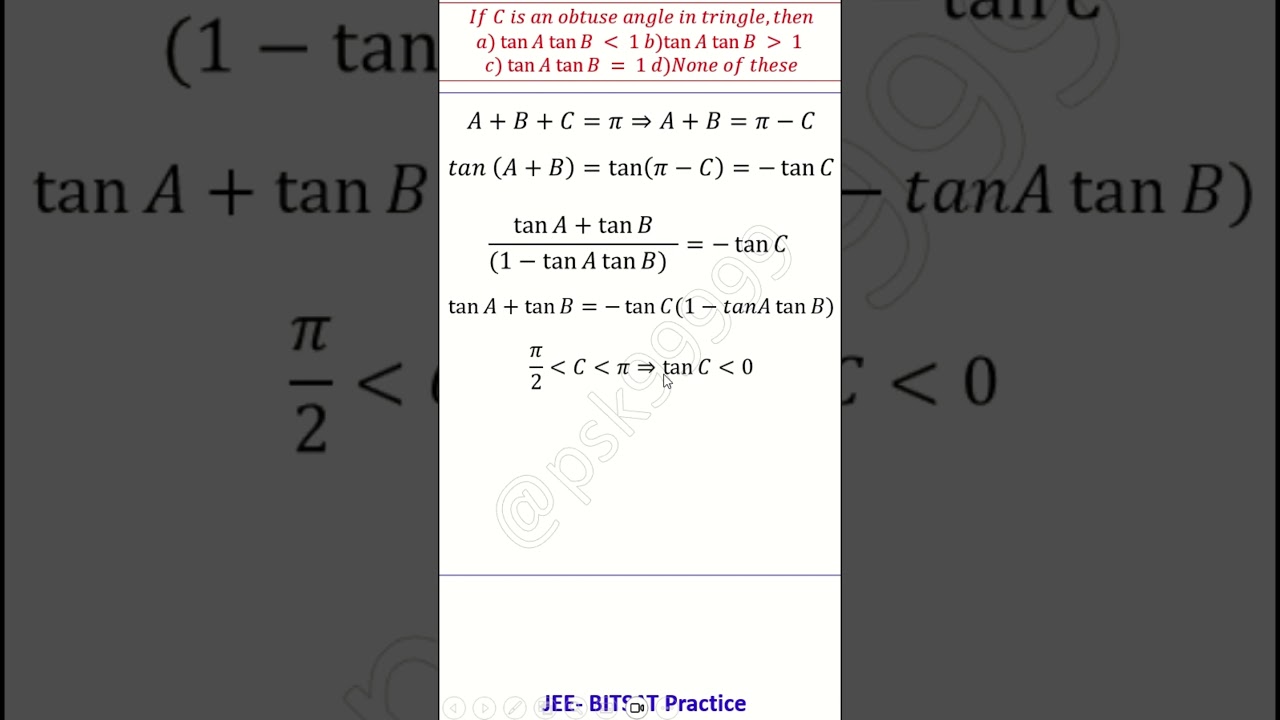
𝐼𝑓 𝐶 𝑖𝑠 𝑎𝑛 𝑜𝑏𝑡𝑢𝑠𝑒 𝑎𝑛𝑔𝑙𝑒 𝑖𝑛 𝑡𝑟𝑖𝑛𝑔𝑙𝑒, 𝑡ℎ𝑒𝑛
𝑎) tan𝐴 tan𝐵 less than 1 𝑏)tan𝐴 tan𝐵 greater than 1
𝑐) tan𝐴 tan𝐵 = 1 𝑑)𝑁𝑜𝑛𝑒 𝑜𝑓 𝑡ℎ𝑒𝑠𝑒
pearl pondBOT
Channel closed
Closed due to timeout
Use .reopen if this was a mistake.
pearl pondBOT
Available help channel!
Send your question here to claim the channel.
Remember:
• Ask your math question in a clear, concise manner.
• Show your work, and if possible, explain where you are stuck.
• After 15 minutes, feel free to ping <@&286206848099549185>.
• Type the command .close to free the channel when you're done.
• Be polite and have a nice day!
Read #❓how-to-get-help for further information on how to ask a good question, and about conduct in the question channels.
 unborn cave
truly not sure what i'm doing wrong here
 pearl pondBOT
unborn cave
truly not sure what i'm doing wrong here
pearl pondBOT
unborn cave
truly not sure what i'm doing wrong here
 copper epoch
So what was your answer?
unborn cave
-4, 0, 4
copper epoch
What's your reasoning?
unborn cave
it's asking where the points of inflection are on the graph, that's where i see them
copper epoch
Yes, but do you know what an inflection point is?
unborn cave
where the graph changes right?
copper epoch
You need to be more precise
unborn cave
like it changes from increasing to decreasing etc
copper epoch
No, that's not an inflection, those are the extrema of the functions
Minimum/maximum
copper epoch
In fact, around 0 is always increasing
Inflection points are where the derivative changes from increasing to decreasing or viceversa (in case it is differentiable)
On the original graph, it's the points where a function goes from convex to concave or viceversa
copper epoch
yes
unborn cave
but if i don't have the function how can i get those precise points?
like it looks like it is changing somewhere around -2, 0, and 2
but i don't know exactly where
copper epoch
We don't have the analytic expression, so the best we can do is take an educated guess
-2 and 2 seems fair to me
unborn cave
i tried -2, 0, 2 and it still says only some parts are correct, so i'm not sure how to be more specific
copper epoch
Does it give 0 only as a correct solution maybe?
unborn cave
it says "you have submitted only part of the correct answer" when i try only 0 😕
copper epoch
Seems weird to me
unborn cave
yeah this software sucks i've had this issue a ton
copper epoch
-1 0 1? -3 0 3?
unborn cave
still no, might have to take the L on this one
i'll try a couple decimals
but thank you for your help!
copper epoch
unborn cave
i'll try a couple decimals
That shouldn't be necessary normally though
Very weird
No way to check the solution?
unborn cave
i agree, if i get it wrong a couple more times sometimes it'll pop up lemme see
it wanted -2.5, 0, 2.5
🙄
copper epoch
unborn cave
it wanted -2.5, 0, 2.5
2.5 is not even marked on the graph
 safe siren
I had to zoom so far in to see it
copper epoch
That's just a bad question
unborn cave
its the software tbh, like this one

i referenced the solution for part d after getting it wrong a few times and it says 1, 4, 5, 6
but when i type that in exactly like that it wont even submit bc it says it needs to be a constant
safe siren
that's sucks, my homework software was so good you could just not input the whole answer in and it wouldn't mark you down but it would still tell you if you got it right or not, so I used to basically get full marks all the time for no effort 💀
safe siren
does this count for your final grade?
safe siren
💀 that's so fucked
maybe you could use the report a problem button at the top and they won't count the question if they fine problems with it or something?
actually tbh I don't think they care enough to do that 💀
pearl pondBOT
@unborn cave Has your question been resolved?
safe siren
unborn cave
i just hope it doesnt come up on my final
it probably will but it'll probably get drowned out by the other questions and only be a couple of marks anyways
pearl pondBOT
Channel closed
Closed by @unborn cave
Use .reopen if this was a mistake.
Available help channel!
Send your question here to claim the channel.
Remember:
• Ask your math question in a clear, concise manner.
• Show your work, and if possible, explain where you are stuck.
• After 15 minutes, feel free to ping <@&286206848099549185>.
• Type the command .close to free the channel when you're done.
• Be polite and have a nice day!
Read #❓how-to-get-help for further information on how to ask a good question, and about conduct in the question channels.
 midnight haven
Is the way I solved this inequality right?
 pearl pondBOT
midnight haven
Is the way I solved this inequality right?
pearl pondBOT
midnight haven
Is the way I solved this inequality right?
 exotic scaffold
the steps are right but your answer is slightly off
4/(1/2) isnt 2
remember when you divide by a fraction you multiply by its reciprocal
midnight haven
Like keep change flip?
midnight haven
Is the way I did it like this right?
 exotic scaffold
yes thats correct
midnight haven
.close
pearl pondBOT
Channel closed
Closed by @kindred garden
Use .reopen if this was a mistake.
Available help channel!
Send your question here to claim the channel.
Remember:
• Ask your math question in a clear, concise manner.
• Show your work, and if possible, explain where you are stuck.
• After 15 minutes, feel free to ping <@&286206848099549185>.
• Type the command .close to free the channel when you're done.
• Be polite and have a nice day!
Read #❓how-to-get-help for further information on how to ask a good question, and about conduct in the question channels.
 winter thistle
simone is facing north at the entrance ofa tunnel throuhg a mountain. she notices that a 1515 m high mountain in the distance has a bearing of 270 degrees and its peak appears at an angle of elevation of 35 degreres. after she exits the tunnel, the same moun tain has a bearing of 258 degrees. asuming that the tunnel is perfectly level and straight, how long is it to the nearest metre?
pearl pondBOT
winter thistle
simone is facing north at the entrance ofa tunnel throuhg a mountain. she notice...
pearl pondBOT
@winter thistle Has your question been resolved?
pearl pondBOT
@winter thistle Has your question been resolved?
pearl pondBOT
@winter thistle Has your question been resolved?
pearl pondBOT
@winter thistle Has your question been resolved?
hazy bear
The mountain was at the bearing of 270° which means it was directly in his West
After coming out of tunnel, the mountain is now at bearing of 258° which means 12° clockwise from his West
hazy bear

Upper one is in xy-plane.
Lowe one is in xz-plane.
M=mountain base
A=your initial position
A'=your final position
H=mountain top
You have to find AA'
@winter thistle
pearl pondBOT
@winter thistle Has your question been resolved?
 alpine belfry
.
pearl pondBOT
Channel closed
Closed due to timeout
Use .reopen if this was a mistake.
Available help channel!
Send your question here to claim the channel.
Remember:
• Ask your math question in a clear, concise manner.
• Show your work, and if possible, explain where you are stuck.
• After 15 minutes, feel free to ping <@&286206848099549185>.
• Type the command .close to free the channel when you're done.
• Be polite and have a nice day!
Read #❓how-to-get-help for further information on how to ask a good question, and about conduct in the question channels.
 carmine peak
yea for question 5 statement 2 im getting it as false??
 toxic lichen
carmine peak
yea for question 5 statement 2 im getting it as false??
toxic lichen
carmine peak
yea for question 5 statement 2 im getting it as false??
how so
carmine peak
toxic lichen
how so
oh ok
so basically
they’re disjoint sets
so it’s basically the same question as S1
so the union must also be the same
gang sm1 help me out here
 cosmic charm
carmine peak
gang sm1 help me out here
cosmic charm
carmine peak
gang sm1 help me out here
what should A - B = empty set mean
 rose yarrow
What’s happening
cosmic charm
no?
carmine peak
cosmic charm
no?
what
cosmic charm
if A and B are disjoint then A - B = A
since A and B have no common elements
then taking out B (which is literally nothing) leaves you still with A
rose yarrow
carmine peak
yea for question 5 statement 2 im getting it as false??
Is the correct answer D ?
For 5
carmine peak
rose yarrow
Is the correct answer D ?
yerp
carmine peak
also have a doubt in 4 if i can ask?
rose yarrow
I can help
rose yarrow
carmine peak
also have a doubt in 4 if i can ask?
Lemme check

 rose yarrow
So is the answer incorrect ?
rose yarrow
carmine peak
my working
For you
carmine peak
rose yarrow
For you
ye
rose yarrow
I see
carmine peak
bet
pearl pondBOT
@carmine peak Has your question been resolved?
Channel closed
Closed by @carmine peak
Use .reopen if this was a mistake.
Available help channel!
Send your question here to claim the channel.
Remember:
• Ask your math question in a clear, concise manner.
• Show your work, and if possible, explain where you are stuck.
• After 15 minutes, feel free to ping <@&286206848099549185>.
• Type the command .close to free the channel when you're done.
• Be polite and have a nice day!
Read #❓how-to-get-help for further information on how to ask a good question, and about conduct in the question channels.
 flint drum
Hi
pearl pondBOT
flint drum
Hi

 smoky musk
@flint drum What is the average rate of change?
flint drum
I forgot how to do that again
Something like
Y2 -y1 over
X2-x1
So I pick to points on the graph
Of the original function
And then solve it and I get my answer?
I don't quite understand the question
smoky musk
Yes
flint drum
Is it like
The X values
Are already give to me he's?
Yes*
?
But then how would I do b?
smoky musk
Probably the question asks for "instanteous rate of change"
flint drum
How do I do that
smoky musk
use the derivative function.
flint drum
Not sure I get it
I wanna know how to do this btw
Since my exam is tomorrow
And it was worth 3 points on the last year's exam
smoky musk
The derivative function is given in the graph.
smoky musk
go on
flint drum
Yeah
That's what I don't get
What is there else to do
What formula do I use
To proceed
Cause it isn't he other one
smoky musk
f'(1)
flint drum
smoky musk
f'(1)
I don't get it
How am I supposed to derive a equation
That I don't know how to get
smoky musk
The instanteous rate of change is simply the value of the derivative function at a certain point.
 limpid lily
There's a graph of f', the derivative of f.
The derivative of f tells the instantaneous rate of change of f.
So, if you're looking for the instantaneous rate of change of f when x = 0, you look at what f' is when x = 0.
flint drum
Yeah don't understand it so the 5 marks can go in the bin whatever
We move on
I'll ask someone in real life before the exam to help
I have another thing that i want to understand

How do I solve this
smoky musk
The question already shows you how to solve it step-by-step.
I assume that the function is odd
flint drum
I don't understand how to interpret the integral graphically and the determine? Part
limpid lily
Yeah, it's odd because it's symmetric with respect to the origin.
flint drum
Also I know it's symmetrical
So -4 to 0 is 7
So the other side is -7?
I don't know how to do it
Ok yk what it's fine
.close
pearl pondBOT
Channel closed
Closed by @flint drum
Use .reopen if this was a mistake.
Available help channel!
Send your question here to claim the channel.
Remember:
• Ask your math question in a clear, concise manner.
• Show your work, and if possible, explain where you are stuck.
• After 15 minutes, feel free to ping <@&286206848099549185>.
• Type the command .close to free the channel when you're done.
• Be polite and have a nice day!
Read #❓how-to-get-help for further information on how to ask a good question, and about conduct in the question channels.
midnight haven
How would i prove that?
 pearl pondBOT
midnight haven
How would i prove that?
lost peak
pearl pondBOT
midnight haven
How would i prove that?
lost peak
synthesis or multiplication
limpid lily
For 1.29, a hint is to consider T = {1}.
Not necessarily for the proof, but to get an idea.
midnight haven
limpid lily
I assume that fg means f(g(x)) in their notation.
Yes
midnight haven
limpid lily
For 1.29, a hint is to consider T = {1}.
well there must be an s in S st B(s) = 1
limpid lily
For 1.30, think of cables going from elements in R to distinct elements in T through alpha and beta. Is it possible for alpha to send two cables to the same S value?
midnight haven
limpid lily
For 1.29, a hint is to consider T = {1}.
must a and b be onto?
limpid lily
Why beta?
midnight haven
limpid lily
Why beta?
Because of every T there must be an S no?
midnight haven
Because there must be an r for every S so we get every T?
limpid lily
Why does there have to be every S?
midnight haven
Because if theres an S missing we might not get all T?
limpid lily
Well, consider T = {1}.
Let's say that S has 1,000 elements.
Wait a minute.
OK.
So, S has 1,000 elements.
midnight haven
Oh yea maybe you dont need all of S only the ones that are necessary for T
limpid lily
Right.
In the example case, you can have all R going to the same S, since all the Ss go to 1.
midnight haven
but then is a Onto no?
limpid lily
No, onto means all possible output values are produced from R.
So, you'd need alpha(R) = S.
But we don't need alpha(R) to be S. It can be {5} or something.
Like alpha(x) = 5. beta(x) = 1.
Since T = {1} and beta(alpha(x)) = 1, you have beta alpha as onto.
But S can be the integers from 1 to 1,000.
If alpha(x) = 5, it doesn't cover all of those, so alpha isn't onto.
limpid lily
OK.
midnight haven
Thank you!
limpid lily
You're welcome.
midnight haven
for 1.30, does One to one require that all of R has a designated value?
Or can it be a subset or R
limpid lily
Yeah, each element in R has a unique value in T.
No element in R shares its T value with another element in R.
midnight haven
Yes but do all elements R have to have an element in T?
limpid lily
Yes, unless we're dealing with partial functions. They usually don't when they're asking these questions.
If beta alpha is one-to-one, then it's a total function.
!occupied
pearl pondBOT
Someone else is already using this help channel. If you need help with a question, please open your own help channel/thread (see #❓how-to-get-help for instructions).
 midnight haven
what does that mean
limpid lily
That means that every element of the domain produces a value from the function.
Like if the domain is the real numbers, any real number input will produce an output.
A partial function can have some real number inputs having no output.
Like when a function is undefined.
Like log(0) or something like that.
midnight haven
hmm
but theyre not saying that theyre total
Theyre just saying that functions are rule assignments from S To T
limpid lily
You can prove it for partial functions as well.
limpid lily
limpid lily
For 1.30, think of cables going from elements in R to distinct elements in T thr...
From this ^
midnight haven
So one to one mean that for every evelemt R theres a different T
limpid lily
Yes.
midnight haven
so b and a are one to one?
limpid lily
Why?
midnight haven
Because b has to be one
and so a must be aswell because we cant have a(s1) = a(s2)
limpid lily
Why does b have to be one-to-one?
midnight haven
Because if we get duplicate values from B it wouldnt be
limpid lily
Why would duplicate values from beta cause beta alpha to not be one to one?
midnight haven
B(a(s1)) =/ B(a(s2))
limpid lily
Hint: What if R = T = {1}, and S = {1, 2}?
midnight haven
well if a is one to one then there can only be one s reached so B doesnt need to be one to one?
limpid lily
Why doesn't beta need to be one-to-one?
midnight haven
Because we only get one value as imput
limpid lily
Well, yes, but I mean in a more general manner, with any sets.
midnight haven
we need at least 2 to contradict One to one ness?
midnight haven
limpid lily
Well, yes, but I mean in a more general manner, with any sets.
well it already showed that B must not be
limpid lily
Oh, OK.
What about alpha?
To clarify, beta can be one-to-one but it doesn't have to be.
midnight haven
Yesss
midnight haven
limpid lily
What about alpha?
i does because if its not we could get the same S and so we would get the same T for different R
limpid lily
Why would that make beta alpha not one-to-one?
midnight haven
cause then we have a(r1) = a(r2) for different r, then b(a(r1)) = b(a(r2)) for r1 =/ r2
limpid lily
Right.
midnight haven
Thank you!!
limpid lily
You're welcome.
midnight haven
.close
pearl pondBOT
Channel closed
Closed by @ivory walrus
Use .reopen if this was a mistake.
pearl pondBOT
Available help channel!
Send your question here to claim the channel.
Remember:
• Ask your math question in a clear, concise manner.
• Show your work, and if possible, explain where you are stuck.
• After 15 minutes, feel free to ping <@&286206848099549185>.
• Type the command .close to free the channel when you're done.
• Be polite and have a nice day!
Read #❓how-to-get-help for further information on how to ask a good question, and about conduct in the question channels.
buoyant pasture
 pearl pondBOT
buoyant pasture
buoyant pasture
pearl pondBOT
buoyant pasture
buoyant pasture
radius of convergence
pearl pondBOT
@buoyant pasture Has your question been resolved?
grim fractal
Have you tried Lagrange Remainder Theorem
pearl pondBOT
@buoyant pasture Has your question been resolved?
buoyant pasture
grim fractal
Have you tried Lagrange Remainder Theorem
What's that?
pearl pondBOT
@buoyant pasture Has your question been resolved?
pearl pondBOT
@buoyant pasture Has your question been resolved?
pearl pondBOT
Channel closed
Closed due to timeout
Use .reopen if this was a mistake.
pearl pondBOT
Available help channel!
Send your question here to claim the channel.
Remember:
• Ask your math question in a clear, concise manner.
• Show your work, and if possible, explain where you are stuck.
• After 15 minutes, feel free to ping <@&286206848099549185>.
• Type the command .close to free the channel when you're done.
• Be polite and have a nice day!
Read #❓how-to-get-help for further information on how to ask a good question, and about conduct in the question channels.
 low skiff
I have a and b, how do I find c?
 pearl pondBOT
low skiff
I have a and b, how do I find c?
low skiff
pearl pondBOT
low skiff
I have a and b, how do I find c?
low skiff

 dusty flame
jolly parrotBOT
dusty flame
jolly parrotBOT
k
 pearl pondBOT
Channel closed
Closed by @low skiff
Use .reopen if this was a mistake.
pearl pondBOT
Available help channel!
Send your question here to claim the channel.
Remember:
• Ask your math question in a clear, concise manner.
• Show your work, and if possible, explain where you are stuck.
• After 15 minutes, feel free to ping <@&286206848099549185>.
• Type the command .close to free the channel when you're done.
• Be polite and have a nice day!
Read #❓how-to-get-help for further information on how to ask a good question, and about conduct in the question channels.
 mortal spade
 pearl pondBOT
mortal spade
mortal spade
pearl pondBOT
mortal spade
mortal spade
I need help with part b
My idea was that we can have 2023^3 +1 as n
Then 2023³ = 1 mod (n)
Oh wait
That is incorrect
toxic lichen
the exponent is n not 3 though
mortal spade
That was incorrect
I mixed up a few things
Does the property a^n = b^n mod k work for fractional n
I cannot see the images
Why is it deleted
????
n= 2023³-1 works
My idea
If n= 2023^m -1 is divisible by m then it workse
Is that correct
<@&286206848099549185>
Oh wait
That is like the initial thing
What am I doing
So any number which has previously satisfied the eqn can be used to find the next n ???
<@&286206848099549185>
 near mauve
mortal spade
Is that correct
near mauve
mortal spade
Is that correct
well prove it, what makes u say that
mortal spade
near mauve
well prove it, what makes u say that
I have proved that I think
Wait I am not sure
Yes I have proved that
But I am still not sure if this is right or not
As I was able to verify for only 1 number
near mauve
then that is not a proof
you probably observed one and concluded it works for all other?
near mauve
well then you can show the proof
mortal spade
I made an error took +1 instead of -1 and the entire thing is wrong
I will give this another try
.close
pearl pondBOT
Channel closed
Closed by @mortal spade
Use .reopen if this was a mistake.
pearl pondBOT
Available help channel!
Send your question here to claim the channel.
Remember:
• Ask your math question in a clear, concise manner.
• Show your work, and if possible, explain where you are stuck.
• After 15 minutes, feel free to ping <@&286206848099549185>.
• Type the command .close to free the channel when you're done.
• Be polite and have a nice day!
Read #❓how-to-get-help for further information on how to ask a good question, and about conduct in the question channels.
 sonic mist
Yo is there any other way to solve this other than drawing a circle around B, A E corners?
 pearl pondBOT
sonic mist
Yo is there any other way to solve this other than drawing a circle around B, A ...
sonic mist
pearl pondBOT
sonic mist
Yo is there any other way to solve this other than drawing a circle around B, A ...
sonic mist
Because I'm not bright enough to think about drawing a circle during the exam probably
Just a little hint would be very nice 
timber tartan
Can you translate it
sonic mist
Oke
timber tartan
What would be angle ECD then
sonic mist
180-k
timber tartan
Good, what about EBD
timber tartan
Wait
It is 180 - (a + 180 - k)
Okay so k - a
Yeah
Finally angles EBA and AEB
sonic mist
Woh I think i see it
Give me a second
Nope lets continue
Uh
Eba = 90 - k + a
Aeb = 90 - a
timber tartan
Okay