#help-39
1 messages · Page 217 of 1
 calm wing
 fringe ice
Especially the displacement part as when it is thrown up it creates more distance upwards
Ohhhhhhhhh
I seeeeeee
fringe ice
calm wing
typically up is + and down is -, which is why your teacher has velocity as +20 a...
Wait so how do you know displacement is -42.5
calm wing
because it went down from the place of start by 42.5 units
we consider the point O as like the origin, zero displacement
going up -> positive displacement
going down -> negative displacement
calm wing
 no worries
 rough forge
calm wing
if you are done, type ".close"
rough forge
calm wing
if you are done, type ".close"
 calm wing
like fr
calm wing
calm wing
like fr
SUVAT king 
big fan of abstract shit but tbh not much reason
i couldn't get into lund physics cuz they needed chem
lol
 pearl pondBOT
Channel closed
Closed by @calm wing
Use .reopen if this was a mistake.
rough forge
calm wing
no i'll do it
sorry
pearl pondBOT
 Available help channel!
Send your question here to claim the channel.
Remember:
• Ask your math question in a clear, concise manner.
• Show your work, and if possible, explain where you are stuck.
• After 15 minutes, feel free to ping <@&286206848099549185>.
• Type the command .close to free the channel when you're done.
• Be polite and have a nice day!
Read #❓how-to-get-help for further information on how to ask a good question, and about conduct in the question channels.
 mental hinge
im asked to examine a vector space $V$ and 3 linear maps, $T_1, T_2, T_3\in\mathcal {L}(V, \mathbb{R}^4)$.
im given that $\exists v\in V$ such that
\begin{enumerate}
\item $T_1(v)=\begin{bmatrix}1 \ 0 \ 0 \ 0\end{bmatrix}$
\item $T_2(v)=\begin{bmatrix}0 \ 1 \ 1 \ 0\end{bmatrix}$
\item $T_3(v)=\begin{bmatrix}1 \ 1 \ 1 \ 1\end{bmatrix}$
\end{enumerate}
and asked whether these are linearly indp, linearly dep, or can be either
pearl pondBOT
mental hinge
im asked to examine a vector space $V$ and 3 linear maps, $T_1, T_2, T_3\in\math...
rough forge
\mathbb{R}^4
mental hinge
ack
 quick star

 graceful yacht


 mental hinge
if i was smart i wouldve latex'd this up before i began a channel
😭
for any of these options, i need to provide a proof, and for opt 3 where it can be either, i need to provide 2 examples of v, and T1 T2 T3 where it is both indp and dp
rough forge
we can't change the past but only the future
mental hinge
yeahhh i have no clue where to begin here
rough forge
maybe start with the definition of linear independence
mental hinge
$a_1T_1(v)+a_2T_2(v)+a_3T_3(v)=0\implies a_1=a_2=a_3=0,\forall v\in V$ right?
 jolly parrotBOT
light
 mental hinge
isnt that the defn of linear indp?
rough forge
oh yes
mental hinge
rough forge
also it says for some v actually
oh shoot rly?
rough forge
that is what you ought to show
rough forge
jolly parrot
**light**
yea it says there exists a v in V
mental hinge
okay well thats much easier to show
mental hinge
rough forge
also it says for some v actually
wait hold on, why is this the case? generally, to show that functions are linearly indp, wouldnt we try to prove
$af(x)+bg(x)=0\implies a=b=0$ for all $x$?
jolly parrotBOT
light
 mental hinge
or am i misunderstanding something
rough forge
jolly parrot
**light**
as far as i understood you ought to inspect whether T_1(v) T_2(v) and T_3(v) are linearly independent, not the transformations itself
post the original
mental hinge
oh no sorry im examining the transformations themselves
mental hinge
rough forge
post the original
it wasnt given to me written, its a problem i copied down that my prof asked us to think abt on our own time
pearl pondBOT
@mental hinge Has your question been resolved?
Channel closed
Closed by @mental hinge
Use .reopen if this was a mistake.
Available help channel!
Send your question here to claim the channel.
Remember:
• Ask your math question in a clear, concise manner.
• Show your work, and if possible, explain where you are stuck.
• After 15 minutes, feel free to ping <@&286206848099549185>.
• Type the command .close to free the channel when you're done.
• Be polite and have a nice day!
Read #❓how-to-get-help for further information on how to ask a good question, and about conduct in the question channels.
 plucky carbon
for this problem can I just do g(f(x)) and f(g(x)) like normal or do I have to do something else
 pearl pondBOT
plucky carbon
for this problem can I just do g(f(x)) and f(g(x)) like normal or do I have to d...
pearl pondBOT
plucky carbon
for this problem can I just do g(f(x)) and f(g(x)) like normal or do I have to d...
 pearl kite
plucky carbon
for this problem can I just do g(f(x)) and f(g(x)) like normal or do I have to d...
pearl kite
plucky carbon
for this problem can I just do g(f(x)) and f(g(x)) like normal or do I have to d...
whats the actual question?
you've just given us information
plucky carbon
determine if they are inverse functions
 versed mica
are you meant to show they’re inverses?
versed mica
plucky carbon
for this problem can I just do g(f(x)) and f(g(x)) like normal or do I have to d...
yep
pearl kite
versed mica
are you meant to show they’re inverses?
then yeah you can do what you said
plucky carbon
got it
 toxic lichen
plucky carbon
for this problem can I just do g(f(x)) and f(g(x)) like normal or do I have to d...
toxic lichen
plucky carbon
for this problem can I just do g(f(x)) and f(g(x)) like normal or do I have to d...
well don't forget that you also have to light a campfire using exactly 17 logs on an odd day without a full moon and go around it counterclockwise exactly 9 times in an amount of time strictly between 47 and 66 seconds
(joke)
versed mica
word
plucky carbon
.close
pearl pondBOT
Channel closed
Closed by @plucky carbon
Use .reopen if this was a mistake.
pearl pondBOT
Available help channel!
Send your question here to claim the channel.
Remember:
• Ask your math question in a clear, concise manner.
• Show your work, and if possible, explain where you are stuck.
• After 15 minutes, feel free to ping <@&286206848099549185>.
• Type the command .close to free the channel when you're done.
• Be polite and have a nice day!
Read #❓how-to-get-help for further information on how to ask a good question, and about conduct in the question channels.
 stiff hare
Hello. For this question i was just wondering how picture 2 works. I thought the square root couldnt take negative values, and to my understand 1^{-1} - 1 would be negative

 pearl pondBOT
stiff hare
Hello. For this question i was just wondering how picture 2 works. I thought the...
stiff hare
pearl pondBOT
stiff hare
Hello. For this question i was just wondering how picture 2 works. I thought the...
stiff hare
wuoldnt it be undefined then like i'd have to write DNE or is this also OK
 lost flax
stiff hare
Hello. For this question i was just wondering how picture 2 works. I thought the...
lost flax
stiff hare
Hello. For this question i was just wondering how picture 2 works. I thought the...
That limit x-> 1- makes no sense at all, the domain is (1,+infinity)
The limit x->1 would just be the same as the limit x->1+
stiff hare
would this be neither an odd/even vertical asymptote then?
stiff hare
mm i know but i have to classify them as odd, even or neither. though i wasnt sure with this one since the definition id been given for neither was that one would go to infinity while the other's finite
lost flax
stiff hare
mm i know but i have to classify them as odd, even or neither. though i wasnt su...
That question is just wrong, as it assumes a fact that simply doesn't hold (the fact that the function's domain contains both limit directions)
pearl pondBOT
Channel closed
Closed by @stiff hare
Use .reopen if this was a mistake.
pearl pondBOT
Available help channel!
Send your question here to claim the channel.
Remember:
• Ask your math question in a clear, concise manner.
• Show your work, and if possible, explain where you are stuck.
• After 15 minutes, feel free to ping <@&286206848099549185>.
• Type the command .close to free the channel when you're done.
• Be polite and have a nice day!
Read #❓how-to-get-help for further information on how to ask a good question, and about conduct in the question channels.
 icy sonnet
|1 0 0 1|
|0 1 0 0| = |I F|
|0 0 1 0|

where F =
|1|
|0|
|0|

such that
    |-1|
N = | 0|
    | 0|
    | 1|
(N is the nullspace matrix where its free columns are the special solutions)

but in this matrix:

|1 1 0 0|   |I F 0|
|0 0 1 0| = |0 0 I|
|0 0 0 1|

Where F =

|1|,

           |-1|
    |-F|   | 1|
N = | I| = | 0| (where is the identity matrix? it doesn't show up in the previous matrix)
           | 0|

this is based on the idea that reducing a matrix to rref returns some form of |I F| where you can easily format the special solutions to result in:

|-F|
| I|

but in the second example, the identity matrix is split down the middle by F, so it doesn't seem to apply properly. is there some form of trick/manipulation of the array that I don't know that makes this trick hold for matrices like the one above?
based on this screen shot from https://youtu.be/VqP2tREMvt0?t=1855


MIT 18.06 Linear Algebra, Spring 2005
Instructor: Gilbert Strang
View the complete course: http://ocw.mit.edu/18-06S05
YouTube Playlist: https://www.youtube.com/playlist?list=PLE7DDD91010BC51F8
- Solving Ax = 0: Pivot Variables, Special Solutions
License: Creative Commons BY-NC-SA
More information at https://ocw.mit.edu/terms
More courses at ...
pearl pondBOT
@icy sonnet Has your question been resolved?
pearl pondBOT
@icy sonnet Has your question been resolved?
pearl pondBOT
@icy sonnet Has your question been resolved?
pearl pondBOT
@icy sonnet Has your question been resolved?
icy sonnet
<@&286206848099549185>
 blissful crown
icy sonnet
<@&286206848099549185>
blissful crown
icy sonnet
<@&286206848099549185>
w h a t
 ruby umbra
blissful crown
w h a t
ruby umbra
blissful crown
w h a t
can you help me
 orchid pendant
ruby umbra
can you help me
orchid pendant
ruby umbra
can you help me
with
icy sonnet
blissful crown
w h a t
do you know how the above question holds for a matrix that doesn't follow the rule/pattern shown above?
blissful crown
icy sonnet
do you know how the above question holds for a matrix that doesn't follow the ru...
For a matrix you just typically need to put it in a different format
imo
matrices are stupid, systems are easier
icy sonnet
I am able to find the solutions, the issue is more about the way of solving it. The presented solution above should make it much quicker to find a solution to a RREF matrix but the example i listed above does not seem to fit the mold. I'm not sure if this is just because the example is only for a specific kind of RREF matrix or there are some matrix operations I can do to get the same pattern used for the solution in the screenshot.
pearl pondBOT
@icy sonnet Has your question been resolved?
pearl pondBOT
Channel closed
Closed due to timeout
Use .reopen if this was a mistake.
pearl pondBOT
Available help channel!
Send your question here to claim the channel.
Remember:
• Ask your math question in a clear, concise manner.
• Show your work, and if possible, explain where you are stuck.
• After 15 minutes, feel free to ping <@&286206848099549185>.
• Type the command .close to free the channel when you're done.
• Be polite and have a nice day!
Read #❓how-to-get-help for further information on how to ask a good question, and about conduct in the question channels.
fringe ice
How to approach question B?
 pearl pondBOT
fringe ice
How to approach question B?
pearl pondBOT
fringe ice
How to approach question B?
@fringe ice Has your question been resolved?
 shrewd mist
Moment equilibrium about D?
shrewd mist
fringe ice
How to approach question B?
mass of the bar induces a ACW moment, while the boy at B induces a (greater) CW moment. you need to find what "additional" moment needs to be induced via a force on A to make the net moment zero
pearl pondBOT
Channel closed
Closed due to timeout
Use .reopen if this was a mistake.
pearl pondBOT
Available help channel!
Send your question here to claim the channel.
Remember:
• Ask your math question in a clear, concise manner.
• Show your work, and if possible, explain where you are stuck.
• After 15 minutes, feel free to ping <@&286206848099549185>.
• Type the command .close to free the channel when you're done.
• Be polite and have a nice day!
Read #❓how-to-get-help for further information on how to ask a good question, and about conduct in the question channels.
 frosty hatch
(8) Proving that 1 and 3^n are a basis of the sequences defined by induction u(n+2) = 4u(n+1) - 3u(n)
 pearl pondBOT
frosty hatch
(8) Proving that 1 and 3^n are a basis of the sequences defined by induction u(n...
frosty hatch
pearl pondBOT
frosty hatch
(8) Proving that 1 and 3^n are a basis of the sequences defined by induction u(n...
frosty hatch
In general I’ve seen quite a few exercises of this kind where we must prove a family of geometric sequences is a basis of a set of induction defined sequences
 robust kraken
montre que tout vecteur de V s’écrit comme combinaison linéaire des 3 vecteurs
en gros faut résoudre la suite récurrente d’ordre 2
frosty hatch
Ouais
frosty hatch
En supposant qu’il y avait une suite géométrique non nulle dans V j’ai bien trouvé que les deux raisons possibles étaient 3 et 1 mais après ça j’ai rien
 spare lark
Exprime le terme général de la suite
robust kraken
yakubros qui vient à la rescousse
spare lark
Un = a(1)^n + b(3)^n pour a et b dans R
Et donc là tu as des deux vecteurs de la famille generatrice
robust kraken
même les 3 nan
frosty hatch
Mais comment montrer qu’elle est génératrice?
spare lark
robust kraken
même les 3 nan
Oui il suffit de mettre un 0 à 3^n + 1
robust kraken
frosty hatch
Mais comment montrer qu’elle est génératrice?
tu montres que tout vecteur de V s’écrit comme combinaison linéaire des 3 vecteurs qui sont supposés former la base
spare lark
frosty hatch
Mais comment montrer qu’elle est génératrice?
Que tout élément de V s'écrit comme combinaison lineaire des vecteurs de ta famille
frosty hatch
C’est Justement la dessus que je galère, on voit bien que les vecteurs sont dans V mais réciproquement je n’arrive pas à trouver qu’un vecteur de V appartient nécessairement à vect(famille)
spare lark
?
robust kraken
frosty hatch
C’est Justement la dessus que je galère, on voit bien que les vecteurs sont dans...
si u_n est dans V, u_n=a1 +b3^n non ?
frosty hatch
robust kraken
si u_n est dans V, u_n=a*1 +b*3^n non ?
Mais où est l’équivalence entre la condition de récurrence et ça
robust kraken
frosty hatch
Mais où est l’équivalence entre la condition de récurrence et ça
bah la relation de récurrence te donne le terme général de u_n
frosty hatch
Désolé je ne comprend pas
Un = 4un+1 - un+2 donne une expression générale de Un ?
robust kraken
si u_n est dans V, alors $u_{n+2}=4u_{n+1}-3u_{n}$
spare lark
frosty hatch
Désolé je ne comprend pas
Un = 4un+1 - un+2 donne une expression générale de Un...
Oui
jolly parrotBOT
tm
Compile Error! Click the  reaction for more information.
(You may edit your message to recompile.)
 spare lark
Avec le polynome caractéristique
frosty hatch
Oui, mais alors comment arriver à Un = a + b3^n ?
spare lark
Tu prends les racines du polynomes caractéristique
Si yen a 2
Bah c'est a(r1)^n + b(r2)^n
robust kraken
t’as pas vu ça ?
 frosty hatch
Non
robust kraken
ah
spare lark
Bah dans ce cas là tu peux lire la page bibmath ig
frosty hatch
Ok merci beaucoup
pearl pondBOT
@frosty hatch Has your question been resolved?
Channel closed
Closed by @frosty hatch
Use .reopen if this was a mistake.
Available help channel!
Send your question here to claim the channel.
Remember:
• Ask your math question in a clear, concise manner.
• Show your work, and if possible, explain where you are stuck.
• After 15 minutes, feel free to ping <@&286206848099549185>.
• Type the command .close to free the channel when you're done.
• Be polite and have a nice day!
Read #❓how-to-get-help for further information on how to ask a good question, and about conduct in the question channels.
 dreamy wind
 pearl pondBOT
dreamy wind
frosty hatch
dreamy wind
whats my next step
pearl pondBOT
dreamy wind
frosty hatch
dreamy wind
whats my next step
If you’ve graphed them the idea is simply to study the sign of the first derivative to explain the variations seen on the graphs
pearl pondBOT
@dreamy wind Has your question been resolved?
Channel closed
Closed by @dreamy wind
Use .reopen if this was a mistake.
Available help channel!
Send your question here to claim the channel.
Remember:
• Ask your math question in a clear, concise manner.
• Show your work, and if possible, explain where you are stuck.
• After 15 minutes, feel free to ping <@&286206848099549185>.
• Type the command .close to free the channel when you're done.
• Be polite and have a nice day!
Read #❓how-to-get-help for further information on how to ask a good question, and about conduct in the question channels.
 glossy root
Hi so basically I have to find the remainder of a 2000 digit number 202520252025......2025 divided by 7
pearl pondBOT
glossy root
Hi so basically I have to find the remainder of a 2000 digit number 202520252025...
 toxic lichen
,rccw
jolly parrotBOT
 toxic lichen
your work is kinda hard to understand
so you expressed your thing mod 7 as 2 (1 + 4 + 4^2 + ... + 4^499) right
wait actually why 4
10 isn't congruent to 4 mod 7
oh wait no 10,000 not 10 my bad
,calc 10000 mod 7
jolly parrotBOT
Result:
4
ok right that is 4
2 (1 + 4 + 4^2 + ... + 4^499)
what did you do after this?
i can't really follow what you've written @glossy root
glossy root
toxic lichen
> 2 (1 + 4 + 4^2 + ... + 4^499)
what did you do after this?
Uh basically I made it so
It's like
1 = 1 mod 7
4 = 4 mod 7
16 = 2 mod 7
And since 1 + 4 + 2 is 7
Just cancel out
500÷3 is 166.666
So 166
toxic lichen
ok so yeah any three adjacent terms cancel out
glossy root
So we left with 2
And then first one which is 1 and second one which is 4
So then I got 5
Then times 2 = 10 then minus 7 so 3
glossy root
Yea
I'm honestly not sure?
Cus I used chatgpt to double check
And it said I'm wrong
But then chatgpt like working is rly random
So that's why I js came here to asl
toxic lichen
glossy root
Cus I used chatgpt to double check
!nogpt
pearl pondBOT
glossy root
Cus I used chatgpt to double check
Please do not trust ChatGPT or similar AI tools for mathematical tasks, as they often generate output which "sounds correct" but has numerous factual or logical errors. Use of these AI tools to answer other people's help questions is strictly against server rules (see #rules).
toxic lichen
glossy root
Yea
ok so this is not "i think i have gone wrong somewhere" and more "i don't trust myself so i need somebody more knowledgeable to look over it"
anyway you have my seal of approval
glossy root
👍 okay ty
glossy root
toxic lichen
ok so this is not "i think i have gone wrong somewhere" and more "i don't trust ...
Basically yea
Xd
Anyways uh bye
.close
pearl pondBOT
Channel closed
Closed by @glossy root
Use .reopen if this was a mistake.
Available help channel!
Send your question here to claim the channel.
Remember:
• Ask your math question in a clear, concise manner.
• Show your work, and if possible, explain where you are stuck.
• After 15 minutes, feel free to ping <@&286206848099549185>.
• Type the command .close to free the channel when you're done.
• Be polite and have a nice day!
Read #❓how-to-get-help for further information on how to ask a good question, and about conduct in the question channels.
robust kraken
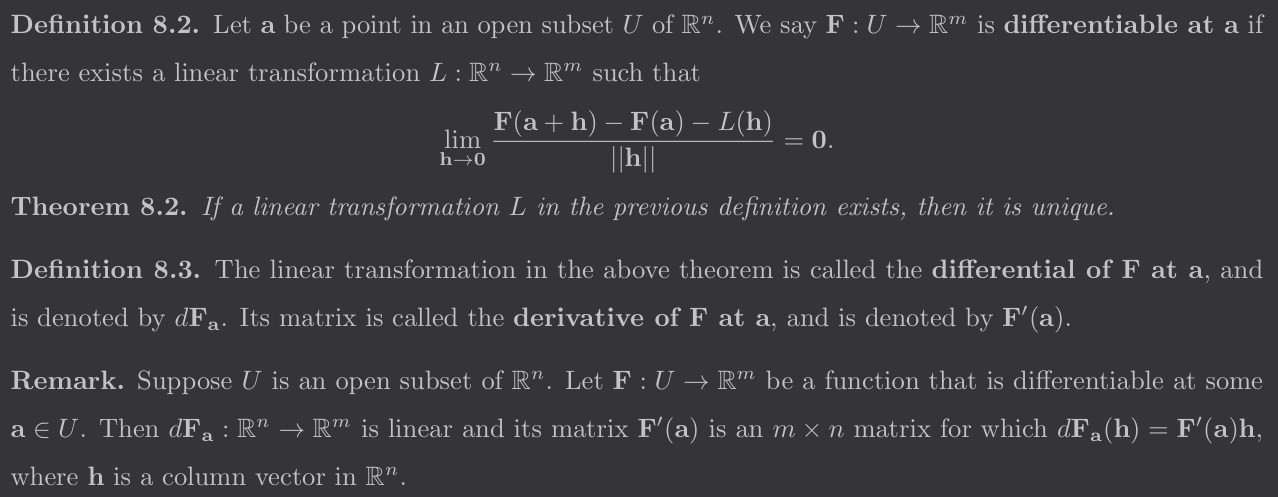
if we have $f(x)=2x^2$, we know that if we want to calculate $Df(x) \cdot h$, we do $lim_{t \to 0} t^{-1} (f(x+th)-f(x))$ which gives us $4xh$ but how can we calculate the tangential linear application at x ?
pearl pondBOT
robust kraken
if we have $f(x)=2x^2$, we know that if we want to calculate $Df(x) \cdot h$, we...
jolly parrotBOT
tm
 robust kraken
the linear application $L_x$ such that $lim_{t \to 0} h^{-1} (f(x+h)-f(x)-L_x(h))=0$
jolly parrotBOT
tm
 robust kraken
yeah but idk how to make the difference between the vector $Df(x) \cdot h$ and the linear application $L_x$
jolly parrotBOT
tm
 robust kraken
oh ok so its linear in h ? or in x ? that’s what i don’t understand 😭
so $L_x=4x Id$ ?
jolly parrotBOT
tm

 lilac jackal
robust kraken
oh ok so its linear in h ? or in x ? that’s what i don’t understand 😭
lilac jackal
robust kraken
oh ok so its linear in h ? or in x ? that’s what i don’t understand 😭
in general it doesnt make sense to ask whether its linear in x
the notation suggests that for every x we have a function L_x that varies with h
robust kraken
okayyy i see
lilac jackal
to be honest... you COULD try to view it as a multivariable function say L(x,h)
in which case its ok to ask about being linear in each variable
but this is not the usual notation
robust kraken
so when we write $Df(x) \cdot h$ it's just the linear application applied to h?
jolly parrotBOT
tm
 jolly parrotBOT
ロケットジャンプ
 robust kraken
i think that’s where i was wrong, i thought it was the differential applied to x
pearl pondBOT
Channel closed
Closed by @robust kraken
Use .reopen if this was a mistake.
 pearl pondBOT
✅
lilac jackal
just gonna leave it open if u have followup questions
robust kraken
lilac jackal
https://i.gyazo.com/c74f2a3381b71a3c2dc58c00ca1b66fe.png
ye i have almost the same thing in my book, it's just these notations that are a little hard to distinguish 😅
robust kraken
lilac jackal
just gonna leave it open if u have followup questions
np, i’ll be back if i have more questions
lilac jackal
yeah notation can vary a tiny bit
many courses call the matrix jacobian
$J(a)$ instead of $F'(a)$ above
jolly parrotBOT
ロケットジャンプ
 robust kraken
yeah i saw it too 😭
lilac jackal
hmm or should we say $J_F(a)$...
jolly parrotBOT
ロケットジャンプ
 robust kraken
im on the gradient rn lemme learn this first 😂
lilac jackal
sure haha
robust kraken
.close
pearl pondBOT
Channel closed
Closed by @robust kraken
Use .reopen if this was a mistake.
pearl pondBOT
Available help channel!
Send your question here to claim the channel.
Remember:
• Ask your math question in a clear, concise manner.
• Show your work, and if possible, explain where you are stuck.
• After 15 minutes, feel free to ping <@&286206848099549185>.
• Type the command .close to free the channel when you're done.
• Be polite and have a nice day!
Read #❓how-to-get-help for further information on how to ask a good question, and about conduct in the question channels.
 sturdy gorge
Alright, basic algebra help since i can’t really get this in my head. apparently my zeroes for this are wrong, i wanna know where i messed up factoring for this.
are my zeroes not 0, 4, and 1?
 pearl pondBOT
sturdy gorge
Alright, basic algebra help since i can’t really get this in my head. apparently...
pearl pondBOT
sturdy gorge
Alright, basic algebra help since i can’t really get this in my head. apparently...
 leaden wadi
You factored x^2 - 4x +4 incorrectly.
 pearl pondBOT
Channel closed
Closed by @sturdy gorge
Use .reopen if this was a mistake.
pearl pondBOT
Available help channel!
Send your question here to claim the channel.
Remember:
• Ask your math question in a clear, concise manner.
• Show your work, and if possible, explain where you are stuck.
• After 15 minutes, feel free to ping <@&286206848099549185>.
• Type the command .close to free the channel when you're done.
• Be polite and have a nice day!
Read #❓how-to-get-help for further information on how to ask a good question, and about conduct in the question channels.
 fickle oasis
Hey, i can easily find the enlargement (this is translated from my main language by ai so it means find the new surface area), but i dont exactly understand, would the factor k=-2 make the triangle just half its size, something like this?

 pearl pondBOT
fickle oasis
Hey, i can easily find the enlargement (this is translated from my main language...
fickle oasis
pearl pondBOT
fickle oasis
Hey, i can easily find the enlargement (this is translated from my main language...
fickle oasis
the negative coefficient confuses me 💔
 green dew
maybe it means homothety?
fickle oasis
so basicially i dont understand how im supposed to scale the triangle down
green dew
that changes everything
green dew
fickle oasis
so basicially i dont understand how im supposed to scale the triangle down
u mean u wanna draw it?
green dew
ok so ur familiar with vectors?
green dew
im listening
fickle oasis
i think this is just enlargement or reduction of the triangle based on a specific point (in here, point O), so if i had a coefficient of 2 id make the triangle 2 times bigger, since its -2 i just make it 1/2 its size, inside the triangle itself?
green dew
no
fickle oasis
im from Albania soo education systems a bit different you might not know what im on about
fickle oasis
yeah i thought so
green dew
do yk vectors or not
green dew
its ok if not
green dew
fickle oasis
what a vector is? sure
u experienced or not lol
green dew
uh
fickle oasis
so
green dew
sure
in that case im not bringing up vectors
now a homothety is characterized by three things
fickle oasis
green dew
in that case im not bringing up vectors
i know what they are, worked with them last year on physics, ive just forgotten
so thanks 🙂
green dew
a center, a ratio and an angle
fickle oasis
green dew
now a homothety is characterized by three things
im listening
green dew
ur given the center of ur homothety as O
ur ratio is also given by the scalar factor k = -2
issue is u dont have an angle so thats a problem
green dew
i guess its a a homothety with angle 180
now what the negatuve sign means is that u draw ur triangle
in the opposite side
it is faced the exact opposite way of trisngle OAB
fickle oasis
... okay
green dew
yes
180 degress around O
think of it as a symmetric to the point O
but enlarged
cause of the 2
fickle oasis
so is that it?
i understand
so then finding the surface area will indeed be 2 times bigger yes
fickle oasis
uh...
green dew
fickle oasis
uh...
remember
if two shapes are similar where the ratio of their sides is k
then their areas are propotional with a factor of k²
fickle oasis
ohh
mate we learned this one semester ago
why is my teacher putting it in the test now 😭
green dew
fickle oasis
why is my teacher putting it in the test now 😭
always use the formulas u learn in class and dont make ones off ur mind
unless ur very much cooked in a math exam
fickle oasis
right i see
gimme 2m in
ok so if surface area of it is (3x2)/2=3cm^2 then the surface area of the bigger one is 9cm^2 or?
green dew
correct
wait no
the scalar product is 2 for their sides
for their areas its k² = 2² = 4
3 × 4 = 12
not 9
fickle oasis
oh shit wait
yeah i squared the area
ok i understand my mistake
thank you a lot
❤️
green dew
npp
pearl pondBOT
Channel closed
Closed by @fickle oasis
Use .reopen if this was a mistake.
pearl pondBOT
Available help channel!
Send your question here to claim the channel.
Remember:
• Ask your math question in a clear, concise manner.
• Show your work, and if possible, explain where you are stuck.
• After 15 minutes, feel free to ping <@&286206848099549185>.
• Type the command .close to free the channel when you're done.
• Be polite and have a nice day!
Read #❓how-to-get-help for further information on how to ask a good question, and about conduct in the question channels.
 outer hare
Why is X=G important in this case? like X never shows up again so im a little confused. Why not just say that H<G and go from there
 pearl pondBOT
outer hare
Why is X=G important in this case? like X never shows up again so im a little co...
outer hare
pearl pondBOT
outer hare
Why is X=G important in this case? like X never shows up again so im a little co...
outer hare
:D
 merry carbon
(what is this an example of?)
outer hare
fist time i asked a question and didnt feel like i missed something obvious lol
 random ermine
nvm this makes sense
outer hare
oh is it just notation
outer hare
Like usually G is the group and X is the set so they are saying G is the set
ah
goddamn it
tysm
.close
pearl pondBOT
Channel closed
Closed by @outer hare
Use .reopen if this was a mistake.
pearl pondBOT
Available help channel!
Send your question here to claim the channel.
Remember:
• Ask your math question in a clear, concise manner.
• Show your work, and if possible, explain where you are stuck.
• After 15 minutes, feel free to ping <@&286206848099549185>.
• Type the command .close to free the channel when you're done.
• Be polite and have a nice day!
Read #❓how-to-get-help for further information on how to ask a good question, and about conduct in the question channels.
 midnight haven
I just wanted to get feedback on how i set up this problem

 midnight haven
Finding volume using washer method
Still a bit confused when we rotate the solid over an axis that isnt just x = 0 , y = 0
 rough stream
Your two pictures don't seem to be from the same problem
rough stream
Heyo!
 shrewd summit
hi guys
midnight haven
one sec
midnight haven
 shrewd summit
versed mica
just being a goose?
shrewd summit
versed mica
just being a goose?
yes
midnight haven
question beneath the red
rough stream
Your integral needs to be dy
If you think about the disc moving through your solid, the disc needs to move up and down, which is integrating vertically
midnight haven
i see can you give me one sec while i fix this
yea i have no idea how to find the radius in terms of y
i thought i did for a second
would otter radius be the function in terms of y
- y ?
so, f(y) - y ?
.close
pearl pondBOT
Channel closed
Closed by @plain lance
Use .reopen if this was a mistake.
rough stream
@midnight haven
Sorry I am back.
Note the left side of the curve is the outer radius, and the right side of the curve is the inner radius
You have expressions for the left side of the curve and right side of the curve written out
pearl pondBOT
Available help channel!
Send your question here to claim the channel.
Remember:
• Ask your math question in a clear, concise manner.
• Show your work, and if possible, explain where you are stuck.
• After 15 minutes, feel free to ping <@&286206848099549185>.
• Type the command .close to free the channel when you're done.
• Be polite and have a nice day!
Read #❓how-to-get-help for further information on how to ask a good question, and about conduct in the question channels.
 buoyant pasture
 pearl pondBOT
buoyant pasture
buoyant pasture
pearl pondBOT
buoyant pasture
buoyant pasture
alpha+beta=3
b^2-4ac>0so k<9/4
 ember patio
Why u use quadratic formula in cubic polynomial
pearl pondBOT
@buoyant pasture Has your question been resolved?
buoyant pasture
ember patio
Why u use quadratic formula in cubic polynomial
Opps
 fickle schooner
pearl pondBOT
fickle schooner
pearl pondBOT
@buoyant pasture Has your question been resolved?
pearl pondBOT
Channel closed
Closed due to timeout
Use .reopen if this was a mistake.
Available help channel!
Send your question here to claim the channel.
Remember:
• Ask your math question in a clear, concise manner.
• Show your work, and if possible, explain where you are stuck.
• After 15 minutes, feel free to ping <@&286206848099549185>.
• Type the command .close to free the channel when you're done.
• Be polite and have a nice day!
Read #❓how-to-get-help for further information on how to ask a good question, and about conduct in the question channels.
 silver oracle
 pearl pondBOT
silver oracle
pearl pondBOT
silver oracle

 tender ingot
silver oracle
tender ingot
silver oracle
3rd step
silver oracle
tender ingot
3rd step
What is wrong
tender ingot
silver oracle
What is wrong
It's supposed to be 3(x-4) + 18
silver oracle
tender ingot
It's supposed to be 3(x-4) + 18
I don't understand why
I added 6 to balance be taking away 6 from inside
tender ingot
That's not valid because the expression inside is being multipled by 3
So if u subtract 6 inside, u have to add 3*6 or 18 outside
silver oracle
tender ingot
That's not valid because the expression inside is being multipled by 3
Okay thanks so much, so the 3 comes what we took out of x-4
tender ingot
Um
silver oracle
silver oracle

@tender ingot like are you just supposed to multiply this number by the 6?
For these types of questions?
pearl pondBOT
@silver oracle Has your question been resolved?
pearl pondBOT
@silver oracle Has your question been resolved?
pearl pondBOT
Channel closed
Closed due to timeout
Use .reopen if this was a mistake.
Available help channel!
Send your question here to claim the channel.
Remember:
• Ask your math question in a clear, concise manner.
• Show your work, and if possible, explain where you are stuck.
• After 15 minutes, feel free to ping <@&286206848099549185>.
• Type the command .close to free the channel when you're done.
• Be polite and have a nice day!
Read #❓how-to-get-help for further information on how to ask a good question, and about conduct in the question channels.
 vernal hinge
can someone help me ques 66a
 pearl pondBOT
vernal hinge
can someone help me ques 66a
vernal hinge
pearl pondBOT
vernal hinge
can someone help me ques 66a
vernal hinge
.close
pearl pondBOT
Channel closed
Closed by @vernal hinge
Use .reopen if this was a mistake.
pearl pondBOT
Available help channel!
Send your question here to claim the channel.
Remember:
• Ask your math question in a clear, concise manner.
• Show your work, and if possible, explain where you are stuck.
• After 15 minutes, feel free to ping <@&286206848099549185>.
• Type the command .close to free the channel when you're done.
• Be polite and have a nice day!
Read #❓how-to-get-help for further information on how to ask a good question, and about conduct in the question channels.
silver oracle
 pearl pondBOT
silver oracle
silver oracle
pearl pondBOT
silver oracle
silver oracle
Paper says that if the num and den have the same degree that you do the leading coefficient over coeffect for the horizontal asymptote

So for this i assumed it would be at 1

But there isn't any at all
So the rule my teacher taught us is incorrect?
 summer imp
There is an asymptote at y=1
silver oracle
summer imp
There is an asymptote at y=1
How come that line in the middle goes through it
summer imp
Horizontal asymptotes dictacte the behaviour of functions for large x
It just means that if you go really far out to the right the function approaches 1
Not that it never crosses that line
silver oracle
summer imp
It just means that if you go really far out to the right the function approaches...
Alr Ty
pearl pondBOT
@silver oracle Has your question been resolved?
Channel closed
Closed by @silver oracle
Use .reopen if this was a mistake.
Available help channel!
Send your question here to claim the channel.
Remember:
• Ask your math question in a clear, concise manner.
• Show your work, and if possible, explain where you are stuck.
• After 15 minutes, feel free to ping <@&286206848099549185>.
• Type the command .close to free the channel when you're done.
• Be polite and have a nice day!
Read #❓how-to-get-help for further information on how to ask a good question, and about conduct in the question channels.
 white estuary
Help
pearl pondBOT
white estuary
Help

 drowsy adder
Yeah
pearl pondBOT
Channel closed
Closed by @white estuary
Use .reopen if this was a mistake.
pearl pondBOT
Available help channel!
Send your question here to claim the channel.
Remember:
• Ask your math question in a clear, concise manner.
• Show your work, and if possible, explain where you are stuck.
• After 15 minutes, feel free to ping <@&286206848099549185>.
• Type the command .close to free the channel when you're done.
• Be polite and have a nice day!
Read #❓how-to-get-help for further information on how to ask a good question, and about conduct in the question channels.
 oblique patio
Question
Consider the differential equation y' = y.
Solve the differential equation (i.e., find y(x)), supposing that y(1.57) = 2.12. Evaluate that solution at the x-coordinates in the table
below. Fill out the table with your answers.
Answer
x-coordinate
x1 = -1.35
x2 = 2.80
x3 = 4.04
Solution Value
y(x1) =
y(x₂) =
y(x3) =
Enter as many decimal places as your calculator allows (8 to 10). Your answer must be within +0.005 of the correct answer to be considered correct
pearl pondBOT
oblique patio
Question
Consider the differential equation y' = y.
Solve the differential equat...
oblique patio
I've tried finding the dereviative and subbing in those x values but it says that it's incorrect?
toxic lichen
when you say "finding the derivative" can you show what you did exactly
oblique patio
oh wait sorry for this one I wasn't sure how to because it says it in terms of y and not x
i wasn't sure how to integrate it?
if that's what I'm supposed to do?
toxic lichen
y' = y should sound familiar. if you know how to take derivatives, you should know at least one function which satisfies this.
ie a function which equals its own derivative
pearl pondBOT
@oblique patio Has your question been resolved?
oblique patio
<@&286206848099549185>
pearl pondBOT
@oblique patio Has your question been resolved?
pearl pondBOT
Channel closed
Closed due to timeout
Use .reopen if this was a mistake.
Available help channel!
Send your question here to claim the channel.
Remember:
• Ask your math question in a clear, concise manner.
• Show your work, and if possible, explain where you are stuck.
• After 15 minutes, feel free to ping <@&286206848099549185>.
• Type the command .close to free the channel when you're done.
• Be polite and have a nice day!
Read #❓how-to-get-help for further information on how to ask a good question, and about conduct in the question channels.
 analog girder
can someone help me with this: for example if this equals 100 and i need to solve for t, how do i do it? ik it turns into ln in some way but how will the equation look like. is it like ln100/ln0.013 or something
 pearl pondBOT
analog girder
can someone help me with this: for example if this equals 100 and i need to solv...
pearl pondBOT
analog girder
can someone help me with this: for example if this equals 100 and i need to solv...
 verbal whale
If you apply ln to both sides, what do you get?
analog girder
verbal whale
If you apply ln to both sides, what do you get?
0.013t=ln100?
verbal whale
Exactly
analog girder
ooh
analog girder
yeah
pearl pondBOT
Channel closed
Closed by @analog girder
Use .reopen if this was a mistake.
pearl pondBOT
Available help channel!
Send your question here to claim the channel.
Remember:
• Ask your math question in a clear, concise manner.
• Show your work, and if possible, explain where you are stuck.
• After 15 minutes, feel free to ping <@&286206848099549185>.
• Type the command .close to free the channel when you're done.
• Be polite and have a nice day!
Read #❓how-to-get-help for further information on how to ask a good question, and about conduct in the question channels.
 sweet snow
Hello, I am having trouble proving this implication right here. I have found some similar results online, but none of them are equivalent to this
 pearl pondBOT
sweet snow
Hello, I am having trouble proving this implication right here. I have found som...
sweet snow
pearl pondBOT
sweet snow
Hello, I am having trouble proving this implication right here. I have found som...
sweet snow
I'm pretty sure the second order taylor expansion may help
$\nabla^2f$ is the hessian matrix of $f$
jolly parrotBOT
GUILLOM
 sweet snow
this is as far as I've been able to get

Not sure what to do with the $o(t^2)$ expression tho
jolly parrotBOT
GUILLOM
 pearl pondBOT
@sweet snow Has your question been resolved?
sweet snow
should I post this in the #optimization channel instead?
pearl pondBOT
@sweet snow Has your question been resolved?
pearl pondBOT
@sweet snow Has your question been resolved?
 sudden heath
sweet snow
this is as far as I've been able to get
sudden heath
sweet snow
this is as far as I've been able to get
g is convex iff g´´ >= 0
pearl pondBOT
@sweet snow Has your question been resolved?
pearl pondBOT
Channel closed
Closed due to timeout
Use .reopen if this was a mistake.
Available help channel!
Send your question here to claim the channel.
Remember:
• Ask your math question in a clear, concise manner.
• Show your work, and if possible, explain where you are stuck.
• After 15 minutes, feel free to ping <@&286206848099549185>.
• Type the command .close to free the channel when you're done.
• Be polite and have a nice day!
Read #❓how-to-get-help for further information on how to ask a good question, and about conduct in the question channels.
 civic temple
Question 2, I don’t quite get what F^-1(F(A)) is supposed to represent or how to write a valid proof
 pearl pondBOT
civic temple
Question 2, I don’t quite get what F^-1(F(A)) is supposed to represent or how to...
pearl pondBOT
civic temple
Question 2, I don’t quite get what F^-1(F(A)) is supposed to represent or how to...
 autumn fossil
civic temple
Question 2, I don’t quite get what F^-1(F(A)) is supposed to represent or how to...
autumn fossil
civic temple
Question 2, I don’t quite get what F^-1(F(A)) is supposed to represent or how to...
F(A) is the image of A under f
so basically the set of all values of the funnction for inputs in A
if the function was from reals and A was the interval [0, 1], then F(A) would include stuff like f(0), f(0.1), f(0.4), f(1)...
and F^-1 does the same, but opposite
it gives you set of all possible inputs, given the outputs
Now to actually write a proof, notice that what we are trying to prove is a set inclusion
There is a standard way to prove A ⊆ B. We assume that x ∈ A, and then attempt to prove that x ∈ B as well.
In our case, we will assume
x ∈ F^-1(F(A)) ∪ F(F^-1(B))
now what can we imply from this?
civic temple
That f(x) is in F(A) union F(B)?
civic temple
Although isnt the second part of that statement u F(F^-1(B))
autumn fossil
civic temple
Although isnt the second part of that statement u F(F^-1(B))
Oh, yeah
Anyway, what does it mean in general when x ∈ A ∪ B? What can we imply from statement of this form?
civic temple
That x is in A or B
autumn fossil
correct
most of questions of this type can be solved just by applying the definitions in the correct order btw, till now we applied definitions of ⊆ and ∪
so now we have that either x ∈ F^-1(F(A)) or x ∈ F(F^-1(B))
let's deal with it case by case
in the first case, we have x ∈ F^-1(F(A))
our ultimate goal is to show that x ∈ F^-1(F(A u B))
autumn fossil
autumn fossil
in the first case, we have x ∈ F^-1(F(A))
You can again just apply the definition of F^-1
what does it mean for x to be an element of F^-1
civic temple
f(x) is in F(A)?
autumn fossil
Yep, great
now recall that our goal is proving that x ∈ F^-1(F(A u B))
which is equivalent to showing that F(x) ∈ F(A u B)
so now you have F(x) in F(A) and you need to show F(x) in F(A u B)
you can either again use the definitions or refer to the first exercise
Do you understnad that?
lilac jackal
a rigorous definition of $F(A)$: $y\in F(A)$ if and only if $y=F(a)$ for some $a\in A$
jolly parrotBOT
ロケットジャンプ
 autumn fossil
Yeah, that'd be the definition. You can either use that or just refer to exercise 1) which proves that F(A u B) = F(A) u F(B)
autumn fossil
civic temple
Im currently getting f(x) in F(A) and f(x) in B
How did you get that f(x) is in B?
autumn fossil
lilac jackal
F(x) not f(x)
Yeah, right, i messed that up a few times above. Thanks
civic temple
F(F^-1(B)), y in F(F^1(B)) then x in F^-1(B)) such that F(x) = y
x in F^-1(B) so F(x) in B
autumn fossil
civic temple
F(F^-1(B)), y in F(F^1(B)) then x in F^-1(B)) such that F(x) = y
x in F^-1(B) so...
This is the second case
civic temple
Ye
autumn fossil
we have to deal with those cases seperately
because they are seperated by or
We dont know whether x will be in F^-1(F(A)) and F(F^-1(B)) at the same time
so we have to make a proof for the first case and a seperate proof for the second case
civic temple
So for the first case F(x) is in F(A) ..?
autumn fossil
Yep, for the first case F(x) is in F(A)
and we need to prove that x is in F^-1(F(A u B)), or equivalently, F(x) is in F(A u B)
Recall the previous exercise
it proves that F(A u B) = F(A) u F(B)
 civic temple
So x is in F^-1(F( A u B ), so F(x) is in F (A u B)
autumn fossil
x is in F^-1(F( A u B )
This is our goal. This is what we are trying to prove
The point is that we can set a simpler goal, and that is proving F(x) is in F(A u B), because from this, we can then by definition imply x is in F^-1(F( A u B ) - our original goal
It's important to distinguish between what we currently have and what's our goal
civic temple
Oh the gears are turning slowly
So F(x) is in F(A) or F(B) and ive already proved that F(x) is in F(A)
autumn fossil
civic temple
So F(x) is in F(A) or F(B) and ive already proved that F(x) is in F(A)
You proved that F(x) is in F(A), indeed
and therefore obviously F(x) is in F(A) or F(B)
now can you retrace your steps and complete the argument to show that x is in F^-1(F( A u B )
- x ∈ F^-1(F(A)) ∪ F(F^-1(B)) ---(Assumption)
- x ∈ F^-1(F(A)) or x ∈ F(F^-1(B)) ---(Definition of ∪)
- ----First case: x ∈ F^-1(F(A))
- | F(x) ∈ F(A) ---(Definition of F^-1)
- | F(x) ∈ F(A) ∪ F(B) ---(Obvious)
- | missing steps.....
- | F(x) ∈ F(A ∪ B) ---(Our goal, NEEDS PROOF)
- | x ∈ F^-1(F(A ∪ B) ---(From the previous statement by defn of F^-1)
just a summary of the proof
autumn fossil
it's the proof only until this step we're currently at
civic temple
.close
pearl pondBOT
Channel closed
Closed by @civic temple
Use .reopen if this was a mistake.
pearl pondBOT
Available help channel!
Send your question here to claim the channel.
Remember:
• Ask your math question in a clear, concise manner.
• Show your work, and if possible, explain where you are stuck.
• After 15 minutes, feel free to ping <@&286206848099549185>.
• Type the command .close to free the channel when you're done.
• Be polite and have a nice day!
Read #❓how-to-get-help for further information on how to ask a good question, and about conduct in the question channels.
 plush sundial
 pearl pondBOT
plush sundial
plush sundial
pearl pondBOT
plush sundial
plush sundial
i tried sending in the formula for IE
IE = 13.6 x Z^2 eV
= 1312 x Z^2 kJ/mol
Z=11 for Sodium
 pseudo plank
don't think you need that since you're given wavelength
c=(lambda)(nu)
E=h(nu)
solve for E
pseudo plank
no, you can just say IE=hc/(242 nm)
pseudo plank
yes using that would take longer
and definitely isnt what they want considering they gave you the wavelength
plush sundial
like the moment i saw IE, the direct formula struck my mind
and even so the answer shud be same ryt
with the IE formula i get something absurd
with the normal walenght formula, im getting the correct answer
pseudo plank
well, you'd have to start by finding the initial n of the outermost sodium electron
what did you get?
plush sundial
wasnt ionisation energy, the energy from n=1 to n = inf?
pseudo plank
thats the energy required to remove an electron that started at n=1
but sodium has electrons further out than n=1
plush sundial
1312 x 11 x 11 = 158752
pseudo plank
ionization energy is energy required to remove only one electron
plush sundial
oh ffffff
bohr atomic model bs is only applicable to single electron species 😭 😭
well i have another doubt in electronic configurations and stuff
@pseudo plank ..
pseudo plank
ok ask
 plush sundial
2 electrons are removed
pseudo plank
which 2
plush sundial
from the outermost subshell
pseudo plank
yeah so what would the electron configuration be
plush sundial
so 2 electrons from 6s get removed?
pseudo plank
yes
plush sundial
hence 5d1?
pseudo plank
5d^1 would be valence electron config
plush sundial
ohk so this wud apply for all elements, we basically take 2 electrons from the outermost subshell
and while writing the config, we use aufbaus principle and follow that order..?
pseudo plank
you take electrons starting from the outmost subshell
and going inward
take as many electrons as you need to get the right positive charge
and then if the ion has a negative charge you add electrons to the outermost subshell
until you get the right charge
pseudo plank
no problem
plush sundial
was getting pissed with chemistry 😭
pseudo plank
sometimes it is confusing
plush sundial
3 hrs lec is taking 6-7 hrs 😭 😭
pseudo plank
electrons do not act conveniently sometimes
pearl pondBOT
Channel closed
Closed by @plush sundial
Use .reopen if this was a mistake.
pearl pondBOT
Available help channel!
Send your question here to claim the channel.
Remember:
• Ask your math question in a clear, concise manner.
• Show your work, and if possible, explain where you are stuck.
• After 15 minutes, feel free to ping <@&286206848099549185>.
• Type the command .close to free the channel when you're done.
• Be polite and have a nice day!
Read #❓how-to-get-help for further information on how to ask a good question, and about conduct in the question channels.
 covert meteor
 pearl pondBOT
covert meteor
pearl pondBOT
covert meteor
 signal atlas
covert meteor
signal atlas
covert meteor
Do you know what translations are
pearl pondBOT
@covert meteor Has your question been resolved?
pearl pondBOT
Channel closed
Closed due to timeout
Use .reopen if this was a mistake.
Available help channel!
Send your question here to claim the channel.
Remember:
• Ask your math question in a clear, concise manner.
• Show your work, and if possible, explain where you are stuck.
• After 15 minutes, feel free to ping <@&286206848099549185>.
• Type the command .close to free the channel when you're done.
• Be polite and have a nice day!
Read #❓how-to-get-help for further information on how to ask a good question, and about conduct in the question channels.
covert meteor
signal atlas
Do you know what translations are
Nope
pearl pondBOT
covert meteor
Nope
 fluid oar
covert meteor
Nope
fluid oar
covert meteor
Nope
Translation is basically "moving"
A translation of a triangle can be described by moving all corners of the triangle in the same way, say "1 unit down, one to the right"
covert meteor
Ahh okay
covert meteor
fluid oar
Translation is basically "moving"
A translation of a triangle can be described b...
So even if it’s the same size but rotated, would it count as a translation
fluid oar
Rotations aren't translations
Think about it, can you rotate a triangle by moving all corners in the same way?
pearl pondBOT
@covert meteor Has your question been resolved?
pearl pondBOT
Channel closed
Closed due to timeout
Use .reopen if this was a mistake.
Available help channel!
Send your question here to claim the channel.
Remember:
• Ask your math question in a clear, concise manner.
• Show your work, and if possible, explain where you are stuck.
• After 15 minutes, feel free to ping <@&286206848099549185>.
• Type the command .close to free the channel when you're done.
• Be polite and have a nice day!
Read #❓how-to-get-help for further information on how to ask a good question, and about conduct in the question channels.
 outer urchin
Stupid question here, but when factorizing by grouping, for example 8x^2 + 2x -3, when I expand out the middle term, I sometimes dont get a common factor and have to try a different pair to get one, is there a different method than trial and error?
pearl pondBOT
outer urchin
Stupid question here, but when factorizing by grouping, for example 8x^2 + 2x -3...
outer urchin
Like it could become 2x(4x+3) - (4x-3) and I have to try a different pair of grouping
To get 4x(2x-1) + 3(2x-1)
 light helm
to determine the appropriate way to split,
use ac method
outer urchin
light helm
to determine the appropriate way to split,
use ac method
Yeah and it splits to 6x and -4x
light helm
yes, and factorisation by grouping is guaranteed to work with that
Like it could become 2x(4x+3) - (4x**-3**) and I have to try a different pair of grouping
you messed up signs here
outer urchin
Sorry if it’s a bit disorganized
 light helm
-4x - 3 would be -(4x + 3)
outer urchin
Huh? Why?
light helm
distributive property
outer urchin
But wasn’t the - sign on 4z only?
light helm
no
outer urchin
When splitting?
outer urchin
So I must distribute the -
Ohhhhh so the - cancels out in both then?
I mean if I distribute the - then it’s be (-4z + 3)
Which is still different I guess
light helm
wdym still different
outer urchin
Like (4z+3) and (-4z+3)
light helm
uh
I mean if I distribute the - then it’s be (-4z + 3)
is incorrect
from splitting you have
$$8z^2 + 6z \red{- 4z - 3}$$
the red part by itself factorises to $-(4z\blue{+}3)$
jolly parrotBOT
ℝαμOmeganato5
 outer urchin
Ohhhh
So I must take the term with its sign then?
Aight
Thanks for clearing it up!
.close
pearl pondBOT
Channel closed
Closed by @outer urchin
Use .reopen if this was a mistake.
Available help channel!
Send your question here to claim the channel.
Remember:
• Ask your math question in a clear, concise manner.
• Show your work, and if possible, explain where you are stuck.
• After 15 minutes, feel free to ping <@&286206848099549185>.
• Type the command .close to free the channel when you're done.
• Be polite and have a nice day!
Read #❓how-to-get-help for further information on how to ask a good question, and about conduct in the question channels.
 zenith drum
What happened to the 18?
 pearl pondBOT
zenith drum
What happened to the 18?
pearl pondBOT
zenith drum
What happened to the 18?
 cold sky
zenith drum
What happened to the 18?
cold sky
zenith drum
What happened to the 18?
Do first -9+18
 brazen vector
-9+18=9
pearl pondBOT
Channel closed
Closed by @zenith drum
Use .reopen if this was a mistake.
Available help channel!
Send your question here to claim the channel.
Remember:
• Ask your math question in a clear, concise manner.
• Show your work, and if possible, explain where you are stuck.
• After 15 minutes, feel free to ping <@&286206848099549185>.
• Type the command .close to free the channel when you're done.
• Be polite and have a nice day!
Read #❓how-to-get-help for further information on how to ask a good question, and about conduct in the question channels.
 fathom ocean
Hi there, can someone here teach euler to me? My teacher sent me this but I haven't been in school since I was sick, I'm not sure where to start
 pearl pondBOT
fathom ocean
Hi there, can someone here teach euler to me? My teacher sent me this but I have...
pearl pondBOT
fathom ocean
Hi there, can someone here teach euler to me? My teacher sent me this but I have...
@fathom ocean Has your question been resolved?
 quartz rampart
fathom ocean
Hi there, can someone here teach euler to me? My teacher sent me this but I have...
quartz rampart
fathom ocean
Hi there, can someone here teach euler to me? My teacher sent me this but I have...
I think such questions are solved by assuming the limit as l and taking logarithm on both sides
the log can then be brought inside the limit allowing you to use the rules for powers coming out as multiplication
and then solve it like a normal limit
at the end equate it to log l
and then find l by exponentiating both sides
pearl pondBOT
Channel closed
Closed due to timeout
Use .reopen if this was a mistake.
Available help channel!
Send your question here to claim the channel.
Remember:
• Ask your math question in a clear, concise manner.
• Show your work, and if possible, explain where you are stuck.
• After 15 minutes, feel free to ping <@&286206848099549185>.
• Type the command .close to free the channel when you're done.
• Be polite and have a nice day!
Read #❓how-to-get-help for further information on how to ask a good question, and about conduct in the question channels.
 lucid hazel
Hi! I'm trying to figure out how to solve math problems regarding trigonometry. I've been stuck on this problem for about 30 minutes now and YouTube guides didn't help me much. The text just says "Simplify the expression"
 pearl pondBOT
lucid hazel
Hi! I'm trying to figure out how to solve math problems regarding trigonometry. ...
orchid pendant
lucid hazel
Hi! I'm trying to figure out how to solve math problems regarding trigonometry. ...
pearl pondBOT
lucid hazel
Hi! I'm trying to figure out how to solve math problems regarding trigonometry. ...
orchid pendant
lucid hazel
Hi! I'm trying to figure out how to solve math problems regarding trigonometry. ...
id recommend putting everything in radians
or degrees
whatever one you prefer, just make them the same
lucid hazel
2pi should equate to 360 degrees, right?
orchid pendant
makes it a tad easier
orchid pendant
lucid hazel
2pi should equate to 360 degrees, right?
correct
lucid hazel
Okay so I've converted everything to degrees, not sure what to do next 😅

Clearer picture
 pearl pondBOT
@lucid hazel Has your question been resolved?
lucid hazel
<@&286206848099549185> Apologize for the ping, but I'm not sure what to do here, should I, for example, for the ctg 600° use the ctgx = cosx/sinx formula?
I'm just stuck since I'm not sure how to simplify the expression further
orchid pendant
lucid hazel
<@&286206848099549185> Apologize for the ping, but I'm not sure what to do here,...
evaluate them at those values
or
yeah you can convert them into terms of sine and cosine
and see what cancels out
lucid hazel
orchid pendant
evaluate them at those values
I'm sorry what does evaluate mean, English isn't my first language
orchid pendant
lucid hazel
I'm sorry what does evaluate mean, English isn't my first language
whats your first language
lucid hazel
Serbian
orchid pendant
lucid hazel
Serbian
this Процените
orchid pendant
orchid pendant
yeah you can convert them into terms of sine and cosine
but do this instead
this can save time
lucid hazel
Alright, thanks a lot
And should I just remove cos 360° altogether since that just equals 1?
orchid pendant
lucid hazel
And should I just remove cos 360° altogether since that just equals 1?
yeah
orchid pendant
orchid pendant
this Процените
okay yeah sorry do this
because they dont cancel out lol
lucid hazel
I'm just not sure what to do with sin (-290°) and cos (-160°)
orchid pendant
-160= 160cw = 200ccw
if you want to evalute them with positive angles
-290= 290cw = 70ccw
lucid hazel
And I'm guessing that's it? the ctg 600° and tg 150° cancel each other out, so I'm just left with sin -290°/cos -160°
orchid pendant
lucid hazel
And I'm guessing that's it? the ctg 600° and tg 150° cancel each other out, so I...
nono
lucid hazel
oh
orchid pendant
sorry i shouldnt have suggested that
they cant cancel because the input differs among them
aka the value in the () are not equal
lucid hazel
Ah, makes sense
pearl pondBOT
@lucid hazel Has your question been resolved?
pearl pondBOT
Channel closed
Closed due to timeout
Use .reopen if this was a mistake.
pearl pondBOT
Available help channel!
Send your question here to claim the channel.
Remember:
• Ask your math question in a clear, concise manner.
• Show your work, and if possible, explain where you are stuck.
• After 15 minutes, feel free to ping <@&286206848099549185>.
• Type the command .close to free the channel when you're done.
• Be polite and have a nice day!
Read #❓how-to-get-help for further information on how to ask a good question, and about conduct in the question channels.
 river bison
can someone help me walk through this question? I dont know what to do to be able to set up the equation for a shell method
 pearl pondBOT
river bison
can someone help me walk through this question? I dont know what to do to be abl...
pearl pondBOT
river bison
can someone help me walk through this question? I dont know what to do to be abl...
 snow sail
river bison
can someone help me walk through this question? I dont know what to do to be abl...
snow sail
river bison
can someone help me walk through this question? I dont know what to do to be abl...
do you know what the equation is in general?
like, just for some function
river bison
its like the integral of some bounds c and d of 2pi r(y) h(y) dy
right?
I forgot the 2pi
 river bison
not yet, though this is a question rotating around the x, shouldnt the values be in terms of y?
snow sail
we could equivalently write it that way, yea
 snow sail
you used an equals to some constant somewhere
 snow sail
if its confusing to you we can swap the x and y
river bison
no no, its just late at night, thats all
snow sail
okay, so we want to rotate this thing about the x axis
that means that height and distance are gonna be swapped
well, swapped than if we were in terms of x
river bison
so we only want y values
snow sail

we want to find r and h
r(y) is going to be our distance from the x axis
h(y) is gonna be our distance from the y axis
river bison
snow sail
r(y) is going to be our distance from the x axis
which is the original equation
river bison
snow sail
h(y) is gonna be our distance from the y axis
thats where im stuck
snow sail
youve got it backwards
river bison
right, other way around
snow sail
theres a tip is that if youre rotating around y=0 or x=0, then r is just x, or y
wonder if i can find a good image
river bison
hm, im second guessing myself now
snow sail

r is the distance from the axis of rotation
in your case, since the axis is just y=0
some y is always just y away from that axis
river bison
so we would need to solve the original equation for y
river bison
ok
snow sail
how far away is y=4 from the line y=0
river bison
4
snow sail
yea
so r(y) is just y
the distance from the axis of rotation, y=0, is just y
if it were y=1 instead, then itd be y-1
just for example
is that part okay?
river bison
yeah
snow sail
okay
river bison
well, I dont know why y can be anything if they r of the cylinder is a set amount
actually thats a dumb question, we just dont know
snow sail
so you know why the radius is y
you unwrap it
the farther away we are from y=0
the longer that rectangle is gonna be
but its just linear
if we are twice as far away from y=0, and we unwrap a rectangle
itll be twice as wide
so having afunction like y makes sense, maybe
idk if that helps
 river bison
lol
 tough karma
wow
jolly parrotBOT
 river bison
so h is r now
snow sail
h is still h
river bison
oh
snow sail
this is why sometimes its easier to switch to just you know
river bison
just clicked
snow sail
switch to letters always the same way
river bison
it just depends on the y axis
river bison
so it could be whatever
snow sail
it will probably be some linear function, the radius
river bison
yeah
snow sail
but it might be like, y-5
or whatever
the height function also falls out kind of easy
since were using x=0
how far away is the function x(y) from x=0
snow sail
yea
river bison
so we got that down
snow sail
and h(y) is just the distance between x(y) and x=0
river bison
which now is the original equation
snow sail
yea
river bison
in terms of y
snow sail
now you do need to solve an equation
theyll give you some bounding function
here its x=0
so you need to find where x(y) intersects the bounding function
maybe you know what that equation you need to solve will be
snow sail
right yea
it will always be values of the indepedent variable
the variable of integration
that you need to solve for
river bison
oh, dy
jolly parrotBOT
jan Niku
 snow sail
so we look at $4y^2-y^3 = 0$
jolly parrotBOT
jan Niku
 jolly parrotBOT
jan Niku
 snow sail
if y=0, its 0 times something, so 0, its a solution
so, lets look for another solution, assume y isnt 0, since we already found that one
then we can divide by y
$4y-y^2=0$
jolly parrotBOT
jan Niku
 snow sail
now you have to solve this to find more solutions
river bison
y(4 - y)?
snow sail
sure yea
river bison
I think thats all of it, do you mind letting me keep this open so I can solve it?
snow sail
yea no problem feel free to ping
 pearl pondBOT
Channel closed
Closed by @river bison
Use .reopen if this was a mistake.
pearl pondBOT
Available help channel!
Send your question here to claim the channel.
Remember:
• Ask your math question in a clear, concise manner.
• Show your work, and if possible, explain where you are stuck.
• After 15 minutes, feel free to ping <@&286206848099549185>.
• Type the command .close to free the channel when you're done.
• Be polite and have a nice day!
Read #❓how-to-get-help for further information on how to ask a good question, and about conduct in the question channels.
 lost rampart
any simple conterexample for this?
 pearl pondBOT
lost rampart
any simple conterexample for this?
pearl pondBOT
lost rampart
any simple conterexample for this?
 west sapphire
take some convergent positive series like sum(1/n^2)
 crude nexus
That goes to zero
west sapphire
so?
i'm not done yet
let the terms of that series be the areas of some little continuous pulses
say, centered at each n
and narrow enough that they don't overlap with each other
if you play with the widths and the heights while maintaining constant areas, you can even make the heights to go infinity instead of to zero, while still having a convergent integral
pearl pondBOT
@lost rampart Has your question been resolved?
pearl pondBOT
Channel closed
Closed due to timeout
Use .reopen if this was a mistake.
Available help channel!
Send your question here to claim the channel.
Remember:
• Ask your math question in a clear, concise manner.
• Show your work, and if possible, explain where you are stuck.
• After 15 minutes, feel free to ping <@&286206848099549185>.
• Type the command .close to free the channel when you're done.
• Be polite and have a nice day!
Read #❓how-to-get-help for further information on how to ask a good question, and about conduct in the question channels.
 agile star
i was wondering if somoene could check my work for this problem


 pearl pondBOT
@agile star Has your question been resolved?
 marble sigil
agile star
marble sigil
agile star
that's right
pearl pondBOT
Channel closed
Closed by @agile star
Use .reopen if this was a mistake.
lost rampart
west sapphire
if you play with the widths and the heights while maintaining constant areas, yo...
smartttt!
I figured out tho it’s the same idea but thank u anyway
pearl pondBOT
Available help channel!
Send your question here to claim the channel.
Remember:
• Ask your math question in a clear, concise manner.
• Show your work, and if possible, explain where you are stuck.
• After 15 minutes, feel free to ping <@&286206848099549185>.
• Type the command .close to free the channel when you're done.
• Be polite and have a nice day!
Read #❓how-to-get-help for further information on how to ask a good question, and about conduct in the question channels.
glossy root
 pearl pondBOT
glossy root
pearl pondBOT
glossy root