#help-39
1 messages · Page 144 of 1
 cloud zephyr
because 15≠30
 brisk nacelle
I wrote no solution
cloud zephyr
brisk nacelle
I wrote no solution
Correct
 pearl pondBOT
Channel closed
Closed by @brisk nacelle
Use .reopen if this was a mistake.
pearl pondBOT
 Available help channel!
Send your question here to claim the channel.
Remember:
• Ask your math question in a clear, concise manner.
• Show your work, and if possible, explain where you are stuck.
• After 15 minutes, feel free to ping <@&286206848099549185>.
• Type the command .close to free the channel when you're done.
• Be polite and have a nice day!
Read #❓how-to-get-help for further information on how to ask a good question, and about conduct in the question channels.
brisk nacelle
 pearl pondBOT
brisk nacelle
pearl pondBOT
pearl pondBOT
brisk nacelle
pearl pondBOT
@brisk nacelle Has your question been resolved?
Channel closed
Closed by @brisk nacelle
Use .reopen if this was a mistake.
Available help channel!
Send your question here to claim the channel.
Remember:
• Ask your math question in a clear, concise manner.
• Show your work, and if possible, explain where you are stuck.
• After 15 minutes, feel free to ping <@&286206848099549185>.
• Type the command .close to free the channel when you're done.
• Be polite and have a nice day!
Read #❓how-to-get-help for further information on how to ask a good question, and about conduct in the question channels.
 plucky cove
I need help figuring out each one
 pearl pondBOT
plucky cove
I need help figuring out each one
pearl pondBOT
plucky cove
I need help figuring out each one
Please don't occupy multiple help channels.
The purpose of this server is to help you learn, not to hand out answers. Do not ask someone to give you the answer directly.
 pearl pondBOT
@plucky cove Has your question been resolved?
pearl pondBOT
Channel closed
Closed due to timeout
Use .reopen if this was a mistake.
Available help channel!
Send your question here to claim the channel.
Remember:
• Ask your math question in a clear, concise manner.
• Show your work, and if possible, explain where you are stuck.
• After 15 minutes, feel free to ping <@&286206848099549185>.
• Type the command .close to free the channel when you're done.
• Be polite and have a nice day!
Read #❓how-to-get-help for further information on how to ask a good question, and about conduct in the question channels.
 gusty prism
 pearl pondBOT
gusty prism
gusty prism
pearl pondBOT
gusty prism
gusty prism
How do u know when to use these equations really
They said it is all for constant acceleration but didn't rlly say when to use which
I guess if i do practice ill realize but
For the constant acceleration motion
 sharp vigil
all of them have a subset of all the variables, so you pick one based on which ones you have and which one you need to solve for
pearl pondBOT
@gusty prism Has your question been resolved?
Channel closed
Closed by @gusty prism
Use .reopen if this was a mistake.
pearl pondBOT
Available help channel!
Send your question here to claim the channel.
Remember:
• Ask your math question in a clear, concise manner.
• Show your work, and if possible, explain where you are stuck.
• After 15 minutes, feel free to ping <@&286206848099549185>.
• Type the command .close to free the channel when you're done.
• Be polite and have a nice day!
Read #❓how-to-get-help for further information on how to ask a good question, and about conduct in the question channels.
 toxic tulip
Hello I need finding the mistake in a proof
pearl pondBOT
toxic tulip
Hello I need finding the mistake in a proof
 iron stream
toxic tulip
Hello I need finding the mistake in a proof
iron stream
toxic tulip
Hello I need finding the mistake in a proof
Bro even copied the logo lol !!
toxic tulip
Let 𝐴, 𝐵 ⊂ 𝐶. If 𝑝 is a limit point of 𝐴∪𝐵, then 𝑝 is a limit point of 𝐴or 𝐵. Proof Suppose p is a limit point of A union B. If I is an open interval containing p, then by definition of limit point, I intersect (A union B) minus {p} is nonempty. Therefore, it contains a point x. Then x is in I and x is in A union B, and x is not equal to p. Since x is in A union B, either x is in A or x is in B. In case 1, x is in A. Then x is in I intersect A minus {p}, so I intersect A minus {p} is not empty. Therefore, p is a limit point of A. Similarly, if x is in B, p is a limit point of B.
and yeah I made this account in Middle School it was dark times
pearl pondBOT
@toxic tulip Has your question been resolved?
 tropic saddle
for each interval I you get a different x
sometimes that x may be in A and sometimes it may be in B
but it would always need to be in the same one
toxic tulip
could you maybe elaborate a little bit
tropic saddle
say p was a limit point of A. then x would always have to be in A
but you have only shown that it is sometimes in A or sometimes in B
toxic tulip
I see what your saying since x is in A union B it could be in either A or B regardless of where the limit point is
How could this be accounted for in the proof?
tropic saddle
tbh not sure right now
pearl pondBOT
Channel closed
Closed by @toxic tulip
Use .reopen if this was a mistake.
pearl pondBOT
Available help channel!
Send your question here to claim the channel.
Remember:
• Ask your math question in a clear, concise manner.
• Show your work, and if possible, explain where you are stuck.
• After 15 minutes, feel free to ping <@&286206848099549185>.
• Type the command .close to free the channel when you're done.
• Be polite and have a nice day!
Read #❓how-to-get-help for further information on how to ask a good question, and about conduct in the question channels.
 brazen swift
 pearl pondBOT
brazen swift
https://i.imgur.com/rBYO4VM.png
brazen swift
pearl pondBOT
brazen swift
https://i.imgur.com/rBYO4VM.png
brazen swift
The question asks to prove this identity
i mean its just cos2x = cos^2(x)-sin^2(x)
but that seems too easy
 acoustic path
that's correct
brazen swift
i mean if i just use that it gets me the answer immediately but that seems too easy
acoustic path
but it is valid proof
brazen swift
im not sure if they mean without using that identity
like its not said anywhere
but its too simple
acoustic path
cosine double angle formula is a staple identity that should be allowed to be used aside from (maybe) first encounter
 opaque lantern
brazen swift
https://i.imgur.com/rBYO4VM.png
opaque lantern
brazen swift
https://i.imgur.com/rBYO4VM.png
I guess u have to use cos2(2x) then cos2(x+x) formula that'll be cos²2x - sin²2x
man i hate trigonometry
acoustic path
acoustic path
cosine double angle formula is a staple identity that should be allowed to be us...
if sm1 asked me to prove this i would just write "apply cosine double angle formula" and be done
brazen swift
acoustic path
if sm1 asked me to prove this i would just write "apply cosine double angle form...
i mean the question just says "prove these identities"
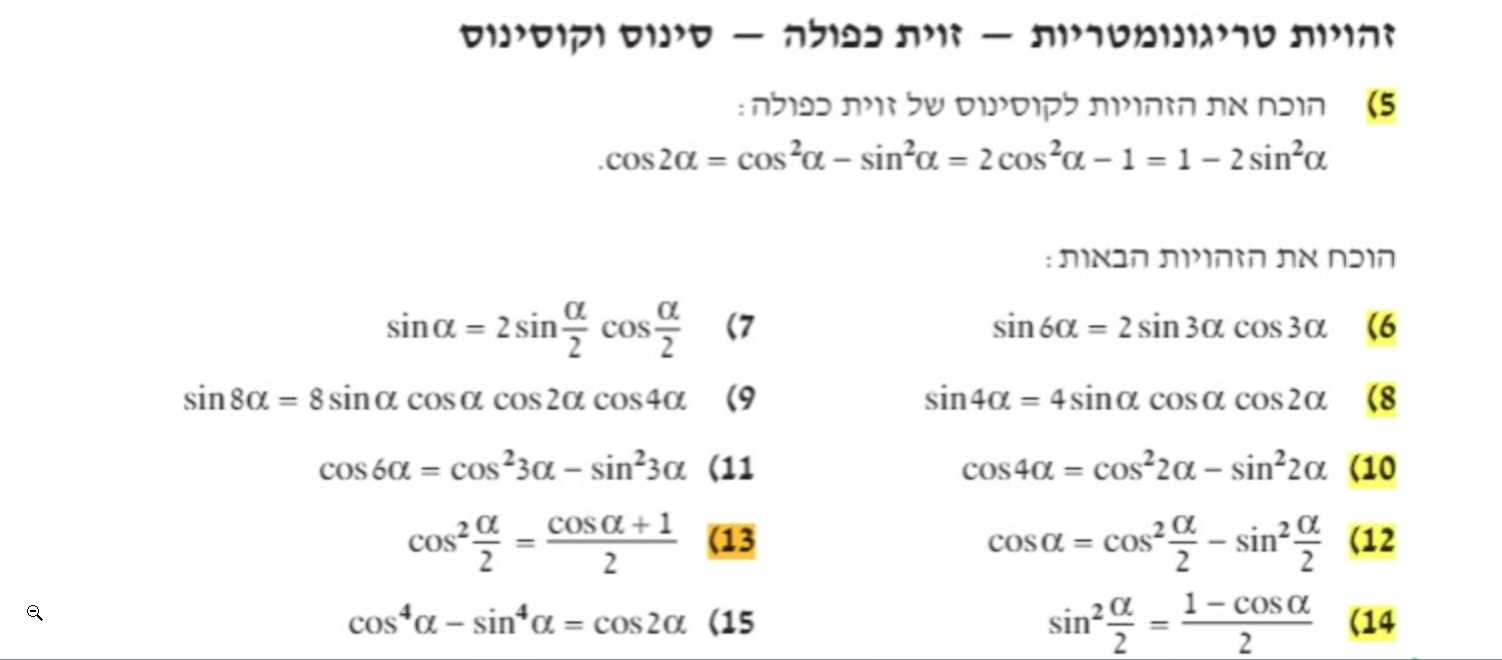
butl ike
the question before
number 5
opaque lantern
brazen swift
https://i.imgur.com/wbt4Jq4.png
ez
brazen swift
says
prove these identities of cosine with a double angle
brazen swift
opaque lantern
ez
ye i did it
opaque lantern
brazen swift
ye i did it
W
brazen swift
so i assume i dont need to repeat ?
also the case at question 6
i just apply it and thats it
🤔
brazen swift
yeah im just overthinking it
opaque lantern
try it
brazen swift
thinking its supposed to be harder
opaque lantern
yw
brazen swift
opaque lantern
yw
any help on 14?
opaque lantern
brazen swift
any help on 14?
lemme see
bro idk abt this one 😭
sorry abt tht i suck at trigono
opaque lantern
thanks for understanding
opaque lantern
have a good day!
brazen swift
u2
acoustic path
brazen swift
any help on 14?
did u do 13
acoustic path
ok
acoustic path
brazen swift
i was looking at the right side
in any case, use the cosine double identity to write cos(a) in terms of sin(a/2)
 noble abyss
 brazen swift
acoustic path
in any case, use the cosine double identity to write cos(a) in terms of sin(a/2)
brazen swift
acoustic path
in any case, use the cosine double identity to write cos(a) in terms of sin(a/2)
and how do i proceed from there?
acoustic path

acoustic path
that is not in terms of sin(a/2)
brazen swift
Oh
i thought
opening the
-cos(a)
is what you meant
but
makes more sense
give me a min
acoustic path
brazen swift
-cos(a)
it is what i meant
brazen swift
huh
acoustic path
but the expression (1-cos^2(0.5a) + sin^2(0.5a)) / 2 is not in terms of sin(a/2)
it is in terms of sin(a/2) and cos(a/2)
brazen swift
in other words?
brazen swift
👍
Oh
howd you know which one to pick?
Assuming because it's the only one to not include cos?
@acoustic path?
acoustic path
brazen swift
Assuming because it's the only one to not include cos?
yes
pearl pondBOT
@brazen swift Has your question been resolved?
pearl pondBOT
Channel closed
Closed due to timeout
Use .reopen if this was a mistake.
pearl pondBOT
Available help channel!
Send your question here to claim the channel.
Remember:
• Ask your math question in a clear, concise manner.
• Show your work, and if possible, explain where you are stuck.
• After 15 minutes, feel free to ping <@&286206848099549185>.
• Type the command .close to free the channel when you're done.
• Be polite and have a nice day!
Read #❓how-to-get-help for further information on how to ask a good question, and about conduct in the question channels.
 midnight haven
 pearl pondBOT
midnight haven
pearl pondBOT
midnight haven
 muted inlet
midnight haven
first time seeing this function can someone nice pls explain wth is going
muted inlet
midnight haven
first time seeing this function can someone nice pls explain wth is going
its called a piecwise and it's really just saying for all numbers x is less then or equal to -1 use the top eqaution to plug in numbers, and for the x values greater then -1 use the bottom equation
midnight haven
yeah but first time seeing this functions graph
muted inlet
ex: if x=-2 (plug into top) 5(-2)+1 =-9. x=0 0^2 -5 =-5
midnight haven
not really but this specific graph
midnight haven
muted inlet
ex: if x=-2 (plug into top) 5(-2)+1 =-9. x=0 0^2 -5 =-5
i understand this part but im not sure how to tell if it's decreasing for this one
muted inlet
k. Just look at the graph and see when the Y value is going down and then see what x values coordinate with the range that the y value is decreasing
midnight haven
i think it goes down from -4? but idk
muted inlet
yes that is the y value when the graph starts to decrease, but you always want to look at the x values because there could be many y=-4 on the graph, but there is only one x=-1
so the graph starts the decrease at x=-1
When does it end the decrease?
midnight haven
dont think it ever does but thats my guess
muted inlet
when the graph is going down it is decreasing and when it goes up it increases. when the y value goes up it increases and when it goes down it decreases
midnight haven
okay
muted inlet
make sure you are always looking left to right when seeing if its increasing or decreasing
 midnight haven
so u said it decreaces at (1-,-4)?
midnight haven
muted inlet
make sure you are always looking left to right when seeing if its increasing or ...
ok
muted inlet
yes that is when it starts to decrease
but then it starts to increase again
when does it stop decreasing?
muted inlet
just pretend your drawing the graph from left to right
midnight haven
theres no option for (-1,-4)
muted inlet
when you pensil starts going down it is decreasing and when it goes up your increasing
midnight haven
muted inlet
when does it stop decreasing?
is it (0,-5)?
muted inlet
midnight haven
theres no option for (-1,-4)
yes!!
(-1,-4) and (0,-5) is in (x,y) it wants you to answer from a range. (x-x) because graphs often cross the same y value more then once but never the same x value
muted inlet
Yeah, but they dont 
midnight haven
so is the 2nd option correct
muted inlet
no
You said that it starts decreasing at (-1,-4) and stops decreasing at (0,-5) but it only wants a range of X VALUES
so you dont care about the y values and just put the two x values together
muted inlet
yep
muted inlet
ofc
midnight haven
.close
pearl pondBOT
Channel closed
Closed by @nimble crystal
Use .reopen if this was a mistake.
Available help channel!
Send your question here to claim the channel.
Remember:
• Ask your math question in a clear, concise manner.
• Show your work, and if possible, explain where you are stuck.
• After 15 minutes, feel free to ping <@&286206848099549185>.
• Type the command .close to free the channel when you're done.
• Be polite and have a nice day!
Read #❓how-to-get-help for further information on how to ask a good question, and about conduct in the question channels.
 gloomy kraken
is this correct?
 pearl pondBOT
gloomy kraken
is this correct?
gloomy kraken
pearl pondBOT
gloomy kraken
is this correct?
gloomy kraken

 dawn sand
looks good to me
gloomy kraken
sorry i think theres supposed to be an 8 in place of 16
dawn sand
k=12 implies j=12+4=16
dawn sand
gloomy kraken
j-4 = k, 12-4
you've subbed 12 for j instead of k
gloomy kraken
dawn sand
you've subbed 12 for j instead of k
oh yea youre right
im slow today
thanks again
dawn sand
mondays amirite
gloomy kraken
.close
pearl pondBOT
Channel closed
Closed by @gloomy kraken
Use .reopen if this was a mistake.
Available help channel!
Send your question here to claim the channel.
Remember:
• Ask your math question in a clear, concise manner.
• Show your work, and if possible, explain where you are stuck.
• After 15 minutes, feel free to ping <@&286206848099549185>.
• Type the command .close to free the channel when you're done.
• Be polite and have a nice day!
Read #❓how-to-get-help for further information on how to ask a good question, and about conduct in the question channels.
 orchid cobalt
 pearl pondBOT
orchid cobalt
pearl pondBOT
orchid cobalt

 old marsh
ok well u showed some good logic
but just start over
keep it in radical form
rewrite sqrt(15) as a product of radicals
what do u get
orchid cobalt
old marsh
keep it in radical form
alr alr
orchid cobalt
old marsh
rewrite sqrt(15) as a product of radicals
square root of 3 and square root of 5-?
old marsh
$\frac 1{\sqrt 3} - \frac {2\sqrt 3}{\sqrt 5 \cdot \sqrt 3}$
 jolly parrotBOT
 old marsh
ok now what
orchid cobalt
guys im sorry im kind slow at this
does the square root of three on the numerator and denominator cancel out-?
orchid cobalt
oh how would i do that?
old marsh
$\frac ab - \frac cd$
jolly parrotBOT
 old marsh
how would u make common denominators here
orchid cobalt
oh damn ure right
old marsh
$\frac 12 - \frac 23$
jolly parrotBOT
 old marsh
how would u make common denominators for this
orchid cobalt
id just make them both 6
old marsh
ok but howd u get that
old marsh
exactly
and how did u get 3/3
and 2/2
ur on the right track, just tell me ur reasoning
orchid cobalt
would i do this-?
 orchid cobalt
old marsh
ur on the right track, just tell me ur reasoning
orchid cobalt
old marsh
ur on the right track, just tell me ur reasoning
oh cuz the the lcm
jolly parrotBOT
 old marsh
ok well yes, that looks correct, but theres a better way
mult left fraction by sqrt5 / sqrt5
orchid cobalt
old marsh
ok well yes, that looks correct, but theres a better way
is it simplifying-?
would they cancel out?
old marsh
no we dont want to cancel anything out yet
$\frac 1{\sqrt 3} - \frac {2\sqrt 3}{\sqrt 5 \cdot \sqrt 3}$
back to this
jolly parrotBOT
 old marsh
see how the denominator of the right fraction is sqrt 3 * sqrt 5
orchid cobalt
yes
old marsh
mutliply the left fraction by sqrt5 / sqrt 5
so u will get sqrt3 * sqrt 5 in both denominators
old marsh
$\frac {\sqrt 5}{\sqrt 5 \cdot \sqrt 3} - \frac {2\sqrt 3}{\sqrt 5 \cdot \sqrt 3}$
jolly parrotBOT
 orchid cobalt
how do we simplify it further?
old marsh
now what do we do after we get common denominators
old marsh
$\frac ac - \frac bc = \frac {a-b}c$
jolly parrotBOT
 old marsh
thats all theres to it
 orchid cobalt
is this the final answer?
orchid cobalt
old marsh
nah ur good dw
ty kind soul
old marsh
meaning, we cant have any radicals in the denominator
how can we get rid of that sqrt(15) in the denominator
orchid cobalt
oh could the square root of 5 cancel out and the square root of 3 cancel out?

btw this is the answer ;-;
old marsh
orchid cobalt
oh could the square root of 5 cancel out and the square root of 3 cancel out?
not quite
so we have
$\frac {\sqrt 5 - 2\sqrt 3}{\sqrt {15}}$
jolly parrotBOT
 orchid cobalt
mhmm
old marsh
now to rationalize
we have to multiply the numerator and the denominator by sqrt(15)
lmk what u get when doing that
old marsh
ok so ur denominator is correct, but we have to distribute the sqrt(15) to the numerator
$\frac {\sqrt{15} (\sqrt 5 - 2\sqrt 3)}{15}$
orchid cobalt
oh ok
old marsh
can u distribute that
jolly parrotBOT
 old marsh
when u distribute u get
$\frac {\sqrt{15} \cdot \sqrt 5 - \sqrt {15} \cdot 2\sqrt 3}{15}$
orchid cobalt
 jolly parrotBOT
 orchid cobalt
is this it-?
orchid cobalt
OMG TYSM!!
orchid cobalt
.close
pearl pondBOT
Channel closed
Closed by @orchid cobalt
Use .reopen if this was a mistake.
pearl pondBOT
Available help channel!
Send your question here to claim the channel.
Remember:
• Ask your math question in a clear, concise manner.
• Show your work, and if possible, explain where you are stuck.
• After 15 minutes, feel free to ping <@&286206848099549185>.
• Type the command .close to free the channel when you're done.
• Be polite and have a nice day!
Read #❓how-to-get-help for further information on how to ask a good question, and about conduct in the question channels.
 deep thistle
How does the top group of cells simplify to A'?

 plush bramble
deep thistle
How does the top group of cells simplify to A'?
plush bramble
deep thistle
How does the top group of cells simplify to A'?
Not enough context
What are A and Abar
 cosmic charm
its a k-map
 feral leaf
deep thistle
How does the top group of cells simplify to A'?
feral leaf
deep thistle
How does the top group of cells simplify to A'?
Because A'B' + A'B = A'(B' + B) = A'(1)
deep thistle
I don't think I you more context for this tbh
deep thistle
feral leaf
Because A'B' + A'B = A'(B' + B) = A'(1)
Wait, I think I get it now. If there's a group of minterms in a row or column, does the simplified Boolean expression correspond to the variable for that row or column?
feral leaf
Not always, it depends on the number of terms
deep thistle
feral leaf
Not always, it depends on the number of terms
I meant like for example in this case
2 terms
feral leaf
Then yes
 feral leaf
Yes
pearl pondBOT
Channel closed
Closed by @deep thistle
Use .reopen if this was a mistake.
pearl pondBOT
Available help channel!
Send your question here to claim the channel.
Remember:
• Ask your math question in a clear, concise manner.
• Show your work, and if possible, explain where you are stuck.
• After 15 minutes, feel free to ping <@&286206848099549185>.
• Type the command .close to free the channel when you're done.
• Be polite and have a nice day!
Read #❓how-to-get-help for further information on how to ask a good question, and about conduct in the question channels.
 opaque hearth
How could you find two vectors u and v given their cross product?
 west sapphire
there's no unique answer
sharp vigil
that wouldn't have a unique answer. for example
i x j = k
j x (-i) = k
west sapphire
more generally, take i and j, and rotate them both by the same angle (any angle), cross product is still k
pearl pondBOT
@opaque hearth Has your question been resolved?
pearl pondBOT
Channel closed
Closed due to timeout
Use .reopen if this was a mistake.
pearl pondBOT
Available help channel!
Send your question here to claim the channel.
Remember:
• Ask your math question in a clear, concise manner.
• Show your work, and if possible, explain where you are stuck.
• After 15 minutes, feel free to ping <@&286206848099549185>.
• Type the command .close to free the channel when you're done.
• Be polite and have a nice day!
Read #❓how-to-get-help for further information on how to ask a good question, and about conduct in the question channels.
 glad glen
I'm having trouble with 31. i dont know how to even start the equation

 versed ledge
glad glen
I'm having trouble with 31. i dont know how to even start the equation
versed ledge
glad glen
I'm having trouble with 31. i dont know how to even start the equation
AOC = AOB + BOC , maybe start with that?
pearl pondBOT
Channel closed
Closed by @glad glen
Use .reopen if this was a mistake.
pearl pondBOT
Available help channel!
Send your question here to claim the channel.
Remember:
• Ask your math question in a clear, concise manner.
• Show your work, and if possible, explain where you are stuck.
• After 15 minutes, feel free to ping <@&286206848099549185>.
• Type the command .close to free the channel when you're done.
• Be polite and have a nice day!
Read #❓how-to-get-help for further information on how to ask a good question, and about conduct in the question channels.
 outer hare
Hey, can anyone explain what this k represents:
 pearl pondBOT
outer hare
Hey, can anyone explain what this k represents:
outer hare
pearl pondBOT
outer hare
Hey, can anyone explain what this k represents:
outer hare
here is the 2.5 they are referencing:

im having trouble understanding how to find a max bound
pearl pondBOT
@outer hare Has your question been resolved?
 merry carbon
outer hare
Hey, can anyone explain what this k represents:
merry carbon
outer hare
Hey, can anyone explain what this k represents:
The k is the[/an] upper bound of the (absolute value of the) derivative, you ideally should be given that before: for example, if you take g(x) = e^x on the interval, say, [-2, -1], then the derivative is at most e^{-1}, which is less than 1
outer hare
So for this case the max will always be 1 no
Like taking a look at the theorem before it
merry carbon
outer hare
Hey, can anyone explain what this k represents:
Well, for here, the k they mention here, is the same as...
merry carbon
outer hare
...the k in the theorem
merry carbon
What you want is that there's some constant, which is less than 1, such that the absolute value of the derivative is less than that (which is stronger than saying you want |g'(x)| < 1)
merry carbon
outer hare
So is k just the abs value of the derivative at p_0
Not necessarily, you can e.g. take $k = \sup_{x\in (a, b)} \abs{g'(x)}$, and you want that to be forced less than 1
jolly parrotBOT
@merry carbon
 outer hare
Hmm
merry carbon
It needn't be its maximum at the point p0 you've chosen, in fact, for the example of e^x in [-2, -1], any point in that interval can be chosen as p0 (but the max happens at -1)
outer hare
Ok wait I’m not looking at it rn but I’ll get a paper and try to understand it when I get back
But from what I get, k is just the max value of the derivative within the interval
merry carbon
Yep, that's pretty much what you kind of want, that k is the max (or sup) of the absolute value of the derivative
But as long as that k is strictly less than 1...
pearl pondBOT
Channel closed
Closed by @outer hare
Use .reopen if this was a mistake.
Available help channel!
Send your question here to claim the channel.
Remember:
• Ask your math question in a clear, concise manner.
• Show your work, and if possible, explain where you are stuck.
• After 15 minutes, feel free to ping <@&286206848099549185>.
• Type the command .close to free the channel when you're done.
• Be polite and have a nice day!
Read #❓how-to-get-help for further information on how to ask a good question, and about conduct in the question channels.
 naive hemlock
Need help with this question
Explanation would be appreciated
 pearl pondBOT
@naive hemlock Has your question been resolved?
 terse bloom
naive hemlock
Need help with this question
Explanation would be appreciated
terse bloom
naive hemlock
Need help with this question
Explanation would be appreciated
is this possible
the identity function satisfies all three of the restraints and has a derivative of 1 at x = 0
west sapphire
i suspect it should have said f(0) = 0
west sapphire
yea?
naive hemlock
Can u help
west sapphire
as noted, the problem is incorrect
naive hemlock
Like I did not get what you all were speaking above
west sapphire
f(x) = x is a counterexample
naive hemlock
west sapphire
as noted, the problem is incorrect
Oh
west sapphire
well where did you find the problem?
west sapphire
is that a screenshot of the assignment, or did you write your own version
west sapphire
yea i would confirm with whoever wrote it, what did they intend
naive hemlock
Yes tell
west sapphire
naive hemlock
Why would I write my own version
you would be surprised, people do it all the time in these channels
west sapphire
anyway i am pretty sure they meant f(0) = 0, not f'(0) = 0
naive hemlock
Ok so now for f(0)=0
west sapphire
and if that's the case, you can prove it pretty easily using the mean value theorem
west sapphire
yep
west sapphire
assume for contradiction that f(0) is not 0
west sapphire
you should find that the slope has to exceed 1 in abs val in one of the two intervals
west sapphire
ok
 west sapphire
no start by assuming that f(0) is not 0
so there are two possibilities
either f(0) > 0 or f(0) < 0
naive hemlock
Wait
west sapphire
if f(0) > 0, then do the MVT on [-a,0]
west sapphire
otherwise do it on [0,a]
(this is assuming a > 0)
btw, they should have stipulated a != 0 in any case, otherwise it's not true
naive hemlock
See
I got
f'(c)=[f(0)-a]/a in [-a,0] and f'(d)=[a-f(0)]/a in [0,a]
Now ?
Fr my mind is blocked today
west sapphire
yea so if f(0) > 0 then in the interval [-a,0] you have:
[f(0) - (-a)] / (0 - (-a)) = [f(0) + a] / a = f(0)/a + 1 > 1
and so there has to be a c with f'(c) > 1
contradiction
argue similarly if f(0) < 0
naive hemlock
Cz I don't think the teacher has told us about assumption in any of the practice problems
west sapphire
which assumption?
naive hemlock
I need to frame and explain
Is there not any method
Which uses the mean value theorems
And gives somewhat direct result?
west sapphire
that's the simplest argument i can think of
naive hemlock
Bro you are right?
But is there?
Pls try
This question's solution has to go in the assignment In a well explained wau
Way*
west sapphire
i already gave you a nearly complete argument haha
i'm not gonna write it out in camera-ready form
naive hemlock
Oh
Oof
Bro I don't need the solution
I need some other simple way
Which directly proves f(0)=0
Without taking f(0)>0 and f(0)<0 in the beginning
@west sapphire
pearl pondBOT
@naive hemlock Has your question been resolved?
pearl pondBOT
@naive hemlock Has your question been resolved?
naive hemlock
<@&286206848099549185>
pearl pondBOT
@naive hemlock Has your question been resolved?
naive hemlock
@west sapphire thanks got it
@west sapphire

Can I be helped with these two questions also
Aah
Fr
<@&286206848099549185>
Anyone?
 rough forge
naive hemlock
Anyone?
rough forge
naive hemlock
Anyone?
Maybe you are better of in #real-complex-analysis or #proofs-and-logic
rough forge
No
It's like the same like last time lol
You may also ask in calculus
most of the time the pros are there
 plucky python
then it's twice differentiable with f(a) = f(b) = 0 and f(c) > 0 for all c in (a,b)
plucky python
but f''(x) = -2 so the conclusion is not true
naive hemlock
My assignment is due tmrw
That's why I came here now at last to understand
This
One
Question
plucky python
plucky python
if f(x) = 1 - x^2, a=-1, b=1
this seems to be a counterexample so i think there needs to be extra conditions
naive hemlock
Can u try for once
plucky python
wdym?
plucky python
i mean like you can create a scenario in which it is true
plucky python
plucky python
if f(x) = 1 - x^2, a=-1, b=1
but this is a counterexample so the statement must be missing something
naive hemlock
Ik
Honestly
Speaking
Can u see the 14th one
Once
I will send the pic again wait
naive hemlock

In 14th one
If u remove the right term from consideration
It becomes cmvt
Cauchy's mean value theorem
plucky python
yes
naive hemlock
But then we don't have g'(x) not equal to 0
Its given g(x) not equal to 0
The assignment has questions that are too ambiguous
Can u suggest what should I do now
For the 15th one
I need to write an answer for it
Should I modify the question
plucky python
naive hemlock
For the 15th one
probably write up like 1-x^2 as a counterexample
naive hemlock
plucky python
probably write up like 1-x^2 as a counterexample
I can't
plucky python
and say that the problem seems to be wrong
plucky python
naive hemlock
I need to write an answer for it
do you have to submit all ur problems?
plucky python
bruh
naive hemlock
But I am troubled with this one
Two above troubled me too
But I cross checked and the questions were wrong
So I modified them
But 14. And 15. Trouble me
Too much
plucky python
naive hemlock
But 14. And 15. Trouble me
well idk abt 15 cus i'm not exactly sure what the problem is meant to be?
naive hemlock
Me too
plucky python
also have u tried posting it to real and complex analysis?
naive hemlock
Should I?
plucky python
naive hemlock
oh wait
naive hemlock
Isn't it supposed to be calculus?
plucky python
for 14
plucky python
try cauchy MVT on f and 1/g
naive hemlock
Aah
plucky python
i think that works
plucky python
cus G(a)G(b)/(G(b)-G(a) is 1/(1/G(a) - G(b)) or whatever
naive hemlock
But
Wait
Its surreal
Yes it works
That's why they gave g(x) not zero for any x
Thanks bro u saved me
plucky python
nw lol
naive hemlock
Wait now I need to get other s checked.too
plucky python
also it seems a little strict that you have to submit for every problem
plucky python
like at my uni we don't need to submit all the problems, as long as we've given like a proper attempt at the sheet
naive hemlock
And they will be evaluated
Under iA
Internal assessment
Along with if the professor wants
A viva
Sort of
💀
Wait see this
Wait let me send specific one

Check for 11
Is it correct
cz I have assumed that it should be f(0)=0
And done it
@plucky python
plucky python
naive hemlock
cz I have assumed that it should be f(0)=0
you can prove that
if f(0) > 0 then you get a contradiction by applying MVT to -a and 0
if f(0) < 0 then you get a contradiction by applying MVT to 0 and a
UK
i study at cambridge uni
naive hemlock
plucky python
if f(0) > 0 then you get a contradiction by applying MVT to -a and 0
Yea did this only
plucky python
naive hemlock
Can u check will it be f'(0)=0 only
well i think it'll be f'(x) = 0 for all x on that interval
but technically if you prove that you also prove f'(0) = 0 lol?
naive hemlock
What
What
What
@plucky python
I will make myself clear
I assumed the question will be f(0)=0 and proved it
Will in the question it will remain f'(0)=0
Only
plucky python
oh right i understand what ur asking now
i think the question is meant to be prove f'(0) = 0
plucky python
plucky python
if f(0) < 0 then you get a contradiction by applying MVT to 0 and a
cus this same argument shows that f(x) = x for all x
naive hemlock
Ok
plucky python
so f'(0) = 0
plucky python
plucky python
if f(0) > 0 then you get a contradiction by applying MVT to -a and 0
so basically apply this same argument for every other x in (-a, a)
this gives you f(x) = x for all x in that interval
i think the question basically wants you to just show that f has to be linear
and it's asking you to do that by showing f'(0) = 0
oh wait ignore me i'm dumb
the derivative of a linear function isn't 0 mb lol
plucky python
naive hemlock
Bro but don't you think this prove f(0)=0
yeah ok it'll be that then
rough forge
Your assignment is crazy
plucky python
naive hemlock
In the 14.
yeah?
plucky python
naive hemlock
is this about that G'(c) might be 0?
if so i feel like that's an issue that they sort-of brushed to the side
naive hemlock
No
I mean
Will there be no problem
Using 1/G(x)
Imma come
I need to make a cover
Wait
plucky python
naive hemlock
Using 1/G(x)
there might be an issue if say g'(c) = 0 but i think they just forgot about this issue
naive hemlock
Okok
No it does not say g'(c)=0
Ya wait
You are correct
They have not given that g'(c) is not zero
pearl pondBOT
@naive hemlock Has your question been resolved?
pearl pondBOT
Channel closed
Closed due to timeout
Use .reopen if this was a mistake.
Available help channel!
Send your question here to claim the channel.
Remember:
• Ask your math question in a clear, concise manner.
• Show your work, and if possible, explain where you are stuck.
• After 15 minutes, feel free to ping <@&286206848099549185>.
• Type the command .close to free the channel when you're done.
• Be polite and have a nice day!
Read #❓how-to-get-help for further information on how to ask a good question, and about conduct in the question channels.
 abstract halo

 pearl pondBOT
abstract halo
abstract halo
pearl pondBOT
abstract halo
abstract halo
so in this situation, finding the characteristic equation would be 10r^2+20r+6260=100 -> r^2+2r+626=10
solving that gets me r = -1 +- 25i
for my homogeneous equation, would it be q(t) or I(t)?
I'm thinking its q(t) but the hint makes me go towards I(t), but I'm not sure how I(t) makes sense. If I go the q(t) route, I get C1= 0, C2=0
merry carbon
abstract halo
so in this situation, finding the characteristic equation would be 10r^2+20r+626...
Assuming you put $I = \dv{q}{t}$ into $L\dv{I}{t} + RI + \frac{q}C = E(t)$ to get a second order diffeq in terms of $q$?
jolly parrotBOT
@merry carbon
 abstract halo
yes
merry carbon
In which case, the solutions you find would be for q
abstract halo
I'm getting my constants as C1 = 0 and C2 = 0, in which case q(t) just = 0
do I have to multiply them by some power of t?
 terse tide
the differential equation gotta be in terms of i, not q
after you differentiate, put dq/dt = i
merry carbon
abstract halo
I'm getting my constants as C1 = 0 and C2 = 0, in which case q(t) just = 0
What constants, the homogenous one?
terse tide
dont change everything to q, why
 merry carbon
terse tide
dont change everything to q, why
merry carbon
terse tide
dont change everything to q, why
It would be easier that way no? Am I missing something
terse tide
no no :p
when he differentiates, hell get the dq/dt (3rd term)
he replaces that with i(t) and there you go
i'' + 2 i' + 626 i = 0
abstract halo
hmmm I seee
abstract halo
terse tide
i'' + 2 i' + 626 i = 0
sorry, so just to confirm, I should differentiate the original equation then to get i''?
and i' and i terms
terse tide
yes, i' will become i'', and i will become i'
abstract halo
thank you guys!!!
terse tide
and q will become dq/dt, which is i
abstract halo
.close
pearl pondBOT
Channel closed
Closed by @abstract halo
Use .reopen if this was a mistake.
pearl pondBOT
Available help channel!
Send your question here to claim the channel.
Remember:
• Ask your math question in a clear, concise manner.
• Show your work, and if possible, explain where you are stuck.
• After 15 minutes, feel free to ping <@&286206848099549185>.
• Type the command .close to free the channel when you're done.
• Be polite and have a nice day!
Read #❓how-to-get-help for further information on how to ask a good question, and about conduct in the question channels.
 dusk otter
Need some assistance with this natural deduction proof. I have been playing around with it, but unsure of the next step I can take. I have attached the rules that I can use.

 pearl pondBOT
dusk otter
Need some assistance with this natural deduction proof. I have been playing arou...
pearl pondBOT
dusk otter
Need some assistance with this natural deduction proof. I have been playing arou...
@dusk otter Has your question been resolved?
pearl pondBOT
@dusk otter Has your question been resolved?
pearl pondBOT
Channel closed
Closed due to timeout
Use .reopen if this was a mistake.
Available help channel!
Send your question here to claim the channel.
Remember:
• Ask your math question in a clear, concise manner.
• Show your work, and if possible, explain where you are stuck.
• After 15 minutes, feel free to ping <@&286206848099549185>.
• Type the command .close to free the channel when you're done.
• Be polite and have a nice day!
Read #❓how-to-get-help for further information on how to ask a good question, and about conduct in the question channels.
 slim rock
i dont get how im supposed to solve this
 pearl pondBOT
slim rock
i dont get how im supposed to solve this
slim rock
pearl pondBOT
slim rock
i dont get how im supposed to solve this
slim rock
this is all of the instructions
do i not just have to get the x value of that midpoint?
slim rock
right i give the value thats literally on top of that mid point
i just dont understand what its asking in that first part

 vestal tapir
ok that doesn't make sense, y=0 is not even visible
you should zoom out and move the sides so they are around 0
vestal tapir
yeah no idea
vestal tapir
maybe you can retry it and it will be zoomed out
pearl pondBOT
@slim rock Has your question been resolved?
pearl pondBOT
Channel closed
Closed due to timeout
Use .reopen if this was a mistake.
Available help channel!
Send your question here to claim the channel.
Remember:
• Ask your math question in a clear, concise manner.
• Show your work, and if possible, explain where you are stuck.
• After 15 minutes, feel free to ping <@&286206848099549185>.
• Type the command .close to free the channel when you're done.
• Be polite and have a nice day!
Read #❓how-to-get-help for further information on how to ask a good question, and about conduct in the question channels.
 quick jewel
How do I complete number 7
 pearl pondBOT
quick jewel
How do I complete number 7
pearl pondBOT
quick jewel
How do I complete number 7
 tall flint
quick jewel
tall flint
quick jewel
I've just been figuring out what kind of equations I could possibly make to get a (first term) or d (difference)
I'm not sure what to start with
tall flint
"the 11th term is 53" should give you one such equation
quick jewel
What would the equation be though
I have no examples from the teacher to base it off of
tall flint
if you have an arithmetic sequence, what is the 11th term in general?
please don't say 53
quick jewel
53 = a + 10d?
tall flint
that doesn't answer the question i just asked but yes that's one of your equations
quick jewel
Sorry lol
tall flint
where do you think your second equation comes from?
pearl pondBOT
@quick jewel Has your question been resolved?
cloud zephyr
quick jewel
How do I complete number 7
what formula(e) do you have right now?

 pearl pondBOT
@quick jewel Has your question been resolved?
pearl pondBOT
Channel closed
Closed due to timeout
Use .reopen if this was a mistake.
Available help channel!
Send your question here to claim the channel.
Remember:
• Ask your math question in a clear, concise manner.
• Show your work, and if possible, explain where you are stuck.
• After 15 minutes, feel free to ping <@&286206848099549185>.
• Type the command .close to free the channel when you're done.
• Be polite and have a nice day!
Read #❓how-to-get-help for further information on how to ask a good question, and about conduct in the question channels.
 covert nymph
Could someone explain why the answer is not DNE or 0? I've tried multiple times?
 pearl pondBOT
covert nymph
Could someone explain why the answer is not DNE or 0? I've tried multiple times?
covert nymph
pearl pondBOT
covert nymph
Could someone explain why the answer is not DNE or 0? I've tried multiple times?
covert nymph
 plush bramble
covert nymph
Could someone explain why the answer is not DNE or 0? I've tried multiple times?
plush bramble
covert nymph
Could someone explain why the answer is not DNE or 0? I've tried multiple times?
The slope at 4 is ?
Do you know how to find the slope of a line?
covert nymph
yes it's (y2-y1)/(x2-x1)
covert nymph
ok so i got
the slope is 1/2 and if i plug in (using 5,2) y-2 = 1/2 (x-5) i get y=1/2x - 0.5
pearl pondBOT
Channel closed
Closed by @covert nymph
Use .reopen if this was a mistake.
pearl pondBOT
Available help channel!
Send your question here to claim the channel.
Remember:
• Ask your math question in a clear, concise manner.
• Show your work, and if possible, explain where you are stuck.
• After 15 minutes, feel free to ping <@&286206848099549185>.
• Type the command .close to free the channel when you're done.
• Be polite and have a nice day!
Read #❓how-to-get-help for further information on how to ask a good question, and about conduct in the question channels.
 meager fog
Back again…. I think I have the math part down. I’m just confused on how I answer.

 pearl pondBOT
meager fog
Back again…. I think I have the math part down. I’m just confused on how I answ...
pearl pondBOT
meager fog
Back again…. I think I have the math part down. I’m just confused on how I answ...
 cosmic garnet
what?

where did the middle 100 come from
also
why are you calculating values with both
meager fog
d. f(-100) + (100)
cosmic garnet
cosmic garnet
why are you calculating values with both
f(-8), you have to calculate f(x) at x=-8, for x < 0 the function is defined as

so you just have to calculate with this
cosmic garnet
meager fog
d. f(-100) + (100)
it is f(-100) + f(100)
versed ledge
midnight haven
f(-100) -100 is your x
Maybe give a comma
midnight haven
then f(100) is ofc >0
meager fog
Oooo ok my math teacher literally went over this in the last five minutes of class and was like OK guys go do homework
midnight haven
so you enter case >=0
midnight haven
versed ledge
Maybe give a comma
i think she understand with or without
midnight haven
meager fog
Oooo ok my math teacher literally went over this in the last five minutes of cla...
sad
its okay we can help
that's why we are here for
all of us, helpers.
meager fog
Ok let’s see if I got it
midnight haven
show us
meager fog

 midnight haven
d is not 3 yea
meager fog
Would it be 8 (-100)+3=-797?
midnight haven
no
you dont have the case just f(-100)
if it asked you for just f(-100) that would be the answerr
but it asks you for
f(-100) +f(100)
the result from f(-100) you add with the result from f(100)
brb
midnight haven
 meager fog
-599+803=204
meager fog
Phew I wouldn’t have thought of that. Thank you guys!! Google and YouTube were not teaching me how to do it!
meager fog
.close
pearl pondBOT
Channel closed
Closed by @meager fog
Use .reopen if this was a mistake.
Available help channel!
Send your question here to claim the channel.
Remember:
• Ask your math question in a clear, concise manner.
• Show your work, and if possible, explain where you are stuck.
• After 15 minutes, feel free to ping <@&286206848099549185>.
• Type the command .close to free the channel when you're done.
• Be polite and have a nice day!
Read #❓how-to-get-help for further information on how to ask a good question, and about conduct in the question channels.
 hasty crater
sorry if im in the wrong channel I was looking to get some help with this https://cdn.discordapp.com/attachments/1285669898009317417/1285669898155982848/7127df816e6612f571bfef8732736102.png?ex=66eb1ce6&is=66e9cb66&hm=dde76fd8f6f51b8358ab979dcc8a8d994ef98b333c29491eccc5c527f38f9f3d& I know it's a non right triangle vector I've watched videos but don't understand what i need to do
 pearl pondBOT
hasty crater
sorry if im in the wrong channel I was looking to get some help with this https:...
pearl pondBOT
hasty crater
sorry if im in the wrong channel I was looking to get some help with this https:...
@hasty crater Has your question been resolved?
pearl pondBOT
@hasty crater Has your question been resolved?
pearl pondBOT
@hasty crater Has your question been resolved?
Channel closed
Closed by @hasty crater
Use .reopen if this was a mistake.
Available help channel!
Send your question here to claim the channel.
Remember:
• Ask your math question in a clear, concise manner.
• Show your work, and if possible, explain where you are stuck.
• After 15 minutes, feel free to ping <@&286206848099549185>.
• Type the command .close to free the channel when you're done.
• Be polite and have a nice day!
Read #❓how-to-get-help for further information on how to ask a good question, and about conduct in the question channels.
 stone imp
 pearl pondBOT
Channel closed
Closed by @stone imp
Use .reopen if this was a mistake.
stone imp
.reopen
pearl pondBOT
✅

 wet swallow
Is this translated
stone imp
Unfortunately
 woeful stump
wet swallow
Is this translated<:bleak:877093280905592842>
woeful stump
wet swallow
Is this translated<:bleak:877093280905592842>
yeah but it's pretty clear imo?
the equation is coffee + roll = juice + cookie
stone imp
Won’t it be the same as
woeful stump
idk maybe
stone imp
They have the same worth and numbers
woeful stump
solve and find out
stone imp
Okay I try
midnight haven
Hello
woeful stump
lol okay
woeful stump
woeful stump
the equation is coffee + roll = juice + cookie
substitute back into this equation if you wanna check
confirm they're equal
stone imp
Wait 12+7 is 21 Right
woeful stump
 wet swallow
Lol
stone imp
Yeah it juys hit me
The way I was so confused when it said it was wrong
Okay we’re done with my stupidity here u will probably see me soon again but bye bye for now 😚
.close
pearl pondBOT
Channel closed
Closed by @stone imp
Use .reopen if this was a mistake.
stone imp
.reopen
pearl pondBOT
✅
stone imp
Hi hi
0.01+0.01x=0.1x
That’s
That’s 0.1111111111 right
Right …
It says answer algebraically
And to answer exactly
So I did that
 versed bluff
May if you Transform it to a fraction Will be easer to solve dontk
stone imp
How do I do that
versed bluff
Soo You write in the numerator the Hole number whitout comma and below You put a 1 and add ceros as many decimals the number has
stone imp
Okay where do I do that

 summer prawn
Oh, couldn't you represent all of these by the same denominator?
wet swallow
Wut
wet swallow
stone imp
0.01+0.01x=0.1x
Is this the question
wet swallow
Convert to fractions
summer prawn
$\frac{1}{100}+\frac{1}{100}x=\frac{1}{10}x$
jolly parrotBOT
Makenna
 summer prawn
$\frac{1}{100}+\frac{1}{100}x=\frac{10}{100}x$
jolly parrotBOT
Makenna
 summer prawn
$\frac{1}{100}=\frac{10}{100}x-\frac{1}{100}x$
jolly parrotBOT
Makenna
 summer prawn
can you go from here?
stone imp
The answer was 1/9 bcs my brother touched the answer button he wasn’t supposed to but I still don’t get it
pearl pondBOT
@stone imp Has your question been resolved?
pearl pondBOT
Channel closed
Closed due to timeout
Use .reopen if this was a mistake.
Available help channel!
Send your question here to claim the channel.
Remember:
• Ask your math question in a clear, concise manner.
• Show your work, and if possible, explain where you are stuck.
• After 15 minutes, feel free to ping <@&286206848099549185>.
• Type the command .close to free the channel when you're done.
• Be polite and have a nice day!
Read #❓how-to-get-help for further information on how to ask a good question, and about conduct in the question channels.
dusk otter
I am trying to prove that associativity is present in this binary operation (i.e. (g+h)^3).
I am not sure how to do the g*(h * i )
 pearl pondBOT
dusk otter
I am trying to prove that associativity is present in this binary operation (i.e...
pearl pondBOT
dusk otter
I am trying to prove that associativity is present in this binary operation (i.e...
 torn shell
you just do the same with h * i first
g * (h+i)^3=(g+(h+i)^3)^3
im not sure how its associative though
torn shell
so you would need those to be equal
torn shell
i think you cna just argue that they are not the same directly from this idk how necessary it is to expand
merry carbon
(you could try and also find explicit a,b,c such that ((a + b)^3 + c)^3 and (a + (b + c)^3)^3 are diferent)
dusk otter
torn shell
i think you cna just argue that they are not the same directly from this idk how...
Like this?
 torn shell
would comparing terms work too
dusk otter
merry carbon
(you could try and also find explicit a,b,c such that ((a + b)^3 + c)^3 and (a +...
Hmm I am not sure which way would work for a better argument
Is there a point to the k in the first aprt?
Idk If I am seeing the purpose there
torn shell
like you would hasve some g^9 term but not on the other one right
torn shell
dusk otter
Is there a point to the k in the first aprt?
no not needed. but you coped the g * h part in the 2nd part should be h * i for clarity
chartbit counterexample works well and is easyh
dusk otter
hmm okay maybe a counter example would be the better option then
torn shell
also for the conclusion the operator * is what is not associative
dusk otter
torn shell
also for the conclusion the operator * is what is not associative
Okay thank you!
dusk otter
torn shell
no not needed. but you coped the g * h part in the 2nd part should be h * i for ...
which piece are you referring to ?


 torn shell
well h * i would be (h+i)^3
pearl pondBOT
@dusk otter Has your question been resolved?
pearl pondBOT
Channel closed
Closed due to timeout
Use .reopen if this was a mistake.
Available help channel!
Send your question here to claim the channel.
Remember:
• Ask your math question in a clear, concise manner.
• Show your work, and if possible, explain where you are stuck.
• After 15 minutes, feel free to ping <@&286206848099549185>.
• Type the command .close to free the channel when you're done.
• Be polite and have a nice day!
Read #❓how-to-get-help for further information on how to ask a good question, and about conduct in the question channels.
Channel closed
Closed by @karmic loom
Use .reopen if this was a mistake.
Available help channel!
Send your question here to claim the channel.
Remember:
• Ask your math question in a clear, concise manner.
• Show your work, and if possible, explain where you are stuck.
• After 15 minutes, feel free to ping <@&286206848099549185>.
• Type the command .close to free the channel when you're done.
• Be polite and have a nice day!
Read #❓how-to-get-help for further information on how to ask a good question, and about conduct in the question channels.
 sand coyote
help
 pearl pondBOT
sand coyote
help
sand coyote
pearl pondBOT
sand coyote
help
sand coyote
I need to show that the angle is 90 degres
I know its the dot product
But how do i apply it
in this context
merry carbon
Which angle do you want to show is 90?
sand coyote
B
merry carbon
Well, you can effectively rephrase that as saying that the line (segments) AB and BC are perpendicular
...if that's enough to cook with? 
sand coyote
No i think they want me to proove it with
Calculations
I can do Dot product of a and b =0
But im not sure how to apply that here and which coordinates to use
sand coyote
sand coyote
I can do Dot product of a and b =0
I know this will work as a proof
To find vector BA, (-2-0; 0-4) and vector BC (8,-4)
something like this
pearl pondBOT
@sand coyote Has your question been resolved?
merry carbon
sand coyote
To find vector BA, (-2-0; 0-4) and vector BC (8,-4)
Yep, and...
merry carbon
sand coyote
I can do Dot product of a and b =0
...you figured that if you showed their dot product to be 0, then they're perpendicular 
pearl pondBOT
Channel closed
Closed due to timeout
Use .reopen if this was a mistake.
Available help channel!
Send your question here to claim the channel.
Remember:
• Ask your math question in a clear, concise manner.
• Show your work, and if possible, explain where you are stuck.
• After 15 minutes, feel free to ping <@&286206848099549185>.
• Type the command .close to free the channel when you're done.
• Be polite and have a nice day!
Read #❓how-to-get-help for further information on how to ask a good question, and about conduct in the question channels.
 deep girder
can someone explain this funky rule to me?
 pearl pondBOT
deep girder
can someone explain this funky rule to me?
pearl pondBOT
deep girder
can someone explain this funky rule to me?
 frank goblet
it is called substitution
consider the following:
let u be a function
u(x)=x^2+1
note that this is exactly the denominator
so we get
deep girder
ok yup
frank goblet
$5\cdot\int\frac{x}{u}dx$
jolly parrotBOT
Martin
 frank goblet
now we dont want u and x
because remember: u depends on x, so we still have to take it into account when integrating
since the x-world was not so nice, we wanna completely switch to the u-world
deep girder
lol
frank goblet
in order to do so, we have to exchange our dx for a du
the question is how we do that
we know that u=x^2+1
therefore du/dx=2x
which we can write as: du=2x*dx
or dx=1/2x * du
so we get
deep girder
ahhhhh
frank goblet
$5\cdot\int\frac{x}{u}dx=5\cdot\int\frac{x}{u}\frac{1}{2x}du=5\cdot\int\frac{1}{2u}du=\frac{5}{2}\cdot\int\frac{1}{u}du$