#help-39
1 messages · Page 77 of 1
 merry python
 tidal otter
Yeah that's very clever proof
merry python
I have to go now, good luck! (open a new channel if you have more questions)
 pearl pondBOT
Channel closed
Closed by @tidal otter
Use .reopen if this was a mistake.
pearl pondBOT
 Available help channel!
Send your question here to claim the channel.
Remember:
• Ask your math question in a clear, concise manner.
• Show your work, and if possible, explain where you are stuck.
• After 15 minutes, feel free to ping <@&286206848099549185>.
• Type the command .close to free the channel when you're done.
• Be polite and have a nice day!
Read #❓how-to-get-help for further information on how to ask a good question, and about conduct in the question channels.
 frozen solar
Am I doing this wrong?
pearl pondBOT
frozen solar
Am I doing this wrong?

 chrome niche
ale co masz zrobić?
frozen solar
I have to graphically present the points
frozen solar
chrome niche
ale co masz zrobić?
.
chrome niche
aren't you polish?
pearl pondBOT
@frozen solar Has your question been resolved?
pearl pondBOT
Channel closed
Closed due to timeout
Use .reopen if this was a mistake.
Available help channel!
Send your question here to claim the channel.
Remember:
• Ask your math question in a clear, concise manner.
• Show your work, and if possible, explain where you are stuck.
• After 15 minutes, feel free to ping <@&286206848099549185>.
• Type the command .close to free the channel when you're done.
• Be polite and have a nice day!
Read #❓how-to-get-help for further information on how to ask a good question, and about conduct in the question channels.
 vast lichen
Help
 pearl pondBOT
vast lichen
Help
pearl pondBOT
vast lichen
Help
 vestal sable
at what value of x does -2x + 4 = 0?
pearl pondBOT
@vast lichen Has your question been resolved?
vestal sable
vast lichen
Idk
Could you rearrange -2x + 4 = 0 until you achieve x = something?
Try adding 2x to each side and then dividing through by 2.
The answer is below if you get stuck but give it a go first :))
||4 = 2x -> x = 2||
vast lichen
So x=2
vestal sable
yep, that's your c
vast lichen
vestal sable
yep, that's your c
Aah
pearl pondBOT
@vast lichen Has your question been resolved?
pearl pondBOT
Channel closed
Closed due to timeout
Use .reopen if this was a mistake.
pearl pondBOT
Available help channel!
Send your question here to claim the channel.
Remember:
• Ask your math question in a clear, concise manner.
• Show your work, and if possible, explain where you are stuck.
• After 15 minutes, feel free to ping <@&286206848099549185>.
• Type the command .close to free the channel when you're done.
• Be polite and have a nice day!
Read #❓how-to-get-help for further information on how to ask a good question, and about conduct in the question channels.
 unkempt yacht
 pearl pondBOT
unkempt yacht
unkempt yacht
pearl pondBOT
unkempt yacht
unkempt yacht
given this diagram (ignore blue writings), find the correct statement

find the correct statement out of the following


these are my calculations so far
the things i box are vital information
 glacial scroll
If the graph is at scale, then d = 0 and (x-3)^2 and x factorize y ??
unkempt yacht
oh youre right
hmm, i think the first is correct
doesnt check out with the anskey, but its probably wrong anyway
thanks
.close
pearl pondBOT
Channel closed
Closed by @unkempt yacht
Use .reopen if this was a mistake.
unkempt yacht
second
pearl pondBOT
Available help channel!
Send your question here to claim the channel.
Remember:
• Ask your math question in a clear, concise manner.
• Show your work, and if possible, explain where you are stuck.
• After 15 minutes, feel free to ping <@&286206848099549185>.
• Type the command .close to free the channel when you're done.
• Be polite and have a nice day!
Read #❓how-to-get-help for further information on how to ask a good question, and about conduct in the question channels.
 lilac trail
hey, im completely stuck on a math problem. The problem is to determine if the function has an inverse. f(x) = x* tan((pi*x)/2) with domain (-1,1). with my knowledge, a function has an inverse if it is one-to-one in the domain area. i know you can derivate and find out if the derivated function > 0 or < 0 in the domain to find out if it is increasing or decreasing and then also if it has an inverse.
well, the derivative doesnt look nice and im just thinking if there is any other way i can see that this function doesnt have an inverse? without looking at the graph itself
pearl pondBOT
lilac trail
hey, im completely stuck on a math problem. The problem is to determine if the f...
 pseudo oxide
i mean
swap vars and solve for y?
if u can, i guess it has an inverse
pretty cool once u graph it
lilac trail
yea, it isnt x/2 but pi*x is divided by 2
pseudo oxide
oh, nevermind
yea i saw that
$x\tan\left(0.5\pi x\right) \rightarrow x = y\tan\left(0.5\pi y\right)$
lilac trail
yea thats the one
 jolly parrotBOT
ren
 lilac trail
idk how you would go from swapping vars and solve for y
pseudo oxide
that's how u calculate an inverse function
lilac trail
well from my ujnderstanding the function doesnt have an inverse in the domain (-1,1)
jolly parrotBOT


 Requested by justarenegade
pseudo oxide
jolly parrot
**ren**
Requested by justarenegade
pseudo oxide
jolly parrot
**ren**
wait what if we convert to polar
does that help? i got no idea
lilac trail
yea, i just dont know how i can actually calculate or use any theories to support that it doesnt have an inverse in that domain
pseudo oxide
cot (0.5piy) = tan theta
so on
then arctan cot 0.5pi * y = theta
etc
,w arctan (cot (x))
omfg
why can't WA just simplify
jolly parrotBOT
 Requested by justarenegade
pseudo oxide
Requested by justarenegade
pseudo oxide
i know what it is
just might as well check
,w differentiate 0.5x(x + 2 arctan (cot x))
jolly parrotBOT
 Requested by justarenegade
pseudo oxide
Requested by justarenegade
pseudo oxide
yea, idt it's very reducible, is it?
lilac trail
these looks like pretty ugly numbers so i cant imagine that my professor wants me to do it like this
pseudo oxide
ok hang on
googled to reconfirm MY answer
pi/2 - t
so basically, arctan (cot 0.5piy) = theta
arctan (cot t) = theta
pi/2 - t = theta
pi/2 - piy/2 = theta
(pi/2)(1 - y) = theta
oops, dc italics hang on
wait--no
not in the interval (-1, 1)
sighs
one sec.
lilac trail
it doesnt have an inverse in (-1,1)
lilac trail
how can i show it?
pseudo oxide
dk
lilac trail
yea, been stuck for like 2 days lol
i mean it looks impossible to calculate the derivate and solving for f'(x) = 0 using only simple calculator, so i imagine there must be some theorem or something that can be used to explain why it dont have an inverse in that domain
pseudo oxide
,w inverse function theorems
jolly parrotBOT
Wolfram Alpha doesn't understand your query!
Perhaps try rephrasing your question?
Click here to refine your query online
Requested by justarenegade
lilac trail
yea idk
lilac trail
np, this is university type question though am i in the wrong channel
lilac trail
what
pseudo oxide
im an idiot
lilac trail
rip
pseudo oxide
ok wait i have a small idea
$\cot 0.5\pi y = \frac yx \rightarrow \frac {\cos (0.5\pi y)}{\sin (0.5\pi y)} = \frac yx$
jolly parrotBOT
ren
 lilac trail
impossible
pseudo oxide
there're gonna be 2-4 or smth values
with cos 0.5pi*y = y
that's an assumption we're gonna have to make
so that means y is constant
which means that x is constant
which means inverse doesn't exist
HOWEVER this assumes that cos 0.5pi*y = y
lilac trail
idk that logic, x can be whatever number between (-1,1) and limx->1 = infinite
pseudo oxide
ok ykw
idk
IF you figure out that cos (0.5pi*y) has to equal y for the inverse
then there is no antiderivative, basically
(by my logic)
pseudo oxide
idk man
lilac trail
damn, thanks for your help though
pearl pondBOT
@lilac trail Has your question been resolved?
lilac trail
<@&286206848099549185>
pseudo oxide
it's legit PINNED
lilac trail
its pinned yea
correct yea
its (pi*x)/2 not pi/2x
hmmm
but looking at the function x*tan(blah blah) it doesnt have an inverse in that domain or am i tripping?
lilac trail
yea but at point 0 it goes from decreasing to increasing
 valid plover
to disprove that it has an inverse just plug in -1 and 1
and f(-1) = f(1)
or going the derivative way
the function cant "turn around"
lilac trail
yea, but the function isnt defined at -1 or 1
valid plover
lilac trail
yea, but the function isnt defined at -1 or 1
then look at the left, right hand limit
or literally plug in any point from (-1,1)
you get that its equal
1 sec
f(-x) = -x * tan(pi/2 * -x) = -1 * (-1) x * tan(pi/2 * x) = f(x)
its symmetrical around x = 0
lilac trail
hmm alright thanks, i guess i can use that
valid plover
or
2nd derivative has to be 0
but why would you even bother if you can disprove it with a counterexample
lilac trail
yea, but there are other functions to prove also, and just for example checking each number in the domain doesnt really work, so it feels like cheating kinda just doing f(-1) = f(1)
valid plover
lilac trail
yea, but there are other functions to prove also, and just for example checking ...
nah just show that its symmetrical around x = 0
meaning 2 inputs share the same output
pearl pondBOT
Channel closed
Closed by @lilac trail
Use .reopen if this was a mistake.
pearl pondBOT
Available help channel!
Send your question here to claim the channel.
Remember:
• Ask your math question in a clear, concise manner.
• Show your work, and if possible, explain where you are stuck.
• After 15 minutes, feel free to ping <@&286206848099549185>.
• Type the command .close to free the channel when you're done.
• Be polite and have a nice day!
Read #❓how-to-get-help for further information on how to ask a good question, and about conduct in the question channels.
 surreal smelt
Hello, how to show that this is a distribution for all φ in D(R) ?
 pearl pondBOT
surreal smelt
Hello, how to show that this is a distribution for all φ in D(R) ?
pearl pondBOT
surreal smelt
Hello, how to show that this is a distribution for all φ in D(R) ?
@surreal smelt Has your question been resolved?
 marble sigil
I think I'd need context for what phi is, isn't a distribution just integral = 1 and always nonnegative
surreal smelt
phi is a test function D(R)
I don't think distrubution is just integral = 1 !
.close
pearl pondBOT
Channel closed
Closed by @surreal smelt
Use .reopen if this was a mistake.
pearl pondBOT
Available help channel!
Send your question here to claim the channel.
Remember:
• Ask your math question in a clear, concise manner.
• Show your work, and if possible, explain where you are stuck.
• After 15 minutes, feel free to ping <@&286206848099549185>.
• Type the command .close to free the channel when you're done.
• Be polite and have a nice day!
Read #❓how-to-get-help for further information on how to ask a good question, and about conduct in the question channels.
 silent bramble
 pearl pondBOT
silent bramble
pearl pondBOT
silent bramble

 prime bramble
silent bramble
how do they know Xn+1/xn - c goes to 0
prime bramble
silent bramble
how do they know Xn+1/xn - c goes to 0
pretty sure it's because x_(n+1)/x_n goes to c
pearl pondBOT
@silent bramble Has your question been resolved?
silent bramble
oh okok
how do you know there exists such M_0 > n_0
is it because there exists such n_0 for

and by the triangle inequality you can say there exists such m_0
i think so
ok
silent bramble

Im guessing here, they imply for all y in B
but if someone can confirm thatd be appreciated
pearl pondBOT
@silent bramble Has your question been resolved?
pearl pondBOT
Channel closed
Closed due to timeout
Use .reopen if this was a mistake.
Available help channel!
Send your question here to claim the channel.
Remember:
• Ask your math question in a clear, concise manner.
• Show your work, and if possible, explain where you are stuck.
• After 15 minutes, feel free to ping <@&286206848099549185>.
• Type the command .close to free the channel when you're done.
• Be polite and have a nice day!
Read #❓how-to-get-help for further information on how to ask a good question, and about conduct in the question channels.
 frosty badge
if we divide a by a number by 11 we will get 8 remaining if we divide b by 11 we get 3 remaining what will we get if we divide a+b by 11
pearl pondBOT
frosty badge
if we divide a by a number by 11 we will get 8 remaining if we divide b by 11 ...
pearl pondBOT
Channel closed
Closed by @frosty badge
Use .reopen if this was a mistake.
pearl pondBOT
Available help channel!
Send your question here to claim the channel.
Remember:
• Ask your math question in a clear, concise manner.
• Show your work, and if possible, explain where you are stuck.
• After 15 minutes, feel free to ping <@&286206848099549185>.
• Type the command .close to free the channel when you're done.
• Be polite and have a nice day!
Read #❓how-to-get-help for further information on how to ask a good question, and about conduct in the question channels.
 rigid trench
 pearl pondBOT
rigid trench
pearl pondBOT
rigid trench
 hoary birch
pearl pondBOT
hoary birch
pearl pondBOT
@rigid trench Has your question been resolved?
pearl pondBOT
Channel closed
Closed due to timeout
Use .reopen if this was a mistake.
pearl pondBOT
Available help channel!
Send your question here to claim the channel.
Remember:
• Ask your math question in a clear, concise manner.
• Show your work, and if possible, explain where you are stuck.
• After 15 minutes, feel free to ping <@&286206848099549185>.
• Type the command .close to free the channel when you're done.
• Be polite and have a nice day!
Read #❓how-to-get-help for further information on how to ask a good question, and about conduct in the question channels.
 stoic siren
 pearl pondBOT
stoic siren
jolly parrotBOT
pearl pondBOT
stoic siren
jolly parrotBOT
Result:
7.3924855102639
,calc 12cos(-125)
jolly parrotBOT
Result:
9.4525741457308

 gentle hatch
are you working in radian or degres on your calculator?
 light helm
you shouldn't be evaluating sin or cos of -125° for exponential form
light helm
you shouldn't really be touching sine or cos at all
stoic siren
how do i convert it to component form then
stoic siren
no
light helm
i'd recommend that you start by looking that up
stoic siren
either way
the question asks me to do this
through what we know

so there has to be a way
we havent gone over complex numbers
for (5e)
why is my answer wrong
light helm
oh sry,, misread the question
misread component as exponent
what answer were you getting
stoic siren
oh 😭
stoic siren
light helm
what answer were you getting
i got -6.88i and -9.83J
stoic siren
jolly parrot
Result:
```
7.3924855102639
```
this gave me different answers
but
heres the thing
neither of these are correct
i do have an answer sheet
if you'd like to see
light helm
what does the answer sheet say
stoic siren

my rounding up was definitely not wrong when doing 12cos(-125)
and the J value is just so off
i dont know what i even did wrong
light helm
were there any issues with a,b,c,d?
light helm
seems like an error in the book then
stoic siren
even if it is, i changed modes to check and i didn't get anything like the answer
pearl pondBOT
Channel closed
Closed by @stoic siren
Use .reopen if this was a mistake.
Available help channel!
Send your question here to claim the channel.
Remember:
• Ask your math question in a clear, concise manner.
• Show your work, and if possible, explain where you are stuck.
• After 15 minutes, feel free to ping <@&286206848099549185>.
• Type the command .close to free the channel when you're done.
• Be polite and have a nice day!
Read #❓how-to-get-help for further information on how to ask a good question, and about conduct in the question channels.
 pearl pondBOT
Channel closed
Channel closed due to the original message being deleted.
If you did not intend to do this, please open a new help channel,
as this action is irreversible, and this channel may abruptly lock.
stoic siren

pearl pondBOT
Available help channel!
Send your question here to claim the channel.
Remember:
• Ask your math question in a clear, concise manner.
• Show your work, and if possible, explain where you are stuck.
• After 15 minutes, feel free to ping <@&286206848099549185>.
• Type the command .close to free the channel when you're done.
• Be polite and have a nice day!
Read #❓how-to-get-help for further information on how to ask a good question, and about conduct in the question channels.
 loud lintel
Can someone please help me
pearl pondBOT
loud lintel
Can someone please help me

 runic zephyr
do you know derivative and its concept ?
loud lintel
No, I don’t think so
runic zephyr
it is that
loud lintel
Ok
Should I just search up the derivative and its concept on YouTube and watch a tutorial?
runic zephyr
idk because it needs some basics.
loud lintel
Like?
loud lintel
Ok
runic zephyr
like limit
loud lintel
I think I’ve covered everything except for functions
loud lintel
Do you know what the best way to revise for GCSE is?
runic zephyr
i dont take these exams because our education system is different so no sorry.
 distant goblet
loud lintel
Do you know what the best way to revise for GCSE is?
distant goblet
loud lintel
Do you know what the best way to revise for GCSE is?
the best way is to just keep doing practice exams
it might be boring but thats the best way to understand what the questions want from you
loud lintel
I’ll keep doing that
The thing is that because we’re doing advanced maths
We have a normal GCSE (edexcel)
And an advanced maths qualification (AQA)
So I have 2 different exam boards to study for
distant goblet
yeah i did the same, realistically the edexel one is the one you should properly focus on and hte AQA one is a nice bonus, but it is worth revising for both. but you still have loads of time before gcses start anyway
loud lintel
We’ve got our mocks in May
For both
And if I get under 90% on any of them, my dad isn’t gonna be happy
And if I do bad on the AQA one especially, I’ll get moved down to normal maths
distant goblet
i find just doing past papers the best form of revision, you still have a long time to revise for it to get your 90%, there is a lot of resources on youtube as well that will walk you through exam prep and how to answer questions the best way
loud lintel
distant goblet
i find just doing past papers the best form of revision, you still have a long t...
also, do you have a preferred video on how to answer exam questions the best way?
distant goblet
loud lintel
also, do you have a preferred video on how to answer exam questions the best way...
i dont know any good gcse videos right now, it has been about 5 years since i revised for my maths gcse. there was a channel called the GCSE tutor that i found quite good but i dont know if they are still doing good videos now
distant goblet
no worries, good luck for your mocks
loud lintel
ty
 trail spindle
loud lintel
ty
trail spindle
loud lintel
ty
hey, just to hop into this rq, im revising for FSMQ Level 3 Additional maths rn, along with the normal maths gcse. I've found one of the more effective methods is past papers. focus on questions about topics that you aren't very strong on. for a 90%, make sure that you can do most questions in a reasonable time frame, preferably quicker than the time allocated, so that you have more time for those questions you'll inevitably find harder
just as an example, if you have a 90 minute long paper, and its worth 90 marks, aim to get around 60-70 of those marks within 45-50 minutes, so that you'll have a little more time on the harder ones
trail spindle
well for the edexcel one, theres a tool on the pearson edexcel website to find past papers
Our easy-to-use past paper search gives you instant access to a large library of past exam papers and mark schemes.
loud lintel
Thanks a lot
trail spindle
and is the aqa one advanced maths or further maths
loud lintel
I wasn’t able to find many for the AQA one tho
Further maths iirc
Let me check again
It’s AQA level 2 further mathematics
trail spindle
 trail spindle
its alright lol
loud lintel
Thanks a lot!
trail spindle
dont worry about it :))
loud lintel
🙏
trail spindle
good luck for the mocks
pearl pondBOT
Channel closed
Closed by @loud lintel
Use .reopen if this was a mistake.
Available help channel!
Send your question here to claim the channel.
Remember:
• Ask your math question in a clear, concise manner.
• Show your work, and if possible, explain where you are stuck.
• After 15 minutes, feel free to ping <@&286206848099549185>.
• Type the command .close to free the channel when you're done.
• Be polite and have a nice day!
Read #❓how-to-get-help for further information on how to ask a good question, and about conduct in the question channels.
 midnight haven
\textbf{Question:} Two spheres, each of radius $R$ and carrying uniform volume charge densities, $+\rho$ and $-\rho$ respectively, are placed so that they partially overlap. Call the vector from the positive centre to the negative centre $\vj d$. Show that the field in the region of overlap is constant.

\vs{5 mm}
\textbf{My attempt}: I basically reduced the problem from a physics problem to a vector problem; the electric field for each ball independently is: \[
\vj E_1 =\4{\rho R}{3\eps_0} \vc*r \qq \vj E_2 =-\4{\rho R}{3\eps_0} \vc*r
\]
my question now becomes how do I exactly deal with the intersection region vectorially?
 pearl pondBOT
@midnight haven Has your question been resolved?
midnight haven
.close
pearl pondBOT
Channel closed
Closed by @weak garden
Use .reopen if this was a mistake.
pearl pondBOT
Available help channel!
Send your question here to claim the channel.
Remember:
• Ask your math question in a clear, concise manner.
• Show your work, and if possible, explain where you are stuck.
• After 15 minutes, feel free to ping <@&286206848099549185>.
• Type the command .close to free the channel when you're done.
• Be polite and have a nice day!
Read #❓how-to-get-help for further information on how to ask a good question, and about conduct in the question channels.
 shell brook
Why do we call it closed domain if they don't contain their boundary points
pearl pondBOT
shell brook
Why do we call it closed domain if they don't contain their boundary points
shell brook
What's the reasoning behind it
shell brook
Uhh in trigonometry
Like for example we are given sin domain which is [2π, -2π]
That's open domain
Why is it called open
What's the logic behind naming them
 tropic saddle
who calls that open
pearl pondBOT
@shell brook Has your question been resolved?
Channel closed
Closed by @shell brook
Use .reopen if this was a mistake.
Available help channel!
Send your question here to claim the channel.
Remember:
• Ask your math question in a clear, concise manner.
• Show your work, and if possible, explain where you are stuck.
• After 15 minutes, feel free to ping <@&286206848099549185>.
• Type the command .close to free the channel when you're done.
• Be polite and have a nice day!
Read #❓how-to-get-help for further information on how to ask a good question, and about conduct in the question channels.
 drowsy halo
 pearl pondBOT
drowsy halo
drowsy halo
pearl pondBOT
drowsy halo
drowsy halo
.close
pearl pondBOT
Channel closed
Closed by @drowsy halo
Use .reopen if this was a mistake.
pearl pondBOT
Available help channel!
Send your question here to claim the channel.
Remember:
• Ask your math question in a clear, concise manner.
• Show your work, and if possible, explain where you are stuck.
• After 15 minutes, feel free to ping <@&286206848099549185>.
• Type the command .close to free the channel when you're done.
• Be polite and have a nice day!
Read #❓how-to-get-help for further information on how to ask a good question, and about conduct in the question channels.
 meager imp
 pearl pondBOT
meager imp
meager imp
pearl pondBOT
meager imp
meager imp
I hope you can explain it to me in detail, because my English is not good
pearl pondBOT
@meager imp Has your question been resolved?
meager imp
<@&286206848099549185>
pearl pondBOT
@meager imp Has your question been resolved?
pearl pondBOT
@meager imp Has your question been resolved?
pearl pondBOT
@meager imp Has your question been resolved?
pearl pondBOT
@meager imp Has your question been resolved?
meager imp
<@&286206848099549185>
 white stag
!status
pearl pondBOT
What step are you on?
1. I don't know where to begin.
2. I have begun but got stuck midway.
3. I got an answer but I was told that it's wrong.
4. I got an answer and would like my work checked.
5. I have a question about someone else's work/solution.
6. I have completed the problem and don't need help anymore. Thank you.
7. None of the above
Show your work, and if possible, explain where you are stuck.
meager imp
white stag
if you've tried to solve it then


here
but I find it not feasible, I want another more concise way
pearl pondBOT
@meager imp Has your question been resolved?
 slate ravine
That is the scariest thing I have ever seen
 cursive wolf
Throwing my hat in the ring: Change of coordinates $x \mapsto u := x/R, y \mapsot v := y/R$, then we integrate over the domain $u^2 + v^2 = 1$ and get a new integral $$ R^2 \cdot \int \int_{u^2 + v^2 \leq 1} \frac{1 + 2 v^2/R^2}{1 + (...)/R^4} - \frac{1 + v^2/R^2}{2 + (...)/R^4} du dv$. Note that the factor $R^2$ in the beginning comes from the change of variables
jolly parrotBOT
Lartomato
Compile Error! Click the  reaction for more information.
(You may edit your message to recompile.)
 cursive wolf
The integrand itself (without the R^2 in front) converges to 1/2 (first fraction to 1, second fraction to 1/2) as R goes to infinity, and I am pretty certain that it does so uniformly. I think for fractions of polynomial functions, this isn't terribly hard to try and check
Because of the uniform convergence, the integral itself converges to $\int \int_{u^2 + v^2 \leq 1} \frac{1}{2} du dv = \frac{\pi}{2}$, we're just integrating over a circle. But then, clearly, $R^2 \cdot \int\int(...)$ must diverge
jolly parrotBOT
Lartomato
 cursive wolf
(uniform convergence implies we can exchange integral and limit)
@meager imp what say you
FUCK I got the change of variables wrong
that's what it should be
$ R^2 \cdot \int \int_{u^2 + v^2 \leq 1} \frac{1 + 2 R^2 v^2 }{1 + R^4 (...)} - \frac{1 + R^2 v^2}{2 + R^4(...)} du dv$
thanks for nothing bot
cursive wolf
what demon has asked you to solve this integral
pearl pondBOT
@meager imp Has your question been resolved?
 pearl pondBOT
@meager imp Has your question been resolved?
cursive wolf
jolly parrot
**Lartomato**
@meager imp thought: heuristically, you could rewrite the integral into an integral over the unit disk like in this screenshot
then, if you rewrite it in polar coordinates, you can write it as an infinite sum over annuli, first one from r = 1/2 to r = 1, next one from r = 1/4 to r = 1/2, next one from r = 1/8 to r = 1/4 etc etc
so $\int_{0}^1 (...) dr = \sum_{k = 0}^\infty \int_{1/2^{k+1}}^{1/2^k} (...) dr$
jolly parrotBOT
Lartomato
 cursive wolf
heuristically (???) maybe you can pull the limit $R \to \infty$ into the infinite sum (that one you'd have to think about) and into the integrals (that should be fine, since we are in each individual integral not close to any singularities, the convergence under the integral should be unfirom)
jolly parrotBOT
Lartomato
 cursive wolf
so then you can carry out the limit $\lim_{R \to \infty} R^2 \cdot \frac{1 + 2 R^2 v^2 }{1 + R^4 (u^4 + 6u^2v^2 + v^4)} - \frac{1 + R^2 v^2}{2 + R^4(u^4 +v^4)} = \frac{2v^2}{u^4 + 6u^2v^2 + v^4} - \frac{v^2}{u^4+v^4}$
jolly parrotBOT
Lartomato
 cursive wolf
any by god, that doesn't look so bad anymore in polar coordinates: https://www.wolframalpha.com/input?i=simplify+v^2(u^4+%2B+v^4+-+6u^2v^2)%2F(u^4%2B6u^2v^2%2Bv^4)%2F(u^4%2Bv^4)+with+u+%3D+(r+cos+phi)+and+v+%3D+(r+sin+phi)

Wolfram|Alpha brings expert-level knowledge and capabilities to the broadest possible range of people—spanning all professions and education levels.
and by god, the integral over phi is zero: https://www.wolframalpha.com/input?i=integral+-(16+cos(4+ϕ)+sin^2(ϕ))%2F((-17+%2B+cos(8+ϕ)))+dphi+from+0+to+2+pi
Wolfram|Alpha brings expert-level knowledge and capabilities to the broadest possible range of people—spanning all professions and education levels.
so my guess: the integral will converge to zero
 fallen tartan
you can close this channel if your question has been resolved
cursive wolf
i don't think this question has ever been resolved though
i'm also guessing my solution won't work b/c there is no reason for the limit and the infinite sum to be interchangable unfortunately
dominated convergence will likely fail b/c the function is approaching a singularity for R to zero
meager imp
.close
pearl pondBOT
Channel closed
Closed by @meager imp
Use .reopen if this was a mistake.
cursive wolf
meager imp
.close
did you do it or did you give up 😦
 glad portal
seeing the amount of messages here I'd give up too 😭
 spiral pivot
@meager imp there might be an approach that revolves around the residue theorem; however, for multivariate functions of complex variables it's a little more complicated, and not something I'm completely familiar with
spiral pivot

Mathematics Stack Exchange
Is there an extension of the residue theorem to multivariate complex functions? Say you have a function of $n$ complex variables $s_{n}$ and you wish to integrate it over some region in $\mathbb{C}...
cursive wolf
@meager imp i have now bruteforced both integrals so much

and i am getting increasingly sure that the answer is 0
cursive wolf
what i have done is: rewrite in polar coordinates, x = r cos(theta), y = r sin(theta), substitute u := sin theta; this then gives """relatively""" tame integrands which wolframalpha can indefinitely integrate to horrible artanh expressions which simplify relatively well on the bounds u = 0 and u = 1
ah fuck but then i still haven't done the integral over r
omg
suffering never ends
meager imp
cursive wolf
<@1125652195367452813> i have now bruteforced both integrals so much
yeah, actually, at first I thought the answer was 0, I just had trouble proving it
meager imp
cursive wolf
did you do it or did you give up 😦
No, I didn't give up, I just saw someone reminding me to close the channel when I finished solving the problem so I thought this was necessary. 😦
But somehow miraculously, this channel is still here and we are still struggling with the problem
It's true that suffering never ends

cursive wolf
but honestly i think this strategy works
i wasn't very careful but the polar coordiantes -> u = sin(theta) substituion -> integrate for u -> integrate for r will proably give you a result
@meager imp can i ask if there is any context at all for this problem?
if this was for a class where you're currenlty learning about green's theorem for example, that would be hopeful
meager imp
cursive wolf
i wasn't very careful but the polar coordiantes -> u = sin(theta) substituion ->...
From the beginning we approached the problem using polar coordinates and some people have also said this is the right direction
meager imp
cursive wolf
<@1125652195367452813> can i ask if there is any context at all for this problem...
oh okay
This is not a problem that must be solved, in fact we are only 11th graders, this problem was given to us by a 12th grader.
spiral pivot
meager imp
This is not a problem that must be solved, in fact we are only 11th graders, thi...
💀
cursive wolf
they will be hunted down
meager imp
Usually we will encounter calculus problems that are less complicated than this, the transformation process of this problem is quite complicated for me.
meager imp
cursive wolf
they will be hunted down
😆
meager imp
spiral pivot
💀
Yesterday you told me I could approach it through the residue theorem, but actually it's quite complicated for me to deal with multivariable functions.
But something keeps this channel from disappearing
Will it be here forever?
spiral pivot
Yes, the residue theorem for multivariate functions is an area of active research and deals with high level constructions
I didn't know you were a high schooler
cursive wolf
we are making horrible progress

the last steps of either equation chain is bruteforcing with wolframalpha
i fear for our purity
 meager imp
:))) really can't imagine a scenario without wolframalpha
cursive wolf
hm

i mean, i guess, could make sense, this whole thing goes like 1/r which notoriously does not converge
meager imp
 cursive wolf
yeah this is the 1D-integral that this whole chain ended up with

i'm just curious whether one could have foreseen this from the integrand itself
 acoustic path
suspicious

 sleek cloud
acoustic path
suspicious
sleek cloud
acoustic path
suspicious
hmmmm
 finite jolt
cursive wolf
yeah this is the 1D-integral that this whole chain ended up with
finite jolt
cursive wolf
yeah this is the 1D-integral that this whole chain ended up with
The previous oldest thread: “why is sqrt(a+b) not sqrt(a)+b”
Oldest thread now:
meager imp
finite jolt
The previous oldest thread: “why is sqrt(a+b) not sqrt(a)+b”
Oldest thread now:
haha XD
cursive wolf
acoustic path
suspicious
Owo whats this
cursive wolf
cursive wolf
yeah this is the 1D-integral that this whole chain ended up with
lastly, subtracting the polar coordinate expressions and just checking the highest-degree terms, we get
$ r \cdot \frac{1 + 2r^2 u^2}{1 + r^4(1 + 4(u^2(1-u^2)))} - r \cdot \frac{1 + r^2 u^2}{2 + r^4(u^4 + (1-u^2)^2)} = \frac{3 r^7 u^6 + p(r,u)}{r^8 (1 + 4 (u^2(1-u^2)))(u^4 + (1-u^2)^2) + q(r,u)}$
where $p,q$ are polynomials in $u$ and $r$ and of degree $< 7$ and $<8$ in the variable $r$ respectively. So the large scale behaviour of the polynomial is like $1/r$, whose integral diverges for $r \to \infty$
jolly parrotBOT
Lartomato
 cursive wolf
I guess that's the general rule here, never should've assumed this converges to anything nice -- would've saved me some calculations
@meager imp the answer is confidently $\lim_{R \to \infty} f(R) = + \infty$, by the above reasoning and since we see that the coefficients of the highest degree terms in denominator and enumerator have positive coefficients
jolly parrotBOT
Lartomato
 cursive wolf
and if you want to make the large scale behaviour argument more precise, factor out $r^7$ in the enumerator and find that, because the degree of $p$ in $r$ is less than 7, the function $r \mapsto p(r,u)/r^7$ is bounded away from zero (so bounded on $[c,\infty)$ for any $c > 0$). Same argument for $q$. So as $r$ becomes large, we have that the expression is larger than $\frac{r^7 \cdot const}{r^8 const} = \frac{1}{r} const$ for some constants that only depend on $u$.
jolly parrotBOT
Lartomato
 cursive wolf
hence, for large enough r, the integral can be estimated from below with the integral over some constant times 1/r, and that's divergent
i'm done with this exercise now omg
 meager imp
I really admire your efforts
even though this problem isn't yours, you're awesome

From the beginning, I tried to approach it using polar coordinates
The appearance of the arctanh function made me pretty sure it was going to 0
pearl pondBOT
Available help channel!
Send your question here to claim the channel.
Remember:
• Ask your math question in a clear, concise manner.
• Show your work, and if possible, explain where you are stuck.
• After 15 minutes, feel free to ping <@&286206848099549185>.
• Type the command .close to free the channel when you're done.
• Be polite and have a nice day!
Read #❓how-to-get-help for further information on how to ask a good question, and about conduct in the question channels.
meager imp
pearl pond
Will this be our end?
pearl pondBOT
meager imp
Will this be our end?
meager imp
pearl pondBOT
@meager imp Has your question been resolved?
Channel closed
Closed by @meager imp
Use .reopen if this was a mistake.
pearl pondBOT
Available help channel!
Send your question here to claim the channel.
Remember:
• Ask your math question in a clear, concise manner.
• Show your work, and if possible, explain where you are stuck.
• After 15 minutes, feel free to ping <@&286206848099549185>.
• Type the command .close to free the channel when you're done.
• Be polite and have a nice day!
Read #❓how-to-get-help for further information on how to ask a good question, and about conduct in the question channels.
 dawn tartan
1+tan^2Angle/1+cot^2angle
pearl pondBOT
dawn tartan
1+tan^2Angle/1+cot^2angle
dawn tartan
dawn tartan
1+tan^2Angle/1+cot^2angle
Help me solve this problem using identities pleasee
I dont get it
 broken spear
use tan = sin/cos and cot = cos/sin, and write 1 as a fraction
dawn tartan
broken spear
use tan = sin/cos and cot = cos/sin, and write 1 as a fraction
Huhhh, i don't get it😭
 robust oar
dawn tartan
Help me solve this problem using identities pleasee
robust oar
dawn tartan
Help me solve this problem using identities pleasee
there is no left side or right side
also do you mean the "angle" is theta?
broken spear
robust oar
there is no left side or right side
well I guess they're trying to get a simpler expression
dawn tartan
broken spear
well I guess they're trying to get a simpler expression
Yess
robust oar
broken spear
use tan = sin/cos and cot = cos/sin, and write 1 as a fraction
pretty they said it here
much*
dawn tartan
Do i just have to substitute or stufff
broken spear
when you've got trigonometric expressions like that, you'd always want to express everything in terms of sines and cosines
dawn tartan
Can you give an example please
broken spear
so you go "What's tan(angle) ? -> It's sin(angle)/cos(angle) ! "
then " what's cotan(angle) ?"
you rewrite the expression step by step with what you just found
dawn tartan
dawn tartan
1+tan^2Angle/1+cot^2angle
I have to rewrite this?
broken spear
yeah, I mean I guess that's what you want
so you start a chain of equations
step by step rewriting the same thing in different terms
then things will cancel out, and you'll get a simpler expression
dawn tartan
I still dont get it😭
Wait imma do youtube tutorial stuff
I dont even understand youtube
broken spear
you know that tan = sin/cos right ?
dawn tartan
Yes
dawn tartan
broken spear
you know that tan = sin/cos right ?
It's basically Soh cah toa
Wait
Nvm
Oh i just know it
Now what is next step
broken spear
well tan = sin/cos so you can rewrite the tan²(angle) as something else now
dawn tartan
dawn tartan
1+tan^2Angle/1+cot^2angle
What is the angle hereee? 2?
Ohhh i get ittt
So basically i can just cancell it
broken spear
dawn tartan
What is the angle hereee? 2?
well the angle is just "angle" or "theta" if you like, its value is not important
dawn tartan
Do i cancell?
broken spear
for any angle, it can be 2° or 145° we don't know, but for any angle tan(angle) = sin(angle)/cos(angle)
so you just continue the calculations with that "angle" remaining there
pearl pondBOT
Channel closed
Closed by @dawn tartan
Use .reopen if this was a mistake.
pearl pondBOT
Available help channel!
Send your question here to claim the channel.
Remember:
• Ask your math question in a clear, concise manner.
• Show your work, and if possible, explain where you are stuck.
• After 15 minutes, feel free to ping <@&286206848099549185>.
• Type the command .close to free the channel when you're done.
• Be polite and have a nice day!
Read #❓how-to-get-help for further information on how to ask a good question, and about conduct in the question channels.
 tulip cradle
For this
 pearl pondBOT
tulip cradle
For this
tulip cradle
pearl pondBOT
tulip cradle
For this
tulip cradle
I don’t really understand how it relates to AB=/ BA
 versed remnant
tulip cradle
I don’t really understand how it relates to AB=/ BA
versed remnant
tulip cradle
I don’t really understand how it relates to AB=/ BA
ab is not equal to ba so we can not cancel those out , if thats what u are asking about
 pearl pondBOT
Channel closed
Closed by @tulip cradle
Use .reopen if this was a mistake.
pearl pondBOT
Available help channel!
Send your question here to claim the channel.
Remember:
• Ask your math question in a clear, concise manner.
• Show your work, and if possible, explain where you are stuck.
• After 15 minutes, feel free to ping <@&286206848099549185>.
• Type the command .close to free the channel when you're done.
• Be polite and have a nice day!
Read #❓how-to-get-help for further information on how to ask a good question, and about conduct in the question channels.
 keen thicket
Hello, I need help with this certain problem my teacher gave us. I was able to solve for the derivative of the following but i dont know how to proceed further with the conclusion that symbolab gave me

 pearl pondBOT
keen thicket
Hello, I need help with this certain problem my teacher gave us. I was able to s...
keen thicket
pearl pondBOT
keen thicket
Hello, I need help with this certain problem my teacher gave us. I was able to s...
keen thicket
implicit differentiation involving transcendental functions
versed remnant
keen thicket
Hello, I need help with this certain problem my teacher gave us. I was able to s...
btw if u are differentiating with respect to x
then derivative of cos y would be -sin(y)* (dy/dx)
keen thicket
ah yeah mybad forgot to put
versed remnant
u should now try get all the dy/dx terms to 1 side

 keen thicket
wait
versed remnant
changed acc?
keen thicket
i had not clarified whether
nope
i had not clarified whether its
lnx(y) or ln(xy)
keen thicket
ylnx
versed remnant
i think its lnx(y) cuz they wrote the derivative like that
 hybrid agate
burhhhhhh
keen thicket
most of my classmates r writing ylnx
hybrid agate
i thought it was ln xy
pearl pondBOT
As a helper, please do not give out answers that could be copied as a homework solution. Have the student work through the problem themselves and guide them along the way.
keen thicket
hybrid agate
i thought it was ln xy
my bad
hybrid agate
always write the multiplying factor behind the function
not after it
in this case the factor is a variable y
 hybrid agate
that has to be ln(xy)
keen thicket
okok wait ill try to
hybrid agate
if the y was not in the brackets they wouldve totally writen it as yln(x)
keen thicket
thank you for bearing with me
hybrid agate
❤️
 versed remnant
ln(xy) = lnx + lny = 1/x + 1/y(dy/dx) it would be impossible to get this in ur answer

 versed remnant
keen thicket
versed remnant
keen thicket
btw
i solved the question and sorry but u wrote it wrong
the way u wrote it first was correct
keen thicket
its ok
versed remnant
im getting ur answer
keen thicket
i genuinely need help understanding it haha
versed remnant
its y lnx = sinx/cosy
versed remnant
keen thicket
this was correct
versed remnant
keen thicket
i genuinely need help understanding it haha
the book should have used brackets but they didng
versed remnant
keen thicket
why couldnt it have been ln(xy)
cuz with that u dont get the answer u posted
with y lnx i am getting the answer u posted
i solved it both ways
 keen thicket
versed remnant
did i solve it wrong ? i swear im getting ur answer with
y lnx = sinx/cosy
keen thicket
versed remnant
did i solve it wrong ? i swear im getting ur answer with
y lnx = sinx/cosy
its not my answer and
symbolab might have interpreted it as
ylnx
versed remnant
keen thicket
its not my answer and
oh u used a online calculator
keen thicket
ye
versed remnant
well if ur teachers says its ln(xy) then its gotta be that
keen thicket
it only gives the ans but not the soln
versed remnant
keen thicket
now try to seperate the y'
 keen thicket
i moved y'sinxsiny from the right
keen thicket
im very sorry and thank you so much 🙏
versed remnant
$$\frac{1}{x} + \frac{y'}{y} = \frac{cosy\cdot cosx + sinx \cdot siny (y')}{cos^2y}$$
multiplying both sides with $cos^2y$
jolly parrotBOT
JustToPro
 versed remnant
keen thicket
im very sorry and thank you so much 🙏
versed remnant
keen thicket
im very sorry and thank you so much 🙏
no worries
keen thicket
oh ok so no denominator
versed remnant
so u get this
$$cos^2y(\frac{1}{x} + \frac{y'}{y}) = cosy\cdot cosx + sinx \cdot siny (y')$$
jolly parrotBOT
JustToPro
 versed remnant
yeah no denominator , it becomes hard kinda
keen thicket
ok wait ill try
and go on from there
and try to go on from there*
so i multiply cos^2y to both fractions
versed remnant
yes
and then u can get the sinx siny y' thing to the left side
$$cos^2y\frac{1}{x} + cos^2y\frac{y'}{y} - sinx \cdot siny (y') = cosy\cdot cosx $$
jolly parrotBOT
JustToPro
 versed remnant
now u can take y' common / factor out y'
keen thicket
jolly parrot
**JustToPro**
i moved the first part to the right side tho
the one with no y prime
versed remnant
its good
keen thicket
okok wait
versed remnant
i was going to do that next step
 versed remnant
u can just divide the entire left side parenthesis on right side
keen thicket
ahye
versed remnant
and then with a bit of simplification , combine them into 1 fraction and u got ur answer
 versed remnant
keen thicket
my worst enemy
versed remnant
keen thicket
my worst enemy
just know that $\frac{\frac{1}{x}}{y}
= \frac{1}{xy}$
jolly parrotBOT
JustToPro
 keen thicket
ohh
ok wai
t
ok so
from the bottom
y
the denominator of the bottom cos2y
i can put that on the numerator
versed remnant
yes
keen thicket
as (cosycosx cos2)y
but im not too sure as to how i can do the same for the x denominator
versed remnant
(cosycosx - cos2)y
versed remnant
keen thicket
but im not too sure as to how i can do the same for the x denominator
u can do the same
keen thicket
n bring it down?
versed remnant
wait wait i abit wrong sorry my bad
u need to make sure the fraction have common denominator
like the numerator fraction is 1 single fraction before u can do that
versed remnant
(it would be to hard to type this out in the image thing i did before )

now u can bring down x and take y up
 versed remnant
what i said u didnt do D:
i told to make the denominators common before doing this
keen thicket
wait :'))
 keen thicket
oh so ycosycosx/y is basically just cosycosx?
keen thicket
keen thicket
oh so ycosycosx/y is basically just cosycosx?
just an example but ye

here
how to
disable
when done
 vestal mural
type '.close'
keen thicket
.close
pearl pondBOT
Channel closed
Closed by @keen thicket
Use .reopen if this was a mistake.
keen thicket
thank you
pearl pondBOT
Available help channel!
Send your question here to claim the channel.
Remember:
• Ask your math question in a clear, concise manner.
• Show your work, and if possible, explain where you are stuck.
• After 15 minutes, feel free to ping <@&286206848099549185>.
• Type the command .close to free the channel when you're done.
• Be polite and have a nice day!
Read #❓how-to-get-help for further information on how to ask a good question, and about conduct in the question channels.
 grand bear
hello
pearl pondBOT
grand bear
hello
grand bear

why is this incorrect? I just used the y=mx+b formula
oh

am i supposed to look for the line tangent to the derivative? or... how do i go about this
what i just said makes no sense
grand bear
whats a translation?
 snow sail
use point slope
grand bear
yes
snow sail
grand bear
whats a translation?
like, the tangent line probably doesnt go through the origin
but youve written a line of form y = mx
grand bear
got it got it
jolly parrotBOT
jan Niku
 grand bear
wait
grand bear
snow sail
but youve written a line of form y = mx
so i need a different y intercept?
and a new slope
snow sail
grand bear
so i need a different y intercept?
you dont control the y intercept
snow sail
grand bear
and a new slope
no
we can write it more explicitly
you know the derivative gives you the slope of the tangent line at some point
grand bear
yes
snow sail
jolly parrot
**jan Niku**
so, we can replace that for m here
snow sail
$(y-y_1) = \qty( \frac{14-x_1}{y_1} ) (x-x_1)$
jolly parrotBOT
jan Niku
 grand bear
does -(322 sqare root 51)/255 look right for the y intercept?
snow sail
I can't really say, I'd suggest plotting it
grand bear
ill do that
snow sail
i would sanity check on something more readily intuitive too
like, the slope you can maybe eyeball, at least as far as the sign and whether its bigger than or less than 1 or 2
and what happens at x=x1
im goin around ping if u reply 
 grand bear
snow sail
like, the slope you can maybe eyeball, at least as far as the sign and whether i...
grand bear
snow sail
like, the slope you can maybe eyeball, at least as far as the sign and whether i...
i can tell that it should be negative and less than 1
oh i see my mistake
4.2 is my x value
snow sail
grand bear
oh i see my mistake

Desmos
if its helpful
this is a little more functionalized
grand bear
man what am i doing wrong

that helps
but im sort of confused with that notation
the most i learned was y=mx+b
snow sail
grand bear
the most i learned was y=mx+b
this is just one way to write a line
usually, its best to use the form of the line that corresponds most closely with the information you have
y=mx+b is slope intercept
but with a tangent line, point-slope is much more convenient
snow sail
(a, b) is some point you want the line to go through
grand bear
so x is a?
snow sail
so given that the line has slope $m$ and goes through $(a, b)$, you can write the line as $$(y-b) = m(x-a)$$
jolly parrotBOT
jan Niku
 snow sail
grand bear
so x is a?
snow sail
grand bear
so x is a?
you have to be a little careful here
x is a variable, its value can be anything in the domain
but a is some fixed value, its the x coordinate of the tangent point
snow sail
jolly parrot
**jan Niku**
like, when you write this equation of the line, you assume that a and b are given, and are fixed. Then, we let x and y vary together.
grand bear
so a would be 4.2, and x can vary?
snow sail
grand bear
so a would be 4.2, and x can vary?
a would be 21/5
oh, yea, 4.2
and x can be anything
well, i guess, we dont pick an x here, that x can be anything is what gives us a line
grand bear
🤯
snow sail
were getting a little into the weeds with parameterization  i worry its making this process seem more complicated than it is
grand bear
sorry
my brain feels a little twisted but im learning 👍
you mean we can ignore x here right?
snow sail
its just like
when you have an equation of a line
you know its gonna have an x, and a y
and then some numbers
grand bear
right right
snow sail
so you dont want to plug in a number for x or y, because you want them in the final equation
but the rest, the a, the b, that all becomes numbers
so we assume you plug stuff in there
thats all im really saying
 snow sail
yea, it is
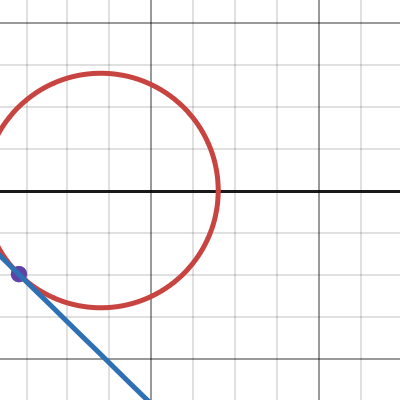
Desmos
heres a version without the b
if its less confusing
either way the name is a placeholder, remember, it ultimately gets replaced by a number
so we can call it more or less whatever we want
grand bear
got it
sorry im still very lost
how do i find the slope of this tangent line
when there the slope itself contains an x variable
snow sail
you gotta ping reply lol
snow sail
grand bear
when there the slope itself contains an x variable
this equation you have for the slope
as an input, it takes in a point on the circle
and it spits out just a number
the number is the slope of the tangent line at the point on the circle
so you just use the formula $m(x,y) = \frac{14-x}{y}$
jolly parrotBOT
jan Niku
 snow sail
where x,y is some point on the circle
snow sail
grand bear
when there the slope itself contains an x variable
youre maybe overthinking this
There are less moving pieces than it seems like at first
but im not certain exactly where you are worried
If youre concerned about the variable issue, I could suggest going back and reviewing finding the equation of a line using given information
with the entire calculus context removed, just algebra
pearl pondBOT
@grand bear Has your question been resolved?
pearl pondBOT
Channel closed
Closed by @grand bear
Use .reopen if this was a mistake.
pearl pondBOT
Available help channel!
Send your question here to claim the channel.
Remember:
• Ask your math question in a clear, concise manner.
• Show your work, and if possible, explain where you are stuck.
• After 15 minutes, feel free to ping <@&286206848099549185>.
• Type the command .close to free the channel when you're done.
• Be polite and have a nice day!
Read #❓how-to-get-help for further information on how to ask a good question, and about conduct in the question channels.
 outer echo
how do i solve a problem like
1.2 ^ x = 2
pearl pondBOT
outer echo
how do i solve a problem like
1.2 ^ x = 2
outer echo
mm a little bit but i am not sure how to use them properly
 young mural
Ok well logs basically tell you what power you have to raise "a" to, to get "b", so log to the base a, of b, would give you the power of a that makes b
So in your case, x = log base 1.2 of 2
outer echo
ohh
young mural
And you'd basically just put that in your calculator
outer echo
,calc log_1.2(2)
jolly parrotBOT
The following error occured while calculating:
Error: Undefined symbol log_1
outer echo
oo
jolly parrotBOT
Result:
0.36464311358791
,calc 1.2^0.36464
jolly parrotBOT
Result:
1.0687414406298
The following error occured while calculating:
Error: Undefined symbol log1
jolly parrotBOT
The following error occured while calculating:
Error: Unexpected type of argument in function pow (expected: number or Complex or BigNumber or Fraction or Unit or Array or Matrix or string or boolean, actual: function, index: 0)
 worthy lance
,w log(6/5, 2)
jolly parrotBOT

 Requested by _arkimond_
young mural
Requested by _arkimond_
young mural
Thank you 🙏
jolly parrotBOT
Result:
3.8017840169239
Yeah so if you write log without a base next to it, so for example log(100), this normally means log base 10
And you may also see ln, this is called the natural logarithm
And it is log to the base e
,calc log(100)
jolly parrotBOT
Result:
4.6051701859881
ohh i thought log was assumed to be base10
young mural
It is yeah
young mural
jolly parrot
Result:
```
4.6051701859881
```
I don't know what this is
worthy lance
In programs like wolfram log means ln
young mural
Right but e^4 isn't 100 either?
 vestal tapir
it is
jolly parrotBOT
Result:
100
ty for teaching me how to use logs... this was like the only basic algebra rule i was missing
i learned how to take the derivative and integral of logarithm before learning how to use logs now 😭
pearl pondBOT
@outer echo Has your question been resolved?
Channel closed
Closed by @outer echo
Use .reopen if this was a mistake.
Available help channel!
Send your question here to claim the channel.
Remember:
• Ask your math question in a clear, concise manner.
• Show your work, and if possible, explain where you are stuck.
• After 15 minutes, feel free to ping <@&286206848099549185>.
• Type the command .close to free the channel when you're done.
• Be polite and have a nice day!
Read #❓how-to-get-help for further information on how to ask a good question, and about conduct in the question channels.
 sand torrent
can someone help me with this
 pearl pondBOT
sand torrent
can someone help me with this
sand torrent
sand torrent
can someone help me with this
pearl pondBOT
sand torrent
can someone help me with this
sand torrent
sand torrent
can someone help me with this
f(x)= e^1-x
 crisp veldt
what are you struggling with on this question? @sand torrent
sand torrent
crisp veldt
what are you struggling with on this question? <@1025475503638990848>
idk how to find the area
 minor falcon
sand torrent
idk how to find the area
minor falcon
sand torrent
idk how to find the area
Integrate the function for the given interval
sand torrent
minor falcon
Integrate the function for the given interval
wouldn't that be
e^1 - e^-1
crisp veldt
sand torrent
wouldn't that be
e^1 - e^-1
yes that's correct
minor falcon
sand torrent
wouldn't that be
e^1 - e^-1
Yes
sand torrent
so the answer is
e- 1/e
minor falcon
Should be correct
minor falcon
 versed mica
it’s from 0 to 2
versed mica
it’s from 0 to 2
Yes -e^(1)+e^(-1)
versed mica
minor falcon
Yes -e^(1)+e^(-1)
you do 2 first
sand torrent
yeah i forgot to integrate it, but i still managed to get the correct answer
versed mica
integral of f(x) from a to b is F(b)-F(a)
 minor falcon
Yes
pearl pondBOT
Channel closed
Closed by @sand torrent
Use .reopen if this was a mistake.
pearl pondBOT
Available help channel!
Send your question here to claim the channel.
Remember:
• Ask your math question in a clear, concise manner.
• Show your work, and if possible, explain where you are stuck.
• After 15 minutes, feel free to ping <@&286206848099549185>.
• Type the command .close to free the channel when you're done.
• Be polite and have a nice day!
Read #❓how-to-get-help for further information on how to ask a good question, and about conduct in the question channels.
 timber elbow
I don't understand how to do this using multivariable calculus
 timber elbow
i know we have to treat S as a constant
pearl pondBOT
@timber elbow Has your question been resolved?
pearl pondBOT
@timber elbow Has your question been resolved?
pearl pondBOT
@timber elbow Has your question been resolved?
pearl pondBOT
@timber elbow Has your question been resolved?
pearl pondBOT
What step are you on?
1. I don't know where to begin.
2. I have begun but got stuck midway.
3. I got an answer but I was told that it's wrong.
4. I got an answer and would like my work checked.
5. I have a question about someone else's work/solution.
6. I have completed the problem and don't need help anymore. Thank you.
7. None of the above
Channel closed
Closed due to timeout
Use .reopen if this was a mistake.
Available help channel!
Send your question here to claim the channel.
Remember:
• Ask your math question in a clear, concise manner.
• Show your work, and if possible, explain where you are stuck.
• After 15 minutes, feel free to ping <@&286206848099549185>.
• Type the command .close to free the channel when you're done.
• Be polite and have a nice day!
Read #❓how-to-get-help for further information on how to ask a good question, and about conduct in the question channels.
midnight haven
Hey doing test corrections, wondering if anyone can help me out its simple algebra 2
pearl pondBOT
midnight haven
Hey doing test corrections, wondering if anyone can help me out its simple algeb...

 grim fractal
8% is crazy 😭
midnight haven
hey man dont judge me bro
grim fractal
it doesn't look like you really tried to solve any of them...
midnight haven
i cant even becuase i dont even know the formula
 wanton latch
Do you understand the concept of fractional exponents?
midnight haven
yes
my teacher teaches one thing
tho
its like different from online
so every hard
wanton latch
Well it really isn’t
It seems to me that your teacher is attempting u-substitution in a very weird way
midnight haven
for number 5 i got pl;us minus 36x^4(y-5)^3
wanton latch
First let’s focus on the top half then we will work on the bottom half
midnight haven
ok
first i got 256^-1/4
-64?
because 1/4 of 254 is 64, and cant forget about the negative
wanton latch
For fractional exponents, the denominator is the power of which the radical is (like square root or cube root) while the numerator power the number that is being radicalized is held to
midnight haven
so is it -64?
wanton latch
No