#help-39
1 messages · Page 63 of 1
 west sapphire
 mellow pine
let my mind process this haha
west sapphire
sure
mellow pine
so we have
newV = oldV - A(oldV)
west sapphire
yep
mellow pine
west sapphire
yep
and the question is asking us to find what A is?
west sapphire
actually it wants a P such that
newV = P(oldV)
but if you find A you're almost done, because then
let P = I - A
mellow pine
so
P(oldV) = oldV - A(oldV)
west sapphire
then you can see that:
P(oldV) = (I - A)(oldV) = I(oldV) - A(oldV) = oldV - A(oldV)
I here is the identity matrix
mellow pine
gotchya
so to find the matrix for the ANSWER
we do
I - A
where A is what?
ugh
how do we calculate A
here we know what Av is, but not A...
just divide by v?
west sapphire
nah it's not that simple
mellow pine
but we don't even know v!!
mellow pine
west sapphire
nah it's not that simple
how close are we bungo 💀
this seems a very very hard problem lolz
west sapphire
you need to find an A that does the following job:
given an arbitrary v, we need
Av = (v.n)n
mellow pine
so A is the hard part, then finding P is trivial
west sapphire
yes pretty much
mellow pine
west sapphire
you need to find an A that does the following job:
given an arbitrary v, we need...
is this even possible 💀
west sapphire
well let's take it a step at a time
suppose I start with a matrix which has 3 identical rows
each row is just n
let's call that matrix B
what would Bv be?
mellow pine
hmmm
mellow pine
west sapphire
suppose I start with a matrix which has 3 identical rows
each row is just n
so like
a a a
b b b
c c c
mellow pine
ohh yeah mb
mellow pine
west sapphire
what would Bv be?
v would get cross producted with a matrix that is the normal of a plane
west sapphire
maybe it's easier if i just give a formula for A and then we see why it works
west sapphire
let's try $A = nn^T$
mellow pine
I feel like we gave up on me tho
west sapphire
mellow pine
I feel like we gave up on me tho
no, the problem is that it's easier to do this if you already know how to do it haha
 jolly parrotBOT
Bungo
 mellow pine
west sapphire
no, the problem is that it's easier to do this if you already know how to do it ...
mellow pine
west sapphire
no, the problem is that it's easier to do this if you already know how to do it ...
gotchya
west sapphire
mellow pine
what are the dollar signs
sorry that was supposed to format,
ah there, delayed reaction
bot is slow today
mellow pine
jolly parrot
**Bungo**
so matrix A is equal to the cross product of n and the transpose of n
where the transpose of n is just like flipping the matrix
west sapphire
no it's the ordinary matrix product of n and n^t
where n is expressed in column form
so in other words
(column form of n)(row form of n)
as a matrix product
mellow pine
west sapphire
no it's the ordinary matrix product of n and n^t
what is n^t?
west sapphire
that's what A will be
west sapphire
mellow pine
what is n^t?
sorry, lazy notation for transpose of n
mellow pine
west sapphire
sorry, lazy notation for transpose of n
wait so I know transpose is flipping rows with columns
but what does that actually do
mellow pine
jolly parrot
**Bungo**
okay I understand what this is now, but I don't understand how you got this formula
mellow pine
west sapphire
suppose your normal vector is just n = (1, 2, 3)
yepp i'm listening
west sapphire
then what I mean is
$$A = \begin{bmatrix}1 \ 2 \ 3\end{bmatrix} \begin{bmatrix}1 & 2 & 3\end{bmatrix} = \begin{bmatrix} 1 & 2 & 3 \2 & 4 & 6 \ 3 & 6 & 9 \end{bmatrix}$$
jolly parrotBOT
Bungo
 mellow pine
mhm
west sapphire
mellow pine
okay I understand what this is now, but I don't understand _how you got this for...
i'll address that next, let's first make sure we agree about what i mean, sounds like you're cool with that part
mellow pine
yeppers
west sapphire
ok so why does that work
west sapphire
lemme write some more formatted stuff, be patient
west sapphire
let's say we defined A as above
then:
$$Av = (nn^T)v = n(n^T v) = n(n \cdot v) = (n \cdot v)n$$
jolly parrotBOT
Bungo
 west sapphire
the key that i'm using here is that $n^T v$ is just the dot product of $n$ and $v$
jolly parrotBOT
Bungo
 mellow pine
jolly parrot
**Bungo**
mellow pine
jolly parrot
**Bungo**
got it
west sapphire
so you see why this choice of A does the job
mellow pine
jolly parrot
**Bungo**
WAIT HOLD UP
west sapphire
and you see it's also easy to compute once you have n
mellow pine
jolly parrot
**Bungo**
so by transposing t and multiplying it with v, you get a scalar?
yes makes sense
west sapphire
yea i'm assuming here that n and v are both column vectors
mellow pine
I wrote it out
west sapphire
so n^transpose is a row vector
then row vector times column vector = scalar
the order of multiplication here is important
mellow pine
west sapphire
so you see why this choice of A does the job
ahhhhhh
and since Av = nn^Tv
A = nn^T
west sapphire
if it was the other way around:
west sapphire
(column vector) times (row vector), that's a matrix
west sapphire
mellow pine
omg how did you even figure that out
i 100% did not figure that out, i've seen it before and remembered the trick
it's actually quite genius
and i am not a genius haha
west sapphire
reminder:
mellow pine
west sapphire
if it was the other way around:
wait so
mellow pine
west sapphire
reminder:
mhm
west sapphire
remember that we assumed here that n is a unit vector
mellow pine
yepp
west sapphire
none of this works if you just take n as the cross product of the two given vectors
remember to normalize it
mellow pine
ie divide by the magnitude of n
west sapphire
yep
mellow pine
mellow pine
ahhhhhh
and since Av = nn^Tv
A = nn^T
SO JUST GONNA put all of the equations in one place rn
we know that
AnswerVector = I - A
mellow pine
where I is the identity vector
and A = (n . v )n
mellow pine
west sapphire
well P = I - A
oops I meant answer matrix
like wut the problem wants us to find
west sapphire
no
Av = (n . v)n
A itself doesn't depend on v
A is n n^T
product of n (column) times n (row)
mellow pine
wait how does A not depend on n when you write it in terms of n?
mellow pine
west sapphire
A doesn't depend on v
makes sense yeah
cuz if it did, then we wouldn't be able to solve the problem! as we don't know v
mellow pine
west sapphire
Av = (n . v)n
yepp lemme rewrite
P = I - A
Av = (n . v)n
A = n n^T
So P = I - n n^T
n = normalized version of cross product of the two vectors
WRITE
RIGHT*
mellow pine
west sapphire
n = normalized version of cross product of the two vectors
oops yes lemme edit and eadd dat
TADA
west sapphire
sure
mellow pine
west sapphire
sure
I got it wrong Bungo 😭
Let me show you my work!

We know that N is sqrt(3) * [-1, -1, 1]
We know that A = N * N^T
so A =
3 3 -3
3 3 -3
-3 -3 3
so I - A =
-2 -3 3
-3 -2 3
3 3 -2
BUT IT SAID I GOT IT WROGN
: (
@west sapphire 
west sapphire
let me check
west sapphire
mellow pine
We know that N is sqrt(3) * [-1, -1, 1]
you need to divide by sqrt(3), not multiply!
unfortunately this means you get ugly noninteger numbers
mellow pine
west sapphire
you need to divide by sqrt(3), not multiply!
OH CRAP
mellow pine
west sapphire
unfortunately this means you get ugly noninteger numbers
sqrt(3)*sqrt(3) --> 3 so we just multiply by 1/3 in the end
mellow pine
mellow pine
We know that A = N * N^T
so A =
3 3 -3
3 3 -3
-3 -3 3
gotchu
thank u bungo!
west sapphire
mellow pine
sqrt(3)*sqrt(3) --> 3 so we just multiply by 1/3 in the end
depends on what you mean here
if you take your wrong A, there you effectively multiplied by 3 instead of dividing by 3
so if you start with the wrong A you would need to divide by 9 to get the right A
 pearl pondBOT
@mellow pine Has your question been resolved?
pearl pondBOT
Channel closed
Closed due to timeout
Use .reopen if this was a mistake.
 Available help channel!
Send your question here to claim the channel.
Remember:
• Ask your math question in a clear, concise manner.
• Show your work, and if possible, explain where you are stuck.
• After 15 minutes, feel free to ping <@&286206848099549185>.
• Type the command .close to free the channel when you're done.
• Be polite and have a nice day!
Read #❓how-to-get-help for further information on how to ask a good question, and about conduct in the question channels.
 dry lintel
I need help...
pearl pondBOT
dry lintel
I need help...
dry lintel
For the LOVE of GOD!
Can someone explain to me the Halting Problem
from whatever Alan Turing was trying to explain
 crystal lion
Theres a pretty good veritasium video about it i think /or something else but it contains it
dry lintel
yeah I tried looking at the videos...
NONE of them makes sense to me
Like wtf was Alan trying to prove?!
Alan: "Let me create a computer/program that solves everything"
World: "THank you Alan!"
 rough stream
long story short:
There exists no algorithm that can take a program, and answers "Does this program halt?"
dry lintel
5 seconds later,
Alan: "Now I'm going to prove that its wrong and no computer can ever solve everything"

I don't understand the paradox aspect
rough stream
Turing does use a contradiction argument to do this. He says "Okay, let's pretend there is such an algorithm" and then shows the logical failure of that assumption
dry lintel
What..paradox?

One of the most influential problems and proofs in computer science, first introduced and proved impossible to solve by Alan Turing. The video provides the idea of this incredibly clever proof. I highly recommend anyone who is comfortable with mathematical proofs to read the formal proof to the problem (look at additional resources below for inf...
I found this video...
But I don't understand where "the paradox" part comes into play
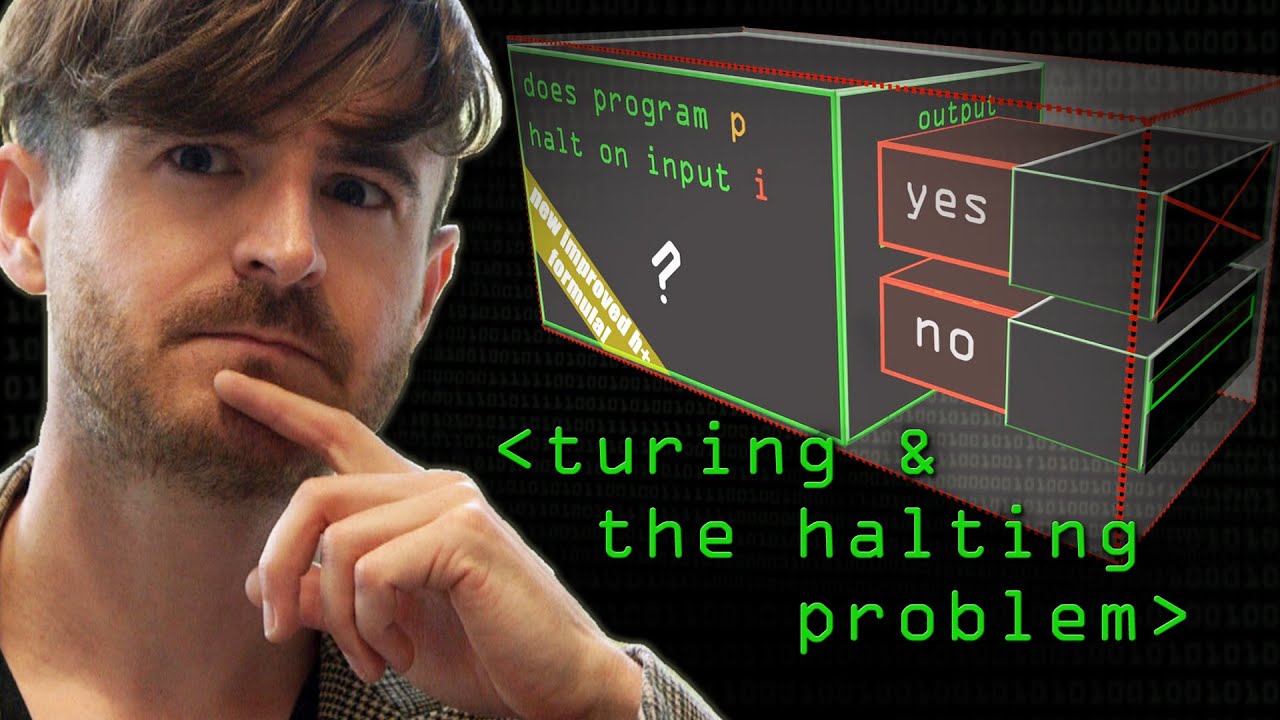
Alan Turing almost accidentally created the blueprint for the modern day digital computer. Here Mark Jago takes us through The Halting Problem.
Turing Machines Explained: https://youtu.be/dNRDvLACg5Q
Busy Beaver: https://youtu.be/CE8UhcyJS0I
VR Simulator: http://youtu.be/Lm0lA0enPSk
What on Earth is Recursion?: http://youtu.be/Mv9NEXX1VHc
T...
same with this
rough stream
rough stream
Turing does use a contradiction argument to do this. He says "Okay, let's preten...
This being the paradox I think you're referencing, to be clear.
dry lintel
rough stream
Turing does use a contradiction argument to do this. He says "Okay, let's preten...
but what algorithm?
He creates a program...thats always right
rough stream
rough stream
long story short:
There exists no algorithm that can take a program, and answers...
.
dry lintel
rough stream
long story short:
There exists no algorithm that can take a program, and answers...
But...
what?
but...he does?
rough stream
He tries to and fails
dry lintel
I'm confused...what is the process?
All I know, there's a program that answers correctly if a program says if it halts or runs forever
and then we put that program in another machine and then....sh*t gets weird
ALL I know, we start off with a program that DOES answer and says if the machine stops/halts or if it runs forever
rough stream
Let's be SUPER CLEAR here, there's actually no such algorithm. That's the halting problem!
How does Turing prove it? Let's begin by PRETENDING there is one.
But as you've mentioned, shit gets weird when we pretend this.
dry lintel
god damn it
Ok so we are pretending there is a program that answers if the machine stops/halts or runs
and then what?
We put that program, in a machine that does...what?
rough stream
Then Turing constructs a machine that "beats our algorithm".
dry lintel
huh...
rough stream
If the algorithm exists, then this machine causes our algorithm to lie.
But that's not possible, our algorithm should work on every machine!
dry lintel
what...
dry lintel
dry lintel
https://www.youtube.com/watch?v=VyHbd6sx5Po
basically this?
Basically we put our perfect program/algorithm in a machine that says the complete opposite?
rough stream
Yep. our perfect algorithm is not so perfect anymore
dry lintel
but...
ok so...what's the paradox?
the algorthm is still perfect
its the machine...
that's the problem
rough stream
Our algorithm should work on every machine!
dry lintel
cause its designed to lie/say the complete opposite
dry lintel
rough stream
Our algorithm should work on every machine!
ok so:
- There's a perfect program that detects if something is supposed to run forever or halt.
- We put that program in a machine that just says the complete opposite.
- Program says "Halt", Machine runs forever / Program says "Run forever", Machine Halts..
- We blame it on Program
rough stream
dry lintel
cause its designed to lie/say the complete opposite
That's true! And perhaps profound. This machine is specifically designed to defeat our algo. The halting problem could also be stated as: these machines exist.
dry lintel
so what's the paradox part?
rough stream
What's the video referring to with the word "paradox"?
rough stream
Just post it! Let's see.
dry lintel
or screw it, I'll post it here
rough stream
They might be referring to the "unsolvability" of the halting problem. That is, given a program, can you determine if it's possible to write an algorithm that determines HALT/NO HALT?
The answer ends up being "we can't know!" We need to actually see that program before we can say.
dry lintel
rough stream
They might be referring to the "unsolvability" of the halting problem. That is, ...
here ^
This professor sucks so much
I understood NONE of what he just said
rough stream
The "paradox" here is the proof by contradiction. There exists a program for which we cannot determine HALT/NO HALT, when we assumed such a progrram isn't possible.
dry lintel
ok, I'm sorry I'm awful at this
Can we do this step by step
cause I'm not getting it still
rough stream
No you're good. This is a pretty tricky proof
dry lintel
literally explain to me like im a 5 year old
who doesn't know anything cause this is too confusing for me
 earnest schooner
There's a video on youtube about diagonal arguments, and it talks about the halting problem if I'm not mistaken
rough stream
- Let's PRETEND we have perfect program that detects if something is supposed to run forever or halt.
- We put that program in a machine that just says the complete opposite (NOTE the construction of this machine is non-trivial!)
- We get a logically impossible contradiction
earnest schooner
I remember watching it even before starting uni
rough stream
(Says HALT, but the program doesn't halt / says NO HALT but the program halts.)
earnest schooner
So it's probably straightforward
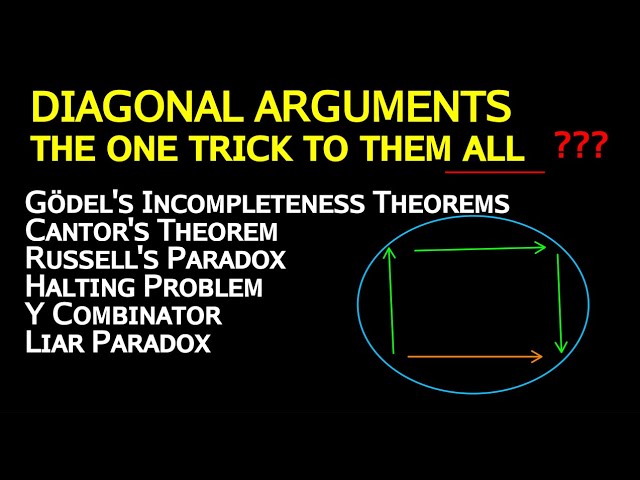
Diagonal Arguments are a powerful tool in maths, and appear in several different fundamental results, like Cantor's original Diagonal argument proof (there exist uncountable sets, or "some infinities are bigger than other infinities"), Turing's Halting Problem, Gödel's incompleteness theorems, Russell's Paradox, the Liar Paradox, and even the Y ...
Hope it helps
dry lintel
rough stream
- Let's PRETEND we have perfect program that detects if something is supposed to...
So the perfect Program is orange box from the clip
rough stream
ye
dry lintel
so my prof was just too dumb to add the part
"we put it in a machine that says the complete opposite"
Ok so we take a program that's perfect which says correctly, "this will halt" or "this will run forever", and we put it in a machine that says the opposite
and obviously, that will not give us the right answer
rough stream
There's some detail there that does need to be fleshed out. Is it possible to construct such a machine? Turing was able to logically construct it.
dry lintel
so even though the Program says in an instance, "Oh this will halt"
the machine will say, "this will run"
earnest schooner
rough stream
There's some detail there that does need to be fleshed out. Is it possible to co...
Most of the time u just argue about a machine's existence using the TCT
For every algorithm there's a machine that does that
I don't think Turing proved that
But it works most of the time
dry lintel
rough stream
There's some detail there that does need to be fleshed out. Is it possible to co...
a machine that says the complete opposite?
LITERALLY the professor posted the video I showed above...
Alan Turing almost accidentally created the blueprint for the modern day digital computer. Here Mark Jago takes us through The Halting Problem.
Turing Machines Explained: https://youtu.be/dNRDvLACg5Q
Busy Beaver: https://youtu.be/CE8UhcyJS0I
VR Simulator: http://youtu.be/Lm0lA0enPSk
What on Earth is Recursion?: http://youtu.be/Mv9NEXX1VHc
T...
This one...which Im still confused about
rough stream
What's up?
dry lintel
just my dumb professor saying, "oh yeah, I said it awfully and explained it badly"
"watch this video instead"
Ok here's where I am stuck on:

This part of the video
How...this...
this makes no SENSE!
dry lintel
dry lintel
https://www.youtube.com/watch?v=macM_MtS_w4&t=105s
This guy is saying, "Ok, H+ is the entire program that tells it correctly!"
How does...
fucking
the program says, "it halts! It can't run!" translate to a machine saying, "IT CAN FOREVER RUN!" when it can't!
what it just says, "halts, halts, halts, halts, halts, " until the computer explodes?
rough stream
Or it calculates digits of pi for eternity
dry lintel
im so frustrated at this im going to cry...
rough stream
For whatever reason, the "loop forever" branch doesn't stop computing.
dry lintel
I don't understand the video starting at the 5 minutes timestamp...
rough stream
dry lintel
the program says, "it halts! It can't run!" translate to a machine saying, "IT C...
Can you elaborate on this? Why shouldn't this happen?
dry lintel
Ok...i'm trying
- We have a perfect algorithm that says if machine stops/halts or runs forever
- We add something that to algorithm where it will say the complete oppposite
like shown in the video
 rough stream
Worth noting, H itself is the "perfect program"
dry lintel
so if it halts, we make it so it runs forever. And if it doesn't halt, we make it halt
Ok!
rough stream
H+, which depends on H, is the "defeating program"
dry lintel
then we package allll that crap together
which is H+
so now we feed H+ into H sort of again.
which agian H+ is this:
 rough stream
We want to know what the output will be, when H+ takes H+ as an input
dry lintel
If....its supposed to Halt, instead of halting, it will run forever.
If its suppoed to run forever, instead of running forever, it will instead halt
dry lintel
rough stream
We want to know what the output will be, when H+ takes H+ as an input
ok so the inputs is H+ got it
 rough stream
Here's a question.
Does H+ halt when we feed H+ into it?
dry lintel
but...what do you want to originally? To make it halt or run forever?
If you want to make it run, I'm assuming H+ is going to make it halt.
And if you want to make it holt, H+ is going to make it run forever...
....I hope this is correct?
rough stream
- Let's assume it halts.
H would print "yes".
But then that goes to the "loop forever", so H+ doesn't actually halt like we assumed.
So our assumption must be wrong.
- Instead, let's assume it runs forever.
H would print "no".
But then that goes to the "halt!", so H+ doesn't actually run forever like we assumed.
So our assumption must be wrong.
dry lintel
dry lintel
but...what do you want to originally? To make it halt or run forever?
If you wan...
with this
...right?
rough stream
Yeah that's basically it
But instead of "want", it's more like "what actually happens"
dry lintel
so essentially....
Whatever the intention was, its doing the opposite
rough stream
H+ has to halt or loop. One of those two options.
Except... it doesn't!
dry lintel
if its thinking that its going to halt, its actually going to run forever.
If its thinking that its going to run forever, its actually going to halt
dry lintel
rough stream
H+ has to halt or loop. One of those two options.
Except... it doesn't!
what?
dry lintel

but...
its doing it?
its..
how does it not exist?
like you mean it literally?
dry lintel
rough stream
That's the paradox. H+ neither halts or loops.
wdym?
but it is halting or going in a loop
rough stream
Basically, it can't halt or loop, so what is it?
dry lintel
if its not halting, it isn't...
 midnight haven
dry lintel
but it is halting or going in a loop
midnight haven
dry lintel
but it is halting or going in a loop
if it halted or went in a loop, then the inner machine, H, incorrectly predicted which it would do
rough stream
Every program's gotta halt or loop. But H+ here can't do either.
dry lintel
rough stream
Basically, it can't halt or loop, so what is it?
....back to being confused
But...it is
rough stream
Which?
dry lintel
ohhh my god I haaaate this sooo god damn much
Alan Turing almost accidentally created the blueprint for the modern day digital computer. Here Mark Jago takes us through The Halting Problem.
Turing Machines Explained: https://youtu.be/dNRDvLACg5Q
Busy Beaver: https://youtu.be/CE8UhcyJS0I
VR Simulator: http://youtu.be/Lm0lA0enPSk
What on Earth is Recursion?: http://youtu.be/Mv9NEXX1VHc
T...
I added the time stamp already
4:58
if the machine says, "Yes it holts!" but we see in run forever/going on a loop
if the machine says, "Its not holting", we see it holting
rough stream
dry lintel
if the machine says, "Yes it holts!" but we see in run forever/going on a loop
That's based on the assumption that H+ halts, however.
rough stream
dry lintel
if the machine says, "Its not holting", we see it holting
And this is based on the assumption that H+ loops
dry lintel
midnight haven
if it halted or went in a loop, then the inner machine, H, incorrectly predicted...
yeah so H is correct, its just H+ screwing it up
rough stream
Skip ahead to 5:16.
"If H+ halts, then it doesn't halt. If H+ doesn't halt, then it halts"
dry lintel
but we are blaming it on H
rough stream
Forget about H atm. The question is "when does H+ halt, or loop?"
The answer ends up being "there is no case where either happens"
dry lintel
rough stream
Skip ahead to 5:16.
"If H+ halts, then it doesn't halt. If H+ doesn't halt, then...
like yeah I get that part...
But why are they wording it different/weirdly?
Isn't it basically:
"If H+ Halts, then it doesn't halt and it runs forever"
If H+ doesn't halt, then it stop running forever/loop and halts"
its just...the opposite
of what Program H is saying
rough stream
Yeah!
So does H+ halt or loop?
Neither.
dry lintel
if its origianlly meant to Halt, its not going to
huh...
?
what do you mean...
H+ is doing the opposite of what H is doing
rough stream
dry lintel
like yeah I get that part...
But why are they wording it different/weirdly?
Isn...
You're saying here.
- If it halts, it doesn't actually halt. So, it can't halt.
- If it loops, it doesn't actually loop. So, it can't loop.
rough stream
So if it can't halt or loop, what does H+ do?
H+ just... kinda logically fails to be a real thing
dry lintel
I don't understand the question.
H+ is just...doing the opposite
of whatever was intented for H to do
rough stream
No. We are assuming what H+ was intended to do
 rough stream
If H+ halts, it doesn't.
If H+ loops, it doesn't.
dry lintel
H is saying:
- If it halts, it halts
- If it runs, its runs
H+ added the craps that made it do the opposite
so:
- If it halts, its actually going to run
- If it runs, its actually going to halt
midnight haven
Regardless of who is screwing everything up, H is still in H+, H still gets fed the question of whether H+ halts or not, and H still makes a prediction
rough stream
Maybe the "it" is confusing. I'll restate without.
We've determined this:
- If H+ halts, H+ doesn't halt.
- If H+ loops, H+ doesn't loop.
midnight haven
midnight haven
Regardless of who is screwing everything up, H is still in H+, H still gets fed ...
H+ makes the prediction wrong, but the point is the prediction was wrong
rough stream
H+ niether halts, or loops.
dry lintel
rough stream
If H+ halts, it doesn't.
If H+ loops, it doesn't.
Ok! I get this!
But, ok you said:
- "If H+ halts, it doesn't." So its going to run instead
- "If H+ loops, it doesn't." So its going to halt instead
right?
rough stream
It can't run if it halts though haha
Can't just say "H+ halts. Therefore H+ loops." We've already stated that H+ halts.
Maybe in better words:
If we assume H+ halts, it makes no sense to say "H+ loops instead".
Because of course, you can't do both
 rough stream
lol the GIFs are good
rough stream
Right. But if it's on halt, it's not on halt.
dry lintel
......
rough stream
Obviously, that makes no sense. So, our assumption that H+ can halt is BS. H+ cannot halt!
dry lintel
ok run through me again...
H+ added the craps where it does the opposites of whatever H was intended
so now the package is H+
but its designed to do the opposite
so when we run it again
when its on "Does this halt?", if its going to respond with "it does!", instead its not going to
or if "Does it halt?", and instead it responds with "it doesn't", its actually going to
.......right?
rough stream
Well, I do believe this is an issue as well.
But to specifically address the video and timestamp earlier, this is the problem:
If we take H+ and feed it as an input to H+, it neither halts or loops. This makes no sense, and so H+ can't exist.
dry lintel
but how?
how does neither halts or loop when it does that?
instead of halting, its going on a loop
and instead of going on a loop, its halting
rough stream
Not "instead". More like "despite".
Despite halting, it loops.
Despite looping, it halts.
rough stream
- Assume H+ halts. (Argument goes here). Therefore H+ loops. But that's impossible, so H+ must not halt!
- Assume H+ loops. (Argument goes here). Therefore H+ halts. But that's impossible, so H+ must not loop!
dry lintel
its INTENDED to loop, but its not going to
or its intended to halt, but its not going to
dry lintel
rough stream
- Assume H+ halts. (Argument goes here). Therefore H+ loops. But that's impossib...
 rough stream
Let's pretend H+ halts. What does it do?
rough stream
But that makes no sense. We're pretending H+ halts!
dry lintel
i want to punch a pillow so badly
rough stream
No I'm not saying you're wrong lol
You're correct:
If we pretend H+ halts, it loops.
dry lintel
so I was right!
rough stream
But that's nonsense. We're pretending H+ halts. It can't just loop
dry lintel
so basically we need to act like idiots
and pretend we don't know whats going on
when we know whats going on
rough stream
No we pretend we know what's going on, but we actually don't haha
dry lintel
...but we know its doing the opposite cause we added something to H that made it do the opposite and put that together in H+
rough stream
We act like geniuses, and end up showing there's no sensible answer
dry lintel
Ohhh my fricken god who I don't know if he or she or it exists...
is it just doing the complete opposite...
right?
that's the whole gist of this thing?
rough stream
Forget H, and the relation to H+.
We ask ourselves a question:
- Does H+ halt?
The answer: - H+ cannot halt, because doing so would be a logical impossibility.
We ask ourselves a question:
- Does H+ loop?
The answer: - H+ cannot loop, because doing so would be a logical impossibility.
rough stream
It ends up being impossible because halting implies looping implies halting implies looping implies...
dry lintel
so like
If I say, "I want it to loop", its going to be impossible because its going to halt instead
or if I say, "I want it to halt", its going to be impossible because its going to loop instead
rough stream
Right. But halting is actually going to make it loop.
And looping is going to make it halt.
And...
dry lintel
over and over and over again
rough stream
Okay that's the paradox haha. Must have been what your prof meant.
dry lintel
But now, we cant say or think,
"Ok KNOWING this doing the opposite to what I want. If I want it to loop, I will say, let it go on halt, so it can then loop"
we can't do that?
or is different cause machines are not like us
rough stream
We're not "wanting" it to loop.
We're asserting it loops.
dry lintel
wdym by asserting?
rough stream
It loops.
(Argument goes here)
It does not loop.
But that means it both loops, and does not loop, which is impossible.
Therefore, the assertion that it loops must be a bad one. H+ cannot loop!
dry lintel
ok so that's the paradox?
Basically when its looping, its actually not going to loop.
And when its supposed to be running, its actually not going to run
or...in other terms to make it weirder
rough stream
Yeah that exactly
dry lintel
when its supposed to halt, its not going to halt.
and when its supposed to not halt, its going to halt
rough stream
Therefore H+ can't either halt or loop
rough stream
Because if it does one, it does the other... then the other... then the other...
rough stream
rough stream
Because if it does one, it does the other... then the other... then the other...
I shouldn't really say this though, because the take away is that it can't do either
dry lintel
so please bare with me! I think I got it:
H+ can't halt or run.
because again:
when its supposed to halt, its going to run.
and when its supposed to run, its going to halt
So its that, it THINKS that its doing one thing, but its doing the other thing
rough stream
Yeah, sounds good!
dry lintel
I...
HATEE this sooo god damn much
but fucking finally
my brain understood this crap
it only took me around 1h and 45 god damn minutes
rough stream
Now. H+ neither halts or loops.
So... what does it do?
As a program must choose one of those two
rough stream
But that can't happen!
rough stream
That's exactly it. The takeaway is that H+ can't be real.
And, H+ is a simple modification of H.
So, H can't exist.
dry lintel
maybe I'm being too literal
cause ok, I get it
I just find it dumb
but I get it!
I hope
rough stream
Ultimately, Turing proved that some things are not computable. There exists no algorithm that can take any program and determines HALT/NO HALT.
dry lintel
But its weird cause wasn't his whole thing about creating a perfect computer?
rough stream
Well, let's say he did create a perfect computer.
This algorithm is something the computer cannot do
pearl pondBOT
@dry lintel Has your question been resolved?
pearl pondBOT
Channel closed
Closed due to timeout
Use .reopen if this was a mistake.
Available help channel!
Send your question here to claim the channel.
Remember:
• Ask your math question in a clear, concise manner.
• Show your work, and if possible, explain where you are stuck.
• After 15 minutes, feel free to ping <@&286206848099549185>.
• Type the command .close to free the channel when you're done.
• Be polite and have a nice day!
Read #❓how-to-get-help for further information on how to ask a good question, and about conduct in the question channels.
 unkempt saddle
I need help finding the pattern in this integer sequence
1 3 5 9 15 17 19 27 45 51 57 ...
I already tried wolfram and oeis
pearl pondBOT
unkempt saddle
I need help finding the pattern in this integer sequence
`1 3 5 9 15 17 19 27 45...
 acoustic path
is there strictly a pattern? or does something like "ordered factors of 43605" suffice
unkempt saddle
that doesn't help me but it's possible that there's no answer that will help me
I can explain where the sequence comes from
that might help you help me
unkempt saddle
so this table is a table of the ratios of the overtones which you get by taking the "frequency" rounding it down to the next power of 2 and dividing by that.
+----------+--------+---------+-------+
| Overtone | N      | Ratio   | Ratio |
+----------+--------+---------+-------+
| 1        | 1      | 1       | 1/1   |
| 3        | 8      | 1.5     | 3/2   |
| 5        | 5      | 1.25    | 5/4   |
| 7        | unused | 1.75    | 7/4   |
| 9        | 3      | 1.125   | 9/8   |
| 11       | unused | 1.375   | 11/8  |
| 13       | unused | 1.625   | 13/8  |
| 15       | 12     | 1.875   | 15/8  |
| 17       | 2      | 1.0625  | 17/16 |
| 19       | 4      | 1.1875  | 19/16 |
| 21       | unused | 1.3125  | 21/16 |
| 23       | unused | 1.4375  | 23/16 |
| 25       | unused | 1.5625  | 25/16 |
| 27       | 10     | 1.6875  | 27/16 |
| 29       | unused | 1.8125  | 29/16 |
| 31       | unused | 1.9375  | 31/32 |
| 33       | unused | 1.03125 | 33/32 |
| 35       | unused | 1.09375 | 35/32 |
| 37       | unused | 1.15625 | 37/32 |
| 39       | unused | 1.21875 | 39/32 |
| 41       | unused | 1.28125 | 41/32 |
| 43       | unused | 1.34375 | 43/32 |
| 45       | 7      | 1.40625 | 45/32 |
| 47       | unused | 1.46875 | 47/32 |
| 49       | unused | 1.53125 | 49/32 |
| 51       | 9      | 1.59375 | 51/32 |
| 53       | unused | 1.65625 | 53/32 |
| 55       | unused | 1.71875 | 55/32 |
| 57       | 11     | 1.78125 | 57/32 |
| 59       | unused | 1.84375 | 59/32 |
| 61       | unused | 1.90625 | 61/32 |
| 63       | unused | 1.96875 | 63/32 |
+----------+--------+---------+-------+
in just intonated 12 tone music we use these 11 overtones 1 3 5 9 15 17 19 27 45 51 57
I'm trying to figure out why
in order to figure out how to do 24 tone or N tone just intonation
maybe it's just a thing of "they are closest to the P_n = P_a2^{(n-a)/X} way of diving the range 1-2 into X parts"
pearl pondBOT
@unkempt saddle Has your question been resolved?
 tulip ore
unkempt saddle
so this table is a table of the ratios of the overtones which you get by taking ...
tulip ore
unkempt saddle
so this table is a table of the ratios of the overtones which you get by taking ...
the ratios of 12-tone equal temperament are:
1/1
T/1
T^2/1
T^3/1
T^4/1
...
T^11/1
T^12/1
where T is the 12th root of 2
this is because:
- sounds at equal ratios have the same interval
- an octave 2:1 needs to be split into 12 equal intervals
so the 12th root of 2 as a ratio can be continuously applied to get from 1 to 2, 3, 4, ... 12
the fractions youre seeing are what happens when a number happens to get close to one of these ratios
but really theyre always slightly off

Pianos can't be perfectly tuned - it's a mathematical fact!
Thanks to http://www.audible.com/minutephysics for supporting MinutePhysics.
Equal tempered tuning: https://en.wikipedia.org/wiki/Equal_temperament
Just Tuning: https://en.wikipedia.org/wiki/Just_intonation
Harmonics: https://en.wikipedia.org/wiki/Harmonic
Pythagorean vs Just Tunin...
you can think of it as
using 12-tone equal temperament, they are all made to sound equally spaced between each other and together

the gap between the points is like multiplying by T
now here's what 3/2 looks like:

the gap it has with C is very close to 7/12
now heres the lowest three ratios

you can see it vaguely suggests a sound of some sort split into 12ths
and so the other ratios are found from sounding close to being split this way
@unkempt saddle do you have any questions so far
pearl pondBOT
@unkempt saddle Has your question been resolved?
tulip ore
so for N-tones you just need N fractions that sound close to the various powers of the Nth roots of 2
To find those, idk
pearl pondBOT
Channel closed
Closed due to timeout
Use .reopen if this was a mistake.
pearl pondBOT
Available help channel!
Send your question here to claim the channel.
Remember:
• Ask your math question in a clear, concise manner.
• Show your work, and if possible, explain where you are stuck.
• After 15 minutes, feel free to ping <@&286206848099549185>.
• Type the command .close to free the channel when you're done.
• Be polite and have a nice day!
Read #❓how-to-get-help for further information on how to ask a good question, and about conduct in the question channels.
 drowsy tendon
Hey guys
I need help calculating this system of equations and where to start:
 pearl pondBOT
drowsy tendon
Hey guys
I need help calculating this system of equations and where to start:
pearl pondBOT
drowsy tendon
Hey guys
I need help calculating this system of equations and where to start:
 cunning comet
e.g. write the second one as x = ... and then plug this in the first.
pearl pondBOT
@drowsy tendon Has your question been resolved?
 burnt minnow
drowsy tendon
Hey guys
I need help calculating this system of equations and where to start:
burnt minnow
drowsy tendon
Hey guys
I need help calculating this system of equations and where to start:
Start by simplifying the first equation. You can then derive the value of x from the second equation. Substitute the value of x in equation 1.
drowsy tendon
This is What I’ve done until now
 burnt minnow
drowsy tendon
This is What I’ve done until now
burnt minnow
drowsy tendon
This is What I’ve done until now
You could actually simplify the first equation to make things easier.
drowsy tendon
how?
burnt minnow
I'll give a hint- you can divide the equation with 5
 light helm
you didn't sub properly
burnt minnow
drowsy tendon
This is What I’ve done until now
Also whenever multiplying with two terms, don't forget the parentheses.
light helm
regardless, i don't see how you're getting 14y
pearl pondBOT
Channel closed
Closed due to timeout
Use .reopen if this was a mistake.
drowsy tendon
.reopen
pearl pondBOT
✅
drowsy tendon
light helm
regardless, i don't see how you're getting 14y
I made calculation error/mistake
burnt minnow
yes
pearl pondBOT
Channel closed
Closed by @drowsy tendon
Use .reopen if this was a mistake.
pearl pondBOT
Available help channel!
Send your question here to claim the channel.
Remember:
• Ask your math question in a clear, concise manner.
• Show your work, and if possible, explain where you are stuck.
• After 15 minutes, feel free to ping <@&286206848099549185>.
• Type the command .close to free the channel when you're done.
• Be polite and have a nice day!
Read #❓how-to-get-help for further information on how to ask a good question, and about conduct in the question channels.
 fervent ginkgo
 pearl pondBOT
fervent ginkgo
fervent ginkgo
pearl pondBOT
fervent ginkgo
fervent ginkgo
how to solve this?
pearl pondBOT
@fervent ginkgo Has your question been resolved?
pearl pondBOT
@fervent ginkgo Has your question been resolved?
fervent ginkgo
what theoorem?
pearl pondBOT
@fervent ginkgo Has your question been resolved?
 neat harbor
fervent ginkgo
how to solve this?
neat harbor
fervent ginkgo
how to solve this?
maybe use the fact that CO, DO and BO are of same length
pearl pondBOT
@fervent ginkgo Has your question been resolved?
pearl pondBOT
Channel closed
Closed due to timeout
Use .reopen if this was a mistake.
Available help channel!
Send your question here to claim the channel.
Remember:
• Ask your math question in a clear, concise manner.
• Show your work, and if possible, explain where you are stuck.
• After 15 minutes, feel free to ping <@&286206848099549185>.
• Type the command .close to free the channel when you're done.
• Be polite and have a nice day!
Read #❓how-to-get-help for further information on how to ask a good question, and about conduct in the question channels.
midnight haven
<@&286206848099549185> Tanya is having a bake sale and must bake cupcakes. She has cupcakes donated by a friend and after her first hour of baking, Tanya has a total of 60 cupcakes. She has 84 cupcakes after the second hour of baking. Tanya continues baking the same number of cupcakes each hour. - The graph for the number of cupcakes baked will have a slope of _________________ and a y- intercept of ___________
pearl pondBOT
midnight haven
<@&286206848099549185> Tanya is having a bake sale and must bake cupcakes. She h...
Please don't occupy multiple help channels.
midnight haven
ok
midnight haven
midnight haven
ok
your rate would be determined by the amount change between hour 2 and hour 1
so for this instance, do 84-60, what do you get?
24
oh the slope is 24
60-24 = 36 so the y-incpt in 36
yes
there you go
thanks
np
@midnight haven do you mind doing .close here?
.close
pearl pondBOT
Channel closed
Closed by @tight viper
Use .reopen if this was a mistake.
midnight haven
alright thanks
pearl pondBOT
Available help channel!
Send your question here to claim the channel.
Remember:
• Ask your math question in a clear, concise manner.
• Show your work, and if possible, explain where you are stuck.
• After 15 minutes, feel free to ping <@&286206848099549185>.
• Type the command .close to free the channel when you're done.
• Be polite and have a nice day!
Read #❓how-to-get-help for further information on how to ask a good question, and about conduct in the question channels.
midnight haven
can someone help me solve this? i started on it but idk where to go from there (for context i’m trying to split it into two different fractions, or do partial fraction decomposition)
 pearl pondBOT
midnight haven
can someone help me solve this? i started on it but idk where to go from there (...
pearl pondBOT
midnight haven
can someone help me solve this? i started on it but idk where to go from there (...
 feral leaf
midnight haven
can someone help me solve this? i started on it but idk where to go from there (...
feral leaf
midnight haven
can someone help me solve this? i started on it but idk where to go from there (...
Since you know this part, you can multiply by x(x - 3) on both sides to remove the fractions

 blissful salmon
midnight haven
can someone help me solve this? i started on it but idk where to go from there (...
blissful salmon
midnight haven
can someone help me solve this? i started on it but idk where to go from there (...
next what you do is let A+B=0 and A=-1, therefore B=1
midnight haven
blissful salmon
next what you do is let A+B=0 and A=-1, therefore B=1
does the A+B=0 come from taking the derivative
feral leaf
You don't need the derivative
midnight haven
feral leaf
You don't need the derivative
oh okay
feral leaf
feral leaf
Since you know this part, you can multiply by x(x - 3) on both sides to remove t...
Doing this, you should get 3 = A(x - 3) + Bx
Then you can solve for A and B
The easiest, is using the roots of the denominator from the original fraction, x(x -3)
x(x -3) = 0, solve for x, then use that to solve for A and B
blissful salmon
midnight haven
does the A+B=0 come from taking the derivative
it doesnt come from taking the derivative, you can just see that since the numerator has no x, therefore the coefficent of x (aka A+B) has to be equal to 0
midnight haven
blissful salmon
it doesnt come from taking the derivative, you can just see that since the numer...
ohh ok
midnight haven
feral leaf
x(x -3) = 0, solve for x, then use that to solve for A and B
so here the x values would be 0 and 3 right
feral leaf
Yes
So now knowing 3 = A(x - 3) + Bx, and x = 3 and x = 0, plug in each value of x separately then you can find A and B
So for example, plugging in 0 for x, you get 3 = A(0 - 3) + B * 0 which is 3 = A(-3) + 0
So then A = -1
Repeat using x = 3
midnight haven
feral leaf
Repeat using x = 3
ohh okay that makes sense, thank you
pearl pondBOT
@midnight haven Has your question been resolved?
Channel closed
Closed by @viscid meadow
Use .reopen if this was a mistake.
Available help channel!
Send your question here to claim the channel.
Remember:
• Ask your math question in a clear, concise manner.
• Show your work, and if possible, explain where you are stuck.
• After 15 minutes, feel free to ping <@&286206848099549185>.
• Type the command .close to free the channel when you're done.
• Be polite and have a nice day!
Read #❓how-to-get-help for further information on how to ask a good question, and about conduct in the question channels.
 snow sail
presumably it should say x,y >= 0?
on e
I don't think youre correctly interpreting e
There exists an x, such that for any y,
x and y nonnegative implies their sum is non-negative
pearl pondBOT
@signal lynx Has your question been resolved?
 surreal ocean
d & first 2 good. works for counter with -1, 3. reev e. for the other one... let x < 0. when y < 0, is x+y>0? klds
 signal lynx
snow sail
presumably it should say x,y >= 0?
signal lynx
snow sail
presumably it should say x,y >= 0?
yeah thats what ijm assuming
signal lynx
snow sail
x and y nonnegative implies their sum is non-negative
ohhhh
wait
isnt it still false if x is 0 and y is negative?
snow sail
y wont be negative
signal lynx
surreal ocean
d & first 2 good. works for counter with -1, 3. reev e. for the other one... let...
no its not so wouldnt c be false? sorry im a little confused on ur phrasing
surreal ocean
x doesn't need to be 0 right
snow sail
i dont wanna cross talk lemme know when youre done with fluffy
signal lynx
fair enough
surreal ocean
fine you then-
signal lynx
?
snow sail
howdy
so
Ignore the part that x and y are reals, just assume it in the back of your head
what this says is that, for any nonnegative number, there exists another nonnegative number, such that their sum is nonnegative
signal lynx
the only issue i have with that is that while its a non negative number, it could be comprised of negative numbers could it not?
since its only the product of the two thats non negative?
snow sail
its not clear what that is supposed to say
so, who knows
to me i'd assume it says $x,y \geq 0$
jolly parrotBOT
jan Niku
 snow sail
but its not clear, since theres a typo
signal lynx
i mean the previous 4 have it as the product of x and y
so why wouldnt it be the same as well?
signal lynx
so its just entirely depends on the typo then lol
i was operating with it as xy
thats why i was getting it
snow sail
sure
signal lynx
can u help me w c then if there isnt anything else to be said for e
snow sail
all this excludes is x or y being 0
signal lynx
for c?
snow sail
signal lynx
for c?
yea
signal lynx
snow sail
yea
okay yeah that makes sense. that makes the statement true then right? because as long as y isnt 0 it continues to hold?
signal lynx
oops
yeah
so for the final overall lineup it would be:
a) true
b)false
c) false
d) false
e) false depending on the typo: if the typo is xy >= 0 it's false. if x,y then true
sound abt right to you?
snow sail
i havent checked the other 
signal lynx
:p theyre simple enough it should be fine
signal lynx
yeah 😭
im not gonna get all freaked out over though
these answers make sense to me so
snow sail
you know a bunch of these are symmetric
because multiplication and addition are commutative
so b and c are identical.
e is mostly identical, too
signal lynx
so it makes sense for the majority to be false
snow sail
i think so
you know
for e
what if x=0 and y=4
then xy>=0
but 4 >= 0

then again, it says such an x exists for all y
which isnt true
0 wont work for all y
signal lynx
yeah
signal lynx
as long as theres a single y that disproves it (which there is) we should be good
snow sail
yea
 snow sail

pearl pondBOT
Channel closed
Closed by @signal lynx
Use .reopen if this was a mistake.
pearl pondBOT
Available help channel!
Send your question here to claim the channel.
Remember:
• Ask your math question in a clear, concise manner.
• Show your work, and if possible, explain where you are stuck.
• After 15 minutes, feel free to ping <@&286206848099549185>.
• Type the command .close to free the channel when you're done.
• Be polite and have a nice day!
Read #❓how-to-get-help for further information on how to ask a good question, and about conduct in the question channels.
 sinful hemlock
I have to solve this Indefinite integral using trig sub, I have no idea where to even start, I've pulled out a factor of 4 from the sqrt but the numbers aren't exactly working and I've no clue how to do trig sub when both numbers in the sqrt have an x. Any help in understanding what to do would be excellent, thank you!
 pearl pondBOT
sinful hemlock
I have to solve this Indefinite integral using trig sub, I have no idea where to...
pearl pondBOT
sinful hemlock
I have to solve this Indefinite integral using trig sub, I have no idea where to...
 merry carbon
May want to complete the square...
sinful hemlock
can I ask how you know to complete the square there? is there a form you just see that immediately lets you know that?
 plush bramble
sinful hemlock
can I ask how you know to complete the square there? is there a form you just se...
plush bramble
sinful hemlock
can I ask how you know to complete the square there? is there a form you just se...
Something x^2 + something x without anything else
sinful hemlock
I feel like I have made a mistake somewhere. I am unsure how to proceed. A hint would be excellent

 merry carbon
The x in the numerator, you also want to deal with that too...
If x - 1 = sec(theta) then x = 1 + sec(theta) 
sinful hemlock
This is what I have so far. I want to look at some of my other material to make sure I'm resubbing theta to x right. How does it look? any issues?

I am very likely not subbing it back right lol
need to square x's under sqrt I think
merry carbon
sinful hemlock
need to square x's under sqrt I think
Yep  or note as tan^2(theta) = sec^2(theta) - 1 of course
sinful hemlock
I'm rather stuck here wondering if this is the correct answer. I tried subbing tan for sec^2theta - 1, but I'm not competent enough at trig to figure out what happens when sec^2(arcsec(x+1)) occurs
 pearl pondBOT
@sinful hemlock Has your question been resolved?
merry carbon
Well remember that sec(theta) was (x - 1), so you want rather (x - 1)^2 - 1 under those roots
sinful hemlock
would that eliminate the roots or is there another piece I'm missing? I feel like there is
orperhaps I have to expand
jolly parrotBOT


 merry carbon
Meh, it should be fine, can’t be bothered to check equivalence 
sinful hemlock
I will believe you, math wizard

 sinful hemlock
me when fundemental theorem of calculus
merry carbon
,w diff sqrt(x^2 - 2x)/2 + ln(x - 1 + sqrt(x^2 - 2x))
jolly parrotBOT
 sinful hemlock
yeah so it does work
merry carbon
sinful hemlock
I have to solve this Indefinite integral using trig sub, I have no idea where to...
When you make the changes you get the same thing 
merry carbon
sinful hemlock
I'm rather stuck here wondering if this is the correct answer. I tried subbing t...
 sinful hemlock
OKAY I WAS SO CONFUSED HOW WA GOT THAT ANSWER I GUESS IT WAS THROUGH CRAZY SIMPLIFICATION
sinful hemlock
merry carbon
dw I fixed it
 merry carbon
Haha you’d be surprised, integration can get you many results that look different 
sinful hemlock
that headache is over. I am so terrible at trig but I'm slowly getting there
thank you for your help, I very much appreciate it
.close
pearl pondBOT
Channel closed
Closed by @sinful hemlock
Use .reopen if this was a mistake.
Available help channel!
Send your question here to claim the channel.
Remember:
• Ask your math question in a clear, concise manner.
• Show your work, and if possible, explain where you are stuck.
• After 15 minutes, feel free to ping <@&286206848099549185>.
• Type the command .close to free the channel when you're done.
• Be polite and have a nice day!
Read #❓how-to-get-help for further information on how to ask a good question, and about conduct in the question channels.
 vast holly
 pearl pondBOT
vast holly
vast holly
pearl pondBOT
vast holly
vast holly
Confused on the 2nd part of question B. I don't fully know for which functions you can / can't setup a hessian matrix
pearl pondBOT
@vast holly Has your question been resolved?
Channel closed
Closed by @vast holly
Use .reopen if this was a mistake.
vast holly
.reopen
pearl pondBOT
✅
vast holly
<@&286206848099549185>
I guess it should only be the first one right?
since its a scalar function?
pearl pondBOT
@vast holly Has your question been resolved?
vast holly
.close
pearl pondBOT
Channel closed
Closed by @vast holly
Use .reopen if this was a mistake.
Available help channel!
Send your question here to claim the channel.
Remember:
• Ask your math question in a clear, concise manner.
• Show your work, and if possible, explain where you are stuck.
• After 15 minutes, feel free to ping <@&286206848099549185>.
• Type the command .close to free the channel when you're done.
• Be polite and have a nice day!
Read #❓how-to-get-help for further information on how to ask a good question, and about conduct in the question channels.
 royal pelican
Can some1 please check for me the last question in this page
 pearl pondBOT
royal pelican
Can some1 please check for me the last question in this page
pearl pondBOT
royal pelican
Can some1 please check for me the last question in this page
Please don't occupy multiple help channels.
@royal pelican Has your question been resolved?
 jolly shuttle
royal pelican
Can some1 please check for me the last question in this page
jolly shuttle
royal pelican
Can some1 please check for me the last question in this page

why n+3?
pearl pondBOT
@royal pelican Has your question been resolved?
Channel closed
Closed by @royal pelican
Use .reopen if this was a mistake.
Available help channel!
Send your question here to claim the channel.
Remember:
• Ask your math question in a clear, concise manner.
• Show your work, and if possible, explain where you are stuck.
• After 15 minutes, feel free to ping <@&286206848099549185>.
• Type the command .close to free the channel when you're done.
• Be polite and have a nice day!
Read #❓how-to-get-help for further information on how to ask a good question, and about conduct in the question channels.
 sly dagger
what are the possible values for |z| and arg(z) if z satisfies |z+2-2i|=2?
pearl pondBOT
sly dagger
what are the possible values for |z| and arg(z) if z satisfies |z+2-2i|=2?
sly dagger
im unsure what to do, i know that there is a cricle with radius of 2 centred around -2+2i
 ashen geyser
sly dagger
ashen geyser
sly dagger
yeah i have drawn it now, i can see that the pi/2<=arg(z)<=pi
but I have no clue what to do to find possible values for |z|
pearl pondBOT
@sly dagger Has your question been resolved?
Channel closed
Closed by @sly dagger
Use .reopen if this was a mistake.
pearl pondBOT
Available help channel!
Send your question here to claim the channel.
Remember:
• Ask your math question in a clear, concise manner.
• Show your work, and if possible, explain where you are stuck.
• After 15 minutes, feel free to ping <@&286206848099549185>.
• Type the command .close to free the channel when you're done.
• Be polite and have a nice day!
Read #❓how-to-get-help for further information on how to ask a good question, and about conduct in the question channels.
 wicked creek
How do you solve this?
(2x+1)(x-4)(1-x) is strictly less than 0
 blissful raptor
find the critical points of the same after converting all equations in such a form that all your coefficients of x are positive
wicked creek
I don't know how to do that.
wicked creek
yes
how do you continue?
i found the answer
a friend of mine explained it
.closed
blissful raptor
wicked creek
how do you continue?
sorry, didn't see this
wicked creek
/close
blissful raptor
critical point means a point where the equation would return the value of 0
wicked creek
.close
pearl pondBOT
Channel closed
Closed by @wicked creek
Use .reopen if this was a mistake.
blissful raptor
oh you're done alr
 fading lance
Hi everyone
pearl pondBOT
Someone else is already using this help channel. If you need help with a question, please open your own help channel/thread (see #❓how-to-get-help for instructions).
 pseudo oxide
it isnt occupied, but just to help if u need it @fading lance
fading lance
Ok got it
pearl pondBOT
Available help channel!
Send your question here to claim the channel.
Remember:
• Ask your math question in a clear, concise manner.
• Show your work, and if possible, explain where you are stuck.
• After 15 minutes, feel free to ping <@&286206848099549185>.
• Type the command .close to free the channel when you're done.
• Be polite and have a nice day!
Read #❓how-to-get-help for further information on how to ask a good question, and about conduct in the question channels.
 sick galleon
Simultaneous equation
pearl pondBOT
Please stick to your channel.

 unborn abyss
wow your book hates you
pseudo oxide
@sick galleon close your other channel
unborn abyss
get rid of the fractions by multiplying each equation by a common denominator
sick galleon
there
unborn abyss
you'll have big numbers but they'll be integers at least
sick galleon
which common denominator
unborn abyss
like see the first one has /17 and /4
just multiply that equation by both of those so you don't have those mixed fractions anymore
or you could convert those into improper fractions
but once you've done that it's the same as any other system
sick galleon
how does that work with the 3 again
if i times it by 4
where does the 3 go again I forgot
wait
sick galleon
unborn abyss
like see the first one has /17 and /4
combine the numbers into a full number
Then multiply ?
unborn abyss
i don't know that term
unborn abyss
whatever it takes to get out of $\text{Mixed}\frac{\text{Fraction}}{\text{Hell}}$
jolly parrotBOT
hayley!
 pseudo oxide
LOL
unborn abyss
you're going to have some absurd numbers here. you absolutely should have a calculator handy

 unborn abyss
remember to multiply on the right by all relevant things
you missed the 22 and the 17
actually in general you need to do that
like 3951y didn't get hit with the 17 bat
sick galleon
unborn abyss
you missed the 22 and the 17
did I ?
I multiplied the fraction
by the other number
FUCK
MY BRAIN
WHY R THE NUMBERS SO WEIRD
 sick galleon
I’m fried
unborn abyss
,w rref {{456 + 2/17, 987 + 3/4, 1}, {233 + 13/22, -94 - 2/3, 4}}
jolly parrotBOT


 Requested by kitten.in.a.teacup
unborn abyss
Requested by kitten.in.a.teacup
unborn abyss
what I would do I think
is convert all your numbers to decimal with 4 decimal places
and then just use those
much easier to deal with in the calculator that way
or? just don't worry about this kind of problem, it doesn't really teach you much beyond precision
sick galleon

 keen ore
Uhm, Peter, this is just a passing remark for you - unless this is a question you need to submit later, consider skipping it. This tests nothing except your ability to multiply big numbers, which is worthless in my opinion.
I apologize for being blunt.
pearl pondBOT
@sick galleon Has your question been resolved?
pearl pondBOT
Channel closed
Closed due to timeout
Use .reopen if this was a mistake.
pearl pondBOT
Available help channel!
Send your question here to claim the channel.
Remember:
• Ask your math question in a clear, concise manner.
• Show your work, and if possible, explain where you are stuck.
• After 15 minutes, feel free to ping <@&286206848099549185>.
• Type the command .close to free the channel when you're done.
• Be polite and have a nice day!
Read #❓how-to-get-help for further information on how to ask a good question, and about conduct in the question channels.
 livid bolt
 pearl pondBOT
livid bolt
livid bolt
pearl pondBOT
livid bolt
livid bolt
is this if it is no raining then there are no clouds in the sky
pseudo oxide
its contrapositive
if there's a statement "if p, then q" then the contrapositive is "no q means no p"
wait no sorry
livid bolt
switch the hypothesis and conclusioon?
pseudo oxide
i got that wrong
pseudo oxide
livid bolt
switch the hypothesis and conclusioon?
its like the inverse
livid bolt
weird
pseudo oxide
sorry it's like
livid bolt
is there a reason for dis
livid bolt
ahhh ok
pseudo oxide
if done do .close
livid bolt
.close
pearl pondBOT
Channel closed
Closed by @livid bolt
Use .reopen if this was a mistake.
pearl pondBOT
Available help channel!
Send your question here to claim the channel.
Remember:
• Ask your math question in a clear, concise manner.
• Show your work, and if possible, explain where you are stuck.
• After 15 minutes, feel free to ping <@&286206848099549185>.
• Type the command .close to free the channel when you're done.
• Be polite and have a nice day!
Read #❓how-to-get-help for further information on how to ask a good question, and about conduct in the question channels.
 kindred parcel
 pearl pondBOT
kindred parcel
kindred parcel
pearl pondBOT
kindred parcel
kindred parcel
hey guys I need help
pearl pondBOT
kindred parcel
hey guys I need help
merry carbon
May help to explain what you want to do with those (e.g. sketch them, find domain/ranges, etc)
kindred parcel
yeah
I need help with understanding
like for the first question C
how and why do I need to find the factor
and for d I have no idea how to do
how to graph them and find the points
<@&286206848099549185>
midnight haven
Yeah
kindred parcel
I'm having trouble with C
I don't understand why and how to find the factor
and also for d I don't know how to do it in general
midnight haven
If x = 20 and y=40 then x and y are
kindred parcel
?
midnight haven
kindred parcel
I'm having trouble with C
Idk
kindred parcel
<@&286206848099549185>
 daring roost
kindred parcel
<@&286206848099549185>
daring roost
kindred parcel
<@&286206848099549185>
add the six to both sides then take an x outside parenthesis and solve as normal by factoring or quadratec formula (pretty sure)
kindred parcel
.close
pearl pondBOT
Channel closed
Closed by @kindred parcel
Use .reopen if this was a mistake.
Available help channel!
Send your question here to claim the channel.
Remember:
• Ask your math question in a clear, concise manner.
• Show your work, and if possible, explain where you are stuck.
• After 15 minutes, feel free to ping <@&286206848099549185>.
• Type the command .close to free the channel when you're done.
• Be polite and have a nice day!
Read #❓how-to-get-help for further information on how to ask a good question, and about conduct in the question channels.
 red trail
does this solve the question? cuz it has a good amount of points in an exam
 pearl pondBOT
red trail
does this solve the question? cuz it has a good amount of points in an exam
tulip ore
red trail
does this solve the question? cuz it has a good amount of points in an exam
pearl pondBOT
red trail
does this solve the question? cuz it has a good amount of points in an exam
tulip ore
red trail
does this solve the question? cuz it has a good amount of points in an exam
looks good to me
red trail
 merry python
a + b <= a is false if b is positive
merry python
a + b <= a is false if b is positive
why?
merry python
take 3 + 4 <= 3 for example
tulip ore
oh wait thats facing the opposite direction than what I expected
thats not good at all
red trail
merry python
take 3 + 4 <= 3 for example
😂😂😂 i just noticed
merry python
You could prove that f is increasing and then assume that x >= y
that way you'd get rid of the absolute values
red trail
merry python
You could prove that f is increasing and then assume that x >= y
i used Lagrange mean value therom
i think it worked
 merry python
lol
pearl pondBOT
@red trail Has your question been resolved?
pearl pondBOT
Channel closed
Closed due to timeout
Use .reopen if this was a mistake.
pearl pondBOT
Available help channel!
Send your question here to claim the channel.
Remember:
• Ask your math question in a clear, concise manner.
• Show your work, and if possible, explain where you are stuck.
• After 15 minutes, feel free to ping <@&286206848099549185>.
• Type the command .close to free the channel when you're done.
• Be polite and have a nice day!
Read #❓how-to-get-help for further information on how to ask a good question, and about conduct in the question channels.
 pearl pondBOT
 ivory shadow
pearl pondBOT
ivory shadow
help with this please
ivory shadow
pearl pondBOT
ivory shadow
help with this please
 ripe cobalt
ivory shadow
ripe cobalt
ivory shadow
You put in where f(x) =0 while the question is asking for the value of f at x=0
In other words, at what y value does the parabola cross the y axis?
pearl pondBOT
@ivory shadow Has your question been resolved?
pearl pondBOT
Channel closed
Closed due to timeout
Use .reopen if this was a mistake.
pearl pondBOT
Available help channel!
Send your question here to claim the channel.
Remember:
• Ask your math question in a clear, concise manner.
• Show your work, and if possible, explain where you are stuck.
• After 15 minutes, feel free to ping <@&286206848099549185>.
• Type the command .close to free the channel when you're done.
• Be polite and have a nice day!
Read #❓how-to-get-help for further information on how to ask a good question, and about conduct in the question channels.
 undone bough
hey
pearl pondBOT
undone bough
hey
undone bough
sp
so
theres this thing
calculate the value for x = 2
and one of the calculations is
3x+2+(2x+1)
can anyone explain this nonsense?
why isnt anyone here?
pearl pondBOT
@undone bough Has your question been resolved?
undone bough
nah fuck off
plush bramble
undone bough
why isnt anyone here?
Just wait
pearl pondBOT
Channel closed
Closed by @undone bough
Use .reopen if this was a mistake.
Available help channel!
Send your question here to claim the channel.
Remember:
• Ask your math question in a clear, concise manner.
• Show your work, and if possible, explain where you are stuck.
• After 15 minutes, feel free to ping <@&286206848099549185>.
• Type the command .close to free the channel when you're done.
• Be polite and have a nice day!
Read #❓how-to-get-help for further information on how to ask a good question, and about conduct in the question channels.
 strong ether
The following information is provided about a function
Dm(f) = {x E Rix -::f:.-61\x-::/:- 6}
f(-1 1) = 0, f(-7) = 0 and f(-3) = 0
f(O) = 2
f(x) > 0 in the intervals]-11; -7[,]-3; 6[ and ]6; oh [
f'(-9) = 0, f'(0) = 0 and f'(9) = 0
fer growing in the intervals ]-oo;-9], ]-6; 6 [ and ] 9; oh [
a) Write down the coordinates of the curves of the graph with the coordinate axes.
b) Sketch the graph of a function that fits the given information.
pearl pondBOT
strong ether
The following information is provided about a function
Dm(f) = {x E Rix -::f:.-6...
 pearl pondBOT
@strong ether Has your question been resolved?
pearl pondBOT
Channel closed
Closed due to timeout
Use .reopen if this was a mistake.
Available help channel!
Send your question here to claim the channel.
Remember:
• Ask your math question in a clear, concise manner.
• Show your work, and if possible, explain where you are stuck.
• After 15 minutes, feel free to ping <@&286206848099549185>.
• Type the command .close to free the channel when you're done.
• Be polite and have a nice day!
Read #❓how-to-get-help for further information on how to ask a good question, and about conduct in the question channels.
 vernal hill
Let's say that when moving the coordinates, the origin is reflected at the point (-1;3); Then at which point will the point (1;-3) be reflected in the same parallel translation
pearl pondBOT
vernal hill
Let's say that when moving the coordinates, the origin is reflected at the point...
vernal hill
.close
pearl pondBOT
Channel closed
Closed by @vernal hill
Use .reopen if this was a mistake.
pearl pondBOT
Available help channel!
Send your question here to claim the channel.
Remember:
• Ask your math question in a clear, concise manner.
• Show your work, and if possible, explain where you are stuck.
• After 15 minutes, feel free to ping <@&286206848099549185>.
• Type the command .close to free the channel when you're done.
• Be polite and have a nice day!
Read #❓how-to-get-help for further information on how to ask a good question, and about conduct in the question channels.
 small drum
f1,f2:R->R
is {f1,f2} linearly independent over R?
 small drum
is there any work free method to solve that?
like of course they are dependent the dimension of R is 1
 hollow cobalt
Hm?
Why is dimension of R relevant
f1 and f2 are vectors from the vector space of real functions
small drum
ohh yee I get it sry
hollow cobalt
I would start by solving for real a, b such that ax^2sin(x) + b(cos(x) - 2x) is the zero function
If you find a solution where a, b are nonzero, then {f1, f2} is linearly dependent
But if a = b = 0 is implied, then it's linearly independent
 tired violet
small drum
like of course they are dependent the dimension of R is 1
tired violet
small drum
like of course they are dependent the dimension of R is 1
I think you might be thinking about a basis on the vector space R but in reality you’re working in a vector space of functions which is likely infinite dimensional
hollow cobalt
Try plugging in some values for x to solve for a, b
tired violet
So the dimension of the field underlying it is irrelevant here
small drum
hollow cobalt
Try plugging in some values for x to solve for a, b
is that allowed?
hollow cobalt
Of course