#help-39
1 messages · Page 14 of 1
 mortal sparrow
 pearl pondBOT
Channel closed
Closed by @mortal sparrow
Use .reopen if this was a mistake.
 Available help channel!
Send your question here to claim the channel.
Remember:
• Ask your math question in a clear, concise manner.
• Show your work, and if possible, explain where you are stuck.
• After 15 minutes, feel free to ping <@&286206848099549185>.
• Type the command .close to free the channel when you're done.
• Be polite and have a nice day!
Read #❓how-to-get-help for further information on how to ask a good question, and about conduct in the question channels.
 wise rampart
Could you please help me with the steps of partial fraction decomposing $\frac{−4x−10}{x^2+4x+3}$ using the way they used in the symbolab link below?
https://www.symbolab.com/solver/step-by-step/partial fractions \frac{−4x−10 }{x^{2}%2B4x%2B3}?or=input
Free Pre-Algebra, Algebra, Trigonometry, Calculus, Geometry, Statistics and Chemistry calculators step-by-step
pearl pondBOT
wise rampart
Could you please help me with the steps of partial fraction decomposing $\frac{−...
 jolly parrotBOT
kangaroo rat

 plush bramble

This precalculus video tutorial provides a basic introduction into partial fraction decomposition. The full version of this video contains plenty of examples and practice problems with repeated linear factors and repeated quadratic factors. Partial fraction decomposition is the process of taking a complex fraction and breaking it into multiple...
 toxic lichen
your link only takes me to the problem itself but not any steps for it
 midnight haven
wise rampart
Could you please help me with the steps of partial fraction decomposing $\frac{−...
midnight haven
wise rampart
Could you please help me with the steps of partial fraction decomposing $\frac{−...
you are better off understanding how to decompose in general than following some "steps" from a website
toxic lichen
^
pearl pondBOT
@wise rampart Has your question been resolved?
pearl pondBOT
Channel closed
Closed due to timeout
Use .reopen if this was a mistake.
pearl pondBOT
Available help channel!
Send your question here to claim the channel.
Remember:
• Ask your math question in a clear, concise manner.
• Show your work, and if possible, explain where you are stuck.
• After 15 minutes, feel free to ping <@&286206848099549185>.
• Type the command .close to free the channel when you're done.
• Be polite and have a nice day!
Read #❓how-to-get-help for further information on how to ask a good question, and about conduct in the question channels.
Channel closed
Closed due to the original message being deleted
Available help channel!
Send your question here to claim the channel.
Remember:
• Ask your math question in a clear, concise manner.
• Show your work, and if possible, explain where you are stuck.
• After 15 minutes, feel free to ping <@&286206848099549185>.
• Type the command .close to free the channel when you're done.
• Be polite and have a nice day!
Read #❓how-to-get-help for further information on how to ask a good question, and about conduct in the question channels.
 frozen night
 pearl pondBOT
frozen night
frozen night
pearl pondBOT
frozen night
frozen night
This is what I have done so far

not sure how I obtain $\frac{\partial f}{\partial u}$
jolly parrotBOT
張嘉棋
 frozen night
and $\frac{\partial f}{\partial v}$
jolly parrotBOT
張嘉棋

 lunar trench
How about just keep it in that form and plug into equation
frozen night
erm huh? how?
lunar trench
You don’t need to obtain $\frac{\partial f}{\partial v}$ and $\frac{\partial f}{\partial u}$
They just ask you to simplify the equation
Omg how to use latex
jolly parrotBOT
asuasu
 frozen night
hmmm
frozen night
lunar trench
They just ask you to simplify the equation
then what do I put and where?
because it ain't clear
lunar trench
Your method is correct
frozen night
I think I need final equation in terms of $u$ and $v$
jolly parrotBOT
張嘉棋
 lunar trench
The final equation will be in the form of $\frac{\partial f}{\partial v}$ and $\frac{\partial f}{\partial u}$
jolly parrotBOT
asuasu
 lunar trench
Instead of $\frac{\partial f}{\partial x}$ and $\frac{\partial f}{\partial y}$
jolly parrotBOT
asuasu
 frozen night
oh no then
we can easily get $\frac{\partial f}{\partial x}$ and $\frac{\partial f}{\partial y}$ from the given equation?
jolly parrotBOT
張嘉棋
 frozen night
(given is a better word here, rather than initial lmao)
lunar trench
frozen night
This is what I have done so far
Basically, you transform $\frac{\partial f}{\partial x}$ and $\frac{\partial f}{\partial y}$into $\frac{\partial f}{\partial v}$ and $\frac{\partial f}{\partial u}$ from this
jolly parrotBOT
asuasu

 leaden cape
I think I've figured it now.
lunar trench
 frozen night
okay so, $\frac{\partial f}{\partial x}$ and $\frac{\partial f}{\partial y}$ can be obtained where?
jolly parrotBOT
張嘉棋
 lunar trench
Just substitute the whole thing into equation
frozen night
erm the given equation into the concoction of partials?
leaden cape
Assume the regular d is partial d. Using x = x(u, v) = e^u cos(v) and y = y(u, v) = e^u sin(v).
If f(x, y) = f(x(u, v), y(u, v)) then df/du = df/dx (dx/du) + df/dy (dy/du) = df/dx (e^u cos(v)) + df/dy (e^u sin(v))>
In short, df/du = x df/dx + y df/dy.
Perform a similar calculation for df/dv and then notice what df/du - df/dv equals.
 lunar trench
leaden cape
Assume the regular d is partial d. Using x = x(u, v) = e^u cos(v) and y = y(u, v...
lunar trench
leaden cape
Assume the regular d is partial d. Using x = x(u, v) = e^u cos(v) and y = y(u, v...
This is also alternative solution
frozen night
lunar trench
oh like this 💀 my brain thought the other way to substitute
so is $\frac{\partial f}{\partial u}$ just the derivative of $e^ucos(v)$?
jolly parrotBOT
張嘉棋
 frozen night
oh wait that makes no sense
leaden cape
f = f(x(u, v), y(u, v)) so
$\pdv{f}{u} = \pdv{f}{x} \pdv{x}{u} + \pdv{f}{y} \pdv{y}{u}$.
jolly parrotBOT
stabulo
 leaden cape
Since x(u, v) = e^u cos(v) and y(u, v) = e^u sin(v) then
$\pdv{f}{u} = e^u \cos v \pdv{f}{x} + e^u \sin v \pdv{f}{y}$,
jolly parrotBOT
stabulo
 leaden cape
$\pdv{f}{u} = x \pdv{f}{x} + y \pdv{f}{y}$.
jolly parrotBOT
stabulo
 frozen night
leaden cape
$\pdv{f}{u} = e^u \cos v \pdv{f}{x} + e^u \sin v \pdv{f}{y}$,
frozen night
leaden cape
$\pdv{f}{u} = e^u \cos v \pdv{f}{x} + e^u \sin v \pdv{f}{y}$,
why does it seem cyclic? meaning $\pdv{f}{x}$ is used?
jolly parrotBOT
張嘉棋
 leaden cape
I don't think it is. It's just the way you've been around in circles I think.
frozen night
leaden cape
I don't think it is. It's just the way you've been around in circles I think.
well they are quite round 🤣
leaden cape
We're assuming, without proof here, that we can solve for x and y in terms of u and v.

Then we simply assume we started off instead with f(x(u, v), y(u, v)) instead of simply f(x, y).
We use the chain rule to calculate df/du and df/dv so really there was no circular logic.
frozen night
This is where I’m at
 leaden cape
frozen night
This is where I’m at
leaden cape
frozen night
This is where I’m at
Maybe bring the outside brackets inside to form a simplification but I didn't do this process.
frozen night
leaden cape
Maybe bring the outside brackets inside to form a simplification but I didn't do...
the other guy did
leaden cape
Is that the current method you're going to use?
frozen night
leaden cape
Is that the current method you're going to use?
yessir
oooohhhh okay so i'm taking the $\pdv{f}{u}$ and $\pdv{f}{v}$ out
jolly parrotBOT
張嘉棋
 pearl pondBOT
@frozen night Has your question been resolved?
pearl pondBOT
@frozen night Has your question been resolved?
lunar trench
Did you find the solution?
 lunar trench
I think your sign is wrong
 lunar trench
Plus and minus on last line
lunar trench
Yeah i want to mark but i dont know how to
lunar trench
It is the one after $\frac{x}{x^2+y^2}$
frozen night
ahhh so they should be flipped?
frozen night
lunar trench
Wrong syntax again?
wait it seems correct tho? the syntax
lunar trench
Also the other one is after $\frac{y}{x^2+y^2}$ on second bracket
lunar trench
In df/dv part
frozen night
 lunar trench
Now you simplify the form in each bracket
 frozen night
lunar trench
frozen night
lunar trench
it goes to 1
all this time I thought it didn't
okay I should be good now
all it was, was just the signs
😭
so the answer is just $\pdv{f}{u}+\pdv{f}{v}=0$
jolly parrotBOT
張嘉棋
 lunar trench
Ok it wasn’t supposed to be plus
frozen night
so minus?
lunar trench
And i just noticed that your calculation in the first partial differentiation was wrong
lunar trench
frozen night
This is what I have done so far
Here
lunar trench
frozen night
so minus?
Yeah should be minus
pearl pondBOT
Channel closed
Closed by @frozen night
Use .reopen if this was a mistake.
Available help channel!
Send your question here to claim the channel.
Remember:
• Ask your math question in a clear, concise manner.
• Show your work, and if possible, explain where you are stuck.
• After 15 minutes, feel free to ping <@&286206848099549185>.
• Type the command .close to free the channel when you're done.
• Be polite and have a nice day!
Read #❓how-to-get-help for further information on how to ask a good question, and about conduct in the question channels.
 tall flint
That is indeed what it's asking for
For a transaction that isn't suspicious, what is the sample space of the tagging test?
Every transaction gets tested. What is the sample space of this test?
If something gets tested, it's either tagged or not tagged, right?
So when a transaction gets tested, given that it's not fraudulent, what is the test's sample space?
The test can't make mistakes?
It can't incorrectly tag a legitimate transaction?
Yes the sample space doesn't change
The point I'm trying to make (and perhaps not doing so well on) is that conditioning on events like this doesn't change the sample space, but it does change the assigned probabilities
The sample space has two elements. You know the probability of one of them already
That's not how this works
Given that the transaction isn't fraudulent, it either is tagged or isn't tagged
You know the probability that it isn't tagged
10%?
The question says 0.99
Or 99% I guess
Yes
Np
Where's that coming from?
But they're asking for fraudulent and suspicious. It's no longer conditioning on anything
Nothing is given in b
Yes
That sounds right
Why do you think that?
the conditioning is going the other way
of the legitimate transactions, 99% aren't tagged
but of those not tagged, how many are legitimate?
err, of those tagged
you get the idea
where's that coming from?
and that gives you P(F'|T)?
yes
it does not
you computed P(T) in a previous question
1-P(T'|F')
because when you condition on F (or F') then it's no longer random; it's information, it's given
thus your sample space (the space of possible outcomes) only contains randomness in T
ie whether it's T or T'
Np
pearl pondBOT
Channel closed
Closed by @subtle bolt
Use .reopen if this was a mistake.
Available help channel!
Send your question here to claim the channel.
Remember:
• Ask your math question in a clear, concise manner.
• Show your work, and if possible, explain where you are stuck.
• After 15 minutes, feel free to ping <@&286206848099549185>.
• Type the command .close to free the channel when you're done.
• Be polite and have a nice day!
Read #❓how-to-get-help for further information on how to ask a good question, and about conduct in the question channels.
 midnight ravine
 pearl pondBOT
midnight ravine
midnight ravine
pearl pondBOT
midnight ravine
midnight ravine
Why did they set first and second deeivative equal to each other
<@&286206848099549185>
.close
pearl pondBOT
Channel closed
Closed by @midnight ravine
Use .reopen if this was a mistake.
pearl pondBOT
Available help channel!
Send your question here to claim the channel.
Remember:
• Ask your math question in a clear, concise manner.
• Show your work, and if possible, explain where you are stuck.
• After 15 minutes, feel free to ping <@&286206848099549185>.
• Type the command .close to free the channel when you're done.
• Be polite and have a nice day!
Read #❓how-to-get-help for further information on how to ask a good question, and about conduct in the question channels.
 grizzled lodge
Stuck again on this one
 pearl pondBOT
grizzled lodge
Stuck again on this one
grizzled lodge
pearl pondBOT
grizzled lodge
Stuck again on this one
grizzled lodge
I got that it’s 2-sec^2(x/2^k) but now what
 bold ledge
that's cursed
 shrewd basin
,tex \sec^2{\left(\frac{x}{2^k} \right)} \left(2\cos^2{\left(\frac{x}{2^k}\right)} -1 \right)
jolly parrotBOT
Pure
Compile Error! Click the  reaction for more information.
(You may edit your message to recompile.)
 shrewd basin
,tex \sec^2{\left(\frac{x}{2^k} \right)}cos{\left(\frac{x}{2^{k-1}}\right)}
jolly parrotBOT
Pure
Compile Error! Click the reaction for more information.
(You may edit your message to recompile.)
 shrewd basin
$$\int \frac{\cos{x}}{x} \prod_{k=1}^{\infty} \sec{\left(\frac{x}{2^k} \right)} \ dx$$
 glacial sequoia
\prod and not \Pi I believe
jolly parrotBOT
Pure
 glacial sequoia
Don't ask me 🗿 just as clueless as you
But I'd think that you'd wanna evaluate the first few terms and have a look and see how a pattern develops
grizzled lodge
Okay I’ll try
glacial sequoia
You can write cos x in terms of cos x/2 I mean and stuff
pearl pondBOT
Channel closed
Closed by @grizzled lodge
Use .reopen if this was a mistake.
grizzled lodge
.reopen
pearl pondBOT
✅
glacial sequoia
Usually these problems are magical
With a bit of manipulation you can start a chain reaction the simplifies the whole product
Not sure how you'd do that though
grizzled lodge
I’m just gonna wait for pure or someone else
glacial sequoia
Yeah sorry I can't help
grizzled lodge
Nah dw it’s a tough question
shrewd basin
im gonna play minecraft. try some trig identities
grizzled lodge

glacial sequoia
grizzled lodge
<:bhappy:924710573885755422>
I think
You can split the cos x
And it'll give you a term with cos^2 (x/2)
With one of those cancel with the sec x and the other split it into x/4 to cancel with the next sec x
And so on 🗿
grizzled lodge
I’m not following bruh
glacial sequoia
Magical chain reaction but I'm unsure of the logistics
glacial sequoia
grizzled lodge
I’m not following bruh
Can I just ask
What level is this problem
Like grade
jolly parrotBOT
NEONPerseus
 glacial sequoia
Are you aware of this formula
grizzled lodge
Yes
jolly parrotBOT
NEONPerseus
 grizzled lodge
Okay still following
glacial sequoia
The goal is to somehow get the secants in that product to cancel with the cosines in this formula
grizzled lodge
Ok
glacial sequoia
One of the cos (x/2)s can be turned into 2 cos (x/4)s and one of those can be turned into a cos (x/8) and so on
I'm in Grade 11 though so take whatever I say with a grain of salt 💀
grizzled lodge
Grade 11 is like what year in the UK?
glacial sequoia
I just have one more year of high school left before I go to college
grizzled lodge
I see
pearl pondBOT
@grizzled lodge Has your question been resolved?
pearl pondBOT
Channel closed
Closed due to timeout
Use .reopen if this was a mistake.
Available help channel!
Send your question here to claim the channel.
Remember:
• Ask your math question in a clear, concise manner.
• Show your work, and if possible, explain where you are stuck.
• After 15 minutes, feel free to ping <@&286206848099549185>.
• Type the command .close to free the channel when you're done.
• Be polite and have a nice day!
Read #❓how-to-get-help for further information on how to ask a good question, and about conduct in the question channels.
 modern talon
its asking for the value associated with the 97.5%
pearl pondBOT
@subtle bolt Has your question been resolved?
modern talon
np
and yes
its the largest
so you want the values on the right
meaning the 97.5%
yep
pearl pondBOT
Channel closed
Closed due to timeout
Use .reopen if this was a mistake.
pearl pondBOT
Available help channel!
Send your question here to claim the channel.
Remember:
• Ask your math question in a clear, concise manner.
• Show your work, and if possible, explain where you are stuck.
• After 15 minutes, feel free to ping <@&286206848099549185>.
• Type the command .close to free the channel when you're done.
• Be polite and have a nice day!
Read #❓how-to-get-help for further information on how to ask a good question, and about conduct in the question channels.
 raw zephyr
Would anyone here be able to help with physics?
 pearl pondBOT
raw zephyr
Would anyone here be able to help with physics?
pearl pondBOT
raw zephyr
Would anyone here be able to help with physics?
@raw zephyr Has your question been resolved?
pearl pondBOT
Channel closed
Closed due to timeout
Use .reopen if this was a mistake.
Available help channel!
Send your question here to claim the channel.
Remember:
• Ask your math question in a clear, concise manner.
• Show your work, and if possible, explain where you are stuck.
• After 15 minutes, feel free to ping <@&286206848099549185>.
• Type the command .close to free the channel when you're done.
• Be polite and have a nice day!
Read #❓how-to-get-help for further information on how to ask a good question, and about conduct in the question channels.
 limber ravine
Can you exclude any of the answers from the domain of x alone?
 buoyant panther
you any simply check if answers fit
pearl pondBOT
@gilded onyx Has your question been resolved?
Channel closed
Closed by @gilded onyx
Use .reopen if this was a mistake.
pearl pondBOT
Available help channel!
Send your question here to claim the channel.
Remember:
• Ask your math question in a clear, concise manner.
• Show your work, and if possible, explain where you are stuck.
• After 15 minutes, feel free to ping <@&286206848099549185>.
• Type the command .close to free the channel when you're done.
• Be polite and have a nice day!
Read #❓how-to-get-help for further information on how to ask a good question, and about conduct in the question channels.
midnight haven
How do i divide 1/5 on paper?
pearl pondBOT
midnight haven
How do i divide 1/5 on paper?
midnight haven
Or 1/6, 1/3 etc
tall flint
What do you mean "divide 1/5"
midnight haven
Like i need to 1:5
tall flint
Is there a specific problem you're trying to solve?
limber ravine
Do you need to find the decimal representation of 1/5?
midnight haven
tall flint
Is there a specific problem you're trying to solve?
I just want to know how to do it
midnight haven
limber ravine
Do you need to find the decimal representation of 1/5?
I guess so
limber ravine
Do you need to use a certain method, like long division?
midnight haven
I don't know what that is
midnight haven
I need to do it on paper
 fiery vortex
but ydk long division
midnight haven
Are there ways easier than that?
limber ravine
Remember the most common fraction's decimal values
fiery vortex
^
limber ravine
1/2 = 0.5, 1/3 = 0.333..., 1/4 = 0.25 and 1/5 = 0.2 are good ones to remember
midnight haven
But i can't do it if it's 1/43, can i?
I even can't do it after 5 properly
Like 6, 7, 8, 9
 copper kestrel
yeaa that's why you should learn long division
if you really want to do those without a calculator
 cinder flower
I can think of a really inefficient way with multiplication lol
limber ravine
@midnight haven I tried to write out an explanation of long division, but it's pretty hard to format it properly. Try to watch this video to get a general understanding of the method: https://www.youtube.com/watch?v=eIUoIhfupuA

A guide of how to divide a three digit number by a two digit number
midnight haven
Thanks
pearl pondBOT
@midnight haven Has your question been resolved?
Channel closed
Closed by @stone epoch
Use .reopen if this was a mistake.
Available help channel!
Send your question here to claim the channel.
Remember:
• Ask your math question in a clear, concise manner.
• Show your work, and if possible, explain where you are stuck.
• After 15 minutes, feel free to ping <@&286206848099549185>.
• Type the command .close to free the channel when you're done.
• Be polite and have a nice day!
Read #❓how-to-get-help for further information on how to ask a good question, and about conduct in the question channels.
 sturdy bolt
 pearl pondBOT
sturdy bolt
sturdy bolt
pearl pondBOT
sturdy bolt
sturdy bolt
,rotate
jolly parrotBOT

 pulsar lark
Find angle C first
sturdy bolt
pulsar lark
Pythagoras and trigonometry
We haven’t done trigonometry the teacher said u wouldn’t have to use it
pulsar lark
Ok
sturdy bolt
Is there another way
Wouldn’t u have 2 similar triangles if u bisected angle A
I think you’d have to use that? But I’m not sure
@pulsar lark
pearl pondBOT
@sturdy bolt Has your question been resolved?
sturdy bolt
<@&286206848099549185>
Pls check this out
@buoyant panther I think this is similar to the other one
 sturdy bolt
Yes hypotenuse is 13
buoyant panther
DC = 6.5
sturdy bolt
ABC and edc are similar?
buoyant panther
now for example DE/5 = 6.5/12
buoyant panther
sturdy bolt
ABC and edc are similar?
yes
sturdy bolt
So what else from there?
buoyant panther
DE/5 = 6.5/12
pearl pondBOT
@sturdy bolt Has your question been resolved?
sturdy bolt
That means x is 2.70
2.708
But how is that the answer
And if u make that a mixed number it still doesn’t work
@buoyant panther
jolly parrotBOT
Result:
2.7083333333333
Result:
2.7083333333333
advice: work on fractions
pearl pondBOT
Channel closed
Closed due to timeout
Use .reopen if this was a mistake.
 unborn sundial
.reopen
pearl pondBOT
✅
unborn sundial
.close
pearl pondBOT
Channel closed
Closed by @unborn sundial
Use .reopen if this was a mistake.
pearl pondBOT
Available help channel!
Send your question here to claim the channel.
Remember:
• Ask your math question in a clear, concise manner.
• Show your work, and if possible, explain where you are stuck.
• After 15 minutes, feel free to ping <@&286206848099549185>.
• Type the command .close to free the channel when you're done.
• Be polite and have a nice day!
Read #❓how-to-get-help for further information on how to ask a good question, and about conduct in the question channels.
pearl pondBOT
Channel closed
Closed due to the original message being deleted
Available help channel!
Send your question here to claim the channel.
Remember:
• Ask your math question in a clear, concise manner.
• Show your work, and if possible, explain where you are stuck.
• After 15 minutes, feel free to ping <@&286206848099549185>.
• Type the command .close to free the channel when you're done.
• Be polite and have a nice day!
Read #❓how-to-get-help for further information on how to ask a good question, and about conduct in the question channels.
 vernal grove
Is this correct
"Nico asks us to predict the ocean temperature at the surface using his data. What value would you provide to Nico?" Do I use this equation to predict?
 primal robin
Hello, the slope is wrong
The dependent variable is not the depth(meters)
It's asking for a linear model of temperature as a function of depth
The slope should be the inverse
I mean you found ∆z/∆T
That would be correct if you consider z as a function of T, but that's not the case here
Yes
The slope is always ∆y/∆x, where y is a function of x
I think you have to find the independent term again
y is a function of x
The problem says that T is a function if z
It should be T2-T1/z2-z1
but you originally found z2-z1/T2-T1
No, a and b are x0 and y0
$y-y_0=m(x-x_0)$
jolly parrotBOT
ELeonardo
 primal robin
where $(x_0,y_0)$ is any known point on the line
jolly parrotBOT
ELeonardo
 vernal grove
oh yes im slow
so basically this
thru the two points
wait is this right
@primal robin
vernal grove
Yes now
Do I use this equation
and predict what the temp will be at the surface level
Surface level meanin depth would b 0
"Nico asks us to predict the ocean temperature at the surface using his data. What value would you provide to Nico?"
says using his data so Im confused what data.
Or do I j straight up predict off this last line
 primal robin
vernal grove
Surface level meanin depth would b 0
primal robin
vernal grove
Surface level meanin depth would b 0
Yes that's correct
vernal grove
Yes but
Do I j plug in 0
in my equation
to find?
because it says predict using Nicos data.
primal robin
You used the data to find the linear model
Now use the linear model to predict temperature at depth=0
 primal robin
Yes 👍🏽
vernal grove
for this its p = f(z) n findin the derivative of p with respect to z basically?
m i suppose to find the derivative of both graphs?
or do I find derivative of both graphs and then equal to each other?
pearl pondBOT
@vernal grove Has your question been resolved?
primal robin
It's asking for a sketch of just dp/dz
primal robin
It's just a sketch
Look at the slope of p(z) and try to sketch the derivstive
You don't have to find a number, equation or something
vernal grove
oh
vernal grove
primal robin
Look at the slope of p(z) and try to sketch the derivstive
that would be the graph on the right?
vernal grove
Basically like this
 primal robin
Almost
 primal robin
The y axis should increase when you go up
vernal grove
so x is my y and y is my x
primal robin
vernal grove
Yes that's great
primal robin
vernal grove
so x is my y and y is my x
Yes 😵💫
vernal grove
Now I j find the slope on the curve?
primal robin
Yes
Draw a sketch, basically when it's increasing and decreasing, and how steep is the curve
pearl pondBOT
Channel closed
Closed due to timeout
Use .reopen if this was a mistake.
Available help channel!
Send your question here to claim the channel.
Remember:
• Ask your math question in a clear, concise manner.
• Show your work, and if possible, explain where you are stuck.
• After 15 minutes, feel free to ping <@&286206848099549185>.
• Type the command .close to free the channel when you're done.
• Be polite and have a nice day!
Read #❓how-to-get-help for further information on how to ask a good question, and about conduct in the question channels.
vernal grove
primal robin
Draw a sketch, basically when it's increasing and decreasing, and how steep is t...
 pearl pondBOT
vernal grove
vernal grove
pearl pondBOT
vernal grove
vernal grove
would this b correct
sketch of
p(z)
I had to sketch because the values were confusing me
primal robin
Don't forget that it's flat at the beginning
vernal grove
yeh
but other then that
wait does that flat part in the beginning matter?
when Im trying to find the slope
primal robin
It does matter because it's part of the given graph
And you have to sketch the derivative using that graph
primal robin
Because the problem does not ask for that graph
vernal grove
also
zeros dont exist for this right
since there cant be no horizontal line drawn for the curve
primal robin
vernal grove
since there cant be no horizontal line drawn for the curve
Wdym
The graph of p(z) is horizontal st the beginning according to the given graph
primal robin
Yes, but there's a very steep part
so the slope is big
Then it gets small because it's much less steep, almost horizontal
 primal robin
Mmm I don't think so
Notice that it's very steep next to the beginning
Then it's almost horizontal
but keeps growing
Anyway the slope is small
vernal grove
🤔
primal robin
The graphing the derivative, think of the y axis as the slope
primal robin
Don't worry, just take your time later
Don't forget that you are graphing how steep is the curve, not how high it is
pearl pondBOT
@vernal grove Has your question been resolved?
Channel closed
Closed by @vernal grove
Use .reopen if this was a mistake.
Available help channel!
Send your question here to claim the channel.
Remember:
• Ask your math question in a clear, concise manner.
• Show your work, and if possible, explain where you are stuck.
• After 15 minutes, feel free to ping <@&286206848099549185>.
• Type the command .close to free the channel when you're done.
• Be polite and have a nice day!
Read #❓how-to-get-help for further information on how to ask a good question, and about conduct in the question channels.
 floral gull
Is it possible to have a continuous function in a closed interval that has a local min but no abs min? I feel like no, because how can you have a local min without an abs min
pearl pondBOT
floral gull
Is it possible to have a continuous function in a closed interval that has a loc...
plush bramble
You should try to prove it then
floral gull
well
how can you have a local min without a abs min
sorry thats not a proof at all but
I was hoping someone could just confirm my logic
well I suppose thats actually for me to do
nvm then
.close
pearl pondBOT
Channel closed
Closed by @floral gull
Use .reopen if this was a mistake.
Available help channel!
Send your question here to claim the channel.
Remember:
• Ask your math question in a clear, concise manner.
• Show your work, and if possible, explain where you are stuck.
• After 15 minutes, feel free to ping <@&286206848099549185>.
• Type the command .close to free the channel when you're done.
• Be polite and have a nice day!
Read #❓how-to-get-help for further information on how to ask a good question, and about conduct in the question channels.
pearl pondBOT
Channel closed
Closed due to the original message being deleted
Available help channel!
Send your question here to claim the channel.
Remember:
• Ask your math question in a clear, concise manner.
• Show your work, and if possible, explain where you are stuck.
• After 15 minutes, feel free to ping <@&286206848099549185>.
• Type the command .close to free the channel when you're done.
• Be polite and have a nice day!
Read #❓how-to-get-help for further information on how to ask a good question, and about conduct in the question channels.
 calm herald
.close
pearl pondBOT
Available help channel!
Send your question here to claim the channel.
Remember:
• Ask your math question in a clear, concise manner.
• Show your work, and if possible, explain where you are stuck.
• After 15 minutes, feel free to ping <@&286206848099549185>.
• Type the command .close to free the channel when you're done.
• Be polite and have a nice day!
Read #❓how-to-get-help for further information on how to ask a good question, and about conduct in the question channels.
calm herald
<@&286206848099549185>
pearl pondBOT
calm herald
<@&286206848099549185>
 abstract locust
you haven't even asked a quetsion
toxic lichen
is there a reason why you think the statement is false?
right...
well
perhaps you could instead try to find some property that is true for Y1+Y2 but false for a Bin(n, p1+p2) distribution
for example, what values can each of these RVs even take?
calm herald
.close
pearl pondBOT
Channel closed
Closed by @calm herald
Use .reopen if this was a mistake.
Available help channel!
Send your question here to claim the channel.
Remember:
• Ask your math question in a clear, concise manner.
• Show your work, and if possible, explain where you are stuck.
• After 15 minutes, feel free to ping <@&286206848099549185>.
• Type the command .close to free the channel when you're done.
• Be polite and have a nice day!
Read #❓how-to-get-help for further information on how to ask a good question, and about conduct in the question channels.
 tepid current
 tepid current
.close
pearl pondBOT
Channel closed
Closed by @tepid current
Use .reopen if this was a mistake.
Available help channel!
Send your question here to claim the channel.
Remember:
• Ask your math question in a clear, concise manner.
• Show your work, and if possible, explain where you are stuck.
• After 15 minutes, feel free to ping <@&286206848099549185>.
• Type the command .close to free the channel when you're done.
• Be polite and have a nice day!
Read #❓how-to-get-help for further information on how to ask a good question, and about conduct in the question channels.
 pallid wasp
 pearl pondBOT
pallid wasp
pallid wasp
pearl pondBOT
pallid wasp
pallid wasp
idk where to start
 stark barn
equate the horizontal forces
But you dont have the horizontal forces from the outset
so to find the Tension force of each string you equate the vertical forces
pearl pondBOT
@pallid wasp Has your question been resolved?
pallid wasp
stark barn
equate the horizontal forces
why r u here LOL
pallid wasp
yeah
stark barn
I've met clix here as well lmao
pallid wasp
i read ur name and i was like this guy seems familiar
pallid wasp
stark barn
But you dont have the horizontal forces from the outset
._.
 pallid wasp
bad
stark barn
same here man
pallid wasp
im stuck on that question
stark barn
Im considering just skipping all the probability questions
pallid wasp
😭
stark barn
Look at the vertical components first
stark barn
oh boy
pearl pondBOT
@pallid wasp Has your question been resolved?
pearl pondBOT
Channel closed
Closed due to timeout
Use .reopen if this was a mistake.
Available help channel!
Send your question here to claim the channel.
Remember:
• Ask your math question in a clear, concise manner.
• Show your work, and if possible, explain where you are stuck.
• After 15 minutes, feel free to ping <@&286206848099549185>.
• Type the command .close to free the channel when you're done.
• Be polite and have a nice day!
Read #❓how-to-get-help for further information on how to ask a good question, and about conduct in the question channels.
 teal flame
 pearl pondBOT
teal flame
teal flame
pearl pondBOT
teal flame
teal flame
I dont understand 23a it jumped kinda too fast
 manic arrow
just plug in the value
and see it LHS and RHS is equal.
like if you substitute (1,7)
you get 7=3(1)+4
similarly plug in second point
and see what comes
pearl pondBOT
@teal flame Has your question been resolved?
Channel closed
Closed by @teal flame
Use .reopen if this was a mistake.
Available help channel!
Send your question here to claim the channel.
Remember:
• Ask your math question in a clear, concise manner.
• Show your work, and if possible, explain where you are stuck.
• After 15 minutes, feel free to ping <@&286206848099549185>.
• Type the command .close to free the channel when you're done.
• Be polite and have a nice day!
Read #❓how-to-get-help for further information on how to ask a good question, and about conduct in the question channels.
teal flame
 pearl pondBOT
teal flame
teal flame
pearl pondBOT
teal flame
teal flame
Hi I would like to ask 23c I dont understand about it
pearl pondBOT
@teal flame Has your question been resolved?
pearl pondBOT
Channel closed
Closed due to timeout
Use .reopen if this was a mistake.
Available help channel!
Send your question here to claim the channel.
Remember:
• Ask your math question in a clear, concise manner.
• Show your work, and if possible, explain where you are stuck.
• After 15 minutes, feel free to ping <@&286206848099549185>.
• Type the command .close to free the channel when you're done.
• Be polite and have a nice day!
Read #❓how-to-get-help for further information on how to ask a good question, and about conduct in the question channels.
 primal comet
hello can someone explain what -1/3 means?
 pearl pondBOT
primal comet
hello can someone explain what -1/3 means?
primal comet
pearl pondBOT
primal comet
hello can someone explain what -1/3 means?
primal comet
is that 1 / -3?
 river hazel
Gradient
 kind rampart
or slope
primal comet
no i just mean -1/3
kind rampart
wait let me check
primal comet
like how do you calculate it
kind rampart
1 moment
primal comet
 jolly parrotBOT
insult
 pearl pondBOT
Channel closed
Closed by @primal comet
Use .reopen if this was a mistake.
Available help channel!
Send your question here to claim the channel.
Remember:
• Ask your math question in a clear, concise manner.
• Show your work, and if possible, explain where you are stuck.
• After 15 minutes, feel free to ping <@&286206848099549185>.
• Type the command .close to free the channel when you're done.
• Be polite and have a nice day!
Read #❓how-to-get-help for further information on how to ask a good question, and about conduct in the question channels.
 fallow yew
What does it mean when a Probability distribution is normalized that it integrates to 1?
The context is the function of exponential family, a class of probability distribution, which will be used to model the data y
pearl pondBOT
fallow yew
What does it mean when a Probability distribution is normalized that it integrat...
 real jungle
@fallow yew It means that the sum of all your probabilities is equal to 1
pearl pondBOT
@fallow yew Has your question been resolved?
fallow yew
real jungle
<@456199055643770881> It means that the sum of all your probabilities is equal t...
Awesome, thanks a lot
pearl pondBOT
Channel closed
Closed by @fallow yew
Use .reopen if this was a mistake.
Available help channel!
Send your question here to claim the channel.
Remember:
• Ask your math question in a clear, concise manner.
• Show your work, and if possible, explain where you are stuck.
• After 15 minutes, feel free to ping <@&286206848099549185>.
• Type the command .close to free the channel when you're done.
• Be polite and have a nice day!
Read #❓how-to-get-help for further information on how to ask a good question, and about conduct in the question channels.
 vivid ginkgo
 pearl pondBOT
vivid ginkgo
pearl pondBOT
vivid ginkgo
 halcyon tulip
good 1
abstract locust
elementary engineering principal
vivid ginkgo
tf does that meant, I'm really confused about this. My teacher sent us this, it took me 4h still couldn't get it. My teacher give us 2 weeks to solve it.
Gave
limber ravine
vivid ginkgo
tf does that meant, I'm really confused about this. My teacher sent us this, it ...
You're actually serious that it's supposed to be a question?
vivid ginkgo
limber ravine
You're actually serious that it's supposed to be a question?
No I don't think so, is it sort of prank? I message this to my math teacher, and she sent me a laughing emoji.
pearl pondBOT
@vivid ginkgo Has your question been resolved?
pearl pondBOT
Channel closed
Closed due to timeout
Use .reopen if this was a mistake.
Available help channel!
Send your question here to claim the channel.
Remember:
• Ask your math question in a clear, concise manner.
• Show your work, and if possible, explain where you are stuck.
• After 15 minutes, feel free to ping <@&286206848099549185>.
• Type the command .close to free the channel when you're done.
• Be polite and have a nice day!
Read #❓how-to-get-help for further information on how to ask a good question, and about conduct in the question channels.
 cold frigate
Hi! I’m practicing for my abstract algebra midterm and I’m struggling with these true/false questions that sum up the last chapter:
———
-
If H is a subgroup of G, then <H> = H
-
The group (Q-{0},•) can be generated by a finite number of generators.
-
The subgroup of Sn generated by {(1,2),(2,3),…..,(k-1,k)} with k inferior or equal to n is ISOMORPHIC to the group Sk.
-
If H is a subgroup of G, then H is a subgroup of or equal to Cg(H)
-
The subgroup <1> of the group (Z,+) is Z itself.
————-
I have already been through the course material but since I’ve been sick I can only catch up. Can someone explain to my why these would be either true of false?
pearl pondBOT
cold frigate
Hi! I’m practicing for my abstract algebra midterm and I’m struggling with these...
cold frigate
<@&286206848099549185>
pearl pondBOT
@cold frigate Has your question been resolved?
cold frigate
.close
pearl pondBOT
Channel closed
Closed by @cold frigate
Use .reopen if this was a mistake.
Available help channel!
Send your question here to claim the channel.
Remember:
• Ask your math question in a clear, concise manner.
• Show your work, and if possible, explain where you are stuck.
• After 15 minutes, feel free to ping <@&286206848099549185>.
• Type the command .close to free the channel when you're done.
• Be polite and have a nice day!
Read #❓how-to-get-help for further information on how to ask a good question, and about conduct in the question channels.
 clear ridge
Hello. How to graph this exponential function? Thank you!
 pearl pondBOT
clear ridge
Hello. How to graph this exponential function? Thank you!
pearl pondBOT
clear ridge
Hello. How to graph this exponential function? Thank you!
@clear ridge Has your question been resolved?
clear ridge
<@&286206848099549185>
 feral apex
Shift the e^x graph above by 3 units and then to the right by 1 unit.
 dense ravine
are you familiar with how coordinate axis transforms work?
clear ridge
feral apex
Shift the e^x graph above by 3 units and then to the right by 1 unit.
Oh. Could you by any chance draw it?
clear ridge
dense ravine
are you familiar with how coordinate axis transforms work?
Not really. But if it is going to help me to solve it I can do my research
dense ravine
so here's the thing
if you have (x-a) in your function
you can setup a new axis, let's call it t which is t = x-a
this means that axis t is shifted to the right by a with respect to x
so in your case t starts at x=1
and you function is now 3+e^t
does that make sense?
clear ridge
Well. Kind of. But I guess my teacher would be surprised where I took the t
But I am fascinated
That there is a way like that
dense ravine
oh it's just a new axis we defined
we defined a new axis, like x, shifted by a to the right
and next we do the same for y
y=3+e^t
y-3=e^t
and we invent a new axis, s = y-3
which is shifted by 3 on the y axis
and we get a new coordinate system s-t
in which we draw the function s=e^t
which is just the regular exponential function
here, I'll draw it real quick so you understand better
clear ridge
Oh. This sounds super interesting. I would like to understand that. Thank you that you will draw it
dense ravine

so t lies on top of x but is shifted by 1
and s lies on top of y and is shifted by 3
and now we just move them on top of each other to form a new coordinate system t-x
t-s*
clear ridge
Thank you. Teacher will be surprised! I will now study it.
dense ravine

and now you just draw the function s=e^t in your new coordinate system
as a shorthand for the future, whenever you have x-a in a function it means that the graph is shifted by a units to the right
and if you have y-b it's shifter b units to the top
clear ridge
You are very smart. Thank you.
pearl pondBOT
@clear ridge Has your question been resolved?
Channel closed
Closed by @clear ridge
Use .reopen if this was a mistake.
Available help channel!
Send your question here to claim the channel.
Remember:
• Ask your math question in a clear, concise manner.
• Show your work, and if possible, explain where you are stuck.
• After 15 minutes, feel free to ping <@&286206848099549185>.
• Type the command .close to free the channel when you're done.
• Be polite and have a nice day!
Read #❓how-to-get-help for further information on how to ask a good question, and about conduct in the question channels.
 nocturne timber
 pearl pondBOT
nocturne timber
nocturne timber
pearl pondBOT
nocturne timber
nocturne timber
idk how to solve
 ebon skiff
Hi lol
Havent seen you in a while
You could complete the square and read off the vertex from there
Or you could find the vertex with some formulas
ebon skiff
Let's try to complete the square
Just a reminder
If the function is
f(x)=a(x-d)^2+e
From here
We can directly read the vertext
It will be
S(d,e)
Ok?
nocturne timber
V(x) = 2×325x - 4600
ebon skiff
We need to complete the square to bring the function into the form from above and read the vertext from there
nocturne timber
for the deriative
nocturne timber
ik but
ebon skiff
Complete the square
nocturne timber
where V represents the value of the home and x represents each year after 2020
ebon skiff
I suggest watching a video about it
Since it's preety hard from me to explain by typing
ebon skiff
nocturne timber
where V represents the value of the home and x represents each year after 2020
That doesnt matter
You you need is the vertex of that function
nocturne timber
it does matter
ebon skiff
It's there to throw you off
ebon skiff
nocturne timber
where V represents the value of the home and x represents each year after 2020
That describes the function
But all the quesion is asking is the vertex of that function
You dont care abou the rest
pearl pondBOT
@nocturne timber Has your question been resolved?
Channel closed
Closed by @nocturne timber
Use .reopen if this was a mistake.
Available help channel!
Send your question here to claim the channel.
Remember:
• Ask your math question in a clear, concise manner.
• Show your work, and if possible, explain where you are stuck.
• After 15 minutes, feel free to ping <@&286206848099549185>.
• Type the command .close to free the channel when you're done.
• Be polite and have a nice day!
Read #❓how-to-get-help for further information on how to ask a good question, and about conduct in the question channels.
 warm horizon
 pearl pondBOT
warm horizon
warm horizon
pearl pondBOT
warm horizon
warm horizon
derivative x exist at 0?
buoyant panther
warm horizon
derivative x exist at 0?
no
 viral kiln
Absolutely not
 honest bough
What about conditionally? /s
honest bough
The derivative is undefined whenever there's a sharp point
warm horizon
honest bough
The derivative is undefined whenever there's a sharp point
wait what would be the equation for derivative anyway
of |x|
honest bough
There's a few different ways to represent it
viral kiln
isnt it abs(x)/x
honest bough
|x|/x is my favorite way, yes
honest bough
|x|/x = x/|x|
buoyant panther
in fact yep
honest bough
|x| = √(x²)
buoyant panther
or sgn(x)
warm horizon
honest bough
|x| = √(x²)
Oh shit ur big brain
honest bough
You can also find the derivative using the piecewise definition
viral kiln
warm horizon
how tf r we supposed to find that
its one of those ones u remember tbh
like d/dx ( lnx ) = 1/x
pearl pondBOT
Channel closed
Closed by @warm horizon
Use .reopen if this was a mistake.
Available help channel!
Send your question here to claim the channel.
Remember:
• Ask your math question in a clear, concise manner.
• Show your work, and if possible, explain where you are stuck.
• After 15 minutes, feel free to ping <@&286206848099549185>.
• Type the command .close to free the channel when you're done.
• Be polite and have a nice day!
Read #❓how-to-get-help for further information on how to ask a good question, and about conduct in the question channels.
 lime ginkgo
 pearl pondBOT
lime ginkgo
pearl pondBOT
pearl pondBOT
lime ginkgo
pearl pondBOT
Channel closed
Closed by @lime ginkgo
Use .reopen if this was a mistake.
Available help channel!
Send your question here to claim the channel.
Remember:
• Ask your math question in a clear, concise manner.
• Show your work, and if possible, explain where you are stuck.
• After 15 minutes, feel free to ping <@&286206848099549185>.
• Type the command .close to free the channel when you're done.
• Be polite and have a nice day!
Read #❓how-to-get-help for further information on how to ask a good question, and about conduct in the question channels.
 strange lantern
hello
pearl pondBOT
strange lantern
hello
 lyric elbow
$\int_{3}^{2} = -\int_{2}^{3}$
jolly parrotBOT
『Marius』
 lyric elbow
this is how you change the intervals right?
 lyric elbow
dude
strange lantern
yes
 feral sedge
lyric elbow
this is how you change the intervals right?
feral sedge
lyric elbow
this is how you change the intervals right?
Yes
feral sedge
lyric elbow
dude
And this isn't your help channel
lyric elbow
we send it in the same time
strange lantern
I was here before
feral sedge
strange lantern
Assuming they're independent
strange lantern
yes
feral sedge
So you need P(A and B) when A and B are independent
strange lantern
correct
feral sedge
in that case you can multiply P(A) and P(B)
feral sedge
Yes
strange lantern
Find the probability that BOTH alarms will work.
Find the probability that AT LEAST ONE of the alarms work.
feral sedge
P(A and B)=P(A)*P(B)
strange lantern
there is two parts to the question
feral sedge
That's the first part then
strange lantern
ok
strange lantern
can you help me solve this question
feral sedge

How to use a tree diagram to calculate combined probabilities of two independent events
Like this kind of thing
There's probably a better video on it somewhere
strange lantern
.close
pearl pondBOT
Channel closed
Closed by @strange lantern
Use .reopen if this was a mistake.
Available help channel!
Send your question here to claim the channel.
Remember:
• Ask your math question in a clear, concise manner.
• Show your work, and if possible, explain where you are stuck.
• After 15 minutes, feel free to ping <@&286206848099549185>.
• Type the command .close to free the channel when you're done.
• Be polite and have a nice day!
Read #❓how-to-get-help for further information on how to ask a good question, and about conduct in the question channels.
warm horizon
 pearl pondBOT
warm horizon
warm horizon
pearl pondBOT
warm horizon
warm horizon
i thought the 1st and 4th are true but it said no
copper kestrel
warm horizon
i thought the 1st and 4th are true but it said no
this is the graph of f'
so the local mins and maxes are only when the derivative changes signs
pulsar lark
copper kestrel
so the local mins and maxes are only when the derivative changes signs
Is f(6) absolute max?
copper kestrel
uhh no?
I don't think so at least because we don't know the actual graph of f right
pearl pondBOT
@warm horizon Has your question been resolved?
pearl pondBOT
Channel closed
Closed due to timeout
Use .reopen if this was a mistake.
Available help channel!
Send your question here to claim the channel.
Remember:
• Ask your math question in a clear, concise manner.
• Show your work, and if possible, explain where you are stuck.
• After 15 minutes, feel free to ping <@&286206848099549185>.
• Type the command .close to free the channel when you're done.
• Be polite and have a nice day!
Read #❓how-to-get-help for further information on how to ask a good question, and about conduct in the question channels.
 junior pawn
$[\frac{u^{-n+1}}{-n+1}]^2_1 = \frac{2^{-n+1}}{-n+1} - \frac{1^{-n+1}}{-n+1}$
pearl pondBOT
junior pawn
$[\frac{u^{-n+1}}{-n+1}]^2_1 = \frac{2^{-n+1}}{-n+1} - \frac{1^{-n+1}}{-n+1}$
 pearl pondBOT
Please don't occupy multiple help channels.
junior pawn
am i right?
junior pawn
 grim patrol
wrt u
grim patrol
wrt u
x if you want it doesn't matter here
grim patrol
no i mean
idk like
weve 2 vars, u and n
anw
u just replaced all u's with the vals
so it shld b wrt u
looks fine
junior pawn
hum
i asked the question because when i calculated this integral it gives me :

the opposite

Solve definite and indefinite integrals (antiderivatives) using this free online calculator. Step-by-step solution and graphs included!
that's the integral

when i'm putting 1 and 0 instead of x i just don't have that so i don't get it
lunar trench
Both are equal

 lunar trench
Yes, and the one you said it was an opposite
pearl pondBOT
Channel closed
Closed by @junior pawn
Use .reopen if this was a mistake.
Available help channel!
Send your question here to claim the channel.
Remember:
• Ask your math question in a clear, concise manner.
• Show your work, and if possible, explain where you are stuck.
• After 15 minutes, feel free to ping <@&286206848099549185>.
• Type the command .close to free the channel when you're done.
• Be polite and have a nice day!
Read #❓how-to-get-help for further information on how to ask a good question, and about conduct in the question channels.
 marsh crater
How do I prove that Haar's measure on the borel sigma algebra generated by the unit circle with subspace topology is unique?
pearl pondBOT
marsh crater
How do I prove that Haar's measure on the borel sigma algebra generated by the u...
@marsh crater Has your question been resolved?
pearl pondBOT
Channel closed
Closed due to timeout
Use .reopen if this was a mistake.
pearl pondBOT
Available help channel!
Send your question here to claim the channel.
Remember:
• Ask your math question in a clear, concise manner.
• Show your work, and if possible, explain where you are stuck.
• After 15 minutes, feel free to ping <@&286206848099549185>.
• Type the command .close to free the channel when you're done.
• Be polite and have a nice day!
Read #❓how-to-get-help for further information on how to ask a good question, and about conduct in the question channels.
 mystic pebble
i need help visualising and doing these questions pls
 pearl pondBOT
Channel closed
Closed due to the original message being deleted
pearl pondBOT
Available help channel!
Send your question here to claim the channel.
Remember:
• Ask your math question in a clear, concise manner.
• Show your work, and if possible, explain where you are stuck.
• After 15 minutes, feel free to ping <@&286206848099549185>.
• Type the command .close to free the channel when you're done.
• Be polite and have a nice day!
Read #❓how-to-get-help for further information on how to ask a good question, and about conduct in the question channels.
 vital bluff
need help with this. complex numbers. I only need the answer because i want to compare it with mine
 pearl pondBOT
vital bluff
need help with this. complex numbers. I only need the answer because i want to c...
glacial sequoia
pearl pondBOT
vital bluff
need help with this. complex numbers. I only need the answer because i want to c...
glacial sequoia
What's the question?
shrewd basin
,w solve |z+1-i| < sqrt(2)


 vital bluff
yeah
shrewd basin
It’s the region inside a circle centred at -1+i with radius sqrt2
Not including the border
pearl pondBOT
Channel closed
Closed by @vital bluff
Use .reopen if this was a mistake.
Available help channel!
Send your question here to claim the channel.
Remember:
• Ask your math question in a clear, concise manner.
• Show your work, and if possible, explain where you are stuck.
• After 15 minutes, feel free to ping <@&286206848099549185>.
• Type the command .close to free the channel when you're done.
• Be polite and have a nice day!
Read #❓how-to-get-help for further information on how to ask a good question, and about conduct in the question channels.
midnight haven
 pearl pondBOT
midnight haven
pearl pondBOT
midnight haven
 sharp quest
there are multiple correct answers
midnight haven
sharp quest
there are multiple correct answers
i workeed out a and b
but i cant work out c
is c coreect?
sharp quest
the last option?
pearl pondBOT
Channel closed
Closed by @zenith mica
Use .reopen if this was a mistake.
Available help channel!
Send your question here to claim the channel.
Remember:
• Ask your math question in a clear, concise manner.
• Show your work, and if possible, explain where you are stuck.
• After 15 minutes, feel free to ping <@&286206848099549185>.
• Type the command .close to free the channel when you're done.
• Be polite and have a nice day!
Read #❓how-to-get-help for further information on how to ask a good question, and about conduct in the question channels.
 broken delta
hey
pearl pondBOT
broken delta
hey
broken delta
is the derivative of f(x) = h(g(x)k(x))
this:
f'(x) = h'(g(x)k(x))(g'(x)k(x)+g(x)k'(x))
plush bramble
yes
pearl pondBOT
Channel closed
Closed by @broken delta
Use .reopen if this was a mistake.
broken delta
.reopen
pearl pondBOT
✅
broken delta
then if I was to find f'(1)
i would replace every x with 1
so:
f'(1) = h'(g(1)k(1))(g'(1)k(1)+g(1)k'(1))
from this formula
f'(x) = h'(g(x)k(x))(g'(x)k(x)+g(x)k'(x))
plush bramble
yup
pearl pondBOT
Channel closed
Closed by @broken delta
Use .reopen if this was a mistake.
Available help channel!
Send your question here to claim the channel.
Remember:
• Ask your math question in a clear, concise manner.
• Show your work, and if possible, explain where you are stuck.
• After 15 minutes, feel free to ping <@&286206848099549185>.
• Type the command .close to free the channel when you're done.
• Be polite and have a nice day!
Read #❓how-to-get-help for further information on how to ask a good question, and about conduct in the question channels.
 low jungle
m=p^4 , p^5q=2, express m in terms of q
pearl pondBOT
low jungle
m=p^4 , p^5q=2, express m in terms of q
low jungle
I'll try to figure out textit but yeah I don't know how to solve that ^
sharp quest
solve your second equality for p
then substitute it into the first equality
 low jungle
sharp quest
solve your second equality for p
then substitute it into the first equality
low jungle
sharp quest
solve your second equality for p
then substitute it into the first equality
hi, i don't believe this applies anymore does it?
sharp quest
why not? if you know what p equals in terms of q, then sub it into the first equality, you have m in terms of q
pearl pondBOT
Channel closed
Closed by @low jungle
Use .reopen if this was a mistake.
pearl pondBOT
Available help channel!
Send your question here to claim the channel.
Remember:
• Ask your math question in a clear, concise manner.
• Show your work, and if possible, explain where you are stuck.
• After 15 minutes, feel free to ping <@&286206848099549185>.
• Type the command .close to free the channel when you're done.
• Be polite and have a nice day!
Read #❓how-to-get-help for further information on how to ask a good question, and about conduct in the question channels.
midnight haven
pearl pondBOT
midnight haven
*
 pearl pondBOT
@midnight haven Has your question been resolved?
 coarse citrus
wait, im doing it now
almost there, just need a picture if you still need the answer @midnight haven
midnight haven
coarse citrus
almost there, just need a picture if you still need the answer <@456226577798135...
ok
i need
coarse citrus

ok tell me if anything is unclear
i went through a different path because your proof went into a wall
midnight haven
its unclear
coarse citrus
the picture lol?
midnight haven
yes
midnight haven
no problem

 jolly parrotBOT
 midnight haven
,rotate
jolly parrotBOT
 pearl pondBOT
Channel closed
Closed by @merry jackal
Use .reopen if this was a mistake.
Available help channel!
Send your question here to claim the channel.
Remember:
• Ask your math question in a clear, concise manner.
• Show your work, and if possible, explain where you are stuck.
• After 15 minutes, feel free to ping <@&286206848099549185>.
• Type the command .close to free the channel when you're done.
• Be polite and have a nice day!
Read #❓how-to-get-help for further information on how to ask a good question, and about conduct in the question channels.
 vapid trench

 pearl pondBOT
vapid trench
vapid trench
pearl pondBOT
vapid trench
vapid trench
In the first picture the first graph is supposed to be the same as the second pne
idk y its not the same since its just a long divided version
i had to long divide since i wasnt getting the correct answer without
.close
pearl pondBOT
Channel closed
Closed by @vapid trench
Use .reopen if this was a mistake.
pearl pondBOT
Available help channel!
Send your question here to claim the channel.
Remember:
• Ask your math question in a clear, concise manner.
• Show your work, and if possible, explain where you are stuck.
• After 15 minutes, feel free to ping <@&286206848099549185>.
• Type the command .close to free the channel when you're done.
• Be polite and have a nice day!
Read #❓how-to-get-help for further information on how to ask a good question, and about conduct in the question channels.
 vivid solar
i’m stuck proofing this😓
 pearl pondBOT
vivid solar
i’m stuck proofing this😓
pearl pondBOT
vivid solar
i’m stuck proofing this😓
 mental bloom
pearl pondBOT
mental bloom
pearl pondBOT
Channel closed
Closed by @vivid solar
Use .reopen if this was a mistake.
pearl pondBOT
Available help channel!
Send your question here to claim the channel.
Remember:
• Ask your math question in a clear, concise manner.
• Show your work, and if possible, explain where you are stuck.
• After 15 minutes, feel free to ping <@&286206848099549185>.
• Type the command .close to free the channel when you're done.
• Be polite and have a nice day!
Read #❓how-to-get-help for further information on how to ask a good question, and about conduct in the question channels.
 pseudo gulch
hi guys, how can i evaluate this limit without using l'hopitals rule?
pseudo gulch

i literally dont know where to start. i know lim x-> 0 sinx/x is 1, but this is lim x-> infinity
midnight haven
use the substitution u=1/x
pseudo gulch
how does that help?
midnight haven
you should get something that looks familiar
 tacit mulch
If you make that substitution, then u will approach 0 as x approaches infinity
 noble sigil
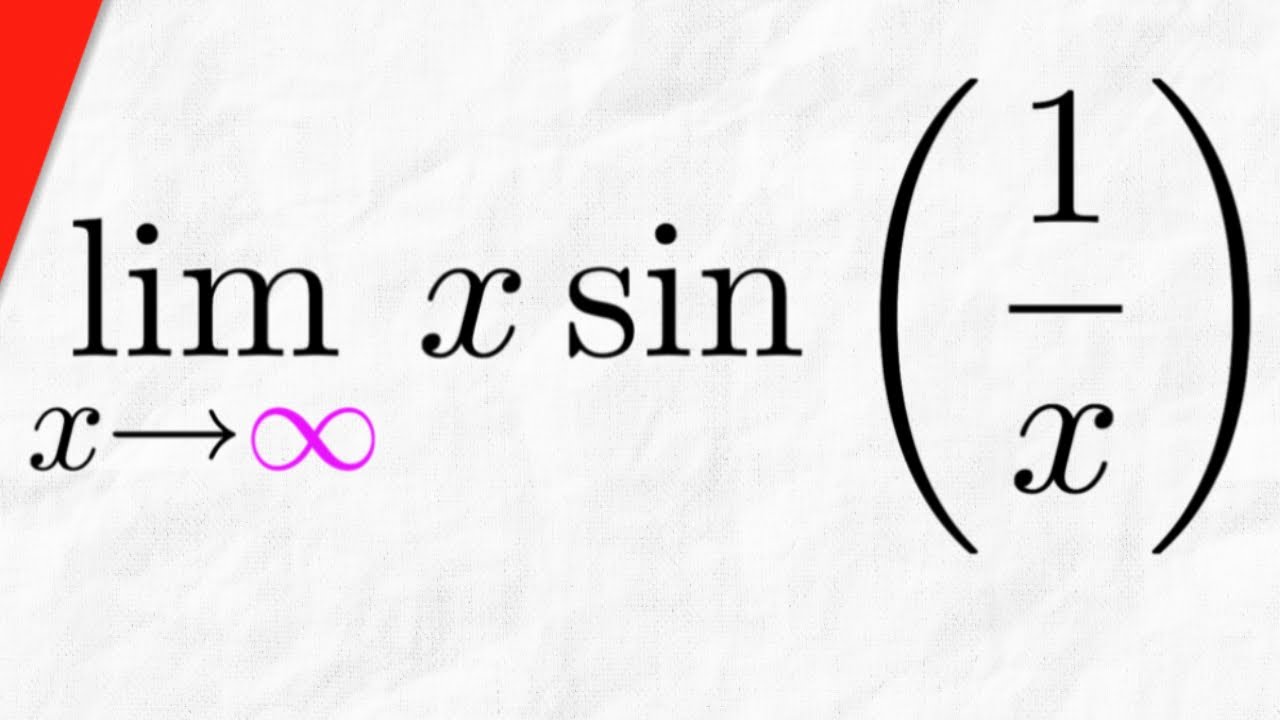
We show the limit of xsin(1/x) as x goes to infinity is equal to 1. This means x*sin(1/x) has a horizontal asymptote of y=1. We'll also mention the limit with x at negative infinity, which is found in the same way and is also equal to 1. To figure this all out, we'll give 1/x a different name, and see that we actually have a limit in the form si...
tacit mulch
pseudo gulch
but our teacher didnt teach us that yet
That's okay, you're allowed to get creative
Substitutions like that are very common, you probably did things like that in earlier classes