#help-39
1 messages · Page 9 of 1
 safe prairie
 exotic plume
ok
also

now I want to now how to add this up
this is based on the previous problem
.close
 pearl pondBOT
Channel closed
Closed by @exotic plume
Use .reopen if this was a mistake.
 Available help channel!
Send your question here to claim the channel.
Remember:
• Ask your math question in a clear, concise manner.
• Show your work, and if possible, explain where you are stuck.
• After 15 minutes, feel free to ping <@&286206848099549185>.
• Type the command .close to free the channel when you're done.
• Be polite and have a nice day!
Read #❓how-to-get-help for further information on how to ask a good question, and about conduct in the question channels.
 outer hare
Hi, im trying to learn the chain rule
pearl pondBOT
outer hare
Hi, im trying to learn the chain rule

 hexed crypt
You know how to do chain rule?
outer hare
Yeah, its just mostly splitting it up into steps right
like
differentiating f(g(x))
and it would become f’(g(x)) g’(x)
outer hare
hm ok
so split them up and do them separately
ok i think i understand
give me a second to work it out
so f(x) = x^1/2
f'(x) = 1/2x^-1/2
idk if im doing this right
hexed crypt
That is correct
hexed crypt
outer hare
f'(x) = 1/2x^-1/2
And so you plug in g(x) into x here
outer hare
and then gx = 0-8x
hexed crypt
Yes
outer hare
or just -8x
hexed crypt
So just -8x
outer hare
1/2(-8)^1/2
hexed crypt
And now just multiply
outer hare
so 2
outer hare
i thought to plug in the x
hexed crypt
No, it's f'(g(x))*g'(x)
So the derivative of f, with g as x, times the derivative of g
So [1/2f(x)^(1/2)]*-8x
Or rather:
[1/2(5-4x²)^(1/2)]*-8x
hexed crypt
outer hare
[1/2(x-4x^3)^-1/2]*-8x?
?
hexed crypt
Where did the other x come from
outer hare
mistake
[1/2(5-4x^3)^-1/2]*-8x
sorry sorry i get it im just typing it in my head
[1/2(5-4x^2)^-1/2]*-8x
outer hare
wait how would they
hexed crypt
$\frac{-4x}{\sqrt{5-4x^2}}$
 jolly parrotBOT
Estebson

 hexed crypt
Ah ok
outer hare
alr rememvering that
hexed crypt
outer hare
f’(g(x)) g’(x)
Good to know
hexed crypt
outer hare
thank you so much for your help
No problem!
outer hare
yeah i immagine lmao
this next one makes less sense tbh

do i do the same thing but just use the graphs outputs
hexed crypt
outer hare
Oh dear what is that
outer hare
i think its the same thing just idk
graphing lol
im trying it work it out
f’(g(x)) g’(x)
g(1) would be
2
so
f'(2)*g'(1)
hopefully
-3 * 2
-6
does that seam right?
bam

lmao
hexed crypt
Well good job, because I was completely stumped lol
outer hare
yeah its just a huge mindfuck
basiclly its the same thing just
using the graphs outputs
outer hare
and using the actual slope
yup

i hate these already lol
f(x) = cos^4x
g(x) = 4x^2+1
hexed crypt
Oh so this is a double
hexed crypt
f(x)=x^4
g(x)=cosx
h(x)=4x²+1
f(g(h(x)))
outer hare
jesus christ ok
hexed crypt
Ok so do derivative of x^4
outer hare
how did you figure out f(g(h(x)))
hexed crypt
Right
outer hare
im so lost rn
hexed crypt
outer hare
4x^3
So replace x with cos(4x²+1) here
outer hare
can you hop in a vs by chance lol
hexed crypt
Sure ig
hexed crypt
Ok
See if you can follow
f(x)=x^4
g(x)=cosx
h(x)=4x²+1
f(g(h(x)))
[f(g(h(x)))]'=f'(g(h(x)))*g'(h(x))*h'(x)
So
f'(x)=4x³
g'(x)=-sinx
h'(x)=8x
When plugging in everything:
{[cos(4x²+1)]^4}'=4[cos(4x²+1)]³*-sin(4x²+1)*8x
=-32x[cos(4x²+1)]³sin(4x²+1)
pearl pondBOT
@outer hare Has your question been resolved?
pearl pondBOT
Channel closed
Closed due to timeout
Use .reopen if this was a mistake.
pearl pondBOT
Available help channel!
Send your question here to claim the channel.
Remember:
• Ask your math question in a clear, concise manner.
• Show your work, and if possible, explain where you are stuck.
• After 15 minutes, feel free to ping <@&286206848099549185>.
• Type the command .close to free the channel when you're done.
• Be polite and have a nice day!
Read #❓how-to-get-help for further information on how to ask a good question, and about conduct in the question channels.
 languid vigil
Hello! I'm working on a YouTube video discussing the hardest Geometry Dash level and the hardest one requires a FPS count of this number. I'd really like to be able to at least attempt to be able to understand what this means and I'm wondering if any of you understand this lol
 pearl pondBOT
languid vigil
Hello! I'm working on a YouTube video discussing the hardest Geometry Dash level...
pearl pondBOT
languid vigil
Hello! I'm working on a YouTube video discussing the hardest Geometry Dash level...
 midnight haven
those are meaningless letters without a definition of what they are
languid vigil
oh damn
ok lmao i wasnt rly expecting to understand it even if it did mean smth anyways 😭
thx for informing me its not actually anything tho
.close
pearl pondBOT
Channel closed
Closed by @languid vigil
Use .reopen if this was a mistake.
pearl pondBOT
Available help channel!
Send your question here to claim the channel.
Remember:
• Ask your math question in a clear, concise manner.
• Show your work, and if possible, explain where you are stuck.
• After 15 minutes, feel free to ping <@&286206848099549185>.
• Type the command .close to free the channel when you're done.
• Be polite and have a nice day!
Read #❓how-to-get-help for further information on how to ask a good question, and about conduct in the question channels.
 lucid brook
the ratio of LCM (2,4,6,8 . . . 26) the smallest first 6 prime numbers (2,3,5,7,11,13)
pearl pondBOT
lucid brook
the ratio of LCM (2,4,6,8 . . . 26) the smallest first 6 prime numbers (2,3,5,7,...
 young ermine
$\frac{8}{2}}$
jolly parrotBOT
Ken_
$\frac{8}{2}}$
```Compilation error:```! Extra }, or forgotten $.
l.57 $\frac{8}{2}}
$
I've deleted a group-closing symbol because it seems to be
spurious, as in `$x}$'. But perhaps the } is legitimate and
you forgot something else, as in `\hbox{$x}'. In such cases
the way to recover is to insert both the forgotten and the
deleted material, e.g., by typing `I$}'.
Preview: Tightpage -1310720 -1310720 1310720 1310720
[1{/usr/local/texlive/2020/texmf-var/fonts/map/pdftex/updmap/pdftex.map}]``` young ermine
$\frac{8}{2}$
jolly parrotBOT
Ken_
 lucid brook
Options 11 13 24 25 26
jolly parrotBOT
Ken_
 lucid brook
so basically the least common multiple (2,4,6,8,10,12,14,16,18,20,22,24,26) divided by (2,3,5,7,11,13)
pearl pondBOT
@lucid brook Has your question been resolved?
pearl pondBOT
Channel closed
Closed due to timeout
Use .reopen if this was a mistake.
pearl pondBOT
Available help channel!
Send your question here to claim the channel.
Remember:
• Ask your math question in a clear, concise manner.
• Show your work, and if possible, explain where you are stuck.
• After 15 minutes, feel free to ping <@&286206848099549185>.
• Type the command .close to free the channel when you're done.
• Be polite and have a nice day!
Read #❓how-to-get-help for further information on how to ask a good question, and about conduct in the question channels.
 verbal snow
How do you solve (5 - 3i) divided by (2+5i) where i is the square root of negative one, i know how to add substract and multiply, but i have no idea how to approach division
pearl pondBOT
verbal snow
How do you solve (5 - 3i) divided by (2+5i) where i is the square root of negati...
 cinder flower
verbal snow
How do you solve (5 - 3i) divided by (2+5i) where i is the square root of negati...
cinder flower
verbal snow
How do you solve (5 - 3i) divided by (2+5i) where i is the square root of negati...
omgggg
verbal snow
cinder flower
omgggg
Omgg
cinder flower
does solve (5 - 3i) divided by (2+5i) mean write it like a + bi?
cinder flower
I think the most straightforward way is to start with writing $\frac{5-3i}{2+5i}=a+bi$
jolly parrotBOT
layla💜
 cinder flower
then $5-3i = (2+5i)(a+bi)$
jolly parrotBOT
layla💜
 verbal snow
Then 5-3i = 2a + 2bi + 5ai + 5bi^2?
cinder flower
yep, perfect
verbal snow
i squared is -1 right
cinder flower
yep
cinder flower
so 5-3i = 2a -5b + 5ai + 2bi = 2a - 5b + (5a+2b)i
verbal snow
You lost me😭
cinder flower
verbal snow
Then 5-3i = 2a + 2bi + 5ai + 5bi^2?
the first equality is just this with 5bi^2 = -5b
verbal snow
Oh
cinder flower
then the second one is from factoring out the i from 5ai + 2bi
also oops had a typo
following so far?
cinder flower
oh ok well we just want 5-3i = 2a - 5b + (5a+2b)i anyway
verbal snow
Oh ok
cinder flower
do you follow up to there?
verbal snow
I think so
cinder flower
so now if two complex numbers are equal then their real and imaginary parts are both equal
in other words, 5 = 2a - 5b and -3 = 5a+2b
verbal snow
Then you do system of equations to find a and b?
cinder flower
sure
verbal snow
Then once you have the value of a and bi, you just plug it in to a+bi
and that is solution?
cinder flower
yep
verbal snow
I think i still dont get the 2nd step
5- 3i = 2a + 2bi + 5ai - 5bi
5 - 3i = 2a + 5ai - 3bi
Then im lost
cinder flower
asdufhaesfuh sorry I made a typo earlier
cinder flower
I meant 5bi^2 = -5b, not 5bi^2 = -5bi
verbal snow
verbal snow
5 - 3i = 2a + 2bi + 5ai - 5b*
So what is next from here
cinder flower
the real part of 5 - 3i is 5 and the real of part of 2a - 5b + (5a+2b)i is 2a - 5b
and the real parts must be equal
the real part of a complex number like x + yi is x
and the imaginary part is y
verbal snow
Then im parts equal?
cinder flower
yep
cinder flower
the imaginary part of 5 - 3i is actually just -3, not -3i
verbal snow
Oh
cinder flower
so we can go right to -3 = 5a+2b
verbal snow
verbal snow
-3i = (5a+2b)i
It wouldnt be bad if you did this though right? Cause you get the same thing if you divide by i
cinder flower
yea that's fine too 🙂
cinder flower
np!
pearl pondBOT
@verbal snow Has your question been resolved?
pearl pondBOT
Channel closed
Closed due to timeout
Use .reopen if this was a mistake.
Available help channel!
Send your question here to claim the channel.
Remember:
• Ask your math question in a clear, concise manner.
• Show your work, and if possible, explain where you are stuck.
• After 15 minutes, feel free to ping <@&286206848099549185>.
• Type the command .close to free the channel when you're done.
• Be polite and have a nice day!
Read #❓how-to-get-help for further information on how to ask a good question, and about conduct in the question channels.
 tough void
Linear Algebra Question: If an indexed set of vectors S = {v1, v2 .... vn} contains a vector vj where j > 1 such that vj is a linear combination of the other vectors, why can it not be said that the set of vectors are linearly independent? Furthermore, let's say that the set of vectors S form the columns of an nxn matrix A. Why could it not be said that the columns of A span R^n, given that the above conditions are true?
pearl pondBOT
tough void
Linear Algebra Question: If an indexed set of vectors S = {**v**1, **v**2 .... *...
tough void
So I kind of understand one part of this question, but I am wondering more on how these concepts tie together. The set of vectors would be linearly dependent because if we set Ax=0 and solved for x, we could have some non-zero solution x. But why does this not allow us to say that the columns of A span R^n?
This is the essential part that I'm missing
 rancid hearth
Fix S as the canonical basis of R^(n-1) plus a linear combination, it's clear that there's a vector in R^n that's not a linear combination of vectors in S
tough void
What do you mean by canonical basis? Are you saying that if that vj vector exists within the set S, then it (the set) would span R^(n-1)? Also just to clarify, in my textbook, it says that R^n would just be a column vector with n x 1 entries. So when you say that there's a vector in R^n that's not a linear combination of the vectors in S, do you mean that c1v1 + c2v2 + c3v3 + cnvn != some(b)
From my understanding, if was to say that 2 column vectors in a 2x2 matrix span R^2, this would mean that there is some linear combination of these columns that would yield a result for every value in the set R^2
 mental hinge
im gonna suggest the 3b1b eola video on linear combination span and basis
rancid hearth
tough void
What do you mean by canonical basis? Are you saying that if that **v**j vector e...
Doesn't really matter which basis, i just set an example where S would span R^(n-1) but not R^n
It might be easier to see concretely, let n=3 and say S={v1=(1,0,0), v2=(0,1,0), v3=(1,1,0)}
It's clear that v3=v1+v2, but there's no combination that would be equal to (0,0,1) which is in R^3
tough void
rancid hearth
It's clear that v3=v1+v2, but there's no combination that would be equal to (0,0...
do you mean v3 = x1+x2?
rancid hearth
No, I wrote v1=(1,0,0) and v2=(0,1,0)
tough void
oooh
thats what you mean
got it
Ok ok i see what you're saying
So is this generalizable to all cases?
This is very interesting
rancid hearth
The fact that you have a vector that is a linear combination means that a set of cardinality n that contains it cannot span a space of dimension n
tough void
Let me think for a sec
So... just to be clear, when you say "set of cardinality n that contains it cannot span a space of dimension n" do you mean that if I can find a single value in R^n that is unobtainable as the linear combination of the vector set S, then it necessarily cannot span a space of dimension n?
Is there a generalized proof for this?
Like, now I understand what's going on, I just don't know that it's true in every case where that vj exists in the set
Like I haven't seen it
rancid hearth
It's the definition of span; the smallest vector subspace that contains the set
rancid hearth
tough void
So... just to be clear, when you say "set of cardinality n that contains it can...
Yes, being in the span of a set is the same as being a linear combination of elements in the set
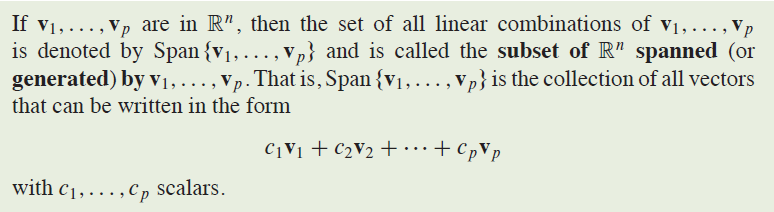
In mathematics, the linear span (also called the linear hull or just span) of a set S of vectors (from a vector space), denoted span(S), is the smallest linear subspace that contains the set. It can be characterized either as the intersection of all linear subspaces that contain S, or as the set of linear combinations of elements of S. The linea...
 rancid hearth
It's equivalent
tough void
It's missing the "smallest vector subspace" part
rancid hearth
"Smallest" there means that nothing but the linear combinations are counted in
tough void
ooo
IC
Okay
One last thing
I think I get it now, but, I want to see the proof that if vj exists within the set then the set cannot span R^n (assuming nxn matrix A)
Is there a proof for this? What should I look up to find it?
rancid hearth
It is a theorem that the span of the set including linear combinations is the same without them, then you can construct a vector in R^n that is not obtainable by taking the orthogonal of the set S, which necessarily exists
Sorry if it's still too hand-wavy that's as detailed I can phrase it without checking a book lol
tough void
Hahaha no it's okay you have helped out a lot
I'm going to be doing more research on it, maybe I'll go to office hours and ask my professor for a proof
Really appreciate the help
mental hinge
just gonna mention it again because i rly do believe it to be a valuable resource
3b1b's essence of linear algebra is a super intuitive way of looking at the subject
and its extremely helpful
mental hinge
each video is about 10-15 mins ish
i would recommend the whole series to supplement your coursework
mental hinge
np and gl with ur work!
tough void
.close
pearl pondBOT
Channel closed
Closed by @tough void
Use .reopen if this was a mistake.
Available help channel!
Send your question here to claim the channel.
Remember:
• Ask your math question in a clear, concise manner.
• Show your work, and if possible, explain where you are stuck.
• After 15 minutes, feel free to ping <@&286206848099549185>.
• Type the command .close to free the channel when you're done.
• Be polite and have a nice day!
Read #❓how-to-get-help for further information on how to ask a good question, and about conduct in the question channels.
 rose hazel
Suppose the inflation rate of a country in 2009 was 20%. If a dress costs $150 at the beginning of the year, how much would it cost at the end of the year?
pearl pondBOT
rose hazel
Suppose the inflation rate of a country in 2009 was 20%. If a dress costs $150 a...
 inner cairn
Convert the percentage to a decimal by dividing it by 100
Then multiply 150 by your answer
rose hazel
k
rose hazel
inner cairn
Or just add 1 to the decimal before multiplying
so 150.3
but the answer options are these
 inner cairn
0.2 * 150 = 30
inner cairn
30 + 150 = 180
inner cairn
All good
 inner cairn
It’s the same working out
rose hazel
so
inner cairn
Almost
rose hazel
is that minus?
inner cairn
Yeah
rose hazel
98%*150?
inner cairn
yeah
rose hazel
147
inner cairn
Yeah
rose hazel
and the only one close is 1470
rose hazel
o
inner cairn
98% * 1500
inner cairn
Yeah
pearl pondBOT
Channel closed
Closed by @rose hazel
Use .reopen if this was a mistake.
Available help channel!
Send your question here to claim the channel.
Remember:
• Ask your math question in a clear, concise manner.
• Show your work, and if possible, explain where you are stuck.
• After 15 minutes, feel free to ping <@&286206848099549185>.
• Type the command .close to free the channel when you're done.
• Be polite and have a nice day!
Read #❓how-to-get-help for further information on how to ask a good question, and about conduct in the question channels.
 naive musk
How do I group this 3z^2 - 9z - 2z + 6?
pearl pondBOT
naive musk
How do I group this 3z^2 - 9z - 2z + 6?
naive musk
I'm workin on quadratic formula
 fiery vortex
wdym group
 fleet sky
well that would be 3z^2 - 11z + 6 to combine like terms
naive musk
welllll like how 3x^2 + 9x + 1x + 3 can be grouped and simplified into (3x + 1) (x + 3)
fleet sky
ah you mean factored
fiery vortex
naive musk
welllll like how 3x^2 + 9x + 1x + 3 can be grouped and simplified into (3x + 1) ...
eh this
doesn’t seem
right
fleet sky
well you need to find 2 values that multiply together to 18 (6*3) and add up to -11.
naive musk
i did tho, thats how i made the firs part of 3z^2 - 9z - 2z + 6
the problem is 3z^2 - 11z + 6
fleet sky
oh I see. Well then I would look for common factors of your equation
for example 3x^2 and -9z share a factor of 3z
naive musk
so 3z would be put in front of somethin like 3z( )( )
fleet sky
so 3z^2 - 9z - 2z + 6 = 3z(z - 3) - 2z + 6.
then 2z + 6 has a common factor of 2
so then we get 3z(z - 3) -2(z-3). Then you can factor out a (z - 3) to get (z-3)(3z-2)
and there's your factor
and that's really just playing around with different things you can factor out until you get one that fits
naive musk
this is makin sense just have another question, am i lookin for common factors in ANY part, or did ya purposefully look for common factors between 3z^2 and 9z because theyre neighbors?
fleet sky
nah I just normally start with "what's the most I can factor out". I could factor out a z, and a 3, so why not factor out 3z and see what happens?
it's a bit of trial and error at first then you get good at spotting the stuff
naive musk
can a common factor be negative?
does that make sense or nah?
is that just relative to the equation im finding common factors in?
nvm all good ty
.close
pearl pondBOT
Channel closed
Closed by @naive musk
Use .reopen if this was a mistake.
Available help channel!
Send your question here to claim the channel.
Remember:
• Ask your math question in a clear, concise manner.
• Show your work, and if possible, explain where you are stuck.
• After 15 minutes, feel free to ping <@&286206848099549185>.
• Type the command .close to free the channel when you're done.
• Be polite and have a nice day!
Read #❓how-to-get-help for further information on how to ask a good question, and about conduct in the question channels.
 arctic horizon
Hello!
-Assume that 18% of the population is left-handed. Determine the probability of having terms within a group of 50 individuals at least 2 lefties
pearl pondBOT
arctic horizon
Hello!
-Assume that 18% of the population is left-handed. Determine the probab...
arctic horizon
How can i do? I did like this: 9/50*9/50=3.24%, its correct?
 hybrid dome
cinder flower
I'd calculate the probability of 0 or 1 lefties
hybrid dome
cinder flower
I'd calculate the probability of 0 or 1 lefties
it says atleast 2
so that means 2-50
arctic horizon
cinder flower
I'd calculate the probability of 0 or 1 lefties
how?
cinder flower
yea but I meant for complementary probability purposes
sounds a lot easier that way
hybrid dome
oh
but
wouldnt it be
wait howd i explain it
@cinder flower so how would you assume to do it?
hybrid dome
arctic horizon
How can i do? I did like this: 9/50*9/50=3.24%, its correct?
??
can you explain your thought process
im trying to see how you did it
cinder flower
the number of lefties follows a binomial distribution
hybrid dome
wait so its 18% right?
cinder flower
hybrid dome
wait so its 18% right?
for what?
arctic horizon
50*0.18 = 9
hybrid dome
ohhhhhh
i see
wait so @arctic horizon
its like
48/50?
wait no
according to layla's logic
cinder flower
not that either
hybrid dome
im more confused
than i was
-Assume that 18% of the population is left-handed. Determine the probability of having terms within a group of 50 individuals at least 2 lefties
so
like
ohhhhhh
what would it be
1 <2> atlest 2 >50
what is the question asking HELP
WHATS THE probability of getting atleast 2 lefties
arctic horizon
hybrid dome
WHATS THE probability of getting atleast 2 lefties
yesssss
cinder flower
I'm gonna guess it's translated which is why it sounds a little off
arctic horizon
at least two peoples need be lefties, what is the probably?
jolly parrotBOT


 Requested by idk man#0434
hybrid dome
Requested by idk man#0434
hybrid dome
myb?
cinder flower
no 
hybrid dome
but is it a sample spaced roup or
arctic horizon
2.88%?
jolly parrotBOT
 Requested by idk man#0434
cinder flower
Requested by idk man#0434
cinder flower
what's 9/50*8/50 supposed to be a calculation of?
hybrid dome
-Assume that 18% of the population is left-handed. Determine the probability of having terms within a group of 50 individuals at least 2 lefties
0.0288
oh
like
from 50 the probs is 18
9
is the probable no of lefties
from 50
thats what i though anywats
imma look at some google to learn how youd do this type of question
sorry dudes
arctic horizon
im looking here
hybrid dome
Part A:
Given that 18% of the population is left handed, in a sample of 6 customers, we expect to see 0.18 x 6 = 1.08 lefties.
Part B:
Given that the proportion of lefties is 18% or 0.18 and the proportion of non-lefties is 100 - 18 = 82% or 0.82.
Since the sample size is 6, the sample standard deviation is given by:
s=\sqrt{npq} \ \ =\sqrt{6\times0.18\times0.82} \ \ =\sqrt{0.8856}=0.94
arctic horizon
arctic horizon
i didnt understand
hybrid dome
this is for 10%
arctic horizon
hybrid dome
Part A:
Given that 18% of the population is left handed, in a sample of 6 custo...
it
hybrid dome
yeye
arctic horizon
hybrid dome
this is for 10%
10%?
hybrid dome
i got the answer for 18
cinder flower
none of the answers proposed so far have been right
hybrid dome
cinder flower
none of the answers proposed so far have been right
yeah but howd you know

ok so
cinder flower
because I did it correctly and nobody got the same answer as me 🥲
hybrid dome
cinder flower
because I did it correctly and nobody got the same answer as me 🥲
ahuhhhh
🤷♂️
arctic horizon
cinder flower
because I did it correctly and nobody got the same answer as me 🥲
how you did?
hybrid dome
arctic horizon
how you did?
second that
hybrid dome
so i am on that calculator
Use the free, online Binomial Calculator to compute individual and cumulative binomial probability. For help in using the calculator, read the Frequently-Asked Questions or review the binomial sample problems.
i cant figure that shi out
so i didnt bother
hybrid dome
 cinder flower
.18 probability success, 50 trials, and number of successes = 2
and P(X>=2) is the probability
hybrid dome
ohhhhh
 cinder flower
$1 - (1-0.18)^{50} - 50(.18)(1-0.18)^{49}$
hybrid dome
@cinder flower SO WHICH IS THE ANSWER
jolly parrotBOT
layla💜
 hybrid dome
bruh i need someone to explain this shi to me
cinder flower
,calc 1 - (1-0.18)^(50) - 50(.18)(1-0.18)^49
jolly parrotBOT
Result:
0.99941252383037
hmmmmmmmmmmmmmmmmmmmmm
hybrid dome
jesus im getting lost
cinder flower
jolly parrot
**layla💜**
that's what I was suggesting at the start
1 - (probability of 0 lefties) - (probability of exactly 1 lefty)
arctic horizon
now the final anwser, the prob is 0.99941252383037 or 0.00058747616?
 cinder flower
that precision 💀
arctic horizon
thank you so much guys ♥
hybrid dome
arctic horizon
thank you so much guys ♥
awww its closing
cinder flower
gn
arctic horizon
.close
pearl pondBOT
Channel closed
Closed by @arctic horizon
Use .reopen if this was a mistake.
Available help channel!
Send your question here to claim the channel.
Remember:
• Ask your math question in a clear, concise manner.
• Show your work, and if possible, explain where you are stuck.
• After 15 minutes, feel free to ping <@&286206848099549185>.
• Type the command .close to free the channel when you're done.
• Be polite and have a nice day!
Read #❓how-to-get-help for further information on how to ask a good question, and about conduct in the question channels.
 hot niche
Can someone help me verify that what i have on this question is right? And also find the missing angle
pearl pondBOT
hot niche
Can someone help me verify that what i have on this question is right? And also ...
 toxic lichen
try cancelling and reuploading
hot niche
I did
toxic lichen
it's probably just a glitch on your end
hot niche
I agree

Ok we good now
alright so the problem gives us angle 2 as 92 degrees, and angle 12 as 74°.
First thing I did was look at my vertical angles, which are congruent regardless of parallel lines
That gives me number 23 on the left, which asks for angle 8
Next thing i did was find corresponding angles
Angle 2 and 10 are corresponsing, so angle 10 is also 92°
Next i had to find angle 9
We can see that its a linear pair, so i took 180-92 to get 88
Giving me the measure of angle 9
but the last angle im asked to find is angle 5, how do i find that?
It cant be corresponding with angle 2 because the lines arent parallel
I have another question over a problem using a quadratic
A large majority of my issues come from barely being able to do the algebra
I think this one will be a linear system and a quadratic combined
pearl pondBOT
@hot niche Has your question been resolved?
pearl pondBOT
@hot niche Has your question been resolved?
hot niche
Algebra help please
 midnight haven
Do you need z?
 cursive fulcrum
What issue are you facing after this?
hot niche
Z is squared btw its a quadratic
I didnt write it properly
I dont know how to solve 3z^2+33=0
midnight haven
alright
Let's subtract 33 on both side
Then divide by 3 both side
what do you have?
midnight haven
z²=-11
hot niche
Ok wait
midnight haven
but z² is always positive for z real
hot niche
We can divide it just by 3?
midnight haven
so you probably got something wrong
 midnight haven
So your calculations are wrong somewhere for z
hot niche
Yeah?
midnight haven
what did u use
hot niche
3z^2-5
midnight haven
how did you find your 3z²+33=0
hot niche
I got 7.5 as y
By putting alternate interior angles equal to each othee
So
4(7.5)+8
Is 38
and 38 plus 3z^2-5 will equal 180
midnight haven
You probably can find z² and apply square root to find z
hot niche
Can you give me the answer and explain how you get there? I dont know how to use imperfect squares
midnight haven
3z^2-142=0
Alright let's take it easy
3z^2-5+38=180
You bring across you have:
(you can say you substract 180 on both side)
midnight haven
Alright, keep going
midnight haven
yes
You applied square root on both side
z=7 OR -7 (because z=-7 also means z²=49)
here z is clearly not -7 so z=7
hot niche
Im whacked out bro this class is murdering me
Thank you so so so so much
your a lifesaver man
 We've all been here
pearl pondBOT
We've all been here
pearl pondBOT
Channel closed
Closed by @hot niche
Use .reopen if this was a mistake.
Available help channel!
Send your question here to claim the channel.
Remember:
• Ask your math question in a clear, concise manner.
• Show your work, and if possible, explain where you are stuck.
• After 15 minutes, feel free to ping <@&286206848099549185>.
• Type the command .close to free the channel when you're done.
• Be polite and have a nice day!
Read #❓how-to-get-help for further information on how to ask a good question, and about conduct in the question channels.
 indigo sapphire
I'm stuck can someone please help me what I did wrong here
 indigo sapphire
<@&286206848099549185>
 light helm
your y at x=1 is wrong
indigo sapphire
Should I just substitute the x=1 into the original equation?
midnight haven
Yeah it's not ln(3)
indigo sapphire
So it's just gonna be In(3)-e^-2 ?
light helm
yeh
 indigo sapphire
-In(3)+e^-2?
light helm
yeh
pearl pondBOT
@indigo sapphire Has your question been resolved?
indigo sapphire
This is what I got but I just wanna make sure if I still did any mistakes on it?

Like in the part where y=(2 x 1/e^2 +1)
light helm
looks fine
pearl pondBOT
Channel closed
Closed by @indigo sapphire
Use .reopen if this was a mistake.
Available help channel!
Send your question here to claim the channel.
Remember:
• Ask your math question in a clear, concise manner.
• Show your work, and if possible, explain where you are stuck.
• After 15 minutes, feel free to ping <@&286206848099549185>.
• Type the command .close to free the channel when you're done.
• Be polite and have a nice day!
Read #❓how-to-get-help for further information on how to ask a good question, and about conduct in the question channels.
 grim patrol
 pearl pondBOT
grim patrol
grim patrol
pearl pondBOT
grim patrol
grim patrol
help
sqrt((b-x)(x-a)) = t in [0,-ing)
(b-x)(x-a) = t^2
-x^2+(a+b)x-ab=t^2
x^2-(a+b)x+ab+t^2=0
x = (a+b+-sqrt((a+b)^2-4(ab+t^2)))/2
$x = (a+b)/2 \pm \sqrt{(a-b)^2-t^2}/2$
jolly parrotBOT
 grim patrol
so when t=0, x = a,b
so like this

where 1 is branch point, 2 is branch cut
and they connect at inf
im tired ill b back
lol.
pearl pondBOT
@grim patrol Has your question been resolved?
pearl pondBOT
Channel closed
Closed due to timeout
Use .reopen if this was a mistake.
grim patrol
.reopen
pearl pondBOT
✅
 rustic gate

grim patrol
hii
was that right so far
ok idk what to do now, i tried to let sqrt(z-a)sqrt(z-b) =t and square it again
but i realise its the same as whats shown in the option? whats the diff
rustic gate
,w (z - a)(z - b) = t
jolly parrotBOT

 grim patrol
idk i skipped this
now im on wiki reading about keyholes
so i can become a future locksmith

jolly parrotBOT
 rustic gate
?
grim patrol
how did u even get dogbone
dog bone as in
like a dumbell right
no weird bit goes to inf
 rustic gate
so a dogbone lol
grim patrol
so C goes to inf
grim patrol
??
grim patrol
how
jolly parrotBOT
 grim patrol
hm
rustic gate
so like
jolly parrotBOT
 grim patrol
oh urs doesnt hv sqrt tho
grim patrol
rustic gate
,w (z - a)(z - b) = t
ur original
rustic gate
so like 
grim patrol
change t to t^2?
rustic gate
no
you need t to be (-inf, 0]
so you get a line on the real axis somewhere when -(a - b)^2/4 < t <= 0
and then
you get some imaginary line
i think its like
a vertical line
when t < -(a - b)^2/4
jolly parrotBOT
 rustic gate
to calculate the branch cut
rustic gate
no thats the branch cut of
grim patrol
rustic gate
so you get a line on the real axis somewhere when -(a - b)^2/4 < t <= 0
hb the non real bits
aka when sqrt is neg n gives im

 grim patrol
wldnt it differ
rustic gate
??
rustic gate
differ what
rustic gate
what
jolly parrotBOT
 rustic gate
its entire

 jolly parrotBOT
 rustic gate
yes
 jolly parrotBOT
 pearl pondBOT
Channel closed
Closed by @grim patrol
Use .reopen if this was a mistake.

 pearl pondBOT
Available help channel!
pearl pondBOT
Available help channel!
Send your question here to claim the channel.
Remember:
• Ask your math question in a clear, concise manner.
• Show your work, and if possible, explain where you are stuck.
• After 15 minutes, feel free to ping <@&286206848099549185>.
• Type the command .close to free the channel when you're done.
• Be polite and have a nice day!
Read #❓how-to-get-help for further information on how to ask a good question, and about conduct in the question channels.
 glass cliff
Can someone pleas help me re-arrange this equation i will be eternally grateful :WOWOWOWOW:
-log(x - T) + c1 = kt + c2
Rearrange to be in terms of T=f(t)
pearl pondBOT
glass cliff
Can someone pleas help me re-arrange this equation i will be eternally grateful ...
glass cliff
So i have to sub some values in once ive rearranged but i end up with a negative log and no real solutions so i've gone wrong somewhere but im not sure where
jolly parrotBOT

 Requested by Circle#0025
glass cliff
Requested by Circle#0025
glass cliff
i can show the working
glass cliff
 pearl pondBOT
@glass cliff Has your question been resolved?
pearl pondBOT
Channel closed
Closed due to timeout
Use .reopen if this was a mistake.
Available help channel!
Send your question here to claim the channel.
Remember:
• Ask your math question in a clear, concise manner.
• Show your work, and if possible, explain where you are stuck.
• After 15 minutes, feel free to ping <@&286206848099549185>.
• Type the command .close to free the channel when you're done.
• Be polite and have a nice day!
Read #❓how-to-get-help for further information on how to ask a good question, and about conduct in the question channels.
indigo sapphire
Idk what to do next tryna differentiate using quotient rule

 shrewd basin
check dv/dx
shrewd basin
Your dv/dx isn’t right
indigo sapphire
Ooh okay I fixed it
So 4(2x-1)
And idk what comes after that which I'm confused about
indigo sapphire
Idk
 shrewd basin
,w derivative of (3x^2)/(2x-1)^2
jolly parrotBOT

 Requested by Pure#9389
shrewd basin
Requested by Pure#9389
shrewd basin
You’ve already cancelled the (2x-1) in the second term
pearl pondBOT
Channel closed
Closed by @indigo sapphire
Use .reopen if this was a mistake.
Available help channel!
Send your question here to claim the channel.
Remember:
• Ask your math question in a clear, concise manner.
• Show your work, and if possible, explain where you are stuck.
• After 15 minutes, feel free to ping <@&286206848099549185>.
• Type the command .close to free the channel when you're done.
• Be polite and have a nice day!
Read #❓how-to-get-help for further information on how to ask a good question, and about conduct in the question channels.
pearl pondBOT
 tough token
the first two terms are your first 3 terms, the last 2 terms look similar but not entirely sure if they are exactly the same. cant see anything wrong in the algebra so looks right


symbolab
oh wait no its just derivative calculator
Solve derivatives using this free online calculator. Step-by-step solution and graphs included!


 arctic nexus
I think you're correct @delicate dock
tough token
its $\sinh^{-1}{x}$
jolly parrotBOT
Duh Hello
 tough token
(x^3(1+x^3)^(e^x)(sinh^-1(x))^2022/(log (pi)+cscx)^(1/5)
my absolute value symbol doesnt work on my keyboard so u gotta fill those in youself lol
(3/x+(3e^x x^3)/(1+x^3)+e^x ln(1+x^3)+2022/(sinh^-1(x)sqrt(x^2+1))+(cscx cotx)/(5 log(pi)+5cscx))((x^3(1+x^3)^(e^x)(sinh^-1(x))^2022)/(ln(pi)+cscx)^(1/5)
mine times out as well
think ur just gonna have to go with ur instinct
either go through and make really sure the algebra is right, or try and manipulate yours into being the same as the one this calculator gives
wouldnt take long to try and get them to be the same, the first 3 terms in yours are trivial to see if its the same, can probably use wolfram or something for the last two to check if they are the same
no idea, i havent used anything other than natural log for years
but this calculator i used treated the log as ln
same rules apply anyways
so shouldnt matter, just keep it as ln on both sides
you need to find a function which checks if they are the same. pretty sure its just using 2 equal signs, so "your expression"=="derivative calculator expression"
then you should get true or false
ye
"your expression"=="derivative calculator expression"
 delicate dock
tough token
the first two terms are your first 3 terms, the last 2 terms look similar but no...
delicate dock
tough token
the first two terms are your first 3 terms, the last 2 terms look similar but no...
this?
tough token
you can remove the first 3 terms in your expression and set that equal to the last two in the derivative calculator expression


because we already know those are equal, will maybe make the computation time a bit lower, either way u can also just put the full expressions in and it will probably be fine
delicate dock
aight wish me luck haha
tough token
i gotta go now tho. good luck
delicate dock
tough token
i gotta go now tho. good luck
lol it didn't return true or false
I wish I had mathematica
delicate dock
arctic nexus
I think you're correct <@422012576566738947>
yoo I will trust you okay?
😂
pearl pondBOT
@delicate dock Has your question been resolved?
Channel closed
Closed by @delicate dock
Use .reopen if this was a mistake.
pearl pondBOT
Available help channel!
Send your question here to claim the channel.
Remember:
• Ask your math question in a clear, concise manner.
• Show your work, and if possible, explain where you are stuck.
• After 15 minutes, feel free to ping <@&286206848099549185>.
• Type the command .close to free the channel when you're done.
• Be polite and have a nice day!
Read #❓how-to-get-help for further information on how to ask a good question, and about conduct in the question channels.
 junior pawn
an idea to integrate $\int \frac{1}{1 + sin^2x}$?
 grim patrol
residue theorem
junior pawn
never hear about it
 toxic lichen
@grim patrol you're suffering from hammer-nail syndrome
grim patrol
toxic lichen
<@187850624421986304> you're suffering from hammer-nail syndrome
wot
oh using op stuff to do easy stuff?
toxic lichen
when you wield a hammer everything looks like a nail
junior pawn
$\int \frac{dx}{1 + sin^2x} = \int \frac{dx}{2 - cos^2(x)}$
grim patrol
sry i just slayed the demon king
 junior pawn
grim patrol
junior pawn
grim patrol
hey what the website
grim patrol
Solve definite and indefinite integrals (antiderivatives) using this free online calculator. Step-by-step solution and graphs included!
junior pawn
it can be pretty useful
grim patrol
u can google integral calc w steps
grim patrol
junior pawn
it can be pretty useful
it nearly always is
except when they give u smt which antiderivative doesnt exist
junior pawn
idk why but worlfram alpha bug with me and you must pay to see the step sx)
grim patrol
junior pawn
idk why but worlfram alpha bug with me and you must pay to see the step sx)
probably why they r more profitable
LOL
in a capitalist society
companies do what they can to maximise profit
even if it harms the consumer or the workers
 fierce oxide
mega stonk
grim patrol
hey u look diff
fierce oxide
just my pfp
whchi depicts my current mood
junior pawn
grim patrol
companies do what they can to maximise profit
calm calm x)
rustic gate
grim patrol
residue theorem
LOL
grim patrol
yes
 severe quartz
jolly parrot
**Max.cc**
severe quartz
jolly parrot
**Max.cc**
for integrations where theres trig functions squared, dividing the num and denom by (cosx)^2 then taking tanx=t works most of the times
grim patrol
most is the keyword here
grim patrol
grim patrol
residue theorem
sometimes ud have to resort to more powerful weapons
severe quartz
what is that
junior pawn
severe quartz
for integrations where theres trig functions squared, dividing the num and denom...
it looks simple say like that x)
rustic gate
you cant do indefinite integrals with residue theorem lol
grim patrol
severe quartz
what is that
an integration technique
grim patrol
rustic gate
you cant do indefinite integrals with residue theorem lol
D:
oh its from -inf to inf right
who even does indef integrals smh
junior pawn
so i found arctan(u), is it right?
grim patrol
well id say just check it w integral calc
im bad at int
mayb if u wait some1 else will come along
if u dk a specific step u can ss it n i can try to help
if im still here
pearl pondBOT
@junior pawn Has your question been resolved?
pearl pondBOT
Channel closed
Closed due to timeout
Use .reopen if this was a mistake.
Available help channel!
Send your question here to claim the channel.
Remember:
• Ask your math question in a clear, concise manner.
• Show your work, and if possible, explain where you are stuck.
• After 15 minutes, feel free to ping <@&286206848099549185>.
• Type the command .close to free the channel when you're done.
• Be polite and have a nice day!
Read #❓how-to-get-help for further information on how to ask a good question, and about conduct in the question channels.
naive musk
Can I look at 5x(3x-2)-3(3x+2) as 5x(3x-2)+3(3x-2)
toxic lichen
no
naive musk
ok, im tryna factor the first equation, and im wondering what step im missing to end with (3x-2)(5x-3)
the 3x+2 is throwing me off
cause i know i can throw 3x-2 up front if it had another 3x-2
 peak mist
suggestion - just multiply it out then factor?
naive musk
oh like multiply out 5x(3x-2) and 3(3x+2) and then factor the result of those?
naive musk
oh wait but i had it multiplied out to begin with, like (15x^2-10x)-(9x+6)
or is that not the multiplied out version?


 naive musk
yes im tryna factor
peak mist
divide the full thing by 3
naive musk
the original expression was 15x^2 - 19x + 6
peak mist
all of that should equal to 0 right?
peak mist
what the question say?
naive musk
"factor the given expression"
naive musk
im goin off the ac method