
#help-38
1 messages · Page 221 of 1
 solid kilnBOT
 onyx mist
This is an open cover of $\mathbb{R}$
solid kilnBOT
Cycadellic
 onyx mist
Can you give me a finite subset of this cover
$$…,(0,2),(1,3),(2,4),…$$
That still covers $\mathbb{R}$?
 warm trench
no
solid kilnBOT
Cycadellic
 warm trench
i see
onyx mist
The only sets that are compact are closed and bounded
But we need a metric for boundedness to make sense
warm trench
i think i get it
onyx mist
Why isnt an open set compact?
onyx mist
Lol
So, what does closedness have to do with every open cover having a finite subcover
onyx mist
(0,1)
warm trench
(0,1) is the set we want to determine if it is compact?
onyx mist
Are you familiar with the archimedean property?
onyx mist
Think about 1/1, 1/2, 1/3, …
warm trench
converges to 0
onyx mist
Make my open covers around it
You cant give me a finite subcover
Has to exist and cover (0,1) by archimedean prop
warm trench
{(1/2,2),(-1,1)}
onyx mist
A subset of the cover
onyx mist
You cant
warm trench
🤯
onyx mist
Once you name like 1/n, ill just say you didnt cover 1/(n+1)
And thats arch prop at the work
warm trench
oh damn
onyx mist
So, no openness, and it must be bounded
warm trench
got it
warm trench
open balls?
onyx mist
Thats good
 trim joltBOT
Channel closed
Closed by @warm trench
Use .reopen if this was a mistake.
trim joltBOT
 Available help channel!
Send your question here to claim the channel.
Remember:
• Ask your math question in a clear, concise manner.
• Show your work, and if possible, explain where you are stuck.
• After 15 minutes, feel free to ping <@&286206848099549185>.
• Type the command .close to free the channel when you're done.
• Be polite and have a nice day!
Read #❓how-to-get-help for further information on how to ask a good question, and about conduct in the question channels.
 umbral onyx
my teacher showed this weird thing
$X_{n+2} = X_{n+1} - 2X_n \
X_{n+2} - X_{n+1} + 2X_n = 0 \
E^2(X_n) - E(X_n) + 2(X_n) = 0 \
(\lambda^2 - \lambda + 2)(X_n) = 0 \$
trim joltBOT
umbral onyx
my teacher showed this weird thing
$X_{n+2} = X_{n+1} - 2X_n \\
X_{n+2} - X_{n+...
solid kilnBOT
Nyxzore
 umbral onyx
This is a discrete first order homogeneous difference equation
where E is the E operator/ shift operator
$E(X_n) = X_{n+1}$
solid kilnBOT
Nyxzore
 umbral onyx
now the context has scared people away 😭
 arctic silo
bro ngl
once my teacher said smthing like this
and i never understood
i get it that u mean d(x n+1)/d(x n) = E or smting like dat
 marble wharf
until the third line you should be fine, yes?
the fourth line is a general trick for linear recurrences like this
umbral onyx
It's the lamba nonsense that's weird for me yeah
marble wharf
you assume that X_(n+1) = lambda * X_n
that enables you to find particularly simple solutions X_n
umbral onyx
Why?
marble wharf
it then turns out that the actual solutions will be linear combinations of those simple solutions
umbral onyx
marble wharf
you assume that X_(n+1) = lambda * X_n
Where does this assumption come from
marble wharf
someone did it at some point and saw that it worked
umbral onyx
💀
marble wharf
its a classic example of first assuming a simpler case
then solving that
and then using it to solve the harder original problem
trim joltBOT
@umbral onyx Has your question been resolved?
Channel closed
Closed by @umbral onyx
Use .reopen if this was a mistake.
Available help channel!
Send your question here to claim the channel.
Remember:
• Ask your math question in a clear, concise manner.
• Show your work, and if possible, explain where you are stuck.
• After 15 minutes, feel free to ping <@&286206848099549185>.
• Type the command .close to free the channel when you're done.
• Be polite and have a nice day!
Read #❓how-to-get-help for further information on how to ask a good question, and about conduct in the question channels.
Please don't occupy multiple help channels.
Channel closed
Channel closed due to the original message being deleted.
If you did not intend to do this, please open a new help channel,
as this action is irreversible, and this channel may abruptly lock.
Available help channel!
Send your question here to claim the channel.
Remember:
• Ask your math question in a clear, concise manner.
• Show your work, and if possible, explain where you are stuck.
• After 15 minutes, feel free to ping <@&286206848099549185>.
• Type the command .close to free the channel when you're done.
• Be polite and have a nice day!
Read #❓how-to-get-help for further information on how to ask a good question, and about conduct in the question channels.
 soft grove
anyone's got any idea how to solve this problem (its economics but I can't quite figure out how to get around the math)
 trim joltBOT
soft grove
anyone's got any idea how to solve this problem (its economics but I can't quite...
trim joltBOT
soft grove
anyone's got any idea how to solve this problem (its economics but I can't quite...
@soft grove Has your question been resolved?
trim joltBOT
Channel closed
Closed due to timeout
Use .reopen if this was a mistake.
trim joltBOT
Available help channel!
Send your question here to claim the channel.
Remember:
• Ask your math question in a clear, concise manner.
• Show your work, and if possible, explain where you are stuck.
• After 15 minutes, feel free to ping <@&286206848099549185>.
• Type the command .close to free the channel when you're done.
• Be polite and have a nice day!
Read #❓how-to-get-help for further information on how to ask a good question, and about conduct in the question channels.
 tough wyvern
i need some help on the following problem , let $M_3(\mathbb{R})$ be the space of all $3\times3$ real matrices , let $F$ be a subspace of $M_3(\mathbb{R})$ such that $$F = \left{\begin{bmatrix} a & b & 0 \ 0 & a & b \ b & 0 & 2a \end{bmatrix} | a,b \in \mathbb{R} \right}$$ , note that $A = \begin{bmatrix} 1 & 0 & 0 \ 0 & 1 & 0 \ 0 & 0 & 2 \end{bmatrix}$ and $B = \begin{bmatrix} 0 & 1 & 0 \ 0 & 0 & 1 \ 1 & 0 & 0 \end{bmatrix}$ form a basis of $F$ , find another subspace $K$ such that $F \oplus K = M_3(\matbb{R})$
trim joltBOT
tough wyvern
i need some help on the following problem , let $M_3(\mathbb{R})$ be the space o...
solid kilnBOT
Sneferu
Compile Error! Click the  reaction for more information.
(You may edit your message to recompile.)
 tough wyvern
 trim lichen
ok so have you made any progress yet
trim lichen
ok so have you made any progress yet
i have just an idea but it just seemed weird that i don't think it's the "intended solution"
trim lichen
well share it anyway
tough wyvern
the thing we have the canonical basis of $M_3(\mathbb{R})$ and since ${A,B}$ is linearly independent $\dim(F) = 2$ and $\dim(F) + \dim(K) = \dim(M_3(\mathbb{R})) \implies \dim(K) = 9-2 = 7$i thought of using that basis completeness theorem and pick matrices from the canonical basis and add them to the set ${A,B}$ and check whether they are linearly independent or not until i have my 7 matrices and pray that their span will give me $K$
solid kilnBOT
Sneferu
 trim lichen
ok yeah dim(K) = 7 is correct
and actually you can pluck matrices from the canonical basis
thats a perfectly fine solution
tough wyvern
is there some other solution you have in mind that doesn't rely on trial and error with the canonical basis ?
i thought it wasn't really the intended solution since the test was like 1 hour and i'm sure this takes some time to check
trim joltBOT
@tough wyvern Has your question been resolved?
tough wyvern
@trim lichen
trim lichen
ehh
i mean ok like
heres the idea
because the matrices A and B only have 3 nonzero entries each
you can add the canonical-basis matrices with their 1's not overlapping with either A or B, for free
and then for each set of canonical-basis matrices of which A and B themselves are linear combination, you take all but one
trim joltBOT
@tough wyvern Has your question been resolved?
tough wyvern
thank you so much
trim joltBOT
Channel closed
Closed by @tough wyvern
Use .reopen if this was a mistake.
Available help channel!
Send your question here to claim the channel.
Remember:
• Ask your math question in a clear, concise manner.
• Show your work, and if possible, explain where you are stuck.
• After 15 minutes, feel free to ping <@&286206848099549185>.
• Type the command .close to free the channel when you're done.
• Be polite and have a nice day!
Read #❓how-to-get-help for further information on how to ask a good question, and about conduct in the question channels.
 calm thunder
Hello so I have been trying my best to do mixed numbers but cannot ever understand how it works. I always get thrown off with the second part with the subtracting or adding portion.
answer= answer given from site
this is one of the problems Im having issues with (subtracting)
I get stuck after attemping to subtract/add them.
There is also usually a last part that has an answer like this:
1 1/2 or 1/4/5 that 1 always in front always throws me off for I dont understand how it always gets there.

 trim joltBOT
calm thunder
Hello so I have been trying my best to do mixed numbers but cannot ever understa...
trim lichen
trim joltBOT
calm thunder
Hello so I have been trying my best to do mixed numbers but cannot ever understa...
trim lichen
1/2 + 5/8 = 1/2 + 6/8
how did the 5/8 become 6/8 exactly...? and then it looks like you did the "add top and add bottom" thing, which is a common ish mistake
 worn flume
Which is the workings for this question?
trim lichen
calm thunder
Hello so I have been trying my best to do mixed numbers but cannot ever understa...
based on the work you've shared i don't think mixed numbers are what's troubling you
i think it's fractions in general that you're struggling with
also yeah none of these like three different exercises look like they have anything to do w/ the problem you shared...
worn flume
So we are asked how many more tablespoons of mustard we need than chopped onions
trim lichen
worn flume
So we are asked how many more tablespoons of mustard we need than chopped onions
you mixed a lot of words up in that
trim lichen
@calm thunder hey are you still here
trim joltBOT
@calm thunder Has your question been resolved?
 solid kilnBOT
 worn flume
@calm thunder
trim joltBOT
Channel closed
Closed due to timeout
Use .reopen if this was a mistake.
Available help channel!
Send your question here to claim the channel.
Remember:
• Ask your math question in a clear, concise manner.
• Show your work, and if possible, explain where you are stuck.
• After 15 minutes, feel free to ping <@&286206848099549185>.
• Type the command .close to free the channel when you're done.
• Be polite and have a nice day!
Read #❓how-to-get-help for further information on how to ask a good question, and about conduct in the question channels.
calm thunder
worn flume
<@988531676055494656>
sorry
trim joltBOT
calm thunder
sorry
trim lichen

This video tutorial shows you how to add, subtract, multiply, and divide fractions. It shows you how to convert between improper fractions, mixed numbers, decimals and even percents.
Fractions - Basic Introduction: https://www.youtube.com/watch?v=3TklZi6MeJ4
Adding Fractions - Unlike Denominators:
https://www.yout...
calm thunder
this is very helpful thanks
calm thunder
trim lichen
... was that sarcastic or genuine?
geniuine
trim lichen
ok
calm thunder
I have trouble with fractions and it seems its gonna be a while to study to ackonowledge
 jolly basin
Look at khan academy for additional practice too!
trim lichen
i mean, yeah, shit takes time to get used to/ comfortable with
trim joltBOT
@calm thunder Has your question been resolved?
Channel closed
Closed by @calm thunder
Use .reopen if this was a mistake.
Available help channel!
Send your question here to claim the channel.
Remember:
• Ask your math question in a clear, concise manner.
• Show your work, and if possible, explain where you are stuck.
• After 15 minutes, feel free to ping <@&286206848099549185>.
• Type the command .close to free the channel when you're done.
• Be polite and have a nice day!
Read #❓how-to-get-help for further information on how to ask a good question, and about conduct in the question channels.
 echo rose
 echo rose
the question is about physics but my problem is math
so i need find Vo
and Vo need to be 3 m/s
i tried use cos
but idk
what to do
if I find Vo the remainder is formula
trim joltBOT
@echo rose Has your question been resolved?

 mellow tendon
Yes
echo rose
but in this case Vo = 25/3
mellow tendon
Wait when dealing with vectors
mellow tendon
Vo = cos(theta) * 5
echo rose
yes
echo rose
so, cos theta = Vo/5
mellow tendon
5 is the hypotenuse
echo rose
mellow tendon
Forget what I said there
dont worry
mellow tendon
So yeah cos theta= Vo/5
echo rose
cos theta top and cos theta bot are equal
mellow tendon
Yeah
But here we want to decompose the 5 into its 2 components so it should be the hypotenuse
echo rose
how I do this?
 echo rose
ohhh
mellow tendon
mellow tendon
That are perpendicular
So I can move the vectors to be in this shape
So you would be able to see that 5m/s is the hypotenuse vector
Understandable?
mellow tendon
Yeah but you understand why right?
mellow tendon
Np
trim joltBOT
Channel closed
Closed by @echo rose
Use .reopen if this was a mistake.
Available help channel!
Send your question here to claim the channel.
Remember:
• Ask your math question in a clear, concise manner.
• Show your work, and if possible, explain where you are stuck.
• After 15 minutes, feel free to ping <@&286206848099549185>.
• Type the command .close to free the channel when you're done.
• Be polite and have a nice day!
Read #❓how-to-get-help for further information on how to ask a good question, and about conduct in the question channels.
 scenic delta
$\frac{1}{1-x} = \sum_{n=0}^\infty x^n$\
$f(x) = \sum_{n=0}^\infty (-1)^n \frac{x^{2n+1}}{2n+1}$\
$f'(x) = \sum_{n=0}^\infty (-1)^n x^{2n}$\
$f'(x) = \sum_{n=0}^\infty (-x^2)^n$\
$f'(x) = \frac{1}{1+x^2}$\\
$f(x) = Arctan(x)$\
$Arctan(x) = x - \frac{x^3}{3} + \frac{x^5}{5} - \frac{x^7}{7} + ...$\\
$\frac{\pi}{4} = 1 - \frac13 + \frac15 - \frac17 + ...$\\
$\pi = 4 - \frac43 + \frac45 - \frac47 + ...$
trim joltBOT
scenic delta
$\frac{1}{1-x} = \sum_{n=0}^\infty x^n$\\
$f(x) = \sum_{n=0}^\infty (-1)^n \frac...
solid kilnBOT
Oğuzhan
 scenic delta
Is this a valid way of showing this?
 limpid dawn
i cant tell what you are aiming to show, but i dont see something particularly wrong so far
scenic delta
Our professor proved it this way today, and I've seen it being proven in much more complex ways, is it really just this simple?
scenic delta
limpid dawn
i cant tell what you are aiming to show, but i dont see something particularly w...
The famous, simple but slow, approximation of pi
limpid dawn
i see, well depends on whats simple for anyone, but yea you can do the things he did
limpid dawn
if you are done you can close
 sturdy fiber
trim joltBOT
sturdy fiber
trim joltBOT
Channel closed
Closed by @scenic delta
Use .reopen if this was a mistake.
trim joltBOT
Available help channel!
Send your question here to claim the channel.
Remember:
• Ask your math question in a clear, concise manner.
• Show your work, and if possible, explain where you are stuck.
• After 15 minutes, feel free to ping <@&286206848099549185>.
• Type the command .close to free the channel when you're done.
• Be polite and have a nice day!
Read #❓how-to-get-help for further information on how to ask a good question, and about conduct in the question channels.
 turbid gazelle
the answers i filled in for e and f are wrong

 turbid gazelle
but anyways, can someone explain all the parts starting from c
trim joltBOT
@turbid gazelle Has your question been resolved?
trim joltBOT
Channel closed
Closed due to timeout
Use .reopen if this was a mistake.
Available help channel!
Send your question here to claim the channel.
Remember:
• Ask your math question in a clear, concise manner.
• Show your work, and if possible, explain where you are stuck.
• After 15 minutes, feel free to ping <@&286206848099549185>.
• Type the command .close to free the channel when you're done.
• Be polite and have a nice day!
Read #❓how-to-get-help for further information on how to ask a good question, and about conduct in the question channels.
 obtuse lantern
\begin{align*}
3g + f + 0c &= -4 \
0g - 2f + c &= -1 \
6g + 0f + c &= -9
\end{align*}
trim joltBOT
obtuse lantern
\begin{align*}
3g + f + 0c &= -4 \\
0g - 2f + c &= -1 \\
6g + 0f + c &= -9
\end{...
solid kilnBOT
Ytterbium
 obtuse lantern
My calculator shows math error when I try to solve these three
Are they unsolvable
 dusky thunder
try finding if there is a free variable
obtuse lantern
A free variable
I think I get what you're saying
But it's not working
The variables cancel out
dusky thunder
take twice the first equation and add it with the second
you will notice a linear combination
which implies...?
obtuse lantern
I get $-2f+c=-1$
solid kilnBOT
Ytterbium
 trim joltBOT
Channel closed
Closed by @obtuse lantern
Use .reopen if this was a mistake.
trim joltBOT
Available help channel!
Send your question here to claim the channel.
Remember:
• Ask your math question in a clear, concise manner.
• Show your work, and if possible, explain where you are stuck.
• After 15 minutes, feel free to ping <@&286206848099549185>.
• Type the command .close to free the channel when you're done.
• Be polite and have a nice day!
Read #❓how-to-get-help for further information on how to ask a good question, and about conduct in the question channels.
 marsh forum
I would like someone to walk me through this
 marsh forum
I have to use green's here btw
so I have $\iint_{D} div(F) \cdot s = \int_{C} F \cdot r$
solid kilnBOT
What a wonderful world !
 marsh forum
have to figure out the boundary
 rigid portal
u remember what i said about boundaries
if u lived in that 2d plane in the first octant, where would the "end of the world" be
marsh forum
rigid portal
if u lived in that 2d plane in the first octant, where would the "end of the wor...
at the x,y and z axes
rigid portal
uh no
marsh forum
wait
rigid portal
but maybe u have the right idea but just stated it wrong
marsh forum
here it would be a triangle on the xy plane
rigid portal
also wrong
marsh forum
2x+y=2, x=0, y=0 would be the boundary
rigid portal
unfortunately incorrect
marsh forum
why
rigid portal
say u have a triangle
any triangle
including the inside
what are the boundaries of said triangle
marsh forum
the edges
rigid portal
marsh forum
the edges
right
so what are the edges of the triangular section of that plane?
marsh forum
0≤x≤1;0≤y≤2
marsh forum
rigid portal
so what are the edges of the triangular section of that plane?
this right
rigid portal
no
rigid portal
well maybe idk i didnt do all the math but the point i was trying to make is that the boundaries are the line segments at the xy yz xz planes
cuz it says first octant
marsh forum
rigid portal
well maybe idk i didnt do all the math but the point i was trying to make is tha...
I'm still not sure what the boundary would be
The best I can say is0≤x≤1;0≤y≤2;0≤z≤1
rigid portal
maybe itd help to draw it out

the triangle ur working with looks like this
its a portion of a plane
that exists in the 1st octant
then the boundary are these 3 lines

findable by substituting x = 0 for the line in the yz plane, y = 0 for the one in the xz plane, and z = 0 for the one in the xy plane
trim joltBOT
Channel closed
Closed by @marsh forum
Use .reopen if this was a mistake.
marsh forum
Thanks
trim joltBOT
Available help channel!
Send your question here to claim the channel.
Remember:
• Ask your math question in a clear, concise manner.
• Show your work, and if possible, explain where you are stuck.
• After 15 minutes, feel free to ping <@&286206848099549185>.
• Type the command .close to free the channel when you're done.
• Be polite and have a nice day!
Read #❓how-to-get-help for further information on how to ask a good question, and about conduct in the question channels.
 bronze tinsel
 trim joltBOT
bronze tinsel
bronze tinsel
trim joltBOT
bronze tinsel
bronze tinsel
Hi guys.
Here is an integral that I'm currently trying.
The answer involves Hypergeometric Function.
 bronze tinsel
bronze tinsel
bronze tinsel
As you can see here.
Problem is, I'm stuck and I don't know how to proceed to get the 1/8 and 9/8
trim joltBOT
@bronze tinsel Has your question been resolved?
marble wharf
something something if you have (1/8)_n and (9/8)_n then they more or less cancel each other out. somewhere along those lines is probably the solution
working backwards probably helps
bronze tinsel
My goal is not to prove.
It's to solve.
bronze tinsel
marble wharf
working backwards probably helps
Although this might help.
 exotic tundra
find the ratio between successive terms, then make it look like the definition
bronze tinsel
exotic tundra
find the ratio between successive terms, then make it look like the definition
What do you mean by successive term?
I think my main problem lies on 1/(8n+1)
exotic tundra
bronze tinsel
What do you mean by successive term?
$\frac{\text{n+1th term}}{\text{nth term}}$
solid kilnBOT
Sepdron
 bronze tinsel
exotic tundra
$\frac{\text{n+1th term}}{\text{nth term}}$
bronze tinsel
exotic tundra
$\frac{\text{n+1th term}}{\text{nth term}}$
Hmm...
Let me see...
Now.
I got
exotic tundra
nice!
exotic tundra
oh no, do the general term
not just for a specific n
solid kilnBOT
2KGod
 exotic tundra
close, what about the $\frac{\qty(\frac12)_n}{n!}$?
solid kilnBOT
Sepdron
 exotic tundra
bronze tinsel
$\frac{\text{8n+1}}{\text{8n+9}}$
exotic tundra
bronze tinsel
$\frac{\text{8n+1}}{\text{8n+9}}$
btw, you don't need the \text if the inside is math
bronze tinsel
exotic tundra
btw, you don't need the \text if the inside is math
I straight away copy your stuff.
bronze tinsel
solid kiln
**Sepdron**
What do I have to do with that??
It's fixed.

This is what the form that I want it to be.
bronze tinsel
bronze tinsel
According to here, I have the b and z.
Now I need a and c.
exotic tundra
aah, you have that definition
I was following wolfram's
https://mathworld.wolfram.com/HypergeometricFunction.html
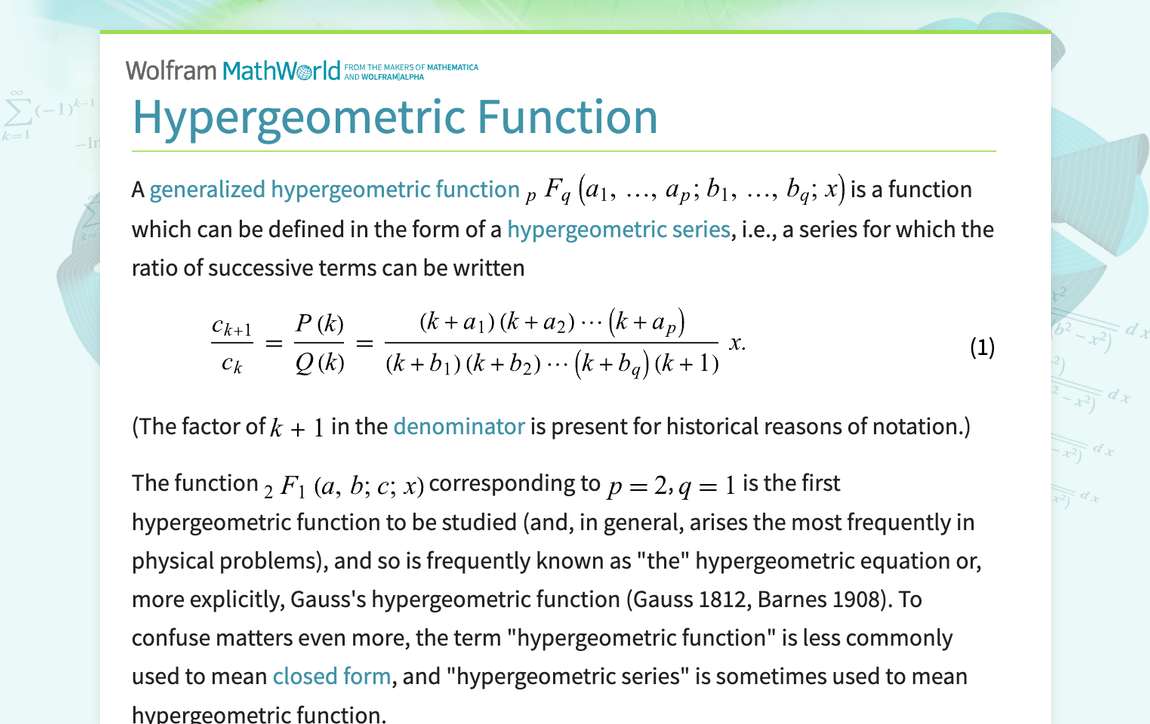
A generalized hypergeometric function pF_q(a_1,...,a_p;b_1,...,b_q;x) is a function which can be defined in the form of a hypergeometric series, i.e., a series for which the ratio of successive terms can be written (c(k+1))/(c_k)=(P(k))/(Q(k))=((k+a_1)(k+a_2)...(k+a_p))/((k+b_1)(k+b_2)...(k+b_q)(k+1))x. (1) (The factor of k+1 in the denomi...
bronze tinsel
exotic tundra
aah, you have that definition
I was following wolfram's
https://mathworld.wolfra...
This is generalized one.
bronze tinsel
bronze tinsel
Should have mentioned this earlier...
exotic tundra
bronze tinsel
This is generalized one.
yeah, so from that, for $2F_1$ you have
$$\frac{c{n+1}}{c_n} = \frac{(k+a_1)(k+a_2)}{(k+b_1)(k+1)}$$
solid kilnBOT
Sepdron
 bronze tinsel
solid kiln
**Sepdron**
bronze tinsel
solid kiln
**Sepdron**
And....
exotic tundra
solid kiln
**2KGod**
ig the trick is that you can factor an 8 from the numerator and denominator of that
bronze tinsel
Hmm....
trim joltBOT
@bronze tinsel Has your question been resolved?
trim joltBOT
@bronze tinsel Has your question been resolved?
trim joltBOT
@bronze tinsel Has your question been resolved?
trim joltBOT
Channel closed
Closed due to timeout
Use .reopen if this was a mistake.
Available help channel!
Send your question here to claim the channel.
Remember:
• Ask your math question in a clear, concise manner.
• Show your work, and if possible, explain where you are stuck.
• After 15 minutes, feel free to ping <@&286206848099549185>.
• Type the command .close to free the channel when you're done.
• Be polite and have a nice day!
Read #❓how-to-get-help for further information on how to ask a good question, and about conduct in the question channels.
 fair forge
can i preform the step for whole number z:
z^2 mod 5 = (z mod 5)*(z mod 5)
and what justification do i use?
trim joltBOT
fair forge
can i preform the step for whole number z:
z^2 mod 5 = (z mod 5)*(z mod 5)
and ...
 vagrant prism
usually, you have something like
z^2 = ___ (mod 5)
where you have something in place of ___
z^2 mod 5 is a bit cursed
vagrant prism
fair forge
can i preform the step for whole number z:
z^2 mod 5 = (z mod 5)*(z mod 5)
and ...
but no that isn't correct: take z=4
 carmine mauve
fair forge
can i preform the step for whole number z:
z^2 mod 5 = (z mod 5)*(z mod 5)
and ...
carmine mauve
fair forge
can i preform the step for whole number z:
z^2 mod 5 = (z mod 5)*(z mod 5)
and ...
yes
 austere cedar
I know some programming courses like to treat mod as an operator, this is non-standard though
vagrant prism
i think this would work if you did
z^2 mod 5 = (z mod 5)*(z mod 5) mod 5
carmine mauve
Given $r \equiv z \mod 5$ (where $0 \le r < 5$) means there exists some integer $k$ such that $z = 5k + r$, we have
$$z^2 = (5k + r)^2 = (25k + 5r)k + r^2 \equiv r^2 \mod 5$$
and $z = 5k + r \equiv r \mod 5$
solid kilnBOT
Shuba
 trim joltBOT
@fair forge Has your question been resolved?
trim joltBOT
Channel closed
Closed due to timeout
Use .reopen if this was a mistake.
Available help channel!
Send your question here to claim the channel.
Remember:
• Ask your math question in a clear, concise manner.
• Show your work, and if possible, explain where you are stuck.
• After 15 minutes, feel free to ping <@&286206848099549185>.
• Type the command .close to free the channel when you're done.
• Be polite and have a nice day!
Read #❓how-to-get-help for further information on how to ask a good question, and about conduct in the question channels.
 stark pebble
 trim joltBOT
stark pebble
trim joltBOT
stark pebble
 placid radish
stark pebble
placid radish
stark pebble
what have you done? its be helpful to sketch a graph
trim joltBOT
@stark pebble Has your question been resolved?
trim joltBOT
Channel closed
Closed due to timeout
Use .reopen if this was a mistake.
stark pebble
.reopen
trim joltBOT
✅
stark pebble
placid radish
what have you done? its be helpful to sketch a graph
i dont think a rough graph will be helpful
 vagrant imp
stark pebble
🤧
vagrant imp
stark pebble
🤧
just integrate it....
vagrant imp
stark pebble
(1/5)^x/log (1/5)
simplify..
stark pebble
1- 5^(-10)/ log 5
vagrant imp
stark pebble
1- 5^(-10)/ log 5
alr can you answer the qs now?
stark pebble
vagrant imp
alr can you answer the qs now?
can you?😭
placid radish
stark pebble
i dont think a rough graph will be helpful<:blobcry:971797574916907028>
well you can bound the function by step functions
a graph helps visualize what the steps functions are
the "decreasing function" property is very important
stark pebble
placid radish
the "decreasing function" property is very important
its a gp with ratio less then 1
yes its decreasing
placid radish
stark pebble
its a gp with ratio less then 1
yeah we can worry abt the ratio later, but the main problem is: how to trasform the integral (which is hard to compute since we dont have any info) to something (perferrably sum) relating to f(0),..., f(10)?
again a step function bound is v helpful
vagrant imp
stark pebble
then?
bruh 1=f(0), so 0<integral<f(0)<2f(0)
placid radish
vagrant imp
bruh 1=f(0), so 0<integral<f(0)<2f(0)
i mean this works but it doesn't quite help the op understand the concept 
vagrant imp
placid radish
i mean this works but it doesn't quite help the op understand the concept <:KEK:...
hmmm well yeah but quicker methods are also useful in tests and stuff
stark pebble
vagrant imp
bruh 1=f(0), so 0<integral<f(0)<2f(0)
ohhh i seee 🤩
step function like the graph of [x]
but why not a continuous function
to something (perferrably sum) relating
yes understood
placid radish
stark pebble
but why not a continuous function
hint because when we are working with a step function, lets say g(x) is equal to f(0) on the interval [0,1], then $\int_0^1 g(x) \ dx=f(0)$, can you see why?
solid kilnBOT
qwertytrewq
 placid radish
furthermore $g(x)\geq f(x)$ on the interval $[0,1]$ (which is the crucial step, can you justify this?
solid kilnBOT
qwertytrewq
 stark pebble
placid radish
hint because when we are working with a step function, lets say g(x) is equal to...
stark pebble
placid radish
hint because when we are working with a step function, lets say g(x) is equal to...
g(x) is a step function here?
placid radish
stark pebble
g(x) is a step function here?
sure, but lets say one of the "steps" is on the interval [0,1] and g(x). Just to be clear a step function just means that the function is defined as being constant on intervals (you divide the domain into intervals, and on each interval the function is constant)
stark pebble
placid radish
sure, but lets say one of the "steps" is on the interval [0,1] and g(x). Just to...
yes got it
how do apply this concept in the qs above
placid radish
here is an example

 vagrant imp
i believe he means smtn like this
 placid radish
stark pebble
placid radish
stark pebble
like that but a little bit more general
if the red line is the function f, then you can see that the constant function (blue line) bounds f from aboce
 stark pebble
placid radish
if the red line is the function f, then you can see that the constant function (...
stark pebble
placid radish
if the red line is the function f, then you can see that the constant function (...
yes yes
make sence
okayyy
placid radish
we can improve the bound by dividing into two parts

the blue line still bounds the red line
stark pebble
vagrant imp
i believe he means smtn like this
like this right?
placid radish
(we need the decreasing condition here for the bounding reason)
placid radish
stark pebble
like this right?
yeah, thats when we refine the bound into 10 parts
can you figure out the function for the bound?
stark pebble
placid radish
we can improve the bound by dividing into two parts
btw it can go below the x axis too right?
placid radish
stark pebble
btw it can go below the x axis too right?
yeah
as long as the function is constant on the intervals its fine
its simply partitioning the domain, and then defining the function on each partition
visually it looks like steps
placid radish
placid radish
visually it looks like steps
of different sizes and heights
stark pebble
okayyyyy
stark pebble
placid radish
can you figure out the function for the bound?
now this has to do smthing with the ratio?
1/5
decreasing
placid radish
stark pebble
now this has to do smthing with the ratio?
not yet, but lets work through it
placid radish
vagrant imp
i believe he means smtn like this
can you figure out the function for upper bound here?
stark pebble
placid radish
its simply partitioning the domain, and then defining the function on each parti...
is the partition all the integers?
placid radish
stark pebble
is the partition all the integers?
not necessarily integers, for example i can partition [0,3] into [0,1.6) and [1.6,3]
stark pebble
placid radish
not necessarily integers, for example i can partition [0,3] into [0,1.6) and [1....
no for this particular qs... cuz it says the f(0), f 1 , f2.... f10 all are in gp, i want to use this
placid radish
placid radish
we can improve the bound by dividing into two parts
if I divide [0,10] into [0,5),[5,10], and define g(x)=f(0) on [0,5), and g(x)=f(5) on [5,10], do you see how g would represent the blue line?
placid radish
stark pebble
no for this particular qs... cuz it says the f(0), f 1 , f2.... f10 all are in g...
yeah yeah we are getting there, but ill need to give you sole context (which is done for arbitrary functions)
an intuitive understanding would help
stark pebble
placid radish
an intuitive understanding would help
yess i think i am getting the full view

stark pebble
placid radish
if I divide [0,10] into [0,5),[5,10], and define g(x)=f(0) on [0,5), and g(x)=f(...
AHHHH I SEEE
YEAAHH
placid radish
placid radish
if I divide [0,10] into [0,5),[5,10], and define g(x)=f(0) on [0,5), and g(x)=f(...
This gives us a bound: $$\int_{0}^{10}f(x) \ dx\leq \int _0^{10} g(x) \ dx=5f(0)+5f(10)$$
solid kilnBOT
qwertytrewq
 stark pebble
okay okayy
stark pebble
solid kiln
**qwertytrewq**
i got this okay
placid radish
stark pebble
i got this okay
ok now try partitioning the interva [0,10] into [0,1),[1,2),...,[9,10]
and defining a step function there
stark pebble
placid radish
and defining a step function there
okay yeah i see how it will be
we put the the first valuve of domain as the upper bound
placid radish
stark pebble
i was trying to write a general equation
its fine to define it one interval by one interval
placid radish
stark pebble
we put the the first valuve of domain as the upper bound
u mean g(x)=f(0) on [0,1), etc?
stark pebble
placid radish
u mean g(x)=f(0) on [0,1), etc?
yes
placid radish
stark pebble
yes
yeah precisely! can you now give an upper bound for $\int_0^{10} f(x) \ dx$ using your function?
solid kilnBOT
qwertytrewq
 stark pebble
placid radish
u mean g(x)=f(0) on [0,1), etc?
stark pebble
placid radish
u mean g(x)=f(0) on [0,1), etc?
didnt we just did that?😭
vagrant imp
placid radish
yeah precisely! can you now give an upper bound for $\int_0^{10} f(x) \ dx$ usin...
tbh I didn't know about this method , its pretty cool
vagrant imp
stark pebble
didnt we just did that?😭
maybe this diagram would help you answer what he's asking

(sorry for the terrible handwriting)
stark pebble
vagrant imp
maybe this diagram would help you answer what he's asking
yes i get thatt now how do i proceed?
vagrant imp
stark pebble
yes i get thatt now how do i proceed?
do you know what upper bound means?
stark pebble
vagrant imp
do you know what upper bound means?
yes
stark pebble
vagrant imp
maybe this diagram would help you answer what he's asking
its the ones with straight black lines ablove the green line
vagrant imp
stark pebble
its the ones with straight black lines ablove the green line
like if you can calculate the area under the graph for this functions
its an upper bound on the area of f(x)
does that make sense?
stark pebble
yeah yeah
vagrant imp
whats the area of the first rectangle?
stark pebble
vagrant imp
like if you can calculate the area under the graph for this functions
but doent we get extra area?
vagrant imp
stark pebble
but doent we get extra area?
thats the point of an upper bound to give us an inequality on the area of f(x) so we can use it to solve the problem
stark pebble
vagrant imp
thats the point of an upper bound to give us an inequality on the area of f(x) s...
hmmmm okayy
so now i find all the areas of rectangle
vagrant imp
basically upper bound of the area must have more area than f(x) hence the name 'upper'
stark pebble
and then it will be more then $$\int_{0}^{10}f(x)$$
solid kilnBOT
Eclipse
 stark pebble
vagrant imp
basically upper bound of the area must have more area than f(x) hence the name '...
stark pebble
vagrant imp
basically upper bound of the area must have more area than f(x) hence the name '...
alright
stark pebble
vagrant imp
basically upper bound of the area must have more area than f(x) hence the name '...
and it will be less then?
vagrant imp
stark pebble
and it will be less then?
the lower bound, but we don't need one right now, just solve this first
if need arises we will check
did you get the upper bound?
stark pebble
waittt
vagrant imp
stark pebble
but i cant right?
no leave it as it is
stark pebble
i cant get how to put the partitions
vagrant imp
stark pebble
i cant get how to put the partitions
whats the width of each partition
stark pebble
vagrant imp
whats the width of each partition
1
vagrant imp
stark pebble
f3, f(4)
it starts at f(0)
stark pebble
okayyy
vagrant imp
do you know what sum you can apply here
stark pebble
f(0)/1-1/5
vagrant imp
stark pebble
f(0)/1-1/5
there isnt inf terms
stark pebble
thats the sum of all the height
vagrant imp
10
vagrant imp
stark pebble
F(0)(1-(1/5)^11)/4/5
im pretty sure there are 10 terms
stark pebble
0 to 10?
vagrant imp
f(0),f(1),,,f(9)
vagrant imp
stark pebble
0 to 10?
that would be integrating from 0 to 11
stark pebble
vagrant imp
that would be integrating from 0 to 11
yea for the bound
it will stop at 9
to count till 10
right
vagrant imp
stark pebble
F(0)(1-(1/5)^11)/4/5
so power will be 10
vagrant imp
alr now you can writ this as 5/4 f(0)(1-5^-10)
which is lesser than 5/4f(0)
but integral<5/4 f(0)(1-5^-10)<5/4f(0)
makes sense?
now check the value of f(0), can it be negative?
stark pebble
okay so $$\int_{0}^{10}f(x)$$ is less then 5/4 f(0)
solid kilnBOT
Eclipse
 vagrant imp
stark pebble
its area
vagrant imp
stark pebble
its area
no, its cuz then the gp wouldn't be decreasing
stark pebble
vagrant imp
no, its cuz then the gp wouldn't be decreasing
that too
okay
great make sencee
vagrant imp
alr so f(0)>0
stark pebble
yea yea
vagrant imp
=>2f(0)>5/4f(0)
stark pebble
okayy
stark pebble
vagrant imp
integral<2f(0)
but insted of 2 u can write any integer greater then 2 as well
why u chose 2?
vagrant imp
stark pebble
but insted of 2 u can write any integer greater then 2 as well
cuz its there in the options
stark pebble
cuz its more closer as well
vagrant imp
yeah you should also check the lower limit
now we know the area must be more than 0 since f(0)>0 and the function is decreasing, so int>0
stark pebble
okayyyy
vagrant imp
so the int must also be more than 0
vagrant imp
well you should thank qwertytrewq
stark pebble
thats a nice way to slove
vagrant imp
I didn't do much, it was him who introduced it
stark pebble
@placid radish thankssss
stark pebble
its a great way to approach this
placid radish
stark pebble
<@615804407371792385> thankssss
np
stark pebble
really appricated!!
stark pebble
vagrant imp
I didn't do much, it was him who introduced it
u helped me reach the ans, also thankss!! plus the short way too!!
stark pebble
placid radish
you can also get a lowr bound this way
alrighttt!!
placid radish
or something close to that
placid radish
vagrant imp
wouldnt it be 5/20
yeah maybe
its a bit less than 1/4 f(0)
cuz we can really add to infinite anymore for the lower bound
vagrant imp
stark pebble
alrighttt!!
you consider these rectangles for the lower bound btw
 placid radish
2441406/9765625 f(0)
vagrant imp
placid radish
2441406/9765625 f(0)
lmao nice
stark pebble
vagrant imp
you consider these rectangles for the lower bound btw
hmmmmmmmm
placid radish
its the same method, just with a lower approximation instead
these type of "step function bounds" are sort of common when it comes to riemann integral, in fact it is used to define riemann integral
we say riemann integral exists when the highest step function bound, and the lowest step function bound gets arbitrarily close when our partition is small.
trim joltBOT
@stark pebble Has your question been resolved?
Channel closed
Closed by @stark pebble
Use .reopen if this was a mistake.
Available help channel!
Send your question here to claim the channel.
Remember:
• Ask your math question in a clear, concise manner.
• Show your work, and if possible, explain where you are stuck.
• After 15 minutes, feel free to ping <@&286206848099549185>.
• Type the command .close to free the channel when you're done.
• Be polite and have a nice day!
Read #❓how-to-get-help for further information on how to ask a good question, and about conduct in the question channels.
vagrant imp
 trim joltBOT
vagrant imp
vagrant imp
trim joltBOT
vagrant imp
vagrant imp
Im not sure how to simplify this

C represents choose or combination or binomial coeff or wtever you call it
carmine mauve
vagrant imp
Im not sure how to simplify this
what does nCr mean?
by which I mean, what is the formula for it?
vagrant imp
carmine mauve
by which I mean, what is the formula for it?
n!/(n-r)!r!
carmine mauve
yep, maybe use that to simplify?
vagrant imp

ok what now

i dont think it helps, besides the options are in terms of A10 B10 and C10, so maybe expanding it isnt a great idea
 austere shard
vagrant imp
Im not sure how to simplify this
austere shard
vagrant imp
Im not sure how to simplify this
split it into two summations, take the constants outside
after that, hint: use nCr = nC(n-r)
trim joltBOT
@vagrant imp Has your question been resolved?
vagrant imp
austere shard
after that, hint: use nCr = nC(n-r)
(1+x)^10 * (x+1)^10=(x+1)^20
and whenever the powers add up to 10, like say x and x^9, their coefficients will be the same since 10C1=10C9, thus we get sum of Ar^2=coeff of x^10 in (x+1)^20=B10

is that right?
but im not sure how to do sum ArBr
austere shard
vagrant imp
(1+x)^10 * (x+1)^10=(x+1)^20
and whenever the powers add up to 10, like say x an...
yes
austere shard
vagrant imp
but im not sure how to do sum ArBr
do the same thing
vagrant imp
austere shard
do the same thing
oh so its C10
austere shard
yup
vagrant imp
Wow so ans is 0
austere shard
yeah
vagrant imp
austere shard
yeah
wth uh is this wrong?
 austere shard
huh oh wait
oh shoot
left summation is only for 10 terms
so doesnt include all B
vagrant imp
austere shard
so doesnt include all B
yeah but coeff of x^10 wont have stuff like coeffs of x^11 or x^20 from B
or maybe im understanding it wrong
oh bruh 0 is also not included
vagrant imp
austere shard
even for the right summation
Thanks a lot for your help, really appreciate it!
austere shard
np happy to help
vagrant imp
.close
trim joltBOT
Channel closed
Closed by @vagrant imp
Use .reopen if this was a mistake.
trim joltBOT
Available help channel!
Send your question here to claim the channel.
Remember:
• Ask your math question in a clear, concise manner.
• Show your work, and if possible, explain where you are stuck.
• After 15 minutes, feel free to ping <@&286206848099549185>.
• Type the command .close to free the channel when you're done.
• Be polite and have a nice day!
Read #❓how-to-get-help for further information on how to ask a good question, and about conduct in the question channels.
 fluid bloom
 trim joltBOT
fluid bloom
fluid bloom
trim joltBOT
fluid bloom
fluid bloom
trying to show this series converges to 3
not sure how to do so. is there a way to express Sn as a sequence so i can take the limit?
trim lichen
your S_N is incorrect bc you just take the first, second, third and then jump straight to the N'th term
fluid bloom
yeah i know
trim lichen
fluid bloom
not sure how to do so. is there a way to express Sn as a sequence so i can take ...
yes there is, look up geometric progressions
fluid bloom
i meant to add ...
fluid bloom
trim lichen
yes there is, look up geometric progressions

this?
so 2r^n-1
what's r
trim lichen
fluid bloom
yes but you need the formula for the sum of the first n terms.
trim lichen
fluid bloom
what's r
1/3.
fluid bloom

 trim lichen
fluid bloom
how can i tell it's 1/3?
trim lichen
fluid bloom
how can i tell it's 1/3?
2/3^(n-1) = 2 * 1/3^(n-1) = 2 * (1/3)^(n-1)
fluid bloom
where'd 2/3rds come from?
 versed jasper
fluid bloom
where'd 2/3rds come from?
versed jasper
fluid bloom
where'd 2/3rds come from?
$\frac{2}{3^{n-1}} = 2 \cdot \frac{1^{n-1}}{3^{n-1}} = 2(\frac{1}{3})^{n-1}$
solid kilnBOT
BuilderDolphin

 trim joltBOT
Channel closed
Closed by @fluid bloom
Use .reopen if this was a mistake.
trim joltBOT
Available help channel!
Send your question here to claim the channel.
Remember:
• Ask your math question in a clear, concise manner.
• Show your work, and if possible, explain where you are stuck.
• After 15 minutes, feel free to ping <@&286206848099549185>.
• Type the command .close to free the channel when you're done.
• Be polite and have a nice day!
Read #❓how-to-get-help for further information on how to ask a good question, and about conduct in the question channels.
 valid beacon
 trim joltBOT
valid beacon
valid beacon
trim joltBOT
valid beacon
valid beacon
Hey everyone, heres a question from Silverman's friendly intro to number theory
im having a difficult time with demonstrating the first part of the hint
i was thinking about using quadratic residues mod 3 but it doesnt seem to work well enough
trim joltBOT
@valid beacon Has your question been resolved?
 zinc ginkgo
Also try #elementary-number-theory
trim joltBOT
@valid beacon Has your question been resolved?
 hot root
I think I might be able to help
First you can easily say that x will not be negative
Second by further analysing you can say that x has to be perfect square
valid beacon
hot root
Second by further analysing you can say that x has to be perfect square
i dont think x has to be a perfect square
hot root
No it has to be
valid beacon
i might have solved it now but that was one of the cases i checked
it seems that checking the cases of how squarefree x is seems to work
so either x is a square, x is not square but not squarefree, or x is squarefree
valid beacon
hot root
No it has to be
i mean even x being a square doesnt work
because you get smth like
hot root
 valid beacon
$\begin{aligned}
x = A^2 \
\implies y^2 &= A^2(A^4 + z^4) \
\implies (\frac{y}{A})^2 &= Y^2 = A^4 + z^4
\end{aligned}$
which doesnt work bc thats a stronger statement of FLT at n = 4
solid kilnBOT
hiidostuff
 hot root
This is the equation that forms so x is either equal to
X^2 + Z^4
Or x is perfect square but
If all x,y,z are integers x has to be perfect square
valid beacon
i dont think it has to be equal
i mean consider smth like $x = a^2 b$ where b is squarefree
solid kilnBOT
hiidostuff
 valid beacon
then we just get an implication that b divides x^2 + z^4
rather than saying that x is forced to be equal to x^2 + z^4
hot root
But if that's the case then y ^2 will not be perfect square
hot root
Which it has to be as y is integer
valid beacon
then we get a^2 b^2 times smth else that could very well be square
hot root
Got it I forgot bout that possibility
valid beacon
luckily im pretty sure the "not squarefree but not square" case can be shown to be impossible due to descent
i didnt use the advice the book gave though
i still wonder what their idea was
trim joltBOT
@valid beacon Has your question been resolved?
Channel closed
Closed by @valid beacon
Use .reopen if this was a mistake.
trim joltBOT
Available help channel!
Send your question here to claim the channel.
Remember:
• Ask your math question in a clear, concise manner.
• Show your work, and if possible, explain where you are stuck.
• After 15 minutes, feel free to ping <@&286206848099549185>.
• Type the command .close to free the channel when you're done.
• Be polite and have a nice day!
Read #❓how-to-get-help for further information on how to ask a good question, and about conduct in the question channels.
 leaden nebula
is the empty set a basis for a subspace with dimension 0?

 royal remnant
yes
leaden nebula
.close
trim joltBOT
Channel closed
Closed by @leaden nebula
Use .reopen if this was a mistake.
trim joltBOT
Available help channel!
Send your question here to claim the channel.
Remember:
• Ask your math question in a clear, concise manner.
• Show your work, and if possible, explain where you are stuck.
• After 15 minutes, feel free to ping <@&286206848099549185>.
• Type the command .close to free the channel when you're done.
• Be polite and have a nice day!
Read #❓how-to-get-help for further information on how to ask a good question, and about conduct in the question channels.
 lean kraken
 trim joltBOT
lean kraken
lean kraken
trim joltBOT
lean kraken
lean kraken
Any shortcut?
trim joltBOT
@lean kraken Has your question been resolved?
lean kraken
But how can I find A^3 by any short way?
 native shuttle
Idk
trim joltBOT
Channel closed
Closed by @lean kraken
Use .reopen if this was a mistake.
 stark tapir
.reopen
stark tapir
lean kraken
Any shortcut?
use characteristic Equation |A-(lambda)I| = 0
Got the ans. loll
 lean kraken
I have solved out
trim joltBOT
Available help channel!
Send your question here to claim the channel.
Remember:
• Ask your math question in a clear, concise manner.
• Show your work, and if possible, explain where you are stuck.
• After 15 minutes, feel free to ping <@&286206848099549185>.
• Type the command .close to free the channel when you're done.
• Be polite and have a nice day!
Read #❓how-to-get-help for further information on how to ask a good question, and about conduct in the question channels.
trim joltBOT
 warm sedge
Part c

 trim joltBOT
Channel closed
Channel closed due to the original message being deleted.
If you did not intend to do this, please open a new help channel,
as this action is irreversible, and this channel may abruptly lock.
 boreal apex
warm sedge
boreal apex
warm sedge
Yea lol mb
trim joltBOT
Available help channel!
Send your question here to claim the channel.
Remember:
• Ask your math question in a clear, concise manner.
• Show your work, and if possible, explain where you are stuck.
• After 15 minutes, feel free to ping <@&286206848099549185>.
• Type the command .close to free the channel when you're done.
• Be polite and have a nice day!
Read #❓how-to-get-help for further information on how to ask a good question, and about conduct in the question channels.
vagrant imp
shouldnt f-1(2) be 0
 trim joltBOT
vagrant imp
shouldnt f-1(2) be 0
vagrant imp
trim joltBOT
vagrant imp
shouldnt f-1(2) be 0
vagrant imp
e^(-0) f(0)=2+int(0,0)sqrt(t^4+1)dt
=>f(0)=2+0=2
so f-1(2)=0
am i wrong or is this question wrong?
they've given the answer as|| B) 1/3||
.
 spiral ocean
vagrant imp
spiral ocean
vagrant imp
oh bruh missed the dash
ugh
yeah i got 1/3
basically i took f(x) as y, found dx/dy, interchanged x and y, found values of x and y from the function, subtituted and solved
trim joltBOT
Channel closed
Closed by @vagrant imp
Use .reopen if this was a mistake.
trim joltBOT
Available help channel!
Send your question here to claim the channel.
Remember:
• Ask your math question in a clear, concise manner.
• Show your work, and if possible, explain where you are stuck.
• After 15 minutes, feel free to ping <@&286206848099549185>.
• Type the command .close to free the channel when you're done.
• Be polite and have a nice day!
Read #❓how-to-get-help for further information on how to ask a good question, and about conduct in the question channels.
 glad patio
 trim joltBOT
glad patio
trim joltBOT
glad patio

 carmine mauve
where do you get x = 2 from?
trim joltBOT
@glad patio Has your question been resolved?
 woven python
how are you finding the turning point x=2 when the function (by extension its turning points) are dependant on k?
@glad patio
trim joltBOT
Channel closed
Closed due to timeout
Use .reopen if this was a mistake.
Available help channel!
Send your question here to claim the channel.
Remember:
• Ask your math question in a clear, concise manner.
• Show your work, and if possible, explain where you are stuck.
• After 15 minutes, feel free to ping <@&286206848099549185>.
• Type the command .close to free the channel when you're done.
• Be polite and have a nice day!
Read #❓how-to-get-help for further information on how to ask a good question, and about conduct in the question channels.
 hushed ferry
 trim joltBOT
hushed ferry
trim joltBOT
hushed ferry
 fervent leaf
what part are u stuck at?
hushed ferry
fervent leaf
what part are u stuck at?
I just dont know how to do it
 dusty sleet
Do you know the quadratic formula?
dusty sleet
Then apply it to the equation
dusty sleet
hushed ferry
b2 -4ac
This is the discriminant, yeah
trim lichen
hushed ferry
b2 -4ac
b**^**2. you should use the symbol ^ to write exponents.
hushed ferry
dusty sleet
This is the discriminant, yeah
so I get 8 +/- square root of 120/ 4
hushed ferry
so the answer would be 120
dusty sleet
There you go 👍
hushed ferry
thank you!!
dusty sleet
Yw 🤗
hushed ferry
.close
trim joltBOT
Channel closed
Closed by @hushed ferry
Use .reopen if this was a mistake.
Available help channel!
Send your question here to claim the channel.
Remember:
• Ask your math question in a clear, concise manner.
• Show your work, and if possible, explain where you are stuck.
• After 15 minutes, feel free to ping <@&286206848099549185>.
• Type the command .close to free the channel when you're done.
• Be polite and have a nice day!
Read #❓how-to-get-help for further information on how to ask a good question, and about conduct in the question channels.
glad patio


 trim joltBOT
glad patio
glad patio
trim joltBOT
glad patio
glad patio
i got area of R as 100/3
 empty prairie
What is your question?
glad patio
b)
 grim saffron
Look at the second and third picture
 split chasm
can you show your work
glad patio
 split chasm
you didn't find the area of the correct region
you've found the area between curve C and the x-axis, from x=0 to 2
i.e. the red part

 split chasm
yes, that works
trim joltBOT
@glad patio Has your question been resolved?
trim joltBOT
Channel closed
Closed due to timeout
Use .reopen if this was a mistake.
Available help channel!
Send your question here to claim the channel.
Remember:
• Ask your math question in a clear, concise manner.
• Show your work, and if possible, explain where you are stuck.
• After 15 minutes, feel free to ping <@&286206848099549185>.
• Type the command .close to free the channel when you're done.
• Be polite and have a nice day!
Read #❓how-to-get-help for further information on how to ask a good question, and about conduct in the question channels.
 blazing geode
ahhhhhhhhhhh
blazing geode
I do not
I get tired about an hour of studying
But I'm supposed to solve 20 questions in a 100 minutes test
what should I do
empty prairie

 late flume
Well the best suggestion is to simulate exam conditions a week before the exam
blazing geode
should I take a nap, I'm so tired rn
late flume
blazing geode
But I'm supposed to solve 20 questions in a 100 minutes test
That isn't that bad
blazing geode
should I take a nap if I feel tired before exam
late flume
We have 75 questions in 180 mijs
blazing geode
really
blazing geode
.close
trim joltBOT
Channel closed
Closed by @blazing geode
Use .reopen if this was a mistake.
trim joltBOT
Available help channel!
Send your question here to claim the channel.
Remember:
• Ask your math question in a clear, concise manner.
• Show your work, and if possible, explain where you are stuck.
• After 15 minutes, feel free to ping <@&286206848099549185>.
• Type the command .close to free the channel when you're done.
• Be polite and have a nice day!
Read #❓how-to-get-help for further information on how to ask a good question, and about conduct in the question channels.
trim joltBOT
@pearl lark Has your question been resolved?
trim joltBOT
@pearl lark Has your question been resolved?
trim joltBOT
@pearl lark Has your question been resolved?
Channel closed
Closed by @pearl lark
Use .reopen if this was a mistake.
trim joltBOT
Available help channel!
Send your question here to claim the channel.
Remember:
• Ask your math question in a clear, concise manner.
• Show your work, and if possible, explain where you are stuck.
• After 15 minutes, feel free to ping <@&286206848099549185>.
• Type the command .close to free the channel when you're done.
• Be polite and have a nice day!
Read #❓how-to-get-help for further information on how to ask a good question, and about conduct in the question channels.
 boreal shuttle
$\lim_{x\to\infty}x\left(\frac{\ln(x+1)}{x}\right)$
solid kilnBOT
<rajel />
 boreal shuttle
im trying to calculate that limit
$\lim_{x \to \infty} x \left( \frac{\ln(x) + \ln\left(1 + \frac{1}{x}\right)}{\ln(x)} \right)$
solid kilnBOT
<rajel />
 boreal shuttle
this is what i ended up wtih
i believe theirs a rule that says for any large value x , ln(1 + 1/x) = 1/x
and then i ended up with $\lim_{x \to \infty} x \left( \frac{\ln(x) + \frac{1}{x}}{\ln(x)} \right)$
solid kilnBOT
<rajel />
 trim lichen
boreal shuttle
$\lim_{x\to\infty}x\left(\frac{\ln(x+1)}{x}\right)$
trim lichen
boreal shuttle
$\lim_{x\to\infty}x\left(\frac{\ln(x+1)}{x}\right)$
hold up
doesnt this just simplify to ln(x+1)
or did you mess it up at some point writing down the original
boreal shuttle
i pasted the wrong equation
its ln(x) not x, sorry
$\lim_{x\to\infty}x\left(\frac{\ln(x+1)}{\ln(x)}\right)$
solid kilnBOT
<rajel />

 frozen plover
this is just infinity
boreal shuttle
no its not
frozen plover
ln (x + 1) ~ ln (x)
boreal shuttle
it should be 1
frozen plover
,w limit as x goes to infinity of xln(x + 1)/ln(x)
trim lichen
hold on a minute
solid kilnBOT


 Requested by neonperseus
frozen plover
Requested by neonperseus
frozen plover
^
trim lichen
are you SURE you arent messing up the original eq again

log(x+1)/log(x) -> 1
x*that -> ∞
boreal shuttle
yes im messing it again lmao
i need some rest lol
$\lim_{x\to\infty}x\ln(\frac{x+1}{x})$
frozen plover
better
solid kilnBOT
<rajel />

 eager pendant
put u= (x+1)/x
boreal shuttle
nope
eager pendant
eager pendant
put u= (x+1)/x
Then solve for x
boreal shuttle
solid kiln
**<rajel />**
@trim lichen pasted the correct one ^
eager pendant
U know how to do that transition that I told you?
solid kilnBOT
Ann
 trim lichen
this is your limit
eager pendant
solid kiln
**Ann**
Why do that
frozen plover
LH incoming
boreal shuttle
trim lichen
this is your limit
hmm we dont work with log in my school
boreal shuttle
boreal shuttle
hmm we dont work with log in my school
neither l'hopital
boreal shuttle
i'll try
 gusty plank
boreal shuttle
hmm we dont work with log in my school
gusty plank
boreal shuttle
hmm we dont work with log in my school
what do you mean you don't work with log
trim lichen
boreal shuttle
hmm we dont work with log in my school
ln
just pretend it is ln
i write it as log without a base out of habit
trim lichen
frozen plover
LH incoming
fuck no
tossing a thousand stones at you for that @frozen plover
no LH
just limit definition of the derivative @boreal shuttle
boreal shuttle
trim lichen
i write it as log without a base out of habit
oh i see
eager pendant
trim lichen
just limit definition of the derivative <@1243243131458162748>
U see what I am seeing ? Doesn’t it work also that way , way more simple
trim lichen
eager pendant
U see what I am seeing ? Doesn’t it work also that way , way more simple
i think my way is simpler
you just recognize 1/x goes to 0
eager pendant
solid kiln
**Ann**
With that?
eager pendant
boreal shuttle
<@183668144404037632> <@724206525853466644> you both got cool methods , solved i...
Yo also
eager pendant
Ln(x+1/x) = ln(x+1) - lnx
boreal shuttle
nice
eager pendant
boreal shuttle
and ?
Nvm that doesn’t get anywhere
boreal shuttle
.close
eager pendant
But what I told you in the beginning does
trim joltBOT
Channel closed
Closed by @boreal shuttle
Use .reopen if this was a mistake.
trim joltBOT
Available help channel!
Send your question here to claim the channel.
Remember:
• Ask your math question in a clear, concise manner.
• Show your work, and if possible, explain where you are stuck.
• After 15 minutes, feel free to ping <@&286206848099549185>.
• Type the command .close to free the channel when you're done.
• Be polite and have a nice day!
Read #❓how-to-get-help for further information on how to ask a good question, and about conduct in the question channels.
 signal island
i need help understanding something
trim joltBOT
signal island
i need help understanding something
signal island
can somebody explain why this would be true

instead of using -1 please use a variable like a or c or something
grim saffron
What is the definition of limit?
 ionic pendant
the limit $\lim_{x \to c} f(x)$ is completely independent of the value of $f(c)$
solid kilnBOT
cloud
 ionic pendant
because it only quantifies the behavior of f near c
grim saffron
Wait, that's statement is not true. What if f(x) and g(x) is not continuous, like Weierstrass function
signal island
ohh
so even if it doesnt exist at that point
we can aproximate what it would be if it existed at that point?
signal island
grim saffron
Wait, that's statement is not true. What if f(x) and g(x) is not continuous, lik...
whats that
im lockind in for my calc bc exam
 wooden plover
grim saffron
Wait, that's statement is not true. What if f(x) and g(x) is not continuous, lik...
wooden plover
grim saffron
Wait, that's statement is not true. What if f(x) and g(x) is not continuous, lik...
then both limits don't exist
ionic pendant
we can say that the limit is the point that the function "would" approach if it's continuous
signal island
ionic pendant
we can say that the limit is the point that the function "would" approach if it'...
that makes sense
 stable ore
grim saffron
Wait, that's statement is not true. What if f(x) and g(x) is not continuous, lik...
stable ore
grim saffron
Wait, that's statement is not true. What if f(x) and g(x) is not continuous, lik...
The weierstrass function is continuous
That’s like the whole point
stable ore
grim saffron
meant for Blumberg function
I’m not familiar
grim saffron
Well, or 0 for rational, 1 for irrational, dirichlet function
ionic pendant
the implication here is that the limits are performed over the same set. it would only be untrue if you dropped that assumption
stable ore
grim saffron
Well, or 0 for rational, 1 for irrational, dirichlet function
The indicator function of the rationals is the Dirichlet function
 vast egret
I could say, f(x) = g(x) at $(-1)^+$ and $(-1)^-$ so f(-1) = g(-1)
solid kilnBOT
╰ 𝕃 𝕌 ℂ 𝕀 𝔽 𝔼 ℝ ╮
 vast egret
Let's add limit
vast egret
I could say, $\lim f(x) = \lim g(x)$ at $(-1)^+$ and $(-1)^-$
so $$\lim_{x \to -1} f(x) = \lim_{x \to -1} g(x)$$
solid kilnBOT
╰ 𝕃 𝕌 ℂ 𝕀 𝔽 𝔼 ℝ ╮
 vast egret
 vagrant kraken
jump discontinuity
vagrant kraken
jump discontinuity
What I know is that if a function is continue to the right of a point and to its left, and left = right. that means it is continuous at that point.
trim joltBOT
@signal island Has your question been resolved?
Channel closed
Closed by @signal island
Use .reopen if this was a mistake.
Available help channel!
Send your question here to claim the channel.
Remember:
• Ask your math question in a clear, concise manner.
• Show your work, and if possible, explain where you are stuck.
• After 15 minutes, feel free to ping <@&286206848099549185>.
• Type the command .close to free the channel when you're done.
• Be polite and have a nice day!
Read #❓how-to-get-help for further information on how to ask a good question, and about conduct in the question channels.
 somber siren
the blue is the correct answer. i don’t understand b)
 somber siren
i don’t really get what it means to be colinear, but it says it’s on the same line
wait
“but i don’t know how they’d be on the same line”
is it because if you multiply a scalar quantity by the vector, you only increase/decrease the magnitude, basically make it longer or shorter
u can ofc change its direction but we aren’t talking about that rn
so if u multiply by the scalar vector, you’ll be able to find ones that will be on the same line
is this correct?
but still what does it ACTUALLY mean to be collinear though
 supple copper
You’ve got it
 stuck plover
Yeah collinear just means they're on the same line
Aka they're scaled versions of each other
supple copper
2 vectors v and w are colinear if there exists some scalar k such that v = kw
trim joltBOT
@somber siren Has your question been resolved?
trim joltBOT
Channel closed
Closed due to timeout
Use .reopen if this was a mistake.
Available help channel!
Send your question here to claim the channel.
Remember:
• Ask your math question in a clear, concise manner.
• Show your work, and if possible, explain where you are stuck.
• After 15 minutes, feel free to ping <@&286206848099549185>.
• Type the command .close to free the channel when you're done.
• Be polite and have a nice day!
Read #❓how-to-get-help for further information on how to ask a good question, and about conduct in the question channels.
 plain tusk
 trim joltBOT
plain tusk
trim joltBOT
plain tusk
 tidal igloo
What have you tried mate
 tidal igloo
Now what do we know about c and t that relates them?
plain tusk
the ratio 5:9
plain tusk
whats that slash sign
plain tusk
tidal igloo
c / t = 5 / 9
does that mean divide?
plain tusk
so c/t = 5/9
tidal igloo
Thats what ratio means
tidal igloo
No
plain tusk
oh
plain tusk
