#help-38
1 messages · Page 208 of 1
 dusty mist
and none of the answers gave me 0 😦
Ik that means they don't intersect, but I dont trust myself
I feel like I messed up somewhere

<@&286206848099549185>
 split chasm
shouldn't be subbing in integer values like that,
doesn't actually show whether there's a t that actually work
just solve d = 0 and see if there are positive real solutions
dusty mist
but the ship is changing directions at 8:30pm
split chasm
i mean at the very end
split chasm
after you've got their positions at 9
split chasm
looks fine
dusty mist
alr
didnt work
t has to be greater than 0
That means they dont intersect

I def messed up somewhere
oh my god
could this be it

was theta supposed to be 90-16.26

wait no
<@&286206848099549185>
here is the full question

 trim joltBOT
@dusty mist Has your question been resolved?
trim joltBOT
Channel closed
Closed due to timeout
Use .reopen if this was a mistake.
 Available help channel!
Send your question here to claim the channel.
Remember:
• Ask your math question in a clear, concise manner.
• Show your work, and if possible, explain where you are stuck.
• After 15 minutes, feel free to ping <@&286206848099549185>.
• Type the command .close to free the channel when you're done.
• Be polite and have a nice day!
Read #❓how-to-get-help for further information on how to ask a good question, and about conduct in the question channels.
 trim joltBOT
 little egret
how i do 10a?
little egret
little egret
how i do 10a?
little egret
 full dock
bum chickoen back on vectors again
full dock
bum chickoen back on vectors again
HELP
we are doing 3d now
and im stuck on 2d
😭
full dock
U know i should be able to do this but i dont like geometry
full dock
little egret
we are doing 3d now
gg
full dock
evaluate it as in do what
little egret
evaluate
little egret
non calc
 iron pier
it's probably (a+b)/2 lmao
 simple panther
full dock
let e = 3
simple panther
full dock
let e = 3
Nope, ans would be waaaay off
iron pier
little egret
why>?
ok see that's the problem 💀 i forgot whatever theorem could let me say such a thing
little egret
1/2(a+b)
simple panther
🧠 16e^9/9 = 16e^1 = 16e = 16×2.7 = 43.2
little egret
 little egret
iron pier
ok see that's the problem 💀 i forgot whatever theorem could let me say such a t...
little egret
iron pier
ok see that's the problem 💀 i forgot whatever theorem could let me say such a t...
theres a theorem..
wat...
iron pier
little egret
ok consider this heuristic argument:
little egret
WHATS HEURISTIC
full dock
 iron pier
it'd hold true for a rectangle
full dock
math monks guys
iron pier
little egret
theres a theorem..
probably
to be honest tho, maybe the question is asking you to prove this result yourself
that'd be a lot more fun
iron pier
little egret
WHATS HEURISTIC
basically, hand waving not rigorous but lets you see why it's true
full dock
iron pier
probably
i found it the name
little egret
iron pier
to be honest tho, maybe the question is asking you to prove this result yourself
there is a way to do it without
full dock
the Trapezoid Midsegment Theorem
little egret
I DID THIS LAST YEAR
simple panther
little egret
there is a way to do it without
Try dropping perpendicular from A and D onto BC and using similar triangles
You'll basically prove this theorem this way (hopefully)
full dock
 iron pier
little egret
there is a way to do it without
iron pier
little egret
there is a way to do it without
the point of proving the result is to bolster your geometry understanding tho
iron pier
...by proving the theorem and then using it 💀
full dock
we'll call it the bum chicken trapezoid theorem
little egret
.close
trim joltBOT
Channel closed
Closed by @little egret
Use .reopen if this was a mistake.
Available help channel!
Send your question here to claim the channel.
Remember:
• Ask your math question in a clear, concise manner.
• Show your work, and if possible, explain where you are stuck.
• After 15 minutes, feel free to ping <@&286206848099549185>.
• Type the command .close to free the channel when you're done.
• Be polite and have a nice day!
Read #❓how-to-get-help for further information on how to ask a good question, and about conduct in the question channels.
 wraith hinge
i cant mental math this one
 trim joltBOT
wraith hinge
i cant mental math this one
trim joltBOT
trim joltBOT
wraith hinge
i cant mental math this one
trim joltBOT
@wraith hinge Has your question been resolved?
wraith hinge
 fair beacon
you got the first term right
fair beacon
you got the first term right
2nd?
fair beacon
i can't tell where you went wrong because i don't understand anything you've written
fair beacon
8x-5 = A+B(-2x+6) = -2Bx + 6B + A
wraith hinge
$\int\frac{8x-5}{sqrt(7+6x-x^2}
 native shuttle
end
native shuttle
u can edit message
fair beacon
it's wrong anyways
 solid kilnBOT
rivenrivers
 fair beacon
$\int\frac{8x-5}{\sqrt{7+6x-x^2}},dx$
native shuttle
better
solid kilnBOT
carburetor
 fair beacon
8x-5 = A+B(-2x+6) = -2Bx + 6B + A
fair beacon
fair beacon
8x-5 = A+B(-2x+6) = -2Bx + 6B + A
B = -4 and A = 19
so you split 8x - 5 as 19 - 4(-2x + 6)
fair beacon
wraith hinge
GOODNESS
yeah everything else is right
trim joltBOT
Channel closed
Closed by @modern iris
Use .reopen if this was a mistake.
trim joltBOT
Available help channel!
Send your question here to claim the channel.
Remember:
• Ask your math question in a clear, concise manner.
• Show your work, and if possible, explain where you are stuck.
• After 15 minutes, feel free to ping <@&286206848099549185>.
• Type the command .close to free the channel when you're done.
• Be polite and have a nice day!
Read #❓how-to-get-help for further information on how to ask a good question, and about conduct in the question channels.
 paper jay
 paper jay
is this diagram correct ?
also i think the answer is a) 110° (corresponding L)
b) 70° (interior angles)
is that correct ?
 obsidian zealot
the diagram is correct
paper jay
what about the answers of a and b
obsidian zealot
for a we can analyse quadrilateral KLBC
since KL || BC it's a trapezoid
the interior angles add up to 360
KLC = BKL
if we let KBC = x, 220+2x=360
x=70º
AKL is similar to ABC by AAA
so its also 70 for b
paper jay
what is the reason ?
paper jay
for both a and b cus i need to add a reason in my answer
obsidian zealot
you can say this
by interior angles of trapezoid
220+2x=360
x=70
paper jay
and what about for b?
obsidian zealot
umm
by similar triangles (AAA)
although you could write the whole process if there's enough space
paper jay
okok thanks
solid kilnBOT
Couldn't find an attached image in the last 10 messages.
trim joltBOT
@paper jay Has your question been resolved?
trim joltBOT
Channel closed
Closed due to timeout
Use .reopen if this was a mistake.
Available help channel!
Send your question here to claim the channel.
Remember:
• Ask your math question in a clear, concise manner.
• Show your work, and if possible, explain where you are stuck.
• After 15 minutes, feel free to ping <@&286206848099549185>.
• Type the command .close to free the channel when you're done.
• Be polite and have a nice day!
Read #❓how-to-get-help for further information on how to ask a good question, and about conduct in the question channels.
 knotty saffron
find 2 numbers whose sum is a, if the product of the square of one by the cube of the other is to be a maximum
trim joltBOT
knotty saffron
find 2 numbers whose sum is a, if the product of the square of one by the cube o...
knotty saffron
i'm having a hard time with the pattern of problems like these (applications of minima/maxima) can anyone help me out step by step?
knotty saffron
i got x+y = a
x^2y^3 = P
knotty saffron
x = a-y?
knotty saffron
i find the derivative of that, right?
knotty saffron
okay wait
obsidian zealot
im waiting 🛑
knotty saffron
x(a-x)^2[-3x+2(a-x)]
obsidian zealot
can u simplify the []s
knotty saffron
x(a-x)^2(-5x+2a)
knotty saffron
x=0
a-x=0 ; x=a
-5x+2a = 0 ; x=2a/5
knotty saffron
by finding the second derivative?
knotty saffron
i thought that was y
obsidian zealot
oh
yea
i meant like plugging in the x=0/x=a to find that 0 and a are roots of P and thus can't be maxima
the other one, 2a/5, is correct
and you find (2a/5, 3a/5) ❤️
obsidian zealot
ok
knotty saffron
A rectangular field of given area is to be fenced off along the bank of a river. If no fence is needed along the river, what is the shape of the rectangle requiring the least amount of fencing?
trim joltBOT
@knotty saffron Has your question been resolved?
knotty saffron
.close
trim joltBOT
Channel closed
Closed by @knotty saffron
Use .reopen if this was a mistake.
trim joltBOT
Available help channel!
Send your question here to claim the channel.
Remember:
• Ask your math question in a clear, concise manner.
• Show your work, and if possible, explain where you are stuck.
• After 15 minutes, feel free to ping <@&286206848099549185>.
• Type the command .close to free the channel when you're done.
• Be polite and have a nice day!
Read #❓how-to-get-help for further information on how to ask a good question, and about conduct in the question channels.
 jaunty sparrow
I need to scale this shape down by a factor of 1/24. how should I do that? btw the bottom function says x=
 trim joltBOT
jaunty sparrow
I need to scale this shape down by a factor of 1/24. how should I do that? btw t...
jaunty sparrow
trim joltBOT
jaunty sparrow
I need to scale this shape down by a factor of 1/24. how should I do that? btw t...
jaunty sparrow
hmm I should color code my functions
ight idk if it made it easier to understand at all, but I colored each function the same as it's reflection

as for the dotted line, I just ran out of colors so I made it dotted lol
I guess it would save a lot of hassle if I never had to scale it down at all
I could just scale the rest of the shape up instead (this is only a part of it)
But idk what kinda implications that would have when I want to 3D print this shape
trim joltBOT
@jaunty sparrow Has your question been resolved?
trim joltBOT
Channel closed
Closed due to timeout
Use .reopen if this was a mistake.
Available help channel!
Send your question here to claim the channel.
Remember:
• Ask your math question in a clear, concise manner.
• Show your work, and if possible, explain where you are stuck.
• After 15 minutes, feel free to ping <@&286206848099549185>.
• Type the command .close to free the channel when you're done.
• Be polite and have a nice day!
Read #❓how-to-get-help for further information on how to ask a good question, and about conduct in the question channels.
jaunty sparrow
Rip
trim joltBOT
jaunty sparrow
Rip
jaunty sparrow
jaunty sparrow
I need to scale this shape down by a factor of 1/24. how should I do that? btw t...
<@&286206848099549185>
 velvet bolt
🤣 i like this question
jaunty sparrow
 that makes one of us
 naive crest
you have an eq y = 8 {-66 <= x <= -56}
wouldn't y = 8/24 {-66/24 <= x <= -56/24} be the scaling down ?
like y' = y/24 and x' = x/24
jaunty sparrow
naive crest
you have an eq y = 8 {-66 <= x <= -56}
wouldn't y = 8/24 {-66/24 <= x <= -56/24}...
Idk bro I just need to make it smalller
naive crest
your points are of the form (x, f(x)) {a <= x <= b}
so I'd say to replace by (x/24, f(x)/24) {a/24 <= x/24 <= b/24}
so (x, f(24x)/24), {a/24 <= x <= b/24}
like your first eq should become y = (0.5714(24x+83)-77.143)/24 {66/24 <= x <= 73/24}
etc
trim joltBOT
@jaunty sparrow Has your question been resolved?
trim joltBOT
Channel closed
Closed due to timeout
Use .reopen if this was a mistake.
trim joltBOT
Available help channel!
Send your question here to claim the channel.
Remember:
• Ask your math question in a clear, concise manner.
• Show your work, and if possible, explain where you are stuck.
• After 15 minutes, feel free to ping <@&286206848099549185>.
• Type the command .close to free the channel when you're done.
• Be polite and have a nice day!
Read #❓how-to-get-help for further information on how to ask a good question, and about conduct in the question channels.
jaunty sparrow
naive crest
your points are of the form (x, f(x)) {a <= x <= b}
so I'd say to replace by (x/...
when I have a vertical line, should I make the equation x/24 = 78 ?
jaunty sparrow
ight thanks that worked
now I just need to figure out how to rotate this thing
I'll ask that question when I am ready for it
.close
trim joltBOT
Channel closed
Closed by @jaunty sparrow
Use .reopen if this was a mistake.
trim joltBOT
Available help channel!
Send your question here to claim the channel.
Remember:
• Ask your math question in a clear, concise manner.
• Show your work, and if possible, explain where you are stuck.
• After 15 minutes, feel free to ping <@&286206848099549185>.
• Type the command .close to free the channel when you're done.
• Be polite and have a nice day!
Read #❓how-to-get-help for further information on how to ask a good question, and about conduct in the question channels.
 hardy rivet
tg 30 + tg 60
1 - tg 30 + tg 60
How i simplify this ??
trim joltBOT
hardy rivet
tg 30 + tg 60
------------------
1 - tg 30 + tg 60
How i simplify this ??
 zinc ginkgo
use tangent sum formula
or plug in the special values for tan(30 deg) and tan(60 deg)
hardy rivet
but how i simplify more than this ?
 zinc ginkgo
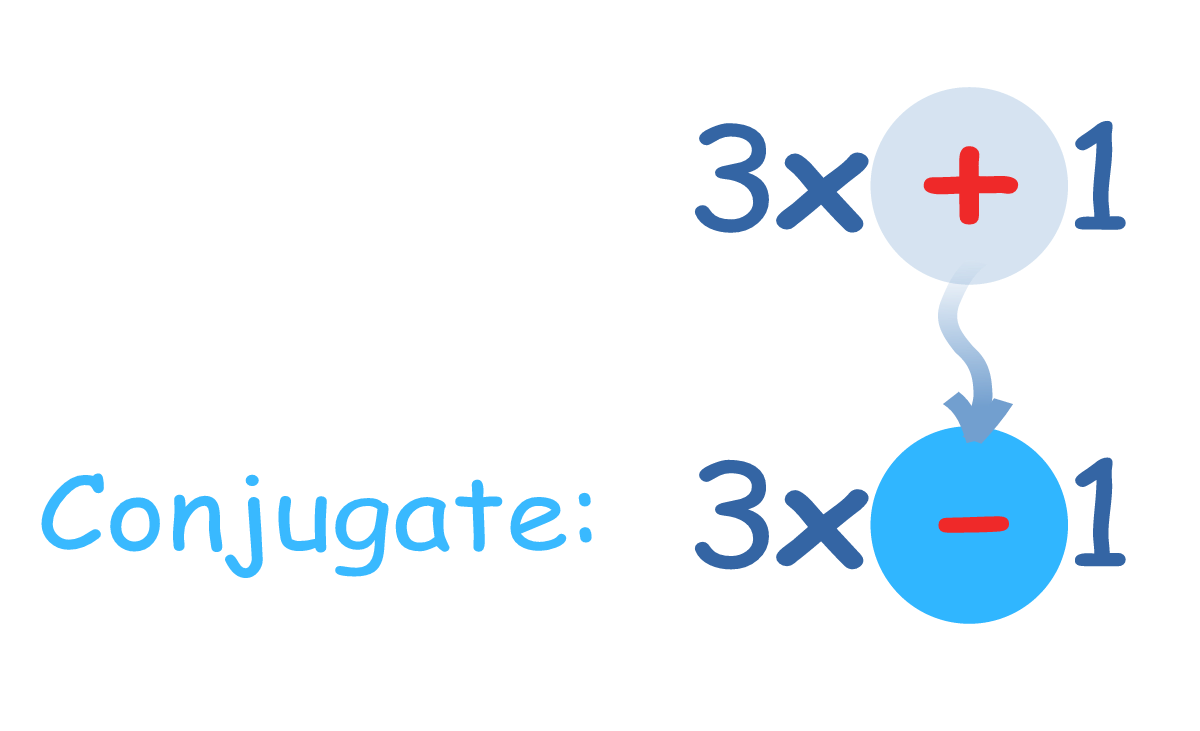
it's not pretty, but you can rationalize the denominator by multiplying the top and bottom by the conjugate
Math is Fun
The conjugate is where we change the sign in the middle of two terms like this: Here are some more examples: The conjugate can be very useful...
hardy rivet
thx man
trim joltBOT
@hardy rivet Has your question been resolved?
Channel closed
Closed by @hardy rivet
Use .reopen if this was a mistake.
Available help channel!
Send your question here to claim the channel.
Remember:
• Ask your math question in a clear, concise manner.
• Show your work, and if possible, explain where you are stuck.
• After 15 minutes, feel free to ping <@&286206848099549185>.
• Type the command .close to free the channel when you're done.
• Be polite and have a nice day!
Read #❓how-to-get-help for further information on how to ask a good question, and about conduct in the question channels.
 austere matrix
how does pie actually work
trim joltBOT
austere matrix
how does pie actually work
 ionic pendant
given any circle, if its circumference is $C$ and its diameter is $D$, then $\pi$ (``pi'') is the ratio of its circumference to its diameter: [ \pi = \frac CD ]
solid kilnBOT
cloud
 ionic pendant
it turns out that this ratio is the same for every circle
trim joltBOT
@austere matrix Has your question been resolved?
austere matrix
oh ight
trim joltBOT
Channel closed
Closed due to timeout
Use .reopen if this was a mistake.
Available help channel!
Send your question here to claim the channel.
Remember:
• Ask your math question in a clear, concise manner.
• Show your work, and if possible, explain where you are stuck.
• After 15 minutes, feel free to ping <@&286206848099549185>.
• Type the command .close to free the channel when you're done.
• Be polite and have a nice day!
Read #❓how-to-get-help for further information on how to ask a good question, and about conduct in the question channels.
 solemn sleet
 trim joltBOT
solemn sleet
solemn sleet
trim joltBOT
solemn sleet
solemn sleet
can someone explain where to start with this
im very lost
i though i could just use trig to find the force on the ramp
 nimble stone
that is indeed how you do it
obsidian zealot
yes
solemn sleet
or projections but the answer is 12 and im getting 48
nimble stone
how are you doing it?
nimble stone
got it a bit mixed
it would be sin(30)=ramp/24
solemn sleet
but 24 isnt the hypotenuse
nimble stone
how did you draw your triangle then?
nimble stone
when we are finding components we typically want the force to be the hypotenuse, because then the other sides are our perpendicular components
in this case, perpedicular to the ramp and parallel to it
solemn sleet
nimble stone
when we are finding components we typically want the force to be the hypotenuse,...
what do you mean by components
also
the force always need to be the hypotenuse?
nimble stone
its because we are looking at the force parallel and perpendicular to the plane, when you draw the triangle as you did, youre taking the 24N to be a component of a larger force, in this case the 48N you calculated
solemn sleet
okay so how do i draw the triangle here
nimble stone
pretty much this
 solemn sleet
nimble stone
pretty much this
solemn sleet
nimble stone
pretty much this

how did they get this
or oh
is that the end of the ramp?
 trim joltBOT
Channel closed
Closed by @solemn sleet
Use .reopen if this was a mistake.
trim joltBOT
Available help channel!
Send your question here to claim the channel.
Remember:
• Ask your math question in a clear, concise manner.
• Show your work, and if possible, explain where you are stuck.
• After 15 minutes, feel free to ping <@&286206848099549185>.
• Type the command .close to free the channel when you're done.
• Be polite and have a nice day!
Read #❓how-to-get-help for further information on how to ask a good question, and about conduct in the question channels.
 bleak ridge
 trim joltBOT
bleak ridge
trim joltBOT
bleak ridge
 rose inlet
bleak ridge
rose inlet
bleak ridge
ok so you have that region in the first quadrant under y = x^2 from x = 0 to x = 1
bleak ridge
yes
rose inlet
for each slice of this solid, perpendicular to the x axis, the cross section is a quarter circle
the radius of that quarter circle is just the distance from the x axis up to y = x^2
which is?
bleak ridge
distance from where
rose inlet
how far the curve is from the x axis
bleak ridge
like at 0 it would be x=0 it would be 0 and at x=1 it would be 1?
rose inlet
it would not be one
bleak ridge
oh
rose inlet
since the curve is y = x^2, the vertical distance from the x axis to that curve is just x^2
bleak ridge
okay
rose inlet
so the radius of each quarter circle is x^2
rose inlet
exactly
bleak ridge
and then i integrate that?
rose inlet
!!!
bleak ridge
okay awesome thank you
bleak ridge
im just a little confused why
its so different than doing like
a semi circle
like i usually just use the pi / 8 formula for that right
bleak ridge
so would it not just be pi / 16 for quarter
how does it become bigger
oh ig i see
bc if the radius is on it then it would be larger vs the whole diameter
rose inlet
exactly if ur working with the radius
the numbers r usually bigger cuz the diamater is twice the radius
once u sqare it that factor of 4 comes in
bleak ridge
tysm
rose inlet
np
rose inlet
yes ofc as long as u have quarter circles
bleak ridge
cool
trim joltBOT
@bleak ridge Has your question been resolved?
Channel closed
Closed by @bleak ridge
Use .reopen if this was a mistake.
Available help channel!
Send your question here to claim the channel.
Remember:
• Ask your math question in a clear, concise manner.
• Show your work, and if possible, explain where you are stuck.
• After 15 minutes, feel free to ping <@&286206848099549185>.
• Type the command .close to free the channel when you're done.
• Be polite and have a nice day!
Read #❓how-to-get-help for further information on how to ask a good question, and about conduct in the question channels.
 crimson thunder
how would one go about this
 trim joltBOT
crimson thunder
how would one go about this
trim joltBOT
crimson thunder
how would one go about this
 west sleet
crimson thunder
how would one go about this
west sleet
crimson thunder
how would one go about this
Can compare coefficients
Or do polynomial long division
crimson thunder
west sleet
Or do polynomial long division
yea im kinda stumped on that ;-;
west sleet
Alright then comparing coefficients it is
crimson thunder
wait i kinda need to do long division for my test ;-;
west sleet
Alright alright
crimson thunder
does comparing coefficients work for everything?
crimson thunder
west sleet
Alright alright
no i dont wanna for you into doing anything!
crimson thunder
ohh ok
west sleet
Actually depends but anyway
 crimson thunder
west sleet
Just remember to distribute the negative
crimson thunder
west sleet
Just remember to distribute the negative
oh wdym?
west sleet
west sleet
So -27x^6+216x^3
Uh as seen here we distribute the negative sign
crimson thunder
OH SO WE ADD
west sleet
Yea
crimson thunder
do i pull down the 0x^4?
west sleet
And uh we can just add it to the x^3 part of the polynomial
crimson thunder
west sleet
And uh we can just add it to the x^3 part of the polynomial
oh so now i bring down the -217x^3?
or do i add it it -217x^3?
west sleet
crimson thunder
or do i add it it -217x^3?
Yea just add it
trim joltBOT
Channel closed
Closed by @crimson thunder
Use .reopen if this was a mistake.
Available help channel!
Send your question here to claim the channel.
Remember:
• Ask your math question in a clear, concise manner.
• Show your work, and if possible, explain where you are stuck.
• After 15 minutes, feel free to ping <@&286206848099549185>.
• Type the command .close to free the channel when you're done.
• Be polite and have a nice day!
Read #❓how-to-get-help for further information on how to ask a good question, and about conduct in the question channels.
 marsh rapids
I’m confused on turning logarithms into exponential equations and so forth, can someone help me? Specifically this problem!!
 trim joltBOT
marsh rapids
I’m confused on turning logarithms into exponential equations and so forth, can ...
trim joltBOT
marsh rapids
I’m confused on turning logarithms into exponential equations and so forth, can ...
 quick tusk
e^ln(x) = x
marsh rapids
Huh
quick tusk
ln(x-3) = 4
You can eliminate the ln by exponentiating both sides
since e^ln(x-3) = (x-3)
quick tusk
marsh rapids
So I divide by -6?
yeah, thats the first step
marsh rapids
And then do I put it back in exponential form?
quick tusk
dividing both sides by -6 gives you ln(x-3) = 4, right?
marsh rapids
Yeah
quick tusk
Presumably you're trying to solve for x?
marsh rapids
Yeah
quick tusk
You wan't to eliminate the ln. You can do so by raising both sides to the power of e, euler's number
marsh rapids
Do I switch it to e^4 = x-3
quick tusk
yeah, because when you take e^ln(something), the e and ln cancel each other out, leaving (something)
marsh rapids
And then I solve for x from there?
quick tusk
yes

 high patio
marsh rapids
Ok I have one more question i need help on (e is tripping me up):
high patio
marsh rapids
Ok I have one more question i need help on (e is tripping me up):
Bring the 5 to the other side?
marsh rapids
And then put it into logarithmic form?
high patio
Yeah log both sides
 quick tusk
no. don't forget, ln and e cancel each other out
 knotty locust
Why did you write ln on one side and log on the other
marsh rapids
I don’t know
marsh rapids
I’m confused and literally on the verge of tears dude
high patio
knotty locust
If by log you mean base e log yes
Log usually means base 10 tho
high patio
knotty locust
What are your pronouns
Lol
knotty locust
high patio
Log usually means base 10 tho
Exactly my point
marsh rapids
knotty locust
Well that’s rather dramatic
I don’t have control over my emotions because of my autism and I’ve been stuck on this problem since I got the assignment.
knotty locust
Let’s see if we can’t clear this doubt then it
e^(n-7) = 335
Is clearly fine right
Okay
Whatever we do now we want to preserve this equality
We want to do the same thing to both sides
Does that general idea make sense it?
marsh rapids
So would it be: n-7 = ln 335?
knotty locust
marsh rapids
So would it be: n-7 = ln 335?
What operation occurs to reach this
marsh rapids
…I don’t know
knotty locust
Okay so why do you think that equation is true
marsh rapids
I don’t know
marsh rapids
Sorry
knotty locust
This is where we are it
What can we do to this equation
To both sides
At the same time
We can multiply, divide, add, subtract, etc… aslong as we do the same thing to both sides
Obviously the power of e is messing us up yes?
So it’d be nice if we could do something to both sides that would get rid of that
What do you think we should do
marsh rapids
ln??
marsh rapids
…Put ln335 in my graphing calculator
marsh rapids
…but then I’d find what n-7 is and could just add 7 to both sides and I’d have n
marsh rapids
How did you get -5.8? Calculator says positive 5.8
marsh rapids
Huh
knotty locust
It means approximately
marsh rapids
Oh I can’t read very well
knotty locust
It’s squiggly
marsh rapids
Sorry
knotty locust
That’s okay it
marsh rapids
…do you have to say my pronouns like that…just call me dude or bro…
Or man…
Any work
knotty locust
Well I wasn’t sure
What you wanted because you say ask and I asked and you didn’t clarify
Idk how to use
Yours
My apologies dude
knotty locust
Yes
knotty locust
Np
marsh rapids
.close
trim joltBOT
Channel closed
Closed by @marsh rapids
Use .reopen if this was a mistake.
Available help channel!
Send your question here to claim the channel.
Remember:
• Ask your math question in a clear, concise manner.
• Show your work, and if possible, explain where you are stuck.
• After 15 minutes, feel free to ping <@&286206848099549185>.
• Type the command .close to free the channel when you're done.
• Be polite and have a nice day!
Read #❓how-to-get-help for further information on how to ask a good question, and about conduct in the question channels.
 dapper oxide
is (x, 0, 0) where x is varying, the x-axis? or is it just a point where x can be anything
trim joltBOT
dapper oxide
is (x, 0, 0) where x is varying, the x-axis? or is it just a point where x can b...
 orchid wagon
the locus of (x, 0, 0) when x varies over R is the x-axis
otherwise, (x, 0, 0) is just a point on the x-axis
dapper oxide
even though x is varying
trim joltBOT
@dapper oxide Has your question been resolved?
trim joltBOT
@dapper oxide Has your question been resolved?
 gilded pulsar
dapper oxide
is (x, 0, 0) where x is varying, the x-axis? or is it just a point where x can b...
gilded pulsar
dapper oxide
is (x, 0, 0) where x is varying, the x-axis? or is it just a point where x can b...
The set of all points (x,0,0) is the x axis
dapper oxide
How would u graph (x, 0, 0) when x is varying but (x, 0, 0) is not the set of all points?
trim joltBOT
@dapper oxide Has your question been resolved?
simple panther
dapper oxide
How would u graph (x, 0, 0) when x is varying but (x, 0, 0) is not the set of al...
(x, 0, 0) is just a point. By graphing it, it means that mark all the possible values that that point can be.
For example, at x = 1, it would be (1, 0, 0)
At x = 1.1, it would be (1.1, 0, 0)
At x = 1.2, it would be (1.2, 0, 0) and so on...
Marking all those will give us its graph which would turn out to be the x axis
dapper oxide
So is it just a point or the x axis?
How would I graph x=1 OR x=1.1 OR x=1.2
simple panther
Depends
If they mention that it's a point or they said x is fixed (or anything similar), then it's a point
If they mention that x is a parameter or ask you the locus of that point, it would be the x axis
Graphing x = 1 or the point at x = 1?
dapper oxide
I wanna graph (x,0,0) at x = 1 OR x=1.1.
simple panther
Then it's just a point whose x is 1 OR 1.1, y is 0 and z is 0
dapper oxide
Not at x=1 AND x=1.1
dapper oxide
Yes not together
simple panther
??
dapper oxide
simple panther
(x, 0, 0) is just a point. By graphing it, it means that mark all the possible v...
In this example when ur graphing all possible points. Are you doing “x=1 AND x=2 AND x=3, etc”
dapper oxide
What if I wanna graph x=1 OR x=2 OR x=3, not AND
dapper oxide
Would that also be the x axis
simple panther
Yeah, but they won't be together in the same graph
If it's or,
Then it's either 1 or 2
Not both together
So it's either this or that
If it is togethers then we would get the x axis
simple panther
Yes
trim joltBOT
Channel closed
Closed due to timeout
Use .reopen if this was a mistake.
trim joltBOT
Available help channel!
Send your question here to claim the channel.
Remember:
• Ask your math question in a clear, concise manner.
• Show your work, and if possible, explain where you are stuck.
• After 15 minutes, feel free to ping <@&286206848099549185>.
• Type the command .close to free the channel when you're done.
• Be polite and have a nice day!
Read #❓how-to-get-help for further information on how to ask a good question, and about conduct in the question channels.
 signal sundial
If A is an infinite set, are we allowed to define |P(A)| and treat it as a real number? I have seen some prooofs just say that $|P(A)| = 2^\kappa$ where $|A| = \kappa$
 trim joltBOT
signal sundial
If A is an infinite set, are we allowed to define |P(A)| and treat it as a real ...
solid kilnBOT
trim joltBOT
signal sundial
If A is an infinite set, are we allowed to define |P(A)| and treat it as a real ...
solid kilnBOT
rya
 simple panther
solid kiln
**rya**
simple panther
solid kiln
**rya**
Isn't it supposed to be $\kappa^\kappa$!?
solid kilnBOT
Suika

 somber ginkgo
simple panther
Isn't it supposed to be $\kappa^\kappa$!?
somber ginkgo
simple panther
Isn't it supposed to be $\kappa^\kappa$!?
kappa^kappa would be the set of functions A -> A
signal sundial
so im not sure if u can do it for infinite sets
simple panther
somber ginkgo
kappa^kappa would be the set of functions A -> A
Oh, ok
somber ginkgo
signal sundial
If A is an infinite set, are we allowed to define |P(A)| and treat it as a real ...
with more formal cardinal arithmetic, you can "sort of" pretend the cardinals are ordinary numbers
simple panther
By considering kappa is infinite, I think you can
 marble wharf
the expression 2^kappa is just defined to be the cardinality of P(A). its not actually exponentiation in the sense of like repeated multiplication or via taylor series or something
signal sundial
somber ginkgo
with more formal cardinal arithmetic, you can "sort of" pretend the cardinals ar...
My lecturer gonna kill me...
somber ginkgo
but here you shouldn't be thinking about them like normal numbers
signal sundial
Do you think i could find a bijection
somber ginkgo
write down relevant bijections/injections/surjections to show that |P(A) x P(A)| = |P(A)|
i gather this is for like an introductory uni course rather than a logic&sets course right?
somber ginkgo
somber ginkgo
write down relevant bijections/injections/surjections to show that |P(A) x P(A)|...
yeah in which case write down ^
if this were say a set theory course then it's possible to do cardinal arithmetic to show that the sets have the same cardinalities
(also remark - the assumption |A x A| = |A| is technically vacous cus it's always true lol)
signal sundial
wait are u sure?
cuz i mean just comparing element in a
u already have |A|
like (1,a0),(1,a1),...(1,an)
then that will already be |A| elements
somber ginkgo
signal sundial
then that will already be |A| elements
A is infinite though
somber ginkgo
ofc it's not true for finite sets, but i.e. N x N has the same cardinality as N, R x R has the same cardinality as R etc.
signal sundial
that we should use?
somber ginkgo
signal sundial
that we should use?
yh
signal sundial
Im a lil behind on lectures, but i think we went into sets/functions a fair amount
I think they would be fine with cardinal arithmetic to prove this
somber ginkgo
signal sundial
that we should use?
oh as in don't use what i told u
as in they gave you the assumption that |A x A| = |A| so you should probably use it
but i just wanted to remark that actually if you do more maths in later years @ uni, then turns out this property is always true lol
signal sundial
isnt it like u can just find a bijection for A x A and A if they are countably infintie?
marble wharf
(isnt |AxA|=|A| assuming aoc or something?)
somber ginkgo
marble wharf
(isnt |AxA|=|A| assuming aoc or something?)
(maybe? but we like choice!)
marble wharf
(but not all logicians do)
signal sundial
Considering Im a first year 5 weeks into this course, do yuo think I should find a bijection or just use cardinal arithmetic without fuilly justifying every step?
marble wharf
bijection
signal sundial
Just asking because idk if it would be hard to find a bijection
marble wharf
cardinal arithmetic is proved by finding bijections anyway
signal sundial
alright thankls :)\
somber ginkgo
signal sundial
Considering Im a first year 5 weeks into this course, do yuo think I should find...
i just brought up cardinal arithmetic to explain why you might have seen some proofs that basically treat |P(A)| like a real number
somber ginkgo
signal sundial
but thats like proven through bijection
yh
signal sundial
any ideas on where too start with bijection?
somber ginkgo
signal sundial
any ideas on where too start with bijection?
are you familiar with the proof that N x N is countable? try to mimic that
signal sundial
somber ginkgo
are you familiar with the proof that N x N is countable? try to mimic that
im not familiar with that prof ;-;
trim joltBOT
@signal sundial Has your question been resolved?
Channel closed
Closed by @signal sundial
Use .reopen if this was a mistake.
trim joltBOT
Available help channel!
Send your question here to claim the channel.
Remember:
• Ask your math question in a clear, concise manner.
• Show your work, and if possible, explain where you are stuck.
• After 15 minutes, feel free to ping <@&286206848099549185>.
• Type the command .close to free the channel when you're done.
• Be polite and have a nice day!
Read #❓how-to-get-help for further information on how to ask a good question, and about conduct in the question channels.
 regal flint
There are two boxes containing marbles of the same size and mass. The first box contains 5 red marbles and 5 green marbles, the second box contains 6 red marbles and 4 green marbles. Randomly take one marble from the first box and transfer it to the second box, then randomly take one marble from the second box (assuming the marble taken from the second box is red). Calculate the probability that the red marble is from the first box.
trim joltBOT
regal flint
There are two boxes containing marbles of the same size and mass. The first box ...
 cedar flower
!status
trim joltBOT
What step are you on?
1. I don't know where to begin.
2. I have begun but got stuck midway.
3. I got an answer but I was told that it's wrong.
4. I got an answer and would like my work checked.
5. I have a question about someone else's work/solution.
6. I have completed the problem and don't need help anymore. Thank you.
7. None of the above
1
 marble karma
Alr
so
whats the probability the marble is red
from the first box
lets start here
regal flint
sorry im thinking a little bit
marble karma
5 red 5 green
regal flint
P(get red from box 2) = 5/10 * 7/11 + 5/10 * 6/11 = 13/22
P(get red from box and its origin is box 1) = 5/10 * 1/11 = 1/22
=> P(the marble is from box 1 assuming that it is red) = 1/22 : 13/22 = 1/13
Is it correct?
marble karma
no
regal flint
why?
@cedar flower help please
@marble karma please explain why it is incorrect
guys
cedar flower
regal flint
<@139113990537216000> help please
sorry I just got home. reading over now
P(a red marble is taken from the second box that originally in box 1 | the marble taken is red) = P(a red marble is taken from the second box that originally in box 1 AND the marble taken is red) / P(the marble taken is red)
yes, I think you are correct
if you can go "oh the actual solution is 1/4" then we can work out where we went wrong - but I don't see a problem w/it
trim joltBOT
@regal flint Has your question been resolved?
trim joltBOT
Channel closed
Closed due to timeout
Use .reopen if this was a mistake.
Available help channel!
Send your question here to claim the channel.
Remember:
• Ask your math question in a clear, concise manner.
• Show your work, and if possible, explain where you are stuck.
• After 15 minutes, feel free to ping <@&286206848099549185>.
• Type the command .close to free the channel when you're done.
• Be polite and have a nice day!
Read #❓how-to-get-help for further information on how to ask a good question, and about conduct in the question channels.
 sudden seal
How does one check if a vector is parallell with a plane?
The task is as following:
A plane has a normal vector n = [3,2,-1]. Furthermore, a point P(-2, 1, 0) is inside the plane.
a) Find an equation for plane alfa.
I did this by using Ax+Bx+Cx = 0, and came to the following 3x+2y-z+4 = 0
b) Find the coordinates that cross with the plane and y axis.
(0, a, 0)
Set in values in the equation and solve for a
(0, -2, 0)
c) Research if vector [1,1,5] is parallell with the plane.
How do you start with this?
trim joltBOT
sudden seal
How does one check if a vector is parallell with a plane?
The task is as follow...
cedar flower
a vector that is parallel with a plane will be perpendicular to the normal vector
sudden seal
Alright, so I have to see if v * n = 0?
cedar flower
aye
trim joltBOT
Channel closed
Closed by @sudden seal
Use .reopen if this was a mistake.
trim joltBOT
Available help channel!
Send your question here to claim the channel.
Remember:
• Ask your math question in a clear, concise manner.
• Show your work, and if possible, explain where you are stuck.
• After 15 minutes, feel free to ping <@&286206848099549185>.
• Type the command .close to free the channel when you're done.
• Be polite and have a nice day!
Read #❓how-to-get-help for further information on how to ask a good question, and about conduct in the question channels.

 undone gorge
paper jay
hi is this correct ?
undone gorge
paper jay
hi is this correct ?
C is wrong
Take triangle OTU
OU=OT (radius)
So it is an isosceles triangle
Now angle TOU=180-angle TOP
Now TOP = 64°
paper jay
so 116
undone gorge
So TOU = 180-64= 116° (UOP) is a straight line
undone gorge
paper jay
so 116
Yeah
Now in isosceles triangle base angles are equal (let's say x)
paper jay
but is mine correct ?
obsidian zealot
yes
paper jay
even the reasoning?
undone gorge
paper jay
but is mine correct ?
Yes, I am sorry
paper jay
it’s ok thanks
obsidian zealot
yea I think it’s all correct?
paper jay
thank you
trim joltBOT
@paper jay Has your question been resolved?
Channel closed
Closed by @paper jay
Use .reopen if this was a mistake.
Available help channel!
Send your question here to claim the channel.
Remember:
• Ask your math question in a clear, concise manner.
• Show your work, and if possible, explain where you are stuck.
• After 15 minutes, feel free to ping <@&286206848099549185>.
• Type the command .close to free the channel when you're done.
• Be polite and have a nice day!
Read #❓how-to-get-help for further information on how to ask a good question, and about conduct in the question channels.
 rich heart
I am currenttly on question 2 so sorry for not answering before, if anybody can help it would be hreat
 trim joltBOT
rich heart
I am currenttly on question 2 so sorry for not answering before, if anybody can ...
obsidian zealot
trim joltBOT
rich heart
I am currenttly on question 2 so sorry for not answering before, if anybody can ...
obsidian zealot
what do the angle numbers here mean?
obsidian zealot
also fyi some of the questions are cut off lol
hmm it doesn’t denote congruency……….
 obsidian zealot
ok let’s just talk in terms of C123 and T2
bc that’s what’s on the diagram
we know C1 + C2 = 90
obsidian zealot
have you proven 3.2.3?
rich heart
no
obsidian zealot
oh bc you need to prove this lmao
obsidian zealot
is COT isosceles?
rich heart
doesnt say
obsidian zealot
ok let’s just state all the lines
C1 + C2 + C3 + C4 = 180
T2 + T3 = 180
T1 + T2 = 180
C1 + C2 = 90
so C3 + C4 = 90
and T1 = T3
rich heart
yes
rich heart
i think so
obsidian zealot
C2 + C3 = 90
trim joltBOT
Channel closed
Closed by @rich heart
Use .reopen if this was a mistake.
trim joltBOT
Available help channel!
Send your question here to claim the channel.
Remember:
• Ask your math question in a clear, concise manner.
• Show your work, and if possible, explain where you are stuck.
• After 15 minutes, feel free to ping <@&286206848099549185>.
• Type the command .close to free the channel when you're done.
• Be polite and have a nice day!
Read #❓how-to-get-help for further information on how to ask a good question, and about conduct in the question channels.
 crisp wolf
(Integral calculus) I have been trying to solve this for a while now, i tried using some substitutions but i always get 2 variables. I want to know what am i doing wrong or what should i consider doing instead

 trim joltBOT
crisp wolf
(Integral calculus) I have been trying to solve this for a while now, i tried us...
trim joltBOT
trim joltBOT
crisp wolf
(Integral calculus) I have been trying to solve this for a while now, i tried us...
trim joltBOT
@crisp wolf Has your question been resolved?
crisp wolf
<@&286206848099549185>
obsidian zealot
unless you fix one of the sides, you will always have two variables
zinc ginkgo
crisp wolf
(Integral calculus) I have been trying to solve this for a while now, i tried us...
!original
trim joltBOT
crisp wolf
(Integral calculus) I have been trying to solve this for a while now, i tried us...
Please show the original problem, exactly as it was stated to you, with the entire original context. A picture or screenshot is best. If the original problem is not in English, then post it anyway! The additional context might still be helpful. Do your best to provide a translation.
@crisp wolf Has your question been resolved?
crisp wolf
trim jolt
Please show the original problem, **exactly as it was stated to you**, with the ...
I'm gonna look into that and confirm with my senior that sent me the question, thanks
.close
trim joltBOT
Channel closed
Closed by @crisp wolf
Use .reopen if this was a mistake.
Available help channel!
Send your question here to claim the channel.
Remember:
• Ask your math question in a clear, concise manner.
• Show your work, and if possible, explain where you are stuck.
• After 15 minutes, feel free to ping <@&286206848099549185>.
• Type the command .close to free the channel when you're done.
• Be polite and have a nice day!
Read #❓how-to-get-help for further information on how to ask a good question, and about conduct in the question channels.
 bronze jetty
Anyone help to find f(theta) please , i am unable to get a series for cancellations
 trim joltBOT
bronze jetty
Anyone help to find f(theta) please , i am unable to get a series for cancellati...
bronze jetty
trim joltBOT
bronze jetty
Anyone help to find f(theta) please , i am unable to get a series for cancellati...
bronze jetty
<@&286206848099549185>
trim joltBOT
bronze jetty
<@&286206848099549185>
Please only use the <@&286206848099549185> ping once if your question has not been answered for 15 minutes. Please do not ping or DM individual users about your question.
 sacred jackal
bronze jetty
<@&286206848099549185>
sacred jackal
bronze jetty
<@&286206848099549185>
!showwork
trim joltBOT
bronze jetty
<@&286206848099549185>
Show your work, and if possible, explain where you are stuck.
@bronze jetty Has your question been resolved?
trim joltBOT
Channel closed
Closed due to timeout
Use .reopen if this was a mistake.
Available help channel!
Send your question here to claim the channel.
Remember:
• Ask your math question in a clear, concise manner.
• Show your work, and if possible, explain where you are stuck.
• After 15 minutes, feel free to ping <@&286206848099549185>.
• Type the command .close to free the channel when you're done.
• Be polite and have a nice day!
Read #❓how-to-get-help for further information on how to ask a good question, and about conduct in the question channels.
 bright seal
5+5-5÷5 ???
trim joltBOT
bright seal
5+5-5÷5 ???
 clear cloud
Idk but <@&268886789983436800> do know
 knotty oriole
trim joltBOT
knotty oriole
trim joltBOT
Channel closed
Closed by @knotty oriole
Use .reopen if this was a mistake.
bright seal
Why is it troll?
trim joltBOT
Available help channel!
Send your question here to claim the channel.
Remember:
• Ask your math question in a clear, concise manner.
• Show your work, and if possible, explain where you are stuck.
• After 15 minutes, feel free to ping <@&286206848099549185>.
• Type the command .close to free the channel when you're done.
• Be polite and have a nice day!
Read #❓how-to-get-help for further information on how to ask a good question, and about conduct in the question channels.
 glad patio
 trim joltBOT
glad patio
trim joltBOT
glad patio

 dusky thunder
the surface area is the sum of individual areas of each side
glad patio
yes
dusky thunder
did you manage to express h in terms of x?
 dusky thunder
yeah
 dusky thunder
glad patio
dusky thunder
glad patio
here ur second line, u make it 2(2xh) = 4x2h which doesnt make sense. write it as 4xh. even for the first term, write it as 2xh rather than 2x2h
trim joltBOT
@glad patio Has your question been resolved?
trim joltBOT
Channel closed
Closed due to timeout
Use .reopen if this was a mistake.
Available help channel!
Send your question here to claim the channel.
Remember:
• Ask your math question in a clear, concise manner.
• Show your work, and if possible, explain where you are stuck.
• After 15 minutes, feel free to ping <@&286206848099549185>.
• Type the command .close to free the channel when you're done.
• Be polite and have a nice day!
Read #❓how-to-get-help for further information on how to ask a good question, and about conduct in the question channels.
 hoary idol
How I finish solving this
 trim joltBOT
hoary idol
How I finish solving this
zinc ginkgo
hoary idol
How I finish solving this
trim joltBOT
hoary idol
How I finish solving this
zinc ginkgo
hoary idol
How I finish solving this
,tex .cross mult
solid kilnBOT
riemann

 gusty bone
zinc ginkgo
,tex \.cross mult
gusty bone
zinc ginkgo
,tex \.cross mult
why is there a shortcut for that 💀
trim joltBOT
@hoary idol Has your question been resolved?
trim joltBOT
Channel closed
Closed due to timeout
Use .reopen if this was a mistake.
trim joltBOT
Available help channel!
Send your question here to claim the channel.
Remember:
• Ask your math question in a clear, concise manner.
• Show your work, and if possible, explain where you are stuck.
• After 15 minutes, feel free to ping <@&286206848099549185>.
• Type the command .close to free the channel when you're done.
• Be polite and have a nice day!
Read #❓how-to-get-help for further information on how to ask a good question, and about conduct in the question channels.
 silver sandal
can someone tell me where it went wrong?
 trim joltBOT
silver sandal
can someone tell me where it went wrong?
trim joltBOT
silver sandal
can someone tell me where it went wrong?
@silver sandal Has your question been resolved?
silver sandal
<@&286206848099549185>
 trim joltBOT
Channel closed
Closed by @silver sandal
Use .reopen if this was a mistake.
trim joltBOT
Available help channel!
Send your question here to claim the channel.
Remember:
• Ask your math question in a clear, concise manner.
• Show your work, and if possible, explain where you are stuck.
• After 15 minutes, feel free to ping <@&286206848099549185>.
• Type the command .close to free the channel when you're done.
• Be polite and have a nice day!
Read #❓how-to-get-help for further information on how to ask a good question, and about conduct in the question channels.
 limpid siren
Find the numbers of factors of n if n = a^x * b^y
limpid siren
Yes, a and b are primes
 queen burrow
the answer would be (x+1)(y+1)
 round imp
Ah
queen burrow
basic combinatorics
round imp
queen burrow
the answer would be (x+1)(y+1)
Bruh
queen burrow
lol
round imp
!nosols
trim joltBOT
As a helper, please do not give out answers that could be copied as a homework solution. Have the student work through the problem themselves and guide them along the way.
queen burrow
sorry
round imp
Aiyo
queen burrow
so if you think logically
round imp
Think of the conditions of p if p|n
queen burrow
and similarly 1,b,b^2...b^y
for each factor you need to find a combination
there are x+1 choices for a or it's power appearing in the factor,
and y+1 for b
round imp
Let him think ._. but okay
limpid siren
All factors of n can be listed as follows:
(a, a^2, a^3, a^4,....................., a^x) + (b, b^2, b^3,............................, b^y) - [x + y factors]
(ab, ab^2, ab^3, ab^4,..................., ab^y) - [y factors]
(a^2b, a^2b^2, a^2b^3,...................., a^2b^y) - [y factors]
........................ - x columns in total
(a^x * b, a^x b^2, a^x b^3,..........................., a^x b^y) - [y facotrs]
These are all the factors. Counting the number of factors we get:
(x + y) + (y * x)
round imp
+1 for 1
limpid siren
But the number of factors should be (x+1)(y+1)
round imp
1 is a factor
limpid siren
Of course
round imp
Ah yes
round imp
Np
limpid siren
.close
trim joltBOT
Channel closed
Closed by @limpid siren
Use .reopen if this was a mistake.
trim joltBOT
Available help channel!
Send your question here to claim the channel.
Remember:
• Ask your math question in a clear, concise manner.
• Show your work, and if possible, explain where you are stuck.
• After 15 minutes, feel free to ping <@&286206848099549185>.
• Type the command .close to free the channel when you're done.
• Be polite and have a nice day!
Read #❓how-to-get-help for further information on how to ask a good question, and about conduct in the question channels.
dusty mist
"a helicopter leaves point (24,12) while travelling at 25km/h in the direction of 343.74 true bearing. What is the position vector and velocity vector of this moving object?"
trim joltBOT
dusty mist
"a helicopter leaves point (24,12) while travelling at 25km/h in the direction o...
@dusty mist Has your question been resolved?
trim joltBOT
@dusty mist Has your question been resolved?
 devout yew
dusty mist
"a helicopter leaves point (24,12) while travelling at 25km/h in the direction o...
devout yew
dusty mist
"a helicopter leaves point (24,12) while travelling at 25km/h in the direction o...
first you can find the velocity vector. here's a hint: think of a right angled triangle with x and y components equal to that of the x and y components of the velocity, what could the hypotenuse be? and if you knew that, how would you find the x and y components if you new one angle other than 90 inside the triangle?
then you should be able to workout the position vector easiliy
dusty mist
would the velocity vector be [-24,7]
devout yew
I didn't do the calculation but I'd be surprised if you such a clean answer, what was your method?
dusty mist
uh
would it be alright if I could give you the background to the question
its a bit of a read
devout yew
yeah, go on
dusty mist
the question I asked was a simplified version of question 14

here was my calculations for the velocity vector and position vector for the helicopters motion at 9pm using the 16.26 true bearing

so my first approach was to substitute the theta value with the new 343.74 true bearing
but then I got confused
so I ended up with this

which I hope I got correct
devout yew
dusty mist
so I ended up with this
yeah, this logic works fine for this question
devout yew
dusty mist
so I ended up with this
this is nice because it shows you really thought about the question instead of just plugging in the values to the position vector formula, which would give you the same answer just without the added satisfaction
devout yew
I assume you mean the cosine and sine values right?
dusty mist
no like the actual x and y components
the blue was supposed to be 24
and the 7 was supposed to be -7 and 7
hence the changed signsd
😭
devout yew
ahh the classic sign mixup, nw mate
trim joltBOT
Channel closed
Closed due to timeout
Use .reopen if this was a mistake.
Available help channel!
Send your question here to claim the channel.
Remember:
• Ask your math question in a clear, concise manner.
• Show your work, and if possible, explain where you are stuck.
• After 15 minutes, feel free to ping <@&286206848099549185>.
• Type the command .close to free the channel when you're done.
• Be polite and have a nice day!
Read #❓how-to-get-help for further information on how to ask a good question, and about conduct in the question channels.
native shuttle
What do I do after f'(x)
 trim lichen
post the rest of the question
native shuttle
Oh just check for 1-1 and onto
 solid plank
Why are you derivating it then?
native shuttle
To find 1-1
Since if we do f(x1)=f(x2) we can't find
So we need to do f'(x)
And show it's strictly increasing/decreasing
solid plank
Oh okay you could do that too yeah
native shuttle
But idk what to do after f'(x)
solid plank
So equate f'(x) =0
native shuttle
hmm ok
I am getting (11x^2-30x-20)/(7x^2+2x+10)^2
For f'(x)
So if f'(x)=0 I need to equate $11x^2-30x-20=0$
solid kilnBOT
devthemasked
 solid plank
Yeah
native shuttle
So x=30+-root20/22
solid plank
And you're also have to make sure that $(7x^2+2x+10)^2=0$ won't have any variable satisfying it
solid kilnBOT
Aria
 solid plank
Yeah that's why you have to make sure
trim lichen
what a crunchy question...
native shuttle
wdym by crunchy
solid plank
native shuttle
So x=30+-root20/22
So for some value of x, f'(x) is zero, thus it won't be strictly increasing or decreasing
native shuttle
The solution is something else
trim lichen
native shuttle
wdym by crunchy
needs a lot of number-crunching
native shuttle
Should I send that
trim lichen
but i can note the denominator has negative discriminant and so is always strictly positive
and by the looks of it, the same is true of the numerator
solid plank
native shuttle
The solution is something else
Are you sure that you derivative f'x correctly?
trim lichen
so no matter what x is, f(x) will be positive
so just from this alone
no hope for onto-ness
native shuttle
Wait why no onto
solid plank
trim lichen
no hope for onto-ness
yeah you're right
trim lichen
native shuttle
Wait why no onto
cause f(x) = -69 can never happen
solid plank
😭😭
solid plank
nothing
solid plank
it would be negative, yeah
trim lichen
solid plank
nothing
then why the sobs
solid plank
trim lichen
then why the sobs
nvm
trim lichen
native shuttle
Did you find discriminant of numerator and denominator
i didn't calculate them but i can tell they are negative for sure
native shuttle
Ok so if discriminant is negative the quadratic is positive
 willow urchin
trim lichen
then why the sobs
willow urchin
trim lichen
then why the sobs
bc funny number cant happen
trim lichen
1 - 4×2×5 and 4 - 4×7×10...
native shuttle
yea'
trim lichen
willow urchin
bc funny number cant happen
oh. sad. many such cases
trim lichen
native shuttle
Ok so if discriminant is negative the quadratic is positive
the quadratic has constant sign
whether it's positive or negative, you tell by the sign of a or c (which have to match)
willow urchin
we dont know range = R^+, all we know is range is contained in R^+
trim lichen
i didnt claim the range is (0, +infty) -- and it isn't.
what matters is that the range isn't R.
solid plank
you can say that the range would be a subset of R+
solid plank
native shuttle
So basically range cannot be -R
yeah
native shuttle
ok
trim lichen
native shuttle
So basically range cannot be -R
overcomp again
native shuttle
so not onto
willow urchin
-R is an abuse of notation
solid plank
frfr
willow urchin
just say the range cant include negative numbers
native shuttle
how
solid plank
Nah we'll have to differentiate
solid plank
but I think you did something wrong there
if there are some roots for f'(x), that means it won't be strictly increasing/decreasing
native shuttle
solid plank
if there are some roots for f'(x), that means it won't be strictly increasing/de...
There are no roots if D<0 right
native shuttle
Yea I got roots
solid plank
Uhh I got f'(x)= $(11x^2-30x-20)/(7x^2+2x+10)^2$
solid kilnBOT
Aria
 native shuttle
So I saw at those particular roots the value of f'(x)=0 hence it will not be strictly increasing/decreasing
native shuttle
solid kiln
**Aria**
yep
trim lichen
solid plank
Uhh I got f'(x)= $(11x^2-30x-20)/(7x^2+2x+10)^2$
$f'(x) = \frac{11x^2-30x+20}{(7x^2+2x+10)^2}$
solid kilnBOT
Ann
 solid plank
yeah thanks
native shuttle
-20
solid plank
native shuttle
So I saw at those particular roots the value of f'(x)=0 hence it will not be str...
Yeahh
trim lichen
native shuttle
-20
typo oops
solid plank
It's says that function is increasing or decreasing in intervals
trim lichen
so they just say the derivative isn't sign-constant