#help-38
1 messages · Page 198 of 1
 violet gust
 proper saffron
do i need to solve it or use it somewhere else to figure out another angle
violet gust
can you find 180-KLC from that?
violet gust
YES
Now, the next is the most critical step for this problem
Join the points K and B
 violet gust
now what can you say about KLB and KAB triangles
proper saffron
violet gust
now what can you say about KLB and KAB triangles
they are the same right?
violet gust
proof?
proper saffron
uh
each of them has one y side
and 1 x side
im not sure if thats how you do it
oh wait nvm
because angle BLK is 2z
and thats not the same
violet gust
Do you know congruence of triangles?
proper saffron
violet gust
Do you know congruence of triangles?
no
violet gust
Like can you name the tests for congruency?
proper saffron
not entirely
isnt it like when there is 2 triangle
and they are proportional
in angle
violet gust
proportional is similarity
proper saffron
violet gust
proportional is similarity
oh
proper saffron
yeah idk congruence tests
violet gust
Congruence is like 8th grade maths. you sure about that you dont know it?
proper saffron
violet gust
Congruence is like 8th grade maths. you sure about that you dont know it?
no
im just now in grade 8
proper saffron
violet gust
without congruency, its gonna be tough
how do you find out if something is congruent
violet gust
theres test for congruence
like if all three sides are same, then all the properties of the triangles are the same
proper saffron
violet gust
like if all three sides are same, then all the properties of the triangles are t...
oh
violet gust
or if two sides and the angle between the two side is same, then also all the properties are same
violet gust
Yea, somewhat. Bu you only talked ablut 2 sides. So thats not sufficient
proper saffron
violet gust
Yea, somewhat. Bu you only talked ablut 2 sides. So thats not sufficient
i talked about 3
violet gust
But yea
violet gust
thats the point. The twi triangles are congruent
proper saffron
wait
proper saffron
violet gust
thats the point. The twi triangles are congruent
only from 2 sides?
violet gust
coz the 3rd side is the common side so its also the same
proper saffron
violet gust
coz the 3rd side is the common side so its also the same
ohh
yeah
so that means
CAB=BLK
violet gust
That means the angles KAB and angle KLB are equal
violet gust
mhm
violet gust
yep
proper saffron
5/2a
=180
5a=360
a=72
or so
and since top angle is 1/2a
ITS 32
36
YES
I GOTIT
tysm
violet gust

violet gust
yea lol
violet gust
yea
proper saffron
.close
 trim joltBOT
Channel closed
Closed by @proper saffron
Use .reopen if this was a mistake.
trim joltBOT
 Available help channel!
Send your question here to claim the channel.
Remember:
• Ask your math question in a clear, concise manner.
• Show your work, and if possible, explain where you are stuck.
• After 15 minutes, feel free to ping <@&286206848099549185>.
• Type the command .close to free the channel when you're done.
• Be polite and have a nice day!
Read #❓how-to-get-help for further information on how to ask a good question, and about conduct in the question channels.
 high wraith
Can someone tell me why the bottom one is right and the top one is wrong. And why on other questions both methods work?
 trim joltBOT
high wraith
Can someone tell me why the bottom one is right and the top one is wrong. And wh...
high wraith
trim joltBOT
high wraith
Can someone tell me why the bottom one is right and the top one is wrong. And wh...
high wraith
,rotate
 solid kilnBOT
 trim joltBOT
@high wraith Has your question been resolved?
trim joltBOT
Channel closed
Closed due to timeout
Use .reopen if this was a mistake.
trim joltBOT
Available help channel!
Send your question here to claim the channel.
Remember:
• Ask your math question in a clear, concise manner.
• Show your work, and if possible, explain where you are stuck.
• After 15 minutes, feel free to ping <@&286206848099549185>.
• Type the command .close to free the channel when you're done.
• Be polite and have a nice day!
Read #❓how-to-get-help for further information on how to ask a good question, and about conduct in the question channels.
 vocal epoch
 trim joltBOT
vocal epoch
trim joltBOT
vocal epoch
 crimson pebble
vocal epoch
crimson pebble
vocal epoch
$x(x+h)\neq x^2+h$
solid kilnBOT
CST (reply ping for help)
 vocal epoch
oh yea
vocal epoch
vocal epoch
am i allowed to factor out h from that top fraction in the 2nd last step the way i did
 vernal palm
ussualy yes
crimson pebble
Oh please put lim_(h->0) everywhere
vernal palm
but this time you removed the h from x^2+h

 vernal palm
yes but you need to still multiply x by h at x^2+x it should be x^2+x*h
vocal epoch
so it should be like this?
 vernal palm
yes
 vernal palm
now you just need to "take"/"solve"/"complete" the limit
vocal epoch
what
 grave monolith
When h = 0 ,xh = 0 leaving -2/x^2
vernal palm
remove the h
vocal epoch
isnt that what i had before anyway
vernal palm
!noans
trim joltBOT
The purpose of this server is to help you learn, not to hand out answers. Do not ask someone to give you the answer directly.
vocal epoch
-2/x^2
vocal epoch
vocal epoch
in this
vernal palm
yeah you can get the right answer for the wrong reasons
vocal epoch
fair enough
does it matter if the derivative function i get is a rational function like this
questions that ive done for this stuff before usually give a linear function
 topaz heart
vocal epoch
does it matter if the derivative function i get is a rational function like this
topaz heart
vocal epoch
does it matter if the derivative function i get is a rational function like this
No
You can do -2/x^2 or -2x^(-2)
trim joltBOT
@vocal epoch Has your question been resolved?
Channel closed
Closed by @vocal epoch
Use .reopen if this was a mistake.
trim joltBOT
Available help channel!
Send your question here to claim the channel.
Remember:
• Ask your math question in a clear, concise manner.
• Show your work, and if possible, explain where you are stuck.
• After 15 minutes, feel free to ping <@&286206848099549185>.
• Type the command .close to free the channel when you're done.
• Be polite and have a nice day!
Read #❓how-to-get-help for further information on how to ask a good question, and about conduct in the question channels.
 tight mantle
how would i go about finding y, i believe i found x correctly, i used tan inverse and got 29.74 degrees
 trim joltBOT
tight mantle
how would i go about finding y, i believe i found x correctly, i used tan invers...
trim joltBOT
tight mantle
how would i go about finding y, i believe i found x correctly, i used tan invers...
 burnt mulch
tight mantle
how would i go about finding y, i believe i found x correctly, i used tan invers...
burnt mulch
tight mantle
how would i go about finding y, i believe i found x correctly, i used tan invers...
Angle sum of a quadrilateral = 360 deg
tight mantle
so would i minus x from 360 to find y?
burnt mulch
tight mantle
so would i minus x from 360 to find y?
What about the two right angles?
tight mantle
and those
burnt mulch
then yeah
trim joltBOT
Channel closed
Closed by @tight mantle
Use .reopen if this was a mistake.
trim joltBOT
Available help channel!
Send your question here to claim the channel.
Remember:
• Ask your math question in a clear, concise manner.
• Show your work, and if possible, explain where you are stuck.
• After 15 minutes, feel free to ping <@&286206848099549185>.
• Type the command .close to free the channel when you're done.
• Be polite and have a nice day!
Read #❓how-to-get-help for further information on how to ask a good question, and about conduct in the question channels.
 thin vine
 thin vine
could someone help explain why the answer is d
im going to upload my work in a sec

ok here it is
so i managed to factor it into this form
i just set x=log2x
sorry if thats confusing
 austere cedar
Make sure to keep a table of log identities nearby as you work
 zinc ginkgo
,tex .log rules
solid kilnBOT
riemann
 austere cedar
I'm not sure why they use f(x) when they just mean "log2", maybe to trip you up? It doesn't really do much
You just want to simplify. You'll get one of the answers
thin vine
austere cedar
You just want to simplify. You'll get one of the answers
I did x^2/4x to get log2(x/4) and then multiplied by 8 but that gave me log2(2x)
austere cedar
log2(2x)
= log2(2) + log2(x)
= 1 + log2(x)
austere cedar
You're good haha, almost there
trim joltBOT
Channel closed
Closed by @thin vine
Use .reopen if this was a mistake.
trim joltBOT
Available help channel!
Send your question here to claim the channel.
Remember:
• Ask your math question in a clear, concise manner.
• Show your work, and if possible, explain where you are stuck.
• After 15 minutes, feel free to ping <@&286206848099549185>.
• Type the command .close to free the channel when you're done.
• Be polite and have a nice day!
Read #❓how-to-get-help for further information on how to ask a good question, and about conduct in the question channels.
 urban copper
gauss plane and argand plane refer to the same thing?
urban copper
I know it as Argand plane, the plane that has like x = Re(z) and y = Im(z)
x-axis and y-axis respectively I mean
 dapper swift
urban copper
gauss plane and argand plane refer to the same thing?
dapper swift
urban copper
gauss plane and argand plane refer to the same thing?
yes
Wikipedia says that Gauss plane is another name for the Argand plane
but I've never heard of it being called the Gauss plane
the most common term in English is just the complex plane
urban copper
dapper swift
but I've never heard of it being called the Gauss plane
exactly my thoughts until I saw a maessage in #math-pedagogy
dapper swift
urban copper
exactly my thoughts until I saw a maessage in <#541382507656904704>
translated from their own language, lol
urban copper
urban copper
dapper swift
but I've never heard of it being called the Gauss plane
I appreciate the help, no need to create more work for u guys, I can actually google this, sorry for this
urban copper
dapper swift
Wikipedia says that Gauss plane is another name for the Argand plane
thanks
.solved
trim joltBOT
Channel closed
Closed by @urban copper
Use .reopen if this was a mistake.
trim joltBOT
Available help channel!
Send your question here to claim the channel.
Remember:
• Ask your math question in a clear, concise manner.
• Show your work, and if possible, explain where you are stuck.
• After 15 minutes, feel free to ping <@&286206848099549185>.
• Type the command .close to free the channel when you're done.
• Be polite and have a nice day!
Read #❓how-to-get-help for further information on how to ask a good question, and about conduct in the question channels.
 clear ember
I’m stuck at this question:
“Imagine you throw a bouncing ball at a train. You throw the ball at a speed of 20 m/s directly towards the train, which is moving at a speed of 180 km/h towards you. What speed does the ball have if we assume the bounce is perfectly elastic?”
I checked and the solution in the answer key is:
“v_train = 180 km/h = 50 m/s
The direction of the train's movement is the positive direction.
Towards the train, we imagine a thrown ball with
a velocity of v_ball before = -20 m/s (negative direction).
We are looking for the ball's velocity after the bounce towards the train and call it v_ball after. The train's velocity after the bounce is still
50 m/s. The train's velocity is hardly affected by a small ball hitting it.
The bounce is perfectly elastic. The following equation holds:
v_ball after - v_train = v_train - v_ball before
v_ball after - 50 = 50 - (-20)
v_ball after = 120 m/s (432 km/h)
Answer: 120 m/s"
I don’t really understand how the solution arrived at that answer. I tried using the formula: mAvA1 + mBvB1 = mAvA2 + mBvB2. I thought that the mass in this case should be irrelevant, so I wrote it as:
-20 + 50 = x + 50
-20 = x
Answer: The ball's speed is -20 m/s. (Incorrect answer)
How should I have solved the problem instead? Am I using the wrong formula, and if so, which formula should I have used?
trim joltBOT
clear ember
I’m stuck at this question:
“Imagine you throw a bouncing ball at a train. You t...
@clear ember Has your question been resolved?
clear ember
<@&286206848099549185>
 supple copper
,w 180kmph to m/s
solid kilnBOT


 clear ember
supple copper
So looks like you’re using this
clear ember
supple copper
So looks like you’re using this
Yea I think so?
 wraith hinge
wouldnt the velocity of the ball be -70m/s?
supple copper
Ok if you’re on the train
The ball comes at you at 20 + 50 m/s
This means from the perspective of the train it should bounce and go forwards (away from the train) at 70 m/s
wraith hinge
my english is not englishing, where is the ball thrown from?
supple copper
But you’re on the train that’s also moving at 70m/s so from a stationary observer the ball would be moving 70m/s + 50m/s of the train’s frame of reference
So 120m/s in total
wraith hinge
are you throwing the ball at the train while you being inside the train or outside the train?
my english level is very poor
clear ember
wraith hinge
are you throwing the ball at the train while you being inside the train or outsi...
As I understood the text I am trowing the ball on the train from the outside but yea it's a bit unclear so I might be on the train?
supple copper
No the ball is thrown from stationary towards the train
clear ember
So I'm on the train then? Sorry I am quite lost lol
clear ember
Alright!
clear ember
supple copper
So looks like you’re using this
If I'm supposed to use this formula then why do they switch to - instead of using + in the answer?
supple copper
supple copper
So looks like you’re using this
This I don’t think is right
This assumes that the bounce will take kinetic energy away from the train
clear ember
Alright so what formula am I supposed to use?
clear ember
Alright thanks!
clear ember
.close
trim joltBOT
Channel closed
Closed by @clear ember
Use .reopen if this was a mistake.
Available help channel!
Send your question here to claim the channel.
Remember:
• Ask your math question in a clear, concise manner.
• Show your work, and if possible, explain where you are stuck.
• After 15 minutes, feel free to ping <@&286206848099549185>.
• Type the command .close to free the channel when you're done.
• Be polite and have a nice day!
Read #❓how-to-get-help for further information on how to ask a good question, and about conduct in the question channels.
 inland bear
Can someone see for me if my working for part B is correct?
 inland bear

 west sleet
inland bear
Can someone see for me if my working for part B is correct?
west sleet
inland bear
Can someone see for me if my working for part B is correct?
No the tangent is a straight line
Sub x=4 into the derivative function to find the slope of the tangent
Before using point line formula
dapper swift
west sleet
Sub x=4 into the derivative function to find the slope of the tangent
you mean x = 4
west sleet
Oh yea
dapper swift
yeah it's $y - 2 = f'(4) (x - 4)$
solid kilnBOT
south
 inland bear
Oh okay thank you
dapper swift
no worries!
inland bear
.close
trim joltBOT
Channel closed
Closed by @inland bear
Use .reopen if this was a mistake.
Available help channel!
Send your question here to claim the channel.
Remember:
• Ask your math question in a clear, concise manner.
• Show your work, and if possible, explain where you are stuck.
• After 15 minutes, feel free to ping <@&286206848099549185>.
• Type the command .close to free the channel when you're done.
• Be polite and have a nice day!
Read #❓how-to-get-help for further information on how to ask a good question, and about conduct in the question channels.
 true canyon
i'm not sure how to deal with my a.b term here
 true canyon
i cropped it out but p = λa + (1-λ)b (or so i think)
trim joltBOT
@true canyon Has your question been resolved?
trim joltBOT
Channel closed
Closed by @true canyon
Use .reopen if this was a mistake.
trim joltBOT
Available help channel!
Send your question here to claim the channel.
Remember:
• Ask your math question in a clear, concise manner.
• Show your work, and if possible, explain where you are stuck.
• After 15 minutes, feel free to ping <@&286206848099549185>.
• Type the command .close to free the channel when you're done.
• Be polite and have a nice day!
Read #❓how-to-get-help for further information on how to ask a good question, and about conduct in the question channels.
 glad patio
 trim joltBOT
glad patio
glad patio
trim joltBOT
glad patio
glad patio

ive done a b c
for d do they want me to use 3-13x to find 2.9998^6?
im kind of confused
also for c does my value of x seem to be a suitable value
glad patio
i dont know which expansion they want me to use from
i assumed the original one from a
 split chasm
you shouldn't have done those last two lines in a)
if you want to factor out a value, indicate it as such instead of just dividing
you x value is fine
glad patio
oh i only did it because in the question it asked for the simplest form
split chasm
the point still stands
729 isn't the same as 3 etc
whether the factored form or standard form is considered simpler is a different matter
in this case, they probably want expanded
glad patio
so for a) should i have just left it like that without dividing it?
split chasm
yes
but
if you want to factor out a value, indicate it as such instead of just dividing
glad patio
wdym indicate it as such
glad patio
ah
split chasm
also 36/3 is 12, not 13
 split chasm
yes
split chasm
yes
glad patio
so 729-2916x=2.9998^6?
split chasm
not = and not quite
729 - 2916x when x=0.0001 (the value you found in c)
will give an approximation of 2.9998^6
glad patio
i got 728.7084
split chasm
,w 729 - 2916x when x=0.0001


 glad patio
that should be right then cause they asked for 4 dp
glad patio
alright thank you for the help
split chasm
,calc 2.9998^6
solid kilnBOT
Result:
728.70844859568
@glad patio Has your question been resolved?
trim joltBOT
Channel closed
Closed due to timeout
Use .reopen if this was a mistake.
trim joltBOT
Available help channel!
Send your question here to claim the channel.
Remember:
• Ask your math question in a clear, concise manner.
• Show your work, and if possible, explain where you are stuck.
• After 15 minutes, feel free to ping <@&286206848099549185>.
• Type the command .close to free the channel when you're done.
• Be polite and have a nice day!
Read #❓how-to-get-help for further information on how to ask a good question, and about conduct in the question channels.
 limber heath
Can someone help me with this?
 trim joltBOT
limber heath
Can someone help me with this?
limber heath
trim joltBOT
limber heath
Can someone help me with this?
limber heath
I understood the part where sad face means subset relation and smiley face means set equality
I just cant understand the idea of x and y
like if x and y are in sigma then x and y are elements ? or are they some powerset or subset of sigma?
 silver glade
if x and y are in sigma, they are sets of the form
{1,2,...n}
limber heath
Also in discrete math I just dont understand the idea of writing a proof in general...
like I can explain it in words... but how do i make it into math expressions
limber heath
silver glade
if x and y are in sigma, they are sets of the form
{1,2,...n}
yea but if the form is the same, doesnt that means that x and y are the same ? or is n different for both of them ?
limber heath
so Sigma = { {1}, {1,2}, {1,2,3}, ... , {1,2,3,...,n}} ?
silver glade
sigma = { {1}, {1,2}, {1,2,3}, ... }
it has infinite cardinality
i mean it doesn't have a final element
trim joltBOT
@limber heath Has your question been resolved?
limber heath
so now I known this
and I understand that x and y are gonna be unique in the sense of the number of elements and what they are
and I also understand that if x and y are unique one will have more elements than the other
and as they have repeating elements, one has to be a subset of the other
BUT HOW DO I Write it as a proof
@twilit nacelle
silver glade
x and y don't have to be unique
i'm not sure exactly what was covered in your class, but i would try to say something like this, for part (a):
$x = {1,2,\ldots m}$ and $y = {1,2,\ldots n}$ for some $m,n \in\mathbb{Z}^{+}$. Either $m>n$, $m=n$, or $m<n$. In the first case, for all $y'\in y$ we have $1\leq y'\leq n < m$ so $y'\in x$. This means that $y$🙁$x$.
solid kilnBOT
Axe
 silver glade
and so on, for the other two cases (m=n and m<n)
limber heath
oh okay
wait so proofs can be written like this??
we have been taught that it has to have some amount of propositions or some kind of infereicng or something to show. you cant just say stuff
silver glade
could you give an example?
trim joltBOT
@limber heath Has your question been resolved?
trim joltBOT
Channel closed
Closed due to timeout
Use .reopen if this was a mistake.
trim joltBOT
Available help channel!
Send your question here to claim the channel.
Remember:
• Ask your math question in a clear, concise manner.
• Show your work, and if possible, explain where you are stuck.
• After 15 minutes, feel free to ping <@&286206848099549185>.
• Type the command .close to free the channel when you're done.
• Be polite and have a nice day!
Read #❓how-to-get-help for further information on how to ask a good question, and about conduct in the question channels.
 solemn phoenix
Die Gleichung (\mid x-2\mid =5) besitzt mit (x \in \mathbb{R}) folgende Lösungsmenge (L:)
trim joltBOT
solemn phoenix
Die Gleichung \(\mid x-2\mid =5\) besitzt mit \(x \in \mathbb{R}\) folgende Lösu...
solid kilnBOT
Subniif
 solemn phoenix
this question is hard but what do these lines mean
 real rose
solemn phoenix
this question is hard but what do these lines mean
real rose
solemn phoenix
this question is hard but what do these lines mean
Absolute value. Takes the positive output of any real number.
i.e., turns something like -3 into 3.
 clear cloud
,w graph abs(x)
solid kilnBOT

 solemn phoenix
real rose
i.e., turns something like -3 into 3.
solemn phoenix
real rose
i.e., turns something like -3 into 3.
im insanely confused
real rose
solemn phoenix
im insanely confused
|-3|=3.
solemn phoenix
but why
solemn phoenix
real rose
It is basically the distance a number is from 0.
ahhhh
solemn phoenix
real rose
Ok, in *numerical analysis*.
no
real rose
Yeah.
So, if |x| is defined as the distance of x from 0, wouldn't the output always be positive?
solemn phoenix
ye
real rose
solemn phoenix
ye
Do you see why I said what I said earlier?
solemn phoenix
yes
solemn phoenix
solid kiln
**Subniif**
so the answer of this should be 7
real rose
solemn phoenix
so the answer of this should be 7
For the positive branch.
solemn phoenix
just 7 right
wait im a touch confused now
can you walk me through the question just so i can understand the thinkng behind it
real rose
solemn phoenix
can you walk me through the question just so i can understand the thinkng behind...
Ok.
real rose
clear cloud
if x > 0 , |x| = x
Try to understand this.
solemn phoenix
ok
so if x between those lines (im sorry idk how to put that w my keyboard lol) only has a positive answer then x stays unchanged
real rose
solemn phoenix
so if x between those lines (im sorry idk how to put that w my keyboard lol) onl...
Yes.
solemn phoenix
and if x between those lines is negative then x inverts and becomes positive
oh i found the lines on my keyboard ||
real rose
solemn phoenix
and if x between those lines is negative then x inverts and becomes positive
Yep.
real rose
solemn phoenix
is that all?
Yes
zinc ginkgo
solemn phoenix
idk how to close the chat
.close
trim joltBOT
Channel closed
Closed by @zinc ginkgo
Use .reopen if this was a mistake.
trim joltBOT
Available help channel!
Send your question here to claim the channel.
Remember:
• Ask your math question in a clear, concise manner.
• Show your work, and if possible, explain where you are stuck.
• After 15 minutes, feel free to ping <@&286206848099549185>.
• Type the command .close to free the channel when you're done.
• Be polite and have a nice day!
Read #❓how-to-get-help for further information on how to ask a good question, and about conduct in the question channels.
 spice fulcrum
 trim joltBOT
spice fulcrum
spice fulcrum
trim joltBOT
spice fulcrum
spice fulcrum
I think it wants me to do it with vectors/linear algebra if possible (calculators allowed)
I solved it through equating magnitudes AB=AC=BC, then adding in another equation relating the angle ABC using dot product
But it took me a whole page. In the exam its only 2 marks and theres only 7 lines, so i'm asking for ideas on probably the most efficient method
 quick tusk
Distance formula?
All sides of the triangle are the same length, you can get this length by calculating AB, then equate the distance BC and AC into this value.
There isn't any reason to add the third equation with the dot product, AC = AB and BC = AB are two independent equations.
spice fulcrum
When it wants me to verify, can I just substitute it in or do I have to show it by solving it myself?
quick tusk
idk how your teacher marks it but it should be sufficient to sub in
trim joltBOT
Channel closed
Closed by @spice fulcrum
Use .reopen if this was a mistake.
wraith hinge
spice fulcrum
When it wants me to verify, can I just substitute it in or do I have to show it ...
yk slopes and stuff..?
(if yes use tan theta = |m2-m1/(1+m1m2)|)
trim joltBOT
Available help channel!
Send your question here to claim the channel.
Remember:
• Ask your math question in a clear, concise manner.
• Show your work, and if possible, explain where you are stuck.
• After 15 minutes, feel free to ping <@&286206848099549185>.
• Type the command .close to free the channel when you're done.
• Be polite and have a nice day!
Read #❓how-to-get-help for further information on how to ask a good question, and about conduct in the question channels.
 neat scarab
this is super open-ended, but is anyone here familiar with actuarial math/financial math/working with data?
trim joltBOT
neat scarab
this is super open-ended, but is anyone here familiar with actuarial math/financ...
@neat scarab Has your question been resolved?
neat scarab
.close
trim joltBOT
Channel closed
Closed by @neat scarab
Use .reopen if this was a mistake.
trim joltBOT
Available help channel!
Send your question here to claim the channel.
Remember:
• Ask your math question in a clear, concise manner.
• Show your work, and if possible, explain where you are stuck.
• After 15 minutes, feel free to ping <@&286206848099549185>.
• Type the command .close to free the channel when you're done.
• Be polite and have a nice day!
Read #❓how-to-get-help for further information on how to ask a good question, and about conduct in the question channels.
 outer mirage
Hello, how do you solve for question 2c? Is my method correct? Because the Ans sheet said is ‘5’

 trim joltBOT
outer mirage
Hello, how do you solve for question 2c? Is my method correct? Because the Ans s...
solid kilnBOT
trim joltBOT
outer mirage
Hello, how do you solve for question 2c? Is my method correct? Because the Ans s...
solid kilnBOT


 Requested by whycantiusechinesecharacters
outer mirage
Requested by whycantiusechinesecharacters
outer mirage
So, when you do the brackets 1-4(x +5) you don’t get -3?
split chasm
the multiplication takes priority over the subtraction
 ivory dawn
split chasm
you messed up in the first step
ivory dawn
split chasm
you messed up in the first step
do u mean the wolf thing
bc i aint do no multiplying
just rearanging
split chasm
i mean what op did in their work
ivory dawn
ohh
outer mirage
Oh, so there isn’t -3(x+5)?
split chasm
no
trim joltBOT
Channel closed
Closed by @outer mirage
Use .reopen if this was a mistake.
trim joltBOT
Available help channel!
Send your question here to claim the channel.
Remember:
• Ask your math question in a clear, concise manner.
• Show your work, and if possible, explain where you are stuck.
• After 15 minutes, feel free to ping <@&286206848099549185>.
• Type the command .close to free the channel when you're done.
• Be polite and have a nice day!
Read #❓how-to-get-help for further information on how to ask a good question, and about conduct in the question channels.
 stone briar
every point on a plane can be written as linear combination of the other points on the plane? regardless of the position vector?
 trim joltBOT
stone briar
every point on a plane can be written as linear combination of the other points ...
stone briar
trim joltBOT
stone briar
every point on a plane can be written as linear combination of the other points ...
stone briar
say i used b as my position vector
i can choose any linear combination of a,b,c in my direction vector?
 molten comet
trim joltBOT
molten comet
trim joltBOT
@stone briar Has your question been resolved?
trim joltBOT
Channel closed
Closed due to timeout
Use .reopen if this was a mistake.
Available help channel!
Send your question here to claim the channel.
Remember:
• Ask your math question in a clear, concise manner.
• Show your work, and if possible, explain where you are stuck.
• After 15 minutes, feel free to ping <@&286206848099549185>.
• Type the command .close to free the channel when you're done.
• Be polite and have a nice day!
Read #❓how-to-get-help for further information on how to ask a good question, and about conduct in the question channels.
 young reef
 trim joltBOT
young reef
young reef
trim joltBOT
young reef
young reef
how this step change
split chasm
multiply by $\frac{\sqrt{2}}{\sqrt{2}}$
solid kilnBOT
ℝαμOmeganato5
 split chasm
at your level, its what's preferred
but as you get higher, noone really cares about roots of integers in denominators
trim joltBOT
Channel closed
Closed by @young reef
Use .reopen if this was a mistake.
trim joltBOT
Available help channel!
Send your question here to claim the channel.
Remember:
• Ask your math question in a clear, concise manner.
• Show your work, and if possible, explain where you are stuck.
• After 15 minutes, feel free to ping <@&286206848099549185>.
• Type the command .close to free the channel when you're done.
• Be polite and have a nice day!
Read #❓how-to-get-help for further information on how to ask a good question, and about conduct in the question channels.
 fallen oyster
Find the area of inscribed circle in pi unit sq

 trim lichen
 exotic pine
fallen oyster
Find the area of inscribed circle in pi unit sq
exotic pine
fallen oyster
Find the area of inscribed circle in pi unit sq
hint:
 fallen oyster
(r×15/2) + (r ×14/2) + (r×13/2) = √21(8)(7)(6)
exotic pine
fallen oyster
(r×15/2) + (r ×14/2) + (r×13/2) = √21(8)(7)(6)
continue it
exotic pine
good job (it should be right)
fallen oyster
how to close it?
exotic pine
write ".close"
fallen oyster
.close
trim joltBOT
Channel closed
Closed by @fallen oyster
Use .reopen if this was a mistake.
exotic pine
fyi with the method you can derive the formula for the inradius of the triangle, which would be r=A/s (A=area, s=semiperimiter)
trim joltBOT
Available help channel!
Send your question here to claim the channel.
Remember:
• Ask your math question in a clear, concise manner.
• Show your work, and if possible, explain where you are stuck.
• After 15 minutes, feel free to ping <@&286206848099549185>.
• Type the command .close to free the channel when you're done.
• Be polite and have a nice day!
Read #❓how-to-get-help for further information on how to ask a good question, and about conduct in the question channels.
 slender tartan
Hi I'm trying to understand what being a 'normal number' actually means --> from what I can gather it means that any digit in the decimal expansion in that particular base is equally likely to occur, but does that guarantee that some particular combination of digits is going to occur?
trim joltBOT
slender tartan
Hi I'm trying to understand what being a 'normal number' actually means --> from...
slender tartan
I'm a little confused by the wikipedia page
trim joltBOT
@slender tartan Has your question been resolved?
 shrewd ridge
yes
any digit is called "rich"
any combination
or idk
wikipedia is very unsure what it means
@slender tartanit's probably the same thing
if a digit is random, independently of other digits, then inevitably every sequence is equally likely to occur
yeah, i'm confused too nevermind
slender tartan
shrewd ridge
yeah, i'm confused too nevermind
me too 💀
shrewd ridge
@slender tartanit's certainly true though
ok, i misunderstood the question
yes, anything you could think of is guaranteed to occur
there's a high res jpeg of eiffel tower in a normal number
and that's weaker than normal
if you can find infinite amount of anything you want
that's only rich
slender tartan
wdym by rich
shrewd ridge
it's from wikipedia
normal number page, tells you about rich numbers, where anything occurs at least once
shrewd ridge
but that means it occurs at least any amount of times
slender tartan
i was initially trying to prove there are 2 consecutive zeroes in the base 10 decimal expansion of sqrt(3)
shrewd ridge
i don;t know how to prove it
slender tartan
but i just realised sqrt(3) hasn't been proved normal yet afaik
but thanks
this is kinda interesting
.close
trim joltBOT
Channel closed
Closed by @slender tartan
Use .reopen if this was a mistake.
trim joltBOT
Available help channel!
Send your question here to claim the channel.
Remember:
• Ask your math question in a clear, concise manner.
• Show your work, and if possible, explain where you are stuck.
• After 15 minutes, feel free to ping <@&286206848099549185>.
• Type the command .close to free the channel when you're done.
• Be polite and have a nice day!
Read #❓how-to-get-help for further information on how to ask a good question, and about conduct in the question channels.
 covert spindle
Use maclaurin series for $f(x)=\frac{x}{\sqrt{4+x^2}}$

 solid kilnBOT
BrettASUS
 covert spindle
$g(t)=(4+x^2)^{-1/2} <=> \ln{g(t)}=-1/2\ln{(4+x^2)}$ ?
 elder linden
what's exactly the question
you need to expand the function using the Maclaren series?
covert spindle
yes
elder linden
ohk
solid kilnBOT
BrettASUS
 solid kilnBOT
T&C
 elder linden
covert spindle
and not x² but x^2
elder linden
covert spindle
and not x² but x^2
okayy sorry for the inconvenience
solid kilnBOT
BrettASUS
 elder linden
yeah
id find the 1st few derivatives
elder linden
you know the expansion formula no?
 red mountain
keep it as ^(3/2) PLS
elder linden
red mountain
keep it as ^(3/2) **PLS**
yeahh
covert spindle
OOPS
solid kilnBOT
BrettASUS
 covert spindle
okay
red mountain
ty ❤️
 limpid dawn
sheep in wolfs clothes
limpid dawn
maclaurin series centers around c = 0
covert spindle
yup
limpid dawn
so some derivatives will be 0
elder linden
ohh yeah shit
solid kilnBOT
BrettASUS
 limpid dawn
covert spindle
that will give 0?
limpid dawn
covert spindle
that will give 0?
you are literally multiplying 0
with something nonzero
covert spindle
so $-\frac{1}{4^{3/2}}$ ?
solid kilnBOT
BrettASUS
 red mountain
ong fr no cap
red mountain
solid kiln
**BrettASUS**
no.
$\left.\begin{aligned}\frac{-x}{(4+x^2)^\frac32}\x=0\end{aligned}\right}\implies\frac{0}{(4+0)^\frac32}$
covert spindle
so it is zero?
solid kilnBOT
Bonk
 red mountain
yes
covert spindle
but I said that
red mountain
g'(0)=0
elder linden
so take out the 4
you'll get
$2\sqrt(1+\frac{x^2}{4})$
limpid dawn
what is it with the sqrt(()
covert spindle
$\frac{1}{\sqrt{(4+x^2)} = \frac{1}{2} * \frac{1}{\sqrt{(1+\frac{x^2}{4}}}$
red mountain
use \sqrt{}
elder linden
not quite but you get it
solid kilnBOT
T&C

BrettASUS
Compile Error! Click the  reaction for more information.
(You may edit your message to recompile.)
 covert spindle
okay i give up
but i understand
I am lowkey hurting latex at this point latex on IC right now
okay what now?
solid kilnBOT
$\frac{1}{\sqrt{(4+x^2)}} = \frac{1}{2} \cdot \frac{1}{\sqrt{(1+\frac{x^2}{4})}}$
 elder linden
expand ( 1+x²/4) ^(-1/2) with binomial expansion
limpid dawn
elder linden
expand ( 1+x²/4) ^(-1/2) with binomial expansion
what?
red mountain
you can prob so some chain rule thingy, yeah
 stable crescent
whats the question
red mountain
stable crescent
whats the question
check the pins
covert spindle
Use maclaurin series for $f(x)=\frac{x}{\sqrt{4+x^2}}$
solid kilnBOT
BrettASUS
 covert spindle
stable crescent
whats the question
covert spindle
stable crescent
whats the question
gothendrieck casually spawns
stable crescent
this ur alt account?
limpid dawn
sus account
covert spindle
yes
stable crescent
what u tried?
elder linden
the maclaurin is related to the binomial expansion of (1+x²)
 elder linden
if you can expand the denominator with binomial formula you'll get through 90 of the question
stable crescent
f(x) = x/2 *1/sqrt(1+u) ; u = x²/4 apply mcl to the u-expression
 elder linden
covert spindle
elder linden
covert spindle
yess
limpid dawn
covert spindle
bro
covert spindle
ye that is what T&C said
limpid dawn
-1/2 is not an integer
stable crescent
ye go into that
stable crescent
no problem continue wit it
covert spindle
why does it have to be an integer?
limpid dawn
cause you are not supposed to work with some gamma function
covert spindle
what do I do then ;-;
limpid dawn
look up the binomial coefficient
covert spindle
I did you have two
one with k element R
and one with k >0
but one is for a finite series and one is infinite
stable crescent
limpid dawn
look up the binomial coefficient
u look up the generalized binomial coeff
elder linden
yess
covert spindle
we got told to use the k element R one
so my answer is correct?
more like T&C's
stable crescent

 stable crescent
idk didnt check, but follow what T&C said
stable crescent
covert spindle
u gotta expand that even more
elder linden
$\binom{-\frac{1}{2}}{k} = (-1)^k \frac{(2k-1)!!}{2^k k!}$
for n=-1/2
covert spindle
i need to expand the (-1/2 n) i suppose?
alright and add the 1/2 to the sum
okay wait please imma try
solid kilnBOT
T&C
 covert spindle
how did you figure that out?
elder linden
covert spindle
how did you figure that out?
um the terms fall into a pattern
solid kilnBOT
BrettASUS
Compile Error! Click the reaction for more information.
(You may edit your message to recompile.)
 covert spindle
idk where the error is anyways
how can I like simplify the top part
(-1)(-3)(-5)?
i suppose that is the (-1)^n (2n-1)!!?
covert spindle
 elder linden
yup
now this n was inside the summation
put n=0,1 and so on
elder linden
yupp doesn't matter
you just figured out the coefficients for the 1st 3 terms
now use these in the expansion of the summation
covert spindle
what do you mean?
elder linden
covert spindle
here
 elder linden
covert spindle
elder linden
covert spindle
simplify a lil bit more
4=2²
covert spindle
you mean with the 1/4 and 1/2?
elder linden
yeah
covert spindle
alright
elder linden
it'll be easier then to calculate the net coefficient
 elder linden
covert spindle
so (1)(3)(5)(7)(9)....(2n-1) = (2n-1)!! ?
elder linden
covert spindle
so (1)(3)(5)(7)(9)....(2n-1) = (2n-1)!! ?
yess!
calculate for a few terms. how many terms do you need to expand up to??
covert spindle
i just had to give the maclaurin series of the function
so i think this is enough
elder linden
ahh yeah then this form will be enough.
btw did you multiply with x? becus we were figuring things out of the denominator. so dont forget there was a x already in the numerator
covert spindle
the x from x/sqrt(4+x²)?
elder linden
yeah
covert spindle
ye i did add that already
oh i made a mistake at the end
it should be 2n+1
idk why i did that there
elder linden
covert spindle
it should be 2n+1
yeahh whats wht I was thinking also check the power of the negative 1
elder linden
oh yeah
covert spindle
alright thank you very much 🙂
elder linden
okay!! it was a pleasure
make sure you verify the solution though 💜
covert spindle
how?
elder linden
with your professor
trim joltBOT
Channel closed
Closed by @covert spindle
Use .reopen if this was a mistake.
trim joltBOT
Available help channel!
Send your question here to claim the channel.
Remember:
• Ask your math question in a clear, concise manner.
• Show your work, and if possible, explain where you are stuck.
• After 15 minutes, feel free to ping <@&286206848099549185>.
• Type the command .close to free the channel when you're done.
• Be polite and have a nice day!
Read #❓how-to-get-help for further information on how to ask a good question, and about conduct in the question channels.
 sonic moss
how should I try to solve this? its very vague
 clear cloud
Row reduce it
 willow urchin
try finding a theorem in your notes about when a unique solution exists
clear cloud
And get a compatibility eqn
sonic moss
clear cloud
Row reduce it
sorry what do you mean?
trim lichen
gaussian elimination
sonic moss
Like this?
 trim lichen
,rccw
clear cloud
,rotate
solid kilnBOT
 wraith hinge
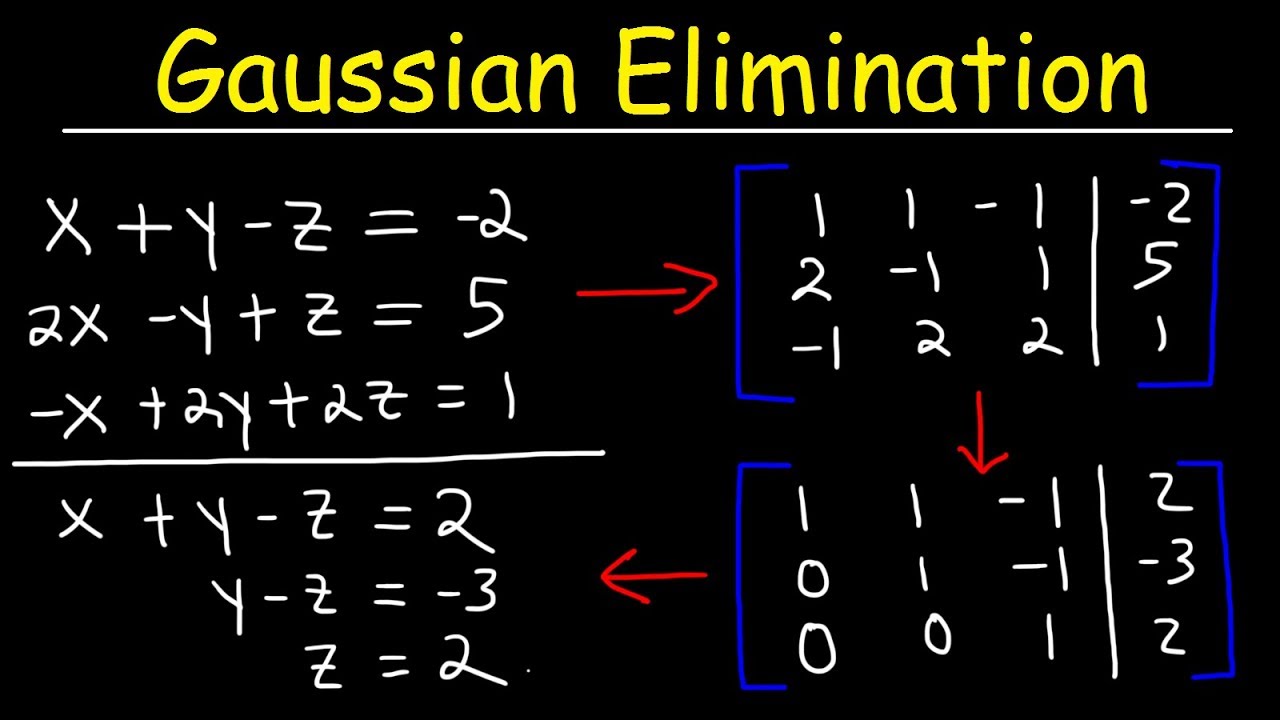
This precalculus video tutorial provides a basic introduction into the gaussian elimination - a process that involves elementary row operations with 3x3 matrices which allows you to solve a system of linear equations with 3 variables. You need to convert the system of equations into an augmented matrix and use matrix row operations to write it ...
watch this video
it explains everything
You would be able to solve these kinds of questions easily
sonic moss
wraith hinge
https://www.youtube.com/watch?v=eDb6iugi6Uk
thanks man!
wraith hinge
Good luck
trim joltBOT
@sonic moss Has your question been resolved?
trim joltBOT
@sonic moss Has your question been resolved?
trim joltBOT
Channel closed
Closed due to timeout
Use .reopen if this was a mistake.
Available help channel!
Send your question here to claim the channel.
Remember:
• Ask your math question in a clear, concise manner.
• Show your work, and if possible, explain where you are stuck.
• After 15 minutes, feel free to ping <@&286206848099549185>.
• Type the command .close to free the channel when you're done.
• Be polite and have a nice day!
Read #❓how-to-get-help for further information on how to ask a good question, and about conduct in the question channels.
 sullen swift
Could someone explain what Im missing here? Im trying to understand the area of a circle formulas, but some things are weird
like, why does the circumference times the radius = twice the area? shouldnt it just = area? how do you get area(2) from that?
like, im getting a mental image of (radius)(circumference) just being the the radius taking a revolution around the center of the circle, giving you the area. if anything, id assume the diameter times the circumference would be area(2)
trim joltBOT
sullen swift
Could someone explain what Im missing here? Im trying to understand the area of ...
 lime magnet
Think of the area of the circle as made up of concentric circles
sullen swift
okay, i can do that, yeah
lime magnet
Notice how the concentric circles slowly decrease in radius
sullen swift
okay
lime magnet
So consider each concentric circle as a strip of very small width h
What will be the area of that strip?
sullen swift
itd be the very small width times the length of the strip, right
sullen swift
its a circle so pi r 2, right
shrewd ridge
 lime magnet
sullen swift
its a circle so pi r 2, right
lime magnet
sullen swift
its a circle so pi r 2, right
Not quite
It will depend on which concentric circle we are taking area of
The concentric circle closer to the centre will have the length equal to a smaller circle's circumference
 slender shard
sullen swift
Could someone explain what Im missing here? Im trying to understand the area of ...
slender shard
sullen swift
Could someone explain what Im missing here? Im trying to understand the area of ...
If I'm reading this correctly, that only applies to a unit circle.
lime magnet
slender shard
If I'm reading this correctly, that only applies to a unit circle.
No? It applies to all circles.
sullen swift
lime magnet
The concentric circle closer to the centre will have the length equal to a small...
yeah, because circumference is just perimeter of a circle
slender shard
"why does the circumference times the radius = twice the area?"
lime magnet
sullen swift
yeah, because circumference is just perimeter of a circle
Right, so when we are making up the area, we are adding up smaller and smaller strips yes?
slender shard
There is a difference in how the two things are measured. One is a unit of length, R^1, while the latter is a unit of area, R^2.
sullen swift
yes, thats true
lime magnet
2pi r * (small width) + 2pi (r - small width) * (small width) and so on till 0
lime magnet
slender shard
There is a difference in how the two things are measured. One is a unit of leng...
No? We are multiplying two length measures to get the area measure
slender shard
"why does the circumference times the radius = twice the area?"
Read what OP asked.
lime magnet
lime magnet
2pi r * (small width) + 2pi (r - small width) * (small width) and so on till 0
So if we sum over all of them, what can we take as common factor?
lime magnet
slender shard
"why does the circumference times the radius = twice the area?"
Read what OP a...
That statement is true for all circles
sullen swift
lime magnet
So if we sum over all of them, what can we take as common factor?
2 pi?
lime magnet
sullen swift
2 pi?
And also the small width
So what do we have as a sum?
r + r-small width +.. so on till 0
slender shard
2pi r * r = 2 pi r^2. Ok, now I'm on the same page.
sullen swift
i mean, its got to sum to the area, right
lime magnet
Since we are summing smaller and smaller radii
Going from r to 0
The avg is gonna be r/2
sullen swift
yeah, thats true
lime magnet

What might it feel like to invent calculus?
Help fund future projects: https://www.patreon.com/3blue1brown
An equally valuable form of support is to share the videos.
Special thanks to these supporters: http://3b1b.co/lessons/essence-of-calculus#thanks
In this first video of the series, we see how unraveling the nuances of a simple geometry que...
Watch this video
He starts by explaining exactly ur problem
In the first half
And in the second half he introducea basics of calculus
So u get two birds in one stone
 flint sluice
love 3b1b!
sullen swift
okay
i think im starting to kind of see where youre leading although im still a little lost, ill watch this right now, yeah
thanks for the help both of you
trim joltBOT
@sullen swift Has your question been resolved?
sullen swift
wait a second, i think i get something
like, i havent finished the video (showering to help me think) but i think i understand like, why radius * circumference is 2x area
if you took the circumference of a circle and then laid it out as a flat length, you could multiply it by the radius to get an area, yes
but youd end up with more area than expected, because a circle has less area than a square of the same height and width
a circle is made of cuts of triangles compared to a square which is cuts of squares, and since the area of a triangle is half of the area a square in the same dimentsions would have, the area youd get from radius * circumference is twice as much as is accurate
so the area of a circle would be the radius * circumference divided by 2
at least thats what im currently thinking, ill continue the video yeah
trim joltBOT
Channel closed
Closed due to timeout
Use .reopen if this was a mistake.
trim joltBOT
Available help channel!
Send your question here to claim the channel.
Remember:
• Ask your math question in a clear, concise manner.
• Show your work, and if possible, explain where you are stuck.
• After 15 minutes, feel free to ping <@&286206848099549185>.
• Type the command .close to free the channel when you're done.
• Be polite and have a nice day!
Read #❓how-to-get-help for further information on how to ask a good question, and about conduct in the question channels.
 real herald
instead of doing a case 3, can i just write WLOG on case 2?

 marble wharf
yes
trim joltBOT
Channel closed
Closed by @real herald
Use .reopen if this was a mistake.
trim joltBOT
Available help channel!
Send your question here to claim the channel.
Remember:
• Ask your math question in a clear, concise manner.
• Show your work, and if possible, explain where you are stuck.
• After 15 minutes, feel free to ping <@&286206848099549185>.
• Type the command .close to free the channel when you're done.
• Be polite and have a nice day!
Read #❓how-to-get-help for further information on how to ask a good question, and about conduct in the question channels.
 low cloud
 low cloud
I think that this is where i need to use l'hospital's but im also not sure
low cloud
sick then lets try algebra first
limpid dawn
just factor 2^n
low cloud
6^n?
limpid dawn
how
low cloud
i was thinking 2*3=6
solid kilnBOT
 limpid dawn
factored 2^n
low cloud
ohh okay
limpid dawn
we can rewrite it a bit better taking 4^n
solid kilnBOT
 red mountain
u-sub 
limpid dawn
at first glance it might look like inf/inf the left
making u think lhopital
but with one trick you can tell what it really results to
low cloud
limpid dawn
but with one trick you can tell what it really results to
how do i know this trick?
low cloud
1^n/2^n => 1/2^n?
limpid dawn
yes
solid kilnBOT
 limpid dawn
any idea now what it could be
low cloud
is it 0?
limpid dawn
can you justify why
low cloud
limpid dawn
can you justify why
im pretty sure its because 1/2^n is a number getting really large quickly that is dividing 1 which is basically approaching 0 and then you have the same case in the numerator of 0/15
limpid dawn
the right goes to 3/15 but yea
it's basically 0 times a constant which is 0
2^n becomes very large quickly making 1/2^n become very small quickly
low cloud
limpid dawn
2^n becomes very large quickly making 1/2^n become very small quickly
ya this is what i was trying to say but mine explanation was just super confusing
low cloud
limpid dawn
2^n becomes very large quickly making 1/2^n become very small quickly
i dont know why all of these questions are so hard for me to understand when they also seem like simple concepts, like doing this question was so simple and im like ya i can totally do this now but then i look at the next problem and i have no idea what to do again! its so frustrating
limpid dawn
i guess that's life
low cloud
so philosophical
limpid dawn
only way is to try and fail and try again
if you wanna learn
i just guided you maybe that's why it felt kind of easy
low cloud
ya maybe
okay but for this one isnt it always going between 1 and -1 so wouldnt it be divergent?

but it said that was wrong
limpid dawn
hmm okay isee your thinking
it oscillates that's what you are saying
but what happens with sin(14/n)
like yea it goes back and forth
but?
low cloud
limpid dawn
but what happens with sin(14/n)
isnt sine bounded by -1 and 1 so it also doesnt approach anything
low cloud
it approaches 0
limpid dawn
yes
it becomes infact smaller and smaller
which means for sine
what does sine become for small values near 0
low cloud
sine of 0 is 0
limpid dawn
yes
sine becomes therefore also really small near 0 as n grows large
so yess it keep going back and forth
but the oscillation becomes smaller
it's like dancing around the x-axis
low cloud
damn ya i see what you mean
limpid dawn
 low cloud
the spinning cat is so random it makes me laugh every time
i can never tell what its supposed to mean
im dean rn
limpid dawn
my trade mark
low cloud
limpid dawn
my trade mark
okay last math problem for today this one i also think that i need to do l'hospital's
 limpid dawn
just observe what's happening inside the ln
for large n
actually l'hopital is not quiet applicable
low cloud
in my head all i see is inf/inf
low cloud
like this?

 clear cloud
Better thing to do before
low cloud
limpid dawn
can you now tell what happens inside
the 7/n and 4/n go to 0
wraith hinge
correct
limpid dawn
yes
wraith hinge
therefore..?
low cloud
well then i have 3n/6n which is basically what i had before
limpid dawn
n cancels
wraith hinge
u already factored it why not cancel it lol
low cloud
limpid dawn
n cancels
ohh oops okay then its just ln(1/2)
wraith hinge
yes
limpid dawn
if you even just need to tell the limit of some rational function then you can do it instantly with this trick

the 3rd applies to you since both numerator and denominator are linear
so you instantly can tell 3/6
nice to know
trim joltBOT
Channel closed
Closed by @low cloud
Use .reopen if this was a mistake.
Available help channel!
Send your question here to claim the channel.
Remember:
• Ask your math question in a clear, concise manner.
• Show your work, and if possible, explain where you are stuck.
• After 15 minutes, feel free to ping <@&286206848099549185>.
• Type the command .close to free the channel when you're done.
• Be polite and have a nice day!
Read #❓how-to-get-help for further information on how to ask a good question, and about conduct in the question channels.
 cyan furnace
Problem is to find the particular solution to the following differential equation using the inverse differential operator and noting the following.
 trim joltBOT
cyan furnace
Problem is to find the particular solution to the following differential equatio...
cyan furnace
trim joltBOT
cyan furnace
Problem is to find the particular solution to the following differential equatio...
cyan furnace


I understand that i need to rewrite the particular solution in terms of this operator and the right hand side. y_p= L^{-1}(D)[tcost] then go from there but i dont really understand how im supposed to get some quadratic in terms of differntial operators out of this.
the bottom equation is when you have some L(D) =a_0+a_1D+a_2D^2
currently i have the following

Like i have a similar example from my prof but like it has a crazy jump that i don't really get and would like help with.

Like i know the next step is to do L(D+-i) = D(+-i)^2 +4 but i would like to understand why this works.
Never mind i got it just have an issue with the notation
.close
trim joltBOT
Channel closed
Closed by @cyan furnace
Use .reopen if this was a mistake.
trim joltBOT
Available help channel!
Send your question here to claim the channel.
Remember:
• Ask your math question in a clear, concise manner.
• Show your work, and if possible, explain where you are stuck.
• After 15 minutes, feel free to ping <@&286206848099549185>.
• Type the command .close to free the channel when you're done.
• Be polite and have a nice day!
Read #❓how-to-get-help for further information on how to ask a good question, and about conduct in the question channels.
 meager hornet
Hello can someone help with regression analysis
 empty orchid
!da2a
trim joltBOT
No need to ask “Can I ask…?” or “Does anyone know about…?”—it’s faster for everyone if you just ask your question! See https://dontasktoask.com/
meager hornet
Time series regression analysis
trim joltBOT
@meager hornet Has your question been resolved?
quick tusk
"Don’t ask permission to ask a question, or ask if anyone knows how to solve a type of problem. Just ask your question."
trim joltBOT
@meager hornet Has your question been resolved?
zinc ginkgo
.close
trim joltBOT
Channel closed
Closed by @zinc ginkgo
Use .reopen if this was a mistake.
Available help channel!
Send your question here to claim the channel.
Remember:
• Ask your math question in a clear, concise manner.
• Show your work, and if possible, explain where you are stuck.
• After 15 minutes, feel free to ping <@&286206848099549185>.
• Type the command .close to free the channel when you're done.
• Be polite and have a nice day!
Read #❓how-to-get-help for further information on how to ask a good question, and about conduct in the question channels.
 lost urchin
how do i evaluate this
 trim joltBOT
lost urchin
how do i evaluate this
trim joltBOT
lost urchin
how do i evaluate this
 cunning cliff
use series for cos
trim joltBOT
@lost urchin Has your question been resolved?
 left oriole
could also try multiplying and dividing by 1+cos(4x)
trim joltBOT
Channel closed
Closed due to timeout
Use .reopen if this was a mistake.
Available help channel!
Send your question here to claim the channel.
Remember:
• Ask your math question in a clear, concise manner.
• Show your work, and if possible, explain where you are stuck.
• After 15 minutes, feel free to ping <@&286206848099549185>.
• Type the command .close to free the channel when you're done.
• Be polite and have a nice day!
Read #❓how-to-get-help for further information on how to ask a good question, and about conduct in the question channels.
 high raptor
Hello, can someone use rk4 to approximate y(0.2) , i just want to check my work im getting couple different answers
 trim joltBOT
high raptor
Hello, can someone use rk4 to approximate y(0.2) , i just want to check my work ...
trim joltBOT
high raptor
Hello, can someone use rk4 to approximate y(0.2) , i just want to check my work ...
@high raptor Has your question been resolved?
trim joltBOT
@high raptor Has your question been resolved?
 simple haven
@high raptor using an online calculator I arrived at about 1.24
trim joltBOT
@high raptor Has your question been resolved?
simple haven
(note this agrees well with the actual value of the IVP, 4/(exp(4/5)+1))
trim joltBOT
@high raptor Has your question been resolved?
trim joltBOT
Channel closed
Closed due to timeout
Use .reopen if this was a mistake.
Available help channel!
Send your question here to claim the channel.
Remember:
• Ask your math question in a clear, concise manner.
• Show your work, and if possible, explain where you are stuck.
• After 15 minutes, feel free to ping <@&286206848099549185>.
• Type the command .close to free the channel when you're done.
• Be polite and have a nice day!
Read #❓how-to-get-help for further information on how to ask a good question, and about conduct in the question channels.
 carmine skiff
Problem 4: A woodworking factory uses mahogany to produce 5 tables per day. The cost for each raw material shipment is 5,800 USD, and the storage cost for one unit of raw material is 10 USD per day. Each table requires one unit of raw material.
The factory must order raw materials in batches, and the goal is to determine the optimal order quantity that minimizes the average daily cost, which includes both ordering costs and storage costs.
Question: How many units of raw material should the factory order each time?
 trim joltBOT
carmine skiff
Problem 4: A woodworking factory uses mahogany to produce 5 tables per day. The ...
carmine skiff
trim joltBOT
carmine skiff
Problem 4: A woodworking factory uses mahogany to produce 5 tables per day. The ...
carmine skiff
5800/(5m) + 10m
m is supposed to be the amount of days in a cycle
m's value is 215,4
Therefore, raw materials's value is 215,4*5
Answer is 1077
Is there anything wrong with my solution
trim joltBOT
@carmine skiff Has your question been resolved?
Channel closed
Closed by @carmine skiff
Use .reopen if this was a mistake.
Available help channel!
Send your question here to claim the channel.
Remember:
• Ask your math question in a clear, concise manner.
• Show your work, and if possible, explain where you are stuck.
• After 15 minutes, feel free to ping <@&286206848099549185>.
• Type the command .close to free the channel when you're done.
• Be polite and have a nice day!
Read #❓how-to-get-help for further information on how to ask a good question, and about conduct in the question channels.
 tepid condor
Is the greedy choice property basically saying that there is only one local minima and that is therefore the global minima
trim joltBOT
tepid condor
Is the greedy choice property basically saying that there is only one local mini...
tepid condor
How do I relate this idea of there being just one minima
To something like Dijkstras
If someone knows please confirm this
trim joltBOT
@tepid condor Has your question been resolved?
trim joltBOT
@tepid condor Has your question been resolved?
trim joltBOT
Channel closed
Closed due to timeout
Use .reopen if this was a mistake.
trim joltBOT
Available help channel!
Send your question here to claim the channel.
Remember:
• Ask your math question in a clear, concise manner.
• Show your work, and if possible, explain where you are stuck.
• After 15 minutes, feel free to ping <@&286206848099549185>.
• Type the command .close to free the channel when you're done.
• Be polite and have a nice day!
Read #❓how-to-get-help for further information on how to ask a good question, and about conduct in the question channels.
 radiant portal
 trim joltBOT
radiant portal
radiant portal
trim joltBOT
radiant portal
radiant portal
I literally have no idea what this question is asking 💀
I understand everything before this part

This is the bit that I dont understand
Wtf is a
covert spindle
Sorry i see now too
radiant portal
And what line do they mean
radiant portal
1
trim lichen
radiant portal
And what line do they mean
the line passing thru the points at t=a and at t=pi-a
covert spindle
okay so use t=1 and t=pi-1
trim lichen
!noadvert
trim joltBOT
Please do not advertise your help channel or thread in other parts of the server. There are many people who need help, so advertising can quickly turn into spam.
radiant portal
covert spindle
Any idea what you have to do <@996564019672535040> ?
Not at all 😭
covert spindle
okay so P_a and P_pi-a are just two points on the curve
the subscript gives a certain time
so for example P_1 would mean the point (x,y) that comes from t=1
you got me so far?
radiant portal
Yes I think so, but im still not really sure what to do
This question seems really hard
radiant portal
covert spindle
well instead of t=1 now we have two t's
What do you mean instead of sry
They are still equal 1, no?
Oh wait nvm
I get you
radiant portal
I mean we can sub them in to x(t) and y(t) but im not sure how that would help us prove theyre in a vertical line
covert spindle
in math sometimes you just must try stuff
it sometimes makes sense if you are halfway through it
so i recommend doing exactly what u just said
and it will probably make sense when ur done
covert spindle
okay so P_a (cos(a)sin(2a),cos(a))
radiant portal
x(pi - a) = cos(pi - a)sin(2pi - 2a) = -cos(a)sin(-2a)
Is that correct? I tried to use identities
radiant portal
y(pi - a) = cos(pi - a) = -cos(a)
covert spindle
try again