#help-38
1 messages · Page 188 of 1
 sharp heart
That's the part where the circles intersect.
Now look at every part except that.
Then add them together.
 severe vigil
yes the complement would be {12, 15, 20}, so wouldn't solving for n be the total number of numbers within that set? making it 3? does the n mean to add them?
sharp heart
You didn't answer the first two questions with that reasoning.
You didn't say that the sets you wrote have 1 element and then answered 1.
severe vigil
no i know because the set has {3} which is 1 element. since 1 didnt work i put 3, the actual set number and it worked, so i did the same for b
when i answered 1 it was obviously wrong
sharp heart
Right. The numbers there are a cardinality of that subset.
So, the intersection of the circles has 3 elements in it. Its cardinality is 3.
severe vigil
this is why i did that
 sharp heart
If you look at A, one part of A has 12 elements in it. The other part has 3 elements.
So, in total, there are 15 elements in A.
severe vigil
wait you lost me there
sharp heart
The numbers on the diagram aren't set elements.
They're set cardinalities.
They tell you the number of elements in that part.
severe vigil
how do you distinguish that?
sharp heart
They're not written {3} and {12}.
severe vigil
interesting, the professor doesn't write the elements as {x} when writing them in the venn diagram
that's probably where im confused
sharp heart
Right, but here we have one number per part.
severe vigil
okay i think i understand, ill lyk in a couple mins if i get the other quesitons
sharp heart
What happens if you click the circle i next to the diagram?
severe vigil
 sharp heart
Ahh, OK.
severe vigil
adding the numbers i got from the sets worked out anyway to complete the questions, i appreciate you lol cause chatgpt was getting the same thing i was getting
sharp heart
Glad you got it 🙂
severe vigil
.close
 trim joltBOT
Channel closed
Closed by @severe vigil
Use .reopen if this was a mistake.
trim joltBOT
 Available help channel!
Send your question here to claim the channel.
Remember:
• Ask your math question in a clear, concise manner.
• Show your work, and if possible, explain where you are stuck.
• After 15 minutes, feel free to ping <@&286206848099549185>.
• Type the command .close to free the channel when you're done.
• Be polite and have a nice day!
Read #❓how-to-get-help for further information on how to ask a good question, and about conduct in the question channels.
 novel dagger
 trim joltBOT
novel dagger
novel dagger
trim joltBOT
novel dagger
novel dagger

Why do you take the averge value as opposed to just summing up all the probabilities for each value of theta?
 viscid flower
novel dagger
Why do you take the averge value as opposed to just summing up all the probabili...
viscid flower
novel dagger
Why do you take the averge value as opposed to just summing up all the probabili...
theyre being lazy
its just a way of describing
really theres a limit and an integral
viscid flower
novel dagger
Why do you take the averge value as opposed to just summing up all the probabili...
but this is what theyre actually doing
you could try it yourself, and build up to that, if you want
lemme scribble
viscid flower
divide by pi?
viscid flower
ah, well, its an average
novel dagger
1-theta/2 wrt theta
viscid flower
$\overline f = \frac{1}{b-a} \int _a ^b f (x) \dd x$
 solid kilnBOT
jan Niku
 viscid flower
so i think youre getting b=pi and a=0
novel dagger
yeah but like why are you taking the avg value in the first place
viscid flower
its just how it works out
i wanna scribble to show
but we can write out like
well i wanna scribble since creating an evenly spaced sum can be a pain in the ass and error prone
okay
 empty orchid
 ivory rapids
F(x)dx
ivory rapids
F(x)dx
Do you need help, or what?
viscid flower
theyre posting defn of something? idk
you know sage
i dont think deriving this is gonna be all that helpful
novel dagger
like what i dont get is conceptually why are we not just adding up all the probabilities for each value of theta (just integrating)
cuz wouldnt that just give up the total probability
viscid flower
well, i guess, what we want is total probability
as in law of total prob
im just trying to be sure 
novel dagger
I think where i might be going wrong is its conditional or smth
viscid flower
yea
i mean
you are doing a bunch of conditionals right
because its like
lets write something easy
novel dagger
like for each value of theta it should be pr(that value of theta occurs)*pr(3rd point lies wherever)
viscid flower
lets say g for "point good" make sense
novel dagger
then add that up for all thetas
viscid flower

so youre looking at something like this
A here is "the point is on the same semi circle"
and B_n is each possible configuration of the two other points
you can maybe see where P(B_n) comes in?
novel dagger
isnt b_n continuous in this case?
viscid flower
since the probability of the other two points is uniform, then $P(B_1) = \dots = P(B_n)$
solid kilnBOT
jan Niku
 viscid flower
novel dagger
isnt b_n continuous in this case?
viscid flower
novel dagger
isnt b_n continuous in this case?
yea, were abusing notation
were abusing the sum to mean integral, either
some kind of totalling operator
can you work out what $P(B_n)$ is?
solid kilnBOT
jan Niku
 viscid flower
lets say in the discrete case
lets say you only consider n=2
so, 3 points
r = 1/2, r = 3/4, and r=1
whats the probability of each configuration here
(we know that P is a probability, so $\sum _i P(B_i) = 1$ must be true)
solid kilnBOT
jan Niku
 viscid flower
funny typo lol
viscid flower
solid kiln
**jan Niku**
combine this
viscid flower
solid kiln
**jan Niku**
with this
@novel dagger
hopefully i havent totally lost you 
novel dagger
im lost tbh😅
viscid flower
okay lets start more easy
novel dagger
 viscid flower
you know what uniform means?
novel dagger
this is where i got up to
viscid flower
novel dagger
yea, actually, i did this too
i dont think its very helpful though, since you only get to P(A)
but, its alright
its just ... its not the most elucidating thing
I guess I'm only going to explain it in a discrete case
@novel dagger we know discrete probabilities over some interval
right
if theere are 5 points, and they all have the same chance
they are 1/5 each
novel dagger
yeah
viscid flower
viscid flower
that is P(B_n) here
P(B_n) in your case is the chance that some configuration of the first 2 points happen
each one is equally likely
so if there are n of them
novel dagger
yeah that makes sense
viscid flower
each one is 1/n
we can rewrite this
$P(A) = \sum _i P( A \mid B_i ) \frac 1n$
we are so much abusing notation.
solid kilnBOT
jan Niku
 viscid flower
this makes it more clear
n is just a number, yea? not an index
n is how many points we are considering, in this discrete example
it can come out
$P(A) = \frac 1 n \sum _i P(A \mid B_i)$
solid kilnBOT
jan Niku
 viscid flower
this looks a lot like an average
and it is. It's the exact average theyre talking about in the problem
make sense?
novel dagger
yeah
viscid flower
okay
so now
you either believe the transition to average in integral form lol
or, you work out P(A | B_i) and do the limit
im not sure
but im tired
viscid flower
$P(A) = \lim _{n \to \infty} \frac 1 n \sum _{i=0}^n P(A \mid B_i)$
solid kilnBOT
jan Niku
 novel dagger
ohhh right
viscid flower
this is just an integral
nothing fancy
except the function is a probability and its conditional
viscid flower

novel dagger
.close
trim joltBOT
Channel closed
Closed by @novel dagger
Use .reopen if this was a mistake.
trim joltBOT
Available help channel!
Send your question here to claim the channel.
Remember:
• Ask your math question in a clear, concise manner.
• Show your work, and if possible, explain where you are stuck.
• After 15 minutes, feel free to ping <@&286206848099549185>.
• Type the command .close to free the channel when you're done.
• Be polite and have a nice day!
Read #❓how-to-get-help for further information on how to ask a good question, and about conduct in the question channels.
 umbral river
I am stuck on b) for this Differential Equations problem. I can't figure out how to show that y2 is asymptotically stable. I tried plugging it back into the dy/dt equation, but I (of course) just get 0, as that's where it came from. I don't know how to prove it for a non-trivial number such as y2.
 trim joltBOT
umbral river
I am stuck on b) for this Differential Equations problem. I can't figure out how...
trim joltBOT
umbral river
I am stuck on b) for this Differential Equations problem. I can't figure out how...
 edgy willow
umbral river
I am stuck on b) for this Differential Equations problem. I can't figure out how...
edgy willow
umbral river
I am stuck on b) for this Differential Equations problem. I can't figure out how...
stability has to do with the 2nd derivative
so you want to plug into the derivative of r(1-y/K)y-Ey and see if it's negative or positive
trim joltBOT
@umbral river Has your question been resolved?
umbral river
edgy willow
so you want to plug into the derivative of r(1-y/K)y-Ey and see if it's negative...
I thought stability was if the rate of change is toward or away from it?
SO the 1st derivativer
edgy willow
that's true too, you can check points a little above and below y2 and see if it's towards y2
but the 2nd derivative is the formal way to show it, otherwise you'd need a graph or something
umbral river
.close
trim joltBOT
Channel closed
Closed by @umbral river
Use .reopen if this was a mistake.
trim joltBOT
Available help channel!
Send your question here to claim the channel.
Remember:
• Ask your math question in a clear, concise manner.
• Show your work, and if possible, explain where you are stuck.
• After 15 minutes, feel free to ping <@&286206848099549185>.
• Type the command .close to free the channel when you're done.
• Be polite and have a nice day!
Read #❓how-to-get-help for further information on how to ask a good question, and about conduct in the question channels.
 leaden falcon
Hello my doctor says at x=2 it’s differentiable but it’s not continuous
trim joltBOT
leaden falcon
Hello my doctor says at x=2 it’s differentiable but it’s not continuous

 fair beacon
it's not differentiable at x = 2 (for the reason you stated)
 limpid dawn
A differentiable function implies it's continuous
leaden falcon
Yes exactly
I’m in class en
Rn*
I’m talking to him
And he’s telling me it’s differentiable
I keep on explaining it to him and he’s not giving me a reason
He tells me
Since the function from the left and right are the same so it’s differentiable
Doesn’t matter what f(2) equals
limpid dawn
But it's not continuous just because left and right
leaden falcon
Exactly
I hate this doctor
He’s under qualified and we are all complaining
He just “understood” my point
limpid dawn
Ask him to prove it then
leaden falcon
And corrected his mistake
I did and he realized he’s wrong
I’ve been trying to convince him for 30 minutes
limpid dawn
Good job Bobo
trim joltBOT
Channel closed
Closed by @leaden falcon
Use .reopen if this was a mistake.
trim joltBOT
Available help channel!
Send your question here to claim the channel.
Remember:
• Ask your math question in a clear, concise manner.
• Show your work, and if possible, explain where you are stuck.
• After 15 minutes, feel free to ping <@&286206848099549185>.
• Type the command .close to free the channel when you're done.
• Be polite and have a nice day!
Read #❓how-to-get-help for further information on how to ask a good question, and about conduct in the question channels.
 midnight vessel
$\int{\frac{\sec^2(x)}{(\sec(x)+\tan(x))^{\frac92}}~\mathrm{d}x}\\$
I tried substituting $u=\tan(x)$ but that didn't work out. I tried to get the numerator in the form of the derivative of the denominator but that required a different substitution of $\sec(x)$ later. After substitutions, the integrals looked even uglier and more difficult.
trim joltBOT
midnight vessel
$\int{\frac{\sec^2(x)}{(\sec(x)+\tan(x))^{\frac92}}~\mathrm{d}x}\\\\$
I tried s...
solid kilnBOT
GoldBarley

 past widget
midnight vessel
$\int{\frac{\sec^2(x)}{(\sec(x)+\tan(x))^{\frac92}}~\mathrm{d}x}\\\\$
I tried s...
past widget
midnight vessel
$\int{\frac{\sec^2(x)}{(\sec(x)+\tan(x))^{\frac92}}~\mathrm{d}x}\\\\$
I tried s...
Time for me to payback 
1 + sin x = (sin x/2 + cos x/2)²
Send (cos x)^{9/2} above, times (sec x)² gives (cos x/2 - sin x/2)^{5/2} (cos x/2 + sin x/2)^{5/2}
Cancel terms from denom and you have
(cos x/2 - sin x/2)^{5/2} / (sin x/2 + cos x/2)^{13/2}
Correct me if there's some mistake but it's a dv/v type if you know what I mean
midnight vessel
I got here.
 past widget
cos x = (cos x/2 - sin x/2) (cos x/2 + sin x/2)
midnight vessel
past widget
cos x = (cos x/2 - sin x/2) (cos x/2 + sin x/2)
Ah, got it, that part confused me a bit.
Ok got it, thanks for the help. It's easy after that.(I realised it's not that easy 😭 )
.close
trim joltBOT
Channel closed
Closed by @midnight vessel
Use .reopen if this was a mistake.
Available help channel!
Send your question here to claim the channel.
Remember:
• Ask your math question in a clear, concise manner.
• Show your work, and if possible, explain where you are stuck.
• After 15 minutes, feel free to ping <@&286206848099549185>.
• Type the command .close to free the channel when you're done.
• Be polite and have a nice day!
Read #❓how-to-get-help for further information on how to ask a good question, and about conduct in the question channels.
 ember ivy

 wanton rune
let u=x+3
 orchid wagon
ok this is simpler
ember ivy
make (x+3)^-2 ????
wanton rune
sure, you can use whatever variable you want
 lilac flame
wanton rune
lilac flame
wanton rune
u and v are placeholders
like, you could replace u and v with f and g in the intergration by parts formula and it would still be fine

 ember ivy
I know the sum difference 100% but that's not what I have here
wanton rune

 wanton rune
no...
ember ivy
Why not
wanton rune
why would you switch the exponent
wanton rune
write down what you mean
ember ivy
 wanton rune
yes, you forgot an extra integral sign but yes
 trim joltBOT
@ember ivy Has your question been resolved?
Channel closed
Closed by @ember ivy
Use .reopen if this was a mistake.
Available help channel!
Send your question here to claim the channel.
Remember:
• Ask your math question in a clear, concise manner.
• Show your work, and if possible, explain where you are stuck.
• After 15 minutes, feel free to ping <@&286206848099549185>.
• Type the command .close to free the channel when you're done.
• Be polite and have a nice day!
Read #❓how-to-get-help for further information on how to ask a good question, and about conduct in the question channels.
 frosty hinge
How do it reach to this answer?
(note: can't use partial fractions, cause that wasn't taught yet. So we use transforming the integrand methods such as adding zero, changing radical to power, perform indicated operation, add zero, use of equivalent forms, etc)
 trim joltBOT
frosty hinge
How do it reach to this answer?
(note: can't use partial fractions, cause that w...
trim joltBOT
frosty hinge
How do it reach to this answer?
(note: can't use partial fractions, cause that w...
 tulip perch
frosty hinge
How do it reach to this answer?
(note: can't use partial fractions, cause that w...
tulip perch
frosty hinge
How do it reach to this answer?
(note: can't use partial fractions, cause that w...
think about this:

last term, u can sub u = x^3+1 to solve the integral
 trim joltBOT
Channel closed
Closed by @frosty hinge
Use .reopen if this was a mistake.
 dull temple
(this is partial fractions lol)
frosty hinge
(really??)
trim joltBOT
Available help channel!
Send your question here to claim the channel.
Remember:
• Ask your math question in a clear, concise manner.
• Show your work, and if possible, explain where you are stuck.
• After 15 minutes, feel free to ping <@&286206848099549185>.
• Type the command .close to free the channel when you're done.
• Be polite and have a nice day!
Read #❓how-to-get-help for further information on how to ask a good question, and about conduct in the question channels.
 subtle canopy
guys i wanna just make sure that my approach is correct now i am thinking to prove that e´->n can be reprsented by e´=>k n where =>k is number of transition steps and analoguly do the same for e->n and finally by transitivity prove the sentnce
 trim joltBOT
subtle canopy
guys i wanna just make sure that my approach is correct now i am thinking to pro...
trim joltBOT
subtle canopy
guys i wanna just make sure that my approach is correct now i am thinking to pro...
Please don't occupy multiple help channels.
@subtle canopy Has your question been resolved?
trim joltBOT
Channel closed
Closed due to timeout
Use .reopen if this was a mistake.
trim joltBOT
Available help channel!
Send your question here to claim the channel.
Remember:
• Ask your math question in a clear, concise manner.
• Show your work, and if possible, explain where you are stuck.
• After 15 minutes, feel free to ping <@&286206848099549185>.
• Type the command .close to free the channel when you're done.
• Be polite and have a nice day!
Read #❓how-to-get-help for further information on how to ask a good question, and about conduct in the question channels.
 hidden dew
<@&268886789983436800>
 vagrant marsh
oh my god
trim joltBOT
Channel closed
Channel closed due to the original message being deleted.
If you did not intend to do this, please open a new help channel,
as this action is irreversible, and this channel may abruptly lock.
Available help channel!
Send your question here to claim the channel.
Remember:
• Ask your math question in a clear, concise manner.
• Show your work, and if possible, explain where you are stuck.
• After 15 minutes, feel free to ping <@&286206848099549185>.
• Type the command .close to free the channel when you're done.
• Be polite and have a nice day!
Read #❓how-to-get-help for further information on how to ask a good question, and about conduct in the question channels.
 glossy steppe
Having trouble isolating y
 trim joltBOT
glossy steppe
Having trouble isolating y
trim joltBOT
glossy steppe
Having trouble isolating y
 robust wigeon
There's no non annoying way to do it, you gotta multiply by y+1 on both sides, and then distribute out and collect every y term
robust wigeon
At least to my knowledge*
glossy steppe
.close
trim joltBOT
Channel closed
Closed by @glossy steppe
Use .reopen if this was a mistake.
trim joltBOT
Available help channel!
Send your question here to claim the channel.
Remember:
• Ask your math question in a clear, concise manner.
• Show your work, and if possible, explain where you are stuck.
• After 15 minutes, feel free to ping <@&286206848099549185>.
• Type the command .close to free the channel when you're done.
• Be polite and have a nice day!
Read #❓how-to-get-help for further information on how to ask a good question, and about conduct in the question channels.
 urban copper
 trim joltBOT
urban copper
trim joltBOT
urban copper
 willow mortar
Que significa conjunto ?
solid kilnBOT
938c2cc0dcc05f2b68c4287040cfcf71
 urban copper
willow mortar
Que significa conjunto ?
urban copper
willow mortar
Que significa conjunto ?
notice A + B = C implies A ⊂ C and B ⊂ C
solid kilnBOT
938c2cc0dcc05f2b68c4287040cfcf71
 willow mortar
That’s the first thing I’d check
urban copper
willow mortar
That’s the first thing I’d check
I don't even know how to prove that statement, but I have struggled with a lot of exercises and sometimes u need to know this tricks
the "A + B = C implies A ⊂ C and B ⊂ C"
willow mortar
Check for what value of a T is included in H
willow mortar
Yup
willow mortar
Good
urban copper
answer is d)
willow mortar
So now you need to make sure that S and T don’t intersect
urban copper
oh, right
urban copper
willow mortar
So now you need to make sure that S and T don’t intersect
yeah sorry
I was rushing ahead of myself
urban copper
when a = 2
S = <(4,2,4,4)>
T = <(4,2,4,4),(1,0,0,-1)>
so a = 2 is not valid
when a = -2
willow mortar
Yup
urban copper
urban copper
answer is d)
so answer is not d) is a)
willow mortar
You made sure S vector is not a linear combination of T vectors ?
Nevermind, the solution is not null so it has to be a
urban copper
,w rank {{4,-2,4,4},{4,2,4,4},{1,0,0,-1}}
solid kilnBOT


 Requested by 938c2cc0dcc05f2b68c4287040cfcf71
trim joltBOT
Requested by 938c2cc0dcc05f2b68c4287040cfcf71
trim joltBOT
Channel closed
Closed by @urban copper
Use .reopen if this was a mistake.
trim joltBOT
Available help channel!
Send your question here to claim the channel.
Remember:
• Ask your math question in a clear, concise manner.
• Show your work, and if possible, explain where you are stuck.
• After 15 minutes, feel free to ping <@&286206848099549185>.
• Type the command .close to free the channel when you're done.
• Be polite and have a nice day!
Read #❓how-to-get-help for further information on how to ask a good question, and about conduct in the question channels.
 surreal temple
what can i do when i need to find the diagonal of a quadrilateral but the diagonal is split into two isosceles
trim joltBOT
surreal temple
what can i do when i need to find the diagonal of a quadrilateral but the diagon...
 pure fiber
what data do you have?
 lone basin
surreal temple
what can i do when i need to find the diagonal of a quadrilateral but the diagon...
lone basin
surreal temple
what can i do when i need to find the diagonal of a quadrilateral but the diagon...
The diagonal is split into two isosceles?
pure fiber
lone basin
The diagonal is split into two isosceles?
I guess the diagonal splits the quadrilateral into two isosceles
surreal temple
pure fiber
I guess the diagonal splits the quadrilateral into two isosceles
yes
pure fiber
pure fiber
what data do you have?
?
 sturdy haven
it honestly depends on the info that you have
surreal temple
can we work with this
 empty orchid
surreal temple
can we work with this
empty orchid
surreal temple
can we work with this
Is that isoceles?
surreal temple
yeah
empty orchid
In what manner?
trim joltBOT
@surreal temple Has your question been resolved?
trim joltBOT
Channel closed
Closed due to timeout
Use .reopen if this was a mistake.
trim joltBOT
Available help channel!
Send your question here to claim the channel.
Remember:
• Ask your math question in a clear, concise manner.
• Show your work, and if possible, explain where you are stuck.
• After 15 minutes, feel free to ping <@&286206848099549185>.
• Type the command .close to free the channel when you're done.
• Be polite and have a nice day!
Read #❓how-to-get-help for further information on how to ask a good question, and about conduct in the question channels.
 proven jewel
 trim joltBOT
proven jewel
proven jewel
trim joltBOT
proven jewel
proven jewel
is my numbr 1 correct
proven jewel


 vague walrus
oh not sure about the epsilon delta definition
trim joltBOT
Channel closed
Closed by @proven jewel
Use .reopen if this was a mistake.
Available help channel!
Send your question here to claim the channel.
Remember:
• Ask your math question in a clear, concise manner.
• Show your work, and if possible, explain where you are stuck.
• After 15 minutes, feel free to ping <@&286206848099549185>.
• Type the command .close to free the channel when you're done.
• Be polite and have a nice day!
Read #❓how-to-get-help for further information on how to ask a good question, and about conduct in the question channels.
 stable wharf
wrong channel last time but i’m missing one step cause i keep getting -sinx no matter what, can someone help with it
 trim joltBOT
stable wharf
wrong channel last time but i’m missing one step cause i keep getting -sinx no m...
trim joltBOT
stable wharf
wrong channel last time but i’m missing one step cause i keep getting -sinx no m...
 safe loom
1 - cos(2x) = 1 - [1 - 2sin^2(x)] = 2sin^2(x)
stable wharf
safe loom
1 - cos(2x) = 1 - [1 - 2sin^2(x)] = 2sin^2(x)
doesn’t the 1 not subtract the 1 inside
safe loom
1 - 1 + 2sin^2(x)
trim joltBOT
@stable wharf Has your question been resolved?
Channel closed
Closed by @stable wharf
Use .reopen if this was a mistake.
Available help channel!
Send your question here to claim the channel.
Remember:
• Ask your math question in a clear, concise manner.
• Show your work, and if possible, explain where you are stuck.
• After 15 minutes, feel free to ping <@&286206848099549185>.
• Type the command .close to free the channel when you're done.
• Be polite and have a nice day!
Read #❓how-to-get-help for further information on how to ask a good question, and about conduct in the question channels.
 potent vault
 trim joltBOT
potent vault
potent vault
trim joltBOT
potent vault
potent vault
I have no clue how to do graphs literally my first skeychong question
lone basin
potent vault
Find the y-intercept, x = ...-asymptote
And make sure you know which direction the graph goes
$4 - x > 0$ must be satisfied
solid kilnBOT
King Leo
 trim joltBOT
@potent vault Has your question been resolved?
 wraith hinge
potent vault
No
wraith hinge
potent vault
No
Can you show the question again?
wraith hinge
solid kiln
**King Leo**
This thing is confusing
 wraith hinge
potent vault
wraith hinge
potent vault

This video explains how to "sketch" a logarithmic equation.*******************************************Math Tutorials on this channel are targeted at college-...
This can help...
potent vault
I'll watch it thx
solid kilnBOT
King Leo
 wraith hinge
lone basin
$$4 - x > 0$$
$$4 > x$$
wraith hinge
lone basin
$$4 - x > 0$$
$$4 > x$$
So...
x ≨ 4
x cannot be 4
@lone basin Just remember that x cannot be same either bigger than 4

 wraith hinge
potent vault
wraith hinge
potent vault
Seem maybe
But I didn't know this is right or not
<@&286206848099549185> Common who can help this guy
potent vault
wraith hinge
But I didn't know this is right or not
Alright
trim joltBOT
@potent vault Has your question been resolved?
Channel closed
Closed by @potent vault
Use .reopen if this was a mistake.
Available help channel!
Send your question here to claim the channel.
Remember:
• Ask your math question in a clear, concise manner.
• Show your work, and if possible, explain where you are stuck.
• After 15 minutes, feel free to ping <@&286206848099549185>.
• Type the command .close to free the channel when you're done.
• Be polite and have a nice day!
Read #❓how-to-get-help for further information on how to ask a good question, and about conduct in the question channels.
 gray swallow
In the quadrilateral ABCD AB 14 BC 48 CD 40 and AD 30 find the diagonal AC and the area of the quadrilateral if AC divides its area in the ratio 14:25
 trim joltBOT
gray swallow
In the quadrilateral ABCD AB 14 BC 48 CD 40 and AD 30 find the diagonal AC and t...
gray swallow
trim joltBOT
gray swallow
In the quadrilateral ABCD AB 14 BC 48 CD 40 and AD 30 find the diagonal AC and t...
gray swallow
any suggestions on how i can find the diagonal?
 zinc ginkgo
Is it a trapezoid?
gray swallow
zinc ginkgo
Is it a trapezoid?
quadrilateral
 frosty slate
quadrilateral but is it cyclic?
gray swallow
i dont think so
frosty slate
U need to check it then apply "bruh man gotta" formula
Its Brahmagupta's Formula
I cant remember the original name so I come up with a way to remember it by "bruh man gotta" then google for the original 😭
First find S = sum of all length / 2
past widget
You'll find that ABCD is cyclic
frosty slate
Then if (s - one side)*(s - other side) ... do for 4 sides, ...> 0, then its cyclic
A = sqrt((s−a)(s−b)(s−c)(s−d))
past widget
,texsp $\frac{14}{25} = \frac{[ABC]}{[ADC]} = \frac{14\cdot 48 \cdot \sin B}{30\cdot 40 \cdot \sin D} = \frac{14 \sin B}{25 \sin D}$
gray swallow
ill work on it
solid kilnBOT
 past widget
I think Blues' idea is more direct :o Use Heron's formula
,texsp $\sqrt{\frac{(14 + 48 + x)(x + 48 - 14)(x + 14 - 48)(14 + 48 - x)}{(x + 70)(x - 10)(x + 10)(70 - x)}} = \frac{14}{25}$
solid kilnBOT
 past widget
solid kiln
past widget
solid kiln
once you're done with this, you can apply cosine law on ADC and ABC to solve for cases B = D, and B + D = 180° and thus get AC
trim joltBOT
Channel closed
Closed by @gray swallow
Use .reopen if this was a mistake.
trim joltBOT
Available help channel!
Send your question here to claim the channel.
Remember:
• Ask your math question in a clear, concise manner.
• Show your work, and if possible, explain where you are stuck.
• After 15 minutes, feel free to ping <@&286206848099549185>.
• Type the command .close to free the channel when you're done.
• Be polite and have a nice day!
Read #❓how-to-get-help for further information on how to ask a good question, and about conduct in the question channels.
 void current
The widths (in meters) of a kidney-shaped swimming pool were measured at 6-meter intervals as indicated in the figure. Use the Midpoint Rule with n = 4 to estimate the area S of the pool if a1 = 18.6, a2 = 21.6, a3 = 20.4, a4 = 16.8, a5 = 15, a6 = 14.4, and a7 = 14.4.
 trim joltBOT
void current
The widths (in meters) of a kidney-shaped swimming pool were measured at 6-meter...
void current
trim joltBOT
void current
The widths (in meters) of a kidney-shaped swimming pool were measured at 6-meter...
void current
hey guys i dont rly kno how to do this problem, any formulas or tips ?
<@&286206848099549185>
<@&286206848099549185>
???
.CLOSE
.close
trim joltBOT
Channel closed
Closed by @void current
Use .reopen if this was a mistake.
Available help channel!
Send your question here to claim the channel.
Remember:
• Ask your math question in a clear, concise manner.
• Show your work, and if possible, explain where you are stuck.
• After 15 minutes, feel free to ping <@&286206848099549185>.
• Type the command .close to free the channel when you're done.
• Be polite and have a nice day!
Read #❓how-to-get-help for further information on how to ask a good question, and about conduct in the question channels.
 tiny horizon
How do we differentiate this?
 trim joltBOT
tiny horizon
How do we differentiate this?
tiny horizon
trim joltBOT
tiny horizon
How do we differentiate this?
tiny horizon
Im thinking product rule or chain rule but im not too sure
Im confused what to do with the x^2, do we still reduce the power by 1 when we turn it into cos?
 void berry
No you don't need to reduce it to one inside the cos just outside when you're doing the chain rule
tiny horizon
void berry
No you don't need to reduce it to one inside the cos just outside when you're do...
So it would be
Sinx^2 * 1 + x * cosx^2 * 2x?
so whenever there it is raised to a power it is separate to the sin or cos?
void berry
Yes I think that's correct
trim joltBOT
Channel closed
Closed by @tiny horizon
Use .reopen if this was a mistake.
vague walrus
tiny horizon
How do we differentiate this?
chain rule should work yeah
tiny horizon
vague walrus
chain rule should work yeah
Ye I figured it thanks
trim joltBOT
Available help channel!
Send your question here to claim the channel.
Remember:
• Ask your math question in a clear, concise manner.
• Show your work, and if possible, explain where you are stuck.
• After 15 minutes, feel free to ping <@&286206848099549185>.
• Type the command .close to free the channel when you're done.
• Be polite and have a nice day!
Read #❓how-to-get-help for further information on how to ask a good question, and about conduct in the question channels.
wraith hinge
hey
trim joltBOT
wraith hinge
hey

 sick zenith
yeah thats a misprint it should be x*y*x^-1
trim joltBOT
Channel closed
Closed by @vagrant meteor
Use .reopen if this was a mistake.
trim joltBOT
Available help channel!
Send your question here to claim the channel.
Remember:
• Ask your math question in a clear, concise manner.
• Show your work, and if possible, explain where you are stuck.
• After 15 minutes, feel free to ping <@&286206848099549185>.
• Type the command .close to free the channel when you're done.
• Be polite and have a nice day!
Read #❓how-to-get-help for further information on how to ask a good question, and about conduct in the question channels.
 lilac lynx

 trim joltBOT
lilac lynx
lilac lynx
trim joltBOT
lilac lynx
lilac lynx
can someone explain how after using Pk the equations becomes that
 meager tulip
its a simple substitution
u got this right?

so put the value of lhs in here

and u get
(k/2 +1) +1/(k + 1)
 lilac lynx
yeah but where is -(k+1)/2 from
trim joltBOT
@lilac lynx Has your question been resolved?
meager tulip
i think this is not complete
is there a definition of P
oh my bad its there in 1st pic
so to answer ur question i think they substracted -(K+1)/2 to generate the form at end (1-k)/2(k+1)
then we know for sure that the this

is <= 0
which implies

why (k+1)/2 u can ask?
why not something else?
thats because we need to prove that as rhs in the final eqn
i agree this one is a short but a lil complicated way of doing the proof
so if u want u can look some other proof on this
trim joltBOT
@lilac lynx Has your question been resolved?
empty orchid
lilac lynx
Oh no, the (using P_k) note is for the line adjacent to it. Not the line below it.
Weird part of the problem statement. I would have proved it like this:
Now $\sum_{i=1}^{k+1}\frac{1}{i}=\qty(\sum_{i=1}^k\frac{1}{i}) +\frac{1}{k+1}\le\frac{k}{2}+\frac{1}{k+1}+1\=\frac{k+2}{2}+\frac{1}{k+1}\ \ \cdots$
solid kilnBOT
;(
 lilac lynx
Ooo thanks i kinda see what i have to do
lilac lynx
meager tulip
so if u want u can look some other proof on this
Thanks ill try this aswell
.close
trim joltBOT
Channel closed
Closed by @lilac lynx
Use .reopen if this was a mistake.
Available help channel!
Send your question here to claim the channel.
Remember:
• Ask your math question in a clear, concise manner.
• Show your work, and if possible, explain where you are stuck.
• After 15 minutes, feel free to ping <@&286206848099549185>.
• Type the command .close to free the channel when you're done.
• Be polite and have a nice day!
Read #❓how-to-get-help for further information on how to ask a good question, and about conduct in the question channels.
empty orchid
How would you go about starting with $\sum_{n=1}^{\infty}\frac{1}{2^n\cdot n^2}$? I remember (or misremember) seeing this in a Micheal Penn video once, but I completely forgot how to solve it. Any hints?
trim joltBOT
empty orchid
How would you go about starting with $\sum_{n=1}^{\infty}\frac{1}{2^n\cdot n^2}$...
solid kilnBOT
;(
 midnight vessel
The terms get small very very fast.$\\$
$\frac12+\frac1{16}+\frac1{72}+\frac1{256}+\frac1{700}+\text{...}\\$
So I guess you could find the sum for the first 5-6 terms and then approximate it since the farther you go, the less difference it makes.
solid kilnBOT
GoldBarley
 midnight vessel
You can approximate it till 10 terms for a better accuracy I guess.
 vernal palm
0.58224052646501250590265632015968003287921568838685734695129391486614285424
that's wolfram alpha for the first 100
midnight vessel
So it converges to ≈0.6
vernal palm
 amber python
pi^2/12 - log(2)^2/2
amber python
pi^2/12 - log(2)^2/2
yes but why
midnight vessel
amber python
pi^2/12 - log(2)^2/2
So I guess it doesn't go past 0.58
vernal palm
it looks like the basel problem
amber python
it looks like it because it essentially is...
vernal palm
yes but it is also multiplied by 1/2^n for every term
trim joltBOT
@empty orchid Has your question been resolved?
past widget
empty orchid
How would you go about starting with $\sum_{n=1}^{\infty}\frac{1}{2^n\cdot n^2}$...
Consider: $$S(x) = \sum_{n = 1}^{\infty} \frac{x^n}{n^2}$$
solid kilnBOT
 trim joltBOT
Channel closed
Closed due to timeout
Use .reopen if this was a mistake.
Available help channel!
Send your question here to claim the channel.
Remember:
• Ask your math question in a clear, concise manner.
• Show your work, and if possible, explain where you are stuck.
• After 15 minutes, feel free to ping <@&286206848099549185>.
• Type the command .close to free the channel when you're done.
• Be polite and have a nice day!
Read #❓how-to-get-help for further information on how to ask a good question, and about conduct in the question channels.
empty orchid
past widget
Consider: $$S(x) = \sum_{n = 1}^{\infty} \frac{x^n}{n^2}$$
Is there a power series for this?
trim joltBOT
empty orchid
Is there a power series for this?
 marble wharf
are you asking whether there is a closed form for the power series?
something something differentiate twice should probably work
solid kilnBOT
;(
Compile Error! Click the  reaction for more information.
(You may edit your message to recompile.)
 empty orchid
$S’’(x)=\sum_{n=1}^{\infty}x^{n-2}-\sum_{n=1}^{\infty}\frac{x^{n-2}}{n}$
marble wharf
you have to be a bit careful where the sum starts
solid kilnBOT
;(
Compile Error! Click the reaction for more information.
(You may edit your message to recompile.)
 marble wharf
after you differentiated it once you can actually recognize the series
solid kilnBOT
;(
 amber python
empty orchid
amber python
empty orchid
Interesting.
limpid dawn
amber python
-
great point
empty orchid
So now we can do $-\int_0^{\frac12}\frac{\ln(1-x)}{x}dx$ and we are done.
amber python
empty orchid
Hm?
amber python
,w expand log(1 - x)/x at x=0


 empty orchid
Yeah, this is pretty easy to work with.
Power sum, Fubini’s Theorem.
$\int_0^{\frac12}\sum_{n=1}^{\infty}\frac{x^{n-1}}{n}dx$
solid kilnBOT
;(
 trim joltBOT
@empty orchid Has your question been resolved?
Channel closed
Closed by @empty orchid
Use .reopen if this was a mistake.
trim joltBOT
Available help channel!
Send your question here to claim the channel.
Remember:
• Ask your math question in a clear, concise manner.
• Show your work, and if possible, explain where you are stuck.
• After 15 minutes, feel free to ping <@&286206848099549185>.
• Type the command .close to free the channel when you're done.
• Be polite and have a nice day!
Read #❓how-to-get-help for further information on how to ask a good question, and about conduct in the question channels.
 plain storm
r(x)=(1/25) (-x+35)^(3)+5 = blue
f(x)=5 sin((nπ/40) x) = orange
intersect/ root = (40; 0)
what is n and how do i make it so its tangent to blue
 trim joltBOT
plain storm
r(x)=(1/25) (-x+35)^(3)+5 = blue
f(x)=5 sin((nπ/40) x) = orange
intersect/ root...
limpid dawn
plain storm
r(x)=(1/25) (-x+35)^(3)+5 = blue
f(x)=5 sin((nπ/40) x) = orange
intersect/ root...
trim joltBOT
plain storm
r(x)=(1/25) (-x+35)^(3)+5 = blue
f(x)=5 sin((nπ/40) x) = orange
intersect/ root...
limpid dawn
plain storm
r(x)=(1/25) (-x+35)^(3)+5 = blue
f(x)=5 sin((nπ/40) x) = orange
intersect/ root...
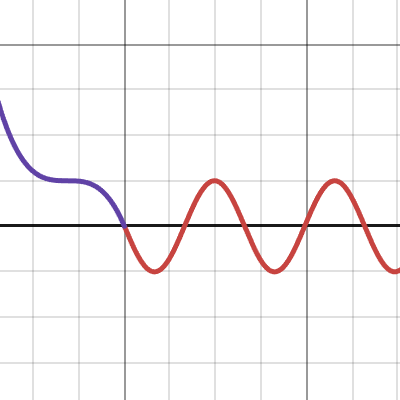
Desmos
If you work with cleaner numbers your computations are clearer
plain storm
limpid dawn
If you work with cleaner numbers your computations are clearer
yeah thats why i changed them
and reopened
limpid dawn
you can also set contraints where it should be defined
limpid dawn
it's a desmos link
limpid dawn
a is stretch factor
so i calculated the derivative of sine in terms of a and wanted to find such a so that the slopes are the same (aka they are tangent in (40,0))
the result was
a = -slope/5
plain storm
so you put the derivative of t(40) equal to the derivative of q(40)?
and solved in terms of a
limpid dawn
exactly
limpid dawn
wha
plain storm
what
limpid dawn
are u doing this by hand and you also flipped the functions
the slopes are not that clean
plain storm
wdym 😭
limpid dawn
q'(40) = -2.38 something
plain storm
i changed the numbers
limpid dawn
lisa you are dealing with cube roots and stupid trigonometric values use a calculator
plain storm
i am i am
plain storm
no i wanna see how you did it 😭
limpid dawn
t(x,a) and q(x)
t for trigonometric and q for qubic polynomial
you want them to be tangent at (40,0)
so
plain storm
oh
limpid dawn
t(40,a) = q(40) and t'(40,a) = q'(40)
plain storm
limpid dawn
t(40,a) = q(40) and t'(40,a) = q'(40)
what do i do now💀
 plain storm
why -40
limpid dawn
-5cos(a(x-40))
plain storm
ah ok
plain storm
what how
limpid dawn
cos(0) = 1
plain storm
ohh
 plain storm
so a is -3/5
plain storm
limpid dawn
are you still trying to build a roller coaster or are you doing calculus
rollercoaster
limpid dawn
yea should be
trim joltBOT
Channel closed
Closed by @plain storm
Use .reopen if this was a mistake.
trim joltBOT
Available help channel!
Send your question here to claim the channel.
Remember:
• Ask your math question in a clear, concise manner.
• Show your work, and if possible, explain where you are stuck.
• After 15 minutes, feel free to ping <@&286206848099549185>.
• Type the command .close to free the channel when you're done.
• Be polite and have a nice day!
Read #❓how-to-get-help for further information on how to ask a good question, and about conduct in the question channels.
 rancid salmon
Is this correct
 trim joltBOT
rancid salmon
Is this correct
trim joltBOT
rancid salmon
Is this correct
 neon dirge
rancid salmon
Is this correct
neon dirge
rancid salmon
Is this correct
 robust wigeon
!original
trim joltBOT
Please show the original problem, exactly as it was stated to you, with the entire original context. A picture or screenshot is best. If the original problem is not in English, then post it anyway! The additional context might still be helpful. Do your best to provide a translation.
neon dirge
-b²/a at the end
and what happened here

the c doesn't get distributed onto b²
and the b doesn't get distributed onto -b
when you bring them into the fractions
rancid salmon
Thanks for catching that i was in a hurry and made a mistake i was wondering why it was wrong
rancid salmon
robust wigeon
!original
How is it not orginal
neon dirge
rancid salmon
Thanks for catching that i was in a hurry and made a mistake i was wondering why...
np
rancid salmon
neon dirge
np
Btw for this problem
robust wigeon
rancid salmon
How is it not orginal
what. That's a command. Look at what the bot said
rancid salmon
robust wigeon
what. That's a command. Look at what the bot said
I know but why did u do jt
rancid salmon
rancid salmon
Btw for this problem
Nvm i figured it out
robust wigeon
Because we can help you much easier if you show the original problem so we can understand the context
rancid salmon
robust wigeon
Because we can help you much easier if you show the original problem so we can u...
That problem was wrighting it in terms of v
Not much else i coulda put
robust wigeon
Idk what "it" you're refering to so that for example
robust wigeon
lol
rancid salmon
Ig that makes sense
neon dirge
rancid salmon
Wrong react
impossible to retract :}
robust wigeon
It's fine tho looks like lunatic was able to help you regardless in this case
rancid salmon
For the problem v is volicty over time and h is height over time where x is time and the others are variables and I'm just trying to prove you can allways simplify down after substitution and cancel out the v and be left with just v^2 so you can allways inverse
trim joltBOT
@rancid salmon Has your question been resolved?
Channel closed
Closed by @rancid salmon
Use .reopen if this was a mistake.
Available help channel!
Send your question here to claim the channel.
Remember:
• Ask your math question in a clear, concise manner.
• Show your work, and if possible, explain where you are stuck.
• After 15 minutes, feel free to ping <@&286206848099549185>.
• Type the command .close to free the channel when you're done.
• Be polite and have a nice day!
Read #❓how-to-get-help for further information on how to ask a good question, and about conduct in the question channels.
 vapid idol
 trim joltBOT
vapid idol
trim joltBOT
vapid idol
 nova spire
vapid idol
nova spire
vapid idol
!status
trim joltBOT
vapid idol
What step are you on?
1. I don't know where to begin.
2. I have begun but got stuck midway.
3. I got an answer but I was told that it's wrong.
4. I got an answer and would like my work checked.
5. I have a question about someone else's work/solution.
6. I have completed the problem and don't need help anymore. Thank you.
7. None of the above
I dont know where to begin
nova spire
ok
so do you know that with uniform probability, the probability can be computed as:
(number of satisfying outcomes)/(total number of outcomes)
how many total outcomes are there?
meaning in how many ways can we choose three points on this grid?
vapid idol
9.8.7 = 504??
nova spire
here's the problem with what you wrote
I believe your intuition might be "we choose the first point, 9 choices, then we choose the second point, 8 choices, etc..."
vapid idol
yes
nova spire
however
how do we distinguish
"first point top left, second point top middle, third point top right"
from "first point top right, second point top middle, third point top left"?
vapid idol
I dont get it
nova spire
vapid idol
I dont get it
basically
nova spire
nova spire
"first point top left, second point top middle, third point top right"
those two
nova spire
nova spire
from "first point top right, second point top middle, third point top left"?
give you the same set of 3 points
vapid idol
yeah
nova spire
even though those are two DIFFERENT ways to count it
nova spire
Well
Just don't order the way you choose your points
And instead choose the three of them simultaneously
Isn't there a type of number
That tells you exactly how many ways to simultaneously choose k things
Among a total of n things?
vapid idol
like fraction or what do you mean
nova spire
it's a number
Here's an easy list to see if you get it
"how many ways to choose 0 things out of 0 things in total"? 1, you just don't pick anything
more generally, "how many ways to choose 0 things out of n things in total"? 1, just don't pick anything
same thing for choosing n things out of n things in total, you have 1 way to do it, just pick everything
eventually
if you list it like a triangle
it starts looking a little something like this

do you have it now?
vapid idol
sorry but no
vapid idol
no, i have never heard of those ever
solid kilnBOT
rafilou is not not born in 2003
 nova spire
well that's the formula for combinatorial numbers
nova spire
ok at least tell me this
if you have n things in total
how many ways are there to order them?
in a line
how many ways to rearrange n objects
for example, take digits 1,2,3,4
how many ways to arrange them in a line
for example 1234 is a valid way
2314
2413
etc...
nova spire
yes
that's 4!
4 * 3 * 2 * 1
in general
how many ways to rearrange n objects?
answer: n!
which is n(n-1)(n-2)...* 1
vapid idol
okay
nova spire
so
nova spire
vapid idol
9.8.7 = 504??
the problem with your answer there
is that taking "first point, second point, third point"
is that ANY rearrangement of positions 1,2,3
will give you the SAME set of 3 points
so for example say I focus on how to obtain the 3 points on the top row
vapid idol
theres one way only?
nova spire
I could have started with first point = top left
second point = top middle
third point = top right
vapid idol
okay
nova spire
that's already one way to obtain the top row, using your method of counting dots in order
but ANY rearrangement of first, second, third
will give me the same 3 points
so top right first, top left second, top middle third is another way
of getting the exact same thing
vapid idol
i get it
vapid idol
6?
vapid idol
ohh
nova spire
nova spire
so when you compute 9*8\*7
so how do we fix your result?
vapid idol
divide 504 by 6?
nova spire
solid kiln
**rafilou is not not born in 2003**
which is also 9C3
"how many ways to simultaneously choose 3 objects out of 9"
so now that this is out of the way
total amount of outcomes = 84
nova spire
nova spire
(number of satisfying outcomes)/(total number of outcomes)
so we got one of the two things needed for this formula
we now have to count how many of those outcomes are "satisfying"
meaning how many form a line
nova spire
vapid idol
I think it will be easy counting them using the graph
vapid idol
8?
nova spire
vapid idol
okay tysm
don't forget to simplify to simplest terms and then you'll be done
trim joltBOT
Channel closed
Closed by @vapid idol
Use .reopen if this was a mistake.
trim joltBOT
Available help channel!
Send your question here to claim the channel.
Remember:
• Ask your math question in a clear, concise manner.
• Show your work, and if possible, explain where you are stuck.
• After 15 minutes, feel free to ping <@&286206848099549185>.
• Type the command .close to free the channel when you're done.
• Be polite and have a nice day!
Read #❓how-to-get-help for further information on how to ask a good question, and about conduct in the question channels.
 sweet turret
how do i start part C
 trim joltBOT
sweet turret
how do i start part C
sweet turret
trim joltBOT
sweet turret
how do i start part C
sweet turret
whats the relation of normal vector and plane equation
 red mountain
notice that z=1+2f(x,y)
 gilded pulsar
For a surface defined by the equation 0=f(x,y,z) the tangent space is given by Kern Df. Since the gradient is the differentials dual vector, for a given tangent vector v <v, grad f> = 0
sweet turret
wha
gilded pulsar
So grad f is the surfaces normal vector
sweet turret
whats grad
gilded pulsar
The gradient
sweet turret
so basically partial derivative of x,y,z is the normal vector
sweet turret
den how do i find the normal vector
is the gradient vector basically normal vecotr?
gilded pulsar
I just said if you have a surface given by f(x,y,z)=0 then grad f is a normal vector
trim joltBOT
Channel closed
Closed by @sweet turret
Use .reopen if this was a mistake.
trim joltBOT
Available help channel!
Send your question here to claim the channel.
Remember:
• Ask your math question in a clear, concise manner.
• Show your work, and if possible, explain where you are stuck.
• After 15 minutes, feel free to ping <@&286206848099549185>.
• Type the command .close to free the channel when you're done.
• Be polite and have a nice day!
Read #❓how-to-get-help for further information on how to ask a good question, and about conduct in the question channels.
 woeful gorge
I did eveerything but got k=1/3 but my textbook says k=1/15
 trim joltBOT
woeful gorge
I did eveerything but got k=1/3 but my textbook says k=1/15
trim joltBOT
woeful gorge
I did eveerything but got k=1/3 but my textbook says k=1/15
@woeful gorge Has your question been resolved?
woeful gorge
.close
trim joltBOT
Channel closed
Closed by @woeful gorge
Use .reopen if this was a mistake.
Available help channel!
Send your question here to claim the channel.
Remember:
• Ask your math question in a clear, concise manner.
• Show your work, and if possible, explain where you are stuck.
• After 15 minutes, feel free to ping <@&286206848099549185>.
• Type the command .close to free the channel when you're done.
• Be polite and have a nice day!
Read #❓how-to-get-help for further information on how to ask a good question, and about conduct in the question channels.
 barren tinsel
 trim joltBOT
barren tinsel
barren tinsel
trim joltBOT
barren tinsel
barren tinsel
I have to check if the function is descending in R
for me it is
but the answer says no
i dont understand why
 lethal valve
is that arctanx??
barren tinsel
@lethal valve Yes
limpid dawn
barren tinsel
for me it is
can you explain why
barren tinsel
I've drawn it
the |arctan| is descending lal the time
all*
and then the -log is of course descending always
@limpid dawn i can show u my drawing
lethal valve
for me it is also yes 😭😭
limpid dawn
i don't think so
limpid dawn
|arctan(x)| = -arctan(x) since it's defined for x <= 0
so derivative -1/(1+x²) < 0
-log_2(x) = -1/(xln(2)) < 0 too if x > 0
barren tinsel
OOH i may know why
maybe I cant type that is descdening in all R because those are two different intervals
and when writing down the intervals we dont sum them
we like seperate them by a comma?
what do you think
so it is more like the function is descnedning in
(-infinity;0>, (0;infinity)
therefore it is not descdending in all R
am i right or is it a bunch of nonsense
limpid dawn
R = (-oo, 0] U (0, oo)
barren tinsel
but when we like write down those intervals while writing down the monoticity we cant sum them
we seperate them by a comma
barren tinsel
barren tinsel
so it is more like the function is descnedning in
(-infinity;0>, (0;infinity)
like i did here
limpid dawn
if it descends in "(-infinity;0>" and "(0;infinity)" then it does descend everywhere?
barren tinsel
i mean yes
but maybe the two functions have to be connected
to make it in all R
damn mb i will just ask my proffesor
limpid dawn
ok
i have one clue
it's not continuous in x = 0
therefore it's not differentiable in x = 0
so technically you can't say what the monotony is in x = 0
 stable crescent
hello, whats the question OwO
barren tinsel
barren tinsel
I have to check if the function is descending in R
@stable crescent
stable crescent
descending as in it monotonically decreasing?
barren tinsel
Yes
barren tinsel
limpid dawn
so technically you can't say what the monotony is in x = 0
i mean you kinda can tell because when you draw the function u see it
barren tinsel
alright I will jsut wait for @stable crescent to look at it and then im gonna close the thread and just ask my proffesor 😂
stable crescent
Since its a piecewise-defined qustion, you can just study monotony over each interval where its defined
obviously it isnt continuous at 0
so its useless to study it at 0, so study it for x <0 and for x > 0
limpid dawn
decreasing would also be equivalent to a < b => f(a) > f(b), but take a = -1 and b = 0.1 then f(a) = 0.78 and f(b) = 3.3 so it would contradict f(a) > f(b)
barren tinsel
okay guys one more question haha.
Why not all elements in this sequence are not positive?
one more thing I was thinking about a lot too
stable crescent
limpid dawn
decreasing would also be equivalent to a < b => f(a) > f(b), but take a = -1 and...
it isnt continuous
limpid dawn
i know.
stable crescent
thats not the same f , though
limpid dawn
?
trim joltBOT
Channel closed
Closed by @barren tinsel
Use .reopen if this was a mistake.
stable crescent
@barren tinsel it isnt decreasing nor increasing
barren tinsel
understood
trim joltBOT
Available help channel!
Send your question here to claim the channel.
Remember:
• Ask your math question in a clear, concise manner.
• Show your work, and if possible, explain where you are stuck.
• After 15 minutes, feel free to ping <@&286206848099549185>.
• Type the command .close to free the channel when you're done.
• Be polite and have a nice day!
Read #❓how-to-get-help for further information on how to ask a good question, and about conduct in the question channels.
 unkempt kindle
Hey there, I'm currently preparing for my abstract algebra exam and I worked on a question asking if 3Z/(6) is a field, or in other words, if (6) is a maximal ideal in 3Z, which it should not be (i guess), because (3) is a "bigger" ideal than (6). Is this reasoning correct?
trim joltBOT
unkempt kindle
Hey there, I'm currently preparing for my abstract algebra exam and I worked on ...
 mighty prism
Right, (3) contains (6) so (6) is not maximal
trim joltBOT
Channel closed
Closed by @unkempt kindle
Use .reopen if this was a mistake.
trim joltBOT
Available help channel!
Send your question here to claim the channel.
Remember:
• Ask your math question in a clear, concise manner.
• Show your work, and if possible, explain where you are stuck.
• After 15 minutes, feel free to ping <@&286206848099549185>.
• Type the command .close to free the channel when you're done.
• Be polite and have a nice day!
Read #❓how-to-get-help for further information on how to ask a good question, and about conduct in the question channels.
 junior viper
is m = 60 correct?
 trim joltBOT
junior viper
is m = 60 correct?
lethal valve
trim joltBOT
junior viper
is m = 60 correct?
lethal valve
nope... its not
lethal valve
should try solving again
junior viper
help#
lethal valve
try again yourself
 kindred pier
junior viper
is m = 60 correct?
kindred pier
junior viper
is m = 60 correct?
how did you get 60?
lethal valve
you can use the cross multiplication method
 kindred pier
you did m=20L, not 20L³
junior viper
but i already cubed it before
kindred pier
and you need to cube it again
kindred pier
m is proportional to the cube of L
junior viper
so its 20 cubed
kindred pier
20 is the constant of proportionality, not L
kindred pier
we all make simple mistakes
junior viper
81
kindred pier
junior viper
27 x 3 then
why are you multiplying by 3
kindred pier
Remember, you started with $m\propto L^3$. You correctly wrote the equality as $m=kL^3$. You were given $M=160$ when $L=2$, giving you $160=k(2)^3$, you solved for $k$, getting $k=20$. So, your proportionality is $M=20L^3$. So, what is $M$ when $L=3$?
junior viper
what the f
solid kilnBOT
SWR
 kindred pier
junior viper
is it not 27 x 3 then
kindred pier
junior viper
is it not 27 x 3 then
where are you getting 3?
kindred pier
then where are you getting 27?
junior viper
L cubed
kindred pier
then what happened to k?
kindred pier
I think you just got lost in a the sauce a bit
junior viper
why is the porportional sign a fish
 junior viper
whats the point of direct proportoo
kindred pier
wdym?
junior viper
oh
kindred pier
Proportionality is a good way to determine correlations of two events
Like, how much longer does your commute take based on how many cars are on the road
How many people are born each year given the current total population
How fast does a virus spread given how many people are already infected
junior viper
how would you even work that out
thats next level
you need to make your own factors
kindred pier
Take several data points, and see if they make a trend
junior viper
thats socomplex
can i try anoter question
another

one sec
lemme work this out
is it (A) = 50X
and B) 17500
 kindred pier
dividing by 10 leaves you with 1=50k
kindred pier
$\frac{10}{500}\ne50$