#help-38
1 messages · Page 186 of 1
 viscid flower
Maybe if you want to push yourself
show that Q is open in Q, but Q is not open in R
or, just convince yourself
you already believe probably that Q is open in Q, we just reasoned through that a set will be open in itself
but is Q open in R?
viscid flower
yea
we wiggle even a little bit around a rational
we can find some irrational
so Q open in Q
but Q not open in R
anyways
Are you still up to continue? we are halfway done 
we need to do X is closed in X
i'll be around for another few hours, if you want to continue later
 vast viper
viscid flower
we need to do X is closed in X
vast viper
viscid flower
we need to do X is closed in X
It is close because each element we wiggle we can include the boundary
viscid flower
you said you felt good about limit points right
we build a sequence out of points in the space, and make it so that it converges
a set is closed if it contains all its limit points
So, lets construct a sequence in R out of r in R, such that the sequence converges to some p in R
vast viper
viscid flower
you said you felt good about limit points right
Yes
viscid flower
this has the same thing as before, by design, by construction, all of these limit points will be in R
maybe you think the same thing, is Q closed in Q
lets make a sequence of rationals, out of the first Q, such that it converges to some q in the first Q
obviously q will be in the second Q
but is Q closed in R? @vast viper can you argue yes or no?
vast viper
Q is not closed in R@viscid flower
viscid flower
whys that?
let me make some sequence qn such that it converges
what issue might happen
vast viper
Every point we pick from rational it will contain some irrational and it fails
viscid flower
well, we can make a sequence of rationals that converge to something irrational
so, if we take Q in Q, any limit point of the first Q has to be in the second Q
if we take Q in R, any limit point of the Q has to be in R
viscid flower
viscid flower
if we take Q in R, any limit point of the Q has to be in R
htis is a big problem
viscid flower
viscid flower
so, if we take Q in Q, any limit point of the first Q has to be in the second Q
here it doesnt matter
viscid flower
viscid flower
a set is closed if it contains all its limit points
we end up with it being obvious that Q is closed
how do you feel about that
this should be everything, i think
if you feel okay
You agreed that X should be open in X
and you seem to agree that X contains all its own limit points
so it must be closed, too
vast viper
I want to compare open and closed with an another definition
A is open of it is equals to interior points
A is closed if it is set+limit points
viscid flower
vast viper
I want to compare open and closed with an another definition
there are two definitions you can use, if you want
but you need to be comfortable with pushing symbols around
vast viper
Let's take rational numbers...so
viscid flower
there are sequential definitions and set based definitions
like, the idea of a making a ball around some point is a set based one
and the idea of creating a sequence out of points is the sequential one
vast viper
How I show that Q is open in Q
viscid flower
vast viper
How I show that Q is open in Q
do you want to use sequences or sets
vast viper
Sets
vast viper
Yeah
viscid flower
do you think its okay if we write Q1 is open in Q2
do you see what i mean
I know that Q1 = Q2
but maybe it is helpful to be clear which Q we mean
when we are talking about things
viscid flower
no
I just want to make it easier to talk about, instead of me saying first Q, second Q
when we say Q in R its very clear
but when we say Q in Q it is not clear
if i say q in Q
which Q
do you see what I mean?
vast viper
I see
viscid flower
so lets show Q1 is open in Q2
we mean Q is open in Q
so what we want to do is show this
we want to take some q in Q1
and build a neighborhood around q using points from Q2
if all of those points are in Q1, then we are done, and Q1 is open
vast viper
Yes yes
Ohh it is just rationals
So we can't have around irrationals
Each q will contain Q2 nbd and it will be Q1
viscid flower
vast viper
Each q will contain Q2 nbd and it will be Q1
yea, so maybe you see now
there is not much to do, other than be careful what we mean
vast viper
Hmm interesting
vast viper
Yeah
viscid flower
you have choices
viscid flower
vast viper
Q1 is close in Q2
you can use sequences, if you want to work directly
vast viper
Sure
viscid flower
vast viper
Q1 is close in Q2
you can also use the fact (maybe you have proved??) that the complement of a closed set is open
vast viper
Compliment of Q will be phi
viscid flower

vast viper
And phi is closed?
viscid flower
phi is closed and open
vast viper
Ohhh yes???
viscid flower
so again not much to do lol

 vast viper
Buttttt
one second
Q1=Q2 and both are close
I mean Q is close because its compliment phi is open
😇
viscid flower
its nice it seems like its coming together for you
maybe you see once you start to understand a piece of it, then it spreads outwards
viscid flower
you can think of a lot of these things in terms of the other
viscid flower
vast viper
I am really sorry actually i am taking so much time
the day we covered this in my class, i stayed in the library with another student until almost midnight
vast viper
My mind enjoying confusing
viscid flower
so he could help me understand
vast viper
😭
viscid flower
I am paying a debt
viscid flower
this is not for a class?
vast viper
No professor, no students only books/internet
vast viper
Yes
viscid flower
these people really like to help with analysis
viscid flower
this community is really something
How do you feel about the idea now
X is open in X
X is closed in X
vast viper
Is this particular university server?
viscid flower
no, its general
there are people from all over the world
they usually say only english because its hard to make sure stuff follows the rules
if its in some other language
but people speak a lot of languages here
vast viper
Ah..my English is quite messy
viscid flower
i am not one of them 😭 i only speak english
vast viper
viscid flower
X is closed in X
So i will show that X is open and its compliment phi is open/close
And phi is open then its compliment is close
---><----
vast viper
viscid flower
i am not one of them 😭 i only speak english
USA?
viscid flower
yea
viscid flower
vast viper
So i will show that X is open and its compliment phi is open/close
And phi is o...
yea, so its pretty easy
everything spreads outward, if you understand one part of the argument
you need make sure you believe phi is open and close
and be able to argue that complement of open set is closed
but then you are done
not much to do
I don't want to keep you too long
did you have other confusions about this?
vast viper
No confusion
You gave me lots of things/learning
I am so much grateful you made it easy for me
Now i am ready to arguments and help my friends if they ask me about it😍
Do we have paid channels too?
Or just free
vast viper
Amazing
viscid flower
there is a secret chat for people who help a lot
viscid flower
sometimes it is easier to get help there
but you cannot pay to get in, you just have to help a lot
vast viper
Are you in that chat...?
viscid flower
of course
viscid flower
You have maybe seen how smart the advanced members in this chat are
I am always so impressed
I am not very smart lol
you can almost always find someone who knows more about the thing than you
if you are patient
vast viper
viscid flower
I am not very smart lol
To me You are...
Thank you very much
Can I ask lots of questions?
viscid flower
here? yea, there's almost always open channels
theres no limit how much you can ask
 trim joltBOT
Channel closed
Closed by @vast viper
Use .reopen if this was a mistake.
trim joltBOT
 Available help channel!
Send your question here to claim the channel.
Remember:
• Ask your math question in a clear, concise manner.
• Show your work, and if possible, explain where you are stuck.
• After 15 minutes, feel free to ping <@&286206848099549185>.
• Type the command .close to free the channel when you're done.
• Be polite and have a nice day!
Read #❓how-to-get-help for further information on how to ask a good question, and about conduct in the question channels.
 untold phoenix
Hi
trim joltBOT
untold phoenix
Hi

 dull steppe
proof by induction
untold phoenix
Im in calc 4 right now, and it's not supposed to be a "proofs" class,
But here we go,
I don't have any idea how to start
untold phoenix
dull steppe
proof by induction
I've never done proofs before I don't know what that means LOL
In class we've literally just gone over tensor notation and space curves
dull steppe
if it is true for n then it is true for n+1
untold phoenix
I did these ones before this one,
And I basically multiplied it all out, and then divided every answer by 3, and if my answer was divisible by 3 then N^3+2n was divisible by 3 was my proof

I don't know how that could help me here
dull steppe
so sub n=n+1 in this case and show that that is divisible by 6
untold phoenix
dull steppe
if it is true for n then it is true for n+1
That's what I did on the ones above right?
untold phoenix
dull steppe
so sub n=n+1 in this case and show that that is divisible by 6
But how do I do that? Should I pick a random n?
 empty orchid
untold phoenix
I did these ones before this one,
And I basically multiplied it all out, and t...
empty orchid
untold phoenix
I did these ones before this one,
And I basically multiplied it all out, and t...
this is a more modular arithmetic-esque approach.

dull steppe
untold phoenix
But how do I do that? Should I pick a random n?
no, instead of n, take n+1
untold phoenix
empty orchid
this is a more modular arithmetic-esque approach.
what does that mean 😭
empty orchid
untold phoenix
what does that mean 😭
like, its not a standard proof by induction.
since you have cases here that correspond to the divisibility of k.
so, you can either plug in 6k, 6k+1, 6k+2...6k+5, which would be tedious work, or manipulate the expression such that it becomes obvious that it is divisible by 6.
dull steppe
wait , or we can prove the divisibility of n^7-n to 2 and 3 and finish the proof
empty orchid
or, just prove that n^7-n is even, and that it is divisible by 3, and use the methods mentioned.
untold phoenix
Should I expand if all the way and then see if it’s divisible?
 untold phoenix
empty orchid
so, you can either plug in 6k, 6k+1, 6k+2...6k+5, which would be tedious work, o...
untold phoenix
empty orchid
so, you can either plug in 6k, 6k+1, 6k+2...6k+5, which would be tedious work, o...
Oh I see
empty orchid
untold phoenix
Should I expand if all the way and then see if it’s divisible?
what?
untold phoenix
empty orchid
what?
Im so confused
Like this is my first time in my life encountering proofs like these
empty orchid
empty orchid
or, just prove that n^7-n is even, and that it is divisible by 3, and use the me...
okay, just do this.
dull steppe
if n is odd
odd-odd=even
if n is even
even-even=even
n^7-n is divisible by 2
idk how to prove div by 3
untold phoenix
dull steppe
if n is odd
odd-odd=even
if n is even
even-even=even
n^7-n is divisible by 2
id...
Yeah that's what I was thinking,
 sharp heart
dull steppe
if n is odd
odd-odd=even
if n is even
even-even=even
n^7-n is divisible by 2
id...
sharp heart
dull steppe
if n is odd
odd-odd=even
if n is even
even-even=even
n^7-n is divisible by 2
id...
Well, even and odd are remainders after division by 2.
There are also remainders after division by 3.
Three of them, in fact: 0, 1, and 2.
empty orchid
untold phoenix
Yeah that's what I was thinking,
you can also show that n(n^6-1)=n^7-n is even
why am i barred from reacting
do you see this
untold phoenix
but how do I use the fact that an even number is divisible by 2 to prove that it is divisble by 6
Also it says it has to be any positive integer n, so it could be odd?
dull steppe
untold phoenix
Also it says it has to be any positive integer n, so it could be odd?
but even then n^7-n is even
empty orchid
untold phoenix
but how do I use the fact that an even number is divisible by 2 to prove that it...
because to be divisible by 6, a number must be divisible by 2 and 3
untold phoenix
empty orchid
because to be divisible by 6, a number must be divisible by 2 and 3
true
sharp heart
untold phoenix
but how do I use the fact that an even number is divisible by 2 to prove that it...
Well, your problem says: "You can use that fact that an integer k is divisible by m iff it is divisible by all the factors of m." m is 6 here and the factors are 2 and 3.
untold phoenix
empty orchid
because to be divisible by 6, a number must be divisible by 2 and 3
So if its odd its divisible by 3 then right?
empty orchid
wait, do you guys see this
untold phoenix
And if its even its divisible by 2
empty orchid
like im reacting to chai's messages and its not letting me
untold phoenix
so N^7-n is divisible by 6?
dull steppe
untold phoenix
So if its odd its divisible by 3 then right?
not necessarily
sharp heart
untold phoenix
So if its odd its divisible by 3 then right?
No, 5 is odd but not divisible by 3.
empty orchid
untold phoenix
So if its odd its divisible by 3 then right?
no.
sharp heart
It shows that it's divisible by 2.
empty orchid
empty orchid
you can also show that n(n^6-1)=n^7-n is even
^
sharp heart
Now you need to show it's also divisible by 3. Then you're done.
untold phoenix
then I need to figure out how ot show its divisible by 3
empty orchid
bro please tell me if you see what i am seeing
untold phoenix
ah
empty orchid
i am literally reacting but it is not letting me
untold phoenix
empty orchid
you can also show that n(n^6-1)=n^7-n is even
I can see this
So whats a way I can show its divisible by 3?
Put in a number that's divisible by 3?
empty orchid
untold phoenix
I can see this
not that man
empty orchid
untold phoenix
So whats a way I can show its divisible by 3?
casework, but its gonna be tedious
empty orchid
untold phoenix
Put in a number that's divisible by 3?
no, the standard way is induction but since you haven't learned it use casework
dull steppe
To prove that ( n^7 - n ) is divisible by 3, we will use modular arithmetic.
Step 1: Rewrite the statement
We need to show that:
[
n^7 - n \equiv 0 \pmod{3}.
]
This means ( n^7 - n ) leaves a remainder of 0 when divided by 3.
Step 2: Consider cases for ( n \mod 3 )
When any integer ( n ) is divided by 3, the remainder can be 0, 1, or 2. Thus, we have three cases to consider:
- ( n \equiv 0 \pmod{3} ),
- ( n \equiv 1 \pmod{3} ),
- ( n \equiv 2 \pmod{3} ).
Step 3: Analyze each case
-
Case 1: ( n \equiv 0 \pmod{3} )
If ( n \equiv 0 ), then:
[
n^7 - n \equiv 0^7 - 0 \equiv 0 \pmod{3}.
]
Clearly, ( n^7 - n ) is divisible by 3 in this case. -
Case 2: ( n \equiv 1 \pmod{3} )
If ( n \equiv 1 ), then:
[
n^7 - n \equiv 1^7 - 1 \equiv 1 - 1 \equiv 0 \pmod{3}.
]
Again, ( n^7 - n ) is divisible by 3. -
Case 3: ( n \equiv 2 \pmod{3} )
If ( n \equiv 2 ), note that:
[
2^2 \equiv 1 \pmod{3}.
]
Thus, ( 2^7 = (2^2)^3 \cdot 2 \equiv 1^3 \cdot 2 \equiv 2 \pmod{3} ). Therefore:
[
n^7 - n \equiv 2^7 - 2 \equiv 2 - 2 \equiv 0 \pmod{3}.
]
Once again, ( n^7 - n ) is divisible by 3.
Step 4: Conclusion
In all cases (( n \equiv 0 ), ( n \equiv 1 ), ( n \equiv 2 ) modulo 3), we have shown that:
[
n^7 - n \equiv 0 \pmod{3}.
]
Thus, ( n^7 - n ) is divisible by 3 for all integers ( n ). (\boxed{\text{Proven.}})
 solid kilnBOT
Lone Wolf
LaTeX source sent via direct message.
```Compilation error:```! You can't use `macro parameter character #' in internal vertical mode.
l.53 #
## Step 1: Rewrite the statement
Sorry, but I'm not programmed to handle this case;
I'll just pretend that you didn't ask for it.
If you're in the wrong mode, you might be able to
return to the right one by typing `I}' or `I$' or `I\par'.``` empty orchid
huh?
 silver glade
isn't that chat gpt
empty orchid
dull steppe
solid kiln
**Lone Wolf**
```fix
LaTeX source sent via direct message.
```Compilation error:...
empty orchid
solid kiln
**Lone Wolf**
```fix
LaTeX source sent via direct message.
```Compilation error:...
oh yeah that confirms it
 past widget
!nogpt
trim joltBOT
Please do not trust ChatGPT or similar AI tools for mathematical tasks, as they often generate output which "sounds correct" but has numerous factual or logical errors. Use of these AI tools to answer other people's help questions is strictly against server rules (see #rules).
empty orchid
!nogpt
trim joltBOT
Please do not trust ChatGPT or similar AI tools for mathematical tasks, as they often generate output which "sounds correct" but has numerous factual or logical errors. Use of these AI tools to answer other people's help questions is strictly against server rules (see #rules).
sharp heart
untold phoenix
So whats a way I can show its divisible by 3?
Well, you can say that n is 3k + 0, or n is 3k + 1, or n is 3k + 2. That covers all integers based on the ks you choose.
empty orchid
bro i swear
dull steppe
sharp heart
Well, you can say that n is 3k + 0, or n is 3k + 1, or n is 3k + 2. That covers ...
ye
empty orchid
why is it not letting me put reactions on messages
sharp heart
Like if k = 0, you get 0, 1, and 2. If k = 1, you get 3, 4, and 5. And so forth.
empty orchid
sharp heart
Well, you can say that n is 3k + 0, or n is 3k + 1, or n is 3k + 2. That covers ...

can any one of yall pls tell me if u see me tryna put reactions
dull steppe
empty orchid
<:this:489575168314966026>
ya, we can
empty orchid
why is it doing that wtf
 marsh forum
empty orchid
why is it doing that wtf
marsh forum
empty orchid
why is it doing that wtf
you've been blocked
empty orchid
marsh forum
you've been blocked
bro what
untold phoenix
sharp heart
Well, you can say that n is 3k + 0, or n is 3k + 1, or n is 3k + 2. That covers ...
Okok, so I can say n = 3k + 0, and that would be 3k^7 - 3k if k = 1 then it is divisible by 3 and 2 and thus divisible by 6 so n^7 - n is divisible by 6?
empty orchid
why 
empty orchid
untold phoenix
Okok, so I can say n = 3k + 0, and that would be 3k^7 - 3k if k = 1 then it is d...
no
untold phoenix
😦
empty orchid
you have to "pull a 3 out" if you want to prove it divisible by 3
past widget
Well, for divisibility by 2, you can write that n odd => n^7 - n is odd - odd = even Also, n even is trivial
empty orchid
i.e., factor it out
past widget
the problem was to show 3 | n^7 - n
untold phoenix
empty orchid
you have to "pull a 3 out" if you want to prove it divisible by 3
If 3k^7 - 3k is divisible by 3
but not 2
past widget
past widget
Well, for divisibility by 2, you can write that `n odd => n^7 - n is odd - odd =...
.
untold phoenix
unless k is 2
empty orchid
untold phoenix
If 3k^7 - 3k is divisible by 3
but this is the first case
untold phoenix
empty orchid
but this is the first case
so then I could do 2k^7 - 2k is divisible by 2 and with a second case? And prove that it is true because those two are factors of 6? if k = 1?
oh oh
no
Id have to do
3k+1
right
empty orchid
untold phoenix
so then I could do 2k^7 - 2k is divisible by 2 and with a second case? And prove...
no, the point is to prove divisibility by 2 and 3 seperately, then join them to say that it is divisible by 6, since those are the requirements to do so
untold phoenix
So case 1 can be 3k and case 2 can be 3k+1
The only thing is I have to expand 3k+1 to the power of 7
sharp heart
untold phoenix
Okok, so I can say n = 3k + 0, and that would be 3k^7 - 3k if k = 1 then it is d...
n^7 - n
3k + 0: (3k)^7 - (3k) = 3^7k^7 - 3k = 3 * 3^6k^7 - 3k = 3(3^6k^7 - k) = 3u + 0
3k + 1: (3k + 1)^7 - (3k + 1) = ....
empty orchid
untold phoenix
So case 1 can be 3k and case 2 can be 3k+1
(and a case 3 too)
sharp heart
I could factor out a 3 from the whole expression, so it became 3u + 0, where u was the part left after factoring out 3.
Starting with 3k + 1 should also lead to 3u + 0 as should starting with 3k + 2.
You can use the binomial theorem if you know it to simplify expansion.
Once you show they all lead to 3u + 0, they're all divisible by 3.
sharp heart
untold phoenix
3k, 3k+0 and 3k+1
Well, 3k + 0, 3k + 1, and 3k + 2.
With this kind of thing, you have 0 through the number multiplied by k minus 1.
So, 0 to 2 here.
Modular arithmetic makes this much easier.
You can essentially work with remainders after division.
Like let's say you're working modulo 3. That means the divisor is 3.
So, 28 has a remainder of 1 when it's reduced modulo 3.
That's because 28 divided by 3 is 7 r 1 from elementary school division problems.
What modular arithmetic does is it allows you to do arithmetic using these remainders. You can add, subtract, and multiply with them. You can't necessarily divide.
You can also do exponents, but the exponents don't get reduced to a remainder.
So, like let's say you have 35 * 5 + 71 modulo 3.
Well, 35 reduces to 2. 5 reduces to 2. 71 reduces to 2.
So, you have 2 * 2 + 2, which is 6, which reduces to 0.
So, 35 * 5 + 71 has a remainder of 0 when divided by 3.
,calc (35 * 5 + 71) / 3
solid kilnBOT
Result:
82
As you can see, it has no remainder.
With your problem, you have (3k + 0)^7 - (3k + 0). Well, 3 reduces to 0 modulo 3, so you have (0k + 0)^7 - (0k + 0) = 0, which reduces to 0.
So, you know that it's divisible by 3.
Similarly, you have (3k + 1)^7 - (3k + 1) = (0k + 1)^7 - (0k + 1) = 1 - 1 = 0.
And you have (3k + 2)^7 - (3k + 2) = (0k + 2)^7 - (0k + 2) = 2^7 - 2 = 128 - 2 = 2 - 2 = 0.
untold phoenix
Chai I dont know what a modulu is 😦
sharp heart
A modulus is the divisor.
untold phoenix
oh
sharp heart
So, let's say you have 58 modulo 3.
untold phoenix
thats 58/3?
sharp heart
You divide 58 by 3 and look at the remainder.
19 r 1
So, you can just look at the remainder after division by 3.
Which is 1.
So, instead of dealing with 58, you can deal with 1.
trim joltBOT
What step are you on?
1. I don't know where to begin.
2. I have begun but got stuck midway.
3. I got an answer but I was told that it's wrong.
4. I got an answer and would like my work checked.
5. I have a question about someone else's work/solution.
6. I have completed the problem and don't need help anymore. Thank you.
7. None of the above
okay interesting, so because I have 3k+1^7 - 3k+1 and Im doing modulus 3, then the 3's reduce and 1-1 is equal to 0 so case 2 is proven
and now I have 3k+2^7 - 3k+2 modulus 3 turns my 3s into 0s and I get 128-2, why does that turn into 2-2?
untold phoenix
trim jolt
```
What step are you on?
1. I don't know where to begin.
2. I have begun but go...
uhh, almost there?
sharp heart
Because 128 / 3 = 42 r 2.
Any time you get a large number, you can reduce it.
Except for exponents.
untold phoenix
sharp heart
Because 128 / 3 = 42 r 2.
42 with remainder 2? And I look at the remainder 2 -2 = 0?
sharp heart
Yes, you replace 128 with the remainder 2.
sharp heart
Yes.
untold phoenix
and using the even case I can prove its divisible by 2?
And then because its divisible by both voila its divisible by 6?
sharp heart
You use both even and odd cases to prove divisibility by 2.
2k + 0 and 2k + 1.
If you prove it's divisible by 2 with 2k + 0 and 2k + 1 and you prove it's divisible by 3 with 3k + 0, 3k + 1, and 3k + 2, then it's divisible by 6.
past widget
Alternatively,
So, n^7 - n = n(n^6 - 1)
Now, either n is of the form 3k and 3 | n => 3 | n(n^6 - 1)
Or, n² is of form 3k + 1
=> n^7 - n = n[(3k + 1)^3 - 1] = 3n(9k^3 + 9k^2 + 3k) which is divisible by 3 again

Therefore, 3 divides n^7 - n```

To show that 2 divides n^7 - n is trivialSo I can do modulus 2 and modulus 3?
sharp heart
untold phoenix
So I can do modulus 2 and modulus 3?
Yes, but make sure you do all 2 cases with modulo 2 and all 3 cases with modulo 3.
untold phoenix
sharp heart
Yes, but make sure you do all 2 cases with modulo 2 and all 3 cases with modulo ...
ooo okok
sharp heart
Here's a better introduction: https://brilliant.org/wiki/modular-arithmetic/.
untold phoenix
Man Its so uncool this prof is making us do proofs when its not supposed to be a proofs class and we've never done proofs before LMAO
empty orchid
untold phoenix
Man Its so uncool this prof is making us do proofs when its not supposed to be a...
proofs are essential to math.
sharp heart
Well, calculus 4 is not too far from when you do courses that have lots of proofs to do.
It's good to have some practice going in.
untold phoenix
sharp heart
Well, calculus 4 is not too far from when you do courses that have lots of proof...
This is my last math class LOL
Im a physics major
sharp heart
Oh, OK.
untold phoenix
with 2k+1 I got 2^7 -2
Which is 128 - 2
and then I divided by 128 by 2 and got remainder 0
so now I have 0-2
Unless I can use modulu to get rid of that -2 as well?>
and then its 0 - 0?
untold phoenix
sharp heart
Oh, OK.
is that valid?
sharp heart
No, you just do normal arithmetic and then reduce big numbers by the modulus.
untold phoenix
sharp heart
No, you just do normal arithmetic and then reduce big numbers by the modulus.
ah ok
untold phoenix
so 128/2 64/2 32/2 16/2 8/2 4/2 -2?
sharp heart
Oh, I see, you switched moduluses.
untold phoenix
well dont I need to do modulus 2 and modulus 3?
sharp heart
Yes, I just didn't notice.
untold phoenix
LOL
sharp heart
So, 2k + 1 has you doing (2k + 1)^7 - (2k + 1), modulo 2.
Then 2 reduces to 0, so you can replace all the 2s with 0s.
(0k + 1)^7 - (0k + 1).
untold phoenix
yeah then my 2ks go to 0k and I get 1+1 on both sides because its n+1 on each one
and n = 2k + 1
so I end up with 2^7 and 2
sharp heart
You get 0k + 1, and 0 times k is 0.
untold phoenix
 untold phoenix
sharp heart
You get 0k + 1, and 0 times k is 0.
untold phoenix
sharp heart
You get 0k + 1, and 0 times k is 0.
How's that?
sharp heart
There are two problems.
One is that you need parentheses on the second lines of each section and the 7 exponent.
(0 + 0)^7 - (0 + 0), for example.
Otherwise, you change the meaning of things.
Also, you need to divide by the modulus, and only once.
In the last one, you keep dividing by 2 instead of dividing by 3 once.
untold phoenix
sharp heart
In the last one, you keep dividing by 2 instead of dividing by 3 once.
Oh yeah my bad
I got carried away
trim joltBOT
@untold phoenix Has your question been resolved?
trim joltBOT
Channel closed
Closed due to timeout
Use .reopen if this was a mistake.
Available help channel!
Send your question here to claim the channel.
Remember:
• Ask your math question in a clear, concise manner.
• Show your work, and if possible, explain where you are stuck.
• After 15 minutes, feel free to ping <@&286206848099549185>.
• Type the command .close to free the channel when you're done.
• Be polite and have a nice day!
Read #❓how-to-get-help for further information on how to ask a good question, and about conduct in the question channels.
 lethal lodge
i'm so stuck on b
 trim joltBOT
lethal lodge
i'm so stuck on b
lethal lodge
trim joltBOT
lethal lodge
i'm so stuck on b
lethal lodge
we have to do it geometrically not using the fact that modulus = squareroot(a^2 + b^2)
so what i did is plot it on the complex plane
and i made a rhombus
empty orchid
 safe loom
never saw anyone use cis before
safe loom
never saw anyone use cis before
shorthand notation, so people don't die writing it all out.
lethal lodge
this is what the markscheme has as the diagram

i managed to derive the same thing
and pulled out that triangle, turned it into a rhombus
but now my math is failing me or smth
safe loom
for the first one u can just forget the 2 and only focus on z^(-1)
empty orchid
think about how 1-z would be defined in the cartesian world.
lethal lodge
its like
a vector
so first you go 1 unit to the right
then you go down to the left (z)
like diagonally
and the diagonal also has a length of 1
so you make a new point (1-z)
and connect the origin to that point
and that's the vector for 1-z
trim joltBOT
@lethal lodge Has your question been resolved?
 prisma bronze
 trim joltBOT
Channel closed
Closed by @lethal lodge
Use .reopen if this was a mistake.
trim joltBOT
Available help channel!
Send your question here to claim the channel.
Remember:
• Ask your math question in a clear, concise manner.
• Show your work, and if possible, explain where you are stuck.
• After 15 minutes, feel free to ping <@&286206848099549185>.
• Type the command .close to free the channel when you're done.
• Be polite and have a nice day!
Read #❓how-to-get-help for further information on how to ask a good question, and about conduct in the question channels.
vast viper
 trim joltBOT
vast viper
vast viper
trim joltBOT
vast viper
vast viper
how should I start integration?
 vast viper
I see
 orchid wagon

marsh forum
I was wrong
marsh forum
vast viper
I see
Don't use partial fractions
vast viper
Ohh why
solid kilnBOT


 Requested by math_rocks
marsh forum
Requested by math_rocks
marsh forum
if you want to integrate this be my guest
safe loom
Well you can still partial fraction it tho
past widget
why'd u want to use partial fraction
safe loom
Not that monstrous partial fraction lol
past widget
XD
trim joltBOT
@vast viper Has your question been resolved?
safe loom
Hint: $x^{5}+1=(x+1)(x^{2}+\frac{1}{\varphi}x+1)(x^{2}-{\varphi}x+1)$
solid kilnBOT
TargetVN
 safe loom
with phi is the golden ratio
 trim joltBOT
@vast viper Has your question been resolved?
trim joltBOT
Channel closed
Closed due to timeout
Use .reopen if this was a mistake.
Available help channel!
Send your question here to claim the channel.
Remember:
• Ask your math question in a clear, concise manner.
• Show your work, and if possible, explain where you are stuck.
• After 15 minutes, feel free to ping <@&286206848099549185>.
• Type the command .close to free the channel when you're done.
• Be polite and have a nice day!
Read #❓how-to-get-help for further information on how to ask a good question, and about conduct in the question channels.
 analog pier
Find the remainder.
 trim joltBOT
analog pier
Find the remainder.
analog pier
trim joltBOT
analog pier
Find the remainder.
analog pier
I suppose I have to use crt for 8^7^7 but im not sure how to find modulo for 3 and 5
 marble wharf
you started with the problem (huge number) mod (something) and reduced it to (still huge number) mod (something else). why do you now want to switch strategy
analog pier
I want to write 8^7^7 as 30* something so I can find the remainder
since 8^30 modulo 31 is 1
and I thought about using crt on 8^7^7
but Im not sure how to go from here
marble wharf
so you have to compute 8^7^7 mod 30
analog pier
yes
marble wharf
previously you had to compute 8^8^7^7 mod 31
which is the exact same kind of problem
which you managed to reduce
so do the same thing to 8^7^7 mod 30
marble wharf
which theorem did you use to go from mod 31 to mod 30
analog pier
fermat
marble wharf
good
analog pier
little theorem
marble wharf
for example $\varphi(n) = n\prod_{p\mid n} \left(1-\frac1p\right)$
solid kilnBOT
Denascite
 marble wharf
where the product is over all prime factors of n
otherwise you could also just count the number of coprime numbers less than 30
trim joltBOT
@analog pier Has your question been resolved?
trim joltBOT
Channel closed
Closed by @analog pier
Use .reopen if this was a mistake.
trim joltBOT
Available help channel!
Send your question here to claim the channel.
Remember:
• Ask your math question in a clear, concise manner.
• Show your work, and if possible, explain where you are stuck.
• After 15 minutes, feel free to ping <@&286206848099549185>.
• Type the command .close to free the channel when you're done.
• Be polite and have a nice day!
Read #❓how-to-get-help for further information on how to ask a good question, and about conduct in the question channels.
 uneven oyster
Please I need help with these questions. They are practice questions. I have a really hard time with differentiation and integration. Could you please work me through how to solve these?
 trim joltBOT
uneven oyster
Please I need help with these questions. They are practice questions. I have a r...
trim joltBOT
uneven oyster
Please I need help with these questions. They are practice questions. I have a r...
@uneven oyster Has your question been resolved?
trim joltBOT
@uneven oyster Has your question been resolved?
 void berry
Hi are you there ? I think I can help with some of the number 2 , 3 and 4
void berry
Soo let's start with some of the easier one 2c
uneven oyster
K
uneven oyster
yh
void berry
So you could just use the chain rule to find it's derivative
uneven oyster
Alr

This is the chain rule right?
It's been a while since I've visited the topic
 uneven oyster
void berry
Or you could see it as
uneven oyster
void berry
Or you could see it as
I get but I'm more familiar with the first format we didn't use this much
void berry
Just use what you're familiar with it's basically the same just a different notation
uneven oyster
void berry
Just use what you're familiar with it's basically the same just a different nota...
Also when you differentiate an exponential it stays the same right?
void berry
only for base e
 void berry
Yes that is correct
uneven oyster
Final answer?
 void berry
That's correct
uneven oyster
Alright
void berry
Next let's go to the number 3a
void berry
I believe the function is x^2 e^(2x) ?
void berry
Yes
uneven oyster
It is
void berry
To do it just use integration by parts 2 times
uneven oyster
Not sure how to integrate by part
void berry
It's hard to explain it by words I think it's better for you to watch some yt video I'm gonna go search About it right now
uneven oyster
ok thanks I'm here
Also if you know any youtube channels that can explain this area of maths I would really appreciate
The other ones I find are either too basic or too complex
void berry
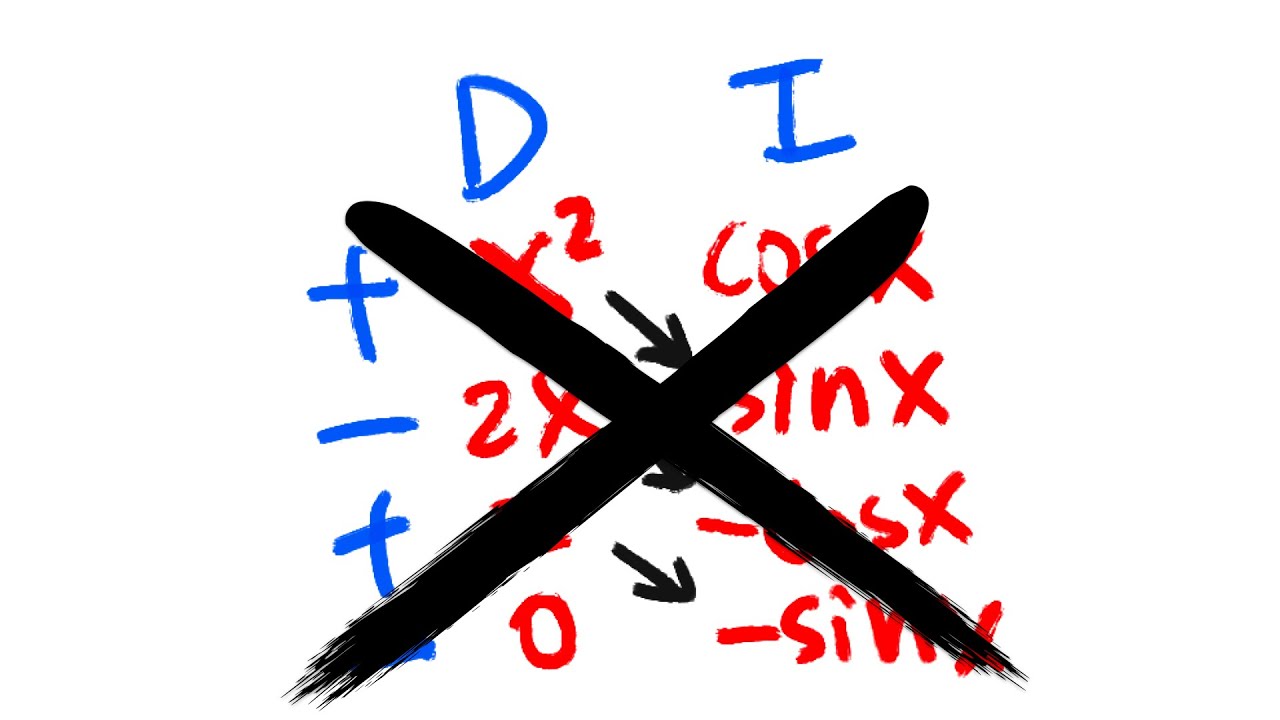
Try Brilliant with 30 days free: 👉 https://brilliant.org/blackpenredpen/ (20% off with this link!) #calculus #brilliant #maths #math
In this video, we will show you why your calculus students deserve to learn and use the DI method for integration by parts. While it's true that the DI and u-dv methods are equivalent, the DI method has many adva...
Here I think this is pretty good
uneven oyster
void berry
Here I think this is pretty good
Alright I'll check it out
void berry
And DI method is basically just a way to make the integration by parts more easy to think of but it's basically the same
uneven oyster
void berry
And DI method is basically just a way to make the integration by parts more easy...
OK I think I understand
3b is the same right?
void berry
Wait really 😅 ?
uneven oyster
void berry
Wait really 😅 ?
Like the method I'll use to solve it
void berry
Yes
uneven oyster
OK
void berry
4a too
void berry
It's up to you
uneven oyster
void berry
It's up to you
OK I understand
void berry
And maybe some of the problems are included in the video as well so when you understand the main formula please try doing it first 😅 (I forgot to check)
uneven oyster
void berry
And maybe some of the problems are included in the video as well so when you und...
I will, thnx
trim joltBOT
@uneven oyster Has your question been resolved?
Channel closed
Closed by @uneven oyster
Use .reopen if this was a mistake.
uneven oyster
.reopen
trim joltBOT
✅
 north forge
 wraith hinge
<@105878844061286400>
wraith hinge
<@105878844061286400>
please ping the Moderator role, not individual mods
wraith hinge
👍
trim joltBOT
@uneven oyster Has your question been resolved?
Channel closed
Closed by @uneven oyster
Use .reopen if this was a mistake.
Available help channel!
Send your question here to claim the channel.
Remember:
• Ask your math question in a clear, concise manner.
• Show your work, and if possible, explain where you are stuck.
• After 15 minutes, feel free to ping <@&286206848099549185>.
• Type the command .close to free the channel when you're done.
• Be polite and have a nice day!
Read #❓how-to-get-help for further information on how to ask a good question, and about conduct in the question channels.
 ember ivy
How do derive lnx^2 ?
trim joltBOT
ember ivy
How do derive lnx^2 ?
 gaunt wave
Are you familiar with the chain rule?
gaunt wave
Not quite, x^2 is the "inner" function. You first derive the outer function then multiply it by thederivative of the inner function
ember ivy
1/x is the derivation of the outer?
ember ivy
1/x^2
gaunt wave
yep, and the derivative of the inner function?
ember ivy
2x
gaunt wave
multiply them together?
ember ivy
2x/x^2
gaunt wave
simplify
 hybrid vine
||Also you can use properties of logarithms first||
 gaunt wave
ember ivy
ln x^2 ----> 2 / x
gaunt wave
ember ivy
ln x^2 ----> 2 / x
yes
ember ivy
Can you give me another test of chain rule? I struggle with this the most?
gaunt wave
Here is a set of practice problems to accompany the Chain Rule section of the Derivatives chapter of the notes for Paul Dawkins Calculus I course at Lamar University.
trim joltBOT
Channel closed
Closed by @ember ivy
Use .reopen if this was a mistake.
Available help channel!
Send your question here to claim the channel.
Remember:
• Ask your math question in a clear, concise manner.
• Show your work, and if possible, explain where you are stuck.
• After 15 minutes, feel free to ping <@&286206848099549185>.
• Type the command .close to free the channel when you're done.
• Be polite and have a nice day!
Read #❓how-to-get-help for further information on how to ask a good question, and about conduct in the question channels.
wraith hinge
Determine the y-intercept of the line representing the following affine function: x = 5 f(x)= -11 x=6 f(x)=-13****
trim joltBOT
wraith hinge
Determine the y-intercept of the line representing the following affine function...
Please don't occupy multiple help channels.
past widget
!original
trim joltBOT
Please show the original problem, exactly as it was stated to you, with the entire original context. A picture or screenshot is best. If the original problem is not in English, then post it anyway! The additional context might still be helpful. Do your best to provide a translation.
@wraith hinge Has your question been resolved?
trim joltBOT
Channel closed
Closed due to timeout
Use .reopen if this was a mistake.
Available help channel!
Send your question here to claim the channel.
Remember:
• Ask your math question in a clear, concise manner.
• Show your work, and if possible, explain where you are stuck.
• After 15 minutes, feel free to ping <@&286206848099549185>.
• Type the command .close to free the channel when you're done.
• Be polite and have a nice day!
Read #❓how-to-get-help for further information on how to ask a good question, and about conduct in the question channels.
 ocean quail
the fact that the expansion has 3 terms instead of two makes me not know how to solve this
 trim joltBOT
ocean quail
the fact that the expansion has 3 terms instead of two makes me not know how to ...
ocean quail
trim joltBOT
ocean quail
the fact that the expansion has 3 terms instead of two makes me not know how to ...
ocean quail
i thought of grouping 1+x and then 1/x but then we would get that T(k+1)=C5^k * (1+x)^(5-k)*x^(-k)
 clear cloud
Imagine (a+b) but b = x+1/x
 magic eagle
multinomial theorem 🗿
clear cloud
You can group stuff
ocean quail
clear cloud
Imagine (a+b) but b = x+1/x
so you wanna group them that way
 teal vale
 teal vale
Just make it the numerator and then the denominator and move on
you just need to know what is the last term
 zinc ginkgo
clear cloud
Imagine (a+b) but b = x+1/x
zinc ginkgo
clear cloud
Imagine (a+b) but b = x+1/x
Did you try this yet
clear cloud
I don't get the quotient thing
 limpid siren
ocean quail
<@706934233012371577> pls help
limpid siren
ocean quail
<@706934233012371577> pls help
!NOPING
trim joltBOT
ocean quail
<@706934233012371577> pls help
Please do not ping individual helpers unprompted.
ocean quail
zinc ginkgo
Did you try this yet
i alreaedy asked earlier if this wouldnt mean that k=0
clear cloud
||Also some Laurent series at x = 0 but i don't think this is the purpose here||
ocean quail
because the b would have to be 1
clear cloud
zinc ginkgo
I was asking Gustavo sorry if that wasn't clear
It was clear chief dw
ocean quail
limpid siren
!NOPING
ma bad
zinc ginkgo
Whatever k is
ocean quail
so how would you find k
ocean quail
zinc ginkgo
No?
it asked for the term independent of x
zinc ginkgo
b=x+1/x
zinc ginkgo
Expand (a+b)^5
ocean quail
wait one second
zinc ginkgo
Without expanding b
ocean quail
cant we just write the formula for a random term in an expansion?
ocean quail
ocean quail
i thought of grouping 1+x and then 1/x but then we would get that T(k+1)=C5^k * ...
like (a+b)^5 => (the thing im replying to)?
ocean quail
magic eagle
🗿
what do you think the answer is?
lets see if that formula got u the right answer
magic eagle
ok gimmi 5 mins
ocean quail
zinc ginkgo
No?
why not
zinc ginkgo
x can pair with 1/x in many different ways
zinc ginkgo
ocean quail
why not
Try it and see if you get the right answer
zinc ginkgo
x * (1/x) = 1
ocean quail
but its wrong
ocean quail
zinc ginkgo
x * (1/x) = 1
ok?
zinc ginkgo
Yea because you're missing terms that multiply to a constant
zinc ginkgo
zinc ginkgo
x can pair with 1/x in many different ways
.
ocean quail
so how do i do it?
zinc ginkgo
zinc ginkgo
Expand (a+b)^5
Do this
zinc ginkgo
Find the constant term in each summand
zinc ginkgo
zinc ginkgo
Find the constant term in each summand
This would be the expanding b term
magic eagle
sheesh i got 50
zinc ginkgo
b^k rather
 limpid dawn
magic eagle
sheesh i got 50
limpid dawn
magic eagle
sheesh i got 50
how
zinc ginkgo
It's also not helpful to just give numbers without any explanations
ocean quail
limpid dawn
how
good question
ocean quail
zinc ginkgo
It's also not helpful to just give numbers without any explanations
ill just show you the expansion
zinc ginkgo
zinc ginkgo
Find the constant term in each summand
Do this too
 zinc ginkgo
No
zinc ginkgo
clear cloud
Imagine (a+b) but b = x+1/x
Read this again for the third time
zinc ginkgo
It's not wrong
ocean quail
then?
zinc ginkgo
ocean quail
are the constants: 1, 5, 10, 10, 5, 1?
This is wrong though
ocean quail
what are the constants then?
ocean quail
????????
ocean quail
ffs
zinc ginkgo
ocean quail
are the constants: 1, 5, 10, 10, 5, 1?
I mean clearly the last term has power -5 so why are you thinking it contributes 1
ocean quail
zinc ginkgo
I mean clearly the last term has power -5 so why are you thinking it contributes...
cuz i thought that the constant term is the coeficient buddy
thats why
zinc ginkgo
Coefficient of the constant yes
ocean quail
this one exercise alone is taking way too much time
zinc ginkgo
Not coefficient of random powers of x
zinc ginkgo
Why are you still talking
You haven't explained single thing beyond "multinomial theorem" which op clearly doesn't need to learn
 naive otter
If you have a better solution, you can surely type it ! But riemmans is good enough
ocean quail
so whats the constant
zinc ginkgo
zinc ginkgo
Find the constant term in each summand
This shouldn't take 20 minutes
ocean quail
zinc ginkgo
This shouldn't take 20 minutes
i started working on other exercises since noone wants to explain to me how to figure this exercise out
if anyone's got any explanations, go ahead
naive otter
(1+(x+1/x))⁵=
1 + 5(x+1/x) + 10(x+1/x)² + 10(x+1/x)³ + 5(x+1/x)⁴ + (x+1/x)⁵
naive otter
Can you do it now ?
ocean quail
the thing i had problems on is finding out the constant term or whatever
naive otter
I actually got an exam tmrw !! So struggling with it !
naive otter
ocean quail
the thing i had problems on is finding out the constant term or whatever
(x+1/x) yk both terms have to be of the same power to get constant
So yk you need to check for even powers only
Like (x+1/x)² middle term and (x+1/x)⁴ middle term
Then you add
ocean quail
and then what
naive otter
ocean quail
and then what
That's the answer!
magic eagle
Can i expl 🗿
naive otter
1+ 10×2c1 + 5×4c2
ocean quail
magic eagle
Can i expl 🗿
if you feel like it
ocean quail
are you asking me?
magic eagle
im drawing it, since i cant use texit and stuff, gimmi a min
zinc ginkgo
ocean quail
the thing i had problems on is finding out the constant term or whatever
Constant term is when the power on x is zero
1-1=0, 2-2 = 0
zinc ginkgo
zinc ginkgo
x * (1/x) = 1
Which generalizes this a bit
past widget
ocean quail
the fact that the expansion has 3 terms instead of two makes me not know how to ...
that's trivial tho 
past widget
General term: $\frac{5!}{p!q!r!}x^{q-r}$ subject to condition: $p + q + r = 5$
solid kilnBOT
 past widget
constant term is q = r.
Constant term: $\frac{5!}{(5 - 2q)!q!q!}$ subject to condition: $p + 2q = 5$
solid kilnBOT
 past widget
sum over q = 0, 1, 2 
Xor has a better sol?
@ocean quail . Do you know multinomial expansion?
ocean quail
no
past widget
or multinomial coefficient / theorem, anything with multi in it
Alr np
Do you know (x + 1/x) raised to odd never has a constant term?
ocean quail
past widget
Do you know (x + 1/x) raised to odd never has a constant term?
why not
naive otter
I didnt use multinomial
past widget
ocean quail
why not
because, for (x + 1/x)^{2n + 1}, for any general term, the sum of powers of x and 1/x should be odd
naive otter
Sry i was just using the space here to copy paste somewhere else lol
past widget
past widget
because, for (x + 1/x)^{2n + 1}, for any general term, the sum of powers of x an...
so both powers cannot be equal, and hence, (x + 1/x)^{2n+1} does not have a constant term
past widget
so in the expansion of [1 + (x + 1/x)]^5, you're only interested in 5(x + 1/x)^4 + 10(x + 1/x)^2 + 1
pick out constant terms from both binomials and you have:
Constant term = 5 x 6 + 10 x 2 + 1 = 51
ocean quail
whered you get the 6 from
the thing yall miss is that ive never done this thing before
naive otter
ocean quail
the thing yall miss is that ive never done this thing before
4c2 = 6
past widget
ocean quail
the thing yall miss is that ive never done this thing before
pascal's triangle
naive otter
(x+1/x)⁴ the middle term. Will be 4c2 x²×(1/x)²
past widget
(x + y)^4 has coefficients in pattern: 1 4 6 4 1
(x + y)^5 has 1 5 10 10 5 1
(x + y)^2 has 1 2 1
naive otter
I thought you would cont with (x+y)⁶ 😕
past widget
1 6 15 20 15 6 1
so anyways, I used pascal's triangle to go `5 x [middle term coeff = 6] + ...
zinc ginkgo
ocean quail
the thing yall miss is that ive never done this thing before
It's just binomial theorem
zinc ginkgo
ocean quail
If you bothered to expand any term here like I said you would have seen the constant terms
ocean quail
.close
trim joltBOT
Channel closed
Closed by @ocean quail
Use .reopen if this was a mistake.
Available help channel!
Send your question here to claim the channel.
Remember:
• Ask your math question in a clear, concise manner.
• Show your work, and if possible, explain where you are stuck.
• After 15 minutes, feel free to ping <@&286206848099549185>.
• Type the command .close to free the channel when you're done.
• Be polite and have a nice day!
Read #❓how-to-get-help for further information on how to ask a good question, and about conduct in the question channels.
 leaden hawk
how do i show this is differentiable [f(x, y)=\ln (1+x+y)]
solid kilnBOT
dghf

 red mountain
for all x,y?
leaden hawk
yes
 dense breach
it's not defined on all x,y
leaden hawk
like which x and y?
clear cloud
1+x+y > 0
leaden hawk
it's defined when 1+x+y > 0?
clear cloud
Y
leaden hawk
so how do i show it's differentiable?
dense breach
differentiate it
leaden hawk
∂f/∂x and ∂f/∂y?
leaden hawk
∂f/∂x = 1/(1+x+y) and same for ∂f/∂y = 1/(1+x+y)
dense breach
1+x+y is differentiable
it's a composition of differentiable functions
that automatically makes it differentiable
technically just showing ∂f/∂x and ∂f/∂y exist isn't enough, you need all directional derivatives to exist
leaden hawk
do i need to find the lim?
dense breach
you're not allowed to use that compositions of differentiable functions are differentiable?
 dense breach
i assume that's some definition of differentiability they have
leaden hawk
[\lim_{\left( h,k \right) \rightarrow \left( 0,0 \right)} \frac{f\left( 1+h,2+k \right) -f\left( 1,2 \right) -hf_{x}\left( 1,2 \right) -kf_{y}\left( 1,2 \right)}{\sqrt{h^{2}+k^{2}}}]
solid kilnBOT
dghf
 leaden hawk
this is how i would do it?
[
\lim_{\left( h, k \right) \to \left( 0, 0 \right)} \frac{\ln(4 + h + k) - \ln(4) - h \cdot \frac{1}{4} - k \cdot \frac{1}{4}}{\sqrt{h^2 + k^2}}.
]
[
\ln(4 + h + k) - \ln(4) \approx \frac{h + k}{4}.
\implies \frac{h + k}{4} - \frac{h}{4} - \frac{k}{4} = 0. ]
solid kilnBOT
dghf

 keen panther
leaden hawk
\[\lim_{\left( h,k \right) \rightarrow \left( 0,0 \right)} \frac{f\left( 1+h,2+k...
keen panther
leaden hawk
\[\lim_{\left( h,k \right) \rightarrow \left( 0,0 \right)} \frac{f\left( 1+h,2+k...
how do u even type this shit🛐
trim joltBOT
@leaden hawk Has your question been resolved?
trim joltBOT
Channel closed
Closed due to timeout
Use .reopen if this was a mistake.
Available help channel!
Send your question here to claim the channel.
Remember:
• Ask your math question in a clear, concise manner.
• Show your work, and if possible, explain where you are stuck.
• After 15 minutes, feel free to ping <@&286206848099549185>.
• Type the command .close to free the channel when you're done.
• Be polite and have a nice day!
Read #❓how-to-get-help for further information on how to ask a good question, and about conduct in the question channels.
 barren crescent
Ok I think I fixed it


 trim joltBOT
barren crescent
Ok I think I fixed it
barren crescent
trim joltBOT
barren crescent
Ok I think I fixed it
barren crescent
disregard the min max stuff on the long sc, it should be correct in the separate one
.close
trim joltBOT
Channel closed
Closed by @barren crescent
Use .reopen if this was a mistake.
trim joltBOT
Available help channel!
Send your question here to claim the channel.
Remember:
• Ask your math question in a clear, concise manner.
• Show your work, and if possible, explain where you are stuck.
• After 15 minutes, feel free to ping <@&286206848099549185>.
• Type the command .close to free the channel when you're done.
• Be polite and have a nice day!
Read #❓how-to-get-help for further information on how to ask a good question, and about conduct in the question channels.
 vocal mist
A cone of height H with a base of radius r is cut by a plane parallel to and h units above the base where
h < H.
Find the volume of the solid (frustum of a cone) below the plane.
trim joltBOT
vocal mist
A cone of height H with a base of radius r is cut by a plane parallel to and h u...
vocal mist
i tried using disk method and i've ended up with pih/3(r^2+r(r2)+(r2)^2)
where r2 is the upper radius
but i need help getting r2 in terms of r H and h

and also i tried doing big cone minus little cone and that didn't work
also i tried plugging (H-h)r/h in for r2 and that didn't work
<@&286206848099549185>
please im cooked 😭
 fleet bear
$$ R(y) = \frac{r}{h} (H - y) $$
Low key should have started with the full equation
solid kilnBOT
StrangeQuarkAL
 trim joltBOT
@vocal mist Has your question been resolved?
trim joltBOT
Channel closed
Closed due to timeout
Use .reopen if this was a mistake.
Available help channel!
Send your question here to claim the channel.
Remember:
• Ask your math question in a clear, concise manner.
• Show your work, and if possible, explain where you are stuck.
• After 15 minutes, feel free to ping <@&286206848099549185>.
• Type the command .close to free the channel when you're done.
• Be polite and have a nice day!
Read #❓how-to-get-help for further information on how to ask a good question, and about conduct in the question channels.
 wet nest
Can someone explain to me what a field is? My professor covered but neither the textbook or my personal book covers it formally
trim joltBOT
wet nest
Can someone explain to me what a field is? My professor covered but neither the ...
wet nest
I will also accept any resources or videos
zinc ginkgo
wet nest
Can someone explain to me what a field is? My professor covered but neither the ...
Field means different things in different contexts
What book or subject are you learning
wet nest
zinc ginkgo
What book or subject are you learning
Real Analysis, its the thing where you do operation on a set I think
like +: FxF -> F
zinc ginkgo
wet nest
Real Analysis, its the thing where you do operation on a set I think

Mathematics LibreTexts
In this chapter we will take a deep dive into structure of the real numbers by building up the multitude of properties you are familiar with by starting with a collection of fundamental axioms. …
9 axioms in 5.1
 ionic pendant
a field is a set of numbers equipped with operations of addition and multiplication that behave "nicely" (with the precise definition supplied in the axioms posted above)
wet nest
ionic pendant
a field is a set of numbers equipped with operations of addition and multiplicat...
Thats what I got out of the lecture, it just seems a bit weird
obviously I know what a set is its just the operation part that throws me off
zinc ginkgo
The addition or multiplication?
ionic pendant
if you're at all familiar with linear algebra, it's very much similar to the vector space axioms
wet nest
zinc ginkgo
The addition or multiplication?
both? I just dont get what the point of it is
$+ : F \times F \to F$
solid kilnBOT
TheKingPin
 zinc ginkgo
It's not very deep
wet nest
the notation is just a bit sudden for me. From my previous knowledge this is an ordered pair that goes into the set of F through addition?
zinc ginkgo
If you know things like 1+1=2 then you know addition
And things like 2*3=6 then you know multiplication
ionic pendant
so that notation means + is a function which takes two elements as input (the two numbers you're adding) and returns one number as output (their sum)
since F x F is the set of pairs of elements of your field (pairs of numbers)
wet nest
oh, that is very simple.
zinc ginkgo
solid kiln
**TheKingPin**
The point of this notation is to set foundation for generalizing to more complicated binary operations
Mathematics LibreTexts
zinc ginkgo
Point of what
wet nest
obviously im using it in RA but why use fields?
ionic pendant
the utility of introducing fields is that if there is any theorem about the real numbers relying only on the field axioms, then the same property holds for any other field
wet nest
it just seems like a function
like for the one i wrote just say f(x) := 2x
oh wait no
cause FxF would be any combination from the set of F
{f(x,y) := (x+y) | x,y is in F}
zinc ginkgo
wet nest
obviously im using it in RA but why use fields?
to do all the common operations you need in real analysis
addition, multiplication
wet nest
ya, what I mean is that it seems there simpler way to express this
ionic pendant
you'd have to introduce formal definitions of addition and multiplication even if you only plan to use the real numbers. using the field axioms allows you to generalize certain results to other number systems
wet nest
ionic pendant
you'd have to introduce formal definitions of addition and multiplication even i...
makes some more sense
ill read through the resources and come back if I have more questions
thank you both
.close
trim joltBOT
Channel closed
Closed by @wet nest
Use .reopen if this was a mistake.
trim joltBOT
Available help channel!
Send your question here to claim the channel.
Remember:
• Ask your math question in a clear, concise manner.
• Show your work, and if possible, explain where you are stuck.
• After 15 minutes, feel free to ping <@&286206848099549185>.
• Type the command .close to free the channel when you're done.
• Be polite and have a nice day!
Read #❓how-to-get-help for further information on how to ask a good question, and about conduct in the question channels.
 glad pumice
How do I calculate DG/EF? I know the measurements of the other side lengths but idk how to calculate DG/EF
 trim joltBOT
glad pumice
How do I calculate DG/EF? I know the measurements of the other side lengths but ...
glad pumice
trim joltBOT
glad pumice
How do I calculate DG/EF? I know the measurements of the other side lengths but ...
glad pumice
So far, I know
Area of triangle DAE= 24
DE=10
Area of AEFGD is in the form 24+10x, where x is the measurement of DG/EF
CD= 6 and EB = 8, which are both equal to the diagonal of the square when you reflect the two triangles
I applied the formula 1/2d^2, where d is the diagonal for the area of a square
I got area of triangle CGD = 9
I got area of triangle EFB = 16
 exotic pine
AEFGD=ABC-EBF-DGC?
glad pumice
Yeah, that was what i tried and got it wrong
exotic pine
glad pumice
I got area of triangle CGD = 9
how did you get this?
glad pumice
exotic pine
how did you get this?
1/2 (1/2*6^2)
you get a square when you reflect triangle CGD
and the hypotenuse (CD) is the diagonal of that square
we know CD is 6
 violet gust
glad pumice
you get a square when you reflect triangle CGD
violet gust
glad pumice
you get a square when you reflect triangle CGD
no you dont
exotic pine
you get a rectangle, not a square
glad pumice
how do you know that
violet gust
Youd get a square only if CGD were isosceles right triangle
But its similar to ABC, and ABC is not
exotic pine
if its a square, then it would imply CD=CG (if you work it out its not)
glad pumice
then idk how to solve the problem then
exotic pine
do you know simmilarity?
glad pumice
yes, triangle CGD is proportional to triangle CAB
glad pumice
exotic pine
do you know simmilarity?
it's like proportional triangles, right
exotic pine
mhm
glad pumice
exotic pine
mhm
how would we know if side length GD is an integer or not
exotic pine
its not
glad pumice
yeah cause no triangle has hypotenuse 6 if it's legs are integers
we know CB is 20 too
exotic pine
mhm
glad pumice
exotic pine
mhm
how can i calculate GD
exotic pine
glad pumice
yes, triangle CGD is proportional to triangle CAB
simmilarity on hypotenuse and base
glad pumice
exotic pine
simmilarity on hypotenuse and base
proportion is 16/6=8/3
exotic pine
no
glad pumice
AB=16, CD= 6
exotic pine
hypotenuse/hypotenuse=base/base
glad pumice
exotic pine
hypotenuse/hypotenuse=base/base
so area of the figure is 72?
yeah it is
thanks for helping
.close
trim joltBOT
Channel closed
Closed by @glad pumice
Use .reopen if this was a mistake.
trim joltBOT
Available help channel!
Send your question here to claim the channel.
Remember:
• Ask your math question in a clear, concise manner.
• Show your work, and if possible, explain where you are stuck.
• After 15 minutes, feel free to ping <@&286206848099549185>.
• Type the command .close to free the channel when you're done.
• Be polite and have a nice day!
Read #❓how-to-get-help for further information on how to ask a good question, and about conduct in the question channels.
 inland bear
can someone help me? im just confused on how they figured out the values of b for these parts. eg, for part A how they found 1.2
 trim joltBOT
inland bear
can someone help me? im just confused on how they figured out the values of b fo...
inland bear
trim joltBOT
inland bear
can someone help me? im just confused on how they figured out the values of b fo...
inland bear

 inland bear
yeah but how did they find the value of b? for example in part A, i see that they did 4-1.2 but where did they get 1.2 from
 tardy aurora
mif 👀
empty orchid

ionic pendant
,tikz
\begin{axis}[axis lines = center, xlabel=$x$, ylabel=$y$]
\addplot[black]{x^2};
\draw[ultra thick, blue] (1.2,0) -- (4,0) -- (4,16) -- (1.2,0);
\end{axis}
solid kilnBOT
cloud

 ionic pendant
it seems like they estimated a point that would sort of fit
empty orchid
ionic pendant
,tikz
\begin{axis}[axis lines = center, xlabel=$x$, ylabel=$y$]
\addplot[black]{...
this is real coding 😭
ionic pendant
gotta add pgfplots to the preamble
 dull temple
you do it pls i want to see what the √x one is about
ionic pendant
,tikz
\begin{axis}[axis lines = center, xlabel=$x$, ylabel=$y$, xmin=-1]
\addplot[black, samples at={0,0.001,0.005,0.01,...,0.2,0.3,0.4,...,5}]{sqrt(x)};
\addplot[ultra thick, blue] coordinates {(0,0) (3,0) ( 3,2.2) (0,0)};
\end{axis}
dull temple
ok i have no idea
ionic pendant
no that's just my plot being broken
solid kilnBOT
cloud
 inland bear
so i'd just have to draw the graph as accurate as possible then?
trim joltBOT
Channel closed
Closed by @inland bear
Use .reopen if this was a mistake.
trim joltBOT
Available help channel!
Send your question here to claim the channel.
Remember:
• Ask your math question in a clear, concise manner.
• Show your work, and if possible, explain where you are stuck.
• After 15 minutes, feel free to ping <@&286206848099549185>.
• Type the command .close to free the channel when you're done.
• Be polite and have a nice day!
Read #❓how-to-get-help for further information on how to ask a good question, and about conduct in the question channels.
 vast geyser
Question