#help-38
1 messages · Page 144 of 1
 slim pawn
slim pawn
slim pawn
and the question is asking about 10√2cm
 granite light
it is 10√2
coincidence
it is asking to consider the case where container is full to the brim
in other words the h√2 hypotenuse is equal to the segment you marked in purple
slim pawn
yes
slim pawn
do we have to rationalise?
(20cm)/(√2)
i think we do have
because if we rationalize
it will be 20√2 / 2
granite light
you got it
slim pawn
let's go
granite light
so the other part asks you to find the volume
which you can do by finding the area of rectangle+area of triangle and multiplying that by 10cm
(because formula for the volume of a prism or something)
slim pawn

idk how to proove it
but i think the liquid will be the purple
so
the volume is 1000
granite light
granite light
the surface of the liquid has to be parallel to the ground
.
because gravity
slim pawn
granite light
which you can do by finding the area of rectangle+area of triangle and multiplyi...
the are of the triangle is 1000
10 * 10 * 10
granite light
why?
granite light
why?
 granite light
do you mean area or volume?
slim pawn
granite light
do you mean area or volume?
volume
slim pawn
yes
granite light
if that wasn't the case we couldn't apply this formula
so what about the rectangle
granite light
we know height + yellow = 20
slim pawn
so the height would be 10
 granite light
no
slim pawn
ok
granite light
but we are saying it's full all the way for part b
slim pawn
so the height is really 10
granite light
yes
slim pawn
so the volume is 1000
granite light
yes, and then the total volume is
slim pawn
the liquid?
granite light
yes
granite light
no?
slim pawn
1500
granite light
why?
slim pawn
1000 + 500
granite light
yes
slim pawn
no
granite light
1500cm³
 granite light
it actually didn't
slim pawn
really?
granite light
it just moved up
slim pawn
no, in this case we added liquid
because the rectangle in bigger and the triangle is the same
so we have more liquid now
granite light
yes
but we calculated the volume for the big rectangle
(rectangular prism, technically)
slim pawn
i can see the answers too if you want
but i think we didnt added liquid
lemme see here
granite light
1500cm³ is correct
granite light
there is an easy way to see this actually
slim pawn
tell me
granite light
the total volume of 10x10x20 is what?
slim pawn
2000
granite light
we can split it into 2 equal cubes
slim pawn
1000
granite light
we can split each cube along the diagonal in half
slim pawn
500
granite light
split the top cube such that you remove the part which would overflow
so you have 3/4 of the 2000
slim pawn
i think i understood now
so it really added liquid
i thought that we could move the arrow
granite light
well the amount of liquid is determined by where the arrow points
 granite light
idk how to explain this better
slim pawn
so the arrow continued in the same place?
slim pawn
understand
my biggest problem was probably because i didn't understand the question
anyways
thank you
have a great day
.close
 trim joltBOT
Channel closed
Closed by @slim pawn
Use .reopen if this was a mistake.
trim joltBOT
 Available help channel!
Send your question here to claim the channel.
Remember:
• Ask your math question in a clear, concise manner.
• Show your work, and if possible, explain where you are stuck.
• After 15 minutes, feel free to ping <@&286206848099549185>.
• Type the command .close to free the channel when you're done.
• Be polite and have a nice day!
Read #❓how-to-get-help for further information on how to ask a good question, and about conduct in the question channels.
 cobalt cloak
how to show that there is instataneous acceleleraton at t = 10 given v=0.5t for 0≤t≤10, v=0.25t^2-8t+40 for 10≤t≤20
trim joltBOT
cobalt cloak
how to show that there is instataneous acceleleraton at t = 10 given v=0.5t for ...
 livid thunder
find v at t=10 for both equations
livid thunder
well if its velocity gives different answers at t=10 then the only way for that to be true is if it accelerated instantly
cobalt cloak
livid thunder
well if its velocity gives different answers at t=10 then the only way for that ...
i don't need to differentiate it?
livid thunder
i mean u can if u want
cobalt cloak
livid thunder
i mean u can if u want
if i do it this way how do i prove
trim joltBOT
@cobalt cloak Has your question been resolved?
 leaden nacelle
you can draw it
that proves that there is a vertical line in the velocity
meaning instant acceleration from one velocity to another
if that makes sense
trim joltBOT
@cobalt cloak Has your question been resolved?
cobalt cloak
leaden nacelle
you can draw it
question doesn't let me draw though
😭
i get what you mean
trim joltBOT
@cobalt cloak Has your question been resolved?
trim joltBOT
Channel closed
Closed due to timeout
Use .reopen if this was a mistake.
trim joltBOT
Available help channel!
Send your question here to claim the channel.
Remember:
• Ask your math question in a clear, concise manner.
• Show your work, and if possible, explain where you are stuck.
• After 15 minutes, feel free to ping <@&286206848099549185>.
• Type the command .close to free the channel when you're done.
• Be polite and have a nice day!
Read #❓how-to-get-help for further information on how to ask a good question, and about conduct in the question channels.
 wraith hinge
hello
trim joltBOT
wraith hinge
hello
wraith hinge
i need help with calc 3 problem


i solved a
but i dont know how to solve b
<@&286206848099549185>
trim joltBOT
Please only use the <@&286206848099549185> ping once if your question has not been answered for 15 minutes. Please do not ping or DM individual users about your question.
wraith hinge
<@&286206848099549185>
trim joltBOT
@wraith hinge Has your question been resolved?
 unique minnow
Well using the hint, can you give a vector from the equation of the plane that we know is always perpendicular to the plane?
wraith hinge
well i can know the normal to the plane
using the equation of it
but idk what to do after that
wraith hinge
unique minnow
Well using the hint, can you give a vector from the equation of the plane that w...
.
unique minnow
Well we would want a point on the sphere where the vector from the center of the sphere to that point is parallel to the normal vector.
Can you give the center of the sphere?
wraith hinge
yes u have it
look i formed a line equations
equation *
using the normal vector as a direction vector
and the center as a poin on it
unique minnow
That's good.
wraith hinge
then i used
the parametric equation
in the eq of the plane
found t
then found x y z
does that work?
unique minnow
Yeah that's fine.
trim joltBOT
@wraith hinge Has your question been resolved?
trim joltBOT
Channel closed
Closed due to timeout
Use .reopen if this was a mistake.
Available help channel!
Send your question here to claim the channel.
Remember:
• Ask your math question in a clear, concise manner.
• Show your work, and if possible, explain where you are stuck.
• After 15 minutes, feel free to ping <@&286206848099549185>.
• Type the command .close to free the channel when you're done.
• Be polite and have a nice day!
Read #❓how-to-get-help for further information on how to ask a good question, and about conduct in the question channels.
 nova spire
I don't understand what you mean by that
and I'm not sure why 6*2 gives you the second digit
sure last digit is 1
but what you're doing isn't really justified
trim joltBOT
@wraith hinge Has your question been resolved?
 sudden mist
Oh you could just do this with the binomial expansion
idk if the video does that
Maybe the method you did it in is a lot more effective, but i could do it by rewriting 61 as 6*10 + 1
To find the last two digits
we want to find the coef. a,b which are in the form a 10^1 + b 10^0
the binomial expansion lets us do this
by expanding the first two first of (6*10 + 1)^12
we get the two terms ${12 \choose 0}(6\cdot 10)^0 + {12 \choose 1}(6\cdot 10)^1$
 solid kilnBOT
Aslan
 sudden mist
here the left term is just 1
while the right term is 720
so the first digit is 1
and the 2nd is 2
Since its the first two terms of the binomial expansion, and anything higher would be a bigger exponent in the (6*10) factor, thus a bigger digit and it does not contribute to the digits before it
I.e you sum 1 and 720
the one from above
then read off the two first digits
the 7 here is not correct for the third btw
you need to calculate another term for that
Remember what i wrote above
To read off the digits, we want to find a way to express the number in the form ... + a 10^1 + b 10^0
where a is the second digit and b the first
we could do this via the binonal expansion
But again, this might not be the best method
Did you read the above?
Go from the start and start there
What is the second digit in 721?
im only including the 7 here to show that this comes from the above calculation
but its irrelevant here
Where did you get?
Oh i see you rewrote it
Yeah so did you follow the part before it?
This does not give the second digit in general btw
yeah
So let's go trhough the details again
are you familar with the binomial expansion?
Of the binomial expansion?
uh idk expand (a+b)^n for fixed a,b and natural n
youll have to know how to use the binomial expansion formula
but idk if ur method requires that; so maybe useless to learn
We'll need it for my method
but thats assuming you want to understand it
if not, thats perfectly fine
Oh i just checked it and it seems theyre doing something very simliar with the binomial expansion
but not rewriting 61 as 6*10 + 1
in any case
youll have to understand the binomial expansion formula if you want to understand why this works
the binomial expansion formula?
well it depends on what level, do you want to understand why its true or just see the formula?
let's try
i'll first just tex the formula and work from there
Suppose $a,b$ are real numbers and $n$ is a natural number. Then we have that $(a+b)^n = {n\choose 0}a^0 b^{n-0} + \cdots + {n\choose n}a^n b^{n-n} $.
This is the formula
are you familiar with the notation used?
Hm
lets maybe try and rewrite it without sigma notation
solid kilnBOT
Aslan
 solid kilnBOT
Aslan
 sudden mist
Are you famliar with factorial, like n! ?
like combinatorics in general
neat
so are you aware of permutations?
n! would be a kind pf permutation
so we could permutate a subset of objects from a bag of things, say we want to permute 3 from 6 objects
then we notice that in total theres 6! ways, but we have to divide away the number of way of not selecting 3 things, so (6-3)! number of things.
I.e the total number of ways to select 3 out of 6 objects (when order matters) is 6!/(6-3)! number of ways, so in notation that would be P(6,3). Again, in other words the number of permutations of 3 things out of 6
Okay so the bracket notation is basically permuations but without order
so ${n\choose k} = \frac{P(n,k)}{k!}$
solid kilnBOT
Aslan
 sudden mist
there we go
I.e this bracket notation is the total number of combinations
Where the total number of permutations (from $k$ elements out of $n$) as we saw was just $P(n,k)=\frac{n!}{(n-k)!}$
solid kilnBOT
Aslan
 sudden mist
Makes sense?
yup!
Why would you think that?
0! is infact defined
and its not zero
Its defined as 1
incase that was unclear
In any case, hopefully that notation is clear
sudden mist
solid kiln
**Aslan**
Lets go back to this?
I'll try explaining why this is true
Sounds good?
Let me also just repost the image for clarity

Alright, so in order to get a term in (a+b)^n = (a+b)(a+b)....(a+b); then we must in each parenthesis choose either a or b.
Right?
Yeah but without order now, so the bracket notation
Notice that the terms a^k b^n-k occurs as many times as we can choose a in k, out of the n parenthesis's, i.e exactly n choose k, (the bracket notation)
So each term a^k b^n-k has a corresponding coefficient n choose k
and thats pretty much it
Yeah sorry i should of made that clear, here k is the term we're talking about, so k = 0 is the first term and k = n is the last term
i could of added that back in again
let me do that quickly
Suppose $a,b$ are real numbers and $n$ is a natural number. Then we have that $$(a+b)^n = {n\choose 0}a^0 b^{n-0} + \cdots + {n\choose k}a^k b^{n-k} + \cdots + {n\choose n}a^n b^{n-n}. $$
Looks rather messy though
thats why i prefer the sigma sum notation for stuff like this
solid kilnBOT
Aslan
 sudden mist
So first off a^k b^(n-k), do you understand this part?
the terms
Yeah
do you understand how we got there from the line above?
So think of it like this way, when you multiply each parenthesis, you naturally do so by distributing the a's and b's depending on which parenthesis youre working with, right?
Say in the first parenthesis you picked a, then you have a binary choice what to multiply this with, either a or b in the next parenthesis.
Suppose you only pick b afterwards
then you get a term of the form a^1 b^(n-1), right?
Now its just the n parenthesis from (a+b)^n = (a+b)(a+b)...(a+b)
i.e the start
Take (a+b)(a+b) for example, you could start from the left and say first pick a, and then multiply it with either a or b in the next parenthesis, right?
so you either get a^2 or ab
or in general, a^2 b^(2-2) or a^1 b^(2-1)
right?
Notice that this is just of the form a^k b^(n-k)
im trying to rewrite it in the more general setting, therye the same still
b^(2-2) = 1
just to motivate where a^k b^(n-k) comes from
its basically a sequence of yes and no's for selecting a or b in the multiplication
Do you notice how when doing the multiplication for (a+b)(a+b)...(a+b) starting from the leftmost parenthis and going to each one to the right
we're asking
do you want to multiply a or b?
Yes, but theyre seperate terms
we want to get a hold of every term separately
hence the formula above
not to mention that some of these will occur more than others!
for example
a^n
only occurs once
and so does b^n
and infact these are the only two terms in the expansion that occurs exactly once
do you see how?
Yup
and why is that the only way to do so?
notice how multiplication is commutative
the order does not matter!
while yes there are n! ways of multiplying all the a's
it doesnt matter
as all the a's are the same and multiplication commutes and we only pick a each time
so we'll only get one such term
so i guess this smoothly transitions to how we find how many times the other terms occurs, since you seem to agree that all the terms are of the from a^k b^(n-k) now?
yeah
so going back to (a+b)(a+b)
notice how theres another way of getting ab
by picking b instead at first
and then a
you're picking them from different parenthesis
so the first ab was by multiplying the a from the first parenthesis, and the b from the 2nd. While the second ab we get by multiplying b from the first parenthesis (a different element, not the same as a) and then the a from the 2nd.
Notice how these are genuinely two different ways of getting ab
Comparing it to a^2, we can only do so once
doesnt matter
and the reason here is really because we're picking a and b differently in each parenthesis, thats why that counts as a different way
youve already used up the a from the 1st parenthesis
from the first ab
if that makes sense!
So this leads up the sentence "that the terms a^k b^n-k occurs as many times as we can choose a in k, out of the n parenthesis's, i.e exactly n choose k"
We can make use of the notion of n choose k
since this is what we're dealing with
we're dealing with the amount of combinations, selecting an object out of a bigger collection, where order doesnt matter
For example, how many ways are there of selecting a in 2 out the n parenthesis's?
This hardly relates to it at this point in time
but you need the formula for it
which you said you didnt understand
and wanted an explanation
so heres my attempt of one!
Well, its quite hard to go trhough a few weeks of combinatorics or whatever in just a few sentences, so if the explantion is not coming through its totally understandable; hopefully if you still care i think a video or two about the binomial expansion is better
They might be more concrete
Yeah i could tell, i feel mean for not stopping
also its 4 am atm lmao
I hope you got something out of this atleast
hopefully it'll come easier when you decide to watch videos about it maybe
or ask about it here

maybe someone else can chime in, if u decide to keep the channel open
The first part being?
Oh i see
well again, so what i was getting at before was that in either case youll need to be comfortable with the binomial expansion, in order for me to explain this
since the method basically is just the binomial expansion
he does every so slightly differently
but it still uses that
Yeah, im just using the formula is all
And the fact that the formula writes it almost in the form a_1 10^0 + a_2 10^1 + ... etc
so we can just read of the cofficents a_1, and a_2 to see what the first and 2nd digits are
and since these are just the first two terms of the expansion this is rather easy
sudden mist
sudden mist
And the fact that the formula writes it almost in the form a_1 10^0 + a_2 10^1 +...
by writing the number in a form like 6*10 + 1 for example instead of 61
but the person in the video does it slightly differently for some reason, using x instead of 10
which is not clear why
i alteast explain why that will work if i use 10, it makes sense atleast that way
maybe the confusion here is that youre not aware what the purpose of rewriting the number as a_1 10^0 + a_2 10^1 + ... does?
So you do get it?
sudden mist
sudden mist
maybe the confusion here is that youre not aware what the purpose of rewriting t...
Since im taking this almost for granted btw
the rest is just the binomial formula
 acoustic idol
sudden mist
acoustic idol
sudden mist
If you read #❓how-to-get-help someone kind enough will
@wraith hinge Im gonna sleep now, so goodluck!
trim joltBOT
Channel closed
Closed by @prisma whale
Use .reopen if this was a mistake.
trim joltBOT
Available help channel!
Send your question here to claim the channel.
Remember:
• Ask your math question in a clear, concise manner.
• Show your work, and if possible, explain where you are stuck.
• After 15 minutes, feel free to ping <@&286206848099549185>.
• Type the command .close to free the channel when you're done.
• Be polite and have a nice day!
Read #❓how-to-get-help for further information on how to ask a good question, and about conduct in the question channels.
 ancient edge
 trim joltBOT
ancient edge
ancient edge
trim joltBOT
ancient edge
ancient edge

My work to solve the SA however when I plugged in the values, I get differing answers
 unique minnow
I've not completely diagnosed it but the inside the of the square root should be 1 + 4u^2, not 1+2u^2.
trim joltBOT
@ancient edge Has your question been resolved?
trim joltBOT
@ancient edge Has your question been resolved?
trim joltBOT
Channel closed
Closed due to timeout
Use .reopen if this was a mistake.
trim joltBOT
Available help channel!
Send your question here to claim the channel.
Remember:
• Ask your math question in a clear, concise manner.
• Show your work, and if possible, explain where you are stuck.
• After 15 minutes, feel free to ping <@&286206848099549185>.
• Type the command .close to free the channel when you're done.
• Be polite and have a nice day!
Read #❓how-to-get-help for further information on how to ask a good question, and about conduct in the question channels.
 nimble grove
 trim joltBOT
nimble grove
nimble grove
trim joltBOT
nimble grove
nimble grove


 spiral kettle
nimble grove
spiral kettle
nimble grove
this step that you did to simplify the numerator was not valid in the first place (you can’t just bring the thing you’re multiplying by inside the tangent)
nimble grove
spiral kettle
this step that you did to simplify the numerator was not valid in the first plac...
What am i supposed to do then..
nimble grove
spiral kettle
this step that you did to simplify the numerator was not valid in the first plac...
Can i eliminate sin and tan before i put in y+5 to x?
spiral kettle
nimble grove
Can i eliminate sin and tan before i put in y+5 to x?
that is certainly something that you can try. if you write tan as sin(the stuff inside)/cos(the stuff inside) you might end up with something that you can work with. also is this for a class or just standardized exam practice? if it’s just to prep for standardized exams then we can do some funny tricks
trim joltBOT
@nimble grove Has your question been resolved?
trim joltBOT
Channel closed
Closed due to timeout
Use .reopen if this was a mistake.
trim joltBOT
Available help channel!
Send your question here to claim the channel.
Remember:
• Ask your math question in a clear, concise manner.
• Show your work, and if possible, explain where you are stuck.
• After 15 minutes, feel free to ping <@&286206848099549185>.
• Type the command .close to free the channel when you're done.
• Be polite and have a nice day!
Read #❓how-to-get-help for further information on how to ask a good question, and about conduct in the question channels.
 arctic saddle
use the circle theorem to help find the values of the pronumerals (pls help thank you :))
 trim joltBOT
arctic saddle
use the circle theorem to help find the values of the pronumerals (pls help than...
arctic saddle
trim joltBOT
arctic saddle
use the circle theorem to help find the values of the pronumerals (pls help than...
arctic saddle
HOW DID YOU GET THERE??
 arctic saddle
Wow you're an actual wizard
arctic saddle
 worldly lagoon
The angle at the circumference is the half the angle at the diameter
worldly lagoon
The angle at the circumference is the half the angle at the diameter
could you possibly dumb it down for me? TwT
worldly lagoon
Basically of there's a circle and an angle in the middle
With straight lines to any point on the edge of the circle
The angle formed by those lines will be 1/2 the angle in the middle
Sorry I'm not too good at explaining things hope that helps
arctic saddle
so does it matter if the straight lines are equal or does it just have to meet at the edge of the circle??
arctic saddle
OHHHHHH
worldly lagoon
Basically try remember the shape in that question and if you ever see it again you know what to do
arctic saddle
is the other lines for distraction btw??
worldly lagoon
You're welcome
trim joltBOT
@arctic saddle Has your question been resolved?
Channel closed
Closed by @arctic saddle
Use .reopen if this was a mistake.
Available help channel!
Send your question here to claim the channel.
Remember:
• Ask your math question in a clear, concise manner.
• Show your work, and if possible, explain where you are stuck.
• After 15 minutes, feel free to ping <@&286206848099549185>.
• Type the command .close to free the channel when you're done.
• Be polite and have a nice day!
Read #❓how-to-get-help for further information on how to ask a good question, and about conduct in the question channels.
arctic saddle
Sorry to ask another question but how do I prove that these triangles are similar?
 trim joltBOT
arctic saddle
Sorry to ask another question but how do I prove that these triangles are simila...
arctic saddle
trim joltBOT
arctic saddle
Sorry to ask another question but how do I prove that these triangles are simila...
arctic saddle
This one too sorry

 supple saffron
arctic saddle
Sorry to ask another question but how do I prove that these triangles are simila...
supple saffron
arctic saddle
Sorry to ask another question but how do I prove that these triangles are simila...
So proving triangle similar u need minimum 2 angle the same
,rotate
solid kilnBOT

 prisma stone
just place the angles
supple saffron
arctic saddle
Sorry to ask another question but how do I prove that these triangles are simila...
in this case u can see BAE = DAC
supple saffron
prisma stone
just place the angles
bro they haven't study trigonometry i think
arctic saddle
Ya not very good at trig sorry 😭
supple saffron
arctic saddle
Ya not very good at trig sorry 😭
u dont have to
supple saffron
arctic saddle
Ya not very good at trig sorry 😭
u were asked for x value right?
arctic saddle
Yes
supple saffron
supple saffron
in this case u can see BAE = DAC
also angle AEB = ADC because they are paralel
arctic saddle
Oohhh
supple saffron
arctic saddle
Yes
use similarity
arctic saddle
How do I do that?? Sorry
supple saffron
arctic saddle
Yes because we use AAA
bro for similarity we dont use same sides
we use sides for congruent which the triangle the same
arctic saddle
Ohh
supple saffron
now with that u can do this
arctic saddle
AAA
supple saffron
$\frac{BD}{BC} = \frac{AB}{BD}$
solid kilnBOT
Newt
 solid kilnBOT
Newt
 supple saffron
$x = \frac{10 \times 10}{7}$
solid kilnBOT
Newt
 supple saffron
@arctic saddle here you go
arctic saddle
OHHHH
arctic saddle
supple saffron
also angle AEB = ADC because they are paralel
Btw is this all I need to prove they're similar??
supple saffron
arctic saddle
Btw is this all I need to prove they're similar??
also angle AEB = ADC because they are paralel and
in this case u can see angle BAE = DAC
arctic saddle
Using that how do I figure out x?
arctic saddle
supple saffron
also angle AEB = ADC because they are paralel and
in this case u can see angle ...
Ohhh okay that makes sense
supple saffron
arctic saddle
Using that how do I figure out x?
have u study comparison in similarity
arctic saddle
I don't think so
But it might be on the test and I couldn't find any info on how to do it in the power points 😭😭
Is it the same as ratio??
supple saffron
arctic saddle
But it might be on the test and I couldn't find any info on how to do it in the ...
power of points?
 sage jacinth
arctic saddle
Sorry to ask another question but how do I prove that these triangles are simila...
sage jacinth
arctic saddle
Sorry to ask another question but how do I prove that these triangles are simila...
?? Only 1 triangle
arctic saddle
supple saffron
power of points?
PowerPoint as in the presentations
arctic saddle
sage jacinth
?? Only 1 triangle
It's similar triangles so there's 2
sage jacinth
arctic saddle
It's similar triangles so there's 2
Sorry I'm unable to understand your question,can u send that again
arctic saddle
Basically I have to prove similarity and find x

I know how to prove it's similar but idk how to find x
sage jacinth
arctic saddle
Basically I have to prove similarity and find x
Ohh
supple saffron
arctic saddle
PowerPoint as in the presentations
Bruh i thought power of point in mathematics lol
arctic saddle
supple saffron
Bruh i thought power of point in mathematics lol
Sorry bout that😭😭
supple saffron
arctic saddle
Sorry bout that😭😭
nah it's okat
sage jacinth
arctic saddle
I know how to prove it's similar but idk how to find x
Angle A is common &
'DC' is parallel to 'EB'
So angle(AEB)=(ADC)
Hence ∆ADC~∆AEB
arctic saddle
So how do I find x??
sage jacinth
arctic saddle
So how do I find x??
If 2 triangles are similer,then ratio of their side is constant
ie (10-x)/10 = (3/8)
sage jacinth
arctic saddle
So if I get the ratio
U get the equation to solve for x
sage jacinth
sage jacinth
If 2 triangles are similer,then ratio of their side is constant
ie (10-x)/10 =...
Which I have given
supple saffron
arctic saddle
3/8=2.67
huh
arctic saddle
Is that not right?? 😭😭
supple saffron
$\frac{10-x}{10} = \frac{3}{8}$
solid kilnBOT
Newt
 sage jacinth
Solve
(10-x)/10 =(3/8)
& Calc x
supple saffron
solid kiln
**Newt**
the equation was like this
use the method to multiply diagnoally idk what the name my english bad
arctic saddle
Ohhh
sage jacinth
arctic saddle
Is that not right?? 😭😭
U are right but u don't need to divide like that , that's waste of time
arctic saddle
Wait how would you do it??
solid kilnBOT
Result:
0.375
but it is useless
sage jacinth
arctic saddle
Wait how would you do it??
The ratio of sides of similar triangle is equal to each other
@arctic saddle i think you first need to study some properties of similar triangle
arctic saddle
Okk
arctic saddle
Thank you I brainrot on val
supple saffron
bro my pfp is empty idh any money i am broke
arctic saddle
Mines free
supple saffron
😭
supple saffron
arctic saddle
Mines free
how
arctic saddle
It's from a quest my guy!!
sage jacinth
supple saffron
bro my pfp is empty idh any money i am broke
❤️
sage jacinth
arctic saddle
It's from a quest my guy!!
Ohh
arctic saddle
I think all I did was join call and it gave me a quest
And then I accept it and just had to run val till it reach 100%
sage jacinth
I don't know much about this😅
arctic saddle
More than me lmaoo
sage jacinth
@arctic saddle u are most useful as u r edible, mushroom 🍄😉
supple saffron
arctic saddle
At least yk math
i dont know math
math is to complex to know perhaps
arctic saddle
sage jacinth
<@711415644855205889> u are most useful as u r edible, mushroom 🍄😉
Yes I am
arctic saddle
supple saffron
i dont know math
Trig hard
sage jacinth
Friends
arctic saddle
supple saffron
math is to complex to know perhaps
Y'all are philosophical 🫡
 sage jacinth
Trigonometry is easiest,i think
arctic saddle
supple saffron
i am still grad 9<:bleakkekw:913344117981999125>
HUH
WHAT COUNTRY
THIS IS YR 10 EXTENTION
supple saffron
sage jacinth
Trigonometry is easiest,i think
depends
arctic saddle
WHAT
supple saffron
arctic saddle
THIS IS YR 10 EXTENTION
no i study math comp that why
but since it math comp i haven't study trig
arctic saddle
That's actually insane 😭😭
sage jacinth
supple saffron
depends
Yes it depends on practice
supple saffron
arctic saddle
That's actually insane 😭😭
no
arctic saddle
I thought y'all were in uni or sum😭😭
sage jacinth
arctic saddle
I thought y'all were in uni or sum😭😭
What
arctic saddle
Idk man y'all are just smart like that 😭
sage jacinth
arctic saddle
Idk man y'all are just smart like that 😭
Ya we r smart, but little less than u
As u r mashroom
arctic saddle
Insane
Also off topic but do you guys have tips on what to put on a maths notes page??
supple saffron
arctic saddle
I thought y'all were in uni or sum😭😭
but in my curriculum it was 9 grade though
sage jacinth
arctic saddle
Also off topic but do you guys have tips on what to put on a maths notes page??
We'll talk about it later on dm,as I have to go,bye
arctic saddle
Byee
supple saffron
arctic saddle
Also off topic but do you guys have tips on what to put on a maths notes page??
wdym?
arctic saddle
supple saffron
but in my curriculum it was 9 grade though
Diff country probs
supple saffron
arctic saddle
Diff country probs
yeah
sage jacinth
arctic saddle
Also off topic but do you guys have tips on what to put on a maths notes page??
Very nice as u r trying to improve u in maths
All the best
arctic saddle
supple saffron
wdym?
Like cuz in my school we're allowed to take a notes page for the calc section
supple saffron
arctic saddle
Like cuz in my school we're allowed to take a notes page for the calc section
calc is calculus?
supple saffron
arctic saddle
Like cuz in my school we're allowed to take a notes page for the calc section
depend on how u study anyways
arctic saddle
Should I put examples to help me??
sage jacinth
Yes
arctic saddle
okii thanks guyss
supple saffron
arctic saddle
Should I put examples to help me??
that will help
supple saffron
arctic saddle
okii thanks guyss
Can you do .close?
trim joltBOT
Channel closed
Closed by @arctic saddle
Use .reopen if this was a mistake.
trim joltBOT
Available help channel!
Send your question here to claim the channel.
Remember:
• Ask your math question in a clear, concise manner.
• Show your work, and if possible, explain where you are stuck.
• After 15 minutes, feel free to ping <@&286206848099549185>.
• Type the command .close to free the channel when you're done.
• Be polite and have a nice day!
Read #❓how-to-get-help for further information on how to ask a good question, and about conduct in the question channels.
 vernal fern
how can i find the exact value of sin(-165)?
vernal fern
i need to use one of those half angle identities right
 cold dune
vernal fern
how can i find the exact value of sin(-165)?
cold dune
vernal fern
how can i find the exact value of sin(-165)?
sin(-165) = -sin(15) = -sin(45-30)
 split chasm
you could so stuff like compound angle identities and oddness
(and supplementary identity)
its more convenient than the half angle identity which gets you nested roots in many cases
cold dune
vernal fern
why?
for why sin(-165) = -sin(15) you can use the unit circle, or prove it like this:
sin(-165) = -sin(165) = -sin(180-15) = -sin(15)
vernal fern
cold dune
for why sin(-165) = -sin(15) you can use the unit circle, or prove it like this:...
so just a second, can we go step by step?
first thing I have to do to solve for sin(-165)
cold dune
vernal fern
so just a second, can we go step by step?
sure
cold dune
vernal fern
first thing I have to do to solve for sin(-165)
a general solution would be using the supplementary angle identities to get to angles which you can calculate their exact value (30, 45 60 etc), and then using compound angle identities to evaluate it
let's do that step by step
vernal fern
okay
vernal fern
yes
cold dune
alright, so we have -sin(165) = -sin(180-15)
this is where we can use supplementary angle identities
do u know them?
cold dune
ahh i see
so there are a couple identities which you can use when you have sin(180±x) or cos(180±x), to make them simpler, the one you're gonna use here is
sin(180-x) = sin(x)
you can prove it just by doing that on the unit circle
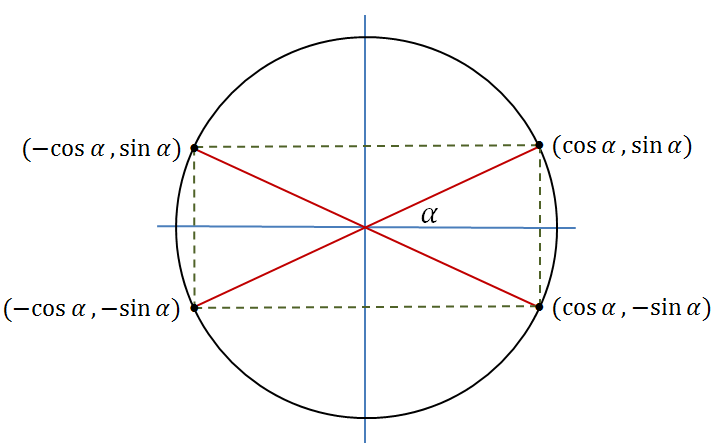
the other ones are
cos(-x) = cos(x)
cos(180-x) = -cos(x)
cos(180+x) = -cos(x)
sin(180-x) = sin(x)
sin(180+x) = -sin(x)
cold dune
cold dune
ahh i see
so there are a couple identities which you can use when you have sin(1...
try using this one to change -sin(180-15)
vernal fern
wait so decimal form -0.99
vernal fern
i just used a calculator to check
cold dune
oh
I meant try using the identity to change -sin(180-15)
we'll get to the exact value in a bit
vernal fern
im so sorry i dont understand
cold dune
frr
ok so
imagine you start from 0 on the unit circle, and move an imaginary amount, say x degrees on it
vernal fern
yes alright
cold dune
it'll look like something like this
cold dune
vernal fern
yes alright
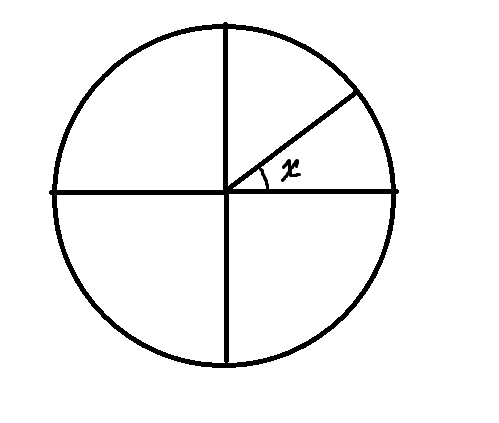
now about the point on the circle we're pointing at, do we agree that it's y coordinate is equal to sin(x)?
vernal fern
cold dune
now about the point on the circle we're pointing at, do we agree that it's y coo...
understanding..
cold dune
for example if we move 30 degrees on the circle, we'll get to a point where its y coordinate is sin(30), or 1/2 to be exact
vernal fern
cold dune
for example if we move 30 degrees on the circle, we'll get to a point where its ...
okay
cold dune
now imagine if we start from 0, then move 180 degrees on the circle, and then move back x degrees
something like this

we see that if we move x degrees or 180-x degrees on the circle, we get the same y coordinate (in other words, we get the same sine)
vernal fern
wait why are we doing that though
cold dune
that proves sin(180-x) = sin(x)
so in your question we have -sin(180-15)
following the same logic, we can say -sin(180-15) = -sin(15)
cold dune
all we did was change sin(-165) to -sin(15), to make it simpler to solve the problem
do you know about compound angle identities though?
cold dune
nice!
in short
sin(x+y) = sin(x).cos(y) + sin(y).cos(x)
cos(x+y) = cos(x).cos(y) - sin(x).sin(y)
as u can see, we can write -sin(15) as -sin(45-30)
vernal fern
oh oh oh
cold dune
cold dune
sin(x+y) = sin(x).cos(y) + sin(y).cos(x)
cos(x+y) = cos(x).cos(y) - sin(x).sin(y...
imagine x = 45 and y = -30, and use this formula to evaluate it
vernal fern
okay thank you very much i have to run to work i will do this on my break and come back in a couple hours
thank you very much!!!
cold dune
cheers! good luck
trim joltBOT
Channel closed
Closed by @vernal fern
Use .reopen if this was a mistake.
trim joltBOT
Available help channel!
Send your question here to claim the channel.
Remember:
• Ask your math question in a clear, concise manner.
• Show your work, and if possible, explain where you are stuck.
• After 15 minutes, feel free to ping <@&286206848099549185>.
• Type the command .close to free the channel when you're done.
• Be polite and have a nice day!
Read #❓how-to-get-help for further information on how to ask a good question, and about conduct in the question channels.
 drifting storm
 trim joltBOT
drifting storm
drifting storm
trim joltBOT
drifting storm
drifting storm
guys can anyone pls help guide on how to solve this
 lilac flame
you can start by simplifying what's inside the modulus
 drifting storm
lilac flame
you can start by simplifying what's inside the modulus
drifting storm
lilac flame
you can start by simplifying what's inside the modulus
do i do that by removing fractions?
drifting storm
oooh
lilac flame
drifting storm
this is almost correct
you should plug in the solutions you found
to check if they're correct
because for example the left side is only true if what's inside the modulus is positive
drifting storm
ooohhhh
ohhhh ure rightt
i got it correct alreadyy
thank you so muchh
.close
trim joltBOT
Channel closed
Closed by @drifting storm
Use .reopen if this was a mistake.
lilac flame
np
drifting storm
.reopen
trim joltBOT
✅
drifting storm
btw guys, is |21/5| = -21/5?
nova spire
no
|21/5| is 21/5
since 21/5 > 0
|x| always outputs the positive (non-negative) value
drifting storm
ohhh wait yes ure right, absolute value should give non negative results

so do i conclude that this equation only has one solution?
 drifting turtle
solve 2x+7 = 0 first to note when the absolute value function changes the sign of 3x
which is -7/2
now for each case x >= -7/2 and x < -7/2
for the first case the RHS is just 3x, for second case RHS is -3x
then solve for each case
reject when the answer contradicts the assumption (for the first case l, x>= -7/2)
trim joltBOT
Channel closed
Closed by @drifting storm
Use .reopen if this was a mistake.
drifting turtle
np
trim joltBOT
Available help channel!
Send your question here to claim the channel.
Remember:
• Ask your math question in a clear, concise manner.
• Show your work, and if possible, explain where you are stuck.
• After 15 minutes, feel free to ping <@&286206848099549185>.
• Type the command .close to free the channel when you're done.
• Be polite and have a nice day!
Read #❓how-to-get-help for further information on how to ask a good question, and about conduct in the question channels.
trim joltBOT
 prime lynx
Yeah sure
 nimble stone
i would say or rather than and, but sure, both are okay
prime lynx
Although change the and to or
nimble stone
and means it has to satisfy both of them to use that expression
which doesnt work
or means it can satisfy either or both
that much is fine, yeah
no real difference really, one just takes less time to write
trim joltBOT
Channel closed
Closed by @echo scaffold
Use .reopen if this was a mistake.
trim joltBOT
Available help channel!
Send your question here to claim the channel.
Remember:
• Ask your math question in a clear, concise manner.
• Show your work, and if possible, explain where you are stuck.
• After 15 minutes, feel free to ping <@&286206848099549185>.
• Type the command .close to free the channel when you're done.
• Be polite and have a nice day!
Read #❓how-to-get-help for further information on how to ask a good question, and about conduct in the question channels.
 untold phoenix
Hey I need help with this
trim joltBOT
untold phoenix
Hey I need help with this
untold phoenix


This is the drawing I’ve setup
Now Im a little confused with finding the top of my Z, because Z = to squareroot of 9-y^2 seems right
But the thing is why is that the case? Its a cylinder extending infinitely into X no?
untold phoenix
 prime sierra
the plane y=3x prevents x from getting to infinity.
prime sierra
the plane y=3x prevents x from getting to infinity.
Oh yeah ur right, I got confused because my drawing skills suck LOL
That black shape is my new drawing, that’s the solid right?
 trim joltBOT
@untold phoenix Has your question been resolved?
trim joltBOT
Channel closed
Closed due to timeout
Use .reopen if this was a mistake.
trim joltBOT
Available help channel!
Send your question here to claim the channel.
Remember:
• Ask your math question in a clear, concise manner.
• Show your work, and if possible, explain where you are stuck.
• After 15 minutes, feel free to ping <@&286206848099549185>.
• Type the command .close to free the channel when you're done.
• Be polite and have a nice day!
Read #❓how-to-get-help for further information on how to ask a good question, and about conduct in the question channels.
 deep solstice
if 100% is 124
.... %? 279
trim joltBOT
deep solstice
if 100% is 124
.... %? 279
 pseudo zodiac
deep solstice
if 100% is 124
.... %? 279
pseudo zodiac
deep solstice
if 100% is 124
.... %? 279
100/100 * x = 124
=> x = 124
y/100 * 124 = 279
y = 27900/124
deep solstice
pseudo zodiac
100/100 * x = 124
=> x = 124
y/100 * 124 = 279
y = 27900/124
225%?
pseudo zodiac
deep solstice
225%?
yup
trim joltBOT
@deep solstice Has your question been resolved?
Channel closed
Closed by @deep solstice
Use .reopen if this was a mistake.
Available help channel!
Send your question here to claim the channel.
Remember:
• Ask your math question in a clear, concise manner.
• Show your work, and if possible, explain where you are stuck.
• After 15 minutes, feel free to ping <@&286206848099549185>.
• Type the command .close to free the channel when you're done.
• Be polite and have a nice day!
Read #❓how-to-get-help for further information on how to ask a good question, and about conduct in the question channels.
 snow night
I need help
trim joltBOT
snow night
I need help
snow night
A guy asked 50 dollars from his mom and dad so he could buy a shirt, he now has 100 dollars. He then went outside to buy a shirt, he said "Hey, how much is shirt?" The seller said "100 dollars" he then said "can I get a discount?" The seller "said sure I'll sell it to you for 97$" he now has 3 dollars that he will give it to both his parent's and the extra 1 dollar for him. He then gave 1 dollar to both his parents, since he gave the 1 dollar back the parents gave him 50 each in total. 49+49 = 98$ + 1 from his extra change = 99$. Where did the extra 1 go$
solid kilnBOT
𝗖𝗼𝗿𝗺𝗮𝗰

 empty sluice
Wait. If he gives 1 dollar each to his parents, he has 1 dollar with him. Then his parents give him 50 each. So won't he have 1+50+50=101? Or did I get the question wrong?
snow night
empty sluice
Wait. If he gives 1 dollar each to his parents, he has 1 dollar with him. Then h...
His parents gave him 50 each
Then he bought shirt for 97
He now has 3
He gave 1 dollar to his mom and dad
He kept 1 dollar
empty sluice
Right
snow night
Then
Since he gave 1 to his parents
The parents made 1 dollar
So like
Wait

It's like this
trim joltBOT
Please show the original problem, exactly as it was stated to you, with the entire original context. A picture or screenshot is best. If the original problem is not in English, then post it anyway! The additional context might still be helpful. Do your best to provide a translation.
snow night
It was just told
trim joltBOT
@snow night Has your question been resolved?
 wind cloak
snow night
It was just told
wind cloak
snow night
It was just told
So after he gave 1 dollar to each of his parents, we can see this new situation like the both the parents gave him 49 dollars each.
So he has total 98 dollars. From these 98 dollars, he bought a shirt for 97 dollars and kept one for himself
trim joltBOT
Channel closed
Closed due to timeout
Use .reopen if this was a mistake.
Available help channel!
Send your question here to claim the channel.
Remember:
• Ask your math question in a clear, concise manner.
• Show your work, and if possible, explain where you are stuck.
• After 15 minutes, feel free to ping <@&286206848099549185>.
• Type the command .close to free the channel when you're done.
• Be polite and have a nice day!
Read #❓how-to-get-help for further information on how to ask a good question, and about conduct in the question channels.
 strange imp
In the following system of equations, y can be expressed as m/n, where m and n are positive integers and relatively prime. What is the value of m + n?
trim joltBOT
strange imp
In the following system of equations, y can be expressed as m/n, where m and n a...
 trim joltBOT
Channel closed
Closed by @strange imp
Use .reopen if this was a mistake.
trim joltBOT
Available help channel!
Send your question here to claim the channel.
Remember:
• Ask your math question in a clear, concise manner.
• Show your work, and if possible, explain where you are stuck.
• After 15 minutes, feel free to ping <@&286206848099549185>.
• Type the command .close to free the channel when you're done.
• Be polite and have a nice day!
Read #❓how-to-get-help for further information on how to ask a good question, and about conduct in the question channels.
 static girder
Javier draws a quadrilateral. The first and second angles are equal. The third angle is 45° more than the first angle. The fourth angle is half the size of the first angle.
(a) Let the size of the first angle be x. Write down the sizes of the other three angles in terms of x.
(b) Form an equation in x and solve for y x to find the size of each angle of the quadrilateral.
I have done a which is
1, 2 = x
3 = x + 45°
4 = x ÷ 2.
I'm still stuck on b because I don't know what equation to make.
trim joltBOT
static girder
Javier draws a quadrilateral. The first and second angles are equal. The third a...
 mild oxide
Yo
static girder
Hi
static girder
Yes I've done that
mild oxide
.close
trim joltBOT
Channel closed
Closed by @static girder
Use .reopen if this was a mistake.
mild oxide
Welcome
trim joltBOT
Available help channel!
Send your question here to claim the channel.
Remember:
• Ask your math question in a clear, concise manner.
• Show your work, and if possible, explain where you are stuck.
• After 15 minutes, feel free to ping <@&286206848099549185>.
• Type the command .close to free the channel when you're done.
• Be polite and have a nice day!
Read #❓how-to-get-help for further information on how to ask a good question, and about conduct in the question channels.
 lavish sequoia
 trim joltBOT
lavish sequoia
trim joltBOT
lavish sequoia
 hollow arrow
quadratic equation?
hollow arrow
Isn't it supposed to be 0?
lavish sequoia
hollow arrow
Isn't it supposed to be 0?
yh
hollow arrow
the discriminant is less than 0
lavish sequoia
yh
hollow arrow
So there are no real solutions
hollow arrow
if the discriminant = 0
lavish sequoia
yep
hollow arrow
then there is one real solution
lavish sequoia
yh
hollow arrow
Okay I think you got it
lavish sequoia
thnx
lavish sequoia
hollow arrow
Okay I think you got it
yeah
hollow arrow
np
lavish sequoia
.close
trim joltBOT
Channel closed
Closed by @lavish sequoia
Use .reopen if this was a mistake.
trim joltBOT
Available help channel!
Send your question here to claim the channel.
Remember:
• Ask your math question in a clear, concise manner.
• Show your work, and if possible, explain where you are stuck.
• After 15 minutes, feel free to ping <@&286206848099549185>.
• Type the command .close to free the channel when you're done.
• Be polite and have a nice day!
Read #❓how-to-get-help for further information on how to ask a good question, and about conduct in the question channels.
trim joltBOT
empty sluice
What are you supposed to find?
 vernal briar
Yeah guessing is easy here
 supple copper
pick 3 integers that multiply to 4
 elder glade
I know but how do u do it with equations
supple copper
you don't
maybe you do actually im not sure
there's some weird cubic factorisation methods i've not studied
in general it's really ass though
supple copper
i wouldn't
i just said, i wouldn't
i'd look at it
try to guess
if it doesn't work i'd give up
lol
i mean i suppose you can substitute things in and see if it works
solve for alpha, sub into beta, etc etc
that's a pain though
idk it sounds terribel
there's a cubic formula if you want to take a look
no one really uses it though
sudden mist
IIRC you could also try to exploit some kind of symmetry to avoid solving a cubic
trim joltBOT
Channel closed
Closed by @elder glade
Use .reopen if this was a mistake.
trim joltBOT
Available help channel!
Send your question here to claim the channel.
Remember:
• Ask your math question in a clear, concise manner.
• Show your work, and if possible, explain where you are stuck.
• After 15 minutes, feel free to ping <@&286206848099549185>.
• Type the command .close to free the channel when you're done.
• Be polite and have a nice day!
Read #❓how-to-get-help for further information on how to ask a good question, and about conduct in the question channels.
 fathom flicker
Is the answer of question 17 D?
 trim joltBOT
fathom flicker
Is the answer of question 17 D?
trim joltBOT
fathom flicker
Is the answer of question 17 D?
 chilly bobcat
fathom flicker
Is the answer of question 17 D?
chilly bobcat
fathom flicker
Is the answer of question 17 D?
yes
trim joltBOT
Channel closed
Closed by @fathom flicker
Use .reopen if this was a mistake.
 steady silo
hhelpme
trim joltBOT
Available help channel!
Send your question here to claim the channel.
Remember:
• Ask your math question in a clear, concise manner.
• Show your work, and if possible, explain where you are stuck.
• After 15 minutes, feel free to ping <@&286206848099549185>.
• Type the command .close to free the channel when you're done.
• Be polite and have a nice day!
Read #❓how-to-get-help for further information on how to ask a good question, and about conduct in the question channels.
 pale tulip
 trim joltBOT
pale tulip
trim joltBOT
pale tulip
 trim joltBOT
@pale tulip Has your question been resolved?
trim joltBOT
Channel closed
Closed due to timeout
Use .reopen if this was a mistake.
Available help channel!
Send your question here to claim the channel.
Remember:
• Ask your math question in a clear, concise manner.
• Show your work, and if possible, explain where you are stuck.
• After 15 minutes, feel free to ping <@&286206848099549185>.
• Type the command .close to free the channel when you're done.
• Be polite and have a nice day!
Read #❓how-to-get-help for further information on how to ask a good question, and about conduct in the question channels.
 marsh forum
Can I have this verified
 trim joltBOT
marsh forum
Can I have this verified
marsh forum
trim joltBOT
marsh forum
Can I have this verified
marsh forum
I can tex it if required
 grim sparrow
do you mind elaborating a bit when you say “by definition”?
chilly bobcat
marsh forum
Can I have this verified
hmm, for sums like these a more formal answer would be better
you can start with calling a variable x, where x belongs to A
 worldly wing
What does U_f represent?
chilly bobcat
all the elements in the family of sets F
if F is {{1, 2}, {2, 3}} then U F is {1, 2, 3}
worldly wing
How is it different than F itself then
worldly wing
chilly bobcat
if F is {{1, 2}, {2, 3}} then U F is {1, 2, 3}
Ohhhh okay
sudden mist
It’s just the union
sudden mist
It has a precise definition in this case, which the exercise is all about
marsh forum
One minute, have some bank work to finish, will be back in 5
So I basically have to define the unions of multiple sets here
sudden mist
You have to define? Isn’t it already given
sudden mist
Try and unpack what you have and what the goal is
For example unpack what it means for a set to be a subset of another, since after all this is what you’ll need to show
marsh forum
$x \in A_i$
solid kilnBOT
ƒ(Why am. I here)=I don't Know
 marsh forum
sudden mist
For example unpack what it means for a set to be a subset of another, since afte...
marsh forum
sudden mist
For example unpack what it means for a set to be a subset of another, since afte...
Something like this right
sudden mist
solid kiln
**ƒ(Why am. I here)=I don't Know**
What is this for?
sudden mist
Why are you constructing it? It should already be given
In your textbook or whatever it may be
chilly bobcat
marsh forum
$x \in A_i$
so basically, $x \in A$, and\
$A \subseteq \cup F \implies x \in \cup F$
i dont know if there's any special theorem to make it clearer so this is the best I can do
sudden mist
??
chilly bobcat
sudden mist
??
what happened? it looks quite right to me
chilly bobcat
sudden mist
A subset U F is what we want to show
they have given that A is a subset of F
sudden mist
chilly bobcat
they have given that A is a subset of F
No they’re given A is an element of F
chilly bobcat
sudden mist
No they’re given A is an element of F
ahhh my bad
marsh forum
So my proof is wrong?
solid kilnBOT
 chilly bobcat
better now?
sudden mist
I mean in any case I don’t see how this is helping
sudden mist
marsh forum
So my proof is wrong?
You just need to clarify it, or else I could write every proof of my own as “proof by definition” and be done
chilly bobcat
marsh forum
So my proof is wrong?
not really, just that I'm not sure if they'd accept a worded solution
marsh forum
So I need to write the definition of union essentially right?
sudden mist
solid kiln
No that’s just gibberish to me
sudden mist
marsh forum
So I need to write the definition of union essentially right?
Yeah just unpack what everything says
First off start slow
You’re essentially showing a set is a subset of another set
What does that mean? Start like that and peel the layers slowly
chilly bobcat
sudden mist
No that’s just gibberish to me
x is an element of A
A is a subset of UF
so, x belongs to UF as well
that's essentially what it means
sudden mist
chilly bobcat
x is an element of A
A is a subset of UF
so, x belongs to UF as well
Your second line is literally what we want to show
chilly bobcat
sudden mist
Your second line is literally what we want to show
yes that's where I'm stuck
marsh forum
So this essentially means that $x \in A \implies x \in B$
chilly bobcat
I've never done questions using UF
chilly bobcat
marsh forum
So this essentially means that $x \in A \implies x \in B$
if A is a subset of B or the other way round
sudden mist
chilly bobcat
I've never done questions using UF
Well if you can’t help, then don’t? We’re trying to help someone else here
solid kilnBOT
ƒ(Why am. I here)=I don't Know
 sudden mist
solid kiln
**ƒ(Why am. I here)=I don't Know**
sudden mist
solid kiln
**ƒ(Why am. I here)=I don't Know**
Yeah for arbitrary x
And in our case B is?
sudden mist
Yeah
solid kilnBOT
ƒ(Why am. I here)=I don't Know
 sudden mist
marsh forum
sorry
sudden mist
marsh forum
sorry
It’s fine don’t worry
So in your textbook, do you have a definition for a union over a family of sets?
marsh forum
so as every arbitrary element x that belongs to A belongs to $\bigcup F$ we have that $ A \subseteq \bigcup F$
solid kilnBOT
ƒ(Why am. I here)=I don't Know
 sudden mist
That’s what we’re trying to convince ourselves of in the moment yes
But we haven’t shown it yet
marsh forum
what do you mean
sudden mist
We want to show that A is a subset of union F
marsh forum
yes
sudden mist
solid kiln
**ƒ(Why am. I here)=I don't Know**
This is just restating the definition
It doesn’t mean it’s necessarily true
So convince me!
marsh forum
so you want me to define union now right?
sudden mist
I could do it for you, the reason we need to is to unpack what the notation is saying; or else it could really mean anything
So x is an element of union F iff there exists some element B in F such that x is an element of B
Does your textbook state something similar?
solid kilnBOT
ƒ(Why am. I here)=I don't Know
 sudden mist
That’s a union between two sets, we’re talking about over a family of sets
Is there one for a family of sets?
solid kilnBOT
ƒ(Why am. I here)=I don't Know
 sudden mist
Yup this is the exact same
Note that the letter A here isn’t necessarily the same set so it’s best to use a different letter like I did
So if we pick an element in the union it satisfies the latter condition which you have written
sudden mist
sudden mist
So x is an element of union F iff there exists some element B in F such that x i...
I.e this
marsh forum
hmm, yeah
sudden mist
But notice that by assumption we have that x is in A
so there does indeed exist an element in F (pick B=A)
Such that x is in B
marsh forum
oh , that's it?
sudden mist
Yup!
 sudden mist
Np 
marsh forum
I'm used to using intutution
sudden mist
Yeah that’s what I realized too
marsh forum
sadge
sudden mist
Definitions are really important
marsh forum
yeah, thanks
trim joltBOT
Channel closed
Closed by @marsh forum
Use .reopen if this was a mistake.
trim joltBOT
Available help channel!
Send your question here to claim the channel.
Remember:
• Ask your math question in a clear, concise manner.
• Show your work, and if possible, explain where you are stuck.
• After 15 minutes, feel free to ping <@&286206848099549185>.
• Type the command .close to free the channel when you're done.
• Be polite and have a nice day!
Read #❓how-to-get-help for further information on how to ask a good question, and about conduct in the question channels.
 spring bolt
If four sides of parallelogram sides touches a circle like this then it will be
trim joltBOT
spring bolt
If four sides of parallelogram sides touches a circle like this then it will be
 trim joltBOT
@spring bolt Has your question been resolved?