#help-38
1 messages · Page 134 of 1
 dusk bear
idont knowi worked this problem out before i saw the lecture this morning 😭
and that was mentioned
let me upload my work onto here
dusk bear
 worldly wing
why would that be necessary?
worldly wing
why would that be necessary?
 worldly wing
I think your working was fine
just the last substitution is wrong
why does x=0 give you a 1?
dusk bear
because sin(0) = 1
worldly wing
dusk bear
because sin(0) = 1
wrong
dusk bear
oh
oh wait i see
for some reason my mind went up the y axis
instead of to the right
 trim joltBOT
@dusk bear Has your question been resolved?
Channel closed
Closed by @dusk bear
Use .reopen if this was a mistake.
trim joltBOT
 Available help channel!
Send your question here to claim the channel.
Remember:
• Ask your math question in a clear, concise manner.
• Show your work, and if possible, explain where you are stuck.
• After 15 minutes, feel free to ping <@&286206848099549185>.
• Type the command .close to free the channel when you're done.
• Be polite and have a nice day!
Read #❓how-to-get-help for further information on how to ask a good question, and about conduct in the question channels.
 misty cosmos
The sequence ${a_{n}}$ is defined by the following conditions. $\ a_{1} = \frac{1}{2}, a_{2} = \frac{1}{3}, a_{n+2} = \frac{a_{n}a_{n+1}}{2a_{n}-a_{n+1}+2_{a}a_{n+1}}$ \ So the first part of the question was: (i) Let $b_{n} = \frac{1}{a_{n}}.$ Express $b_{n+2}$ in terms of $b_{n+1}$ and $b_{n}.$ Which i got $b_{n+2} = 2b_{n+1}-b_{n} + 2$ by flipping the sequence of $a_{n+2}.$ \\ What I am confused about is the second part to the question which is: Let $b_{n+1} - b_{n} = c_{n}.$ Express $c_{n}$ in terms of $n$.
trim joltBOT
misty cosmos
The sequence ${a_{n}}$ is defined by the following conditions. $\\ a_{1} = \frac...
 solid kilnBOT
ISAVAGE
 misty cosmos
am i suppose to substitute??
trim joltBOT
@misty cosmos Has your question been resolved?
trim joltBOT
@misty cosmos Has your question been resolved?
trim joltBOT
@misty cosmos Has your question been resolved?
trim joltBOT
Channel closed
Closed by @misty cosmos
Use .reopen if this was a mistake.
Available help channel!
Send your question here to claim the channel.
Remember:
• Ask your math question in a clear, concise manner.
• Show your work, and if possible, explain where you are stuck.
• After 15 minutes, feel free to ping <@&286206848099549185>.
• Type the command .close to free the channel when you're done.
• Be polite and have a nice day!
Read #❓how-to-get-help for further information on how to ask a good question, and about conduct in the question channels.
 marsh forum
so I'm having a hard time understanding the proof of bezout's lemma
 spiral kettle
a minimal one you mean
you can take the set {ax + by: a, b in Z}, and that's a subset of the natural numbers
marsh forum
my book just says gcd(a,b)=ax+by
spiral kettle
spiral kettle
you can take the set {ax + by: a, b in Z}, and that's a subset of the natural nu...
then, since N is a well-order, the subset must have a least element
marsh forum
yes
spiral kettle
okay, that d is gcd(a,b)
 main sigil
marsh forum
more specifically, I'm unable to understand why a d=ax+by must exist
main sigil
marsh forum
more specifically, I'm unable to understand why a d=ax+by must exist
E.g. d = a*1 + b*1 obviously exists
spiral kettle
that's what bezout's lemma is

 pulsar dust
marsh forum
more specifically, I'm unable to understand why a d=ax+by must exist
pulsar dust
marsh forum
more specifically, I'm unable to understand why a d=ax+by must exist
That's a natural consequence of the Euclid algorithm
trim joltBOT
Channel closed
Closed by @marsh forum
Use .reopen if this was a mistake.
pulsar dust
marsh forum
wait
Yes if you reverse the process you get that
pulsar dust
Oh ok alright:)
trim joltBOT
Available help channel!
Send your question here to claim the channel.
Remember:
• Ask your math question in a clear, concise manner.
• Show your work, and if possible, explain where you are stuck.
• After 15 minutes, feel free to ping <@&286206848099549185>.
• Type the command .close to free the channel when you're done.
• Be polite and have a nice day!
Read #❓how-to-get-help for further information on how to ask a good question, and about conduct in the question channels.
 full dock
Not sure how to do part B
 trim joltBOT
full dock
Not sure how to do part B
trim joltBOT
full dock
Not sure how to do part B
 exotic pine
try to find the center of the circle
full dock
exotic pine
try to find the center of the circle
I need k for that but that’s hard to find isn’t it
exotic pine
not really
full dock
how do I find k
exotic pine
uh
exotic pine
marsh forum
can you find the equation of the normal
here
full dock
marsh forum
can you find the equation of the normal
Of y =x+1?
exotic pine
try to find the equation that passes trough the point of tangent and the center of the circle
full dock
But idk where the centre of the circle is
 marsh forum
you also know the distance from the centre to the tangent
exotic pine
i dont think its as simple as i thought
marsh forum
it is
exotic pine
i thought it would be simpler lol
marsh forum
if the centre is (h,k) what's the distance between teh point and the line
exotic pine
isnt it k,h
marsh forum
$d=\frac{|ax_1+by_1+c|}{\sqrt{a^2+b^2}}$
where the line equation is ax+by+c
and the point is (x,y)
exotic pine
tbh you should probably use x_1 y_1 lol to not cause confusion
solid kilnBOT
ƒ(Why am. I here)=I don't Know

 twilit latch
I think you guys might be overcomplicating this a bit
We know the height of the intersection point for the tangent line with the circle
Which instantly gives us it's x coordinate
And we know how far that point is horizontally from the center of the circle
This is all you need
exotic pine
good point
trim joltBOT
@full dock Has your question been resolved?
trim joltBOT
Channel closed
Closed due to timeout
Use .reopen if this was a mistake.
Available help channel!
Send your question here to claim the channel.
Remember:
• Ask your math question in a clear, concise manner.
• Show your work, and if possible, explain where you are stuck.
• After 15 minutes, feel free to ping <@&286206848099549185>.
• Type the command .close to free the channel when you're done.
• Be polite and have a nice day!
Read #❓how-to-get-help for further information on how to ask a good question, and about conduct in the question channels.
 fair forge
why 2^(k-1)?
 trim joltBOT
fair forge
why 2^(k-1)?
fair forge
trim joltBOT
fair forge
why 2^(k-1)?
fair forge
and also this:

 trail ingot

trim joltBOT
@fair forge Has your question been resolved?
fair forge
trail ingot
<:eeveethink:601029006418116608>
it makes 0 sense to just make this step without explanation
trail ingot
it’s also wrong
fair forge
trail ingot
it’s also wrong
can you prove it?
trail ingot
fair forge
why 2^(k-1)?
you can just put n = 3 or whatever here and those aren’t equal
trail ingot
that equality is wrong regardless
fair forge
trail ingot
you can just put n = 3 or whatever here and those aren’t equal
yeah true
fair forge
exotic pine
could you post the whole thing?
yeah
prove:

using newton's idk-what


q.e.d
n is a natural number (in this class >= 1)
pulsar dust
ok lets see
$\sum_{k=0}^{n} \binom{n}{k} \frac{1}{n^k}$
solid kilnBOT
convergence
 pulsar dust
now this is equal to
$\sum_{k=0}^{n} \frac{\left(n(n-1)\dots(n-k+1)\right)}{k!}\frac{1}{n^k}$
solid kilnBOT
convergence
 fair forge
pulsar dust
now this is equal to
$\sum_{k=0}^{n} \frac{\left(n(n-1)\dots(n-k+1)\right)}{k!}...
fair forge
pulsar dust
now this is equal to
$\sum_{k=0}^{n} \frac{\left(n(n-1)\dots(n-k+1)\right)}{k!}...
i dont follow, dont skip step pls
pulsar dust
its just cancelling the common terms
fair forge
pulsar dust
its just cancelling the common terms
i dont follow
pulsar dust
n!=n(n-1)...(n-k+1)(n-k)!
fair forge
pulsar dust
n!/(n-k)!
= n(n-1)...(n-k+1)
pulsar dust
yes
fair forge
pulsar dust
yes
and this has to be divided by n^k
pulsar dust
yes\
fair forge
pulsar dust
yes\
so whats next? saying this is $\leq$ whats in the proof above?
solid kilnBOT
Ayanokoji
 pulsar dust
mmmh wait i forgot why

Mathematics Stack Exchange
It was shown in here that $\left(1+\frac{1}{n}\right)^n < n$ for $n>3$. I think we can be come up with a better bound, as follows:
$$\left(1+\frac{1}{n}\right)^n \le 3-\frac{1}{n}$$
for ...
check here
and we can state 3 -1/n<3
fair forge
pulsar dust
and we can state 3 -1/n<3
wrong proof, n->inf we get lim=3, and e=2.78
fair forge
pulsar dust
but we are not talking about limits here
well then i dont get it
ill look into it later
.close
trim joltBOT
Channel closed
Closed by @fair forge
Use .reopen if this was a mistake.
trim joltBOT
Available help channel!
Send your question here to claim the channel.
Remember:
• Ask your math question in a clear, concise manner.
• Show your work, and if possible, explain where you are stuck.
• After 15 minutes, feel free to ping <@&286206848099549185>.
• Type the command .close to free the channel when you're done.
• Be polite and have a nice day!
Read #❓how-to-get-help for further information on how to ask a good question, and about conduct in the question channels.
 tropic heart
what did i do wrong here?

 trim joltBOT
tropic heart
what did i do wrong here?
tropic heart
trim joltBOT
tropic heart
what did i do wrong here?
tropic heart
<@&286206848099549185>
trim joltBOT
@tropic heart Has your question been resolved?
 nimble zealot
I think you mixed up your sin and cos angles
It should be $T_a \sin{\theta} = T_b \cos{\theta} + 2.2g$
solid kilnBOT
interesting_ly
 tropic heart
nimble zealot
It should be $T_a \sin{\theta} = T_b \cos{\theta} + 2.2g$
tropic heart
nimble zealot
It should be $T_a \sin{\theta} = T_b \cos{\theta} + 2.2g$
how tho
isnt it $T_a \sin{A} = T_b \cos{B} + 2.2g$
solid kilnBOT
zen
 tropic heart
and A is 90-theta and B is theta
nimble zealot
$T_a sin A$ would be the horizontal component of $T_a$, maybe you should check again?
solid kilnBOT
interesting_ly
 trim joltBOT
@tropic heart Has your question been resolved?
trim joltBOT
Channel closed
Closed by @tropic heart
Use .reopen if this was a mistake.
trim joltBOT
Available help channel!
Send your question here to claim the channel.
Remember:
• Ask your math question in a clear, concise manner.
• Show your work, and if possible, explain where you are stuck.
• After 15 minutes, feel free to ping <@&286206848099549185>.
• Type the command .close to free the channel when you're done.
• Be polite and have a nice day!
Read #❓how-to-get-help for further information on how to ask a good question, and about conduct in the question channels.
 dapper ice
How do I do this?
 dapper ice
,rotate
solid kilnBOT

 pseudo bear
!show
trim joltBOT
Show your work, and if possible, explain where you are stuck.
dapper ice
Idk how to do it
trim joltBOT
@dapper ice Has your question been resolved?
 cunning gate
it takes 50 seconds per transaction
 wraith hinge
therefore 360 receipt
cunning gate
convert seconds to minutes and minutes to hours and then divide the 5 hours by the time taken per transaction in hours
wraith hinge
cunning gate
convert seconds to minutes and minutes to hours and then divide the 5 hours by t...
yes
then divide time for one receipt by total time he work for
sorry other way around
total time by time for one receipt
@dapper ice
trim joltBOT
Channel closed
Closed due to timeout
Use .reopen if this was a mistake.
Available help channel!
Send your question here to claim the channel.
Remember:
• Ask your math question in a clear, concise manner.
• Show your work, and if possible, explain where you are stuck.
• After 15 minutes, feel free to ping <@&286206848099549185>.
• Type the command .close to free the channel when you're done.
• Be polite and have a nice day!
Read #❓how-to-get-help for further information on how to ask a good question, and about conduct in the question channels.
 civic fox
Hi, I have a little problem...
I have to solve the image operation, I already did but I still can’t understand step 3, I don't understand why (11m/5pq²r)³•(5r³/7p²)² can be expressed as (11³m³•5²r⁶)/(5³p³q⁶r³•7²p⁴), in the book says that it's by the property power of a product, but as far as I understand, this applies only when the exponents are the same number, in this case the exponents are 3 and 2, I think I lack to understand something, I would appreciate some help.
 trim joltBOT
civic fox
Hi, I have a little problem...
I have to solve the image operation, I already di...
trim joltBOT
civic fox
Hi, I have a little problem...
I have to solve the image operation, I already di...
 dapper flicker
$$(a^{b})^{c}=a^{b*c}$$
solid kilnBOT
CrEpasPmkinPie
 dapper flicker
this is true no matter what b and c are
civic fox
dapper flicker
this is true no matter what b and c are
So I should apply the property power of a power instead of the property power of a product?
dapper flicker
the power of a power rule is distributive
theyre the same thing
the power of a product rule is just what it's called when multiple power-of-a-powers are applied
civic fox
dapper flicker
the power of a product rule is just what it's called when multiple power-of-a-po...
Oh ok.
Thank you.
.close
trim joltBOT
Channel closed
Closed by @civic fox
Use .reopen if this was a mistake.
trim joltBOT
Available help channel!
Send your question here to claim the channel.
Remember:
• Ask your math question in a clear, concise manner.
• Show your work, and if possible, explain where you are stuck.
• After 15 minutes, feel free to ping <@&286206848099549185>.
• Type the command .close to free the channel when you're done.
• Be polite and have a nice day!
Read #❓how-to-get-help for further information on how to ask a good question, and about conduct in the question channels.
wraith hinge
 trim joltBOT
wraith hinge
trim joltBOT
wraith hinge
 dull temple
hmm, well i don't want to just tell you how to do it because that's the point
but what's your proof for what you have so far?
 cyan zinc
wraith hinge
cyan zinc
wraith hinge
You already asked this
wraith hinge
cyan zinc
You already asked this
oh i meant question 2
 wraith hinge
dull temple
but that's not a proof
wraith hinge
dull temple
but that's not a proof
so how do i prove it/
dull temple
what if i gave you n = 2340923842309482309482309420492343
dull temple
,w 2340923842309482309482309420492343 * 3
solid kilnBOT


 Requested by kitten.in.a.teacup
wraith hinge
dull temple
doesn't look like it
Requested by kitten.in.a.teacup
wraith hinge
dull temple
doesn't look like it
wait
wraith hinge
ohhhh i thought u meant 'find the end of digit within n'
wraith hinge
dull temple
you're trying to find an m that goes with that n to make n * m end in a 1
so it should be 7
wraith hinge
dull temple
you're trying to find an m that goes with that n to make n * m end in a 1
i missunderstood ur question
.close
trim joltBOT
Channel closed
Closed by @idle mica
Use .reopen if this was a mistake.
trim joltBOT
Available help channel!
Send your question here to claim the channel.
Remember:
• Ask your math question in a clear, concise manner.
• Show your work, and if possible, explain where you are stuck.
• After 15 minutes, feel free to ping <@&286206848099549185>.
• Type the command .close to free the channel when you're done.
• Be polite and have a nice day!
Read #❓how-to-get-help for further information on how to ask a good question, and about conduct in the question channels.
 dense wharf
Did I mess anything up?
trim joltBOT
dense wharf
Did I mess anything up?
 stoic oxide
virzus

 trim joltBOT
Channel closed
Closed by @dense wharf
Use .reopen if this was a mistake.
 rotund grove
,w factor x^2+y^2+xy=0
solid kilnBOT

 Requested by anshulyolo121
trim joltBOT
Available help channel!
Requested by anshulyolo121
trim joltBOT
Available help channel!
Send your question here to claim the channel.
Remember:
• Ask your math question in a clear, concise manner.
• Show your work, and if possible, explain where you are stuck.
• After 15 minutes, feel free to ping <@&286206848099549185>.
• Type the command .close to free the channel when you're done.
• Be polite and have a nice day!
Read #❓how-to-get-help for further information on how to ask a good question, and about conduct in the question channels.
 mellow fox
Part d is my problem
trim joltBOT
Channel closed
Channel closed due to the original message being deleted.
If you did not intend to do this, please open a new help channel,
as this action is irreversible, and this channel may abruptly lock.
mellow fox
Part d is my problem
I assumed because the gradient is 1
It must be x/x
So the time must be X seconds
trim joltBOT
Available help channel!
Send your question here to claim the channel.
Remember:
• Ask your math question in a clear, concise manner.
• Show your work, and if possible, explain where you are stuck.
• After 15 minutes, feel free to ping <@&286206848099549185>.
• Type the command .close to free the channel when you're done.
• Be polite and have a nice day!
Read #❓how-to-get-help for further information on how to ask a good question, and about conduct in the question channels.
 severe stump
Is anyone really good with Excel? I'm in a math class and the first assignment is to execute some functions in Excel but there's not even guide for me to even know where to start with what the teacher wants.
trim joltBOT
severe stump
Is anyone really good with Excel? I'm in a math class and the first assignment i...
severe stump
I have a set of data that goes down 1000 rows, and I need to isolate between sex 1 and 2 but I have no idea what function can even execute something like that.

I don't even know what I don't know, so I have no idea how to look this up on Google either.
 knotty locust
what do you mean isolate between sex1 and sex2
like sort the rows so that sex1 is all the top rows and then sex2 is all the rows below?

 split chasm
think you can use a filter function
severe stump
A what now
split chasm
there's a function in excel called
"FILTER"
 supple copper
There’s Microsoft excel documentation to look through how to use functions
It’d be very useful to learn how to read documentation
split chasm
that allows you to grab data that fulfils certain conditions you specify
severe stump
supple copper
It’d be very useful to learn how to read documentation
Well duh. I would imagine this documentation is very long, and I didn't know what I was looking for.
severe stump
split chasm
that allows you to grab data that fulfils certain conditions you specify
Where do I find that?
supple copper
severe stump
Well duh. I would imagine this documentation is very long, and I didn't know wha...
Yes I’m not saying you shouldn’t ask, I just wanted to tell you the documentation exists
split chasm
well you know the name now
so look up the documentation specifically for "FILTER"
there's also a few channels (i forgot the names)
that do vids on nice excel tips and tricks
severe stump
Ok. I've never used excel before so this short class is very overwhelming to me.
.close
trim joltBOT
Channel closed
Closed by @severe stump
Use .reopen if this was a mistake.
trim joltBOT
Available help channel!
Send your question here to claim the channel.
Remember:
• Ask your math question in a clear, concise manner.
• Show your work, and if possible, explain where you are stuck.
• After 15 minutes, feel free to ping <@&286206848099549185>.
• Type the command .close to free the channel when you're done.
• Be polite and have a nice day!
Read #❓how-to-get-help for further information on how to ask a good question, and about conduct in the question channels.
 grim sparrow
stupid question: do finite sets contain their limit points?
grim sparrow
oh this might be an xy actually
let me just lay my problem out flat
so I have this exercise

but I also have learned that finite sets are closed
I feel as though this exercise contradicts the closedness of finite sets
because they don't contain all of their limit points
the definition of "limit point" I am working with is that
p is a limit point of A if every neighbourhood of p contains of a point of A other than p itself
but if A is finite, like a singleton, surely it cannot contain a point outside of the single point itself
and yet I've learnt that a singleton is closed
am I mixing up definitions or something here?
 torn sorrel
Does a singleton set have any limit point which is not contained in set?
We don't have to worry about elements of set being limit points
grim sparrow
torn sorrel
Does a singleton set have any limit point which is not contained in set?
wdym
grim sparrow
no?
that's not what it says, does it?
take X = R and A = (0,1). then p = 1 is a limit point, but it is not in A
torn sorrel
torn sorrel
It should be in A
For A to be closed
grim sparrow
singletons are closed, but how do they contain their limit points?
grim sparrow
no, they don't
grim sparrow
so they contain no limit points, and thus contain all of them 
torn sorrel
Yea
grim sparrow
I see
torn sorrel

 torn sorrel
Ye
torn sorrel
Yw
trim joltBOT
Channel closed
Closed by @grim sparrow
Use .reopen if this was a mistake.
trim joltBOT
Available help channel!
Send your question here to claim the channel.
Remember:
• Ask your math question in a clear, concise manner.
• Show your work, and if possible, explain where you are stuck.
• After 15 minutes, feel free to ping <@&286206848099549185>.
• Type the command .close to free the channel when you're done.
• Be polite and have a nice day!
Read #❓how-to-get-help for further information on how to ask a good question, and about conduct in the question channels.
 boreal star
Does anyone know of a tool I can use to solve for x in the following expression?
(C*D*cos(C*arctan(B*x-E(B*x-arctan(B*x))))(B-E(B-B/((B^2)*(x^2)+1)))/(((B*x-E(Bx-arctan(Bx)))^2)+1)
I am trying to approximate the peak value of the pacejka magic formula, but this equation is far too complex for me to solve and solver websites seem to just give up.
 trim joltBOT
boreal star
Does anyone know of a tool I can use to solve for x in the following expression?...
trim joltBOT
boreal star
Does anyone know of a tool I can use to solve for x in the following expression?...
@boreal star Has your question been resolved?
trim joltBOT
@boreal star Has your question been resolved?
trim joltBOT
@boreal star Has your question been resolved?
Channel closed
Closed by @boreal star
Use .reopen if this was a mistake.
Available help channel!
Send your question here to claim the channel.
Remember:
• Ask your math question in a clear, concise manner.
• Show your work, and if possible, explain where you are stuck.
• After 15 minutes, feel free to ping <@&286206848099549185>.
• Type the command .close to free the channel when you're done.
• Be polite and have a nice day!
Read #❓how-to-get-help for further information on how to ask a good question, and about conduct in the question channels.
dapper ice
I tried solving this
trim joltBOT
dapper ice
I tried solving this
solid kilnBOT

 vocal vigil
It's there tho
dapper ice
for the x axis
vocal vigil
Y axis is solution
trim joltBOT
Channel closed
Closed by @dapper ice
Use .reopen if this was a mistake.
 trim joltBOT
Available help channel!
trim joltBOT
Available help channel!
Send your question here to claim the channel.
Remember:
• Ask your math question in a clear, concise manner.
• Show your work, and if possible, explain where you are stuck.
• After 15 minutes, feel free to ping <@&286206848099549185>.
• Type the command .close to free the channel when you're done.
• Be polite and have a nice day!
Read #❓how-to-get-help for further information on how to ask a good question, and about conduct in the question channels.
 thick idol
hey, can someone help with question 8?
 trim joltBOT
thick idol
hey, can someone help with question 8?
trim joltBOT
thick idol
hey, can someone help with question 8?

 hallow kite
what's g'(x)? you'll probably need that if you want to find g'(1)
thick idol
yea but im having trouble finding g'(x)
hallow kite
what do you think it should be
thick idol
or just g(x) itself
hallow kite
they give you g(x)?
so you just differentiate using power rule and chain rule and stuff
thick idol
OHHHHH
WAIT
but what about when it comes to differentiating that f(x) inside g(x)?
do i juust ignore it
hallow kite
no
when you calculate g'(x), it'll include f(x) and f'(x)
and since you want to find g'(1), you need f(1) and f'(1)
which you have
i mean if you differentiate g(x) first by using the power rule, you get 3/2 (2x + f(x))^(1/2), right?
thick idol
yes
hallow kite
but then you also need to do chain rule
so you multiply that by d/dx (2x + f(x))
which is 2 + f'(x)?
so combining all of that, you get g'(x) = 3/2 (2x + f(x))^(1/2) * (2 + f'(x))?
and evaluating this at 1, you have f(1) and f'(1)
thick idol
can i just use this rule U^n= n∙U^n-1∙U'
hallow kite
yes, that's exactly the rule i used
where u is some other function of x
u = 2x + f(x), n = 3/2
here
thick idol
hallow kite
so combining all of that, you get g'(x) = 3/2 (2x + f(x))^(1/2) * (2 + f'(x))?
yes i got this
so i just replace
x with 1 here
hallow kite
yes
thick idol
and i alr have f'(1)
 tropic vapor
Prove that
 hallow kite
!occupied
trim joltBOT
Someone else is already using this help channel. If you need help with a question, please open your own help channel/thread (see #❓how-to-get-help for instructions).
thick idol
hallow kite
so combining all of that, you get g'(x) = 3/2 (2x + f(x))^(1/2) * (2 + f'(x))?
does this simplify to : 3∙f'(x)∙(2x+f'(x))^1/2
hallow kite
no
3/2 (2 + f'(x)) can't be simplified to 3 f'(x)
it can be simplified to 3 + 3/2 f'(x) but at this point you should really just plug in 1
hallow kite
yes
trim joltBOT
Channel closed
Closed by @thick idol
Use .reopen if this was a mistake.
trim joltBOT
Available help channel!
Send your question here to claim the channel.
Remember:
• Ask your math question in a clear, concise manner.
• Show your work, and if possible, explain where you are stuck.
• After 15 minutes, feel free to ping <@&286206848099549185>.
• Type the command .close to free the channel when you're done.
• Be polite and have a nice day!
Read #❓how-to-get-help for further information on how to ask a good question, and about conduct in the question channels.
 silver sandal
hello
trim joltBOT
silver sandal
hello
 trim joltBOT
@silver sandal Has your question been resolved?
silver sandal
.close
trim joltBOT
Channel closed
Closed by @silver sandal
Use .reopen if this was a mistake.
Available help channel!
Send your question here to claim the channel.
Remember:
• Ask your math question in a clear, concise manner.
• Show your work, and if possible, explain where you are stuck.
• After 15 minutes, feel free to ping <@&286206848099549185>.
• Type the command .close to free the channel when you're done.
• Be polite and have a nice day!
Read #❓how-to-get-help for further information on how to ask a good question, and about conduct in the question channels.
trim joltBOT
Channel closed
Channel closed due to the original message being deleted.
If you did not intend to do this, please open a new help channel,
as this action is irreversible, and this channel may abruptly lock.
Available help channel!
Send your question here to claim the channel.
Remember:
• Ask your math question in a clear, concise manner.
• Show your work, and if possible, explain where you are stuck.
• After 15 minutes, feel free to ping <@&286206848099549185>.
• Type the command .close to free the channel when you're done.
• Be polite and have a nice day!
Read #❓how-to-get-help for further information on how to ask a good question, and about conduct in the question channels.
 deep hollow
Is it 35 million or 35,658.6 million?
 trim joltBOT
deep hollow
Is it 35 million or 35,658.6 million?
deep hollow
trim joltBOT
deep hollow
Is it 35 million or 35,658.6 million?
deep hollow
.close
trim joltBOT
Channel closed
Closed by @deep hollow
Use .reopen if this was a mistake.
trim joltBOT
Available help channel!
Send your question here to claim the channel.
Remember:
• Ask your math question in a clear, concise manner.
• Show your work, and if possible, explain where you are stuck.
• After 15 minutes, feel free to ping <@&286206848099549185>.
• Type the command .close to free the channel when you're done.
• Be polite and have a nice day!
Read #❓how-to-get-help for further information on how to ask a good question, and about conduct in the question channels.
 lone plover
tropic vapor
Prove that
lone plover
tropic vapor
Prove that
 trim joltBOT
lone plover
trim joltBOT
lone plover
 visual ivy
lone plover
visual ivy
lone plover
Don't forget to type .close
lone plover
im not finished yet
trim joltBOT
@lone plover Has your question been resolved?
lone plover
you can handle the second proof on your own
trim joltBOT
Channel closed
Closed by @lone plover
Use .reopen if this was a mistake.
Available help channel!
Send your question here to claim the channel.
Remember:
• Ask your math question in a clear, concise manner.
• Show your work, and if possible, explain where you are stuck.
• After 15 minutes, feel free to ping <@&286206848099549185>.
• Type the command .close to free the channel when you're done.
• Be polite and have a nice day!
Read #❓how-to-get-help for further information on how to ask a good question, and about conduct in the question channels.
 zinc raft
I asked this before but my chat closed.
I’m confused how to do this 🥲🥲🥲


 blazing meadow
m1=m4?
zinc raft
So do I make an equation or smt?
blazing meadow
yeah, an equation is a great idea
zinc raft
blazing meadow
yeah, an equation is a great idea
Can u help me pls
Idk what variable to put
It will equal 360 right
Idk
blazing meadow
give me a sec
m1 = 2(m3)
m2 = m3 + 20
m1 +m2 + m3 +m4 = 360
since m1 = m4
then 2 m1 + m2 + m3 = 360
give me a sec
blazing meadow
is this problem related to equation systems of three variables?
zinc raft
blazing meadow
is this problem related to equation systems of three variables?
Not at all
This is geometry
.close
trim joltBOT
Channel closed
Closed by @zinc raft
Use .reopen if this was a mistake.
trim joltBOT
Available help channel!
Send your question here to claim the channel.
Remember:
• Ask your math question in a clear, concise manner.
• Show your work, and if possible, explain where you are stuck.
• After 15 minutes, feel free to ping <@&286206848099549185>.
• Type the command .close to free the channel when you're done.
• Be polite and have a nice day!
Read #❓how-to-get-help for further information on how to ask a good question, and about conduct in the question channels.
 atomic crow
I'd like to understand how to determine if a Critical Point found using Lagrange multipliers is a max/min on an unbounded restriction.
Example problem
f(x, y) = e^xy
Restriction: x^3+y^3=16
Using Lagrange Theorem I arrive at one Critical Point at (2,2). How can I prove this is a min/max since the restriction isn't bounded and thus weierstrass theorem can't be used?
trim joltBOT
atomic crow
I'd like to understand how to determine if a Critical Point found using Lagrange...
solid kilnBOT
Slye
 trim joltBOT
@atomic crow Has your question been resolved?
atomic crow
<@&286206848099549185> anyone that can guide me please
atomic crow
,help
solid kilnBOT
A brief description and guide on how to use me was sent to your DMs!
Please use ,list to see a list of all my commands, and ,help cmd to get detailed help on a command!
atomic crow
$f(x,y) = e^{xy}$
solid kilnBOT
Slye
 atomic crow
$Restriction: x^3+y^3 = 16$
solid kilnBOT
Slye
 atomic crow
does it though
okay yeah
I mean, I can graph this and im pretty convinced (2,2) is a max
but I have no theory to back that claim
 wanton rune
which means the end behavior of e^(xy) given this restriction will be 0 on both negative and positive infinity
it could help do to just do a substitution
atomic crow
I could parametrize the restriction
and thus simplify this to a 1 variable analysis problem
but I don't think that's the gist of it, also it involves a lot more calculations
finding the roots of e^(x*(16-x^3)^1/3))
seems tedious
I don't think I can do this in an exam
So from a multi-variable standpoint, using Lagrange to find the critical points
is there anything I can do to confirm (2,2) is a min/max ?
I understand your reasoning, im not sure if its enough as formal proof
atomic crow
wanton rune
which means the end behavior of e^(xy) given this restriction will be 0 on both ...
positive infinity in R2 is kind of a loose term, as this depends on which direction im choosing, there could exist a curve that goes infinitely to a lower/higher value than f(2,2)
wanton rune
yeah. I was thinking of the single variable case
atomic crow
Yeah, also in this example parametrization is possible, but its not clear that would be the case
for any arbitrary unbounded restriction
for bounded restrictions, I just use weierstrass theorem
and I'm pretty sure I can't simply use the 2nd derivative criteria
in fact, the Hessian for e^xy is Indeterminate at (2,2) which indicates a Saddle point
yet Im pretty sure its a max
wanton rune
thats only for checking without the restraint...
without any restraint e^(xy) has no max or min..
atomic crow
yeah, exactly
well, it has to be a saddle because the gradient has to be zero
but other than that no info
wanton rune
I can't really think of anything beyond changing to a single variable yeah :3
atomic crow
D:
wanton rune
i think you may be able to do something with this additional constraint though (y+x>0)
implied from x^3+y^3=16
atomic crow
how does an additional constraint help
googling I Found this but noway I understand why its valid
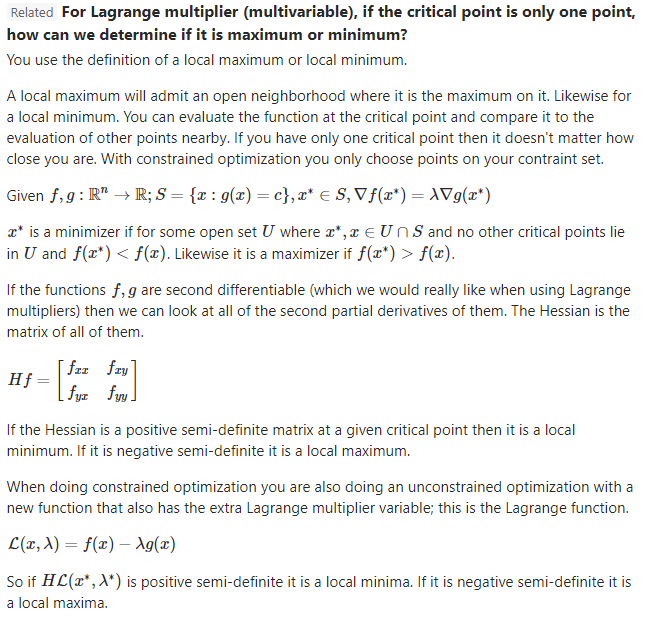 wanton rune
oh wait. You can note that if x<0, y>0(if in second quadrant), then e^(xy) will be less than or equal to 1, and same for x>0, y<0 (fourth quadrant). So you know the maximum must be achieved in the first quadrant, as it contains all values where e^(xy)>=1
atomic crow
you're saying for any (x,y) combination in 2nd quadrant, e^xy <= 1
wanton rune
yes!
atomic crow
why is this?
wanton rune
well, think about how the y and x values are restricted
x is forced to be less than or equal to 0
and y is forced to be greater than or equal to 0
if xy=k what will the value of k be (more importantly, the SIGN)
atomic crow
yeah it has to be negative
wanton rune
nonpositive
wanton rune
which implies e^xy<=1
same case for fourth quadrant
so you can restrict to the case of the first quadrant,
then apply extreme value theorem
since you have two endpoints
atomic crow
hmm
I would need to find the extremes which would be
the borders of the first quadrant
x=0 and y=0
wanton rune
no?
you want the restriction to apply
x^3+y^3=16
so let x=0, what does that make y, this gives you the y-axis endpoint
atomic crow
yeah, that's what I meant
wanton rune
then do the same for y
atomic crow
so given those border values and the critical point foun
we should be able to establish if its a min or max
wanton rune
mhm
atomic crow
Im still not sold because
while we've restricted the curve to a "segment" of a curve" idk how to call this
atomic crow
suppose (0,a) is 1 endpoint
and (b,0) is the other one
how can we be sure that among all points on the curve x^3+y^3=16 limited to that segment
What I mean to say is, it feels like we're using Bolzano Theorem from single variable calculus
but we're on a R2 compact domain
wanton rune
atomic crow
how can we be sure that among all points on the curve x^3+y^3=16 limited to that...
you didn't finish your point here?
atomic crow
What I mean to say is that
we know (2,2) belongs to the segment and is a critical point
wanton rune
yes
atomic crow
how can we be sure that just by checking F(2,2) F(0,a) and F(b,0)
we can deduce if (2,2) is a min or a max
wanton rune
because we've limited to this segment, constrainted to it...
atomic crow
we know outside this segment, the value is lower than F(2,2)
wanton rune
 wanton rune
yes
atomic crow
okay, so
this is like a single variable calculus problem then
once we've established a compact set
okay here is the real question, how do we know
there is no other point that is higher/lower than our critical point candidate
in the segment
im trying to connect the dots 😛 thanks for the help btw
wanton rune
in this constrainted subset we have determined, the two endpoints of this subset, and a critical point within this subset. These are the only candidates that can be maximums or minimums
atomic crow
wanton rune
in this constrainted subset we have determined, the two endpoints of this subset...
why is this?
wanton rune
fermat's theorem

extreme value tells you existence, fermat's theorem tells you where
atomic crow
hmm okay
even then, the endpoints couldn't be absolute min/max either
because they would've appeared when doing Lagrange Multipliers
atomic crow
alright, so basically the way to tackle this
is to bound your unbounded restriction
and justify why we can do so
wanton rune
yes
atomic crow
in this case, every other value outside this segment makes e^xy <= e^2*2
because e^2*2 = f(2,2) >= 1
1
well lets hope one can always find a way to bound it(?
alright, thanks for the help man
really appreciate it
.close
trim joltBOT
Channel closed
Closed by @atomic crow
Use .reopen if this was a mistake.
trim joltBOT
Available help channel!
Send your question here to claim the channel.
Remember:
• Ask your math question in a clear, concise manner.
• Show your work, and if possible, explain where you are stuck.
• After 15 minutes, feel free to ping <@&286206848099549185>.
• Type the command .close to free the channel when you're done.
• Be polite and have a nice day!
Read #❓how-to-get-help for further information on how to ask a good question, and about conduct in the question channels.
 idle palm
Hiiii, i need help with this
 trim joltBOT
idle palm
Hiiii, i need help with this
idle palm
trim joltBOT
idle palm
Hiiii, i need help with this
idle palm
I dont know where to start 🥲
 white dagger
idle palm
I dont know where to start 🥲
white dagger
idle palm
I dont know where to start 🥲
Let's start with area of the small rectangle
If H denote height and W denote width of the small rectangle then you have H*W = 80
Now you can try to expand this to the large rectangle
trim joltBOT
@idle palm Has your question been resolved?
idle palm
white dagger
Now you can try to expand this to the large rectangle
Ooo okayyy ill tryyy 🙂 thank youu
trim joltBOT
Channel closed
Closed by @idle palm
Use .reopen if this was a mistake.
Available help channel!
Send your question here to claim the channel.
Remember:
• Ask your math question in a clear, concise manner.
• Show your work, and if possible, explain where you are stuck.
• After 15 minutes, feel free to ping <@&286206848099549185>.
• Type the command .close to free the channel when you're done.
• Be polite and have a nice day!
Read #❓how-to-get-help for further information on how to ask a good question, and about conduct in the question channels.
 cosmic gate
Hello
trim joltBOT
cosmic gate
Hello
cosmic gate

I was wondering what the notation R(R)
implied
the lecturer referred to it as a all real valued function over r
what exactly does real valued functions over r mean
does real valued function over C make sense then
hallow kite
i believe it refers to f:R -> R
as in functions that take in real numbers as inputs and output real numbers
R(C) makes sense as well, f:C -> R as functions that map complex inputs to real outputs
trim joltBOT
Channel closed
Closed by @cosmic gate
Use .reopen if this was a mistake.
trim joltBOT
Available help channel!
Send your question here to claim the channel.
Remember:
• Ask your math question in a clear, concise manner.
• Show your work, and if possible, explain where you are stuck.
• After 15 minutes, feel free to ping <@&286206848099549185>.
• Type the command .close to free the channel when you're done.
• Be polite and have a nice day!
Read #❓how-to-get-help for further information on how to ask a good question, and about conduct in the question channels.
 gentle sleet
Can a graph with just 1 vertex have a cycle?
 kindred pier
gentle sleet
Can a graph with just 1 vertex have a cycle?
kindred pier
gentle sleet
Can a graph with just 1 vertex have a cycle?
Define a cycle
 cosmic meadow
There are no edges
kindred pier
gentle sleet
cant it like have an edge that is pointing back to itself
Yes it can
torn sorrel
gentle sleet
cant it like have an edge that is pointing back to itself
If there is a edge point back to itself
kindred pier
So long as such an edge exist in your graph
torn sorrel
Ye
gentle sleet
.close
trim joltBOT
Channel closed
Closed by @gentle sleet
Use .reopen if this was a mistake.
trim joltBOT
Available help channel!
Send your question here to claim the channel.
Remember:
• Ask your math question in a clear, concise manner.
• Show your work, and if possible, explain where you are stuck.
• After 15 minutes, feel free to ping <@&286206848099549185>.
• Type the command .close to free the channel when you're done.
• Be polite and have a nice day!
Read #❓how-to-get-help for further information on how to ask a good question, and about conduct in the question channels.
 frosty field
i have a Bernoulli equation i am solving it is dy/dx+(7/x)y=xy^2 I came to an answer of y = 5/x^2+5Cx^7 and have verified the solution i just wanna make sure im actually correct (unable to get image of my work to upload since im on a farm in Lithuania rn) thank you 🙂
trim joltBOT
frosty field
i have a Bernoulli equation i am solving it is dy/dx+(7/x)y=xy^2 I came to an an...
@frosty field Has your question been resolved?
trim joltBOT
@frosty field Has your question been resolved?
trim joltBOT
Channel closed
Closed due to timeout
Use .reopen if this was a mistake.
trim joltBOT
Available help channel!
Send your question here to claim the channel.
Remember:
• Ask your math question in a clear, concise manner.
• Show your work, and if possible, explain where you are stuck.
• After 15 minutes, feel free to ping <@&286206848099549185>.
• Type the command .close to free the channel when you're done.
• Be polite and have a nice day!
Read #❓how-to-get-help for further information on how to ask a good question, and about conduct in the question channels.
 drifting rose
can anyone help me figure out how to convert a mg/s to m^3/min
 drifting rose
I understand how to write out the differential being intake-outake but how do you convert between m^3 and mg?
trim joltBOT
@drifting rose Has your question been resolved?
drifting rose
.close
trim joltBOT
Channel closed
Closed by @drifting rose
Use .reopen if this was a mistake.
trim joltBOT
Available help channel!
Send your question here to claim the channel.
Remember:
• Ask your math question in a clear, concise manner.
• Show your work, and if possible, explain where you are stuck.
• After 15 minutes, feel free to ping <@&286206848099549185>.
• Type the command .close to free the channel when you're done.
• Be polite and have a nice day!
Read #❓how-to-get-help for further information on how to ask a good question, and about conduct in the question channels.
 lament flax
Hi, did I solve this task correctly? We need to find the roots of the equation
 trim joltBOT
lament flax
Hi, did I solve this task correctly? We need to find the roots of the equation
split chasm
trim joltBOT
lament flax
Hi, did I solve this task correctly? We need to find the roots of the equation
split chasm
ur not quite done yet
for equations like these (with square roots)
extraneous (solutions) may be generated in the squaring process
you should check whether they're both valid
worldly wing
Look at the second line, you have $x-3=2\sqrt{x}$
solid kilnBOT
kheerii
 worldly wing
What does that tell you about x-3?
lament flax
I moved 3 from the right side of the equation to the left
lament flax
split chasm
what's the range of the square root function
range, I know that the number under the square root of nn must be negative
lament flax
split chasm
what's the range of the square root function
I do not understand
split chasm
what sort of values can come out from plugging numerical values of x into
sqrt(x)
lament flax
split chasm
what sort of values can come out from plugging numerical values of x into
sqrt(...
half as much
split chasm
half as much of what
lament flax
split chasm
what sort of values can come out from plugging numerical values of x into
sqrt(...
for example sqrt9 = 3
 vagrant prism
lament flax
range, I know that the number under the square root of nn must be negative
vagrant prism
lament flax
range, I know that the number under the square root of nn must be negative
you mean nonnegative, right?
lament flax
vagrant prism
you mean nonnegative, right?
Yes
vagrant prism
okay great, now considering that those are the acceptable values for sqrt, what can the result be?
hint: start with the ||fact that the smallest nonnegative number is 0, what's sqrt(0)||?
vagrant prism
vagrant prism
okay great, now considering that those are the acceptable values for sqrt, what ...
the set of all possible results is called the range of a function
lament flax
vagrant prism
hint: start with the ||fact that the smallest nonnegative number is 0, what's sq...
it will be 0
lament flax
vagrant prism
the set of all possible results is called the range of a function
sqrt 9 is 3
cosmic meadow
You can expose extraneous solutions immediately by factoring
lament flax
vagrant prism
the set of all possible results is called the range of a function
do I need to find a number so that the left and right sides of the equation become equal?
cosmic meadow
Do you know that the result of sqrt of a number is always positive, right?
I will show you how to solve this without squaring both sides
cosmic meadow
cosmic meadow
Do you know that the result of sqrt of a number is always positive, right?
But answ this first
lament flax
cosmic meadow
Do you know that the result of sqrt of a number is always positive, right?
Yes
 brittle barn
(hint: consider $u=\sqrt x$)
solid kilnBOT
nameless individual
 lament flax
cosmic meadow
<@1178951696047689798> do you know how to factor this over reals?
lament flax
cosmic meadow
<@1178951696047689798> do you know how to factor this over reals?
what is reals? are these floating point numbers?
cosmic meadow
Real numbers
lament flax
cosmic meadow
Real numbers
does it mean any number?
brittle barn
kinda, it just mean no $\sqrt{-1}$s
solid kilnBOT
nameless individual
 brittle barn
(assuming your n is "and"?)
cosmic meadow
Start by replacing x with (sqrt(x))^2
lament flax
brittle barn
(hint: consider $u=\sqrt x$)
U is the number that x/2 ?
lament flax
brittle barn
x/2 !?
if you extract a number from under the square root, you get half of that number, right?
cosmic meadow
cosmic meadow
Start by replacing x with (sqrt(x))^2
Start with this
lament flax
cosmic meadow
Start with this
Will I get x?
cosmic meadow
But u dont simplify it
U let like that
After that find a common factor between (sqrt(x))^2 ans -2sqrt(x)
$x - 2\sqrt{x} -3 = (\sqrt{x})^2 - 2 \sqrt{x} -3$
solid kilnBOT
Samuel
 lament flax
cosmic meadow
$x - 2\sqrt{x} -3 = (\sqrt{x})^2 - 2 \sqrt{x} -3$
lament flax
cosmic meadow
$x - 2\sqrt{x} -3 = (\sqrt{x})^2 - 2 \sqrt{x} -3$
I don't understand what I can do here.
cosmic meadow
Start factoring out sqrt(x)
brittle barn
If we let $u=\sqrt x$, then we have $u^2-2u-3$. Can you factor that?
solid kilnBOT
nameless individual
 lament flax
brittle barn
If we let $u=\sqrt x$, then we have $u^2-2u-3$. Can you factor that?
lament flax
brittle barn
If we let $u=\sqrt x$, then we have $u^2-2u-3$. Can you factor that?
Yes, I understand now.
brittle barn
nice
solid kilnBOT
Samuel
 cosmic meadow
$(\sqrt{x}-1)^2 -3 - 1 = (\sqrt{x}-1)^2 - 4$
solid kilnBOT
Samuel
 cosmic meadow
Can you continue from here?
brittle barn
(theres really no difference, one is easier to understand, the other is more notationally compact and usually prefered)
cosmic meadow
Yes i know, I just wanted him to learn a method he probably doesn’t know
As more tools he has
The better to solve a problem
Without memorizing
Or if he gets stucked he has other tools to use
@lament flax did you factor it? Show your result please
lament flax
cosmic meadow
$(\sqrt{x}-1)^2 -3 - 1 = (\sqrt{x}-1)^2 - 4$
im, will I get x=-3 ?
cosmic meadow
solid kiln
**Samuel**
.
You can rewrite 4 like 2^2
$(\sqrt{x}-1)^2 - 4 = (\sqrt{x}-1)^2 - (2^2)$
solid kilnBOT
Samuel
 cosmic meadow
And now u have a difference of squares
Do u know how to factor difference of squares?
lament flax
cosmic meadow
And now u have a difference of squares
do I need to do actions with degrees?
lament flax
cosmic meadow
Do u know to factor a^2 - b^2?
(a-b)(a+b)
lament flax
cosmic meadow
From factoring the right side
It's difficult, but I'll try. $((sqrtx -1)-2) (sqrtx -1) +2)$
solid kilnBOT
monul
 cosmic meadow
Perfect
Now
-1-2 = -3 and 1+2 = 1 so
$(\sqrt{x} -1 -2)(\sqrt{x} - 1 +2) = (\sqrt{x} -3)(\sqrt{x} +1)$
solid kilnBOT
Samuel
 cosmic meadow
Right?
lament flax
cosmic meadow
Right?
Yes
cosmic meadow
Ok
That is equal the original x -2sqrt(x) -3
So we can equal our factored form to 0
Do it and solve for me please
lament flax
cosmic meadow
Do it and solve for me please
What do I need to do next?
cosmic meadow
$(\sqrt{x} -3)(\sqrt{x} +1)=0$
solid kilnBOT
Samuel
 lament flax
cosmic meadow
$(\sqrt{x} -3)(\sqrt{x} +1)=0$
lament flax
cosmic meadow
$(\sqrt{x} -3)(\sqrt{x} +1)=0$
I think I understood I need to solve them separately?
lament flax
cosmic meadow
You have a product
It sounds logical.
cosmic meadow
We are almost finished, tell me what i do now
brittle barn
cosmic meadow
For this to happen
unless its a matrix, and in that case you can't do that: that's my mistake in #help-13
edit: i know the obvious, just that the circumstance is so perfect i had to point it out
cosmic meadow
We are not doing anything with matrix now
The context is very important
And here the context is clear
lament flax
cosmic meadow
We are almost finished, tell me what i do now
Omg, I still can't figure it out.
cosmic meadow
solid kiln
**Samuel**
Here
Either sqrt(x) -3 = 0
Or sqrt(x) + 1 = 0
Solve this two equations
lament flax
cosmic meadow
Solve this two equations
so, sqrt(x)-3=0
x=9
so sqrt(x)+1=0
x=-1 ?
cosmic meadow
Lets start with the first
Sqrt(x) = 3
Sqrt(x) = sqrt(3^2) = sqrt(9); x = 9
Correct now the second
Sqrt(x) = -1
What is the range of sqrt(x)?
Can the square root of a number ever be negative?
lament flax
cosmic meadow
Can the square root of a number ever be negative?
no
cosmic meadow
Then u can immediately say this second equation has no solutions
So you stay only with x=9
lament flax
cosmic meadow
So you stay only with x=9
I know the correct answer for this assignment is 9. But why did you write 3?
lament flax
cosmic meadow
When did i write 3
Did you mean 9 when you wrote 3?
cosmic meadow
cosmic meadow
Sqrt(x) = sqrt(3^2) = sqrt(9); x = 9
Read this again
It was just a typo i fixed it
lament flax
cosmic meadow
Read this again
so, $sqrt(x)=sqrt(3^2)=sqrt(9)
x=9$
solid kilnBOT
monul
 solid kilnBOT
nameless individual
 cosmic meadow
solid kiln
**nameless individual**
cosmic meadow
solid kiln
**nameless individual**
Like this
lament flax
cosmic meadow
Care with the writing
is this the only way to solve this task, or is this the best and most convenient way to solve this task?
cosmic meadow
You can solve however you want, like you did was ok
But you need to put a restriction
cosmic meadow
lament flax
Hi, did I solve this task correctly? We need to find the roots of the equation
After step 3
brittle barn
there is never an only way to solve any reasonable task
you can always do a shopping spree before, after, or while you do it
cosmic meadow
You need to specify that x-3>=0
So when u get your two solutions
You get x_1 = 9
Amd x_2 = 1
When u check ur restriction
x-3 >= 0
U can realize that x=1 fails here
So that cannot be a solution
lament flax
cosmic meadow
So that cannot be a solution
I think I figured out how to check it 9-1=6 and 6 > 0, 1-3=-2 and -2<0
cosmic meadow
Exactly, although i think u meant 9-3=6
lament flax
cosmic meadow
Exactly, although i think u meant 9-3=6
Sorry, you're right, I meant 9-3=6
lament flax
cosmic meadow
Exactly, although i think u meant 9-3=6
Thank you so much for your help
brittle barn
.close anyone?
lament flax
.close
trim joltBOT
Channel closed
Closed by @lament flax
Use .reopen if this was a mistake.
trim joltBOT
Available help channel!
Send your question here to claim the channel.
Remember:
• Ask your math question in a clear, concise manner.
• Show your work, and if possible, explain where you are stuck.
• After 15 minutes, feel free to ping <@&286206848099549185>.
• Type the command .close to free the channel when you're done.
• Be polite and have a nice day!
Read #❓how-to-get-help for further information on how to ask a good question, and about conduct in the question channels.
 rapid horizon
 trim joltBOT
rapid horizon
rapid horizon
trim joltBOT
rapid horizon
rapid horizon
Anyone please check my integration and limits
 kind ginkgo
rapid horizon
Anyone please check my integration and limits
kind ginkgo
rapid horizon
Anyone please check my integration and limits
is the first integral supposed to be (-x/e-2) dx?
rapid horizon
No
kind ginkgo
can you give me the function i blind bruh 😭
rapid horizon
Which function?
trim joltBOT
Channel closed
Closed by @rapid horizon
Use .reopen if this was a mistake.
trim joltBOT
Available help channel!
Send your question here to claim the channel.
Remember:
• Ask your math question in a clear, concise manner.
• Show your work, and if possible, explain where you are stuck.
• After 15 minutes, feel free to ping <@&286206848099549185>.
• Type the command .close to free the channel when you're done.
• Be polite and have a nice day!
Read #❓how-to-get-help for further information on how to ask a good question, and about conduct in the question channels.
 cinder lark
 trim joltBOT
cinder lark
cinder lark
trim joltBOT
cinder lark
cinder lark
Hi can someone check two of my answers?
brittle barn
looks right!?
 formal sage
They seem to be right
Except that I found the last x to be positive 2/5, not negative
Nvm
Mb, it's correct
trim joltBOT
Channel closed
Closed by @cinder lark
Use .reopen if this was a mistake.
trim joltBOT
Available help channel!
Send your question here to claim the channel.
Remember:
• Ask your math question in a clear, concise manner.
• Show your work, and if possible, explain where you are stuck.
• After 15 minutes, feel free to ping <@&286206848099549185>.
• Type the command .close to free the channel when you're done.
• Be polite and have a nice day!
Read #❓how-to-get-help for further information on how to ask a good question, and about conduct in the question channels.
drifting rose
could anyone check wheather this is right?
drifting rose


this is the initial question if you want to know initial condition and such
bc when I checked it was wrong and Idk where I went wrong
if this is too much could I ask help what would be the inital when t=0
 viscid flower
im calling it a proportion i guess because that part represents like
viscid flower
the proportion of the air in the room that is cleaned
its like constant effort cleaning
but 5/5220 seems low
because the room is only 87 m^3
and our air conditioner can clean 5 of that
viscid flower
👀
drifting rose
theres check boxes under the question that helps you check so the red is 100% correct
viscid flower

drifting rose
 viscid flower
that makes no sense to me but okay
solid kilnBOT
Result:
6.58503e+5
because I think I'm getting it wrong because of the inital condition
viscid flower
why is 5220
viscid flower
MINUTE
drifting rose
bc 0.06mg/s
viscid flower
ur right
okay
man how stupid ur in ode and they still have you screwing with units
anyways
drifting rose
wait I know how to calculate ODE
solid kilnBOT
jan Niku
 drifting rose
Could I see what you did
viscid flower
i can yea
viscid flower

drifting rose
or do you wanna explain
viscid flower
$S(t) = \frac TR + C e^{Rt}$
solid kilnBOT
jan Niku
 solid kilnBOT
jan Niku
 drifting rose
ok
viscid flower
so $C = - \frac TR$
solid kilnBOT
jan Niku
 drifting rose
this is VERY abridged but I get it lol
viscid flower

i can un abridge if you want
but assuming youve solved some of these before
u know how it goes
$S(t) = \frac TR \qty( 1 - e^{Rt})$ is final
solid kilnBOT
jan Niku
 viscid flower
it is
drifting rose
did I miss a minus in my working out?
viscid flower
the constant on the exponential needs to eat the constant of integration
to make the IC 0
sorry, i said that wrong
the constants need to eat each other at t=0
so you expect one to be negative
drifting rose
oh I see
viscid flower
it can help to assign variables like i did just a suggestion but also i get it
so you have less annoying nonsense floating around
viscid flower
hmm?
viscid flower
sure so, this is a first order linear ode
and they can be solved generically, i believe
https://www.sfu.ca/math-coursenotes/Math 158 Course Notes/sec_first_order_homogeneous_linear.html you might look here if youre curious
by generically i mean like, like you have a quadratic formula for ax^2+bx+c=0
we have that for $y' + p(t)y = f(t)$
solid kilnBOT
jan Niku
 viscid flower
and yea, its exponentials
drifting rose
I see
viscid flower
does that answer your question?

 viscid flower

drifting rose
.close
trim joltBOT
Channel closed
Closed by @drifting rose
Use .reopen if this was a mistake.
Available help channel!
Send your question here to claim the channel.
Remember:
• Ask your math question in a clear, concise manner.
• Show your work, and if possible, explain where you are stuck.
• After 15 minutes, feel free to ping <@&286206848099549185>.
• Type the command .close to free the channel when you're done.
• Be polite and have a nice day!
Read #❓how-to-get-help for further information on how to ask a good question, and about conduct in the question channels.
 heavy belfry
Anyone know how to solve this x^x=2^(1/x)
trim joltBOT
heavy belfry
Anyone know how to solve this x^x=2^(1/x)
 forest terrace
I think you have to use the Lambert-W function
heavy belfry
No idea what that is
forest terrace
do you know what ln(x) is
ln(x) is the inverse of e^x
$x = e^y \implies y = ln(x)$
solid kilnBOT
oscoface
 solid kilnBOT
oscoface
 forest terrace
because your problem has x terms in the exponent
$x^x = 2^{\frac{1}{x}} \therefore x \ln(x) = \frac{1}{x} \ln(2) \therefore x^2 \ln(x) = \ln(2) \therefore \frac12 x^2 \ln{(x^2)} = \ln(2) \therefore x^2 \ln{(x^2)} = 2 \ln(2) \therefore x^2 e^{x^2} = 2 e^2$
solid kilnBOT
oscoface
 trim joltBOT
@heavy belfry Has your question been resolved?
heavy belfry
Then you are saying there is only 1 solution?
heavy belfry
forest terrace
$x^x = 2^{\frac{1}{x}} \therefore x \ln(x) = \frac{1}{x} \ln(2) \therefore x^2 \...
I don’t understand the 4th line
forest terrace
heavy belfry
Then you are saying there is only 1 solution?
Yeah, x = $\sqrt2$
solid kilnBOT
oscoface
 forest terrace
heavy belfry
I don’t understand the 4th line
forest terrace
heavy belfry
I don’t understand the 4th line
Because $ln(x^2) = 2ln(x)$
solid kilnBOT
oscoface
 heavy belfry
forest terrace
Because $ln(x^2) = 2ln(x)$
heavy belfry
forest terrace
Because $ln(x^2) = 2ln(x)$
Ok i understand now But How did you get the solution from the last line
forest terrace
Let $g(x) = x e^x$
solid kilnBOT
oscoface
 forest terrace
Then from the last line, $g(x^2) = g(2)$
solid kilnBOT
oscoface
 forest terrace
This means x^2 = 2 is a solution
There could be other solutions, but as g(x) is an increasing function in the range x > 0, any other solutions would require x < 0
So x = root 2 is the only positive solution
Showing there are no negative solutions might be a bit harder
For negative numbers, $x^x$ is only real for integers
solid kilnBOT
oscoface
 forest terrace
And 2^(1/x) is real for all negative numbers
So any negative solution would have to be an integer
trim joltBOT
Channel closed
Closed by @heavy belfry
Use .reopen if this was a mistake.
trim joltBOT
Available help channel!
Send your question here to claim the channel.
Remember:
• Ask your math question in a clear, concise manner.
• Show your work, and if possible, explain where you are stuck.
• After 15 minutes, feel free to ping <@&286206848099549185>.
• Type the command .close to free the channel when you're done.
• Be polite and have a nice day!
Read #❓how-to-get-help for further information on how to ask a good question, and about conduct in the question channels.
wraith hinge
Let $f(x)=x^2-5x+6$ and $A=\begin{pmatrix}
2 & 0 & 1\
2 & 1 & 3\
1 & -1 & 0
\end{pmatrix}$, then find $f(A)$
trim joltBOT
wraith hinge
Let $f(x)=x^2-5x+6$ and $A=\begin{pmatrix}
2 & 0 & 1\\
2 & 1 & 3\\
1 & -1 & 0
\e...
solid kilnBOT
pun pun
 wraith hinge
how can i do this using its characteristic equation
supple copper
What is the characteristic polynomial of A?
supple copper
The main thing here is that A satisfies its own characteristic equation
If p(λ) is the characteristic polynomial of A, then p(A) = 0
wraith hinge
-λ^3+3λ^2-4λ+3=0
supple copper
Huh?
wraith hinge
what 😭
solid kilnBOT
pun pun
 supple copper
wraith hinge
-λ^3+3λ^2-4λ+3=0
supple copper
wraith hinge
-λ^3+3λ^2-4λ+3=0
This isn’t the same as the question 😭
Maybe you want to factorise (x-2)(x-3)
And plug (A-2I)(A-3I)
wraith hinge
wait im confused