#help-38
1 messages · Page 123 of 1
 leaden walrus
 acoustic flint
It’s simple to implement and efficient. I’m not sure how it compares to other methods, you can probably find out through a quick google search though.
If you have a lot of data, then you will need to approximate in sub sections as opposed to the entire data set though to avoid numerical errors
It will certainly be enough with the data you are dealing with by the looks of it. You will just have to do some testing to see how many interpolated functions you need e.g. 31%, 32%, 33% etc, until you find the surface is sufficiently smooth for you
leaden walrus
Oh, on a sidenote, would you happen to know how I would properly plot the result via python/matlab/mathematica or other common mathematical software ?
acoustic flint
leaden walrus
Oh, on a sidenote, would you happen to know how I would properly plot the result...
I’m only familiar with matplotlib via python and gnuplot.
Matplotlib has good documentation and tutorials on the website, should be as easy as feeding arrays storing x, y, z values into a function
I just took a quick look at matlab docs, it seems to be just as simple and produces better looking plots so go with matlab
 trim joltBOT
@leaden walrus Has your question been resolved?
trim joltBOT
Channel closed
Closed due to timeout
Use .reopen if this was a mistake.
 Available help channel!
Send your question here to claim the channel.
Remember:
• Ask your math question in a clear, concise manner.
• Show your work, and if possible, explain where you are stuck.
• After 15 minutes, feel free to ping <@&286206848099549185>.
• Type the command .close to free the channel when you're done.
• Be polite and have a nice day!
Read #❓how-to-get-help for further information on how to ask a good question, and about conduct in the question channels.
 gentle sleet
 trim joltBOT
gentle sleet
gentle sleet
trim joltBOT
gentle sleet
gentle sleet
why did they let the bound be 0.25 to x_1 instead of 0 to 0.5?
trim joltBOT
@gentle sleet Has your question been resolved?
 steep dome
What do they mean by P(0<=X1<=0.5, 0.25<=X2)?
trim joltBOT
@gentle sleet Has your question been resolved?
trim joltBOT
Channel closed
Closed due to timeout
Use .reopen if this was a mistake.
trim joltBOT
Available help channel!
Send your question here to claim the channel.
Remember:
• Ask your math question in a clear, concise manner.
• Show your work, and if possible, explain where you are stuck.
• After 15 minutes, feel free to ping <@&286206848099549185>.
• Type the command .close to free the channel when you're done.
• Be polite and have a nice day!
Read #❓how-to-get-help for further information on how to ask a good question, and about conduct in the question channels.
 wraith hinge
help
trim joltBOT
wraith hinge
help
 trim joltBOT
Channel closed
Closed by @fathom bear
Use .reopen if this was a mistake.
trim joltBOT
Available help channel!
Send your question here to claim the channel.
Remember:
• Ask your math question in a clear, concise manner.
• Show your work, and if possible, explain where you are stuck.
• After 15 minutes, feel free to ping <@&286206848099549185>.
• Type the command .close to free the channel when you're done.
• Be polite and have a nice day!
Read #❓how-to-get-help for further information on how to ask a good question, and about conduct in the question channels.
Channel closed
Channel closed due to the original message being deleted.
If you did not intend to do this, please open a new help channel,
as this action is irreversible, and this channel may abruptly lock.
Available help channel!
Send your question here to claim the channel.
Remember:
• Ask your math question in a clear, concise manner.
• Show your work, and if possible, explain where you are stuck.
• After 15 minutes, feel free to ping <@&286206848099549185>.
• Type the command .close to free the channel when you're done.
• Be polite and have a nice day!
Read #❓how-to-get-help for further information on how to ask a good question, and about conduct in the question channels.
 charred hawk
idk how to do this at all
 trim joltBOT
charred hawk
idk how to do this at all
trim joltBOT
charred hawk
idk how to do this at all
 icy mural
Do you know how to convert polar coordinates to rectangular coordinates?
trim joltBOT
@charred hawk Has your question been resolved?
trim joltBOT
Channel closed
Closed due to timeout
Use .reopen if this was a mistake.
Available help channel!
Send your question here to claim the channel.
Remember:
• Ask your math question in a clear, concise manner.
• Show your work, and if possible, explain where you are stuck.
• After 15 minutes, feel free to ping <@&286206848099549185>.
• Type the command .close to free the channel when you're done.
• Be polite and have a nice day!
Read #❓how-to-get-help for further information on how to ask a good question, and about conduct in the question channels.
 lapis wolf
what unit is this? i heard it was quadratics and Parabola, teacher told me to Be sure to review quadratics and how to solve for the “a” value of a parabola. But idk how to do it.
I have exam which look similar to this paper and ik nothing
 trim joltBOT
lapis wolf
what unit is this? i heard it was quadratics and Parabola, teacher told me to Be...
trim joltBOT
lapis wolf
what unit is this? i heard it was quadratics and Parabola, teacher told me to Be...
@lapis wolf Has your question been resolved?
trim joltBOT
@lapis wolf Has your question been resolved?
lapis wolf
.close
trim joltBOT
Channel closed
Closed by @lapis wolf
Use .reopen if this was a mistake.
Available help channel!
Send your question here to claim the channel.
Remember:
• Ask your math question in a clear, concise manner.
• Show your work, and if possible, explain where you are stuck.
• After 15 minutes, feel free to ping <@&286206848099549185>.
• Type the command .close to free the channel when you're done.
• Be polite and have a nice day!
Read #❓how-to-get-help for further information on how to ask a good question, and about conduct in the question channels.
 loud sedge
 trim joltBOT
loud sedge
trim joltBOT
loud sedge

 wanton tendon
If you slice (horizontally) the solid obtained by rotation into pieces with width dy, you can find the volume obtained by rotating each slice approximately as the difference of volumes of a cylinder (hence cylindrical shell) with radius y and a cylinder with radius y+dy, which is just the volume of a cuboid with width dy, height 2piy and length is the difference between x values which given the same y... if I made the correct shells 😅
 wanton tendon
loud sedge
i need hel;p on this
wanton tendon
loud sedge
i need hel;p on this
Wait this is different from what it was before O_O
-_-
loud sedge
wanton tendon
Wait this is different from what it was before O_O
sorry!! i figured out the other one
;(
my bad im very sorry
:(
wanton tendon
It's ok
Same thing, cut horizontally to get slices of width dy, volume of the cylindrical shell is same as volume of cuboid with dimensions dy, 2piy, e-e^y
 loud sedge
i see
wanton tendon
I think that's the only thing you couldn't figure out, what the dimensions will be, right?
Whenever one of the limits is 0, it is easier to figure out the dimensions, but when it isn't, it is helpful to just shift everything so that one of the limits is zero
So it becomes this

@loud sedge Solved?
loud sedge
yep!
wanton tendon
Do .close :)
loud sedge
.close
trim joltBOT
Channel closed
Closed by @loud sedge
Use .reopen if this was a mistake.
trim joltBOT
Available help channel!
Send your question here to claim the channel.
Remember:
• Ask your math question in a clear, concise manner.
• Show your work, and if possible, explain where you are stuck.
• After 15 minutes, feel free to ping <@&286206848099549185>.
• Type the command .close to free the channel when you're done.
• Be polite and have a nice day!
Read #❓how-to-get-help for further information on how to ask a good question, and about conduct in the question channels.
 main hemlock
hello
trim joltBOT
main hemlock
hello
 trim joltBOT
@main hemlock Has your question been resolved?
trim joltBOT
Channel closed
Closed due to timeout
Use .reopen if this was a mistake.
trim joltBOT
Available help channel!
Send your question here to claim the channel.
Remember:
• Ask your math question in a clear, concise manner.
• Show your work, and if possible, explain where you are stuck.
• After 15 minutes, feel free to ping <@&286206848099549185>.
• Type the command .close to free the channel when you're done.
• Be polite and have a nice day!
Read #❓how-to-get-help for further information on how to ask a good question, and about conduct in the question channels.
 wet nest
How many logical connectives are possible involving the n simple propositions: p1, p2, . . . , pn?
trim joltBOT
wet nest
How many logical connectives are possible involving the n simple propositions: p...
wet nest
its $2^n$ right?
 solid kilnBOT
TheKingPin
 wet nest
I think im misreading this question
trim joltBOT
@wet nest Has your question been resolved?
wet nest
<@&286206848099549185>
wet nest
ya, its the wording thats getting me
cause a proposition is a statement that can be proven as true or false right?
ah
true or false are considered both options for one proposition due negation being a connective
so thats wehre 2^n comes from
but wehre does the 2(2^n) come from
wet nest
cause i feel the other connectives join two propositions like and, or , implication, etc...
 shrewd ridge
what if you could have a connective that works with 7 things
wet nest
wouldnt the amount of logical connectives for other ones just be n-1?
if we have n=3: p1,p2,p3
you can only have 2 joining loigical connectives 'and' and 'or'
shrewd ridge
the point is that you can have ← which is like implication but backwards
wet nest
oh, that complicates thing, i didnt think about that
shrewd ridge
it's possible to think of it
and there are 2^2^2 things you can think of
with 2 propositions
wet nest
thats right, so for n=3, there are 3 possible combinations for implication
right cause as you mentioned it can go both directions the implication
and you can only have one logical connective joining two propositions at a time
with implication creating the most possiblities, n
where n is equal to the number of proposition
so if you have n propositions you can have n possible joining connectives.
you also have to take into consideration that they can be true or false due to negation which only needs one proposition
which is 2^n possibility
so combining them would be n^2^n
since negation and joining logical connectives are independent of eachother
bad math
shrewd ridge
no, i don't know what you're saying and i still don't know what it's asking but it's not what i meant
wet nest
if n =2 then there are 8 possibilities
since if you take implication there are two possiblities
and 2^n for negation
shrewd ridge
this doesn't account for ⊻
wet nest
so, the best, I can find is that youre answer is right because its 2^(# of row)^(# of propositions)
but it isnt making sense to me
in a truth table
 boreal harbor
think about a set of n variables
the set of all functions of those variables is the set of all possible ways to assign 0 or 1 to each row in the truth table
a single function can be uniquely identified by the set of inputs that map to 1
so you have the set of all possible inputs, and then each function can be represented as the subset of those inputs that map to 1
hence the set of all functions is the power set of the set of all inputs. the cardinality of the set of all inputs is 2^n, so the cardinality of the power set is 2^(2^n)
wet nest
do I not know what a logical connectives is?
thats negation, and, or, implication right?
shrewd ridge
yes
shrewd ridge
we're assuming it's about how many more can you think of
that you were never taught
boreal harbor
2^2^n to be precise
shrewd ridge
not how to combine them
boreal harbor
wait what maybe im the one confused here
shrewd ridge
we're just assuming what the question wants, i don't personally know
wet nest
2^2^n is the right answer
its just confusing to understand why
lets say n =2, the answer would be 16 , what does the 16 mean/
?
shrewd ridge
that there's and, or, imlpication, not equals, equals
boreal harbor
then its considering a logical connective to just be a function
$f:{0,1}^n\to{0,1}$
solid kilnBOT
esca (@ with reply)
 boreal harbor
wet nest
lets say n =2, the answer would be 16 , what does the 16 mean/
boreal harbor
wet nest
lets say n =2, the answer would be 16 , what does the 16 mean/
iirc all 16 have names
shrewd ridge
i would be surprised
 wet nest
im seeing it as the number of combinations you can have with logical connectives. so if you have p and q that would be 4 logical connectives, p and q, not p and q, p and not q, and not p and not q. its irrelevant what you have in between p and q because you have to have a logical connective between them.
im missreading this
wet nest
how many logical connective, what does that even mean
boreal harbor
wet nest
how many logical connective, what does that even mean
so if it helps you, you can think of it as just counting all possible boolean functions of n variables
wet nest
i know what a logical connective is
shrewd ridge
there are connectives that you weren't taught
boreal harbor
boreal harbor
the set of all functions of those variables is the set of all possible ways to a...
if you can accept that, then refer back to here
shrewd ridge
the question asks to count how many you were not taught
boreal harbor
you dont need to exhaustively list every possible connective to count them
shrewd ridge
the point is that it's solveable
wet nest
boreal harbor
so if it helps you, you can think of it as just counting all possible boolean fu...
so you mean the number of T and F combinations between n propositions right?
boreal harbor
wet nest
so you mean the number of T and F combinations between n propositions right?
thats the set of all possible inputs, if im understanding correctly
wet nest
yes
boreal harbor
right
solid kilnBOT
esca (@ with reply)
Compile Error! Click the  reaction for more information.
(You may edit your message to recompile.)
 boreal harbor
however, thats the same as, lets say
$(A \land B)(B\lor \neg B)$
solid kilnBOT
esca (@ with reply)
 boreal harbor
so we need a way of getting a unique signature for each function from which you can construct the truth table
one way of doing this is identifying each function by the inputs that make it true
in the case of $A\land B$ this is the set ${(1,1)}$
solid kilnBOT
esca (@ with reply)
 boreal harbor
do you follow so far
wet nest
so, starting with the first part, you created a truth table of A and B and a third column of the result of the conjunction
not sure how thats equivalent to (A and B) (B or not B) theres not logical connective between (A and B) and (B or not B)
boreal harbor
wet nest
so, starting with the first part, you created a truth table of A and B and a thi...
ah thats just shorthand for and
wet nest
oh mb
boreal harbor
$(A\land B)\land(B\lor \neg B)$
solid kilnBOT
esca (@ with reply)
 boreal harbor
wet nest
oh mb
boreal harbor
wet nest
oh mb
no worries
point being that there are a bunch of different ways we can express the same thing
wet nest
(A and B)(B or not B), (A and B) F, where F is the contradiction, (A and F) and ( B and F) therefore its always false by domination law
do i have that correct?
boreal harbor
hmm wdym
boreal harbor
solid kiln
**esca (@ with reply)**
this has the exact same truth table as (A and B)
wet nest
oh i missplaced the or in B for an and
so ya
wait
(A and B) and (B or not B), (A and B) and T where T is tautology, (A and T) and (B and T) which is (A and B)
got it
so they are equivalent
had to write it down
boreal harbor
yep exactly
boreal harbor
solid kiln
**esca (@ with reply)**
so the main thing im doing here is finding a way to uniquely represent each distinct truth table
and im doing that by saying each truth table is uniquely represented by the set of the rows whose output is 1
do you follow that so far
wet nest
could you explain that part a little more
in the case of $A\land B$ this is the set ${(1,1)}$
solid kilnBOT
TheKingPin
 boreal harbor
gimme a sec
this is our truth table for AND. now i want to find a way to uniquely represent this as a set

to do this, we circle each row where xy evaluates to 1
boreal harbor
boreal harbor
this is our truth table for AND. now i want to find a way to uniquely represent ...

here its just one row
we represent this row as the inputs in an ordered pair (x,y)
put it in a set and we have {(1, 1)}
lmk if im not explaining clearly enough
wet nest
I think i get it
boreal harbor
just to make sure we're on the same page, what would the set corresponding to this truth table be?
 wet nest
set? I know what a set is but im not sure what youre asking. If i had to guess x+y = {(0,0),(0,1),(1,0),(1,0)}
boreal harbor
well you included one element there twice
(1,0) is a single element. remember sets cant have two of the same element
wet nest
oh I meant that as an ordered pair
boreal harbor
hmm
boreal harbor
boreal harbor
just to make sure we're on the same page, what would the set corresponding to th...

hopefully this makes it a little clearer
 vagrant prism
boreal harbor
just to make sure we're on the same page, what would the set corresponding to th...
vagrant prism
boreal harbor
just to make sure we're on the same page, what would the set corresponding to th...
do you mean something like $A \cup B$?
solid kilnBOT
artemetra
 vagrant prism
OR is (sorta) equivalent to a union
wet nest
sorta, i meant to write it like this x or y = (x) x (y) = {(x,y) : x,y in {0,1} } which is {(0,0),(0,1),(1,0),(1,0)}
boreal harbor
vagrant prism
do you mean something like $A \cup B$?
nah this is just or
wet nest
a cartesian product
boreal harbor
logical or is written as + in circuit design
boreal harbor
wet nest
sorta, i meant to write it like this x or y = (x) x (y) = {(x,y) : x,y in {0,1} ...
well each element of the set will be am element in the cartesian product here yeah. thats an important fact that will be helpful later. but its not necessarily all possible elements in the cartesian product that we're including in this representation of the function
boreal harbor
wet nest
thats nonsense
its not nonsense, the set of all possible inputs is indeed ${0,1}\times{0,1}$
solid kilnBOT
esca (@ with reply)
 wet nest
ah yes, thats what i meant
boreal harbor
but we're looking at a subset of the set of all possible inputs corresponding to the inputs that make our function spit out true
boreal harbor
boreal harbor
going back to this we have the last three rows evaluate to 1
wet nest
right, i get why theyre 1
boreal harbor
so we just take the inputs corresponding to those
(0,1)
(1,0)
(1,1)
and we put them in a set
and thats our signature for the function
does that make sense
wet nest
why are we fixated on the rows that produce a 1 for logically connected propositions?
boreal harbor
because that is what uniquely identifies our function/connective
wet nest
I can see that
boreal harbor
okay so heres the where the main argument comes in
you mentioned earlier the cartesian product
{0,1}x{0,1}
right
wet nest
yes
boreal harbor
now you know that the signature of any function of two variables will be a subset of this set
so what is the set of all possible functions?
wet nest
it would be 2^n
boreal harbor
well im not asking the size just yet
wet nest
its not the same thing?
boreal harbor
like can you describe the set of all possible functions in terms of the set of all possible inputs?
wet nest
oh describe the set
{ {0}x{0}, {0,1}x{0}, {1}x{0}, {0}x{0,1}, {0}x{1}, {1}x{1} } I believe
boreal harbor
an element of the set {0,1} can only be either 0 or 1. so {0,1}x{0,1} is just the set of all ordered pairs (x,y), which is exactly the set of all possible inputs
wet nest
oh, thats right, i over thought that
boreal harbor
yeah
wet nest
mb
boreal harbor
wet nest
{ {0}x{0}, {0,1}x{0}, {1}x{0}, {0}x{0,1}, {0}x{1}, {1}x{1} } I believe
technically this is right but youre counting some elements more than once
boreal harbor
wet nest
mb
no worries
wet nest
right, its redundant
boreal harbor
basically, the set of all functions is the power set of the set of all inputs
that is, its the set of all possible subsets of the set of inputs
this is a little confusing, so lets assign some notation to it. lets say
$D = {0,1}$. lets consider the case of two variables, and say that a function f takes as input $D^2=D\times D$. $f$ corresponds to some subset of $D^2$ that has exactly the rows of f's truth table that spit out a 1
solid kilnBOT
esca (@ with reply)
 boreal harbor
then the set of all possible $f$ is the power set of D, $P(D)$
solid kilnBOT
esca (@ with reply)
 wet nest
number of elements?
boreal harbor
the number of elements in $D^2$, right
solid kilnBOT
esca (@ with reply)
 boreal harbor
which is?
wet nest
ah, yes
so D^2 is the cartesian product DxD where D = {0,1} which is also 2^n basically same idea, you have the element or not
boreal harbor
yep
the cardinality of D^2 is 2 to the power of how many variables you have, which is 2
in general, the cardinality of D^n is 2^n. here n is the number of variables
so you just plug that into your equation for the cardinality of the power set
and you have 2^(2^n)
wet nest
so, the power set is 2^n combinations due to the number of elements in D where n is D which is also a set which has the size 2^n based on the combination of the number of elements right?
i poorly wrote that
boreal harbor
wet nest
so, the power set is 2^n combinations due to the number of elements in D where n...
yeah exactly
wet nest
ok, i get that
thats pretty cool actually
I still dont get what the original question is asking though
boreal harbor
its just asking for this
wet nest
I do understand this
 wet nest
lol
is there a simpler way of writting what they are asking?
i just dont like how the question is worded
it confuses me
boreal harbor
yeah me neither. i would write something like how many possible unique boolean functions of n boolean variables exist or something maybe
wet nest
cause i know what we did was write all the possible combination of T and F in a truth talble of any number of variabels
wet nest
boreal harbor
yeah me neither. i would write something like how many possible unique boolean f...
that makes more sense
oh
I think i get it now
there might be logical connectives that I dont know
so to take that into account we found all the possible truth tables that can be written
for the number of propositions we have
boreal harbor
yep exactly
 pseudo grotto
w uestion
boreal harbor
wet nest
ya, i definitely get it now
glad to hear it
boreal harbor
pseudo grotto
w uestion
pee norm maxxing
pseudo grotto
boreal harbor
pee norm maxxing
esca
wet nest
that answers all my question. I very much appreciate taking the time to help me understand this
boreal harbor
no problem
wet nest
.close
trim joltBOT
Channel closed
Closed by @wet nest
Use .reopen if this was a mistake.
trim joltBOT
Available help channel!
Send your question here to claim the channel.
Remember:
• Ask your math question in a clear, concise manner.
• Show your work, and if possible, explain where you are stuck.
• After 15 minutes, feel free to ping <@&286206848099549185>.
• Type the command .close to free the channel when you're done.
• Be polite and have a nice day!
Read #❓how-to-get-help for further information on how to ask a good question, and about conduct in the question channels.
 keen void
$|x| = (x^2_1 + x^2_2 + x^2_3 ... + x^2_n)^{\frac{1}{2}}$
solid kilnBOT
Merineth
 keen void
Can someone help me find the derivative wrt x?
My guess was
first 1/2 comes down
subtract the exponent by -1
 rugged latch
subtract exponent by 1*
keen void
Yea
rugged latch

solid kilnBOT
Merineth
 keen void
$1/2 * (2x+2x+2x...2x_n)^{-1/2}$
solid kilnBOT
Merineth
 keen void
This was my guess
rugged latch
what about the subscripts
keen void
subscripts?
 whole coral
keen void
And then derive the inner part
whole coral
keen void
And then derive the inner part
Worth checking, what are you differentiating wrt?
keen void
x
rugged latch
$2x_1 + 2x_2 + 2x_3 + ... + 2x_n$
solid kilnBOT
 keen void
Yea i was just lazy putting them in
whole coral
Are you trying to find $\nabla \norm{x}$ then?
keen void
$1/2 * (2x_1+2x_2+2x_3...2x_n)^{-1/2}$

 keen void
whole coral
Are you trying to find $\nabla \norm{x}$ then?
keen void
whole coral
Are you trying to find $\nabla \norm{x}$ then?
Yes
The question was find the gradient to the given function
and we are given a bunch of functions
whole coral
Remember that $\nabla f = \pmqty{ \pdv{f}{x_1} \ \pdv{f}{x_2} \ \vdots \ \pdv{f}{x_n}}$
solid kilnBOT
@whole coral
 whole coral
@full dock multivariate calc for you 
keen void
solid kiln
<@788085606483361802>
Is it tho?
Considering
the first would be wrt x
and then wrt y
but we only have x
so the gradient would only be one direction?
whole coral
keen void
Is it tho?
It is 
 rugged latch
wait a sec...
keen void
whole coral
It is <:catYes:830588319472812044>
It's so cute that you saved my formula sheet <3

This is what you meant?
$\frac{1}{2(2x_1+2x_2+2x_3...2x_n)^{\frac{1}{1}}$
rugged latch
$\pdv{f}{x_1} = 0.5(x_1 ^2 + x_2 ^2 + ... + x_n ^2)^{-0.5} \cdot 2x_1 = \frac {x_1}{\sqrt {x_1 ^2 + x_2 ^ 2 + ... + x_n ^2}}$
solid kilnBOT
Merineth
Compile Error! Click the reaction for more information.
(You may edit your message to recompile.)

 keen void
latex 
rugged latch
u just have to become a latex chad (like me or snow) if u want to get this good
keen void
Chartbit is a god at latex
i hadn't touch latex until i joined this discord
she essentially held my hand like a toddler for most of my math "career" at uni
Anyhow
rugged latch
CHARTBIT IS A SHE??!?!
 keen void
 whole coral
solid kiln
whole coral
solid kiln
Remember you differentiate the insides wrt each of the variables  see as per here for the first one
keen void
whole coral

whole coral
solid kiln
Are you at least happy with here?

 whole coral
It does happen to be right, yep 
keen void
It's a bit confusing rememberig that i have to derive wrt x_1, x_2,..x_n
rugged latch
u should include a \pdv in there somewhere, otherwise it looks like ur just equating |x| and x/|x|
keen void
Oh
rugged latch
and get rid of an equals sign
rugged latch
its not a fine detail
whole coral
In particular, top is not equal to the bottom-
 rugged latch
1 more thing: which x are u differentiating wrt?
keen void
I'll do it properly next time 
Speaking of next time
Calculate the directional derivative in the direction $(-4,2,-4)$ of the function $f(x,y,z)=\frac{xy^2z^2}{2+x}$ in the point $(2,2,1)$
solid kilnBOT
Merineth
 keen void
I am not entirely sure i understand gradients well enough to interpret this question
But if i derive and find nabla to the function. Plug in the point 2,2,1 should i get the answer?
derive and find the gradient*
whole coral
whole coral
It is <:catYes:830588319472812044>
One extra thing you need too-
 whole coral
Yep, you have a directional derivative, though be careful what you choose as v
keen void
$\nabla f(a)\cdot v$
solid kilnBOT
Merineth
 whole coral
v is to be the direction, but there's a condition that v must satisfy first-
keen void
|v| = 1?
whole coral
keen void
|v| = 1?
Yep, and the direction they give you originally?
whole coral
keen void
if v = (-4,2,-4) then |v| = (4,2,4) ?
Not quite  remember |v| is a number
whole coral
The vector norm is supposed to be 1
whole coral
whole coral
Not quite <a:SCsadkittyNO:797710340237426709> remember |v| is a number
The norm of a vector is a number
whole coral
Or you at least very much should have 
solid kilnBOT
Merineth
 whole coral
keen void
$v \cdot v$
whole coral
keen void
$v \cdot v$
Almost, sqrt that
whole coral
keen void
I dont have that formula sheet
 whole coral
keen void
but i got |v| to be 6
whole coral
keen void
but i got |v| to be 6
And there's an easy fix to that 
keen void
They remove access to view courses we already passed ._.
 keen void
Literal dogshit
whole coral
That's just a shit policy tbh 
Even with me, most of the courses are actually not only still available, but the current versions are openly accessible for anyone 
 whole coral
The word is just banned 
whole coral
whole coral
<:Ehehe:1116912840176050177>
Yea, how do you make it 1 
keen void
we multiply it with lambda?
whole coral
And what do you wanna choose as lambda
 whole coral


You can always divide by the norm (for nonzero vectors) to get a unit vector in the same direction 
 whole coral
Awwwww  yeaaa stuff's all really linked and shows up everywhere you go
keen void
So i can only use the formula if i have |v| = 1
I don't understand why that condition is set, but i can see the formula requires it
However i have no idea how i make it = 1
We aren't even given the formula sheet for linear algebra on the exam
so how am i supposed to remember this by heart?
whole coral
whole coral
You can always divide by the norm (for nonzero vectors) to get a unit vector in ...
You just remember that you can always-
If $\norm{v}$ isn't already 1, then replace $v$ with $\frac{v}{\norm{v}}$
solid kilnBOT
@whole coral
 whole coral
That just scales v (and as the norm is strictly positive, direction remains unchanged, doesn't end up pointing in the opposite direction or anything) and "clearly" has norm 1
keen void

Like so?
oh wait a minute
isn't a unit vector (1,1,1)?
always?
fuck my life
i can't remeber this
whole coral
Unit vector means its norm is 1, and in fact, (1, 1, 1) is not a unit vector as it does not have norm 1
keen void
How am i supposed to remember linear algebra
whole coral
A unit vector, you just need to work out its norm, and see that it should be 1
keen void
what does normalize mean
whole coral
"make it have norm 1"
whole coral
whole coral
<:Ehehe:1116912840176050177>
The length of the vector!
 keen void
"A normalized vector maintains it's direction but it's length becomes 1" ?
whole coral
keen void
that it is perpendicular to the plane?
(there needn't be a "plane" under consideration, even-)
keen void
Alright i think i get it
we divide a vectors length by it's length, making it = 1 and preserving the direction?
whole coral
You divide a vector by its length, and the result then will have length 1 and same direction, yea
solid kilnBOT
Merineth
 keen void
This statement is true?
Since i divided it with |v| it's now normalized and we can use the formula
Do you have any advice to find the gradient?
$\nabla f(x,y,z) = xy^2z^2(2+x)^{-1}$
solid kilnBOT
Merineth
 keen void
Write it as such and apply product rule wrt x, y and z?
whole coral
keen void
This statement is true?
They’re not equal, but the second is a unit vector in the same direction as the first, you use the second one in the formula
whole coral
keen void
Do you have any advice to find the gradient?
And more differentiate the original expression wrt each of the variables
keen void
It's a bit tricky to differentiate
$\frac{\partial f}{\partial x} = y^2z^2(2+x)^{-1} + xy^2z^2 * -1(2+x)^{-2}$
solid kilnBOT
Merineth
 keen void
Does this seem right?
pseudo grotto
solid kiln
**Merineth**
PEE NORM 
keen void

$\frac{\partial f}{\partial x} = y^2z^2(2+x)^{-1} + xy^2z^2 * -1(2+x)^{-2} \ \
= \frac{y^2z^2}{2+x}-\frac{xy^2z^2}{(2+x)^2} \ \
= \frac{(2+x)(y^2z^2)-xy^2z^2}{(2+x)^2} \ \
= \frac{2y^2z^2+xy^2z^2-xy^2z^2}{(2+x)^2} \ \
= \frac{2y^2z^2}{(2+x)^2}$
solid kilnBOT
Merineth

 keen void
 whole coral
Repossessed by grey cat 
keen void
Now i just do dot product with my normalized vector v
keen void
whole coral
Repossessed by grey cat <:catRose:1167622566169563186>
i'm saving that immediately
whole coral
Other cat said what about her 
keen void
i got the final answer to -7/3?

it's supposed to be -11/3
hmm
weirdly enough
chat gets -7/3 also?
Ohwell think i'm done for today c:
i did learn a few new things which is nice c:
Gonna have to continue with calc tomorrow and discrete math ._.
I hope you'll be on @whole coral 
ily bai
.close
trim joltBOT
Channel closed
Closed by @keen void
Use .reopen if this was a mistake.
trim joltBOT
Available help channel!
Send your question here to claim the channel.
Remember:
• Ask your math question in a clear, concise manner.
• Show your work, and if possible, explain where you are stuck.
• After 15 minutes, feel free to ping <@&286206848099549185>.
• Type the command .close to free the channel when you're done.
• Be polite and have a nice day!
Read #❓how-to-get-help for further information on how to ask a good question, and about conduct in the question channels.
 main sigil
Why does the ** equation hold? I don't understand how it's implied from the fact that matrix with two identical rows has a 0 determinant.
 trim joltBOT
main sigil
Why does the ** equation hold? I don't understand how it's implied from the fact...
main sigil
trim joltBOT
main sigil
Why does the ** equation hold? I don't understand how it's implied from the fact...
main sigil
relevant definition (TLDR: T_i, j is cofactor)

t's are the entries of the matrix
<@&286206848099549185>
 cobalt nebula
When calculating the determinant of a matrix you can make lineair combinations of rows with rows and columns with columns. If you have two identical rows, you can substract one row from the other identical row, thus creating a row with only zeros. If you have a row with only zeros, the determinant is always zero.
 amber python
main sigil
Why does the ** equation hold? I don't understand how it's implied from the fact...
amber python
main sigil
Why does the ** equation hold? I don't understand how it's implied from the fact...
so equation (*) is the usual laplace expansion right
it gives you the determinant
amber python
now imagine you replaced row k with row i
and did the laplace expansion in row k
you'd get the expression in (**)
amber python
yep
amber python
np
main sigil
.close
trim joltBOT
Channel closed
Closed by @main sigil
Use .reopen if this was a mistake.
trim joltBOT
Available help channel!
Send your question here to claim the channel.
Remember:
• Ask your math question in a clear, concise manner.
• Show your work, and if possible, explain where you are stuck.
• After 15 minutes, feel free to ping <@&286206848099549185>.
• Type the command .close to free the channel when you're done.
• Be polite and have a nice day!
Read #❓how-to-get-help for further information on how to ask a good question, and about conduct in the question channels.
gentle sleet
 trim joltBOT
gentle sleet
gentle sleet
trim joltBOT
gentle sleet
gentle sleet
Im very confused by the bounds
the inner integral covers the bounds for x_1 right
so why is it stat=rting from
0.25
instead of 0
we have 0 <= X_1 <= 0.5
so shouldnt the bounds for inner integral be 0.25 to 0.5
vagrant prism

 exotic jetty
inner integral is x_2
exotic jetty
doesnt have to be
gentle sleet
why is it doing 0.25 to 0.5 instead of 0 to 0.5
 vagrant prism
oh sorry
x_2 is less than or equal to x_1
so x_1 is greater than or equal to x_2
$x_1 \geq x_2$
solid kilnBOT
artemetra
 vagrant prism
and $0.25 \leq X_2$
gentle sleet
oh my god
solid kilnBOT
artemetra

 vagrant prism
so x1 is also from 0.25
vagrant prism
gentle sleet
Im an actual sped
it's okay
trim joltBOT
Channel closed
Closed by @gentle sleet
Use .reopen if this was a mistake.
gentle sleet
.reopen
trim joltBOT
✅
 gentle sleet
gentle sleet
gentle sleet
its related to this question btw
forgot to mention that
for the first one shouldnt it be 0.25 to x_1 since we r integrating wrt dx_2?
vagrant prism
gentle sleet
for the first one shouldnt it be 0.25 to x_1 since we r integrating wrt dx_2?
x_2 is between 0 to x_1
the lower bound of 0.25 was from the first probability question, i.e. P(0.25 <= X2)
but otherwise, in general x2 is between 0 and x1
 gentle sleet
vagrant prism
x_2 is between 0 to x_1
gentle sleet
vagrant prism
x_2 is between 0 to x_1
oh so we dont care about the bounds for x_2 we focus on the bounds of f instead? and we have 0 <= f <= 1
oh wait
ohhhhh
vagrant prism
yes because you are not finding some probability, you are finding the pdf over the whole ranges of both variables
 trim joltBOT
Channel closed
Closed by @gentle sleet
Use .reopen if this was a mistake.
vagrant prism
no problem!
gentle sleet
.reopen
trim joltBOT
✅
gentle sleet
vagrant prism
no problem!
sorry but another question about bounds 😭

why dint they let the outer bound be x_1 to 1 ?
why 0 to 1
wont we be integrating over the same bound twice?
0 to 1 also covers 0 to x_2 right
 supple copper
gentle sleet
why dint they let the outer bound be x_1 to 1 ?
supple copper
gentle sleet
why dint they let the outer bound be x_1 to 1 ?
How
If the outer bound is x₁ to 1
After you evaluate both integrals it’ll be a function of x_1
But the expectation should be some number
Not a function
Bounds can only be functions of outside variables
gentle sleet
oh I dont get how they got the bounds then
supple copper
The outer bound can’t be a function of x₁ because x₁ was already integrated out
gentle sleet
why is the inner bound 0 to x_2
supple copper
The inner integral is taking each slice of some x₂ value
The outer integral is taking all such slices
gentle sleet
oh so the very outer integral bounds shoulkd always cover the whole space?
for this
gentle sleet
why couldnt the inner integral bound have been 0 to x_1 or x_1 to 1?
I dont get that
supple copper
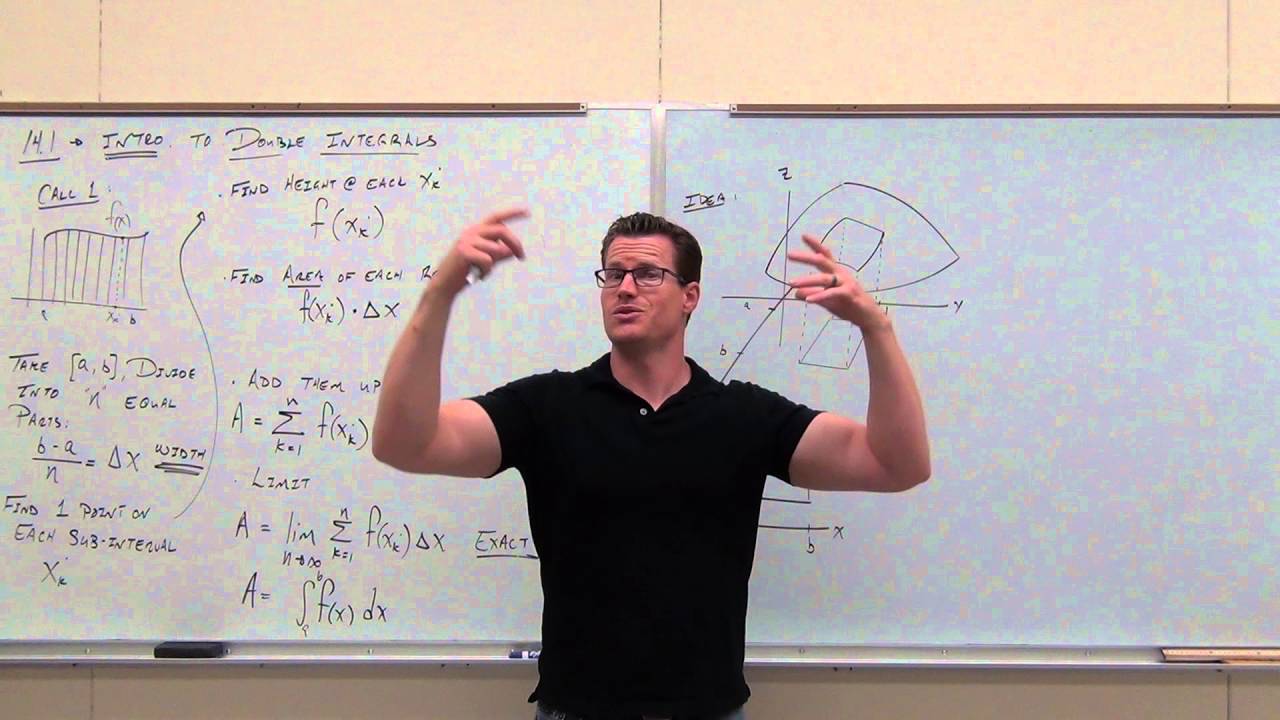
Calculus 3 Lecture 14.1: INTRODUCTION to Double Integrals (Background Info): A lesson on where double integrals come from, what they represent, and how to understand them.
I recommend learning multivar calculus first
rugged latch
Bro why is Leonard posing
supple copper
gentle sleet
why couldnt the inner integral bound have been 0 to x_1 or x_1 to 1?
You can’t have bounds that depend on the integration variable
After you integrate you should lose all the x₁’s
gentle sleet
supple copper
I recommend learning multivar calculus first
Im taking that course along with this
ill peep the vid real quick
supple copper
If the limits still have x₁ it’ll still be a function of x₁
supple copper
gentle sleet
ill peep the vid real quick
I really really like his teaching style, it’s a whole calc playlist
I pretty much learned all my calculus knowledge from his channel
This and the next few videos solidify everything you should know about multivariate integration
It’s good to spend just a few hours over like 2 days and the idea of bounds should be completely clear after watching the videos
But make sure you’re actively watching not just playing it in the background
trim joltBOT
Channel closed
Closed by @gentle sleet
Use .reopen if this was a mistake.
trim joltBOT
Available help channel!
Send your question here to claim the channel.
Remember:
• Ask your math question in a clear, concise manner.
• Show your work, and if possible, explain where you are stuck.
• After 15 minutes, feel free to ping <@&286206848099549185>.
• Type the command .close to free the channel when you're done.
• Be polite and have a nice day!
Read #❓how-to-get-help for further information on how to ask a good question, and about conduct in the question channels.
trim joltBOT
 kindred pier
 left oriole
10 won't get you all the way there
so either 11 or find the exact (non integer) value
trim joltBOT
Channel closed
Closed by @rough oxide
Use .reopen if this was a mistake.
trim joltBOT
Available help channel!
Send your question here to claim the channel.
Remember:
• Ask your math question in a clear, concise manner.
• Show your work, and if possible, explain where you are stuck.
• After 15 minutes, feel free to ping <@&286206848099549185>.
• Type the command .close to free the channel when you're done.
• Be polite and have a nice day!
Read #❓how-to-get-help for further information on how to ask a good question, and about conduct in the question channels.
 still idol
are isomorphisms transitive?
trim joltBOT
still idol
are isomorphisms transitive?
 stark bison
Yes
trim joltBOT
@still idol Has your question been resolved?
trim joltBOT
Channel closed
Closed by @still idol
Use .reopen if this was a mistake.
Available help channel!
Send your question here to claim the channel.
Remember:
• Ask your math question in a clear, concise manner.
• Show your work, and if possible, explain where you are stuck.
• After 15 minutes, feel free to ping <@&286206848099549185>.
• Type the command .close to free the channel when you're done.
• Be polite and have a nice day!
Read #❓how-to-get-help for further information on how to ask a good question, and about conduct in the question channels.
 quiet relic
I have a question
trim joltBOT
quiet relic
I have a question
quiet relic
You have a diagram of x and h
X numbers are listed 1,2,3,4
Y numbers listed 2,4,8,16
Is this linear or not
.close
trim joltBOT
Channel closed
Closed by @quiet relic
Use .reopen if this was a mistake.
quiet relic
I figured it out
trim joltBOT
Available help channel!
Send your question here to claim the channel.
Remember:
• Ask your math question in a clear, concise manner.
• Show your work, and if possible, explain where you are stuck.
• After 15 minutes, feel free to ping <@&286206848099549185>.
• Type the command .close to free the channel when you're done.
• Be polite and have a nice day!
Read #❓how-to-get-help for further information on how to ask a good question, and about conduct in the question channels.
 urban copper
let $f$ and $g$ be functions with three continuous derivatives such that $\\\begin{cases} f(3) &= 4 \ f'(3) &= 2 \ f''(3) &= 3 \end{cases}\\$ and the taylor polynomial of $g$ of degree $2$ centered in $x_0 = 1$ is $\P(x) = \frac{(x-1)^2}{2} + 2(x-1) + 3$. $\\$Find the taylor polynomial of degree $2$ centered at $x_0 = 1$ of $f \circ g$.
trim joltBOT
urban copper
let $f$ and $g$ be functions with three continuous derivatives such that $\\\\\b...
solid kilnBOT
calc_and_real_anal

 cedar anvil
What does g map x = 1 to?
urban copper
3
cedar anvil
Can you construct the taylor polynomial of f centered here?
urban copper
no
cedar anvil
Can you find the taylor polynomial of f at 3?
urban copper
,, Q_2(x) = f(3) + f'(3)(x-3) + \frac{f''(3)}{2!} (x-3)^2
cedar anvil
That’s centered at 1
solid kilnBOT
calc_and_real_anal
 cedar anvil
Ok, what about the values of g, g’, g’’ at x = 1
urban copper
we know $P_2(x) = \frac{\left(x-1\right)^2}{2} + 2(x-1) + 3 = \frac{g''(1)}{2!}(x-1)^2 + g'(1)(x-1) + g(1)$
solid kilnBOT
calc_and_real_anal
 cedar anvil
Yup. We also know f(g(x)) centered at 1 has something to do with the two taylor polynomials and derivatives you have found
How might you find the derivatives of f(g(x)) centered at 1
urban copper
which $\implies \begin{cases} g''(1) &= 1 \ g'(1) &=2 \ g(1) &= 3 \end{cases}$
solid kilnBOT
calc_and_real_anal
 urban copper
,, \frac{d}{dx} \left[f(g(x))\right] = f'(g(x)) \cdot g'(x)
solid kilnBOT
calc_and_real_anal
 cedar anvil
Yup, (f(g(x)))’ = f’(g(x))g’(x) => f’(3)g’(1)
urban copper
okay $f'(3) \cdot g'(1)$ now what?
solid kilnBOT
calc_and_real_anal
 cedar anvil
Can you do the same for the second derivative?
urban copper
,, \frac{d}{dx} \left[f'(g(x)) \cdot g'(x)\right]
solid kilnBOT
calc_and_real_anal
 urban copper
product rule + chain rule
omg
haha
,, \frac{d}{dx} \left[f'(g(x)) \cdot g'(x)\right] \
\left[ \frac{d}{dx} \left[f'(g(x))\right]\cdot g'(x) + f'(g(x)) \cdot \frac{d}{dx}\left[g'(x)\right]\right]
cedar anvil
Nice, then once you have the derivatives, you should be able to write out the taylor polynomial
solid kilnBOT
calc_and_real_anal
 urban copper
okay
chain rule

,, \frac{d}{dx} \left[f'(g(x)) \cdot g'(x)\right] \
\left[ \frac{d}{dx} \left[f'(g(x))\right]\cdot g'(x) + f'(g(x)) \cdot \frac{d}{dx}\left[g'(x)\right]\right] \ \left[ \left[f''(g(x)) \cdot g'(x) \right]\cdot g'(x) + f'(g(x)) \cdot \left[g''(x)\right]\right]
how do I differentiate that
do I need chain rule
cedar anvil
You have differentiated everything you need
urban copper
right side
cedar anvil
Derivative of g’ is just g’’
solid kilnBOT
calc_and_real_anal
 cedar anvil
Now you just need to evaluate at 1 and write out the taylor polynomial
urban copper
,, Q_2(x) = f(3) + f'(3)(x-1) + \frac{f''(3)}{2!} (x-1)^2
urban copper
,, \begin{cases} f(3) &= 4 \ f'(3) &= 2 \ f''(3) &= 3\end{cases}
solid kilnBOT
calc_and_real_anal
 urban copper
cedar anvil
Use the derivatives of f(g(x))
urban copper
cedar anvil
Use the derivatives of f(g(x))
how
urban copper
im so confuseddddddddd
cedar anvil
(f(g(x)))’ = ? at x=1
urban copper
f(3)
cedar anvil
cedar anvil
f(g(1)) = ?
What is this?
cedar anvil
cedar anvil
(f(g(x)))’ = ? at x=1
What is this?
cedar anvil
cedar anvil
What is this?
We calculated this using the chain rule above
urban copper
but f(3) remains
cedar anvil
urban copper
but its centered at x_0 = 1
You are doing it centered at 1
solid kilnBOT
calc_and_real_anal
 cedar anvil
f(g(x)) at 1 is f(3)
urban copper
yes
cedar anvil
urban copper
but f(3) remains
You are given the value of f(3)
urban copper
,, Q_2(x) = 4 + 2(x-1) + \frac{3}{2} (x-1)^2
solid kilnBOT
calc_and_real_anal
 urban copper
okay, how do I check my solution
cedar anvil
Plug in some values close to x = 1 and see if they match closely the actual values of f(g(x))
urban copper
can you check on wolfram and send screnshot
cedar anvil
Sure, you should be able to check with substitution using the taylor series of f and g manually too, but that is a lot of work
urban copper
.close
urban copper
given the series $\sum_{n = 1}^{\infty} \frac{3^n\left(x-4\right)^n}{a^n\sqrt{2n+1}}$ find $a > 0\\$ such that the radius of convergence is $2$. $\\$For the found a value, find all $x\in \mathbb{R}$ such that the series converges.
solid kilnBOT
calc_and_real_anal

 limpid dawn
what have you tried
urban copper
I was thinking of maybe applying ratio test but unsure if it will work
limpid dawn
it should work out

 urban copper
,, |x-4| < \lim_{n \to \infty} \frac{3^n}{a_n \cdot \sqrt{2n+1}} \cdot \frac{a^{n+1} \cdot \sqrt{2(n+1) + 1}}{3^{n+1}}
limpid dawn
the limit is without (x-4)^n
and without (x-4)^(n+1)
because it is one the left side already
solid kilnBOT
calc_and_real_anal
 urban copper
,, |x-4| < \lim_{n \to \infty} \frac{3^n}{a_n \cdot \sqrt{2n+1}} \cdot \frac{a^{n+1} \cdot \sqrt{2(n+1) + 1}}{3^{n+1}} \ \implies |x-4| < \lim_{n \to \infty} \frac{3^n}{a^n \cdot \sqrt{2n+1}} \cdot \frac{a^{n} \cdot a \cdot \sqrt{2(n+1) + 1}}{3^{n} \cdot 3}
solid kilnBOT
calc_and_real_anal
 urban copper
,, \implies |x-4| < \lim_{n \to \infty} \frac{a \sqrt{2n + 3}}{3\sqrt{2n+1}}
solid kilnBOT
calc_and_real_anal
 limpid dawn
nice
urban copper
,, \implies |x-4| < \lim_{n \to \infty} \frac{a}{3} \cdot \sqrt{\frac{2n+3}{2n+1}}
limpid dawn
,, \abs{x-4} < \lim_{n \to \infty} \frac{a \sqrt{2n + 3}}{3\sqrt{2n+1}} \ -\lim_{n \to \infty} \frac{a \sqrt{2n + 3}}{3\sqrt{2n+1}} <x-4 < \lim_{n \to \infty} \frac{a \sqrt{2n + 3}}{3\sqrt{2n+1}}

 urban copper
a moment
this limit is solvable
is approaching a/3
,, -\frac{a}{3} < x-4 < \frac{a}{3}
solid kilnBOT
calc_and_real_anal
 urban copper
how do I check my solution
limpid dawn
wdym
urban copper
if R = 2 , $a \in (-6, 6)$
limpid dawn
uhm wait
solid kilnBOT
calc_and_real_anal
 urban copper
@wild quail
limpid dawn
(-6,6) is not correct notation
urban copper
how do I find a then
limpid dawn
a = 6
urban copper
okay
limpid dawn
a > 0 anyway
limpid dawn
maybe there is an online calculator

but you also need to determine the interval of convergence
urban copper
how to find all x such that this converges?
limpid dawn
solid kiln
**calc\_and\_real\_anal**
this
urban copper
,, -\frac{6}{3} < x-4 < \frac{6}{3} \ \implies \frac{-6 + 12}{3} < x < \frac{18}{3}
left oriole
not sure if this was already addressed, but the endpoints should be checked
solid kilnBOT
calc_and_real_anal
 limpid dawn
yea this too
limpid dawn
solid kiln
**calc\_and\_real\_anal**
it's just -2 < x-4 < 2
urban copper
wdym
limpid dawn
borders
urban copper
given the series $\sum_{n = 1}^{\infty} \frac{3^n\left(x-4\right)^n}{a^n\sqrt{2n+1}}$ find $a > 0\\$ such that the radius of convergence is $2$. $\\$For the found a value, find all $x\in \mathbb{R}$ such that the series converges.
limpid dawn
like previous times same blue print
solid kilnBOT
calc_and_real_anal
 urban copper
$\begin{cases} &\sum_{n = 1}^{\infty} \frac{3^n\left(2-4\right)^n}{6^n\sqrt{2n+1}} \\ &\sum_{n = 1}^{\infty} \frac{3^n\left(3-4\right)^n}{6^n\sqrt{2n+1}} \end{cases}$
limpid dawn
and a?
urban copper
6
solid kilnBOT
calc_and_real_anal
 limpid dawn
also you cansimplify 3^n/6^n
urban copper
$\implies \begin{cases} &\sum_{n = 1}^{\infty} \left(\frac{1}{2}\right)^n\cdot \frac{\left(2-4\right)^n}{6^n\sqrt{2n+1}} \\ &\sum_{n = 1}^{\infty} \left(\frac{1}{2}\right)^n\cdot \frac{\left(3-4\right)^n}{\sqrt{2n+1}} \end{cases} \\\ \implies \begin{cases} &2 \cdot\sum_{n = 1}^{\infty} \left(\frac{1}{2}\right)^n\cdot \frac{\left(-1\right)^n}{6^n\sqrt{2n+1}} \\ &\sum_{n = 1}^{\infty} \left(\frac{1}{2}\right)^n\cdot \frac{\left(-1\right)^n}{\sqrt{2n+1}} \end{cases}$
solid kilnBOT
calc_and_real_anal
 left oriole
wait, you found the interval of convergence to be (2,3) even though the series is centered at 4?
that doesn't make sense
it should be symmetric around x=4
urban copper
we ommited $(x-4)^n$ when taking ratio test
solid kilnBOT
calc_and_real_anal
 urban copper
I think
left oriole
sure
urban copper
okay
left oriole
but if the radius of convergence is R then the interval is gonna be (4-R, 4+R)
possibly including the endpoints
urban copper
2, 6
,, -\frac{6}{3} < x-4 < \frac{6}{3} \ \implies \frac{-6 + 12}{3} < x < \frac{18}{3}
solid kilnBOT
calc_and_real_anal
 left oriole
yea, assuming R=2
left oriole
nw
urban copper
so $x \in \left(2,6\right)$
solid kilnBOT
calc_and_real_anal
 left oriole
yea, and you have to manually check 2 and 6
the series may or may not converge at the endpoints
urban copper
$\begin{cases} &\sum_{n = 1}^{\infty} \frac{3^n\left(2-4\right)^n}{6^n\sqrt{2n+1}} \\ &\sum_{n = 1}^{\infty} \frac{3^n\left(6-4\right)^n}{6^n\sqrt{2n+1}} \end{cases}$
solid kilnBOT
calc_and_real_anal
 urban copper
$\implies \begin{cases} &\sum_{n = 1}^{\infty} \left(\frac{1}{2}\right)^n\cdot \frac{\left(2-4\right)^n}{6^n\sqrt{2n+1}} \\ &\sum_{n = 1}^{\infty} \left(\frac{1}{2}\right)^n\cdot \frac{\left(6-4\right)^n}{\sqrt{2n+1}} \end{cases} \\\ \implies \begin{cases} &2 \cdot\sum_{n = 1}^{\infty} \frac{\left(-1\right)^n}{6^n\sqrt{2n+1}} \\ &\sum_{n = 1}^{\infty} \left(\frac{1}{2}\right)^n\cdot \frac{\left(2\right)^n}{\sqrt{2n+1}} \end{cases}$
solid kilnBOT
calc_and_real_anal
 left oriole
go back to this:
 urban copper
2-4 = -2
left oriole
in the first one you get (3^n (-2)^n) / 6^n which is just (-1)^n
in the second one it will be just 1
urban copper
wait
left oriole
so the first one should simpflify to (-1)^n / sqrt(2n+1)
urban copper
what happened to the sqrt
 urban copper
that should be $\sum_{n = 1}^{\infty} \frac{(-1)^n}{\sqrt{2n+1}}$?
solid kilnBOT
calc_and_real_anal
 urban copper
left oriole
so the first one should simpflify to (-1)^n / sqrt(2n+1)
urban copper
left oriole
so the first one should simpflify to (-1)^n / sqrt(2n+1)
ok
and the second one the same but not -1 but 1
that second one should be $\sum_{n = 1}^{\infty} \frac{(1)^n}{\sqrt{2n+1}}$
solid kilnBOT
calc_and_real_anal
 urban copper
how to check convergence now?
limpid dawn
what happend to the 2^n term in the denominator
urban copper
(1/2)^n
 limpid dawn
,,\frac{3^n}{6^n} = \frac{1}{2^n}
solid kilnBOT
now what (𝔸dωn𝓲²s)
 urban copper
but the limit of (1/2)^n is the same as the limit of 2^-n
urban copper
$\implies \begin{cases} &\sum_{n = 1}^{\infty} \left(\frac{1}{2}\right)^n\cdot \frac{\left(2-4\right)^n}{6^n\sqrt{2n+1}} \\ &\sum_{n = 1}^{\infty} \left(\frac{1}{2}\right)^n\cdot \frac{\left(6-4\right)^n}{\sqrt{2n+1}} \end{cases} \\\ \implies \begin{cases} &\sum_{n = 1}^{\infty} \frac{\left(-1\right)^n}{\sqrt{2n+1}} \\ &\sum_{n = 1}^{\infty} \frac{\left(1\right)^n}{\sqrt{2n+1}} \end{cases}$
lowkey
urban copper
mb
solid kilnBOT
calc_and_real_anal

 limpid dawn
,, \sum_{n = 1}^{\infty} \frac{1}{\sqrt{2n+1}} \geq \sum_{n = 1}^{\infty} \frac{1}{\sqrt{4n}}
this seems to diverge more
so we could try to find a smaller series that diverges
compare it to 1/sqrt(4n)
urban copper
I need more hints
urban copper
this comparison test does not tell anything about convergence though, we still need to check the convergence
solid kilnBOT
now what (𝔸dωn𝓲²s)
 limpid dawn
urban copper
this comparison test does not tell anything about convergence though, we still n...
limpid dawn
urban copper
this comparison test does not tell anything about convergence though, we still n...
we want to know if the borders are legit
limpid dawn
urban copper
you can take the 4 out of the sqrt
yea
and 1/sqrt(n) diverges after the integral criterion
so for x = 6 it diverges
urban copper
wdym
limpid dawn
you could also save the images i sent smh
urban copper
 limpid dawn
,,\sum_{n=1}^{\infty} \frac{1}{n^{\alpha}} \text{ converges for } \alpha > 1
solid kilnBOT
now what (𝔸dωn𝓲²s)
 left oriole
integral test a bit overkill here but sure, it works
limpid dawn
solid kiln
**now what (𝔸dωn𝓲²s)**
use this fact
urban copper
limpid dawn
,,\sum_{n=1}^{\infty} \frac{1}{n^{\alpha}} \text{ converges for } \alpha > 1
that is p test?
urban copper
 limpid dawn
yea this
urban copper
alternating
left oriole
yea, see if it satisfies all the requirements for the alt series test
urban copper
which one leibnitz or alternating?
 solid kilnBOT
calc_and_real_anal
 limpid dawn
You can prove algebraically 1)
urban copper
I need more handholding
limpid dawn
a_n has to be a null sequence