#help-38
1 messages · Page 113 of 1
 sweet hare
 main flower
Right, but how come the online calculator is giving the wrong output
sweet hare
I don't know
main flower
sweet hare
I just did the row reduction
is it possible if you show how you got it?
sweet hare
it's too much to type out, there are several steps
main flower
I mean cant you take a snapshot
sweet hare
i'm on a computer so not really
 trim joltBOT
Channel closed
Closed by @main flower
Use .reopen if this was a mistake.
trim joltBOT
 Available help channel!
Send your question here to claim the channel.
Remember:
• Ask your math question in a clear, concise manner.
• Show your work, and if possible, explain where you are stuck.
• After 15 minutes, feel free to ping <@&286206848099549185>.
• Type the command .close to free the channel when you're done.
• Be polite and have a nice day!
Read #❓how-to-get-help for further information on how to ask a good question, and about conduct in the question channels.
 olive pumice
Is there a general rule for this?
 trim joltBOT
olive pumice
Is there a general rule for this?
trim joltBOT
olive pumice
Is there a general rule for this?
Please don't occupy multiple help channels.
 sharp herald
Could you provide English translation?
trim joltBOT
@olive pumice Has your question been resolved?
olive pumice
On a large squared sheet of paper, Agata drew a figure consisting of 40 connected sections, which she numbered successively with natural numbers from 1 to 40. The drawing shows a fragment of this figure, consisting of eight initial sections. Agata drew the subsequent sections of this figure according to the same rule that she used to draw sections 1–8.
Note: all grid cells are the same squares
The straight lines containing segments numbered 1 and 7 are mutually perpendicular.
True or false
The straight lines containing sections numbered 5 and 33 are parallel to each other.
True or false
@sharp herald
<@&286206848099549185>
trim joltBOT
@olive pumice Has your question been resolved?
trim joltBOT
Channel closed
Closed due to timeout
Use .reopen if this was a mistake.
trim joltBOT
Available help channel!
Send your question here to claim the channel.
Remember:
• Ask your math question in a clear, concise manner.
• Show your work, and if possible, explain where you are stuck.
• After 15 minutes, feel free to ping <@&286206848099549185>.
• Type the command .close to free the channel when you're done.
• Be polite and have a nice day!
Read #❓how-to-get-help for further information on how to ask a good question, and about conduct in the question channels.
 hoary cosmos
can I get some help with the following question
 hoary cosmos
Like this

 livid thunder
yes
hoary cosmos
now I should differentiate dy/dx
trim joltBOT
@hoary cosmos Has your question been resolved?
livid thunder
hoary cosmos
now I should differentiate dy/dx
oh mb, its just power rule
trim joltBOT
Channel closed
Closed due to timeout
Use .reopen if this was a mistake.
Available help channel!
Send your question here to claim the channel.
Remember:
• Ask your math question in a clear, concise manner.
• Show your work, and if possible, explain where you are stuck.
• After 15 minutes, feel free to ping <@&286206848099549185>.
• Type the command .close to free the channel when you're done.
• Be polite and have a nice day!
Read #❓how-to-get-help for further information on how to ask a good question, and about conduct in the question channels.
 pure apex
Hello, i just have a question about exponential functions since I'm a bit rusty
My worksheet has the following problem to solve:
f(x)=c*a^x
A(-3|2)
B(2|5)
-> calculate c and a
I don't think it's possible to calculate the function based on just 2 points but please correct me if I'm wrong
trim joltBOT
pure apex
Hello, i just have a question about exponential functions since I'm a bit rusty
...
 tiny valve
I think you can
 true sierra
why wouldn't it be possible?
you have two points, therefore 2 pairs of x and y
and you have two unknowns, c and a
so you can write a system of two equations with 2 unkowns from that
Also assuming a isn't equal to zero as well I guess
pure apex
so i got
ca^2=5 and ca^(-3)=2
true sierra
ye
pure apex
and then just solve the system for equations; the values i got yesterday were wrong so i guess i mustve made a mistake solving
yeah i solved it thanks, i found my mistake i made yesterday too thanks
trim joltBOT
@pure apex Has your question been resolved?
Channel closed
Closed by @pure apex
Use .reopen if this was a mistake.
Available help channel!
Send your question here to claim the channel.
Remember:
• Ask your math question in a clear, concise manner.
• Show your work, and if possible, explain where you are stuck.
• After 15 minutes, feel free to ping <@&286206848099549185>.
• Type the command .close to free the channel when you're done.
• Be polite and have a nice day!
Read #❓how-to-get-help for further information on how to ask a good question, and about conduct in the question channels.
 dry linden
is this correct ? should i take 1/5 or 4/5 ?
 trim joltBOT
dry linden
is this correct ? should i take 1/5 or 4/5 ?
trim joltBOT
dry linden
is this correct ? should i take 1/5 or 4/5 ?
@dry linden Has your question been resolved?
 dapper swift
dry linden
is this correct ? should i take 1/5 or 4/5 ?
dapper swift
dry linden
is this correct ? should i take 1/5 or 4/5 ?
You have a geometric distribution cause the question is asking you about the situation when there are (n - 1) hits in a row, and then a miss
So in this situation, your miss counts as a 'success' cause you need a success to stop the throws
And so yes taking p = 1/5 is correct, as that's the probability of success
Yes so the expected value is just 1/p = 1/(1/5) = 5, but you need to subtract 1 to get 4
The variance is (1 - p)/p^2
(both for the number of trials before the first miss, and the total number of trials)
Which is just (1 - 1/5)/(1/25)
,calc (1 - 1/5)/(1/25)
 solid kilnBOT
Result:
20
so the variance is 20?
dapper swift
dry linden
so the variance is 20?
yes
dry linden
dapper swift
yes
thank u
dapper swift
no worries
dry linden
.close
trim joltBOT
Channel closed
Closed by @dry linden
Use .reopen if this was a mistake.
trim joltBOT
Available help channel!
Send your question here to claim the channel.
Remember:
• Ask your math question in a clear, concise manner.
• Show your work, and if possible, explain where you are stuck.
• After 15 minutes, feel free to ping <@&286206848099549185>.
• Type the command .close to free the channel when you're done.
• Be polite and have a nice day!
Read #❓how-to-get-help for further information on how to ask a good question, and about conduct in the question channels.
 modern ferry
"Show that the field F below is conservative. Determine a potential for F and then calculate the line integral
...
where γ is an arbitrary C^1 curve from (0, 0, 1) to (1,π/2, 1). Cross-check your result: calculate the integral
directly by choosing the straight path between the two points"
 trim joltBOT
modern ferry
"Show that the field F below is conservative. Determine a potential for F and th...
trim joltBOT
modern ferry
"Show that the field F below is conservative. Determine a potential for F and th...
 shrewd vessel
modern ferry
"Show that the field F below is conservative. Determine a potential for F and th...
shrewd vessel
modern ferry
"Show that the field F below is conservative. Determine a potential for F and th...
which part do you need help with?
modern ferry
well all of it kind but how do i start by showing that F is conservative
do i juste find the derives of F(x,y,z)?
 nova spire
It's kinda the opposite
you want to show that F itself is the gradient of another function
modern ferry
oh okay
nova spire
and try to create that function yourself
shrewd vessel
modern ferry
well all of it kind but how do i start by showing that F is conservative
a vector field F is conservative if $F = \nabla \phi = \left( \frac{\partial \phi}{\partial x}, \frac{\partial \phi}{\partial y}, \frac{\partial \phi}{\partial z} \right)$ for some scalar field $\phi$
modern ferry
so like we need to show that F is a gradiant to for example Φ(x,y,z)?
solid kilnBOT
lgkoo
 nova spire
modern ferry
so like we need to show that F is a gradiant to for example Φ(x,y,z)?
nova spire
modern ferry
so like we need to show that F is a gradiant to for example Φ(x,y,z)?
yes, and create such a phi
modern ferry
oh yeah
nova spire
for example, start with finding an antiderivative with respect to z of the third coordinate of F
and then keep adding terms until all the derivatives match
modern ferry
yeah okay!
okay i think i got 4xy^2 + 3yln(z) + 3z cos(y)
no wait the last term is wrong
4xy^2 + 3yln(z) + z cos(y)?
do i find the antiderive for 3ln(z)-zsin(y) wrt y?
nova spire
modern ferry
do i find the antiderive for 3ln(z)-zsin(y) wrt y?
first, try to differentiate what you got wrt x and y
and if it already works, it's great!
otherwise, add antiderivative terms that might be missing from the function you got
modern ferry
oh okay
nova spire
yes
modern ferry
yes i got the same this when i derived wrt x y and z
so now i do the same for term 2 and 1 but antiderive wrt y and x?
modern ferry
oh wait i got confused
modern ferry
modern ferry
4xy^2 + 3yln(z) + z cos(y)?
so its this?
nova spire
yes
modern ferry
okay so now we need to calculate the line intergal?
where the bounds are from (0,0,1) to (1, pi/2, 1)
nova spire
yes
modern ferry
okay do we use Φ(0,0,1) - Φ(1, pi/2, 1)?
solid kilnBOT
rafilou2003
 shrewd vessel
modern ferry
so we get (4 + 3pi/2 -1) - (0 + 0 + 1)?
shrewd vessel
modern ferry
so we get (4 + 3pi/2 -1) - (0 + 0 + 1)?
after you substituted the values (1, pi/2, 1) into Φ, you should get a single number rather than a coordinate, same for (0,0,1)
modern ferry
hmm okay so like 3pi/2 +2?
shrewd vessel
modern ferry
hmm okay so like 3pi/2 +2?
uhh what was your Φ?
modern ferry
modern ferry
so we get (4 + 3pi/2 -1) - (0 + 0 + 1)?
is it not this
shrewd vessel
modern ferry
is it not this
assuming those numbers are right then yh 3pi/2 +2 is right
modern ferry
since we got 4xz^2 + 3yln(z) + zcos(y)
yeah okay
do we use this in the integral now
modern ferry
modern ferry
since we got 4xz^2 + 3yln(z) + zcos(y)
dont we use the first numbers from here
nova spire
we do
and plug in (x,y,z) = ...
so I ask again
how'd you get (4 + 3pi/2 - 1) - ...?
modern ferry
so (1, pi/2, 1) becomes 1 * 4 = 4 and pi/2 * 3 = 3pi/2
modern ferry
ohh y?
nova spire
no, y = pi/2
so 3*y
that's not what you forgot
rewrite 4xz^2 + 3yln(z) + zcos(y) and exactly plug in x = 1,...
so the first term I rewrite as 4(1)(1)^2
keep doing this and you'll see what's wrong
nova spire
yep
modern ferry
okay so we get 3?
nova spire
yes
modern ferry
modern ferry
since we got 4xz^2 + 3yln(z) + zcos(y)
this and 3?
shrewd vessel
modern ferry
okay do we use Φ(0,0,1) - Φ(1, pi/2, 1)?
the line integral is just Φ(1, pi/2, 1) - Φ(0,0,1) =3 (by Fundamental Theorem of Line Integral), so you're done, for the first part
modern ferry
okay what does he mean by cross check your result?
shrewd vessel
it means do the line integral in a different way, by parametrising x(t), where x(t) is the straight line path from (0,0,1) to (1, pi/2, 1)
modern ferry
oh okay so like (t, pi/2t, 1)?
shrewd vessel
modern ferry
oh okay so like (t, pi/2t, 1)?
yes, but you should specify what is domain for t
modern ferry
from 0 to 1?
shrewd vessel
yup
modern ferry
do we use F(γ(t)) * γ`(t) dt?
shrewd vessel
modern ferry
do we use F(γ(t)) * γ`(t) dt?
yh
modern ferry
so γ`(t) = (1, pi/2, 0)?
shrewd vessel
yes
modern ferry
okay wait so we get (4t^2, 3ln(1)- sin(pi/2t), 8t+ (3pi/2t)/1 + cos(pi/2t)) * (1, pi/2, 0)?
shrewd vessel
modern ferry
okay wait so we get (4t^2, 3ln(1)- sin(pi/2t), 8t+ (3pi/2t)/1 + cos(pi/2t)) * (1...
almost, your x-component of F(γ(t)) isn't right
modern ferry
is it 4xt^2?
modern ferry
is it not t?
shrewd vessel
that's right, so (x,y,z) = (t, t*pi/2, 1)
modern ferry
oh 4tz^2?
shrewd vessel
How did you get that?
modern ferry
yes
shrewd vessel
and (x,y,z) = (t, t * pi/2, 1), which means x = t, y = t * pi/2 and z = 1
substitute z = 1 into 4z^2
what should we have here?
modern ferry
oh so we just get 4?
shrewd vessel
yah
shrewd vessel
modern ferry
wait i dont know if i get 3
can you send your work?
modern ferry
well let me just ask so i have it right
4 is gone
3ln(1) also dissepears
and cos (pi/2t)/1 also disappears
does -sin(pi/2t) become -t?
shrewd vessel
modern ferry
does -sin(pi/2t) become -t?
no, why would it
shrewd vessel
modern ferry
4 is gone
also why would 4 be gone?
modern ferry
because -sin(pi/2) is -1
shrewd vessel
modern ferry
because -sin(pi/2) is -1
yh but that's for a specific t = 1, but t runs from 0 to 1. Think about, say t = 0.5, is that still true?
modern ferry
oh okay
shrewd vessel
modern ferry
4 is gone
I'm still wondering why 4 is gone?
shrewd vessel
okk
modern ferry
but what happens to the (3pi/2t)/1?
shrewd vessel
ok so we had $\left( 4t^2, 3 \ln(1) - \sin(\frac{\pi}{2}t), 8t + \frac{3\pi}{2}t + \cos(\frac{\pi}{2}t) \right) \cdot \left(1, \frac{\pi}{2}, 0 \right)$
solid kilnBOT
lgkoo
 shrewd vessel
modern ferry
but what happens to the (3pi/2t)/1?
shrewd vessel
modern ferry
but what happens to the (3pi/2t)/1?
here we are doing a dot product, so what does (3pi/2t)/1 get multiplied with?
shrewd vessel
why?
 limpid dawn
shrewd vessel
why?
limpid dawn
shrewd vessel
why?
Dont question her⚔️
shrewd vessel
limpid dawn
Dont question her⚔️
mb 
modern ferry
is it not that?
shrewd vessel
modern ferry
is it not that?
no, it's a dot product, do you remember how to do a dot product of say (a, b, c) dot (e, f, g)?
modern ferry
yes i think so haha
shrewd vessel
modern ferry
yes i think so haha
ok, what will it be for the example I gave?
modern ferry
it is ae + bf+ cg
shrewd vessel
ok that's right
shrewd vessel
solid kiln
**lgkoo**
so for this, c is 8t + 3pi/2 t + cos(pi/2 t) and g is 0
right?
modern ferry
oh okay right
shrewd vessel
so what will be your full expression in terms of t after the dot product?
modern ferry
we will get 4 + 3pi/2(ln(1)-sin(pi/2t)?
or maybe we dont need to take out the 3
so 4 + pi/2(3ln(1) - sin(pi/2t)
shrewd vessel
modern ferry
so 4 + pi/2(3ln(1) - sin(pi/2t)
yup, and what is ln(1)
I'm sorry @limpid dawn I'm sorry, forgive me 
modern ferry
no dont say sorry
limpid dawn
You can have her😡
modern ferry
it is 0
limpid dawn
She for the discord help channels😡
shrewd vessel
modern ferry
it is 0
yup
modern ferry
so the entire ln term is gone
shrewd vessel
limpid dawn
You can have her😡
huh?
shrewd vessel
modern ferry
so the entire ln term is gone
not quite, only ln(1) vanishes, you still have sin(pi/2 t) remains inside
modern ferry
so now we have 4 + pi/2(-sin(pi/2t)
shrewd vessel
yup
shrewd vessel
nope
modern ferry
okay so do we put in the bounds now?
shrewd vessel
now all that remains just need to be integrated
shrewd vessel
it won't, you're integrating 4 - pi/2 sin(pi/2 t) wrt. t from 0 to 1
shrewd vessel
modern ferry
so we get 4t + pi/2 cos(pi/2t)?
almost, you forgot the chain rule, if you integrate sin(pi/2 t) alone you also get a factor in front remember?
modern ferry
ohh right
i forgot
do we just get pi then infront?
4t + pi(cos(pi/2t)?
no wait
4t+pit*cos(pi/2t)?
shrewd vessel
no, think about differentiating it back to check
if we differentiate pi/2 cos(pi/2 t), we get
pi/2 * pi/2 * -sin(pi/2 t) = -pi^2/4 * sin(pi/2 t)
but we should expect only -pi/2 * sin(pi/2 t)
so integrating -pi/2 sin(pi/2 t) is simply cos(pi/2 t), cuz differentiating cos(pi/2 t) = -pi/2 sin(pi/2 t) by chain rule
shrewd vessel
nice
modern ferry
thank you so much for the help!
shrewd vessel
you're welcome!
modern ferry
.close
trim joltBOT
Channel closed
Closed by @modern ferry
Use .reopen if this was a mistake.
 wispy ravine
<@&286206848099549185>
trim joltBOT
Available help channel!
Send your question here to claim the channel.
Remember:
• Ask your math question in a clear, concise manner.
• Show your work, and if possible, explain where you are stuck.
• After 15 minutes, feel free to ping <@&286206848099549185>.
• Type the command .close to free the channel when you're done.
• Be polite and have a nice day!
Read #❓how-to-get-help for further information on how to ask a good question, and about conduct in the question channels.
 marsh forum
$\lim_{x\rightarrow\infty}\left(\left(\frac{n!}{n!+\left(n+1\right)!}\right)\right)$
trim joltBOT
marsh forum
$\lim_{x\rightarrow\infty}\left(\left(\frac{n!}{n!+\left(n+1\right)!}\right)\rig...
solid kilnBOT
ƒ(Why am. I here)=I don't Know
 marsh forum
I started by dividing the num and denom by $n!$
solid kilnBOT
ƒ(Why am. I here)=I don't Know
 marsh forum
to obtain
$\lim_{x\rightarrow\infty}\left(\left(\frac{1}{1+\left(n+1\right)}\right)\right)$
solid kilnBOT
ƒ(Why am. I here)=I don't Know
 marsh forum
so isn't the limit 0
 bright quarry
do you mean as n->inf
trim joltBOT
Channel closed
Closed by @marsh forum
Use .reopen if this was a mistake.
trim joltBOT
Available help channel!
Send your question here to claim the channel.
Remember:
• Ask your math question in a clear, concise manner.
• Show your work, and if possible, explain where you are stuck.
• After 15 minutes, feel free to ping <@&286206848099549185>.
• Type the command .close to free the channel when you're done.
• Be polite and have a nice day!
Read #❓how-to-get-help for further information on how to ask a good question, and about conduct in the question channels.
modern ferry
"Let C be the curve of intersection between the paraboloid z = x^2 + y^2
and the plane z = 6x + 2y + 6 oriented
counterclockwise seen from the point (0,0,100) way up on the z axis. Calculate the circulation
...
(a) by parametrizing C (projecting C into the xy plane, parametrizing x = x(t), y = y(t), expression
then z from the equation of the plane, you know the drill. . . ).
(b) by using Stokes' theorem."
 trim joltBOT
modern ferry
"Let C be the curve of intersection between the paraboloid z = x^2 + y^2
and the...
modern ferry
trim joltBOT
modern ferry
"Let C be the curve of intersection between the paraboloid z = x^2 + y^2
and the...
modern ferry
how do i parametizise it?
is the radius 10?
and x(t) = r cos(t) y(t) = r sin(t)
z(t) = 6(10 cos(t) + 2(10 sin(t) + 6
z(t) = 60 cos(t) + 20 sin(t) + 6
F(x(t), y(t), z(t)) = [-z, 8x, -y] = [-60 cos(t) -20 sin(t) -6, 80 cos(t), -10 sin(t) ]
 undone solstice
modern ferry
is the radius 10?
undone solstice
modern ferry
is the radius 10?
how did you obtain this?
modern ferry
well i thaught since we have (0,0,100) that means z = 100 and sqrt of 100 is 10
but maybe that is totally wrong
undone solstice
well youre trying to find the intersection of the two surfaces z = x^2 + y^2 and z = 6x + 2y + 6
so all x,y such that 6x + 2y + 6 = x^2 + y^2
modern ferry
yes okay
undone solstice
undone solstice
so all x,y such that 6x + 2y + 6 = x^2 + y^2
so try to get a parametrization out of this
modern ferry
okay can we write it like 16 = (x-3)^2 + (y-1)^2?
undone solstice
yep
modern ferry
okay does that mean that the radius is 4?
undone solstice
yea
modern ferry
okay do we use x(t) = a + r cos(t) and y(t) = b + r sin(t)?
undone solstice
yea exactly
modern ferry
so that we get 6( 3 + 4cos(t)) + 2( 1 + 4 sin(t)) + 6
modern ferry
yeah okay 26 + 24cos(t) + 8sin(t)
undone solstice
yes correct
so r(t) would be?
or whatever you wanna call it
also dont forget the bounds for t
so that the curve would fit the description they want
counter-clockwise from z = 100
modern ferry
r(t) = [3 + 4cos(t), 1 + 4sin(t), 26 + 24cos(t) + 8sin(t)]?
undone solstice
yes
modern ferry
r`(t) = [-4sin(t), 4cos(t), -24sin(t) + 8cos(t)}?
undone solstice
yeah that looks correct
modern ferry
do we calculate F(x(t), y(t), z(t)) * r`(t) now?
undone solstice
yeah but what would be the bounds of t, since you need some bounds for your integral
modern ferry
modern ferry
do we calculate F(x(t), y(t), z(t)) * r`(t) now?
Okay so can I do this or do I do something else?
undone solstice
yea you can evaluate the integral now
modern ferry
okay i think i get 128sin(t) -32sin^2(t) + 128cos^2(t) + 96cos(t) + 192sin(t)cos(t) from that?
without having integrated and put in the bounds
undone solstice
let me check
trim joltBOT
@modern ferry Has your question been resolved?
modern ferry
Thank you for the help but I will continue tomorrow
trim joltBOT
Channel closed
Closed by @modern ferry
Use .reopen if this was a mistake.
trim joltBOT
Available help channel!
Send your question here to claim the channel.
Remember:
• Ask your math question in a clear, concise manner.
• Show your work, and if possible, explain where you are stuck.
• After 15 minutes, feel free to ping <@&286206848099549185>.
• Type the command .close to free the channel when you're done.
• Be polite and have a nice day!
Read #❓how-to-get-help for further information on how to ask a good question, and about conduct in the question channels.
 rocky karma
hey,
can anyone give me an example please of a function f that does not have an inverse when:
f, g : N to N
and f o g = the identity function
trim joltBOT
rocky karma
hey,
can anyone give me an example please of a function f that does not have an...
rocky karma
 wraith hinge
y=x^2
wraith hinge
y=x^2
but how can f o g be the identity function in this case
trim joltBOT
@rocky karma Has your question been resolved?
trim joltBOT
Channel closed
Closed due to timeout
Use .reopen if this was a mistake.
Available help channel!
Send your question here to claim the channel.
Remember:
• Ask your math question in a clear, concise manner.
• Show your work, and if possible, explain where you are stuck.
• After 15 minutes, feel free to ping <@&286206848099549185>.
• Type the command .close to free the channel when you're done.
• Be polite and have a nice day!
Read #❓how-to-get-help for further information on how to ask a good question, and about conduct in the question channels.
 idle summit
Hi, you can solve this equation using the inverse matrix method (if possible with a step-by-step explanation)
 trim joltBOT
idle summit
Hi, you can solve this equation using the inverse matrix method (if possible wit...
trim joltBOT
idle summit
Hi, you can solve this equation using the inverse matrix method (if possible wit...
@idle summit Has your question been resolved?
sweet hare
what is the "inverse matrix method"?
trim joltBOT
Channel closed
Closed due to timeout
Use .reopen if this was a mistake.
Available help channel!
Send your question here to claim the channel.
Remember:
• Ask your math question in a clear, concise manner.
• Show your work, and if possible, explain where you are stuck.
• After 15 minutes, feel free to ping <@&286206848099549185>.
• Type the command .close to free the channel when you're done.
• Be polite and have a nice day!
Read #❓how-to-get-help for further information on how to ask a good question, and about conduct in the question channels.
 storm shoal
What is that symbol? Which has a "∨" and a "_" below it, I've never seen that before
 trim joltBOT
storm shoal
What is that symbol? Which has a "∨" and a "_" below it, I've never seen that be...
trim joltBOT
storm shoal
What is that symbol? Which has a "∨" and a "_" below it, I've never seen that be...
 austere cedar
Might be referring to the "NAND", which is the set of all things that aren't in the intersection
But I can't be sure. These operations don't have agreed upon symbols and aren't commonly used
storm shoal
Thank you
I thought the "∨" symbol would have something to do with the "or" symbol
.close
trim joltBOT
Channel closed
Closed by @storm shoal
Use .reopen if this was a mistake.
trim joltBOT
Available help channel!
Send your question here to claim the channel.
Remember:
• Ask your math question in a clear, concise manner.
• Show your work, and if possible, explain where you are stuck.
• After 15 minutes, feel free to ping <@&286206848099549185>.
• Type the command .close to free the channel when you're done.
• Be polite and have a nice day!
Read #❓how-to-get-help for further information on how to ask a good question, and about conduct in the question channels.
 acoustic flint
I'm trying to compute the Ricci Tensors for a given line element. I have computed the following non-zero Christoffel symbols
[ \Gamma^{r}{\varphi\varphi} = \tanh (r) \sech^2 (r) ]
[ \Gamma^{\varphi}{r\varphi} = \Gamma^{\varphi}{\varphi r} = \frac 1{\cosh (r) \sinh (r)} ]
I understand the Ricci Tensors are given by
[ R{ij} = \partial_k \Gamma^{k}{ij} - \partial_j \Gamma^k{ik} + \Gamma^{k}{ij} \Gamma^m{km} - \Gamma^k_{im} \Gamma^m_{jk} ]
But I'm getting lost in the notation/expansion with the Christoffel Symbols I have computed already
trim joltBOT
acoustic flint
I'm trying to compute the Ricci Tensors for a given line element. I have compute...
solid kilnBOT
shsgd
 trim joltBOT
@acoustic flint Has your question been resolved?
acoustic flint
.close
trim joltBOT
Channel closed
Closed by @acoustic flint
Use .reopen if this was a mistake.
trim joltBOT
Available help channel!
Send your question here to claim the channel.
Remember:
• Ask your math question in a clear, concise manner.
• Show your work, and if possible, explain where you are stuck.
• After 15 minutes, feel free to ping <@&286206848099549185>.
• Type the command .close to free the channel when you're done.
• Be polite and have a nice day!
Read #❓how-to-get-help for further information on how to ask a good question, and about conduct in the question channels.
 hollow bronze
hi
trim joltBOT
hollow bronze
hi

 keen sable
sorry it was an accident I was in a hurry
 wanton rune
hollow bronze
what would be the correct answer
wanton rune
hollow bronze
what would be the correct answer
!noans
trim joltBOT
hollow bronze
what would be the correct answer
The purpose of this server is to help you learn, not to hand out answers. Do not ask someone to give you the answer directly.
trim joltBOT
@hollow bronze Has your question been resolved?
trim joltBOT
Channel closed
Closed due to timeout
Use .reopen if this was a mistake.
Available help channel!
Send your question here to claim the channel.
Remember:
• Ask your math question in a clear, concise manner.
• Show your work, and if possible, explain where you are stuck.
• After 15 minutes, feel free to ping <@&286206848099549185>.
• Type the command .close to free the channel when you're done.
• Be polite and have a nice day!
Read #❓how-to-get-help for further information on how to ask a good question, and about conduct in the question channels.
 north hinge
 trim joltBOT
north hinge
north hinge
trim joltBOT
north hinge
north hinge
I forgot how to tell how the graph is going to from the function
sharp herald
Use the fact that the largest power of f(p) is odd/even
And whether or not the coefficient is positive/negative
north hinge
what is coefficient again
I think I know what you mean

oh I see I remember coefficient now lol thanks
.close
trim joltBOT
Channel closed
Closed by @north hinge
Use .reopen if this was a mistake.
Available help channel!
Send your question here to claim the channel.
Remember:
• Ask your math question in a clear, concise manner.
• Show your work, and if possible, explain where you are stuck.
• After 15 minutes, feel free to ping <@&286206848099549185>.
• Type the command .close to free the channel when you're done.
• Be polite and have a nice day!
Read #❓how-to-get-help for further information on how to ask a good question, and about conduct in the question channels.
 frigid lark
 trim joltBOT
frigid lark
frigid lark
trim joltBOT
frigid lark
frigid lark
im pretty confused with this
so we take moments clockwise and anticlockwise
but i dont understand what the answers are doing, because i wouldve taken moments from either D or A

i dont get why they keep multiplying by cos53.1 and why its = T x 0.8 as thats not going to be the tension in CD because CD is not 0.8m long
they must be taking moments from A due to 1.7 x 10 x 9.8 but it doesnt make sense
austere cedar
They are taking the moment from A
austere cedar
What's the moment caused by the weight of the pole?
frigid lark
im just confused as to why they are doing xcos53.1 for each torque
austere cedar
It's typically included in the formula
Or you may have the formula as a dot product
Moment = F•r
r is a vector pointing to the location of action, and F is the vector for the force
• being the dot product
Note this is also |F||r|cosθ
Where θ is the angle between vectors F and r
frigid lark
yes but the angle of 53.1 is at D
using alternate angles, you can put it outside the triangle at A but i just dont think it makes sense
austere cedar
LOL whoops sorry it's been a while. Moment is a cross product, not a dot product
You want to take the sin of the angle between r and F.
But they instead must have decomposed the vector, and took the cos of the complementary angle
frigid lark
decomposed it?
austere cedar
frigid lark

Basically break the vector down into components, like the red and blue here
austere cedar
That, but for every force
Personally, I would have done sin(36.9) not cos(53.1)
As 36.9 is the actual angle between r and F
frigid lark
if its for every force doesnt that mean the moments wont be taken from the same place (sorry its exam week and im tired, brains not working)
the angle in reference is blue vs hypotenuse?
and how would you find the angle considering blue isnt parallel to CD
austere cedar
frigid lark

Green is vector r
Red is vector F
Cross product between them is |r||F|sinθ
That's how I would have personally done this question. I'm not certain how they did this question.
frigid lark
do you mind explaining it without "cross product" bc we dont use that terminology (its specialist math which i recently dropped and i kinda forgot about it)
and we dont get taught it in physics
do you mean calculating the angle parallel to CD
using r F sin θ
*parallel
frigid lark
yep and you use that to calculate CD
austere cedar
Eventually. Right now we're calculating the moment that the weight of the pole places on A
We can repeat for the lamp, and the force CD
frigid lark
got it
austere cedar
Note you can cheat a little bit for the moment caused by CD
frigid lark
?
 austere cedar
Okay cool, you're ahead of me then lol
frigid lark
ive done the question
you helped heaps
i got to go to economics class now but theres one more question im stuck on
i have ~10min before, do you mind helping me?

thank you so much for your help btw, i think it will be helping for a lot of questions in the exam
trim joltBOT
@frigid lark Has your question been resolved?
trim joltBOT
Channel closed
Closed due to timeout
Use .reopen if this was a mistake.
Available help channel!
Send your question here to claim the channel.
Remember:
• Ask your math question in a clear, concise manner.
• Show your work, and if possible, explain where you are stuck.
• After 15 minutes, feel free to ping <@&286206848099549185>.
• Type the command .close to free the channel when you're done.
• Be polite and have a nice day!
Read #❓how-to-get-help for further information on how to ask a good question, and about conduct in the question channels.
 proper plover
soo this one one of the problems i got wrong on my test, and im actually struggling
solve the system
2x=3-3y
5x+2y=15
first time i got (-12/22, 15/11)
this time i got
(-12/11, -15/11)
trim joltBOT
proper plover
soo this one one of the problems i got wrong on my test, and im actually struggl...
 rugged latch
,w solve 2x+3y = 3 and 5x + 2y = 15
solid kilnBOT


 Requested by northsteve
rugged latch
proper plover
soo this one one of the problems i got wrong on my test, and im actually struggl...
Requested by northsteve
rugged latch
proper plover
soo this one one of the problems i got wrong on my test, and im actually struggl...
show ur work how u got this answer
 rugged latch
,calc 5*1.5
solid kilnBOT
Result:
7.5
ok so ur y is correct
y=-15/11
but when we sub back in it should be
$2x = 3 -3(\frac {-15}{11})$
solid kilnBOT

 proper plover
wait
wait my answer is definitely wrong
i did 2x= 33/11 - -45/11
but i got 78/11
 glossy turret
solve 2x = 78/11 for x
proper plover
78/11/2??
 cyan snow
Yes do it
rugged latch
$\frac{\frac {78}{11}}{2} = \frac {78}{11} \div \frac{2}{1}$
solid kilnBOT
 rugged latch
yep
proper plover
THANK YOU
rugged latch
np
proper plover
.close
trim joltBOT
Channel closed
Closed by @proper plover
Use .reopen if this was a mistake.
trim joltBOT
Available help channel!
Send your question here to claim the channel.
Remember:
• Ask your math question in a clear, concise manner.
• Show your work, and if possible, explain where you are stuck.
• After 15 minutes, feel free to ping <@&286206848099549185>.
• Type the command .close to free the channel when you're done.
• Be polite and have a nice day!
Read #❓how-to-get-help for further information on how to ask a good question, and about conduct in the question channels.
 timid sleet
 trim joltBOT
timid sleet
timid sleet
trim joltBOT
timid sleet
timid sleet
can someone explain 2.E
trim joltBOT
@timid sleet Has your question been resolved?
trim joltBOT
Channel closed
Closed due to timeout
Use .reopen if this was a mistake.
Available help channel!
Send your question here to claim the channel.
Remember:
• Ask your math question in a clear, concise manner.
• Show your work, and if possible, explain where you are stuck.
• After 15 minutes, feel free to ping <@&286206848099549185>.
• Type the command .close to free the channel when you're done.
• Be polite and have a nice day!
Read #❓how-to-get-help for further information on how to ask a good question, and about conduct in the question channels.
 lilac cloud
How do i find the limit as n approaches infinity of the sequence {n*sin(5pi*n)}
trim joltBOT
lilac cloud
How do i find the limit as n approaches infinity of the sequence {n\*sin(5pi\*n)...
lilac cloud
i dont think i can use squeeze theorem here since multiplying -1<= sin(5pin) <= 1 by n leaves the bounds which still approach infty
and I cant see a way to turn it into an indeterminant form
trim joltBOT
@lilac cloud Has your question been resolved?
 alpine saffron
$\sum_{n=1}^{\infty}n\sin(5\pi n)$?
solid kilnBOT
otheol
 alpine saffron
or just the term
lilac cloud
the term
alpine saffron
You can use the idea that for any integer $k$, $\sin\pi k=0$
solid kilnBOT
otheol
 alpine saffron
I believe so
lilac cloud
.close
trim joltBOT
Channel closed
Closed by @lilac cloud
Use .reopen if this was a mistake.
trim joltBOT
Available help channel!
Send your question here to claim the channel.
Remember:
• Ask your math question in a clear, concise manner.
• Show your work, and if possible, explain where you are stuck.
• After 15 minutes, feel free to ping <@&286206848099549185>.
• Type the command .close to free the channel when you're done.
• Be polite and have a nice day!
Read #❓how-to-get-help for further information on how to ask a good question, and about conduct in the question channels.
 coarse lark
 trim joltBOT
coarse lark
coarse lark
trim joltBOT
coarse lark
coarse lark
i got everything except for b=13894/15573

cuz why r they dividng by Spp
isnt the formula b= Sxy/Sxx
and in this my Sxx is Sff
trim joltBOT
@coarse lark Has your question been resolved?
trim joltBOT
@coarse lark Has your question been resolved?
trim joltBOT
@coarse lark Has your question been resolved?
Channel closed
Closed by @coarse lark
Use .reopen if this was a mistake.
trim joltBOT
Available help channel!
Send your question here to claim the channel.
Remember:
• Ask your math question in a clear, concise manner.
• Show your work, and if possible, explain where you are stuck.
• After 15 minutes, feel free to ping <@&286206848099549185>.
• Type the command .close to free the channel when you're done.
• Be polite and have a nice day!
Read #❓how-to-get-help for further information on how to ask a good question, and about conduct in the question channels.
trim joltBOT
Channel closed
Channel closed due to the original message being deleted.
If you did not intend to do this, please open a new help channel,
as this action is irreversible, and this channel may abruptly lock.
Available help channel!
Send your question here to claim the channel.
Remember:
• Ask your math question in a clear, concise manner.
• Show your work, and if possible, explain where you are stuck.
• After 15 minutes, feel free to ping <@&286206848099549185>.
• Type the command .close to free the channel when you're done.
• Be polite and have a nice day!
Read #❓how-to-get-help for further information on how to ask a good question, and about conduct in the question channels.
Channel closed
Channel closed due to the original message being deleted.
If you did not intend to do this, please open a new help channel,
as this action is irreversible, and this channel may abruptly lock.
Available help channel!
Send your question here to claim the channel.
Remember:
• Ask your math question in a clear, concise manner.
• Show your work, and if possible, explain where you are stuck.
• After 15 minutes, feel free to ping <@&286206848099549185>.
• Type the command .close to free the channel when you're done.
• Be polite and have a nice day!
Read #❓how-to-get-help for further information on how to ask a good question, and about conduct in the question channels.
 slow owl
 wraith hinge
❌
wraith hinge
slow owl
isnt the discriminant meant to be greater than zero???
If the discriminant was greater than zero the function becomes zero at two different points
slow owl
wraith hinge
If the discriminant was greater than zero the function becomes zero at two diffe...
???
wraith hinge
Always
slow owl
wraith hinge
If the discriminant was greater than zero the function becomes zero at two diffe...
?
wraith hinge
What did you not understand in that statement
slow owl
two diff points
wraith hinge
Well when discriminant is zero then just 1
wraith hinge
Yes
slow owl
ye
trim joltBOT
Channel closed
Closed by @slow owl
Use .reopen if this was a mistake.
trim joltBOT
Available help channel!
Send your question here to claim the channel.
Remember:
• Ask your math question in a clear, concise manner.
• Show your work, and if possible, explain where you are stuck.
• After 15 minutes, feel free to ping <@&286206848099549185>.
• Type the command .close to free the channel when you're done.
• Be polite and have a nice day!
Read #❓how-to-get-help for further information on how to ask a good question, and about conduct in the question channels.
 cinder swallow
 trim joltBOT
cinder swallow
cinder swallow
trim joltBOT
cinder swallow
cinder swallow
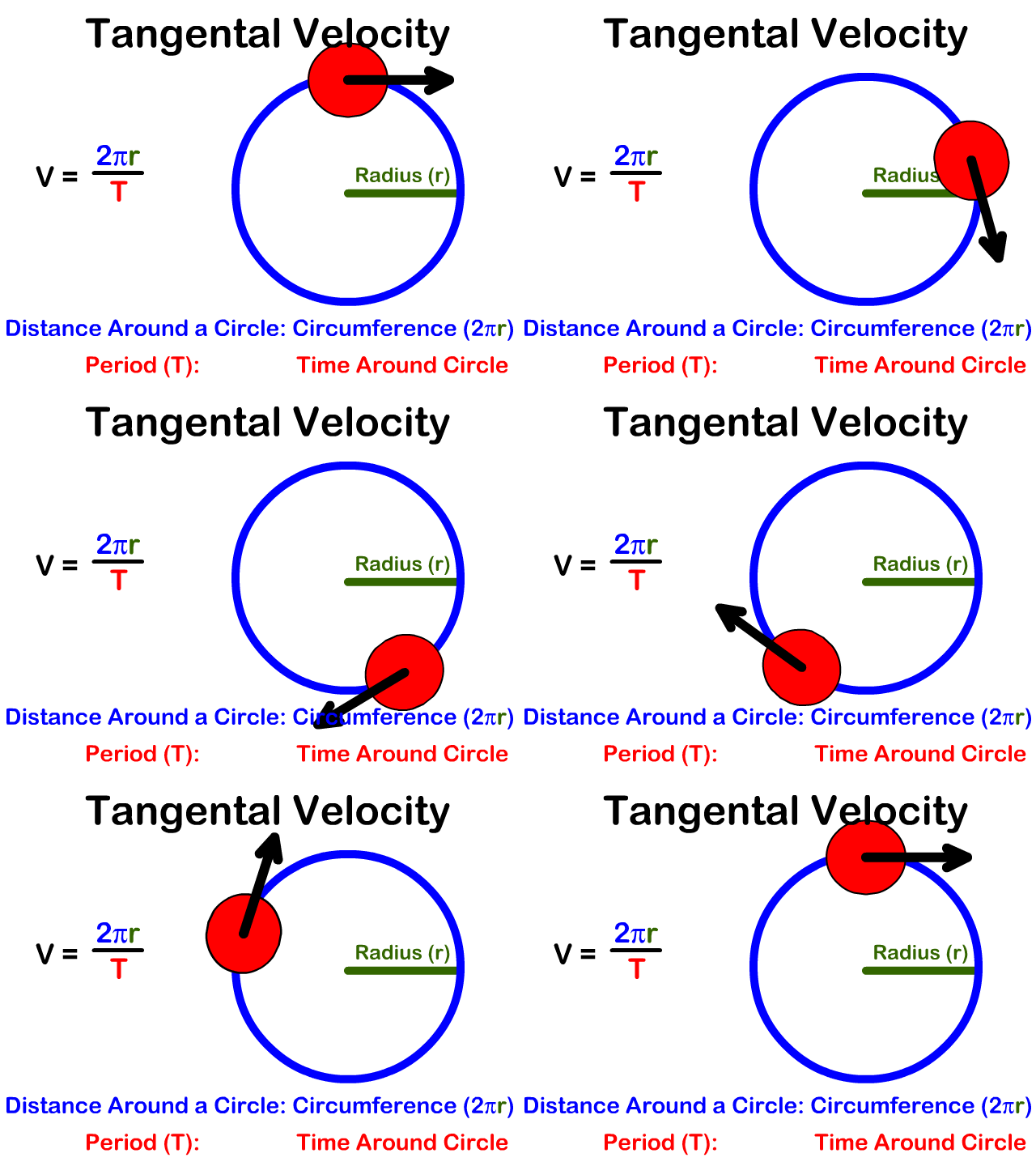
Is the red line tg phi?
Is the displacement the position of the particle, and how does the tagent shows it's velocity?
This is what I don't understand.
This tangent is the velocity of the particle?
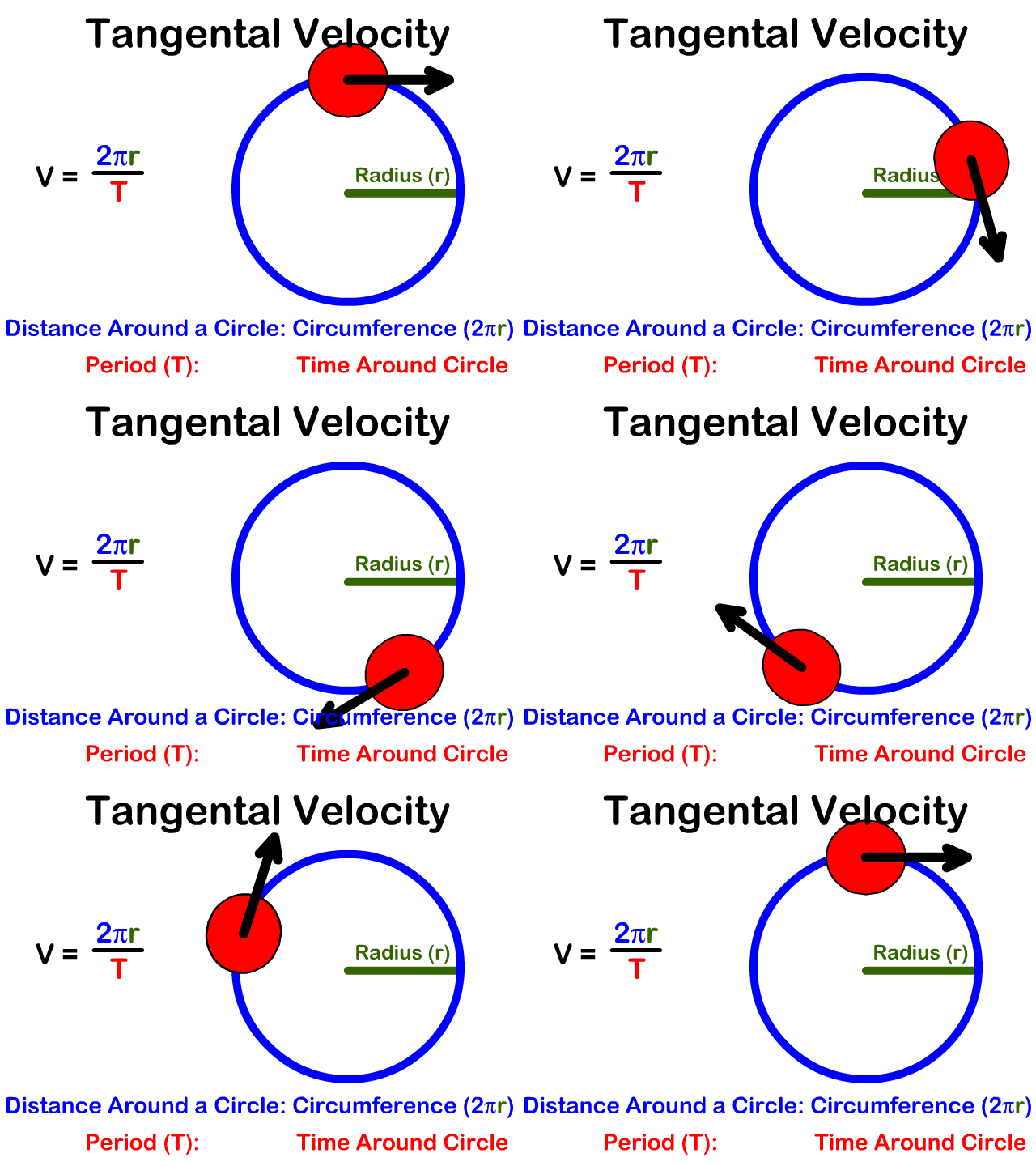
It is y/x, because it is a slope.
trim joltBOT
@cinder swallow Has your question been resolved?
cinder swallow
I don't yet see how the abstract concepts of, y, x, and their ratio is velocity.
trim joltBOT
Channel closed
Closed by @cinder swallow
Use .reopen if this was a mistake.
Available help channel!
Send your question here to claim the channel.
Remember:
• Ask your math question in a clear, concise manner.
• Show your work, and if possible, explain where you are stuck.
• After 15 minutes, feel free to ping <@&286206848099549185>.
• Type the command .close to free the channel when you're done.
• Be polite and have a nice day!
Read #❓how-to-get-help for further information on how to ask a good question, and about conduct in the question channels.
 elfin kettle
 trim joltBOT
elfin kettle
elfin kettle
trim joltBOT
elfin kettle
elfin kettle
how do i get x
trim joltBOT
What step are you on?
1. I don't know where to begin.
2. I have begun but got stuck midway.
3. I got an answer but I was told that it's wrong.
4. I got an answer and would like my work checked.
5. I have a question about someone else's work/solution.
6. I have completed the problem and don't need help anymore. Thank you.
7. None of the above
stuck midway
trim joltBOT
Show your work, and if possible, explain where you are stuck.


 burnt mulch
,rotate
solid kilnBOT
 burnt mulch
$7x^{4/3}-8x^{1/3}=0$
solid kilnBOT
Civil Service Pigeon
 elfin kettle
yes i tried but i didnt know how to
i knew x^1/3 is a common
hmm
its gonna be 7x4/3/1/3?
when we take common factor
burnt mulch
elfin kettle
? Can you write it out like you did here
 solid kilnBOT
 burnt mulch
Yeah that seems good
 burnt mulch
Yup that’s one solution, there’s another too
burnt mulch
elfin kettle
so now 8/7 is the point of infelction
Also points of inflection are where the second derivative changes sign
Not the first
burnt mulch
It’s a critical point if that’s what you mean
elfin kettle
ye critical
so if x>0 its increasing at 8/7 to infinity
and decreasing from 8/7 to negative infinity
trim joltBOT
Channel closed
Closed by @elfin kettle
Use .reopen if this was a mistake.
trim joltBOT
Available help channel!
Send your question here to claim the channel.
Remember:
• Ask your math question in a clear, concise manner.
• Show your work, and if possible, explain where you are stuck.
• After 15 minutes, feel free to ping <@&286206848099549185>.
• Type the command .close to free the channel when you're done.
• Be polite and have a nice day!
Read #❓how-to-get-help for further information on how to ask a good question, and about conduct in the question channels.
 twilit tusk
Hello
trim joltBOT
twilit tusk
Hello
twilit tusk
Anyone help me
The vertex of a right angled isosceles triangle ABC is A(2,-3)and the equation of the base BC is 5x+y-3=0 Find the equations of equal sides
How do do it
trim joltBOT
@twilit tusk Has your question been resolved?
 narrow prawn
Hmm lemme see
||Just find the equation of line perpendicular to given equation and passing through (2,-3) that would be first equation and for second would have angle with the x axis =(angle of 5x+y-3=0 with the x asix )-90+45 and this line alsso pass through (2,-3) so just make the equation ||
trim joltBOT
Channel closed
Closed due to timeout
Use .reopen if this was a mistake.
Available help channel!
Send your question here to claim the channel.
Remember:
• Ask your math question in a clear, concise manner.
• Show your work, and if possible, explain where you are stuck.
• After 15 minutes, feel free to ping <@&286206848099549185>.
• Type the command .close to free the channel when you're done.
• Be polite and have a nice day!
Read #❓how-to-get-help for further information on how to ask a good question, and about conduct in the question channels.
 turbid tartan

 obsidian ferry
.close
trim joltBOT
Channel closed
Closed by @obsidian ferry
Use .reopen if this was a mistake.
Available help channel!
Send your question here to claim the channel.
Remember:
• Ask your math question in a clear, concise manner.
• Show your work, and if possible, explain where you are stuck.
• After 15 minutes, feel free to ping <@&286206848099549185>.
• Type the command .close to free the channel when you're done.
• Be polite and have a nice day!
Read #❓how-to-get-help for further information on how to ask a good question, and about conduct in the question channels.
wraith hinge
Hey, is the answer to this 0?
 trim joltBOT
wraith hinge
Hey, is the answer to this 0?
trim joltBOT
wraith hinge
Hey, is the answer to this 0?

 tepid rock
@short kiln why do you think it is?
wraith hinge
 short kiln
'
short kiln
'
Okay, I fully computed the thing, just wanted confirmation. $\int_C \vec{F} \cdot \dd \vec{r} = \int_a^b \vec{F}(\vec{r}(t)) \cdot \vec{r}'(t)$?
short kiln
the energy field is a conservative field... thus the work done is a state function @tepid rock
solid kilnBOT
ecoproducts
 wraith hinge
I do end up getting 0...
tepid rock
short kiln
the energy field is a conservative field... thus the work done is a state functi...
Conservative? Is it?
short kiln
tepid rock
Conservative? Is it?
first law of thermodynamics?
are you saying this to instruct guidance? or out of curiousity? @tepid rock
 wooden plover
short kiln
are you saying this to instruct guidance? or out of curiousity? <@74802960308738...
wooden plover
short kiln
are you saying this to instruct guidance? or out of curiousity? <@74802960308738...
he's suggesting you're wrong
short kiln
wooden plover
he's suggesting you're wrong
make an argumet
short kiln
i am aware the force field isnt conseravite there partial derivatives arent equivalent
tepid rock
$\vec{\nabla} \cross \vec{F} \neq 0$ yeah
solid kilnBOT
! What the hell am I doing here?
 short kiln
true...
but it is quite aparent that if you think of a force acting on an object in a linear path of action if that object goes around in a circle the work done is 0
can you correct my explanation
i understand why the mathematics i provided is incorrect
tepid rock
Why is it "quite apparent"
short kiln
any energy added by the field going around half the circle would be removed by the field coming back?
tepid rock
What happens if the energy added/removed in each half cycle aren't equivalent
short kiln
they have to be... oh wait that force field isnt linear
MY BAD
my bad
i ... over simplified the problem
ya... you have to work out the integral then. @wraith hinge
thank you @tepid rock
wraith hinge
short kiln
ya... you have to work out the integral then. <@456226577798135808>
Which I did though?
I get 0...
tepid rock
Yeah I think it does turn out to be zero.
wraith hinge
F(x, y) = <x^2, xy>, r(t) = <2cost, 2sint>, r'(t) = <-2sint, 2cost>. Then dot product.
wraith hinge
Yeah!
Can you guys please explain how that relates back to F being conservative, or not?
short kiln
scratch that
i was wrong
but
in the future, if a vector field is conservative... the work integral only depends on the end points
wraith hinge
Also, doesn't integrating along a closed path imply the integral is 0?
short kiln
no only if the field is conservative
tepid rock
wraith hinge
Also, doesn't integrating along a closed path imply the integral is 0?
Not always.
short kiln
the curl of the field has to = 0 right?
tepid rock
yeah
wraith hinge
short kiln
in the future, if a vector field is conservative... the work integral only depen...
Oh, "independent of path"?
Right?
short kiln
its been a few years since ive had multi variable... so i defer to the what the hell am i doing here
short kiln
wraith hinge
Oh, "independent of path"?
yes its path independent if and only if the field is conservative
a "state function"
wraith hinge
Also, this is kind of related: $\oint_C \vec{F} \cdot \dd \vec{r} = \iint_D (\textup{Curl} \vec{F}) \cdot \vec{k} \dd A$? Can I ask why this (Vector Form (1) of Green's Theorem) is helpful to know and what $\vec{k}$ represents?
solid kilnBOT
ecoproducts
 wraith hinge
Especially since we have a general formula for $\int_C \vec{F} \cdot \dd \vec{r}$ even when C isn't closed.
solid kilnBOT
ecoproducts
 wraith hinge
And, how does this differ from Vector Form (2) of Green's Theorem, i.e. $\oint \vec{F} \cdot \vec{n} \dd s = \iint_D (\textup{Div} \vec{F}) \cdot \vec{k} \dd A$? Why would I use this over the general formula?
solid kilnBOT
ecoproducts
 trim joltBOT
@wraith hinge Has your question been resolved?
trim joltBOT
@wraith hinge Has your question been resolved?
trim joltBOT
@wraith hinge Has your question been resolved?
trim joltBOT
Channel closed
Closed due to timeout
Use .reopen if this was a mistake.
Available help channel!
Send your question here to claim the channel.
Remember:
• Ask your math question in a clear, concise manner.
• Show your work, and if possible, explain where you are stuck.
• After 15 minutes, feel free to ping <@&286206848099549185>.
• Type the command .close to free the channel when you're done.
• Be polite and have a nice day!
Read #❓how-to-get-help for further information on how to ask a good question, and about conduct in the question channels.
wraith hinge
 trim joltBOT
wraith hinge
wraith hinge
trim joltBOT
wraith hinge
wraith hinge
😭can someone explain dis😭😭
bro i csnt
wat does min even mean
teachers neber taught me like dis
minimum but
wat does this all mean
 wraith hinge
why r we takin the minimum
 past river
And the paragraph explains a way of finding the gcd, by takingthe prime factorization of both numbers, and only keeping the smallest exponent
past river
wraith hinge
why r we takin the minimum
Since we want the greatest common divider, it‘s going to be the smaller power of 2 that divides both numbers
And then repeat for 3 and each other prime factors
wraith hinge
wait
wraith hinge
past river
Since we want the greatest common divider, it‘s going to be the smaller power of...
why
nvm
thank u bro
❤️
.close
trim joltBOT
Channel closed
Closed by @hasty skiff
Use .reopen if this was a mistake.
Available help channel!
Send your question here to claim the channel.
Remember:
• Ask your math question in a clear, concise manner.
• Show your work, and if possible, explain where you are stuck.
• After 15 minutes, feel free to ping <@&286206848099549185>.
• Type the command .close to free the channel when you're done.
• Be polite and have a nice day!
Read #❓how-to-get-help for further information on how to ask a good question, and about conduct in the question channels.
 fast ocean
i have a LOT of geometry related stuff
trim joltBOT
fast ocean
i have a LOT of geometry related stuff
fast ocean
where does one find the geometry man
 quaint gyro
fast ocean
i have a LOT of geometry related stuff
quaint gyro
fast ocean
i have a LOT of geometry related stuff
send it
fast ocean
ill translate it for you
what is the weight of 200 parts in the shape of a regular hexagon with a side of 2 cm, if the weight of 1 square meter of sheet metal is 24 kg
along the lines of that
but theres 34 of them
could you help solve a few? i dont know if i have enough time today
quaint gyro
fast ocean
what is the weight of 200 parts in the shape of a regular hexagon with a side of...
dont u have like pictures of the problem
quaint gyro
send i can just image translate
quaint gyro
send first one

 fast ocean
oh man
<@&286206848099549185>
now what
<@&268886789983436800> ...?
<@&286206848099549185>
 knotty oriole
fast ocean
<@&268886789983436800> ...?
knotty oriole
fast ocean
<@&268886789983436800> ...?
Don't ping mods for this.
trim joltBOT
@fast ocean Has your question been resolved?
trim joltBOT
Channel closed
Closed by @fast ocean
Use .reopen if this was a mistake.
Available help channel!
Send your question here to claim the channel.
Remember:
• Ask your math question in a clear, concise manner.
• Show your work, and if possible, explain where you are stuck.
• After 15 minutes, feel free to ping <@&286206848099549185>.
• Type the command .close to free the channel when you're done.
• Be polite and have a nice day!
Read #❓how-to-get-help for further information on how to ask a good question, and about conduct in the question channels.
wraith hinge
 trim joltBOT
wraith hinge
trim joltBOT
wraith hinge
 trim joltBOT
@wraith hinge Has your question been resolved?
wraith hinge
<@&286206848099549185>
trim joltBOT
Channel closed
Closed due to timeout
Use .reopen if this was a mistake.
trim joltBOT
Available help channel!
Send your question here to claim the channel.
Remember:
• Ask your math question in a clear, concise manner.
• Show your work, and if possible, explain where you are stuck.
• After 15 minutes, feel free to ping <@&286206848099549185>.
• Type the command .close to free the channel when you're done.
• Be polite and have a nice day!
Read #❓how-to-get-help for further information on how to ask a good question, and about conduct in the question channels.
 woven quarry
 trim joltBOT
woven quarry
woven quarry
trim joltBOT
woven quarry
woven quarry
can someone explain this process to me
 chrome grotto
What part are you stuck on?
chrome grotto
They're basically combining everything that isn't order 3 into a function "o" using the highest order of the terms they're combining
woven quarry
so for the numerator i understand that
but for the denomindator they have o(x^2)
but the earliest non x^3 term is x^5
chrome grotto
They have x^5 in the first line of the blue box there. The x^2 comes after dividing the numer and denom by x^3 in order to get just o(x) in he numer
woven quarry
ohhh right that makes sense thanks
chrome grotto
np
woven quarry
.close
trim joltBOT
Channel closed
Closed by @woven quarry
Use .reopen if this was a mistake.
trim joltBOT
Available help channel!
Send your question here to claim the channel.
Remember:
• Ask your math question in a clear, concise manner.
• Show your work, and if possible, explain where you are stuck.
• After 15 minutes, feel free to ping <@&286206848099549185>.
• Type the command .close to free the channel when you're done.
• Be polite and have a nice day!
Read #❓how-to-get-help for further information on how to ask a good question, and about conduct in the question channels.
 opaque cosmos
 trim joltBOT
opaque cosmos
opaque cosmos
trim joltBOT
opaque cosmos
opaque cosmos
I think that the radius of w is 2? idk what the two values of the argument would be tho
wanton rune
well you know the possible values of z, that dictates what the possible values of w must be
trim joltBOT
@opaque cosmos Has your question been resolved?
opaque cosmos
yeah, so is w rootz? thats why i figured out the radius would be 2
 grim sigil
w1 = sqrt(z)= 2exp(jpi/6), w2 = 2exp(jpi/6 + pi)= 2exp(7j*pi/6), you add pi to the second solution to account for the rotation the other way around
wanton rune
!noans
trim joltBOT
The purpose of this server is to help you learn, not to hand out answers. Do not ask someone to give you the answer directly.
trim joltBOT
As a helper, please do not give out answers that could be copied as a homework solution. Have the student work through the problem themselves and guide them along the way.
wanton rune
@grim sigil
grim sigil
alright sorry
trim joltBOT
Channel closed
Closed due to timeout
Use .reopen if this was a mistake.
Available help channel!
Send your question here to claim the channel.
Remember:
• Ask your math question in a clear, concise manner.
• Show your work, and if possible, explain where you are stuck.
• After 15 minutes, feel free to ping <@&286206848099549185>.
• Type the command .close to free the channel when you're done.
• Be polite and have a nice day!
Read #❓how-to-get-help for further information on how to ask a good question, and about conduct in the question channels.
 quaint apex
how do i solve an equation like this: GCD(2^310 * 4^100, 2^207)?
quaint apex
i know i can combine the bases in the first so it would be GCD(2^510, 2^207)
but this is where i hit the road block
using euclideans algorithm
 marble wharf
lets imagine they were smaller numbers
quaint apex
so GCD(2^510, 2^207) == GCD(2^207, 2^510mod(2^207))
marble wharf
for example gcd(2^3,2^7). what then
quaint apex
marble wharf
for example gcd(2^3,2^7). what then
GCD(2^7, 2^3mod(2^7))
marble wharf
well what actually is that
quaint apex
the remainder
quaint apex
we would be lookin for the remainder of 0
so the process repeats until GCD(a, b) where b is 0
marble wharf
what are the numbers 2^3 and 2^7
quaint apex
exponents
marble wharf
I chose them small enough so that you can actually calculate them
marble wharf
so what is the remainder?
quaint apex
wait
b is > a
so its 8
?
not grasping how that helps with exponents you cannot calculate
quaint apex
GCD(8,128) is 8
marble wharf
why
marble wharf
ok because 128 is a multiple of 8
 chilly bobcat
that's correct
marble wharf
2^7 is a multiple of 2^3
chilly bobcat
but a bit too hard for larger numbers
marble wharf
do you think that is a coincidence?
quaint apex
but that was only because i could calculate the exponent
chilly bobcat
ok so what exactly is a gcd
chilly bobcat
like what does it represent
marble wharf
what happens when you divide one of them by the other
quaint apex
i mean could i just use the exponents themselves since they have the same base?
marble wharf
yes
chilly bobcat
the gcd is the greatest number which is a common factor for all the numbers
quaint apex
hmm so that works 100% of the time?
chilly bobcat
for just a single base and exponent its easy
but for combinations you need to think
marble wharf
depends on what you mean by that and 100% of the time
quaint apex
so for GCD(2^510, 2^207) all id need to do is GCD(510, 207)?
marble wharf
no no
chilly bobcat
quaint apex
so for GCD(2^510, 2^207) all id need to do is GCD(510, 207)?
ok wait
marble wharf
what is 2^510 divided by 2^207
quaint apex
marble wharf
what is 2^510 divided by 2^207
no idea, i mean i could calculate 2^510 but i think the whole purpose of this is to be able to do this with exponents that will equate to too many digits to calculate
quaint apex
chilly bobcat
is 2 a common factor?
yea
chilly bobcat
what about 2^5?
quaint apex
all exponents of 2
marble wharf
do you know exponent laws
chilly bobcat
this is tough to explain
quaint apex
marble wharf
do you know exponent laws
ahhh forgot.. 2^507/2^207 would just be 2^297
marble wharf
well close enough
the point is, its an integer
the first is a multiple of the other
marble wharf
wdym. this is the correct way to do it
quaint apex
ok, so i have GCD(2^507, 2^207). The next step is for me to subtract the exponents?
marble wharf
noticing that 2^510 is a multiple of 2^207. or in other words, 2^207 is a divisor of 2^510
quaint apex
marble wharf
noticing that 2^510 is a multiple of 2^207. or in other words, 2^207 is a diviso...
so the GCD would simple be the lower number?
marble wharf
yes
marble wharf
yes
quaint apex
since b is > a
marble wharf
the order of the numbers doesnt matter
quaint apex
ahh ok
how about this tho
GCD(2^5001, 7^2023)
to find something like this out what would the steps be?
marble wharf
if you have two different primes like this (2 and 7 here) then such a gcd is always 1
marble wharf
write the 10^1000 as 2^1000*5^1000
and then its 2^201 because thats included on both sides
quaint apex
ok hmm maybe this will help
what if the bases are both odd
like
GCD(3^100, 7^500)?
quaint apex
interesting
is there a way to perfom eclidean algorithm on these bigger exponents?
dividing two huge exponents such as 2^510 and 2^207
id subtract the exponents
2^303
but how do i get the remainder
2^510mod 2^207
marble wharf
if one number is divisible by another, the remainder is 0
quaint apex
ahhh so there is no need to even perform euclideans
marble wharf
yes
 dawn grove
yeah denascite seems like a nice helper
quaint apex
if i were to be building a program to automate this
id have to check if bases were the same
and if they have exponents
if base is same, then if exponents, then the lower exponent is the GCD
waittttttttttttt
trim joltBOT
@quaint apex Has your question been resolved?
Channel closed
Closed by @quaint apex
Use .reopen if this was a mistake.
Available help channel!
Send your question here to claim the channel.
Remember:
• Ask your math question in a clear, concise manner.
• Show your work, and if possible, explain where you are stuck.
• After 15 minutes, feel free to ping <@&286206848099549185>.
• Type the command .close to free the channel when you're done.
• Be polite and have a nice day!
Read #❓how-to-get-help for further information on how to ask a good question, and about conduct in the question channels.
 west jacinth
hey so
trim joltBOT
west jacinth
hey so

 whole cradle
what do you need to do?
west jacinth
simplify
whole cradle
OK so: $\frac{(n+1)\times n \times(n-1)\dots}{(n-1)\times(n-2)\dots}$
solid kilnBOT
Norker_g
 whole cradle
is equal to (n+1)n
 ionic needle
n^2 + n
whole cradle
because n-1 and so on cancel out
trim joltBOT
Channel closed
Closed by @west jacinth
Use .reopen if this was a mistake.
ionic needle
You do times n on top and bottom and take out (n+1) from top term
Then you send email to teacher asking why hes giving away free points ggez, then teacher is sad and no school tmrw

 trim joltBOT
✅
whole cradle
yeah
west jacinth
then how does the 3n ever cancel
whole cradle
it doesnt
ionic needle
Same thing as above
whole cradle
you have 1/3n as an answer
west jacinth
whole cradle
you have 1/3n as an answer
how do you get there
what happens to the numerator
whole cradle
(3n-1)! = (3n-1)(3n-2)(3n-3)...
ionic needle
Write it out as a sum, you will see it
whole cradle
sry
west jacinth
alg
whole cradle
$\frac{(3n-1)(3n-2)(3n-3)(3n-4)\dots}{3n(3n-1)(3n-2)(3n-3)\dots}$
west jacinth
$
solid kilnBOT
Norker_g
 ionic needle
 ionic needle
Yes you are
whole cradle
$\frac{\cancel{(3n-1)}\cancel{(3n-2)}\cancel{(3n-3)}\dots}{3n\cancel{(3n-1)}\cancel{(3n-2)}\cancel{(3n-3)}\dots}$
sweet hare
ionic needle
Yes you are
don't be rude
ionic needle
Also i am, it aint a sum dx
ionic needle
sweet hare
don't be rude
? He said so and i agreed no?
solid kilnBOT
Norker_g
 whole cradle
$\frac{1}{3n}$
solid kilnBOT
Norker_g
 west jacinth
solid kiln
**Norker\_g**
west jacinth
solid kiln
**Norker\_g**
got it thank you
whole cradle
happy to help!