#help-38
1 messages · Page 103 of 1
 rapid horizon
 trim joltBOT
Channel closed
Closed by @rapid horizon
Use .reopen if this was a mistake.
trim joltBOT
 Available help channel!
Send your question here to claim the channel.
Remember:
• Ask your math question in a clear, concise manner.
• Show your work, and if possible, explain where you are stuck.
• After 15 minutes, feel free to ping <@&286206848099549185>.
• Type the command .close to free the channel when you're done.
• Be polite and have a nice day!
Read #❓how-to-get-help for further information on how to ask a good question, and about conduct in the question channels.
 wide ravine
Quick question
trim joltBOT
wide ravine
Quick question
wide ravine
Is 1 and half :2:3 the simplest form of this ratio
Is it 3/2:2:3
Or 3/4/6?
Which is considered simpler
 stoic iron
Depends who you ask
 dapper swift
I would expect 3:4:6 tho
stoic iron
Generally ratios written without fractions I would consider easier to interpret
wide ravine
Ok
Simplest form tho
I jus dk which one to go with lol
U do write 1.5 as 3/2 tho correct
dapper swift
Yes
wide ravine
Thanks so much
dapper swift
np
trim joltBOT
@wide ravine Has your question been resolved?
trim joltBOT
Channel closed
Closed due to timeout
Use .reopen if this was a mistake.
trim joltBOT
Available help channel!
Send your question here to claim the channel.
Remember:
• Ask your math question in a clear, concise manner.
• Show your work, and if possible, explain where you are stuck.
• After 15 minutes, feel free to ping <@&286206848099549185>.
• Type the command .close to free the channel when you're done.
• Be polite and have a nice day!
Read #❓how-to-get-help for further information on how to ask a good question, and about conduct in the question channels.
 rotund spear
Anyone have any idea on how to find the nth derivative of a trig function without doing successive differentiation
trim joltBOT
rotund spear
Anyone have any idea on how to find the nth derivative of a trig function withou...
 gritty harness
You need to write the first few to find a pattern, no other way
rotund spear
I see
trim joltBOT
@rotund spear Has your question been resolved?
trim joltBOT
Channel closed
Closed due to timeout
Use .reopen if this was a mistake.
Available help channel!
Send your question here to claim the channel.
Remember:
• Ask your math question in a clear, concise manner.
• Show your work, and if possible, explain where you are stuck.
• After 15 minutes, feel free to ping <@&286206848099549185>.
• Type the command .close to free the channel when you're done.
• Be polite and have a nice day!
Read #❓how-to-get-help for further information on how to ask a good question, and about conduct in the question channels.
 young arch
 trim joltBOT
young arch
trim joltBOT
young arch
 real pebble
Have you tried plugging in
 wraith hinge
zero?
young arch
i forgot to mention
i already have the answer
its 0 but my teacher is saying its 1
i have no idea why
wraith hinge
is he crazy
real pebble
wraith hinge
is he crazy
FR
 young arch
.close
trim joltBOT
Channel closed
Closed by @young arch
Use .reopen if this was a mistake.
Available help channel!
Send your question here to claim the channel.
Remember:
• Ask your math question in a clear, concise manner.
• Show your work, and if possible, explain where you are stuck.
• After 15 minutes, feel free to ping <@&286206848099549185>.
• Type the command .close to free the channel when you're done.
• Be polite and have a nice day!
Read #❓how-to-get-help for further information on how to ask a good question, and about conduct in the question channels.
wraith hinge
Can i get help with these
 trim joltBOT
wraith hinge
Can i get help with these
trim joltBOT
wraith hinge
Can i get help with these
 past river
What have you tried
 lapis star
!status
trim joltBOT
What step are you on?
1. I don't know where to begin.
2. I have begun but got stuck midway.
3. I got an answer but I was told that it's wrong.
4. I got an answer and would like my work checked.
5. I have a question about someone else's work/solution.
6. I have completed the problem and don't need help anymore. Thank you.
7. None of the above
2
past river
Can you show your work please
past river
wraith hinge
so for 3c i got the answer as PI and that its convergent
It does converge, but it‘s not exactly pi. You‘re close though
wraith hinge
its rly all over the place

but for 3a and 3c i got it converges
i have no idea how to do 3b
past river
3b is the gamma function if you‘ve heard of it. If not, integration by parts should work
Wait it won‘t nvm
wraith hinge
nah i dont know gammma function
past river
3a is integration by parts, as for 3b, let me think about it
wraith hinge
its all improper integrals i just dk bout 3b
past river
Yeah. I‘m not sure how you‘d do that without using the Gamma function. It does converge tho, that‘s for sure
wraith hinge
yea our teacher hasnt taught us that
 rough goblet
how is 3B gamma?
wraith hinge
but he makes the questions harder then what we do in class normally
past river
Dude
rough goblet
you forget
past river
Sub
rough goblet
it's gamma and incomplete gamma mixed
past river
Yeah exactly
past river
But if they haven‘t gamma no point in mentionning that
past river
All good. If you know how to do that without gamma function then feel free to take over this help channel cause I know I don‘t. Only thing I can think of is maybe get this to look like a Gaussian integral but even then, would be meh to solve
wraith hinge
im guessing the teacher mustve spiked the difficulty
 pseudo grotto
what class is this for
wraith hinge
this is for a calc 2 question
wraith hinge
yea this is improper integrals in calc 2
pseudo grotto
maybe rewrite e^-t as a power series, divide by t^2/3 and interchange limits
pseudo grotto
idk what else you can do in a calc2 setting
rough goblet
erm
pseudo grotto

 solid kilnBOT
ren
 rough goblet
@pseudo grotto
look good?
uhhh
tbh not entirely sure what to do now 
$$\int_0^1 \sum_{n=0}^{\infty} \frac{(-t)^n t^{-\frac 23}}{n!}\text{ d}t$$
$$\sum_{n=0}^{\infty} \frac{(-1)^n}{n!} \int_0^1 t^{n -\frac 23} \text { d}t$$
tf????
huh
@pseudo grotto
better?
@wraith hinge u following this?
wraith hinge
how could i plug in to find convergence/divergence from there?
rough goblet
not really? expected
rough goblet
wraith hinge
how could i plug in to find convergence/divergence from there?
i mean
idk abt convergence/divergence
it isn't really necessary
just... solve the integral?
then plug in the resulting value
and u get the form e^{something}
wraith hinge
rough goblet
idk abt convergence/divergence
i need it for the question prompt
rough goblet
solve the integral here, then figure out the taylor series for e^{whatever}
wraith hinge
ah
rough goblet
"compute each of the following integrals"
pseudo grotto
you're missing an n! in the denom but yea
rough goblet
is what i see
rough goblet
pseudo grotto
you're missing an n! in the denom but yea
MB LMAO
wraith hinge
rough goblet
"compute each of the following integrals"
i think it means i have to show converge or diverge too.
solid kilnBOT
ren
$$\int_0^1 \sum_{n=0}^{\infty} \frac{(-t)^n t^{-\frac 23}}{n!}\text{ d}t$$
$$\sum_{n=0}^{\infty} \frac{(-1)^n}{n!} \int_0^1 t^{n -\frac 23} \text { d}t$$

 rough goblet
!nogpt
trim joltBOT
Please do not trust ChatGPT or similar AI tools for mathematical tasks, as they often generate output which "sounds correct" but has numerous factual or logical errors. Use of these AI tools to answer other people's help questions is strictly against server rules (see #rules).
rough goblet
tf is "e^-t x"
pseudo grotto
then the integrals become $\left.\frac{t^{n + 1/3}}{n+1/3}\right|_0^1$
solid kilnBOT
chebyshev's infinite pee norm
 pseudo grotto
which is just $\frac{1}{n+1/3}$
solid kilnBOT
chebyshev's infinite pee norm
 pseudo grotto
then the sum becomes $\sum_{n=0}^\infty \frac{(-1)^n}{n!}\frac{3}{3n+1}$

 rough goblet
tf??
@wraith hinge
and to be honest, no idea how to find sum convergence for that
uhhh
*mumbles*
wraith hinge
yea i think my teacher just dragged it
rough goblet
lmao
wraith hinge
doesnt exactly seem like a standard improper integral problem for calc 2
pseudo grotto
any divergence test prob works
rough goblet
it isn't
rough goblet
pseudo grotto
any divergence test prob works
i may or may not have forgotten all of them
let's see
we had...
root test
r- something test
limit comparision
those are all i can remember
pseudo grotto
wait uh
rough goblet
yea probably ratio
pseudo grotto
you're meant to actually find the value of convergence
 primal steppe
wraith hinge
Can i get help with these
primal steppe
wraith hinge
Can i get help with these
i think question 3b is a mistake
pseudo grotto
not just show it converges
rough goblet
pseudo grotto
you're meant to actually find the value of convergence
ahahaha
oops
erm
primal steppe
the answer for 3b is not elementary
wraith hinge
primal steppe
i think question 3b is a mistake
imma just take is as that cause no way bruh expects me to figure this out. If he puts it on a test imma just hold that
rough goblet
u sure fam
,w int from 0 to 1 of e^-t * t^(2/3)
yep
like i said
incomplete gamma
so nonelem
wraith hinge
There is 12 questions and each have 2-3 parts. imma just move on so i dont get cooked
rough goblet
alr
trim joltBOT
Channel closed
Closed by @near lodge
Use .reopen if this was a mistake.
trim joltBOT
Available help channel!
Send your question here to claim the channel.
Remember:
• Ask your math question in a clear, concise manner.
• Show your work, and if possible, explain where you are stuck.
• After 15 minutes, feel free to ping <@&286206848099549185>.
• Type the command .close to free the channel when you're done.
• Be polite and have a nice day!
Read #❓how-to-get-help for further information on how to ask a good question, and about conduct in the question channels.
 vague pier
$4x dy - y dx = x^2 dy$
trim joltBOT
vague pier
$4x dy - y dx = x^2 dy$
solid kilnBOT
rainy
 vague pier
How would you solve this diff. eq.?
I first have to know what form it is
So I was thinking, first divide all by dy
then im left with:
$\frac{dx}{dy} = \frac{x^2}{4x-y}$
But now idk what to do
 kindred pier
vague pier
So I was thinking, first divide all by `dy`
kindred pier
vague pier
So I was thinking, first divide all by `dy`
I would divide by dx instead of dy. Seeing dy/dx is much more common
kindred pier
vague pier
$\frac{dx}{dy} = \frac{x^2}{4x-y}$
Also, you made a slight algebra error here. Better double check
vague pier
kindred pier
I would divide by dx instead of dy. Seeing dy/dx is much more common
Okay, I just did dy because then the right side cancels out and i just get x^2
$4x\frac{dy}{dx}-y=x^2\frac{dy}{dx}$
solid kilnBOT
rainy

 solid kilnBOT
rainy
 trim joltBOT
Channel closed
Closed by @vague pier
Use .reopen if this was a mistake.
Available help channel!
Send your question here to claim the channel.
Remember:
• Ask your math question in a clear, concise manner.
• Show your work, and if possible, explain where you are stuck.
• After 15 minutes, feel free to ping <@&286206848099549185>.
• Type the command .close to free the channel when you're done.
• Be polite and have a nice day!
Read #❓how-to-get-help for further information on how to ask a good question, and about conduct in the question channels.
 open kelp

 wraith hinge
well start with the numerator
what progression do u notice there
assume ur n starts from 1
wraith hinge
open kelp
i dont get the +2 part
well remember u r starting from n = 1
so like
realise that they are powers of 3 of course
but also realise that they are starting from 27 (so no 3, 9 for example)
and u know 3^3 = 27
AND you also know it just carries on the powers of 3 normally from there, so 3^3, 3^4, 3^5, ...
so ur index starts from 1, ur first term should start with exponent 3, and the successive terms should increment that value
does that help you piece it up in your mind better
wraith hinge
ok sure but thats the same thing
,, 27\23^{n-1} = 3^3 \23^{n-1} = 3^{n-1+3} = 3^{n+2}
solid kilnBOT

 trim joltBOT
@open kelp Has your question been resolved?
trim joltBOT
Channel closed
Closed due to timeout
Use .reopen if this was a mistake.
Available help channel!
Send your question here to claim the channel.
Remember:
• Ask your math question in a clear, concise manner.
• Show your work, and if possible, explain where you are stuck.
• After 15 minutes, feel free to ping <@&286206848099549185>.
• Type the command .close to free the channel when you're done.
• Be polite and have a nice day!
Read #❓how-to-get-help for further information on how to ask a good question, and about conduct in the question channels.
 drowsy shell
So far I've got ((n-3)!/(4(n-8!)))((n-2)+2(n-3)+3(n-4)+...+(n-4)3+(n-3)2+(n-2))
I think I should be able to write the (n-2)+2(n-3)+3(n-4)+...+(n-4)3+(n-3)2+(n-2) as a summation but I haven't studied summation in school yet and I'm quite bad with it so I'd need help with that
Also I think I can just simplify the first part like this: (n-3)!/(4(n-8)!) = (1/4)(n-3)(n-4)(n-5)(n-6)(n-7) but I'm not competly sure if it's actually correct
 trim joltBOT
drowsy shell
So far I've got ((n-3)!/(4(n-8!)))((n-2)+2(n-3)+3(n-4)+...+(n-4)3+(n-3)2+(n-2))
...
drowsy shell
trim joltBOT
drowsy shell
So far I've got ((n-3)!/(4(n-8!)))((n-2)+2(n-3)+3(n-4)+...+(n-4)3+(n-3)2+(n-2))
...
drowsy shell
The formula I got comes from the combinations of everything but the yellow and white pawns (the fraction with the factorials) times the different ways the yellow and white pawns can arrange (first possible white pawn fixed position times ways yellow pawns can dispose+ second possible white pawn fixed position times ways yellow pawns can dispose ect.)
trim joltBOT
@drowsy shell Has your question been resolved?
drowsy shell
<@&286206848099549185>
 timid obsidian
drowsy shell
<@&286206848099549185>
timid obsidian
drowsy shell
<@&286206848099549185>
Hello, how can I help you?
drowsy shell
Hi I was trying to write a formula has a summation and needed help since I'm not good at summation
the formula is this one ((n-3)!/(4(n-8!)))((n-2)+2(n-3)+3(n-4)+...+(n-4)3+(n-3)2+(n-2))
timid obsidian
drowsy shell
the formula is this one ((n-3)!/(4(n-8!)))((n-2)+2(n-3)+3(n-4)+...+(n-4)3+(n-3)2...
Ok…
wraith hinge
drowsy shell
the formula is this one ((n-3)!/(4(n-8!)))((n-2)+2(n-3)+3(n-4)+...+(n-4)3+(n-3)2...
I cant help srry.
I aint advance in math
timid obsidian
wraith hinge
I aint advance in math
:/
drowsy shell
I think that it's jut about the part starting from (n-2) cause then I should just be able to multiply the first part by the summation right?
so I have to write as a summation a series of addends that are the product of 2 elements, one goes from 1 to n-2 and the other from n-2 to 1
timid obsidian
drowsy shell
I think that it's jut about the part starting from (n-2) cause then I should jus...
Yep
timid obsidian
drowsy shell
so I have to write as a summation a series of addends that are the product of 2 ...
Yep
drowsy shell
alright
 trim joltBOT
Channel closed
Closed by @drowsy shell
Use .reopen if this was a mistake.
trim joltBOT
Available help channel!
Send your question here to claim the channel.
Remember:
• Ask your math question in a clear, concise manner.
• Show your work, and if possible, explain where you are stuck.
• After 15 minutes, feel free to ping <@&286206848099549185>.
• Type the command .close to free the channel when you're done.
• Be polite and have a nice day!
Read #❓how-to-get-help for further information on how to ask a good question, and about conduct in the question channels.
 gaunt mist
help
trim joltBOT
gaunt mist
help
 trim joltBOT
What step are you on?
1. I don't know where to begin.
2. I have begun but got stuck midway.
3. I got an answer but I was told that it's wrong.
4. I got an answer and would like my work checked.
5. I have a question about someone else's work/solution.
6. I have completed the problem and don't need help anymore. Thank you.
7. None of the above
1
gaunt mist
 alpine raptor
what is the formula for the space of a prism?
alpine raptor
what is the formula for the space of a prism?
i have no idea im only in the eighth grade 
alpine raptor
Surface area right?
gaunt mist
yes
alpine raptor
okay then, so you know that the two small triangles are 8cm^2 each
gaunt mist
alpine raptor
okay then, so you know that the two small triangles are 8cm^2 each
does ^ mean multiply?
alpine raptor
power
doesn't really mean anything, just the measuring unit for area
you have the area of the two triangles known to be 8cm^2 each
all the rectangles are of length 15, as it shown in the picture
and 2 of them are of width 4, and 1 is of width 5.7
area of rectangle = hxw:
area 1: 4x15 = 60
area 2: 4x15 = 60
area 3: 5.7x15 = 85.5
are of triangles:
area 1 = area 2 = 8
Combining all of them: 60+60+85.5+8 +8 = 221.5 cm^2
trim joltBOT
@gaunt mist Has your question been resolved?
trim joltBOT
Channel closed
Closed due to timeout
Use .reopen if this was a mistake.
trim joltBOT
Available help channel!
Send your question here to claim the channel.
Remember:
• Ask your math question in a clear, concise manner.
• Show your work, and if possible, explain where you are stuck.
• After 15 minutes, feel free to ping <@&286206848099549185>.
• Type the command .close to free the channel when you're done.
• Be polite and have a nice day!
Read #❓how-to-get-help for further information on how to ask a good question, and about conduct in the question channels.
 flat wing


 craggy sage
U know alpha and angle between walls is 75° there u can find the third angle then using that u can work out like done in the first collision
craggy sage
I am having difficulty to understand ur point here
If u know beta doesn't that tells u which direction ball is going
trim joltBOT
@flat wing Has your question been resolved?
 thick hull
flat wing
doesnt original tell me the direction thno
thick hull
flat wing
doesnt original tell me the direction thno
i guess you draw a diagram and you can sort of tell which direction the ball is going to go
trim joltBOT
Channel closed
Closed due to timeout
Use .reopen if this was a mistake.
Available help channel!
Send your question here to claim the channel.
Remember:
• Ask your math question in a clear, concise manner.
• Show your work, and if possible, explain where you are stuck.
• After 15 minutes, feel free to ping <@&286206848099549185>.
• Type the command .close to free the channel when you're done.
• Be polite and have a nice day!
Read #❓how-to-get-help for further information on how to ask a good question, and about conduct in the question channels.
 high ridge
why was an X added in the first part of this question
 trim joltBOT
high ridge
why was an X added in the first part of this question
trim joltBOT
high ridge
why was an X added in the first part of this question
@high ridge Has your question been resolved?
trim joltBOT
Channel closed
Closed due to timeout
Use .reopen if this was a mistake.
Available help channel!
Send your question here to claim the channel.
Remember:
• Ask your math question in a clear, concise manner.
• Show your work, and if possible, explain where you are stuck.
• After 15 minutes, feel free to ping <@&286206848099549185>.
• Type the command .close to free the channel when you're done.
• Be polite and have a nice day!
Read #❓how-to-get-help for further information on how to ask a good question, and about conduct in the question channels.
trim joltBOT
trim joltBOT
@haughty condor Has your question been resolved?
trim joltBOT
Channel closed
Closed by @haughty condor
Use .reopen if this was a mistake.
trim joltBOT
Available help channel!
Send your question here to claim the channel.
Remember:
• Ask your math question in a clear, concise manner.
• Show your work, and if possible, explain where you are stuck.
• After 15 minutes, feel free to ping <@&286206848099549185>.
• Type the command .close to free the channel when you're done.
• Be polite and have a nice day!
Read #❓how-to-get-help for further information on how to ask a good question, and about conduct in the question channels.
 clever cave
 trim joltBOT
clever cave
trim joltBOT
clever cave
 elder saffron
clever cave
elder saffron
clever cave
Have you learned the method of separation of variables?
clever cave
elder saffron
Have you learned the method of separation of variables?
separating y terms with dy and x terms with dx
right
elder saffron
clever cave
separating y terms with dy and x terms with dx
Yup
clever cave
i did that but my teachers answer key is different than my answer
i got y=sqrt(16x-16)
but my teachers key says
 elder saffron
clever cave
i did that but my teachers answer key is different than my answer
elder saffron
clever cave
i did that but my teachers answer key is different than my answer
Ah so what did you get on both sides before you integrated
clever cave
elder saffron
Ah so what did you get on both sides before you integrated
dy-y = 8dx
elder saffron
clever cave
dy-y = 8dx
Looks like you tried to multiply both sides by dx first
You will get dy=(y+8)dx
now you must divide both sides by (y+8) as a whole
clever cave
oh wait what
elder saffron
so you will integrate 1/(y+8) dy and 1dx separately
elder saffron
clever cave
i can’t just subtract the y in the (y-8)
Nope
clever cave
oh
trim joltBOT
@clever cave Has your question been resolved?
clever cave
elder saffron
Just think of dy/dx as a fraction
but how did my teacher get e
i’m still lost abt that
elder saffron
clever cave
but how did my teacher get e
After you integrate 1/(y+8) you get ln|y+8|
thats where the e comes from
clever cave
elder saffron
thats where the e comes from
I am so cooked for the ap exam
😔
i’m so close to an A in calc too, i’m at an 89.96 😭
elder saffron
clever cave
I am so cooked for the ap exam
are you taking BC or AB
elder saffron
clever cave
AB
Ah, don't fret then
Id say if you are just learning differential eq, they are very tricky
but once you get used to implicit differentiation, they become more intuitive
clever cave
here’s the thing, i get the concepts but after the unit passes and we move onto a new topic that doesn’t necessarily use the same concepts
i forget it entirely
like we learned implicit differentiation a while ago, but i forgot it
elder saffron
clever cave
here’s the thing, i get the concepts but after the unit passes and we move onto ...
Hmm yes
I'd say practice more then
elder saffron
clever cave
like we learned implicit differentiation a while ago, but i forgot it
But yes differential equations is a big jump from implicit differentiation
Theres alot of integrals in the middle. When I was learning it, I forgot alot of differentiation as well!
clever cave
You got any study resource recommendations for the ap exam?
elder saffron
clever cave
You got any study resource recommendations for the ap exam?
I really recommend this guy on yt called redpenblackpen
He talks about many calculus 1&2 topics
trim joltBOT
@clever cave Has your question been resolved?
clever cave
@elder saffron i am currently at y+8=e^(x*ln|12|)
would it be right to simplify the right side into
12x
oh wait
12e^x
ohhhh
im stupid i figured it out
.close
trim joltBOT
Channel closed
Closed by @clever cave
Use .reopen if this was a mistake.
trim joltBOT
Available help channel!
Send your question here to claim the channel.
Remember:
• Ask your math question in a clear, concise manner.
• Show your work, and if possible, explain where you are stuck.
• After 15 minutes, feel free to ping <@&286206848099549185>.
• Type the command .close to free the channel when you're done.
• Be polite and have a nice day!
Read #❓how-to-get-help for further information on how to ask a good question, and about conduct in the question channels.
wraith hinge
 trim joltBOT
wraith hinge
wraith hinge
trim joltBOT
wraith hinge
wraith hinge
Can anyone provide me the proof for this one?
trim joltBOT
@wraith hinge Has your question been resolved?
trim joltBOT
@wraith hinge Has your question been resolved?
trim joltBOT
Channel closed
Closed due to timeout
Use .reopen if this was a mistake.
trim joltBOT
Available help channel!
Send your question here to claim the channel.
Remember:
• Ask your math question in a clear, concise manner.
• Show your work, and if possible, explain where you are stuck.
• After 15 minutes, feel free to ping <@&286206848099549185>.
• Type the command .close to free the channel when you're done.
• Be polite and have a nice day!
Read #❓how-to-get-help for further information on how to ask a good question, and about conduct in the question channels.
 edgy willow
z=r*e^(i*theta) but the e part has magnitude 1, it just rotates around
kindred pier
Because $e^{i\theta} = \cos{\theta}+i\sin{\theta}$
solid kilnBOT
SWR


 kindred pier
correct
trim joltBOT
@wraith hinge Has your question been resolved?
Channel closed
Closed by @potent echo
Use .reopen if this was a mistake.
Available help channel!
Send your question here to claim the channel.
Remember:
• Ask your math question in a clear, concise manner.
• Show your work, and if possible, explain where you are stuck.
• After 15 minutes, feel free to ping <@&286206848099549185>.
• Type the command .close to free the channel when you're done.
• Be polite and have a nice day!
Read #❓how-to-get-help for further information on how to ask a good question, and about conduct in the question channels.
 split epoch
helpp please i feel so dumb
 trim joltBOT
split epoch
helpp please i feel so dumb
trim joltBOT
split epoch
helpp please i feel so dumb
 vapid grove
the area under the curve is distance traveled
 wraith arch
does it want LRAM, RRAM, or MRAM
vapid grove
middle >.>
split epoch
wraith arch
does it want LRAM, RRAM, or MRAM
ehat r these😭😭
wraith arch
left, right, and middle endpoint rectangular approximation
basically what height are we using for each strip
like the y value at the very left of the interval, the middle, or the very right
trim joltBOT
@split epoch Has your question been resolved?
trim joltBOT
@split epoch Has your question been resolved?
trim joltBOT
@split epoch Has your question been resolved?
 robust wagon
i’m gonna assume they want middle riemann sum which would look something like this for the first 2 rectangles

since you want 5 strips of equal width, each width is 2
depending on left, right, or middle approximation, the height you use for the rectangles will be different
 split epoch
ohh okay thank you
 knotty garnet
@split epoch close it
trim joltBOT
Channel closed
Closed by @split epoch
Use .reopen if this was a mistake.
knotty garnet
Its alright
trim joltBOT
Available help channel!
Send your question here to claim the channel.
Remember:
• Ask your math question in a clear, concise manner.
• Show your work, and if possible, explain where you are stuck.
• After 15 minutes, feel free to ping <@&286206848099549185>.
• Type the command .close to free the channel when you're done.
• Be polite and have a nice day!
Read #❓how-to-get-help for further information on how to ask a good question, and about conduct in the question channels.
 regal hatch
how do I prove this?
 trim joltBOT
regal hatch
how do I prove this?
regal hatch
trim joltBOT
regal hatch
how do I prove this?
regal hatch
im not sure how to make the left side = right side
 crisp lantern
try shuffling things around
regal hatch
 nimble stone
maybe could be of use
nimble stone
maybe could be of use
I was trying to find this one, but I only know cos^2
crisp lantern
its pretty simple once you shuffle things the correct way
nimble stone
regal hatch
I was trying to find this one, but I only know cos^2
ive just uses sin^2+cos^2=1
nimble stone
crisp lantern
its pretty simple once you shuffle things the correct way
wdym
crisp lantern
try proving cos^2-sin^2=cos^4-sin^4
nimble stone
you cant do that
crisp lantern
this follows immediately
crisp lantern
nimble stone
you cant do that
why not
regal hatch
nimble stone
ive just uses sin^2+cos^2=1
but that's cos^2 not cos^4
crisp lantern
ofc you can
nimble stone
if theyre proving an identity, there cant be any operations across the sides
nimble stone
because then youre assuming the identity rather than proving the identity
regal hatch
regal hatch
but that's cos^2 not cos^4
@nimble stone can you explain this please?
crisp lantern
nimble stone
because then youre assuming the identity rather than proving the identity
that only happens if you apply something non injective on both sides
like squaring or something like that
adding or subtracting something is completely fine
regal hatch
I now have
sin^2x + 1 - sin^2x - sin^2x + sin^4x
crisp lantern
crisp lantern
try proving cos^2-sin^2=cos^4-sin^4
did you try proving this instead?
regal hatch
crisp lantern
did you try proving this instead?
where did this come from?
crisp lantern
this is the same as your statement with things shuffled around
regal hatch
crisp lantern
this is the same as your statement with things shuffled around
when do I shuffle around equations like this?
instead of just turning the LS to RS
or vice versa
regal hatch
crisp lantern
i mean that depends on the question really
do I just expand:
(cos^2x + sin^2x)(cos^2-sin^2x)
regal hatch
crisp lantern
you dont have to
what do I do then?
regal hatch
ohh
regal hatch
crisp lantern
if it makes things easier
may I ask how did you think that shuffling the equation around like this would make it easier
crisp lantern
as i said there's no hard written rule as such
you do it when it makes things easier
trim joltBOT
Channel closed
Closed by @regal hatch
Use .reopen if this was a mistake.
trim joltBOT
Available help channel!
Send your question here to claim the channel.
Remember:
• Ask your math question in a clear, concise manner.
• Show your work, and if possible, explain where you are stuck.
• After 15 minutes, feel free to ping <@&286206848099549185>.
• Type the command .close to free the channel when you're done.
• Be polite and have a nice day!
Read #❓how-to-get-help for further information on how to ask a good question, and about conduct in the question channels.
wraith hinge
Hello! Can someone explain how the formula in b) works? Thanks!
 wraith hinge
(Meaning why you do those calculations)
And I know a is 13 spades here, but what value does a usually stand for?
crisp lantern
usually you need to find the probability in each scenario to find the expected value
so the probability to get 0 spades 1 spade 2 spade and so on
then the expected value is 0*p(0 spades)+1p(1 spade)....
but there might be some trick here that i'm missing idk
ok there's one trick that i can see
the expected value of all four suits is the same so 4*E[x]=8
and you get E[x]=2
wraith hinge
crisp lantern
and you get E[x]=2
Hmm, I'm confused as to what a stands for, like in general, not specific to this question
In this formula^
crisp lantern
here they seem to have taken a different approach
it's basically saying the expected number of spades is 8*(probability each card is a spade)
so a is the total number of spade cards in the deck
dont get too bogged down with the notation here i'd say
its completely unnecessary here
trim joltBOT
Channel closed
Closed by @slate heron
Use .reopen if this was a mistake.
wraith hinge
.reopen
trim joltBOT
✅
wraith hinge
Question: A geologist mixes 10 rocks with fossils in a bag with 90 other similarly sized rocks that do not contain fossils. She then removes 20 rocks from the bag at random.
b) What is the probability she will get less than 3 fossils?
c) What is the probability she will get at least 4 fossils?
Correct answer:

For b) I tried to do C(10,7)×C(90,13)÷C(100,20)
But the answer isn't correct, lol
I'm confused as to what exact calculations they did
crisp lantern
what are you trying to do here?
crisp lantern
wraith hinge
For b) I tried to do C(10,7)×C(90,13)÷C(100,20)
isnt this the probability to get 7 fossils?
wraith hinge
crisp lantern
what are you trying to do here?
Math : D I was trying to find the probability of 7 so I can minus it by 1 and get the probability of 3
Something indirect method something
But apparently not correct
crisp lantern
wraith hinge
Math : D I was trying to find the probability of 7 so I can minus it by 1 and ge...
that gives you the probability to get any number of fossils but 7
wraith hinge
oh
crisp lantern
so 1,2,3,...6,8,9,10
wraith hinge

Applied the wrong formula ahahaha
I don't understand the formula that they did use
crisp lantern
the probability to get more than or equal to 4 fossils is 1 - probability to get less than 4 fossils
wraith hinge
crisp lantern
the probability to get more than or equal to 4 fossils is 1 - probability to ge...
So how do I get the probability to get less than 4
crisp lantern
you have to get probability of 3 in the first part first
less than or equal to 3 i mean
which is the sum of probability to get 0,1,2 or 3
oh wait it's just less than 3
so only 0,1 or 2
which they've done in the b) part
 crisp lantern
so what do you not understand here?
wraith hinge
wraith hinge
Question: A geologist mixes 10 rocks with fossils in a bag with 90 other similar...
 wraith hinge
crisp lantern
so what do you not understand here?
wraith hinge
crisp lantern
so what do you not understand here?
The red line
I don't understand what calculation they're doing
crisp lantern
wraith hinge
For b) I tried to do C(10,7)×C(90,13)÷C(100,20)
you have to do it like you did it here
for 0,1 and 2
instead of 7
crisp lantern
yea
crisp lantern
now i dont know if you can use the calculator here
to get the decimal part
you'll need stirling here ig
wraith hinge
I have it right here, doing calculations as we go
crisp lantern
ok cool
 wraith hinge
Factorial is n!, no?
crisp lantern
yeah i mean
it's a factorial
just do it and you'll see what i mean
i dont think it would be able to handle this
crisp lantern
yes
wraith hinge
It says we use the complementary values we already know, what would those be?
crisp lantern
what do you mean
crisp lantern
wraith hinge
But where does P(x=3) come from
because 3 is less than 4?
wraith hinge
Do we do C(10,3)×C(90,17)÷C(100,20)
crisp lantern
yes
crisp lantern
did you calculate these tho?
wraith hinge
Yes
crisp lantern
can your calculator even do this?
crisp lantern
wraith hinge
Yes
did it work?
crisp lantern
ok cool then
 crisp lantern
you too
wraith hinge
.close
trim joltBOT
Channel closed
Closed by @slate heron
Use .reopen if this was a mistake.
trim joltBOT
Available help channel!
Send your question here to claim the channel.
Remember:
• Ask your math question in a clear, concise manner.
• Show your work, and if possible, explain where you are stuck.
• After 15 minutes, feel free to ping <@&286206848099549185>.
• Type the command .close to free the channel when you're done.
• Be polite and have a nice day!
Read #❓how-to-get-help for further information on how to ask a good question, and about conduct in the question channels.
 delicate lance
was my way of solving for x right?
 trim joltBOT
delicate lance
was my way of solving for x right?
trim joltBOT
delicate lance
was my way of solving for x right?
 austere cedar
You're using a lot of brackets for multiplication, which is going to throw you off someday
 delicate lance
austere cedar
You're using a lot of brackets for multiplication, which is going to throw you o...
delicate lance
austere cedar
You're using a lot of brackets for multiplication, which is going to throw you o...
Oh ok
delicate lance
austere cedar
Sus is crazy
austere cedar
You'll want this identity:
3^(5x) = e^(ln(3)5x)
Then by taking the ln of both sides, you can turn this into a linear equation for x
trim joltBOT
@delicate lance Has your question been resolved?
Channel closed
Closed by @delicate lance
Use .reopen if this was a mistake.
Available help channel!
Send your question here to claim the channel.
Remember:
• Ask your math question in a clear, concise manner.
• Show your work, and if possible, explain where you are stuck.
• After 15 minutes, feel free to ping <@&286206848099549185>.
• Type the command .close to free the channel when you're done.
• Be polite and have a nice day!
Read #❓how-to-get-help for further information on how to ask a good question, and about conduct in the question channels.
 unborn estuary
HELP MEEE
 trim joltBOT
unborn estuary
HELP MEEE
trim joltBOT
unborn estuary
HELP MEEE
 maiden zinc
Do you know log rules
Your first step is wrong
Can you see why?
Well first of all, set domain restrictions as well
@unborn estuary
unborn estuary
@empty yacht
maiden zinc
oh
 empty yacht
ok so
maiden zinc
You confused your log rules
empty yacht
oh
empty yacht
uhm
maiden zinc
x must be larger than what
maiden zinc
And
maiden zinc
No
empty yacht
1/2
empty yacht
okok
maiden zinc
So
empty yacht
so
maiden zinc
When you have an expression in your argument with subtraction or addition
It can’t be broken up
maiden zinc
If you have an expression in your argument that is division or mitolicafikn it can
maiden zinc
empty yacht
i can’t do
Ye
maiden zinc
But
empty yacht
but
maiden zinc
You have ln(x-1/2)+ ln(2)
empty yacht
yes
 empty yacht
oh
maiden zinc
Its addition
maiden zinc
which is
empty yacht
oh
maiden zinc
Is times two
empty yacht
uhm wait
empty yacht
which is Ln (2x-1
empty yacht
ok then
empty yacht
the right side
maiden zinc
Using rule 3
empty yacht
x^2
maiden zinc
no
empty yacht
we
maiden zinc
exponentitate
maiden zinc
do you know what that means
empty yacht
yeah
empty yacht
ohhhh
maiden zinc
2x-1=x^2
empty yacht
ohhh
maiden zinc
Or you could just rember that bc they are the same on both sides
empty yacht
ok
maiden zinc
2x-1=x^2
But that’s where it comes from in essence
So now just move everything over
0=x^2-2x+1
And factor
maiden zinc
Ye
empty yacht
OK
maiden zinc
And we said x>1/2
maiden zinc
so it checks out
 maiden zinc
I would always try to keep x^2 positive
empty yacht
x=-2
maiden zinc
👍
trim joltBOT
@unborn estuary Has your question been resolved?
 trim joltBOT
Channel closed
Closed due to timeout
Use .reopen if this was a mistake.
Available help channel!
Send your question here to claim the channel.
Remember:
• Ask your math question in a clear, concise manner.
• Show your work, and if possible, explain where you are stuck.
• After 15 minutes, feel free to ping <@&286206848099549185>.
• Type the command .close to free the channel when you're done.
• Be polite and have a nice day!
Read #❓how-to-get-help for further information on how to ask a good question, and about conduct in the question channels.
 strong horizon
can someone help me with this problem?
 trim joltBOT
strong horizon
can someone help me with this problem?
trim joltBOT
strong horizon
can someone help me with this problem?
@strong horizon Has your question been resolved?
trim joltBOT
Channel closed
Closed due to timeout
Use .reopen if this was a mistake.
Available help channel!
Send your question here to claim the channel.
Remember:
• Ask your math question in a clear, concise manner.
• Show your work, and if possible, explain where you are stuck.
• After 15 minutes, feel free to ping <@&286206848099549185>.
• Type the command .close to free the channel when you're done.
• Be polite and have a nice day!
Read #❓how-to-get-help for further information on how to ask a good question, and about conduct in the question channels.
 serene crane
 trim joltBOT
serene crane
serene crane
trim joltBOT
serene crane
serene crane
Why isnt this correct?
for ratio test?
My first answer is wrong, which would lead to the limit possibly being wrong
 rugged latch
it wants u to simplify probably
serene crane
holy hell
it did
@rugged latch one more question

I made bvn+1 = 1/(n+1)!, and once I put in 6 it was smaller than .0005.
trim joltBOT
@serene crane Has your question been resolved?
 molten warren
trim jolt
<@128156260771168256> Has your question been resolved?
molten warren
trim jolt
<@128156260771168256> Has your question been resolved?
this confused me for a second because I know I don't use my name for my username fellow Gabe
trim joltBOT
@serene crane Has your question been resolved?
serene crane
molten warren
this confused me for a second because I know I don't use my name for my username...
hazzah fellow gabe
trim joltBOT
Channel closed
Closed due to timeout
Use .reopen if this was a mistake.
trim joltBOT
Available help channel!
Send your question here to claim the channel.
Remember:
• Ask your math question in a clear, concise manner.
• Show your work, and if possible, explain where you are stuck.
• After 15 minutes, feel free to ping <@&286206848099549185>.
• Type the command .close to free the channel when you're done.
• Be polite and have a nice day!
Read #❓how-to-get-help for further information on how to ask a good question, and about conduct in the question channels.
wraith hinge
how do i prove 1/1+x + 2x/1+x^2 + 4x^3/1 + x^4..................... to infinity = 1/1-x
trim joltBOT
wraith hinge
how do i prove 1/1+x + 2x/1+x^2 + 4x^3/1 + x^4..................... to infinity ...
 zinc dove
Uh I think you could say
Let’s set the series to S
And then multiply both sides by x
wraith hinge
oh
zinc dove
Wait no that doesn’t work as nicely as I thought in my head
wraith hinge
can i not do this using differentiation
i am studying it under
differentiation
chapter
zinc dove
Hmm
wraith hinge
so i think there must be some way
wraith hinge
zinc dove
And then multiply both sides by x
also this would work if there was some geometric
proggresion
here is none
zinc dove
I didn’t see the numerators were being multiplied
wraith hinge
yeah
wraith hinge
i know integration due to physics
but
it dosent make sense to use it here
as i am learning it
the differential calculus first
then the integral
zinc dove
Same thing tho basically
wraith hinge
so i wanna do it clearly using idea of differentiation
zinc dove
If you have a series ln(1+x) + ln(1+x^2) +.. so on the derivative is the lhs
wraith hinge
zinc dove
Same thing tho basically
yes but then why would i even do this if know some stuff beyond it actually the courses taught in schools in my country are illogical they make you apply math in physics chemistry you dont have any intuition about
wraith hinge
zinc dove
If you have a series ln(1+x) + ln(1+x^2) +.. so on the derivative is the lhs
yes
i figured that
zinc dove
Same everywhere probably
wraith hinge
hmm
zinc dove
If you know how to take derivative you can find integrals
wraith hinge
i know how to find integrals
zinc dove
It’s not like there’s any new integration techniques used here
zinc dove
zinc dove
If you have a series ln(1+x) + ln(1+x^2) +.. so on the derivative is the lhs
Idk what to do from here though because if you combine into one ln it becomes a crazy product
wraith hinge
so you mean i integrate the general term t(n) then apply limit n tends to infinity
zinc dove
Yeah
wraith hinge
zinc dove
Idk what to do from here though because if you combine into one ln it becomes a ...
but can i say something about what that product will be equal to
i saw something like this in complex numbers where we have things like z^n -1 = ( z - 1)(z-a)(z-a^2)......(z^-a^n-1)
the roots of unity thing
i got it i guess product is just (1-x^2n-1)(1 +x^2n-1)
.close
trim joltBOT
Channel closed
Closed by @frank gazelle
Use .reopen if this was a mistake.
zinc dove
wraith hinge
but can i say something about what that product will be equal to
Come back
 trim joltBOT
Available help channel!
trim joltBOT
Available help channel!
Send your question here to claim the channel.
Remember:
• Ask your math question in a clear, concise manner.
• Show your work, and if possible, explain where you are stuck.
• After 15 minutes, feel free to ping <@&286206848099549185>.
• Type the command .close to free the channel when you're done.
• Be polite and have a nice day!
Read #❓how-to-get-help for further information on how to ask a good question, and about conduct in the question channels.
 narrow prawn
Didn't get that modulo 8 part...
 trim joltBOT
narrow prawn
Didn't get that modulo 8 part...
trim joltBOT
narrow prawn
Didn't get that modulo 8 part...
 vague citrus
odd power of 3 is in the form 2k+1
now, 3^(2k+1)=3*(9^k) which can easily be proved to be 3 mod 8
same way for even
gritty harness
,rotate
solid kilnBOT
 narrow prawn
vague citrus
odd power of 3 is in the form 2k+1
now, 3^(2k+1)=3*(9^k) which can easily be pro...
narrow prawn
vague citrus
odd power of 3 is in the form 2k+1
now, 3^(2k+1)=3*(9^k) which can easily be pro...
No not that part ..but how $3^n +3^n =0 (mod 8)$ ?
solid kilnBOT
ideal_37

 amber python
because 3^m + 3^n + 1 is a square mod 8
and it's also odd
the only odd square mod 8 is 1
trim joltBOT
@narrow prawn Has your question been resolved?
trim joltBOT
Channel closed
Closed due to timeout
Use .reopen if this was a mistake.
narrow prawn
.reopen
trim joltBOT
✅
narrow prawn
amber python
and it's also odd
Didn't get it like WLOG let 2b+1>2a, $$3^{2a}+3^{2b+1}=3^{2a}\cdot (1+ 3^{2b+1-2a}) $$ here 1+3^{2b-2a+1} is even$ ? Am I doing something wrong??
solid kilnBOT
ideal_37
Compile Error! Click the  reaction for more information.
(You may edit your message to recompile.)
 trim joltBOT
Channel closed
Closed by @narrow prawn
Use .reopen if this was a mistake.
trim joltBOT
Available help channel!
Send your question here to claim the channel.
Remember:
• Ask your math question in a clear, concise manner.
• Show your work, and if possible, explain where you are stuck.
• After 15 minutes, feel free to ping <@&286206848099549185>.
• Type the command .close to free the channel when you're done.
• Be polite and have a nice day!
Read #❓how-to-get-help for further information on how to ask a good question, and about conduct in the question channels.
 fading pebble
 trim joltBOT
fading pebble
fading pebble
trim joltBOT
fading pebble
fading pebble
Not sure how to find a_2 and w, but I know that a_1 is the slope in a linear regression of the last points since -a2cb+a2cv is stable and negligible at the end
trim joltBOT
@fading pebble Has your question been resolved?
trim joltBOT
Channel closed
Closed due to timeout
Use .reopen if this was a mistake.
fading pebble
.reopen
trim joltBOT
✅
 polar wigeon
what terms are a_2 and w coefficients of in the solution equation
solving coupled ODE takes time
trim joltBOT
@fading pebble Has your question been resolved?
fading pebble
polar wigeon
what terms are a_2 and w coefficients of in the solution equation
Hmm not sure what you mean
fading pebble
polar wigeon
solving coupled ODE takes time
I have found the general solution
But it’s extremely long and painful to look at
polar wigeon
i mean the data gives you loads of boundary conditions
but some boundary conditions will be better than others
its 2nd order so the slope and value at t=0 should be enough though
fading pebble
polar wigeon
its 2nd order so the slope and value at t=0 should be enough though
How do you see it’s second order?
fading pebble
polar wigeon
its 2nd order so the slope and value at t=0 should be enough though
How do I find the slope at t=0 here?
polar wigeon
you could probably do a crude (y2 - y1) / dt
polar wigeon
fading pebble
How do you see it’s second order?
you have to take a derivative of one equation and substitute in the other equation to solve one
polar wigeon
fading pebble
How do I find the slope at t=0 here?
although it also says "given the last observations in the table, "
maybe you're meant to use final value boundary condition and gradient?
boundary conditions are really important and can sometimes require more information about a process
i know nothing about blood concentration
fading pebble
polar wigeon
maybe you're meant to use final value boundary condition and gradient?
I was told I could just do a linear regression on the final 5 observations
And then my slope, A, would be a_1
fading pebble
polar wigeon
you could probably do a crude (y2 - y1) / dt
I guess so, but again I’d only get information about the first diff equation
trim joltBOT
@fading pebble Has your question been resolved?
trim joltBOT
Channel closed
Closed due to timeout
Use .reopen if this was a mistake.
trim joltBOT
Available help channel!
Send your question here to claim the channel.
Remember:
• Ask your math question in a clear, concise manner.
• Show your work, and if possible, explain where you are stuck.
• After 15 minutes, feel free to ping <@&286206848099549185>.
• Type the command .close to free the channel when you're done.
• Be polite and have a nice day!
Read #❓how-to-get-help for further information on how to ask a good question, and about conduct in the question channels.
 slim mountain
Why does it have e^f(x) in front ?
 trim joltBOT
slim mountain
Why does it have e^f(x) in front ?
slim mountain
trim joltBOT
slim mountain
Why does it have e^f(x) in front ?
slim mountain
Isn’t it supposed to just be xe^f(x) times f’(x)
 burnt mulch
Answered in another server ^
slim mountain
.close
trim joltBOT
Channel closed
Closed by @slim mountain
Use .reopen if this was a mistake.
trim joltBOT
Available help channel!
Send your question here to claim the channel.
Remember:
• Ask your math question in a clear, concise manner.
• Show your work, and if possible, explain where you are stuck.
• After 15 minutes, feel free to ping <@&286206848099549185>.
• Type the command .close to free the channel when you're done.
• Be polite and have a nice day!
Read #❓how-to-get-help for further information on how to ask a good question, and about conduct in the question channels.
 quiet remnant
How to solve first quartile, we use the formula but the answer is not included in the choices 😭😭
trim joltBOT
quiet remnant
How to solve first quartile, we use the formula but the answer is not included i...
trim joltBOT
quiet remnant
How to solve first quartile, we use the formula but the answer is not included i...
Please show the original problem, exactly as it was stated to you, with the entire original context. A picture or screenshot is best. If the original problem is not in English, then post it anyway! The additional context might still be helpful. Do your best to provide a translation.
quiet remnant
 trim joltBOT
@quiet remnant Has your question been resolved?
trim joltBOT
Channel closed
Closed due to timeout
Use .reopen if this was a mistake.
Available help channel!
Send your question here to claim the channel.
Remember:
• Ask your math question in a clear, concise manner.
• Show your work, and if possible, explain where you are stuck.
• After 15 minutes, feel free to ping <@&286206848099549185>.
• Type the command .close to free the channel when you're done.
• Be polite and have a nice day!
Read #❓how-to-get-help for further information on how to ask a good question, and about conduct in the question channels.
 carmine junco
whats open and closed interval
 trim joltBOT
carmine junco
whats open and closed interval
carmine junco
trim joltBOT
carmine junco
whats open and closed interval
carmine junco
.close
trim joltBOT
Channel closed
Closed by @carmine junco
Use .reopen if this was a mistake.
trim joltBOT
Available help channel!
Send your question here to claim the channel.
Remember:
• Ask your math question in a clear, concise manner.
• Show your work, and if possible, explain where you are stuck.
• After 15 minutes, feel free to ping <@&286206848099549185>.
• Type the command .close to free the channel when you're done.
• Be polite and have a nice day!
Read #❓how-to-get-help for further information on how to ask a good question, and about conduct in the question channels.
 bleak basalt
"How many multiples of 3 less than 1000 can be formed from the digits 2, 5, and 9?"
I'm learning fundamental counting principles with problems such as: "how many even 2-digit integers less than 50 are there" This were never too hard to solve; however, that first above stumped me. How do even I solve this not manually?
trim joltBOT
bleak basalt
"How many multiples of 3 less than 1000 can be formed from the digits 2, 5, and ...
 stark sandal
bleak basalt
"How many multiples of 3 less than 1000 can be formed from the digits 2, 5, and ...
stark sandal
bleak basalt
"How many multiples of 3 less than 1000 can be formed from the digits 2, 5, and ...
0?
if something is a multiple of 3, then it also has to be divisible by 3
and the condition for divisibilty by 3 is if the sum of digits is divisible by 3, then the number itself is divisible by 3
but any number formed with the digits 2,5, and 9 will have sum of digits = 16
so nay number formed by 2,5, and 9 cannot be divisible by 3
trim joltBOT
Channel closed
Closed by @bleak basalt
Use .reopen if this was a mistake.
trim joltBOT
Available help channel!
Send your question here to claim the channel.
Remember:
• Ask your math question in a clear, concise manner.
• Show your work, and if possible, explain where you are stuck.
• After 15 minutes, feel free to ping <@&286206848099549185>.
• Type the command .close to free the channel when you're done.
• Be polite and have a nice day!
Read #❓how-to-get-help for further information on how to ask a good question, and about conduct in the question channels.
 limpid fjord
I need help with: "Prove that 1/1.4 + 1/4.7 + .... + 1/((3n-2)(3n+1)) = n/(3n+1)" My first idea was to try and find the limit of the sum of the series, but before that I set out to find the limit of 1/((3n-2)(3n+1)) and using that the lim of 1/n when n-> infinity = 0, i think that the limit is 0. So the sum is 1/4 + 1/28 + 1/70 and so on until the numbers we add on almost reach zero and they are each smaller than 1/4. So I guess it would make sense that the value of the sum should be smaller than 1/4 + 1/4 = 1/2 so smaller than 1/2. Then i checked the limit of the right side: n/(3n+1), again using the same law, i think it is 1/3. And that is indeed smaller than 1/2. But I have no idea now how to find the limit of the sum of the series so that it equals this expression.
trim joltBOT
limpid fjord
I need help with: "Prove that 1/1.4 + 1/4.7 + .... + 1/((3n-2)(3n+1)) = n/(3n+1...
 regal bough
limpid fjord
I need help with: "Prove that 1/1.4 + 1/4.7 + .... + 1/((3n-2)(3n+1)) = n/(3n+1...
regal bough
limpid fjord
I need help with: "Prove that 1/1.4 + 1/4.7 + .... + 1/((3n-2)(3n+1)) = n/(3n+1...
u prove this through induction
not through limits
 lyric hawk
or you can use telescoping
limpid fjord
how so? I am not sure what induction is in my language 😅
regal bough
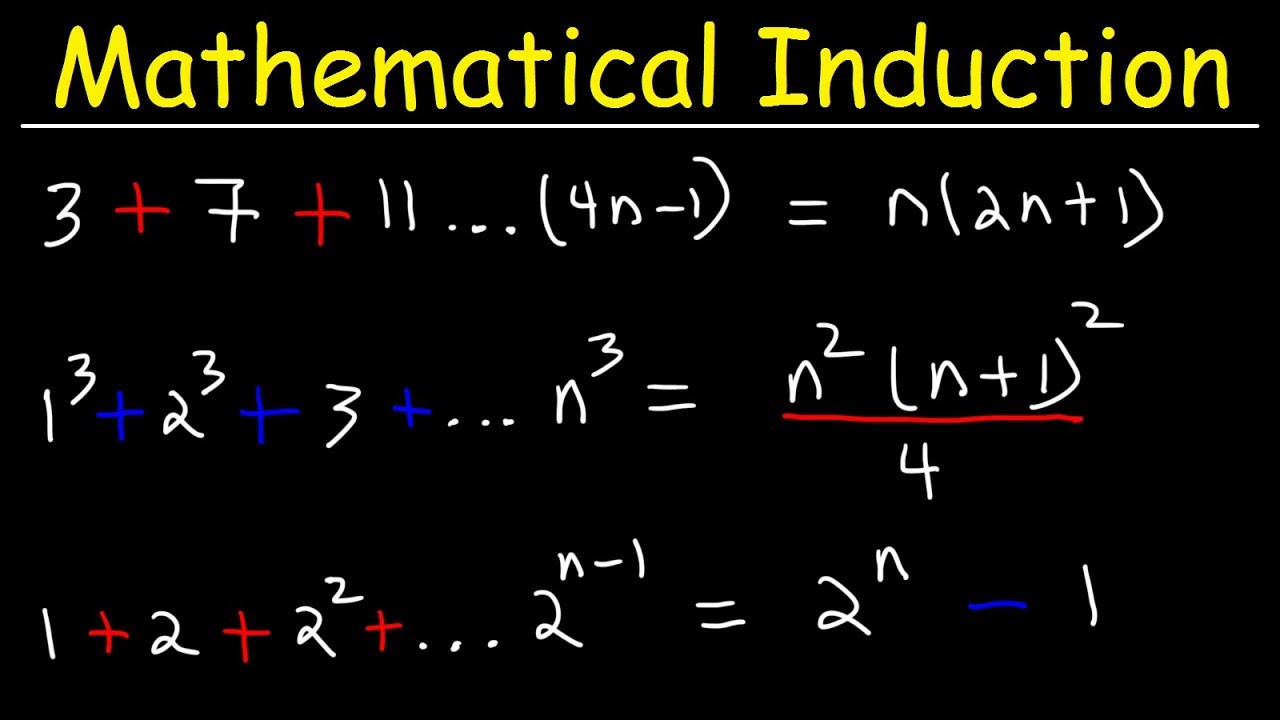
This precalculus video tutorial provides a basic introduction into mathematical induction. It contains plenty of examples and practice problems on mathematical induction proofs. It explains how to prove certain mathematical statements by substituting n with k and the next term k + 1. Examples include arithmetic sequences and exponents.
Intro...
it takes a specific case and generalizes it over a domain
lyric hawk
alternatively, you can note that $$\frac{1}{1\cdot4} + \frac{1}{4\cdot7} + \ldots + \frac{1}{(3n-2)(3n+1)} = \frac{1}{3}\left(1-\frac{1}{4} + \frac{1}{4} - \frac{1}{7} + \ldots - \frac{1}{3n+1}\right).$$
solid kilnBOT
lpieleanu
 lyric hawk
so a lot cancels
limpid fjord
oh nice
perfect then that approach makes more sense no idea why i started with limits
thanks!
.close
trim joltBOT
Channel closed
Closed by @limpid fjord
Use .reopen if this was a mistake.
trim joltBOT
Available help channel!
Send your question here to claim the channel.
Remember:
• Ask your math question in a clear, concise manner.
• Show your work, and if possible, explain where you are stuck.
• After 15 minutes, feel free to ping <@&286206848099549185>.
• Type the command .close to free the channel when you're done.
• Be polite and have a nice day!
Read #❓how-to-get-help for further information on how to ask a good question, and about conduct in the question channels.
 deft moth

 thorny gazelle
Equivalence means. It's Reflexive, symmetric, and transitive. So you have to prove these to show its equivalence.
trim joltBOT
@deft moth Has your question been resolved?
deft moth
thorny gazelle
Equivalence means. It's Reflexive, symmetric, and transitive. So you have to pro...
hm
ik the defintion of equivalence
a relation on N would be a subset of NxN
deft moth
deft moth
these are not subsets of [5]x[5]
so what exactly does it mean "write down the correspondng equivalence relation"
<@&286206848099549185>
trim joltBOT
Channel closed
Closed due to timeout
Use .reopen if this was a mistake.
Available help channel!
Send your question here to claim the channel.
Remember:
• Ask your math question in a clear, concise manner.
• Show your work, and if possible, explain where you are stuck.
• After 15 minutes, feel free to ping <@&286206848099549185>.
• Type the command .close to free the channel when you're done.
• Be polite and have a nice day!
Read #❓how-to-get-help for further information on how to ask a good question, and about conduct in the question channels.
 tight prism
I need help with Combination
Inside a box there are 7 red balls 5 white balls and 3 green balls, how many ways can you select 3 balls that are
- all red?
trim joltBOT
tight prism
I need help with Combination
Inside a box there are 7 red balls 5 white balls ...
tight prism
so apprarently what our teacher said is that the total number of objects are 15 since 7+5+3
then the selected objects r 3
but Idk what to do next
when I solved it what comes out is 455
 runic dew
There will be only 1 combination if the balls are all red
tight prism
how
runic dew
What is the original question
This comes directly from the definition of combination
combination is what something consist of
tight prism
Idrk wait let me reconstruct my question:
A BOX CONTAINS 7 RED BALLS, 5 WHITE BALLS, AND 3 GREEN BALLS. IN HOW MANY WAYS CAN WE SELECT 3 BALLS SUCH THAT THEY ARE ALL RED?
runic dew
If you want to regards the balls as individually different, doing so we would get $(765)$/3! (the 3! factorial accounts for permutations)
solid kilnBOT
team132
 runic dew
Think about it
tight prism
my head hurts 🥲
runic dew
I think the actual answer they want to go for is $765$ not the 3 factorial
solid kilnBOT
team132
 tight prism
how did u come up with 765?
runic dew
Take your time. We are applying the rule of product axiom (refer to wikipedia if need be). An axiom is statement that is true an cannot be proven,
tight prism
okay
tight prism
runic dew
There will be only 1 combination if the balls are all red
ur actually right haha
but is 1 rlly the final answer though?